El Marro, left, has issued a new threat against the president.
For the second time this year, the Santa Rosa de Lima Cartel has issued a threat to President López Obrador to halt the fight against fuel theft and crime in Guanajuato.
But this time, the message was more personal.
The narco banner appeared Friday hanging from a pedestrian overpass in Celaya, Guanajuato. In the signed message, cartel boss José Antonio “El Marro” Yépez included a personal threat against the president’s life.
“If you continue to sentence innocent police officers, next time I will deliver the gift I sent to the refinery directly to Cuitláhuac #90 in the Toriello Guerra neighborhood on Tlalpan avenue,” listing the address where the president lives with his wife and youngest son.
The “gift” mentioned in the threat refers to a van stuffed with explosives that was parked in front of the oil refinery in Salamanca on January 31, together with a signed message that warned the president to withdraw federal forces from the state or innocent people would die.
The most recent narcomanta also made reference to a confrontation between police and gangsters on Thursday after the gang attempted to free suspected plaza boss Armando Soto González from a Celaya police station. Soto, another prisoner and a judge were killed.
The banner said “for every one of my people you take down, two of yours are going to pay.” It was signed, “Yours sincerely, Señor Marro.”
Yépez’s fuel theft gang is believed to be behind much of the violence that made Guanajuato Mexico’s most violent state in 2018, especially in areas where it is engaged in a turf war with the Jalisco New Generation Cartel (CJNG).
Friends and family in shock after last night's shooting.
Thirteen people including an infant boy were killed last night when a gang of armed men opened fire at a bar during a family celebration in Minatitlán, Veracruz.
The Secretariat of Public Security said that unidentified gunmen arrived at La Potra bar in the Obrera neighborhood to look for the owner, a man known as “El Becky.”
The motive for the attack is unknown, authorities said.
Four other people were wounded and are being treated in the Pemex regional hospital in Minatitlán, a city in the south of Veracruz that is home to one of Mexico’s six state-owned oil refineries.
Public Security Secretary Hugo Gutiérrez Maldonado said on Twitter that state and federal security forces launched an operation to search for the perpetrators of the crime but no arrests have been reported.
[wpgmza id=”183″]
Survivors of the attack said the gunmen forced their victims to look at them before they shot them.
“They told them to turn around to see them, to see them while they were killing them,” one woman said. “I felt the gun at my head . . . the guy pointed it at me but didn’t shoot.”
Another woman whose brother was killed said: “There were about six of them. Even if you had a baby in your arms, they still shot you.”
Veracruz Governor Cuitláhuac García wrote on Twitter after midnight that he had attended an emergency meeting to “attend to the appalling and reprehensible incident in the south” of the state. He pledged that the crime would not go unpunished.
Veracruz is one of the most violent states in Mexico, and in the first months of this year it has recorded the highest number of kidnappings and femicides.
President López Obrador, who has vowed to reduce the high levels of violence in Mexico, is scheduled to visit Veracruz tomorrow to attend a ceremony at a military school.
On Monday, he will chair a meeting to discuss and coordinate security strategies in the state, according to a government schedule published before yesterday’s attack.
The far eastern coast of the state of Yucatán is far from an international tourism hot spot but things are slowly starting to change thanks to an English woman and her Mexican husband.
Cathy Sissens and Óscar Flores fell in love with El Cuyo, a coastal village in the municipality of Tizimín, during a weekend camping trip.
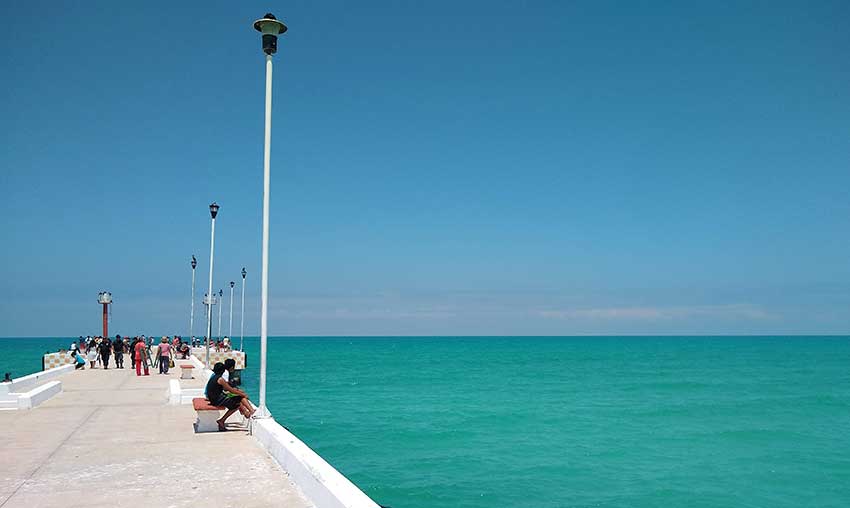
Soon after, the couple decided to pack up their lives in Playa del Carmen and start afresh in the quiet town on the Gulf of Mexico, where according to Sissens, the turquoise sea is like a “mirror.”
She told the newspaper El Financiero that after she and her husband had made up their minds to move they started to think about how they could make a living in El Cuyo, where tourists were few and far between.
Sissens started off teaching English in a local school but after battling with 90 kids who had varying levels of motivation to learn the language, she and Flores – a chef and graphic designer – came up with the idea of opening a restaurant.
The turquoise waters of El Cuyo.
It was then that Sissens also put her mind to attracting more tourists to the little slice of paradise just west of the border with Quintana Roo.
She realized that there was little information available – especially in English – about how to get to that part of the coast as well as where to stay and what to do while there.
With that in mind, Sissens opened an Instagram account to show off the local attractions and created a website aimed at international travelers, which has detailed information about El Cuyo.
Why visit, how to get there, what to do, where to stay and where to eat are all covered on elcuyo.net, which also features enticing photos of the blue sea, local wildlife such as flamingos, pink lagoons and people both lazing in hammocks and getting an adrenalin rush while kitesurfing on the Gulf of Mexico waters.
The website quickly generated an upsurge in interest about the remote eastern coast of Yucatán.
“I spend a large part of the day responding to messages from people who ask how to get here or where to stay,” Sissens said.
[wpgmza id=”182″]
A lot more foreign faces are now seen around town, she added, and interest among locals to learn English and attend to the needs of international visitors has grown.
Apart from running their restaurant – El Chile Gordo – Sissens and Flores have also opened a workshop where the town’s youth can learn how to make surfboards, kitesurfing boards and skateboards – another project that has helped put El Cuyo on the map.
Anyone with a hankering for a tasty snack served by an environmentally aware vendor should look out for “El Chuy” in downtown Oaxaca city.
Jesús Alvarado Carrera, better known by his nickname, sells elotes (corn on the cob) and esquites (corn kernels cooked in butter and topped with mayonnaise, chile and lime juice) in the zócalo, or central square, of the southern state’s capital.
Unlike most vendors, Alvarado doesn’t serve his esquites in Styrofoam cups anymore but rather on corn husks.
A native of Huautla de Jiménez, El Chuy told the newspaper El Universal that he started using corn husks last May, explaining that he was motivated to do so because he had heard a lot about the damage that pollution causes “to the seas, marine animals and ecosystems.”
Alvarado said his environmentally-conscious decision creates more work for himself because he has to get up early in the morning to cut and clean the corn husks.
But it’s been worth it: in addition to helping the environment, the Styrofoam substitute has proved popular among El Chuy’s customers.
“People say that [the esquites] taste better than with Styrofoam. [Corn husks] are very clean and they release a very sweet flavor,” Alvarado said.
His sales have also improved and despite the extra work he puts in, El Chuy continues to sell a serving of esquites at the same old price of 20 pesos (US $1).
Few if any other vendors in Oaxaca sell esquites on corn husks but they may soon be forced to follow Alvarado’s lead.
In September last year, the municipal government prohibited businesses that sell food from using Styrofoam and plastic but most street vendors ignored the ban and, according to El Chuy, authorities have done little to enforce it.
However, that could change because two weeks ago the Oaxaca state Congress passed a law that prohibits the sale, distribution and use of all disposable products made out of Styrofoam and plastic.
Municipal authorities have a period of six months within which they must ensure that the law is obeyed and establish penalties for non-compliance.
There will be no complaints from El Chuy, who has been selling his snacks in downtown Oaxaca for the past 15 years.
“. . . We have to create awareness [about the environment] among ourselves . . . the planet can’t wait any longer.”
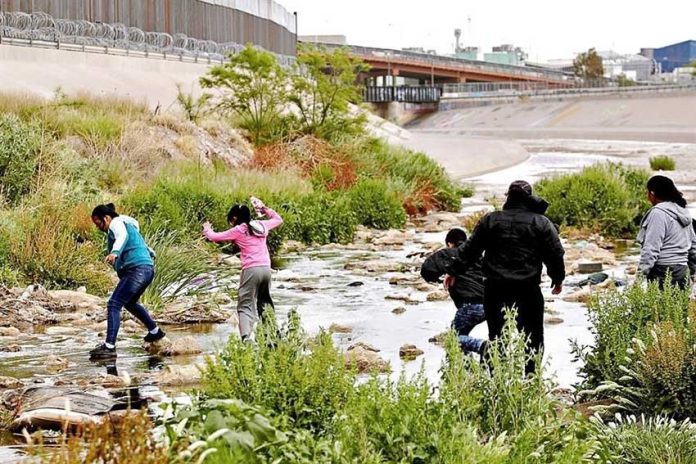
International migrants and Mexicans who have been deported from the United States are flooding into Ciudad Juárez, Chihuahua, placing a heavy strain on local resources.
More than 1,000 migrants arrived in the northern border city this week, 95% of whom are Cubans who were previously stranded in Chiapas as they waited to be issued with transit visas.
Enrique Valenzuela, director of the State Population Commission (Coespo), said that an average of 62 migrants arrived daily in Juárez during January and February but the number spiked to 110 in March.
This week, 260 migrants arrived on Monday, 252 on Tuesday, 350 on Wednesday and 177 yesterday, adding up to a total of 1,039.
Since October, more than 12,000 migrants have arrived in Ciudad Juárez, and at least 3,200 remain in the city.
Most faced – or continue to face – long waits to request asylum due to the introduction of a “metering” system that limits the number of cases United States immigration authorities will hear on a daily basis.
While the number of would-be asylum seekers arriving in Juárez is on the rise, so too is the number of people sent to the border city by United States authorities.
According to Coespo, there were 1,300 repatriations to Ciudad Juárez in each of January and February but in March the figure increased to 1,800.
In light of the situation, municipal authorities are asking state governments to cover the costs of returning Mexican deportees to their places of origin.
“[Mayor Héctor Armando Cabada] is talking to all the states so that they support their fellow citizens; we can’t leave them here,” said municipal human rights director Rogelio Pinal.
He pointed out that many deportees arrive without any money or the legal documents they need to find work in Mexico.
Four states – Aguascalientes, Jalisco, Colima and México – have so far agreed to pay travel costs so that those deported from the United States can return to their home towns in Mexico.
The federal government allocated 10.7 million pesos (US $570,000) to a migrant support fund last year to help states cover accommodation and transportation expenses for deported Mexicans but no additional funding was provided for 2019.
Chihuahua Governor Javier Corral met with Interior Secretariat (Segob) undersecretary Zoé Robledo this week to request that the funding be reinstated.
In addition to would-be asylum seekers and deportees, non-Mexican migrants who are awaiting the outcome of their asylum requests in the United States are also being sent to Ciudad Juárez.
The United States government resumed its so-called “Remain in Mexico” policy this week after halting it for a few days following a federal court ruling.
On April 8, Judge Richard Seeborg in San Francisco blocked the Trump administration from returning asylum seekers to Mexico on the grounds that its policy “lacks sufficient protections against aliens being returned to places where they face undue risk to their lives or freedom.”
However, an appeals court last Friday overturned the ruling, allowing the U.S. government to resume the policy.
United States authorities this week returned 75 migrants to Ciudad Juárez under the scheme, the newspaper El Diario reported, and almost 400 migrants, most from Central America, have now been sent to the city to wait for their asylum cases to be heard in the U.S.
Most have been staying in shelters or churches but one group of 38 migrants is currently housed in a fire station, the newspaper Reforma said.
Some have chosen to return to their countries of origin rather than waiting in Juárez with no certainty about when they will be summoned to appear in court.
However, there is some evidence that the wait will not be as long as many migrants expect, although it appears that those traveling with children are being given priority.
Francisco Javier Calvillo, a priest and director of the Casa del Migrante shelter in Ciudad Juárez, said that four families were summoned by United States authorities on Wednesday and that two women and one man – each of whom were staying in the city with a child – were called yesterday.
“They crossed [the border] and they haven’t told us anything but they haven’t returned,” he said.
Rarámuri inmates celebrate Easter in Chihuahua prison.
Easter is a major celebration across Mexico, even among indigenous inmates of a prison in Chihuahua.
While the reenactment of the Passion of Christ is the center of the celebrations for many communities, the Rarámuri people have their own blended version called Noriwachi, which is celebrated at the Rarámuri state penitentiary in Guachochi.
The week-long event includes traditional dances starting on Palm Sunday and concludes with a celebration of the start of the harvest season.
Noriwachi is centered on the fight between good and evil and draws from Catholicism and the Rarámuri religion alike, with pleas for good fortune, health, a good harvest and rain made to Onorúame-Eyerúame, the Rarámuri father-mother god.
Celebrations at the Guachochi penitentiary started yesterday with dances accompanied by traditional instruments, part of a program designed by the state justice system to promote the Rarámuri traditions along with freedom of religion.
While the inmate population at Guachochi is exclusively Rarámuri, other penitentiaries in the state have their own Easter celebrations that include Passion reenactments organized by the penitentiary system parish.
Costa Azul beach in Tamaulipas is among the 10 cleanest beaches in Mexico.
Beaches in Mexico may not be as safe as the federal government claims because their waters are tested with samples taken at least two weeks before the data is published, and the nation’s standards are far more lax than those set by the World Health Organization (WHO).
Marine biologist Alejandro Olivera Bonilla, the representative in Mexico of the Center for Biological Diversity, told the newspaper Excélsior that the samples do not offer a current snapshot of water quality, as conditions at sea change from one moment to the next.
Those conditions can change significantly when one takes into consideration that thousands of families are hitting the beaches this week during their Easter vacation, meaning that the presence of fecal coliforms will increase.
On top of that, he said “. . . the country’s maximum allowed limits [of fecal coliforms in seawater] do not correspond to the limits set by the WHO, as international regulations establish the limit as 100 fecal coliforms per 100 milliliters of water . . .”
Mexico’s limit is twice that, at 200 fecal coliforms per 100 milliliters.
In the United States the limit is 33 and in Canada, 35.
As an alternative to the federal government offering outdated water quality data, Olivera proposed that local environmental and health authorities conduct their own testing and publish current data.
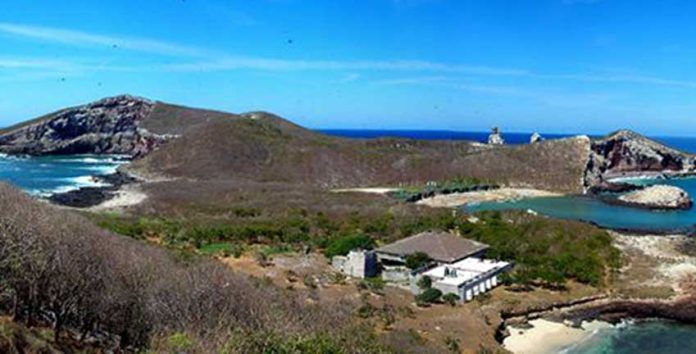
Located 32 kilometers off Mexico’s Pacific Coast and 150 kilometers northwest of Puerto Vallarta, Isla Isabel is a small basalt island measuring only two square kilometers, but much appreciated by naturalists, scientists, scuba divers, photographers, fishermen and those who seek adventure off the beaten track.
Jacques-Yves Cousteau, of course, fell into all of these categories, so it’s not surprising that he celebrated the island’s attractions in a 1975 documentary called The Sea Birds of Isabela.
In 1980 Isabel was declared a national park. In 2003 it was designated a Ramsar site, a wetland of international importance, and in 2005 it joined the ranks of UNESCO’s World Heritage Sites.
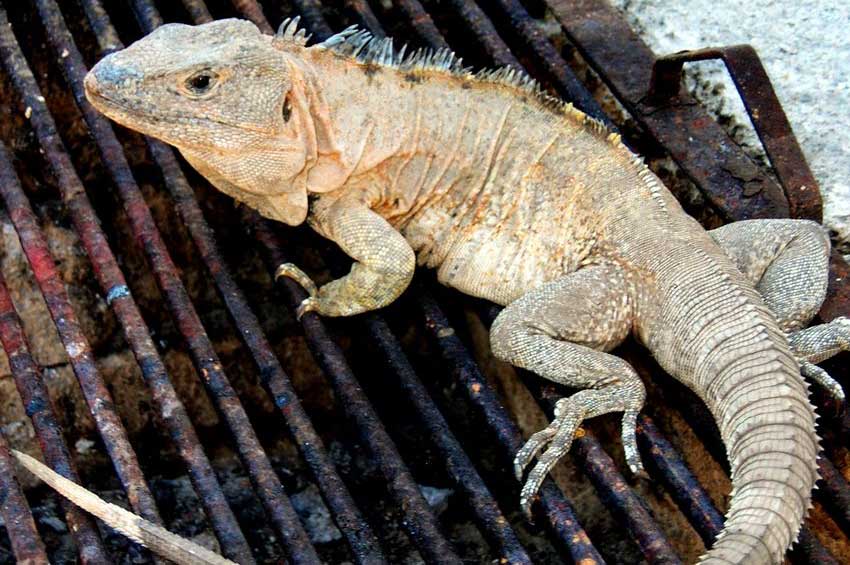
Because the birds and iguanas on the island have no natural enemies, human visitors can get quite close to them, for which reason the island is sometimes called The Galapagos of Mexico.
You can take a boat to Isabel from San Blas or Mazatlán, but my friends and I decided to get there from the little village of Boca de Camichín, in the state of Nayarit. Although Camichín is well off the beaten track, from here it’s only a 90-minute boat ride to the island, while the trip from San Blas supposedly takes twice as long.
Iguanas pop up in the strangest places, always looking for a treat.
After spending a night swatting mosquitoes in the tiny town of Santiago Ixcuintla, we drove the next morning to nearby Boca de Camichín, where we arrived at 7:00am ready for adventure.
Our guide and captain, Julio Mata, started things off with a short introduction to the No. 1 local industry of Camichín: oyster farming. “The system we use,” said Julio, “was invented by the Japanese and introduced to us in 1976 as Project Pider Pesca.”
To become an oyster farmer with this ingenious approach all you have to do is string old oyster shells — interspersed with short plastic tubes — on a two-meter length of strong cord or wire. This is then made to dangle in the waters of the estuary.
At a certain time of year, sweet water flowing down from the San Pedro river is full of baby oysters which then attach themselves to some 2,000 strings of broken shells placed in the water by the enterprising people of Boca de Camichín.
Saltwater and sweet water alternately bathe the strings as the tide goes in and out and eight months later each string is heavy with new oysters ready to eat.
“This industry turned out to be so successful,” says Julio Mata, “that Camichín is said to be the only town in Mexico with not a single citizen working in the U.S.A.”
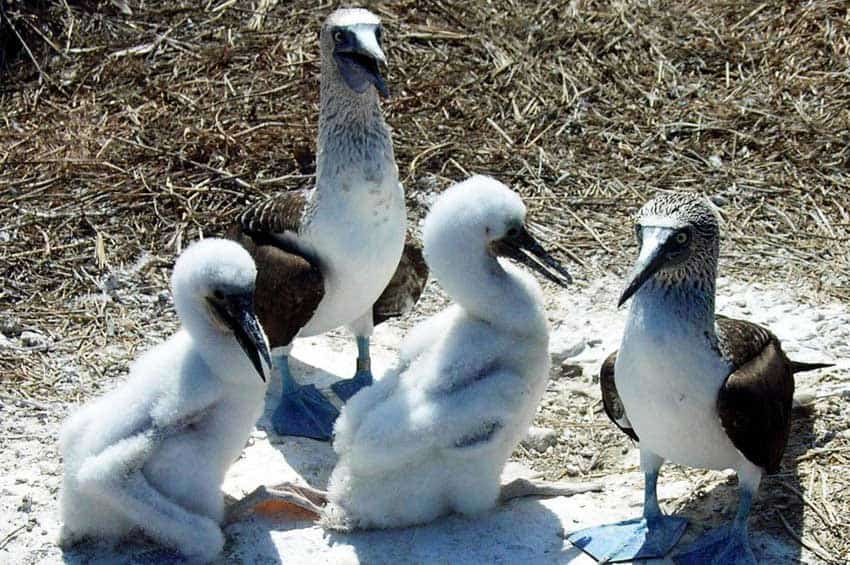
Unafraid, boobies nest on the ground at Isla Isabel.
After picking up a load of fresh oysters for us to eat during our island visit, we headed out of the estuary and came face to face with a great wall of water separating us from the open ocean.
“The surf is ferocious today,” explained Julio. “We have to wait for exactly the right moment between two waves, when the sea is flat for an instant, and then zip out past the surf line. Don’t worry — in all the years we’ve been doing this, we have never flipped over.”
Well, tension mounted in us landlubbers as our crew tried again and again to break through the surf barrier. The procedure was as follows: after bobbling around for a while, the engine would suddenly come to life and with a jerk we would rocket straight at the wall of white water in front of us. Then, at the very last instant, the pilot would suddenly make a hairpin turn, just as the giant wave was crashing upon the very spot we occupied a tenth of a second before.
Now we would race in the opposite direction for dear life, or, if we happened to be in the wrong position, the pilot would throw the boat into reverse and we would back away from the crashing froth. This scenario was repeated over and over for some 25 attempts until suddenly we sailed right through the wall of surf.
What an adrenaline rush and what a relief to find ourselves on the other side, in relatively calm waters! A half-hour later, as if rewarding us for our patience, a gorgeous whale shark appeared next to our boat and swam around us in circles for a long time, as if welcoming us to the open sea.
Although this did not turn out to be the “short” ride I had expected, we eventually arrived at the island, which has a naturally protected harbor. A few minutes later, we discovered what is truly unique about Isabel Island: the air is always full of hundreds of birds and so are the garlic-pear (Crataeva tapia) trees, which aren’t much higher than two meters.
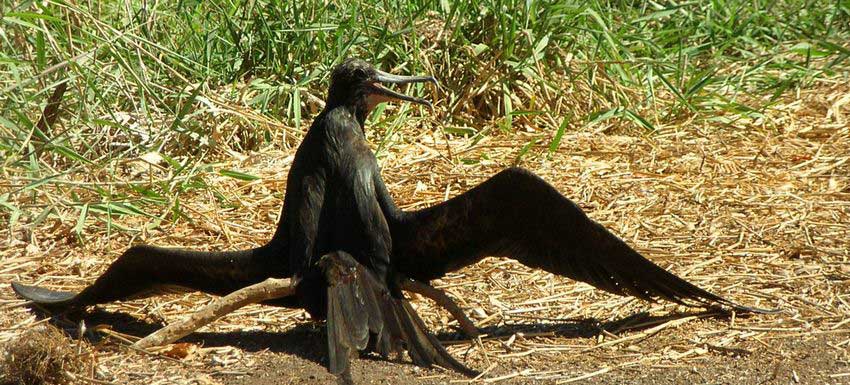
A frigatebird can spread its wings and take the sun without fear of predators.
Thousands of frigatebirds have built nests in these trees and, because they have no predators, you can walk right up to one of the “babies” (which are bigger than chickens) and take all the photos you like. We deposited our sleeping bags and gear inside a huge, roofed building, the only place on the island where ecotourists are allowed to camp. It’s also the favorite haunt of dozens of iguanas which, like the frigates, showed no fear of us.
A few minutes later we were climbing a nearby hill where countless seagulls and boobies nest on the ground. These birds have a special squawk to advise intruders like us whenever they step within the boundaries of their personal space, a distance that varies from about 1 1/2 to 2 1/2 meters.
This, of course, is plenty close for taking photos of the famous blue-footed booby, as well as its red, brown and green-footed cousins, which roam the island.
From the top of the hill we could see most of the two-kilometer-long volcanic island and could make out the other members of our party happily snorkeling in pools near our campsite. The snorkelers said the coral and fish they saw were spectacular and that’s the only word I can use to describe the taste of the home-grown oysters and fish smoked over mangrove wood, which we enjoyed later that day, not to mention the spectacular sunset we witnessed in the evening.
As we prepared for our return voyage the next morning, we asked Julio: “Do you think we’ll see any dolphins on the way back?” “Caray,” he said, “I wish I could say yes, but around here we don’t see them very often. Sorry.”
Well, we were enjoying a calm sea and a beautiful blue sky when suddenly the entire horizon was filled with hundreds and hundreds of silvery shapes leaping high into the air. It was more than a school of dolphins, it was a whole university of them!
[wpgmza id=”181″]
We turned and drew near to them and they just kept coming. Their joyful exuberance and energy filled the air. As if that was not enough, a little while later a family of humpback whales appeared next to us and frolicked around our boat for the longest time.
A visit to Isla Isabel is a once-in-a-lifetime experience. If you don’t mind roughing it, you ought to put this extraordinary island on your bucket list. You’ll get to see much of what the Galapagos have to offer without ever having to leave Mexico!
The writer has lived near Guadalajara, Jalisco, for more than 30 years and is the author of A Guide to West Mexico’s Guachimontones and Surrounding Area and co-author of Outdoors in Western Mexico. More of his writing can be found on his website.
Two women were attacked and mauled this week by their own family’s eight dogs — six pit bulls and two Dalmatians.
Local police reported that the dogs attacked a 46-year-old woman and her 26-year-old daughter on Wednesday at their home in Texcoco, México state.
The two were able to flee and take shelter in one of the rooms of the house and call authorities. They were subsequently transferred to a nearby hospital with serious injuries.
Authorities identified another daughter and her boyfriend, who live in the same house, as the dogs’ owners. The couple voluntarily gave permission for an animal control team to capture the animals.
They were taken into custody for observation of their conduct.
One year ago two pit bulls killed a seven-year-old child in Chimalhuacán, México state. He and his mother had left the house to go shopping but when they returned they discovered they had left the keys inside.
The young boy volunteered to scale the entrance way but when he descended on the other side the dogs attacked. Neighbors rushed to help but by the time they entered the home the child was dead.
Thousands of trucks are stranded in Ciudad Juárez, Chihuahua, and Tijuana, Baja California, as chaos at the northern border enters its fourth week.
The National Chamber of Trucking (Canacar) said yesterday that 15,000 trucks were stuck in the former city, where there are long lines at border crossings to El Paso, Texas, and Santa Teresa, New Mexico.
Long wait times at several ports of entry to the United States have been reported since March 28 – the day after U.S. Customs and Border Protection (CBP) announced the reassignment of 750 border agents to deal with a large influx of migrants.
“It’s been catastrophic,” said Manuel Sotelo, a regional vice-president of Canacar.
He explained that the manufacturing industry in Chihuahua has incurred losses of around US $20 million a day since the delays began.
Sotelo, who is also the president of a Ciudad Juárez transport association, said he was told at a meeting with United States authorities that 100 border agents had returned to their port of entry posts, but most went to border crossings between Tamaulipas and Texas.
“We were confident that the [border] agents who were returning would come back to our area . . . but they were sent to Laredo,” he said.
Further complicating the situation in the Juárez area is that commercial border crossings are currently operating with reduced holiday hours even though Canacar requested that the normal schedule be maintained.
Lines of three, four and five kilometers were seen yesterday at the Bridge of the Americas, the Ysleta-Zaragoza Bridge and the San Jerónimo port of entry respectively. Sotelo said that trucks are waiting five hours on average to cross into the United States.
In Tijuana, long lines of trucks have been reported over the past two days due to the closure of commercial lanes at the border and an increase in Easter vacation traffic.
A report in the newspaper Milenio said there were lines as long as 10 kilometers in the border city yesterday.
Truck driver Miguel Ángeles said he would normally cross the border twice a day but now he can only cross once, and after a long wait at that.
Yesterday, he joined a line of trucks at 5:00am but didn’t cross into the San Diego area until 3:00pm. Average wait times at commercial ports of entry in the area have tripled to nine or 10 hours.
Another driver said his earnings had dropped by half in recent weeks as a result of the long border delays.
“In an economic sense, it’s hitting me really hard . . .” Francisco Javier said.
In an attempt to clear the congestion, commercial border crossings are operating with regular hours in Tijuana today but will close at 2:00pm tomorrow and Sunday.
Chihuahua Governor Javier Corral and other politicians, as well as representatives of several business groups, will meet with Foreign Affairs Secretary Marcelo Ebrard in Mexico City on Monday to discuss the situation and consider their options to speed up cross-border trade.
Chihuahua government spokesman Mario Dena said Mexican authorities need to reach an agreement with their United States counterparts so that all personnel who were reassigned from ports of entry are reinstated.