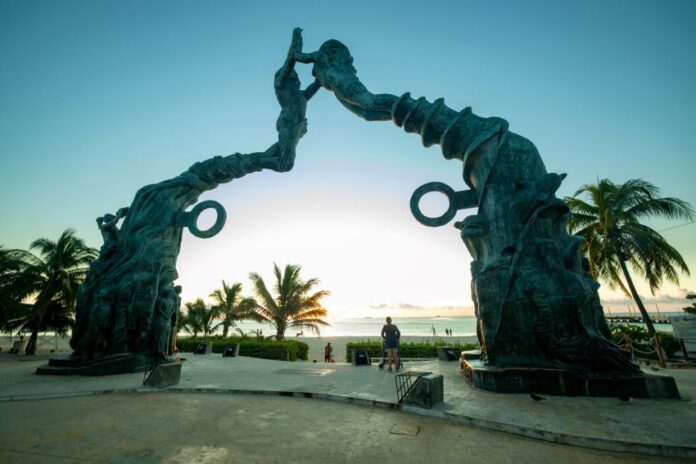
Tickets to the event start at US $1,400 for general access and go all the way up to 1.1 million. (Sergio Sala/Unsplash)
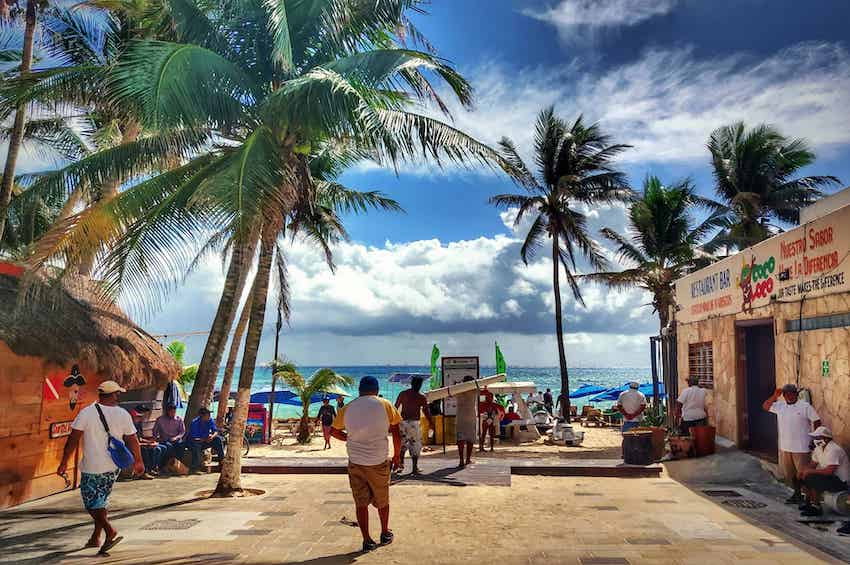
A March 21 post on Fyre Festival’s official social media account says that the second edition of the musical festival is moving to Playa del Carmen following a February announcement that it would take place in Isla Mujeres.
Fyre Festival, a fraudulent, disastrous music festival held in 2017, saw its creator Billy MacFarland face criminal charges in the United States after pleading guilty to charges of wire fraud, bank fraud and making false statements to federal officials. After spending four years in prison, he’s now attempting a second edition of the festival dubbed Fyre Festival 2.
The latest announcement changing the venue’s location was met with skeptical comments from social media users like: “How is this dude even legally allowed to try this again? Lol,” and “Does this guy not know how to plan? Situate location first. Then plan from there.”
Responding to the negative reaction to the event, MacFarland, 33, said in a video on Twitter early in March that “Fyre 2 is real,” claiming that he has contracts with partners that include a production company in Mexico, yachts, hotels and more.
According to its official Instagram page, Fyre Festival 2 is set to happen from May 30 to June 2. A press conference is scheduled for Thursday, March 27, in Playa del Carmen, to share further details of the event.
“This press conference marks a major milestone in bringing Fyre 2 Festival 2 to life as an intimate, curated event, bringing together the best of music, arts, community, and adventure in the heart of the Riviera Maya,” the statement says. Despite the announcement, details about the musical lineup remain scarce, leaving fans and skeptics wondering who might perform at the festival.
Tickets to the event start at US $1,400 for general access. VIP access can be purchased for $5,000, which in addition to the general access package, includes a shuttle service from a selection of local hotels.
For $25,000, fans can get backstage access to the “Water Stage, Pitside access to the Fight Pit, a curated itinerary of FYRE experiences, transportation throughout the weekend, accommodation for two nights amongst the artists and performers, concierge, and more,” according to the organizers.
As if those packages weren’t enticing enough, the festival’s site advertises a ticket priced at $1.1 million dubbed the “Prometheus God of Fyre” ticket, which includes the aforementioned “Artists” package plus access to the Prometheus Marina and accommodation in any of the following alternatives: the Marina four-stateroom yacht, a four-bedroom villa provided by the Nemesis Group or a three-bedroom Presidential Suite at the Chablé Maroma, for three nights.
Neither Chablé Maroma nor Nemesis Group have confirmed this collaboration.
The Playa del Carmen municipal government has not yet released a statement regarding Fyre Festival 2. (Dennis Sylvester Hurd/wikicommons)
The original Fyre Festival, which sold day passes ranging from $500 to $1,500, and VIP packages including airfare and accommodation for $12,000, was scheduled to take place in April 2017 in the Bahamas. When attendees arrived at the venue, they found flimsy camping tents instead of luxury villas and cheap food including a now-infamous cheese sandwich that was served along with some lettuce in a styrofoam container.
It remains to be seen how Fyre Festival 2 unfolds, and if MacFarland has regained the public’s trust.
Guanajuato, known to have the highest homicide rate in Mexico, had its least violent week of 2025 last week, according to government data shared on Tuesday. (Diego Costa/Cuartoscuro)
The Bajío region state of Guanajuato has been Mexico’s most violent state in recent years in terms of total homicides.
But the state’s daily murder rate declined sharply last week, according to preliminary government statistics, allowing Guanajuato to shake off that unenviable title, at least for a brief period of time.
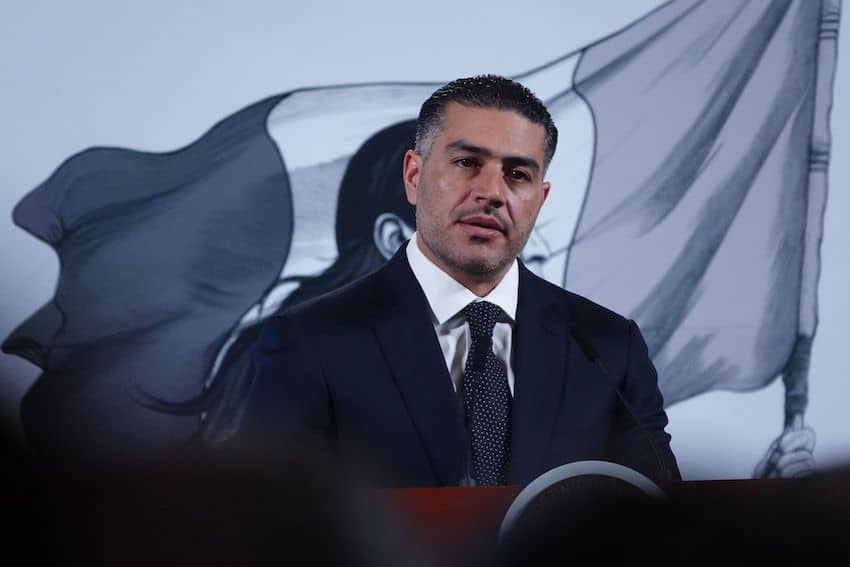
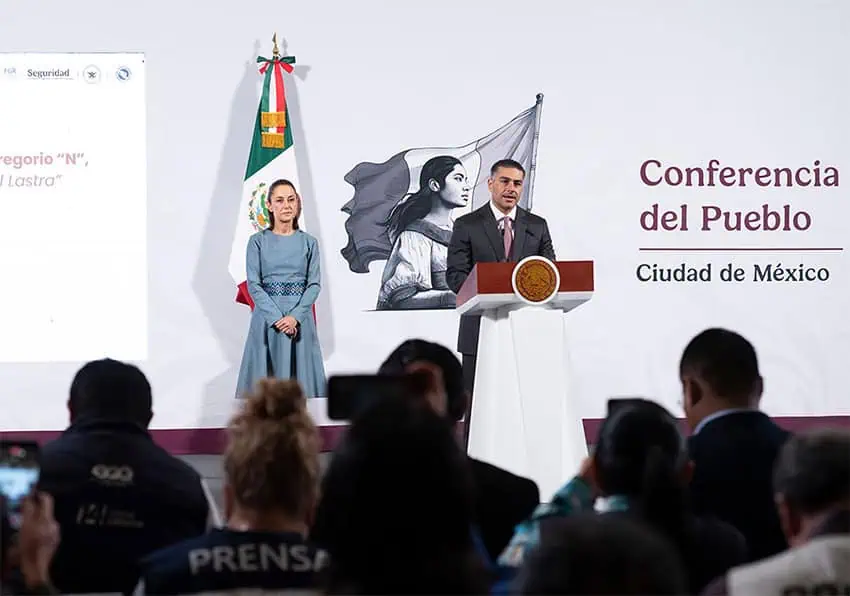
Security Minister Omar García Harfuch told reporters on Tuesday that the drastic reduction in homicides was “an immediate result” of high-impact arrests made last week. (Galo Cañas/Cuartoscuro)
Federal Security Minister Omar García Harfuch attributed the almost 45% week-over-week decline in homicides to the arrest last Tuesday of nine people he said were “members of a crime cell linked to a group dedicated to kidnapping, fuel theft, drug sales, armed attacks and principally homicides in the state of Guanajuato.”
At President Claudia Sheinbaum’s morning press conference on Tuesday, García presented data that showed there was an average of seven homicides per day in Guanajuato between March 17 and 23, a 44.9% reduction compared to the 12.7 murders per day recorded in the state between March 10 and 16.
Guanajuato thus had its least violent week of 2025 last week, according to the data displayed by the security minister. The most violent week of the year to date in Guanajuato was between March 3 and 9, when there was an average of 15.6 homicides per day.
García told reporters that “as an immediate result” of the arrests last Tuesday “Guanajuato has not been in first place in homicide numbers for six days.”
However, data presented earlier in the press conference showed that Guanajuato has been the most violent state so far this month with almost 300 homicides between March 1 and 24.
Crime cell leader ‘Alfa 1’ among the 9 suspects detained
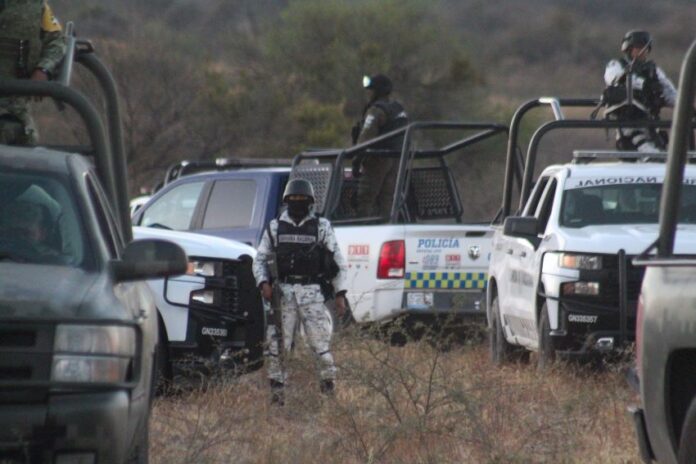
García reported that federal security forces including the army and the navy carried out “six simultaneous” operations on March 18 that resulted in the arrest of nine people in Querétaro, Guanajuato and Yucatán.
As noted above, the security minister said that the nine suspects were members of a crime cell linked to a larger organized crime group that operates in Guanajuato.
The larger group he was referring to is reportedly an alliance between the Santa Rosa de Lima Cartel and the Gulf Cartel, which are believed to have joined forces in a fight against the Jalisco New Generation Cartel (CJNG) in Guanajuato. The Santa Rosa de Lima Cartel has been fighting the CJNG in Guanajuato for years.
Detenido José Francisco Contreras Gómez, alias “Alfa 1”, líder de la célula “Escorpiones” del Cártel del Golfo, vinculada con el Cártel Santa Rosa de Lima
Cuenta con antecedentes penales por diversos delitos en los años 2008 y 2019 y fue señalado como objetivo prioritario de las… pic.twitter.com/FWLy3m7pFV
García highlighted that José Francisco Contreras Gómez — who allegedly headed up the Los Escorpiones cell of the Gulf Cartel — was among those detained last Tuesday.
“In addition, he was in charge of ordering attacks on rival groups and also against authorities,” García said.
Contreras was arrested in Querétaro along with his partner, Sandra León Moreno, nicknamed “La Patrona” (The Boss).
García said that the arrest of Contreras was of “great importance because he was one of the main generators of violence in the region.”
“As we’ve said on other occasions, we’re convinced that in order to reduce the crime rate we have to detain those who commit crimes and this is proof of that,” he said.
García also highlighted that a man identified only as José Remedios “N” was among the nine people detained in last week’s simultaneous operations.
He described José Remedios as a “homicide leader of a criminal cell” and said he has been “identified by the National Intelligence Center as one of the main generators of violence in the region of Guanajuato and Querétaro.”
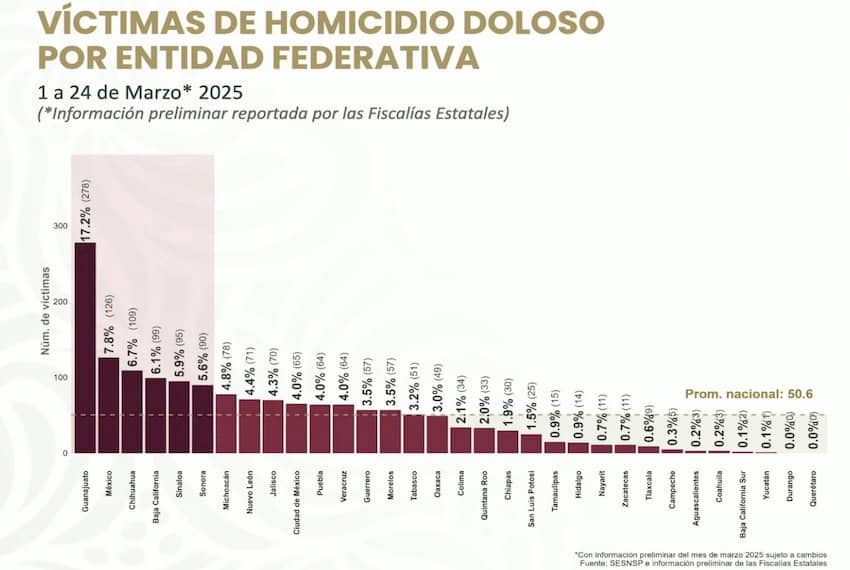
Though Guanajuato saw fewer homicides last week, the state is still the most violent in the country, registering 278 homicides from March 1-24. Following Guanajuato are México state, Baja California, Chihuahua, Sinaloa and Sonora. (SSNSP/X)
The suspect, also reportedly a member of Los Escorpiones, was detained in the state of Yucatán.
García said that on the instructions of Sheinbaum, he and Defense Minister Ricardo Trevilla Trejo would travel to Guanajuato later in the day to meet with the state governor and her team in order to “monitor the actions that are continuing to reduce high-impact crimes in the entity.”
Almost 1 in 5 homicides this month occurred in Guanajuato
Data presented earlier in Sheinbaum’s press conference by the head of the National Public Security System (SNSP) showed that there were 278 homicides in Guanajuato between March 1 and 24 for an average of 11.6 per day. That figure is more than double the number of homicides in México state, which ranks as Mexico’s second most violent state so far this month.
SNSP chief Marcela Figueroa highlighted that more than 17% of all homicides in Mexico so far this month occurred in Guanajuato. There were 1,619 homicides across the country in the first 24 days of March, according to the data she presented. An average of 67.46 murders were reported per day in the first 24 days of the month, a 22.4% decline compared to the daily average in September, the last month of former president Andrés Manuel López Obrador’s six-year term.
In Guanajuato, most of the violence is concentrated in a relatively small number of municipalities including Salvatierra, Celaya and Salamanca. The aforesaid turf war between the Santa Rosa de Lima Cartel and the CJNG is the main driver of the violence.
Mexico’s most violent states this month
According to the preliminary data presented by Figueroa, the 10 most violent states in Mexico in terms of total homicides so far this month are as follows:
Guanajuato: 278 homicides accounting for 17.2% of all homicides in Mexico this month.
Initial expansion plans for Dr. Simi US will focus on California and Texas, but the company expects to eventually open offices in the states of New York, Illinois, Arizona and Florida. (Moisés Pablo/Cuartoscuro)
The drug store chain Farmacias Similares and its iconic mascot Dr. Simi are closer to gaining a foothold in the United States after nearly two decades of trying to expand the pharmacy north of the border.
On Monday, the company inaugurated its new office in downtown Austin, the Texas state capital, only 500 meters south of the state capitol building.
Director Víctor González Herrera presided over the ceremonial ribbon-cutting ceremony, describing the event as “the perfect moment” to enter the U.S. market. The site features two offices, a board room and a meditation room.
“The first attempt was over 20 years ago with my father; years later, we made another attempt, but fate didn’t allow it to flourish. Today is the perfect moment for Dr. Simi to arrive not only as a commercial enterprise but also to extend its mission of support and assistance to this great nation,” González said.
The Austin operations center — to be known as Dr. Simi US — will provide non-prescription generic drugs and health supplements, and, via an alliance with CVS Pharmacy, will also supply products via e-commerce using platforms such as Amazon.
Initial expansion plans for Dr. Simi US will focus on California and Texas, but the company expects to eventually open offices in the states of New York, Illinois, Arizona and Florida.
“Our strategic plan is based on reaching cities where 70% of Latinos live,” said Ramón Soler, the director of Dr. Simi US.
Beyond its basic commercial goals, González said the company’s mission “will emphasize the social commitment that characterizes the Farmacias Similares brand” within a long-term vision that includes participation in cultural and sporting events such as the 2026 World Cup which will be co-hosted by Mexico, the U.S. and Canada.
The company was encouraged by the inroads it made into California via its non-profit, charitable organization Fundación del Dr. Simi during January’s tragic fires in Los Angeles. The foundation provides help for those in need in areas such as health, nutrition, education and sports.
Power outages affected seven of Quintana Roo's 11 municipalities on Monday evening. (Enrique Bancalari/Unsplash)
The Federal Electricity Commission (CFE) restored power in the southeastern Yucatán Peninsula on Tuesday morning after several power outages were reported across the state of Quintana Roo.
The blackouts, which began at 6 p.m. on Monday, affected seven of the 11 municipalities in Quintana Roo, including the tourist destinations Tulum, Cancún, Playa del Carmen, Isla Mujeres, Cozumel, Bacalar and Puerto Morelos.
🔴#Urgente | México sufre apagones masivos y prolongados en Yucatán, Campeche y siete municipios de Quintana Roo: Bacalar, Cancún, Cozumel, Playa del Carmen, Tulum, Puerto Morelos e Isla Mujeres. pic.twitter.com/aBXjDEqxdi
In Cancún, the power outage primarily affected the northwest corner of the city. Residents in the neighboring states of Campeche and Tabasco also reported several hours of power outages on social media.
CFE reported that the blackouts were due to the poor quality of natural gas caused by high humidity levels in the Mayakán gas pipeline that runs from southern Tabasco to Valladolid, Yucatán.
The commission said in a statement that because of the poor gas quality, generating plants were forced to switch to alternative fuels.
“To mitigate the impacts during this period of irregular supply, the Generation Subdirectorate, in coordination with the subsidiary CFEnergía and the National Energy Control Center (Cenace), made the decision to implement scheduled power outages for periods of time (rotating outages) to minimize the impact on users,” the bulletin stated.
CFE reported that power was restored to 47% of those affected in Campeche, Quintana Roo, Tabasco and Yucatán by 9 p.m. on Monday.
The highway project — dubbed The Route of the Maya Cultures — was originally presented by the federal government in 2001. (Damián Sánchez/Cuartoscuro)
A controversial highway in Chiapas whose construction has been delayed for nearly 20 years has received the go-ahead after residents of five municipalities approved the project via a nonbinding referendum, the state governor announced.
Nearly 40,000 residents of the municipalities of Palenque, Ocosingo, Chilón, Salto de Agua and Tumbalá voted in favor of the highway between San Cristóbal and Palenque, Chiapas. (@ramirezlalo_/X)
Ramírez thanked the public for their participation during “an exemplary day of voting” on Sunday, adding that the highway was approved with 39,321 votes in favor and only 919 against.
The highway will connect the former state capital, San Cristóbal de las Casas, with the town of Palenque, known as the gateway to ancient Mayan ruins. Palenque, founded in 1567 and populated primarily by Indigenous Maya communities, is also the home of former President Andrés Manuel López Obrador (2018-2024).
Residents of the municipalities of Palenque, Ocosingo, Chilón, Salto de Agua and Tumbalá took part in a public consultation organized by the state government. Approval was sought only for the section of the highway between Palenque and Ocosingo.
State officials said that ballots were provided in Spanish, as well as in the Indigenous languages of tzeltal and chol so as to “promote the full participation of all those who wish to make their voices heard.”
As stipulated by Mexico’s constitution, public consultations are required any time the government plans to take legislative or administrative measures affecting the country’s Indigenous groups and their land.
The new highway would replace Highway 199 which originates in the central highlands and traverses the jungle in the northeast part of the state. Ocosingo is only 68 kilometers south of Palenque, but Highway 199 winds its way through the jungle for 119 kilometers to reach Palenque.
The old highway also connects Ocosingo to San Cristóbal de las Casas to the southwest, but it takes roughly two and a half hours to drive the 95 kilometers.
Opponents of Chiapas highway project decry destruction of land, culture
Since the project was first presented nearly two decades ago, successive state and federal governments have defended the highway by saying it would provide economic benefits to the poorest parts of the state.
The highway project has faced opposition for nearly two decades. (Isabel Mateos/Cuartoscuro)
“We are fully committed to the people of Chiapas,” Governor Ramírez said in February. “We want to improve connectivity and, at the same time, help those who most need help, especially those who are most vulnerable.”
Ahead of Sunday’s public consultation, Ramírez added that the highway would remain in public hands and that there would be no private concessions granted.
Critics of the long-delayed highway proposal argue that construction will destroy the environment and strip local residents of their land and its resources. They also claim that residents have not been fully informed about the proposal and its consequences.
Last month, the regional organization Movement in Defense of Life and Land (Modevite), which has been campaigning against the project for 12 years, published a letter it had submitted to the state government in which it described the project as another example of “colonialism and racism that favors transnational interests, extractivism, drug cartels and the government.”
Modevite said that while it was not opposed to the concept of progress, “we are against the violation of our rights; [we are] against imposition and authoritarianism that benefits the few in and harms the land that has been the source of life for our peoples.”
In contrast, the Ocosingo-based bus company Grupo Único Cotaco, voiced support for the highway project, calling it “an important step toward modernization and regional development” that would boost tourism and benefit the local economy.
Wave, wag, write and more with our guide to Mexican gestures and when (or when not) to use them. (Usman Yousaf/Unsplash)
Ever had someone in Mexico give you the stink eye and you didn’t know why?
Were you pointing in a really obvious way?
Don’t point! (Artem Beliakin/Unsplash)
Hand signals and gestures are one of those things that take a while to learn. I’d throw graphic symbols into this category, too. My first year here, for example, I just did not understand the political billboards. They seemed to be saying “Vote Green Party,” but then they’d have a giant “X” over the Green Party candidate’s name.
“So… do you want us to vote for them or not?” Crossing their names out felt like defacing their pictures. “Support them, but don’t vote for them?”
It turns out that an “X” is how you make a selection on ballots. “Oooooh, okay! Well that makes more sense then, I guess.”
But back to the pointing. Did you know it’s rude here? “What am I supposed to do besides point?” you may ask. My friend, I do not know. Describe it, I guess. Or describe them, especially if it’s a “them.” Pointing at a person is especially rude.
What are some other common hand gestures you’ll want to know? This is a perennial topic if you ask me, something that should always be stacked near the top of recent articles.This is not the first one that Mexico News Daily has published, but that’s okay — this is exactly the kind of thing it’s good to hear from perspectives on.
So let’s dive in! But first, a kind of sad caveat: likecursing andwhistling, lots of these gestures are things that primarily men do. There’s no official prohibition against women doing them, of course, but it’s considered, well, unladylike.
This is not something that concerns me greatly on a personal level. Also, it’s very useful in a loud place like Mexico — not everyone can hear every word perfectly! Anyway, if the “ladylike” thing is for you, I wanted to give you a heads up!
Here are the hand gestures that I personally use the most in Mexico:
A wagging finger
Really, it’s just sticking out your arm and wagging your index finger back and forth. I feel like a grouchy señora admitting that this is one of my most-used gestures here. I may be a little bitchy sometimes, but hey — at least I’m honest! This is especially useful when you need to vehemently refuse a service, like when dudes want to clean your windshield at an intersection. They’ll start but just keep at it; they’ll give up eventually and move on.
And careful with making this gesture a habit. Once I used it on my mom to say no when I was chewing and swallowing food, and she was not happy. “Don’t you wag your finger at me!” Whoops! Needless to say, it’s not as rude here as it might be in other places.
The “redrum” gesture from The Shining
This is the best way I can think of to describe this gesture, and oh, how it confused me when I first saw it! The Mexican exchange students at my college would do it, and I’d just think, “What the hell are they doing?”
I finally asked one day and realized it’s just a little symbol to say “yes,” as if your finger were nodding. “Ooooooh!” This is also very handy if you’re chewing and/or swallowing: not moving your neck all over the place as your food chooses between the oesophagus and the nearby airways is important!
A hand held up, palm facing you, with a slight bow of the head
(Sarah DeVries)
If you’re not expecting this one, it can be easy to interpret as downright offensive. But it’s not, I promise! This is the Mexican symbol for “thank you,” and it’s perfect for communicating your gratefulness at a distance. I use it quite a bit, for example, when cars stop to let me to cross the street. If you ask me, it’s always a good idea to let even strangers know that you appreciate them!
Shaking your hand as if you’re trying to fling water from it, but a little slower
This is often accompanied by a hissing sound, as in, “ooooh, you’re in troubleeeee!” You might see children do it, for example, if a student talks back to a teacher. “Things just got real, y’all.” It’s very useful, too, when someone is telling you a scandalous story, and they get to the part of heightened confrontation. “I can’t believe that just happened!” could be another good interpretation.
Finally, you use this gesture when you yourself have made a mistake. It’s a way of acknowledging a moment that says, “Whoops! Sorry, I didn’t realize!” or “That was an accident, I am so sorry!” Since I’m kind of clumsy, I use it more than you might think.
Slapping hands together vertically, with one sliding up and the other down
This means “let’s go!” I use it a lot for emphasis, especially with children, who just always seem to take forever at anything. I am convinced, in fact, that if zombies were sprinting toward my house and our salvation depended on my kid getting her shoes on quickly, we’d be zombies very, very quickly.
Pretending to write a note in the air
Remember that at restaurants, you will pretty much never have a bill spontaneously brought to the table. Why? Because it’s bad manners: the waiter is not trying to rush you out! This means that when you’re ready to go, you need to ask for the check. Many restaurants have thin margins and not a lot of staff, which means you’ll often need to flag someone down — especially if you’ve basically finished your meal. To do this, just catch someone’s eye and make that scribbling gesture. They’ll get the message right away and get the bill to you!
We’ll stop here. It’s not a complete list, of course, but it is a list of the ones I actually use. If you’re new, I’d recommend watching others use them first, because, well — you don’t know what you don’t know, and I might have missed an important detail, which is always possible.
But soon, you’ll have mastered “Mexican sign language” along with the best of them!
Good luck!
Sarah DeVries is a writer and translator based in Xalapa, Veracruz. She can be reached through her website, sarahedevries.substack.com.
Hablar some español while you cocinas some Mexican comida alongside these influencer pros. (Roberto Morales/Instagram)
When learning a second language, it’s important to familiarize yourself with the vocabulary related to one of life’s basic activities — cooking.
To assist you in your journey to improve your Spanish — and perhaps discover new recipes along the way — we’ve compiled a list of our current favorite Mexican food influencers. Following these folks’ accounts will help you practice listening to everyday Spanish in the context of cooking while solving one of life’s biggest questions: What am I cooking today?
Here are seven Mexican food influencers you should follow:
A La Cocina con Jacobina (To the Kitchen with Jacobina)
Lentejas con Tortas de Camarón – Receta Fácil y Deliciosa ✅
If you don’t have a Mexican abuelita, Jacobina will make you feel like you do.
Addressing her audience as “mis hijos” (my children) and sharing everything from traditional Mexican recipes to housekeeping tips, Jacobina has amassed an audience of over 4.5 million followers across Instagram, TikTok and YouTube. With no fancy utensils or modern appliances, Jacobina’s kitchen resembles that of an average Mexican household.
Some of her most popular videos include “How to Make the Perfect Rice?” “How To Make Entomatadas,” and “Chicken a la Coca Cola.”
With an aesthetic inspired by a Renaissance style, Mandoka shares more than just recipes; her account aims to inspire others to indulge in culinary pleasures.
The account, which has amassed over 4 million followers across Instagram and TikTok, takes her followers on an auditory and visual journey through food. Each recipe is accompanied by a video in which María Paola narrates a creative story in Spanish, featuring a dish or an ingredient as the protagonist.
From exquisite fruit desserts to pastas and Mexican delicacies, Mandoka invites her followers to approach cooking with a dash of romance.
At just 21 years old, the founder of Robe Grill, Roberto Morales, has featured on his social media accounts international celebrities like actor Dwayne “The Rock” Johnson, ex-Formula 1 racer Sergio “Checo” Pérez and singers Olivia Rodrigo and Rosalía, to name a few.
Robe Grill stands out in social media for his delicious recipes a la parrilla (on the grill), amassing over 19 million followers across TikTok and Instagram.
His recipes feature a variety of dishes, mainly involving meat and seafood. The lively phrase “¡Que chille!” (Make it cry!) — which he exclaims after he has placed a piece of meat on the grill — has become his signature expression. He has also popularized giving a “nalgadita” (spanking) to the meat before cooking it, a distinctive gesture that originates from his hometown of Hermosillo, Sonora.
Mesa Sana
Mesa Sana - Chorizo de Soya
Mesa Sana, which translates as Healthy Table, features recipes for everyday life but with an original twist. Using everything from soups to salads to desserts, founders and sisters Andrea and Pamela Berrondo have amassed an audience of close to 1 million followers.
With their slogan “Stop thinking what you’ll cook for lunch – we’ll tell you!” some of their most popular recipes include salpicón de pollo, salpicón de pescado and beef aguachile.
The Berrondo sisters have also launched a cookbook and a weekly calendar of meals available at their website.
Belinda González, a Mexican American woman and founder of the account Homemade Always, will conquer your heart with the home style Mexican dishes she cooks from her terrace in Los Angeles. Unlike the other accounts, she doesn’t talk during the video. Instead, you’ll listen to the cooking noises with Mexican music in the background.
Her most popular recipes have reached over 15 million views, including her chilaquiles rellenos, flautas and caldo de camarón (shrimp broth). In addition to Mexican dishes, Belinda has combined her Mexican roots with U.S. food culture to develop original recipes such as pumpkin atole and horchata-flavored iced coffe.
Cocinero en proceso (A Cook in Progress)
¿SIN IDEAS PARA LA COMIDA? ¡Estas 3 Recetas serán tu SALVACIÓN! | El cocinero en Proceso #RECETAS
Erik Domínguez’s account has amassed over 5 million followers across Instagram and TikTok. His videos show him cooking from a traditional Mexican kitchen, using big clay pots over a wood fire.
He always explains the procedures and ingredients he uses step by step, making him the perfect teacher to improve your Spanish.
His dishes and authentic Mexican recipes have taken him to the Max channel as part of a segment called “Chismecito Literario” (Literary Gossip), promoting HBO’s new series Como Agua Para Chocolate, based on the bestselling 1989 Mexican novel of the same name.
Moving on from food into drinks, this influencer Cola de Gallo will show you how to prepare original drinks with Mexican spirits and beyond. Using unusual ingredients like candy canes, marshmallows and corn milk, his cocktail recipes vary according to the season.
Some of his most popular cocktails include watermelon mojitos, mezcal shots with strawberries and chamoy and a coffee-based cocktail, the carajillo, done with pumpkin spice flavoring. As part of his cocktails content, Cola de Gallo’s channel also features appetizer recipes.
The man behind Cola de Gallo, whose name remains unknown to date, also offers mixology workshops online.
Gabriela Solis is a Mexican lawyer turned full-time writer. She was born and raised in Guadalajara and covers business, culture, lifestyle and travel for Mexico News Daily. You can follow her lifestyle blog Dunas y Palmeras.
President Sheinbaum faced numerous questions about the case of cartel training site and alleged extermination camp in Teuchitlán, Jalisco. (Presidencia)
President Claudia Sheinbaum’s Monday morning press conference was dominated by discussion of a case that has horrified Mexico this month — the so-called “extermination camp” of Teuchitlán.
The discovery of human remains and more than 150 pairs of shoes at a ranch in Jalisco linked to the Jalisco New Generation Cartel (CJNG) led various media outlets to dub the property an “extermination camp.”
On Monday morning — after Security Minister Omar García Harfuch spoke about the arrest of an alleged CJNG recruitment cell leader and provided additional insight into the activities that allegedly took place at the now-notorious property in the municipality of Teuchitlán — the government questioned that narrative.
Government cast doubt on ‘extermination camp’ narrative in Teuchitlán ranch case
After a few journalists recounted what they saw during authorized visits to the Izaguirre Ranch, Sheinbaum asked García Harfuch what the government knows about the property.
The government has confirmed that Izaguirre Ranch was a cartel training center, but said that they have no confirmation of human remains found at the site. (Presidencia)
Sheinbaum asked Harfuch whether “deceased people” have been found at the property, located about 60 kilometers east of Guadalajara.
“We don’t have knowledge [of that],” said the security minister, even though a search collective reported finding burnt human remains at the property and countless media outlets including Mexico News Daily have reported on the discovery of the remains as well as hundreds of shoes and other discarded personal items.
Sheinbaum specifically asked García Harfuch whether “there are human remains on the property,” eliciting the following response from the security minister.
“The Attorney General’s Office will determine exactly if there are remains. We have not confirmed that. What is certain is that in the first operation the Ministry of National Defense did with the National Guard [at the ranch last September] there was a body and 10 people were detained.”
Sheinbaum: Jalisco authorities have not yet transferred control of the property to the FGR
“The Federal Attorney General’s Office needs to take over the property and do the investigations,” she said.
“If there are human remains or not, the Federal Attorney General’s Office has to tell us that,” Sheinbaum added.
The FGR has to “begin the process of investigation, and I understand … [it’s] doing that,” she said.
“… The people of Mexico have to know the truth about what there is at that ranch,” Sheinbaum said.
The president pledged that no one in her government “will hide anything” in relation to the case and declared that her administration “will always be on the side of the victims and justice.”
‘We ask the media to tell the truth’
After questioning some news outlets’ reporting on the Teuchitlán case earlier in her press conference, the president issued a request to the media.
“We ask that the media tell the truth and not construct stories without having all the information,” Sheinbaum said.
Like her predecessor Andrés Manuel López Obrador, Sheinbaum has used her morning press conferences to denounce what she considers to be false or biased reporting.
The new route, discussed by President Sheinbaum Monday in Zempoala, Hidalgo, is part of her goal of building nearly 3,000 miles of train line during her administration.(Presidencia/Cuartoscuro)
President Claudia Sheinbaum officially launched the construction of the train line to Pachuca over the weekend, marking a significant step in expanding Mexico’s rail network.
The project, which officials expect to be completed in one year and seven months, will help connect Mexico City with the central state of Hidalgo, which they say will benefit 1.2 million residents and create approximately 40,000 direct jobs and twice as many indirect ones.
Military personnel, who will be involved in the construction of the new rail line, attended the president’s presentation in Hidalgo. (Presidencia/Cuartoscuro)
Officials said the train will run at a maximum speed of 120 kilometers per hour (75 mph), reducing travel time from Mexico City to Pachuca, the capital of Hidalgo, by about 25% to one hour and 10 minutes.
From the Felipe Ángeles International Airport (AIFA) in México state, the journey to Pachuca will take just 38 minutes.
The AIFA-Pachuca section will feature 57 kilometers of double electrified track in support of a system that won’t pollute along the route.
Construction by the Mexican Army, with support from other government agencies, is under way as of Saturdayand will involve 10 simultaneous work fronts to meet the project timeline.
The new line will terminate in Pachuca, which has a population of about 314,000 in the city and 665,000 in the greater metropolitan area. The region is known for its rich mining history and has an interesting connection to Great Britain, specifically Cornwall, that dates back to 1824.
During the latest ceremony, held in the community of Jaguey de Téllez in Zempoala, Hidalgo, Sheinbaum emphasized her administration’s goal to build nearly 3,000 kilometers of railways before the end of her term on Sept. 30, 2030.
These include a Mexico City–Querétaro line, a Querétaro-Irapuato line and a Saltillo–Nuevo Laredo line that includes Monterrey. She also mentioned a line that will go to Guadalajara, Mazatlán and cities along the Pacific Coast, eventually linking Mexico City to Nogales, Sonora, on the U.S.-Mexico border.
Other new train lines in Mexico include the Maya Train in the south, the Interoceanic Train across the Isthmus of Tehuantepec and the Mexico City-to-Toluca line.
All of them are part of an effort to enhance connectivity and reduce carbon emissions through public transportation, Sheinbaum noted.
The Mexico City–Pachuca train will connect with other public transportation systems, including the Mexico City Metro and the Buenavista-Cuautitlán Suburban Train, a CDMX railway that complements the Metro.
The project involves the construction of 12.3 kilometers of elevated viaducts, 45 kilometers of embankments, 12 bridges, 56 drainage works and 14 overpasses for vehicles, said Gustavo Vallejo Suárez, commander of the Felipe Ángeles engineering group. Replacement of Pemex, CFE and Conagua infrastructure will also be built.
The exact number of stations on the AIFA-Pachuca line has not been finalized. Stops will for sure include Tepojaco and Jaltocán in Hidalgo, with a handful of other cities said to be under consideration.
Hidalgo Gov. Julio Menchaca Salazar welcomed the project, noting it will have a significant economic impact on his state.
The federal government reportedly has allocated 44 billion pesos (US $2.2 billion) for the Mexico City-Pachuca line, part of a larger 157 billion peso (US $7.8 billion) investment in railway projects through 2025.
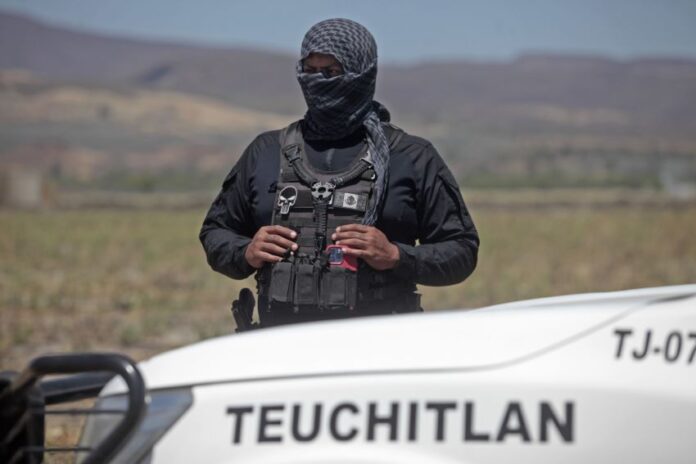
Two local police officers are among the first arrests made on the case since a search collective found previously unreported evidence at a ranch near Teuchitlán, Jalisco. (Fernando Carranza García/Cuartoscuro)
In recent days, authorities arrested at least three people in connection with the so-called extermination camp case in Jalisco, including an alleged Jalisco New Generation Cartel (CJNG) leader.
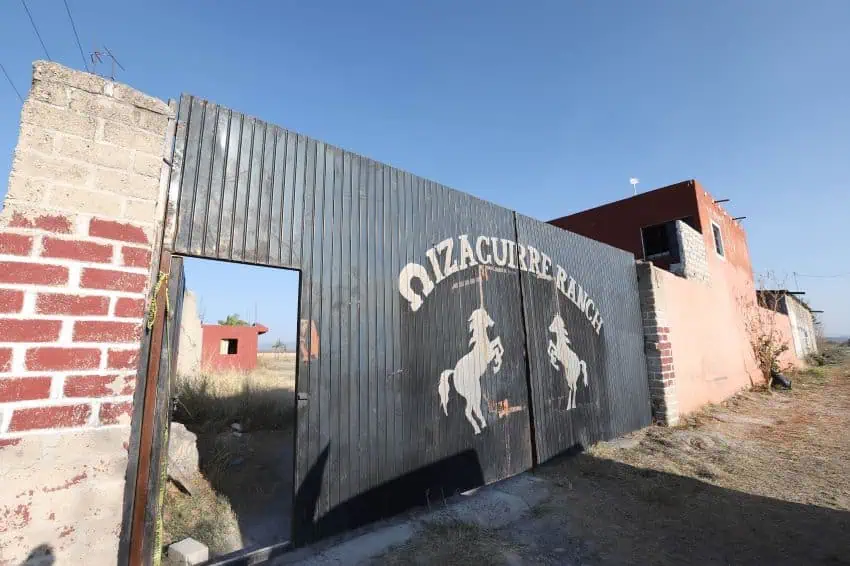
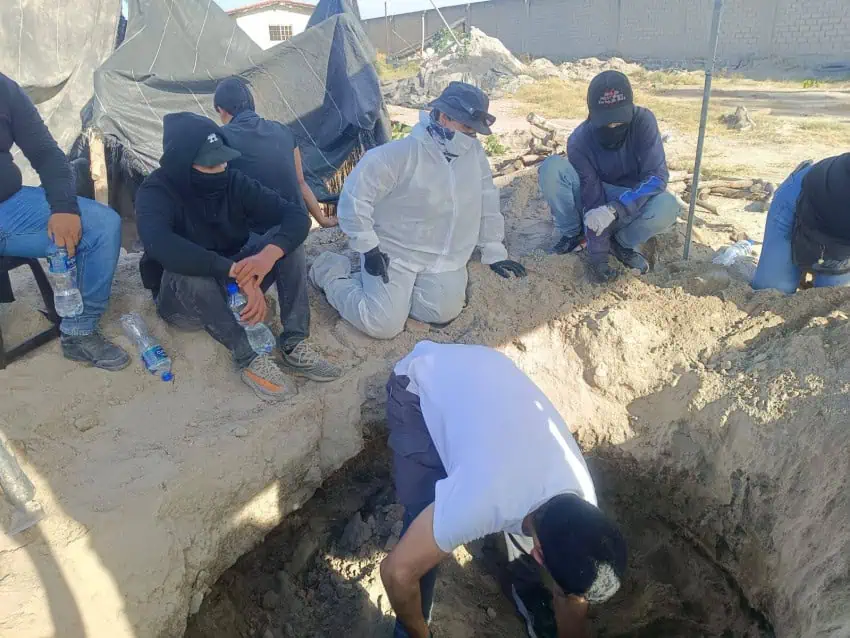
A volunteer search collective made the grim discovery at Izaguirre Ranch, months after federal officials inspected the property. (Fiscalía del Estado de Jalisco/Cuartoscuro)
Clandestine graves are frequently found in Mexico, but the discovery of what some media outlets have called an “extermination camp” where scores of people may have been killed and/or cremated shocked the nation and made headlines around the world. No victims have yet been identified.
The three people recently arrested in connection with the case are the alleged leader of a CJNG recruitment cell and two former police officers from Tala, a municipality in Jalisco that adjoins Teuchitlán.
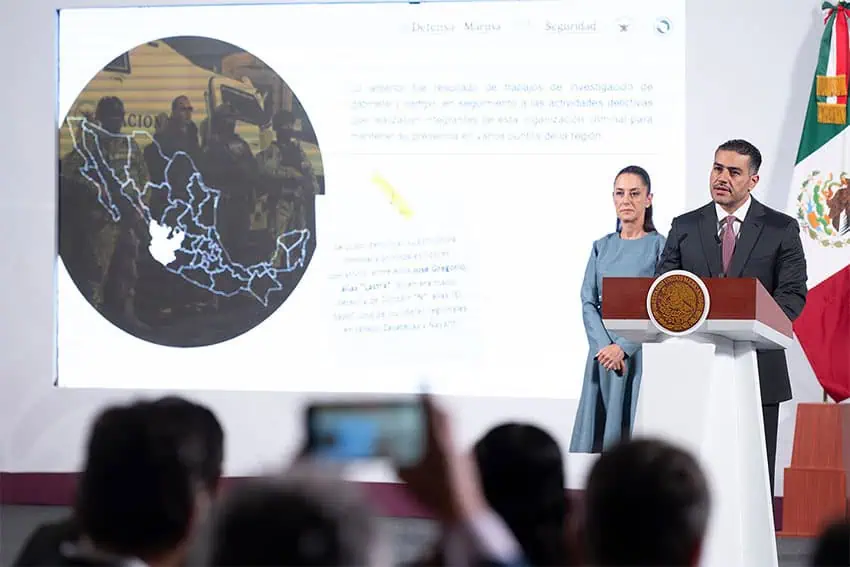
At a press conference on Monday, federal Security Minister Omar García Harfuch spoke about the arrest of the alleged CJNG leader and provided additional insight into the activities that allegedly took place at the now-notorious property in Teuchitlán.
The National Guard arrested 10 people at the ranch last September, months before the Warrior Searchers of Jalisco collective searched the property.
Alleged CJNG leader arrested in Mexico City
Federal security authorities announced the arrest of José Gregorio Lastra Hermida — allegedly a CJNG leader involved in the recruitment of cartel members — on Saturday.
Soldiers, marines and other federal security personnel detained Lastra, 51, and a 43-year-old woman who was with him in the Mexico City borough of Cuajimalpa, according to a joint statement issued by the Ministry of Defense, the Ministry of the Navy, the Federal Attorney General’s Office (FGR), the National Guard and the federal Security Ministry.
The woman has been identified in media reports as alleged CJNG operative Abril Dianeh Robles Vázquez. She is also a CJNG recruiter, according to the Reforma newspaper, but it was unclear whether she faces charges in connection with the Teuchitlán case.
García Harfuch said on social media on Saturday that the arrest of Lastra was the “result of investigations” that began months ago.
At President Claudia Sheinbaum’s press conference on Monday, he said that Lastra is “one of the main collaborators of Gonzalo ‘N,’ alias ‘el Sapo'” (the Toad), who he identified as “one of the regional leaders” of the CJNG in Jalisco, Nayarit and Zacatecas.
“According to the information obtained, this person identified as ‘Comandante Lastra’ was responsible for recruitment for the Jalisco New Generation Cartel and was in charge of the training center located at the Izaguirre ranch in the municipality of Teuchitlán,” García Harfuch said.
Resultado de investigaciones de gabinete y campo desarrolladas desde hace meses, en una acción de el Gabinete de Seguridad fue detenido en la Ciudad de México José Gregorio “N”, alias “Lastra”, líder de la célula delictiva vinculada al reclutamiento de personas para el CJNG.… pic.twitter.com/0pSFr3NhMA
He said that Lastra allegedly recruited personnel for the CJNG between May 2024 and the beginning of March 2025.
“We have knowledge that José Gregorio … had a group of collaborators dedicated to the process of recruitment,” García Harfuch said.
The security minister said that Lastra mainly used social media to advertise “fake work opportunities,” adding that criminal activities were only mentioned in closed groups.
He said that some posts on social media advertised security guard positions with a salary of 4,000-12,000 pesos (about US $200-600) per week.
Applicants were summoned to different bus stations and from there were taken to the “training center” at Izaguirre Ranch, García Harfuch said.
Once at the ranch, the recruits were given training in the handling of firearms and in “physical conditioning,” he said.
Security Minister García Harfuch shared the news of the arrests at President Sheinbaum’s Monday morning press conference. (Presidencia)
Upon arriving at the property, the recruits were dressed in tactical gear and stripped of their cell phones, García Harfuch said.
He said that the training lasted approximately one month and the recruits were left “incommunicado” during that period.
“Depending on their aptitudes,” recruits were granted a position within the CJNG and “assigned to different entities” of Mexico “to increase the strength of the criminal organization,” García Harfuch said.
Citing the “testimony” of Lastra, he said that “people who resisted to receive the training” or “tried to escape from the place” were abducted, beaten and subjected to torture.
However, the security minister said that the ministry he leads and the federal government’s security cabinet had no evidence that the property was “an extermination camp” as has been claimed.
Rather, it was “a training center,” he said, adding that he didn’t have any knowledge of people having been killed at the property.
Izaguirre Ranch has been in national and international headlines since a Jalisco search collective found ash mixed with bone fragments and piles of personal belongings at the alleged CJNG recruitment center. (Guerreros Buscadores De Jalisco/Facebook)
García Harfuch also cast doubt on whether human remains were in fact found at the ranch, saying that the Security Ministry hadn’t confirmed that to be the case.
“The Federal Attorney General’s Office will determine if there are remains,” he said.
García Harfuch said that through “intelligence work” authorities have also identified Lastra as the “mastermind” of the abduction of two university students in June 2024. He added that authorities have established that the suspect met with “el Sapo” — identified as Gonzalo Mendoza Gaytán in media reports — on March 10 in Puerto Vallarta and the latter ordered the former to “end the training activities.”
Lastra subsequently went into hiding in the municipality of Tala before traveling to Mexico City and “trying to hide himself in the capital,” García Harfuch said.
While his arrest was announced on Saturday, he was detained last Thursday in possession of a firearm, false ID and methamphetamine, according to Reforma.
García Harfuch told reporters that Security Ministry personnel had carried out a “search and analysis of profiles on social media related to the recruitment of people for their incorporation to organized crime activities” and “39 recruitment pages” were taken down from various online platforms.
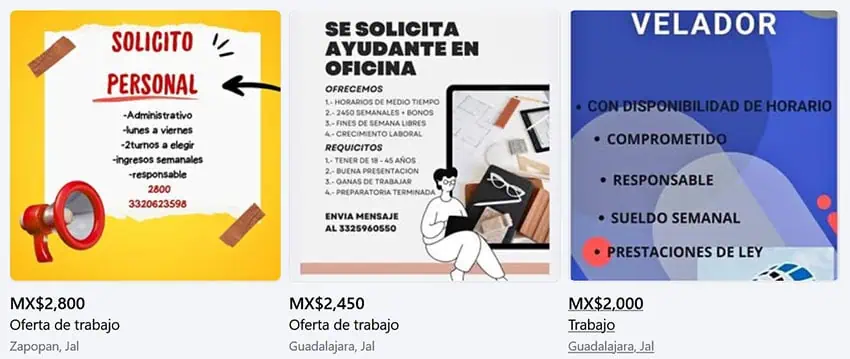
The security minister described how cartel recruiters used fake job postings to draw victims into a forced recruitment scheme. (Facebook)
“This review of different platforms is continuing,” García Harfuch said.
He said that 49 people related to “recruitment activities” for organized crime have been arrested since last September, including Lastra, the “leader of these operations.”
“These actions represent a significant advance in the clearing up of the events at the Izaguirre Ranch in Teuchitlán, Jalisco,” García Harfuch said, adding that the FGR will have access to “essential evidence” as a result of the arrest of Lastra.
2 police officers linked to Teuchitlán case in custody
The FGR said on Sunday that two municipal police officers from Tala who are “allegedly related” to the Teuchitlán case were arrested.
José “N” — identified as José Antonio Solís Nava in media reports — was detained on Sunday while Gabriel “N” was arrested on Saturday.
The FGR said that Solís was arrested for his “probable responsibility” for “the crime of enforced disappearance of people.”
The FGR said that the Jalisco Attorney General’s Office requested its support to execute a warrant issued by a judge in Tequila, Jalisco, for the arrest of Solís. The arrest warrant was executed in Colima city, the FGR said.
Gabriel “N” was allegedly involved in the enforced disappearance of two men who were rescued by the National Guard at the Izaguirre Ranch last September.
At a press conference last week, federal Attorney General Alejandro Gertz Manero spoke about alleged collusion between municipal police from Tala and cartel members at the Izaguirre ranch. He also asserted that Jalisco state authorities were negligent in their investigation of the activities carried out at the property.