The victim, a student from Denmark, was reported missing around 7 a.m. Monday morning shortly after going swimming at Playa Gaviota Azul beach with a friend. (Elizabeth Ruiz/Cuartoscuro)
A 27-year-old student from Denmark drowned off the coast of Cancún on Monday, the fifth loss of life at the iconic beach, Playa Gaviotas Azul, this year.
The victim — identified as Sofie Barup Enggard — was on vacation in Cancún from the state of Nuevo León, where she was attending the Tecnológico de Monterrey university.
Sofie Barup Enggard was on vacation in Cancun, but she was a student at Tecnologico de Monterrey in Nuevo Leon. (University of College/Shutterstock)
Around 7 a.m. Monday, Cancún authorities were alerted to a body floating in the surf in the resort city’s hotel zone. The newspaper Riviera Maya News reported that emergency services arrived shortly thereafter but were unable to immediately locate the victim.
Police and paramedics were eventually able to pull Barup Enggard’s body ashore, where she was pronounced dead, likely by drowning. Riviera Maya News reported that winds have been strong in the area for days due to the clashing of weather systems that has also brought rain to the region.
Reports indicate the victim and at least one other companion went for a swim on the beach early Monday morning. Strong currents soon had Barup Enggard in distress, and her friend lost sight of her, according to reports.
State prosecutors are investigating the incident, and an autopsy will be performed to determine the exact cause of death. The newspaper Por Esto! reported that the authorities have not ruled out alcohol as a contributing factor.
This latest incident has revived the complaint that local Civil Protection authorities do not assign adequate personnel to lifeguard duties. Lifeguards are on duty from 9 a.m. to 5 p.m., and, according to Por Esto!, people will often head to the beach after sundown following a night on the town.
Local resident Belén Salazar said the authorities should do a better job protecting beachgoers, suggesting a more flexible schedule and additional lifeguards.
Barup Enggard’s death has sparked new discussion of an old topic in Cancún: whether authorities provide enough lifeguard coverage. (Illustrative/Civil Protection Cancún)
“The last thing we want is for [Cancún] to be in the headlines like this and scare away the tourists,” she told Por Esto!
“Each individual is responsible for themselves while at the beach,” said Ismael González, “but it is better to have supervision that might prevent the loss of human life, which leaves [Cancún] with a black eye.”
Barup Enggard’s death is the fifth accidental death this year at the popular Cancún beach.
On March 10, two men taking a break from working on the Maya Train drowned after entering the water at Playa Gaviotas Azul. They were reportedly under the influence of alcohol.
On March 31, a 5-year-old child was swept out to sea while playing at the edge of the surf, and on April 20 a 40-year-old tourist drowned after struggling against the strong marine currents off the coast of the iconic beach.
This sort of gesture might be obviously rude, but there are many other behaviors we take for granted can be seen as offensive in Mexican culture. (Adi Goldstein/Unsplash)
I recently witnessed an uncomfortable situation at dinner with another expat. When the plate arrived, she became irate at the waiter, who brought her something she hadn’t ordered. I have never heard someone from Mexico get angry at a waiter, so her behavior struck me as not only being rude, but culturally tone-deaf, as she had ordered in poor Spanish. I was so embarrassed that I went back to the restaurant the next day and apologized on her behalf. The waiter could not have been more gracious.
She is not alone, of course — we all violate cultural etiquette at times. We may even be wired to assume our own culture is better than others: evolutionary psychologists suggest that since our ancestral roots are tribal, our actions reflect a powerful loyalty to our tribe or social group.
Raising your voice at service workers is unheard of in Mexico and considered highly offensive. (Freepik)
This, however, doesn’t excuse us from committing repeated cultural offenses.To avoid inappropriate behavior, practice what cross-cultural experts call “cultural competence”: the ability to interact respectfully and sensitively with people of different cultures. Here are eight ways to do that in Mexico.
Study your own culture
This is often easier said than doneThere’s a famous line attributed to the 1920s American anthropologist Ruth Benedict: “The fish are the last to see the water.” In other words, our own culture can often be invisible to us. U.S. culture, for example, has a fairly direct communication style, which I only figured out after marrying Barry, a Brit, and discovering that my in-laws sometimes interpreted my direct style as rude.
I, meanwhile, thought they were evasive and even occasionally dishonest. Fortunately, I not only grew to love and understand his family but learned about different communication styles. That came in handy for living in Mexico, another culture that values indirect communication.
Observe the locals
Studytheir interactions with each other, their dress, eating styles and table manners, how they greet and say goodbye to each other, their formalities and so on. When Barry and I were remodeling our Mexican house, for example, we noticed the importance of hierarchy and titles when our contractor would address the architect not by his first name, but as “Arquitecto.”
Hierarchy in the workplace, especially towards more learned colleagues, is an important part of Mexican culture. (Graciela López/Cuartoscuro)
Find a trusted guide who can answer your questions
Spanish teachers can serve as cultural interpreters, as canpeople with dual Mexican and U.S. citizenship. My first Spanish teacher, for example, explained to me that Mexicans like to tease each other, give friends cheesy nicknames and make jokes about things that in the U.S. would be considered inappropriate, like the time at a concert when one of the musicians referred to another as “gordito” — plump. It’s hard for me to picture an American performer referring to their fellow musician as “Fatty.”
Adopt a curious, listening mindset
My model is the lateFran Peavey, an American political activist and author of the book “Heart Politics.”During the 1980s, she traveled to different cities around the world, sitting in public squares with a placard reading “American willing to listen.” Scores of people would stand in line for hours waiting to talk to her.
Weigh carefully whether to raise sensitive subjects with people you don’t know well
In the 1990s, Barry and I spent three weeks in Oaxaca studying Spanish and staying with a host family who had two adult children in their twenties. One of the other Spanish students staying at the house had told me that the 22-year-old son had fathered a child who didn’t live with him and that this was not unusual in Mexico.
On the last evening, we took our hosts out to a restaurant. During dinner, I blithely asked to the mother “You have a grandchild, don’t you?” No, she said, icily, frowning. “I don’t have any grandchildren.” I realized with a pang that I had crossed a cultural line.
Avoid stereotypes, which are usually negative
Americansare loud, Mexicans are lazy, Brits are reserved, Japanese are timid and so on.
I still cringe remembering a stereotype I repeated the first year I lived in Guanajuato. “Mexicans love to gossip,” I announced at a small gathering, as though I were a modern-day Margaret Mead who had done anthropological research on the culture for decades. Fortunately, a Mexican-American friend took me aside and tactfully suggested I refrain from such comments again.
Gossip might seem it’s like part of the culture, but does that actually make it part of the culture? Be carefully when generalizing. (Marilia Castelli/Unsplash)
Afterwards, deciding I should educate myself about gossip, I looked it up and discovered it’s a universal aspect of all cultural groups. No one has a monopoly on it.
Use self-effacing humor
When Mexicans ask me where I’m from, I say, “Soy estadounidense,” and then often add, “No es mi culpa” — “It’s not my fault.” I don’t feel I’m to blame for being American, and I’m not ashamed of my nationality. But given Mexico’s ambivalent relationship with the U.S., this immediately lightens any possible tension. The person I’m chatting with almost always cracks up, and it breaks the ice.
Expats are not experts!
Even if I’ve lived in Mexico for many years, I keep reminding myself I’m not an authority on the culture. It’s easy to assume I know more than I do.
Wherever we’re from, we tend to think our birth culture’s practices and customs are the norm, and to react with surprise — and even occasional anger — when other cultures don’t follow our lead. None of us is immune from making cultural gaffes. The trick is to notice, acknowledge the error, apologize and start over.
Louisa Rogers and her husband Barry Evans divide their lives between Guanajuato and Eureka, on California’s North Coast. Louisa writes articles and essays about expat life, Mexico, travel, physical and psychological health, retirement and spirituality. Her recent articles are on her website, https://authory.com/LouisaRogers
When you see this sign, brace for impact. It's going to be a rough ride. (Dickelbers/CC BY-SA 4.0)
A couple of weeks ago, I decided to drive to Veracruz city, about an hour and a half away from where I live. I left later than I’d meant to, and wound up making most of the trip in the dark.
The toll road between Xalapa and Veracruz is in pretty good shape and is always a fairly smooth drive. I’ve come to enjoy driving fast with the music blaring, especially after being stuck in the congested city, where so much of it can barely be covered in second gear.
This guy probably just hit a tope too hard. (Conor Samuel/Unsplash)
It wasn’t until I got into the city that my heart jumped up into my throat. I was cruising along happily on one of the city’s widest avenues, heading toward downtown. Almost there!
Suddenly, I hit a bump. A big bump. My car — Scarlet is her name — went flying for a beat more than I’d have liked and landed heavily on the other side of a very big, very invisible tope. Luckily, Scarlet and I both lived to tell the tale.
What’s that thing in the road?
Topes, topes, topes.
If you’ve driven in Mexico, you’re certainly familiar with what they are. For those uninitiated among you, they are essentially speed bumps. And they are everywhere.
Everywhere.
A rare well-designed tope. These are distressingly uncommon. (María Ruiz)
The reason topes — pronounced “toe-pay” — are everywhere is, simply, to slow drivers down. The transit police do not have the manpower or training to stop speeders in any meaningful or consistent way. When they do stop someone, it’s usually for a minor infraction like an expired sticker or tinted windows so they can solicit a mordida. That word translates literally as “bite,” but means a bribe. Did I mention their pay is not great? As Damien Cave of theNew York Times put it, topes are “suspension-killing wonders that fill a void in law and order.”
We let the road itself do the work of stopping speeders around here. And the way it does the work is by literally forcing drivers to slow down, lest they really, really mess up their cars.
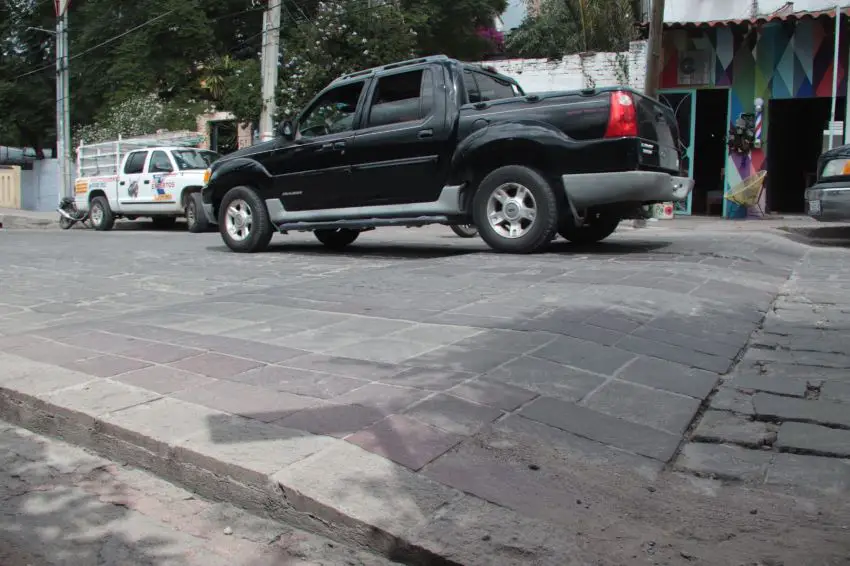
Unfortunately, there’s no standard regulation regarding topes, which vary by state and even municipality, and many don’t follow the standards that do exist. They come in all shapes and sizes and can be found — I cannot emphasize this enough — literally anywhere. That includes the highway, so keep your eyes peeled! Topes can even appear on steep uphill roads, so make sure your zero to first gear game is on point if you’re in a standard.
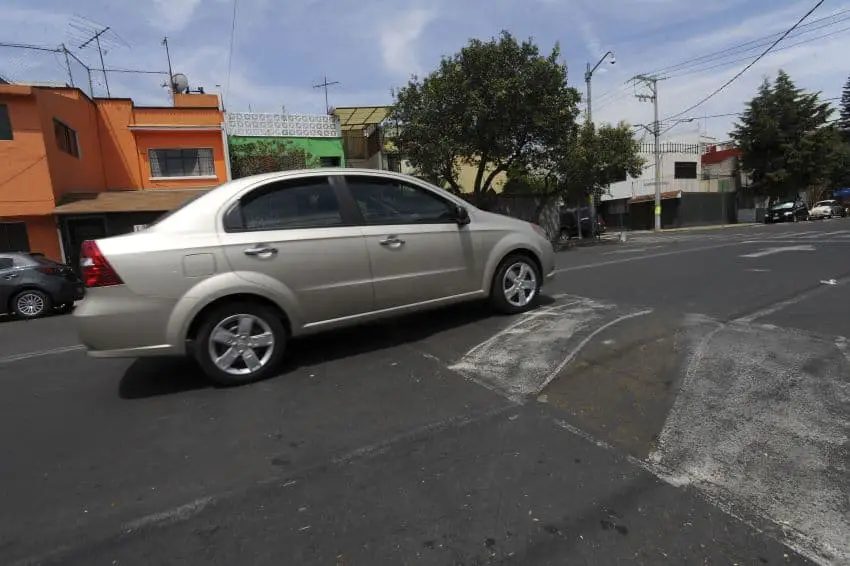
Remember too that while most of them were likely painted initially, once the paint wears off, they may never be painted again. Look alive!
Topes come in a variety of presentations: let me count the ways!
Sometimes, the first thing you know about a tope is when you hit it at speed. Hope you’re wearing your seatbelts! (Armando Monroy/Cuartoscuro)
The invisible mountain
This was the kind of tope I encountered on the avenue into Veracruz. The main way you can tell it’s there is by noticing the cars in front of you braking at the same spot even though there’s no traffic light. Depending on the time of day, you might also notice its shadow. I must have been spaced out that night, because I saw no clue of its presence until me and Scarlet were flying like Daenerys on her dragon.
Snakes in the gray grass
These are similar to the ones above, but the impact isn’t quite as harsh because they’re smaller. There’s one like this near my house, in fact, that I regularly glide over at 30 kmh without too much of an issue.
Balls of doom
These topes — also known as boyas, or buoys — are made up of a series of metal half-balls that stretch across the road, and they are hands-down awful. If you’re lucky, they’ll be worn down a little by the time you get to them. Or, one or two will be missing, allowing you to spare at least two of your tires with some clever maneuvering. I regularly have to go over some brand new ones, though, and even in first gear and diagonally — a trick for lowering the impact — it feels like I’m driving over bowling balls.
Ridged plateaus
These seem to be gaining in popularity when it comes to new topes. They slope up on each side, and are wide and flat on top. We just got some new ones around the corner from my house. They looked innocent and undramatic enough. But let’s just say that if Scarlet’s belly was itchy, she got a good scratch.
These can be any kind of topes that have been mercifully worn down or otherwise destroyed, at least in part. The most fun ones let you get both sets of your tires through without elevating your car. On one of my common routes home, there’s one I’ve learned to maneuver so well I don’t even have to slow down!
A variation of this is when there’s a tope that only stretches across half of the road. If you see someone swerving drastically in front of you, they’re likely going around one of these half-hearted attempts at slowing traffic.
Not today, tope!
So be careful out there, folks. Expect that the road will send you flying, and stay alert! And try to have fun with the obstacle course ones.
The peso was the most depreciated currency today due to the increase in the probability of approval of the reform to the judicial power. (Isabel Mateos/Cuartoscuro)
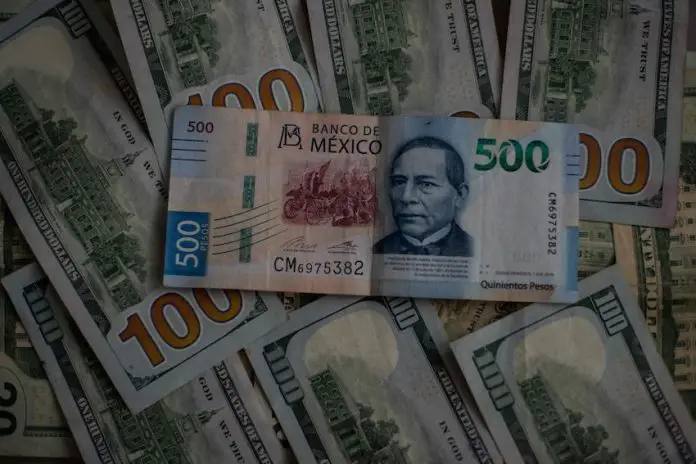
The likelihood that the Mexican Senate will soon approve the government’s controversial judicial reform proposal caused the Mexican peso to depreciate to over 20 to the US dollar on Tuesday.
The peso was trading at 20.07 to the dollar at 12:30 p.m. Mexico City time, but depreciated to 20.13 to the greenback earlier in the day, according to Bloomberg.
Mexico’s peso touches 20.13 per dollar in early trading as the Senate gets ready to approve AMLO’s controversial judicial reform
The government lacks just one vote but I suspect they won’t have much trouble in finding a flip flopper… pic.twitter.com/uOiTYXrghy
The depreciation on Tuesday came as it appeared increasingly likely that the ruling Morena party and its allies will have the numbers to approve the judicial reform proposal in the Senate.
Morena, the Labor Party and the Ecological Green Party of Mexico have 85 senators — one fewer than the number needed to secure an outright supermajority in the Senate — but there has been speculation that National Action Party (PAN) Senator Miguel Ángel Yunes Márquez, or his father, would vote in favor of the reform.
Yunes, a senator from Veracruz, failed to attend a PAN meeting on Monday night and other PAN lawmakers and officials were unable to establish contact with him.
If he voted with Morena and its allies, the judicial reform would pass Congress and be referred to state legislatures for their ratification.
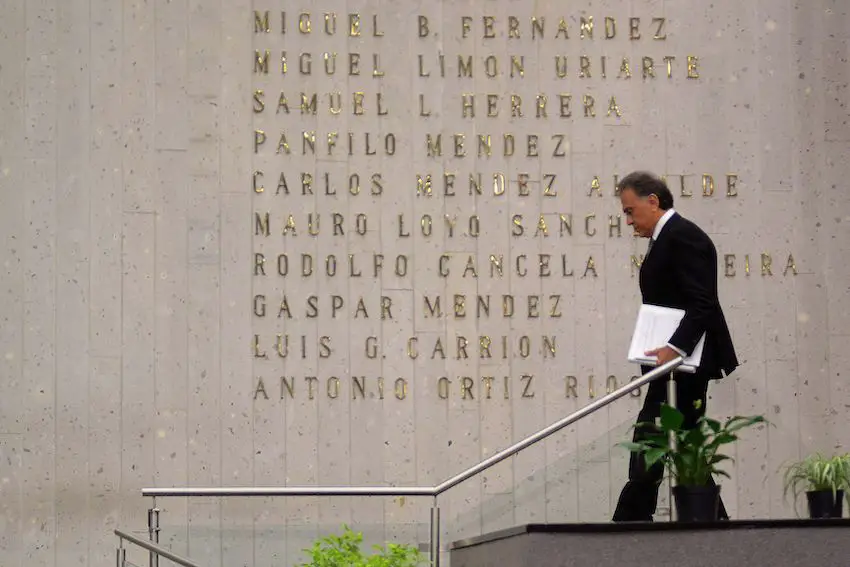
Miguel Ángel Yunes Linares, who is under investigation for committing fraud and other crimes, is suspected of having reached a deal with Morena that would eliminate the case in exchange for a vote in favor of the judicial reform proposal. (Alberto Roa/Cuartoscuro)
Several sources suspect that Yunes Márquez and his father, former Veracruz governor Miguel Ángel Yunes Linares, reached a deal with Morena that would result in the withdrawal of criminal charges against the two men and Yunes Márquez’s brother Fernando.
Ex-governor Yunes Linares is a “substitute senator” for the PAN, meaning that he can attend the Senate in place of his son and vote in favor of the judicial reform proposal, likely on Tuesday or Wednesday.
On Tuesday, Yunes Márquez requested to step down as a senator to attend to health problems, allowing his father to take his place.
“He will be the traitor that was needed to break the opposition bloc,” Raphael wrote.
“In exchange for this defection, [Morena’s Senate leader] Adán Augusto [López Hernández] offered to make the various arrest warrants against the Yunes family disappear,” Raphael added.
Gabriela Siller, director of economic analysis at Banco Base, said on X on Tuesday morning that the peso was “the most depreciated currency today due to the increase in the probability of approval of the reform to the judicial power.”
On Monday, she said that if the reform proposal is not approved, the Mexican peso could strengthen by “approximately one peso” against the dollar by the end of the year.
If the reform is approved, the USD:MXN exchange rate will increase to 20.50 “first and to 21 pesos per dollar later,” Siller forecasted.
The peso has depreciated more than 15% since the June 2 elections in which Claudia Sheinbaum won the presidency, and Morena and its allies secured large majorities in the Chamber of Deputies and the Senate, putting them in a strong position to approve the judicial reform proposal and other constitutional bills President Andrés Manuel López Obrador sent to Congress in February.
Concern over the likely approval of the reforms has been a major factor in the depreciation, albeit not the only one.
The peso depreciated to above 20 to the US dollar in early August as fears of a recession in the United States upended markets around the world. An unwinding of global carry trades, including bets on the peso by Japanese investors, has also recently affected the currency.
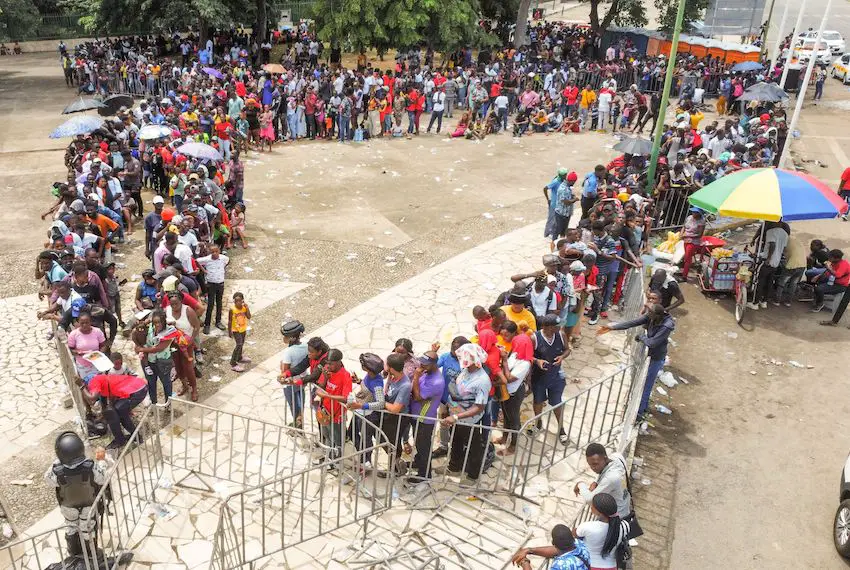
After three consecutive years at record highs, the number of migrants applying for refugee status in Mexico has sharply declined. (Alejandro Rodríguez/Cuartoscuro)
The number of migrants seeking refugee status in Mexico in 2024 has diminished significantly while the government takes steps to streamline the application process and provide support and protection for them.
The Mexican Refugees Assistance Commission (Comar) reported this week that the number of migrants seeking asylum in Mexico is down 48% from last year’s record highs, a statistic that aligns with government data that indicates irregular migrant flows are down 66% from 2023.
The majority of the applications were filed in Comar offices in the southern state of Chiapas. (Damián Sánchez/Cuartoscuro)
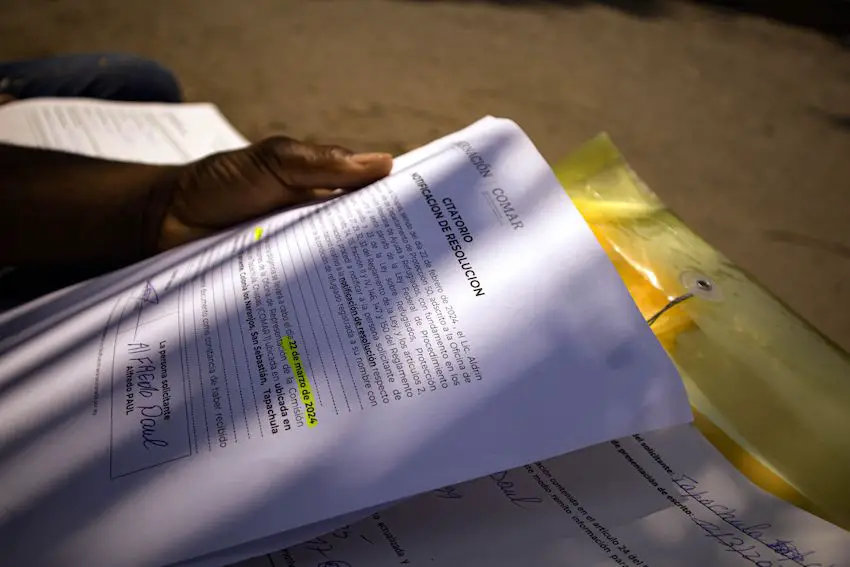
The majority of the applications were filed in Comar offices in the southern state of Chiapas, Ramírez reported in another social media post, but asylum requests were received in all 32 states of the Republic.
On Monday, Ramírez announced that beginning Wednesday, migrants in Mexico will be able to track their asylum status online instead of having to go to Comar offices.
On Monday, Comar launched “Comar Digital,” which will allow migrants to check their asylum status online instead of having to go to Comar offices. (Damián Sánchez/Cuartoscuro)
The digital platform is available in four languages — Spanish, English, French and Creole — and has earned the approval of the United Nations for its confidentiality and facility of use. Migrants can receive updates and can consult frequently asked questions via their electronic devices.
In addition, an intersecretarial commission comprised of six federal ministries is collaborating with Comar and the United Nations to improve the treatment of migrants in Mexico.
In a statement issued last week, the intersecretarial commission (Ciaimm) said improved coordination among federal agencies has helped reduce human trafficking which often impacts migrants arriving to Mexico’s northern and southern borders.
In the same statement, Welfare Ministry Undersecretary Raúl Paulín Hernández detailed the success of the three Integrated Welfare Centers established in northern Mexico. These centers — which also benefit from UN cooperation — offer programs that target the health and welfare of migrants, while also helping migrants find jobs.
The Ciaimm also reiterated its commitment to guarantee safe, orderly and regulated migrant and migrant labor flows.
On Sept. 4, the Foreign Affairs Ministry (SRE) released a book outlining the government’s official migrant policy, providing data reflecting the policy’s results, and an evaluation of the structural causes of migration to and from Mexico.
The book explains how the government uses statistical analysis to help design public policy in support of migrants and how regional cooperation addressing the structural causes of migration can mitigate these external factors that produce refugees.
One strategy the SRE touted is its effort to institute social programs that have had some success in Mexico, such as Sembrando Vida and Jóvenes Construyendo el Futuro, in other parts of Latin America. Thus far, Mexico has helped install these programs in Belize, Colombia, Cuba, El Salvador, Guatemala, Haití, Honduras and Venezuela.
Aeroméxico cut wages in the face of steep profit losses during the coronavirus pandemic. (Erik Si/Unsplash)
Mexican airline Aeroméxico unveiled new flights to the United States for the upcoming winter season, in partnership with Delta Air Lines.
The SkyTeam Alliance member will offer non-stop flights to select cities in the U.S. from two of Mexico’s biggest cities: Guadalajara, Jalisco and Monterrey, Nuevo León. These routes, the airline said, aim to “reinforce” Aeroméxico’s presence in the U.S.
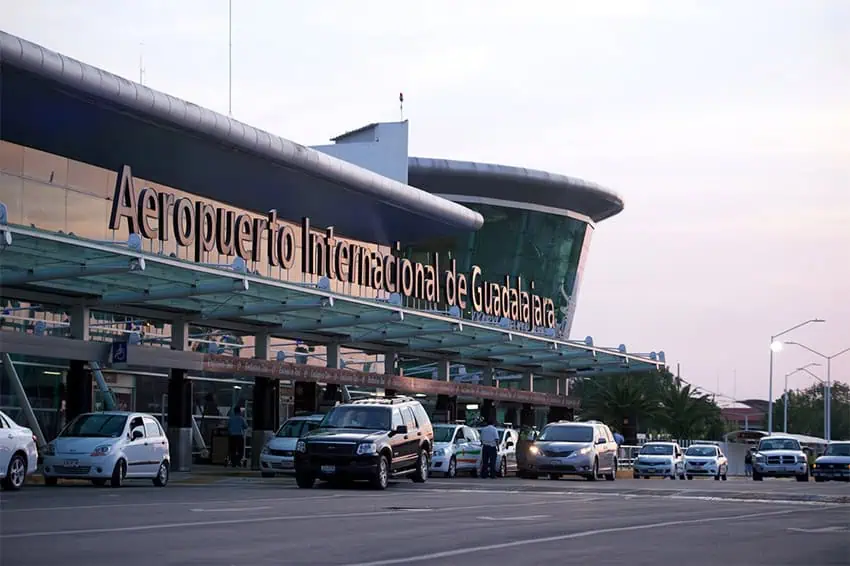
Guadalajara recently inaugurated a second runway at their growing international airport. (Visita Guadalajara)
New routes to the US from Guadalajara
Planned routes from Guadalajara include the following:
Denver, Dec. 21, 2024-April 20, 2025 one flight a week
Miami, Dec. 19, 2024-Jan. 12, 2025, one flight daily
Las Vegas, Dec. 19, 2024-Jan. 12, 2025, six flights a week
Orlando, Dec. 19, 2024-Jan. 12, 2025, four flights a week
These routes will be operated on the Boeing 737 MAX.
Starting Jan. 13, 2025, the frequencies of flights to Orlando and Miami will be reduced to four per week. Flights to Las Vegas will be discontinued.
“Guadalajara is a destination with a long tradition for Aeroméxico. We have been operating here for more than 70 years, and during this time our goal has been to evolve alongside the city,” Pasquale Speranza, Aeroméxico’s vice president of sales said in a statement.
In addition to the seasonal flights announced from Monterrey and Guadalajara, Aeroméxico will also expand its winter schedule from other destinations in Mexico, offering more frequent flights to the following U.S. cities:
Cancún-Miami, one daily flight from Dec. 19
Manzanillo-Atlanta, one weekly flight from Nov. 2
Manzanillo-Los Angeles, one weekly flight from Dec. 21
Monterrey-Denver, one weekly flight from Dec. 21
The Miami and Denver route will operate aboard the Boeing 737 MAX, the Los Angeles route on the Boeing 737-800, and the Atlanta route on the Embraer E190.
According to preliminary reports from Pemex officials, the explosion at the oil refinery in Salina Cruz, Oaxaca, was caused when the facility's waste treatment system overflowed after unusually heavy rains in the area. (Oaxaca Politico/X)
Two workers died and another suffered burns in an explosion and fire Saturday at Pemex’s Salina Cruz oil refinery on the Oaxaca coast.
The early-afternoon conflagration — which caused much concern among residents in the Oaxaca port city — occurred after heavy rainfall caused drains filled with oily waste to overflow onto walkways inside the complex, plant manager Arturo Recio Espinoza told reporters on Monday.
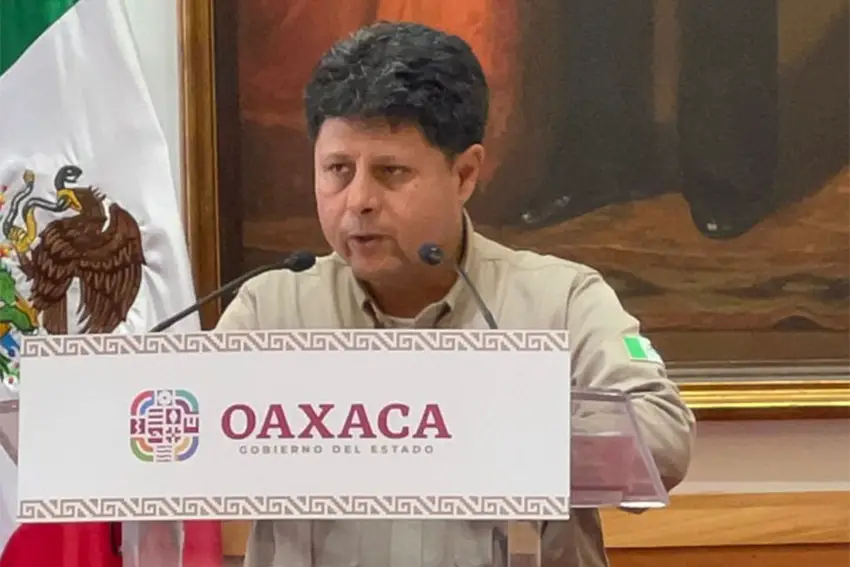
Pemex plant manager Arturo Recio Espinoza gave a press conference two days after the accident confirming the deaths of two employees and the hospitalization of another, whom he said was in stable condition. (Screen capture)
For more than 24 hours after the fire, officials with Pemex, Mexico’s state oil company, denied that there had been any deaths, but on Monday, Recio admitted that Mariana Sánchez Bailón, 21, and Erick Martínez Rodríguez, 26, both lost their lives.
The injured person, who was hospitalized with burns on various parts of his body, was identified as Julián Meléndez Martínez, 25.
According to the online news outlet Oaxaca Político, Sánchez was an administrative employee and Martínez was an engineer. Sánchez died while sitting in the back of a pickup truck parked in the complex and Martínez was located near the truck when the explosion happened, the news outlet reported. According to various media sources, Sanchez’s body was desiccated by the intense heat of the explosion.
Recio said the incident led to a “temporary halt” in operations at the facility’s main distillation and gasoline plants but that no other units were affected.
The oil refinery, one of Mexico’s largest, has a crude oil processing capacity of 330,000 barrels per day, according to Reuters. On Monday, however, it was operating at approximately 70% of capacity.
Recio also revealed that the plant’s cleanup-and-repair operation included a pumping procedure that sent sludge onto La Ventosa Beach, about 5 kilometers away. Refinery personnel were hurriedly cleaning up that spill, he added.
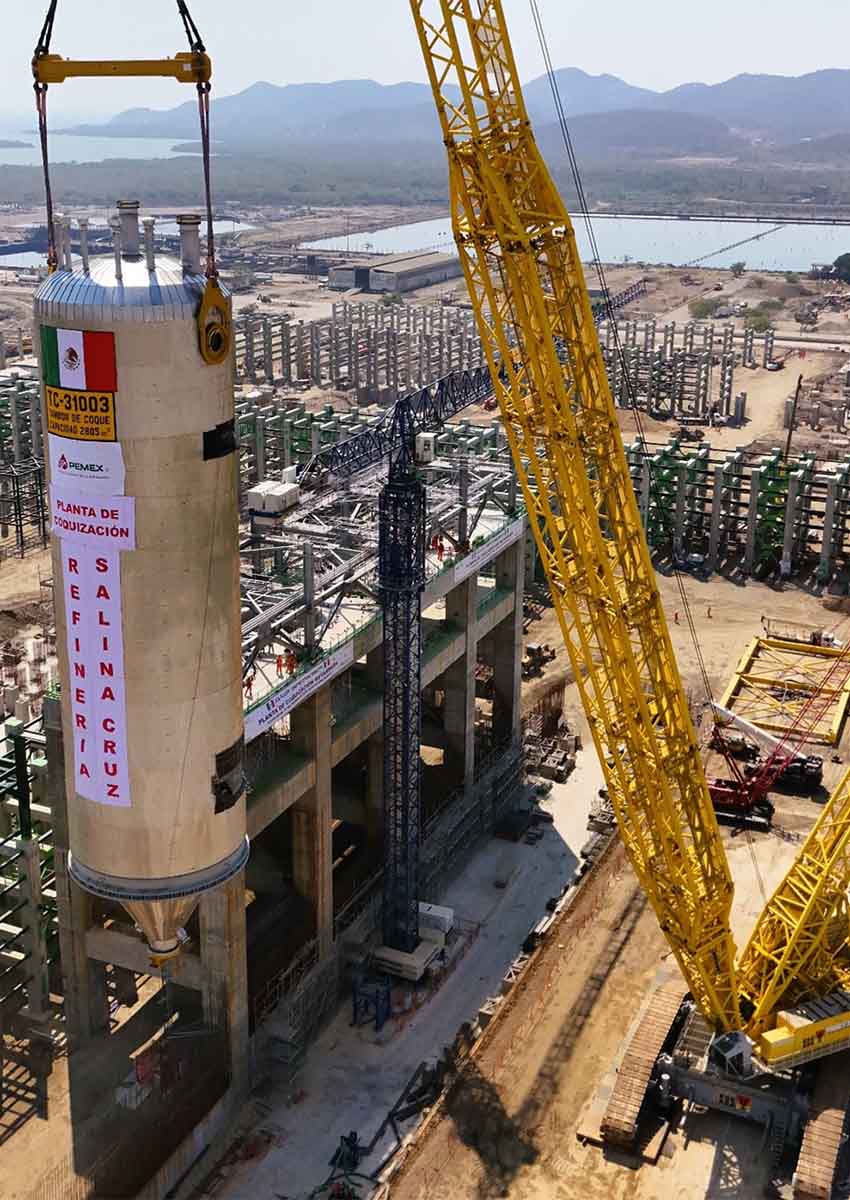
A coking plant under construction at the Salina Cruz refinery. The two employees who died were associated with the company contracted to build this plant at the Salina Cruz refinery, which Pemex hopes will monetize residuals leftover from the refining process, providing new income sources. (Pemex)
The Pemex plant manager also explained that “atypical” rains caused the refinery’s internal drainage and storm management system — which handles industrial waste such as oil and gasoline — to overflow. When the slurry rose to the surface and came into contact with a spark or flame, it caused an explosion and the fire, he said.
“We are in the initial stages of investigation and interviews to establish the root cause of where the fire started,” Recio said Monday.
He also noted that the deceased worked for Eseasa and Pesado, a transport company subcontracted by ICA Fluor, a company responsible for engineering, procurement and construction at the oil refinery. According to El Universal, ICA Fluor is under contract with Pemex to build a coking plant at the Salina Cruz refinery.
Meanwhile, the newspaper El Universal reported that fishermen and oil workers in the area blamed the fire — and the “constant spills that contaminate La Ventosa Bay” — on the refinery’s obsolete sewage and wastewater treatment systems.
These sources told El Universal said that the systems haven’t been operating for at least 10 years, which causes oil and gasoline waste to go untreated. Instead, they said, the industrial waste goes straight into a drainage system that discharges into La Ventosa Bay.
Local fishermen and oil workers told El Universal newspaper that the refinery’s sewage and wastewater treatment systems haven’t been operating for a decade and that the refinery pumps untreated waste into nearby La Ventosa bay. (Video capture)
Three months ago, a spill of oily waste covered the beach and flooded its fishing and oyster area, the newspaper reported.
“We are tired,” said fishermen and oyster extractors as quoted by El Universal. “We are going to make decisions in the next few days to show the oil company that it cannot contaminate with impunity.”
Though usually called the Salina Cruz refinery, the Pemex plant is officially named the Antonio Dovalí Jaime refinery in tribute to a late civil engineer from Zacatecas.
This was not the first Pemex oil refinery in 2024 to experience an explosion: in February, state Civil Protection officials in Hidalgo, reported an explosion at Pemex’s Tula refinery — the nation’s most productive — that they said occurred inside its hydrodesulfurization plant, where the sulfur is removed from refined petroleum products using a high-pressure process.
Mexico has seen a significant amount of announced foreign investment this year, but uncertainty regarding the judicial reform and the U.S. presidential elections could be making investors hesitate. (Samuel García/X)
Foreign companies are holding back approximately US $35 billion in investment in Mexico due to uncertainty related to the federal government’s judicial reform proposal and the upcoming United States election, according to The Wall Street Journal.
The figure comes from company representatives and advisers cited by the Journal in a report published Sunday under the headline “Why Mexico’s looming judiciary overhaul spooks U.S. business.”
The Wall Street Journal published the report on Sunday. (Screen capture)
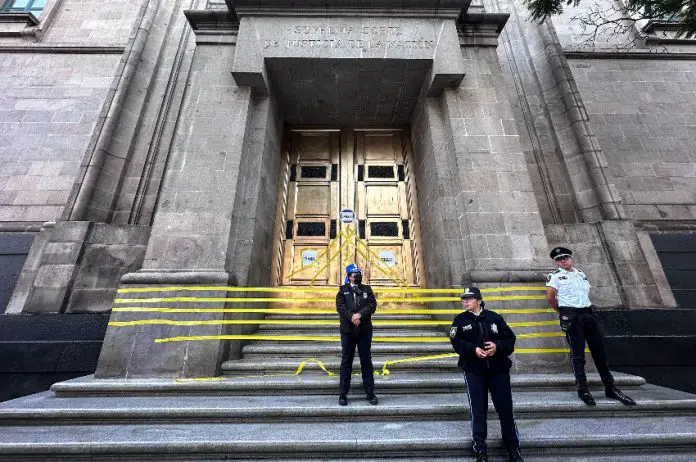
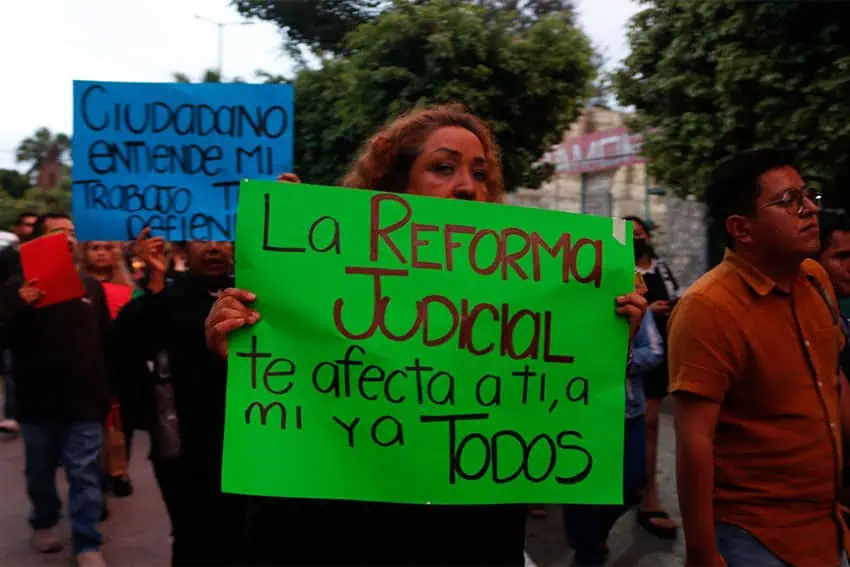
Approved by the lower house of Congress last week, the proposed judicial reform seeks to allow citizens to directly elect thousands of judges, including Supreme Court justices and other federal judges.
Senators could vote on the reform as soon as today, and it appears quite likely that the ruling Morena party and its allies will have the numbers to reach the two-thirds majority required to approve constitutional bills such as this one.
The Journal reported that “American companies are delaying investment plans in Mexico as they review how a shake-up of the country’s judicial system would affect doing business with the U.S.’s largest trading partner.”
The newspaper said that the proposed overhaul of the judiciary “has worried foreign investors who fear judges will become beholden to constituents or political considerations instead of the law.”
The lower house of Congress approved the judicial reform bill last Wednesday, with 359 votes in favor and 135 votes against. (Mario Jasso/Cuartoscuro)
The stalled foreign investment amounting to some $35 billion is for projects in sectors ranging from information technology and car manufacturing to natural-gas pipelines and industrial infrastructure, the Journal said.
Tesla CEO Elon Musk said in July that the project was “paused,” not because of uncertainty related to the judicial reform proposal, but due to uncertainty over the U.S. presidential election and the possibility that Donald Trump will impose tariffs on vehicles made in Mexico if he wins on Nov. 5.
Tesla’s position on the judicial reform is unclear, but former U.S. ambassador to Mexico Earl Anthony Wayne told the Journal that American executives have disclosed to him that they are pausing investments in Mexico while they wait to see what happens with the judicial reform proposal.
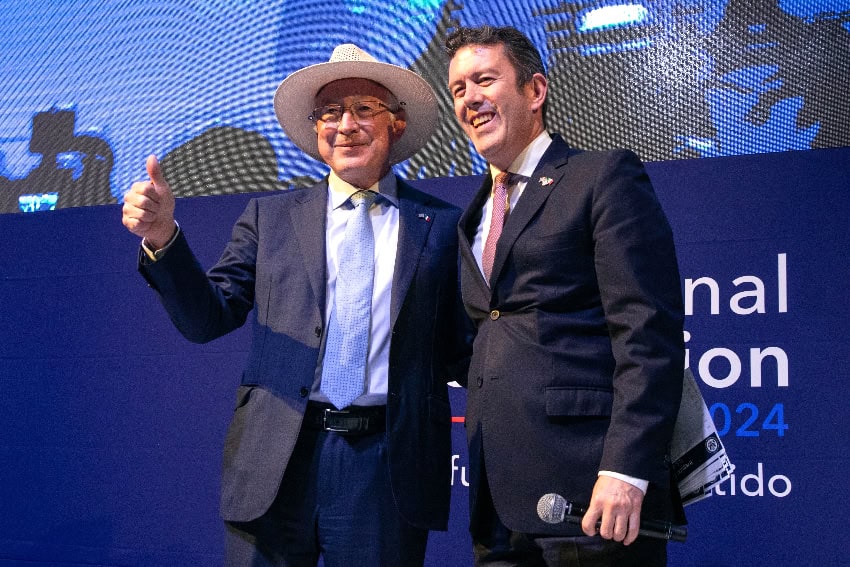
U.S. Ambassador Ken Salazar (left) with president of the American Society Larry Rubin. Both have been critical of the Mexican government’s judicial reform and warn it will impact investment. (Cuartoscuro)
Larry Rubin, president of the American Society of Mexico, made similar remarks last week, and called on the Mexican Congress “to take into consideration the voice of the most important investment in the country, which is United States investment.”
Wayne, a public policy fellow at the Wilson Center and co-chair of its Mexico Institute Advisory Board, told the Journal that Mexico will find it hard to attract nearshoring investment, create jobs and combat poverty if the judicial reform is approved.
“Mexico is going to get a lot of negative attention,” he said.
Another $18 billion in investment ‘at stake’
The Wall Street Journal also reported that the judicial reform proposal places “at stake” another $18 billion in private investment “that Mexico needs to cover rising electricity demand for industrial use.”
The Journal noted that the Supreme Court has “blocked policy initiatives that could have disrupted Mexico’s electricity sector in violation of the United States-Mexico-Canada Agreement” (USMCA), but added that “some investors fear a new, elected court would approve them.”
Supreme Court justices and other judges would be elected from candidates nominated by the president, the Congress and the judiciary.
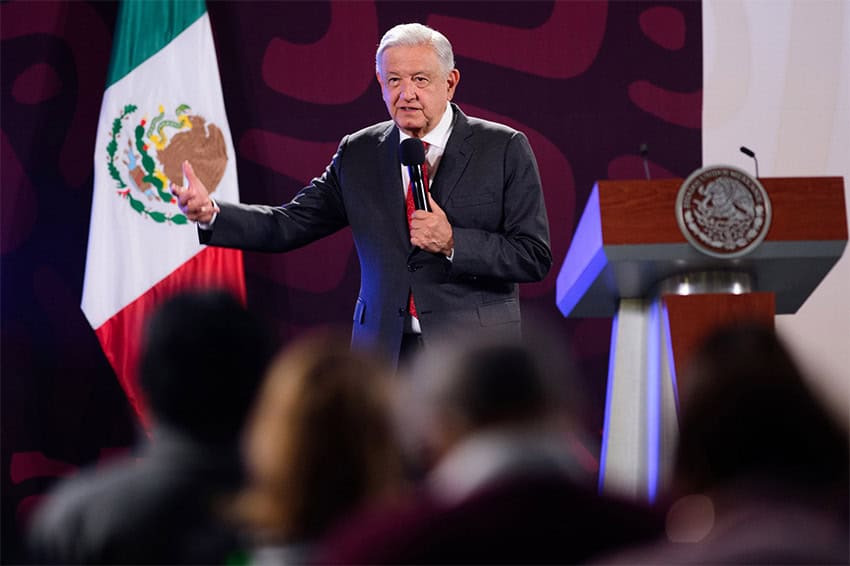
The president and his successor, Claudia Sheinbaum, both support the judicial reform bill. (Lopezobrador.org.mx)
Current President Andrés Manuel López Obrador — the foremost proponent of the judicial reform — and his successor, Claudia Sheinbaum, are both affiliated with Morena, which also controls both houses of Congress. Critics of the reform argue that the president and Morena will therefore be able to stack courts with judges sympathetic to their agenda, and thus eliminate a crucial check on executive and legislative power.
They are also concerned about a separate reform proposal that seeks to disband a number of autonomous government agencies and absorb their functions into the executive branch, potentially removing other checks on executive power.
López Obrador and Sheinbaum reject claims that the independence of the judiciary — and foreign investment inflows — are at risk by the plan to allow citizens to directly elect judges.
The latter asserted last week that “the reform to the judicial power doesn’t affect our trade relationships or private national and foreign investment.”
Other warning bells
The Wall Street Journal reported on a range of other concerns about the judicial reform proposal. It said that:
Expensive international arbitration over investment rights is “likely to increase as companies seek to avoid Mexican courts.”
“Corporate lending in Mexico would also be affected because of the uncertainty, according to bankers.”
The reform risks “undermining talks to review the USMCA in 2026, according to Global Companies in Mexico, a group of top executives from 60 or so companies operating in the country.”
“The replacement of the judiciary would also disrupt labor tribunals under the USMCA and violate treaty provisions that call for independent magistrates, according to the American Chamber of Commerce of Mexico.”
Supreme Court Chief Justice Norma Piña told the Journal that the reform, if enacted, would violate Mexico’s free trade agreements.
“A state can’t invoke its internal law as an excuse for failing to comply with international obligations,” she said.
Juan Luis González Alcántara, another Supreme Court justice, also spoke to the Journal.
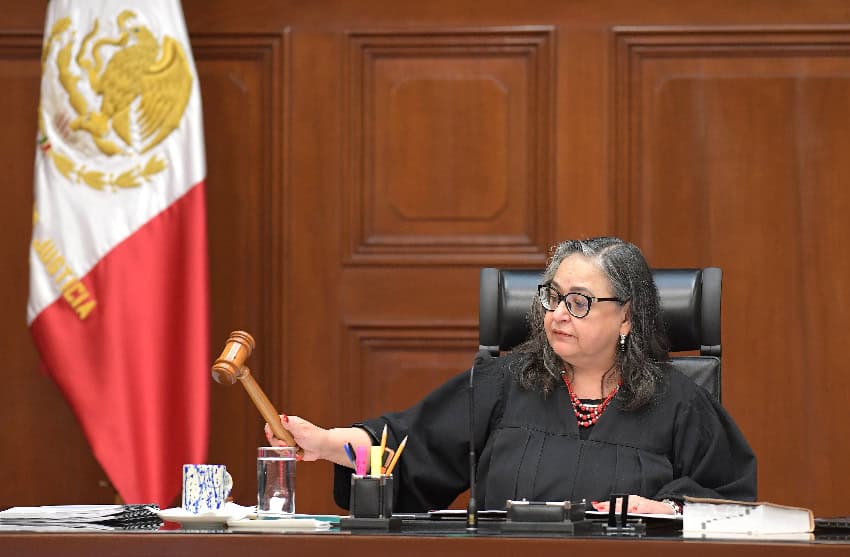
Norma Piña, the chief justice of the Supreme Court, has criticized the judicial reform bill and said it would violate Mexico’s free trade treaty obligations. (Cuartoscuro)
“It’s difficult to imagine a country that attracts foreign investment or encourages domestic investment when the minimum conditions of legal certainty don’t exist,” he said.
Mexico is currently amidst what has been described as a “once-in-a-generation opportunity” to attract foreign investment, but there are a range of factors that make capitalizing on it a challenge, including insecurity, water and electricity concerns, lack of infrastructure and uncertainty about the rule of law.
There are also external factors outside of Mexico’s control that worry foreign companies that already have a presence here or are considering establishing one.
“A victory in the presidential election by Donald Trump, who wants to impose more tariffs on imports, would complicate the trade relationship between the U.S., Mexico and Canada,” the Journal reported.
Pedro Casas, CEO of the American Chamber of Commerce of Mexico, shares his opinion on how Mexico can reform its judicial system without destabilizing its economy. (Cuartoscuro)
On Aug. 26, the American Chamber of Commerce of Mexico (AmCham) released a statement regarding the government’s judicial reform, where we warned that: “When multiple voices rise in a chorus of warnings, it is wise to pay attention. The convergence of diverse opinions on a risk is not mere coincidence but an echo of shared experiences and knowledge.”
To provide context for the conversation, I want to make two points very clear.
The first is that AmCham Mexico has been the chamber representing the binational trade relationship between Mexico and the United States since 1917. Today, we bring together more than 1,400 companies from the U.S., Mexico and around the globe; large, medium, and small; and operating in every state of the country. Together, we generate one-quarter of Mexico’s GDP and more than 10 million formal jobs.
Secondly, our Chamber has thoroughly followed and analyzed the reform process, from the president’s initial proposal to today. We have shared recommendations with the current government, the transitional government and representatives of Congress.
Our activity in Mexico for more than a century has taught us that the key to overcoming any challenge lies in dialogue, deep analysis, and finding common ground amidst differences, not in incendiary statements. This has never been and will never be AmCham’s approach. Thus, we are concerned that the discussion about the reform has been reduced to the popular election of judges, ministers, and magistrates; however, this is not the only factor that could divert Mexico from a path of growth and prosperity.
The first problem with the proposal lies in the independence of the judges elected under the conditions of the new judicial discipline tribunal. This body could sanction judges based on vague and imprecise criteria, such as “acts or omissions contrary to the law,” “administration of justice,” or subjective metrics like “excellence.” This ambiguity of criteria can lead to arbitrary sanctions and compromised justice.
A second issue is the re-election of judges. We should aim for those elected to serve for a reasonable and continuous period. Only then can we avoid the temptation for elected judges to seek popular approval rather than fulfill their primary duty, which is to administer justice.
Another relevant issue is the eligibility requirements. The criterion established in the president’s initial project, regarding the accreditation of professional experience, is essential. Our proposal includes the implementation of a knowledge and professional practice exam, developed and implemented publicly, openly, and transparently, under the supervision of law schools, faculties, and professional bar associations.
An additional concern is the implementation and its effect on the functioning of the justice system. Conservative estimates suggest that this reform would result in the election of more than 10,000 candidates among magistrates and judges from the 32 circuits nationwide. Thus, a resident of Mexico City would have to choose over 600 officials among more than 4,000 candidates, using 175 ballots — a task seemingly designed to test patience, logistics, and the very purpose of voting.
Abruptly changing 50% of the Judiciary in 2025 and the other 50% in 2027 would create significant challenges. In any scenario, we recommend a gradual implementation that allows for an orderly and viable transition without affecting ongoing cases. This could include extraordinary elections in 2025 to fill vacancies, with subsequent partial elections in 2030, 2033, 2036, and 2039.
If, at a minimum, the points previously mentioned are not modified, the social and economic impacts will be inevitable and devastating. I highlight three ways these effects could materialize in our economy.
The first and most significant impact will be on the country’s credit rating. Losing investment-grade status — a warning already raised by several institutions — would be like playing with fire: the consequences would be serious and could shake the country’s economic stability, affecting debt costs, interest rates, exchange rates, country risk, and ultimately, inflation.
The second impact is the implementation of the USMCA. The potential dysfunction of independent and specialized courts in labor matters, as well as insufficient protection of investments through alternative justice mechanisms, increases the risk of renegotiating the treaty in 2026.
Finally, the third blow will be felt in investment. With a fragile judicial structure, a downgraded credit rating, and a poorly implemented USMCA, it is to be expected that the appetite for investing in the country will diminish, ending the opportunity to take advantage of nearshoring.
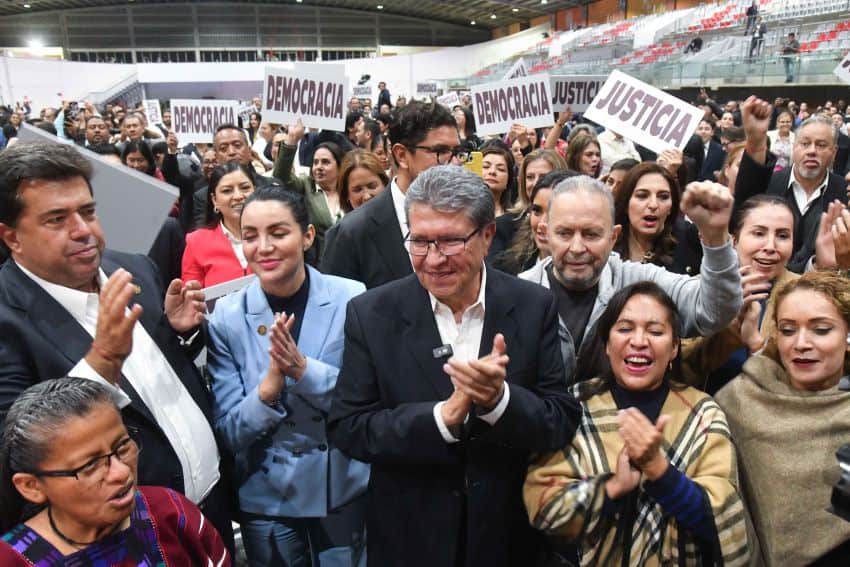
The message is clear. The reform we need is one that is debated, discussed, and ideally agreed upon, combining the best of all worlds: democracy, with certainty and growth. Why take rushed steps when we all agree that we can, together, improve the national justice system?
An accessible and democratic judicial system is also achievable without undermining the rule of law and checks and balances. We are at a historic and opportune juncture to start a new government where dialogue is the cornerstone upon which we build a more democratic and just country.
Pedro Casas Alatriste is the executive vice president and CEO of the American Chamber of Commerce in Mexico.
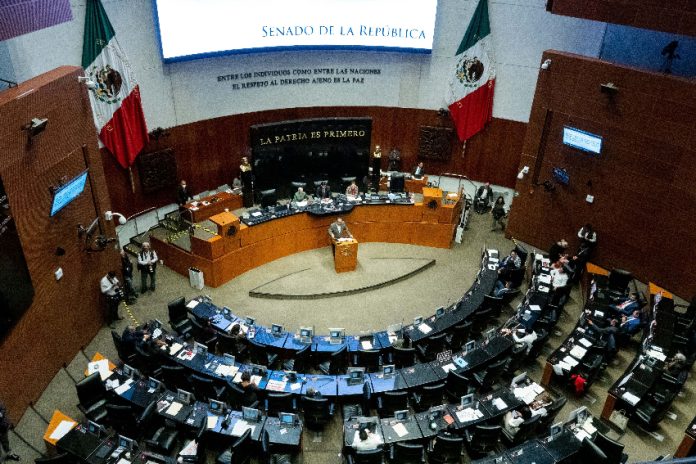
Why? Because the constitutional bill — which was approved by the Chamber of Deputies last week — needs the support of a supermajority, or two-thirds of the Mexican Senate, to pass Congress.
In case you haven’t yet completed the calculation, two-thirds of 128 is 85.33.
So the number of votes needed to reach a two-thirds majority in the Senate is …? It depends who you ask.
As Congress considers constitutional changes to Mexico’s judicial system, legislators are debating the exact requirements of a Senate supermajority. (Dassaev Téllez Adame/Cuartoscuro)
Politicians of all persuasions sometimes present half-baked ideas, but none of the lawmakers is just half — or one-third — of a human-being. Thus finding one-third of a vote to get to 85.33 votes in order to reach a supermajority is not a viable option.
So 86 it is!
Not so fast! Haven’t you heard of rounding down?
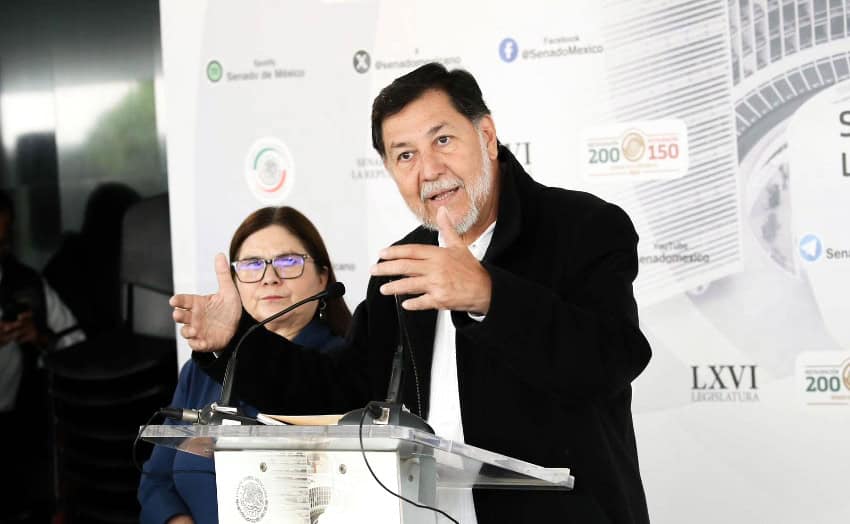
Senate President Gerardo Fernández Noroña certainly has.
On Sunday, the ruling Morena party senator claimed that a constitutional bill could be approved in the Senate with just 85 votes rather than 86.
“It’s like in school, when it was point four and below you rounded down to the number immediately below. When it was point six and above you rounded up to the number immediately above,” Fernández Noroña said.
“There is not 0.3 of a senator. From my point of view, in a strict sense, 85 senators would be enough,” he said.
Senator Adán Augusto López Hernández, Morena’s leader in the upper house, made the same argument last week.
The president of the Senate, Morena party Senator Gerardo Fernández Noroña, suggested that 85 — the number of senators in Morena’s coalition — is enough to pass constitutional amendments. (Cuartoscuro)
Fernández Noroña claimed last Wednesday that Morena and its allies would have a “surplus” of support in the Senate, but he now appears less certain that at least one of 43 opposition senators will vote in favor of the reform that seeks to allow citizens to directly elect Supreme Court justices and thousands of other judges.
Francisco Burgoa, a constitutional law professor at the National Autonomous University, predicted there will be a constitutional crisis if Morena and its allies, the Labor Party and the Ecological Green Party of Mexico, attempt to push the reform proposal through the Senate with just 85 votes.
If they were to do so, they would be making an “incorrect interpretation” of the Constitution “given that 85 doesn’t exceed a supermajority” in the Mexican Senate, he said.
“Eighty-five is not more than 85.33 and having an absolute majority doesn’t give them the power to decide that this 0.33 can be left out or rounded down,” Burgoa said.
“There are precedents in the Senate where 86 votes have been demanded … to change the Constitution,” he said.
“Even Ricardo Monreal publicly acknowledged it at another time,” Burgoa said in reference to a remark the former Morena senator and current ruling party deputy made in 2022.
A vote on the judicial reform proposal could be held in the Senate as soon as this Tuesday.
Barring unforeseen circumstances, 128 fully-formed men and women will vote on the reform proposal that the government argues is needed to eliminate corruption in the judiciary, but which the opposition contends will threaten the independence of the nation’s justices, judges and magistrates.
Expect things to get rather interesting if the final vote count is 85-43 in favor of the constitutional bill.