Electronics were Mexico's top export in 2025 — just one of the signs of changing times in Mexico, Travis Bembenek writes. (Shutterstock)
I find myself still fuming at The Economist’s coverage of the Mexican economy in an article from two weeks ago. If you missed it, they had an article titled “Mexico’s broken economy” that had a picture of a man on a horse in front of Mexican beer bottles. Talk about an insulting article. I wrote about it here. It was so offensive that the Mexican government even wrote and published a formal rebuttal of the article. You can see it here.
In countless conversations that I have with people about Mexico, I find that many — especially wealthier Mexicans — are still in denial about how Mexico is changing. Many of them are pessimistic, negative and backward-looking. They say that “Mexico is going to hell,” but when asked to provide data to back up their strong opinions, they have little if any. It seems to be more of a “feeling” to them than something that is data driven. They have little if anything positive to say about what is going on in the country today. I love debating these people, especially when they tell me that they are considering moving to Spain for opportunities instead (which I have heard more than a few times).
For those with an open mind, an appreciation for the complexity of the world we are in, and a bent toward positivity, there are signs all around of a quickly changing Mexico. This past week in particular brought some interesting headlines. For the first one, I will start by asking a question: What do you think was Mexico’s biggest export last year?
Think about it for a minute. Many people would likely say beer or tequila. Others might think it’s agricultural products. Still others would say oil, automobiles, or auto parts. The answer: high technology computer equipment. That’s right, for the first time ever, high tech equipment was Mexico’s leading export in 2025. In fact, this category of exports grew 145% last year!
A narrative can change quickly. After last year’s dismal GDP growth of only 0.8%, many economists were predicting that Sheinbaum’s policies were going to lead to years of slow growth for the country. Just a few months into the new year, analysts have begun to make changes to 2026 projections, with both BBVA and Barclay’s recently increasing their estimates and the Mexican Finance Ministry predicting that growth as high as 2.8% might be possible this year. Foreign direct investment hit a record high last year and there have been some significant new announcements already this year.
In another example, MND ran a fascinating article this past week on the changing demographics of Mexico — specifically highlighting the fertility rate and the modern Mexican family. For Mexican women, the fertility rate has had an astonishing drop from 6.8 children to 1.9 in just two generations! The article also showed how a woman in the country now gets married on average at age 32, and a man at age 35. These demographic trends are a result of many factors, but are more typical of what one would see in a middle income, more developed country.
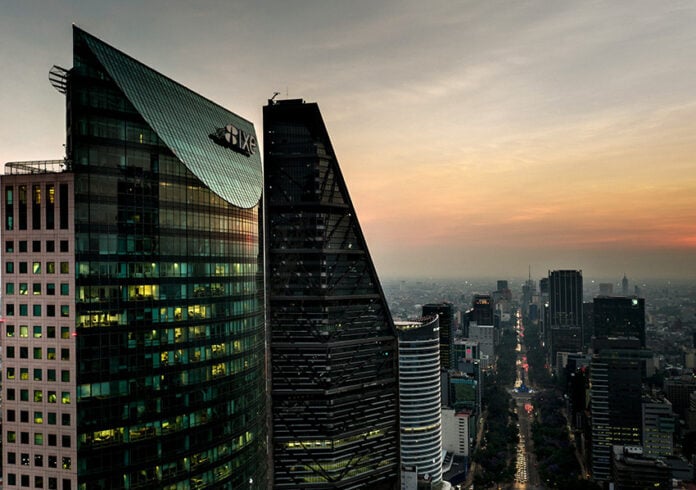
Finally, I want to share a very visible example of the changing country that understandably is open to different interpretations. As of this past week, Mexico (more specifically Monterrey in the north of the country) has a new tallest building. Not only is the still-under-construction “Torre Rise” going to be the tallest building in Mexico, but it will also be the tallest in Latin America, the second tallest in the Americas (after the One World Trade Center in NYC), and the 13th tallest in the world. I am not by any means suggesting that “tall building = economic power,” but buildings of this scale clearly are a sign of investor confidence.
So much for the image of a tired horse in front of dusty beer bottles. So how about you — do you see the changes? And if so, do you see Mexico’s glass as half-full or half-empty?
Travis Bembenek is the CEO ofMexico News Daily and has been living, working or playing in Mexico for nearly 30 years.
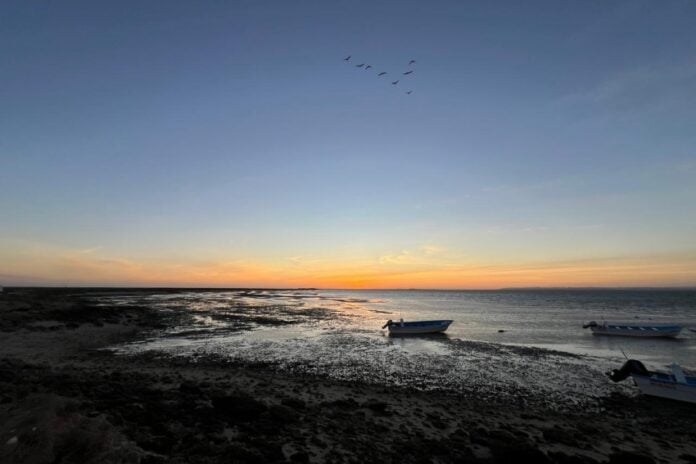
The windswept shoreline of Kuyimá camp, on Laguna San Ignacio, where Beatriz Padilla camped and painted for two months, immersing herself in the whales’ habitat. (Beatriz Padilla)
On a windswept stretch of Baja California’s Pacific coast, Beatriz Padilla braces her canvas against the desert extremes and waits for the whales.
For months, she has followed their migration, painting what she calls their “voices” as their numbers decline.
Now, as scientists warn the whales are under growing pressure, a Mexican court has ordered a halt to tanker traffic tied to a massive liquefied natural gas (LNG) project that she and many others have been fighting — effectively blocking its ability to export gas while the case moves through the courts. The order stems from a lawsuit filed by the environmental organization Nuestro Futuro and allied groups, arguing that regulators failed to fully assess the project’s risks to the Gulf’s marine life. In an unusual legal approach, the case frames whales as rights-bearing entities. The ruling temporarily blocks LNG tanker traffic — a move aimed at preventing irreversible harm while the case proceeds.
‘The world’s aquarium’
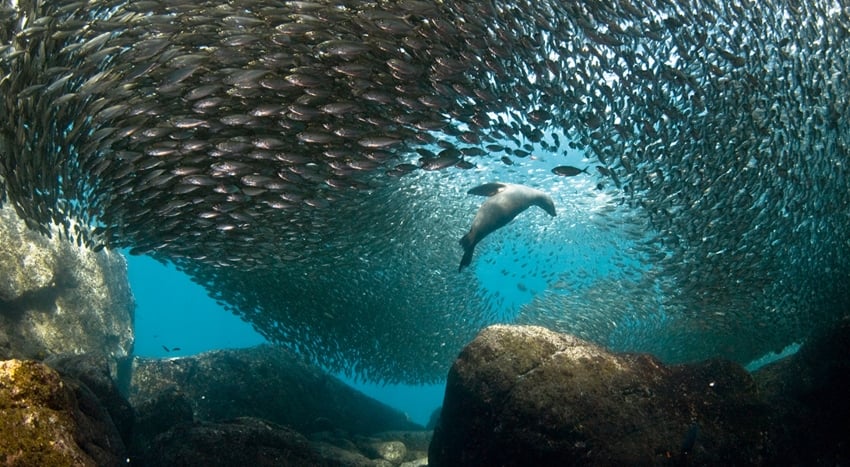
Called “the world’s aquarium” by Jacques Cousteau, the Gulf of California — or Sea of Cortez — is one of the most biodiverse marine ecosystems on Earth. This narrow body of water harbors over 39% of the world’s marine mammals, including blue whales, sperm whales, fin whales and the critically endangered vaquita porpoise.
The Saguaro Energy LNG project would pipe fracked gas from Texas’ Permian Basin through 800 kilometers of Northern Mexico to Puerto Libertad, Sonora. From there, the gas would be exported via giant tankers to markets in Asia.
Growing concerns about the project have taken on new urgency in recent days, as a major oil spill across the country in the Gulf of Mexico has already killed marine life, threatened whale populations and despoiled over 650 kilometers of coastline.
“States bordering the Gulf of California, such as Sonora and Baja California Sur, have already raised the alarm because they do not want to be affected by the fossil fuel industry as is happening in the Gulf of Mexico,” said Cecilia García Muñoz of Northwest Environmental Defense (DAN). Both state legislatures have formally asked federal authorities for more information on the proposed fossil fuel terminals and called for a strategic environmental assessment to avoid harm to fishing, tourism and local communities, she added.
Pressures on the whales that breed in the Gulf of California
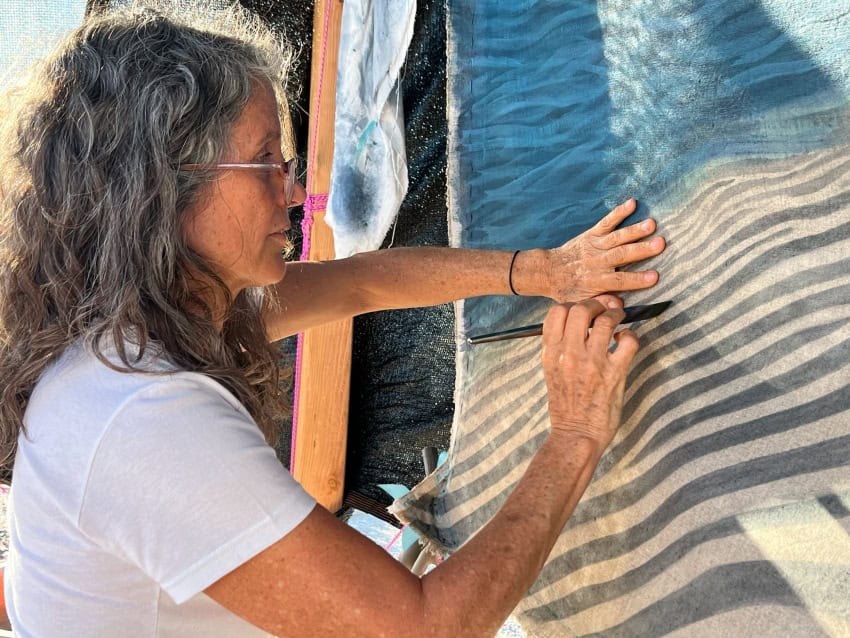
Last year, Padilla fasted for 21 days on the Gulf of California, painting to draw attention to the Saguaro project. This year, she followed the whales to the Pacific side of the peninsula, spending two months encamped along the gray whales’ winter migration route, translating the whales’ vocalizations into paint on canvas.
Wilderness artist and activist Beatriz Padilla has engaged – to date – in 35 wilderness conservation painting expeditions to endangered and protected biodiversity-rich wild areas, here translating gray whale song into paint as an act of wilderness protection. (Beatriz Padilla)
Her shift to the bigger picture reflects a growing unease among scientists and activists alike regarding whale populations. Starvation and other factors have caused gray whale numbers along Mexico’s Pacific coast to plummet from 27,000 to less than 13,000 from 2019 to 2024 following what scientists call an “unusual mortality event.”
The die-off is linked largely to the loss of sea ice in the Arctic, which disrupts the growth of algae critical to the whales’ survival, as well as the oil-rich crustaceans on the seafloor that gray whales depend on. Researchers report whales arriving thinner, under stress. In one year alone, nearly 900 gray whales were found dead along the Pacific coast from Alaska to Mexico.
“They’re already struggling,” Padilla said, pointing to a cascade of pressures on whale populations: entanglement in millions of tons of abandoned “ghost nets”; increasing ship traffic, with its risk of collisions and relentless underwater noise; pollution from plastics, heavy metals and agricultural runoff; and overfishing, including the growing demand for products made with krill, an essential food for many whales.
Art and activism
“We must not add more pressures. Projects to export LNG from their mating, birthing and calving sanctuaries, and along whale migration routes, should not even be considered.”
Padilla’s artistic intervention is just one in a wide and creative range of citizen actions aimed at the cancellation of Saguaro and other LNG terminals to protect the biodiversity hotspot, including the Nuestro Futuro lawsuit. Conexiones Climaticas has been waging a creative campaign involving schools, businesses, coordinated vigils and even a whale sighting contest, motivating thousands to speak up for the whales.
The group is among more than 30 organizations that have taken complaints to United Nations bodies, arguing the projects threaten a UNESCO-recognized World Heritage marine ecosystem. That pressure is already showing results: In late February, opponents secured a major victory when the U.S. energy company Sempra withdrew its application for the Vista Pacífico LNG export project in Topolobampo, Sinaloa.
Scientists warn of “incalculable” impacts
A liquefied natural gas (LNG) tanker can be three times the size of a football field. (U.S. Department of Energy)
Marine scientists warn that the Gulf of California is uniquely vulnerable to increased ship traffic. In a scientific opinion led by researcher Lorena Viloria and backed by the Mexican Society of Marine Mammalogy (SOMEMMA), experts expressed “total opposition” to the Saguaro LNG project.
The letter, supported by more than 200 specialists in marine mammals, warns that the combined impacts of construction, vessel traffic and underwater noise could have “incalculable” effects on whale populations in one of the most biodiverse marine regions in the world.
The region is home to at least eight species of whales, including blue, humpback, fin and sperm whales, some migrating through its waters, and others as resident populations that remain year-round. Among the most vulnerable is the fin whale, a species with a small, genetically distinct population in the Gulf of California estimated at just a few hundred individuals.
Whale collision risks
“This is the whale with the highest rate of ship collisions in the world,” said Viloria, head of SOMEMMA’s scientific committee.
Whales often cannot detect or avoid large vessels in time, she said — especially in a region where maritime traffic has historically been relatively low. As ship traffic increases, so does the likelihood of collisions.
The LNG tankers envisioned for the region would be massive — up to 300 meters long, roughly the length of three football fields — and scientists warn they pose a direct collision risk to whales that surface to breathe in busy shipping lanes. Indeed, their detractors have dubbed them “mataballenas” (whale killers). Even more concerning, most collisions go unrecorded. A whale struck in open water may sink without a trace, while ships often do not detect the impact.
LNG traffic could have devastating impacts on whales, as well as other marine mammals in one of the world’s most diverse seas. (Baja Expeditions)
“These ships are so large that they can strike a whale and not even realize it,” Viloria said.
Such collisions are not hypothetical. In one documented case in Japan, a tanker arrived in port with a dead whale draped across its bow — a stark illustration of the dangerous mismatch between industrial vessels and marine life.
Noise pollution and whales
Noise is another major concern. Large vessels generate low-frequency sound that can travel long distances underwater, interfering with whales’ ability to communicate, navigate and find food.
“There’s no remediation possible where you can convince a whale to coexist with a roar that prevents it from communicating for all of its vital functions,” said Pablo Montaño, director of Conexiones Climáticas, interviewed last year by journalist Carmen Aristegui.
Padilla, who attended the SOMEMMA conference, hand-delivered the scientists’ letters to five government agencies. Despite the scientists’ warnings, responses have been limited. In a formal reply, Mexico’s environmental safety agency (ASEA) said that any project would be required to comply with existing environmental regulations and that authorities are reviewing past approvals. However, the agency indicated that it would not be appropriate to suspend activities for projects that demonstrate compliance with current legal requirements.
Opponents argue that the Saguaro project rests on a questionable regulatory foundation. According to Claudia Campero of Conexiones Climaticas, the project traces back to a 2006 proposal for a very different type of facility — an LNG import terminal that was never built. The current plan, by contrast, is a large-scale export project.
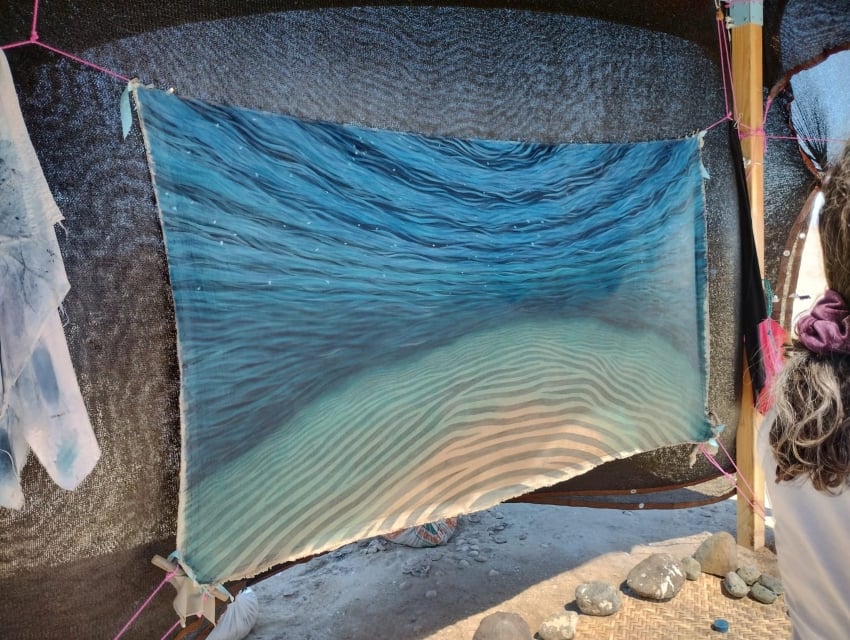
A work in progress in the rough shelter Beatriz Padilla built to shield her from the wind and sun. (Beatriz Padilla)
“They are trying to use the same permit for a completely different project,” she said. “The characteristics and impacts are not the same.”
Environmental advocates say the distinction is critical, raising concerns that current impacts — including increased ship traffic, emissions and risks to marine life — were not fully evaluated under the original approval.
Whales or gas — no middle ground
Opposition to the projects has surged in recent months, coalescing into a nationwide campaign known as Ballenas o Gas — a coalition of more than 40 Mexican organizations working to stop LNG expansion in the Gulf of California.
The campaign has gathered more than 300,000 signatures calling on the federal government to halt the projects, while mobilizing students, businesses and coastal communities across the country. In classrooms, children have submitted thousands of drawings of whales; in restaurants and cafés, campaign materials invite customers to take a stand.
But for organizers, the message is ultimately stark.
“There’s no possibility of coexistence between these massive gas projects and the whales of the Gulf of California,” said Campero, a leader of the campaign.
Beatriz Padilla translates whale vocalizations to paint in her encampment near Laguna San Ignacio, a sanctuary where Pacific gray whales give birth and nurse their young. (Beatriz Padilla)
“This is a struggle for their survival,” she said.
‘A sacrifice zone’
The campaign has combined grassroots organizing with legal challenges, scientific advocacy and international pressure — helping delay key permits and, advocates say, contributing to Sempra’s decision to withdraw its application for the Vista Pacífico LNG project in Topolobampo, Sinaloa.
Like the much larger Saguaro, the project had been designed to liquefy the U.S.-sourced natural gas for export to Asian markets, with exports once projected to begin later this decade. Other projects, including the much larger Saguaro LNG terminal, continue to advance. A third project, Amigo LNG, has also been proposed near Guaymas. Together, the projects would transform the Gulf into a corridor for large-scale LNG shipping, linking U.S. fracked gas production with global markets.
For Campero, the stakes extend far beyond a single project.
“We are turning Mexico into a transit corridor — a sacrifice zone — for gas that isn’t even for us,” she said.
A detail of Beatriz Padilla’s visual interpretation of whale vocalizations: the intimate, looping patterns of a mother (pink) and calf (green), set against long-distance sound waves. (Beatriz Padilla)
Even as global demand remains uncertain, she added, companies continue to push forward projects that could reshape one of the most biodiverse marine regions on the planet.
“The question is very simple,” she said. “Do we want whales — or gas?”
What’s at stake for coastal communities
Beyond the risks to whales, advocates warn that expanding LNG infrastructure could have far-reaching impacts on coastal communities that depend on the Gulf of California for their livelihoods.
The region supports fisheries, shrimping and a growing ecotourism industry, while also serving as a source of cultural identity for many coastal communities — incompatible with the “very, very disruptive infrastructure” of an LNG terminal, said Mima Holt, Global Energy Transition Advocate with the Natural Resources Defense Council.
She pointed to similar development along the U.S. Gulf Coast in Texas and Louisiana, where communities have “basically been ransacked by the gas industry.”
“An example of this would be Freeport, Texas,” she said. “Before Freeport LNG came, it was a thriving community, a big vacation spot for many of the cities close to it in Texas. But now, Freeport LNG is basically evicted, including many of the families that have had beach houses there for generations, and there is no longer the sense of community in the beaches there.”
LNG traffic would also have devastating effects on natural parks and UNESCO-protected marine sanctuaries like Cabo Pulmo in the Gulf of California. (Gustavo D. Danemana/Pronatura Noroeste)
Holt warned that increased tanker traffic and industrial activity could disrupt marine ecosystems in ways that ripple outward — affecting fish populations, tourism and food security.
“If this kind of shipping route affects whales, then just think about how much that would affect the fish catch in that area,” Holt said. “And what kind of consequences would that mean for the availability of this kind of food for the Mexican population?”
Watching the water
Back on the Pacific coast, Padilla spent two months observing the whales. From a boat where she accompanied a fisherman and played a haunting melody with her flute, a pair of fascinated grey whales circled the boat as she played. Before she began painting, she took the canvas out onto the water and dipped it in as a curious whale approached the boat.
In a recent journal entry from her encampment at Kuyimá Camp near Laguna San Ignacio, she described a season already beginning to change. Many gray whales had departed earlier than usual, she wrote, and sightings had become increasingly scarce.
On one outing, she encountered the body of a young whale.
“The absence of the whales is felt,” she wrote.
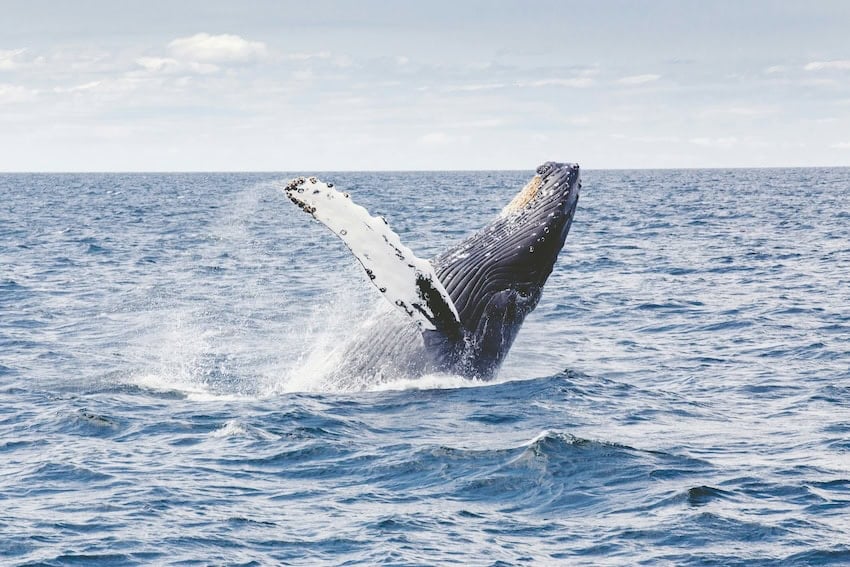
Several whale populations are already dying off due to environmental pressures. This project would be catastrophic for their future. (Thomas Kelley/Unsplash)
Scientists caution that it is too early to draw firm conclusions about the causes of shifting whale patterns. But the changes are being closely watched in a region already under pressure from climate change, industrial development and increasing human activity.
For Padilla, the experience has reinforced a sense of urgency.
“The whales really need us,” she said.
As plans for LNG development continue to move forward, researchers and advocates say the question is no longer whether the Gulf of California will change — but how much, and at what cost.
Tracy L. Barnett is a Guadalajara-based freelance writer and the founder of The Esperanza Project.
If your grandfather's grandfather was a member, maybe you can get into the Guadalajara Country Club. (GCC)
Given the U.S. media’s relentless fixation on cartel violence and desperate Latinos seeking a better life north of the border, most Americans have no idea how much wealth exists in Mexico today.
As a foreigner living in Jalisco for the past four years, I’ve been privy to the lifestyles of Mexico’s super-rich, simply because I love to play tennis.
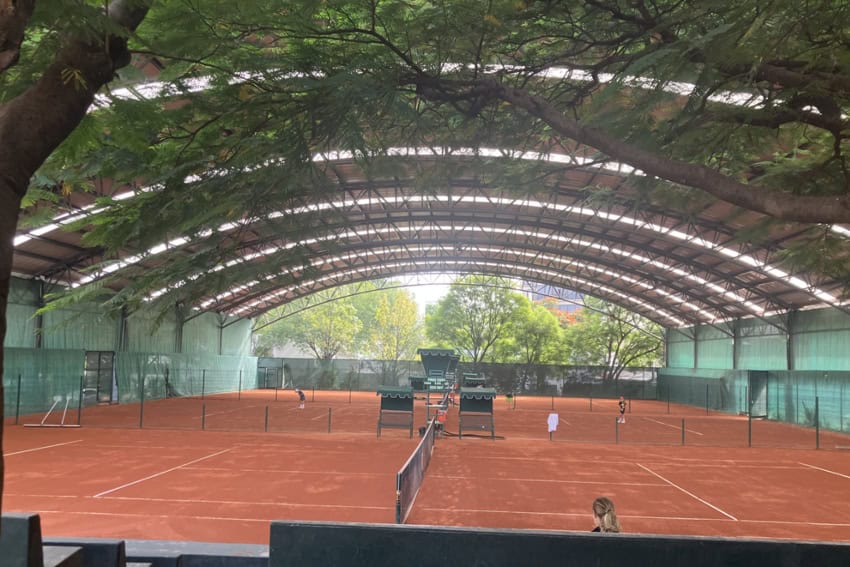
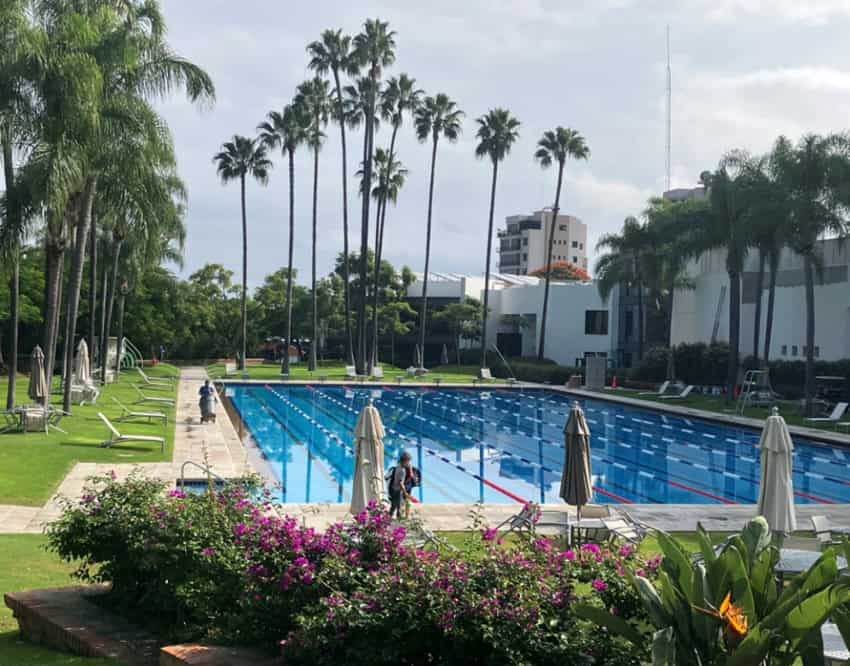
Guadalajara Country Club’s covered tennis courts are the ultimate luxury for sun-phobic local players. (Dawn Stoner)
Below, I share what it’s like inside the heavily gated walls of two exclusive country clubs in Guadalajara. And I’d like to state up front that my intention isn’t to validate how these locals live, but to give our readers a more accurate portrait of modern Mexico.
How a gringa like me gained access to Guadalajara’s top private clubs
I’ve been playing competitive tennis since I was 13. Throughout my life, this sport has offered me a way to stay fit doing something I love, with the added benefit of finding a social circle in every new city I’ve moved to.
Back in the U.S., I never needed to join a hoity-toity club to play tennis. But in Mexico, public tennis courts are practically non-existent, so joining a club is essential if you want to play regularly.
In 2023, my husband and I joined Club de la Colina, and I began playing in the city’s women’s leagues. With matches scheduled at different private clubs all over Guadalajara, I gained access to a world rarely seen or spoken about.
Guadalajara Country Club: Where the city’s old money comes to play
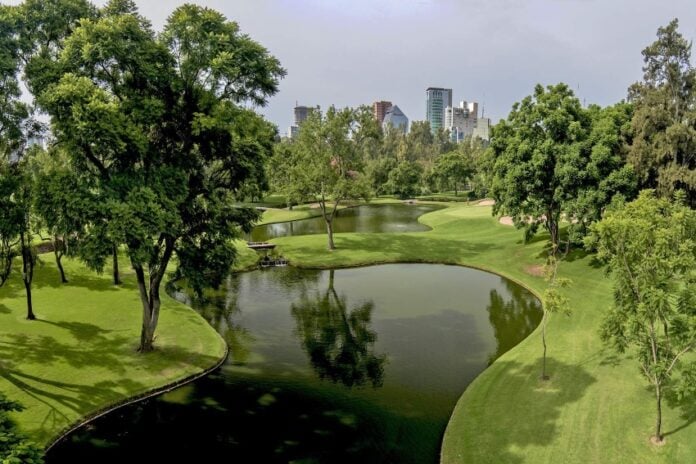
The grande dame of private sports clubs — the Guadalajara Country Club — was established in 1909. These days, GCC offers an oasis of calm amid the chaotic urban sprawl of Guadalajara, at least for the lucky few able to get inside.
To locals, GCC is known as the place where the city’s old money comes to exercise, socialize and relax.
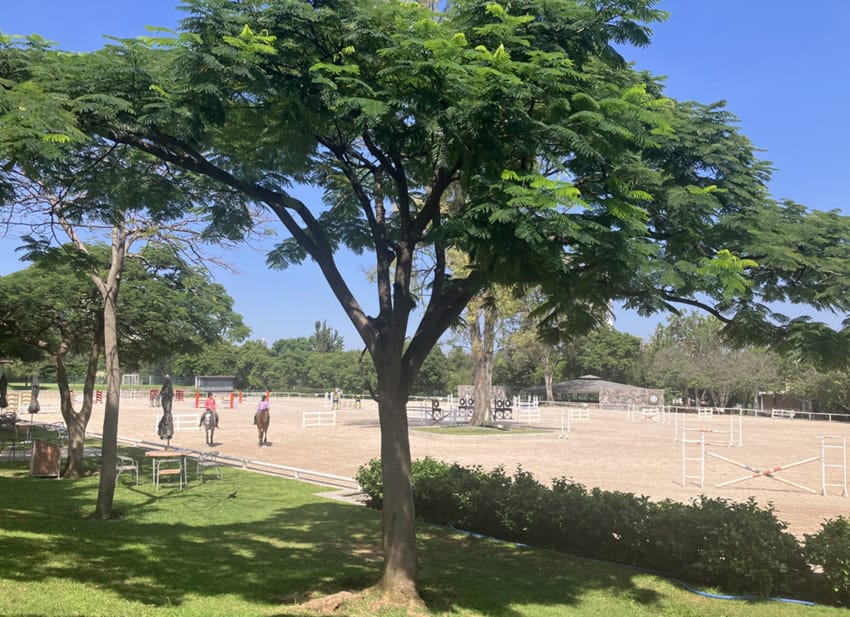
The equestrian ring at Guadalajara Country Club feels far away from the concrete jungle just outside the club’s gates. (Dawn Stoner)
Like a glass of Champagne, I’ve found GCC members to be effortlessly classy. These aren’t Mexico’s strivers or go-getters. Having already reached the pinnacle of Mexican society, they project a breezy self-confidence that comes only from living without a care in the world.
As for the rest of us, there are only two ways to visit GCC — being invited by a current member or participating in one of the club’s events. Failing that, you will hit a proverbial brick wall attempting to enter.
The facilities
A few springs ago, I was assigned to play at GCC for a weekly doubles league. At a time of day when most city residents were headed to work, I’d stroll past the club’s equestrian ring on my way to the courts. Most mornings, there would be a handful of riders gliding effortlessly around the ring on sleek, chestnut thoroughbreds, surrounded by blooming Jacarandas.
The club’s red clay courts are always in pristine condition. After each use, they’re swept by a ball kid and watered by maintenance staff, even in the dry season. For a gringo used to having no assistance whatsoever on a tennis court, even in college competition, this was an adjustment.
Adjacent to GCC’s courts is an Olympic-size swimming pool surrounded by a lush green lawn. It sat empty most mornings. Beyond these installations is an 18-hole golf course that has hosted an LPGA event and a soccer pitch.
The GCC is so breathtaking, I started having crazy thoughts. Could I become a member of such an enchanting place?
The pristine swimming pool at Guadalajara Country Club. (Dawn Stoner)
Becoming a member
One day, I found the courage to ask my friend Daniela, who plays at La Colina. Responding with a wry smile, she said: “Well, you can get in if your grandfather’s grandfather was a member.”
While she seemed to fit the profile, having been educated at a U.S. boarding school, her joke made clear that not even she could get in. As a native of Tamaulipas, she lacked the proper lineage.
As if to reinforce the point, GCC hosts an annual tennis tournament with an entrance fee three times higher than similar events around town. In the fine print, it warned that spectators would be charged the equivalent of US $150 each if they accompanied a non-member participant. Translation: Don’t bother bringing your family to gawk at our posh club, because we don’t want them here.
Fortunately, Guadalajara has other clubs where no illustrious lineage is needed to get in.
Club Atlas Colomos: Where Guadalajara’s “new money” hangs out
I’ve been playing most of my matches lately at Club Atlas Colomos since quitting La Colina due to crazy traffic congestion in that part of town. Affiliated with the professional Atlas Futbol Club, the social/recreational club Atlas Colomos opened in 1916. Unlike the Guadalajara Country Club, Atlas attracts a more “international” clientele. Since joining two years ago, I’ve met two other Americans and a few Europeans.
The Atlas brand couldn’t be more different from GCC. It’s where Guadalajara’s pampered and relatively “new money” come to exercise, socialize and dine, with others just like them. Though Atlas admits foreigners, it still takes Herculean effort to get in. During the application process, we were asked to submit bank statements, credit reports, medical histories, birth certificates, a marriage certificate, family photos, RFC numbers, criminal background checks, recommendations and more.
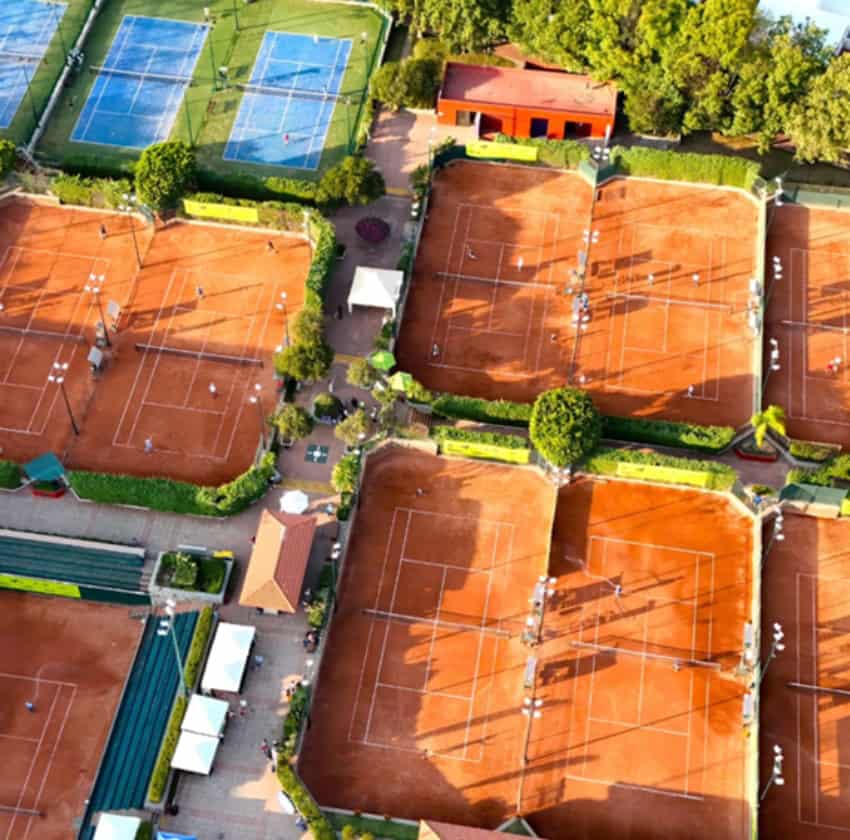
Atlas Colomos is a tennis paradise in Guadalajara, with 20 tennis courts on a sprawling campus in Zapopan. (Atlas Colomos/Instagram)
We had three rounds of in-person interviews, first with the club’s general manager, then with a private investigator, and finally, with a longtime member over breakfast. At times, their questions were uncomfortably personal. My favorite: Do you have any tattoos?
The price to join
Reflecting Jalisco’s conservative culture, memberships are granted only to families, never to individuals. Officially, they say it’s because they’re a “family” club. The unofficial reason I’ve been told (hilariously) is that they wish to reduce the risk of infidelity. Once admitted, the monthly fees at Atlas Colomos are roughly 13,000 pesos per month (about US $780), with a separate annual assessment for special projects. Last year’s was 60,000 pesos.
Why does it cost so much?
Apart from the desire to maintain exclusivity, serious money is needed to fund improvements to the club’s facilities and pay wages to the massive number of employees that keeps the place running. This includes security guards, groundskeepers, gardeners, tennis pros, personal trainers, cleaning staff, locker room attendants, cooks, waiters, cashiers, event planners and, of course, the management.
Who joins these clubs?
Guadalajara’s elite country club members are businessmen, diplomats, doctors, lawyers, and plenty of women and children with inherited wealth. Plus, the occasional foreigner like me. Many hold credentials from prestigious universities abroad. A decent number speak foreign languages, including English, French and German.
The ladies I play tennis with are almost universally thin, fashionable and health-conscious. Most do not work. These “women of leisure” (WOL), as I like to call them, fill their days with sports, appointments with their masseuses, Botox treatments, shopping in Andares, long lunches and attending their children’s activities. Some have a social conscience and oversee charitable projects.
A tennis player at Club Atlas Colomos. (Atlas Colomos/Instagram)
Even though WOLs spend a ton of time outside under Guadalajara’s relentless sun, they’re rarely tan. This is because upper-class Mexican women go to extreme lengths to protect their fair skin, as it’s a sign of socioeconomic status.
Their typical tennis “uniform” consists of long sleeves, a visor, sunglasses, a tennis skirt and a thick slab of sunscreen. Some go even further — wearing face masks when playing. I have no idea how they can breathe.
Some WOLs chose not to have children; they dote on their pets instead. In Mexico’s ultra family-oriented culture, it feels like a radical act.
Life in an upper-class bubble
The wealthy Mexicans who populate these clubs have effectively walled themselves off from the rest of Mexican society.
They shuttle between their exclusive clubs, gated neighborhoods, private schools and private events, in the privacy of their luxury cars. A French woman I play tennis with, who’s married to a Mexican diplomat, describes it as living inside “a gilded cage.”
The Formula 1 Exhibition in Mexico City didn't last long, but it was memorable for those who got a chance to see it. (F1 Exhibition)
Grand Prix racing has finally reached Coyoacán, but not with any actual Grand Prix racing. Instead, Formula 1 is returning to Mexico City’s streets with its internationally renowned exposition, The Formula 1 Exhibition. It’s a historical and contemporary look at F1 in the form of an interactive gallery, which made its debut in Spain in 2023. And it’s bringing in thousands of Mexican F1 fans, who have established themselves as a passionate Grand Prix audience over the years, primarily through F1’s annual pilgrimage to Mexico City as part of the league’s World Championship series. With the arrival of the exhibition, fans are getting to learn about the sport’s history, technology and its social impacts up close.
Located inside the Yama Punto Museum — a museum dedicated to automotive fandom and culture, which is hidden on the third floor of a relatively generic mall on Mexico City’s southern end — the newly minted exhibit makes CDMX the ninth city in the world (and only the second in Latin America) to host the officially sponsored event. Having opened March 20, the space will display everything F1-related: driver lore, ephemera, racing simulators, engines, digitally customizable racer helmets, and of course, a few F1 cars themselves (including Mexican driver Checo Pérez’s Sauber C30 from 2011, the year he debuted in F1, signed by the man himself).
📣¡𝗡𝗨𝗘𝗩𝗔𝗦 𝗙𝗘𝗖𝗛𝗔𝗦 𝗲𝗻 𝗙𝟭® 𝐋𝗮 𝗘𝘅𝗵𝗶𝗯𝗶𝗰𝗶𝗼́𝗻 𝗲𝗻 𝗖𝗗𝗠𝗫!🇲🇽
Debido a la increíble demanda, con muchos días ya agotados, abrimos 2️⃣ nuevas fechas.
Upon entering, fans are asked to download The F1 Experience app on their smartphones. Doing so allows for a self-guided tour, in which an audio accompaniment for each section and gallery can be selected from the phone in various languages. It all begins with a snazzy video of high-intensity F1 moments throughout its 75 years (the inaugural World Championship Grand Prix occurred in 1950, at Silverstone Circuit in Northamptonshire, England, and has been running full speed ever since).
Afterwards, guests are lightly herded through a winding one-way path that covers the entirety of F1’s history: from its inception, to its evolution and main characters throughout each decade (there’s even a brief section about F1 as it has been portrayed in cinema; another on how the sport is incorporating more diversity through women driver programs; and one on the league’s focus on climate and energy sustainability). It’s not only about hairpin turns and high-octane speeds; the exhibit visibly provides a spectrum of information about F1 as a multidimensional entity that goes beyond the checkered flag.
Expect long lines and flocks of avid fans gathering around the museum’s items and artifacts to take photos and videos. There is a ticket option to circumvent some of the longer wait times to get into the actual exhibit, but once inside, it’s a waiting game to be able to get up close to some of the higher-demand attractions (particularly the actual race cars, of which there are a few spread out through the exhibit, from different time periods in F1’s existence). Overall, it’s manageable though, and one never feels at a standstill — there are six galleries, so you can always wander ahead and return to a former space.
Mexicans in Formula 1
Perhaps the coolest feature, though — which is exclusive to the Mexico City edition of The F1 Experience — is that it includes an entire gallery room dedicated solely to Mexicans in F1. It lists every Mexican driver who has ever competed in the sport (six total, ranging from the aforementioned Rodriguez brothers and Perez to Moisés Solana, Héctor Rebaque, and Esteban Gutiérrez) and gives a brief rundown of their racing backgrounds and accomplishments. There’s also a showcase that includes a trophy from Pedro Rodríguez’s 1970 first-place finish in Belgium and a replica of his 1963 helmet.
Maybe the best, and most random thing, though, is a magnum-sized bottle of Moet champagne that was poured out in celebration of Nigel Mansell’s 1992 victory in the Mexico Grand Prix; the bottle is signed by all three of the drivers who finished at the podium that afternoon. Next to that, there’s a race-worn outfit and helmet from Esteban Gutiérrez’s 2016 season with Haas. In addition, there’s a timeline of the sport’s introduction and development in Mexico, and a detailed map of the Autódromo Hermanos Rodríguez track. The Mexican-themed gallery covers a large amount of ground in a relatively compact space.
A growing interest
The rest of the exhibit is worthwhile and extensive. It’s also thoughtful. There’s a wall dedicated to former drivers who have passed away — either on the race track, or from natural causes — and the experience feels inviting and informative rather than being overly burdensome or too technical. All ages are welcome, and that’s apparent when going through the exhibit on a busy weekend afternoon: young girls wearing their favorite racer’s hat stand beside middle-aged men excitedly pointing out a detail to their friends, next to mothers fully dressed in a team outfit of choice, while couples are on a date.
The F1 Exhibition in Mexico City gave visitors a chance to imagine what it’s like to drive over 200 miles an hour. (F1 Exhibition)
It’s for new and old fans alike, and highlights the fact that there is a serious growing interest within Mexico — particularly Mexico City — surrounding F1 and all that it offers. It represents an aspirational kind of living, a sport that is by nature expensive and unforgiving, but as a result, offers a kind of status through fanship: for better or worse, it presents a luxurious appeal and refinement.
A test of skill
Regardless of your skill level behind the wheel or how long you’ve been an F1 petrol head, there’s a racing simulator for visitors to compete in, too. Before entering the exhibit, or upon leaving, if you prefer, you can take a seat in a makeshift F1 cockpit, put on your headphones, and go to town behind a virtually rendered 1,000-horsepower turbocharged engine on an official F1 track. Afterwards, your score will be posted among the afternoon’s other competitors. It’s a rare chance to prove to yourself that you have the drive to survive. And if nothing else, that experience alone is worth the cost of admission.
Alan Chazaro is the author of “This Is Not a Frank Ocean Cover Album,” “Piñata Theory” and “Notes From the Eastern Span of the Bay Bridge” (Ghost City Press, 2021). He is a graduate of June Jordan’s Poetry for the People program at UC Berkeley and a former Lawrence Ferlinghetti Fellow at the University of San Francisco. His writing can be found in GQ, NPR, The Guardian, L.A. Times and more. Originally from the San Francisco Bay Area, he is currently based in Veracruz.
One of the main reasons for the rapidly improving confidence in Mexico's ability to attract foreign investment is its partnership with Canada and the United States in the USMCA free trade deal. (Carlos Aranda/Unsplash)
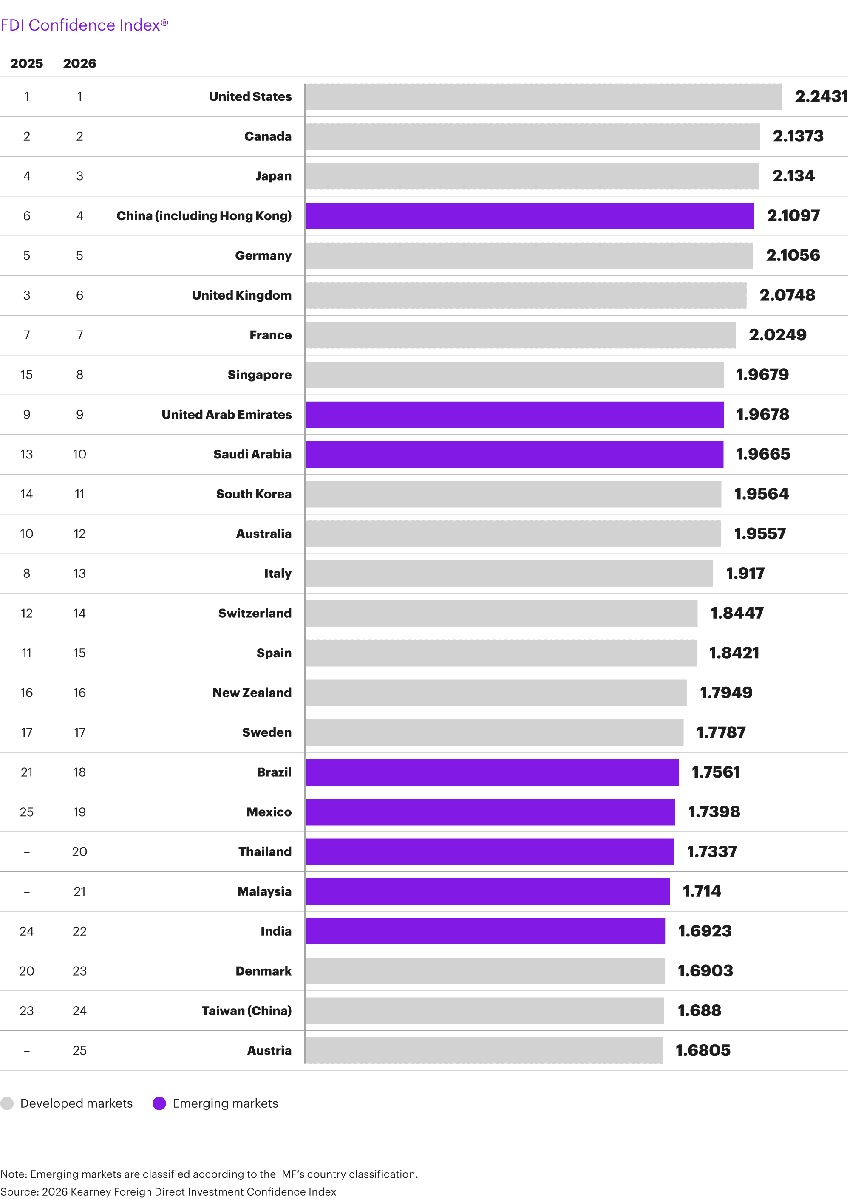
Mexico climbed six places in Kearney’s 2026 Foreign Direct Investment Confidence Index (FDICI), consolidating its position as one of the two fastest-growing markets in the world ranking.
Mexico rose from 25th to 19th in the index released on Thursday, while its two North American trade partners — the United States and Canada — came in first and second, respectively.
Gerardo Rocha, managing partner of Kearney México, said among the reasons Mexico gained ground in this year’s rankings is because it is part of a large regional platform alongside the U.S. and Canada.
Rocha said the improvement can also be attributed to “a favorable inertia driven by the reconfiguration of supply chains” — a trend commonly known as nearshoring — “and the optimism of senior business leaders.”
Rounding out the top five, Japan moved up from fourth to third, China leap-frogged from sixth to fourth, while Germany remained in fifth place.
The FDICI conducted by Kearney — a leading global management consulting firm — is an annual survey of global business executives that ranks markets most likely to attract foreign direct investment (FDI) over the next three years.
According to PR Newswire, the 2026 Index “reflects a global investment environment shaped by intensifying geopolitical tensions, expanding industrial policy and accelerating technological competition.”
Mexico’s advantages and challenges
From 2020 through 2023, Mexico was not included in the FDICI — which only ranks the Top 25 nations — but it returned in 2024 as the 21st most attractive economy for FDI. It slipped to No. 25 in last year’s ranking.
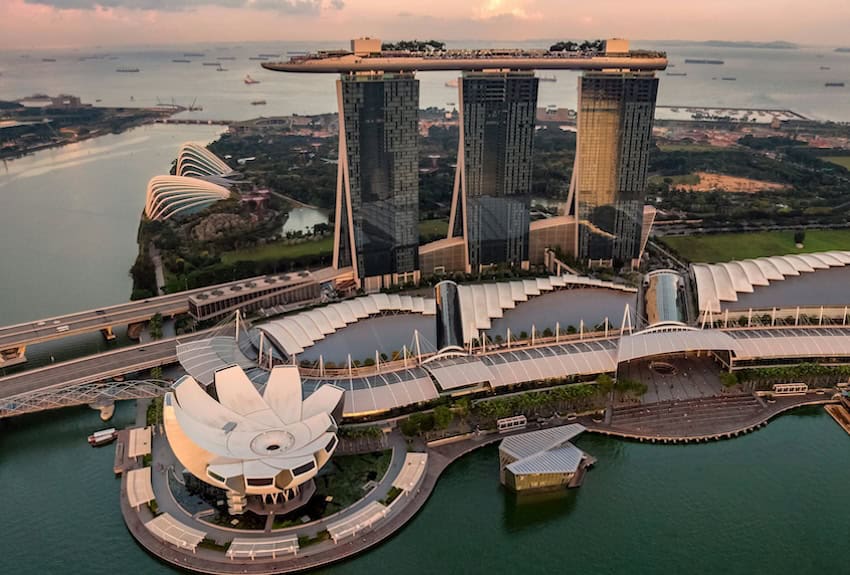
Its six-spot leap in this year’s index — driven by a record FDI haul of $40.87 billion last year — was only exceeded by Singapore, which climbed seven spots from 15th to 8th.
In the face of a prevailing global climate of uncertainty, Rocha said Mexico maintains competitive advantages over other nations, although certain challenges must be overcome to convert this confidence into reality.
Mexico’s Manufacturing, Maquiladora and Export Service Industry program is also attractive to investors as it allows foreign manufacturers to temporarily import raw materials, machinery and components duty-free for production, provided the finished goods are exported.
Singapore is the only nation improving as quickly as Mexico in foreign direct investment confidence. (Hu Chen/Unsplash)
The survey found that the most attractive sector for investment in Mexico is telecommunications, while aerospace and defense, transportation, primary goods, information technology, health and pharmaceuticals, heavy industry and financial services also found favor among those surveyed.
As for challenges, technological innovation is the greatest concern. Mexico was found to rank at the bottom of this indicator within the Top 25.
The FDICI found that technological and innovation capabilities are the most important factors influencing where companies choose to invest, surpassing traditional considerations such as regulatory reliability and domestic economic performance.
As such, Mexico must look to strengthen investment incentives and increase competitiveness, particularly through technological innovation.
Other priorities are the need to increase regulatory efficiency and provide greater legal certainty to property rights.
It was the second blaze in less than a month at the Olmeca (Dos Bocas) refinery, but this time there were no casualties. (Veracruz Gov. Rocio Nahle García/Facebook)
For the second time in less than a month, a blaze was reported at Mexico’s newest oil refinery, where 150 “emergency specialists” were able to douse the flames on Thursday.
State oil company Pemex confirmed the incident at the Olmeca refinery on the Gulf Coast in the state of Tabasco, though it did not offer specifics on the damage or possible cause of the fire at the site’s coke storage warehouse.
🚨 #ÚLTIMAHORA | Reportan incendio en bodega de la refinería Dos Bocas, Tabasco
Un incendio se registró este jueves en la bodega de Coque de la refinería Olmeca de Dos Bocas, informó Petróleos Mexicanos Pemex, sin que hasta el momento se reporten personas lesionadas.
Coke is a carbon-rich fuel used industrially in steel mills and foundries, though it is difficult to sell on international markets due to its high pollutant content.
The newspaper La Jornada reported that neighbors alerted authorities to the conflagration in the early afternoon and a column of smoke could be seen as far away as the town of Paraíso, about 5 kilometers from the Olmeca refinery, also known as Dos Bocas.
In a social media post, Pemex reported that Rodriguez visited the refinery on Friday and was “leading on-site coordination and personally directing the actions to normalize operations for the handling of petroleum coke.”
The refinery is said to be “operating normally” and “all risks have been eliminated.”
The refinery — built to help reduce Mexico’s dependence on fuel imports — cost US $21 billion, more than double its original budget of US $8.8 billion.
According to the Reuters news agency, Dos Bocas “has experienced a series of operating problems including stoppages, and has failed to meet the production targets promised upon inauguration.”
Earlier this week, Pemex was forced to address reports of a potential gas leak at Dos Bocas the day after an emergency response drill was held at the complex. Pemex said the supposed gas observed was actually water vapor emitted as the result of maintenance work.
“It poses no risk to the community, on-site personnel, or the environment,” the company said on Tuesday.
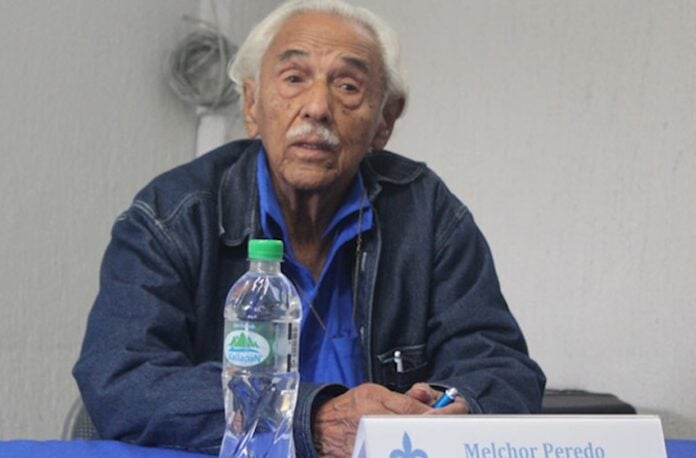
Melchor Peredo (1927-2026), a student of Rivera, Orozco and Siqueiros, promoted not only his own art but Mexican muralism in general. (Universidad de Veracruz)
Melchor Peredo García, considered the last living representative of Mexican muralism and a student of Diego Rivera, José Clemente Orozco and David Alfaro Siqueiros, died early Wednesday in Xalapa, Veracruz. He was 99.
His partner, Lourdes Hernández Quiñones, confirmed the death in a Facebook post cited by several sources.
“Melchor Peredo, my life partner, has just passed away,” she wrote. “A muralist, before being a painter, an artist with a creative vision. Today he flies high, already in an infinite sky of light and color.”
Peredo died of a stroke and kidney complications at his Xalapa home, surrounded by family and friends, the newspaper La Jornada reported. Hernández told outlets Peredo had a urinary problem that progressed to severe dehydration.
Born Jan. 6, 1927, in Mexico City, Peredo studied under Rivera, Orozco and Siqueiros, training at “La Esmeralda” (the National School of Painting, Sculpture and Engraving) and other prestigious Mexican institutions.
He created at least 25 murals across Mexico, the United States, France and Canada.
His major domestic works include titles that translate to “Heroic Resistance of the Veracruz People Against the Invasions” (1979–1980) in Veracruz’s Government Palace and “A Continuous Revolution” (2010) in Xalapa City Hall.
International commissions took his work to the Université Paris-Est Créteil, Clemson University in South Carolina and Southern Arkansas University.
An expert in fresco painting, Peredo often worked with a bamboo cane more than 10 meters long or from scaffolding at great heights. He also developed an innovative method of applying murals on cement panels, allowing works to be moved and exhibited in multiple locations.
Peredo described his art as “a continuation of Mexican muralism in its nationalist characteristics, but also humanist, democratic and if you will, socialist,” in a 2018 interview with EFE.
When asked that year whether muralism was dead in Mexico, he replied: “As long as I’m not dead, muralism isn’t dead.”
He stayed combative to the end. In January, Peredo publicly protested after Mexico’s Tax Administration Service (SAT) demanded he produce a mural — worth an estimated 200,000 pesos (US $11,560) — to settle a tax debt of just 32,000 pesos (US $1,849) under a payment-in-kind program for artists, La Jornada reported.
At the time of his death, he was awaiting publication of his book “A Revolution Continues,” a project six years in the making to be published by the Veracruz Ministry of Culture.
En el Palacio de Gobierno se encuentran las obras del maestro muralista Melchor Peredo, xalapeño que trabajó con gran dedicación. Hoy rendimos homenaje y expresamos nuestro pésame a su familia; pronto podrán contemplar sus obras. pic.twitter.com/VUeYFgT4u5
Veracruz Gov. Rocío Nahle announced that the currently under-renovation Government Palace, which houses several of Peredo’s murals, will at some point open to the public in his honor.
In a loosely translated video interview, Hernández said, “Unlike many painters of the Mexican muralist movement, he was a man who always valued everything popular in our country — all manifestations of popular art . . .
“I believe that his value does not lie solely in the work he did — particularly in Xalapa, where he did most of his mural work — but also in the fact he was a man concerned with spreading muralism.”
Mexico's Universal Health Service will start issuing credentials on Monday. The cards will allow citizens and eligible foreign residents to access health care at any public health institution starting in January 2027. (Presidencia)
President Claudia Sheinbaum signed a presidential decree on April 7 formally creating Mexico’s Universal Health Service (Servicio Universal de Salud), marking what she called “a historic step” toward guaranteeing free public health care for all Mexicans regardless of which institution they are affiliated with.
Registration for the new health care credential begins April 13, starting with Mexicans aged 85 and older. Sign-ups will continue through April 30, organized by age group and the first letter of registrants’ last names, at 2,059 Welfare Ministry modules located across the country.
The card will serve as an official form of identification and will eventually replace existing IMSS and ISSSTE membership cards. Deputy Health Minister Eduardo Clark said the credential is “the guarantee of the right to health care” for Mexican citizens and eligible foreign residents. It will include the holder’s name, CURP national ID code, blood type, organ donation information, and two QR codes that indicate the holder’s affiliated health provider and nearest clinic.
The long-term goal of the Universal Health Service is to allow any Mexican to seek treatment at any public health institution — IMSS, IMSS Bienestar, or ISSSTE — regardless of affiliation. That cross-institutional care is set to begin in phases starting January 1, 2027, initially covering emergency care, high-risk pregnancies, heart attacks, strokes, and breast cancer diagnosis.
A companion mobile app is also planned. In 2026 it will offer a digital version of the card and real-time information on nearby health facilities; by 2027 it will add appointment scheduling, medical history, and AI-assisted teleconsultation.
To register, Mexicans need to bring a government-issued photo ID, a certified CURP, proof of address from within the last six months, and a contact phone number. Modules are open Monday through Saturday from 9 a.m. to 5 p.m. Citizens and residents can find their nearest registration location at gob.mx/bienestar.
Mexico News Daily
This story contains press release summaries generated by Claude. It has been revised and fact-checked by a Mexico News Daily staff editor.