Home Blog Page 675

What does it meme? This week’s selection of Mexican memes

6
Laugh out loud with these Mexican memes.

If you’re on a quest to understand Mexican humor – or at least to find the best Mexican memes to share with your friends – we’ve got you covered! Here’s this week’s curated collection with a translation, background, any relevance to current events, and hopefully, a good chuckle.

Meme translation: “Apartment for rent five minutes from the beach; if you trip, it’s only one minute!”

What does it meme?: Basically, to be cautious when getting excited about rental listings! Seriously, though: I often joke that “safety third!” is Mexico’s official motto when it comes to building everything from public infrastructure to private homes, and this photograph proves the rule. 

Mexicans, of course, take this kind of thing in stride: unlike the U.S. where the builder of something like this would get sued fairly quickly, the prevailing wisdom in Mexico is simply, “Well, watch where you’re going!”

Meme translation: “Well, well, another pregnant lady on Earth! Woosh, woosh, take that, you little brat!” → “Aha! You can’t hurt my child, I’m wearing a red ribbon, and some safety pins just in case. Double protection!”

What does it meme?: Every culture has superstitions around pregnancy (and everything else, I guess), and this is a prominent one in Mexico: if you’re pregnant during a solar eclipse, then you need some extra protection to keep the phenomenon from hurting the fetus. What protection do you need, you might ask? Why, a red ribbon tied around your pregnant belly of course, and safety pins (or at least something metal) for good measure. It sounds pretty wild to most people, but if you think about it, we all have our superstitions and rituals to guard against what often feels like the random and uncontrollable cruelty of nature at large.

Meme translation: “OBJECTIVE: Go running every morning.” → “OBSTACLE: Running is what cowards do.”

What does it meme?: If you need an excuse to not exercise, look no further – you can simply claim you’re brave! Like everyone everywhere, excuses for avoiding exercises are the absolute easiest to come up with.

Meme translation: “I only spent $30 (about $2 USD) on breakfast at the market, and instead of spending $250 ($15 USD) on an Uber, I took the bus…Now I have diarrhea and I’m lost.”

What does it meme?: In Mexico (depending on where you live of course), it’s possible for 10,000 pesos to be enough for the month, and for 100,000 pesos to be not nearly enough for the month. While some of that depends on location, much of it depends on lifestyle.

If you’re not used to eating in places that may or may not have excellent sanitary ratings, doing so can be both an adventure and a risk. And before boarding a bus, be sure to ask where it goes…and perhaps ask the conductor or a fellow passenger to let you know where to get off for good measure!

Meme translation: “Spotify: I’m sorry, you were off by one letter, we can’t find that song.” → “YouTube: endaaaaaaa iaaaaaa…”

What does it meme?: There’s a whole genre of funny videos and audios of people requesting English-language songs with the lyrics of what they think is being said in Spanish. But some people (and apps) are better at guessing than others! Here, we sing the praises of YouTube over Spotify search engines!

Meme translation: “All people know how to do is complain instead of enjoying everything the country has to offer.”

What does it meme?: Ask a Mexican what, on a philosophical level, Mexico’s problem is, and quite a few will point out the collective Mexican psyche, usually calling it “hypocritical.” “People complain about everything but they’re perfectly happy contributing to the problems,” they might say…follow them down this road of reflection, and they’ll usually admit to doing the same.

But sometimes, there’s a moment of clarity and appreciation for what’s special about their lives…and this fabulous meme is a spoof on that.

Meme translation: “My mom: go to the store to see if there are any nochebuenas (the word for poinsettias in Spanish), and bring some home if there are.” → “Me, back from the store.”

What does it meme?: If you’ve been in Mexico around Christmastime, you might know about one of its famous seasonal beers, which shares its name with the famous seasonal plant (and native plant to Mexico!), the poinsettia. And unlike other places in North America, it’s plenty common to send your kids to the store to fetch some beer!

Noche Buena is made by Bohemia, which is my favorite commercial beer here (that’s saying a lot, as I’m kind of an insufferable beer snob). It’s heavy and alcoholic, a good way to warm up on some cold winter nights that just hit different in the absence of central climate control. Just be sure to drink it earlier rather than later in the season – unlike wine, beer is best enjoyed fresh!

Thankfully, showing up with a case of this instead of a plant won’t likely anger too many people.

Sarah DeVries is a writer and translator based in Xalapa, Veracruz. She can be reached through her website, sarahedevries.substack.com.

Would you drink tap water in Mexico? This official had little choice

7
The head of Jalisco's water department was put on the spot during a congressional meeting this week. (@Mariomarlo/X)

To drink or not to drink? The answer in Mexico more often than not is no.

You got it, we’re talking about humble (unfiltered) tap water.

The drinkability (or otherwise) of tap water in the metropolitan area of Guadalajara came up on Friday during an appearance in the Jalisco Congress of the director of the state’s Inter-municipal System of Potable Water and Sewage Services, or SIAPA.

During a grilling from lawmakers over dirty tap water in Guadalajara and other issues, Carlos Enrique Torres Lugo was presented with a challenge by Congresswoman Mara Robles.

Would he drink a glass of water from a faucet connected to the very water system he oversees?

“I went to the kitchen on the second floor of this Congress building and filled a jug of water from the faucet for both of us,” Robles said.

“Can you assure me that we can drink water from the faucet with complete certainty that it is potable?”

Torres nodded, prompting Robles to pour two glasses of congressional tap water, which looked clean enough – at least to the naked eye. And then – after clinking glasses – the lawmaker and the water director drank. Neither displayed any immediate ill effects.

Dirty water has been reported in more than 50 neighborhoods of Guadalajara since July, and residents continue to share evidence online. (@lizcampe/X)

“It’s the first time this has happened!” Robles exclaimed, apparently indicating that Torres isn’t the first water official she has challenged to drink a glass of tap water.

She later joked that they’ll both need to get medical checkups to ensure that they haven’t contracted an illness from drinking the Guadalajara water.

Tap water quality varies across Mexico – as do opinions about whether it is safe to drink – and contamination is caused by different things in different parts of the country.

Choosing to drink tap water or not in Mexico is obviously a personal decision, but in case you’re looking for some advice, the Mexican Association for Correct Hydration, a non-government organization that monitors water quality, “emphatically” advises against it, according to a report by the El Financiero newspaper.

There just may be a reason why bottled water is so popular here.

With reports from Informador and Mural 

Rescuers and vets help dogs and cats affected by Hurricane Otis

1
Four adult dogs and eight puppies were rescued from the rubble in Acapulco this week. (@rbksokol/X)

The Animal Protection Brigade (BVA) of Mexico City and other organizations have estimated that up to 100,000 dogs and cats are homeless in Acapulco, more than two weeks after Hurricane Otis hit.

Despite the sad situation, one story of hope emerged this week: a report that some members of the BVA went on a mission to the Guerrero port city and returned home with 12 rescued dogs.

An estimated 100,000 dogs and cats are homeless in Acapulco after Hurricane Otis devastated the city. (@rbksokol/X)

Four dogs and eight puppies will be rehabilitated and cared for by specialists in the Mexican capital, and then hopefully put up for adoption, said Leticia Varela, former head of the BVA. 

Varela said some BVA members remained in Acapulco to hand out food to pet owners affected by the Category 5 hurricane that made landfall Oct. 25, and to provide medical attention to animals that need it.

“We will return soon to support the nonprofits and individuals who, in the face of the Otis emergency, continue to do the impossible for the animals,” Varela wrote on social media.

The post includes a 63-second video of dogs, including Stinky and Abu, who were rescued by brigade members. One of the rescued dogs, Cuca, suffered severe damage to one of her front legs and will receive specialized care before being put up for adoption. Abu also arrived on Wednesday in bad condition, still very nervous.
The rescues will be rehabilitated and put up for adoption in Mexico City. (@rbksokol/X)

Varela also reported this week that her team found 60 dead dogs in areas affected by the hurricane, which had winds that reached up to 260 km/h (162 mph). At least 48 human fatalities are being reported, along with an estimated damage of at least 26.5 billion pesos (US $11.5 billion).

In addition to dogs and cats, horses, chickens and other animals were also victims of Otis, some by drowning and others by factors related to the storm. Many animals that have become lost or were already living on the street are now malnourished.

“Especially here in the Renacimiento neighborhood, since there is a lot of dust, a lot of humidity,” said veterinarian Andrés Martínez Ángeles. He has been lowering the prices of his pet medicine so people can afford it and offering his services free of charge, he added.

BVA has said that people will be able to adopt the rescued animals after they are treated and rehabilitated.

For more details on adoption, click here or visit the BVA Instagram page.

With reports from Milenio and Infobae

Peso weakens then rallies after central bank interest rate decision

3
Uncut sheets of 500-peso bills
Mexican pesos at the national bank's Mexico City currency printing plant. (Isabel Mateos / Cuartoscuro.com)

The Mexican peso rallied on Friday after depreciating to close to 18 to the US dollar in early morning trading.

Bloomberg data shows that the peso fell to a low of 17.92 to the greenback early Friday, but it had improved to 17.64 to the dollar by 3:30 p.m. Mexico City time.

The peso’s recovery to that level came after the currency closed at 17.81 to the dollar on Thursday, a depreciation of 1.4% compared to its position 24 hours earlier.

The slide came after the Bank of México (Banxico) announced that its board had decided to maintain its key interest rate at a record high of 11.25%.

The newspaper El Economista reported that the peso depreciated on Thursday due to a “less restrictive tone” in the central bank’s monetary policy statement, suggesting that rates will remain at the current level for less time than previously anticipated.

Banxico said in previous statements that its board believed that rates would have to be maintained at 11.25% for “an extended period” in order to achieve “an orderly and sustained convergence of headline inflation to the 3% target.”

The Bank of Mexico building in Mexico City
Banxico said the current record-high interest rates will continue for “some time” to meet its goals to limit inflation. (Shutterstock)
On Thursday, the bank — after acknowledging that inflation is decreasing — adjusted its language slightly, saying that “the reference rate must be maintained at its current level for some time.”

Hence, a first cut to the record high 11.25% rate could come sooner than previously expected.
El Economista said that the weakening of the peso on Thursday was the largest of three depreciations of the currency following Bank of Mexico monetary policy announcements this year.

Gabriela Siller, director of economic analysis at Banco Base, said that remarks on Thursday from the chair of the United States Federal Reserve, Jerome Powell, also had an impact on the peso.

A stock photo of pesos and dollar bills and coins.
The peso fell to almost 18 to a dollar Friday morning before rebounding. (Shutterstock)

Powell said that the Fed’s Federal Open Market Committee “is not confident” that it has achieved “a stance of monetary policy that is sufficiently restrictive to bring inflation down to 2% over time.”

His remarks raised the prospect that the Fed could increase rates from their current 5.25%-5.5% level.

The Mexican peso has benefited this year from the significant difference between interest rates here and those north of the border. An increase in the U.S. would reduce the differential between the two rates and likely cause the peso to depreciate.

So why did the peso rebound on Friday after sinking to close to 18?

According to Janneth Quiroz, director of analysis at the Monex financial group, the peso benefited from a general weakening of the greenback on Friday morning.

The DXY index, which measures the value of the dollar against a basket of foreign currencies, remained below its closing position on Thursday at 3:30 p.m. Friday.

Despite strengthening on Friday, the peso was on track to record a slight depreciation this week after closing at 17.46 to the dollar last Friday.

Last week was a good one for the Mexican currency, prompting President López Obrador to declare last Friday that the “super peso” was back.

With reports from El Economista

Foreign direct investment in Mexico hits record high

0
A man and woman wearing safety goggles operate heavy machinery.
Automakers, like this Audi manufacturing plant in Puebla, are one of the top industries drawing foreign direct investment in Mexico. (Shutterstock)

Foreign direct investment (FDI) reached a record high of almost US $33 billion in the first nine months of 2023, according to preliminary government data published this week.

The Economy Ministry (SE) reported Wednesday that FDI was $32.9 billion between January and September, a 30% increase compared to the same period of last year if spending on the Televisa-Univisión merger and the restructuring of Aeroméxico is excluded from the investment total.

If the investment on the merger and restructuring is included, the increase is 2.4%.

Foreign investment in Mexico has steadily trended upwards this century. FDI in the first three quarters of 2023 is over 200% higher than in the same period of 2006, 129% above the 2010 level, 52% higher than in 2015 and 40% above the 2020 level.

What contributed to Mexico’s FDI total in the first nine months of 2023?

To be precise, FDI in Mexico between January and September was $32.926 billion, according to the preliminary data. A total of just over $29 billion was reported after the first six months of the year, meaning that Q3 FDI was only about $4 billion.

BMW plant in San Luis Potosi, Mexico
A worker puts together a sedan at the German-owned BMW plant in San Luis Potosí. (BMW)

The SE said that the investment in the first three quarters of 2023 came from 4,008 trust agreements, 2,539 Mexican companies backed by foreign companies and one foreign entity.

The majority of the FDI — 76% — came from reinvestment of profits, while 16% came from loans and payments between companies and 8% was new investment.

The SE said that the FDI total to the end of the third quarter is the “result of the confidence of foreign investors due to the good business environment and economic stability of the country.”

Which countries are the biggest investors in Mexico?

U.S. and Mexico flags
The U.S. is the country with the most foreign direct investment in Mexico.(Shutterstock)

Just over two-fifths of the total FDI in Mexico in the first nine months of the year — 41% or $13.5 billion — came from the United States.

Spain ranked second, investing $3.7 billion or 11% of the FDI total in Mexico between January and September.

Ranking third to tenth for FDI in Mexico in the first three quarters of 2023 were:

  • Germany, $2.8 billion, 9% of the FDI total.
  • Argentina, $2.5 billion, 7%
  • Japan, $2.4 billion, 7%
  • Canada, $2.2 billion, 7%
  • United Kingdom, $1 billion, 3%
  • Netherlands, $600 million, 2%
  • France, $500 milion, 1.5%
  • Switzerland, $500 million, 1.5%

Which Mexican states attracted the most FDI? 

The SE reported that 58% of FDI to the end of Q3 went to just five of Mexico’s 32 federal entities.

A crowded street in downtown Mexico City
In the first 9 months of this year, the majority of foreign direct investment went to Mexico City. (Jezael Melgoza/Unsplash)

Mexico City was the clear winner. FDI in the capital was $10.58 billion, or 32% of the total between January and September.

The northern state of Nuevo León ranked second with $2.82 billion, or 9% of the FDI total.

That monetary figure is dwarfed by the combined investment amount of foreign companies that have announced plans this year to build plants in Nuevo León. In the space of just a few days last month, Governor Samuel García announced investments from Asian companies totaling more than $6 billion.

It appears that much of the investment in Nuevo León announced this year — including that linked to Tesla’s gigafactory plan — has not yet begun flowing into the state.

Sonora attracted the third highest FDI amount — $2.53 billion, or 8% of the total — while Chihuahua ($1.51 billion) and México state ($1.47 billion) ranked fourth and fifth, respectively.

Which industries received the most FDI?

Over half of the FDI in the first nine months of the year — $17.5 billion or 53% — went to the manufacturing sector. Within that broad industry, 44% of investment went to the transport equipment sector, which includes automakers.

The remaining 56% of the $17.5 billion investment in manufacturing went to the following sectors: metal (14%); beverages and tobacco (13%); chemicals (8%); computer equipment (5%); energy generation equipment (5%); plastic and rubber (3%); food (3%); machinery (1%); other manufacturing industries (4%).

The financial services industry was the second largest recipient of FDI, attracting $7.2 billion or 22% of the total between January and September.

GM truck
The transport equipment sector, which includes automakers, received more foreign direct investment than any other sector during the first nine months of the year. (General Motors)

The mining industry ranked third, receiving $2.9 billion or 9% of total FDI, followed by the following sectors:

  • Temporary accommodation (hotels, Airbnb, etc.), $2.2 billion, or 7% of the total
  • Transport, $1.3 billion, 4%
  • Construction, $759 million, 2%
  • Wholesale retail, $582 million, 2%

Is the low level of new investment a cause for concern?

As noted above, only 8% of the FDI total in the first nine months of the year is new investment.

That figure is one percentage point higher than the reading after the first two quarters of 2023, but the new investment monetary total — $2.8 billion — is the lowest for the first nine months of a year since 2014 and represents a decline of 80% compared to the first three quarters of 2022.

Gabriela Siller, director of economic analysis at Mexican bank Banco Base, said that the new investment data indicates that Mexico is not taking full advantage of the nearshoring opportunity.

Heavy machinery in a mine in the mountains
The mining industry also draws large amounts of foreign direct investment, including $2.9 billion this year as of the end of September. (Alamos Gold)

On Imagen Televisión, financial reporter David Páramo noted that not much “fresh” investment came into Mexico in the first nine months of the year.

“Mexico, in these times of relocation, in these times of improvement of global conditions, should be attracting a lot more foreign direct investment,” he said, noting that more money flows into the country in remittances than in FDI.

Páramo said that Mexico has “a great opportunity” to benefit from the relocation of foreign companies, but is not taking full advantage. It could be on the crest of the nearshoring “wave” but is only “in the middle,” he said, describing Mexico’s performance in attracting FDI as “mediocre.”

Some other observers also believe that Mexico runs the risk of missing its nearshoring opportunity, or at least not taking full advantage of it, for a variety of reasons.

Numerous foreign companies have recently announced that they will establish a presence in Mexico, but a lot of their proposed investment is still in the pipeline. Tesla, for example, announced in March that it will build a large plant in Nuevo León that is expected to entail investment of some $10 billion, but construction isn’t slated to start until early next year.

President López Obrador’s reaction to the latest FDI data

A profile photo of Mexican president AMLO
The president discussed the preliminary data on foreign direct investment at his Thursday morning press conference. (lopezobrador.org.mx)

“The foreign investment data just came out, it’s a record,” López Obrador noted at his Thursday morning press conference.

He said that FDI creates jobs before asserting that Mexico has one of the lowest unemployment rates in the world, although many Mexicans — over half the total workforce — work in the informal sector.

López Obrador also noted that the Mexican peso remains strong. Analysts have cited strong incoming flows of foreign capital to Mexico as one factor that has helped the peso appreciate markedly this year.

López Obrador has frequently described investment conditions in Mexico as “unbeatable.”

“Mexico is among the countries … with the most advantages for foreign investment because it has a trade agreement that allows what is produced in Mexico to be exported to the United States and Canada [tariff-free]. That’s why a lot of investment is arriving and the forecast is that Mexico is going to grow a lot more than other countries,” he said earlier this year.

With reports from El Finaniciero

Catching the Mexican beat: 3 common phrases around time

22
Ahorita llego (I’ll be there soon, ahorita almost never means now) (Freepik)

If you’ve heard something along the lines you will read below, you know what I’m talking about. In Mexico, if a dinner invitation is at 7 p.m., Mexicans will most likely show up around 8 – or even 10 if you’ve invited my aunt. I’m generalizing, but trust me, I’ve been there. 

It’s important to note that not all Mexicans are unpunctual. I am one of those few for whom punctuality is extremely important. I used to get super upset if I were five minutes late, a trait that might have stemmed from childhood experiences of thinking none of my friends would attend my birthday parties. Little did I know, their moms just didn’t want to be the first ones to arrive, partially to avoid having to help glue the last balloon on the entrance door, place the napkins on the tables, and sit by themselves, waiting for everybody else to show up. 

What’s even funnier is that it’s almost like everybody agrees to get there 40 minutes after the established time and come all at once. But here’s the kicker: the hosts aren’t ready either! They’re either missing the sodas, the plastic glasses, or some more ice, or they’re still getting their makeup done!

However, as with everything in life, there’s a big lesson to learn behind the little annoyances. I understood that the stress I felt was created by living in my own reality because the people around me were living in a different one, with their own sense of timing.

So, I decided to stop stressing and started living life in a more laid-back way. My best advice is simply to accept the culture as it is and send a special invitation to your Mexican friends. If you want them to arrive at 5 p.m., the invitation should say they should be there at 3 p.m. This way, you’ll have your punctual friends arriving at 5 and your not-so-punctual friends arriving at 5, too (you know who they are). It’s all about finding that perfect balance between our expectations and Mexican time’s wonderful, unique rhythm. After all, embracing these quirks makes our cultural experiences all the more colorful and memorable!

Before I go…Here are three common Mexican phrases around time you will surely hear at some point during your time in Mexico. 

  1. “¡Ya voy para allá!” (I’m on my way) 
  2. “Ahorita llego” (I’ll be there soon, ahorita almost never means soon)
  3. “Hay un buen de tráfico” (there is a lot of traffic) 

Paulina Gerez is a translator-interpreter, content creator, and founder of Crack The Code, a series of online courses focused on languages. Through her social media, she helps people see learning a language from another perspective through her fun experiences. Instagram: paulinagerezm / Tiktok: paugerez3 / YT: paulina gerez 

CITES to return to Mexico to monitor vaquita protection efforts

1
An endangered vaquita swimming in the ocean
Mexican authorities and scientists cautioned that more vaquitas may exist outside the survey area. (Paula Olson, NOAA/Wikimedia Commons)

The Standing Committee of the Convention on International Trade in Endangered Species (CITES) has resolved to send a third observation mission to Mexico, to monitor progress in the protection of the highly endangered vaquita porpoise.

The mission will also assess Mexico’s actions to prevent illegal totoaba fishing in the Gulf of California, the vaquita’s only habitat. The tiny porpoises often get tangled and drown in totoaba gillnets, which has caused their numbers to drop sharply: today, there are between 10 and 13 vaquitas in the wild.

A Navy patrol vessel monitoring for illegal fishing operations in the “zero tolerance zone,” inhabited by the critically endangered vaquita porpoise. (Semar/Cuartoscuro)

In March, CITES sanctioned Mexico for its failure to crack down on the illegal totoaba fishing that has driven the vaquita to the brink of extinction. Mexico sent a delegation to the committee’s headquarters in Geneva, where they negotiated with CITES officials to review and update an action plan, and succeeded in having the sanctions revoked.

The action plan’s goals include long-range video surveillance of the Zero Tolerance Zone for illegal fishing, intensifying maritime patrols, destroying illegal totoaba nets, monitoring the vaquita population and training authorities to recognize parts or derivatives of illegally-fished totoaba, which are also considered an endangered species.

Prior to the committee’s 77th meeting this week, cetacean experts from the International Union for the Conservation of Nature (IUCN) criticized CITES’ decision to endorse in advance Mexico’s report stating that many of the action plan’s goals had already been achieved.

“Our experts concluded that there is no evidence of the alleged reduction of the presence of gillnets in the Vaquita Refuge Zone, beyond the Zero Tolerance Zone, which is a very small portion of the species’ range,” IUCN spokesman Dr. Randall Reeves said. “This does not mean that the totoaba and the vaquita porpoise are more protected or that their populations are recovering.”

The observation mission to Mexico was announced during this week’s 77th meeting of the Standing Committee of the Convention on International Trade in Endangered Species (CITES). (@AWIOnline/X)

However, following an agreement signed last month, the conservation group Sea Shepherd is now collaborating with the Mexican Navy to expand the area monitored in the Gulf of California, using six high-range drones, sonar and radar systems.

“The area where fishing nets are not allowed is being expanded by 60%, when you look at the map this means about 140 square kilometers… this is critical because this is the area where vaquitas have been sighted, especially vaquita calves,” Pritam Singh, director of Sea Shepherd’s Board of Directors, told Milenio newspaper. 

“The government of Mexico has responded very quickly to this data that we have collected and that we have provided them; normally we see that in bureaucracies it takes a long time to implement actions, but in this case we have been pleasantly impressed by [the government’s] agility,” Singh added.

For its part, Mexico’s Environment Ministry (Semarnat) has insisted that there is an “international co-responsibility of transit and destination countries” for totoaba. Mexico’s delegation to CITES’ 77th meeting requested that the upcoming observation mission also visit the United States and China, where the totoaba fish’s coveted swim bladder is traded and sold.

Sea Shepherd
Sea Sheperd and the Mexican Navy have worked to enforce a ban on fishing in the protected region that forms the habitat of the Vaquita porpoise. A new agreement will expand the so-called “zero tolerance area.” (Sea Shepherd)

While it was not confirmed if such a visit would take place, the observation mission to Mexico and the delivery of conclusions on the actions carried out by Mexico are expected to be completed before February 2025.

With reports from La Lista, Excelsior and Milenio

The week in photos from Mexico: From Tijuana to Xalapa

2
Beach in Acapulco
Nov 8: Two weeks after Hurricane Otis, Acapulco residents have returned to the beaches for a respite as cleanup efforts continue. (GALO CAÑAS/CUARTOSCURO.COM)

Take a visual tour of the week in Mexico – from the Day of the Dead parade in Mexico City to the migrant caravan from Chiapas to the WTA finals in Cancún – with this selection of pictures from around the country.

Mexico City

Nov. 4: The massive Day of the Dead parade in Mexico City. (ROGELIO MORALES /CUARTOSCURO.COM)

Tenango del Valle, State of México

Nov. 6: A man watches a flock of sheep in the fields of San Francisco Putla. (CRISANTA ESPINOSA AGUILAR /CUARTOSCURO.COM)

Tijuana, Baja California

Nov. 6: Hundreds of people of all ages greeted the arrival of the giant marionette “Amal”, a representation of a Syrian refugee girl searching for a home, as she arrived at the Mexico-U.S. border. (OMAR MARTÍNEZ/ CUARTOSCURO.COM)

Puerto Vallarta, Jalisco

Nov. 6: The giant 28-meter tall Catrina of Puerto Vallarta was awarded the Guinness World Record for the second year in a row as the world’s tallest. (CORTESIA PROMOCIÓN TURISTICA DE PUERTO VALLARTA/CUARTOSCURO.COM)

Huixtla, Chiapas

Nov. 6: A large group of migrants from the caravan that departed Tapachula blocked a road in Chiapas to demand a dialogue with Mexican immigration authorities. (DAMIÁN SÁNCHEZ/CUARTOSCURO.COM)

Xalapa, Veracruz

Protesters in Xalapa
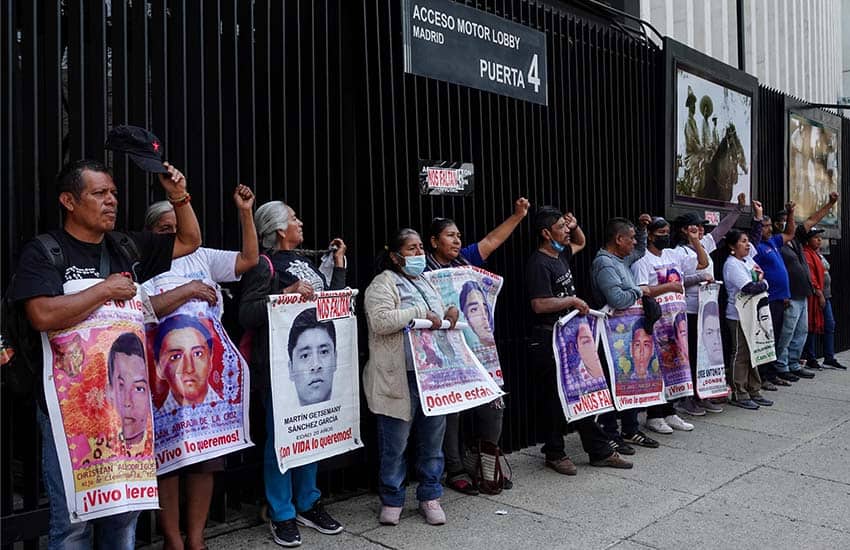
Nov. 6: Various search collectives protested in front of the Government Palace of Veracruz. They say the government has been negligent in efforts to find and identify their missing relatives. (YERANIA ROLÓN/CUARTOSCURO.COM)

Cancún, Quintana Roo

Nov. 6: The Polish player Iga Swiatek (left) won the WTA Finals in Cancún, becoming the world champion of women’s tennis. (CUARTOSCURO)

Las Vigas, Veracruz

Nov. 9: At “La Yerbabuena” ranch, the first Christmas tree of the season was cut this week. (YERANIA ROLÓN/CUARTOSCURO.COM)

‘They’re real’: Another UFO session held in Mexican Congress

2
In his second appearance before Congress, Jaime Maussan brought in x-rays and a group of researchers to affirm the bodies are "non-human." (Daniel Augosto/Cuartoscuro)

In a congressional hearing this week, Mexican journalist and UFO enthusiast Jaime Maussan and other researchers said that a pair of preserved specimens – presented in the Chamber of Deputies September as extraterrestrials – were real, once-living organisms.

However, they declined to certify that the mummified remains were those of alien beings.

Jaime Maussan and others around an alleged alien corpse
Journalist Jaime Maussan (second from left) drew global attention after testifying on extraterrestrial activity in the Chamber of Deputies and presenting what he alleged to be the corpses of aliens found in Peru. (Cuartoscuro)

The two tiny bodies with large heads, big eyes, long necks and three fingers on each hand — resembling the archetypal depiction of a gray alien — were allegedly found in Peru.

Maussan brought them to Congress on Sept. 13 for a first-of-its-kind hearing on UFOs, which these days are usually termed Unidentified Anomalous Phenomena (UAP), or FANI in Spanish. He insisted the bodies were 1,000-year-old corpses of extraterrestrials.

At that time, experts dismissed his presentation as a stunt, pointing to studies on similar remains that concluded the specimens were modified using animal and human bones.

On Tuesday, over the course of three hours in a room of the Chamber of Deputies, Maussan presented a string of doctors and scientists, plus photographs and X-ray images of what he called a new “non-human being.”

Jaime Maussan
Maussan is well known for his belief in extraterrestrial life, and has hosted a TV series on the topic for the last twenty years. (Daniel Augosto/Cuartoscuro)

“They’re real,” said anthropologist Roger Zúñiga of San Luis Gonzaga National University in Peru, noting that researchers had studied five similar specimens. “There was absolutely no human intervention in the physical and biological formation of these beings.”

Argentine surgeon Celestino Adolfo Piotto said he reviewed data and images, concluding that the bodies were an evolved version of today’s human beings. He called them “our descendants.”

Zúiñga presented a letter signed by 11 researchers from his university declaring the bodies to be non-human, but the letter made clear they were not implying the bodies were extraterrestrial.

“None of the scientists say [the study results] prove that they are extraterrestrials, but I go further,” Maussan said, suggesting that the bodies could be evidence of non-Earthly life forms, or a “new species” due to their lack of lungs or ribs.

He previously claimed the specimens had big brains and big eyes that “allowed for a wide stereoscopic vision,” and that they lacked teeth, so they likely only drank and did not chew.

“All ideas and all proposals will always be welcome,” Deputy Sergio Gutiérrez Luna stated, “to debate them, to listen to them and to agree — or not.” 

With reports from El Financiero and Reuters

Mexico’s most active volcano is sleeping…but not for long

6
The Power of Nature, photo taken at 2 kms from the Colima Volcano. (Sergio Tapiro)

The Colima Fire Volcano has erupted more than 30 times and is one of the most active volcanoes in the world.

Sometime in 1989, I received a curious request from a friend in Colima, living under the shadow of the Volcán de Colima, better known as the Colima fire volcano.

The 1989 expedition. The team arrives at the base of Colima Volcano. (John Pint)

“The fire volcano is starting to act up and we need volunteers to carry monitoring equipment to the top and into the crater. Please bring big backpacks, empty of course.”

The Colima fire volcano is Mexico’s most active volcano and one of the most active in the world: somehow, my friend knew that our little caving club wouldn’t say no. A few days later, our backpacks heavy with seismographs, heat sensors and transmitters, we began hiking up the steep volcano. Leading us was Dr. Charles B. Connor, today an eminent volcanologist at the University of South Florida.

As we climbed, Dr. Connor regaled us with cheerful tales of the unpredictability of volcanic eruptions.

On the rim of the inferno 

At last, we reached the crater rim. Below us lay Hades itself, all jagged rocks and fumaroles. We slowly made our way to the crater floor, where we unloaded our backpacks. Dr. Connor was soon busy installing his gear while the rest of us amused ourselves by placing sheets of paper in front of hot air vents and watching them burst into flame.

An hour later, most of us were groggy from breathing in who-knows-what-kind-of-vapors.

As we began our descent, I noticed for the first time that my nylon windbreaker had a huge hole in it: apparently a rock I had leaned against was hotter than it looked.

Why was I leaning against rocks? Because sitting is impossible in an environment where your shoes are liable to melt if you don’t watch carefully where you are standing. A few weeks later, lava surged up into the crater, vaporizing all that expensive equipment we had brought, and the volcano shifted from semi-dormant to active mode.

A melding of two volcanoes

The Volcán de Colima is located in western Mexico, about 80 kilometers from the Pacific coast. According to the United States Geological Survey, the Colima Volcanic Complex is a melding of two volcanoes: the older Nevado de Colima to the north, and the younger, more historically active Volcán de Colima the south. Separated by just 8 kilometers, the Volcán de Colima is slightly shorter than its sibling, rising 3960 meters to the Nevado de Colima’s 4330. Curiously, despite their names, both volcanoes are mostly located within the state of Jalisco. The Colima Volcano has erupted more than 30 times since 1576.

The Colima Volcanic Complex dominates the skyline in much of the state of Jalisco. The Nevado de Colima is on the left and the Volcán de Fuego on the right. (John Pint)

Geographer Tony Burton says that the volcano first erupted about five million years ago, although some say it was more like 15 thousand years ago. In more recent times, adds Burton, the volcano’s eruptions have taken a cyclical pattern, with periods of activity lasting about 50 years interspersed with periods of relative quiet.

“In each cycle,” says Burton, “the first results of renewed activity force new lava into the existing crater. Once the crater has filled up, any additional lava is ejected from the crater and flows down the volcano’s flanks. Later … activity ceases, and the volcano enters another dormant phase. Even during this phase, a plume of hot gas often billows out from the volcano.”

A fiery giant in the night

A few years after my visit to its crater, the volcano went back to sleep. In 2004, however, it was once again spurting lava, and I returned to Colima with the hope of photographing “el Fuego” in all its glory.

“We’ll camp in La María,” I told my wife, “where we’ll have a clear view of the action.”

La María is a charming little lake with cabins and plenty of space for camping. Although the monstrous volcano is only 10 km away, you can’t see it from La Maria itself because high walls surround the lake, so off we went into the dark of night. We started down the rustic road heading north toward the now-abandoned village of Yerba Buena, carrying a tripod and flashlights.

The first thing we ran into in the darkness was a cow. Just a few more steps down the road we heard an ominous and very deep rumble, which seemed to awaken a primal urge in us that said “The gods are angry— run for your lives!”

Another rumble and suddenly a bright red spray lit up the not-so-distant sky followed by the appearance of what looked like a river of lava streaming down one side of the volcano.“This is a perfect spot,” I said. “I’m going to set up the tripod.” 

A half-hour time exposure of the Colima Volcano from just outside La María, taken in 2004. (John Pint)

Once I had the camera on the tripod, ready for a time exposure, the rumbling stopped and so did the pyrotechnics. The sky was now dead black and there was no way I could be sure I had the entire volcano centered in the viewfinder.

Hoping for the best, I squeezed and locked my cable release, opening the shutter.

During the next half hour, the volcano roared again and again, and each time a red-hot stream appeared in a different place. I assumed at the time that these were rivers of lava, but I later learned they were actually incandescent rockfalls.

Finally, I closed the shutter, but, because I was using a film camera, I had no idea what I had captured. Only a week later did I discover that I had indeed pointed the camera at the right spot and was rewarded with a spectacular image of the Volcán de Fuego bathed in fire.

Time to reawaken

Today the volcano is dormant, but if you have an itch to photograph it in all its fiery splendor, you may wonder: how long will you have to wait? I put this question to volcanologist Nick Varley who is based in Colima city and regularly monitors the volcano.

“For the last seven years,” said Varley, “the fire volcano has been quiet, but past events tell us this volcano typically ‘sleeps’ for between five and thirteen years, suggesting that it may soon be rumbling and spitting lava again.”

If and when the fire volcano of Colima comes back to life, you can safely watch the show from just outside the hidden lake of La María, which you can easily reach by asking Google Maps to take you to Centro Ecoturistico Laguna La María, Colima. Driving time from Guadalajara is about three hours.

The writer has lived near Guadalajara, Jalisco, since 1985. His most recent book is Outdoors in Western Mexico, Volume Three. More of his writing can be found on his blog.