Ambulance at the scene where two of the victims were found alive. One was injured, according to authorities. (@AzucenaUresti Twitter)
Two of four United States citizens who came under fire and were kidnapped in Matamoros, Tamaulipas, last Friday, were found dead, the governor of the northern border state said Tuesday.
Américo Villarreal Anaya said that the other two U.S. citizens had also been located. One is wounded and the other is “alive,” he said during a call that was broadcast live during President López Obrador’s morning press conference.
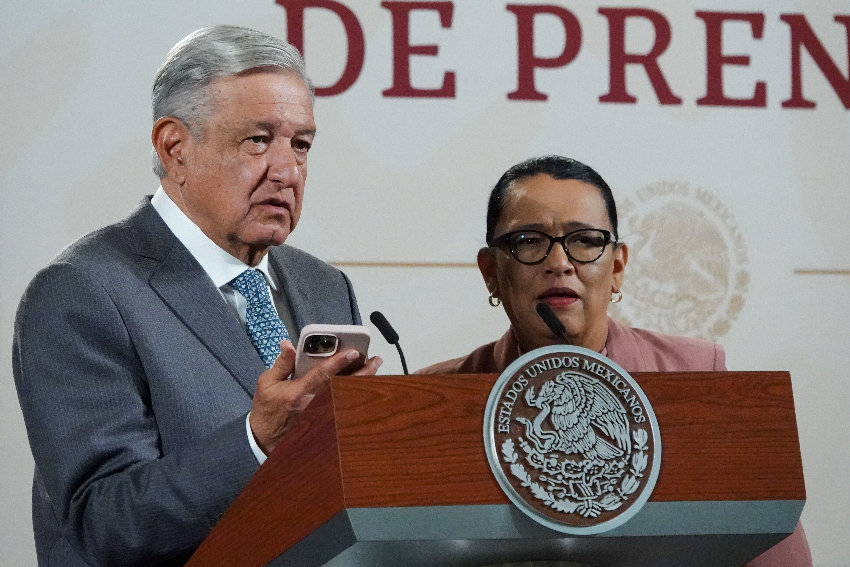
President López Obrador, with Security Minister Rosa Icela Rodríguez, took a call during the press conference from Tamaulipas governor Américo Villarreal. (Galo Cañas Rodríguez / Cuartoscuro.com)
Villarreal said that the Tamaulipas Attorney General’s Office had confirmed the discovery of the victims and the two deaths. He also said that ambulances and security forces were on their way to the unspecified location where they were found.
Security Minister Rosa Icela Rodríguez told López Obrador’s press conference that one person had been arrested in connection with the crime. She also said that Mexican authorities were collaborating with the FBI on the case.
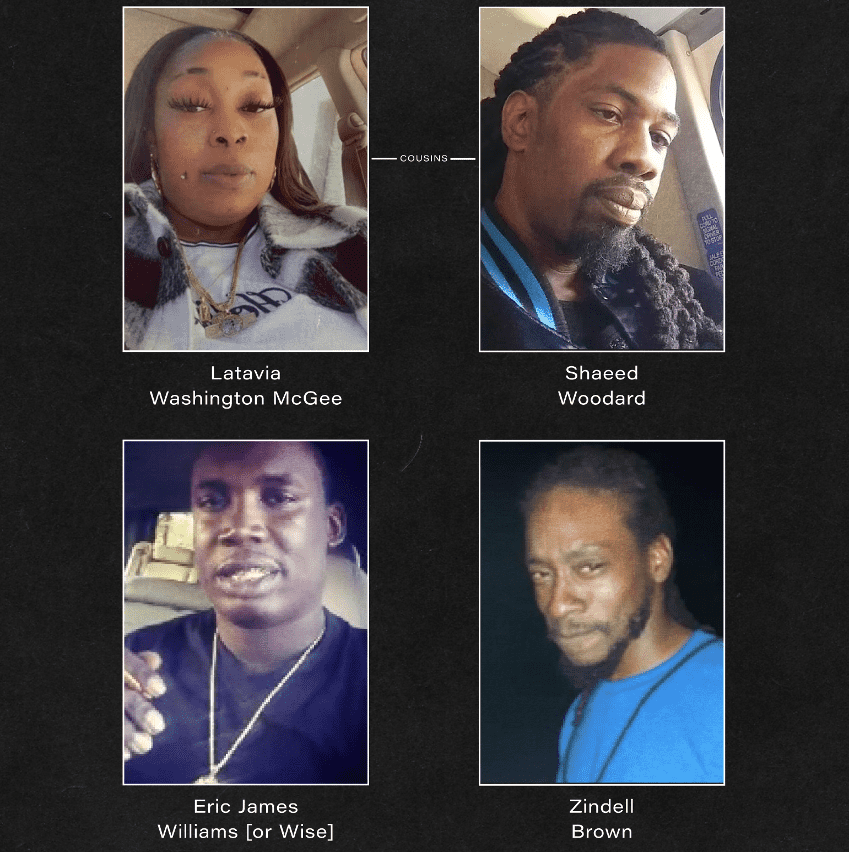
According to an ABC News report, the four Americans have been identified as Latavia “Tay” McGee, Shaeed Woodard, Zindell Brown and Eric James Williams.
McGee, who lived in South Carolina, traveled to Matamoros to undergo a tummy tuck procedure, according to her mother, and was accompanied by her cousin – Shaeed Woodard – and two friends.
The U.S. Embassy in Mexico said in a statement Sunday that four Americans crossed into the northern border city in a white minivan with North Carolina license plates.
Matamoros is located opposite Brownsville, Texas, near the Gulf of Mexico coast in Tamaulipas.
“Shortly after crossing into Mexico, unidentified gunmen fired upon the passengers in the vehicle. All four Americans were placed in a vehicle and taken from the scene by armed men,” the U.S. Embasssy said.
A Mexican woman, described as an “innocent” citizen by U.S. Ambassador Ken Salazar, was killed in the incident.
The white minivan the 4 U.S. citizens were traveling in when they were fired upon by unidentified gunmen. (Twitter)
Video footage posted to social media showed people being put into the back of a white pickup truck by three men in broad daylight. The FBI offered a reward of US $50,000 for the return of the victims and the arrest of those involved.
President López Obrador said Monday morning that the entire federal government was working on the case.
“The information we have [is that] they crossed the border to buy medicine in Mexico, and there was a confrontation between groups and they were detained,” he said.
CNN said it was informed by a United States official with knowledge of the investigation that the U.S. citizens were believed to have been targeted by mistake.
The unnamed official told CNN that investigators believed a Mexican cartel likely mistook the Americans for Haitian drug smugglers. Competing factions of the Gulf Cartel operate in Matamoros.
The U.S. official said that investigators hadn’t identified any concerning criminal history of the kidnapping victims.
Photos of the four victims of the kidnapping in Matamoros on Friday. (Borderland Beat/Courtesy)
A woman who spoke with the Associated Press said that she saw the white minivan in which the U.S. citizens were traveling get hit by another vehicle at an intersection in Matamoros.
She said that gunfire followed and then several armed men got out of an SUV.
“All of a sudden … [the gunmen] were in front of us. I entered a state of shock, nobody honked their horn, nobody moved. Everybody must have been thinking the same thing, ‘if we move they will see us, or they might shoot us,’” the witness said.
She said that a woman who was able to walk and a man who could still move his head were put into a pickup truck. “The other two they dragged across the pavement, we don’t know if they were alive or dead,” the woman said.
White House press secretary Karine Jean-Pierre read a statement on the incident at a media briefing on Monday.
“These sorts of attacks are unacceptable. Our thoughts are with the families of these individuals and we stand ready to provide all appropriate consular assistance. U.S. law enforcement is in touch with Mexican law enforcement,” she said.
“… We will continue to coordinate with Mexico and push them to bring those responsible to justice,” Jean-Pierre said.
The incident in Matamoros occurred five days after Mexican soldiers allegedly murdered five young and apparently unarmed men including a U.S. citizen in Nuevo Laredo, another border city in Tamaulipas.
The U.S. Department of State warns U.S. citizens not to travel to the border state due to crime and kidnapping.
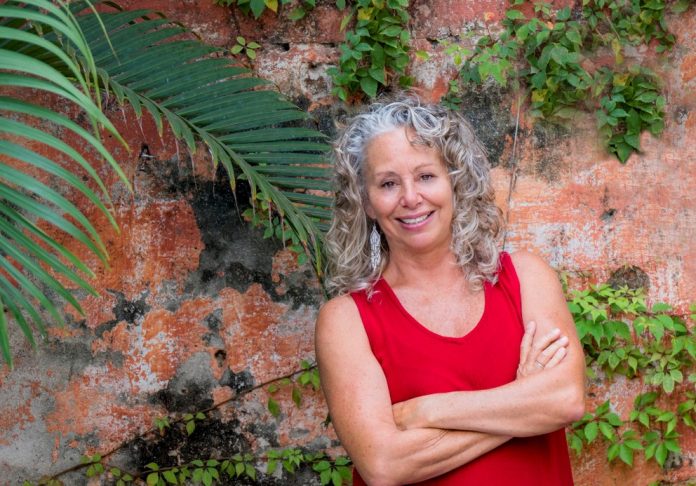
Janet Blaser finds choosing kindness and understanding and believing in the inherent good nature of people is key to surmounting the frequent communication hurdles of being a long-term expat. (Matt Mawson)
This morning I’m on deadline, trying to work. I’ve forced myself to sit at my desk and type; I need to get this article done and off my plate.
Just outside the door are two workers, painting several rooms in my apartment. In the background I can hear gentle strains of banda and reggae music coming from the kitchen, where old paint is being scraped off, landing in big heaps on the floor. It’s already a mess and will become even more so before the day is done.
I’m deep in the process of moving words around the page when Sergio knocks tentatively to ask a question. I stumble from English to Spanish to Spanglish, and we both laugh. Sometimes it’s hard to change languages, but my Spanish is better than his English (which isn’t saying much), and so we smile and figure it out together. In the words of the author David Sedaris, I hope that “me talk pretty one day.”
After giving him the info he needs, I step out to the balcony for a break. Someone is speaking English, the voice coming from the empty lot next door. It’s not very good English, and his thick accent makes the words difficult to understand. He’s trimming trees for my American neighbor, and they — like Sergio and me — are communicating the best they can.
This is a lot of what our lives are about here: Stepping outside our comfort zones, stretching our limits, trying our best to be open-minded about so many things. But it’s not just us doing this, not just the gringos, the foreigners — it’s the locals too who have to step outside their comfort zones, stretch their limits and, Lord knows, try to have patience and open minds about us and some of our weird ways of doing things in what is (ahem) their country.
Personally, I love that we’re in this together; if we can just remember that, then everything becomes a whole lot easier. I’m grateful that Mazatlán, where I live, and Mexico as a whole, is as welcoming as it is, and that the people are as nice as they are.
While I’m nowhere near perfect, I do my best to choose kindness and understanding whenever possible, and to keep on believing in the inherent good nature of people, even when I’m frustrated with what can seem, to my American mind, to be impossible procedures and unnecessary obstacles for the simplest of tasks.
In the process, we make mistakes, laugh a lot, learn to be humble — but communicate and make friends nonetheless.
The Cross Border Xpress, a privately run land border crossing between Mexico and the U.S., is located on one side in Tijuana International Airport and leads on the other side to the port of entry at the Otay Mesa area of San Diego. (Twitter)
The number of airline passengers who used the border crossing linking Tijuana Airport to a service terminal in San Diego County increased by over 50% last year, data shows.
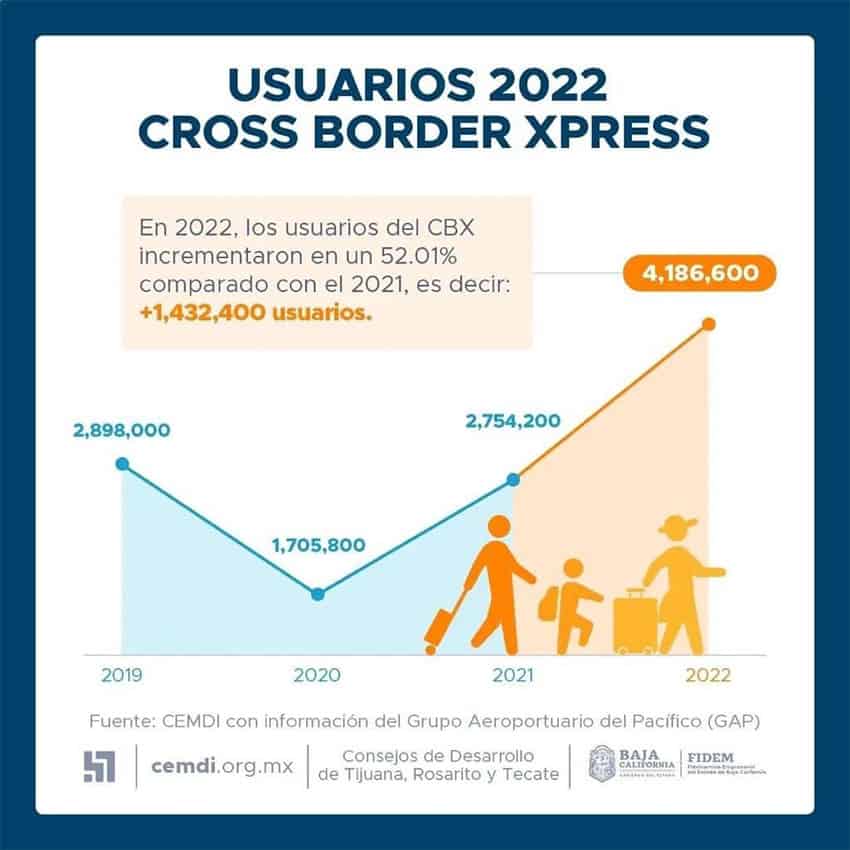
The Pacific Airport Group (GAP), which operates the Tijuana Airport, reported that just under 4.19 million people used the Cross Border Xpress (CBX) pedestrian bridge in 2022.
The figure is 52% higher than the 2.75 million people who used the CBX in 2021 and 44% above the prepandemic 2019 level.
The pedestrian bridge, which opened in 2015, is about 119 meters (390 feet) long, and can only be used by people flying into or out of Tijuana Airport. A “regular season” one-way ticket costs US $26.95 to go from Tijuana Airport to the San Diego side and $23.95 in the opposite direction.
Data shows that 12.3 million passengers used the airport in 2022, up from about 9.7 million the previous year. When the CBX opened in late 2015, the airport was handling approximately 4.8 million passengers per year.
Infographic showing how use of the CBX land border crossing has increased since 2019.
Meanwhile, the Baja California government is considering putting a proposal to United States authorities that would expedite Tijuana-San Diego border crossings for some residents of Tijuana.
Under the proposal, Tijuana residents who have tickets for the San Diego Trolley light rail system would have their own exclusive pedestrian crossing, allowing them to enter the U.S. border city much more quickly than is currently the case.
According to a Feb. 8 report by The San Diego Union-Tribune newspaper, Baja California Economy and Innovation Minister Kurt Honold said during a recent visit to San Diego that the state government is studying the idea with a view to formally presenting it to U.S. authorities.
Instead of waiting for two or three hours to cross into San Diego, Tijuana residents who work in that city and rely on the trolley to get to their place of employment would be able to enter the U.S. “much more quickly” if they had their own exclusive crossing, he said, one that would start at CBX and lead them to the Ped East pedestrian bridge in San Ysidro.
Some Baja California officials have suggested a separate entrance at CBX for people who cross regularly back and forth between the two countries and use San Diego’s public transit station at the San Ysidro Port of Entry to commute into the city. (MTS)
“We don’t need to reinvent the wheel, there is already the famous CBX,” Honold told reporters.
San Diego’s light rail system has a line that links the San Ysidro Port of Entry to the city’s downtown. An average of 13,000 passengers per day get onto the trolley at San Ysidro, according to data from the San Diego Metropolitan Transit System (MTS).
An MTS spokesperson said that the transit authority is aware of the Baja California government’s proposal and supports it, according to the Tribune. A spokesperson for U.S. Customs and Border Protection said that agency is also aware of the idea but it’s too early to comment on any involvement it would have. CBX officials told the Tribune that they have no involvement in the proposal.
Tens of thousands of Tijuana residents, including U.S. citizens, cross into San Diego on a daily basis to work and study.
Jorge Alberto Gutiérrez, head of the Baja California Institute of Sustainable Transport, said that an exclusive border crossing for trolley users could help reduce the number of cars crossing the border and thus reduce pollution.
The executive director of the Smart Border Coalition – a group dedicated to seeking “creative and practical solutions to improve movement for all legitimate travel through the ports of entry in the San Diego-Tijuana binational region” – also applauded the initiative.
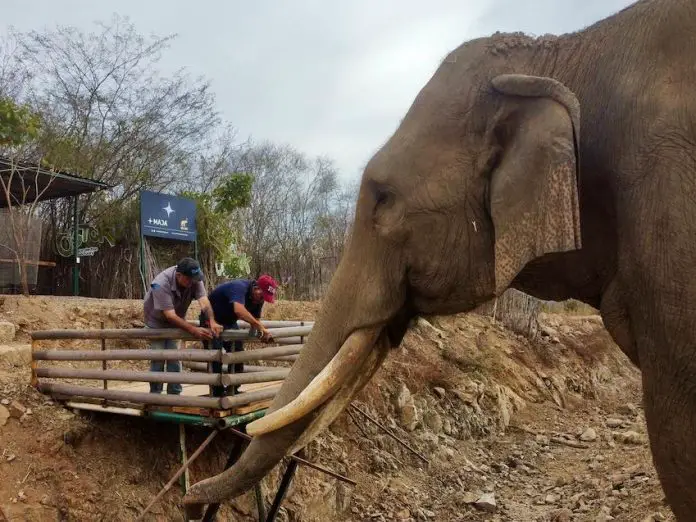
Big Boy has become a local celebrity in Sinaloa, proving a star attraction at Ostok Sanctuary (Facebook/OstokSanctuario)
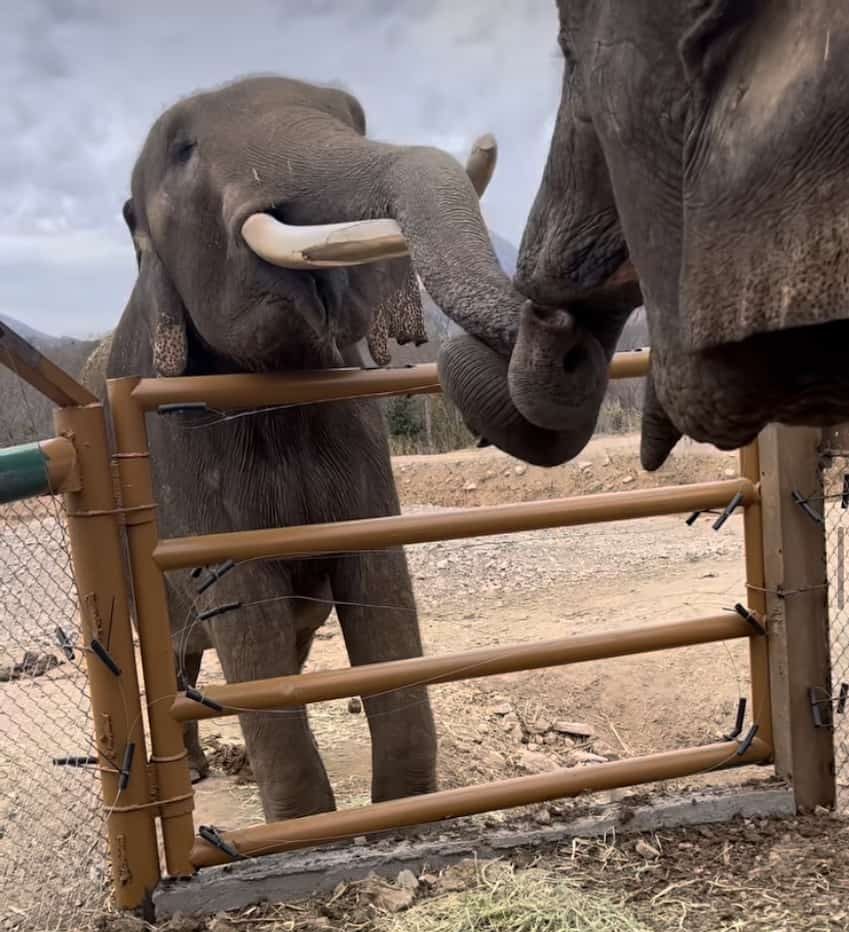
Two rescue elephants living at an animal sanctuary in Culiacán, Sinaloa have potentially developed an amorous relationship, having been seen touching trunks right before Valentine’s Day.
“Love is in the air” proclaimed the online news source Línea Directa. Both elephants were rescued after reportedly receiving years of abuse in the circus.
Elephants Big Boy and Bireki wrap trunks, a sign that many suggest demonstrates an emotional bond (Instagram/OstokSanctuario)
Big Boy, a 39-year-old male African elephant, arrived at the Ostok Animal Protection & Sanctuary in 2021 and had been there a year when Bireki, a beguiling 31-year-old of the same species, showed up in June 2022.
“This is a great advance,” Ernesto Zazueta, director of the Ostok sanctuary, said of the “cuddling” pachyderms. “They have come to understand each other more and more, and [now] are very close to being together.” Although Bireki “had been somewhat distant” for a few months, when she and Big Boy were caught in a “very affectionate intertwining of their trunks” last month, it indicated “Cupid had worked his magic” and that Big Boy was indeed her pachyderm sweetheart — even though the two “roommates” were separated by a metal fence.
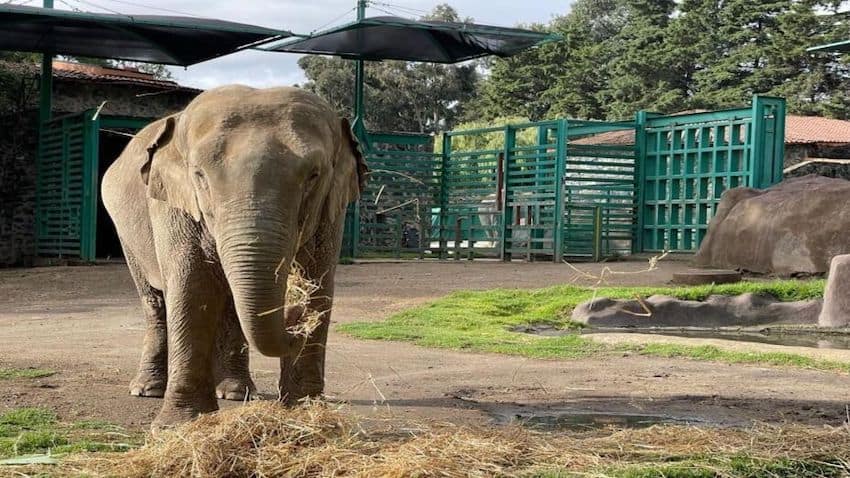
Bireki arrived at Ostok, a 10-hectare (25-acre) sanctuary north of Culiacán after being rescued from a circus in Mexico and then spending years at a zoo in Toluca.
Big Boy became something of a celebrity at the zoo due to his status as a supposed abuse survivor — although the circus that owned him before he ended up at the Culiacán zoo has disputed in the media claims of his abuse. After he was transferred during the COVID pandemic and he became the Ostok’s first elephant, his celebrity grew further, with The Mazatlan Weekly writing earlier this year that the sanctuary is “known for being the home of Big Boy.”
Bireki the elephant arrives at the Ostok Sanctuary (OstokSanctuario)
When Bireki, already known herself for being the first Asian elephant to be born on Mexican soil, was set to arrive 14 months later, the same newspaper trumpeted “The wait is over! The girlfriend of the elephant Big Boy is about to arrive in Culiacán.”
Before arriving at Ostok, where some 400 animals reside, Bireki had spent several years in rehabilitation in México state at the Zoológico de Zacango in Toluca.
The lineup at Ostok includes birds of prey, parrots, deer, lions, jaguars and pumas — and potentially a hippopotamus or two (or maybe even more) if Colombia completes its plan to decrease its invasive hippo population problem by shipping 10 of the animals to Mexico.
As for the elefantes enamorados (elephants in love), their “romantic meet-and-greet,” as described by the online news source Ananova, was nothing to sneeze at. Experts at the sanctuary point out that elephants often use their trunks to greet each other.
Ostok Sanctuary is also home to a range of other exotic animals, including big cats (Facebook/OstokSanctuario)
In some cultures, the uniting of elephant trunks is considered good luck, signifying closeness and camaraderie.
Regardless, the animal keepers at Ostok simply are touched that Big Boy and Bireki have been able to find peace, let alone possible romance, after years of alleged abuse.
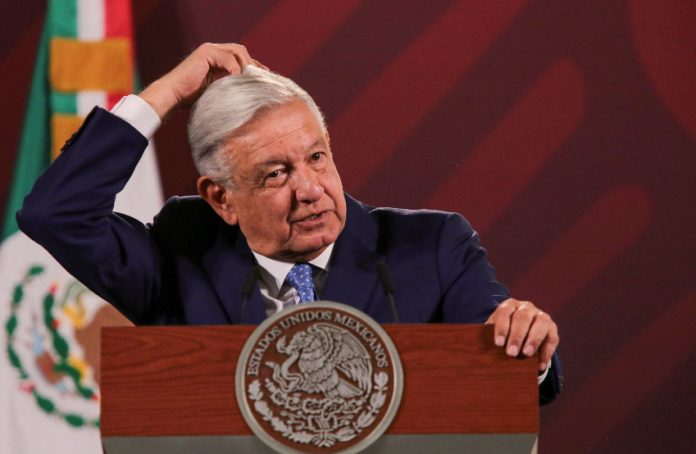
According a poll by El Financiero, President López Obrador still enjoys majority approval but the percentage of respondents who disapprove rose in February. (Gob MX)
A majority of Mexicans continue to approve of Andrés Manuel López Obrador’s performance as president, a new poll found, but the percentage of those who disapprove has hit a new high.
The results of the latest El Financiero survey show that López Obrador had an approval rating of 54% in February, a result that mirrored the finding of the newspaper’s January poll.
President López Obrador still enjoys a 54% approval rating, according to the latest El Financiero poll. (@LopezObrador Twitter)
The percentage of respondents who disapprove of the president’s performance increased one point to 46%, the highest figure since López Obrador took office in December 2018.
A total of 1,100 Mexican adults across all 32 federal entities responded to El Financiero’s poll, conducted via telephone on Feb. 10, 11, 24 and 25. The federal government’s controversial “Plan B” electoral reform package passed the Senate on Feb. 22.
López Obrador retained the support of a majority of poll respondents even though most of them rated his government poorly in the key areas of economy and public security.
Only 34% of those polled praised the government’s management of the economy while just 27% assessed it positively for its security efforts. In contrast, 51% of respondents rated the government’s economic performance as poor or very poor and 59% said the same about its security strategy.
The increased militarization of public security under AMLO has been controversial; poll respondents rated his government poorly on security strategy. (Damián Sánchez Jesús / Cuartoscuro.com)
Although López Obrador has made combating corruption a central aim of his administration, only 35% of respondents said that the government is doing a good job in the area. A considerably larger cohort – 45% of those polled – were critical of the government’s efforts, or lack thereof, to combat corruption.
The AMLO administration was assessed more favorably for its provision of welfare and public health services. Almost half of respondents – 48% – spoke approvingly of the government’s social support measures compared to 31% who criticized them, while 47% of those polled praised its public health services compared to 36% who thought they were bad or very bad.
López Obrador has highlighted that 25 million households benefit from the government’s welfare programs, and said last week that authorities are on track to establish a universal health care system comparable to that in Denmark.
Asked whether Mexico is generally on a good or bad path under the president’s leadership, 33% of respondents said the former while 35% said the latter.
The percentage of those who believe Mexico is on a good path declined five points in the space of a month, but El Financiero’s poll results didn’t clearly suggest why.
One plausible reason is the presentation and ultimate approval of the government’s electoral reform package, which has been widely criticized for weakening the National Electoral Institute.
Hundreds of thousands of Mexicans protested the legislation in cities across the country on Feb. 26.
El Financiero’s survey also found strong support for Morena, the political party founded by López Obrador. Asked who they would vote for if presidential elections were being held on the day they were polled, 45% of respondents opted for the ruling party.
Mexico City’s government said about 90,000 protesters showed up at the Feb. 26 protests, but organizers said the number was closer to 500,000. (Photo: Galo Cañas Rodríguez/Cuartoscuro)
Only 18% chose the National Action Party (PAN), 14% nominated the Institutional Revolutionary Party (PRI), 9% mentioned the Citizens Movement party and 5% expressed support for the Democratic Revolution Party (PRD).
Total support for Morena and its allies, the Labor Party and the Ecological Green Party of Mexico, was 50% while backing for the PAN-PRI-PRD alliance added up to 37%.
The “Va por México” opposition alliance announced in January that it would field a common candidate at the presidential election in June 2024.
Mexico City Mayor Claudia Sheinbaum and Foreign Affairs Minister Marcelo Ebrard are seen as the leading contenders to secure Morena’s nomination.
There is far less clarity about who will represent the PAN, PRI and PRD. In that context, President López Obrador offered his own (very) long-list of possible opposition candidates last October, saying that a total of 43 people had either expressed interest in vying for the presidency or had been mentioned as potential contenders.
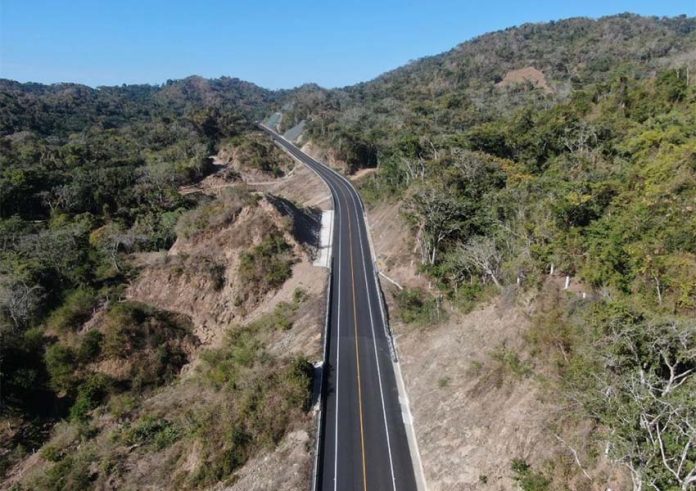
The stretch of highway is just one part of multiple road construction projects that altogether will eventually make the trip between Guadalajara and Puerto Vallarta about two hours quicker. (SICT)
Another section of the Guadalajara–Puerto Vallarta highway has opened, getting drivers another step closer to a world in which driving time between the two cities will drop by two hours.
The road opening comes about two months after the 23.6-kilometer Capomo-La Florida route began operations in December 2022, connecting Las Varas with Junction 692, an important road for tourism.
Once the entire road is finished, driving time between the two cities will be reduced from hours 4 hours 30 minutes to 2 hours 30 minutes.
In a statement, the Secretary of Infrastructure, Communications and Transportation (SICT) announced the opening of a 30.8-kilometer stretch of highway between the La Florida and the La Cruz de Huanacaxtle junctions in the new Las Varas-Puerto Vallarta highway. Construction of the road took an investment of 4.9 billion pesos (US $272.2 million) that benefited nine communities.
A total of 54.4 km of the highway is now open to vehicles, once the third section is complete, the finished road will total 86.5 km in length and will include 45 bridges, seven junctions, three tunnels and three viaducts.
An estimated 6,000 vehicles will circulate on the roadway daily, according to SICT.
The just-opened stretch of highway is the second of the highway’s three phases. The total 85 km length of road will feature three new tunnels.
The highway will grant access to different points of the Riviera Nayarit’s tourist corridor (named one of the world’s greatest places by Time Magazine). It will also give the cities of Guadalajara and Tepic direct access to the tourist corridor. The highway will also connect two international airports in the region: the Puerto Vallarta airport and the Tepic airport in Nayarit.
Representatives of civil and government groups meet to discuss the upcoming Mar. 8 march. (Andrea Murcia/Cuartoscuro)
Feminist activists and security officials held apublic meeting in Mexico City on Thursday, with the aim of improving mutual understanding ahead of the International Women’s Day march on Mar. 8.
The discussion was organized by the Ministry of Citizen Security (SSC) and moderated by Geraldina Gonález Vega, president of the Council to Prevent and Eliminate Discrimination in Mexico City (Copred).
International Women’s Day marches in Mexico City last year were peaceful overall, following some violence that broke out in 2020 and 2021. (Twitter)
Participants shared their perspectives on gender violence, sexual harassment and discrimination, with special mention of the additional stigma faced by trans women. They also discussed the role of the police in relation to these issues and how to address gender bias in law enforcement.
The panel also included: Inspector General Lucía Karen Pérez Ortiz, regional director of the Benito Juárez borough; Chief Inspector Itzania Sandibel Otero Manzo, director of the Atenea Women’s Metropolitan Unit; Paula Salcedo, a member of the pro-civil liberties group Article 19; and Eli Romano Zavala, a psychologist and founder of the activist group Unspeakables, which deals with gender violence.
One aim of the discussion was to promote dialogue between policewomen and activists to reduce the risk of violence during the protest. The Women’s Day protest in Mexico City has drawn thousands of participants in recent years, with some violent clashes breaking out in 2020 and 2021.
The 2022 march, however, was more peaceful, with protesters even giving flowers to police. All panelists agreed that this year’s march should aim for the same level of mutual respect.
“On this march the majority of us are women, which is what we want,” said Inspector General Pérez. “What we least want is for someone to be injured.”
“For the SSC the priority in the marches…is to safeguard the integrity of each and every one of the participants,” she added. “That all the women who participate in them, including the policewomen, leave without harm.”
She also spoke of her own experience as a policewoman in a male-dominated profession.
“It is difficult in an institution where the male gender continues to predominate,” she said. “It has cost us work but today [there] are more than 70 women in command positions, showing that we know, [and] that we are capable. That helps us to be empathetic towards protesters.”
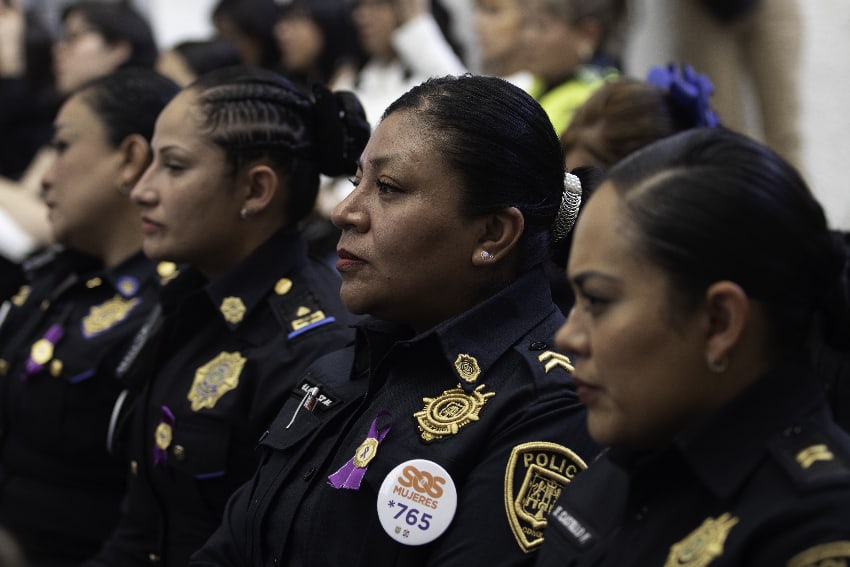
Policewomen in attendance at the public discussion held with feminist activists (Andrea Murcia Monsivais / Cuartoscuro.com)
“We also want to shout…we are also feminists,” Chief Inspector Manzo added. “I am a policewoman and a female citizen, that was the most difficult thing at the time, because we didn’t know whether to defend or support, or care, or protect.”
The activists on the panel added their own views on the importance of the march in the context of the inequality, repression and violence faced by women in Mexico.
“All protests are legitimate and respond to a demand for justice,” Salcedo said. “It is essential that police understand that the right to protest and express oneself freely is a fundamental human right. Repression and violence only perpetuate the injustices we are trying to combat.”
“We shouldn’t have to go out and march for our rights,” Romano added. “We are unhappy with the state that is not achieving fair guarantee and respect for those rights.”
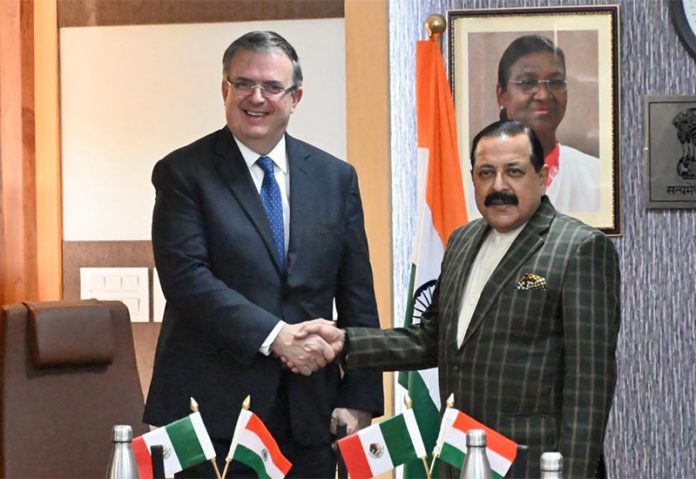
Foreign Affairs Minister Marcelo Ebrard, left, shakes hands in New Delhi with India's Science and Technology Minister Jitendra Singh. The two men signed an agreement for their two countries to collaborate on tech development projects ranging from areas such as electromobility to low-cost vaccine development. (Marcelo Ebrard/Twitter)
Mexico and India have reached an agreement to collaborate on projects across a range of areas, including water management and the production of low-cost vaccines.
Foreign Affairs Minister Marcelo Ebrard joined Indian Science and Technology Minister Jitendra Singh in New Delhi Saturday to witness the signing of the agreement between the ministry he heads and India’s Council of Scientific and Industrial Research.
According to a statement issued by the Ministry of Foreign Affairs (SRE), Ebrard announced that Mexico and India will collaborate on and jointly finance “binational development and innovation projects in several fields,” including ones related to water, lithium, the aerospace industry, biotechnology and vaccines.
Under the new agreement, the SRE statement added, “both countries will identify priority projects for development, among which are water management, development of electro-mobility and production of vaccines at low cost.”
Electromobility refers to e-vehicles, including automobiles but also other forms of transport such as seagoing vessels such as ships and ferries.
Mexico and India agreed to contribute US $500,000 each to a fund to finance the binational projects.
Mexico’s Foreign Affairs Minister, right, at demonstration of e-vehicle battery swapping at a station for electric motorcycles by the Indian company Sun Mobility. Ebrard discussed with the company the possibility of building such stations in Mexico. (Marcelo Ebrard/Twitter)
Once the fund is established, “various research institutions will be called upon to implement the selected projects,” Ebrard said.
India, like Mexico, is seeking to exploit reserves of lithium, a key component in electric vehicle batteries. The south Asian nation — the world’s fifth largest economy — currently relies on imports of lithium for its manufacturing sector.
The exact nature of Mexico and India’s proposed lithium-related project, or projects, was unclear.
The SRE statement also noted that Ebrard met in Delhi with Rajat Malhan, vice president of Sun Mobility, a company that operates battery swapping stations for riders of electric motorcycles.
Ebrard said that the company would seek Mexican partners in order to establish similar stations in Mexico.
“We had the pleasure of demonstrating our battery swapping solution to @m_ebrard … during his visit to Delhi. It is highly motivating for us to receive such a positive response for our solutions that are “Made in India for the world,” Sun Mobility said on Twitter.
The new Mexican consulate in Mumbai, India. (Foreign Affairs Ministry/Twitter)
Earlier last week, Ebrard met briefly with Indian Prime Minister Narendra Modi while attending the G20 foreign ministers’ meeting in Delhi. He passed on the “greetings and affection” of the people of Mexico and President López Obrador, the SRE said.
The foreign minister’s trip to India coincided with the opening of a Mexican Consulate in Mumbai, the country’s financial hub.
In a meeting with his Bangladeshi counterpart Abul Kalam Abdul Momen, Ebrard announced that Mexico would open an embassy in Bangladesh in the second half of 2023.
The SRE said that Mexico “is interested in strengthening business and cooperation with Bangladesh, particularly in the pharmaceutical, agroindustry and technological sectors.”
These towering 'castles' are the biggest, highest-profile examples of the pyrotechnics artisan tradition in Tultepec, but others include fireworks-rigged papier mache bulls or Judas figures. All three types are popular throughout Mexico. (Photo: Guillermo Rivera/Turismo Mexiquense)
I have a confession. The first time I heard the oh-so-common sound of bottle rockets going off in Mexico, my first thought was “gunfire.” But, then, I had lived 11 years in Arizona.
As should surprise no one, fireworks are an incredibly big business in Mexico. The Mexican government calculates that a staggering 5.87 billion pesosare spent each year in the country on fireworks, just for patron saint days, as it is unthinkable to do without them.
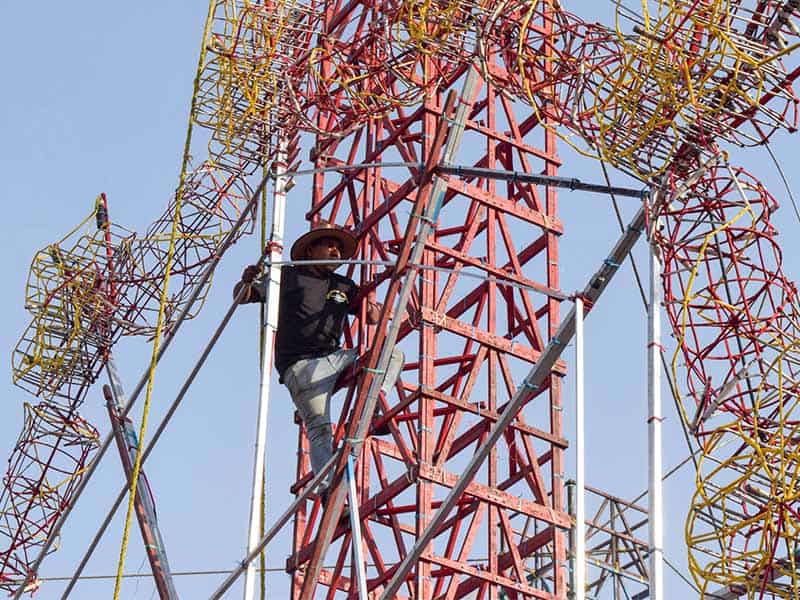
A fireworks artisan climbs the wooden structure that will hold countless fireworks for a castillo. (Photo: Fans of Feria Internacional de la Pirotecnia Tultepec/Facebook)
But unlike in many other countries, few of Mexico’s pyrotechnics shows are highly regimented affairs done only by professionals. Instead, most are made by artisans for individuals and small communities.
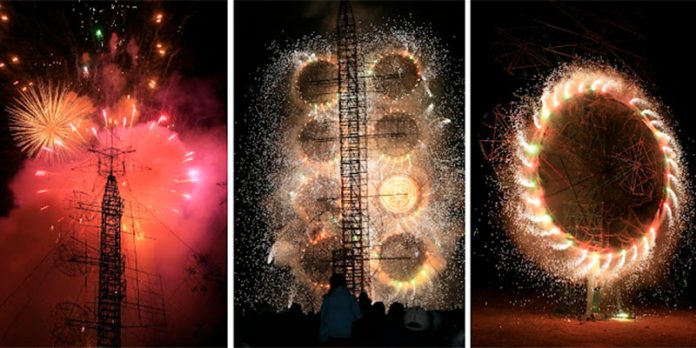
Traditional Mexican fireworks are a folk art, on par with others like pottery and textiles. This is reinforced by the construction of castillos (castles). It is one of several culturally important structures in Mexico that get laden with fireworks — but probably the most impressive, both because of size and because of the wide range of creative variations.
A castillo is one or more towers made from wood, onto which a fireworks show is attached. The show centers on wheels placed on the tower(s), which are powered by small rockets affixed to the edges.
Like toritos (little bulls) and Judas effigies, the public can get pretty darn close to the action, but what really sets these castillos apart are the scale.
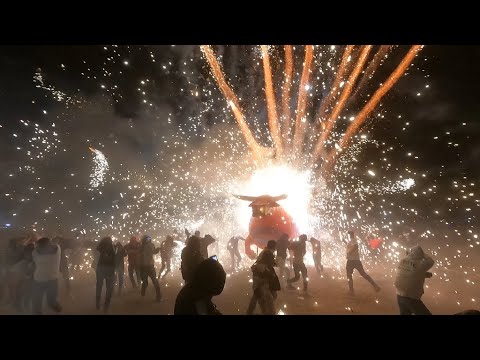
Quema de Toros Tultepec 2022 🔥Mejores Momentos 🔥
This video from 2022’s pyrotechnics fair at Tultepec shows what it’s like to be up close to the not-so-small toritos (little bull) at the Tultepec fair when they are set off, much to spectators’ delight.
Typically between 8–12 meters tall, castillos cost between 50,000 and 250,000 pesos per tower, meaning that only parishes, municipalities and other large organizations can afford to commission one — and only for important events such as patron saint days and major political holidays.
There are two kinds of castillos. Which is used depends on when they are intended to be used.
Those destined for a nighttime event night are fireworks-heavy, providing both wheel motion and a colorful show. Those intended for the daytime have spinning wheels as well, but the visual is provided by decorative paper and/or whimsical papier mache figures.
Despite their cost, Mexico ranks first in the world in the making of castillos, according to the Instituto Mexiquense de la Pirotecnia (Mexican Pyrotechnics Institute). An average of 51,922 castillos are set off per year — again, just for patron saint days — costing a whopping 2.6 billion pesos, a close second to individual fireworks sales.
México state accounts for over 60% of the country’s fireworks production, but when you talk about fireworks, you talk about the municipality of Tultepec. Located just north of Mexico City proper, Tultepec has produced fireworks (and gunpowder) since the colonial period.
Most of the population is involved in the industry in one way or another, from the making of the fireworks proper to making castillos, toritos, Judases and more.
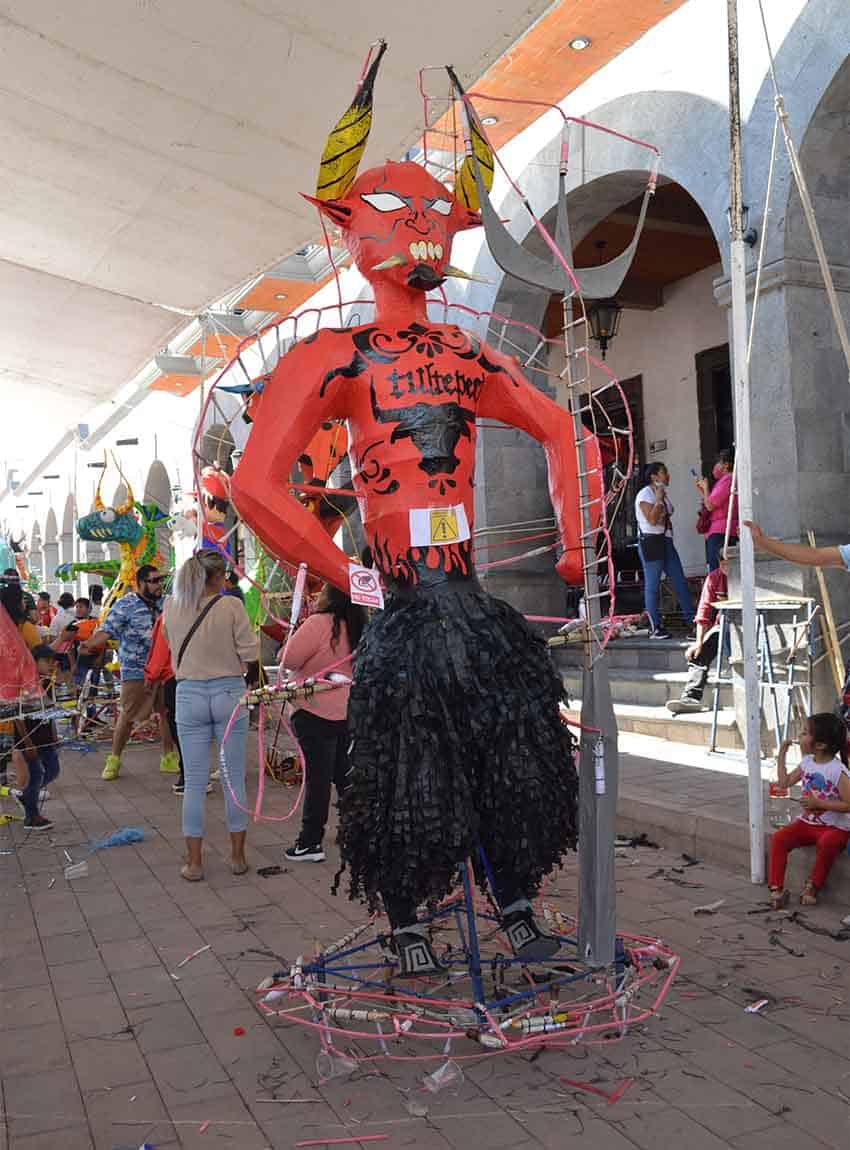
Castillos, Judases and toritos can share elements of Tuletepec’s intertwined pyrotechnics traditions. This Judas/devil is destined for the top of a tower. (Photo: Alejandro Linares García)
All these are still done by hand in small workshops and factories. Officially regulated by the Secretary of National Defense, there is still a laissez-faire attitude about the constructions of these items that might shock those of us from more regulation-heavy countries.
Do accidents happen? Absolutely, but efforts to completely control production and sales have met with resistance.
Tultepec’s patron saint is John of God, and like other municipalities, his annual feast day on March 8 has been an important opportunity to promote its main economic activity. Such promotion began in the late 19th century, focusing on bulls and religion, but since the National Pyrotechnic Festival (Feria Nacional de Pirotechnia) was established in 1989, the festival has grown and secularized tremendously.
The event now runs over a week, both before and after the saint’s day, but the running of fireworks-laden bulls in honor of the saint is now only one of various attractions, such as concerts, dances, sky lantern releases and various fireworks competitions.
Originally, only Tultepec artisans could compete, but now Mexican and even international fireworks makers can demonstrate their skills in castillos, pyrotechnics displays set to music and more.
Castillo artisans compete in two categories, day and night, on two different days, with teams of a dozen or more working frantically for two weeks to build structures between 25–30 meters tall, loaded with fireworks and various gizmos.
A “Rugrats”-themed papier mache decoration being assembled in Tultepec. (Photo: Alejandro Linares García)
The festival is still organized and controlled locally, but México state provides significant support as fireworks can drop anywhere from 500 million to 1.2 billion pesos into México state’s economy in any given year. The festival is now a major regional tourist attraction.
Decades ago, fairgrounds were established primarily for the castillos, but with crowds reaching 250,000, just about all activities have now been moved over to the area in the Pico de Orizaba/Tlamelaca neighborhood.
Although no longer local, the National Fireworks Festival is still extremely important for Tultepec. Long-ago swallowed up by Mexico City urban sprawl, the municipality struggles to maintain a distinct identity. The attention is also important because, like other Mexican folk art, handcrafted pyrotechnics is in danger of disappearing, thanks to cheaper fireworks imports from China and elsewhere.
The state admits that its technology is at least 50 years behind the rest of the world. But Mexican fireworks and their displays have links to culture and tradition that foreign rockets cannot hope to match.
Castillo pyrotechnics competitors are showing their stuff at the fair this Saturday, as this group of fans of the fair publicized on Facebook. (Photo: Fans of Feria Internacional de la Pirotecnia Tultepec/Facebook)
This year’s festival starts Friday and runs until March 13. If you’re not able to get there, many of the events are televised, and you can also see it on videos available on YouTube and other social media.
Leigh Thelmadatter arrived in Mexico over 20 years ago and fell in love with the land and the culture in particular its handcrafts and art. She is the author of Mexican Cartonería: Paper, Paste and Fiesta (Schiffer 2019). Her culture column appears regularly on Mexico News Daily.
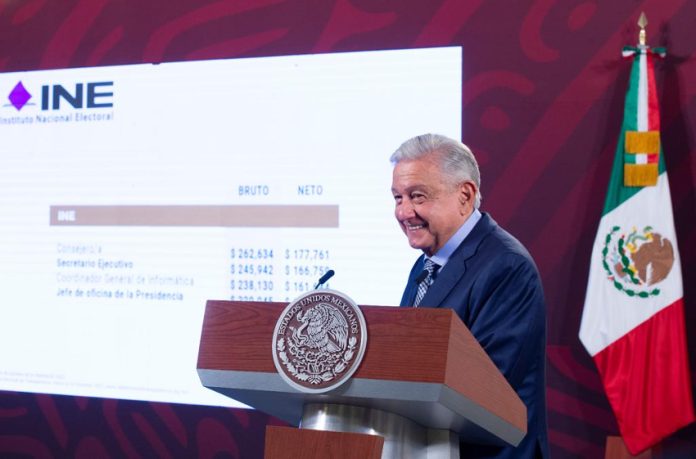
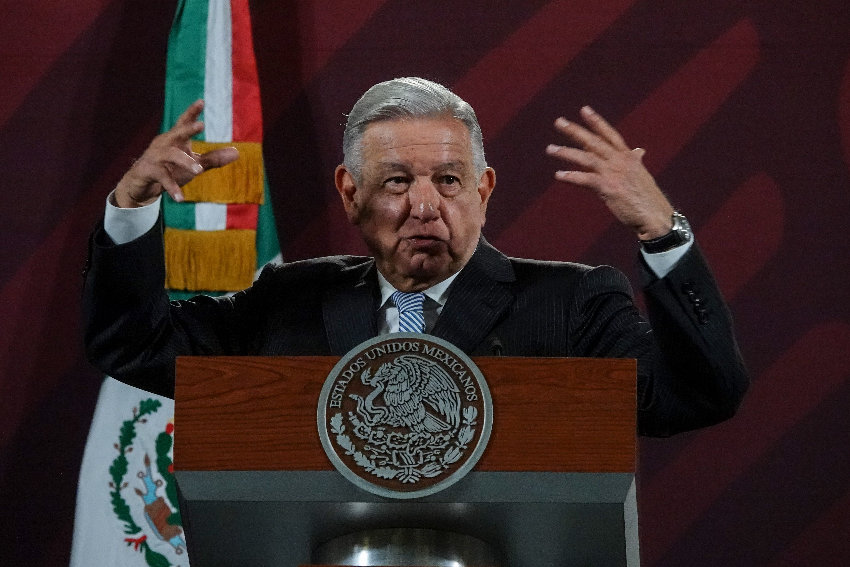
AMLO covered the Maya Train opening date to Tesla's big announcement to Mexico having "more democracy" than the US in this week's morning press conferences (Gob MX)
On his social media accounts last Saturday, he shared a photo “taken by a [Maya Train] engineer three days ago” that purported to show one of the mythical creatures. In addition to going viral, his (tongue in cheek?) Facebook and Twitter posts spawned countless media reports, including articles by The Associated Press and The New York Times.
Hace poco, en el carnaval de Hecelchakán, Campeche, hicieron una representación de lo mismo. El pueblo del sureste se apropió del Tren Maya. Es —como dirían los que hablan “físico”— parte del imaginario colectivo. 2/2 pic.twitter.com/CeHhpQTuxe
AMLO also shared this video of a carnival in Campeche where a representation of the Maya Train was part of the festivities.
Monday
The general director of the state-owned, military-run Maya Train company announced early in the mañanera that the new 1,554-kilometer-long railroad would begin operations on Dec. 1.
Óscar Lozano Águila said the company he heads would take possession of the first train on July 8 and subsequently begin tests to ensure that the railroad – which will link cities and towns in Tabasco, Campeche, Yucatán, Quintana Roo and Chiapas – is ready for service on the slated opening date.
At the top of his presser, AMLO asserted that the rail project is the most important in the world in several respects.
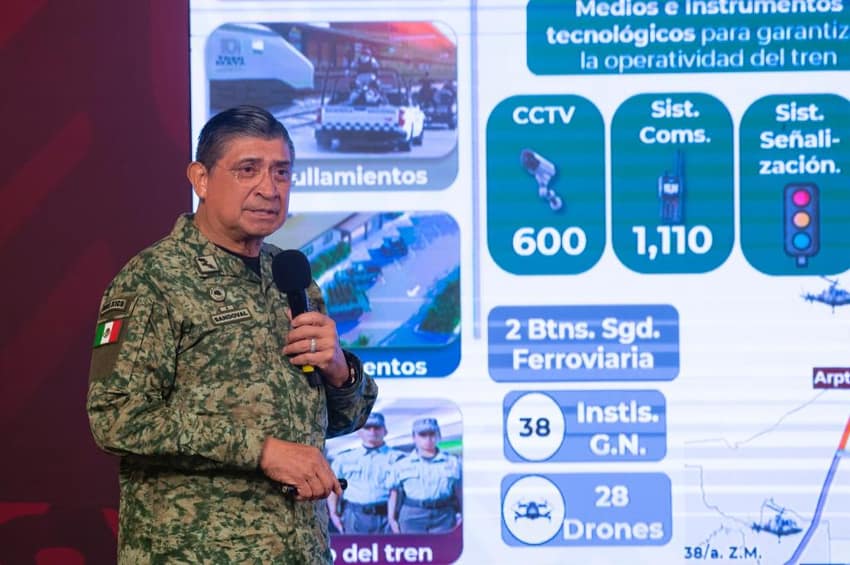
Defense Minister Luis Cresencio Sandoval at the Monday press conference update on the Maya Train (Gob MX)
“There is nothing anywhere in the world like this project [in terms of] its ecological, touristic, archaeological, cultural and artistic importance,” he said. “We’re talking about the connection of ancient Mayan cities of the great Mesoamerican nation. There is no other region like it in the world.”
In response to his first question of the week, López Obrador said that attendees at Sunday’s demonstrations against the recently-approved electoral reform and in defense of the National Electoral Institute (INE) are opposed to the “transformation of the country” his government is carrying out.
“They want to keep stealing, … they want to keep the majority of Mexicans on the margins, in oblivion,” he said.
The president also said that the majority of “the leaders who organize these marches and those who participate” were part of previous governments.
“They’ve been defenders of electoral frauds, formed part of the corruption in Mexico, belonged to the narco-state that, as has been shown with the García Luna matter, was imposed during two six-year periods of government, that of Vicente Fox and that of Felipe Calderón,” he said.
“When they say ‘don’t touch the INE,’ what they’re thinking is don’t touch corruption, don’t touch privileges, don’t touch the narco state.”
López Obrador later added to his criticism of the Peruvian government led by Dina Boluarte, who succeeded the ousted Pedro Castillo last December.
“We don’t accept the whole farce … [of] the removal of president Pedro Castillo because the will of the people of Peru wasn’t respected, democracy was trampled on and a great injustice was committed by dismissing and jailing him and then establishing an authoritarian, repressive government,” he said.
“… An oligarchy in Peru, national but mainly foreign, is looting the natural resources of Peru – gas, mineral resources – and they need a puppet, … a ruler and a Congress to suit their needs,” López Obrador added.
Abruptly bringing his press conference to a close, the president revealed he had a call scheduled with Elon Musk, CEO of electric vehicle manufacturer Tesla.
“I want to be punctual for … what’s it called? A teleconference, yes, and I’ll tell you about it tomorrow.”
Tuesday
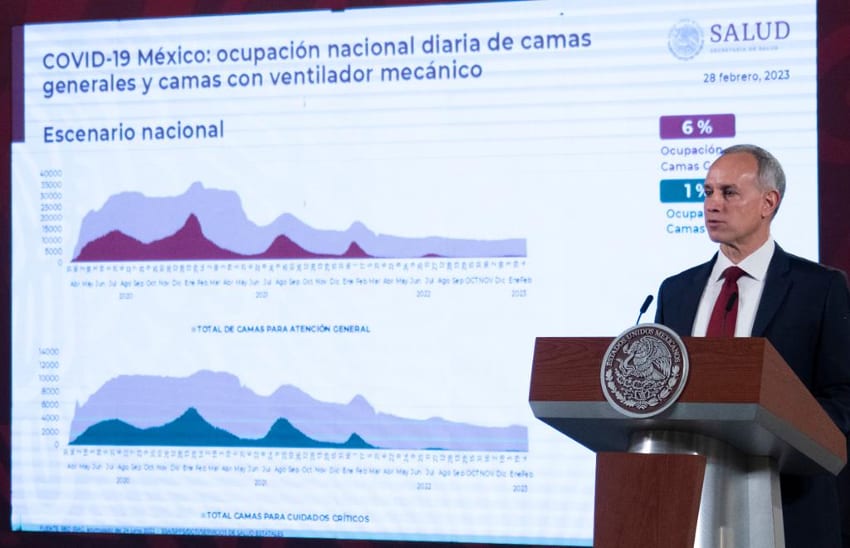
Deputy Health Minister Hugo López-Gatell – a household name in Mexico due to his leadership of the government’s pandemic response – noted that it was three years to the day since the first COVID case was confirmed here.
“Throughout these three years the epidemic has been characterized by a series of waves, or rises and falls in the intensity of transmission,” he said.
The coronavirus czar said that the sixth wave was continuing to recede, but the pace of the descent had slowed in the past four weeks.
Deputy Health Minister Hugo López-Gatell provides a national COVID-19 update (Gob MX)
Continuing the government’s health update, the director of the Mexican Social Security Institute (IMSS) said that IMSS hospitals would seek to retain the services of 5,600 specialist doctors who recently completed their residencies.
“Starting tomorrow we’re going to … offer them a labor option so that they continue working but with new conditions and new opportunities,” Zoé Robledo said.
He said that the number of IMSS training hospitals had increased from 200 to 400, allowing the public health care provider to train and retain more specialists.
López Obrador later remarked that “the right to health” is guaranteed across Mexico, even in “the most remote communities.”
“… I reaffirm the commitment that this year we will complete a universal, effective and free health system, the Denmark commitment still stands,” he added, referring to an ambitious – and likely unachievable – pledge to have a system comparable to that in the Scandinavian country.
“[Denmark] has a good health system. In Denmark what is known as the welfare state is established and that’s what we want to establish in Mexico. In Denmark, you have a pension when you turn 65, the entire health system is free, education is public and free, students are granted scholarships,” López Obrador said.
“That’s the welfare state; it’s guaranteeing humans protection from the cradle to the grave, that’s the responsibility of the state.”
Keeping his word, AMLO updated reporters on his conversation with Elon Musk.
Tesla, he announced, would build a plant in Monterrey under an agreement that includes “a series of commitments to address the problem of water scarcity” in Nuevo León.
Nuevo León governor Samuel García (right) posted this photo with Tesla CEO Elon Musk the day of the gigafactory announcement (@SamuelGarciaS Twitter)
“I spoke with Elon Musk on two occasions via videoconference, Friday night from Chetumal and yesterday morning. He was very receptive, understanding our concerns and accepting our proposals,” López Obrador said.
“With all respect I say to Mr. [Antony] Blinken of the State Department that there is currently more democracy in Mexico than in the United States,” he said. “… When I say that we have more democracy than them it’s because the people rule here and the oligarchy rules there.”
Wednesday
AMLO opened his third mañanera of the week with an encapsulation of his government’s purpose.
“We’re working to transform Mexico from below and with the people,” he said before handing the reins to fake news prospector Ana Elizabeth García Vilchis.
García, who has been presenting the weekly “Who’s who in the lies of the week” segment since 2021, took aim at a headline in the Reforma newspaper, a favorite punching bag of her boss. The headline – US Congress: AMLO is sabotaging democracy – is not an accurate description of the content of the story, she bemoaned.
“It indicates that the Congress of the United States asserted that the president of Mexico is sabotaging democracy, but that headline is a lie. In reality they’re two members of Congress out of 535 federal lawmakers in the United States. One of those is Bob Menendez, a Democratic Party senator of Cuban origin and a known enemy of leftist governments in Latin America, and [the other is] Republican Party representative Michael McCaul, an avowed anti-Mexican and supporter of the border wall,” García said.
“It’s obviously not true that the U.S. Congress has made a statement on the electoral reform in Mexico,” she said.
AMLO at the Wednesday morning press conference. (Cuartoscuro)
Back at the helm of his presser, López Obrador offered his view on a judge’s decision to invalide a warrant for the arrest of former Tamaulipas governor Francisco García Cabeza de Vaca on organized crime and money laundering charges.
“It’s part of the decadence of the judicial power. It hasn’t been possible to reform this power, which comes from the old regime and is … plagued by corruption,” he said.
“… Unfortunately there is protection for common criminals … and protection for white collar criminals … – they were the favorite sons of the old regime. Hopefully the judicial power reforms itself.”
Asked about Mexican soldiers’ alleged murder of five young and apparently unarmed men including a United States citizen in Nuevo Laredo, Tamaulipas, last Sunday, López Obrador said that the government had asked the National Human Rights Commission to conduct an investigation and that military authorities are cooperating so that “if members of the army are responsible, they’re punished.”
The president – who has highlighted that the number of people killed in armed clashes between the military and cartels has declined since he took office – added that his administration is different from those led by former president Felipe Calderón, who launched a militarized “war on drugs” shortly after he took office, and his predecessor Vicente Fox.
“[The strategy] isn’t ‘kill them in the heat of the moment,’ we really respect human rights,” he said.
Among other remarks, López Obrador said that Elon Musk is interested in investing in Mexico beyond the Tesla plant in Nuevo León and revealed that he had invited him to visit.
“I’m thinking about getting him to go to Sonora to see the solar energy plant … and all the potential there is there in copper and lithium,” he said.
“I clarified that lithium has already been nationalized but that doesn’t mean we can’t reach an agreement. Lithium belongs to Mexicans but if you buy the raw material, put it in battery factories in Sonora, give work to sonorenses, to Mexicans, an agreement can be reached.”
Thursday
AMLO boasted early in his presser that the Mexican peso has appreciated just over 10% against the U.S. dollar since he took office in late 2018, outperforming other currencies around the world.
“This hadn’t been seen in half a century,” he said before presenting data that showed that the peso depreciated during comparable periods of the sexenios (six-year periods of government) of his six most recent predecessors.
“If we go further back, it’s 50 years [since the peso appreciated during a sexenio],” López Obrador said.
Continuing an economic update, he declared that foreign investment in Mexico in 2023 will be “exceptional” and noted that the government is “conservatively” forecasting 3% economic growth this year.
“Only in this are we conservatives,” he quipped, using a word he normally reserves for past governments and critics of his administration.
The 69-year-old president later announced that Mexico and other Latin American countries would cooperate on a regional anti-inflation plan. Brazil, Colombia, Cuba, Argentina, Chile, Bolivia and Honduras would take part, he indicated.
“We’re going to have … a teleconference for this purpose on April 5 … and later an in-person meeting,” López Obrador said, adding that the governments of the respective countries would immediately start work to “seek exchanges in the export and import of food and other goods with the aim of tackling the high cost of living together.”
“… We’re going to invite producers, distributors, traders, importers, those who sell, those who buy. This has to do with food, getting [good] prices, removing tariffs, barriers that prevent food from being obtained at a good price for the internal market of the countries,” he said.
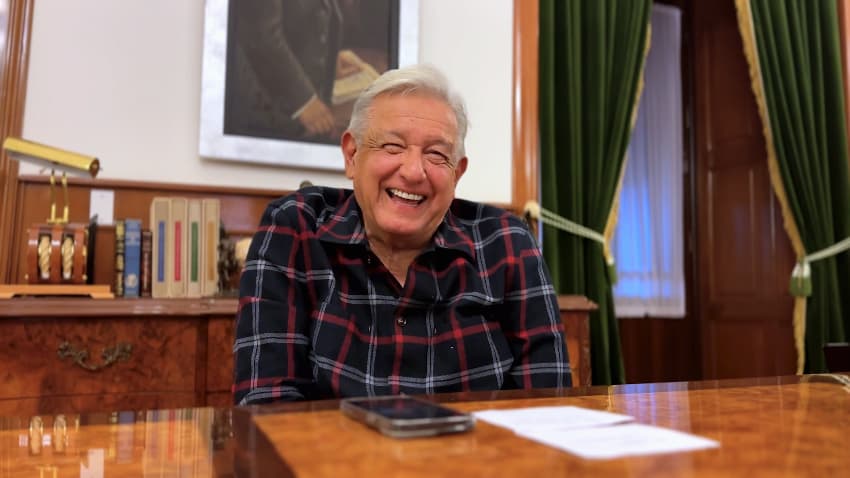
AMLO in his office (Lopezobrador.org.mx)
During his subsequent Q & A session with reporters, AMLO was asked whether he would ask his successor to re-present the constitutional electoral reform bill that was rejected by Congress late last year.
“I’m not going to give orders or instructions,” retorted López Obrador, who has committed to staying out of politics once his term as president concludes next year.
However, he added that if his “transformation” of Mexico is to continue, and a Morena party president “wants to finish cleaning up corruption in the country, purify public life” and “continue helping” Mexico’s most disadvantaged people, a two-thirds majority in Congress, rather than the simple one Morena and its allies currently have, “is needed” so that modifications to the constitution can be made.
In response to another question, López Obrador said that he had no problem with United States Ambassador Ken Salazar’s remark that protests in Mexico, such as those held across the country last Sunday, should be “celebrated” because they’re “part of a democracy that has an opinion.”
He subsequently reiterated his claim that there is “more democracy” in Mexico than in the United States and asserted that U.S. officials have a “bad habit” and even “an obsession” of intervening in the affairs of other countries.
“It dates back about 200 years, but I hope it will go away, it’s an illness that will go away with time,” López Obrador said.
Friday
AMLO arrived at his presser just after 7:20 a.m. and immediately advised reporters that he would visit no fewer than six states – Coahuila, Durango, Nuevo León, Jalisco, Zacatecas and Aguascalientes – over the weekend.
“It’s basically supervision of water supply projects for the people – aqueducts, diversion dams – and also evaluation of the progress of [construction] of the branches of the [state-owned] Wellbeing Bank,” he said.
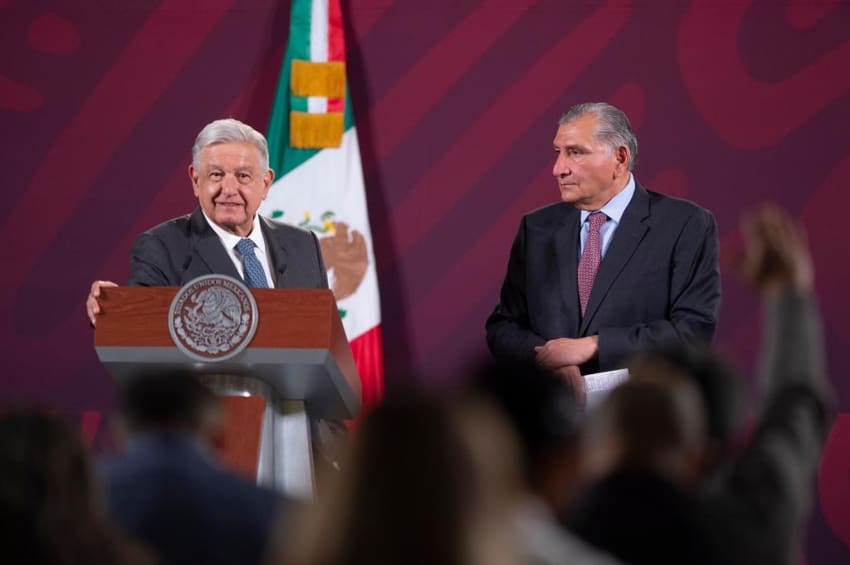
AMLO with Interior Minister Adán Augusto López (Gob MX)
López Obrador and his interior minister, fellow tabasqueño Adán Augusto López Hernández, subsequently spent the majority of the mañanera defending the newly promulgated modifications to five electoral laws.
The “Plan B” electoral reform “has been the target of a series of attacks, of a strategy clearly designed by the opposition based on falsehoods,” López Hernández said.
“… It’s not true that powers are taken away from the National Electoral Institute [INE] or the Electoral Tribunal. On the contrary, powers that local [electoral] councils or local committees had disappear and they’re all concentrated in a single sanctioning procedure that will be regulated by … the National Electoral Institute,” he said.
The interior minister asserted that the electoral reform would put an end to the “golden bureaucracy” at INE by eliminating undue benefits for employees, and claimed that the number of dismissals of INE employees will be much lower than critics of the reform claim.
López Obrador went on the attack when a reporter told him that the Institute for Legal Research at the National Autonomous University had described the electoral reform as a “backward step.”
“When did this institute protest during the neoliberal period? … Was there any protest … when the reforms to private education and health were presented? … Did they protest when the young men from Ayotzinapa disappeared? Did they protest when due to the privatization of social security the appalling [fire] at the ABC daycare center occurred?” he asked.
“[They didn’t protest] any of them,” AMLO said before claiming that the institute’s academics are part of the old “regime” of corrupt governments. “When have they protested the [electoral] frauds? Never,” he added.
The president rejected suggestions that the reform would undermine Mexico’s electoral processes and allow the federal government to intervene in them.
“We’re democrats, because we suffered from electoral frauds, we were victims of electoral frauds like millions of Mexicans,” said López Obrador, who claimed he was the rightful winner of the 2006 presidential election.
“Now that we’re in government, it would be a contradiction to act like [former president Vicente] Fox, who became a traitor of democracy,” he said. “… This reform doesn’t affect citizens or democracy at all.”