The new route was authorized by the U.S. Federal Aviation Administration (FAA) despite a current FAA ban on airlines adding flights to the United States from Mexico's airports. (Photo: Creative Commons)
Starting May 1, Aeroméxico will become the first airline to fly from Felipe Ángeles International Airport (AIFA) to the United States. The direct flight will connect Mexico City and Houston, Texas, with daily flights onboard an Embraer 190.
“After a regulatory assessment of the current conditions, U.S. and Mexican authorities approved the route, considering that AIFA also serves the metropolitan area of the Valley of Mexico,” Aeroméxico said in a statement, adding that tickets will be available for sale in the next few days.
According to the company, the scheduled flights to Houston from the Mexico City International Airport (AICM) will not be affected by the new flights.
Houston will be the ninth destination Aeroméxico offers from AIFA in addition to Acapulco, Cancún, Guadalajara, Monterrey, Mérida, Oaxaca, Puerto Vallarta and Veracruz.
Aeroméxico’s goal is to expand its connectivity network between Mexico and the United States with 22 routes from AIFA.
The airline obtained authorizations from Mexico and the United States to operate the route, despite Mexico’s loss of its Category 1 air safety rating with the U.S. Federal Aviation Administration in May 2021. Part of the consequences of being downgraded to Category 2 status was a prohibition against Mexico’s airlines adding new routes to the United States until Category 1 status is restored.
Aeromexico said it will continue to support the FAA’s aeronautical authority in the matter.
AIFA is one of president López Obrador’s flagship projects. It opened on March 21, 2022.
A lone car navigates a snowy highway near La Rumorosa, Baja California. (Twitter @mediosobsonmx)
The fifth winter storm of the season has hit northwestern Mexico, causing heavy snow in Baja California that has shut down highways and forced local schools to close.
The Centinela-La Rumorosa highway, the main route along the U.S. border, was temporarily closed in both directions on Tuesday morning, after heavy snowfall that started on Monday night in the town of La Rumorosa in the municipality of Tecate. Local authorities have set up a temporary shelter and are coordinating with the Red Cross to provide assistance to those who need it.
As of shortly before 11 a.m. local time, the state transportation ministry announced that the Centinela-La Rumorosa highway was open in both directions. The La Rumorosa-Tecate free highway was also open in both directions while the La Rumorosa-Tecate tollway remained closed, the ministry said.
The storm is the result of cold fronts and bands of low pressure interacting across the northwest of the country. This has caused heavy rains and gusty winds of up to 90 km/h in Baja California, Sonora, Chihuahua, Sinaloa and Durango, with sleet and snow in the mountainous regions of Baja California.
On Sunday night, the government of Baja California announced school closures in the municipalities of Tijuana, Ensenada, Tecate, Rosarito and San Quintín, in anticipation of the extreme weather conditions.
Local people were also advised to wrap up warm, drive with caution, avoid unnecessary journeys and call 911 in case of emergency.
Meanwhile, another cold front interacting with the subtropical jet stream has brought high winds, heavy rains and fog banks to the northeastern states of Coahuila, Nuevo León and Tamaulipas.
The National Weather Service (SMN) projects that the storm conditions will continue throughout Tuesday and into Wednesday, with more extreme weather likely during the coming month.
According to reporting by El Financiero newspaper, the Economy Ministry has shut down offices in Switzerland and the United States. (Twitter @SE_mx)
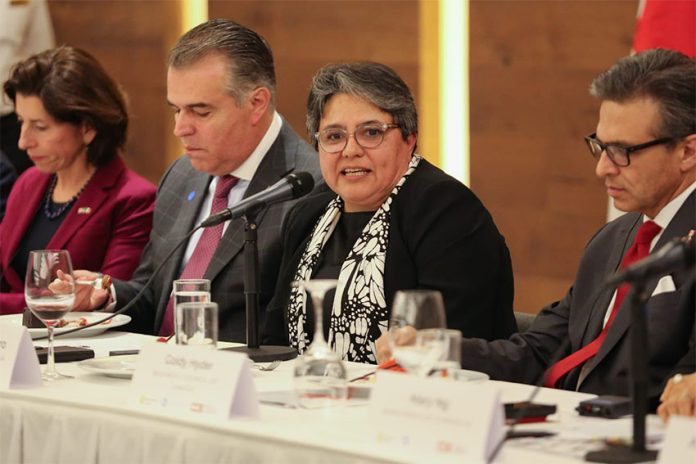
All 32 federal entities have the opportunity to benefit from the nearshoring phenomenon, Economy Minister Raquel Buenrostro said Monday.
The Economy Ministry (SE) said in a statement that Buenrostro and other federal officials met with the economic development ministers of Mexico’s entities (including 31 states and federal entity of Mexico City) in order to “share joint strategies to take advantage of the relocation of new industries.”
The federal economy minister, the statement said, “emphasized the commitment” of the SE to “facilitate and accompany investment projects via a ventanilla única for investors.”
The ventanilla única is a streamlined system that allows foreign investors to complete all bureaucratic procedures on a single website.
Buenrostro told the economic development ministers that “due to its geopolitical position,” Mexico is well-placed to attract foreign investment.
“All [32 entities] are potential candidates to receive investment,” she said.
The economy minister told state officials that companies across five sectors — semiconductors, automotive, electricity and electronics, medical and pharmaceutical devices and agro-industry — are especially well-suited to relocating to Mexico.
Buenrostro, the SE statement added, “called on the state ministers to draw up a work plan for the next two years.”
“Among the points it must contain is a diagnosis of the productive vocation of each entity,” the ministry said.
The SE said in December that Buenrostro and U.S. Secretary of Commerce Gina Raimondo would collaborate to put together a “joint presentation” to the private sector in early 2023 in order to “disseminate the opportunities and economic and fiscal benefits that both countries offer for the relocation of companies.”
Nowports' founders, from left to right, Alfonso de los Ríos and Maxamiliano Casal. (Photo: courtesy)
Nowports, an automated digital freight forwarder based in Monterrey, has opened its first branch in the United States.
Founded in 2018 by Mexican Alfonso de los Ríos and Uruguayan Maximiliano Casal, the company has arrived in Miami, Florida, looking to expand in North America before making the jump to Europe, Players of Life magazine reported.
“Miami is the Latin American hub. It was a no-brainer for us to open an office in Miami in order to support our customer base,” said Alan Bebchik, country manager of the new Nowports headquarters in the United States. He added that the growth in shipping to the US East Coast – and the port of Miami specifically – also made the city an attractive place for their branch.
Nowports board of directors at the Mastercard Gala Endeavor in December, where they won Entrepreneurs of the Year. (Photo: courtesy)
Nowports got its first big boost in 2018 when it was accepted into Y Combinator, the Silicon Valley accelerator, where they secured an investment of US $5.3 million dollars. Later in 2019, Nowports closed a $150 million Series C round with investors that included SoftBank, Tiger Global, Foundation Capitall and Monashees. In 2022, it officially became a “unicorn” when it announced its valuation had climbed to US $1.1 billion after an investment round led by SoftBank’s Latin America Fund.
The company, which currently operates in seven countries in Latin America (Mexico, Colombia, Uruguay, Peru, Brazil and Panama), set up shop in Wynwood and 12 of its 950 employees are based there with plans to double its local headcount by May, reported Refresh Miami.
“We believe that transforming the supply chain in emerging markets can boost their economic growth,” said Alfonso de los Ríos, Nowports’ 23-year-old co-founder and CEO. “The opening of our office in Miami is a step in that direction. We are going to see a more intertwined commercial relationship between the US and Latin America in the next few years. Digitization of supply chains will be a crucial aspect of this new era.”
Nowports has also developed Nowports Capital, a fintech company that provides inventory credit solutions and an internal insurance company for their freight forwarding customers.
The company has received several recognitions, named as one of the 10 most innovative companies in Latin America in 2022 and the founders as “Entrepreneurs of the Year” by Endeavor México.
Fire officials in Tijuana said they didn't expect the fire, which began Saturday, to be put out completely until later this week. (Photo: Tijuana Fire Department)
A large fire that started Saturday in a factory near the Mexico-United States border in Tijuana was still burning on Monday and was not expected to be fully extinguished until later this week.
A fire broke out at approximately 5:30 a.m. Saturday at the Cartonera de Otay cardboard recycling plant in an industrial area of the northern border city. The cause of the blaze was unclear but followed some kind of explosion at the plant, according to social media users.
Workers were evacuated, and surrounding streets were cordoned off. No injuries were reported. The fire is now under control, Tijuana Fire Department officials said on its Facebook page, but it will take days to put out.
More than 100 firefighters and other emergency personnel responded to the blaze, according to fire department officials, but they couldn’t stop it from spreading to other factories and warehouses.
The newspaper El Heraldo de México reported Monday that the fire was still burning more than 50 hours after it began.
Tijuana fire chief Rafael Carillo said that firefighters have been working hard to control the blaze and reduce risks to citizens. He predicted that it will be fully extinguished in the coming days.
A Twitter user who said he was landing at Tijuana International Airport posted images of the plume of smoke over the city.
Carillo said in a television interview that assets of seven companies were damaged by the fire, which he described as the largest in the area in 15 years. He warned citizens to avoid breathing in the smoke emanating from the blaze due to its toxicity.
Cardboard and plastic are among the materials that have fueled the fire.
Thick plumes of smoke crossed the border into neighboring San Diego county on Saturday. The United States National Weather Service (NWS) shared a satellite image on social media that showed the areas affected by the smoke.
Firefighters, who have been working nonstop since Saturday to control and extinguish the fire, received sandwiches and beverages from volunteers organized by the city of Tijuana. (Photos: Tijuana Fire Department)
“A smoke plume near the international border is spreading smoke aloft over #SoCal,” or southern California, NWS San Diego said on Twitter.
A video posted by an airline passenger flying into Tijuana airport showed a large cloud of thick black smoke rising from the blaze and spreading across the sky near the Mexico-U.S. border.
Both airlines reported ferrying at least 20 million passengers in 2022. (Photo: Mislik/Shutterstock)
Low-cost Mexican airlines Volaris and VivaAerobus have reportedhistoric figures for 2022.
Volaris, which according to specialized media in the aviation industry is now the largest airline in Mexico, reported transporting more than 30 million travelers last year, surpassing its 2021 figure of 24.3 million passengers.
In 2022, the budget airline added 30 new flights to and from the Mexico City metropolitan area’s newest airport — Felipe Angeles International a decision that, along with resuming flights at Toluca International Airport in México state, allowed Volaris to offer 1 million more seats on flights in Mexico, according to airline officials.
Volaris CEO Enrique Beltranena said that “passenger traffic in December was solid, and booking curves remain resilient. We continue to estimate that passenger growth will be in line with our anticipated capacity growth.”
Viva Aerobús also offered new routes in 2022 — from Bajío International Airport (BJX) in Silao, Guanajuato, and the Los Cabos International Airport in Baja California Sur — and offered 24 routes in the summer season. It, too, reported record-breaking passenger numbers.
The airline reported more than 2 million passengers in December alone. It also said that 2022 was the first year in which it transported 20 million passengers.
Viva Aerobús CEO Juan Carlos Zuazua said that they “saw strong demand in December as well as healthy levels of passenger traffic” across all their markets. Between 2019 and 2022, and despite the COVID-19 crisis, VivaAerobus’ traffic grew by 72.2%, he said.
One other reason Viva Aerobus and Volaris likely picked up more passengers in 2021 and 2022 was due to the closure of low-cost airline Interjet, which stopped serving customers in December 2020.
An elderly man plays the trumpet for spare change in Mexico City's center. (Photo: Tercero Díaz/Cuartoscuro)
The recorded cry of “tamales oaxaqueños, tamales calientitos” and the ringing bell of a garbage collector are among the sounds featured in an online audiovisual story that explores the cacophony of noise on Mexico City’s streets.
Hear the voice of Elias Zavaleta, whose recording of himself hawking tamales ended up becoming the sound of Oaxacan-style tamale vendors in the capital.
“In Mexico City, many notes in the city’s soundscape come from itinerant merchants,” observes the story by United States visual journalist Aaron Reiss and Mexican academic and photojournalist Oscar Molina Palestina. “… Each type of merchant calls out to potential customers with a unique, identifying noise or cry. … Each of their sounds give another layer of meaning to the din of this beautiful metropolis.”
While scrolling through the interactive story, readers — virtually transformed into Mexico City residents – encounter a range of noisemakers typical of the capital, including a knife sharpener and his pan flute, a garbage collector and his bell and a vendor and his audio recording that touts hot tamales from Oaxaca.
The music of the capital’s iconic organ grinders is also featured in the story as is the well-known recording of the ubiquitous collector of unwanted domestic items: “se compran colchones, refrigeradores, estufas…“
The unique sounds of Mexico City “can delight, annoy and inspire,” acknowledges The Pudding story, noting that the junk metal recording “has been remixed for many, many, many, songs and transformed into a battle cry for feminist activists.”
It also says that “the soundscape of the city is not fixed” as “it changes as the city does.”
“… Old sounds fade and new sounds arrive as the city and its current inhabitants generate a unique sonic landscape,” Reiss and Molina write.
Their story – enhanced with vibrant illustrations by Diego Parés – comes recommended for anyone interested in Mexico City generally, and its aural idiosyncrasies in particular.
Residents and anyone who has visited the city will likely find sounds with which you’re familiar — and which you may well love or loathe.
"Colchones, tambores, refrigeradores" se escucha en Qatar 🔊🤭
The familiar recording of a woman’s voice announcing that she accepts junk and scrap metal is so iconic that one Mexican soccer fan brought it with him to the World Cup in Qatar.
The fiancés José Melesio Gutiérrez Padilla and Daniela Márquez Pichardo. (Facebook)
A dual Mexico-United States citizen has been formally identified as one of four people whose remains were found in a rural area of Zacatecas last week, near the Jalisco border.
The Zacatecas Attorney General’s Office (FGJEZ) confirmed Tuesday that the remains of José Melesio Gutiérrez Padilla were among those found in Tepetongo, a municipality in southwestern Zacatecas that borders Jalisco.
Gutiérrez, a 36-year-old architect who lived in Ohio but was originally from León, Guanajuato, disappeared on Dec. 25 along with his fiancée Daniela Márquez Pichardo, her sister Viviana Márquez Pichardo and Irma Paola Vargas Montoya, a cousin of the two women. The remains of the three women were found along with those of Gutiérrez.
The four victims disappeared on Christmas Day as they were returning to Colotlán, Jalisco — where the three women lived — from Jerez, Zacatecas, a tourism-oriented “magical town” where they spent time at a bar.
The pickup truck in which they were traveling was later located in Tepetongo on Jan. 16. It had bullet holes in it, indicating that they came under fire while traveling through the municipality.
DNA testing of family members of Gutiérrez and an analysis of his remains allowed the FGJEZ to confirm the victim’s identity. The other remains were previously identified as belonging to the Márquez sisters and Vargas.
Gutiérrez’s family members underwent DNA testing in Guanajuato because they were too afraid to travel to Zacatecas.
“Out of fear of everything that’s happening, [we didn’t go to Zacatecas],” said Enrique Gutiérrez, José’s father.
He said that his son lived in the United States from the age of 12 and had a successful life.
“It’s not fair that good people doing good things go through this,” Gutiérrez said.
Brandie Gutiérrez, José’s sister, told Cincinnati television station WCPO that her brother completed a master’s degree in architecture at Miami University in Oxford, Ohio, and had been working at the firm Champlin Architecture in downtown Cincinnati.
She said that her brother and Daniela Márquez had been engaged since last Valentine’s Day and planned to get married in September 2023.
Daniela was an interior designer, her sister was a fashion designer and their cousin was a makeup artist, according to news website La Silla Rota. Funerals for the three women were held on Jan. 22.
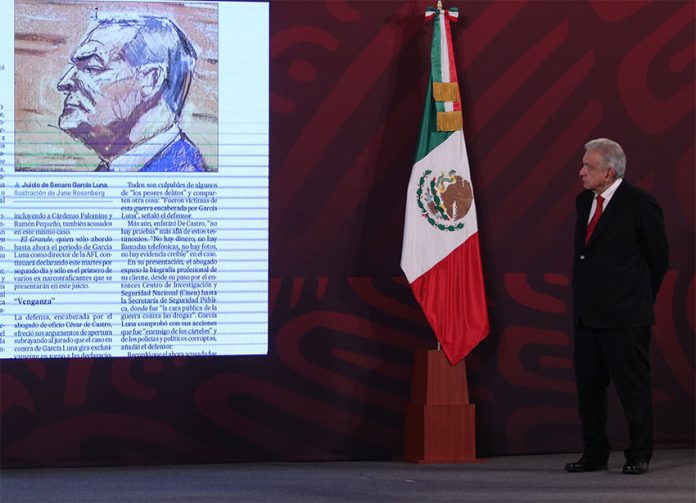
President López Obrador discusses the García Luna trial at his Jan. 24 daily press conference. (Andrea Murcia Monsivais / Cuartoscuro.com)
Former security minister Genaro García Luna is currently on trial in the United States, but he also faces charges in Mexico and federal authorities are attempting to secure his extradition.
The Federal Attorney General’s Office (FGR) said Sunday that it has two warrants for the arrest of García Luna, security minister during the 2006-12 government led by former president Felipe Calderón.
Issued by federal judges, the warrants are for “crimes committed in Mexico” that are unrelated to the charges the ex-official faces in the United States, the FGR said in a statement.
In a trial that began in a federal court in New York last Monday, García Luna is being accused of drug trafficking, accepting multimillion-dollar bribes from the Sinaloa Cartel and intimidating journalists and potential witnesses.
While Calderón was president in Mexico, the United States government allowed people to buy guns illegally in the U.S. and smuggle them into Mexico so that the weapons could be tracked and law enforcement officials could locate and arrest crime bosses.
Handguns, AK-47s, .50 caliber rifles and other weapons displayed at a press conference on arrests and weapon seizures by Operation Fast and Furious. While some weapons were found, others were never recovered. (Rebekah Zemansky via Shutterstock)
However, the United States Bureau of Alcohol, Tobacco, Firearms and Explosives lost track of most of the weapons, some of which were used in fatal shootings of both Mexican and U.S. citizens.
The FGR said in its statement that “the weapons that Mexican authorities … allowed to illegally enter [Mexico] have caused a large number of deaths and irreparable damage to justice.”
It said that the second warrant for the arrest of García Luna relates to a case involving privatized federal prisons, for which a massive amount of funding was authorized during the Calderón government.
The FGR said that García Luna’s involvement in the case “was fundamental in creating immense financial damage” to public coffers.
The federal government has filed a lawsuit in the U.S. to attempt to recover US $700 million that he allegedly accumulated as a result of his broader corrupt activity.
The FGR also said there are two additional ongoing investigations in Mexico against the former official, who headed up the now-defunct Federal Investigation Agency before becoming security minister.
Garcá Luna speaks with then-president Felipe Calderón. Archive / Cuartoscuro.com
It noted that it has applied for a third warrant for García Luna’s arrest, but that request — related to alleged improper use of powers and criminal association — is still being processed.
The FGR added that proceedings aimed at securing his extradition are continuing “within the framework of the corresponding legal limitations.”
García Luna’s New York trial is expected to last more than two months, with scores of witnesses ready to testify. The 54-year-old former security chief was arrested in Dallas, Texas, in December 2019.
President López Obrador claimed in 2020 that Mexico was a narco-state during the administration of Calderón given the accusations faced by García Luna.
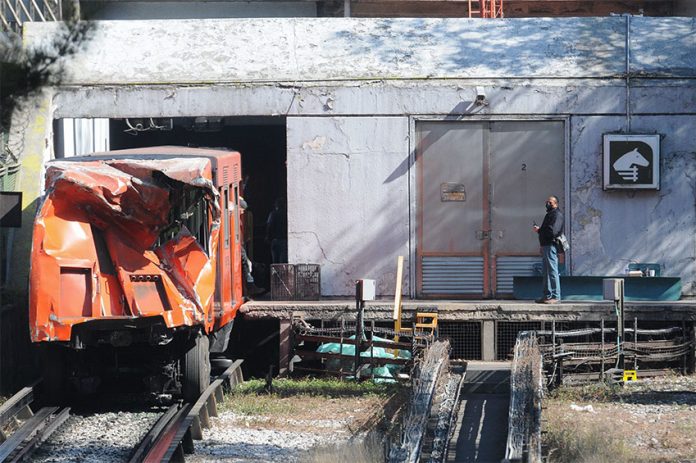
Technical crews pulling the damaged train cars from the Metro tunnels following the Jan. 7 crash. (Daniel Augusto / Cuartoscuro.com)
The driver of a train involved in a fatal accident on the Mexico City Metro in early January has been arrested on homicide charges, authorities said Friday.
Two trains traveling in the same direction on Line 3 of the subway system collided Jan. 7 between the Potrero and La Raza stations north of the historic center. A woman was killed in the crash and more than 100 other passengers were injured.
Ulises Lara, spokesperson for the Mexico City Attorney General’s Office (FGJ), said that the accident was caused by the negligent driving of Carlos Alfredo “N” and “intentional” damage to electrical cables at the Potrero station.
Authorities allege the arrested train driver ignored the low-speed protocol in place between the two Line 3 Metro stations. (Fiscalía CDMX Twitter)
A low-speed protocol was implemented between the Potrero and La Raza stations after signaling problems were detected the day before the accident, but the aforesaid train driver didn’t respect it, according to Lara.
The driver didn’t attempt to stop the train before it collided with the rear of another train on the same line, he added.
He was arrested on charges of homicide and causing injuries to passengers, the FGR spokesperson said.
Lara also said that the “intentional burning and cutting” of “communications, signaling and automatic pilotage” cables at the Poterero station was a factor in the crash.
He said that “fire and tools” were used to damage the cables and that “the crime of sabotage” may have been committed.
The Mexico City government has claimed that sabotage has caused a range of recent “atypical” incidents on the Metro system, including the Jan. 7 crash and the uncoupling of two cars on the same train on Jan. 15.
Lara said that the FGJ will continue investigating to identify those responsible for the unusual incidents.