The Cueva twins, Mía and Lía, shared the coveted Achievement award at the Panam Sports Junior Awards for their recent performances, including winning the gold medal in the 3-meter synchronized springboard diving event at the Junior Pan American Games last August in Asunción, Paraguay. (Panam Sports Junior Awards)
Three of Mexico’s best young athletes collected major honors at the Panam Sports Junior Awards this week: 14-year-old diving twins Mía and Lía Cueva from the state of Jalisco and 21-year-old heptathlete Valeria Páez from Mexico City.
The awards recognize standout junior athletes from across the Americas — focusing on those who excelled among the 4,000 young competitors from 41 nations at the 2025 Junior Pan American Games (ASU2025) held in August in Asunción, Paraguay.
Mía and Lía Cueva, who won the gold medal in 3-meter synchronized springboard diving at that competition, won the Sports Achievement Award over nine other nominees — both male and female, from various sports and countries.
In establishing themselves as contenders for the 2028 Summer Games in Los Angeles, they were competing against adults — often a decade older — in what is the highest level of the sport outside the Olympics.
Overall, more than 45,000 votes were cast in online voting held Dec. 2-21. The categories are best athlete (male and female), sports achievement, best team (male and female), fair play and influencer. Typical nominees were in their teens to early 20s.
Valeria Páez won her category — the Influencer Award — with a 55.4% of the vote to easily beat out Argentinian female beach volleyball player Morena Abdala and Canadian male hockey player Morgan Garside.
Páez was singled out for her online presence during ASU2025 in Paraguay, where she finished fifth in heptathlon but received hundreds of thousands of likes on some of her social media posts — on topics ranging from her training methods to Mexico’s uniforms.
Páez and the Cuevas were the only three Mexican nominees — and all three came away winners.
Their trophies will be presented at the Panam Sports General Assembly in 2026, though no site or date has been announced.
The Pan American Sports Organization is headquartered in Mexico City, with other main offices in Miami, Florida, and Santiago, Chile.
The Navy Beechcraft King Air 350 was approaching Scholes International Airport in foggy weather when it went down into the bay. (X)
At least five people have died following a crash near Galveston, Texas, on Monday of a Mexican Navy plane carrying a child burn victim and members of a nonprofit medical organization.
The aircraft was conducting a medical mission on behalf of the Michou y Mau Foundation, an organization that provides care to Mexican children with life-threatening burns.
Authorities were led to the aircraft partially submerged in Galveston Bay, where two of the passengers were said to be rescued. (@KABBFOX29/X)
Four of the people on board were Navy officers, and four were civilians, including the child, Mexico’s Navy said in a statement to The Associated Press. Two of the passengers were reportedly from the Michou y Mau Foundation.
U.S. Coast Guard Petty Officer Luke Baker said in an early report that at least five on board had died, but did not identify the deceased.
One person remains missing, and two others were rescued alive, Mexico’s Navy Ministry reported in the early hours of Tuesday morning.
The plane was last recorded at 15:01 local time over Galveston Bay, around 50 miles from Houston, according to data from the flight tracking website Flight Radar.
Video footage shared with The Associated Press shows the wreckage of the plane in the water. Air traffic controllers lost communication with the plane for about 10 minutes before it crashed, according to AP.
Search and rescue operations took place following the crash in coordination with the U.S. Coast Guard, the Mexican Naval Ministry reported.
Sky Decker, a professional yacht captain who lives close to the crash site, said he took two police officers to the site of the almost submerged plane before diving in and finding a badly injured woman trapped, who authorities were able to save.
Video footage taken close to the nearby Scholes International Airport showed rescuers working in dense fog.
It is not yet certain whether the severe foggy conditions had a role in the crash. The cause is under investigation.
A spokesperson from the National Transportation Safety Board said they are “aware of this accident and are gathering information about it.”
“We express our deepest solidarity with the families in light of these events,” the Michou y Mau Foundation said in a statement on X. “We share their grief with respect and compassion, honoring their memory and reaffirming our commitment to providing humane, sensitive and dignified care to children with burns.”
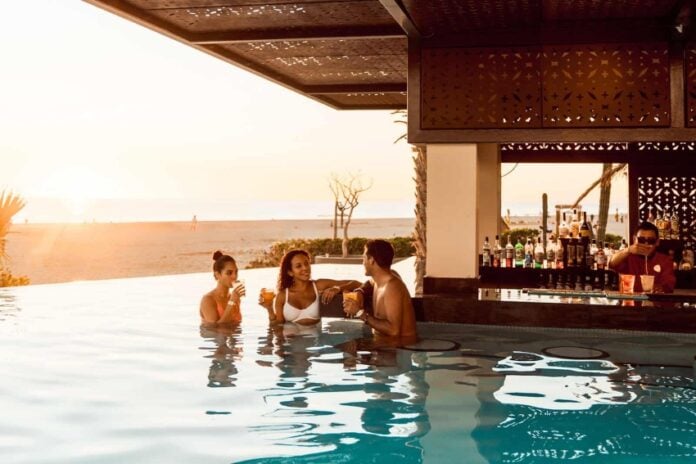
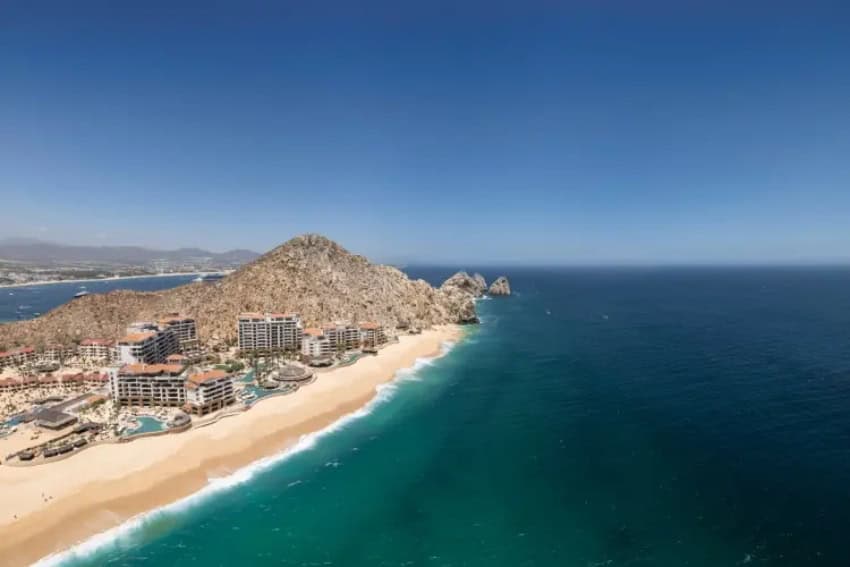
The development of Los Cabos as a tourist destination has been aided by spectacular natural scenery and a very distinctive brand of service. (Hard Rock Hotels)
The age of modern tourism began after the Second World War, largely thanks to advances in commercial airline travel that made reaching international destinations faster and easier than ever. Indeed, this era marked the beginning of people viewing cities and attractive places as destinations, and the onset of destinations actively marketing themselves to tourists.
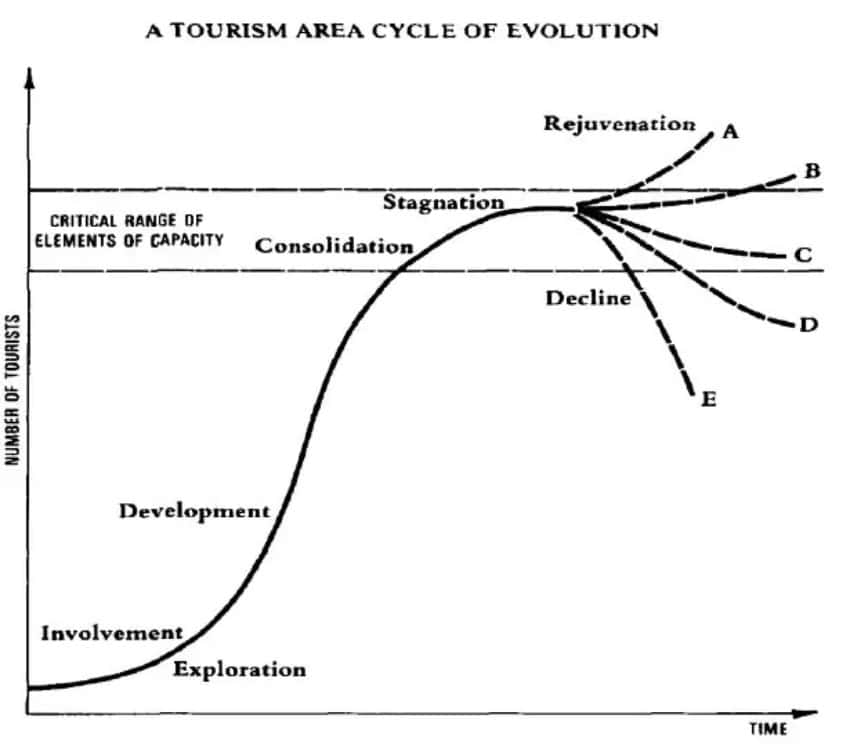
Academic studies of how these tourist destinations developed over time followed, perhaps the most influential and enduring of these being Professor Richard W. Butler’s concept of a Tourism Area Life Cycle (TALC), first published in The Canadian Geographer in 1980.
Butler’s theory of Tourism Area Life Cycle was first published in 1980 and has remained influential ever since. (R.W. Butler)
Butler’s model for how tourism destinations evolve posited six stages, the first five of which are exploration, involvement, development, consolidation and stagnation. The final stage offers several possibilities, ranging from rejuvenation to decline or even outright collapse of tourism due to external factors (the Covid-19 pandemic in 2020 provided a thankfully brief example of how this might happen).
Of course, no two tourist destinations are the same. Nor is there any timeline for how long each of these stages might take. But given the lasting impact of Butler’s theory and the rapid growth in Los Cabos in recent decades, it seemed interesting to explore where Los Cabos is in its evolution, according to Butler’s model, and thus what the future might hold.
Exploration
The first stage occurs when a small number of tourists discover a place, likely because of a single exceptional attraction. In the case of Los Cabos, it was fishing. The reputation for the spectacular fishing throughout the Baja California peninsula began to be spread by Western Outdoor News writer Ray Cannon to U.S. audiences in the 1950s.
The first two lodgings in Los Cabos in response to this exploratory phase were the Fisher House, a guesthouse rather than a hotel, which was opened by Carmen Fisher in San José del Cabo in 1951; and the Hotel Las Cruces Palmilla, which opened in 1956 with but 15 rooms. Intrepid travelers of the time were few and obliged to fly down and land on Palmilla’s airstrip, or come by boat, since there were few roads and no commercial air service nearer than La Paz.
Butler noted that there is little economic benefit for locals in this stage, and with few exceptions, that was the case in Los Cabos.
Involvement
By the time Los Cabos was featured in a Sports Illustrated article in 1965, Los Cabos had been placed on the tourism map, not only for its fishing, but also for some notable new hotels: the Hotel Cabo San Lucas in 1961 and the Hotel Hacienda in 1963, the latter the first lodging to open in Cabo San Lucas.
Except for two brief dips (one for a hurricane, another for a pandemic), Los Cabos tourism has been trending upwards for 50 years.
By then, locals had become more involved in tourism, as Butler predicted would happen in the TALC’s involvement stage, and a defined tourist season was being established. There was also more pressure to improve transportation options to the destination, although these wouldn’t come to fruition until the following decade, when the Transpeninsular Highway was completed — allowing people from the U.S. to drive the length of the peninsula for the first time — and the Los Cabos International Airport opened.
Development
According to Butler, tourists arrive slowly at first before eventually there is a rapid rate of growth. For Los Cabos, this happened only within the past 15 years, as the graph above suggests, with two brief dips due to Hurricane Odile in 2014 and the pandemic in 2020.
However, there was a long run-up to this phase, and it seems clear that Los Cabos first entered the development stage, as Butler defines it, in the early 1990s. That’s when local control of tourism declined as large brands began moving in, beginning with the opening of Westin and Hilton properties in 1993 and 2002, respectively, with more hospitality chains following in their wake. This period also saw the development of attractions beyond fishing and beaches, with luxury resorts featuring spas, upgraded swimming pools and significantly improved dining options increasingly becoming the norm.
This is also the first stage where locals began to see changes to the area that they didn’t approve of, which was true as early as the 1990s.
Consolidation
“As the consolidation stage is entered, the rate of increase in numbers of visitors will decline,” Butler pointed out, “although total numbers will still increase, and total visitor numbers exceed the number of permanent residents. A major part of the area’s economy will be tied to tourism. Marketing and advertising will be wide-reaching and efforts made to extend the visitor season and market area.”
Los Cabos has likely entered this stage now that growth has slowed significantly. This year, per Rodrigo Esponda, managing director of the Los Cabos Tourism Board (FITURCA), tourism growth should finish at about 2.5%, with 3% forecast for next year. Which is to say, quality is now prized above quantity.
Los Cabos has more luxury resorts than ever, with better services and upgraded amenities, from world-class restaurants to pampering spas. (Solmar Resorts)
These figures argue for placing Los Cabos in the consolidation stage, even though other Butler hallmarks for it — well-defined tourism districts, widespread marketing and advertising — were seen during what I have described as Los Cabos’ development stage. A growth in opposition to tourist projects, another Butler staple of consolidation, is also present.
Stagnation
“One aspect of the model that has become more relevant over time,” Butler has written since his theory was first published, “is the relationship implied between level of use and quality of experience.” Meaning that the more people that come to a destination, the more likely they are to degrade the quality of the natural attractions that spurred tourism in the first place.
This is undoubtedly happening in Los Cabos. Fish populations, for example, have been declining regionally for decades, and scarcely any views of the ocean can be seen along what is now termed La Ruta Escénica, which, 20 years ago and before, was truly spectacular. It’s also clear that developments are reaching farther up the Pacific Coast and East Cape, encroaching on natural treasures like the Cabo Pulmo National Park.
It’s likewise true, as Butler foretold, that Los Cabos is starting to lose its fashionable image. But until other trendier destinations arise and Los Cabos actually reaches its peak in terms of tourism numbers — unlikely any time soon, given infrastructure improvements to the Los Cabos International Airport and elsewhere — Los Cabos will continue to fight off stagnation. It bears noting, for instance, that area resorts collectively have never been of a higher quality than they are right now.
The final stage
The final stage, according to Butler, offers five potential outcomes.Two of them, modest growth or complete rejuvenation, suggest a rosy future. The other three — decline, capacity levels cut to stabilize decline, and the total collapse of tourism in the destination due to war, pandemic or other external factors — represent varying degrees of calamity.
Assuming Los Cabos solves its water problems — a big if considering the municipality has been operating at a deficit for quite some time — then I would consider continued moderate growth the likeliest outcome, especially if the Los Cabos Tourism Board continues to be so efficiently managed, and with such foresight. But the future, as always, remains beyond the conception of any model, however well thought out.
Chris Sands is the former Cabo San Lucas local expert for the USA Today travel website 10 Best and writer of Fodor’s Los Cabos travel guidebook. He’s also a contributor to numerous websites and publications, including Tasting Table, Marriott Bonvoy Traveler, Forbes Travel Guide, Porthole Cruise, Cabo Living and Mexico News Daily.
Mexico's oil shipment to Cuba is aimed at helping end the energy crisis caused by an insufficient supply of combustibles to fire electricity generation. (Ángel Hernández/Cuartoscuro)
Mexico has sent two ships carrying 80,000 barrels of petroleum to Cuba to help alleviate the country’s energy crisis over the Christmas period, President Claudia Sheinbaum confirmed on Monday.
“We are doing this within a legal framework as a sovereign nation,” Sheibaum said at her Monday morning press conference.
En Cuba nadie está a salvo de los apagones; en los hoteles cubanos también puedes disfrutarlos 🫣 pic.twitter.com/rarxtHgJdy
Cuba has been experiencing an energy crisis for around three years, with regular power outages of 20 hours or longer in several regions and frequent breakdowns at its aging power plants.
The five total blackouts as well as multiple partial ones in the last years have had a severe knock-on effect on the national economy. Cuba does not have the foreign currency needed to purchase the fuel required for its generating units. In addition, the latest U.S. military pressure on its main oil provider, Venezuela, has increased doubts about whether its neighbor will be able to continue supplying fuel.
The Cuban Electric Union reported on Monday that Cuba was facing an electricity deficit of over 1.9 GW, which was expected to lead to more widespread power outages. Authorities said that they were “working intensively” to bring thermal units back online and maintain service during the most critical hours.
Cubans have taken to social media in recent days to communicate their discontent with the situation, particularly over the Christmas period.
Sheinbaum emphasized that the exports are being made for humanitarian reasons for the people of Cuba. “We are continuing a series of support measures that our country has historically provided to Cuba,” Sheinbaum said. “Regardless of the political party, there has always been a Mexico-Cuba relationship. It’s not something new.”
The 80,000 barrels of fuel sent by Mexico’s state-owned oil firm Petróleos Mexicanos (Pemex) equate to just over one day of Cuba’s oil deficit. The island requires around 110,000 barrels a day to meet its basic energy needs, of which about 40,000 barrels come from domestic production.
Around 60% of Cuba’s fuel consumption comes from imports, with 65% of its oil being used to power its thermoelectric plants, according to Cuba’s National Office of Statistics and Information.
Sheinbaum said that Pemex will later release information on the price of the oil shipments.
On Tuesday, the president led the audience in singing "Feliz Navidad" and thanked reporters and viewers for accompanying her each morning. (Hazel Cárdenas/Presidencia)
President Claudia Sheinbaum will spend her Christmas vacation in Acapulco, Guerrero, marking her first official break since taking office. The president announced Monday that she will be in the coastal city from Dec. 25 to 27.
The trip comes two years after Hurricane Otis devastated the port city in October 2023, killing dozens and causing billions of dollars in damage to infrastructure and the tourism industry.
“We’re going to spend Christmas [in Acapulco],” Sheinbaum told reporters during her Dec. 22 morning press conference, where she also announced that the daily briefings would be suspended from Dec. 24 until Dec. 29 to give journalists time off.
When asked about her Christmas dinner plans, the president revealed she would be eating romeritos, a traditional Mexican dish featuring a herb native to central Mexico, usually served with mole and potatoes.
“[It’s] the dish I like most” for the occasion, Sheinbaum said.
Despite being away from the National Palace, the president emphasized she would remain vigilant about events in Guerrero, particularly the “Paseo del Pendón” festival in Chilpancingo, which draws large crowds.
“I’m going to be paying attention, obviously,” she said, noting that federal authorities would coordinate with state officials to provide any necessary security support for the event.
Sheinbaum clarified that presidential vacation homes in locations like Cozumel or Acapulco no longer exist as exclusive residences. The properties that remain belong to the Defense Ministry or the Navy, not for the president’s exclusive use.
Cierra la presidenta Claudia Sheinbaum la mañanera del pueblo con la canción Feliz Navidad de José Feliciano. pic.twitter.com/HWxrr1sTY7
Before ending her press conference on Tuesday, the president led the audience in singing “Feliz Navidad” and thanked reporters and viewers for accompanying her each morning.
“To everyone watching us, listening to us: Merry Christmas!” Sheinbaum said. “May Santa Claus bring lots of gifts to all the boys and girls.”
Last week, I wrote about the ideological guardrails shaping U.S. trade and economic policy. To recap: the need to decouple from China, the re-industrialization of the U.S. economy, the shift from free trade to managed (or “fair”) trade, and the idea that economic policy isnational security policy.
Now, I know you’re all eager to get to the answer promised in the title — but we’re not there yet. Before that, we need to understand the magnitude of the opportunity, and we can’t do that without talking about the main driver behind these policies: China.
Over the past 20-plus years, three major shifts reshaped the global economic and trade system.
First, manufacturing capacity. Two decades ago, the U.S. share of global manufacturing output was nearly triple China’s. Today, China’s manufacturing output is roughly double that of the United States.
Second, export market share. Before joining the World Trade Organization, China accounted for a modest 3% of global exports, while North America held around 20%. Today, China stands at roughly 12%, and North America at about 14%.
Third, global trade dominance. Twenty years ago, around 80% of countries traded more with the U.S. than with China. Today, nearly 70% trade more with China.
Global Trade Dominance: U.S. vs. China (Via @econovisual. Source: U.S. Census, Customs of China)
The most common — and mistaken — conclusion drawn from this data is that China simply became the “factory of the world.” But when you look at the destination of Chinese exports, the picture changes. The United States is China’s largest trading partner by far — more than three times larger than its next partner, Japan (excluding Hong Kong).
That alone should be a wake-up call. The real question isn’t whether the U.S. can outcompete China on its own — it’s how North America competes together.
So yes, these are a lot of numbers. But what do they actually mean?
In short, over just two decades, China achieved the largest and fastest expansion in production, economic growth and global market share gain of any country in human history. When China entered the WTO, North American integration and production were on a strong upward trajectory — some might even have predicted exponential growth. Then China entered the picture, and North America plateaued. The U.S. outsourced jobs, technology and innovation to China and other Asian economies. The North American engine — the United States — turned its focus elsewhere. Things didn’t go that badly for North America, but we’ve never seriously explored the counterfactual: how different things could have been.
Let’s go back to the numbers to put the opportunity in perspective. Over the past seven years, China’s share of U.S. imports has declined by 8 percentage points. The biggest winner so far? Mexico — which captured two of those eight points in just the last three years.
That shift fueled a years-long conversation among businesspeople and analysts that usually started with some speaker saying something like: “Nearshoring, friendshoring, ally-shoring — pick your favorite, but this is a historic opportunity.”
And all that excitement was about those two points. It truly changed everyone’s expectations of Mexico.
What makes this even more striking is that during those same years, Mexico hasn’t had a strong pro-investment economic policy — in fact, arguably the opposite. Economic growth has been weak; and I’m being generous with that statement. And yet, foreign direct investment keeps hitting record highs, industrial parks are running at full capacity, and exports to the U.S. keep rising. Mexico is now the United States’ top trading partner, both in exports and imports.
Let me leave you with one final data point to underline the scale of what’s at stake. China has roughly 2 billion square meters of industrial parks. Mexico has about 100 million. If Mexico were to capture just 5% of China’s industrial real estate footprint, it would double its total industrial capacity overnight (yes, I know the geographic differences — just bear with me).
I promised short essays, and this one has already pushed the limit. It’s impossible to compress all of this into a few paragraphs, but the message is clear. North America once had the chance to become the world’s leading technological, manufacturing and innovation powerhouse. That opportunity slipped through our fingers around the year 2000.
The good news? It’s not gone forever. But getting it back requires coordination, trust and serious work across multiple fronts. I’ll share my thoughts on how — and where — in the next pieces.
Stay tuned.
Pedro Casas Alatriste is the Executive Vice President and CEO of the American Chamber of Commerce of Mexico (AmCham). Previously, he has been the Director of Research and Public Policy at the US-Mexico Foundation in Washington, D.C. and the Coordinator of International Affairs at the Business Coordinating Council (CCE). He has also served as a consultant to the Inter-American Development Bank.
The city's waterpark during the hot summer months, El Vergel now serves as Tijuana's most Christmassy new addition. (Giovanni Muro)
In the height of July, the air at El Vergel is thick with the scent of chlorine, sunscreen, and the sounds of thousands of families splashing in the pools to escape the Baja California heat. But as December settles over the region, the landscape undergoes a radical, creative transformation. In a brilliant seasonal shift, the park’s famous lazy river — usually a slow-moving stream of inner tubes — has been drained and reimagined as a winding roller-skating tunnel. Nearby, the towering water slides that once pumped thousands of gallons of water per minute have found a second life as “sack slides,” where visitors trade their swimsuits for burlap bags to fly down the dry fiberglass chutes.
This is the magic of Villa Navideña, a winter festival that has allowed El Vergel, a staple of Tijuana’s East side since 1964, to defy the traditional limitations of a seasonal business.
Too cold to swim? No problem! (Giovanni Muro)
For over six decades, El Vergel has been more than just a premier destination for the entire binational region. Historically, the park has served as a sanctuary for residents of Baja California, drawing massive crowds from Ensenada, Mexicali, and Tecate while also attracting a significant number of visitors from Southern California.
However, water parks are notoriously vulnerable to the calendar. When the temperature drops, revenue usually dries up. For the past three years, the park’s management has challenged this reality by extending its reach into the winter months. By pivoting from a water-centric model to a holiday-themed experience, El Vergel has ensured that its gates stay open and its staff remains employed year-round.
This year’s edition of Villa Navideña is the most ambitious yet. Beyond the novelty of dry-sliding down “La Medusa” (the Jellyfish), the park has introduced a variety of sensory experiences that lean heavily into Mexican holiday traditions. The air no longer smells of chlorine; instead, it is filled with the comforting aroma of hot chocolate and elotes (corn cups) topped with cream, cheese, and chili.
The 2025 expansion has introduced entirely new zones for families to explore. A newly constructed movie theater provides a cozy space for children to watch holiday classics, while a petting zoo offers a hands-on experience that contrasts beautifully with the high-adrenaline attractions of the summer.
One of the most popular adaptations remains “La Medusa.” In the summer, it is an iconic, twisting water slide that challenges the bravest swimmers. In the winter, it becomes a giant helter skelter. The transition is seamless, allowing children and adults alike to climb the familiar stairs to the top and descend as many times as they wish. Safety remains the primary focus during this transition; park personnel are stationed at both the summit and the base of the ride to coordinate the flow of “sledders” and ensure everyone enjoys the thrill without incident.
The growth of the event is a calculated strategic expansion. According to Jesus Garcia, Administrative Officer and Event Supervisor at El Vergel, the project’s footprint is expanding at a rapid pace.
From pesebres to party vibes, the water park is divided into different themed sections. (Giovanni Muro)
“Every year, we dedicate more of the park to Villa Navideña,” Garcia explained during a recent tour of the grounds. “This year we are using about 66 percent of the property. We have seen such a positive response from the community that we are already looking ahead. By next year, we expect the winter event to fully take over the entire property.”
This transition reflects a broader trend in the global theme park industry where “flex-space” is king. By utilizing existing infrastructure like the elevation of slide towers and the pathways of the lazy river, El Vergel is maximizing its ROI while providing unique value to the people of Tijuana.
In today’s world, a holiday event is only as successful as its presence on social media, and Garcia and his team are aware of this. While the rides and food are the primary activities, the “photo ops” are arguably the park’s biggest draw.
The park has been meticulously decorated with diverse backdrops designed to cater to every aesthetic. On one side of the park, visitors can find classic, reverent Nativity scenes that honor the traditional roots of the holiday. A few steps away, towering Christmas trees and brightly colored LEDs and neon sculptures provide a contemporary, high-energy vibe perfect for Instagram and TikTok.
“On this third edition of Villa Navideña, there are more photo ops than ever before,” Garcia noted. He pointed out that the goal was to make the park entirely immersive. “People can take a great photo in whatever corner they choose in this park. We wanted to make sure that no matter where you are standing, you feel the spirit of the season.”
As the sun sets over the East side of Tijuana, the lights of Villa Navideña flicker to life, reflecting off the dry slides and the skating rink. What was once a summer-only escape has successfully transformed into a year-round landmark. For the families of Baja California and their neighbors to the north, El Vergel is no longer just a place to cool off — it is a place to gather, to celebrate, and to create new memories under the winter stars.
Ana Gomez is an award-winning journalist who has covered the Cali-Baja region since 2010. Her work focuses on immigration, culture, business, and breaking news.
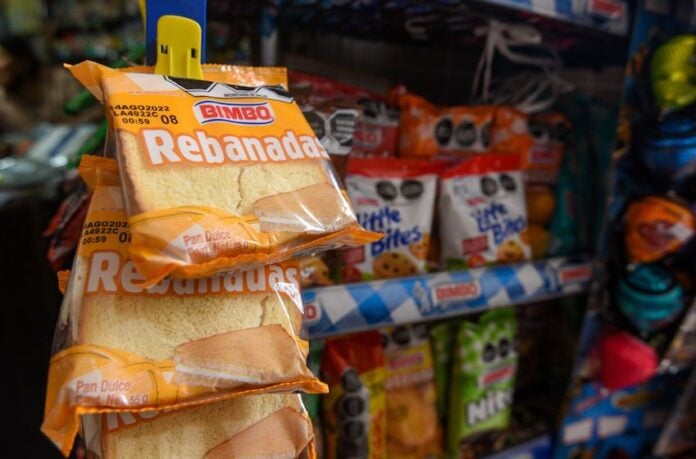
The Bimbo name and its bread and snack products are everywhere in Mexico, but the company has extensive operations in the United States as well. (Cuartoscuro)
Mexican baker Grupo Bimbo has filed a lawsuit in the United States against multiple import tariffs imposed by President Donald Trump.
The suit claims that Trump’s imposition of the tariffs under the pretext of an “economic emergency” was unconstitutional. It also seeks an order for the reimbursement of all tariffs already paid.
The basis of Bimbo’s suit is that Trump’s constitutional rationale for imposing the tariffs against Mexico without legislation was an “economic emergency.” Yet he made it clear that his motive was to pressure Mexico on immigration. (Bimbo/X)
Bimbo’s lawyers did not mention in their lawsuit the amount of money the group has already paid in tariffs and wants back.
The document was filed on Dec. 16 before the International Trade Court (USCIT) in New York by Grupo Bimbo and its subsidiaries Bimbo Bakeries USA, Bimbo Bakehouse, Barcel USA LLC and St. Pierre Groupe LLC.
Specifically, the suit challenges the 25% tariffs applied in February against Mexico and Canada on products that are not covered by the United States-Mexico-Canada free trade agreement (USMCA).
Trump’s government activated the tariffs on a wide range of imports from Mexico and Canada to exert pressure on immigration and trade balance issues.
Bimbo’s claim is based on U.S. statutory law and the Constitution. In May, the USCIT ruled that the U.S. president does not have the authority to impose tariffs across the board under the International Economic Emergency Powers Act (IEEPA) or the National Emergencies Act (NEA). That ruling was upheld by the Federal Circuit Court of Appeals and is currently under final review by the U.S. Supreme Court.
The Supreme Court’s final decision could redefine the balance between executive power and the legal framework of international trade.
Bimbo in the US market
Bimbo maintains a substantial footprint with 43 brands and approximately 60 bakeries operated by Bimbo Bakeries USA, ensuring that most bread and pastries sold in the U.S. are produced domestically. This localized production structure means the tariffs directly affect only a small portion of the company’s U.S. business—less than 10% of its American revenue comes from Mexican imports, according to company statements.
Despite this insulation from direct tariff impact, Bimbo’s North American sales have faced headwinds, declining 5% in the third quarter to 47.47 billion pesos ($2.57 billion). The company attributes this softness to changing U.S. consumer behavior, with shoppers increasingly polarized between value-seeking and premium product preferences amid broader economic pressures.
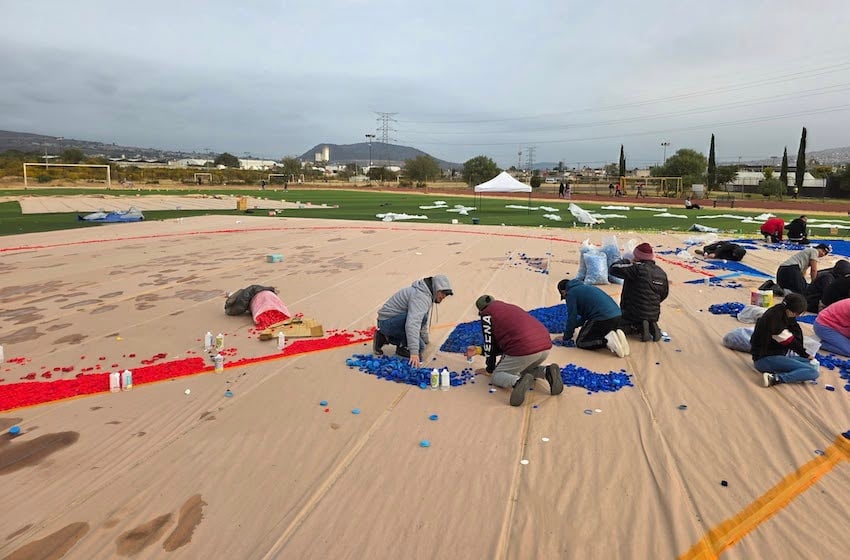
Creating the huge image seen here in miniature required hundreds of volunteers, families, staff and partner organizations, and an estimated 1 million bottle caps. (Guinness World Records)
Guinness World Records has confirmed that Farmacias Similares and its charitable arm, the Dr. Simi Foundation, have secured yet another world title — this time for the largest bottle cap mosaic — bolstering the Mexican company’s growing collection of record-breaking feats.
The mosaic covered 1,203 square meters (12,900 square feet) and was assembled earlier this month from more than 1 tonne of plastic bottle caps on a soccer field in México state on the outskirts of the Mexico City metropolitan area.
The piece featured the smiling-face logo of Dr. Simi and a wheelchair accessibility symbol transformed into a giant heart — serving as a tribute to people with disabilities and children with cancer.
Hundreds of volunteers, families, staff and partner organizations collaborated on the project, carefully placing caps to meet Guinness’s technical standards.
“It was inspiring to witness such an organized and dedicated effort,” adjudicator Susana Reyes said in remarks reported by Guinness.
The charity said the use of 1 tonne of caps — estimated to be around 1 million bottle caps — prevented 1,330 kilograms of carbon dioxide emissions while helping raise funds for medical and social services.
Hundreds of volunteers, families, staff and partner organizations collaborated on the project, carefully placing caps to meet Guinness’s technical standards. (Facebook)
The Dr. Simi Foundation called the mosaic “a testament to the power of collective will when we work toward a greater purpose.”
Roughly 250 volunteers — and six Dr. Simi mascots dressed as Santa Claus, a Wise Man, a tin soldier and three other characters — also gathered Nov. 27 at the Zócalo in Mexico City. Together, they created a huge mosaic of Dr. Simi’s face by using roughly 8 million bottle caps, according to the newspaper El Sol de México.
However, the record officially adjudicated by Guinness occurred Dec. 8 in Valle de Chalco in México state — making it No. 6 in Farmacias Similares’ expanding Guinness portfolio.
In November, the ever-expanding Dr. Simi empire unveiled the world’s largest gummy in the dietary supplement category at SimiFest 2025, a B-complex vitamin figure shaped like Dr. Simi’s face and weighing just over 125 kilograms (276 pounds).
The second annual SimiFest was an 11-hour music festival, headlined by Empire of the Sun and Leon Bridges, on Nov. 29 that drew more than 15,000 people, according to the Dr. Simi Foundation. Proceeds and ticket sales supported causes tied to the Simi Planeta Foundation, such as reforestation projects and environmental awareness efforts.
The agricultural sector was the main driver of the Mexican economy's 1.0% monthly growth in October. (Adolfo Vladimir/Cuartoscuro)
Mexico’s economy took a positive turn in October, growing at a monthly rate of 1%, the National Institute of Statistics and Geography (INEGI) announced on Monday.
The growth came as a welcome surprise after the Mexican economy slumped 0.3% in the third quarter, raising fears that the negative trend would continue for several more months.
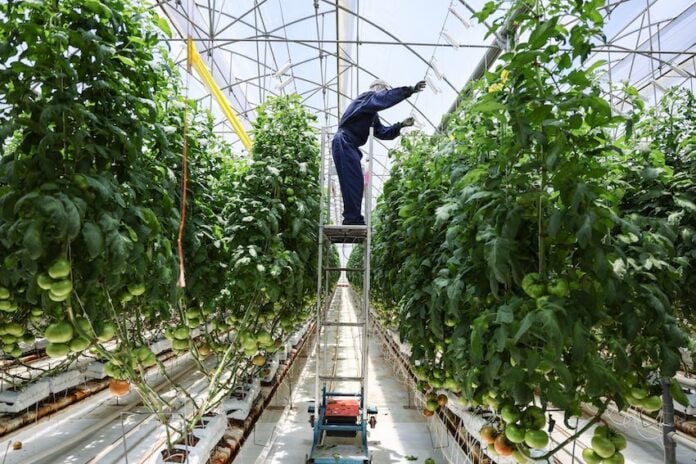
According to INEGI’s Global Indicator of Economic Activity (IGAE), October’s increase was driven by the primary sector — mostly agriculture — which grew 1.4% compared to the previous month.
The tertiary sector (trade, services and tourism) followed in terms of positive performance, increasing by 1.2%. Cultural and sporting entertainment services and other recreational activities were particularly successful, with a 3.5% rebound compared to September figures.
Meanwhile, the industrial or secondary sector saw the least growth, at just 0.7% compared to September. While construction increased by 3.8%, the manufacturing sector contracted by 0.3%.
Tourism was also a big contributor to Mexico’s October growth, as the tertiary sector to which it belongs grew 1.2%. (Bernardino Hernández/Cuartoscuro)
In its year-on-year comparison, the IGAE recorded 1.6% growth in October, owing to a 11.8% increase in primary activities and growth in the tertiary sector of 2.5%.
But smooth sailing ahead is by no means guaranteed. Some of the principal economic risk factors in the medium term include the ongoing uncertainty around U.S. trade tariffs and the slowdown of the U.S. economy, analysts from the Mexican Securities Brokerage House (Valmex) said in a previous report.
“This is compounded by the sluggish pace of public investment and persistent weakness in business confidence, which continue to limit the prospects for recovery in the short term,” Valmex analysts stated in the report.