The week of Oct. 27-31 delivered a sobering economic reality check alongside simmering bilateral tensions with the United States and bright spots in Mexican culture and sports.
While Mexico News Daily returned from a cyber attack that knocked the site offline for five days — three security firms later, we’re back and safer than ever — the news cycle offered no shortage of important headlines.
Didn’t have time to read every story this week? Here’s what you missed.
Mexico’s economy contracts for the first time since 2021
Mexico’s economy shrank in the third quarter, posting its first quarterly contraction since the pandemic recovery began. The unwelcome data arrives as international forecasters had recently upgraded growth projections.
The contraction compounds existing labor market concerns. Mexico’s unemployment rate continued its six-month climb, adding pressure on household budgets even as the government pursues expansionary fiscal policies.

Manufacturing propelled Mexico’s exports to an all-time high in September, with exports reaching $56.48 billion — a 13.8% annual increase. The surge stems primarily from non-automotive manufacturing exports, which jumped 23.9% as Mexico benefits from its comparative advantage: most trade with the United States occurs within the USMCA framework and remains largely exempt from tariffs.
In investment news, the Spanish energy firm Cox announced major wind and solar farm investments in Nuevo León, signaling continued foreign confidence in Mexico’s renewable energy transition. The investment extends Cox’s clean energy commitment in Mexico, where the company plans a US $10.7 billion expansion over the next five years.
Relations with U.S. business interests grew strained as the U.S. Chamber of Commerce took aim at Mexico’s tax agency, citing “aggressive” practices that have created uncertainty for American companies operating in Mexico.
US boat strikes: A brewing diplomatic crisis
The biggest story of the week centered on U.S. military strikes against alleged drug boats near Mexico’s waters.
The strikes killed over a dozen people, with Mexico still seeking the lone survivor.
President Sheinbaum forcefully condemned the operations during her Wednesday press conference and spoke out in favor of arresting suspected drug traffickers at sea, rather than killing them.
“We have a model, a protocol, that has produced a lot of results. If, in international waters, the United States sees a boat that is allegedly carrying drugs, an agreement is reached and either the Mexican Navy or U.S. government institutions [should] intervene to arrest the alleged criminals,” she said.
Sheinbaum said that she had asked her foreign affairs minister, Juan Ramón de la Fuente, to convey the message to the U.S. ambassador to Mexico, Ron Johnson, that what the Mexican government wants is for the aforesaid protocol to be improved “within the framework of the security agreements we have with the United States.”
De la Fuente and Mexico’s Navy Minister Raymundo Pedro Morales met with Johnson on Tuesday.
Flood recovery progresses
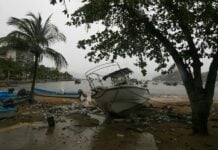
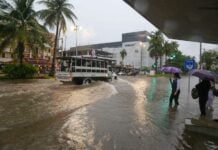
Mexico made significant progress in the recovery from Tropical Storm Raymond, which caused major flooding across Hidalgo, Veracruz, Querétaro, San Luis Potosí and Puebla and killed nearly 100 people. By Monday, power was fully restored to flood-affected communities, with Wellbeing Minister Ariadna Montiel reporting that 70,256 people are in the process of receiving financial support to address damage to their homes.
Recovery efforts deployed 53,394 support personnel who cleared roadways, homes and schools, and delivered over 413,000 food parcels. The Federal Electricity Commission mobilized 1,602 workers, 503 pickup trucks, 219 cranes, six helicopters and eight drones for restoration work.
Tariff deadline extended
Following a Saturday phone call with President Trump, Sheinbaum announced that bilateral negotiations on trade and tariffs would extend by several weeks, postponing a scheduled tariff increase from 25% to 30% on non-USMCA compliant Mexican imports.
The 90-day suspension period that began in July was set to expire this week, but the extension renders that deadline moot.
Scheduled US tariff increase on hold after bilateral talks: Monday’s mañanera recapped
Sheinbaum reported that negotiations on 54 non-tariff trade barriers are “very advanced,” with Economy Minister Marcelo Ebrard claiming the talks are 90% complete. The president said she and Trump would speak again “in a few weeks” as they work to finalize the agreement, suggesting that despite broader bilateral frictions, economic pragmatism continues driving both governments toward accommodation.
Awards and achievements across design and sports
Oaxaca’s Centro Cultural del Mezcal won a prestigious Paris design award, bringing international recognition to the carefully restored 17th-century building that houses an interactive museum, bar and restaurant celebrating mezcal.
In sports, Mexico City’s Yareli Acevedo made history as the first Latin American woman to win the points race at the UCI Track Cycling World Championships, furthering what observers are calling a golden age for Mexican cycling.
Monterrey youth won the prestigious Iris Prize for their project, Journey to the Microcosm of Nuevo León. The citizen science initiative invites residents of the Monterrey metropolitan area and beyond to get to know the Santa Catarina River, which, in recent years, has been seen more as a flood risk than a valuable part of the city’s ecosystem.
View this post on Instagram
Travel news
Aviation news dominated the travel sector this week. The Trump administration announced on Wednesday that it would revoke 13 flight routes between the U.S. and Mexico, while thick fog caused delays at Mexico City International.
Also this week, a federal judge ruled that Uber can legally operate at Mexico’s airports, temporarily settling a years-long saga between airport authorities and taxi permit holders, who are demanding the government maintain their exclusive pick-up rights.
Uber celebrated the news and said that Mexico will need to ensure efficient transportation for the millions of tourists who will arrive during the 2026 FIFA World Cup.
In the Riviera Maya, the cruise ship high season got underway with the arrival of nearly 100,000 tourists to Cozumel.
Butterfly brigades
Authorities and community groups mobilized to protect the iconic monarch butterfly this week. In the Yucatán Peninsula, a community group is mapping a previously undiscovered monarch migration pathway reaching Isla Mujeres, expanding understanding of these remarkable insects’ continental journey.
Profepa also cracked down on illegal logging in Michoacán’s butterfly reserve, working to protect their critical winter habitat from ongoing threats.
Looking ahead
As Mexico enters November, the broader picture suggests underlying economic strengths — record exports and sustained foreign investment — are helping Mexico to ride out the Trump-era tariffs and global uncertainty.
This week, Sheinbaum’s handling of the boat strikes showcased the delicate diplomacy required to defend Mexico’s sovereignty in the bilateral fight against organized crime.
And next week, French President Emmanuel Macron will make a brief visit to Mexico, as Sheinbaum seeks to strengthen ties beyond North America and diversify Mexico’s international partnerships.
Mexico News Daily
This story contains summaries of original Mexico News Daily articles. The summaries were generated by Claude, then revised and fact-checked by a Mexico News Daily staff editor.