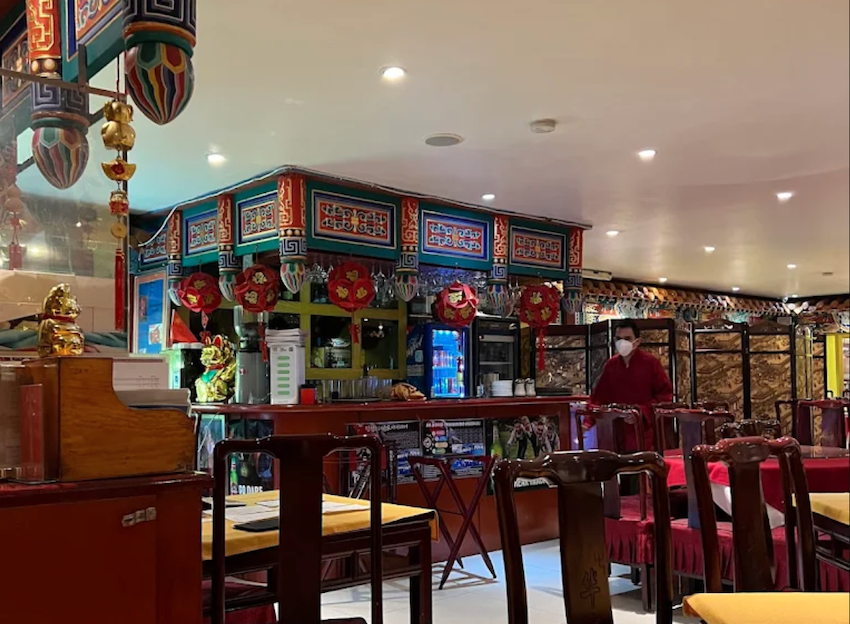
Because suggesting the Hunan would be just too mainstream, here’s our digest of the best Chinese restaurants in Mexico City. (Edgar Negrete Lira/Cuartoscuro)
February in Mexico City always has the feel of Rafael Bernal’s noir novels and the aroma of sweet and sour pork and fortune cookies. As always, the Mexican capital goes all out in its celebrations for theChinese New Year. We celebrate in grand style alongside the community of traditional restaurateurs who have created interesting fusions between their own culinary culture and that which they learned here, in the country we share.
Between dragons, fireworks and little red envelopes, the celebrations of the Year of the Fire Horse are just around the corner this month. So, get your hot-pot belly ready! Here’s our digest of the best Chinese restaurants in Mexico City to celebrate Chinese New Year in 2026.
El Dragón
El Dragón’s Peking duck is so good, every Chinese person in Mexico City can tell you about it. (Paul Tseng/El Dragón Restaurante Chino)
Nowhere in Mexico City will you find a better Peking duck. As you enter through the Chinese Imperial decorated gates, you can smell the scent of the duck quietly sizzling in the back of the room. As it is their star dish, they hired a person exclusively to take care of the roasted ducks — other than the chef, of course — which are left over the fire for at least 8 hours: it is as if he were a sentinel dedicated to ensuring the perfect lacquer.
The portions are generous, so we highly recommend booking a table for bigger parties. Besides the duck, the wonton soup is excellent, and ordering rice noodles to share is always a great idea.
Where? Hamburgo 97, Juárez, Cuauhtémoc.
Cantón Mexicali (廣東墨西加利)
If you’re looking for an edgy mix of Mexicali-inspired cuisine and the Chinese finest dishes, Cantón Mexicali is your choice. (Sergio Téllez/Cantón Mexicali)
After a large influx of Chinese immigrants to Mexicali in the northwestern state of Baja California in the early 20th century, a unique — yet fantastic — combination of coastal dishes and Chinese spices emerged in the region. Cantón Mexicali, located on the border between the Condesa and Roma neighborhoods, was also born from this clash of cultures.
Although the portions aren’t as large as in other traditional Chinese restaurants, it’s always worth sharing. The three-mushroom spring rolls served with oyster fried rice transport you straight to the Canton region in southern China, where dishes are steamed andnot as spicy as in other parts of the country.
Where? Av. Álvaro Obregón 264, Hipódromo, Cuauhtémoc.
Dong Zi Gongfu Te
There is no place in Mexico City with a better assortment of dim sum than the Dong Zi Gongfu Te. (VTM Matsueda/Gong Zi Gongfu Te)
Also referred to simply as “Hong Kong” among Colonia Narvarte dwellers, this is Mexico City’s dim sum sweetheart. As happens in several Chinese places in the neighborhood, the menu is written in Mandarin, and you often must ask for suggestions from the waiter. However! You can spot a fine Chinese restaurant when all its customers are, well, Chinese. When you dine at Dong Zi Gongfu Te, you seldom hear any Spanish. Or any Western language whatsoever.
Their sweet and sour chicken is simply spectacular, always with a side of wonderful fried rice with vegetables. If you’d like to try their specialized dim sum buffet, remember it’s a weekend special, and always try to arrive before noon. The service ends at 2:30 p.m. (officially, at least — diners usually gobble up everything before 1 p.m.). Also, please note that the restaurant does not accept credit card payments, so it’s best to bring cash or be prepared to make a bank transfer.
Where? Dr. José María Vértiz 692, Narvarte Poniente, Benito Juárez.
Hong King
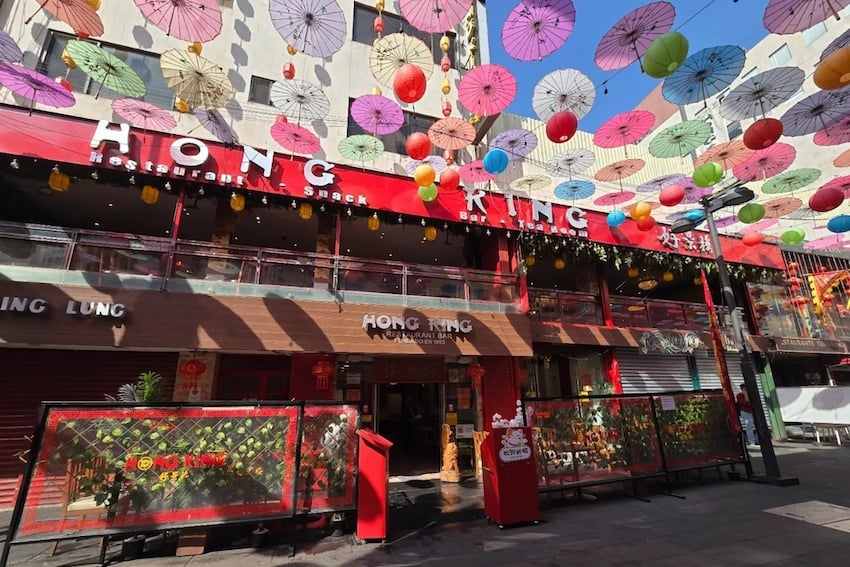
The seasoned pork ribs, Chow Mein chicken and lotus soup are must-haves at this place, located in the heart of Mexico City’s Chinatown. (Lalo Padilla/Hong King at Barrio Chino)
And last, but certainly not least, we must make an honorable mention to this historic jewel in the heart ofMexico City’s Chinatown. The walls of this place hold the echoes of the first Chinese migration to Mexico City, back in the 1930s. Established in the 1960s, Hong King restaurant has established itself as a symbol of traditional Chinese food in the capital.
And how could it not? The founders came from the Canton region directly to Mexico City’s Chinatown to build a business that has been in the market for over 60 years now. With over 160 classic Chinese dishes, the food here tastes of tradition and the tireless work of generations who have passed the recipes from hand to hand. Although the place is famous for its Peking duck, don’t miss the Kung Pao chicken or the dumplings.
Where? Callejón Dolores 25 A, Centro Histórico, Cuauhtémoc.
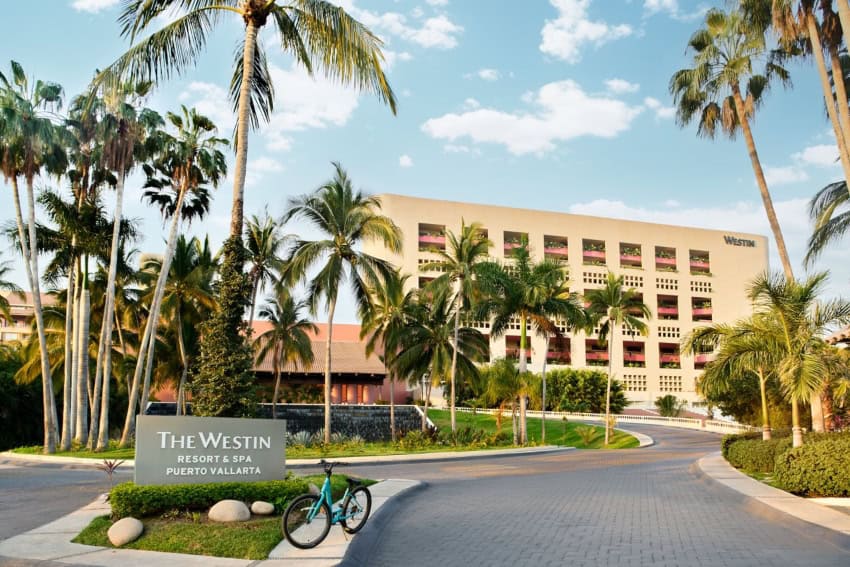
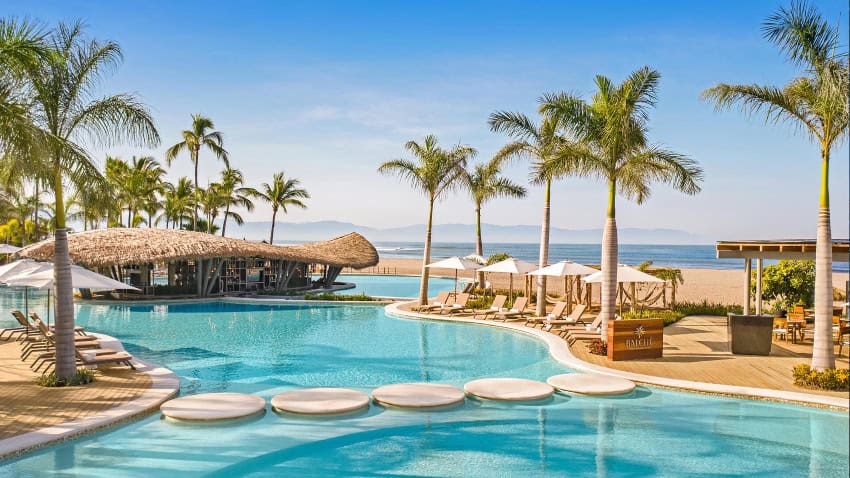
Puerto Vallarta's best hotels are welcoming everyone in 2026. (The Westin Playa Vallarta)
Seasoned Puerto Vallarta travelers don’t need to be sold on the bay. They already know the deal: the misty blue silhouette of mountains behind the coastline, the golden-hour light at sunset, the quick hop between town and the north shore when you want a change of scenery.
What’s new for 2026 is the hotel roster itself, bringing more rooms and distinct personalities. This is the year Vallarta and Riviera Nayarit are courting points-savvy all-inclusive travelers, ultra-luxe guests and adults who want all-inclusive options just for them.
Here are the best hotels to book for 2026 in Puerto Vallarta and the Bay of Banderas.
The Westin Playa Vallarta, an All-Inclusive Resort (relaunching May 1)
Always a popular choice, the Westin Playa Vallarta is relaunching in May with more of a focus on luxury. (The Westin Playa Vallarta)
For years, the Westin has been a smart choice, especially for travelers who like being near the marina/airport side of Vallarta without giving up real beachfront. In 2026, The Westin Playa Vallarta, An All-Inclusive Resort becomes a much better story: The property relaunches as an all-inclusive on May 1 with a full redesign and a more “luxury resort” approach to the format.
This is the best pick for points-friendly travel. All accommodations have ocean views, and the setting keeps it feeling insulated, even though you’re a short drive from the airport. It’s also one of the most practical options for families, with the shallow family pool and a kids club/outdoor play area.
What’s worth watching for in 2026 is the refreshed suite mix, including swim-up and private plunge pool options, the Heavenly Spa, and the on-site food and drink program, including a botanical-forward mixology bar and a multivenue dining hub with plenty of alfresco seating.
Susurros del Corazón, Auberge Resorts Collection
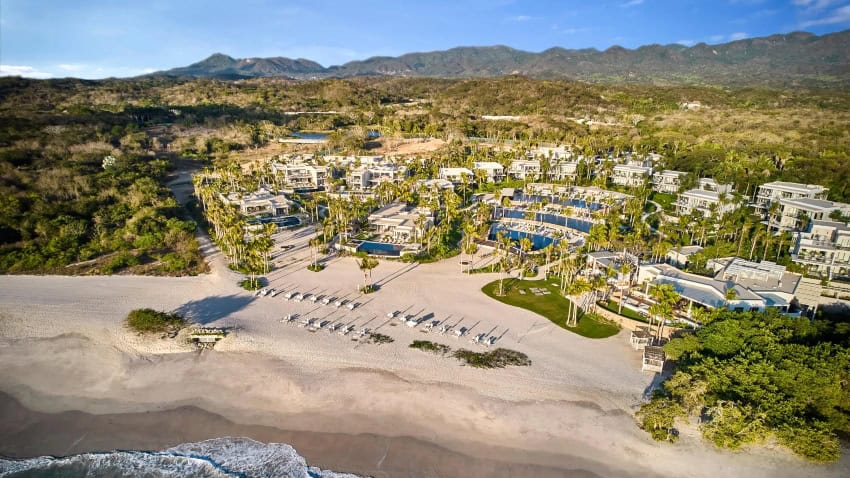
Susurros del Corazón is one of the newer options at Punta Mita and already one of the best. (Susurros del Corazón, Auberge Resorts Collection)
Susurros del Corazón is one of the newer players on the Punta Mita peninsula. The resort sits comfortably alongside the area’s established luxury properties, offering a slightly more relaxed (but equally elegant) design-forward take on the Punta de Mita experience.
The arrival sets the tone immediately. There is no traditional front desk or formal check-in flow. Guests are met with a smoky, sweet cocktail (which can be infused with tequila or left without) and eased into the beautifully manicured property. Accommodations range from standard rooms and suites to multibedroom cases and residential-style villas, making the resort flexible for couples, small families or groups.
Interiors lean modern and coastal, with stone, linen and natural textures layered with locally sourced art. Many rooms open fully onto oversized terraces, and select suites include private pools that are more generous than typical plunge pools.
At the heart of the resort are three adjacent infinity pools — one adults-only, one family-friendly, and one designed for relaxation. The beach is a major draw, with wide, soft sand; easy access; and distinct zones for beginner surfing, swimming and paddleboarding.
Siari, a Ritz-Carlton Reserve
Siari offers almost unparalleled luxury in Punta Mita. (Siari)
Siari, a Ritz-Carlton Reserve‘s headline stats matter because they shape the experience: a 920-acre setting with jungle and more than four miles of beach, plus a relatively limited room count (91 rooms and suites). This is the 2026 pick for travelers who want a self-contained luxury ecosystem.
It’s not isolated but designed so that the property is the main event. Dining is part of the draw — multiple venues with distinct angles, from Pacific-focused cooking to Asian-leaning raw and grilled dishes to wood-fired flatbreads — and the activity roster is substantial: guided hikes, snorkeling, cooking classes centered on Nayarit traditions and an impressive wellness center.
UNICO 20°105° Hotel Riviera Nayarit
Adults-only UNICO 20°105° Riviera Nayarit offers a very cool vibe, not to mention stylish accommodation. (UNICO 20°105° Riviera Nayarit)
UNICO 20°105° Riviera Nayarit is an adults-only all-inclusive with a noticeably smaller footprint than many resorts in the area. With 141 rooms, the property feels contained and easy to navigate, which makes a difference over a multiday stay — you’re not waiting on carts or shuttles, and it’s easy to move between the beach, pool, restaurants and rooms.
Guest rooms follow the brand’s established style carried over from its sister property in the Riviera Maya. The vibe swings modern and comfortable, with balconies that include deep soaking tubs. Ground-floor swim-up suites are popular for guests who plan to spend most of the day near the pool. One of the most-used spaces is the rooftop bar, Alto 20°105°, which overlooks the Bay of Banderas and tends to fill up around sunset for drinks and a swim as the day winds down.
This hotel is best suited for couples or groups of friends looking for an adults-only stay with good food, a social atmosphere and the convenience of an all-inclusive about 20 minutes north of the airport.
Garza Blanca Sanctuary Tower
Puerto Vallarta access plus a quiet stretch of beach: What’s not to like? (Garza Blanca)
Garza Blanca has always been the “best of both worlds” choice: PV proximity with a resort footprint and a quiet stretch of beach. Sanctuary Tower takes that and pushes it upward with a 20-story addition of 118 oceanfront suites, each with a balcony, Jacuzzi, and panoramic bay views. The suite variety is designed to widen the traveler mix: larger two-bedrooms for families, high-end penthouse options for couples and playful family-forward rooftop concepts.
Sanctuary guests still tap into the wider Garza Blanca ecosystem of restaurants, pools, beach, fitness and kids club, plus new concepts and rooftop-only spaces that skew more adult.
VidantaWorld BON Hotel
VidantaWorld has it all in terms of attractions, including the BON Hotel. (VidantaWorld BON Hotel)
BON Hotel is for travelers who think “resort” should mean range. The hotel itself is all-suite and intentionally simple in shared amenities because the broader VidantaWorld campus is the point: dozens of restaurants and bars, multiple golf courses, spas, a mile-long beach, enormous fitness facilities and family favorites like wave pools and a lazy river.
The practical nuance is that VidantaWorld is huge, and so BON guests should be comfortable budgeting extra time for transport. The tram system is essential; the app helps; and shuttles may require more coordination than a smaller resort.
This is for families, multigenerational groups and travelers who want an activity-rich vacation where every day can look different.
Rosewood Mandarina
Lush and luxurious, Rosewood Mandarina makes every day in residence feel like a special occasion. (Rosewood Mandarina)
Rosewood Mandarina is the quiet flex of the north: a luxury resort tucked into a bucolic bay.
The resort is organized into three zones across flatland, beach and mountain. Every suite includes a private plunge pool, and the design leans artisanal, from Indigenous craft references to custom furnishings.
The resort is also unusually strong for travelers who want to do more than lounge. There are equestrian experiences, zip lining excursions through the surrounding forest, golf and a spa complex built around a centuries-old parota tree.
This resort is for special-occasion travelers, serious resort people and families who want uncrowded luxury.
Meagan Drillinger is a New York native who has spent the past 15 years traveling around and writing about Mexico. While she’s on the road for assignments most of the time, Puerto Vallarta is her home base. Follow her travels on Instagram at @drillinjourneys or through her blog at drillinjourneys.com.
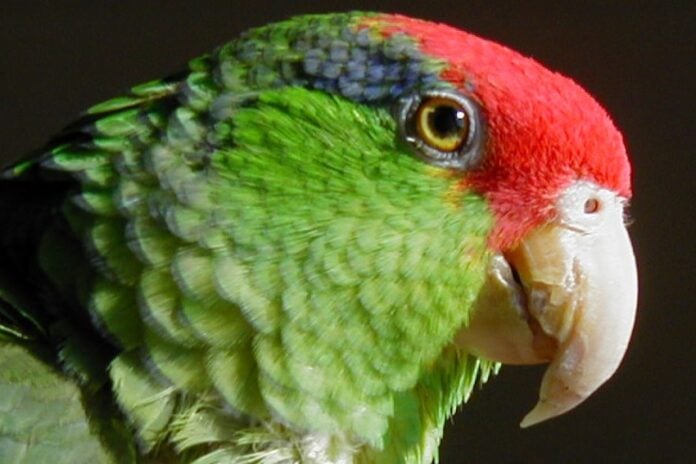
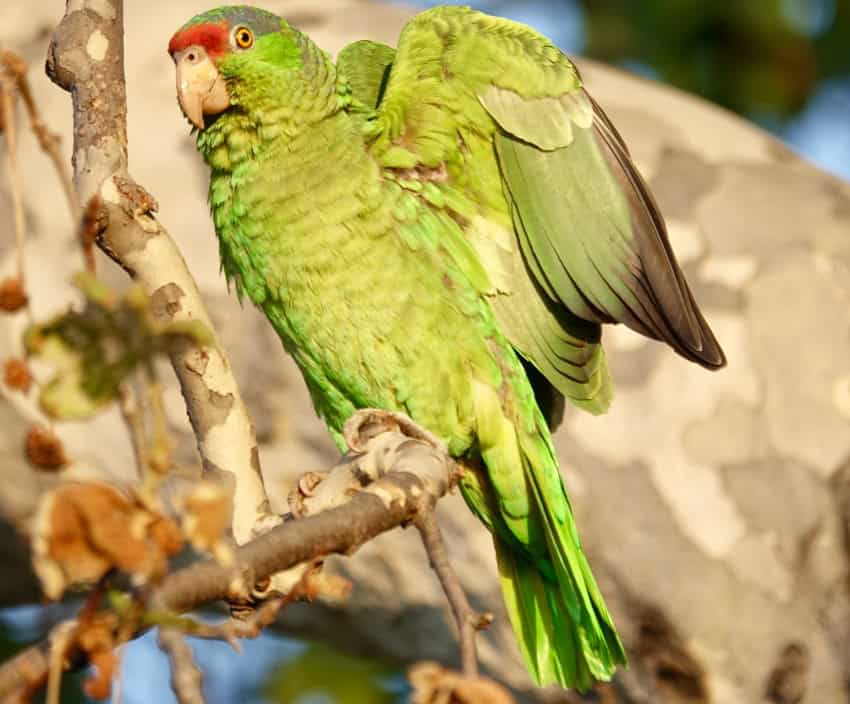
The red-crowned Amazon (Amazona viridigenalis) — a chunky green bird with a bright-red forehead and crown, a dark-blue streak behind the eyes and light-green cheeks that’s endemic to Mexico’s lowland forests and floodplain areas — has in recent years lost between 50% and 85% of its original habitat, causing a population decrease as well. But the current exact numbers of this species of parrot are uncertain.
The International Union for Conservation of Nature (IUCN)’s Red List, the bible for information on endangered animals, notes that there has not been a survey of the red-crowned Amazon since 1994, when there were estimated to be between 3,000 and 6,500 birds in existence, with 2,000 to 4,300 breeding adults. Numbers have probably declined since then, but there is an urgent need for an up-to-date survey.
A bird cursed by its own popularity
The red-crowned Amazon is endangered and is now found only in a few parts of Mexico. (Mike’s Birds/Wikimedia Commons)
The IUCN lists the species as endangered, and any detailed survey in the future is more likely to bring bad rather than good news. Case in point: A 2021 report based on causal observations suggested the wild Mexican population was concentrated in three areas. When a small population of any animal fragments in this way, that is usually taken as a danger sign. However, during the nonbreeding season, the red-crowned Amazon is known to wander over large areas, and it is hoped that the three populations might still interact.
Over many decades, the population in Mexico had been hit by a one-two punch of habitat loss and the capture of the birds for the pet trade. It is a curse of the red-crowned Amazon that it makes a very good pet. It can live for over 50 years in captivity if properly cared for, and it is an affectionate and playful bird, as well as an excellent mimic.
When the pet trade in parrots reached its peak between 1970 and 1982, around 16,000 red-crowned parrots were legally imported into the United States. The species lived at the northern extent of the parrot’s range, relatively close to the U.S. border, making them a favored target for the illegal trade; this may have removed an additional 5,000 birds a year from the wild population. Nestlings were the easiest to capture, and this led to a particularly high mortality rate. For every bird that made it to the U.S., another had probably died along the way.
The banning of the parrot trade
The Mexico parrot trade was banned in 2008, which helped considerably. The easiest way to smuggle any rare animals is to create false documents and then openly take them across borders; that option was now closed.
Ironically, it is the pet trade that might yet save the bird from extinction. Several parrots have escaped or been released when their owners grew tired of them, and many of these intelligent and adaptable birds have survived in the wild. There are now populations of red-crowned Amazons in Texas, Hawaii, Puerto Rico, Florida and Southern California. Altogether, the total U.S. population is estimated at roughly 4,700 birds, which probably outnumbers the Mexican population, which inhabits parts of Eastern Mexico: Southern Tamaulipas, Eastern San Luis Potosí and Northern Veracruz, with sightings also in Nuevo León.
A Brownsville favorite
One colony is based around four cities in southern Texas — Brownsville, Harlingen, McAllen and Weslaco — where it is not uncommon to see large numbers of the parrots gathered in gardens and parks. Texas was the first stop in the U.S on the transport route for both legal and illegal parrots, and several probably escaped while being brought over. This might include many illegal birds released if the truck they were being carried in looked in danger of being stopped by the authorities.
The red-crowned Amazon has found an adopted home in Texas. (World Parrot Trust)
Of all the species’ adopted homes, Brownsville has developed a particular soft spot for the bird, and the Joe & Tony Oliveira Park — a civic space with athletic fields and courts, picnic areas and a skateboard park — is famous for the evening gathering of squawking parrots. In 1992, the red-crowned Amazon was declared Brownsville’s official bird.
An introduced species often harms the native wildlife, but these parrots present a happier story. They are dependent on resources that, like themselves, have been introduced to Texas. They feed on the seeds of imported ornamental plants and prefer to nest in another nonnative tree, the palm. This means that they do not compete with native birds for resources.
Red-crowned Amazons in Texas can be found in parks, large gardens and even the parking lots of big shopping centers where shade trees have been planted. The parrot’s dependence on palm trees is perhaps the reason that the steady growth in numbers over many years appears to be leveling out. The dead palms that the birds nest in are considered unsightly and possibly dangerous and tend to be removed. In parts of Texas, the red-crowned Amazon may have reached the limit of suitable nesting sites.
A migration mystery
The reason the Texas population is so interesting is that there is some debate about whether all the red-crowned Amazons in this part of the U.S. were brought there by humans. Some 25 species of parrots have formed self-sustaining populations in 23 states across the country, and, in most cases, the distance from their natural home leaves little doubt that these colonies originated from escaped pets. However, in the case of the red-crowned Amazon population in Texas, the matter is not so certain.
The distance to their Mexico homelands is roughly 180 kilometers, and while red-crowned Amazons do not make annual migratory flights, times of stress, such as severe winter weather or drought, can see them appear outside their normal range. Newspaper reports suggest flocks of parrots, likely to be red-crowns, were seen in Texas during the late 1880s, and those birds almost certainly got here on their own wings. Those birds did not establish a permanent colony, however, and the present population dates back to around the 1970s.
Theories on red-crowned Amazon populations in Texas
One theory, however, is that the historic freeze of 1983–1984 might have forced some of these birds to leave their Mexican home and fly north, where they joined escaped birds already established in Texas. The same cold winter might have killed many palm trees, the soft decaying wood helping the new arrivals find nesting sites. In June 2019, the U.S. Fish and Wildlife Service weighed the evidence and announced that the red-crowned Amazon should be considered a native bird to the Rio Grande Valley.
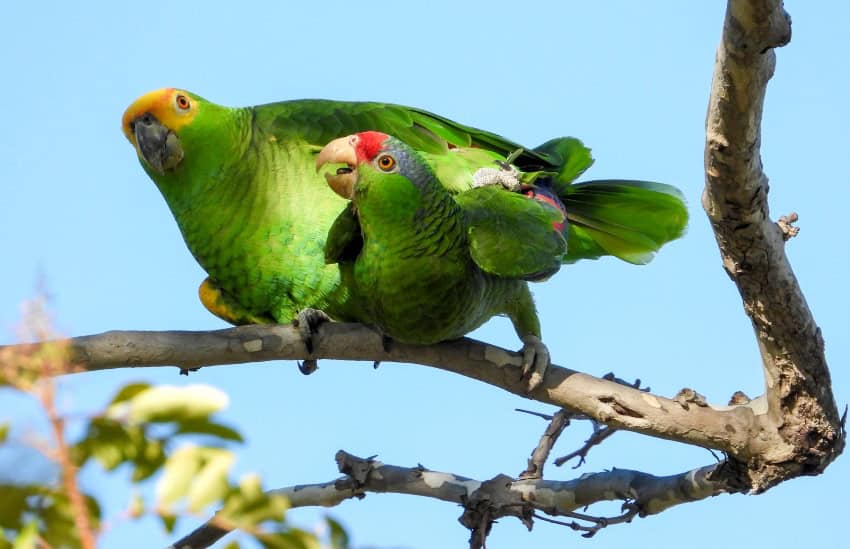
Hybridization is considered a threat, as evidenced by this red-crowned and yellow-headed Amazon couple in California. (James M. Maley/Wikimedia Commons)
In Mexico, the parrot has seldom made the move into urban areas, although there are noteworthy exceptions. Monterrey has a significant population of parrots, as does the smaller Nuevo León community of Hidalgo. As in the U.S., these populations might well have been formed by escaped pets. But in the U.S., the bird is only found in towns and does not seem to have been tempted into the countryside.
Threats to Mexico’s red-crowned Amazon population
There are problems for the U.S. parrots: Cats might take young birds, but they probably face fewer predators than in the wild. But in Mexico, beyond habitat loss — in Tamaulipas, for example, the Global Forest Watch organization reported in 2021 that 80% of the state’s lowland forest had been cleared for agriculture and pasture — another real extinction danger the parrots face in Mexico is altogether more complex: potential hybridization.
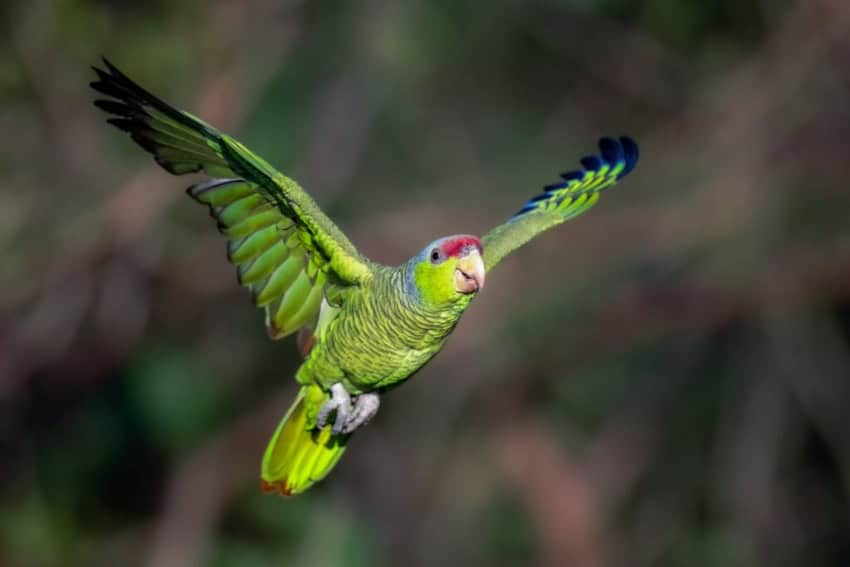
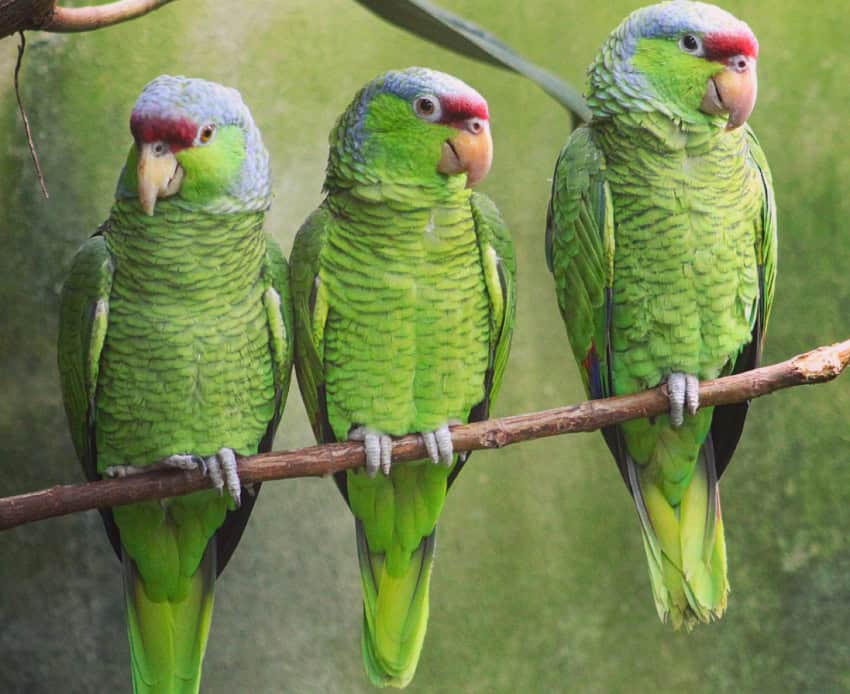
The lilac-crowned is another Mexican parrot that has escaped and established itself in the United States. The two species are so similar in size and color that even experts can sometimes have a tough time telling them apart. The lilac-crowned and red-crowned Amazons have a common recent ancestor but for 2 million years have been separated, with the lilac settling along the Mexican Pacific Coast and the red-crowned Amazon the Atlantic. In Texas, the birds are seen together in the same flock and probably interbreed. Hybridization is not a major issue in the U.S., but it might undermine future attempts to increase the Mexican population by introducing birds from California or Texas.
Continued dangers from the illegal parrot trade
The illegal trade from Mexico has continued, although on a far smaller scale than in the past. The breeding of birds in captivity has helped to lower the price, although sadly, parrots brought in from Mexico are cheaper than those bred as pets, so the trade has not been totally eliminated. Between 1992 and 2005, 3.67% of the total Mexican parrots seized by the authorities were red-crowned Amazons. That represents about 59 birds.
While this is a vast improvement on the situation of 40 years ago, these birds have been taken from a far smaller population. Each case brings its own level of suffering. In May 2025, 17 parrots of various species, including two red-crowned Amazons, were seized by the U.S. Fish and Wildlife Service Office of Law Enforcement. The birds were found bound and hidden under a car seat.
Lilac-crowned Amazons have also been known to interbreed with their red-crowned cousins. (JavAlvarezS/Wikimedia Commons)
Other dangers in Mexico
Much of their Mexican home is located in noted cartel strongholds, and there is little up-to-date information on the birds’ status. While poaching has declined in the wild, the destruction of the birds’ natural habitat continues — a practice that might well have changed in nature in recent years. Much of the forest clearance is now thought to be linked to the drug trade, with trees being cut down to make growing fields and landing strips. Any future crackdown on the drug trade is likely to push growers further into the hills and is likely to endanger the birds’ last refuges.
The red-crowned Amazon is a wonderful example of Mexico’s unique bird life. It is sad to think that to see them in large numbers, we have to go to a city park in Texas!
Bob Patemanis a Mexico-based historian, librarian and a life-term hasher. He is editor of On On Magazine, the international history magazine of hashing.
MEXICO CITY — In an unexpected press conference Tuesday, President Claudia Sheinbaum revealed plans to step into the boxing ring with social media celebrity Jake Paul, leveraging the spectacle to raise international awareness for her newly launched “Boxing for Peace” program.
“Mr. Paul has made a career fighting retired athletes and generating publicity,” Sheinbaum said during the announcement. “Jake Paul fights washed-up MMA guys and aging athletes. I fight macroeconomic instability.”
WBC President Mauricio Sulaimán praised the challenge as “creative diplomacy,” noting that a high-profile exhibition match could bring unprecedented funding and attention to boxing programs across Mexico. “Whether this fight happens or not, President Sheinbaum has already won by getting people talking about supporting young athletes,” he said.
Paul, who has fought former MMA competitors and fellow influencers, has not yet responded to the challenge. Boxing analysts give Sheinbaum minimal odds but acknowledge the match would generate significant revenue for Mexico’s struggling amateur boxing infrastructure.
The president concluded her announcement by demonstrating a surprisingly competent one-two combination, prompting nervous laughter from her security team and applause from attending WBC officials.
“Politics is already a contact sport,” Sheinbaum quipped. “This just makes it official.”
Across the border, Monday was San Francisco’s first-ever “Tigres del Norte Day” in honor of the legendary norteño band. And in El Paso, a bizarre incident involving what U.S. officials claimed was a cartel drone sparked diplomatic confusion and raised more questions than it answered. Behind these headlines, a darker story unfolded in Sinaloa and Mexico found itself playing high-stakes diplomatic chess with both Washington and Beijing.
Didn’t have time to catch the top stories of the week? Here’s what you missed.
Tragedy in Sinaloa: Bodies of kidnapped miners found in mass grave
On Monday, authorities confirmed the bodies of three employees of Canadian mining firm Vizsla Silver Corp were found in a mass grave in Sinaloa. The victims — engineers José Ángel Hernández Velez and Ignacio Aurelio Salazar Flores from Zacatecas, and geologist José Manuel Castañeda Hernández from Guerrero — were among 10 workers kidnapped on Jan. 23 from employee housing near La Concordia, located about 250 kilometers southeast of Culiacán.
The remains were discovered in an advanced state of decomposition in El Verde, a small community north of La Concordia, with mothers searching for their missing loved ones from neighboring Sonora reporting that at least 20 bodies were found at the site. President Sheinbaum announced that federal authorities had made several arrests in connection with the case, with those in custody providing information to prosecutors.
Friends and relatives in the town of Sombrerete, Zacatecas, say goodbye to Zacatecas-born Ignacio Salazar Flores, one of the abducted miners found dead in a mass grave this week. (Adolfo Vladimir/Cuartoscuro)
With five victims confirmed dead and five still missing, the tragedy underscored the dangers that continue to plague Mexico’s northern states despite government claims of reduced violence.
What really happened over El Paso?
A bizarre incident at the U.S.-Mexico border sparked confusion and raised diplomatic tensions when airspace over El Paso, Texas, was abruptly closed late Tuesday, Feb. 10. U.S. Transportation Secretary Sean Duffy initially claimed a “cartel drone incursion” had forced the Federal Aviation Administration to close the airspace, asserting on social media that the threat had been “neutralized.”
However, multiple reports citing people familiar with the situation told a different story. According to The New York Times and the Associated Press, the closure was actually precipitated when U.S. Customs and Border Protection officials deployed a military anti-drone laser on loan from the Department of Defense without giving aviation officials enough time to assess risks to commercial aircraft. The Times reported that CBP officials thought they were firing on a cartel drone but it turned out to be a party balloon.
At her Wednesday morning press conference, Sheinbaum demanded an official explanation from the U.S. government, asserting there was no evidence of drones having entered the U.S. from Mexico. “You can be absolutely certain of that,” she reiterated on Thursday, noting that the U.S. statements referenced “cartels” but never mentioned “Mexico” directly.
U.S. Senator Tammy Duckworth called the incident a result of “lack of coordination that’s endemic in this Trump administration,” while security expert Carlos Pérez Ricart noted that while drone incursions from Mexico are common, “there’s no evidence that the cartels would attack the U.S. with drones, it doesn’t make sense for them.”
Two Mexican Navy vessels carrying more than 800 tonnes of aid arrived in Havana on Thursday, prompting Cuban President Miguel Díaz-Canel to post a video thanking Mexico and President Sheinbaum personally.
At her Friday press conference, Sheinbaum went further, revealing that Mexico could establish an air bridge to Cuba if the island nation requests it. “If Cuba requests it, then those conditions would exist, of course,” she said, noting that planes can refuel in Mexico even though jet fuel shortages have grounded many flights in Cuba itself.
The humanitarian gesture comes as Mexico has suspended oil shipments to Cuba due to U.S. President Donald Trump’s threat to impose tariffs on countries that supply the island with petroleum. Sheinbaum pledged to send more aid, with the humanitarian supplies representing “solidarity, friendship and the exemplary history of sovereignty and respect for the rights of others that distinguish Mexico,” according to Díaz-Canel.
China reenters the frame: Trade talks and manufacturing ambitions
As the U.S., Mexico and Canada began their formal review of the USMCA trade agreement, China moved to strengthen its position in Mexico through both diplomatic and business channels. Deputy Economy Minister Vidal Llerenas traveled to Beijing for the first face-to-face trade talks since Mexico imposed tariffs of up to 50% on many Chinese imports in December, meeting with China’s chief trade negotiator Li Chenggang.
Chinese Ambassador Chen Daojiang expressed confidence that the two countries could deepen cooperation, calling China’s 2026-2030 five-year plan “a golden opportunity” to strengthen ties in manufacturing, innovation, the digital economy, energy and the green economy. Foreign Affairs Ministry undersecretary María Teresa Mercado also met with Chinese officials to discuss technological innovation, public health and smart water management.
Meanwhile, Chinese automakers made a bold move to establish a manufacturing presence in Mexico.
BYD and Geely emerged as two of three finalists bidding to purchase a shuttered car plant in Aguascalientes originally built as a joint venture between Daimler and the Renault-Nissan Alliance. The facility, which comes with skilled workers, transportation infrastructure and 230,000-unit annual capacity, would give China a coveted manufacturing foothold in North America.
However, Economy Ministry officials are reportedly pressuring Aguascalientes authorities to delay any decision until after USMCA trade talks are completed, wary that Chinese production in Mexico could inflame Washington.
World Cup woes
With just four months until the 2026 World Cup kicks off, Mexico’s iconic Estadio Azteca faces a crisis. Renovations at the stadium are running behind schedule, raising concerns that FIFA could strip it of hosting duties for the tournament’s opening match on June 11.
Estadio Azteca traded naming rights to Banorte for the bank’s help in financing renovations required by FIFA for a World Cup host stadium. But the work was plagued with problems from the beginning and continues to run behind schedule. (Rogelio Morales/Cuartoscuro)
A quarterly financial report submitted to the Mexico Stock Exchange by Grupo Ollamani, which owns the stadium, listed as a genuine risk the “failure to meet deadlines for the remodeling works and unforeseen costs,” including a “possible disqualification or relocation of key matches by FIFA.”
Owner Emilio Azcárraga visited the facility — now officially renamed Estadio Banorte after the bank provided a 2.1 billion peso loan to fund renovations — and admitted the work is behind schedule. He announced the project would be divided into three stages, with the first concluding at the end of March for a friendly against Portugal, the second phase focused on meeting minimum requirements for the June 11 inauguration when Mexico faces South Africa, and a third phase to complete remaining work after the tournament ends.
Poised to become the first stadium to host three separate World Cup inaugural matches, Estadio Azteca was closed in June 2024 with promises of complete renovation. However, Azcárraga explained that difficulties arose from the need for constant maintenance that had been lacking for years. FIFA will take full possession of all host stadiums in early May, and if conditions at Estadio Azteca seriously compromise the opening match, relocation remains a possibility.
Olympic pride: Mexican athletes make their mark in Milan Cortina
As the Milan Cortina Winter Olympics unfolded, Mexican athletes gave the nation reason to celebrate. Figure skater Donovan Carrillo made history by becoming the first Mexican to reach the Olympic final twice, qualifying for Friday’s men’s final with a score of 75.56 points in Tuesday’s short program. The 26-year-old from Jalisco, competing in a sport rarely practiced professionally in Mexico, finished 23rd out of 39 competitors, with the top 24 advancing.
“This is for all of Mexico!” Carrillo shouted after his performance. “Dreams do come true!” President Sheinbaum called him “a great source of pride for Mexico.” Carrillo trains in shopping mall ice rinks in Guadalajara, dealing with distractions and lower-quality ice compared to international facilities, but receives support through Olympic Solidarity Grants and a monthly stipend from Mexico’s National Sports Commission.
Meanwhile, U.S.-based Olympic skier Regina Martínez represented Mexico in alpine skiing for the first time, carrying forward the country’s growing presence in winter sports despite its lack of ski infrastructure.
Looking forward
The Cuba situation is becoming a new diplomatic tightrope for Mexico’s Sheinbaum. The president has tried to frame the relationship around humanitarian aid. But as Cuba’s crisis deepens with prolonged blackouts and food shortages, Washington has made clear that cutting off energy supplies is part of its broader strategy to force regime change, extending its reach through bilateral pressure on Mexico. The country must navigate between historical solidarity with Cuba and economic realities with its largest trading partner, all while trade negotiations loom.
Public health officials are racing to contain a measles outbreak that threatens Mexico’s disease-free status just months before the World Cup. With over 9,000 confirmed cases since early 2025, a Pan American Health Organization panel will meet April 13 to decide whether to revoke Mexico’s three-decade measles-free status — less than two months before an estimated 5 million World Cup visitors arrive.
The World Cup preparations themselves have sparked controversy. In Mexico City, construction along Calzada de Tlalpan has cut earnings for sex workers by more than half, while street vendors are being pushed out of underground passages near Estadio Azteca. The pattern echoes what advocacy groups call “social cleansing” ahead of major sporting events, reminiscent of Paris and Brazil’s actions before previous Olympics and World Cups.
How Sheinbaum navigates these intersecting crises — trade negotiations with an unpredictable U.S. administration, Cuba’s humanitarian crisis, a measles outbreak, World Cup displacement of vulnerable workers, and Chinese investment amid American scrutiny — will determine Mexico’s place in a rapidly shifting geopolitical landscape.
Mexico News Daily
This story contains summaries of original Mexico News Daily articles. The summaries were generated by Claude, then revised and fact-checked by a Mexico News Daily staff editor.
If you want to try the world's best hot dogs, you'll need to travel to Hermosillo, Sonora. (Matita de Sandia/Wikimedia Commons)
Most food stories don’t involve the FBI. But sometimes — if the food is worthy enough to create such a stir — an FBI investigation might follow. In this case, I’m talking about hot dogs along the U.S.-Mexico border, and in this particular instance, the FBI was brought in and concluded that one hot dog vendor set up an extortion racket against his top hot dog competitor. Such poor taste.
If you’ve ever spent time in Baja California, Sonora, California, Arizona or Texas, you’ve certainly come across it: hardworking immigrant vendors lining the sidewalk during a sports event or major concert, with a legion of pushcarts selling the same, heavenly-scented food: bacon-wrapped hot dogs.
The origin of the bacon hot dog in Mexico
This bacon-wrapped “Chucho Dog” is courtesy of Daniel Contreras at El Güero Canelo in Arizona, winner of a James Beard award for his hot dog expertise. However, the bacon-wrapped hot dog’s origins lie south of the border. (Facebook)
The smell of greasy bacon being grilled on a flat-iron hot dog cart, mingling with the sweet aroma of sautéed onions and peppers, is a welcome aroma at any public gathering (particularly after a late night out, when other traditional food businesses and restaurants have already closed their kitchens).
Many — including myself — would never surmise that one of the most ubiquitously American foods (a bacon-wrapped hot dog, of all things) actually arrived in the country through immigration patterns in northern Mexico. The ballpark-favorite frankfurter isn’t from Dallas or Phoenix or Los Angeles: it’s from Sonora’s arid capital, Hermosillo. There, the tasty regional item is considered as belovedly Mexican as tacos or tamales, and it has been around for longer than one might assume.
It all technically dates back to the 1940s, when historians believe that U.S.-style hot dogs first arrived in Mexico through either a traveling circus, bullfights or baseball games (the reports are conflicting). One American blogger claims that a young pair of entrepreneurs came to Mexico City and began to sell hot dogs at Plaza Mexico — a business plan that turned them into world-traveling millionaires, supposedly.
The Sonoran dogo
These still-baconless wonders were a hit with Mexican consumers, and from there began to proliferate into other arenas and avenues. From there, hot dogs made their way into the mainstream Mexican diet and were eventually adapted in local ways. Sonoran “dogueros,” in particular — street vendors who bordered the U.S. in a state already known for their beef affinity and baseball adoration — were in an ideal position to elevate the perro caliente for Mexicans and beyond.
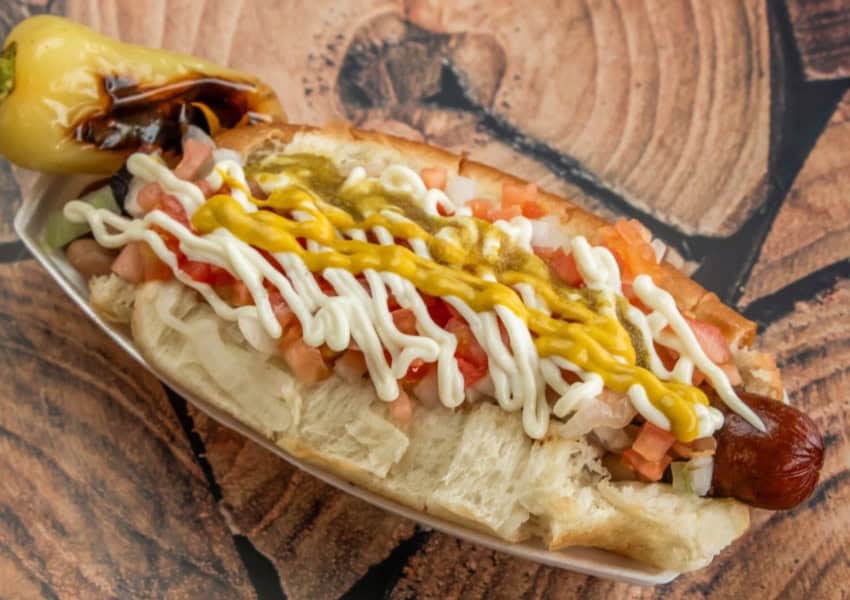
Here’s what that looks like today: bacon-hugged “weenie” that gets sliced down the middle and filled with a stick of cheese, then grilled and inserted into a larger-than-usual bolillo-style bun to be topped with diced tomatoes, avocado, onions (both raw and grilled), pinto beans, lettuce, chorizo and other traditional and unorthodox condiments, from mayonnaise and ketchup to jalapeños and güero peppers. If it isn’t vividly clear, these greasy “dogos” are easily customizable and typically well-laden to the brim (there are double sausage, flour tortilla, and shrimp variations, too).
At least one Mexican American journalist has tried to trace the historical origins of this dogo — going from Los Angeles to Tucson. Most sources seem to point to El Güero Canelo — a hot dog joint in Arizona — as being a major driver in the invention’s popularity during the late 1980s and early 90s. Opened and owned by Sonoran immigrant Daniel Contreras in 1993, El Güero Canelo is generally considered to be the definitive source of the bacon-wrapped weenie’s zeitgeist takeover, which has earned Contreras a lauded James Beard Award. But its roots and essence are clearly still present across the border in Sonora.
The food is easy and on-the-go, a perfect street-side dish and easy to wheel around or set up as a stall for hungry passersby. It is usually accompanied by a super-sized cup of “uvola” — a regional specialty beverage made from grapes and loaded with ice to stave off the desert heat.
It’s simple to see why this combination made its way across the border and became an instant classic in the American Southwest and beyond. Mexican culinary ingenuity never disappoints and knows no limits.
Alan Chazaro is the author of “This Is Not a Frank Ocean Cover Album,” “Piñata Theory” and “Notes From the Eastern Span of the Bay Bridge” (Ghost City Press, 2021). He is a graduate of June Jordan’s Poetry for the People program at UC Berkeley and a former Lawrence Ferlinghetti Fellow at the University of San Francisco. His writing can be found in GQ, NPR, The Guardian, L.A. Times and more. Originally from the San Francisco Bay Area, he is currently based in Veracruz.
Before the days of heaters and thermal wear, water heaters and hand warmers, I simply would not have made it. God bless our ancestors who got us to this, the glorious future of climate control, amiright?
Yes, it gets cold in Mexico
Cold, cold, cold. Note the fleece sweater, space heater and light coming through slits in the wood. (Sarah DeVries)
Alas, climate control is not the same in Mexico. And by “not the same,” I mean “mostly non-existent.”
Now, I know that “cold” is not a word people typically associate with Mexico. Popular images of the country often show sun-baked deserts and beaches, or someone in shorts and a Panama hat eating ice cream on a nice zócalo bench.
But oh, my friends, those scenes transform for many during the winter months.
Take me, for example, right now.
According to the weather app, the temperatures today range between 46 and 54 degrees Fahrenheit. It’s overcast, and sometimes rainy. There is no discernible difference between the temperature inside and outside. At least it’s not raining inside, I guess?
A shock to the system
But if you live in one of those places where the weather is nice enough of the time, you’ve just got to be ready to be uncomfortable during those rare times it’s not nice at all.
Much of Mexico sits at higher elevations, where colder winter temperatures are common. (Kunst Photos/Unsplash)
I know for a lot of people — especially those who didn’t grow up in Texas, like me — 46 to 54 degrees probably sounds downright mild. Still, even for those brave and hardened northerners, 50 degrees is different when you’re romping around outside than when you’re trying to relax in front of the TV inside.
Getting out of bed? Getting undressed for a shower or to change clothes? Having wet hair? Torture.
Get me out of here!
I mean, don’t, I guess. I still love Mexico, and living in the mountains rather than near the beach (The sand all over you all the time! The heat! Can you tell I’m hard to please when it comes to climate?).
But really. If you have grown up with central climate control and then gone to a place without it, prepare for a shock to the system.
Strategies for surviving cold weather
I liken it to language learning as an adult. You’re always going to have a noticeable accent, and you’re going to be uncomfortable if the temperature is not exactly to your liking. Every time I go to my sister’s house in Texas, in fact, I take a few moments in front of their digital thermostat to marvel — 68 degrees exactly. It makes me feel like I’m in some sort of futuristic spaceship.
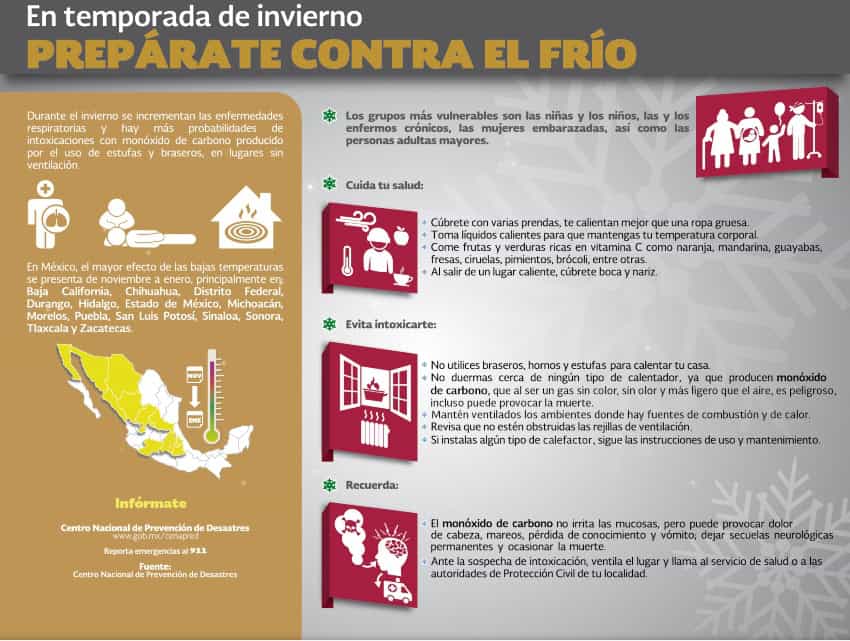
Don’t worry. These Mexican government winter preparedness tips have been translated below into a language you understand. (Gobierno de Mexico)
So what’s a girl to do in Mexico when it’s cold, cold, cold?
Really, just suffer.
As a long-time resident, I’ve tried so many things to varying degrees of success. And because those of you also suffering from the Mexican cold have my deepest sympathies, I will share with you here all of my imperfect strategies for keeping warm.
Be ready for it
I know this sounds a little silly, but if you’re anything like me, you truly have to mentally prepare. (Well, and physically prepare in the ways I’ll outline below.) On sunny days leading up to winter, store that warmth! Really. Pretend like you’re a lizard on a rock, soaking up the rays for use later on. It’s a little woo-woo, but hey — it beats despair! And if you know a cold front is coming, get your house ready: close windows that normally stay open, and get your warm clothes and blankets out. You’re going to need them!
Have warm clothing
Most people do not think they need to take warm clothes to Mexico. And for certain parts of it, I suppose you don’t. But if you’re in a place that could accurately be described as “in the mountains,” and/or “central Mexico,” you’re going to want some warm items.
First, never underestimate the importance of long underwear. Thin thermal pants and long-sleeved shirts can really help! Warm socks, too. And if you can get your hands on some fleece sweaters, you’ll be glad you did. I have a great puffy jacket (that I bought at Lowe’s of all places), which has saved me in chilly temperatures more than once.
Puffy jackets from Lowe’s or anywhere else are a good winter option in Mexico. (Lowe’s)
I often find it difficult to take off my coat when I get home (I try to mostly just wear it outside). But when I finally do, a fleece robe goes on RIGHT away. And for extra special days, I’m not above wearing a hat indoors. I might look like a huge dork answering the door looking like Ebenezer Scrooge, but at least I’m a (sort of) warm dork.
Have animal friends
Snuggle up with those pets, people! Body heat is body heat, and if you’ve seen those “survival in the Alps” type movies, you know it’s the name of the game. If you’ve got a human animal that will let you snuggle up next to them, all the better!
If you don’t have a warm-blooded animal who enjoys snuggling, try for a heated blanket, or just a really nice fuzzy one. I have a few from theVianney catalogue(I am not being paid to promote them, but I should be!) that are just fabulous and cozy, and reasonably priced. I’ve even got warm fuzzy sheets! If only they sold toilet-warmers too …
Own heaters
This is a tricky one, because CFE bills charge based on how much electricity you use. And using heaters, unfortunately, can bump up your rate so that you’re paying both for more kilowatts and paying more for them.
If you decide to use heaters (I do), use them strategically. Small spaces are easier to heat up than large spaces. If you’re going to turn one on, try doing it in a space you can keep yourself in for most of the day and night. I mostly just turn them on when it’s extra cold at night, but I’ll admit to having one on me right now!
Into baking? If you’re stocked up on enough gas, the oven can make a great temporary heater … and you get cookies or a casserole or something afterwards! Bonus: the extra pounds from all those baked goods can insulate you even more!
Space heaters are your friend in winter. Trust me on this. (Joho345/Wikimedia Commons)
Make use of strategic sun and curtains
The way Mexicans houses are built, as I’m sure many of you have discovered, is not for insulation. Gaps in the doors and windows are common, so there’s only so much you can do to keep a home warm. Rolls for the bottoms of doors can help, as can closed curtains for keeping the cold out. But if the sun is shining, open those curtains up and let it in! It can have the effect of “baking” the house — at least until it dips behind the clouds again.
Get some exercise
Getting changed and going to move around outside of your covers probably doesn’t sound like a good time, but it sure does help. At least while you’re exercising, you might actually get to feel normal for a while (as opposed to feeling like a popsicle). Just be sure to hop in the shower and change clothes right when you get back … cold sweat from your clothes freezing your skin afterwards does not feel good.
Have a drink
If you’re an alcoholic, you know … don’t do this. And it’s no permanent solution. But if you’re really, really suffering, a nice glass of wine (or drink of your choice) can warm you up for at least a bit. Honestly, I myself stay mildly drunk through most of the coldest days.
So there you have it, folks. You won’t find the comfort of central heating, it’s true. But snuggle up and do what you can. It will be over soon!
Diego La Garde has helped to lift El Squid Roe during its long run as an iconic Cabo San Lucas nightlife destination. (Instagram)
Back in 1988, a one-time candy store was transformed into one of the first nightclubs in Cabo San Lucas, which also happened to serve some of the Land’s End city’s most underrated food. The visionaries behind this establishment, known ever since as El Squid Roe, were Carlos Anderson and Billy La Garde.
Anderson, of course, was one of Mexico’s most famous and influential restaurateurs, having created Carlos’n Charlie’s, Señor Frog’s and other popular restaurant and bar chains under the Grupo Anderson umbrella before he died in a plane crash in Jalisco in 1990. He knew La Garde from Puerto Vallarta and had proposed that they open a new place somewhere in partnership. La Garde suggested Cabo San Lucas.
Cabo San Lucas has changed a lot since El Squid Roe first opened in January 1989. (Facebook)
A few short years later, Billy’s son, the young Diego La Garde, was sipping Shirley Temples and slurping oysters at El Squid Roe’s bar, looking like a kid who owned the place. If he didn’t already, he soon would, along with his father. Unlike other brands in the Grupo Anderson collection, El Squid Roe has always remained licensed but independently operated.
It has also been phenomenally successful, drawing everyone from vacationers and Spring Breakers to a who’s who of visiting celebrities during its four-plus decades as the standard bearer of the Los Cabos party scene — a history I recently sat down with Diego La Garde in El Squid Roe to discuss.
El Squid Roe began as a family-owned business, correct?
Yes, it’s still family-run and owned. We’ve been in business for 37 years. My father, Billy La Garde, is the one who opened it back in the day. He used to live in Puerto Vallarta. He was helping out at a restaurant there, and Carlos Anderson really liked his service and quality of work. So he said, ‘Billy, I want to open up a new place.’ My dad had visited Cabo before on a small and he told him how he saw a lot of potential here in Cabo. So Carlos said, ‘Okay, let’s go see properties.’ They drove around, they saw many properties and they liked this one the best. That’s how it all started.
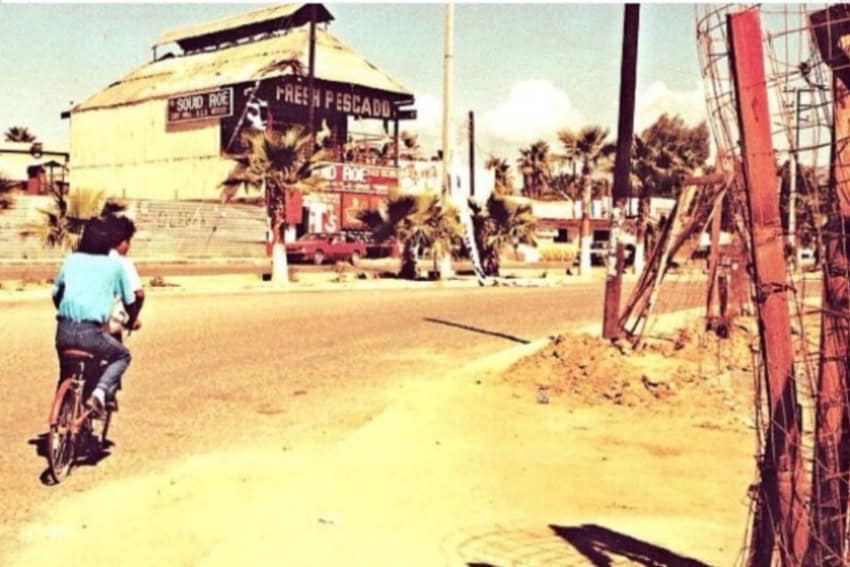
Occasionally, I’ll see on social media that old picture of the year you opened. Nothing but a dirt road out there.
That guy on the bicycle. Yeah, nothing but a dirt road for a long time.
Your father is who the Billy Kitchen and its food menu is named for?
Yes, the Billy Kitchen was named for him, just to let people know we also have a kitchen. Even now, a lot of people don’t know we have food, or how good it is.
Was El Squid Roe the first bar to open in Cabo San Lucas?
We opened in 1988, about the same time as Giggling Marlin (the landmark nightspot that burned down in June 2024). But then we changed the company three or four months later to Operadora Calamar and have been open as El Squid Roe since Jan. 1or 2, 1989 … whenever it was they gave us the permit.
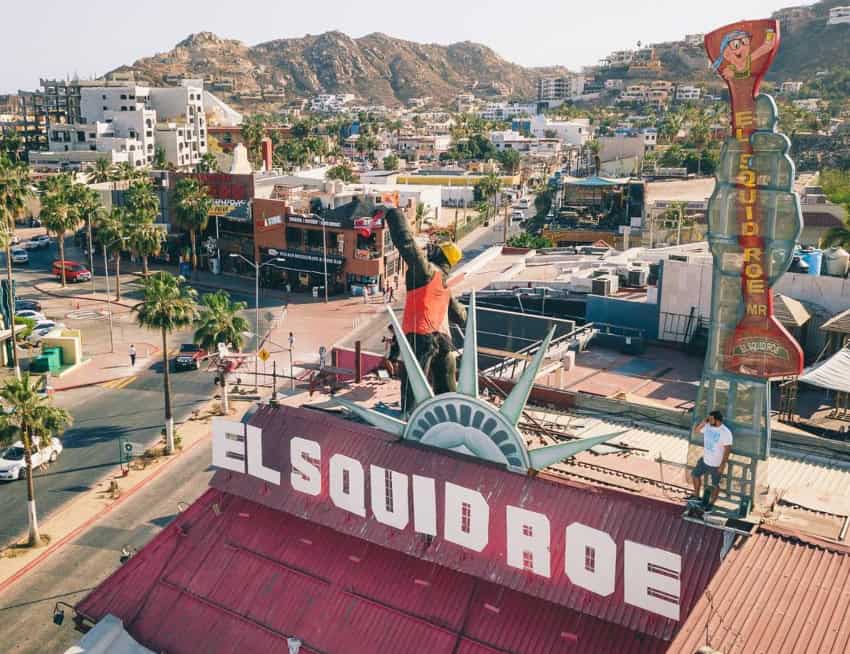
Squid Roe has towered over the Cabo San Lucas nightlife scene for decades. (Instagram)
We had a cooler, a CD player to play discs from clients or customers that would bring them down. They had like 50 of them, very minimal as it was growing and becoming the place it is now. We had customers bring us decorations, like the race car driver who brought us the hood of his car. And that’s how we built the place, with people bringing us things. My dad used to say, “If you have any trash at home, bring it to us. For us, it’s decoration.”
I remember reading somewhere that El Squid Roe was the place where all the locals gathered after Hurricane Kiko in 1989, even though it had only been open a few months. True?
Oh, yeah. We open the next day after every hurricane. We have a generator that uses gas and runs all day. I mean, when the light goes out, it kicks in five seconds later and we have power.
I believe what stops us the most during natural disasters is actually the employees. They have to fix themselves, check their families and make sure everything’s good. Once we know that they’re good, we bring in as many of them as can work. Not because we’re greedy, but because we feel like it’s our responsibility to ignite the destination again.
We have people come here from all over the world, and it’s not their fault that we have a huge hurricane every once in a while. The fact that we turn on our lights and have the party back again, it helps the destination, I believe.
Has the place been evolving since the very beginning?
Well, I feel like, talking from my point of view, the people who come here expect us to continually evolve. Otherwise, it’s going to get stale. At some point, it’s going to die out. Right. So we constantly add new things.
Like, we changed a whole bar. That bar used to come out. Now we’ve made it flat. And we added a bus, the London bus. We had a cart over there. The owner’s lounge is probably the newest thing. We have a joke internally that everybody’s the owner. When people come, they’re like, oh yeah, I’m the cousin of the owner or I know the owner or I know Billy. He’s my boy, he’s my friend, you know? It’s what happens when you have a place for so many years.
The best party in cabo ? you got that right! | EL SQUID ROE
So we said, “fuck it.” If everybody wants to be the owner, let’s create an owner’s lounge. If you want to be in that owner’s lounge, you purchase 10 bottles. Okay. And with 10 bottles, you get the owner’s lounge. It has air-conditioning, it has private bathrooms and it’s a big-ass space.
And the favorite thing that people love is that it says “owners” on it. New Year’s Eve, we had two guys rent out that space with 10 bottles. So you can see, it brings in the right market. And it used to be a storage room for one-liter-sized cups!
So we constantly evolve. I mean, we have a huge plane up there on the second floor. We added the third floor in 2012. The skybox. Not only that, the party stuff, the dances the waiters do — everything has to be constantly refreshed.
People expect so much. Now a show is expected when you dine and wine, you know? So we also try to entertain them. We do drinking contests at night for dinner. So, little things here and there. Also, as the team grows, each person brings in new ideas.
That’s how you stay popular for 37 years! I was thinking earlier about what a celebrity hangout this is, and about people like ‘Johnny Football’ (Johnny Manziel) who have famously partied here through the years.
We all partied with him. All my friends said that we basically ruined his career. One of my friends came up to me and said, “Dude, the Heisman Trophy winner is here.” At that time, I didn’t know what it was, the Heisman Trophy. I was like, “Sure, let’s invite him.” We invited him over there. And we had a huge group there. And they partied, they took a lot of pictures. Many of the pictures ended up on ESPN. They showed up everywhere.
But, yeah, we’ve had many famous people. I mean, Tupac for one. The waiters recognized him, went up to him and talked to him. My dad introduced himself to him. And Tupac said, “Billy, I’m working on a music video. I’m gonna be back in a couple of weeks with some friends. Please take care of us again.”
An average night at El Squid Roe is anything but average. (Instagram)
My dad tells me the story. It was him and some other guy. I don’t think he was famous. He was a rapper. But they were making a music video with this rapper. I don’t think it ever came out as that was the year Tupac died.
But anyway, two or three weeks later, my dad’s at the bar. He gets a tap on the back. It’s Tupac. He’s like, “Billy, I’m back.” My dad turns around, and there’s Tupac, Snoop Dogg, Suge Knight and MC Hammer. They asked for the mic. There’s a picture of them singing in the center of the dance floor. I think that’s one of my favorite stories.
Back then, it was more normal to see these famous people come out and have fun. Now, they’re more likely to stay in the villa, in the hotel. But celebrities still come in. For example, the quarterback of the Los Angeles Rams, Matt Stafford, was here last year with his friends. They got the owner’s lounge. So we still get football players. We get basketball players, actors.
Speaking of people staying in their villas, a lot of people are talking about nightlife being down in Cabo San Lucas. El Squid Roe is always popular, but do you feel like nightlife here isn’t what it used to be?
We notice how a lot of people come in, they get dropped off, they come in, then they get picked up and then leave. So it’s sad. It used to be like, “Oh, we’re going to party three days, stay one day at the hotel, then party three more days.” Now it’s like, “We’re going to stay at the hotel, and we’re going to go out Friday,” out of a whole week, you know? So it’s not good, not for the destination.
Things have to change, maybe. How, I don’t know, but we’re trying our best to keep our spirit alive, keep the place alive, bring new things all the time. But as long as we don’t all do it as a whole, it’s going to be complicated to just do it ourselves.
What do you think should be done?
We’re doing smaller things for now, like painting the streets. We added those trees outside as a group of restaurants together. We put in some trees, paint the streets and keep everything looking clean.
Sometimes people stand on tables at El Squid Roe. At other times, they dance on them. (Instagram)
Those small changes help a lot. But we have to take bigger actions. And it’s not just us but also the government. Keep the streets lit up, keep them clean. Have some security around, you know? Like, try and do something more.
But that doesn’t depend on one business. It depends on either the government or a group of businesses doing it together. You need everybody to kind of be on board. And it’s hard. It’s hard to get everybody on board. They look at you and they say, “Well, you’re the biggest one. You get all the people. You should pay 80% of it.”
So, it’s complicated, but I believe we should do it. That’s the only way we’re gonna be able to keep up.
Do you have many problems with customers, either because of cultural miscommunication or just because they get too drunk?
I love all my customers, you know? I think they all bring something great, but sometimes it’s hilarious when they come to the door and they have their bracelet, and they say, “Oh, I bought the all-you-can-drink, all-you-can-eat package.’
I’m like, yes, at the hotel, though. “Oh, wait, it doesn’t work?” No, we’re not part of the hotel. So that happens a lot. Too many times. Maybe it’s their first time out of the country, or their parents told them that they had all their food and drinks included, and they thought that meant everywhere.
We’ve even had people who are not our customers, who are from somewhere else, come up to us and say, “Hey, we don’t have money for the taxi to go back home. Can you please lend us some money?”
There have been times when our employees take them to the hotel because of that, or because they’re too drunk, you know? We’ve had customers call us to ask us if the club next door is open, if the bar across the street has hookahs. It’s crazy.
Your service is great here, but that’s a hallmark of Los Cabos, don’t you think?
The warmth here is … I’ve never seen it anywhere else. I’ve been to many places. Cancún, Puerto Vallarta, Mazatlán. And since I’ve been involved in this business since I was a kid, I always try and notice those kinds of details.
How do they receive you? Or, how do they sit you down? How is the food, the service? So I’m very critical. I think it’s cool to check and compare with Cabo and how we do it here. And I’ve never seen anywhere else where they treat people the way we do in Cabo.
I’ve been to other restaurants in Mexico. San Miguel de Allende, for example. That was the last place I went to. Oh my God. People are so slow. They’re not used to propinas. People don’t tip at all.
Me, I tip everyone. I literally had a conversation with some waiters and I said, guys, does nobody here like to earn money or what? They’re like, “Well, we don’t get tipped.” And I’m like, well, what if somebody does tip you? Wouldn’t that be nice?
But you go to the restaurants there, and they’re super nice. You’re like, wow, they spent a lot of money doing this place. And they’re empty. So I don’t know; it’s very different. But, yeah, I definitely had conversations with many waiters where I’m like, have you figured out how to get tipped yet? “No, we get paid; that’s it.”
Crowds out the door have been an El Squid Roe feature for 37 years. (Cabo Hospitality)
But here in Cabo, even people when they come from other parts of the country, they get it. Mexico City has great service. But when people from there come here, they’re like, “Okay, yeah, I have great service. But I’m missing, you know, the personal touch.”
Ask the customers where they’re from. Ask them about sports. Make them feel welcome.
Chris Sands is the former Cabo San Lucas local expert for the USA Today travel website 10 Best and writer of Fodor’s Los Cabos travel guidebook. He’s also a contributor to numerous websites and publications, including Tasting Table, Marriott Bonvoy Traveler, Forbes Travel Guide, Porthole Cruise, Cabo Living and Mexico News Daily.