Home Blog Page 117

Mexican directors are making waves at 2025’s film festivals

1
Movie showing on screen
Mexican filmmakers have found a showcase for their work this year courtesy of international film festivals. (Pexels/Tima Miroshnichenko)

As 2025 comes to a close, so does the year’s series of international film festivals, showcasing some of the most insightful and vibrant films from around the world. An impressive number of Mexican films can be counted among that acclaimed group.  

The collaboration between Cinépolis and the Sundance Institute that brought the Sundance Film Festival: CDMX to Mexico City for a second year has further bolstered Mexico’s cinematic reputation, while Mexican filmmaker Carlos Reygadas was on the main competition jury at Cannes. Meanwhile, Mexican directors maintained a strong international presence across festivals, including at the British Film Institute’s London Film Festival (BFI), the Toronto International Film Festival (TIFF) and the Berlin International Film Festival.

Sundance Film Festival
Sundance Film Festival was one of many to showcase the work of creative Mexican filmmakers this year. (Wikimedia Commons/Joseph Wise)

A recurring theme of using nostalgia and childhood memory as lenses to explore Mexico’s history and sociopolitical memory and identity is evident in many of Mexico’s standout works this year, with  notable mentions including Michel Franco’s erotic yet unnerving drama ”Dreams” and Urzula Barba Hopfner’s ”Corina.” But many more of the films recognized internationally this year also explore Mexico’s complex cultural history through drama, experimental filmmaking, animation and even mockumentary.  

Here’s a look at some of the standouts: 

El diablo fuma (y guarda las cabezas de los cerillos quemados en la misma caja)

Trailer de El diablo fuma (y guarda las cabezas de los cerillos quemados en la misma caja) (HD)



Director: Ernesto Martínez Bucio
Genre: Drama

Set in 1990s Mexico City, ”El diablo fuma” follows five young siblings who move in with their schizophrenic grandmother after their parents disappear. Forbidden from leaving the property and increasingly isolated, the children inherit their grandmother’s religious fears and delusions, which begin to distort their fragile sense of reality. The house becomes a psychological playground where innocence is warped and memory becomes contaminated.

Visually emphasized by a shaky handheld camera, the film works to subvert the joys of childhood imagination, portraying it as vulnerable and haunted. Set during Pope John Paul II’s visit to Mexico City, Martínez Bucio critiques the generational weight of religious trauma.

The film was screened at the BFI and Barcelona’s D’A Film Festival and won Best Feature at the Berlin International Film Festival.

Olmo

Director: Fernando Eimbcke
Genre: Drama, Comedy

The Mexican-U.S. coproduction directed by Fernando Eimbcke is a coming-of-age story set in New Mexico in 1979. ”Olmo” follows a Mexican-American teenager desperate to attend a party hosted by his neighbor and crush, Nina. Left to care for his father, who has multiple sclerosis, while his mother works extra shifts to pay the overdue rent, Olmo and his best friend Miguel try to impress Nina with a stereo as their ticket in.

Shot in just 25 days, the film explores the miscommunications and suffocations of adolescence within a family facing real hardship. Eimbcke reconnects with the decade that shaped his own childhood, using warm, soft lighting to evoke a simpler time. Yet, the film goes beyond sentimentality, highlighting the linguistic and financial challenges of Mexican-American families in the 1970s.

“Olmo” was a hit at the Sydney Film Festival, at the Toronto International Film Festival and at BFI London, and was nominated for the Panorama Audience Award at the Berlin International Film Festival.

Yo Soy Frankelda 

Soy Frankelda | Tráiler Oficial | Cinemex

Directors: Arturo Ambriz, Roy Ambriz, Mireya Mendoza
Genre: Animation, Horror

Mexico’s first full-length stop-motion animation, ”Yo Soy Frankelda” is the creation of Roy and Arturo Ambriz’s Cinema Fantasma, with support from internationally acclaimed Mexican director Guillermo del Toro. 

Featuring gothic puppets and a haunting score, the film delves into the subconscious of a ghostly 1870s female horror writer who conjures monsters from her imagination while plotting her escape from a haunted house.

Frankelda’s backstory as a rejected writer in a sexist publishing industry fuels her escapist nostalgia and fantastical storytelling, serving as resistance to her marginalization.

The film opened the Guadalajara Film Festival and was featured at the Morelia and Tokyo International Film Festivals, as well as France’s Annecy International Animation Film Festival. It won the Satoshi Kon Award for Excellence in Animation and received a Special Jury Mention at the Fantasia Film Festival in Montreal.

Tutti Frutti: El Templo del Underground 

Tutti Frutti. El templo del underground | Doctubre Mx

Director: Laura Ponte
Genre: Documentary

Although it debuted three years ago, Ponte’s vibrant documentary returned for a special screening and director Q&A at the Hollywood Theatre during PDXLAFF this October. It revisits Tutti Frutti, a clandestine 1980s Mexico City dive bar that became a haven for the country’s countercultural movement.

A nondiscriminatory refuge for youth seeking alternative music, Tutti Frutti thrived on community and care, symbolizing artistic defiance before hypercommunication and globalization reshaped the music scene. Not unlike “Yo Soy Frankelda,” the documentary explores artistic resistance, but instead through a nostalgic lens that highlights Mexico’s youth counterculture and how Tutti Frutti shaped contemporary Mexican identity.

Autos, Mota y Rocanrol

AUTOS, MOTA Y ROCANROL 🔥 | TRÁILER

Director: José Manuel Cravioto Aguillón
Genre: Comedy, Mockumentary, Music History

This sharp-witted mockumentary follows two friends as they plan a rock concert and car race that unexpectedly evolves into the infamous Avándaro Festival of 1971 in Valle de Bravo, dubbed Mexico’s Woodstock. Originally called the Avándaro Rock and Wheels Festival, this historic event — with an estimated attendance between 100,000 and 500,000, sparked a government crackdown on rock music due to its alignment with La Onda, a countercultural movement rooted in psychedelics, multidisciplinary artistic expression and anti-establishment sentiment.

“Autos, Mota y Rocanrol” blends Super 8 film and archival footage to create a vivid, nostalgic journey through the 1970s. The mockumentary format satirizes the fruitful chaos of the event in a way that underlines the spirit of youth counterculture and a restless liberal identity.

The film was an official selection at the Guadalajara International Film Festival and earned 13 nominations at Mexico’s 67th Ariel Awards. Internationally, it screened at multiple festivals, including the Portland Latin American Film Festival and the Newport Beach Film Festival.

No Nos Movarán

No Nos Moverán | Official Trailer | It’s Never Too Late for Justice | Hola Mexico Film Festival

Director: Pierre Saint-Martin Castellanos
Genre: Drama, Political Satire

Written and directed by Iker Compeán Leroux and Pierre Saint-Martin Castellanos, and supported by FOCINE (a Mexican government fund), “No Nos Movarán” tells the story of Socorro, a defiant sexagenarian lawyer determined to find the soldier who killed her brother during the 1968 Tlatelolco massacre.

Merging documentary materials with fiction, the film uses political satire to confront trauma and loss. Inspired by Saint-Martin’s own mother’s memories, it offers a visceral tool for reckoning with the grief of Mexico’s political past and the challenge of finding peace without remaining trapped in it. Shot in black-and-white, the film combines drama, biting satire and dark comedy to explore the weight of memory and the risk of grief unraveling familial bonds.

The film won four of Mexico’s Ariel Awards in 2025, as well as top honors at several international film festivals, including the Guadalajara International Film Festival, Toulouse’s Cinelatino film festival and the Huelva Ibero-American Film Festival in Spain. It was also selected to represent Mexico at the 2026 Oscars and at Spain’s Goya Awards.

09/05/1982

09/05/1982 Trailer | TIFF 2025

Directors: Jorge Caballero and Camila Restrepo
Genre: Short film 

This 11-minute short delivers a critical warning about the power of artificial intelligence to manipulate truth.

Its unique format challenges viewers to consider the ethical implications of technology’s ability to rewrite history — as what appears to be recovered footage of violence documented in an unspecified Latin American country during the 1980s is actually a digital fabrication, overlaid with an “official” radio broadcast to add a feel of authenticity.

By “reconstructing” this fictional event, “09/05/1982” critiques the instability of memory and the ease with which media can distort our historical narratives. 

The short premiered at the Marseille International Film Festival and received acclaim at South Korea’s DMZ International Documentary Film Festival. It also was shown at the New York Film Festival and at the Toronto International Film Festival.

More than anything, Mexican filmmakers’ cinematic focus on the period between the 1970s and the 1990s reflects a 30-year nostalgia loop: a phenomenon where filmmakers revisit their formative years. This trend has also been observed in U.S. cinema, notably in the Reagan-era aesthetics and predigital childhoods of shows like “Stranger Things.”

An overview

Beyond escapism, these seven films offer a kaleidoscopic lens into the last 50 years of Mexico’s cultural memory, where everything from drama to mockumentary is being used to reckon with identity, trauma and resistance. Many of these films serve as illuminating, thought-provoking and sometimes downright fun primers on Mexican social history, making them worth your while to track down and put on your watchlist.

Millie Deere is a freelance journalist
Mexico launches ‘Tulum Reborn’ strategy to tackle slump in tourism

3
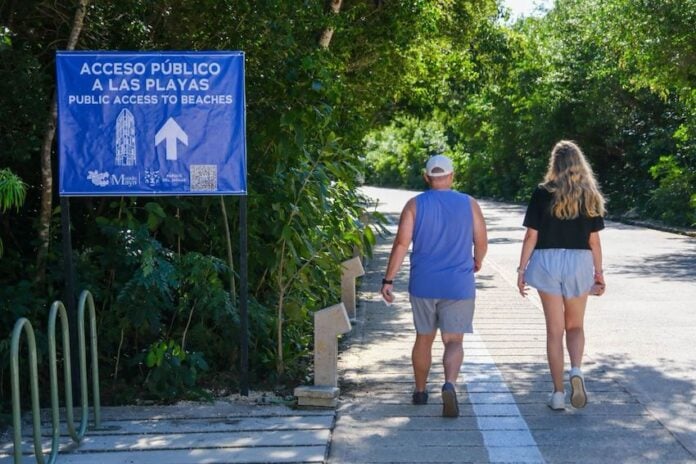
two people walking towards a beach in Tulum
In September, hotel occupancy in Tulum fell 17.5 percentage points compared to the same month last year, from 66.7% to 49.2%. (Cuartoscuro)

The Mexican government launched a 128-action strategy named Tulum Reborn: Fairer, Safer and More Sustainable on Friday, in response to the recent decline in tourism to the Caribbean coast destination. 

Tulum in Mexico’s Yucatán Peninsula welcomed just over 1.3 million tourists between January and October. Meanwhile, Tulum International Airport, which commenced operations in December 2023, experienced a 9.4% increase in passenger traffic, according to Mexico’s Tourism Minister Josefina Rodríguez.  

The town’s average hotel occupancy stands at 75.8%. However, in September, occupancy fell 17.5 percentage points compared to the same month last year, from 66.7% to 49.2%, according to the state Tourism Ministry (Sedetur).

Videos have also circulated on social media in recent months showing empty streets, restaurants and beaches, giving cause for concern across Tulum’s tourism industry.

While Tulum’s Mayor Diego Castañón said the situation has been made worse by a smear campaign orchestrated by the private sector and social media influencers, several factors have, in fact, contributed to the fall in tourism.

Elevated prices, controversial rules regarding public access to beaches and greater quantities of seaweed during the summer months have been blamed for driving tourists away. 

A sharp drop in hotel occupancy has the Tulum tourism sector worried

To tackle the decline, the government announced there will be free access to public beaches — without food or beverage restrictions — in Jaguar National Park and the hotel zones as part of its Tulum Reborn strategy.

The strategy was developed with consultation across various institutions at different levels of government, according to Rodríguez.  

“The design and creation of the campaign… is underway; this includes the promotion of tourist routes and products in the region, and the integration of a calendar of high-impact cultural and tourist events,” Rodríguez stated.

Tulum Reborn is centered around four pillars: the orderly regulation of tourist attractions, responsible urban and environmental management, tourism development and promotion and the comprehensive improvement of infrastructure and facilities. 

Two entrances are now open to Jaguar Park, providing access to the four beaches within the protected area. In addition, two new public access points have been established in the hotel zone, to Conchitas Beach and Playa del Pueblo.  

The park will be open 365 days a year with access to visitors and residents alike. Quintana Roo’s Governor, Mara Lezama, stressed that access to public beaches is a fundamental right. 

“We invite everyone – locals, nationals, and foreigners – to come in… walking, running or cycling and enjoy [the beaches] to the fullest,” said Lezama.

Lezama also announced that the region will soon host “Tulum, the Show,” as part of the Mexico Aerospace Fair, which is expected to attract 20,000 visitors, as well as the PGA Tour Professional Golf Tournament and several other high-impact events. 

With reports from El Universal and Quadratín Quintana Roo

Sheinbaum blames opposition for funding violent protest: Monday’s mañanera recapped

9
Sheinbaum mañanera Nov. 17, 2025
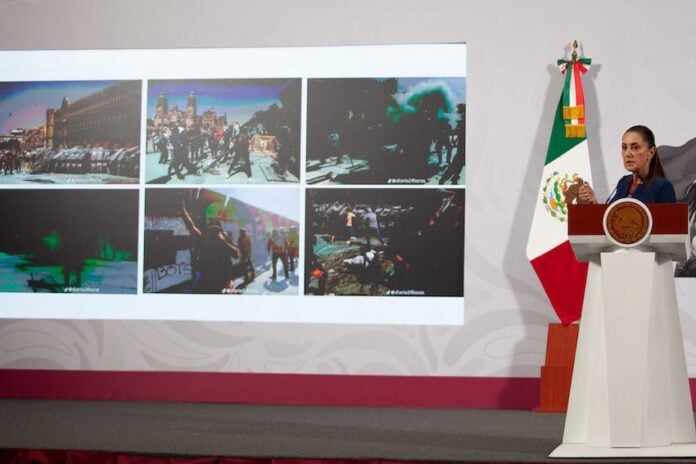
On Monday, the president scrutinized images of the protest in Mexico City on Saturday, saying that there were not that many young people. (Andrea Murcia/Cuartoscuro)

The main focus of President Claudia Sheinbaum’s Monday morning press conference was the protest against insecurity and corruption that took place in Mexico City on Saturday.

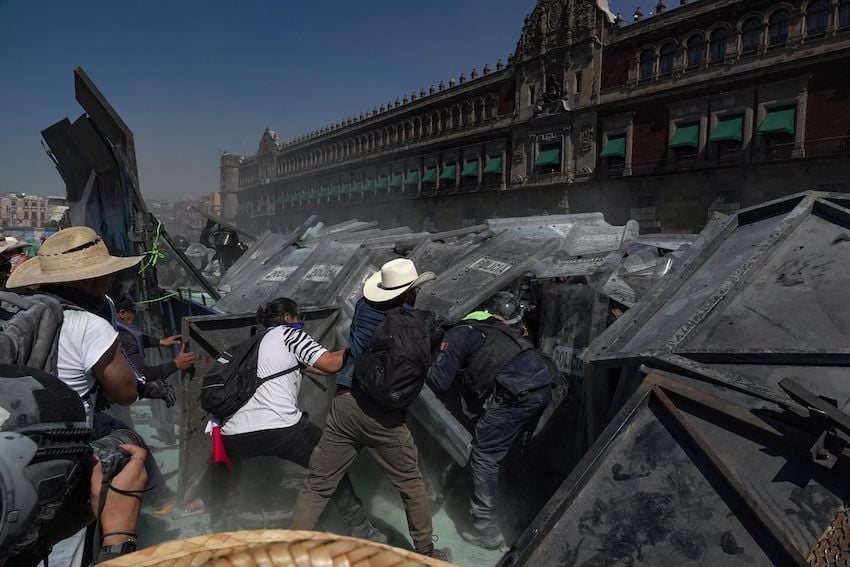
While the march from the Angel of Independence monument to the Zócalo, Mexico City’s main square, was largely peaceful, the protest turned violent in the Zócalo when a so-called “black bloc” of protesters tore down part of a barrier protecting the National Palace and attacked police officers, 100 of whom were injured, according to authorities.

Mass protest against insecurity and the Morena party turns violent in Mexico City

Anti-government and anti-Morena sentiment was on prominent display during the march, with some protesters even calling for Sheinbaum to resign.

A major catalyst for the protest was the Nov. 1 assassination of Uruapan mayor Carlos Manzo, an outspoken anti-crime crusader who had urged the federal government to take a more active and aggressive approach to combating Mexico’s notorious criminal organizations, among which are six drug cartels that were designated as foreign terrorist organizations by the Trump administration earlier this year.

Sheinbaum: Opposition promoted ‘Gen Z’ protest with 90 million pesos 

Sheinbaum noted that last Thursday, the government’s fake news debunker-in-chief, Miguel Ángel Elorza Vásquez, gave a detailed overview of how last Saturday’s protests were promoted on social media.

“They promoted this idea that they were young people organically calling for this march called the ‘Generation Z’ march. But here it was shown how, in reality, there was a push of about 90 million pesos [US $4.9 million] promoting this protest from the opposition, on one hand, and also with the support of a businessman,” she said, referring to Ricardo Salinas.

According to the information presented by Elorza, the promotion of the protests was paid for by foreign right-wing organizations and individuals in collaboration with Mexican people, such as Salinas and others affiliated with Mexican opposition parties.

“A lot of [social media] accounts, even from abroad, promoted this protest,” said Sheinbaum.

The ‘vast majority’ of protesters weren’t young people, says Sheinbaum 

Sheinbaum said that “the vast majority of those who marched on Saturday weren’t young people from Generation Z.”

“Yes, there were some young people, but the majority weren’t young,” she said.

Indeed, most of the participants were older adults, according to various media reports.

“We saw the very familiar faces of those who marched with the Marea Rosa [Pink Tide],” Sheinbaum said, referring to large anti-government rallies that took place last year when former president Andrés Manuel López Obrador was still in office.

Sheinbaum: The objective of violent protesters was to ‘go against the police’

Sheinbaum displayed images of acts of violence committed during Saturday’s protest in Mexico City as well as photos of injured police officers. She also presented confronting video footage of a group of protesters attacking a police officer.

Sheinbaum said that the goal of tearing down barriers that protected the National Palace wasn’t to get to the building in order to vandalize it or to attempt to gain entry, but rather to “go against the police” who were situated behind it.

“This very violent group that arrived with material to break the fence … doesn’t even arrive at the Palace, but rather launch themselves at police in a very violent way,” she said.

“… They removed the barriers in the Zócalo, broke them and threw rocks at the police officers’ shields,” Sheinbaum said, adding that the police resisted for “hours” before they were pushed and “this violence” ensued.

The government said that "violent groups" made "direct attacks" on police, hitting officers, stealing their shields and launching explosive devices at them.
The protest turned violent when a so-called “black bloc” of protesters tore down part of a barrier protecting the National Palace and attacked police officers, 100 of whom were injured. (Rogelio Morales/Cuartoscuro)

The president said she had asked the Mexico City attorney general to investigate “who these groups are,” what motivated their acts of violence and whether they were paid.

“This idea they wanted to create, … that young people are against the [fourth] transformation [political project] is false,” she added.

Sheinbaum said that an investigation into a person who was filmed shouting “you’re going to die” to police must be carried out. A reporter noted that the person also said, “we have weapons.”

Sheinbaum said that Mexico City authorities also need to investigate whether any police officers broke with “police discipline” during the protest in the capital.

There were reports of a range of abuses allegedly committed by police against protesters.

On Monday, Mexico City Security Minister Pablo Vázquez said that 18 incidents in which police officers may have violated acceptable police conduct were under investigation.

Sheinbaum: ‘We want there to be responsible opposition’

Sheinbaum said that if Mexico’s opposition wants to attract more people to their cause, “violence won’t help them.”

“In Mexico, violence is rejected. People don’t want violent actions,” she said.

“And there can be opposition, it’s good that there is opposition in Mexico,” Sheinbaum added.

She asserted that claims that “we want ‘a single way of thinking’ are false.

“We want there to be opposition, responsible opposition, with high-level debate, with proposals, but violence leads nowhere,” Sheinbaum said.

“… No to violence. … Those who promote violence don’t help the country. Those who promote violence don’t help themselves. Those who promote violence don’t create a high-level debate in our country,” she said.

Sheinbaum: Salinas’ television stations sought to create impression that ‘the government is repressive’ 

Sheinbaum said that “in effect,” billionaire businessman Ricardo Salinas — an outspoken government critic — promoted the protests that took place in Mexico City and dozens of other Mexican cities on Saturday.

“He was writing against us [on social media] and promoting the protest, egging it on,” she said.

Sheinbaum also said that Salinas’ television channels, which include Azteca Uno and ADN40, “followed the entire protest” in Mexico City, and asserted that their presenters sought to create the idea that “the government is repressive and young people don’t agree with the government.”

However, “the majority of the people in Mexico” and “the majority of young people” support “the transformation,” she said, referring to the fourth transformation (4T) political project initiated by López Obrador and continued by the current government.

Sheinbaum also said that “young people aren’t repressed [by the government] in Mexico.”

“On the contrary, we give them scholarships, we give them schools, we give them jobs, we embrace young people, and we listen to them. If there is a legitimate, justified demand, we must listen to young people,” she said.

‘In Mexico there is peace’

Sheinbaum noted that a danzón (a dance genre) festival was held in the Zócalo on Sunday, a day after violent scenes played out in the large square in the historic center of Mexico’s capital.

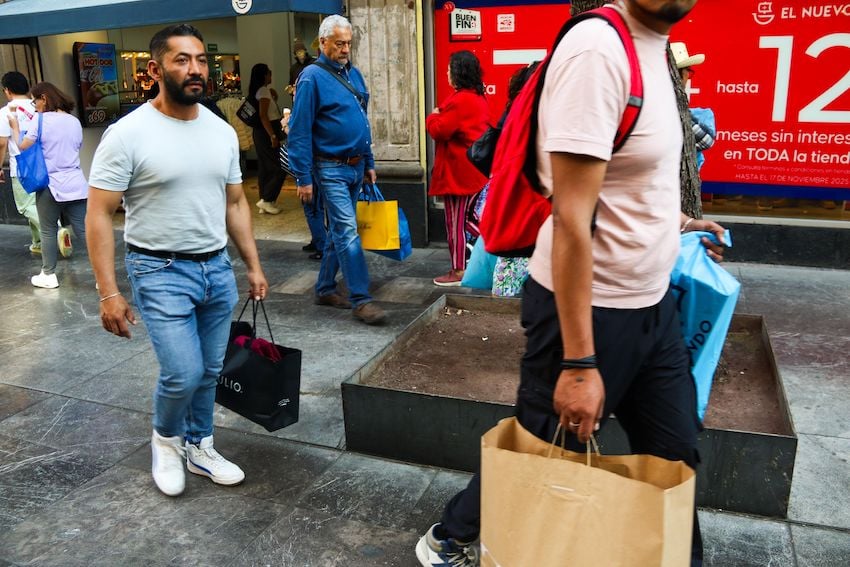
She also said that when she returned to Mexico City from a weekend trip to the state of Tabasco, the historic center was packed with Buen Fin shoppers and people were “happy.”

Despite the violence in the Zócalo on Saturday — and major insecurity problems in various parts of the country — “in Mexico there is peace,” declared Sheinbaum, whose government has reduced homicides but by no means has pacified the country.

Sheinbaum said on Monday that when she returned to Mexico City from a weekend trip to the state of Tabasco, the historic center was packed with Buen Fin shoppers and people were “happy.” (Victoria Valtierra/Cuartoscuro)

“And we’re attending to everything that has to do with insecurity and violence,” she added.

“That has to be attended to, as we are doing. And if we have to dedicate more [to the fight against crime] we will,” said Sheinbaum, whose government last week presented “Plan Michoacán for Peace and Justice” in response to the assassination of Carlos Manzo and general insecurity in the state.

‘The electoral period is approaching, and let the people say what they want’

Sheinbaum noted that her presidency will be subject to a “revocation of mandate” recall vote in 2027.

“The revocation of mandate is a slogan of ours. Who proposed it was President López Obrador, who put it in the constitution was President López Obrador. And of course I’m going to subject myself to the revocation of mandate [vote], because that’s what the constitution says,” she said.

Sheinbaum — a highly popular president — noted that AMLO attracted 90% support when his presidency was the subject of a recall election in 2022, at which turnout was below 20%.

She also noted that Mexicans will have the opportunity to elect governors in many states in 2027 as well as federal deputies and mayors.

“The electoral period is approaching, and let the people say what they want,” Sheinbaum said.

A revocation of mandate vote was one of the demands of the Generation Z organizers of Saturday’s protests, even though a recall election is already provided for in the Mexican Constitution.

By Mexico News Daily chief staff writer Peter Davies (peter.davies@mexiconewsdaily.com)

Google chooses Puebla state as the site of its first AI lab in Mexico

0
Google building and logo
Google's first such lab in Mexico is scheduled to begin operations in January in the municipality of San José Chiapa. (Unsplash)

Google will launch its first artificial intelligence (AI) lab in Mexico, in Puebla state, in January 2026, the state Science and Technology Minister Celina Peña Guzmán announced last week. 

The commercial manager of Google Cloud, Manuel Tierno, confirmed the project during a Tech Capital Summit in Puebla in October, although he did not specify the project’s location or cost at that time.  

The project will focus on applied tools developed through Google Labs. Google AI Labs is an innovation and research center dedicated to the development, testing and public demonstration of cutting-edge artificial intelligence projects and technologies.

Peña Guzmán said she expected the lab to be constructed in the federal government’s 400-hectare Development Hub for Wellbeing, formally known as Ciudad Modelo, in the municipality of San José Chiapa.

Google sees the project as an opportunity to reduce bureaucracy and build technological security that benefits citizens. “These strategic alliances support young people and transform government processes,” Peña Guzmán said in a July press statement

A 600-million-peso (US $32.8 million) electricity substation is being developed in the area, around 65 km from Puebla city, according to the state government’s cabinet coordinator, José Luis García Parra. 

The substation is expected to be completed by February 2026 and will provide 60 megawatt-hours of power to support the operations of both domestic and international companies launching projects in the region. 

Earlier this year, the city of Puebla was dubbed the Capital of Technology and Sustainability, which has attracted more interest from technology companies. 

Tech firms such as Amazon, Oracle and Huawei will help the state’s Education Ministry improve its internal processes and develop applied tools for students, according to Peña Guzmán. 

With reports from Proceso and Telediario

99 facts you need to know about Mexico: 1-20

14
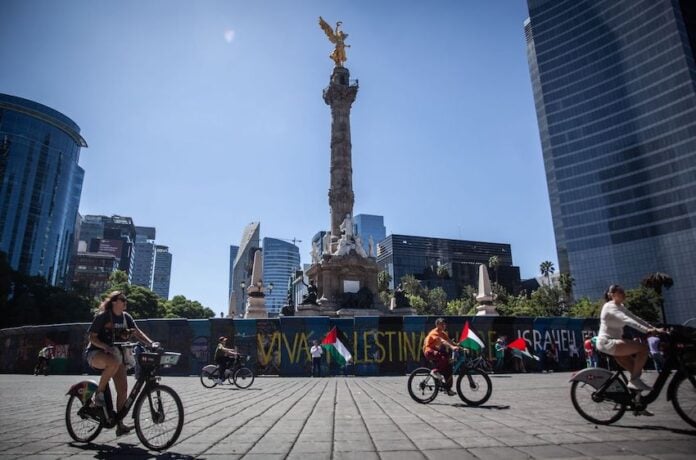
Cyclists enjoy a car-free Paseo Dominical along Reforma Avenue in Mexico City.
Cyclists enjoy a car-free Paseo Dominical along Reforma Avenue in Mexico City. (Andrea Murcia/Cuartoscuro)

In honor of World Statistics Day on Oct. 20, Mexico’s national statistics agency INEGI published a small book presenting the 99 facts you need to know about Mexico.

All week, we will be sharing the book’s contents translated into English.

Here is part 1!

1) In 2023, Mexico’s population reached 129,477,554 people, with women making up 51.7% of the total.

(Source: INEGI, National Survey on Demographic Dynamics – ENADID, 2023)

Mexico is the largest Spanish-speaking country and one of the ten most populous in the
world. These figures from INEGI reflect steady population growth and a slight
predominance of women, a global trend.

2) In 2020, 2.6 million people in Mexico identified as Afro-Mexican or of African descent, representing 2.0% of the national population.

(Source: INEGI, Population and Housing Census – CPV, 2020)

Mexico’s population of African descent is mainly concentrated in states like Guerrero,
Oaxaca and Veracruz, and continues to gain visibility socially and culturally.

3) What is the most common household appliance in Mexico? The blender. In 2024, 91.8% of households owned one.

(Source: INEGI, National Survey on Household Income and Expenditures – ENIGH, 2024)

The blender is an essential tool in Mexican kitchens, used for making salsas, drinks and
sauces. Its versatility and practicality have made it a staple in daily home cooking
throughout the country.

4) In 2020, there were one million people in Mexico aged 85 and older, and 18,295 of them were over 100 years old.

(Source: INEGI, Population and Housing Census – CPV, 2020)

Longer life expectancy and falling birth rates are resulting in a rapidly aging population in
Mexico. This shift brings new challenges for families, healthcare and social policies as
more people live to advanced ages.

5) By the end of 2023, women made up 51.4% of the workforce in Mexico’s federal public administration and 56.3% in state governments.

(Source: INEGI, National Census of Federal and State Governments – CNGF and CNGE, 2024)

Gender representation has become a central focus across Mexican government
institutions. Public policies and electoral reforms have opened opportunities for women to access leadership roles nationwide. These efforts are the result of long-standing
demands for equality and are shaping a more inclusive environment within the country’s
political and administrative spheres.

three women in front of gasworks
President Sheinbaum, seen here with Energy Minister Luz Elena González Escobar and Federal Electricity Commission (CFE) Director Emilia Calleja.  (@EmiliaCalleja/on X)

6) A household is defined as a group of people, related or not, who share the same dwelling and cover their living expenses together. In 2023, there were 38.9 million households in Mexico.

(Source: INEGI, National Survey on Demographic Dynamics – ENADID, 2023)

Households in Mexico include a variety of arrangements, from large multigenerational families to single-person homes.

7) Income can come in the form of money or goods and is derived from various sources such as work, government programs, and others. In 2024, the average combined monthly household income in Mexico was 25,955 pesos (US $1,400).

(Source: INEGI, National Survey on Household Income and Expenditures – ENIGH, 2024)

While many households rely primarily on wages, others depend on informal work or social aid. The data helps illustrate how income distribution shapes daily living conditions across Mexico.

8) In 2024, there were 111,805 establishments in Mexico dedicated to producing tortillas and other corn-based products.

(Source: INEGI, National Statistical Directory of Economic Units – DENUE, 2025)

Corn is at the core of Mexican identity and daily diet, with tortillas as an indispensable staple.

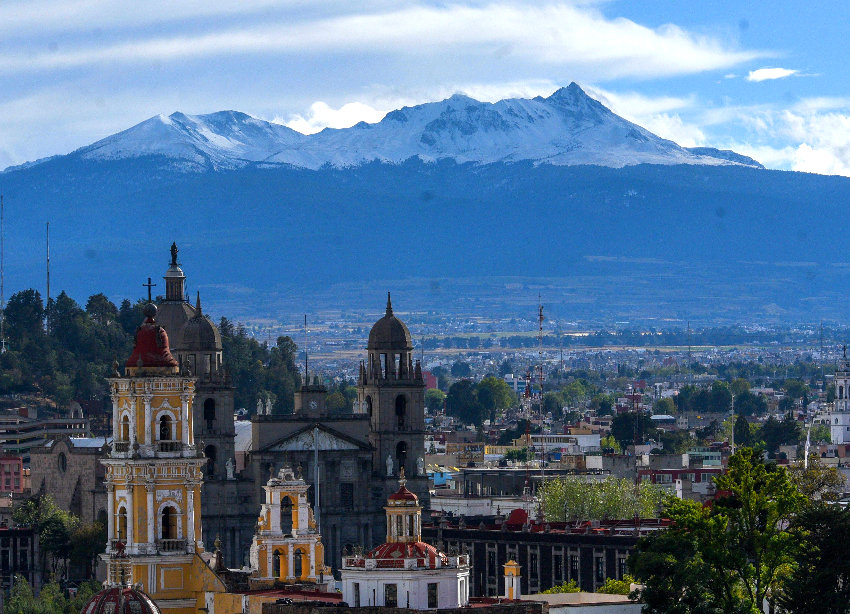
9) Toluca de Lerdo, at 2,674 meters above sea level, is the state capital with the highest elevation in Mexico.

(Source: INEGI, Digital Elevation Models – MDE, 2024)

This altitude gives Toluca a cool climate year-round and makes it unique among
Mexican capitals. Its geography also influences local traditions, agriculture and even high-performance sports, all adapted to life at nearly 2,700 meters.

View of the Xinantécatl volcano from Toluca. (Crisanta Espinosa Aguilar/Cuartoscuro)

10) In 2021, 70.1% of women in Mexico had experienced at least one incident of violence at some point in their lives.

(Source: INEGI, National Survey on the Dynamics of Household Relationships – ENDIREH, 2021)

Psychological, sexual and physical violence against women is widespread in Mexico.

11) In 2024, 7,093,631 establishments were operating in Mexico.

(Source: INEGI, Economic Censuses – CE, 2024)

These establishments span sectors from commerce to services and manufacturing. Most
are small businesses and microenterprises, which form the backbone of the national economy.

12) How many books do Mexicans read per year? In 2022, Mexicans read an average of four books; by 2024, the figure had dropped to three.

(Source: INEGI, Reading Module – MOLEC, 2022 and 2024)

The number of books read by Mexicans has declined in recent years, especially among young adults. Economic factors, access to books and changing habits all play a role. Promoting reading remains an ongoing challenge for schools and families in Mexico.

13) In 2020, 70% of Mexico’s surface water (rivers, lakes, lagoons, wetlands) was found in Chiapas, Tabasco, Campeche and Veracruz.

(Source: INEGI, Hydrology – HIDRO, 2024)

These southeastern states receive the most rainfall, making them rich in natural water resources. Much of the country, especially the north and center, faces water scarcity despite the abundance in the south.

14) The collection of solid urban waste is one of the essential services provided by local governments. In 2022, an average of 108,146 tonnes were collected daily across Mexico.

(Source: INEGI, National Census of Municipal Governments and Mexico City Territorial Demarcations – CNGMD, 2023)

Most waste is gathered through door-to-door pickup, reflecting the country’s substantial urban population. Efficient waste management is a growing challenge for municipalities.

15) In 2024, there were 61.3 million vehicles in circulation in Mexico — a 5.4% increase from 2023.

(Source: INEGI, Motor Vehicles Registered in Circulation – VMRC, 2023 and 2024)

Car ownership continues to grow, especially in urban and suburban areas. Managing pollution and congestion is a growing priority, especially in Mexico City, which has the worst traffic of any city in the world.

16) Between April and June of 2025, the population who had a job or were looking for one had an average of 10.7 years of schooling (roughly equivalent to completing the second year of high school).

(Source: INEGI, National Employment and Occupation Survey – ENOE, second quarter 2025)

This educational level falls just short of finishing upper secondary education, which is a
challenge for workforce readiness in Mexico. Investing in education is key to narrowing
gaps between skills and employment opportunities. The figure also highlights how
school dropout rates continue to impact job prospects.

17) In 2023, 95 out of every 100 people living in Chiapas were born there, while in Quintana Roo, only 50 out of every 100 residents were natives of that state.

(Source: INEGI, National Survey on Demographic Dynamics – ENADID, 2023)

Chiapas has a highly rooted local population, unlike Quintana Roo, a prime destination for internal migration.

18) Between March and April 2025, 75.6% of Mexico’s population felt that living in their state was unsafe due to crime. By contrast, only 40.5% felt their own neighborhoods were unsafe.

(Source: INEGI, National Survey of Victimization and Perception of Public Safety – ENVIPE, 2025)

Insecurity is consistently perceived as the biggest concern among Mexicans. Personal experience varies widely depending on location and local conditions. These attitudes influence daily life, public policy and trust in institutions.

Puerto Vallarta rated third-safest city in Mexico


19) In 2022, 23.7% of Mexico’s population reported having experienced discrimination in the previous 12 months.

(Source: INEGI, National Survey on Discrimination – ENADIS, 2022)

The number of people facing discrimination has been on the rise. Marginalized groups, such as women, members of the LGBTQ+ community and migrants, report above-average experiences of exclusion in Mexico.

20) In 2024, the average monthly income for women in Mexico was 7,905 pesos (US $429), while for men it was 12,016 pesos (US $652) — a gender gap of 4,111 pesos (US $222.50).

(Source: INEGI, National Survey on Household Income and Expenditures – ENIGH, 2024)

Women earned about 34% less than men on average, highlighting persistent gender inequality in Mexico’s labor market. Pay differences can be influenced by occupation, education level and family responsibilities. Bridging the gap is a longstanding goal for policy and social programs.

Mexico News Daily

A totally renovated Metro Line 1 — Mexico City’s oldest — is up and running again 

2
Line 1 trains
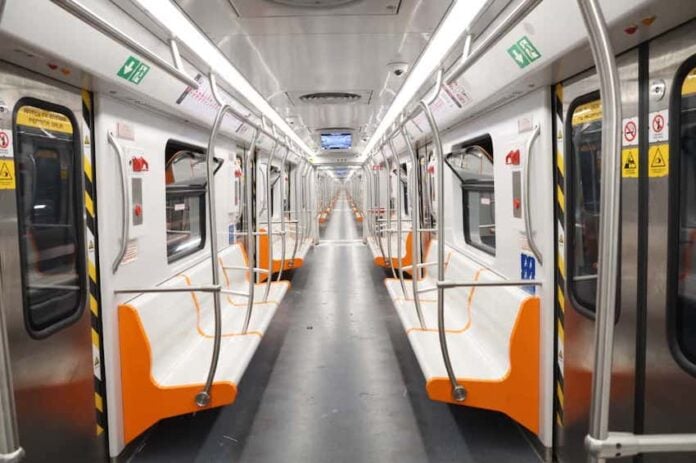
The now ultra-modern Metro Line 1 will carry 850,000 passengers a day, as it makes the 19 km trip in 40 minutes from Pantitlán to Observatorio, already a major ground transport hub and soon to be the terminus for the Mexico City-Toluca train. (@ClaraBrugadaM/X)

Mexico City’s oldest subway line — Metro Line 1 — is completely operational again after long-delayed renovations were completed last week. 

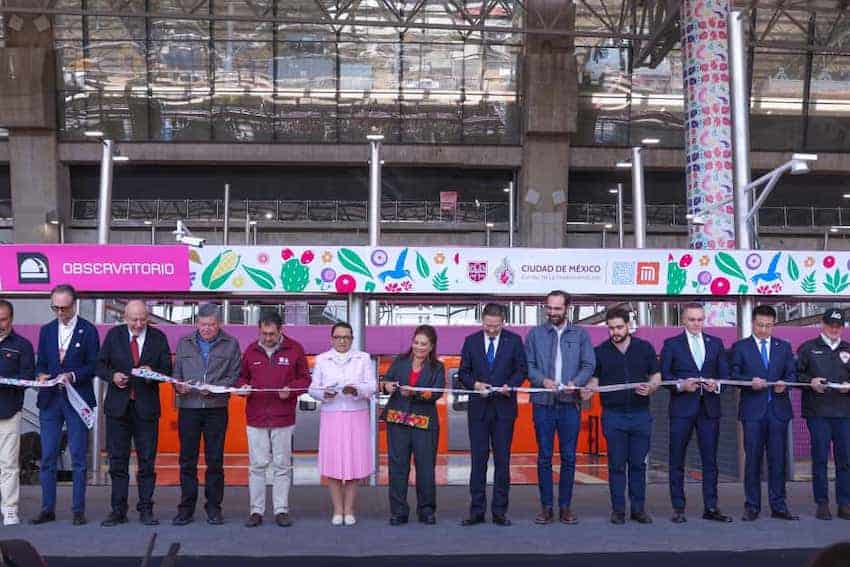
After re-inaugurating the three westernmost stations on Sunday, Mayor Clara Brugada called the restoration effort “the most important urban project in the country” and said it “extended the life of the line for another 50 years.”

The Observatorio station — a modal transfer center — underwent a complete overhaul as it soon will become the terminus of the Toluca-Mexico City Inter-City Train. (@ClaraBrugadaM/X)

“This project not only benefits those who live in Mexico City, but also represents a strategic advance in regional mobility,” she said, touting the state-of-the-art technology as a key part of the comprehensive facelift.

“Every last screw was replaced,” she said.

The modernization of Line 1 began on July 11, 2022, when Claudia Sheinbaum was mayor of Mexico City, and cost roughly 37 billion pesos (US $2 billion). 

The nearly 19 kilometers-long metro line with 20 stations traverses the capital from east to west and is projected to transport approximately 850,000 passengers daily. Brugada said commuters will now be able to make a trip from the easternmost station of Pantitlán to the westernmost, Observatorio, in 40 minutes.

The Observatorio station — a modal transfer center — underwent a complete overhaul as it soon will become the terminus of the Toluca-Mexico City Inter-City Train. In addition to the Metro, the Observatorio complex already houses one of the capital’s four main bus terminals as well as a massive station for local bus service.

Guillermo Calderón, Brugada’s travel and transportation adviser, said the work included the complete rehabilitation of the entire subway tunnel and the renewal of 240 kilometers of track profiles, including rails, running surface and guide rails.

Approximately 200,000 tonnes of ballast (gravel) were replaced, as were 60,000 concrete sleepers (ties), 30,000 insulators and 64 track switches. The new electrical system includes 336 kilometers of cable trays, 2,000 kilometers of cabling and 40 kilometers of lighting, and rehabilitated power stations.

More than 200 km of fiber optic cable were installed for an LTE network, along with 80 kilometers of radiating cable. A new communications-based train control system was also installed.

Originally scheduled to reopen in 2023, Line 1 opened in stages from east to west.

Considered the backbone of the capital’s transportation system, Line 1 — which was first inaugurated in September 1969 — connects with nine of the other 11 metro lines that criss-cross Mexico City.

Brugada praised the work of the Chinese consortium CRCC, which oversaw the construction project.

Speaking at the inauguration ceremony, China’s Ambassador to Mexico Chen Daojiang also thanked CRCC and reiterated his country’s commitment to continue supporting projects that contribute to the development and well-being of Mexico City.

With reports from El Economista, La Jornada and Infobae

US man caught smuggling Mexican parakeets in his pants faces 20 years in prison

1
Smuggled parakeets
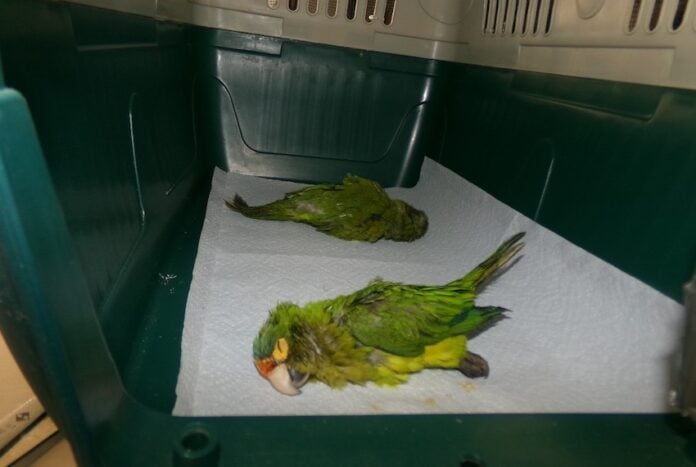
The two smuggled parakeets were unconscious but breathing, and later found to be in stable condition under the care of the Agriculture Department. (@SDCAnews/X)

An American citizen living in Tijuana who was caught trying to smuggle two parakeets across the border into the U.S. last month was indicted in San Diego last week on federal smuggling charges.

Jesse Agus Martinez, 35, was stopped by U.S. Customs and Border Protection (CBP) officers who noticed a suspicious bulge in his pants.

red fronted parakeet in a cage
The orange-fronted parakeet is a member of the parrot family, which also includes parakeets. It is native to Mexico and Central America and is considered vulnerable and is therefore on the protected species list. (@SDCAnews/X)

Despite Martinez’s protestations that he was not carrying anything, the officers discovered two sedated orange-fronted parakeets in sacks concealed in his underwear.

The orange-fronted parakeet (Eupsittula canicularis), a protected species of the parrot family (its genus name means good little parrot) and native to Mexico, is listed as “vulnerable” on the Red List of Threatened Species of the International Union for Conservation of Nature and Natural Resources.

The juvenile birds were “apparently unconscious but breathing,” according to federal prosecutors. A U.S. Fish and Wildlife Service inspector identified the birds and placed them in a cage with food and water.

The birds were transferred to a Department of Agriculture Animal Import Center in New York for quarantine, and are reported to be in stable condition.

A month before the October incident, Martinez was caught trying to smuggle a parrot across the border. The bird, wrapped in a towel under his arm, was badly injured and was euthanized.

If convicted on the smuggling charges, Martinez faces a fine of up to US $250,000 and could be sentenced to 20 years in prison.

Trafficking of wild and endangered species is common in Mexico. Earlier this year, a Mexican citizen was arrested while trying to smuggle 12 orange-fronted parakeets into California, some of them in his boots. 

An investigation carried out by the Center for Biological Diversity in 2022 found that it is relatively easy to negotiate with traffickers in Mexico, often online. Some willingly offered price quotes, including delivery, “even though [they] acknowledge they don’t have legal documentation for the animals.”

NBC News reported that a vendor in Cuernavaca, about 90 km (56 miles) south of Mexico City, said he could ship orange-fronted parakeets across the border for US $500 each by packaging them in cardboard boxes hidden in the trunk of a car.

The 2022 report noted that the trade in protected species in Mexico is often fatal for the animals. It found that 77% of endangered parrots — roughly 60,000 annually — die before reaching the final consumer.

With reports from NBC News, The New York Times and The Independent

Sheinbaum: Mexican Navy to handle ‘drug boat’ interceptions in international waters

3
a boat in the middle of the ocean
The U.S. military has conducted at least 21 strikes on alleged drug boats in the Caribbean Sea and the Pacific Ocean since September, killing a total of 83 alleged traffickers. (Unsplash)

President Claudia Sheinbaum said Thursday that her government had reached an agreement with its U.S. counterpart for the Mexican Navy to intercept vessels suspected of transporting drugs in international waters off Mexico’s coast.

Her remarks came 18 days after the U.S. military carried out at least one strike on a boat allegedly transporting drugs in international waters off Mexico’s southern Pacific coast.

The U.S. military has conducted at least 21 strikes on alleged drug boats in the Caribbean Sea and the Pacific Ocean since September, killing a total of 83 alleged traffickers who the U.S. says were attempting to get narcotics to the U.S.

On Thursday, Sheinbaum noted that there are joint Mexico-U.S. “work protocols” to “avoid” the bombing of suspected drug boats when they are detected in international waters off Mexico’s coast. She also said there are international treaties aimed at stopping such strikes from occurring.

“So, what the navy minister set out is that these treaties be complied with, and in principle they said yes,” Sheinbaum said, referring to U.S. authorities.

“So that is the first agreement. In other words, … if there is information that comes from U.S. agencies or from the Southern Command itself, it will be the Mexican Navy who intercepts these boats that are allegedly carrying drugs,” she said.

Sheinbaum didn’t specify which U.S. authority or authorities she was referring to.

On October 29 — two days after the U.S. military killed 14 people in three strikes on alleged drug boats in the Eastern Pacific — the president said that Navy Minister Raymundo Pedro Morales and Foreign Affairs Minister Juan Ramón de la Fuente had met with U.S. Ambassador to Mexico Ron Johnson, and that the ambassador had “agreed in principle” with Mexico’s view that alleged drug vessels should be intercepted rather than bombed.

Sheinbaum condemns US boat strikes near Mexico’s waters: Wednesday’s mañanera recapped

On Thursday, it was unclear whether Sheinbaum was referring to the agreement from Johnson on that point or from another U.S. authority at a subsequent meeting. The Associated Press reported that the U.S. Department of War (formerly the Department of Defense) didn’t respond to its request for comment.

Asked whether the United States had failed to comply with the agreement not to bomb alleged drug boats off Mexico’s coast, Sheinbaum said that “recently” it had not.

With regard to such boats “off the Mexican coast,” even if they are in international waters, strikes by the U.S. military are “no longer” happening, she said.

Sheinbaum previously spoke out in favor of arresting suspected drug traffickers at sea, rather than killing them.

“We have a model, a protocol, that has produced a lot of results. If, in international waters, the United States sees a boat that is allegedly carrying drugs, an agreement is reached and either the Mexican Navy or U.S. government institutions [should] intervene to arrest the alleged criminals,” she said Oct. 29.

The Mexican Navy frequently seizes drugs off Mexico’s Pacific coast, but associated arrests are seldom reported. It carried out a search mission aimed at rescuing a survivor of the Oct. 27 U.S. military strikes, but failed to locate him.

The New York Times has reported that “a broad range of experts in laws governing the use of armed force have said” that the U.S. strikes on alleged drug boats are “illegal.”

The Times also wrote that the Trump administration “has offered tenuous legal rationales” for its attacks “while releasing little evidence to support its smuggling allegations.”

The most recent strike occurred last Saturday and was reported by the U.S. Southern Command on Sunday.

“On Nov. 15, at the direction of Secretary of War Pete Hegseth, Joint Task Force Southern Spear conducted a lethal kinetic strike on a vessel operated by a Designated Terrorist Organization,” Southern Command said on social media.

“Intelligence confirmed that the vessel was involved in illicit narcotics smuggling, transiting along a known narco-trafficking route, and carrying narcotics. Three male narco-terrorists aboard the vessel were killed. The vessel was trafficking narcotics in the Eastern Pacific and was struck in international waters,” the post stated.

Where in the Eastern Pacific the strike occurred was not specified.

The United States has designated various Western Hemisphere criminal organizations as foreign terrorist organizations, including six Mexican drug cartels.

Mexico News Daily 

Report: Mexico City has the worst traffic of any city in the world

3
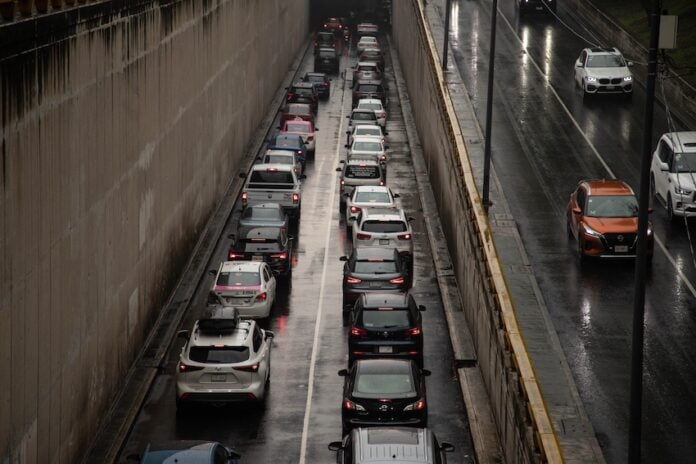
Mexico City, Mexico June 17 2025. Traffic on roads in the western part of Mexico City.
The tendency for traffic flow to come to a standstill for uncomfortable periods of time has helped Mexico City "earn" the title of the world's most congested city. (Shutterstock)

Mexico City residents spend on average 152 hours — nearly a week — stuck in traffic every year, according to the latest TomTom Traffic Index, a Dutch transport monitoring firm that ranked Mexico’s capital as the city with the worst traffic in the world. 

After comparing traffic congestion in more than 500 cities globally, the study revealed that residents of Mexico City waste on average hours in traffic per year than any other, with automobile trips taking 52% longer than they would under optimal conditions.

“Mexico City is the city in which traffic has the greatest impact on the deterioration of journey times compared with ideal traffic conditions,” the TomTom report said. “This means that on all routes surveyed throughout the year on the entire road network, journey times are 52% longer than those recorded in Mexico City when traffic was free-flowing.”

During peak hours, the average speed can drop to 5 kilometers per hour on main thoroughfares such as Eje Central, Constituyentes, Viaducto and Periférico. The report pointed out that in the best-case scenario, average speed can go up to 15 kilometers per hour.

Slow traffic not only wastes time for Mexico City residents and visitors, but it also has a significant impact on air quality and the economy. The report revealed that motorists generate approximately 983 kilograms of carbon dioxide per year due to congestion. The extra cost of gasoline is equivalent to filling a vehicle’s tank eight times.

The world-leading congestion is not directly connected to the city’s number of automobiles. In fact, huge as it is, Mexico City ranks just 17th globally among cities with the most vehicles on the streets. (According to the National Institute of Statistics and Geography, or INEGI, the capital has 5.5 million vehicles in circulation.)

Researcher Dante Pérez Méndez, from the Institute of Research in Applied Mathematics and Systems (IIMAS), told the UNAM Gazette that the capital’s traffic problems are due in a large part to the disorganized manner in which it has grown, along with a highly transient population and insufficient infrastructure in many areas.

Furthermore, employment centers and tourist attractions are mostly concentrated in specific areas, causing high demand for transportation in certain parts of the city. 

Other factors hampering traffic flow include construction work, demonstrations, slow-moving trailers, cranes and heavy trucks, and the frequent boarding and alighting of passengers by buses, large and small.. 

In addition to the capital, two Mexican cities made the top 100: Guadalajara (No. 28) and Monterrey (No. 72). According to the report, Guadalajara’s residents spend 102 hours in traffic, while Monterrey residents spend 80 hours. 

In the global ranking, following Mexico City is Bangkok, Thailand, with a congestion rate of 50%, and Davao City, Philippines, with 49%. 

 With reports from Infobae and El Independiente

Mass protest against insecurity and the Morena party turns violent in Mexico City

22
gen z protest in Mexico City's central square
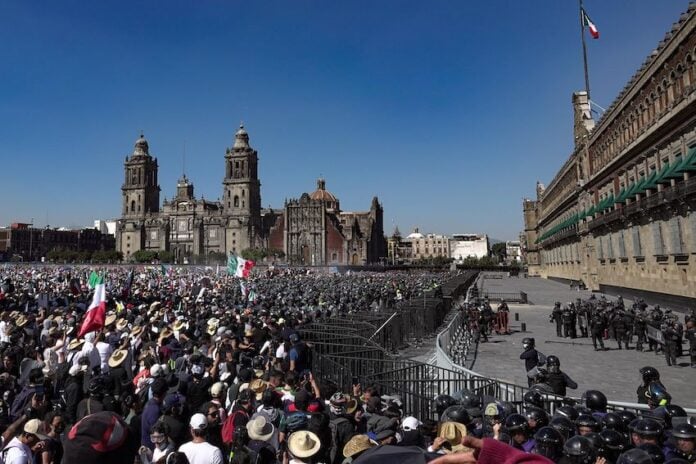
A total of 17,000 people participated in the march, according to the Mexico City government, but some media reports indicated that the turnout was significantly larger. (Rogelio Morales/Cuartoscuro)

A large protest in Mexico City against insecurity and corruption turned violent on Saturday, with some protesters attacking police in the capital’s central square, injuring 100 officers, according to authorities.

A protest march from the Angel of Independence monument to the Zócalo, Mexico City’s main plaza, was organized by a Generation Z movement, but attracted people of all ages, including members of the Sombrero Movement (Movimiento del Sombrero), a group founded by Carlos Manzo, the sombrero-wearing “tough on crime” mayor of Uruapan, Michoacán, who was assassinated on Nov. 1.

A total of 17,000 people participated in the march, according to the Mexico City government, but some media reports indicated that the turnout was significantly larger.

The “Generación Z México” movement, which called for people to take to the streets in Mexico City via a social media account, says it is non-partisan, but anti-government and anti-Morena sentiment was on prominent display during the march.

Generation Z encompasses people born between 1997 and 2012.

Protest marches were also held in dozens of other Mexican cities on Saturday, including Guadalajara, Monterrey, León, Toluca and Uruapan, where Manzo was shot in the city’s central square during a Day of the Dead event.

The ‘black bloc’

The Mexico City government said in a statement that a “black bloc” group of protesters was responsible for violence during Saturday’s protest march. It said that “around 1,000 people in masks” entered the Zócalo and using hammers and other tools “violently” tore down barriers that had been put up to protect the National Palace, Mexico’s seat of executive power and the residence of President Claudia Sheinbaum.

The government also said that “violent groups” made “direct attacks” on police, hitting officers, stealing their shields and launching explosive devices at them.

The Associated Press reported that “protesters attacked police with stones, fireworks, sticks and chains.”

Clashes between protesters and police lasted for some three hours, the newspaper El Universal reported. The Supreme Court building, located next to the National Palace, was also targeted by “black bloc” protesters.

The Mexico City government said that 100 police officers were injured, 40 of whom were transferred to the hospital for medical assessment. Twenty other people were also injured, according to Mexico City Security Minister Pablo Vázquez.

Police responded to the violence with tear gas, which affected “everyone” in the Zócalo, El Sol de México reported. The newspaper La Jornada reported that police were accused of using excessive force against protesters and committing “indiscriminate abuses,” including stealing cell phones from demonstrators.

The government said that "violent groups" made "direct attacks" on police, hitting officers, stealing their shields and launching explosive devices at them.
The government said that “violent groups” made “direct attacks” on police, hitting officers, stealing their shields and launching explosive devices at them. (Rogelio Morales/Cuartoscuro)

Police kicked protesters and hit them with their shields, according to La Jornada. “Paramedics attended to dozens of injured people,” the newspaper wrote.

The Mexico City government said that police “exclusively carried out containment work, without responding to provocations.”

It said that 40 people were arrested, 20 for “administrative” offenses and 20 others on more serious charges.

Vázquez, according to the government statement, said that leaders from Mexico’s political “right” led the protest and that “few” young people participated in it. He criticized “the opposition” for “resorting to violence instead of expressing their differences peacefully and through arguments.”

Sheinbaum, who was in the state of Tabasco on Saturday, denounced the violence and asserted that “very few young people” took part in the protest, despite it being organized by members of Generation Z.

‘Out with Morena, out with Claudia’ 

The Straw Hat Pirates’ Jolly Roger, a flag that features in the Japanese manga series “One Piece,” was held aloft by some protesters, as was the case in previous Gen Z protests in countries including Nepal and Madagascar. Other protesters carried Mexican flags and signs and banners that criticized the ruling Morena party and Sheinbaum.

Among the slogans chanted by protesters in Mexico City were “Out with Morena!” and “Out with Claudia!” as well as “We want peace!” and “We’re not bots!”

Sheinbaum had accused opposition parties of infiltrating the Gen Z movement, and using social media bots to increase attendance at the protest in the capital, the largest anti-government demonstration since the president took office in October 2024.

While the protest focused on denouncing violence, including the assassination of Manzo, and demanding greater security, protesters also condemned corruption, the alleged concentration of power in the federal executive, high levels of impunity, medicine shortages and the missing persons crisis.

“We are all Carlos Manzo,” read one large banner carried by protesters from Uruapan, among whom was the murdered mayor’s grandmother, who was pushed along in a wheelchair.

Some protesters accused the federal government of killing Manzo, who was allegedly shot by a 17-year-old who was later killed by a municipal police officer following his arrest.

The mayor had been critical of the federal government’s security strategy and had urged it to ramp up the fight against organized crime.

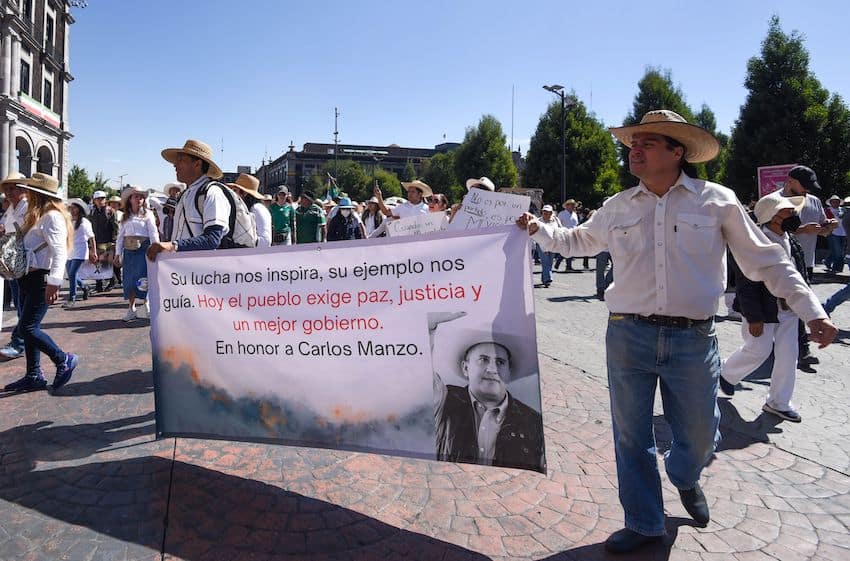
Participants of a march held in Toluca on Saturday hold up a banner honoring Carlos Manzo.
Participants of a march held in Toluca on Saturday hold up a banner honoring Carlos Manzo. (Crisanta Espinosa Aguilar/Cuartoscuro)

Andrés Massa, a 29-year-old business consultant who carried the Jolly Roger flag during the Mexico City march, told the Associated Press that “we need more security.”

Arizbeth Garcia, a 43-year-old doctor, told AP that she was participating in the protest to call for more funding for the public health system and for increased security because doctors “are also exposed to the insecurity gripping the country, where you can be murdered and nothing happens.”

Rosa María Ávila, a 65-year-old real estate agent from Pátzcuaro, Michoacán, who traveled to Mexico City to join the protest, asserted that “the state is dying.”

She told AP that Manzo “was killed because he was a man who was sending officers into the mountains to fight delinquents.”

“He had the guts to confront them,” Ávila added.

An 80-year-old woman in a wheelchair told El Universal that Mexico is currently in its “worst moment of violence,” even though homicides have declined during Sheinbaum’s presidency.

Doña Mariana, as El Universal identified the woman, accused the Sheinbaum administration of being a “narco-government,” and complained that it believes that “a pension of 3,000 pesos” per month is enough to live on.

Manzo’s grandmother, Doña Raquel, asserted that “Morena killed my grandson,” and called on former Michoacán governor and current Morena Deputy Leonel Godoy to be investigated in connection with the crime.

In Guadalajara, another “black bloc” group attacked the Government Palace in the Jalisco state capital. Around 20,000 people joined the protest in that city, where protesters also denounced insecurity and directed blame for the situation to the federal government.

With reports from El Universal, EFE, Quadratín, El Sol de México, Reforma, La Jornada, AP and Reuters