Officials estimate that between 300 and 350 crocodiles live in the Bay of Banderas, which forms Puerto Vallarta's coastline. (Unsplash)
Authorities in the state of Jalisco are set to launch the second phase of a strategy designed to reduce conflicts between people and crocodiles in Puerto Vallarta, home to several hundred of the protected reptiles.
The state’s environmental protection agency (Semadet) announced last week that the next stage of the Strategy for Responsible Coexistence between Humans and Crocodiles will begin the first week of September.
Jalisco environmental authorities are convinced that a well-respected plan with a set of rules for interaction is the best way for humans and crocodiles to coexist safely in Puerto Vallarta. (@noticiaspv/on X)
This comes on the heels of several alarming incidents in Puerto Vallarta last month, including the killing of two adult crocodiles — one found decapitated with some of its tail cut off in the protected El Salado Estuary, another tied up by its snout and legs with bullet wounds to the head.
In addition, lifeguards at one popular beach captured a 3.7-meter (12-foot) crocodile and relocated it to a safe area outside the tourist zone.
Officials said a big part of the bilingual plan is already being disseminated through social media and includes a partnership with local hotels to get information in English to tourists.
Using infographics with clear and accessible language, the materials explain the ecological importance of crocodiles, how to behave in their presence and what actions to take in the event of an encounter.
“The important thing is to stop the negative interactions that have led to accidents and consolidate a long-term strategy for healthy coexistence,” said José Daniel Graff Pérez, Semadet’s director general of natural resources.
He described the information as “simple, engaging and non-scientific” and that it can be “understood by both children and adults.”
🐊 Hoy, en el Día Nacional del Cocodrilo, recordamos la importancia de respetar su hábitat y convivir de manera responsable con esta especie.
The second phase will begin with a working group that includes state and municipal authorities, academics and specialists.
Short-term goals of this phase include posting warning signs and establishing clearer responsibilities for institutions.
Officials estimate between 300 and 350 crocodiles live in the Bay of Banderas, with only about 45 breeding adults.
Roughly 60 live within the El Salado Estuary, where that one croc was found decapitated.
“It was a disturbing and violent incident,” Graf Pérez said, noting that the crime was committed by intruders who had entered the protected area. “With such small numbers, the viability of the population is at risk.”
The area’s beaches are places of transit for crocodiles, who often move through the sea because their natural habitat of estuaries and mangroves have shrunk due to urban growth and tourism.
Moreover, the rainy season expands local waterways, encouraging crocodiles to seek new feeding and breeding grounds. As a result, crocodile sightings increase around this time of year.
The breeding season, which peaks in July and August, is considered a particularly sensitive period for the species.
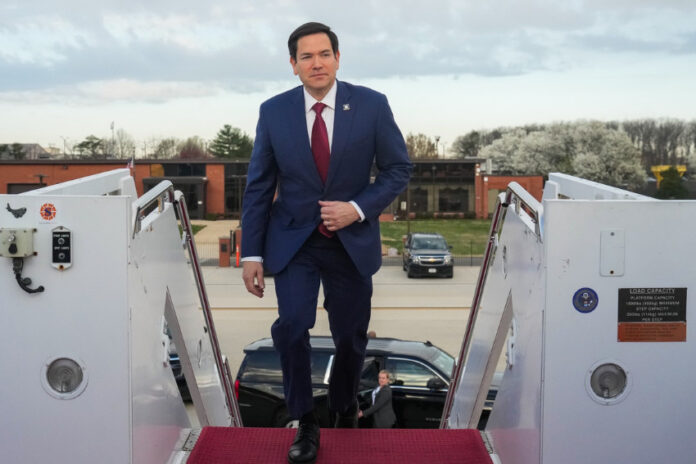
Rubio first expressed his intention to visit Mexico in May. Three months later, it may finally happen. (Marco Rubio/X)
President Claudia Sheinbaum said Monday that it is likely that United States Secretary of State Marco Rubio will come to Mexico next week to sign a new bilateral security agreement.
🇲🇽🇺🇸 Sheinbaum anuncia posible visita de Marco Rubio a México
La presidenta @Claudiashein informó que el secretario de Estado de EUA, @marcorubio, podría visitar México en la primera semana de septiembre para firmar el acuerdo de seguridad bilateral; sin embargo, aclaró que la… pic.twitter.com/PHb4eBWCrj
Asked whether the new Mexico-U.S. security agreement would be signed during Rubio’s visit, Sheinbaum responded: “Yes, that’s the idea.”
The president has said on repeated occasions this month that the new security agreement is “ready.”
She said last week that the bilateral pact was on the verge of being signed and is “fundamentally” based on “sovereignty, mutual trust, territorial respect … and coordination without subordination.”
“They are the four principles,” Sheinbaum said last Tuesday.
Pact to be signed amid tension in the Mexico-US relationship
The signing of a new Mexico-U.S. security agreement in the first week of September would come after an eventful and turbulent August.
On Aug. 8, The New York Times reported that U.S. President Donald Trump had “secretly signed a directive to the Pentagon to begin using military force against certain Latin American drug cartels that his administration has deemed terrorist organizations.”
“We cooperate [with the U.S. on security], we collaborate, but there will be no invasion. That’s ruled out … because, in addition to what we’ve stated in all our conversations, it’s not allowed, nor is it part of any agreement,” she said at her Aug. 8 press conference.
Earlier in August, the president said that a U.S. military intervention in Mexico is “not on the table,” and throughout the month — and indeed during the entirety of her presidency to date — she has stressed that her government would never accept any kind of violation of Mexico’s sovereignty.
Also in August, Sheinbaum asserted that her government hasn’t entered into an agreement with the DEA after the U.S. agency announced what it called a “bold bilateral initiative to dismantle cartel gatekeepers and combat synthetic drug trafficking.”
Sheinbaum’s frequent pushback to U.S. announcements and rhetoric has occurred as Trump and other U.S. officials have talked tough about their desire, and intention, to combat Mexican cartels that smuggle large quantities of fentanyl and other narcotics into the U.S.
Sheinbaum revealed in May that she had rejected an offer from the U.S. president to send the U.S. army into Mexico to combat criminal groups such as the Sinaloa Cartel and the Jalisco New Generation Cartel, both of which are now designated as foreign terrorist organizations by the U.S. government.
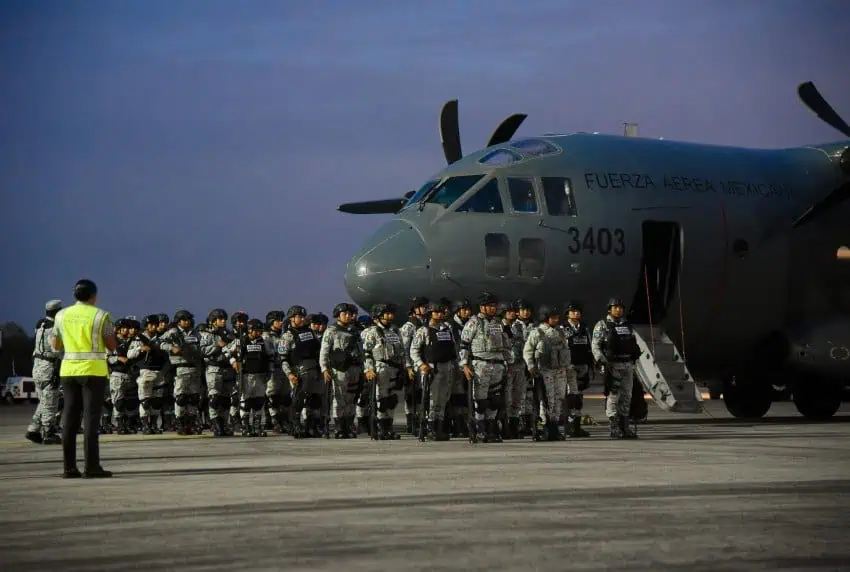
President Sheinbaum has sent 10,000 National Guard troops to patrol the Mexico-U.S. border as part of an agreement with the United States. (Galo Cañas Rodríguez/Cuartoscuro)
The pressure on Mexico from Trump, largely in the form of the threat — and imposition — of tariffs has been relentless. His administration has even asserted that “Mexican drug trafficking organizations have an intolerable alliance with the government of Mexico,” and that “the government of Mexico has afforded safe havens for the cartels to engage in the manufacturing and transportation of dangerous narcotics.”
All these factors, and others, add up to a complex and tense bilateral security environment even as Sheinbaum and Trump maintain that they, and their governments, have a good working relationship.
The signing of a new security pact between Mexico and the United States should give greater clarity and renewed impetus to the joint fight against organized crime, but the complexity and tension in the security relationship will likely remain, as will the calls of some U.S. officials and politicians — and some Mexican ones as well — for the U.S. to adopt a more proactive, and even bellicose, posture, against Mexican cartels.
By Mexico News Daily chief staff writer Peter Davies (peter.davies@mexiconewsdaily.com)
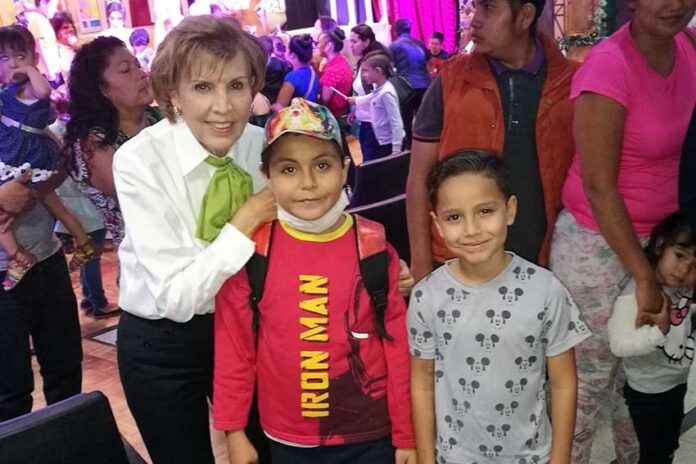
Founder of Mi Gran Esperanza, Bertha Padilla de Pérez, with some of the children her charity has helped over the years. (Mi Gran Esperanza)
Cancer is frightening enough when it afflicts adults. To see it strike children is truly heartbreaking. But what about children whose families have no insurance and no resources?
In 1995, Bertha Padilla de Pérez came upon such children in Guadalajara’s Fray Antonio Alcalde Hospital — too many of them.
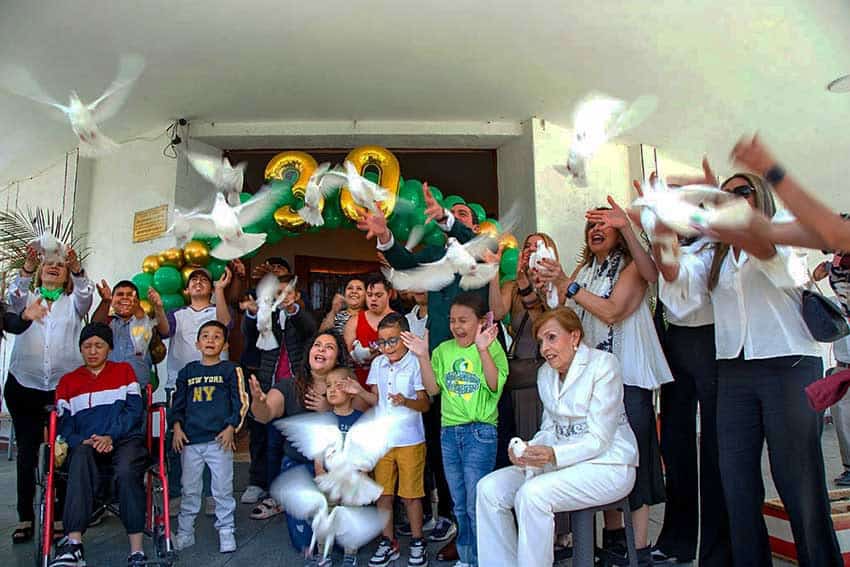
Children and volunteers at the 30th anniversary celebrations. (Mi Gran Esperanza)
Bertha had been invited to tour the hospital by her cousin, pediatrician Horacio Padilla.
“How can I help?” she asked him.
In short order, she and 14 friends set up an Asociación Civil, a nonprofit organization collecting food, clothes, and medicines for the needy families.
They called themselves Mi Gran Esperanza, My Big Hope, and, little by little, they reached the point where they could buy a house where family members of the children — who came from all over Jalisco and neighboring states — could stay, free of charge.
6,500 kids later
“This is how we started out, with zero pesos,” I was told by Mayte Medrano, the present-day Director of Mi Gran Esperanza, “and during the last 30 years we’ve been able to help over 6,500 patients. Today, many of those patients have grown up, completely recuperated, with families of their own.”
Erick Cervantes and Mayte Medrano with some of the children that Mi Gran Esperanza has helped over the years.(Erick Cervantes)
At the moment, Mi Gran Esperanza is helping some 500 families.
“We provide them with a food basket, medicine, treatments like immunotherapy, x-rays, or mammograms, but we also give them workshops, which is very important when the problem is cancer. They need healthy food and good hygiene and we make sure they get the message.
“My job as Director is to keep funds coming in so all this can go on, to contact government, foundations, embassies, corporations, to schedule events, and to train an interdisciplinary team.”
Transparency
Medrano told me she is working on ways to make Mi Gran Esperanza more international, so donations they receive from abroad will be tax-deductible in the donor’s country.
“I’m thinking about people in the U.S.,” she told me. “They are very generous with causes like ours. Here in Mexico, there is more skepticism. So one of the pillars of our organization is transparency. We want people to be sure that every peso they give to Mi Gran Esperanza goes directly to the patients’ treatments. This has become part of our reputation. People know that we do things well.”
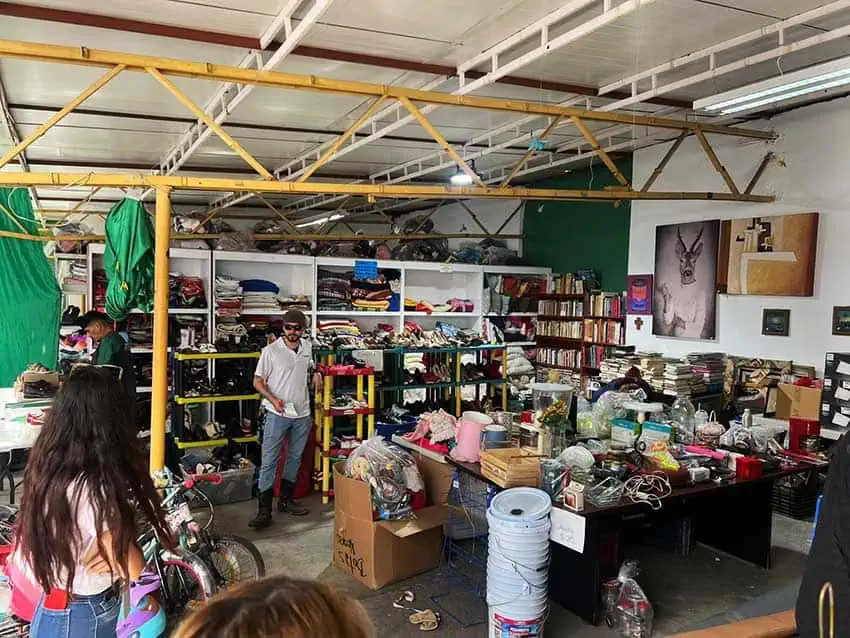
One of the ways Mi Gran Esperanza raises money is by holding a bazaar once or twice a month.
I asked one of the volunteers at the bazaar, expat John Baird, what it’s like.
Knick-knacks and a coffin
“After my wife died,” Baird told me, “I was looking for something to do, so I started going to their facility in downtown Guadalajara and offering to help. They have three or four trucks that go out every day and make the rounds, and they pick up recycled paper, bottle caps, knick-knacks, furniture and clothes, which they bring to the recycling center where it gets sorted by volunteers like me. By the way, you never know what is going to be in a bag or a box when you open it. For example, we found a miniature, handmade coffin three weeks ago. There were 43 hearts painted on it, so I knew it referred to the 43 students in Guerrero who disappeared in 2014. This coffin was probably carried in a march.
“Once a month, they also receive donations of food items, which they give to people who have a family member being treated in the Civil Hospital. I help hand out the food when I can.
“I usually go there twice a month. It’s sweaty, good work for a good cause. It’s fun!”
You can find just about anything at Mi Gran Esperanza’s bazaar. (John Baird)
Since Mi Gran Esperanza has been around for 30 years, I asked Mayte Medrano if she could put me in contact with one of the children they helped years ago, now grown to adulthood.
From cancer patient to manager
“That’s easy,” she said. “We have a staff member right here who came to Mi Gran Esperanza 25 years ago with cancer and today he is our Communications Manager. Meet Erick Cervantes!”
“I’m from Guadalajara,” Cervantes explained. “When I was seven years old, they discovered I had a form of Hodgkin’s Disease. So I went to the old Civil Hospital, and then they accepted me in the new building. That’s when I got help from Mi Gran Esperanza for medicines that I needed and for treatments that the hospital couldn’t provide.
“For ten months, I received chemotherapy at the hospital and 20 or 25 sessions of radiation therapy. After that, they pronounced me free of cancer, but for the next 10 years, I was monitored and had to make regular visits to the hospital for studies and checkups.
“So I was able to go study Business Administration… and today I’m a manager at Mi Gran Esperanza,
“I’m happy to be giving something back to Mi Gran Esperanza for what it gave to me and to my mother.”
John Pint has lived near Guadalajara, Jalisco, for more than 30 years and is the author of “A Guide to West Mexico’s Guachimontones and Surrounding Area” and co-author of “Outdoors in Western Mexico.” More of his writing can be found on his website.
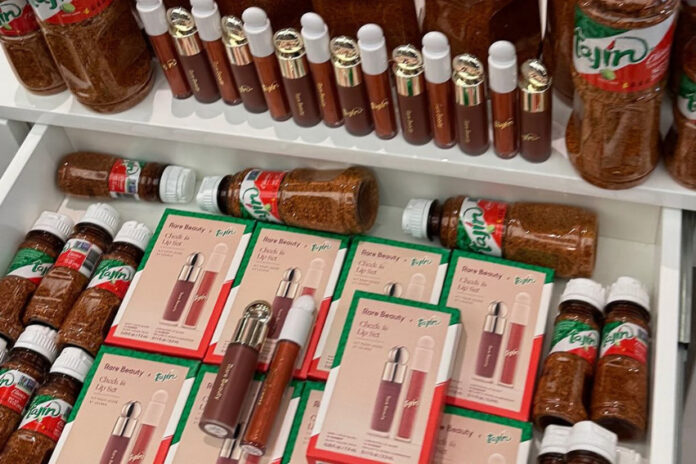
“Just like Tajín, these shades bring boldness, warmth and a spark of joy to every occasion," the Mexican-American actress said of the set. (Selena Gómez/Instagram)
Cosmetic brand Rare Beauty, owned by U.S. actress and singer of Mexican descent Selena Gómez, has launched an exclusive, limited-edition makeup kit in collaboration with the Mexican seasoning Tajín, which is now available for purchase in Mexico.
“This collab is a celebration of what makes us unique — our culture, our energy and the moments that bring us together,” Gómez said in a press statement. “Just like Tajín, these shades bring boldness, warmth and a spark of joy to every occasion.”
The limited edition set includes a 0.11 fluid ounce bottle of Positive Light Luminizing Lip Gloss in the Classic shade, a terracotta color with gold and copper shimmer, and a 0.25 fluid ounce bottle of Soft Pinch Liquid Blush in the Chamoy shade, a deep red with a brown undertone. Both offer warm and original tones, inspired by two typical Mexican flavors and colors.
Tajín Classic is made from a mixture of dried chilies, dehydrated lemon and sea salt, while Chamoy is a Mexican seasoning that combines sweet, sour, salty and spicy flavors. But do not fret – the lipsticks do not actually contain Tajín.
The set costs approximately 730 Mexican pesos in Mexico (US $39) and is available online through Rare Beauty’s official website and at Sephora México, both in physical and digital stores.Customers are limited to two sets per order.
Consumers’ response has been positive on social media, with comments expressing nostalgia and enthusiasm.
“The way my sisters and I would play with chamoy as lip gloss growing up,” an Instagram user commented on Rare Beauty and Tajín’s post promoting the collaboration. “Amoooo (love it),” she wrote.
Another user said in a TikTok video that the new collaboration was “made in heaven.”
Beyond the fun of it, Gómez said that she chose Tajín because it’s a product she grew up with and that she has consumed throughout her life. The actress’s father, Ricardo Joel Gómez, is originally from Monterrey, Nuevo León. However, her grandparents, Mary and Ricardo, are from Guadalajara, Jalisco, the very birthplace of Tajín.
Gómez, who rose to fame as a Disney Channel child star, has expressed how proud she is to have Mexican roots.
“I’m a proud third-generation Mexican-American, and my family’s journey and sacrifices helped me get to where I am today,” she told Vogue in an interview. Even after her parents’ divorce when she was five years old, Gómez has said that her father’s family instilled in her “a diversity of customs and traditions” that made her life “much richer” and helped her become the person that she is today.
This isn’t Gómez’s first collaboration with a food brand in a nod to her Mexican heritage. In May, she teamed up with Oreo to launch limited-edition cookies inspired by horchata, a Mexican drink made from a base of rice water, condensed milk and cinnamon.
The storm dumped 80 millimeters per square meter between Friday night and Saturday morning. (X)
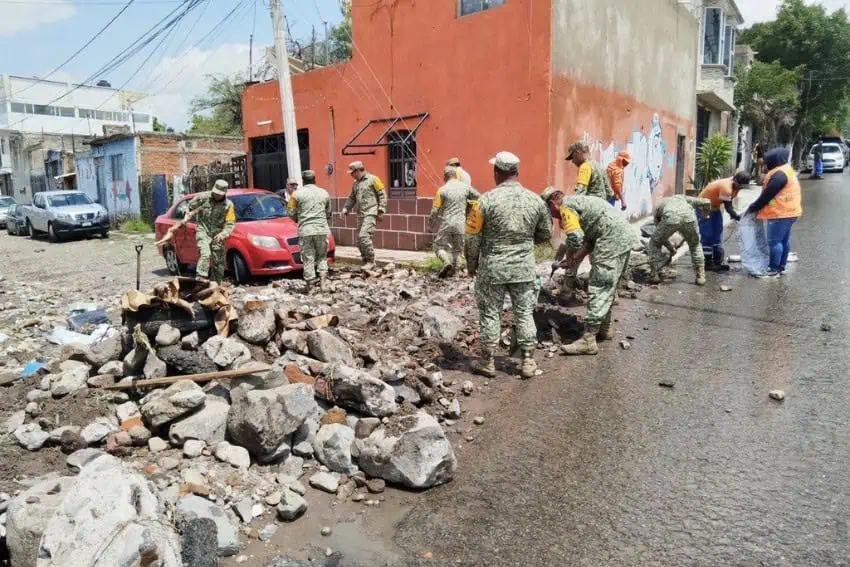
Heavy rains on Friday and Saturday claimed the lives of three people and caused severe damage in the state of Querétaro, prompting the mayor of the state capital to declare a state of emergency in three municipalities.
Querétaro city, the capital of the industrial state to the north of Mexico City, was hit hardest, with flooding and destruction primarily impacting the northern and southern areas of the city of 2.4 million people.
Mayor Felipe Fernando Macías said the heaviest rain occurred on Friday night. He said the storm, starting at around 6 p.m., dumped 80 millimeters per square meter overnight, adding that 30 millimeters per square meter is considered dangerous.
Local authorities said more than 2,200 homes were damaged and manufacturing firms were just beginning to evaluate the impact on their facilities.
On Friday, the Querétaro Municipal Civil Protection agency reported the discovery of two bodies, a man and a woman, in the Peñuelas neighborhood of the capital. The victims were apparently swept away by rushing stormwaters.
The hardest hit neighborhoods of Querétaro were Menchaca 1, Carrillo Puerto, Lomas de San Pedrito Peñuelas, San Pedrito Peñuelas I, El Sabino and Peñuelas. (Mauricio Kuri/X)
The state of emergency — declared on Saturday — established a curfew, ordered businesses and factories in affected areas shuttered, restricted public transportation and closed bridges and roads that were damaged by the rain and floodwaters.
The federal government activated an emergency response as well, sending troops from the 17th Military Zone under the command of Brigadier General José Guillermo Lira to the state.
As of Monday, the three levels of government had dispersed 1,400 cleaning kits, 1,500 emergency food parcels and 18,000 sandbags to different neighborhoods in the capital.
Rain remains in the forecast for Querétaro throughout Monday and Tuesday. Residents are urged to report flood damage to the following local number: 442 101 5205, option 1.
The World Fair of 1889 was the moment that Mexico unveiled itself to the world as a major cultural force, in a meticulously planned appearance in Paris. (Public domain)
The event that put the World Fair on the map was London’s Great Exhibition of 1851. Promoted by Prince Albert, the husband of Queen Victoria, it was held in a giant glass and iron pavilion — the Crystal Palace — in Hyde Park, London. These early exhibitions changed society. Thousands of working-class people bought excursion tickets on the new railways to visit the show, and in doing so changed the nature of tourism. The big profits in the travel industry no longer came from bringing a few lords and ladies to luxury spas. Rather, it was all about getting thousands of factory workers to come to the seaside for their holidays.
It was World Fairs that gave the first demonstrations of the telephone, flushing toilets and the ice cream cone and it was World Fairs that first inspired the mass production of tourist souvenirs.
London’s Crystal Palace exhibit in 1851 helped to put the concept of a World Fair on the map. (Public domain)
Mexico’s first World Fair exhibits
Mexico’s first participation in a World Fair came in 1876. The venue was Philadelphia, and the occasion was the centennial of the Declaration of Independence of the United States of America, which had been signed in that city. There were over nine million visitors, and among the highlights was the chance to see the torch-bearing arm of the Statue of Liberty, the statue being under construction at the time. Only ten years had passed since the execution of Emperor Maximilian, and Mexico was still seen as a backward and unruly country. A Mexican representative to the U.S., Gabriel Mancera, convinced the Mexican government that participation might help repair the country’s tarnished image. However, Mexico lacked experience with such events, and there were insufficient funds to support a major exhibition. The Mexican impact was therefore minimal, with exhibitions in a small area in the “international”building and some minor representation in the art gallery.
Two years later, an international fair was held in Paris, where the task of promoting Mexico was left to private enterprise. Once again, the Mexican exhibition made little impact. The review magazine, Les Merveilles de l’Exposition de 1878, praised the maps of Messrs. Debray and Co. and the onyx marbles of Messrs. Guttierez, but beyond that, they noted, “We see nothing of interest. Hemp, cigarettes, a small quantity of chemical and pharmaceutical products, goat skins, vanilla and mescal brandy, that is the Mexican exhibition.”
The next decade was largely a time of peace and economic progress under the autocratic rule of Porfirio Díaz, with mining and the building of railroads bringing in foreign investment. As the small Mexican elite mixed with foreign businessmen in the office and the sports club, they started to look to the outside world with more interest. This drove Mexico’s return to international exhibitions. In 1884, Mexico was represented at the World’s Industrial and Cotton Centennial Exposition, a largely forgotten event staged in New Orleans to commemorate the emergence of the post-Civil War American South. The Mexican presence in New Orleans was an expensive enterprise, with Ramón Ibarrola designing a multicoloured steel-and-iron Moorish-style Mexican Pavilion. This can still be seen today, on the Alameda in Santa María la Ribera.
The World Fair of 1889
Five years later, in 1889, a world exposition was staged in Paris. Costing 46 million francs, it is considered the greatest fair of the century and has left a legacy that stillimpacts the host city, for the centerpiece was none other than the 330-meter Eiffel Tower. Intended to be dismantled after twenty years, the tower remains the iconic symbol of the city today. Although eventually successful, the fair was controversial at the time. The theme was the Republican values of the French Revolution, and although nearly a century had passed since the execution of Louis XVI, a number of countries with monarchies did not officially take part. However, thanks to French diplomatic efforts, their absence was barely noticed. The French Empire stepped up to fill the gap, boycotting countries were still presented by individual companies, Thomas Alva Edison brought his new phonograph, Buffalo Bill brought his Wild West Show and Mexico stole the show with their Mexica-inspired pavilion.
There was little to fault the Mexican organization. A central organizing committee was approved, this made up of a team of high-profile representatives from the various ministries. This grand committee appointed teams to oversee the nine groups that would make up the Mexican exhibition. Fully funded by the government, the team departed for Paris with a budget of 5 million francs (then almost 1.5 million pesos), the largest fund of any nation at the exposition.
Mexican participation in the World Fair of 1889
An illustrated map for the World’s Fair of 1889 in Paris. (Public Domain)
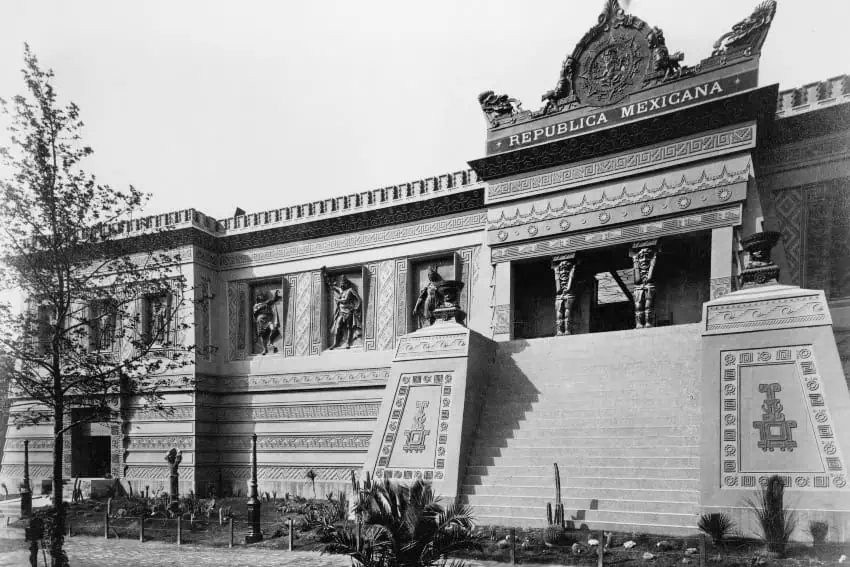
Ramón Fernández, the Minister of Mexico in Paris, was a great supporter of Mexican participation, and work started on the Mexican pavilion. The successful 1884 pavilion in New Orleans had drawn from Mexico’s Spanish culture, which in turn was heavily influenced by Arabic designs. The architectural team for Paris had access to a pre-publication copy of Dr. Peñafiel’s “Monuments of Ancient Mexican Art.” Now, for the first time, there was sufficient knowledge to allow the pavilion to take on a Mexica-like appearance. This temple-like building would cover 2,159 square meters with two side pavilions flanking the main hall, from which an elegant double staircase led to the upper galleries.
Once the project was approved by the Mexican government, negotiations started with the French over the location. A small area had been assigned to the Latin American countries, but this space might have to be shared with the exhibits of some European countries, something Mexico wanted to avoid. After long negotiations, Mexico was granted a rectangular area 70 meters long and 30 meters wide. This was next to Argentina’s exhibit. However, as desired, it was some distance from the European displays.
Mexico’s image portrayed to the world
As the exhibits started to be placed in the pavilion — maps, samples of rocks and minerals, tobacco, hides and skins, building materials, sugars, wines and spirits, plants, flowers and fruits, gold, silver, henequen, coffee, cacao and endless photographs — it started to portray an image of modern Mexico. There was a particularly impressive collection of Mexican textiles, displayed on mannequins that reflected the size and build of the native people of the various Mexican regions. The fact that the Mexican factories producing many of these goods lagged behind Europe and the United States in technology was not hidden, but exploited. It allowed Mexico to be portrayed as an ideal place to invest.
There was also a political side to the exhibition. The Mexican government was anxious to show that it had brought stability to an often turbulent country, and there were photos of new national monuments and buildings, as well as drawings of future projects. Education was an important component of this, and there was a display of educational statistics, issues of major Mexican newspapers and journals, and numerous copies of works from schools.
Perhaps because it was so ambitious, the pavilion wasn’t inaugurated until June 22. However, with the Fair already open, this created a more dramatic spectacle. As the La Marseillaiseand the Mexican national anthem were played by the Mexican 101st battalion orchestra, French President Sadi Carnot, flanked by the directors of the exhibition and Mexican dignitaries, climbed the steps of what was called the “Aztec Palace.” At that very moment, the Eiffel Tower was lit up by fireworks, and the light fountains began their display. It was a delayed but perfect start to the show!
How Mexico fared at the World Fair of 1889
Mexico’s “Aztec Palace” exhibition at the World Fair of 1889 was a rousing success. (Public domain)
By the time the fair closed at the end of October, Mexico had come out with honour. As the Guide Bleu du Figaro et du Petit Journal 1889 summarised, “Mexico has done a great deal, and its exhibition must be ranked among the most remarkable.” It continued, “In the middle of this Street of American Nations, Mexico stands out in a very glorious way for this great country.”
After the success of Paris, we might question why Mexico did not attempt to stage a similar event, if on a smaller scale. There had been proposals in 1878 for a “Mexican-American Fair,” an idea that had resurfaced in 1880. One problem was that Mexico, for all its progress, was still a developing nation. Creating a picture of a vibrant Mexico in a pavilion in Paris or the U.S. was one thing. Inviting the world to come to a city that had its share of problems was quite another.
The story of Mexico at World Fairs continues into modern times. Dubai hosted the most recent global event, Expo 2020, where Mexico, with its cloth-wrapped pavilion and visual efforts, again put on an impressive show. It was a continuation of the legacy that started in Paris 131 years before.
Bob Pateman is a Mexico-based historian, librarian and a life term hasher. He is editor of On On Magazine, the international history magazine of hashing.
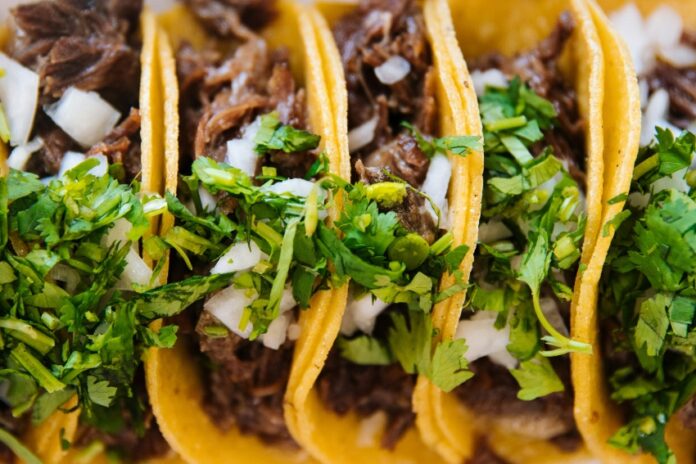
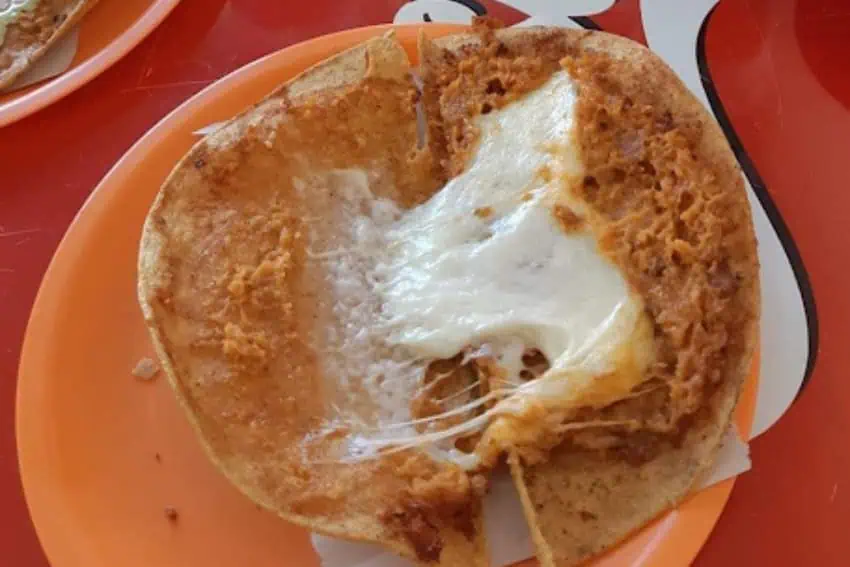
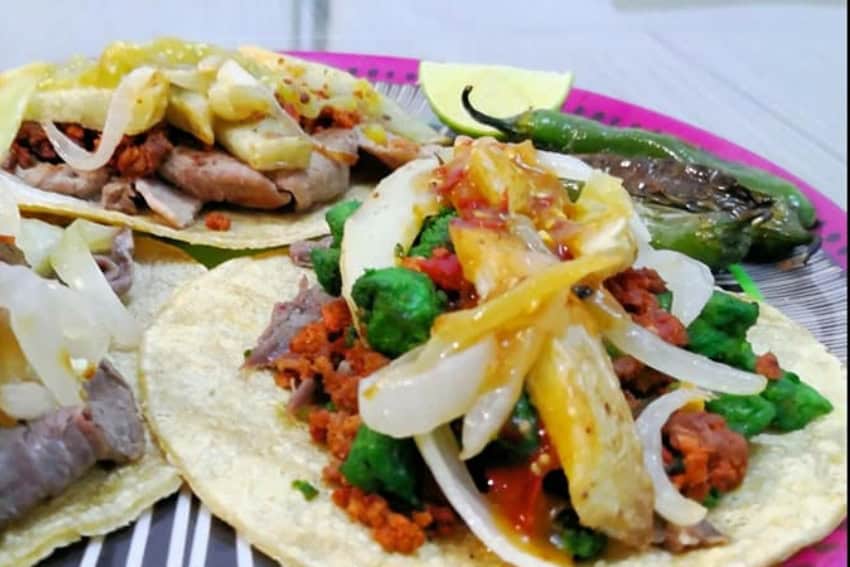
All tacos are made to be delicious, but some sound more delicious than others, it turns out. (Jeswin Thomas/Unsplash)
“What’s in a name?” Shakespeare’s Juliet once asked. “That which we call a rose by any other name would smell as sweet.” By this, I presume the Bard meant, as expressed through the guise of one of literary history’s most romantic characters, that names are but arbitrary labels we attach to things. They never fundamentally affect the character of what they describe.
For proof of the aptness of this perception, look no further than the taco. There are many varieties of this iconic street food from Mexico, after all, that have terrible-sounding names. Yet they’re still delicious. Would that which we call a taco envenenado, or “poisoned” taco, by any other name taste as good? Naturally, it’s the ingredients and preparations that matter, not the moniker attached.
Indeed, if Romeo had eaten a few tacos envenenados instead of drinking poison, he’d still be alive. So would Juliet. Such an ending would have spoiled the play’s tragic effect, of course. But tacos are anathema to such things as tragedy, despite their often unusual names.
The taco envenenado (poisoned tacos)
Tacos envenenados aren’t poisoned, despite what their name suggests. (Tacos Envenenados Zacatecas)
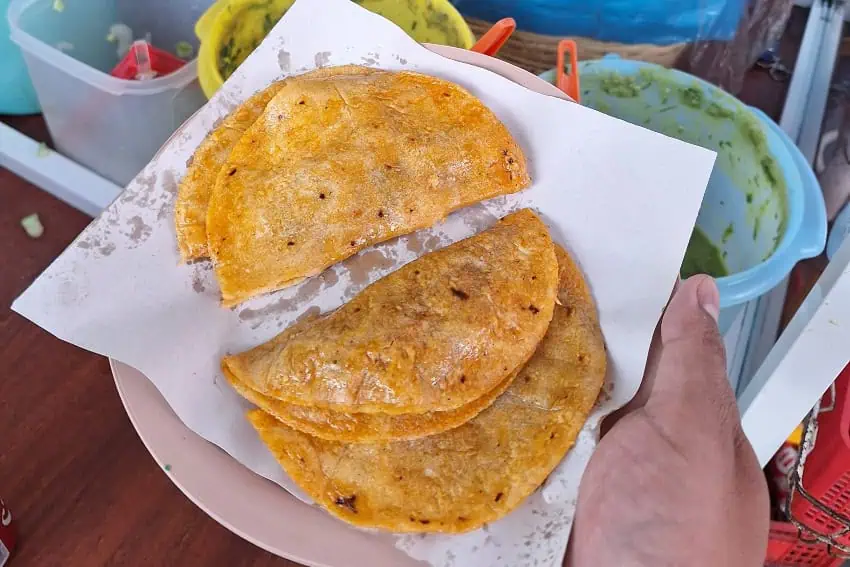
Tacos envenenados were invented in the state of Zacatecas. According to the most accepted origin story, they were invented by a taquero in the eponymous capital city named Don Lauro, who, circa 1940, placed a playful sign outside his shop at the train station that read: “Si quiere envenenarse, coma tacos.” If you want to be poisoned, eat tacos. It may not seem like the best public relations strategy. Nor was Don Lauro’s occasional claim that his tacos did contain poison. Yet these tasty treats soon became popular, with their fame eventually spreading beyond the borders of Zacatecas.
That’s because the name, as Shakespeare taught us, doesn’t signify. It’s the quality of the thing that counts, and Don Lauro’s tacos were special. It wasn’t just that the corn tortillas were larger than normal, or that beans, chile, chorizo and potatoes were particularly original fillings. Rather, it’s the frying of such ingredients in rendered pork fat (aka lard) that gives tacos envenenados their distinctive taste and golden color, and has caused the original recipe to be passed down for generations.
The taco sudado (sweaty tacos)
Despite their sometimes sweaty appearance, these tacos taste great. (B.jars)
Sudado means sweaty in Spanish. It’s a gross appellation to apply to a taco. Even a historically significant one. Although it’s worth noting that the sweating refers to an aspect of preparation, not perspiration.
However, the historical aspect is important. Mexico’s famed comfort food specialty emerged from the nation’s silver mines during the 18th century. The name taco came from the small charges used to break up ore. The original versions were appropriately called tacos mineros, which featured corn tortillas filled with simple ingredients like refried beans and potatoes and were kept warm in baskets.
Tacos sudados directly evolved from tacos mineros. So, later in the 20th century, did tacos de canasta. But these similar taco styles are not exactly synonymous. As Larousse Cocina clarifies, the corn tortillas for tacos sudados are dipped briefly in hot oil before being filled with ingredients and packed in baskets. This is what gives them the characteristic moisture from which their name derives.
The taco de basura (garbage tacos)
These ingredients didn’t come out of any trash can. (Tacos de Basura)
The basura or “garbage” taco emerged in Querétaro about 20 years ago. This more recent favorite takes its name from the sheer number of ingredients included, which makes it seem as if the cook was trying to toss in all the items he was convinced might go to waste.
Indeed, as the story goes, the taco’s moniker was given by a customer at Los Tacos del Güero, who took a gander at the veritable mountain of ingredients and decided it resembled nothing so much as a garbage pile.
But don’t let the name fool you. Since these ingredients often include a veritable cornucopia of meats — bacon, beef, chorizo, ham, turkey and more — plus potatoes, nopales and boiled egg, the resulting corn tortilla-wrapped tacos are invariably both tasty and filling.
The taco de transmisión (transmission fluid tacos)
This oil didn’t come out of anyone’s car, and the resultant tacos sure taste great. (Tacos Michels Cnop)
There are some common themes in Mexico’s terrible-sounding tacos. One is a connection to mining culture, an element shared by tacos envenenados, tacos sudados, and tacos de transmisión. The latter was born in Parral, Chihuahua, a town notable for being the site of Pancho Villa’s assassination, but which also boasts a rich silver mining heritage.
Another common characteristic is frying, either in hot oil or lard. The taco transmisión, for example, gets its name from the dark, bubbling lard in which both its corn tortilla and beef or pork filling are cooked. In color and consistency, this often recycled oil is a dead ringer for the transmission oil that helps your car seamlessly shift gears.
These savory-tasting tacos are typically served with onion, cilantro, lime and salsa, with locals favoring Parral masters of the subspecialty such as Tacos La 20, Tacos Michel’s, or Tacos del Tec.
The taco de nada (nothing tacos)
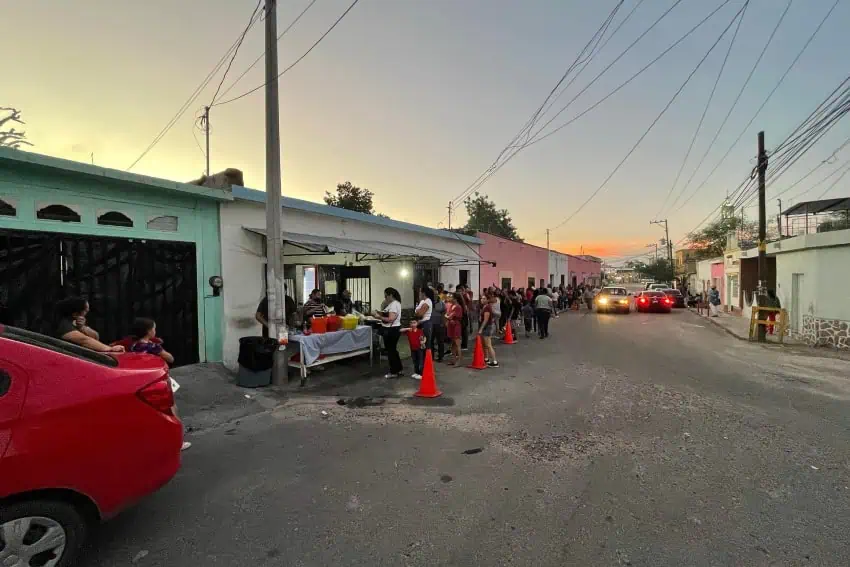
Would the line be this long if the tacos were really nothing? (Taquitos de Nada Doña Lupita)
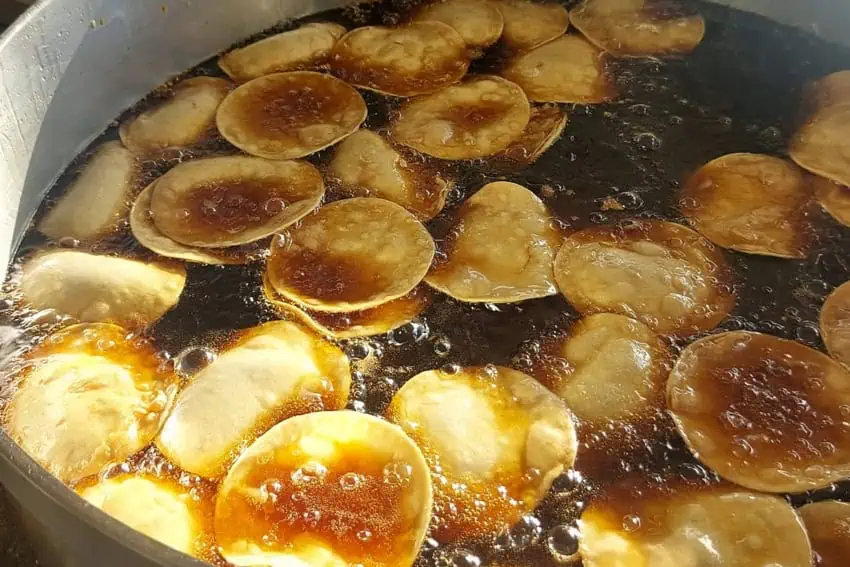
Alternatively known as tacos de nada or tacos de aire, neither descriptor (“nothing” or “air,” respectively) seems to promise much for hungry diners. So why do residents of Hermosillo, Sonora, line up around the block to buy these tacos invented by María Guadalupe del Toro Rodríguez, better known as Doña Lupita, nearly 40 years ago?
The corn tortilla and light potato filling, briefly fried in hot oil until golden brown, certainly offer a distinctive flavor. Particularly when topped with lettuce, cabbage and grated cheese. But what makes these tacos so unique and highly sought after is the salsas, available in both red and green varieties, with secret recipes undoubtedly influenced by Doña Lupita’s childhood in Zamora, Michoacán. All she and her now extended family, who help her serve up to 1,000 tacos a day, will divulge is that the ingredients are all fresh.
So these tacos aren’t exactly nothing, proving Shakespeare’s point. Although their price of 8 pesos apiece is about as close to it as you’re likely to find.
Chris Sands is the Cabo San Lucas local expert for the USA Today travel website 10 Best, writer of Fodor’s Los Cabos travel guidebook and a contributor to numerous websites and publications, including Tasting Table, Marriott Bonvoy Traveler, Forbes Travel Guide, Porthole Cruise, Cabo Living and Mexico News Daily. His specialty is travel-related content and lifestyle features focused on food, wine and golf.
What connects a working-class town and Mexican soccer fandom? (Sunderland AFC/X)
What do the people of Sunderland, England — a working-class port city along the wind-whipped coast of the North Sea, approximately 8,744 kilometers away from Mexico City — have in common with Mexican soccer fans? Absolutely everything, it turns out.
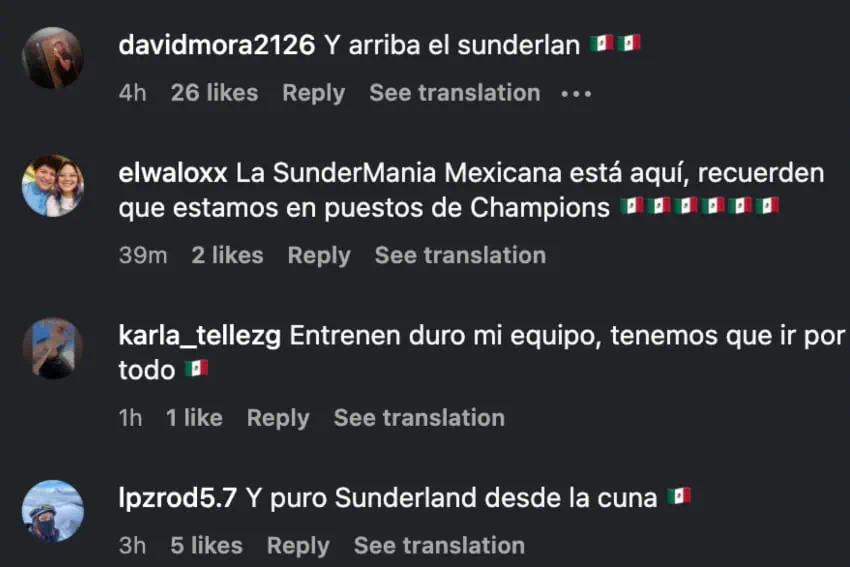
That’s because Sunderland Association Football Club is suddenly at the center of a bizarre if not lovable trend among Mexico’s passionate fanbase and is, inexplicably, Mexico’s European team of choice this season. Currently, thousands of Mexican fans (many of whom have presumably never been to, or even heard of, the metropolitan borough in the United Kingdom before adopting the team) are flooding the team’s social media channels with declarations of loyalty, support and unwavering zeal — followed by a parade of Mexican flag emojis:
Mexican football fans have, somewhat inexplicably, decided to support Sunderland, a Premier League team, this year. (Social media)
Mexican fans throw their support behind Sunderland AFC
The comments have provoked Sunderland AFC fan accounts into asking Mexican fans if they’re joking or serious. The responses have been equally comical, with countless Mexican fans responding that they’re eternally committed to Sunderland and aren’t going anywhere. One Mexico fan broke the cadence of Spanish with an attempt at English, responding with a grammatically incorrect but heartfelt “is forever mate 🇲🇽.”
It all started as a farce on August 16 when Pasion Celeste, a Cruz Azul fan account on X (formerly Twitter) proposed that Mexican soccer aficionados collectively pick a random team in Europe to fully support: “What do you think if with this start to the European League, all of [Mexico’s] football Twitter grabs an underdog team to support and follow, only for the European club to say, ‘What the hell, why are all of these Mexicans supporting us?’”
So far, it has worked. After voting on relatively unknown teams to choose from, the online assortment of Mexican fans landed on Sunderland — a once historic club that for the past eight years has played in the English lower leagues but has just ascended to the top-flight English Premier League. The message was quickly amplified when a soccer fan account, Somos Analistas, made an official declaration in support of Sunderland, encouraging all of Mexico to back the far-flung, relatively obscure team. The post has since received over two million views, 24,000 re-posts and hundreds of comments pledging Mexican fealty.
Sunderland is staggering under Mexican kit requests
Upon happening, the official Sunderland AFC Instagram account began fielding a mix of requests, questions and steady engagement from Mexican fans. The online team store sold out of most of their jerseys, with Mexican fans asking where they could find more. The spike in Mexican fandom certainly raised curiosity among other fans, as many asked about the connection between Mexico and Sunderland. Mexican fans responded quite facetiously with Spanish comments that translate roughly into “it’s something you’re born with” and “I’ve been a Sunderland fan since the cradle.” Even a few nascent fan accounts like Sunderland Mexico have already sprung up to share Sunderland news in Spanish.
“A bit more awareness of the club around the world is great, and if our club and our history can resonate with more than just the local area, it can only be positive for us and football as a whole,” says lifelong Sunderland fan Sean Mountain. “As a club, we’re likable and already have a massive international fan base. Viva México, cabrones.”
It couldn’t have happened at a better time for Sunderland, who kicked off their triumphant return to the Premier League with a dominant, season-opening win against West Ham United. Prior to this campaign, the Black Cats (or Gatos Negros, as Mexican fans have been calling them) were relegated out of England’s major league circuit for nearly a decade. Sunderland itself isn’t a particularly destination-worthy city in the world of European football, either. What with London, Milan, Barcelona, Amsterdam, Munich, Madrid, Istanbul and various other European epicenters boasting rich traditions and proven excellence. Sunderland lacks the sheer star power of many other European units, too. But that hasn’t stopped Mexican ultras from purchasing jerseys and celebrating the team’s quality players like Swiss captain Granit Xhaka, Spanish striker Eliezer Mayenda, and Mozambican defender Reinildo Mandava.
About a week after the Mexican fans stormed their way into Sunderland’s ranks, the team’s social media director conducted a video with a selection of players on the team in which the players (none of whom speak Spanish) welcomed Mexico and its fans by answering basic questions about Mexico’s history, culture and soccer legacy. The team’s official accounts posted the video with a playful “¡Vamos, Muchachos!”. Shortly after, Sunderland’s fans decided to return the favor to Mexico and randomly picked a team of their own — Nexaca, a first-division team based in Aguascalientes that was recently purchased by Mexican actress Eva Longoria — to support. Perhaps the pick wasn’t as random, since Necaxa coincidentally shares Sunderland’s colors of red and white, but still, it’s the sentiment that counts.
There’s a surreal magic that can transpire on the canvas of a soccer pitch. At times logic-defying, the sport has a way of breeding the irrational, the inexplicable, the fantastic. Though it may not always seem obvious for the casual observer, soccer allows for a border-traversing artistry, a fluid interconnection among those as distant as Mexicans and Brits.
Perhaps nothing sums it all up better than Sunderland AFC themselves, who formally welcomed their Mexican fans on the internet with a blend of Spanish and Mackem vernacular: “¡Hola, Mexico! We’re proud to have your passion with us this season — Ha’way the Lads!”
Alan Chazaro is the author of “This Is Not a Frank Ocean Cover Album,” “Piñata Theory” and “Notes From the Eastern Span of the Bay Bridge” (Ghost City Press, 2021). He is a graduate of June Jordan’s Poetry for the People program at UC Berkeley and a former Lawrence Ferlinghetti Fellow at the University of San Francisco. His writing can be found in GQ, NPR, The Guardian, L.A. Times and more. Originally from the San Francisco Bay Area, he is currently based in Veracruz.
In other articles, I’ve written about the enthusiasm my work sparks among those around me. Friends and relatives are always suggesting something — a fruit, a vegetable, a recipe — that they consider essential to our gastronomy and worth sharing with you.
But the person who has turned out to be my most unlikely muse is my boyfriend’s nana, Sabina. “Nana” may sound infantilizing — rest assured, he’s perfectly capable of tying his own shoes — but the name has stayed, and so has she. These days, she runs our household with brisk efficiency, cooking and keeping order, all while standing scarcely taller than the kitchen counter. Yet her presence is formidable, the kind of authority you’d expect from a Oaxacan general in civilian disguise. She is not quick to offer affection, and for months I misread her silence as disdain, convinced she had quietly declared me unworthy.
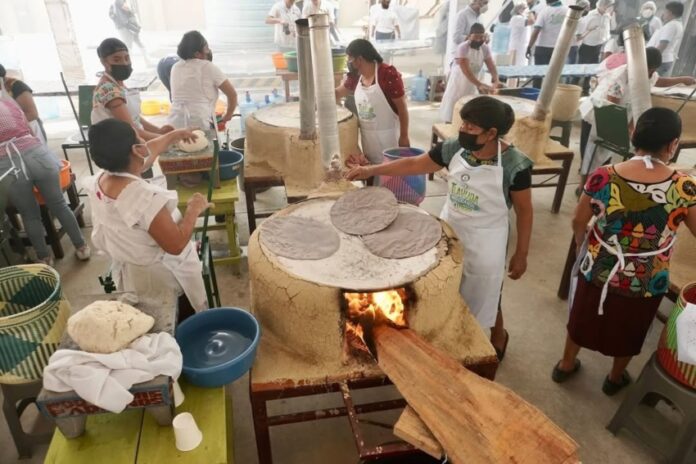
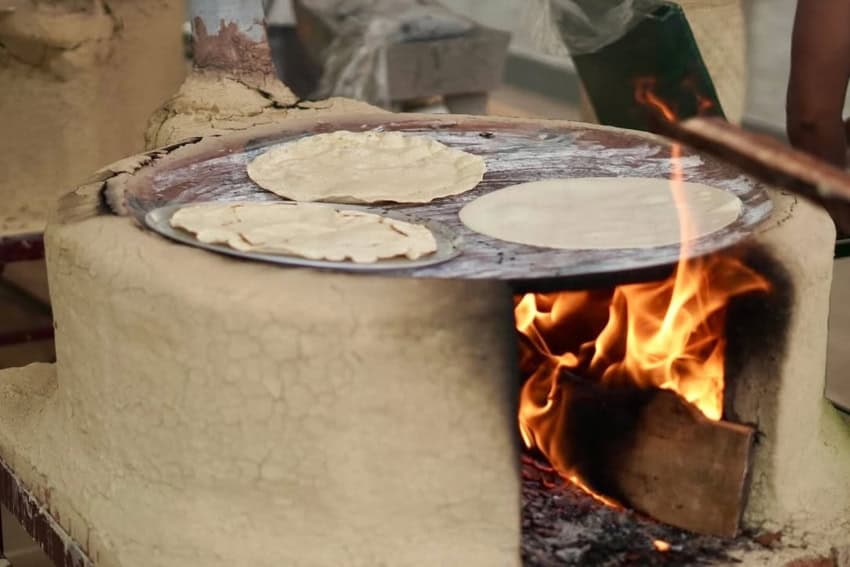
The large, durable tlayuda, a staple of Oaxacan cuisine. (Instagram)
Then one afternoon, she overheard me on the phone with my mother, asking where I might find different varieties of beans for an article and video I was planning on Mexico’s deep relationship with frijoles. When I hung up, Sabina simply asked, “When do you need them?” A week later, she placed in my hands a small stash of beans she had carried from home — the very beans she saves each year to plant again in her own soil.
That was the beginning. Last month, for her town’s fiesta, she prepared a mole and quietly set aside a generous portion for us. More recently, when she returned from Oaxaca, she brought back tlayudas as a souvenir. She asked me, with a rare glint of mischief, if I thought you might be interested in learning about them. Which is how I find myself staring at three oversized tortillas she had been saving with great care for her own family.
Tlayuda. Isn’t that a Mexican pizza?
(Sighs in discomfort) Well, no. Not exactly. If one wants to be orthodox, the comparison is a little crude. But I understand where it comes from.
Strictly speaking, tlayuda refers to the tortilla itself — enormous, durable, designed for sustenance on long journeys. Much as the burrito tortilla evolved in northern Mexico to serve the needs of ranch hands and travelers, the Oaxacan tortilla was engineered to be filling and resilient. The very name suggests strength and endurance.
Etymology, though, is where things get tricky. The common claim is that tlayuda derives from the Nahuatl tlao-li (shelled corn). This, however, is inaccurate. Shelled corn in Nahuatl is tlayolsiuali. Wouldn’ttlaxcalli — the word for tortilla — be a more logical connection? Beyond that, the “ll–y” sound at the heart of tlayuda did not exist in pre-Hispanic languages, which makes the Nahuatl origin dubious at best.
There is another reason to be skeptical. Oaxacans are famously protective of their culture, and with thirteen Indigenous groups in the state — each with its own language, customs, and rivalries — it is hard to imagine them embracing a Nahuatl name for a distinctly Mixtec-Zapotec dish. In Mixtec, tortilla is xita; in Zapotec, eta or gueta. The linguistic puzzle remains unsolved, but Nahuatl seems like the least likely candidate.
A third clue lies in Spanish itself. In the 19th and early 20th centuries, the word tlayudo was used as an adjective to describe someone strong, resistant and enduring. “Did you see how tlayudo Juanito is? He trimmed all the trees as if it were nothing.” The term likely derived from talludo, meaning someone mature, even beyond maturity. This, to me, feels like the most elegant fit. The tortilla that resists, that endures.
And so the name carries its own definition: a tough tortilla, meant to be reheated, meant to last. Enormous enough to serve as a complete meal, designed for travel or a long day’s labor. Which brings us back to the dish itself.
The traditional tlayuda
We may never know the precise moment the tlayuda emerged, but its lineage surely stretches back to the early days of nixtamalization, when Indigenous peoples needed food that could travel and was portable, resilient and nourishing. The earliest versions probably included beans, chapulines, quelites, and other endemic plants, each adding both flavor and nutrition.
The later additions of chorizo, cecina, tasajo, and chicken were unmistakably products of the Spanish conquest and the centuries of culinary mestizaje that followed.
By the 1920s and ’30s, novels described the tlayuda as being used like flatbreads elsewhere in the world. Torn apart to act as edible utensils, like pita in the Middle East, naan in India, Greek barley bread, Turkey’s bazlama, the tortillas of the Americas, or Ethiopia’s injera. Around the same time, another description surfaced. It was a large tortilla, reheated in lard, topped with bean paste, chili, cheese or quesillo, and cabbage.
From there, the modern form was inevitable. Today, a proper tlayuda is crisped with lard, spread with beans, layered with cecina and chorizo, crowned with avocado, preferably a green salsa, perhaps a seasonal quelite, chapulines for crunch, and, of course, cheese. It is at once rustic and baroque. A dish that can carry a day’s worth of sustenance.
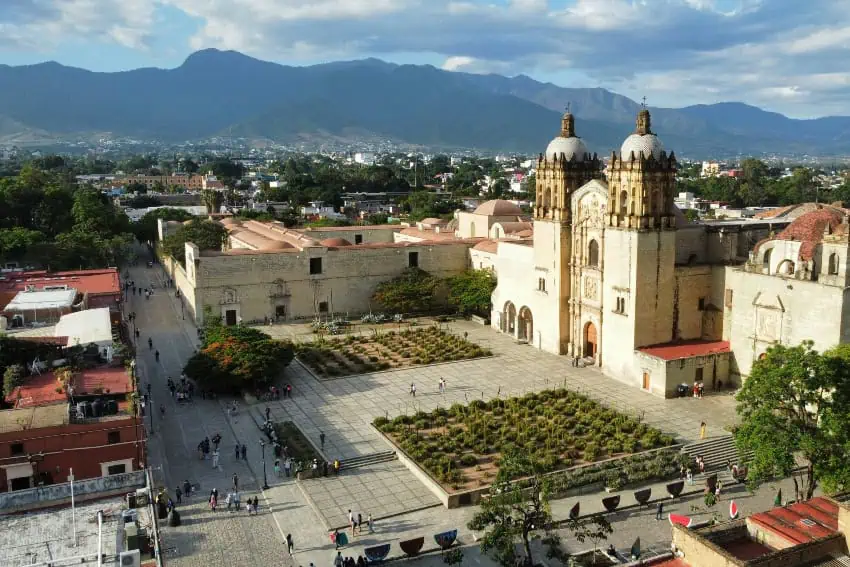
Oaxaca is the ancestral home of the tlayuda. (Unsplash / Ryan Doyle)
Nutritionally, it might even be one of Mexico’s most complete meals. If that is, one applies moderation to the chorizo and cheese. I can’t provide scientific proof, but I’d wager it tastes 50% better when shared, and 100% better with a cold beer.
And if you’d rather not cook your tlayuda in lard, stay tuned for the video. I’ll share a tip Sabina herself taught me.
Friends, if you don’t happen to live near a shop that sells Oaxacan ingredients and tlayudas, you have only two options. Either book a trip to Oaxaca and eat them fresh at the market, or pray devoutly that a Sabina will one day appear in your life.
María Meléndez is a Mexico City food blogger and influencer.
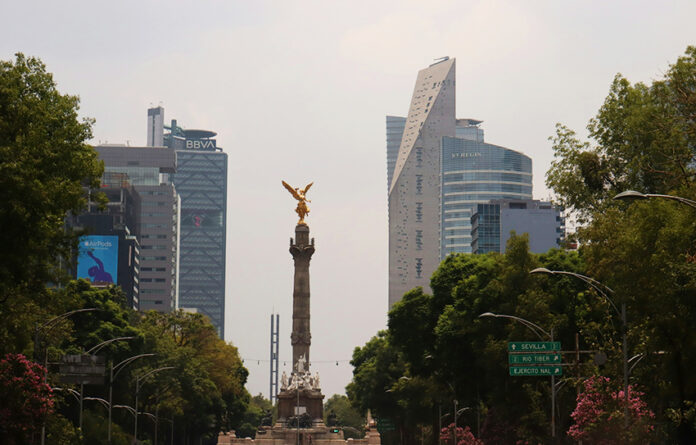
The Angel of Independence towers above Mexico City's iconic Reforma Avenue. (Carlos Ramírez/Unsplash)
As Mexico heads into the last week of August 2025, the country is balancing economic opportunity with political tension, infrastructural challenges and regional collaboration. Foreign investment is reshaping local industries and President Claudia Sheinbaum’s exchanges with the United States over security policy are increasingly charged. Meanwhile, the country is working to position itself on the global stage with cultural diplomacy and tourism promotion.
Didn’t have time to read every story this week? Here’s what you missed.
Business and economic realignments
Major players pull out while others double down
A leading business story this week was GE Appliances announcing a US $3 billion investment shift to the United States, effectively closing its Mexican operations. CEO Kevin Nolan said the decision is a reflection of new trade dynamics, labor cost considerations and geopolitical factors, including tariffs imposed by U.S. President Donald Trump with the goal of luring factories back to the U.S.
Auto exports continue to anchor the economy, and Canada imported more vehicles from Mexico than from the United States in June, a milestone highlighting shifting trade flows within North America. Mexico’s rise to being Canada’s largest auto supplier may be short-lived, analysts warn, as markets adjust to new conditions. Nonetheless, the success of Mexican-made vehicle sales in Canada demonstrating that Mexico’s integration into continental supply chains remains robust despite withdrawals like that of GE Applicances.
Fintech keeps growing at breakneck speed
Meanwhile, Mexico’s domestic financial sector also showed resilience. Nu, the Brazilian fintech giant, reported 52% growth in its credit card accounts, now exceeding 6.6 million holders in Mexico alone. Nearly a quarter of its customer base are first-time account holders, showing that fintech in Mexico remains well-positioned to capture a young, underbanked consumer base.
Politics and relations with the United States
Sheinbaum pushes back against DEA, U.S. rhetoric
President Claudia Sheinbaum’s daily morning press conferences — known as mañaneras — dominated Mexico’s political conversation again this week. A string of news stories reflected a tense Mexico-U.S. dynamic:
On Friday, after U.S. DEA Administrator Terry Cole suggested military strikes in Mexico may be used against cartels, Sheinbaum forcefully rejected the notion of “bombing Mexico,” emphasizing Mexico’s strength and indepedence. “No foreign government would dare to violate our sovereignty,” she declared.
The back-and-forth is indicative of bilateral relations entering a more combative phase, with Sheinbaum leaning heavily on nationalist messaging while simultaneously trying to avoid disrupting trade and investment ties.
Opposition voices stir debate
The week also brought sharper criticism from political opponents: Senator Lilly Téllez argued that many Mexicans actually welcome greater U.S. involvement in the fight against cartels, creating a notable contrast with Sheinbaum’s insistence on sovereignty-first strategies. The comment echoed divisions within Mexican society over how to balance sovereignty and security, especially in border states most affected by drug violence.
In the tourism sector, the Ministry of Tourism launched a program to accredit community-based travel experiences, providing formal recognition and professional development opportunities for grassroots tourism initiatives. The move aims to diversify Mexico’s tourism beyond the beach resorts and promote sustainable development in Indigenous and rural communities.
On a more encouraging note, the governments of Mexico, Belize and Guatemala announced the creation of a trinational cultural and nature corridor. This initiative seeks to preserve shared biodiversity and culture, tapping into Maya heritage and regional conservation efforts.
Local life and law enforcement
Several human interest and local law enforcement stories rounded out the week:
The final week of August showed the complex state of affairs in Mexico: The country is simultaneously a frontline for continental trade shifts, a battleground for competing visions of sovereignty and security, and a vibrant cultural actor in both regional and local arenas.
As the country looks toward September and its traditional Independence Day celebrations, Mexico’s narrative is one of contrasts: global player, vulnerable neighbor, cultural leader, and state of unresolved inequality — all at once.
Mexico News Daily
This story contains summaries of original Mexico News Daily articles. The summaries were generated by Perplexity, then revised and fact-checked by a Mexico News Daily staff editor.