Mexico uses natural gas for most of its electircity generation, and most of that gas is imported from the United States. (Shutterstock)
Mexico’s imports of natural gas from the United States continue to rise year over year, increasing by 2.7% over the first four months of 2025 to a record high of 6.261 billion cubic feet per day, according to U.S. Energy Information Administration figures.
At the same time, gas production by the highly indebted state-owned Petróleos Mexicanos (Pemex) decreased 6.3% year-on-year to 3.534 billion cubic feet per day (Bcf/d) from January to May 2025, marking a second year of decline.
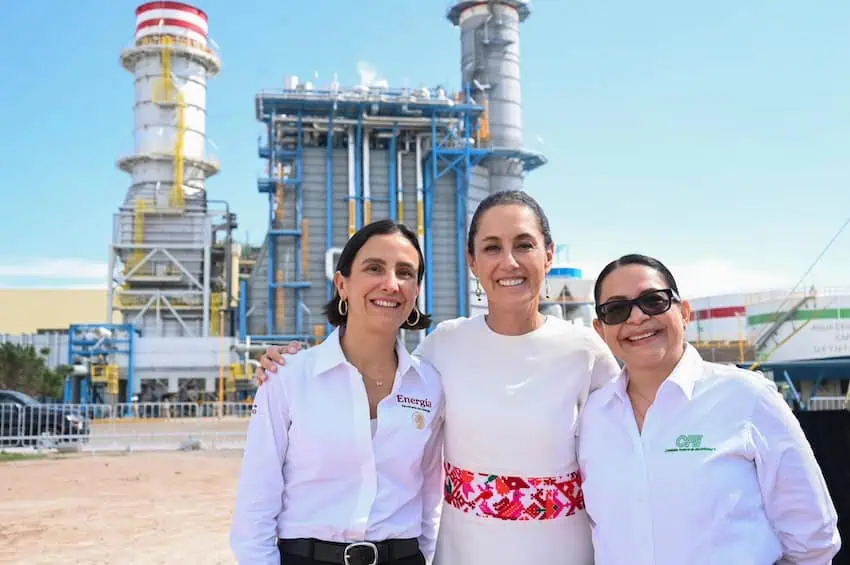
President Sheinbaum, seen here with Energy Minister Luz Elena González Escobar and Federal Electricity Commission (CFE) Director Emilia Calleja, wants domestic gas production to reach 5 Bcf/d by 2030. (@EmiliaCalleja/on X)
Mexico is the main buyer of U.S. natural gas and U.S. exports of natural gas to Mexico have risen every year since 2011, except in 2022.
Those increases, along with the dip in domestic production, have prompted worries that Mexico is ever more vulnerable to the aggressive trade policies of U.S. President Donald Trump. Mexico uses gas to produce around 60% of its electricity, so its heavy dependence on U.S. gas has left experts worried that Trump may weaponize gas exports to put greater pressure on Mexican President Claudia Sheinbaum.
“An interruption of the flow of gas to Mexico would be beyond chaotic,” W. Schreiner Parker, managing director for Latin America at the energy intelligence firm Rystad Energy, told The New York Times. “It’s truly one of the unspoken reasons why Sheinbaum has been so accommodating to Trump.”
In 2024, imported natural gas, mostly from the United States, contributed 74.6% of Mexico’s demand, at an average of 8.7 Bcf/d, according to data from the Mexican Energy Ministry. This is almost 35% higher than the 2014 average.
Average domestic gas production through May was 15% below the 4.163 Bcf/dgoal outlined by President Sheinbaum in November 2024, when she presented the National Strategy for the Hydrocarbons and Natural Gas Sector.
Sheinbaum’s energy policy pursues production of over 4.7 Bcf/d of gas starting in 2027 and reaching 5 Bcf/d by 2030. Those goals appear increasingly unlikely as Pemex’s oil fields mature, drilling equipment becomes outdated and service providers delay projects over non-payment.
Long-term, Mexico could invest in new domestic unconventional gas reserves, which could take several years and a significant investment. Or it could diversify its energy mix through renewable energy expansion, something Sheinbaum’s predecessor refused to do.
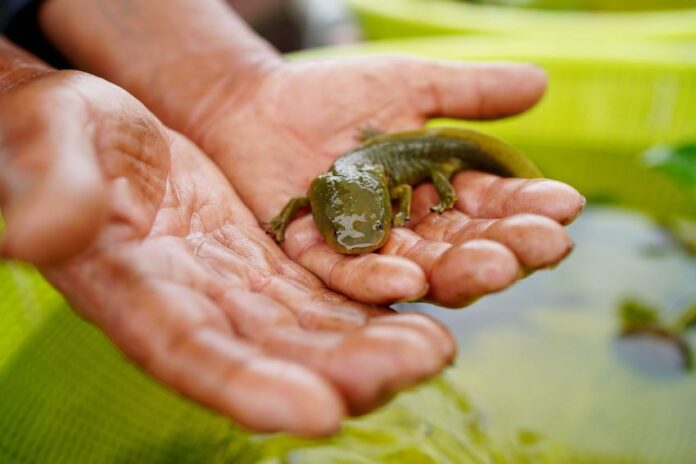
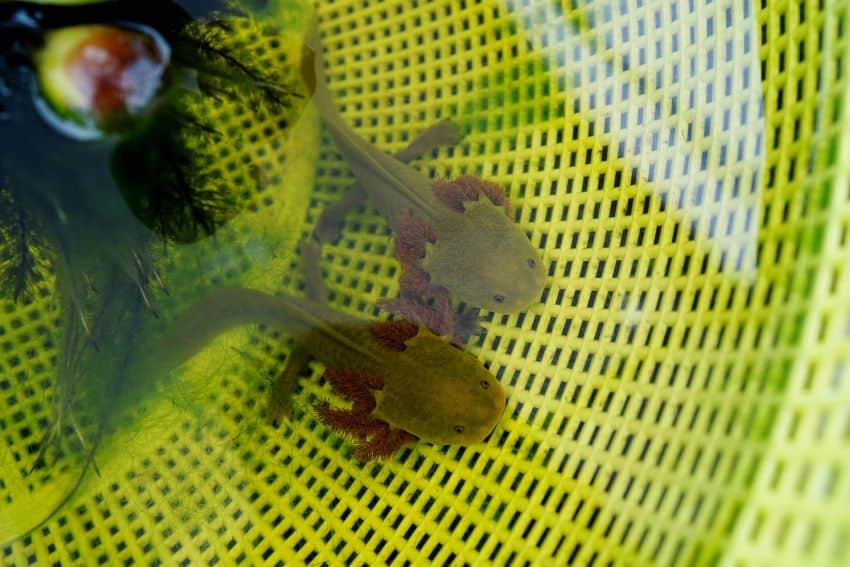
The achoque is a critically endangered salamander that’s the cousin of the famous axolotl. (Juan José Estrada/Cuartoscuro)
Local fishermen and scientists in the central state of Michoacán are mounting an urgent effort to save the achoque, a critically endangered salamander that’s the cousin of the famous axolotl.
Recognized by their lion-like gills, achoques have remarkable regenerative powers and a cultural significance that have captivated both the public and the scientific community.
The achoque, similar to the axolotl, has been used since pre-Columbian times as both food and a folk remedy for respiratory illness. (Juan José Estrada/Cuartoscuro)
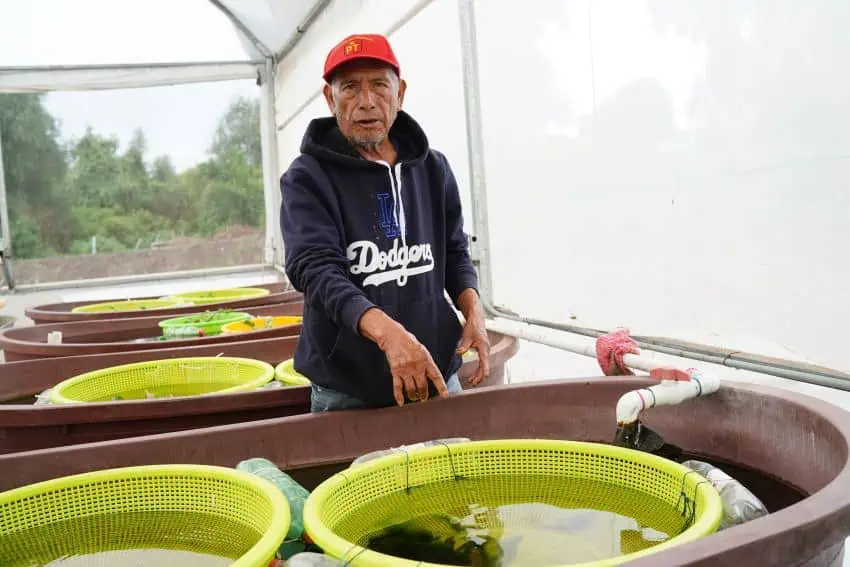
Froylán Correa, who spent decades harvesting fish from the high-altitude waters of Michoacán’s Lake Pátzcuaro, now dedicates himself to collecting amphibian eggs as part of a collaborative project to keep the achoque from vanishing forever.
“There used to be a lot of achoques,” Correa recalled. “Nowadays, the new generation doesn’t even know about them.”
However, overfishing, pollution and dwindling water levels at Lake Pátzcuaro have pushed the species onto the International Union for Conservation of Nature’s Red List of Threatened Species, with approximately 80 to 100 individuals estimated to survive in a narrow zone of the lake.
That’s “much lower than it was 40 years ago,” said Luis Escalera, a biologist at the nearly 500-year-old Michoacán University of San Nicolás de Hidalgo (UMSNH).
Researchers attribute the amphibian’s rapid decline to habitat loss and local traditions, as the salamander has been used since pre-Columbian times as both food and a folk remedy for respiratory illness.
Biologists, led by Rodolfo Pérez of UMSNH have partnered with the Indigenous Purépecha community of San Jerónimo Purenchécuaro, offering compensation in exchange for their labor in collecting eggs, raising hatchlings and ultimately re-releasing them into the wild.
“We can’t miss a day without coming because otherwise they’ll die,” said Israel Correa, one of the fishermen working to save the achoque from extinction. (Juan José Estrada/Cuartoscuro)
“It’s been a lot of work,” Pérez said, noting that “the biggest challenge is finding money to compensate the fishermen, since achoques require constant care.”
The effort has produced initial stability for the population, with hatchlings protected in community reserves before being returned to the lake.
Yet, for those on the front line like Israel Correa — a relative of the aforementioned Froylan Correa — the commitment remains unwavering.
“We can’t miss a day without coming because otherwise they’ll die,” he said. “Rain or shine, party or not, we have to be here.”
The battle to save the achoque is a delicate race against extinction, echoing the larger plight of Mexico’s endangered amphibians, most notably the axolotl.
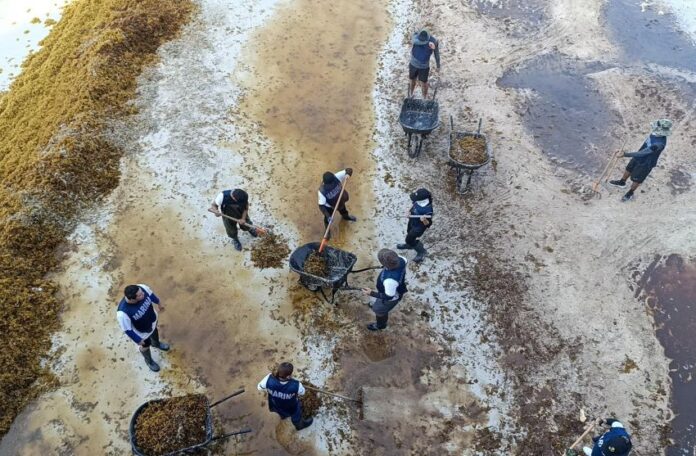
Sargassum has multiplied in recent decades as sea temperatures rise. Besides being unsightly, the decomposing macroalgae release fumes that can cause respiratory irritation. Pictured: A government beach cleanup in June. (Elizabeth Ruiz/Cuartoscuro)
Sargassum has invaded Quintana Roo’s beaches with unprecedented intensity for much of the year, prompting daily herculean efforts by authorities and citizens to clear the noxious brown seaweed from normally pristine shores. And their task shows no sign of abating.
A stunning indication of the current crisis — as well as of the locals’ heroism — took place in Isla Mujeres. Between Sunday night and Monday morning, 140 tonnes of the algae came ashore. In other words, in some 12 hours, the island received an amount of sargassum equivalent to 10% of what it had received in the previous three and a half months.
¡Continuamos trabajando en la limpieza de playas y retiro de sargazo! 💪🏻
Agradezco al personal de todas las áreas del Ayuntamiento, quienes se sumaron a la gran labor que realizan nuestras guerreras y guerreros de #Zofemat, para mantener nuestras playas 🏝️limpias y ordenadas. pic.twitter.com/M1AmvLPG3T
— Atenea Gómez Ricalde (@soyateneadeisla) July 16, 2025
By 5 a.m. on Monday morning, response teams consisting of municipal workers, tourism service providers, Civil Protection personnel, Federal Maritime Terrestrial Zone (Zofemat) staff, firefighters, the Navy, taxi drivers and other civilians were working together to free the town’s coastline of sargassum.
After approximately four hours, the beach was clean.
Esteban Amaro, head of the Sargassum Monitoring Center, which issues red alerts, said that although there are no exact figures on the amount of sargassum arriving, the patches of algae are coming in bands, one after another, spanning from Punta Allen to Bahía Príncipe, in Tulum.
Amaro noted that the most critical areas are in the southern part of the state, particularly in Xcalak and Mahahual, where the algae enter the Mexican Caribbean, passing through Banco Chinchorro.
He added that the most critical recent sargassum cycles have lasted three to four years. The first massive grounding was in 2015, followed by one in 2018, another in 2022 and now this one in 2025, “which has been the most tremendous on record,” Amaro said.
Experts had predicted that July would be the peak sargassum period this year. Indeed, the situation has become so critical this month that nearly all beaches from the northern part of Tulum to the southern coast of Playa del Carmen, as well as the eastern part of Cozumel, are on red alert for the seaweed.
¡Redoblamos esfuerzos por unas playas limpias y un mar saludable! 🌊⚓
En el marco de la Estrategia de Atención al #Sargazo2025, la Secretaría de Marina continúa trabajando para proteger el litoral de #QuintanaRoo, desplegando:
On its official X account, the Navy said it has deployed in its sargassum control efforts an ocean vessel, 11 coastal vessels and 22 smaller support vessels, as well as 8,850 meters of containment barriers and 400 naval personnel along the beaches of Quintana Roo.
Dayana Pérez Medina, director of Zofemat, explained that these types of accumulations are not constant and do not affect all beaches, but when they occur, clean-up efforts are immediately activated, as the Isla Mujeres case confirms.
Sargassum is notorious for its negative effects on ecosystems, tourism and public health. It has indirect consequences for human health when it decomposes, releasing ammonia, methane and sulfuric acid. When it rots, it creates a sludge called “brown tide,” which reduces sunlight penetration and lowers oxygen levels in the water.
In early July, Governor Mara Lezama announced the creation of a new facility to monitor and manage sargassum along Mexico’s Caribbean coast, and eventually convert it to biofuel. Lezama expects the new project to promote new sustainable industries, create jobs and reduce the environmental impact of the sargassum.
According to a report by the Water Basin Authority of the Valley of Mexico (OCAVM), the Cutzamala System recovered 9.45 million cubic meters of water just in the last seven days. (Conagua)
The Cutzamala System, one of the largest and most important water infrastructures in Mexico, as it supplies water to the Mexico City metropolitan area and México state, has seen a remarkable recovery this month.
According to the latest official report from the National Water Commission (Conagua) and the Water Basin Authority of the Valley of Mexico (OCAVM), the Cutzamala System’s water level reached 56.44% of its total capacity on July 13, equivalent to 441.7 million cubic meters.
This marks one of the highest levels recorded in recent years, significantly exceeding levels seen during Mexico’s dry season (November-May).
According to a report by the OCAVM, the Cutzamala System recovered 9.45 million cubic meters of water in the last seven days, replenishing the three dams that supply Mexico City: Valle de Bravo,70.4%; El Bosque, 42.8%; Villa Victoria, 41.7%.
The system’s water levels are a result of intense rainfall during the summer season, which has doubled or even tripled reservoir volumes compared to previous years.
Early in June, the reservoirs were at around 48-52% of their capacity. The recent increase is primarily due to the cumulative effect of historic rainfall in the region.
🤔 ¿Qué pasaría si el Sistema Lerma-Cutzamala hubiera llegado al día #DíaCero hoy? Esta infraestructura aporta el 43% del #agua que llega a la capital. Captación, almacenamiento, bombeo, purificación y distribución las 24h del año 🔋
Abrimos hilo 🧵👇#Cutzamalapic.twitter.com/TZ3qc7mEI4
Although these figures are encouraging, authorities will continue to carry out partial scheduled outages in several of Mexico City’s boroughs, including Iztapalapa, Álvaro Obregón, Tlalpan and Coyoacán, among others.
The Cutzamala System captures, stores and distributes water from the upper basin of the Cutzamala River, located in Michoacán and México state. It consists of seven dams, six macro pumping plants, a water treatment plant and a 200-kilometer-long network of pipes and canals.
At its peak, the system can provide between 30% and 40% of the drinking water consumed by the Metropolitan Area of the Valley of Mexico (ZMVM), although this figure varies depending on hydrological and operating conditions. The rest of the city’s water is drawn from the groundwater aquifer, the Lerma System, and the Chalmita, Chiconautla and La Caldera systems.
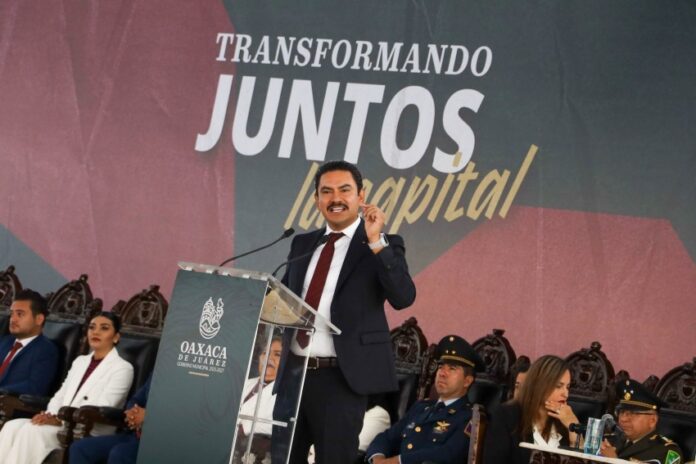
Oaxaca Mayor Raymundo Chagoya took office on January 1, 2025, after promising to transform residents' quality of life and restore civic pride. (Carolina Jiménez/Cuartoscuro)
Over the past six months, Oaxaca’s new mayor, Raymundo Chagoya, has made strides toward the goals he presented when sworn in: addressing safety in the city, restoring pockmarked roads through the Tache al Bache pothole-filling initiative, city cleanup and restoration and tackling water and local environmental issues, among others.
Much of Chagoya’s success to date has been through collaboration with other sectors of government, but also through his grassroots-minded initiatives, which directly involve residents. This has resulted in greater information-sharing with citizens and the strengthening of community relations.
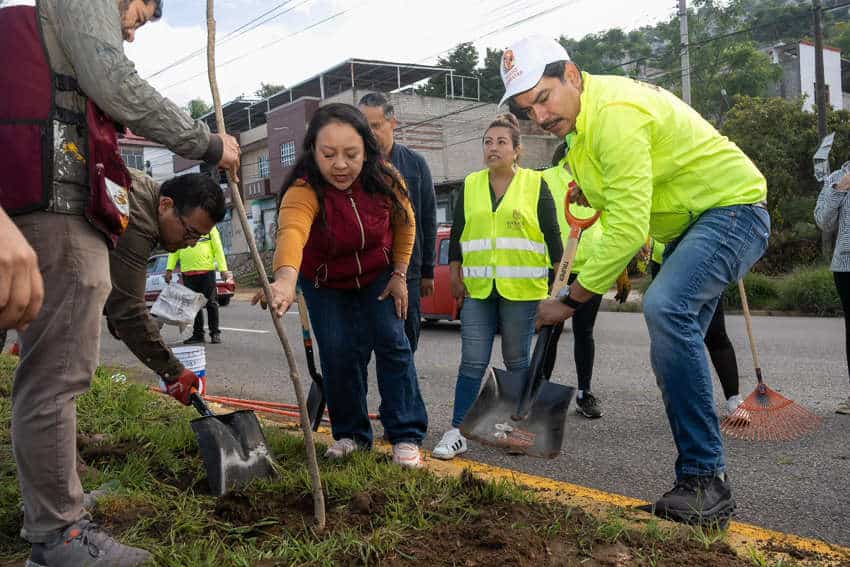
Mayor Raymundo Chagoya, right, in the Santa Rosa Panzacola neighborhood, leading by example as he participates in a community tequio, a neighborhood-based citizen group working on cleaning and improving the city. (Raymundo Chagoya/X)
Involving residents
Chagoya is focused on restoring Oaxaca’s identity as a heritage city by revitalizing the historic center and integrating conservation and maintenance teams. This includes an application for funds from the Association of Mexican World Heritage Cities. Key actions have included cleaning public areas with the involvement of residents, in community improvement events known as neighborhood tequios vecinales.
Tequios — an Indigenous word that embodies community values such as solidarity and teamwork — are groups of volunteers that are working with the government to plant trees, widen sidewalks and repair concrete and ironwork throughout the city.
Chagoya is particularly proud of the tequios’ success, which has gone a long way toward restoring areas in Oaxaca’s capital while at the same time bringing neighbors together.
Tackling Oaxaca city’s water issues
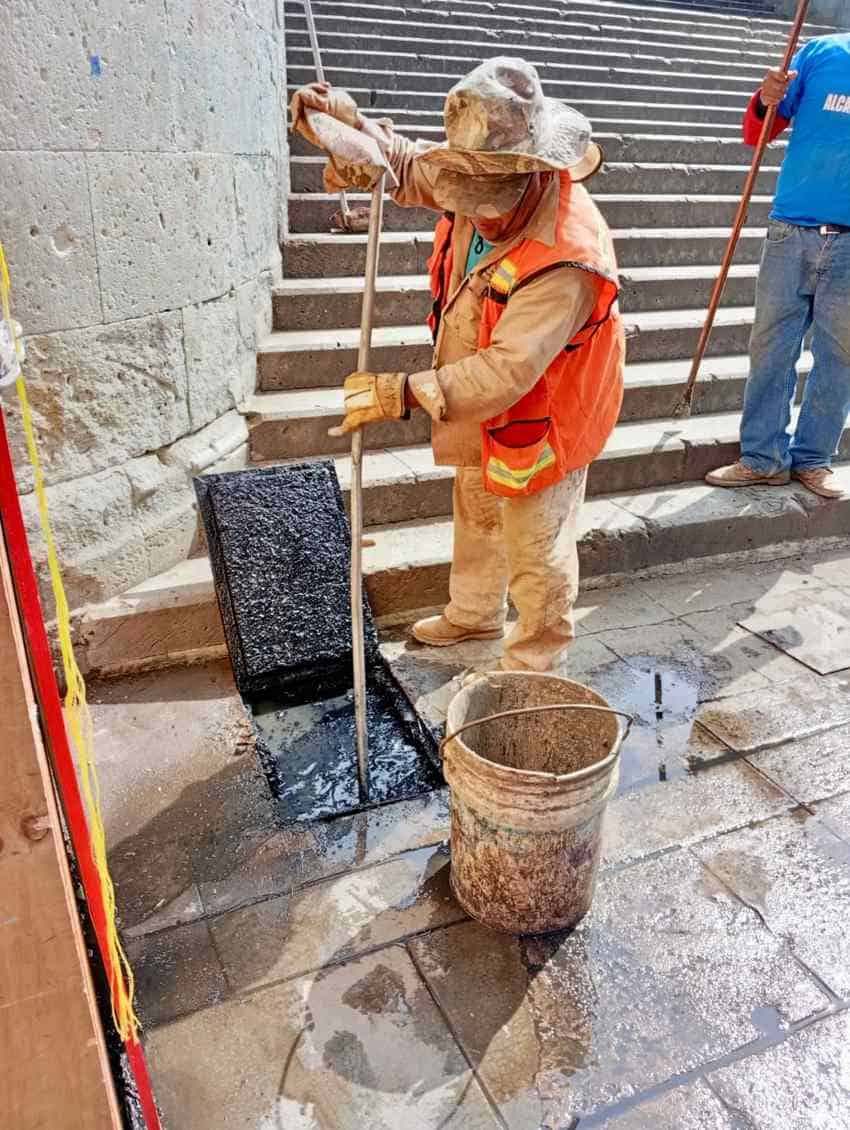
Chagoya has also been leading campaigns to dredge the city’s storm drains, essential work as Oaxaca’s rainy season arrives.
This month, the government has been sending workers throughout the city to clear the city’s rainwater drainage sewers to prevent flooding during the rainy season. (Government of Oaxaca de Juárez)
The municipal government is doing its part by promoting drinking water and sanitation projects to ensure a sustainable supply and improve environmental conditions in Oaxaca de Juárez’s metropolitan area. This work coordinates efforts across various local government departments, with two key projects focused on water security, management and safety: Water for All and the Safe Rain Program.
Chagoya said that water shortages in the city will not be solved by a single action but as a multistep plan that addresses issues with Oaxaca’s water sources — its rivers, reservoirs and wells. It also must deal with issues around water treatment, water distribution and, finally, water storage. Sewers must also be serviced during the rainy season to prevent flooding and further river contamination.
The Safe Rain Program includes preventive and immediate response actions to leaks and flooding in the city’s drainage system, in order to mitigate the rainy season’s effects on the capital. The priority is citizen safety.
Between this past June and November, monitoring of rain levels will be carried out throughout the city using a digital platform with an early warning system, coordinated with the regional meteorological radar and Mexico’s National Water Commission (CONAGUA).
Water storage is a challenge, the mayor said, as space is limited and standing water poses a risk of harboring dengue-carrying mosquitoes. However, he has announced that studies are underway for the installation of rainwater harvesting systems, which he said will allow for the use of up to 56 million liters over the next three years.
So far, much of what has been visible in the media about efforts to address water shortages has been the donation of water tanks, known in Mexico as tinacos. The government has already delivered 3,500 water tanks to neighborhoods with the greatest water shortages. In addition, the government plans to install 36 new hydrants, 20 provided by the municipality and 16 by the state government.
The wider, multifaceted water infrastructure plan underway seeks to strengthen the drinking water supply in strategic areas of the capital, with renovated infrastructure and increased operational capacity. This includes developing water treatment facilities, rehabilitating the city’s Trujano, Vincente Suárez and Candiani wells, developing complementary infrastructure such as an oscillation tower in Xoxocotlán to improve water pressure and providing water storage solutions via tinacos.
Cleaning up the Atoyac River
Chagoya has highlighted the growing success of the wastewater treatment plant in San Juan Bautista La Raya, near Oaxaca International Airport, which will improve the water quality of the increasingly polluted Atoyac River, an essential water source that has been the subject of concern. There has also been collaboration with the Oaxaca state government to clean the river, and construction has started on the road alongside it.
In the heart of the city, where the Atoyac runs behind the Abastos municipal market, a major cleanup has been completed, which removed mountains of trash that were previously spilling down the banks.
Oaxaca’s mayor faces the challenge of maintaining resources during the Guelaguetza, one of Oaxaca’s most important annual festivals and a heavy tourism draw in July. (Ray Chagoya/X)
Chagoya emphasizes the importance of collective awareness, of caring for water, not wasting it, and understanding that its scarcity is not just a technical problem but also a shared societal responsibility. He shared this sentiment in a recent social media post.
“Water is life, it is health, and it is key to the sustainable development of our capital. Let’s reflect on its value and the responsibility we share to preserve it. Every drop counts. Every action contributes. Let’s continue building a more conscious, greener and more committed Oaxaca de Juárez,” he wrote.
The next few months will be telling about Chagoya’s government’s effectiveness at tackling these issues, since the rains in Oaxaca have only just begun. Chagoya also faces this month’s Guelaguetza festival, one of Oaxaca’s busiest seasons for cultural activities in the city.
These challenges will test the mayor’s primary goals — specifically maintaining community safety and cohesion while supporting a city that stays clean and healthy.
Anna Bruce is an award-winning British photojournalist based in Oaxaca, Mexico. Just some of the media outlets she has worked with include Vice, The Financial Times, Time Out, Huffington Post, The Times of London, the BBC and Sony TV. Find out more about her work at her website or visit her on social media on Instagram or on Facebook.
Puerto Vallarta's government is actively striving this summer to beautify the locale and overcome some perennial problems.
Puerto Vallarta’s summer break is marked by development initiatives, cultural milestones and evolving tourism policies.
From infrastructure upgrades in historic neighborhoods and the rollout of a new tourist tax to hosting Mexico’s prestigious film awards, the city is making moves to enhance its appeal while tackling long-standing challenges.
Puerto Vallarta invests in Seapal Vallarta amid ongoing challenges
Mayor Munguía handed over a fleet of new vehicles to Seapal Vallarta, part of efforts to restore public trust in the utility. (Seapal)
Puerto Vallarta Mayor Luis Munguía has delivered 13 new vehicles to water authority Seapal Vallarta, in a bid to improve the utility’s operational efficiency and restore public trust following a year of financial turmoil. The vehicles will be deployed across Seapal’s maintenance and service departments to address citizen complaints, leaks and other infrastructure needs more quickly.
At a ceremony in El Pitillal, Mayor Munguía said the investment reflects a shift toward more responsive, service-oriented governance. “We want a Seapal that is approachable, that solves problems, and delivers real results,” he said at the ceremony.
The delivery comes after a turbulent year for SEAPAL Vallarta. The agency’s current leadership, appointed less than a year ago, inherited a system in crisis. General Director Carlos Ruiz and Administrative Director Rodolfo Domínguez revealed that SEAPAL had been left with only 8 million pesos in reserves, insufficient to cover basic obligations. The agency has requested a 46 million peso loan to stabilize operations.
As Puerto Vallarta nears its high tourist season, water shortages remain a concern. While the new vehicles are a step forward, officials acknowledge more work is needed to rebuild SEAPAL’s capacity and ensure reliable service citywide.
Facelifts in key neighborhoods
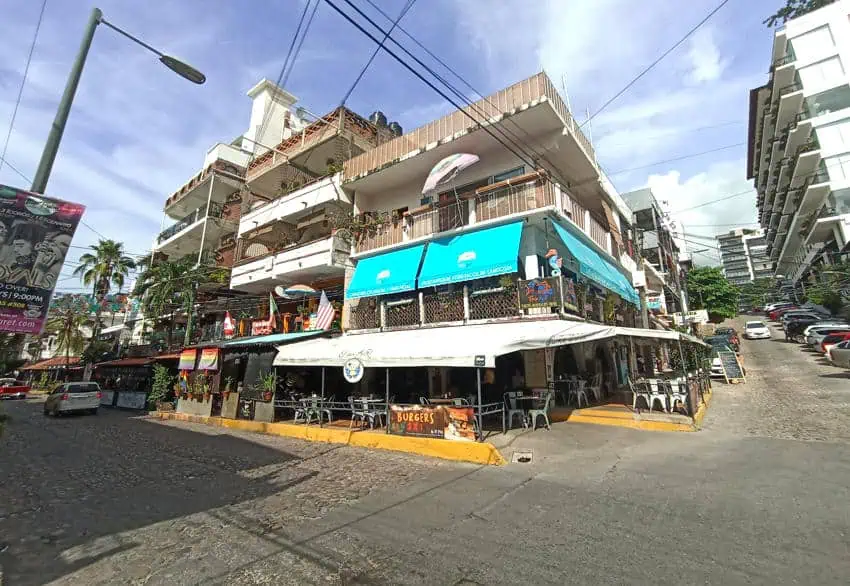
Upgrades in the Romantic Zone’s Emiliano Zapata neighborhood will include the rehabilitation of cobblestone streets and sidewalks and the installation of underground wiring. (Vive Vallarta/X)
Puerto Vallarta is rolling out urban improvements in some of its most popular neighborhoods, including Emiliano Zapata in the city’s Romantic Zone, and the 5 de Diciembre neighborhood. Mayor Munguía announced a slate of infrastructure projects aimed at revitalizing these beloved areas while preserving their architectural significance.
In Emiliano Zapata and the Romantic Zone, upgrades will include the renovation of house facades, rehabilitation of cobblestone streets and sidewalks, and the installation of underground wiring.
Meanwhile, Avenida Mexica in the 5 de Diciembre neighborhood will undergo a complete overhaul between 31 de Octubre and Argentina Streets. The project includes reinforced cobblestone paving and improved pedestrian access to better connect residents and tourists to the waterfront.
Puerto Vallarta to host 67th Ariel Awards
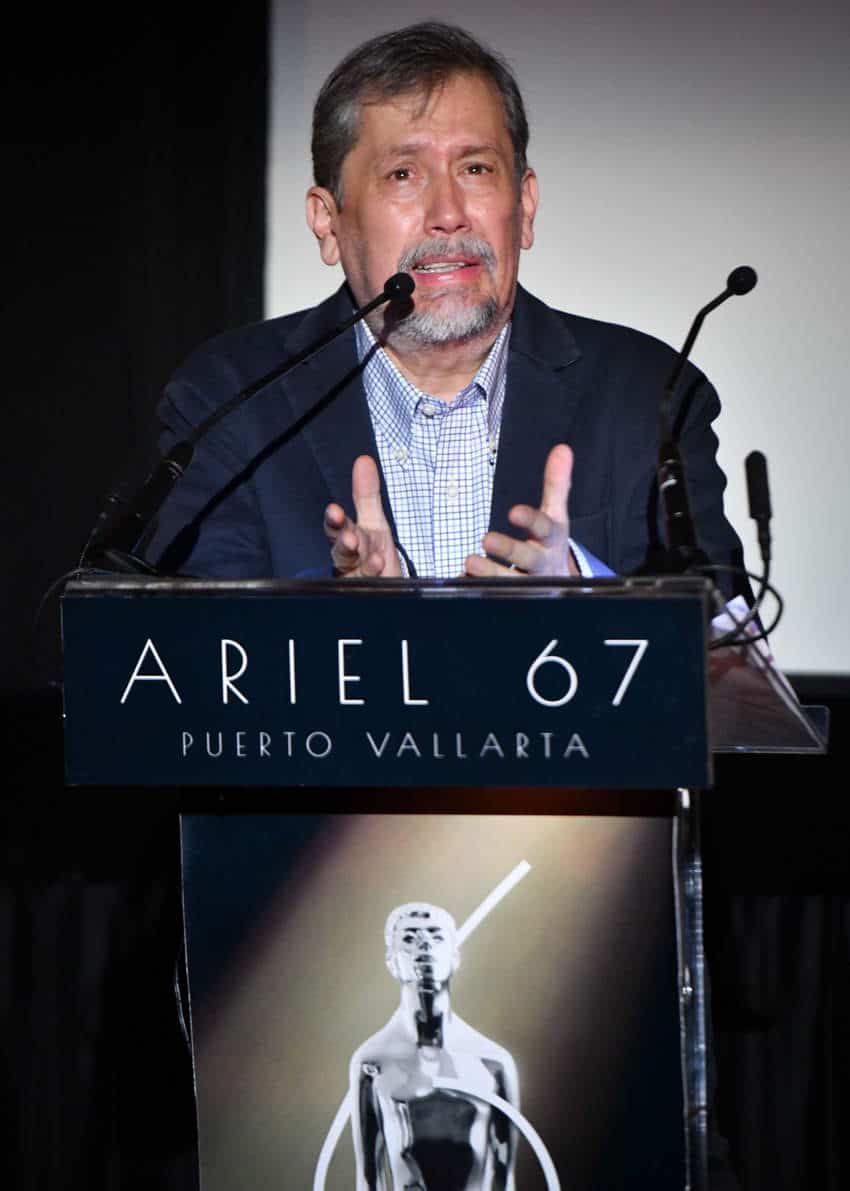
Armando Casas, president of the Mexican Academy of Arts and Cinematographic Sciences (AMACC) during the presentation of nominees for the 2025 edition of the Ariel awards, to take place on Sept. 20 in Puerto Vallarta. (Mario Jasso/Cuartoscuro)
Puerto Vallarta will host the 67th Ariel Awards, one of Mexico’s most prestigious film honors, on September 20, 2025, marking the first time the city welcomes the event. The ceremony, organized by the Mexican Academy of Cinematographic Arts and Sciences (Amacc), will take place at the Puerto Vallarta International Convention Center.
The move is part of Amacc’s strategy to decentralize the awards and amplify their cultural reach. Puerto Vallarta’s selection also underscores Jalisco’s importance in the national film industry, supported by public incentives such as the Filma Jalisco program.
The films leading this year’s nominations are Sujo by Fernanda Valadez and Astrid Rounder, Corina by Úrsula Barba Hopfner and Pedro Páramo by Rodrigo Prieto.
More than 800 industry guests, including filmmakers, press and influencers, are expected to attend.
Puerto Vallarta begins charging new tourist fees
After the downturn in tourism caused by the COVID-19 pandemic, tourism in Mexico is bouncing back strikingly. (@Secturjal/Twitter)
As of July 1, Puerto Vallarta has officially implemented its new Nonresident Rights (DNR) fees for foreign visitors, a measure approved earlier this year by the Jalisco State Congress. The reform grants the city the authority to collect two separate charges from international travelers: a per-person entry fee and a staggered cruise passenger tax.
Visitors arriving by air or sea are now subject to a 141 peso (US $8.25) fee, which is expected to be collected via payment modules installed at Gustavo Díaz Ordaz International Airport and the maritime terminal. The city anticipates raising over 200 million pesos annually from this levy, which will fund improvements to local infrastructure, such as beach access, streets, and the boardwalk.
Additionally, cruise passengers are now required to pay a US $5 DNR fee as of July 1. The amount will gradually increase over the next three years, rising to $10 in 2026, $15 in 2027, and reaching $21 by mid-2028. These funds will support national programs to promote Mexican products, culture and employment opportunities in the cruise industry.
According to the mayor, the program’s 20,000 new homes will address at least half of the city’s rental housing deficit over six years. (@ClaraBrugadaM/X)
Mexico City Mayor Clara Brugada Molina announced on Friday that her government will create thousands of affordable housing units as part of a long-term strategy to tackle gentrification.
Following a protest against gentrification in the Condesa neighborhood earlier this month, Brugada said that her Public Rental Housing program’s 20,000 new rental homes will address at least half of the city’s rental housing deficit during her six-year term.
The total investment is expected to exceed 600 million pesos ($31.8 million).
“We are discussing a fragmented city, a city under pressure from the issue of gentrification, or the displacement of families who have historically lived in the city’s neighborhoods and are being forced out of those places due to various factors,” Brugada said.
The mayor stated plans to launch a set of additional strategies aimed at stabilizing rental prices in the city. “We want the population living in Mexico City to stay in Mexico City,” she said.
Homes that are part of Brugada’s program will be rented at no more than 30% of the residing family’s income, according to the mayor.
“We want the population living in Mexico City to stay in Mexico City,” Mayor Brugada said at an event announcing the program on Friday. (@ClaraBrugadaM/X)
Rents will start at approximately 3,000 pesos (US $160) a month for a 60-square-meter space for those earning the minimum wage, and 7,500 pesos ($400) for those earning three times the minimum wage.
“The increase in rents in Mexico City, especially in certain areas, has been excessively high, so the time has come to develop public policy that helps us ease tensions in those areas,” said Brugada.
The program will prioritize vulnerable groups such as youths, the elderly, workers who commute to central areas, single mothers, families who do not own their own homes, those whose income is less than three times the minimum wage and those who have been evicted.
The spaces are also expected to include a “care system,” offering childcare and education centers, laundromats, eateries and other key facilities, according to Brugada.
The mayor said that 1,000 rental housing spaces have already been acquired and will be renovated and offered to renters in the coming months.
Throughout her political career, Brugada has made affordable childcare an integral part of her public policy, as evidenced by the city-wide Utopias program and other initiatives to support mothers and children. (@ClaraBrugadaM/X)
Mexico City Housing Minister Inti Muñoz Santini announced that four more buildings were under development in strategic locations, such as the central Cuauhtémoc and Miguel Hidalgo boroughs.
The housing initiative was made possible thanks to the “highest budget ever for public and affordable housing in the city,” said Muñoz Santini.
The city has expanded its public land reserve by an additional 10,000 square meters for the housing developments, on top of the more than 9,000 square meters already available, according to Muñoz Santini.
The minister stressed that every year, at least 53,000 families look to rent a home in the face of rising prices, which has forced many to spend over 30% of their monthly income to rent or to move to areas far from their workplaces.
In July, the general director of the Institute of the National Housing Fund for Workers, Octavio Romero, announced that 7,612 or more homes are expected to be delivered before February 2026.
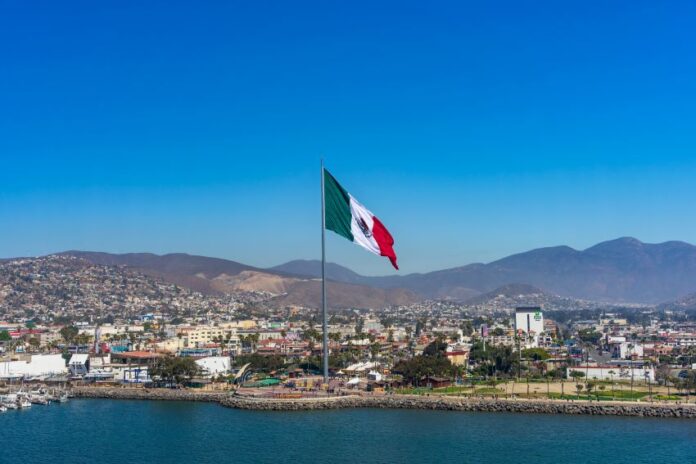
The economic benefit of the works is expected to exceed 12 billion pesos (US $636 million) over the next decade. (Shutterstock)
The city of Ensenada in Baja California plans to invest just over US $300 million (5.74 billion pesos) in public works to boost nearshoring activities, the president of the Ensenada Business Coordinating Council, Julio Alberto Salinas López, said.
Ensenada, located about an hour south of the border with the United States, is preparing for at least 10 new high-technology multinationals to enter the local market within the next three years, according to Salinas.
Projects include the expansion of the El Sauzal seaport and the construction of an international cargo airport. Infrastructure works will include dredging and the expansion of breakwaters to accommodate deeper-draft vessels, aimed at enhancing the region’s trade routes.
Earlier this year, the business group Mexican Construction Companies in Ensenada (Comice) announced the 1,000-hectare “Ciudad Jatay” project, which will feature an industrial park, a technology park, housing and services to be developed in five to ten years.
“The goal is to turn Ensenada into a hub for economic development, as we have privileged conditions — two ports, a new airport, binational connectivity, industrial zones and clean energy,” Salinas said during an interview with the newspaper Milenio published on Monday. “All of this is aligned with a strategy we designed over three years ago.”
The city is focusing on attracting capital in three priority sectors — electronics, biotechnology and green energy. Salinas expects Baja California’s strong infrastructure, clean energy, qualified talent and proximity to the United States to attract investors.
The state government is currently working with the Economy Ministry to gain nationwide recognition as a hub of innovation, according to Salinas.
Obstacles to overcome
According to Salinas, reducing bureaucracy could help boost investment in the region.
“Five years ago, it took up to 18 months to set up a business; however, today, with support from the local government and working groups, we’ve managed to reduce that to half a year,” said Salinas. “But there’s still work to be done… we had 130 state procedures, and we’ve already reduced that to 70, [now] we need to incorporate artificial intelligence, one-stop shops and online systems.”
He also cited Ensenada’s problem of talent drain.
“Around 15% of graduates go to other parts of the country or abroad, as most are recruited by the state of California,” said Salinas. “That’s why we need companies that offer better salaries and quality of life.”
The economic benefit of the works is expected to exceed 12 billion pesos (US $636 million) over the next decade, according to Salinas.
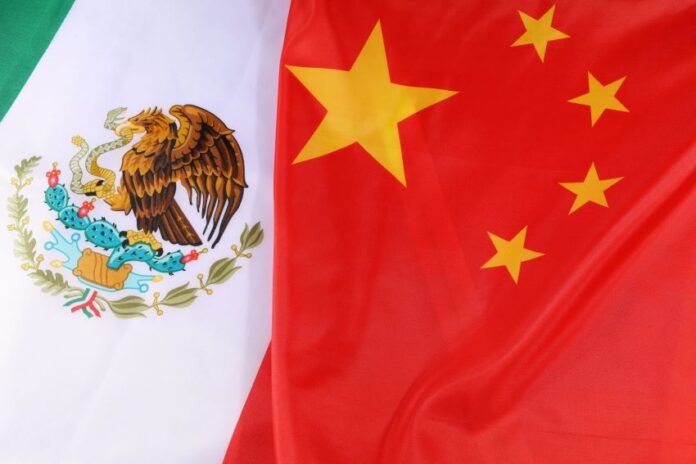
Mexico has doubled its trade deficit with China over the past 10 years, hitting nearly US $120 billion last year.
The red numbers rose to a record $119.86 billion in 2024, according to national statistics agency INEGI, the result of US $9.94 billion in exports and a whopping US $129.795 billion in imports.
Slowing exports to China helped the deficit to balloon as the value of items shipped from Mexico to China declined for a second consecutive year.
Much of what Mexico imports from China are intermediate goods utilized by Mexican companies to produce final export goods. One example is copper, without which the Mexican auto industry would come to a standstill.
The inclusion of Chinese parts in products exported to the U.S. makes them incompatible with the existing U.S.-Mexico-Canada free trade agreement (USMCA), meaning they will be subject to 30% tariffs beginning Aug. 1.
Mexico’s reliance on Chinese goods is attributable to the global competitiveness of Chinese parts and components, as well as the low integration of some domestic production chains, for example, televisions and machinery.
U.S. President Donald Trump’s determination to decouple trade with China (the U.S. deficit with China has fallen nearly 30%) will force Mexico to reconsider its own trade relationship with the world’s second-largest economy.
Since Trump’s first term, China’s trade with the U.S. has shrunk to one-third its value, hitting a 23-year low, according to Forbes magazine. In May, China accounted for just 5.89% of all U.S. trade, its lowest monthly percentage since 2002 and down from 17.77% in early 2017.
This dilemma is something Economy Minister Marcelo Ebrard has addressed previously.
The CEESP, an economic think tank, issued a report explaining how “dependence on Chinese inputs and weak domestic substitutes will limit [Mexico’s] technological development and reinforce a pattern of assembly rather than innovation.”
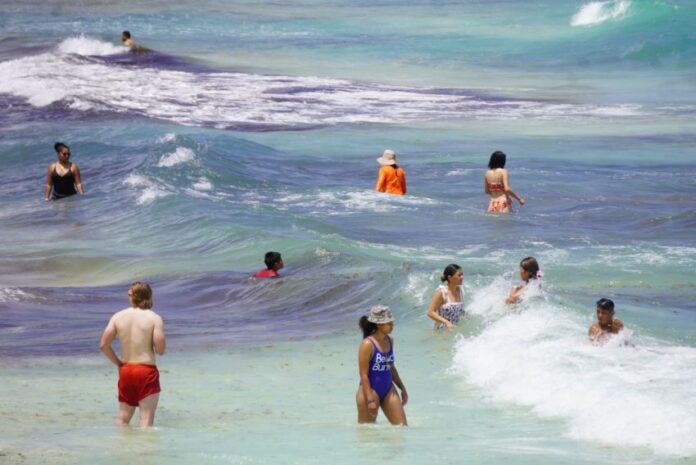
Even though individual spending by the average tourist was down in May, a healthy increase in the number of visitors boosted total tourist spending to US $2.6 billion, a 6.3% annual increase. (Elizabeth Ruiz/Cuartoscuro)
Mexico welcomed 7.93 million travelers in May 2025, up 18% compared to the same month in 2024, according to a report released Tuesday by the National Institute of Statistics and Geography (INEGI).
The May jump continues an upward trend for the year, with INEGI’s month-by-month figures revealing that from January through May, Mexico received a total of 39.39 million international visitors, a 14.2% increase over the same period in 2024.
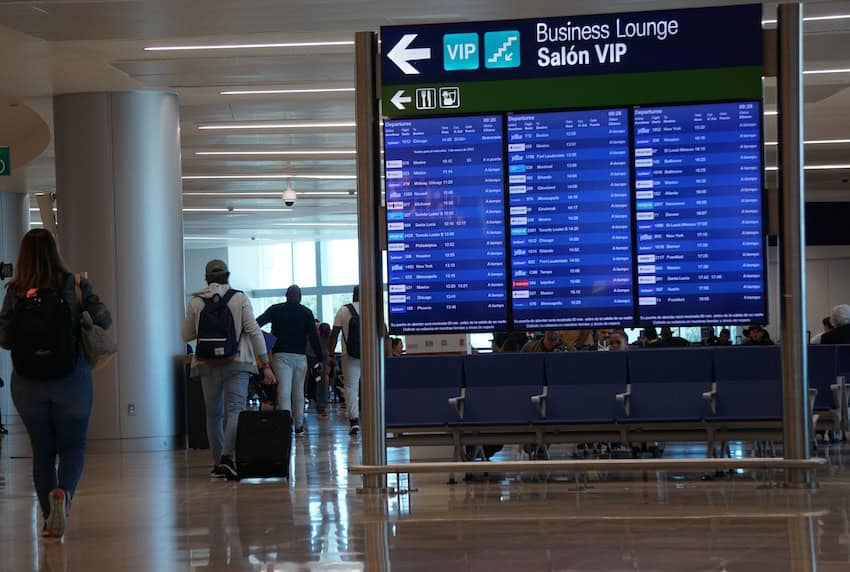
While the total number of tourists entering Mexico increased in May, arrivals by airplane declined. (Cuartoscuro)
Despite the positive trend, air tourist arrivals shrank in May, falling 5.6% year-over-year – the fourth negative month out of the first five months of 2025 (April saw a 0.2% rise).
On the other hand, cross-border tourists arriving by car or on foot increased by 28.2% year-on-year, reaching 1.71 million visitors in May.
Tourism Minister Josefina Rodríguez told the newspaper El Economista that the drop in air arrivals is part of a global trend due to a lack of aircraft.
“It’s not just Mexico; tourist arrivals by air have fallen in many countries,” Rodríguez said. “With the accidents that have occurred, there are planes that are no longer flying and there are fewer seats. It’s a global phenomenon.”
However, she said that trips by her ministry to promote tourism will begin next month in the United States and Canada to boost the airline industry. “In our case, we’re creating new routes and are going to initiate promotional activities,” the tourism minister said.
According to INEGI’s International Traveler Survey (EVI), 3.75 million visitors (47.3%) were international tourists who stayed in Mexico for at least one night, marking a 10% rise compared to May of the previous year. The remaining 4.18 million travelers, or 52.7%, were day trippers who didn’t stay overnight during their visit to Mexico.
Meanwhile, the INEGI report shows that in May 2025, foreign currency income from total visitor spending amounted to US $2.6 billion, representing a 6.3% annual increase. In particular, spending by international tourists was US $2.3 billion.
The survey noted that individual tourists spent nearly 10% less on average in Mexico, from US $366.27 in May 2024 to $329.88 this May. Gabriela Siller, head of economic analysis at Banco Base, which specializes in international finance, cited inflation and the exchange rate as factors in the drop.