A scene from the filming of Roma (No. 46) by Alfonso Cuarón, whom the NYT dubbed “the Mexican virtuoso.” (Carlos Somonte/Instagram)
The New York Times recently released a list of the 100 Best Movies of the 21st Century, and Mexico — or more specifically, Alfonso Cuarón — certainly made its mark. Three Mexican productions made it to the list, in addition to two Hollywood films directed by Cuarón.
The films were ranked based on the criteria of 500 filmmakers, stars and influential film fans. Voters selected movies from the United States, Spain and Japan, among other countries. The list was not limited to one genre — the 100 films include animated movies, documentaries, historical dramas and beyond.
Topping the list is Parasite (2019), a South Korean film directed by Bong Joon Ho.
Here are the Mexican movies that made it to the list.
Pan’s Labyrinth, 2006 (No. 54)
“Pan’s Labyrinth” propelled Director Guillermo del Toro to stardom. A coproduction of Spain and Mexico, the story follows Ofelia, a girl who enters a fantastical world during Franco-era Spain, to escape from the harsh day-to-day of living with her fascist stepfather. “The visually dazzling allegory affirmed del Toro as one of our finest filmmakers today,” the NYT said.
Roma, 2018 (No. 46)
Directed by Alfonso Cuarón, “Roma” tells the story of Cleo, a young domestic worker of Indigenous origin employed by an upper-class family in the Roma neighborhood of Mexico City. The film, set in the 1960s, paints a portrait of social hierarchies, inequality and the fundamental — albeit often tragic — role of women in Mexico. “This is Alfonso Cuarón’s film for himself,” the NYT said.
Y tu mamá también, 2002 (No. 18)
“Y tu mamá también,” also directed by Alfonso Cuarón, follows high schoolers Tenoch (Diego Luna) and Julio (Gael García) on a road trip with an older woman. The story explores classism, male friendship, mortality and above all else, lust. “Cuarón shoots sex the way his characters feel it: hot, all-consuming, the weight of the world just off-camera,” the NYT said. “Like youth itself, we stumble out of the film blinking, disoriented, sifting through memories like sand strewn with gold.”
Movies directed by a Mexican director
Voters also included two Hollywood movies directed by Alfonso Cuarón, whom the NYT dubbed “the Mexican virtuoso.”
Gravity, 2013 (No. 97)
“Alfonso Cuarón’s action film is one of the 21st century’s greatest thrill rides,” the NYT said. “Gravity” tells the story of an abandoned astronaut in space who must find her way back to Earth while confronting trauma she has long suppressed.
Impressive and deserved that 4 movies by Alfonso Cuarón made it into the New York Times list of the 100 Best Movies of the 21st century.
Cuarón’s science fiction drama depicts a global crisis of infertility, where no child has been born for 18 years. The film follows Kee, the only pregnant woman in the world, and Theo, an activist who strives to protect her and her baby from political factions seeking to exploit the child for their own purposes.
What Mexican movies would you add to the Top 100 of the 21st Century? Let us know in the comments.
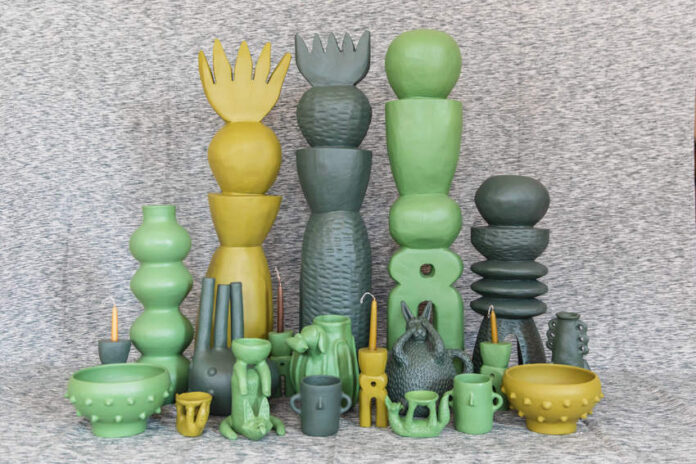
Carved wood and painted clay pieces by M.A Estudio. (MA Estudio)
Seven years ago, after several years in public service, Mexican visual artist Melissa Ávila began crafting a vibrant universe that honors Mexico’s millennia-old artisanal traditions, utilizing a diverse array of materials from Mexico’s handcrafting traditions — including wool, clay, wood, palm, minerals, volcanic stone, cardboard, ceramics, tin, iron, cotton, paint and jute.
Her goal was to create art and artistic decor objects for different spaces using these traditional materials.
Artist Melissa Ávila is the owner of M.A. Estudio in Mexico City. (M.A. Estudio)
The result of her work toward this goal is the M.A Estudioinitiative, a studio that brings sculptures, carpets and other art objects to life, celebrating modernism, Mexico’s traditions and design.
“The magic of M.A. [Estudio] is that it was born intuitively, without overthinking, and evolved through exploration and experimentation,” Ávila told Mexico News Daily as she sat recently down to discuss her Mexico City studio.
One of Ávila’s primary objectives is to foster collaborative projects while preserving traditions and honoring artisanal heritage and processes. So M.A Estudio operates on a collaborative model based on building long-term relationships with traditional artisans.
“To me, fair trade implies a 360-degree approach: It must be fair to those who create, produce, sell and buy it. It must be viable and functional for everyone,” Ávila said.
M.A Estudio emphasizes the value of handmade items and the traditions that produce them.
“We love artisan processes, not just working with artisans. We cherish everything related to crafts, handmade work, artisan culture and traditional processes.”
For Ávila, handmade processes are intimately tied to the earth and to culture. They highlight identity, natural resources and the region in which they were created.
Long-term relationships with artisans
Since its inception in 2017, one of M.A Estudio’s strengths has been its long-term collaboration with five artisan families based in regions known for their rich artisanal traditions, including Oaxaca, Chiapas, Guerrero, Puebla, Michoacán and Mexico State.
When it comes to the creative process, Melissa maintains an open mind. While she designs most pieces, certain series are created in collaboration with artisans.
“The studio is a space where I envision us all fitting together, so we are open to new collaborations and techniques. There is always a spirit of transformation, and we are adaptable to meet evolving needs,” she said.
The GEEL series is one such collaboration: It was designed with members of the Michoacán Purépecha community known as the Zipiajo. The series features a technique that smooths clay using materials like mud, fine black sand and red earth, known as charanda, for its final finishing touches.
“Many other collections feature my designs, which artisans appreciate, allowing us to create prototypes together. Sometimes, I’m hired by associations, NGOs and other institutions to mentor artisan groups,” Ávila explained.
Values make the difference
It’s important to avoid generalizing or romanticizing Mexico’s artisan sector, Ávila said, while also supporting the community and recognizing its complexities
“Mexico has an abundance of talent. It is a vast country and we must continue to seek ways to promote this heritage,” she said.
The Mexico City art and design studio focuses on the creation of art objects for interior design. (M.A. Estudio)
M.A Estudio also provides opportunities for creators to design their own products and produce them with the handmade team, giving them access to a stable income. They can rely on M.A Estudio for the entire design and production process.
“For me, the future is collaborative at any level,” Ávila said.
She is pleased to observe a growing public interest in understanding where products originate, she said.
“The goal for us as consumers is to become more aware of our purchases, to comprehend their origins and to acknowledge their impact on the planet and the people who create them,” she said.
With its unique designs, created using ethical practices, M.A. Estudio departs from the common practice of merely reselling handicrafts, instead integrating a thoughtful design process that is deeply connected to communities. The result is a stunning collection that brings joy and elegance to spaces.
What to do as an inveterate early riser in a culture where many businesses don't open before 11 a.m.? (Jose Carlos/Pexels)
My body wakes naturally around 3 a.m.
Each morning, I lie in bed for a few moments, looking out at the Guanajuato night. Then I slip silently out of bed, careful not to wake my beloved. The early morning, my solo sanctuary, is my favorite time of the day, and not to be disturbed by anyone other than birds.
Mexico is not a country that likes an early start. (VD Photography/Unsplash)
Downstairs, I turn on the coffee, then settle into my comfy armchair in our sala to read inspiring literature, listen to Spanish podcasts and write in my journal.
This time of day was known as matins or vigil in ancient Christianity. The Tzeltal, an Indigenous people who live in the Chiapas highlands, view the predawn darkness as a holy time, when the veil between the human and supernatural worlds thins. I feel I’m in a private, intimate world all my own. I sometimes remember my sister saying that when she nursed her firstborn at this gentle time, she felt like a doe with her fawn.
When people ask me why I get up so early, I explain that it’s not my choice so much as my innate biorhythm. A person’s sleep schedule preference is closely tied to their circadian rhythms, the natural physical process that follows a similar cycle every 24 hours. I used to worry that I wasn’t getting enough quality REM rest, but my sleep pattern doesn’t affect my energy level during the day, especially because Barry and I have a lie-down on our sofa almost every afternoon.
In both towns, we take a stroll around the neighborhood, then I drop him off at the cafe, where he’ll stay for an hour, while I return home.
When we’re traveling, we sleep in, but not much by other people’s standards. Last March, for example, Barry and I stayed at a small hotel in Tepotzlán, near Mexico City. We loved the hotel — other than the breakfast time.
A culture where dinner may not happen until 8 p.m. or later and where even children may be allowed to stay up until late at night, Mexico can be an adjustment for an early-to-bed, early-to-rise expat. (Mark de Jong/Unsplash)
The meal wasn’t served til 8:30 a.m. Clearly a challenge! To fill the waiting time, we went on an early morning walk every morning. Not a bad choice — it was calm and cool at that hour — though I’d have liked the option to have good coffee first. My solution was to carry a portable hot water immerser, a plastic mug and instant coffee — a shabby substitute for the real thing, but así es.
After returning from our walk, we’d have liked nothing better than to enjoy a dip in the pool, but no such luck, as the staff didn’t remove the pool cover til 10 a.m., and there was no way to sneak under it. Believe me, I considered it.
It turns out, not only do individuals have biorhythms, but so do cultures. According to the World Population Review, countries like Switzerland, Australia and Germany are examples of early-morning cultures, while Mediterranean, southern European and Latin American countries tend to have night owl patterns.
A nation’s location influences its culture, with countries closer to the equator (like some in Latin America) having more natural light throughout the day and a tendency to be more active at night. There are exceptions, though.
One is Colombia, the world’s earliest-rising country, where households often start their day around 4 a.m., although, according to El País, that doesn’t make them more productive. The second earliest-rising country is Indonesia (6:55 a.m.), while Mexicans, along with the Japanese, rise at 7:09 a.m. Americans get up at 7:25 a.m.
Weather contributes too. In the ’80s, when Barry and I lived in the Pacific Northwest, I steeled myself to get up early to write before I went to work, dreading it because it was so cold. To save money, we didn’t turn the heat on til; later in the day.
As for shopping, in Guanajuato, the only stores that open at 8 a.m. are La Comer supermarket, Waldo’s (Mexico’s Dollar Store), and another supermarket, Bodega Aurora, which I avoid, as it’s owned by Walmart. But I love my walk to La Comer.
It takes me about 15 minutes through one of the city’s tunnels to reach the supermarket, which is calm and uncrowded at that hour. I wish more Mexican stores would open that early. ¡Ojalá!Many of the stalls in the Hidalgo Mercado aren’t even open at noon. And the department store La Marina doesn’t open til 11 a.m. The nerve!
I also wish the weekly Guanajuato symphony would start earlier. It used to begin at 8:30 p.m., past my bedtime, but at least it now starts half an hour earlier.
Still, I feel fortunate to be a natural early riser, perky even at 3 a.m. Some studies show that people who wake earlier are less likely to develop depression, anxiety and other mood disorders, probably because early risers have more access to daylight, a natural mood booster.
Biorhythmically challenged as I am in Mexico, my unending fascination with its ancient culture, coupled with the country’s many beauties and friendly people, more than make up for later opening hours. Whatever time shops open, it is an honor and a privilege to live here.
Louisa Rogers and her husband Barry Evans divide their lives between Guanajuato and Eureka, on California’s North Coast. Louisa writes articles and essays about expat life, Mexico, travel, physical and psychological health, retirement and spirituality. Her recent articles are on her website, https://authory.com/LouisaRogers
Sheinbaum said on Monday that gentrification "was a phenomenon that occurred after the pandemic [with] the so-called digital nomads." (Andrea Murcia/Cuartoscuro)
At her Monday morning press conference, President Claudia Sheinbaum offered an opinion on Friday’s protest in Mexico City against gentrification.
She also weighed in on the issue of gentrification itself.
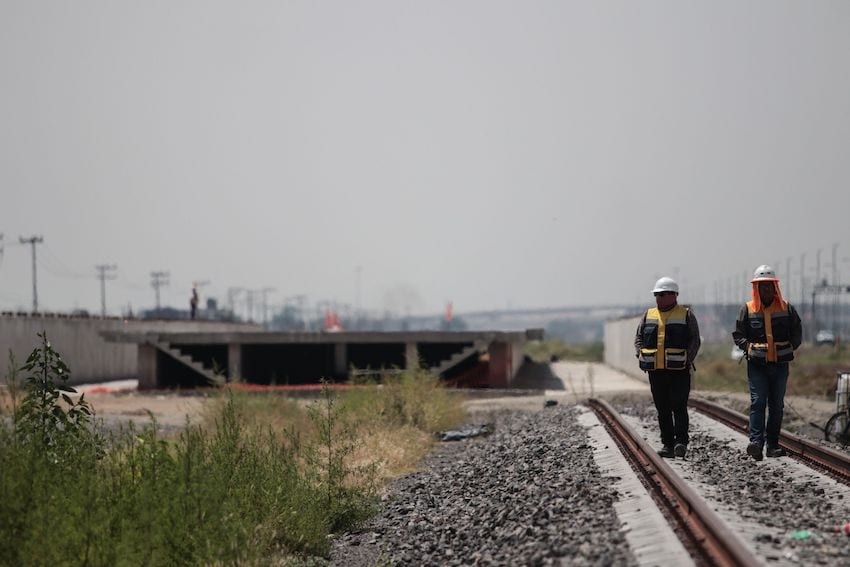
Among other issues, Sheinbaum announced that the train line between central Mexico City and the Felipe Ángeles International Airport (AIFA) in México state won’t open as soon as expected.
Here is a recap of the president’s July 7 mañanera.
Sheinbaum denounces xenophobia in CDMX anti-gentrification protest
A reporter asked the president about the protest in Mexico City on Friday against gentrification. Organized under the slogan “Gentrification is not progress, it’s dispossession,” the protest included expressions of anger and contempt directed at U.S. citizens who have moved into Mexico City neighborhoods such as Condesa and Roma in large numbers in recent years and thus contributed to an increase in rents.
Sheinbaum — who as mayor of Mexico City entered into a partnership with Airbnb and UNESCO to promote the capital to digital nomads — took umbrage at the “xenophobic displays” during Friday’s protest and called on “all Mexicans” to reject discrimination.
Condena la presidenta Claudia Sheinbaum manifestaciones xenofóbicas en la Condesa, “nosotros somos un país abierto al mundo”. Añade que se debe dar un proceso de inclusión en la CDMX ante la gentrificación. pic.twitter.com/Bw1tbhsFy2
— JorgeArmandoRocha (@JorgeArmandoR_) July 7, 2025
“No to discrimination, no to racism, no to classism, no to xenophobia, no to machismo,” she said.
“… All human beings are equal, and we cannot treat anyone as less,” Sheinbaum said.
“The xenophobic displays in that protest must be condemned,” she added.
Sheinbaum declared that it is never okay to call for people of “any nationality” to leave Mexico, even when protesters have a “legitimate” demand, as she said is the case with the fight against gentrification.
She pointed out that Mexico has a rich history of welcoming people from around the world.
“Mexico has always been supportive and fraternal. In the 20th century, we welcomed the Spanish Republicans and people from the southern cone of South America due to the coups,” Sheinbaum said.
“We’ve welcomed Guatemalans, who due to violence and discrimination have arrived to our country. Mexico is a country that is open to the world and isn’t discriminatory. So the xenophobic attitudes can’t be justified,” she said.
Gentrification is ‘an issue of real estate speculation,’ says Sheinbaum
Sheinbaum said that gentrification is, “in reality, an issue of real estate speculation, mainly stemming from the rental of apartments through digital platforms for tourism or for people who come to live in Mexico for 3, 4, or 5 months.”
“It was a phenomenon that occurred after the pandemic [with] the so-called digital nomads,” she said.
“A lot of people from other countries of the world who continue working remotely, many of them from the United States, come to Mexico because Mexico is a marvelous country and Mexico City is a very beautiful city where a lot of people want to live,” Sheinbaum said.
“They come to Mexico to work for a while,” she said.
“The people who come to Mexico have to respect our laws. Likewise, they can’t have a discriminatory attitude, especially toward the people who are opening their arms to them,” Sheinbaum said.
In 2022, Sheinbaum, then the mayor of Mexico City, promoted Airbnb as a way to make Mexico City more attractive to digital nomads, particularly those from the United States. “We have no [knowledge] that … [higher rents] are associated with Airbnb,” Sheinbaum said at the time.
The president said on Monday that the federal government will work with the Mexico City government to “seek mechanisms of regulation” so that the cost of living in neighborhoods such as Condesa and Roma doesn’t continue to go up and force more long-term residents to relocate.
“In effect, particularly in Condesa and Roma, there is a lot of real estate speculation due to Airbnb rentals and all these digital platforms that rent spaces. I say this brand, but there are many other platforms,” Sheinbaum said.
This “real estate speculation” cannot be allowed to increase the cost of living in Mexico City and consequently cause gentrification, “which is to expel people who have lived [in these neighborhoods] for years and years,” she said.
“… There has to be inclusion, always. It’s not tolerance, it’s inclusion — we’re an inclusive society,” Sheinbaum said.
“There was a problem with several communities,” Sheinbaum responded.
She said that the project is “advancing” and that the “problem” with communities in México state has been resolved. However, Sheinbaum also said that talks between authorities and members of the communities through which the new railroad runs are ongoing.
She said that some people say they weren’t “supported” when an “original” train line was built through their communities. They are asking for “social support,” the president said.
Once the train is complete, travelers departing from Mexico City’s Buenavista station will be able to reach the Felipe Ángeles International Airport (AIFA) in México state in approximately 40 minutes. (Andrea Murcia/Cuartoscuro)
“… There are others who say their homes were damaged. A review of homes is being carried out,” Sheinbaum said.
“So everything is being attended to and [the right of way] is now practically freed,” she said.
Sheinbaum said that a new opening date for the long-awaited railroad to AIFA will be announced soon.
She noted that the AIFA-Pachuca train line will open sometime after the inauguration of the railroad between Buenavista, located in central Mexico City, and the three-year-old airport.
By Mexico News Daily chief staff writer Peter Davies (peter.davies@mexiconewsdaily.com)
Search and rescue efforts are ongoing in central Texas, where severe flooding claimed the lives of at least 100 people. (Nick Sortor/X)
The Foreign Affairs Ministry (SRE) is supporting at least 30 Mexican citizens who survived the recent flooding in Texas, President Claudia Sheinbaum said in her Monday morning press conference.
“Nine requested support to return to Mexico, 16 requested the replacement of their passports due to destruction, and four did not request assistance because they are in the U.S. with work visas and are being assisted by contracted agencies,” Sheinbaum said.
Torrential rains hit central Texas over the Fourth of July holiday weekend, causing flash flooding across several areas of Texas and devastating the San Antonio area.
Several rural areas were unprepared for the scale of the storm, with many citing late or insufficient flood warnings from the National Weather Service.
In Kerr County, officials reported 84 deaths, including 27 children and staff who were attending summer camp at Camp Mystic on the banks of the Guadalupe River. Ten campers and one counselor remain missing.
“Our regards, love and strength, our deepest sympathies to all those who died, all the families who lost a family member in these floods,” Sheinbaum said on Monday.
The president said the Mexican Consulate in San Antonio is in communication with Mexican families affected by the floods and will visit shelters as soon as possible.
Sheinbaum also recognized the work of two young Mexican women who participated in rescue efforts.
Silvana Garza Valdez and María Paula Zárate, both counselors at Camp Mystic, reacted quickly to the storm that began on July 3, moving their assigned campers to the highest area of their cabin and staying alert through the night until they could evacuate the 20 young girls to safety.
“It makes me very proud, truthfully,” the president said.
On Sunday, Mexico sent a group of firefighters and rescue personnel from Acuña, Coahuila, to help search for flood victims.
Many participants of Friday's protest against gentrification singled out Americans in Mexico City due to anger over the treatment their compatriots are receiving in the United States as the Trump administration pursues its mass deportation agenda. (Rogelio Morales/Cuartoscuro)
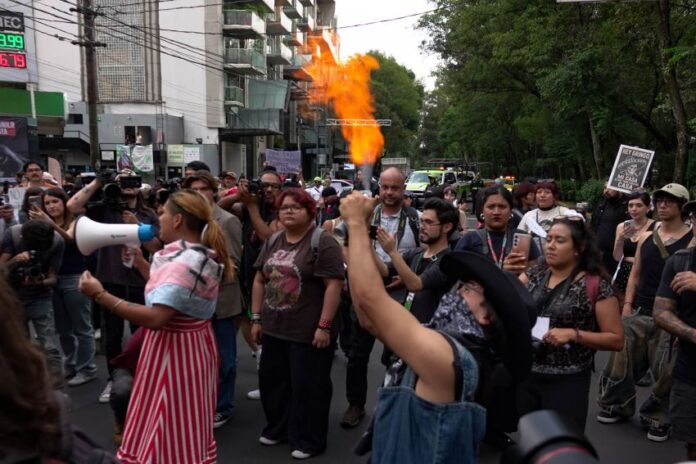
Hundreds of people protested in Mexico City on Friday against the gentrification of neighborhoods where many foreign residents live and many foreign tourists stay, such as Condesa and Roma.
The protesters gathered on Friday afternoon in the Lindbergh Forum section of Condesa’s Parque México, where they held up placards with messages such as “Free us from American gentrification”; “You’re visiting paradise, we’re being pushed out”; “You’re not an expat, you’re an invader”; “Foreigners love Mexico, but hate Mexicans;” and “Dispossession comes disguised as Airbnb.”
“Housing to live in, not to invest in!” read a large banner affixed to the imposing five-pillared structure in Lindbergh Forum, a popular gathering and recreation place for both Mexicans and foreigners.
“We’re sick of foreigners coming with their euros and their dollars, wanting to buy our homeland,” said one rally speaker.
“… At the end of the day, if we begin to allow these kinds of things, there won’t be anything or anyone to stop them,” he said.
The protest was organized under the slogan “Gentrification is not progress, it’s dispossession.”
It was promoted on social media by various organizations, including one called Frente por el Arraigo y la Inclusión Vecinal (Front for Neighborhood Roots and Inclusion).
Most of the protesters were young people, among whom were residents, and former residents, of inner-city Mexico City neighborhoods such as Condesa, Roma and Juárez. However, the majority of the protesters live in other parts of the city, according to media reports.
“¡Gringos, go home!”: En la colonia Condesa se realizó la primera manifestación en contra del aumento de rentas y el desplazamiento de vecinos a causa de la gentrificación.
Durante la protesta quemaron una piñata que representa a los extranjeros gentrificadores.
The number of foreigners living in neighborhoods such as Condesa and Roma increased significantly during the COVID-19 pandemic. Many of the residents are from the United States, and include people who work remotely for companies in the U.S. and thus earn salaries in dollars.
The influx of foreign residents, and foreign tourists, has changed the face of neighborhoods such as Condesa and Roma and contributed to an increase in rents, forcing some Mexicans out and preventing others from moving into highly desirable parts of the capital. Inflation and other factors have also contributed to an overall higher cost of living in Mexico City and other parts of the country.
The resentment some Mexicans harbor toward well-off foreign residents of the capital is not solely based on rising prices and gentrification, but also stems from perceptions that some of the outsiders make little effort to assimilate and learn Spanish, and don’t significantly contribute to local tax collection.
“You walk around here in Condesa and every two steps you see a foreigner,” one protester told the news magazine Proceso.
“… [They are] people who don’t speak our language, don’t share our culture and are displacing [Mexicans],” he said.
Similar protests against gentrification and mass tourism have taken place in various cities around the world, including Barcelona and Paris.
‘Gringos go home!’
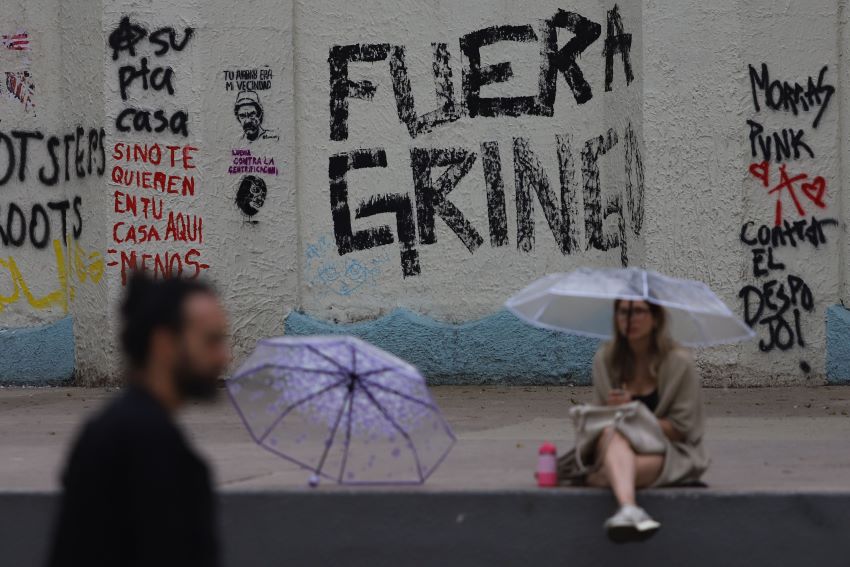
Chants of “¡fuera gringos!” (gringos out!) and “gringos, go home” rang out in Parque México during the demonstration and as protesters subsequently marched through nearby streets of the capital.
“Fuera gringo!” is the battle cry of an emerging anti-gentrification movement in Mexico City. (Daniel Augusto/Cuartoscuro)
While foreigners from many countries around the world live in Condesa, Roma and other central neighborhoods of Mexico City, much of the protesters’ anger was focused on newcomers from the United States.
“Gringo, go back to your fucking country!” and “pinches gringos culeros” (fucking gringo assholes) were among the messages protesters conveyed on signs they held up.
Adding to protesters’ particular anger toward Americans is the unfair treatment many Mexicans believe their compatriots are receiving in the United States as the Trump administration pursues its mass deportation agenda.
In Condesa, some protesters told media outlets that their neighbors have been forced out of parts of Mexico City that are popular with foreigners because many residential properties have been turned into businesses or short-term accommodation advertised online on platforms such as Airbnb.
“We’re being left without neighbors,” one protester told the newspaper Milenio. “A lot of places are now businesses. The rents are going up.”
“We don’t have neighbors anymore,” 82-year-old Condesa resident Raquel Nava told Proceso at the protest in Parque México.
“I’m here because I’m worried that the social fabric of the neighborhood has been lost,” she said.
“… [My] neighbors lived in rentals but with the arrival of Airbnb they couldn’t pay the costs and they were evicted,” Nava said.
She described gentrification as the eviction of residents with ties to the local area and the arrival of “people who don’t integrate into the community.”
“… It’s not that I’m against foreigners, the doors were opened to them and they’re here, but they don’t appreciate the cultural heritage of these neighborhoods,” Nava said.
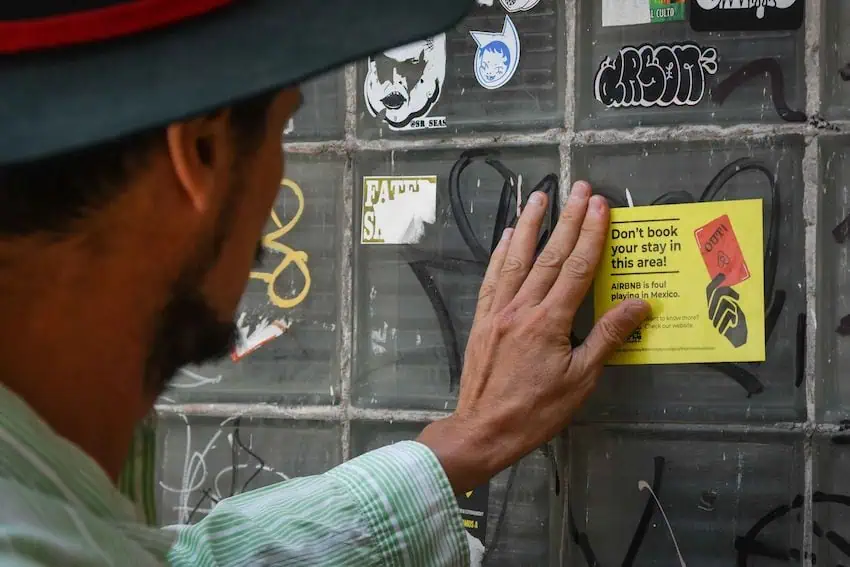
The organization Front for Neighborhood Roots and Inclusion ran a recent sticker campaign called “Red Card on Airbnb,” which seeks to raise awareness among neighbors and tourists about the adverse effects of the short-term housing site on local communities. (Mario Jasso/Cuartoscuro)
Michelle Castro, a 19-year-old university student, told the Associated Press that Mexico City “is going through a transformation.”
“There are a lot of foreigners, namely Americans, coming to live here. Many say it’s xenophobia, but it’s not. It’s just that so many foreigners come here, rents are skyrocketing because of Airbnb. Rents are so high that some people can’t even pay anymore,” she said.
Mexicans forced out of desirable central neighborhoods of the capital often face longer, more expensive commutes due to their relocation to cheaper, more peripheral areas of Mexico City.
While businesses such as cafes have proliferated in trendy neighborhoods that are popular with foreigners, the number of traditional businesses such as tortilla and butcher’s shops have declined in recent years, according to official government data.
“A lot of the flavor of the neighborhood is lost,” Erick Ramírez, a long-time resident of Condesa, told Proceso.
“… Stationery stores, dry cleaners and corner stores disappear,” and “more profitable businesses” appear in their place, he said.
While some of the new businesses are owned by foreigners, the proprietors of many of them are Mexicans, who have no doubt benefited from the influx of Americans, Europeans and others with ample disposable income. Airbnb entrepreneurs have also reaped major monetary rewards from the arrival of large numbers of foreigners.
Karla Mejía, a Condesa resident, spoke about economic inequality between foreigners and Mexicans.
“We, as residents, as taxpayers of the Mexican state, can’t afford housing, much less in an area like Condesa, but these people can,” she told Milenio.
Condesa is a leafy, pretty neighborhood and entertainment hub that many people consider ground zero for gentrification in Mexico City. Its array of entertainment options, including cafes, restaurants and bars, its inviting parks and its central location are among the reasons why it attracts large numbers of foreign residents and tourists.
The protest turns violent
While most protestors demonstrated peacefully, a small group committed acts of vandalism and violence in Parque México and nearby streets.
The large structure in Lindbergh Forum was defaced with graffiti messages, including “Housing is a right, not a commodity” and “My culture is not your trend” as well as pro-Palestine statements.
🔴 Durante Protesta Antigentrificación, destruyen Starbucks ubicado en esquina Sonora con Ámsterdam, colonia Hipódromo
In the streets of Condesa and Roma, radical, masked protesters smashed the windows of businesses and carried out other acts of violence and vandalism. Among the businesses targeted was a Starbucks cafe, where frightened customers threw themselves to the floor, a branch of the Banamex bank and a clothing store, which protesters looted.
All told, 14 businesses were damaged and 40 more were vandalized with graffiti, according to authorities in Cuauhtémoc, the borough where Condesa and Roma are located.
At Café Toscano, located opposite Plaza Rio de Janeiro in Roma Norte, one employee was injured when protesters attacked the establishment.
“Suddenly, they started throwing tables and chairs. Others came in and threw firecrackers. I took cover to avoid being hit by a rock they threw from outside and I hurt my hand,” Karen Jaramillo told the newspaper Reforma.
“They were moments of a lot of fear,” the cafe employee said.
Cafe manager Fernando Jasso said the business doesn’t contribute to gentrification in the area.
“We’re Mexican workers, the owners are Mexicans, the prices are accessible for everyone,” she said.
In addition to perpetrating acts of violence and vandalism, some protesters hurled insults at foreigners they encountered, according to media reports. Some Mexico City police officers were attacked with stones, the Milenio newspaper reported.
The march through the streets of Mexico City reached the Angel of Independence monument on Paseo de la Reforma, the capital’s most famous boulevard. The base of El Ángel, as the monument is commonly known, was also targeted by vandals.
Protesters also demonstrated outside the United States Embassy on Paseo de la Reforma and chanted inside the Mexico City metro system, according to the Associated Press.
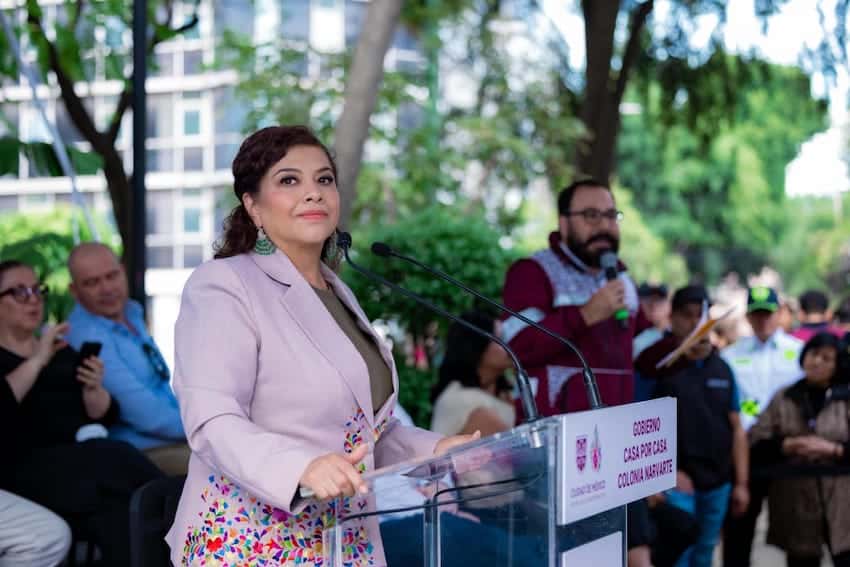
Mayor Brugada and CDMX government denounce violence — and gentrification
“Mexico City doesn’t agree with gentrification. We reject this phenomenon that excludes the population from their neighborhoods and communities,” the government said.
The Mexico City government, led by Mayor Clara Brugada, said it is committed to upholding “the right to decent housing” but rejected the practice of violence as a method to resolve conflicts. (@ClaraBrugadaM/X)
“For that reason, we promote public housing policies that strengthen [community] roots, with accessible loans for the improvement and construction of housing in these areas. We also implement actions so that young people have access to affordable rental housing and families can obtain home ownership at affordable prices,” it said.
The Mexico City government said it is committed to upholding “the right to decent housing” and asserted that it is implementing “concrete policies” to guarantee it.
“We know that gentrification can exclude those who have lived their whole lives in their neighborhoods. That’s why we’re allocating unprecedented resources to create the conditions that allow them to continue developing their life project in their own community,” it said.
“But in no way do we endorse violence in confronting this problem,” the government added.
“We reject violence as a method to resolve conflicts. This city is one of rights and freedoms. We respect protests and social expressions … but not aggression,” it said.
“… The fight against gentrification cannot become an excuse to promote hate speech or discriminatory practices. We categorically reject any xenophobic expression against migrants, regardless of their origin, migratory situation or motivation for arriving in the city,” the Mexico City government said.
* Mexico News Daily has previously published numerous articles on gentrification in Mexico City and associated issues. Here is a selection of those articles.
A sprite or transient luminous event, captured here by astronaut Nichole Ayers, is like a colorful inverted lightning bolt, shooting up from a storm instead of down. (X)
NASA recently captured a light phenomenon known as an “atmospheric sprite” over Mexican territory, near the border with the United States. This event, which looks like an inverted red lightning strike, was photographed from the International Space Station (ISS).
Sprites — more formally, transient luminous events or TLEs — are rare electrical discharges that occur between 50 and 90 km above the Earth’s surface, in the mesosphere.
Just. Wow. As we went over Mexico and the U.S. this morning, I caught this sprite.
Sprites are TLEs or Transient Luminous Events, that happen above the clouds and are triggered by intense electrical activity in the thunderstorms below. We have a great view above the clouds, so… pic.twitter.com/dCqIrn3vrA
— Nichole “Vapor” Ayers (@Astro_Ayers) July 3, 2025
Unlike traditional lightning, which shoots downward, sprites shoot upward from the tops of storm clouds, forming branching, reddish or bluish structures that can extend up to 96 km above the storm. They typically last only fractions of a second, making them difficult to observe from the ground.
The geographic location and frequency of convective thunderstorms make Mexico’s skies an ideal environment for the sprite phenomenon.
“Just. Wow. As we went over Mexico and the U.S. this morning, I caught this sprite,” Nichole Ayers, the astronaut who took the photograph, wrote in her official Instagram account, accompanied by the image taken from space.
The ISS offers a privileged view for capturing these phenomena, as they can be observed from space above the clouds.
According to Ayers, sprite images help scientists better understand the formation of these electrical events, their relationship to storms, and their impact on the upper atmosphere. They also contribute to improving weather and atmospheric electrical activity models.
Ayers’s image aligns with NASA’s “Spritacular” project, an initiative that seeks to collect images of these events.
Sprites were first photographed in 1989, and although pilots had previously reported them, they remain enigmatic and little-studied due to their transience and altitude. The recent image captured by NASA represents an important contribution to atmospheric science and the understanding of these electrical phenomena.
The new project will support the monitoring, management, collection and transportation of sargassum, in addition to treating wastewater and producing biomethane from organic waste and sargassum, according to Lezama. (@maralezama/X)
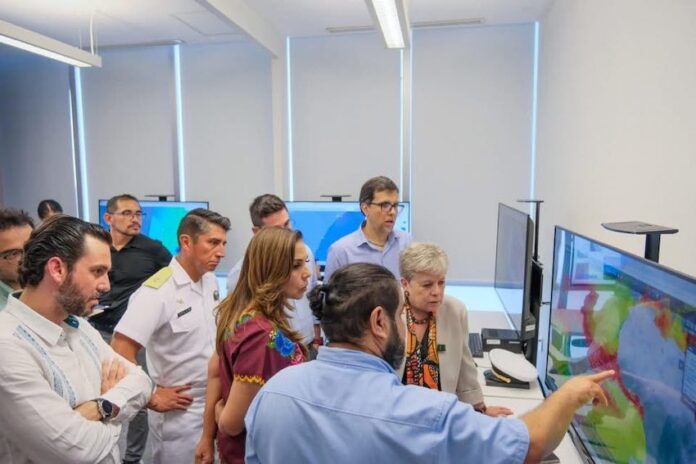
A new facility to monitor and manage sargassum along Mexico’s Caribbean coast — and eventually convert it to biofuel — was announced Saturday by Quintana Roo Governor Mara Lezama.
Work to contain and collect the noxious seaweed has already begun in preparation for the Comprehensive Sargassum Sanitation and Circular Economy Center, as the new facility is named. Lezama first revealed plans to create the Sargassum Center in February.
¡En Quintana Roo convertimos los pasivos ambientales en activos económicos!
Junto a la secretaria de Medio Ambiente, @aliciabarcena, presentamos el Centro Integral de Saneamiento y Economía Circular del Sargazo, un proyecto visionario que impulsa el desarrollo sostenible y la… pic.twitter.com/rExFlKqosa
The new project will support the monitoring, management, collection and transportation of sargassum, in addition to treating wastewater and producing biomethane from organic waste and sargassum, according to Lezama. Plans include the installation of three new wastewater treatment plants in Cancún’s hotel zone.
The aim is to turn “environmental liabilities into economic assets,” Lezama said.
Annual expenditure on sargassum management is equivalent to 11% of the local GDP, or US$2 billion (37.4 billion pesos), according to the governor.
Lezama expects the new project to promote new sustainable industries, create jobs and reduce the environmental impact of the sargassum.
In June, scientists predicted that record levels of sargassum were likely to wash up on Quintana Roo through the summer.
“Every year we face this challenge, and that is why, in Quintana Roo, we are taking concrete actions to protect our beaches, our economy and the thousands of families that depend on tourism,” Lezama said.
Though the brown seaweed is naturally beneficial to marine ecosystems in the open ocean, it can be harmful to marine life, plants, coral and human health when large quantities reach the coast. As it decomposes, it gives off a foul smell similar to rotten eggs.
Lezama highlighted the joint efforts taken by the Navy, the state government, municipal authorities and civil society to remove almost 40,000 tons of sargassum in the region in 2024.
A Dutch consortium consisting of Dutch Clean Tech and the engineering company Oceanus International will be responsible for the financing, design, construction and operation of the Sargassum Center.
The consortium aims to incorporate cutting-edge Dutch and Mexican technology into operations for the biodigestion of sargassum and organic waste, as well as to produce biomethane.
Results from a study on sargassum, sludge and EMR valorization, endorsed by the certifying agency Aenor-Mexico, are due to be released in November. The study’s findings are being used in the development of the sargassum center.
The new center is expected to be a benchmark for research, innovation and coordinated action to solve the sargassum problem efficiently and responsibly, according to the state Minister of Ecology and the Environment Óscar Rébora.
Mexico has now won the Gold Cup 10 times. The U.S. has won seven finals and Canada one. (Selección Nacional de México/Facebook)
Mexico’s men’s national soccer team defeated the United States 2-1 in the 2025 Concacaf Gold Cup final, cementing its record as the tournament’s most successful team in the region with 10 trophies.
The sold-out match, organized by the Confederation of North, Central America and Caribbean Association Football (Concacaf), was held at NRG Stadium in Houston, Texas, before 72,000 fans, the majority of whom were Mexicans.
Edson Álvarez, 27, celebrates with goalkeeper Guillermo Ochoa. (Selección Nacional de México/Facebook)
The U.S. team took an early lead with a header from Richards after an assist from Sebastian Berhalter in the fourth minute. By minute 27, Mexico took control of the match and tied the score with a goal from Fulham striker Raúl Jiménez. In the second half, team captain Edson Álvarez sealed the victory with a header in the 77th minute.
Jiménez, who has emerged as a leader of the national team, finished the tournament as Mexico’s joint-top scorer with three goals, alongside César Montes. But his goal in Sunday’s match is considered the crown jewel of the season.
“[That goal] was really good. I don’t know how I hit it so hard with my left foot,” Jiménez said to reporters. “The goal reminded me of one I made against Poland, in 2017,” he added.
Jiménez has collected 43 goals for the Mexican national team, nine away from matching Javier “Chicharito” Hernández’s record, the all-time leading scorer for El Tri.
Sporting the number 20 at the start of the game (his official jersey is number 9), Jiménez dedicated Sunday’s Gold Cup to his former Wolverhampton teammate Diogo Jota, who passed away tragically at the age of 28 in a car accident last week.
Sunday marked the first time since 2019 that Mexico defeated the U.S. in a Gold Cup final, though Mexico has 39 overall wins over the USMNT.
Mikel Arriola, commissioner of the Mexican Football Federation, dedicated the victory to Mexican fans, especially those residing in the U.S.
This year’s tournament kicked off with an atmosphere of concern among Latino fans. On June 14, Mexico faced off against the Dominican Republic at SoFi Stadium in Los Angeles, California, amid a surge in immigration raids. Despite fears over fan safety, 54,000 people filled the stands. The rest of the tournament ran smoothly without any incidents.
For Javier Aguirre, who took over as head coach of Mexico’s national team for the third time in August 2024, “the litmus test” will be the 2026 World Cup.
“We have a year to prepare,” Aguirre said following the match. “I think there are people who would say we’re good to go [after] today, but there are always little things to do better.”
When asked about his legacy leading the Mexican national team (he was formerly head coach in 2001 and 2010), Aguirre highlighted the change in mentality and the players’ desire to represent Mexico.
“If you ask me, it’s the desire to be on the national team. Before, I felt [the players] came tired, a little forced or didn’t want to come. I think they want to come now. It’s not a legacy, but it’s something I set out to do, and I say that proudly,” Aguirre told Fox Sports.
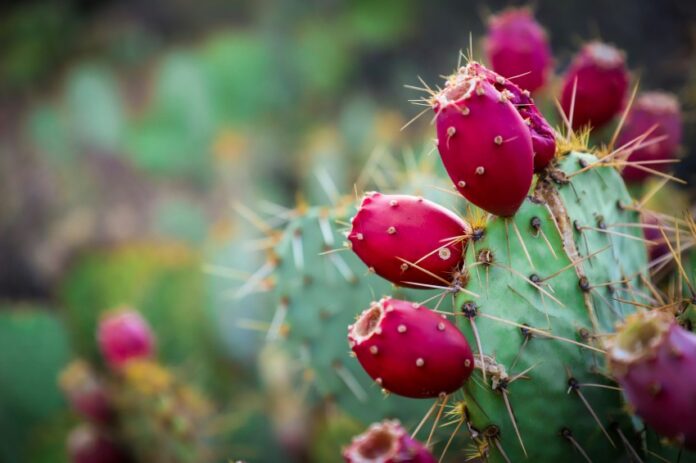
It's harvest season in Mexico for the tuna, the fruit of the prickly pear cactus. Mexicans eat tunas raw, make them into jams and also blend them with water as a refreshing drink! (Frankie Lopez/Unsplash)
July is bursting with summer fruits: papaya, pineapples, and mangos, but let’s not forget the native fruits like tunas! It’s tuna season, and they’re great just peeled and eaten. Or in fruit salads, aguas frescas and, how my Nan made them most, in jams and pies. Mushrooms and squash blooms are also abundant to cook a number of ways, or stuffed in a tlacoyo or gordita from the market.
Also, one of my July and August favorites is huazontle. Trying huazontles capeados was love at first bite for me. A recipe is coming up next month, but if you’re in or around San Miguel de Allende, it’s their big food festival. You may be able to persuade one of the amazing chefs to give you a recipe as well.
If you’ve ever eaten nopales, that’s the leaf part of the prickly pear cactus, which yields the fruit Mexicans call tuna. (Diego Lozano/Unsplash)
Tunas
Tunas, or prickly pear fruits, are a nutritional powerhouse enjoyed in a bunch of ways. Great news: July to October is harvest season. So they’re abundant, at peak deliciousness and popular in drinks. Fermented drinks like colonche are a harvest must. Big cold jugs of refreshing agua de tuna are also popular for cooling off. Once you peel them, the rest is easy!
Agua de tuna
Ingredients
6 tunas
6 cups of water
2 cups of ice cubes
½ cup of sugar (more if you like it sweet)
Directions
Using a sharp knife, cut both ends off the tuna and slit down the side. Use your finger to wriggle under the skin and pull to remove it. Do the same with all the tunas.
Put all the peeled tunas and 2 cups of water into a blender. They’re really soft, so it only takes a moment to blend smoothly.
Place a sieve over your jug to catch the seeds, then pour the blended mixture into your jug.
Add the rest of the water and sugar and stir well.
Serve over ice and enjoy!
Squash blossoms
Many a Mexican would swear that you haven’t lived until you’ve tasted a flor de calabaza (squash blossom) quesadilla. (Koffermejia/Wikimedia Commons)
I love these! And I’m not the only one. Ricotta-stuffed squash blossoms are popular throughout Mexico, and shockingly easy to make. Ready in under half an hour, they’ll always be gobbled up with delight. After all, who could resist this combo? Perfect for snacks or appetizers anytime, you may want to double the recipe. I can’t think of a more delicious way to get your vitamins and important minerals like calcium, magnesium and zinc.
Ricotta-stuffed Squash Blossoms
Ingredients
16 squash blossoms
1 cup ricotta cheese
1 large egg
2 tablespoons finely chopped onion
1 tablespoon chopped parsley
1 tablespoon oil
1 serrano chile minced (optional)
⅓ cup flour
¼ cup beer
Salt and pepper to taste
Oil for frying
Directions
Wash and dry the blossoms. Remove the inside — the pistil — of the flower with scissors.
Make the filling:
Heat the tablespoon of oil in a frying pan or skillet over medium heat. Sauté onions and pepper (if using) until onions are clear, about 1–2 minutes.
Add ricotta to a bowl and, once cool, add the onion mixture and parsley. Mix together, adding salt and pepper to taste.
Stuff and fry the blossoms:
Carefully stuff each blossom. Once stuffed, they can be put in the fridge while you make the batter.
In a bowl, mix the egg, flour and beer to form a batter.
Heat a frying pan over medium-low until hot. Then grab a blossom, dip it in the batter and place in the oil to fry. Cook until light brown (just over a minute), then flip to cook the other side.
Repeat with the remaining blossoms, cooking in batches.
Place on a paper towel to remove the excess oil and serve.
Mushrooms
The humble mushroom is proof that simple ingredients can yield extraordinary flavors. (U.S. Govt.)
Have I ever told you I’m a total mushroom lover? I could eat them every day. These sautéed mushrooms are perfect as a side or a filling for quesadillas and empanadas. You can’t go wrong with them.
The mushrooms’ hearty flavor goes beautifully with the minty citrusy taste of epazote. If you’re not a fan, just substitute cilantro. Quick and easy to make, they’re ready in 20 minutes.
Mexico Correspondent for International Living, Bel is an experienced writer, author, photographer and videographer with 500+ articles published both in print and across digital platforms. Living in the Mexican Caribbean for over seven years now, she’s in love with Mexico and has no plans to go anywhere anytime soon.








![Sheinbaum said on Monday that gentrification "was a phenomenon that occurred after the pandemic [with] the so-called digital nomads."](https://mexiconewsdaily.com/wp-content/uploads/2025/07/1038977_Sheinbaum-conferencia-matutina_impreso-696x462.jpg "Sheinbaum conferencia matutina")