When it comes to native fruit, few countries boast as bountiful an offering as Mexico. (Samuel C. Blackman)
Mexico is one of seventeen countries worldwide classified as megadiverse, meaning it’s extraordinarily biodiverse and teeming with endemic species. Indeed, these seventeen countries account for over 70% of all species worldwide. Mexico, for example, boasts an astonishing variety of plants (23,000) and a vast bounty of 762 edible fruits, of which 53 are native.
Here are a few of the most interesting endemic examples:
Xoconostle (Opuntia joconostle)
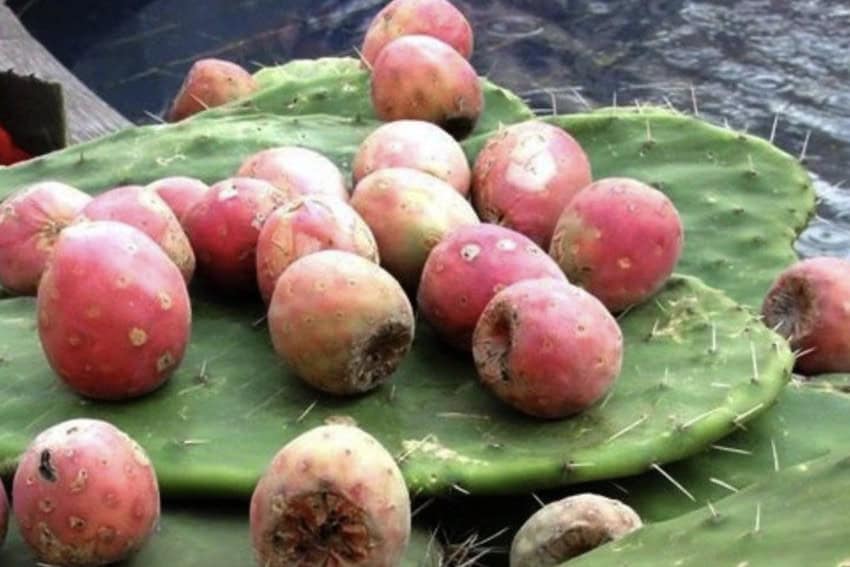
Xoconostle is one of many species of cactus fruit used in Mexico’s cuisine. (Gobierno de Mexico)
Mexico has plenty of fruit that grows on trees, but many of its most iconic fruits come from cacti. Xoconostle, a fruit from the nopal, is among the oldest and most culturally relevant, having been domesticated from about the same time as corn, 9,000 years ago, and has been a staple of salsas, food, and drinks ever since. It’s endemic to Mexico and grows in several states, including Aguascalientes, Durango, Hidalgo, Jalisco, Mexico, Michoacán, Querétaro, San Luis Potosí, and Zacatecas.
The name xoconostle is Nahuatl in origin, with its name translating to “sour tuna.” The fruit is quite tart, even when it has changed color from pale green, indicating unripeness, to a rich pink or red. That tartness has made it popular, often as a counterpoint to sweetness, in everything from jams and jellies to aguas frescas, liqueurs, snacks, sweets, and soups, the most famous of which is a beef stew, mole de olla.
Tejocote (Crataegus mexicana)
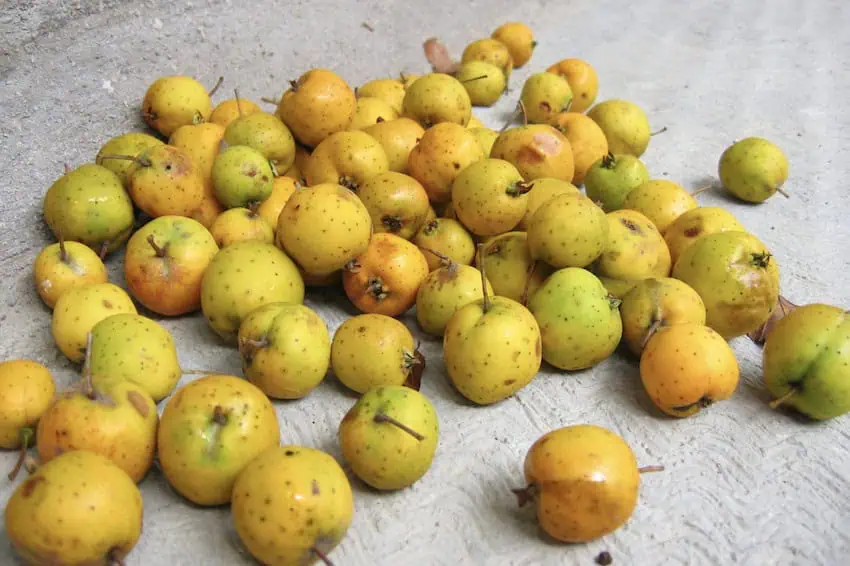
Orange or yellow tejocotes are one of the country’s most popular tree fruits, particularly when it comes to Ponche Navideño. (Daniel Manrique)
Tejocote is harvested from trees (or large shrubs) of the Hawthorne genus. This endemic yellow or orange fruit is overwhelmingly found in the state of Puebla, where some 5,000 tons are produced annually. However, numerous other states in Mexico also grow this crabapple-resembling fruit, whose most famous culinary use is as the signature ingredient in Ponche Navideño, or Christmas Punch.
This seasonal use is not an accident as the fruit traditionally ripens between October and February, just in time for it to be used in Day of the Dead celebrations, too. In this case, it’s often in candied form, with cinnamon and sugar added for dulce de tejocote, or chile and sugar for candy rielitos, each of which can be left as offerings on ofrendas. Tejocote is also an ingredient in jams, jellies, ates, and preserves.
Like the vitamin C-rich xoconostle, tejocote has also been noted for its health benefits and was used by pre-Hispanic healers to cure a variety of digestive and respiratory ailments.
Pitaya de Mayo (Stenocereus pruinosus)
(Huerto en casa)
The gray ghost organ pipe cactus, found most commonly in states like Guerrero, Michoacán, Oaxaca, and Puebla, produces distinctive white flowers and a fruit that, like many species of pitaya, has a very short harvest season. For pitaya de mayo, as the name suggests, it’s in May. Although there’s not much time to savor its bounty, each ripe cactus offers an exceptional number of fruits (about 50 to 100, on average) that can be enjoyed in a variety of ways.
Pitayas have a long history of use in Mexico, dating back thousands of years, and with good reason. Of the 23 species in the Stenocereus genus found worldwide, 21 grow naturally in Mexico. Sinaloa alone is home to seven species. Agua de frescas, in which pitaya fruit is blended with water, sugar, and lime, are a popular summertime treat, but they also find their way into everything from ice cream and popsicles to candies and jam.
Tuna cardona (Opuntia streptacantha)
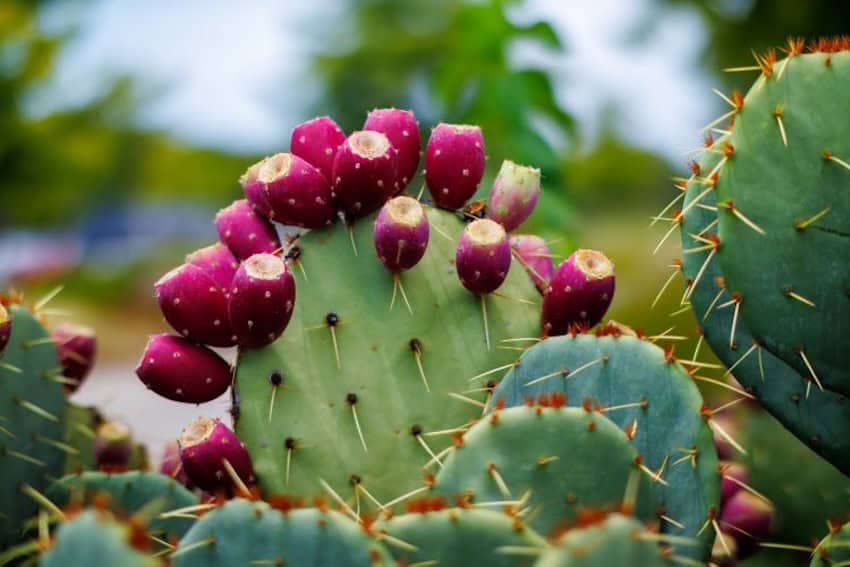
Also known as the prickly pear, tuna fruit is delicious, nutritious and uniquely Mexican. (Hal Wilson/500px)
Another endemic cactus fruit, this one of the prickly pear variety, tuna cardona is notable for being grown at elevation (between 5,000 and 8,000 feet above sea level) in 13 mainland states of Mexico. It’s often so abundant in San Luis Potosi and Zacatecas that it forms dense prickly pear forests known as nopaleras, or tunales. These are not as prevalent as they used to be now that more areas have been cleared for agriculture, but tuna cardona remains an important food source in the rural areas where it still grows.
Some of the traditional preparations for it are a bit unusual. Queso de cardona, for example, belies its label as it contains no dairy. As such, it’s not really a cheese at all, but acquired the name because of its similar texture, which is achieved by boiling the fruit at high heat until it binds into blocks. Peanuts or almonds are sometimes added for added crunch and flavor.
However, the most famous of these concoctions is undoubtedly colonche, a fermented alcohol that has been made from the fruit for over 2,000 years, with its initial creation attributed to the Chichimecas. It’s still made in San Luis Potosí and Zacatecas, although residents of the former consider their version superior due to the addition of cinnamon.
Pitaya de Querétaro (Stenocereus queretaroensis)
(iNaturalist)
Mexico’s endemic pitayas and pitahayas (which are spelled differently because they belong to the genus Hylocereus) are the gift that keeps on giving. This picturesque columnar version of the former, which somewhat resembles a candelabra in shape, is not, despite its name, confined to the boundaries of Querétaro. Rather, it can be found in several states in Mexico at elevations of up to 6,000 feet. Like other pitayas, the fruit of Stenocereus queretaroensis (aka “pitayo”) is avidly sought after during its short growing season for summertime specialties like aguas frescas and ice creams.
However, the most interesting culinary application for this pitaya is dehydrating it and turning it into a powder, which can be made into flour and used to bake bread. No, it can’t be used exclusively, but it can replace wheat flour for up to 30% of the formulation.
Capulín (Prunus salicifolia)
(Pinterest)
The five species above are all endemic, meaning they exist naturally in Mexico and nowhere else. That’s a slightly different category than native, which means the fruit originated in Mexico but has since been transplanted to other locales. A good example of this would be capulín (Prunus salicifolia), a wild black cherry which is thought to have originated in the Valle de Mexico, but is now cultivated throughout the Americas and in Europe. It was an essential nutritional source for the Spanish Conquistadors when they arrived in Mexico during the 16th century, as it was for the Mexica, who so valued the fruit that they had two words for it based on the size of the cherries.
Like almost all of Mexico’s endemic fruits, the culture and traditions that surround capulín are regional, and yes, it can be enjoyed fresh, too. Although in this case, it isn’t enjoyable unless its cherries are fully ripe, since they’re a bit too bitter otherwise.
Fortunately, in Mexico, there are always other fruity options to choose from in the meantime.
Chris Sands is the Cabo San Lucas local expert for the USA Today travel website 10 Best, writer of Fodor’s Los Cabos travel guidebook and a contributor to numerous websites and publications, including Tasting Table, Marriott Bonvoy Traveler, Forbes Travel Guide, Porthole Cruise, Cabo Living and Mexico News Daily. His specialty is travel-related content and lifestyle features focused on food, wine and golf.
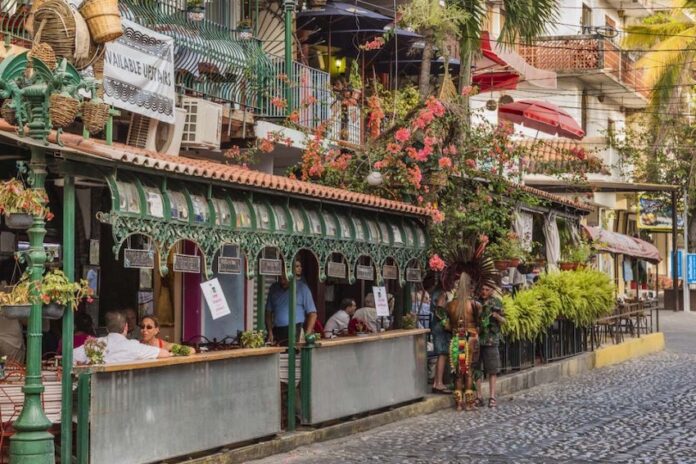
It's the height of summer, and Puerto Vallarta won't let the heat stop the party. (propertyjournal.mx)
July in Puerto Vallarta continues to stay hot, both in temperature and entertainment. This month brings stand-up comedy, holistic healing fairs, LGTBQ+ getaways and a race with crocodiles — sort of. July’s event calendar is a mix of quirky and eclectic surprises, which is very on par with the spirit of Puerto Vallarta. Read on to see what’s on in Puerto Vallarta this July.
Grupo de Teatro Dionisio brings a family-friendly spin to supernatural comedy with “A la media noche,” a play about tarot, unexpected visitors and a mysterious old hacienda. Directed by Juan Carlos Ramírez and written by Alberto Fabián Sahagún, this Spanish-language production is delightfully spooky and fun.
Dates: July 5 and July 12 at 8 p.m. Location: Plataforma 322 Cultural Center, Alondra 103, Los Sauces Cost: Tickets via WhatsApp at +52 (322) 105 6979
The first special event of the 2025 Vallarta Nayarit Gastronómica will make its debut on July 6: The Brunch. This experience features the collaboration of three local Puerto Vallarta chefs to create a special menu. The event will be hosted at Gaviotas Restaurant at the Sheraton Buganvilias Resort.
Date: July 6 at 1:00 p.m. Location: Gaviotas Restaurant, Blvd. Francisco Medina Ascencio 999 Cost: Menus start at 495 pesos. Email coral.romero@sheratonvallarta.com for reservations.
El Gran Ballet Mexicanisimo will perform a special show on Friday, July 18. The colorful performance will help to raise funds for the ballet’s international tour to France. The performance will showcase Mexican traditions and history through folk dance performances and elaborate costumes.
Date: July 18 at 7:00 p.m. Location: Teatro Vallarta, Perú 1105-C, 5 de Diciembre Cost: 200 pesos. Tickets can be purchased by phone by calling (322) 377-7010
For the first time ever, the world-famous POSH Parties are coming to Puerto Vallarta. This luxury LGBTQ+ retreat at Almar Resort includes three days of programming, from pool parties and networking mixers to live DJs and late night events. POSH is known for its presence at global Pride events, and now it’s bringing the festivities down to PV.
Date: July 25 through 28 Location:Almar Resort, Amapas 380, Zona Romántica Cost: Day passes from US $221; full access from US $579
Puerto Vallarta Crocodile Run
(Facebook/Club JC RAZO)
You don’t have to outrun a crocodile for the event — only your fellow racers. The 16th annual Carrera del Cocodrilo offers both a 4k fun run and an 8k competitive course along Boca de Tomates beach. Winners in each age category of the 8l race will receive cash prizes.
Date: July 27 at 7:15 a.m. Location: Boca de Tomates Beach Cost: Registration fee varies; info at carreradelcocodrilo@gmail.com or WhatsApp +52 (322) 150-7386.
Meagan Drillinger is a New York native who has spent the past 15 years traveling around and writing about Mexico. While she’s on the road for assignments most of the time, Puerto Vallarta is her home base. Follow her travels on Instagram at @drillinjourneys or through her blog at drillinjourneys.com.
In Mexico, one of the classic childhood snacks is a cup of raw vegetables, which typically includes cucumber, carrot, and jícama sticks soaked in lime juice, salt, and chile piquín. In these cups, the carrots are usually the last to be eaten, while the jícama is the first to disappear.
Now, as an adult, when I’m starving, I head to my friend’s fruit cart and buy a large cup of jícama with plenty of lime and mild chile piquín, and that keeps me going for hours.
(Organic Facts)
At local street food stalls, jicaletas are incredibly popular. These are large slices of jícama served on a wooden stick, similar to a popsicle. The jícama is often topped with chamoy or mayonnaise, cheese, and chile piquín. Although these combinations might sound unusual, they are a favorite among many.
One example of how cherished jícama was in pre-Hispanic culture can be found in the oral tradition of the Purépecha people of Michoacán. This beautiful story describes the impossible love between the Moon and the Sun. They spent all their time together, resulting in “days full of light with no shadows and nights full of shadows with light.” Mother Nature, who created both the Sun and the Moon, scolded them and reminded them of their true purpose and mission. Although the Sun and the Moon tried to persuade her to let them stay together, she painted a grim picture of what their union would mean for humanity. Ultimately, they agreed to separate.
Devastated by this separation, the Moon shed a single tear that Mother Nature treasured. This is why, today, humans enjoy a white root that is as pale as the Moon, as refreshing as water, and as nourishing as maize — something that satisfies both thirst and hunger.
Jícama is technically a legume that produces green pods, which are toxic. What we consume is the root, not the pods. And the root is so healthy that you won’t believe that something that seems so simple has so many benefits.
Jícama consists of 87–90% water, the remaining 10% is made up of minerals, vitamins, protein, fiber, and carbohydrates, making it a very healthy food choice. It is rich in potassium, calcium, magnesium, vitamin C, vitamin E, vitamin B complex, selenium, and beta-carotene.
For those with digestive issues, jícama contains inulin, a carbohydrate that acts as a prebiotic, helping to maintain a healthy gut microbiome. Inulin also helps regulate blood sugar levels and may aid in weight loss.
Some studies suggest that regular consumption of jícama may help in the prevention of osteoporosis. Additionally, its powerful combo of fiber and inluine content is associated with the prevention of type 2 diabetes.
Also, I don’t have real scientific proof, but whenever I eat jícama with lime, salt, and chili, my endorphin levels seem to increase dramatically.
The Jícama to-do list
It’s not just healthy, it’s versatile too. (Artofit)
By now, you can guess that alongside many other endemic ingredients such as nopales, quelites, chayotes, chía seeds, and amaranth, there are a million things you can do with jícama, and I’ve listed a few for you.
Salads: The delicate and versatile flavor of jícama makes it an ideal ingredient for any salad. In Mexico, we often grate jícama, cucumber, and carrot, then dress it with lime juice, salt, and chili. However, there are countless other ways to use jícama. A salad featuring kale, mango, pineapple, and jícama is perfect for hot weather. You can also create a delicious combination of almonds, dried cranberries, goat cheese, kale, jícama, and sesame seeds — this is truly a salad to die for!
Tacos: Using thin jícama slices instead of tortillas has become trendy in recent years. While I’m not the biggest fan of this alternative because of my loyalty to tortillas, it remains a tasty, low-carb and refreshing option.
Aguachiles and ceviches: Aguachiles and ceviches can be made using jícama either as a substitute for seafood or as a complementary ingredient. Jícama aguachile is a must-try! To prepare it, cut the jícama into sticks and add cucumber matchsticks (without seeds) and thin slivers of red onion.
Next, blend a sauce using 1 to 2 serrano chiles, a bunch of cilantro, the juice of 4 limes, salt, pepper, garlic, and a slice of onion. Pour this sauce over the jícama and let it marinate for about 15 minutes before serving.
Jícama kimchi: Try a twist on the classic fermented dish by substituting jícama for cabbage, or simply add it alongside. Fermented jícama increases the health benefits.
Jícama fries: Substitute jícama for potatoes. Season it, then bake or air fry for a low-starch option.
Jícama chips: You can use the same approach. Slice jícama thinly, like chips, then season and bake or air fry them. Keep in mind that if you choose to air fry, you may need to prepare several batches. Now that you’re aware of the rich history behind this root, its health benefits, and the various ways to prepare it, don’t overlook jícama! It’s a classic, refreshing, healthy, and delicious treat.
Now that you know the fascinating legend behind this root, its health benefits, and the various ways to prepare it, don’t overlook jícama! It’s a classic, refreshing, healthy, and delicious treat!
María Meléndez is a Mexico City food blogger and influencer.
Attention spans are shorter than ever, but a good story can still be captivating and enlightening. (Aditya/Unsplash)
Is long-form journalism dead? That’s a question our leadership team has asked frequently as we have debated if we should add this type of content to MND. The media landscape is a tough one these days. On one hand, you have content responding to people’s decreased attention spans. Many news articles are getting increasingly shorter, with summary bullet points to aid those not willing to read the entire article.
On the other hand, there are forms of longer form content that are thriving. The Atlantic magazine is a great example, and The New York Times and Wall Street Journal both often have longer-form, deep-dive articles that make for a fascinating read. Many long-form podcasts also are doing well. So what makes long-form content successful in a world increasingly built for speed? The answer: content that doesn’t just add words, but also depth, perspective, and a compelling experience.
People clearly have shorter attention spans than ever, but the right content can still command one’s attention for a long time. What to do? Understanding that each day a reader’s content attention span might be different, the team at MND is focused on developing the following:
Option 1: If you want to read only the headlines, you can get that from our daily newsletter.
Option 2: If you want a clear, concise news story, you get that in our regular content in our daily articles. Our editorial team works hard to have the best “readability” of each article, with subtitles and check-in points to make each article easier to understand more quickly.
Option 3 (NEW): We are just starting to publish longer-form, deep-dive journalism articles.
Why do we want to do this? I’m sure most of you would agree that long-form journalism can be deeply rewarding, informative and enlightening. Think about how much more information and context you get out of a long-form podcast, or a 20-minute video on a topic versus a very quick summary. Not only do you learn more, but through a deeper dive into a topic and increased understanding on an issue, I would contend that you can improve your empathy, emotional intelligence and critical thinking skills. Finally, reading a longer-form article can help rebuild focus and concentration — important skills which I’m sure you would agree are under a contant threat due to social media.
The MND team has worked hard to improve our shorter form local, regional, and national content, but it’s become clear that some topics just need more depth to fully understand and appreciate them.
Take the Mexico City subway for example. The metro is an absolutely fascinating microcosm of Mexico City and the country as a whole. You can better understand the history, culture, food, commerce, and the people by spending time underground. MND chief staff writer Peter Davies, who has visited every one of Mexico City’s 163 subway stations, spent many hours on the lines talking to people to give him the depth and perspective to write about the metro system. Here’s the first installment of his three-part series:
Another topic that requires a deeper dive is the aspect of Mexico culture regarding street protests — especially by school teachers. To help understand the reasons behind the protests, an MND reporter actually went into the protests, spending time in the CDMX Zócalo talking to the protestors to understand their motivations and logic behind the demonstrations. Whether you support the protestors or not, they ultimately end up impacting us through their actions. See that article here:
Most of us know that a large asteroid hit the earth and ended the dinosaur age. But did you know that the asteroid hit in what is present day Mexico? And did you know that up until recently, most people didn’t even know that it had hit in Mexico? MND writer Bob Pateman dug deep into the history and research to bring you the fascinating story.
Mexico has had a number of wars throughout its history. Did you know that Mexico once fought Texas and the Yucatan? Pateman once again brings us the intriguing tale.
And at one point in 1847, the U.S. military made it all the way into Mexico City. A group of “Heroic Boy” soldiers wrapped themselves in the Mexican flag rather than surrounder to the Americans. It’s a story that has inspired countless statues across the country — but is it true? MND did a deep dive to learn more.
The idea of migration and reverse migration issue is a complex one. What are the motivations? What is inspiring (or forcing) some Mexicans living in the U.S. and Mexican Americans to move to Mexico? Rocio Lucero brings us their stories in the “My American Dream is in Mexico” series. Here is the latest one:
We have a lot more coming soon. For example, beyond the headlines, what should we make of the current issues facing CIBanco and Intercam? How will it affect account holders? How should we analyze and understand what is going on? Stay tuned for more on this rapidly evolving story soon.
Another example of deep dive content coming soon is regarding salaries in Mexico. Many expats have little knowledge or understanding of the pay that Mexicans receive in most professions. We will look at examples in the lower, middle, and upper classes to help you understand the economic realities — both the challenges and the opportunities — that different people across the country face.
Every day the amount of time each of us can dedidicate to news reading is different. We get that. That’s why the team at MND is working to bring you different options based on the time and the level of interest you have. Please share your feedback with us on how you think we are doing on striking this balance.
Thank you for reading MND. Our team is working hard to get better each and every day!
Travis Bembenek is the CEO of Mexico News Daily and has been living, working or playing in Mexico for nearly 30 years.
Courts in the state of Jalisco have proposed a radical new solution to the state's divorce crisis: Temporary marriages. Sarah DeVries discusses what exactly that might mean. (Abenezer Shewaga/Unsplash)
I’ve always been a romantic.
Even as a young child I would daydream about the boys I thought were cute. We’d fall in love, even at the tender age of 13, stay in love — naturally — and get married once we were grown-ups. Every time we looked into each other’s eyes for the rest of our lives, sparks would fly. I was 100% sure of it.
It must be love. (Sterling Lanier/Unsplash)
When you’re young and love is new, the prospect of one’s feelings changing toward someone you’re infatuated with feels downright absurd. “Me? Not love him? That is literally impossible.”
The new feelings of romantic love are intoxicating; they absolutely bewitch us. No one but our beloved is as lovely, as interesting, as deep, and we basically become addicted to them. Such are our feelings of connection that we’ve invented the concept of the “soul mate,” which, if you think about for more than 10 seconds, is a mathematical probability so low that it might as well be an impossibility (I guess I’m a little less romantic now than I was.)
This is not by accident, but is, rather, a biological fact. Nature is trying to get enough of us to fall in love with each other to keep the species going. Human babies need more care for more time than any other baby creature on earth, after all. So nature doesn’t just have to get us to have sex with each other; it’s got to get us to cooperate enough to raise live children through adulthood. No wonder our brains get so pumped full of dopamine. “Nature’s shrooms,” I call it.
Anyway. Here we are, a bunch of lovey-dovey dopes who can’t predict future feelings or commitment. Even bad, sometimes horrible experiences aren’t enough to discourage us. Freddy Mercury said it best: “I’ve fallen in love for the first time / This time I know it’s for real.”
Well, apparently their family courts are 90% stuffed with divorce proceedings. Yikes.
As someone who has been married and divorced in Mexico,I can attest to the difficulty of getting it done here, besides the regular run-of-the-mill difficulty already inherent in the process. It’s long, it’s expensive, it’s dramatic in the most unpleasant ways possible. I mean, you literally have to sue the other party if you don’t go through some sort of “alternative justice” mediation.
Could there possibly be a less pleasant way to kick things off?
That’s why I read about Jalisco’s proposal with excitement. Of course! Temporary marriage contracts. Brilliant.
While I know some conservative groups are against this — and there are certainly things to be said about how seriously we take marriage — I’m all for it. It’s a clear-eyed view of the on-the-ground reality of modern relationships. It proposes real solutions. And also, honestly, I’d love to simply be married without going through all the stress of an expensive wedding. Spending all my savings on one day where I have to be both the star and the host? Well, when you put it that way…
This is a proposal that recognizes the way people really live.
Most modern humans, for the most part, are what we call in sociology “serially monogamous.” We pair off, and we stay in those pairs for a while. We do our best to love and support each other, in good times and bad. Most of the relationships in our lifetimes simply don’t last…a lifetime.
This fact, to me, does not make them any less special. Is my friendship with my fifth-grade bestie less special because we don’t keep in touch? Of course not.
Romantic relationships, of course, are in a slightly more fraught category. They have to be, because the emotions are so much more intense.
But as any psychologist will tell you, those feelings of infatuation have a shelf life. And once they’ve faded back into the comfort of the everyday, you’ve got to actually like being constantly around who you’re with as a person. Marrying your best friend? Befriend your lover, I say.
So back to the proposal. Just because something isn’t forever doesn’t mean it shouldn’t be official. Contracts, as un-romantic as they sound, I’d argue are one of the most loving things you can draw up with another person. And a temporary marriage contract is extra romantic.
Why?
Jalisco bakers beware: This cake may not be a top seller in future. (Charlota Blunarova/Unsplash)
Because you’re actively looking out for a person who, in the future, you might not like very much.
People grow, people change. People fall out of love. Very unfortunately, being married and even in love doesn’t stop our eyes from wandering, and, well… some people have more self-control than others.
Whatever the reason, some relationships just aren’t meant to go the distance.
So when the tears are flowing and the emotions are all over the place, a contract is something that can save you. It’s a time machine from your former, in-love selves: they, the people who love each other, have already made the tough decisions for you.
First, the most important: what will happen to any children from the relationship?
What will happen to property you acquired together?
How will you relate to each other and set boundaries after the breakup?
And after the number of years you’ve established in the contract are up, how will you decide whether or not you want to continue or go your separate ways?
It’s had me wondering how things might have been different had my ex-husband and I had such a contract. If we had decided on all the “what-if”s when we were deeply in love. Chances are, a legal “check-in” every few years with a set, pre-established checklist might have even strengthened the relationship. At this point, there’s no way to know.
So good for Jalisco. I hope it passes because, ironically, I think getting people to sit down and really think about their future selves is a great way to set them up for marital success. Maybe even a lifetime of it.
The tourism industry in Los Cabos is doing better than ever. Meet the man who made it happen. (FITURCA)
The reason Los Cabos has become such a popular travel destination isn’t solely because of its creative and progressive tourism board (FITURCA), nor is it necessarily the reason why there are so many five-star rated luxury resorts and Michelin Guide recognized restaurants. After all, Los Cabos is a beautiful place with abundant natural attractions and plenty of resorts and restaurants that are savvy marketers.
But it has certainly helped (a lot) that the Los Cabos Tourism Board is so good at its appointed task of promoting the area and has willingly embraced innovative ideas, from a private tourism trust and an office in Los Angeles to award-winning digital design and laying the groundwork for Michelin Guide visits. I recently sat down with Rodrigo Esponda Cascajares, Managing Director of the Los Cabos Tourism Board, to find out how the organization has managed the most successful period in Los Cabos tourism history.
Land’s End in Cabo San Lucas, which, like other Los Cabos attractions, has seen record numbers of visitors in recent years. (Montage Los Cabos)
How did you become the Managing Director of the Los Cabos Tourism Board?
I have been lucky to be head of the Los Cabos Tourism Board for eight and a half years (it will be nine in October). Previously, I spent over 16 years at the Mexico Tourism Board, in New York, Chicago, Toronto, and then back to New York, the last four years as the Regional Director of North America.
After so many years in that job, I needed a different challenge, a new chapter in my life. So, I decided to resign, and then, the next day, I got a phone call from the private sector in Los Cabos, inviting me to come in for an interview to be the new head of the Los Cabos Tourism Board.
It was a good opportunity and a good way to aggregate all that I had been learning during the previous years. So on October 1, 2016, I started as the head of the Los Cabos Tourism Board, and it has been a true pleasure to be here and see so many different things. Los Cabos has a bright future as a destination.
Can you explain the Los Cabos Tourism Board to our readers and how it works, including the role of FIPROTUR, the private tourism trust?
The Los Cabos Tourism Board was created in 1997 and has been around for 28 years. The trust is administered from the hotel tax. The hotel tax is public funding. It started at 2%, then 3%, now it’s 4%.
There have been different formulas along the way. However, it was only four years ago that it was decided that only the tourism board would have a budget out of the 4% of the hotel tax, and from that, we would be proposing a calendar of activities, some objectives, key performance indicators, and so on.
The Private Trust Fund for the Promotion of Los Cabos (FIPROTUR) began because the private sector was concerned that only hotels were participating. Since the destination was evolving, it was believed that some new voices were needed. I told them we didn’t need to invent the wheel because in some parts of the world, the kind of private support they were talking about exists.
So, I explained that it was a formula where there would be some contributions from other sectors besides the hotel [sector] and that New York City, is funded by a government grant and a membership-based contribution of many organizations looking to participate and to have a voice in what New York City is going to do. Several models globally are similar, with slight differences depending on the destination. We decided it was a good idea to create a private organization that would complement the efforts being done with the public fund.
We have been truly transparent in how the public funding is being used. If you go through FITURCA’s website and the minutes of the meetings, I report to a board that is composed of the private and public sectors, including the state government and the private hotel association. Every two months, we have a board meeting where we present the initiatives, present the budget, and even small elements are adjusted. So it’s completely transparent.
At the beginning, it was a little bit challenging for the industry to understand the model because there was nothing like that in Mexico or Latin America. However, the disappearance of the Mexico Tourism Board (defunded in 2019) also helped to raise the awareness that we needed to work together. So by 2019, we had created and instituted the trust.
We started with the hotels, and then different members joined along the way. It’s not only in the tourism sector. Currently, we have almost 100 companies. Fifty of them are hotels, but we also have banks, restaurants, and other companies participating and having a voice in the positioning of the destination. We don’t go out trying to sell it to everybody. It’s more understanding of what we’re trying to do.
We do training for free for different companies and their employees who participate. So we have created a formula. We have an office in Los Angeles that is paid for by the private sector and can be used by private sector companies for free. It’s based in Los Angeles. That is our number one market. There’s a huge network in the California region with different channels of commerce, with different associations and organizations.
The Gallery District in San José del Cabo, one of that city’s most popular areas to visit. (Chris Sands)
The office is very active in different activities, promotions, fan trips, and media outreach. And then, many of the partners in the destination also have offices in Los Angeles, so they actively participate with our office and coordinate throughout the year. It’s important because so many of our travelers come from California. So you can imagine the need to be in touch with travel advisors, with airlines, with meeting planners, and different companies.
So that formula has been optimized throughout the years. We are still doing some interesting additions because the industry continues to evolve. The two of them, the Los Cabos Tourism Board and FIPROTUR, complement each other in a very nice way because both of them are not-for-profit.
Have there been any instances where FIPROTUR has been particularly valuable?
One initiative that I would like to highlight for FIPROTUR involves the Michelin Guide, which, as you know, came to Mexico last year. However, we found out about the process very late. It wasn’t until 2023 that they came to us saying that the country and the Michelin Guide were working with different states to participate. So we had just two weeks to commit to them because they needed to come and evaluate and do the restaurant assessments.
We didn’t have it in the budget, either through the Los Cabos Tourism Board or FIPROTUR. We hadn’t planned for the funding, either publicly or privately. So we did an outreach process to the FIPROTUR members, telling them we have this opportunity, but we need to work fast.
If we commit, this is the timeline that we need, this is the budget that we need to accomplish, and this is extra because it’s a one-off opportunity. And let us know what you think, and then we will discuss it. And in one week, we had the additional funding contributed by the private sector in addition to their annual memberships, because they understood the big opportunity that this would be for the destination.
Mezcal, one of the 2025 Michelin Guide’s newly recognized restaurants, was a beneficiary of Esponda’s efforts to fund a visit from the Michelin Guide. (Mezcal)
But to put it in perspective, we got like a four-year lead by embarking on the Michelin Guide because any destination that couldn’t commit in 2023 would not be able to be included until 2026 or 2027. And we had that lead ahead just by being able to work together.
What new markets are you trying to add for Los Cabos, not only from traditional tourism areas like the U.S. and Canada, but also from Europe, Asia, or South America?
When I started nine years ago, it was a priority to diversify inside the United States because we were fully concentrated on the West Coast. Now, that continues to be our primary market, but at that time, we didn’t even have a nonstop flight from New York. So I had to talk to the airlines, meet with them several times throughout the year to show them the numbers and show them that it would make a lot of sense to have a nonstop from New York.
It wasn’t easy, but flights from New York have now been a total success. We’ve been going through the different outbound markets to see where we need to focus and where we need to concentrate to get additional connectivity. And we meet regularly with all the airlines.
So with that in mind, it’s also a priority to diversify outside the United States, because this is a beautiful destination. And to be competitive and to keep up with changes in the tourism industry, we need to make sure that other markets can reach us.
We have a nonstop flight from Germany (Frankfurt), which took us several years to set up, and the numbers show that it’s not only bringing people from Germany, but also Italy, France, Spain, Switzerland, and even the U.K. So we’re continuing to make efforts in Europe, in terms of the conversations we’re having with airlines, and we’re just about to confirm a flight from South America.
It makes a difference, not only for Los Cabos but the entire Baja California Sur region, which is like an island. We don’t have manufacturing, we don’t have industrial fishing, we don’t have mining, we don’t have anything but tourism. Tourism is the main source of income for the community. The household income of families here is much higher than the national level because of tourism and all the travelers who are coming to the destination. So we have a big responsibility to continue increasing connectivity to transfer those benefits to the community.
During your tenure, Los Cabos has seen record numbers of tourists, doubling from two million to four million annually. Do you think those numbers can go higher, or are you happy with where they’re at right now?
We have almost doubled the numbers. However, in the last three years, we have not doubled. In 2023, in 2024, and in 2025, we’re going to have almost a flat performance in terms of the travelers, which is good because the destination grew very fast in the recovery process of COVID-19 due to all the dynamics that were generated. And we, the destination, took advantage of that recovery, the conditions, the fact of working very closely all together in all the associations.
But that generated a lot of situations internally in terms of the infrastructure, the resources, housing, energy, and many, many, many things that the destination needs to address. So it is an opportunity to keep the same number of travelers in three years, to adjust, to maximize, and to focus on the quality, not the quantity. We need to change the mindset in that.
Fortunately, we’ve been mentioning this in the last three years to the associations, and nobody’s complaining that the destination is not having double-digit growth. By contrast, everybody’s very happy that the number of travelers coming to the destination is not decreasing, especially among international travelers, because that is happening in other destinations in Mexico. Here, the average spending rate per traveler is increasing.
Esponda has also overseen a doubling of the number of tourist in Los Cabos. (Internet)
So it’s the best scenario in that you have the same number of visitors who are spending more, and forty percent of the travelers who are coming to the destination are repeat travelers. That’s super high if you compare it to many other destinations around the world.
Do you monitor people’s feedback from their Los Cabos vacation? What do you think they respond to most positively, and what would they like to see improved?
We conduct an exit survey of travelers every day, and we also survey the community, because it’s equally important to understand what the community is saying as what the travelers are telling us.
The satisfaction level is 95%. Of course, the natural beauty of Los Cabos is the most important factor [for] traveler satisfaction. They love the place, they love its beauty. The quality of the services and hospitality is the second favorite thing, then food.
Travelers leaving Los Cabos are asked to provide feedback on their trip. (Trip Support)
We use a technique called net promoter score to score positive, negative, and neutral impressions from travelers, and we measure it into 15 elements. Yes, some things need to be improved. Traffic is one of them. We’re also monitoring the relationship between cost and quality. We need to make sure that travelers perceive that what they are paying is the right price for the quality of services that they are getting.
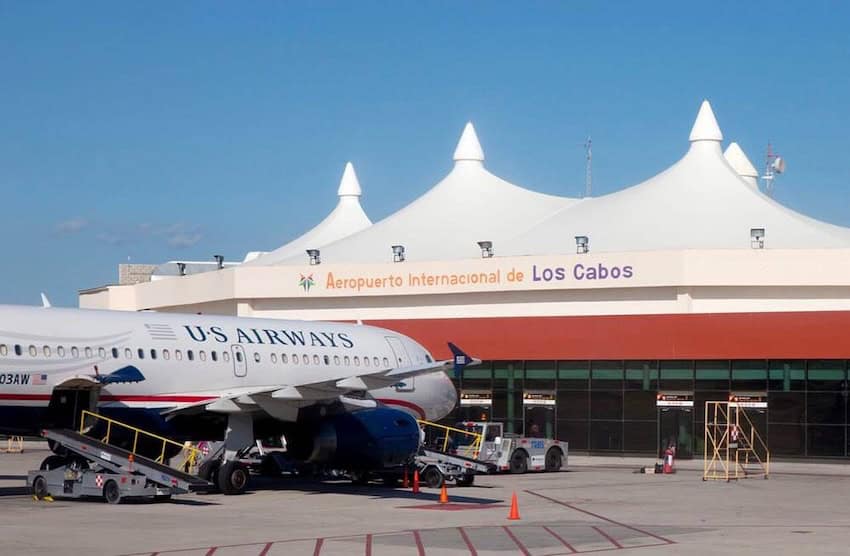
We pass this information to the different hotel associations, to the authorities, for them to understand the feedback that the travelers are providing to us, and the responsibility that we have to build up and finish some infrastructure projects that are needed in the destination, including the airport, roads, housing, energy, water, and many others.
Your website is interactive, and I know you have virtual reality options, too, so people can explore the destination before they decide to visit. Can you talk about why this was so important?
A few years back, when I started, we checked the website and the digital assets, and they were not good. So we started evaluating in 2016 and 2017, and what we needed to do was start from scratch. It was a little bit controversial internally, especially with the hotels. So it was one of those battles that you have, because some people are saying no, don’t invest in the digital assets.
Once we decided that we would do it, we started from scratch, we invested, and thus were able to get to the place where we are now, where we’ve added so many innovative tools that they’ve even been acknowledged as exceptional by tourism industry standards internationally.
It’s a process that started eight years ago. It didn’t happen overnight, because even if you wanted to do it that fast, you couldn’t. For example, on our website, we have 1,200 companies that update their information. So it’s not that our team is updating because there’s just no way we could stay on top of 300 restaurants, plus all the hotels and other companies.
We also have an artificial intelligence chatbot that scrolls around. Things To Do is one of the most visited sections, with a 95% click-through rate, so that travelers looking to find attractions or activities start interacting with the artificial intelligence and find what they’re looking for.
And then we have a virtual reality experience that can be accessed through Apple or Google, for example. We announced it and launched it two months ago. We’ve already been working on the new version that is coming next year. We have to, because the technology advances so fast!
Chris Sands is the Cabo San Lucas local expert for the USA Today travel website 10 Best, writer of Fodor’s Los Cabos travel guidebook and a contributor to numerous websites and publications, including Tasting Table, Marriott Bonvoy Traveler, Forbes Travel Guide, Porthole Cruise, Cabo Living and Mexico News Daily. His specialty is travel-related content and lifestyle features focused on food, wine and golf.
The president discussed stingy cruise ship passengers and a recent meeting with top business leaders on Friday morning. (Presidencia)
Cruise ship tourism and private and public investment were among the topics President Claudia Sheinbaum spoke about at her Friday morning press conference.
Here is a recap of the president’s July 4 mañanera.
Sheinbaum decries scant onshore spending by cruise ship passengers
“Cruise ship tourism is important for the country … but part of what we want is” for passengers to “buy things in Mexico” while they are in the country, she said.
Sheinbaum said that Mexico is seeking a much greater economic benefit from the docking of cruise ships at the nation’s ports.
The president said that cruise ships, and their passengers, “normally bring practically everything” with them and consequently spend little while onshore in Mexico.
Sheinbaum lamented the lack of spending by cruise ship passengers visiting Mexico. (Martín Zetina/Cuartoscuro)
“There is little economic spillover in our country,” she said.
“They get off for a few hours and they get on [the ship] again and leave, in some cases,” Sheinbaum said.
Former tourism minister Miguel Torruco said last year that the average cruise ship tourist expenditure in Mexico was US $83.90 per person.
Sheinbaum said that authorities would like cruise ship passengers to spend more time in Mexico and to purchase more Mexican products, such as arts and crafts. She said that her tourism and culture ministers are working on a project with the National Fund for the Development of Arts and Crafts (Fonart) to make authentic artesanías more accessible to cruise ship passengers.
Her remarks came just three days after Mexico began imposing a US $5 tax on cruise ship tourists, finally implementing a compromise between the government and the cruise ship companies that had lobbied fiercely against the originally proposed $42 levy.
Sheinbaum: Economic impact of Cozumel dock project has to be reviewed
Sheinbaum said that she had spoken to Quintana Roo Governor Mara Lezama about the proposal to build a fourth cruise ship dock in Cozumel, a Caribbean island off the coast of Playa del Carmen.
She said they agreed that the project needs to be reviewed (once again) to determine the “environmental impacts it might have.”
Mexico News Daily reported last month that “advocates for Cozumel’s coral reefs were stunned in April when the federal Environment Ministry greenlit the project to expand a cruise ship port that would allegedly damage the Villa Blanca Reef.”
Opponents say the fourth cruise ship dock planned for Cozumel would damage a locally important coral reef. (File photo)
On Friday morning, Sheinbaum appeared to indicate that she was not in favor of the fourth dock project, at least in its currently proposed location.
“The appeal of Cozumel has a lot to do with the reefs,” she said, adding that conserving them was a matter of “principle.”
“… They’re going to end up destroying the tourism appeal of Cozumel if [the proposed dock] goes over a reef,” Sheinbaum said.
“So it was agreed to review it again and also to speak to the community,” she said.
‘The economy is doing well, the peso is strong,’ Sheinbaum says after meeting with business leaders
A reporter asked the president about her meeting on Thursday with business leaders including Carlos Slim, Mexico’s richest person.
The leader of Mexico’s influential Business Coordinating Council, Francisco Cervantes, was among the other business representatives that attended the meeting with Sheinbaum and other officials, including Altagracia Gómez, head of the government’s Business Advisory Council.
Sheinbaum said that the meeting was “very good” and noted that the business people raised their “different concerns,” including ones about delays in the issuance of permits for projects.
“And what we proposed to them is to invest,” said the president, who said that her government would work “within the framework of the law” to expedite the issuance of permits.
Recibimos en Palacio Nacional a empresarias y empresarios; están optimistas por la situación económica de México y comprometidos con nuestro país. pic.twitter.com/PYm6U3emBS
— Claudia Sheinbaum Pardo (@Claudiashein) July 4, 2025
Slim, via his various companies, is one of the biggest investors and employers in Mexico. In a report last month, Bloomberg described him as Mexico’s “most important oil baron” given his interests in the sector, including as a partner to state oil company Pemex.
Sheinbaum noted that the business people she met with on Thursday, including the CEOs of breadmaker Bimbo and supermarket chain Chedraui, already have investments in many sectors of the economy.
“But there are other areas … where it’s important that they generate value chains with small and medium-sized businesses,” she said.
“The well-being hubs are coming … so what we proposed to them is to invest in the country,” Sheinbaum said.
“In macroeconomic terms, we’re doing well,” she added.
In addition to private investment, Sheinbaum stressed that public investment is also “important.”
“We have that,” she said.
“Public investment this year, counting everything, is around 800 billion pesos [US $42.9 billion],” Sheinbaum said, adding that the outlay on government welfare programs in 2025 will also be about 800 billion pesos.
By Mexico News Daily chief staff writer Peter Davies (peter.davies@mexiconewsdaily.com)
Julio César Chávez Jr., right, was arrested several days after a high-profile boxing match against YouTuber Jake Paul. (Shutterstock)
Julio César Chávez Jr., former world middleweight champion and son of Mexican boxing legend Julio César Chávez, was detained by U.S. immigration agents on Wednesday in the Studio City neighborhood of Los Angeles, California, just days after losing a fight to Jake Paul in Anaheim.
The agents detained Chávez outside his home, on claims that he overstayed his visa and lied on a green card application. He will likely be deported to Mexico, where he faces organized crime charges, including trafficking of arms, ammunition and explosives.
Chávez was detained Wednesday in Los Angeles. (Matt Seedorff/X)
President Claudia Sheinbaum confirmed during her morning press conference on Friday, that the Mexican government will seek the deportation of the boxer so he can serve in Mexico any sentence resulting from the charges.
“We expect that he will be deported and could serve his sentence in Mexico,” Sheinbaum said. “The Attorney General’s Office is working on that process.”
Sheinbaum added that she hadn’t known that Chávez faced charges in Mexico.
“No, I personally wasn’t aware of it,” she said. “Yesterday, as soon as the news came out, we contacted the prosecutor’s office, who told me ‘Yes, there is an arrest warrant in Mexico.'”
The U.S. Department of Homeland Security (DHS) had said there are suspicions about Chávez Jr.’s ties to the Sinaloa Cartel. His defense has denied such accusations, calling them unfounded and sensationalist.
In Mexico, the boxer is accused of connections to a Nogales, Sonora, arms trafficking cell affiliated with Los Chapitos, a faction of the Sinaloa Cartel. U.S. agencies identified the arms trafficking group in 2018, according to the newspaper Reforma.
In 2019, U.S. Immigration and Customs Enforcement (ICE) and the Department of Homeland Security filed a complaint against the group with the Mexican Attorney General’s Office. Following the complaint, the Attorney General’s Office tapped the suspects’ phones.
Based on the wiretaps, authorities learned that when fellow Sinaloa Cartel associates made mistakes, Chávez Jr. allegedly beat them as punishment.
With this information, in January 2023, a federal judge in Hermosillo issued 13 arrest warrants, one of them for the boxer.
On July 2, ICE arrested Mexican boxer and criminal illegal alien Julio Cesar Chavez Jr.
He is now being processed for expedited removal from the United States. This Sinaloa Cartel affiliate has an active arrest warrant in Mexico for his involvement in organized crime and… pic.twitter.com/c4QeRVpCEr
In a statement, the Chávez Jr. family expressed their dismay and asked the public not to make any premature judgments.
“Julio is, above all, a son, a father, and a human being who has faced multiple challenges in his personal and professional life,” the family said. “As a family, we respectfully ask that due process be guaranteed.”
Who is Julio César Chávez Jr.?
Julio César Chávez Jr. was born in 1986 in Culiacán, Sinaloa. He started his boxing career at 17. His greatest achievement was becoming the WBC world middleweight champion in June 2011, a title he successfully defended three times before losing it in 2012.
Throughout his career, he has faced several problems, including doping suspensions (furosemide in 2009 and marijuana in 2012), and criticism for a perceived lack of discipline. In 2012, he was convicted of drunken driving in Los Angeles and sentenced to 13 days in jail. In January 2024, he was again arrested in Los Angeles for possession of an illegal AR-style “ghost rifle.”