MND Local: Is San Miguel de Allende about to receive passenger rail service?

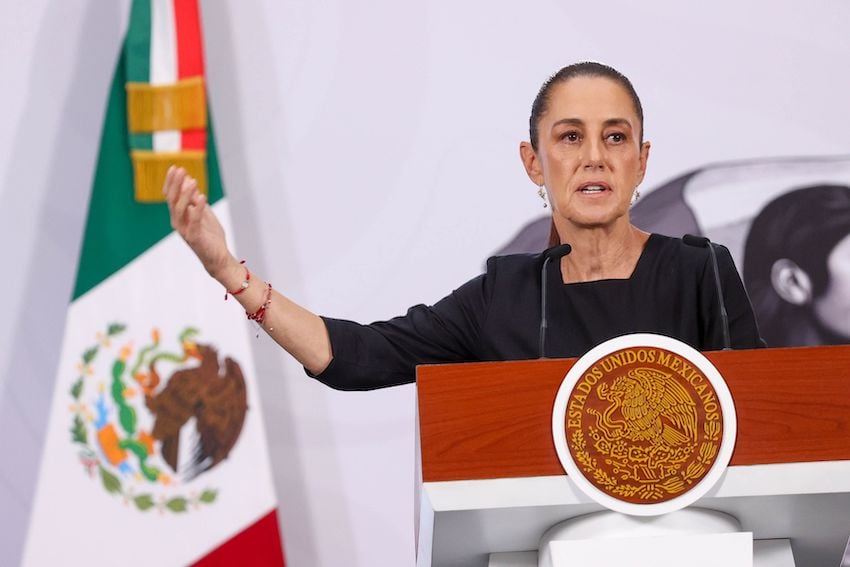
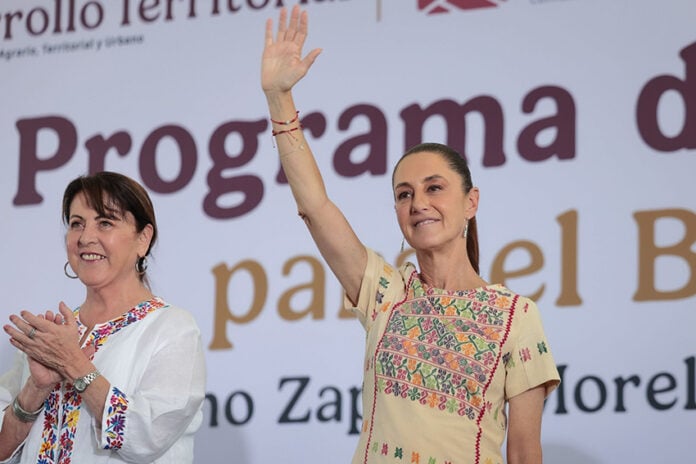
President Claudia Sheinbaum has announced that the passenger train line planned for Querétaro to San Luis Potosí will come through San Miguel in between stops in Comonfort and San Luis de la Paz. The remarks came at her Friday press conference in nearby Irapuato.
San Miguel Mayor Mauricio Trejo noted the development on his Facebook page on Friday but didn’t include any additional details. More than 100 commenters on his post expressed enthusiasm about the development but also wondered whether the train would simply pass through San Miguel or if it will actually stop in the city.
Sheinbaum was accompanied by Andrés Lajous Loaeza, general director of the federal Railway Transport Regulatory Agency, who said that progress was continuing on the Querétaro-to-Irapuato section of the line, which is a distance of about 111 km.
Ground was broken on that US $5.3 billion (90.8 billion pesos) project in September 2025.
The non-electrified passenger line is expected to encourage development in Guanajuato state and also increase connections between the Bajío region and Mexico City through the line from the capital to Querétaro. It is projected to be finished by next year.
Completion of the passenger line from Mexico City to Querétaro is ongoing, but the cost is projected at almost double the original estimate of US $3.7 billion. That route will stop in Tula, Hidalgo and San Juan del Rio.
The federal government plans to build a total of 3,000 km of passenger rail lines during Sheinbaum’s six-year term, a plan she announced even before her inauguration in October 2024.
Cathy Siegner is an independent journalist based in San Miguel and Montana. She has journalism degrees from the University of Oregon and Northwestern University.
Lessons from 52 years of bilingual education in San Miguel: ‘Confidently Wrong’ talks to Escuela Vasconcelos

As we continue to bring you perspectives on raising and educating kids in Mexico, we thought that it would be great to hear first hand from the principal of a school in Mexico that has been teaching young kids in both Spanish and English for 52 years.
Escuela Vasconcelos in San Miguel de Allende is truly a local legend, from its founding so many years ago, to the present day impact that the school has on the local community.
I live near Vasconcelos and know many Mexican and expat families that have sent or currently send their kids there. As a result, I have seen first hand the unique and welcoming culture that the school has built and cultivated over the years. For over five decades now, the school has been a place where Mexican families send their kids to learn in English and foreign families send their kids to learn in Spanish. The mix of families with different backgrounds and experiences makes for a very interesting case study. And as you will hear, the result is a group of very special kids.
In recent episodes of “Confidently Wrong,” we’ve spoken with families from around the world about challenges and delights of raising kids in Mexico.
In this episode, we have a new perspective to share from the educators’ side of the story. Graciela Salazar, principal of Escuela Vasconcelos, has led the school for 9 years. She has a unique take on the issue, as her kids attended the school for years before she began working there. Graciela has seen it both as a mother and as a school principal and shares insight into what makes learning at a bilingual school in a small town such a meaningful experience for kids. This episode will give you perspectives on important questions you may have on topics like:
- How can children with limited Spanish join a bilingual program?
- What does your child do when they hit high school?
- How do kids settle into a learning environment where half of the day is in a different language?
- Can learning happen without constant standardized testing?
Check out this episode, which I am certain you will help you be increasingly less confidently wrong and increasingly more excited and optimistic about the opportunities for your child to study in Mexico. You also find our “Confidently Wrong” podcast on Spotify, here, or on our YouTube channel.
Travis Bembenek is the CEO of Mexico News Daily and has been living, working or playing in Mexico for nearly 30 years.
Uber Eats campaign, ‘La que pica’ celebrates Mexico City’s spiciest salsas

In recent years — amidst the spread of mass tourism and gentrification in Mexico City — there have been rising instances of taquerias “de-spicing” their salsas in order to appease foreigners with tamer palates.
In 2024, The New York Times reported that at least a few taqueros have admitted to lessening the kick in some of their salsas — completely removing serrano chiles from a recipe or adding less habaneros, for example — while others have introduced new salsas to the table as a failsafe option for customers who “would sometimes send tacos back because the salsas had burned their mouths.”
What spicy salsas are meant to be

The New York Times article also revealed that more taquerías have started to clearly label the spice levels of each salsa, something that is generally unheard of in Mexico, where you simply find out the spiciness of anything by tasting it. You know it’s spicy when your nose starts to run or your eyes begin to water up. If you made the wrong choice, you unceremoniously rotate to the next multicolored salsa on the table and take another spin of spice roulette.
Of course, this issue isn’t only about salsas. It’s about maintaining a certain pride and identity of regional Mexican cuisine, globally renowned for its complex heat and wide-ranging varieties — a veritable art form composed from an array of chiles that are native to the vast North American territory, prepared in countless ways.
If it’s spice-less food foreigners are looking for in Latin America, they should maybe check out a country like Costa Rica, Argentina or, ironically, Chile, where the ingredients are relatively less explosive and nowhere near as spicy as what you’ll encounter at a taquería worth its salt (or, in this case, its salsa) in Mexico.
‘La que pica’
Removing the spice from Mexico’s salsas is, in essence, equivalent to deadening its culinary magic. And for many Mexico City locals, the war on salsa has understandably become a source of ongoing frustration — particularly in a shifting city that is already dealing with aggressive changes around rents, the cost of living and transportation.
So in response to it all, Uber Eats, of all saviors — a food delivery app which recently teamed up with FIFA as an official sponsor of the World Cup, and is also a sponsor for the Mexican national soccer team and Liga MX — has now announced the launch of their latest campaign in Mexico: La que pica. Or, roughly translated, “the spicy one.”
The effort involves bringing together 60 taquerías throughout Mexico City, all united under the same Uber Eats branding, to promote the spiciest salsa available at their particular eatery. Whatever in-house salsa that those taqueros have deemed their spiciest gets clearly demarcated in a snazzy bottle that, rightfully, reads: La que pica.
Anti-spicers beware

With messaging like “unidos por el picante” (“united by the spice”) and a street-level billboard on a wall in Mexico City that invited the public to sign their names if they agree that “salsas nunca dejen de picar” (“salsas should never lose their spice”) — accompanied with a cartoony mural of two taqueros carving a trompo (the classic tacos al pastor vertical spit ) that is aflame — Uber Eats seems to be leading the charge against any anti-spicers.
“In Mexico, spice is not an extra; it is identity. With La que pica, we did something bigger than launching salsas. We brought together more than 60 taquerías to defend heat the way it deserves and give it back the place it has always had,” said Emiliano Cortez and Alejandro Rattenbach, Creative Directors at Wieden+Kennedy Mexico, the agency that Uber Eats partnered with for the Mexican-centered campaign.
A spicy manifesto
In a rare act of citywide solidarity, the taqueros agreed to all use the same bottle provided by Uber Eats that, on the back side, extensively denotes its purpose and unapologetically hot manifesto.
Originally printed in Spanish, it reads as translated: “Here ‘the spicy one’ is actually spicy. Not a little spicy or barely spicy, but spicy as it’s meant to be: to give it flavor. When you ask for ‘the spicy one’ at this taquería, you are also asking to sweat, to curse, to tear up. This is a salsa born from taqueros who are tired of tomato sauces disguised as salsas. From those who decided, ‘This needs to be crazy spicy.’ Now enjoy your salsa however you like, sweating or cursing, as this salsa will not disappoint you.”
Milenio reports that the 60 partner taquerías include a mix of neighborhood haunts — Las Cebollas and Bigos Tacos, for instance — as well as famed attractions that celebrities like Katy Perry have been spotted at — Atarantados, El Califa, Copacabana. They’re not confined to the brick-and-mortar locations, either: You can have the special salsas delivered as part of your Uber Eats order.
Marketing initiative set to coincide with the FIFA World Cup in Mexico
The marketing initiative was originally launched on Jan. 16 — International Spicy Food Day, which honors spicy foods worldwide and also Wilbur Scoville, a U.S. pharmacist and chemist who invented the Scoville Heat Test in 1912 to measure the force of every pepper’s bite.

Perhaps more taquerías will join the battle as time goes on. With the World Cup slated for this summer, tourists will likely flood Mexico’s streets in record numbers — with Jurgen Mainka, director of the FIFA Office in Mexico, reporting no fewer than 500 million ticket requests to date.
To be sure, those visitors should all be greeted in the most Mexican way possible: with unrelenting heat on the tongue.
Alan Chazaro is the author of “These Spaceships Weren’t Built For Us” (Tia Chucha Press, 2026), “Notes from the Eastern Span of the Bay Bridge” (Ghost City Press, 2021), “Piñata Theory” (Black Lawrence Press, 2020), and “This Is Not a Frank Ocean Cover Album” (Black Lawrence Press, 2019). He is a graduate of June Jordan’s Poetry for the People program at UC Berkeley and was selected as a Lawrence Ferlinghetti Poetry Fellow at the University of San Francisco. His work can be found in NPR, The Guardian, SLAM, GQ, L.A. Times, and more. He is currently based in Veracruz.
Why does the Mexican class comedy ‘Nosotros Los Nobles’ resonate so well with me?
Those of you who’ve been reading me for a while now, here and elsewhere, know that I have a keen interest in matters of income stratification and social class.
I grew up in a lower-middle-class household: My parents made it work paycheck-to-paycheck. Most of my clothes as a kid came from a family at our church who had girls slightly older than my sister and me. They were always hopelessly out of style, and one of my most enduring fantasies was being able to pick out my clothes for the day from a department store for free (when we got new clothes, they usually came from Walmart, which, honestly … the clothes there are not that bad).
Growing up not so rich

Any vacations we took were typically to the next city over — Austin, here we come! — for a day or two. We enjoyed some “upper-middle-class” advantages too: My grandmother paid for my ballet lessons and braces, for example. Her brother, my wealthy uncle, paid for our college educations. If it weren’t for that trust fund, I’d very likely be a secretary somewhere in Texas right now.
Basically, we grew up in the 1980s just as Reagan was changing the social contract in a way that made sure some would get to become fabulously wealthy at workers’ expense. (See Michael Moore’s “Roger and Me.”)
But then, here in Mexico, I was plopped into the “middle class” essentially by default, a disorienting change to be sure that I’ve still not completely grown used to. At first, I lived with my boyfriend in a two-room apartment with no bathroom door and an outside sink. We eventually moved to a place with an actual kitchen, and later, when I got a job at an American school, I bought my first car ever — a used standard shift Pontiac Matiz with no power steering. My arms got super strong!
Achieving a better standard of living
Later, the ability to “work in the U.S.” online while living here has essentially allowed me to achieve certain aspects of the American dream that would be out of reach in my own country. I still don’t — and probably won’t ever — own a home, but I do have a (nicer) car. And I rent a pretty nice home. And sometimes I can travel, just for fun.
While I’ve had my share of financial trouble, it’s a lot less than most people could ask for. Currently, for all intents and purposes, I’m leading a pretty upper-middle-class lifestyle. A few key factors may be missing at the ground level, but the veneer gives that effect, at least.
Pretty much all societies are stratified. And while economic and class differences appear in every society, I’ve found the particular shape of them in Mexico to be especially fascinating — and, let’s face it, often maddening.
‘Nosotros Los Nobles’
The Mexican movie “Nosotros Los Nobles” has been on my radar for a long time. While I’d seen clips of it here and there, I just now got around to watching the whole thing. It came out the year my daughter was born, in 2013, and, well, you know how hard it is to find leisure time when you’ve got a little kid.
But now she’s 12, so I made her turn off her emotional comfort show, “Bob’s Burgers,” and watch it with me.
“Nosotros Los Nobles” has a pretty predictable plot once you know the premise. It centers around a wealthy family — you guessed it, the Nobles! — with three adult children. The adult children behave as you’d guess adult children who’d had everything given to them might behave.
The patriarch of the family, the owner of a successful Mexico City company, is a serious and ethical hard worker. He looks around at his children: His oldest son, set to inherit the business, is a classic mirrey doofus who thinks he’s a genius. His daughter is a beautiful jerk, the kind who’s mean to waiters and easily insulted. His youngest son is a pot-smoking university student with a habit of seducing his older female professors. He enjoys both denouncing capitalism and being on the winning side of the game.
The patriarch decides something must be done, so he hatches a plan with his business partner. He stages it perfectly: The kids’ phones and credit cards are cancelled. When they arrive home, their cars are taken and the home is foreclosed. In a taxi, they go to an old, decrepit house, and the dad announces that they are broke and will have to get jobs.
With a palanca from their nanny’s nephew, the mirrey starts driving a bus. The princesa begins work as a waitress, and the hippie gets a godín job as a bank teller.

Because this is a somewhat predictable movie, they learn to cope and even sometimes find joy. There are a few happy dinners around their meager meals of tortillas and beans.
I won’t give away any more than that, but if you’re in Mexico, you can watch the movie on HBO.
Teaching the rich and privileged
Watching this hit home for me. Not because I’ve ever lived as this family has, but from my time teaching at an American school in Querétaro.
Most of the students, to be clear, were lovely, thoughtful human beings. Most of them also lived opulent lives compared to the rest of the country (and to me). And just like sheltered and privileged kids all over the world, most didn’t realize how good they had it.
Nearly all had full-time staff working in their homes for the family, and a few even had bodyguards waiting for them just outside the parking lot. Enough of them to make it clear the level of impunity they knew they possessed.
They were the children of the city’s elite. Personally, it was my first time interacting with this strata of Mexican society, and it was hard not to feel both shock and, yes, jealousy; we’d grown up in 100% different worlds, and it was hard to see such privileged people whine and complain about downright frivolities — as all teenagers do, to be fair.

When a kid who could barely write his own name pulled up next to me in a Jaguar one morning, I decided I’d just about had it. I felt, suddenly, that I was also a mere servant employed by these wealthy families who controlled the city. My skills were more intellectual than physical, but my role was clear.
Struggling with a new reality
“Nosotros Los Nobles” did very well, as you can probably imagine.
Collectively, one of our favorite types of stories is getting to watch people who think they’re better than everyone else get cut down to size. I don’t mean, like, physically tortured — see “Nuevo Orden” — but made to struggle like the rest of us.
Watching the characters struggle in their new reality and become better for it will always be a crowd-pleaser. And while this is a very neatly wrapped-up narrative of the upper class versus the working class in Mexico, it’s still informative.
I no longer work at a school for the children of the upper crust. But, amazingly, one of my current neighbors is an ex-student of mine from that school. We grew up in very different worlds, it’s true. And I personally will never quite feel like I “fit in” with the class I’m currently a part of here in Mexico.
But those differences are few when it comes to the human experience. She is lovely and is now a good friend of mine. A breach that felt gigantic before no longer is. Is my newfound comfort a result of my own social mobility or simply a result of growing up?
In the end, “Nosotros Los Nobles” is a “here’s the worst” kind of movie. But “the best” is also out there.
Sarah DeVries is a writer and translator based in Xalapa, Veracruz. She can be reached through her website, sarahedevries.substack.com.

Cayao and the expanding Pacific horizons of Los Cabos cuisine
There are things to complain about in Los Cabos. But the quality of food is not one of them, as over the past 30 years, the area has evolved from comfort food and “you-hook-it-we-cook-it” seafood offerings to a world-class culinary capital, attracting some of the world’s top chefs along the way.
The latest example of this is Cayao, the Richard Sandoval restaurant at the Four Seasons Resort and Residences Cabo San Lucas at Cabo del Sol. As the name — a stylized version of Callao, the Peruvian city — suggests, Cayao specializes in Nikkei cuisine, the fusion of Japanese and Peruvian techniques, ingredients and flavors that has proven increasingly popular in recent years.
A new destination dining restaurant in Los Cabos
View this post on Instagram
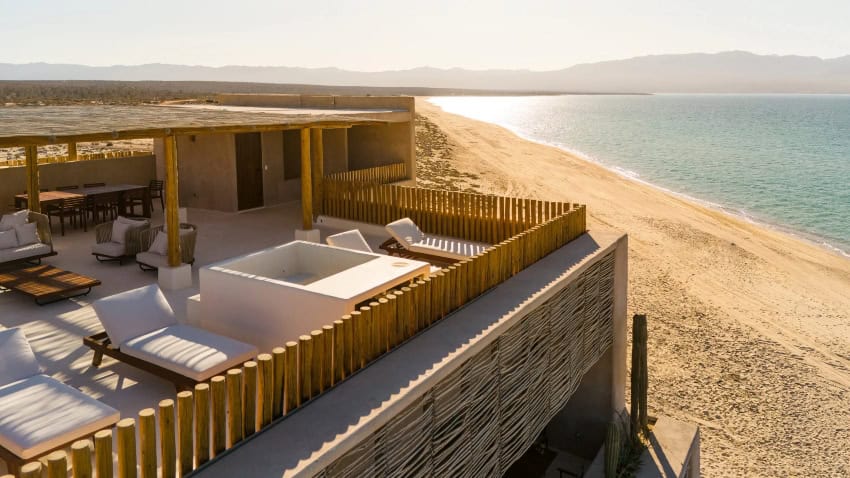
It’s not just tiraditos and ceviches, Nikkei favorites, that distinguish Cayao, which opened at the Four Seasons resort five months after the property premiered in May 2024. Its coastal setting overlooking the Sea of Cortés (as the Gulf of California is always called in Los Cabos) and Punta Ballena, the evocatively whale-shaped headland that is a staple of views at Cabo del Sol, is exceedingly picturesque, particularly at sunset. Downright beautiful, in fact.
The service, first-class but with the informality characteristic of laid-back luxury of Los Cabos, is likewise excellent. But what really sets Cayao apart are the talented chefs involved in creating its dishes. Not just Sandoval, whose conceptual vision and consultations shape Cayao, but also Michoacano Miguel Baltazar, the resort’s executive chef, and Gino Dávila, the Jalisco native who runs the restaurant on a night-to-night basis.
“When I heard about Cayao at Four Seasons Resort and Residences Cabo San Lucas at Cabo del Sol, I knew it was an exciting opportunity,” Dávila said upon taking the job. “Here, we can take inspiration from the richness of Baja’s ingredients and combine them with thoughtful, precise techniques. It’s about creating honest food full of flavor and texture that guests remember.”
The flavors are exceptional, and yes, especially in the ceviches and tiraditos: like the Cayao ceviche made with shrimp, scallops, octopus, sriracha and coconut foam; and the kampachi tiradito with coconut leche de tigre (tiger’s milk), a Peruvian marinade popular with seafood dishes. But creative flavors are present even in more standard menu items like the rib-eye steak, served here with yuzu kosho chimichurri — a Japanese-Argentine fusion — and yakiniku, a Japanese BBQ dipping sauce.
Indeed, Cayao is one of the best restaurants in Los Cabos, and another in an increasingly long line of those embracing Pan-Pacific fusions.
The Pan-Pacific embrace among high-end Los Cabos restaurants
When Enrique Olvera, the acclaimed chef behind the two Michelin stars awarded Pujol in Mexico City, opened Manta at The Cape Hotel in Los Cabos in 2015, he told me: “Baja has a Pacific influence, so that’s why we’re playing around with Peruvian and Japanese flavors; because a sashimi, a tiradito and a Mexican ceviche have a common language.”

Olvera was hardly the first to take a Pan-Pacific culinary approach in Los Cabos. Chefs Ángel Carbajal and Masayuki Niikura had been fusing Japanese techniques with Mexican ingredients at Nick-San in Cabo San Lucas since 1994, and Chef Volker Romeike pioneered “Pacific-Rim” fusions at Pitahayas Restaurant as early as 1995.
But Olvera was part of the culinary shift away from “Baja Med,” the Mediterranean fusion style developed in Baja California cities like Tijuana and Ensenada during the early 2000s — notably, by Chefs Miguel Ángel Guerrero and Javier Plascencia — that had become very influential in Los Cabos, and back towards the Pacific orientation which has always seemed more appropriate for Pacific-facing Los Cabos. As was Sandoval, whose Toro Latin Kitchen and Bar opened in late 2015, pairing Mexican and South American influences with Asian ones. Toro, after all, not only means “bull” in Spanish but also “tuna belly” in Japanese.
Chef Nobu Matsuhisa, whose early Nobu restaurants in Los Angeles and New York helped put Nikkei cuisine on the map, had opened a Nobu Restaurant at the Nobu Hotel in Cabo San Lucas by 2019, furthering the local trend towards Pan-Pacific fusions.
Richard Sandoval’s global influence and Los Cabos legacy
Although Matsuhisa and Sandoval both feature Nikkei cuisine at restaurants in Los Cabos, their approaches are different. Yes, each chef puts a high premium on locally sourced ingredients and sustainability. At Cayao, Sandoval sources almost all of his seafood from the Baja California peninsula — bluefin tuna and oysters from Ensenada, soft-shell crab from La Paz, for instance — with only a few shellfish like shrimp and scallops coming from Sonora.
But the Mexico City-born Sandoval is much more committed to Mexican influences, and it bears noting that he is without equal in taking Mexican cuisine around the globe. To date, he has opened some 60 restaurants across four continents. No other Mexican chef comes close. Olvera, his closest competitor among celebrated Mexican chefs, has opened 14 restaurants in North America and Europe.
Sandoval has also established a significant legacy in Los Cabos, with Cayao being his third restaurant locally, following the aforementioned Toro in 2015 and La Biblioteca de Tequila (since closed) at Breathless Resort in Cabo San Lucas in 2016.
The many attractions of the Four Seasons Resort and Residences Cabo San Lucas at Cabo del Sol

Cayao is a very good reason to visit the Four Seasons Resort and Residences Cabo San Lucas at Cabo del Sol, for guests and locals alike; yes, the latter are welcome at the resort, although reservations are recommended for restaurant dinners.
But there are so many more. For starters, you can arrive early and walk (or take the elevator) up to Sora, the rooftop bar that is a perfect place for a pre-dinner cocktail, wine or beer (try the Piedra Lisa, a Colima IPA). The Mercado near the lobby is also worth visiting, with its selection of wines and artisanal Mexican products, plus fresh coffee, pastries and a superb selection of gelatos. The best time to visit is on Friday nights, when the resort hosts its weekly La Plaza Mágica, with a mariachi band playing in the central plaza and open access to resort features like the Mercado, the mezcal-rich lobby bar and El Taller, the art studio which showcases work from local artists.
The name La Plaza Mágica is inspired by Mexico’s Pueblos Mágicos and there is something magical about it. On my first visit, a mule deer went bounding by on the Uber drive out. It was the largest buck I have ever seen in Los Cabos, and as strikingly magnificent as one would expect at a thousand-dollar-a-night Four Seasons property.
Chris Sands is the former local expert for Cabo San Lucas on the USA Today travel website 10 Best and the writer of Fodor’s Los Cabos travel guidebook. He’s a contributor to numerous websites and publications, including Tasting Table, Marriott Bonvoy Traveler, Forbes Travel Guide, Porthole Cruise, Cabo Living and Mexico News Daily.
In Mexico City, AICM traffic falls for second straight year while AIFA gains ground

Although the Felipe Ángeles International Airport (AIFA) grew moderately in 2025, air connectivity in central Mexico shrank, impacted by U.S. sanctions, restricted operations and ongoing renovations at Mexico City’s main airport.
Combined, the Mexico City International Airport (AICM) and the AIFA handled 51.7 million passengers last year, representing a 0.04% decrease compared to 2024, even as air traffic increased by 2.6% nationally, with 191.2 million passengers served.
“Undoubtedly, last year was challenging for the aviation sector in central Mexico, but this didn’t stop airlines from investing in opening new routes at other airports,” an official with the Federal Civil Aviation Agency told El Economista newspaper.
Key factors contributing to the decline in central Mexico cited by El Economista include: the extended engine overhauls for Viva and Volaris aircraft; the U.S. government’s October decision to revoke approval of new flights; and the restrictions on hourly operations and ongoing renovations at the AICM.
Whereas AIFA passengers increased by 11.5% to 7.1 million last year, the AICM saw air traffic fall 1.7% to 44.6 million people. This represents the second consecutive decline at the country’s busiest airport after it experienced a 6.2% decrease in 2024.
The AICM served 753,685 fewer passengers in 2025 compared to the previous year, while the AIFA saw 730,989 more passengers last year than in 2024.
El Economista termed the results a disappointment for the government, which has been determined to promote AIFA as a transportation alternative to the saturaed AICM.
Government officials are confident the downturn at the AICM will be reversed this year as the 2026 World Cup is scheduled to begin in Mexico City in June and the U.S. government is expected to lift the restrictions on new flights soon.
Additionally, the first stage of remodeling at the AICM is nearing completion, allowing operations to increase from 44 operations per hour to at least 48.
With reports from El Economista, Quadratín EMX and Polemón
US Supreme Court strikes down Trump’s tariffs: What does it mean for Mexico?

The U.S. Supreme Court ruled 6-3 on Friday that U.S. President Donald Trump improperly used a federal law reserved for a national emergency to impose sweeping tariffs on much of the world, and called the import taxes “unlawfully collected.”
The ruling strikes down many, but not all, of Trump’s tariffs, and will impact U.S. importers more so than countries exporting goods to the U.S.

As a formal trading partner, Mexico was exempt from many of Trump’s tariff but enough applied to cause pain. Among the tariffs affecting Mexico that the Court invalidated were reciprocal tariffs (25% to 50% levies on a variety of goods such as energy exports, automobiles, auto parts, and steel and aluminum products) and so-called fentanyl tariffs (25% tariffs imposed citing cross-border flows of fentanyl as justification).
Trump had established the global tariffs citing authorization under the International Emergency Economic Powers Act (IEEPA), declaring a variety of economic emergencies over issues ranging from fentanyl to undocumented immigration and trade imbalances.
That was the Trump tariff policy’s Achilles heel, and the Supreme Court aimed its spear directly at it.
“IEEPA does not authorize the President to impose tariffs,” read the decision by Chief Justice John Roberts, who added that Trump had improperly asserted “the extraordinary power to unilaterally impose tariffs of unlimited amount, duration, and scope.”
The U.S. Chamber of Commerce immediately called for “swift refunds of the impermissible tariffs,” although it had in mind U.S. importers, rather than the foreign exporters sending to the U.S. goods subject to tariffs. In a statement, it said getting money back “will be meaningful for the more than 200,000 small business importers in this country and will help support stronger economic growth this year.”
However, there remains much uncertainty about whether the decision will require the Trump administration to refund billions in tariff revenue it has collected this year. The majority offered no clarity on the specific practical question of what to do with the money the administration has already collected through Trump’s tariffs.
Trump himself said there are no plans to refund companies that paid for his tariffs because the Court didn’t address that in the ruling. Other U.S. government officials say potential repayments could have devastating consequences for the U.S. economy.
Justice Brett Kavanaugh cited that same concern in his dissent. “The United States may be required to refund billions of dollars to importers who paid the IEEPA tariffs, even though some importers may have already passed on costs to consumers or others.”
The Supreme Court has struck down Trump’s unlawful tariffs, which we’ve been paying for about a year now. This is good news for the American people – and it’s the latest proof that this president, no matter what he says, can be stopped. pic.twitter.com/J95DWVydKt
— Pete Buttigieg (@PeteButtigieg) February 20, 2026
On Wednesday, Sheinbaum had expressed hope that U.S. tariffs of 50% on Mexican steel and aluminum would be reduced, noting that the duties also apply to products derived from those metals.
Still, Expansión magazine reported that despite the Supreme Court ruling the White House retains legal alternatives to sustain revenue collection and trade pressure, suggesting that Mexico is likely to take a “wait-and-see” approach.
For example, Expansión noted that Section 122 of the U.S. Trade Act — an alternative instrument that authorizes temporary tariffs of up to 15% in the event of “large and serious” deficits in the U.S. balance of payments — “allows action without prior congressional approval, but only for a maximum period of 150 days.”
Indeed, hours after the ruling, Trump said he would sign an order to “impose a 10% global tariff under Section 122.”
With reports from The Associated Press, CNN, NBC News, Reforma and Expansión
Authorities report steep drop in crime in Guanajuato: Friday’s mañanera recapped

President Claudia Sheinbaum held her Friday morning press conference in Irapuato, a city in Guanajuato known as “the strawberry capital of the world.”
Unfortunately, the city is also known for violence, ranking as Mexico’s 50th most violent municipality in 2025 based on its per capita homicide rate.

Guanajuato, meanwhile, was once again Mexico’s most violent state in 2025 based on total homicides.
However, at Sheinbaum’s Friday mañanera, security officials provided some hope for residents of the Bajío region state, presenting data that shows that homicides are down and that thousands of alleged criminals have been detained over the past 16 months.
Later in the press conference, Security Minister Omar García Harfuch spoke briefly about the apparent abduction case involving the mother of a well-known television presenter, while Sheinbaum explained why she opposes the proposed abbreviation of a new political party.
Homicides decline 62% in January
National Public Security System chief Marcela Figueroa presented preliminary data that showed there was an average of 4.45 homicides per day in Guanajuato in January, a reduction of 62% compared to the same month of 2025.
She highlighted that the daily murder rate in Guanajuato in January was the lowest for any month since Sheinbaum took office in October 2024.
Figueroa also reported that the state’s average daily homicide rate was 7 in 2025, down 19% from 8.6 in 2024.
Sheinbaum acknowledged that Guanajuato still ranks. No. 1 for murders among Mexico’s 32 federal entities, but described the reduction in homicides as “very significant.”
Most of the homicides in Guanajuato are related to organized crime. Various crime groups operate in the state, including the Jalisco New Generation Cartel and the Santa Lima de Rosa, which have been fighting each other for years.
More than 4,000 arrests in Guanajuato since Sheinbaum took office
García Harfuch told reporters that improving the security situation in Guanajuato has been a priority for the federal government since Sheinbaum took office.
The security minister reported that 4,400 people were arrested in the state between Oct. 1, 2024, and Feb. 15, 2026.

García Harfuch said that more than 5 tonnes of drugs and over 6,400 firearms were seized in Guanajuato in the same period.
He noted that homicides in Guanajuato began to decline significantly after the arrest in March 2025 of nine people accused of homicide and various other crimes in the state.
‘No indication’ that Savannah Guthrie’s missing mother is in Mexico
Later in the press conference, a reporter noted that a U.S. media outlet — TMZ — reported that the FBI had contacted Mexican authorities in relation to the search for Nancy Guthrie, the 84-year-old mother of Savannah Guthrie, a co-anchor of NBC News’ morning show “Today.”
TMZ reported that “our sources say the FBI believes it’s possible Nancy was taken across the border, but it’s unlikely it happened directly after the kidnapping.”
According to The New York Times, authorities have said they believe Nancy Guthrie was abducted from her home near Tucson, Arizona, on Feb. 1.
García Harfuch said that Mexican authorities contacted the FBI and found out that “there is no line [of inquiry] that points to Sonora” or anywhere else in Mexico as being locations of interest in the investigation into Guthrie’s whereabouts.
He stressed that there is “no indication” that Guthrie had been brought to Mexico.

Sheinbaum: ‘You can’t use a person’s name’ for a political party
A reporter noted that the National Electoral Institute (INE) didn’t rule against a federal deputy’s plan to use the initials CSP for a new political party he plans to create.
The legal department of the president’s office asked the INE to disallow the use of CSP as the abbreviation for a political party called Construyendo Sociedades de Paz (Building Peaceful Societies) as those letters are the initials of the president, whose full name is Claudia Sheinbaum Pardo.
“How can an organization bear the initials of the president?” Sheinbaum asked.
“That’s why the [legal] department presented this request,” she said before noting that the challenge against the use of the CSP initials would now be taken to the Federal Electoral Tribunal.
“My initials aren’t so well known, but imagine if a political party called itself AMLO,” Sheinbaum said, referring to ex-president Andrés Manuel López Obrador.
“… You can’t use a person’t name,” she added.
The deputy attempting to use the initials CSP for his political party is Hugo Eric Flores, founder of the now-defunct Social Encounter Party.
By Mexico News Daily chief staff writer Peter Davies (peter.davies@mexiconewsdaily.com)
Tulum airport to host NASCAR’s return to Mexico in April

NASCAR is returning to Mexico in 2026, but this time it’s the domestic NASCAR México Series — and the venue is an active airport on the Caribbean coast, not the famed Mexico City Formula 1 circuit.
Felipe Carrillo Puerto International Airport in Tulum, Quintana Roo, will be converted into a temporary oval April 25-26 for the third weekend of the 2026 NASCAR México season, officials announced this week.
The racing will be a paid portion of the new, mostly free Tulum Air Show, organized by the Mexican Air Force and the Mexico Aerospace Fair (Famex).
The four-day program April 23-26 will mix stock-car races with aerobatic displays (involving F-5 jets, helicopters, drones and other devices), aerospace exhibitions and safety workshops at Military Air Base No. 20 and adjoining airport facilities.
The invitation to race in Tulum came from Famex, not from NASCAR México, officials said.
“The project has accumulated over six months of joint work with the Air Force, and the intention is to turn this participation into a recurring relationship with Famex,” NASCAR México president Jimmy Morales said at a news conference Tuesday.
Organizers project roughly 30,000 attendees across the air and racing components. The latter will include the usual practice and qualifying sessions and two races: the main event in the NASCAR México Series and a second-tier Challenge Series race.
As of now, the main event has not been given a name; last year’s NASCAR Cup Series main event in Mexico City was the Viva México 250.
Moreover, organizers haven’t given specifics on the footprint of the racing oval, such as whether it will use parts of the airfield and runway.
The race will underscore how different this event is from last year’s high-profile NASCAR Cup Series debut in Mexico City in June, a points-scoring race at Autódromo Hermanos Rodríguez that included all of the eventual top-12 finishers in NASCAR’s 2025 standings.
That 100-lap race was won by New Zealander Shane van Gisbergen in front of a “sparse” crowd within the 100,000-capacity facility, “with many grandstands empty,” as reported by Autoracing1.com.
Though NASCAR does not announce attendance figures, the fan mag noted “there were reports in Mexico that they sold only 15,000 grandstand seats and the rest were freebies.”
Recuerda Tulum Air Show del 23 al 26 de abril, esta confirmada la participación de #Nascarmexicoseries pic.twitter.com/oQjQqYXMh3
— Feria Aeroespacial México (@FAMEXTweet) February 19, 2026
Citing scheduling conflicts around the 2026 FIFA World Cup in Mexico City and travel logistics, NASCAR opted to drop Mexico City from the 2026 NASCAR Cup schedule, with some reports also questioning the economics of the event.
There was talk for a while that IndyCar would fill the void, but the open-wheel racing series best known for the Indianapolis 500 announced it will not visit CDMX in 2026.
The racing circuit that will visit Mexico City in 2026 is Formula 1, which will be back for the Mexico City Grand Prix on Nov. 1, preceded by two days practice sessions and qualifying.
In addition, Mexico City will be hosting a massive interactive showcase called the Formula 1 Exhibition starting March 20.
Organizers for the NASCAR México weekend in Tulum say they expect to max out hotel capacity in a tourism market that is generally saturated but has been slumping recently.
NASCAR México will kick off its 12-race 2026 season March 14-15 in San Luis Potosí and conclude it Nov. 14-15 in Puebla.
With reports from Lapeando, El Economista, Excélsior, NASCAR.com and The Athletic