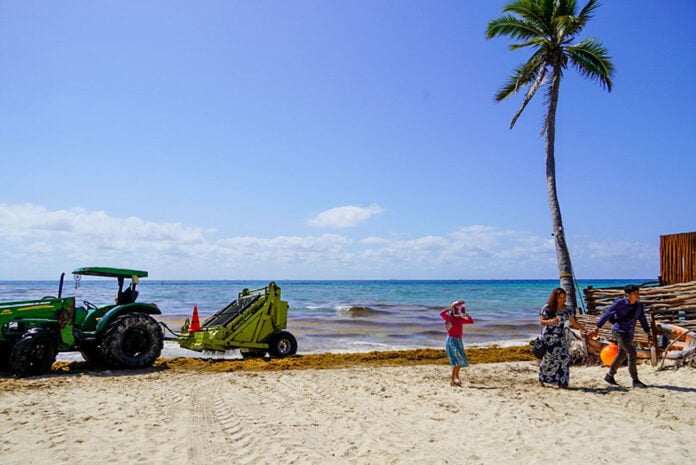
A bulldozer clears sargassum from Playa 38 in Playa del Carmen on April 24. (Elizabeth Ruiz / Cuartoscuro)
Authorities are preparing for an intense sargassum season as large quantities of the seaweed begin to arrive on Quintana Roo beaches. Fifteen hard-hit beaches in the north of the state have been designated as “red zones,” and satellite imagery shows millions of metric tons offshore threatening Caribbean destinations.
The massive influx of the gulfweed this week — 25,000 metric tons has already been collected — prompted Playa del Carmen authorities to declare a red alert on Thursday.
Of the 140 beaches the state Sargassum Monitoring Center supervises, 15 in northern Quintana Roo were considered “red zones” due to the amount of algae present. Business owners in southern Quintana Roo have also indicated sargassum blooms are reaching shores there.
Last year, 96,000 metric tons of the smelly algae were collected on state beaches, and officials expect an increase of 25% to 30% this year.
Mexico’s National Laboratory of Earth Observation (NALOT) projects that 40 million metric tons of the sargassum biomass will develop in the Atlantic Ocean this year and state officials are preparing to deal with up to 130,000 metric tons of the brown seaweed.
Monitoring Center Director Esteban Amaro said collective action to battle the sargassum is off to a good start. In addition to state authorities, business owners and representatives from federal and municipal governments are intensifying clean-up efforts.
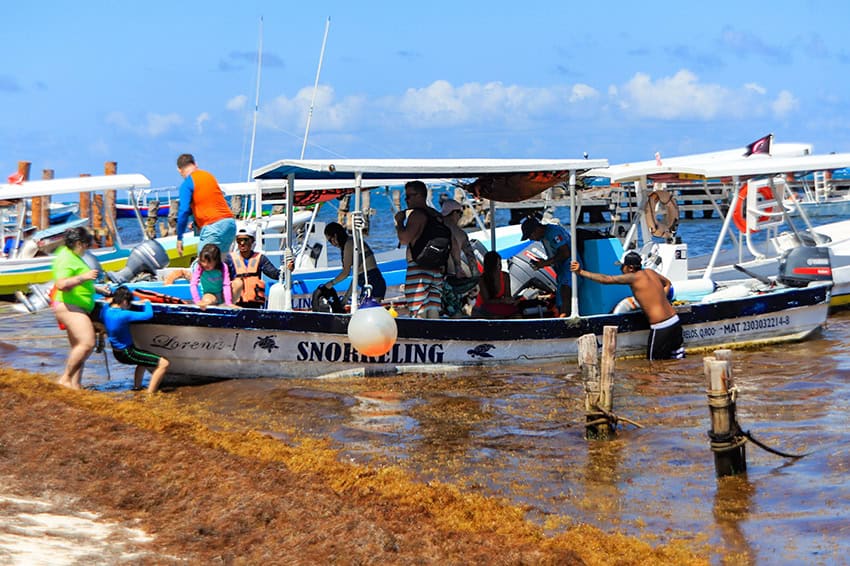
Tourists navigate a soupy mix of seaweed on Tuesday in Tulum. (Elizabeth Ruiz / Cuartoscuro)
The Navy began installing containment barriers along 90 kilometers of coastline in January, while local officials have utilized so-called artisanal barriers made from five-liter plastic bottles, which are formed into chains in hopes of preventing the arrival of the algae.
However, the effort is proving to be insufficient given the large amount of sargassum that reaches the shores.
“As it decomposes, it sinks, allowing it to pass underneath the barriers,” NALOT’s Jorge Prado said. “This causes the brown tide.”
Prado also described the environmental and economic problems beyond the direct impact on tourism.
“The phenomenon has health impacts, too,” he said, “as the material captures arsenic, mercury and cadmium from the ocean, making it unsuitable for animal feed.”
Sargassum may have other uses, however, and organizations like the Mexican Institute for Research in Sustainable Fisheries and Aquaculture are working with the private sector to identify ways to use it as a raw material.
Clearing the beaches of the noxious seaweed also requires special care.
“If it is deposited in the jungle … it can contaminate aquifers,” Prado said. “And removing it mechanically causes damage because it removes some of the sand.”
For his part, Amaro is hopeful this year’s sargassum season will end earlier than normal.
“Since it started in January, three months earlier than usual, it could also end early,” he said, explaining that a typical season lasts six months. Still, he said, May, June and July are expected to be the most intense months.
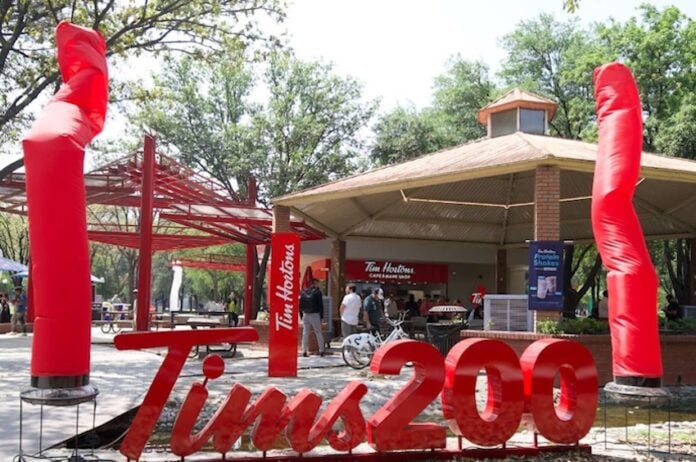
The quick-service restaurant's decision to locate its 200th shop in Monterrey's Fundidora Park is expected to breathe new life into one of the emblematic sites in the Nuevo León state capital. (Tim Hortons / Facebook)
Tim Hortons, the Canadian quick-service restaurant chain beloved by Canadians since 1964 and by Mexicans since 2017, opened its 200th Mexican shop last week with a new construction inside Fundidora Park in Monterrey.
Besides consolidating the business’s presence in northern Mexico, the ribbon-cutting ceremony represented a strategic alliance between the restaurant and the municipality that aims to revitalize one of the Nuevo León state capital’s most recognizable spaces, according to company official Juan José Gutiérrez Chapa.
“This new branch represents the beginning of a special bond: a meeting of paths that seeks to give new life and enhance one of the most important spaces in [Monterrey],” he said, referring to Fundidora Park, named for the steel foundry whose former site the park occupies.
Known for its “Always Fresh” coffee (which the company proudly asserts is 100% Mexican), Timbits (donut holes), donuts and breakfast sandwiches, Canada’s largest restaurant chain was founded in 1964 by hockey player Tim Horton and has become a major Canadian cultural symbol.
The company opened its first store in Mexico on Oct. 27, 2017, in the Fashion Drive Mall in San Pedro Garza García, Nuevo León, about 14 miles southwest of the 200th Tim Hortons.
At last Friday’s inauguration, Gutiérrez Chapa was joined by Tim Hortons company board member Pedro Chapa Chávez and trustees of Fundidora Park, reinforcing the joint commitment to promoting the development and conservation of the emblematic urban park.
The new restaurant was designed to integrate organically into the environment, as if it had always been part of it. The company worked hard “to respect the park’s essence and provide a warm and harmonious presence.”
“We’re doing more than just enhancing the visitor experience here,” Gutiérrez Chapa said. “We are contributing to local economic development through job creation.”
Each Tim Hortons employs more than 25 people, he said, adding that the company employs more than 2,500 people nationwide.
Gutiérrez Chapa said Tim Hortons is not going to rest easy after opening 200 stores in less than 10 years.
“Our goal is to open 500 branches by 2030, and we are confident that at the rate we are going, we will achieve this,” he said.
After an opposition party governor found herself in trouble over alleged, possibly illegal
CIA operations in Chihuahua, the U.S. announced narco-trafficking charges against another state governor — Morena party ally Rubén Rocha Moya in Sinaloa. President Sheinbaum addressed the conundrum at her Friday morning press conference. (Presidencia via Cuartoscuro)
Sheinbaum’s mañanera in 60 seconds
🌱 A ‘labor spring’ on Workers’ Day: Labor Minister Marath Bolaños marked May 1 by highlighting 4T-era gains: the daily minimum wage has risen from 88 to 315 pesos since 2018, unemployment has dropped from 3.7% to 2.4%, and a phased reform will cut the standard workweek from 48 to 40 hours by 2030.
⚖️ Sovereignty a priority in Sinaloa governor case: Sheinbaum denied she is caught between a rock and a hard place over the U.S. drug trafficking case against Sinaloa Gov. Rubén Rocha Moya. She reiterated that the Federal Attorney General’s Office — not U.S. authorities — will determine whether sufficient evidence exists to approve extradition.
⛽ Government caps fuel prices: With oil prices climbing to around $120 a barrel, Sheinbaum highlighted price cap agreements with gas station chains that hold gasoline below 24 pesos per liter and diesel at 27 pesos — levels she said would otherwise have exceeded 30 and 35 pesos, respectively.
Why today’s mañanera matters
Two governors of northern Mexican states — Rubén Rocha Moya in Sinaloa and Maru Campos in Chihuahua — are currently in difficult situations. Rocha, who represents the ruling Morena party, faces drug trafficking charges in the United States. Campos, who represents the opposition National Action Party, is accused of allowing officers with the U.S. Central Intelligence Agency (CIA) to participate in a security operation in Chihuahua in violation of Mexico’s Constitution and National Security Law.
President Sheinbaum also appears to be in a tricky situation, although on Friday morning she denied that she is “entre la espada y la pared” — between the sword and the wall, or, idiomatically, between a rock and a hard place.
If Rocha isn’t extradited to the United States, the Sheinbaum administration will face claims that it is protecting a corrupt governor who has allegedly colluded with the Chapitos faction of the Sinaloa Cartel. If Rocha is extradited, the federal government could face claims that it has meekly ceded to U.S. demands. Sheinbaum could also face blowback from Morena if one of the party’s top officials is handed over to the U.S.
As things stand, Sheinbaum believes (or at least says) that there is a lack of hard “proof” to arrest Rocha for purposes of extradition.
On Friday morning, the president once again underscored her commitment to defending Mexican sovereignty and reiterated that Mexican authorities — namely the Federal Attorney General’s Office — will decide whether there is sufficient evidence to warrant the extradition of Rocha, who would have to be stripped of his political immunity before he could be sent to the U.S.
Also of note at today’s mañanera was the federal labor minister’s overview of how Mexico’s labor landscape has changed in recent years.
The 4T ‘labor spring’
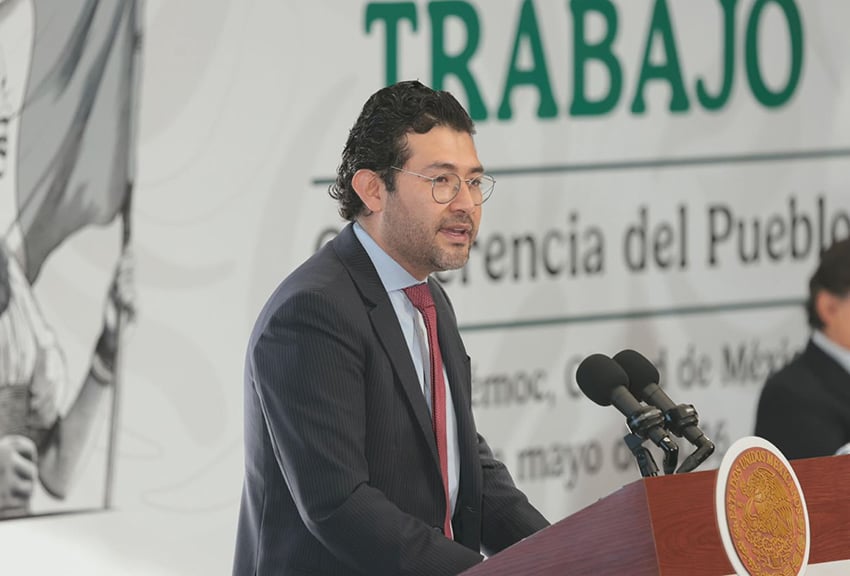
On International Workers’ Day, Sheinbaum said that her mañanera — held at a cultural center in the historic center of Mexico City — was dedicated to the workers of Mexico.
Labor Minister Marath Bolaños subsequently outlined how labor and employment conditions have improved under “Fourth Transformation” (4T) governments — i.e. those led by former President Andrés Manuel López Obrador (2018-24) and Sheinbaum.
He highlighted that Mexico’s minimum wage increased by double digits in percentage terms every year between 2019 and 2026. The minimum wage is currently 315 pesos (US $18) per day in most of the country, up from 88 pesos in 2018.
Bolaños said that the monthly minimum wage can now purchase 1.91 basic food baskets (canastas básicas), up from 0.78 in 2018.
He also highlighted that unemployment has declined from 3.7% in 2018 to 2.4% in (March) 2026.
Among the other labor changes Bolaños spoke about was a reform that allows workers for digital platforms such as Uber and Rappi to access formal employment benefits.
In honor of International Workers’ Day, Labor Minister Marath Bolaños touted the Sheinbaum administration’s labor reforms including increases to minimum wage and a shortened work week. (Presidencia via Cuartoscuro)
He also noted that Congress approved a constitutional reform that will reduce Mexico’s standard workweek from 48 hours to 40 hours by 2030. Bolaños said that around 14 million workers will benefit from the reform, under which Mexico’s standard workweek will decline to 46 hours in 2027, 44 hours in 2028, 42 hours in 2029 and 40 hours in 2030.
Sheinbaum asserted that Mexico is experiencing a “labor spring” under 4T governments.
Is Sheinbaum caught between a rock and a hard place?
Is the U.S. government attempting to “protect” Campos, asked the reporter, who depicted the situation as one in which the United States could retaliate for any action against the Chihuahua governor with the prosecution of the case against Rocha.
“I was looking at some publications yesterday and today [saying] they’re putting the president between a rock and a hard place. False,” Sheinbaum said.
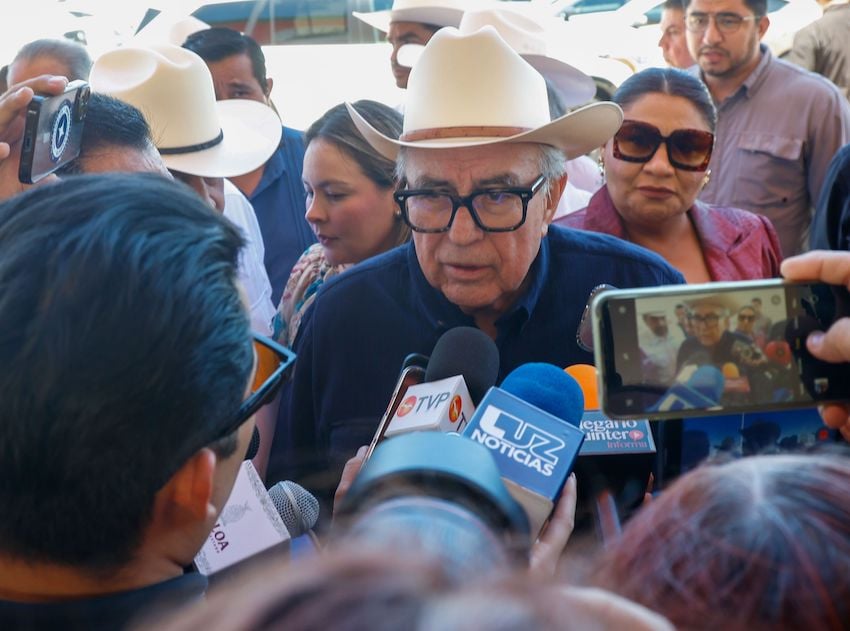
The U.S. Justice Department this week accused Sinaloa Gov. Rubén Rocha Moya of allowing a faction of the Sinaloa Cartel to operate with impunity in his state. (José Betanzos Zárate/Cuartoscuro)
“… With the United States we cooperate, we coordinate, but as I’ve said many times we will never subordinate ourself,” Sheinbaum said.
She noted that the Federal Attorney General’s Office is investigating both the alleged participation of CIA personnel in a security operation in Chihuahua and the accusations against Rocha and nine other Sinaloa-based current and former officials.
Sheinbaum said she felt “calm” about the whole situation — “without any problem.”
She also said that “there is a principle called sovereignty, and that isn’t negotiated.”
That remark elicited enthusiastic applause from government officials, union representatives and other mañanera attendees.
“What did we do? We guaranteed gasoline at less than 24 pesos [per liter],” she said, referring to the government’s price cap agreement with more than 20 gas station companies.
“If we hadn’t acted, gasoline today would be more than 30 pesos [per liter],” Sheinbaum said.
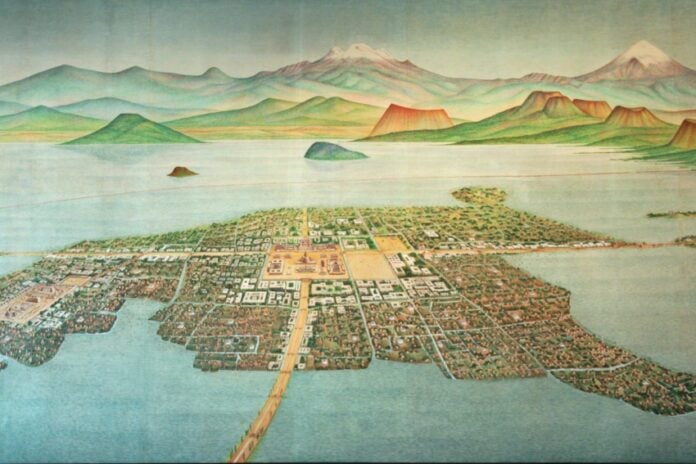
Tenochtitlán as it likely looked during the era of the Mexica, between the 14th and 16th centuries. (Gary Todd/Wikimedia Commons)
When you think of the ancient peoples of Tenochtitlán, the great imperial capital of present-day Mexico City, the first term that comes to mind is possibly Aztec. It is not uncommon for people to refer to this civilization as such, and at times, even use the term as a synonym for Mexica.
Worry not, dear foreign folk and friends! It’s a common mistake that even contemporary Mexicans make in pop culture. It’s no coincidence that the currentEstadio Banorte was formerly called Estadio Azteca (and honestly, it was a better name). This, however, does not mean that the terms Aztec and Mexica can be used indistinctly. In fact, according to Dr. Patrick Johansson, a specialist in the Náhuatl language and theAlfonso Reyes International Prize laureate, the terms refer to completely distinct cultures, each with its own deities and temporal space in the history of pre-Hispanic Mexico. Here’s the difference.
The Aztecs migrated from what we geographically locate as Aridoamerica today (the northernmost part of Mexico) to their city-state, Aztlán. (UNAM/Instituto de Investigaciones Históricas)
The peoples of Aztlán
Aztec is the demonym for Aztlán, an ancientaltépetl (or city-state) on the outskirts of Mesoamerica. No one knows where Aztlán is, when it existed or how many people lived there. From ancient Náhuatl, it translates as “the place of the herons,” but it has also been translated as “the place of whiteness.” Some authors even consider it more of a mythical place, since no archaeological remains have been preserved — or found — to support its geographical location.
Some authors think of Aztlán as more of a mythical city, serving as part of the founding myth of the magnificent Mexico-Tenochtitlán. Although the mythical city has not yet been found, archaeologists and historians alike agree that the Aztecs migrated from “the periphery of Mesoamerica,” per theNational Institute of Indigenous Peoples (INPI), in what we now geographically locate as Aridoamerica, meaning the northernmost part of Mexico.
It is believed that Aztlán was “an island situated in a lagoon,” which eventually became their city-state. Due to demanding tax burdens, explains the INPI, a group of Aztecs decided to “abandon Aztlan and go in search of another land that … had been promised to them” by divine inspiration.
Who promised them this new beginning, which would mark a turning point in Mesoamerica? None other than Huitzilopochtli, the powerful god of war, would guide them on a long journey to what would become their new imperial capital.
Huitzilopochtli’s chosen ones
According to the founding myth, Huitzilopochtli — son of the mother goddess Coyolxauhqui — chose a select group of Aztecs to leave the Place of Whiteness. These chosen ones he anointed as Mexica: those who trusted in his leadership toward the new promised land.
How would they know they had reached the promised land? According to the myth, Huitzilopochtli would signal it to them with the sign of an eagle perched on a prickly pear cactus. “In the beginning was the prickly pear cactus,” writes Dr. Johansson in his book “FromAztlán to Tenochtitlan,” in which he describes this sacred pilgrimage that may have lasted for centuries. According to records from theTemplo Mayor Museum, this sacred migration is estimated to have taken place between 1115 and 1325 AD.
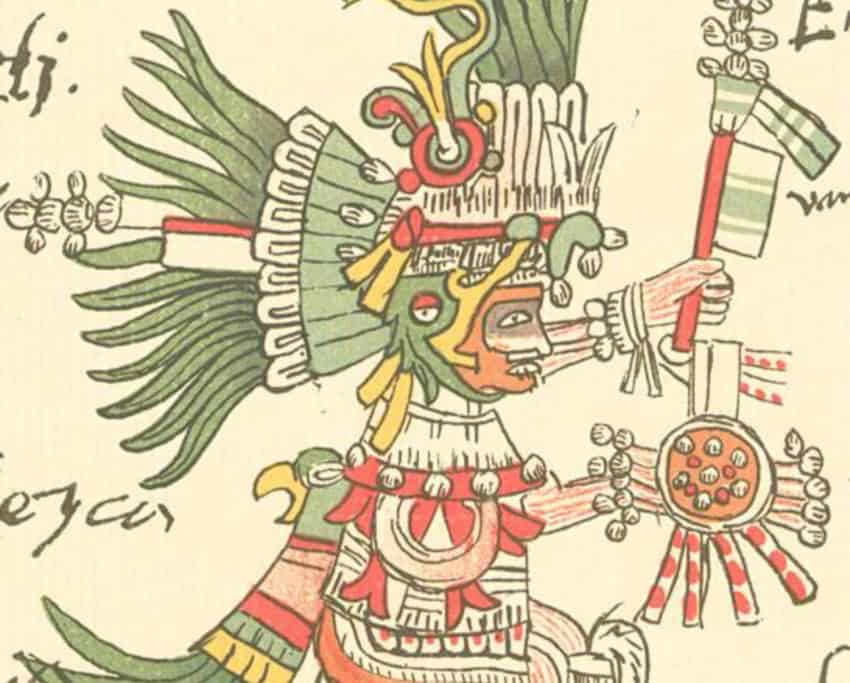
Depiction of the Mexica god of war Huitzilopochtli, as he was represented in the Telleriano-Remensis Codex in the 16th century. (Public Domain)
“The Mexica’s encounter with the prickly pear cactus … was foundational,” writes Johansson, since “it was the axis of the Mexica’s sedentary settlement.” After nearly 200 years of migration, they had finally found the land promised by the god of war, who became their patron — and would mark the military regime of thenew Mexica Empire.
The size of the Mexica’s city-state
During its height, between 1325 and 1521, it is estimated to have encompassed a territory of approximately 14 square kilometers. This corresponds to much of central and southern Mexico, “dominating diverse geographical regions ranging from the Gulf Coast to the Pacific and parts of the south.”
Due to its theocratic, tributary and military power, the imperial city of Mexico-Tenochtitlán, which dominated numerous other peoples at the time of the Spanish Conquest, was thought to have a population of nearly 100,000.
So, now you know: Aztec and Mexica are not synonyms
So no, as we’ve seen, Aztec and Mexica are not synonymous. Generally speaking, we can say that the Aztecs were the inhabitants of the mythical Aztlán, while the Mexica were the chosen ones of Huitzilopochtli who founded the most powerful and extensive empire in Mesoamerica.
However, these two distinct civilizations do share historical, cultural and religious origins. In a nutshell, once the Aztecs — guided by the god of war — left Aztlán, they became theMexica.
At this point, it is crucial to note that much of what we know today about these myths, culture and sacred pantheon of both cultures is filtered through a colonial lens. This is primarily because centuries of written records were lost after the European invasion of the Americas: the Catholic Spaniards destroyed these records in the name of the spiritual conquest of the New World.
The myth of the arrival at what would become Mexico-Tenochtitlán is so deeply rooted in Mexico that it can be seen represented on 50 peso bills, coins and even the national flag! (Museo del Parque Lago de Texcoco/Wikimedia Commons)
After the Spanish conquest, this grand narrative reached the hands of the chroniclers and historians of the Indies, who were responsible for compiling or reconstructing much of the ancientMexica past that was beginning to be forgotten during the first decades of evangelization.
MEXICO CITY — A growing number of American tourists visiting Mexico City this year have reported experiencing significant disorientation upon discovering that the country contains bars — standing, operating, internationally acclaimed bars — that are not affiliated with an all-inclusive resort, do not require a plastic wristband for entry, and will not serve you a watered-down piña colada from a trough.
“Gee, Toto, I’ve got a feeling we’re not in Xcaret anymore.” (World’s 50 Best)
The revelation follows Mexico landing 11 bars on North America’s 50 Best Bars list, including three in the top ten, with Mexico City’s Bar Mauro coming in at number two on the entire continent — a placement that travel agents in Cincinnati, Scottsdale, and Jacksonville confirmed they were not aware of and would not be adding to their brochures at this time.
“I’ve been to Cancún four times,” said one visitor from Ohio, reached outside Bar Mauro in Roma Norte. He said he had previously believed Mexican bars to be outdoor structures adjacent to a pool, staffed by a man named something the resort had anglicised, serving drinks in plastic cups with a novelty straw. He said he was processing the new information.
At Tlecān, ranked fifth on the continent, a couple from Texas confirmed they had almost not come because their travel agent had booked them into an all-inclusive in Los Cabos and they had only deviated from the itinerary after getting lost on the metro. They said the pre-Columbian inspired cocktail menu, featuring Mexican spirits they had not previously encountered, was “a lot to take in after a Señor Frog’s.” They gave it five stars. They have not told their travel agent.
Handshake Speakeasy, ranked twelfth, reported an increase in American visitors arriving. Several asked whether this had always been here. It has been here since 2018.
Industry experts note that Mexico City now rivals New York for the density of world-class cocktail establishments per square kilometre, a fact that the 4 million Americans who visited Cancún last year and spent the majority of their trip inside a gated beachfront compound technically had access to but did not use, having already paid for unlimited drinks at the swim-up bar and considered that sufficient.
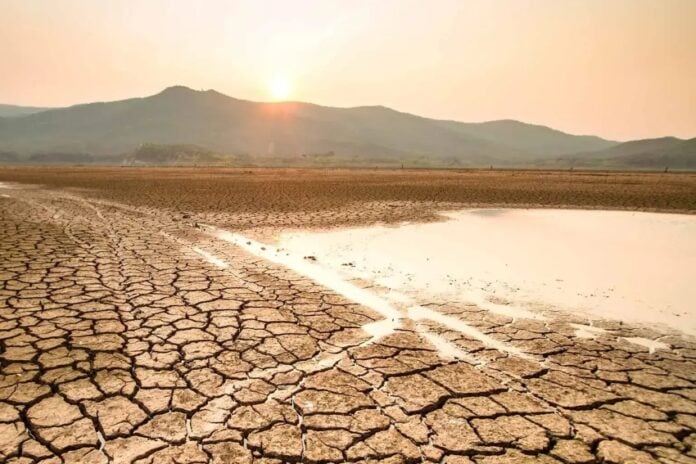
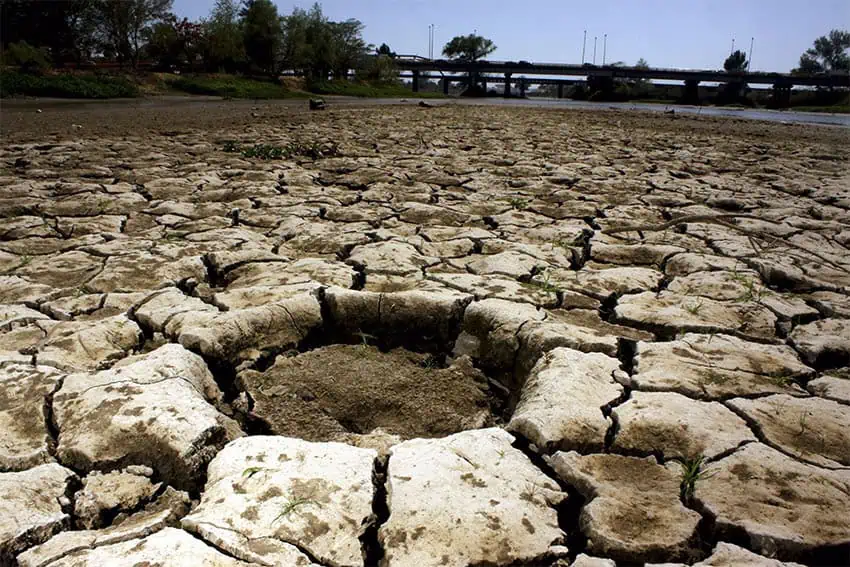
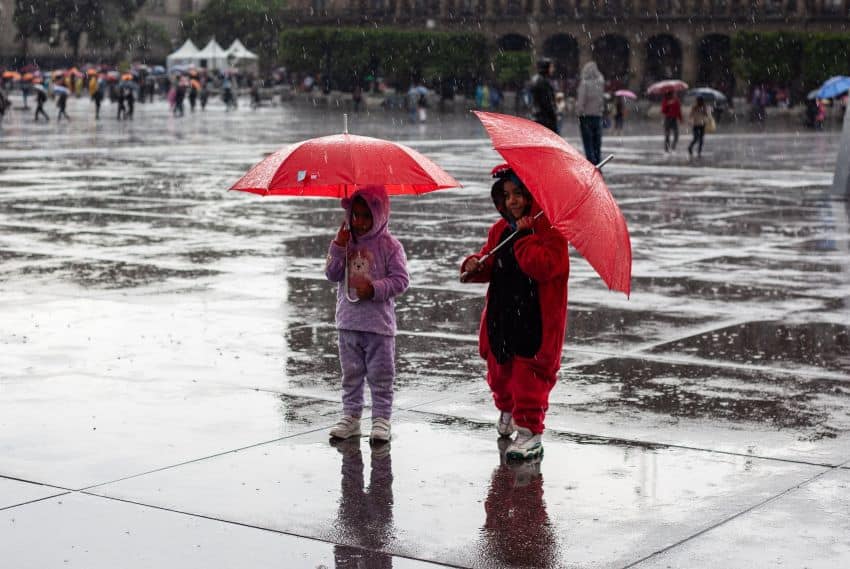
The country has entered a pattern of long periods of drought punctuated by intense rainfall, and it's a troubling warning for the water crisis in Mexico, experts say. (Tec de Monterrey)
After a year of unusually abundant rainfall, Mexico’s much-reported water crisis appeared to ease. Reservoirs rebounded. Drought maps shrank. The immediate pressure lifted in cities like Mexico City and Guadalajara.
Now, with out-of-season rains falling across parts of the country, a new question is emerging: Is this relief — or a warning sign of a climate system growing more erratic? Scientists say the answer is more complicated — and more concerning.
Longer droughts, briefer deluges
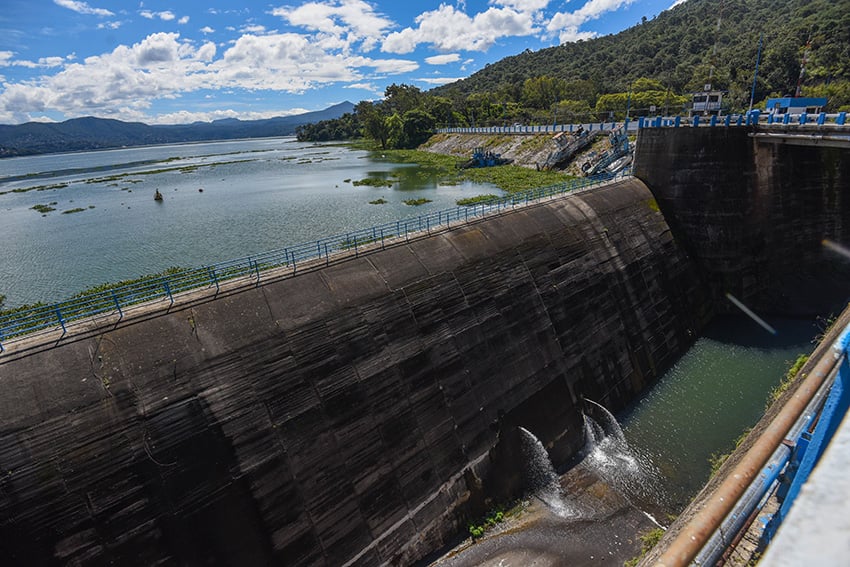
The Valle de Bravo reservoir, part of the Cutzamala system that provides water to Mexico City, is near capacity for now. (Crisanta Espinosa Aguilar/Cuartoscuro)
At the end of March, just 7.4% of Mexico was classified as being in drought, down from 40% in January 2024, according to the National Meteorological Service. But this whiplash between drought and deluge is not a sign of recovery, experts say.
It’s a warning.
New research into Mexico’s long-term climate patterns suggests the country is entering a more volatile water era: longer, more intense droughts punctuated by short bursts of heavy rainfall — events that often fail to replenish water systems.
At the same time, groundwater — Mexico’s most critical reserve — is being depleted faster than it can recover, while rising temperatures accelerate evaporation. Meanwhile, rapid urban expansion is disrupting the natural water cycle.
Even in years of good rain, the underlying trajectory is clear: Mexico is getting drier.
Lessons from the past: A paleoclimatologist takes the long view
National Autonomous University of Mexico (UNAM) paleoclimatologist Priyadarsi Roy studies how rainfall and drought have shaped Mexico over tens of thousands of years. What that long view reveals, he says, is not stability, but contrast.
“Mexico has a very heterogeneous climatic system,” he said, with arid regions in the north and humid zones in the south — a pattern that has persisted for millennia.
Drought, too, is nothing new. Historical records show prolonged dry periods in the 1950s and again in the 1990s.
But in the last two decades, Roy said, something about Mexico’s climate has suddenly changed.
“Since the last 20 years, droughts have been much more persistent and much more intense,” he said.
The implications are not simply theoretical: During Mexico’s drought in the 1990s, migration from Mexico to the United States doubled. Looking ahead, Roy and others’ projections suggest millions could be displaced by water scarcity in the coming decades.
“Possibly up to 6 million people … will migrate because water resources will be depleted,” Roy said.
When water is not available, people migrate to places where it is. (Shutterstock)
The pattern has repeated over millennia. Ancient Mesoamerican cities — including major urban centers — were abandoned during prolonged droughts.
Roy points to Cantona, a city in present-day Puebla that once supported tens of thousands of people before being abandoned when water supplies failed. The pattern repeats across much of Mesoamerica, where entire networks of cities declined during repeated dry periods.
“People left everything and moved to a region where there was water available,” he said.
Shifting storm patterns and rising temperatures: A ‘lethal combination’
Climate change is not just intensifying storms — it is reshaping where they go.
As it grows, storms are increasingly forming farther out at sea and tracking northward, toward the United States and skipping Mexico, or else dissipating in the Atlantic before reaching Mexico. While this means fewer hurricanes are making landfall in Mexico, it also means that the large amounts of rainfall on the periphery of hurricane systems are bypassing Mexico as well — and not replenishing the water sources in those areas.
“Those precipitation systems are not coming to Mexico anymore,” Roy said. “So Mexico is getting drier.”
The consequences are compounded by rising temperatures, which cause water to evaporate more quickly — even when rain does fall.
“We are having less precipitation … and the precipitation that we are getting … is getting dried out,” Roy said.
The combination — fewer storms reaching land and faster water loss — is, in Roy’s words, “a lethal combination.”
A water-management system out of sync with Mexico’s reality
Paradoxically, even when rain does arrive, much of it is lost.
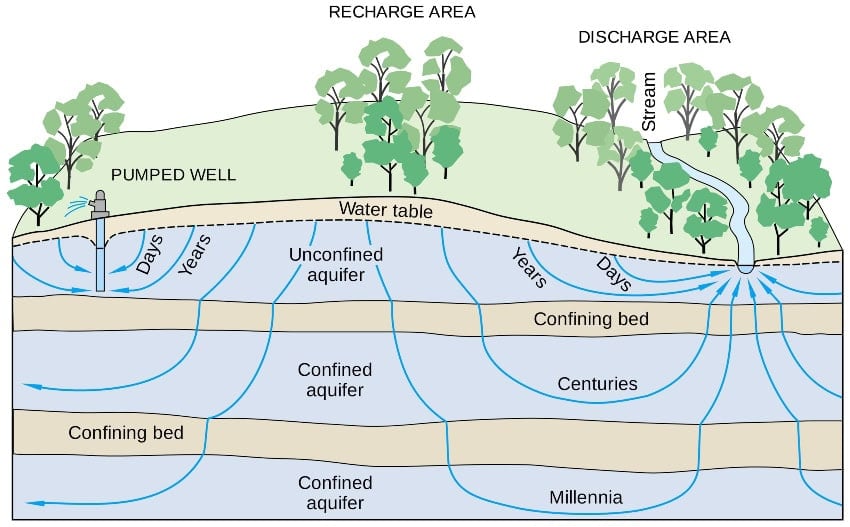
Mexico’s water supply depends heavily on slow processes like infiltration and aquifer recharge — systems that require steady, moderate rainfall over time. But increasingly, precipitation is arriving in short, intense bursts.
Effects of exceptional drought include widespread crop and pasture losses and shortages of water in reservoirs, streams and wells creating water emergencies, according to the U.S. National Oceanic and Atmospheric Association. (Cuartoscuro)
When rain falls too quickly, it runs off instead of soaking into the ground — contributing to flooding without replenishing depleted reserves.
In cities, that loss is amplified.
“In Guadalajara, up to 60% of the rainwater is lost,” said University of Guadalajara water expert Arturo Gleason, who has spent decades studying urban water systems in Mexico and abroad.
The problem, he argues, is not just climate. It is how Mexico manages water.
For decades, Mexico’s response to water scarcity has been to build more infrastructure — dams, aqueducts and pumping systems designed to bring water from farther away.
“That school of thought — the ‘mega-project’ — continues to permeate, even to this day,” Gleason said.
But that model is increasingly mismatched with today’s climate reality.
Across northern and central Mexico, groundwater has become the backbone of the water supply. But rising temperatures, reduced vegetation and shifting rainfall patterns are limiting water recharge — even as demand continues to grow.
At the same time, the systems that deliver water are aging and underfunded.
“The pipes and equipment … are operating beyond their useful life,” Gleason said. “It is becoming increasingly difficult to provide good quality (water) and adequate volume.”
Even where water exists, it is becoming harder to deliver — and harder to trust as safe for use.
The role of urban expansion
The problem is also being intensified by how cities are built, said Gleason.
Fewer hurricanes may sound like a good thing, but Mexico is also getting less of the rainfall associated with these systems. (Andrea Murcia/Cuartoscuro)
Deforestation and the spread of concrete that have come with urban expansion in Mexico are disrupting the natural water cycle.
“The moment you deforest … and cover the ground with concrete, you change the local climate,” Gleason said.
With urban expansion, vegetation that once helped retain moisture and promote rainfall has been removed. Soil that once absorbed water is sealed beneath pavement. The result is a paradox seen across Mexico: Cities suffer intense flooding during storms but struggle with water shortages the rest of the year.
What a different model could look like
For Gleason, the solution is not simply a technical one implemented by experts — it needs to be systemic and cultural, involving citizens.
Over decades of research and advocacy, he has promoted a different approach — one that works with the natural water cycle rather than against it.
That means capturing rain where it falls — in homes, neighborhoods and, critically, in green spaces designed to allow water to infiltrate and recharge aquifers.
It means restoring vegetation, protecting recharge zones at the local level and reducing impermeable surfaces that cut rainwater off from the soil that would absorb it.
And it means rethinking the role of citizens.
“It’s not the system for the sake of the system,” he said. “It’s generating a culture of water management.”
Rainwater harvesting systems, he argues, should not be isolated government programs, but part of a broader transformation — one that engages the citizenry through education, incentives and long-term maintenance.
Lessons from elsewhere
Gleason’s work has taken him abroad, where he has seen alternative models in action.
In Germany, he studied systems designed not to consume rainwater but to retain it — keeping it within urban landscapes to reduce runoff and protect water quality.
Aquifers work best with regular, moderate rainfall. When rainfall comes in short, intense bursts, much of it is lost due to runoff. (Public Domain)
Cities there map their territory in detail, determining where water should be absorbed, stored or redirected — and requiring developers to incorporate those systems into new construction.
In Australia, cities like Melbourne have gone further, adopting what are known as “water-sensitive urban design” strategies — integrating water management into every layer of urban planning.
These systems treat rainfall not as a nuisance to be drained away but as a resource to be captured, stored and reused.
In Mexico, this sort of progress is uneven. Monterrey, for example, has made significant advances in wastewater treatment and reuse, achieving near-total treatment of its wastewater — a rare benchmark nationally.
But such examples remain the exception.
Why solutions fall short
Even where solutions exist, scaling them remains a challenge.
Programs like rainwater harvesting have expanded in cities like Guadalajara. But Gleason says they often lack the long-term vision needed to succeed. Systems are installed — but not maintained. Citizens are given tools — but not the training or incentives to use them effectively.
“It’s a lifestyle,” he said of rainwater harvesting. “And that hasn’t been built.”
Without a cultural shift, he argues, the responsibility for water remains externalized — something managed by utilities rather than shared across society.
A narrowing window for action
If current trends continue, the consequences across Mexico could be severe.
“I think it’s a widespread shortage,” Gleason said. “It’s not just the volume — it’s the quality.”
As water sources become increasingly contaminated and infrastructure struggles to keep up, cities may face rising health risks, higher costs and deepening inequality in access to safe water.
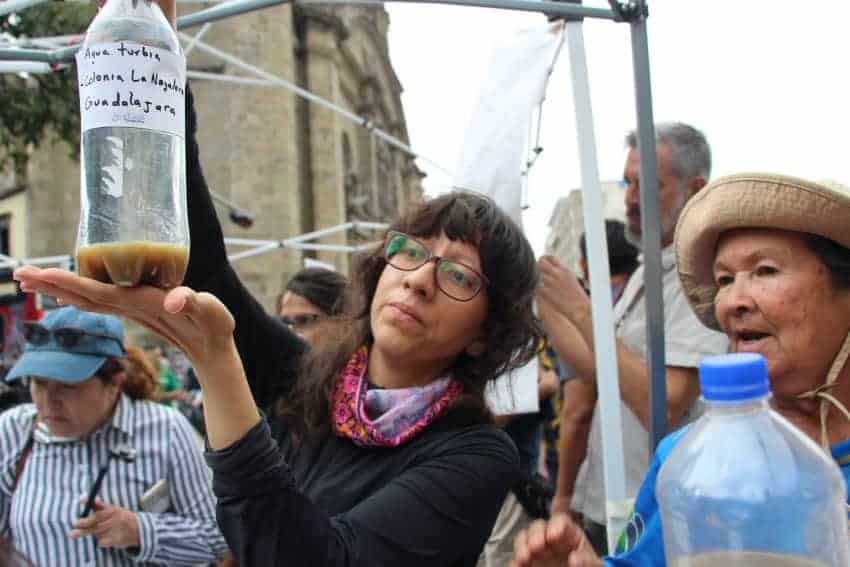
A resident of the Nogalera colonia in Guadalajara holds up a bottle of sediment-filled water she collected from her faucet. (Tracy L. Barnett)
“We are entering chaotic scenarios,” he said — a warning that echoes recent street protests in Guadalajara over water shortages and contaminated, foul-smelling tap water.
At the same time, the window for action is shrinking.
“We are now entering a reduction phase,” he said — a stage where options become more limited and solutions more costly,” he explained.
What must come next
Still, neither Roy nor Gleason sees the future as predetermined. But both point to the same conclusion: the current trajectory is unsustainable.
The path forward will require more than infrastructure, they say.
It will require restoring ecosystems, modernizing systems and fundamentally rethinking how water is valued — not as an unlimited resource to be extracted, but as a finite cycle to be protected.
And it will require something more difficult still: a shift in public consciousness — from consumption to stewardship. Because the question Mexico now faces is no longer simply whether it has enough water, but whether it can adapt — quickly enough — to the reality of having less.
Tracy L. Barnett is a Guadalajara-based freelance writer and the founder of The Esperanza Project.
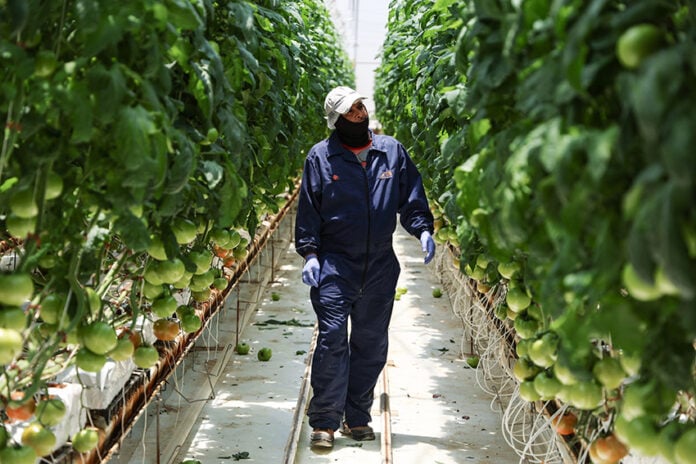
A decline in the primary sector, which includes industries like agriculture and fishing, was one factor driving Mexico's first quarter economic contraction. Pictured: A greenhouse worker inspects tomato plants in Zacatecas. (Adolfo Vladimir / Cuartoscuro.com)
The Mexican economy contracted 0.8% in the first quarter of 2026 compared to the previous three-month period, according to seasonally-adjusted preliminary data published on Thursday by the national statistics agency INEGI.
Compared to the first quarter of 2025, GDP increased 0.2% in seasonally-adjusted terms between January and March and 0.1% in original terms.
The quarter-over-quarter contraction was the worst result for the Mexican economy in any first quarter since 2020. In addition, the contraction was the largest sequential decline for any quarter since Q4 in 2024.
INEGI data shows that the primary, secondary and tertiary sectors all contracted in the first quarter of 2026 compared to the final quarter of last year.
The primary sector, which includes agriculture and fishing, recorded the biggest decline, slumping 1.4% compared to the final three months of 2025.
The secondary sector, which includes manufacturing and construction, contracted 1.1%, while the tertiary or services sector declined 0.6%.
Gabriela Siller, director of economic analysis at Mexican bank Banco Base, wrote on social media that the factors that caused the decline in GDP in the first quarter of the year are “internal.”
For his part, Andrés Abadía, chief Latin America economist at U.K.-based Pantheon Macroeconomics, said that “lower consumption, lower investment of capital and still restrictive financial conditions” are all affecting economic activity in Mexico.
The quarter-over-quarter contraction occurred despite Mexico’s export revenue increasing 17.9% annually in the first three months of 2026. Tourism numbers have also been positive with international arrivals up more than 8% in January and February.
The sequential contraction is a blow for the federal government, which is aiming to grow the Mexican economy and attract more investment within the framework of its ambitious Plan México initiative.
Primary and secondary sectors also declined in annual terms
The primary sector contracted 0.1% in the first quarter compared to the same period of last year, according to INEGI’s preliminary data.
The secondary sector also contracted, declining 1.1% compared to the first quarter of 2025.
The tertiary sector bucked the trend, expanding 0.9% annually in the first quarter of 2026.
Mexico’s economic outlook
Abadía said it’s “probable” that economic activity will pick up in the second quarter of 2026, “supported by a series of temporary favorable factors,” such as the FIFA men’s World Cup, which Mexico will co-host with the United States and Canada.
The tournament will take place in June and July, and millions of tourists are expected to come to Mexico during the period, helping boost GDP.
Abadía also said that construction activity and end-of-year sales could help boost economic activity in Mexico later in 2026. Pantheon Macroeconomics is forecasting that the Mexican economy will grow 1.2% this year.
Siller noted that Banco Base is now forecasting that Mexico’s GDP will grow 1% this year.
“This implies that per capita GDP will continue being lower than in 2018,” she wrote on X.
Citing Banco Base forecasts, Siller also noted that it is anticipated that Mexico’s economy will grow at half the pace of the U.S. economy this year.
With the most recent sale, and another smaller one expected shortly, Citibank will have reached this year's goal of 49% divestiture in the long process of exiting its ownership role in the historic Mexican bank Banamex. (Facebook)
Citigroup announced Wednesday it has closed the sale of 22.6% of Banamex, finalizing most of the 24% equity sale it announced in February.
The tranche was sold to a group of national and international institutional investors and family offices, including Blackstone, General Atlantic and Afore Sura, among others.
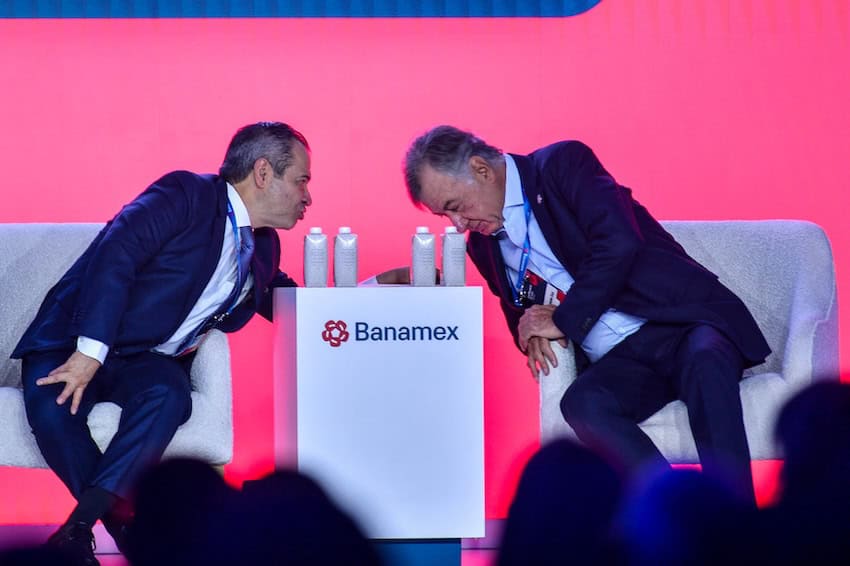
Manuel Romo, shown here with Banamex majority shareholder and Chairman of the Board Fernando Chico Pardo in March, has stepped down as the bank’s director general. (Galo Cañas/Cuartoscuro.com)
In a written statement, the U.S.-based financial services corporation said the purchase had received all the necessary authorizations from the competition regulator in Mexico, and expects the sale of the remaining 1.4% stake to be completed in the coming months through a public offering on the stock market.
“We are pleased to finalize these investments from a group of renowned investors, whose engagement signals their confidence in Banamex’s strategic vision and promising growth trajectory, as well as the strength of Mexico’s financial sector,” head of Citi International Ernesto Torres Cantú said.
Chico’s transaction meant that a key stake in Banamex returned to Mexican ownership.
Citi has reiterated that the full divestment of Banamex remains a strategic priority. But beyond the outstanding 1.4%, it anticipates no further sales this year so the current group of investors can focus on value creation.
“We take great pride in these partners’ commitment to Mexico and its outlook, in addition to their confidence in our management of Banamex,” said Chico, now the majority shareholder and chairman of the board of Banamex.
Banamex also announced last week that Manuel Romo would be stepping down as general manager to be replaced by Edgardo del Rincón, who previously served as the director of Banbajío. Del Rincón is expected to take over in May.
Banamex (full name Banco Nacional de México) is one of the oldest and most important financial institutions in Mexico. Founded in 1884, it is the fourth largest financial group in the country, with 13 million active clients.
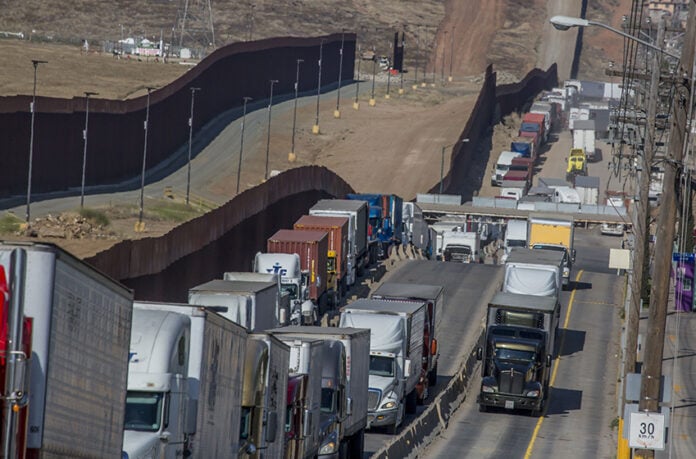
Cargo trailers bearing goods for export line up to cross into the United States at the Otay Mesa crossing in Tijuana. (Omar Martínez / Cuartoscuro.com)
Goods were made in factories across Mexico, fresh produce was grown on farms all over the country and oil was pumped from the Gulf of Mexico and onshore fields.
But, of Mexico’s 32 federal entities, which generated the most export revenue last year?
Which state increased their export revenue by the largest percentage between 2024 and 2025?
Coahuila, a northern border state east of Chihuahua that is also a manufacturing hub, was Mexico’s second biggest exporter in 2025. The state’s exports totaled $65.5 billion.
Nuevo León, a northern border state east of Coahuila, ranked third with exports worth $59.06 billion in 2025.
Baja California, which borders the U.S. State of California, was Mexico’s fourth biggest exporter in 2025, with revenue totaling $56.62 billion.
Jalisco ranked fifth with exports worth $52.57 billion in 2025. It is the only state in the top five that doesn’t border the United States.
The other end of the export ladder
In case you were wondering which states generate the least export revenue, here’s the list of the bottom 5 in 2025.
The Caribbean coast, tourism-oriented state of Quintana Roo ranked last out of Mexico’s 32 federal entities for export revenue in 2025. Earnings totaled just $19.51 million.
Second last for export earnings in 2025 was the Pacific coast state of Nayarit, with $355.36 million.
Ranking third last in 2025 was Baja California Sur, with export revenue of $396.71 million.
In fourth last position was Guerrero, with export earnings of $921.25 million.
Rounding out the bottom five states for export earnings last year was the southern state of Chiapas, with revenue of $1.31 billion.
The top states for export gains
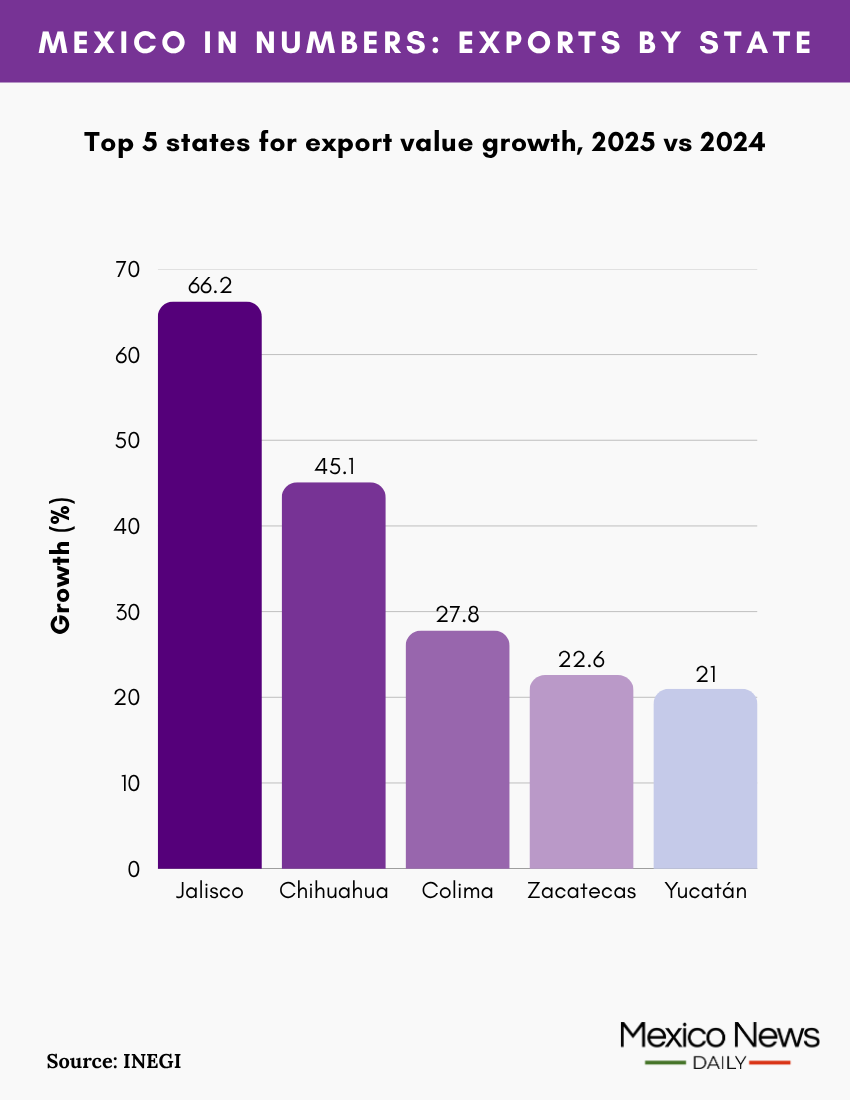
The states which increased their export earnings by the largest percentages in 2025 were:
Jalisco: 66.2% increase to $52.57 billion.
Chihuahua: 45.1% increase to $109.5 billion.
Colima: 27.8% increase to $1.95 billion.
Zacatecas: 22.6% increase to $4.93 billion.
Yucatán: 21% increase to $2.56 billion.
Export earnings increased in 16 of Mexico’s federal entities in 2025 and declined in 16.
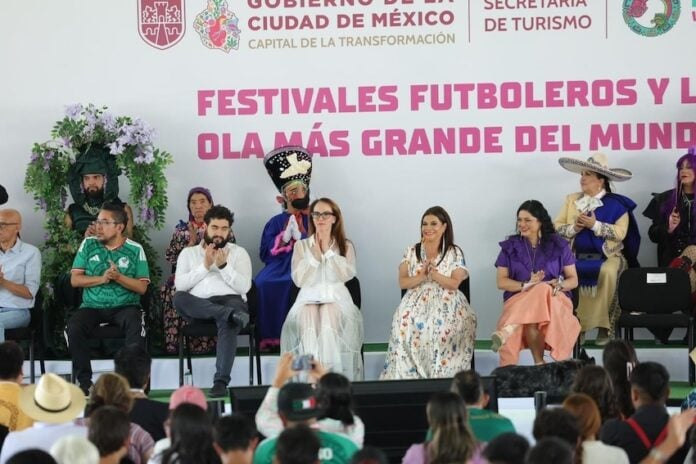
In announcing 18 fan festival sites for the duration of the World Cup, along with "the world's longest wave" along the Paseo de la Reforma on May 30, Mexico City Mayor Clara Brugada continues her efforts to make her city's hosting of World Cup games one big and entertaining cultural extravaganza. (@ClaraBrugadaM/Facebook)
Mexico City Mayor Clara Brugada on Wednesday announced plans to establish 18 free fan festivals during the upcoming World Cup, saying “the capital will be like one big grandstand.”
There will be at least one designated fan fest in each of the city’s 16 boroughs, in addition to the FIFA-sponsored venue in the Zócalo, the main public square in the heart of the Historic Center.
“We don’t view the World Cup as being limited to the matches taking place inside the stadium,” Brugada said. “It’s lived in the streets where communities play, on the neighborhood pitch, in the market, in the public square … because when the pelota comes home, passion overflows in our streets.
In addition to free broadcasts of the matches (seven venues will screen all 104 games, while the remaining 11 will feature Mexico’s games and selected matches), festival sites will feature cultural programming, sporting activities and gastronomic offerings.
Brugada said each site will include big screens, as well as concerts, public art, family entertainment, traditional games and workshops. There will also be food carts and products from local and Indigenous communities, as well as special events such as expos devoted to corn and ice cream.
Although the goal is to extend the World Cup atmosphere beyond the stadiums, Brugada made clear that alcohol sales will be prohibited at the Fan Zones, which she justified by saying “the aim is to promote safe and family-friendly spaces.”
This announcement continues Brugada’s focus on popular events, which some say comes at the expense of needed infrastructure and security work. It even earned her a scolding from President Claudia Shienbaum earlier this month.
During a meeting with Sheinbaum on March 30, FIFA president Gianni Infantino expressed concern over unfinished infrastructure projects in the vicinity of Estadio Azteca, which will host five matches. The media has also made much of the scramble to finish an ambitious renovation of the capital’s subway before the tournament kicks off on June 11.
As a result, Sheinbaum reprimanded Brugada and announced the federal government was taking a bigger role in order to manage risks and ensure preparations in Mexico City meet FIFA standards.