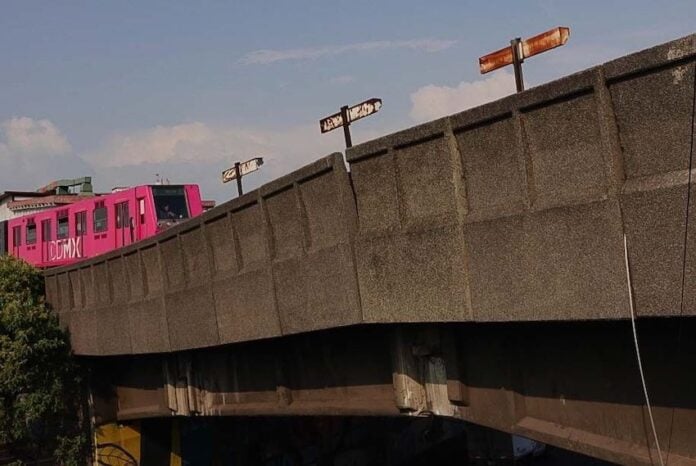
The Mexican capital's rapid rate of sinking has caused structural damage, such as can be seen here in Line 9 of the Metro system, which had to be partially shut down temporarily in 2023 so that repairs could be made. (Rogelio Morales/Cuartoscuro)
Long recognized as one of the fastest-sinking sites in the world, today’s Mexico City is sinking by nearly 10 inches (about 25 centimeters) a year, and has sunk by nearly 40 feet over the past century.
This information comes from newly available satellite data released by NASA last week that was derived from the U.S.-India satellite project known as NISAR.NISAR uses advanced radar imaging — effectively a microscope in space — to measure changes in Earth’s land, ice, sea level rise and groundwater.
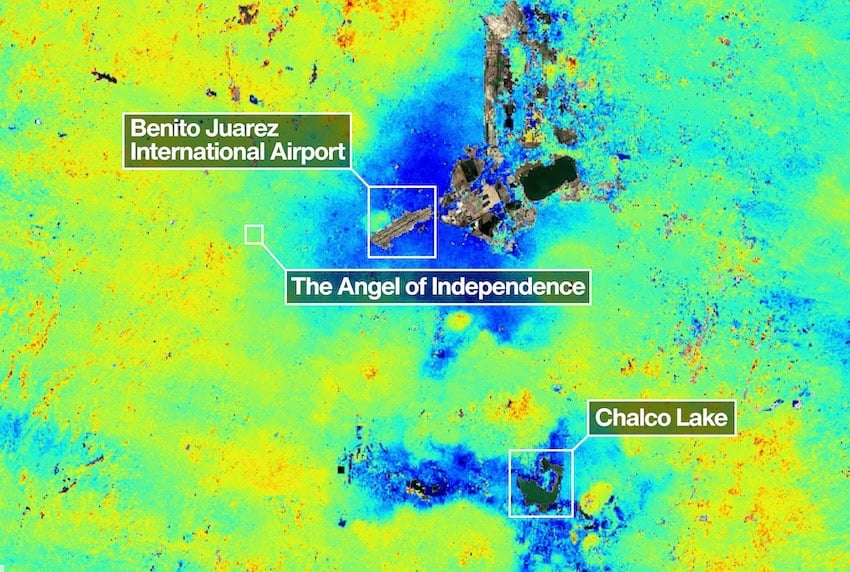
This satellite image from NASA shows how its NISAR technology can identify areas of the Valley of Mexico with significant subsidence, such as those shown in blue here that sank by more than one centimeter per month between Oct. 25, 2025, and Jan. 17, 2026. (NASA/JPL-Caltech/David Bekaert)
It has long been observed that Mexico City has been sinking (a 1995 study by the National Academies of Sciences, Engineering and Medicine found the city was sinking roughly two inches per year by the late 1800s), but the rate of sinking has become more dramatic over time and the NISAR images confirm it.
The NASA data — based on preliminary measurements taken during the dry season between October 2025 and January 2026 — indicates that Mexico City is sinking by more than half an inch every single month.
The primary reason for the subsidence is a lack of water in what was once a vast lake system fed by seasonal rainfall and underground aquifers.
Much of greater Mexico City now relies on the water supplied by these local aquifers, but a surging population, coupled with climate change, means that rainfall no longer replenishes the aquifers sufficiently.
“The [natural] reservoirs are basically empty,” Enrique Lomnitz, founder of a water nonprofit, told online media outlet Jezebel.com.
As the water disappears, the ground inevitably begins to shift and compact under the sheer weight of the skyscrapers and millions of people, cars and buses, and layers of cement built on top of it.
Visible evidence includes tilted historic buildings, cracked infrastructure and sinking monuments.
Enrique Cabral, a geophysicist, described the ongoing subsidence as “a very big problem” because it damages the city’s critical infrastructure, such as the subway, the drainage system, the potable water system, housing and streets.
The government’s response has so far included limiting the further drawing of groundwater from Mexico City wells, establishing new water sources and funding extensive water pipe repairs.
These large-scale efforts will require billions in funding, and it’s possible that the continued sinking would simply erase any gains as quickly as they are made.
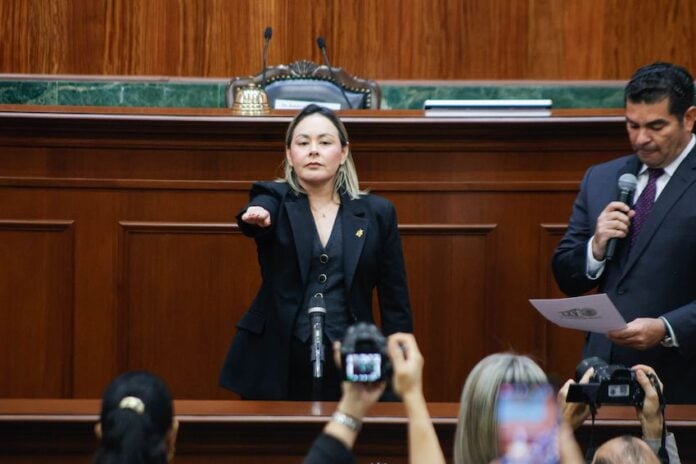
Yeraldine Bonilla Valverde, a 33-year-old former state lawmaker, was serving as general secretary of the Sinaloa government before her appointment as interim governor. (José Betanzos Zarate/Cuartoscuro)
The northern state of Sinaloa has a new governor after Rubén Rocha Moya’s request for temporary leave was approved by state Congress, following the unsealing of a U.S. federal indictment charging him with drug trafficking and ties to the Sinaloa Cartel.
Yeraldine Bonilla Valverde was sworn in as interim governor of Sinaloa on Saturday. Bonilla, a 33-year-old former state lawmaker, was serving as general secretary of the Sinaloa government before her appointment as interim governor.
The unicameral Sinaloa Congress — dominated by the Morena party and its allies — approved her appointment after authorizing Rocha’s request for “temporary leave for more than 30 days.”
Bonilla is the first woman to serve as governor of Sinaloa.
Rocha, who represented Morena as governor, announced his intention to step down on Friday night, two days after the unsealing of a U.S. indictment that accuses him and nine other current and former Sinaloa-based officials of drug trafficking and related weapons offenses. U.S. prosecutors allege that the “Los Chapitos” faction of the Sinaloa Cartel — led by sons of convicted drug lord Joaquín “El Chapo” Guzmán — helped Rocha get elected in 2021, and that as governor, he allowed the criminal cell to operate with impunity. Rocha, who has served as governor since 2021, promptly rejected the accusations against him.
The Federal Attorney General’s Office is assessing a U.S. request that the governor and nine other defendants, including the mayor of Culiacán and a Morena party federal senator, be provisionally arrested for the purpose of extradition. Special prosecutor Ulises Lara said last week that the FGR would “launch an investigation to gather all the necessary information to determine whether there is evidence establishing a reasonable likelihood that the charges brought by U.S. authorities have a legal basis for requesting arrest warrants.”
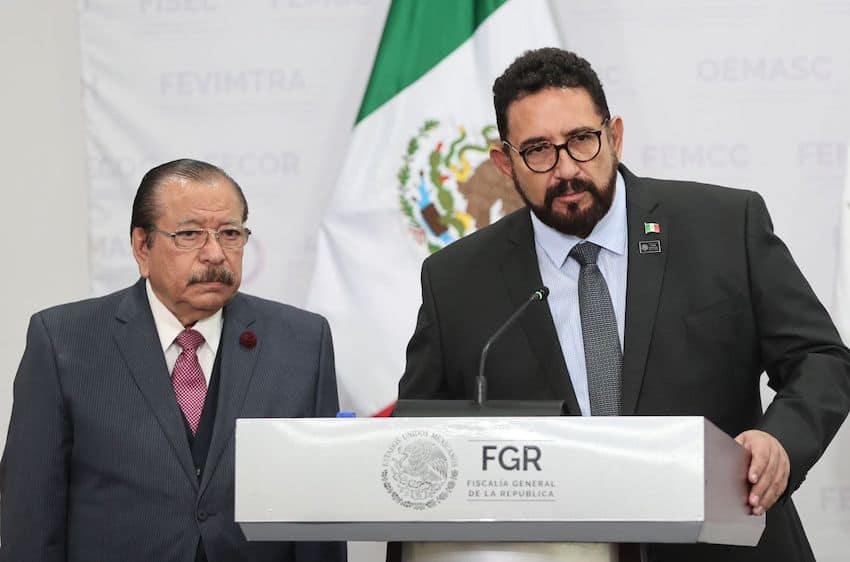
Special prosecutor Ulises Lara insists there is not sufficient evidence for Mexico to decide to extradite Rocha Moya. (FGR/Cuartoscuro)
He said that the U.S. request for the provisional arrest for extradition purposes of the 10 suspects was “not accompanied by sufficient probative elements that provide conclusive evidence” against Rocha and the other defendants.
President Claudia Sheinbaum has endorsed the determination that there is insufficient evidence to arrest and extradite Rocha and the other nine men accused of drug trafficking by U.S. prosecutors. Sheinbaum, a staunch defender of Mexican sovereignty, has stressed that Mexican authorities — not U.S. prosecutors or the U.S. government — will make the final decision about whether Rocha and others have questions to answer in the United States or not.
On Monday, Security Minister Omar García Harfuch said that federal authorities had no suspicions about Rocha.
With a ‘clear conscience,’ Rocha announces decision to take leave
“I address myself to the people of this great state to express the following: I have a clear conscience — a life of work backs up my words. I say it clearly and forcefully: the accusations that have been made against me are false and fraudulent,” he said.
After declaring that he has never betrayed — and will never betray — the people of Sinaloa or his family, Rocha declared that he would prove his innocence to Mexican authorities.
He also said he wouldn’t allow himself to be “used” to “harm the movement to which I belong” — i.e., the “fourth transformation” political movement led by Sheinbaum.
Comunicado
In that context, Rocha announced that he had requested temporary leave as governor for as long as the FGR investigation lasts. He said that his decision was also aimed at “facilitating” the investigative work of Mexican authorities.
Culiacán Mayor Juan de Dios Gámez Mendívil, a Morena party politician, also decided to go on temporary leave after he was accused of colluding with the Sinaloa Cartel on a drug trafficking conspiracy. He too denies the U.S. accusations against him. Ana Miriam Ramos Villarreal, a former bank employee, was appointed interim mayor of the capital of Sinaloa, one of Mexico’s most dangerous cities.
Does Rocha lose his immunity from prosecution by stepping down as governor?
In a social media post on Saturday, former Supreme Court Chief Justice Arturo Záldivar — now a high-ranking government official — wrote that a governor on leave loses their immunity from prosecution and therefore can be arrested like any other person.
“What certain media outlets have published in the sense that a governor and mayor on leave continue having ‘fuero’ [immunity] is incorrect,” he wrote.
“Procedural immunity, misnamed ‘fuero,’ is a guarantee for a certain category of public officials to prevent them from being criminally prosecuted without the Chamber of Deputies issuing a declaration of proceedings that lifts the procedural immunity under the terms of Article 111 of the Constitution,” Zaldívar wrote.
“Fuero protects the role, not the person. Whoever obtains leave no longer exercises the role, therefore, they can be detained like any person, since they no longer enjoy procedural immunity. There are precedents from the Federal Judiciary in this regard,” he wrote.
However, the newspaper El Financiero reported that “according to the Political Constitution of Sinaloa,” Rocha retains his fuero despite taking leave as governor. Similarly, The New York Times reported that Rocha’s “leave of absence could allow him to step down from his position while retaining his immunity, though some legal experts,” such as Zaldívar, “say it would not apply.”
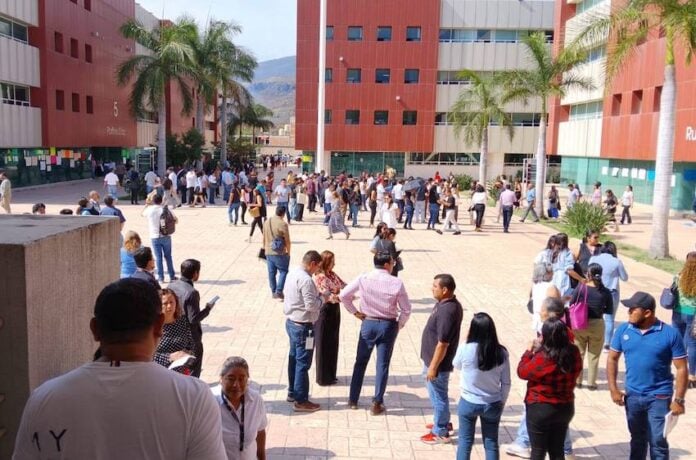
Despite the earthquake's magnitude, the shaking was reportedly minor. (Facebook)
A 5.6-magnitude earthquake originating along Oaxaca’s Costa Chica jolted Mexico on Monday.
The epicenter was located near the Pacific Coast at a depth of 10 kilometers, about 20 kilometers west of Pinotepa Nacional.
SISMO Magnitud 5.6 Loc 24 km al OESTE de PINOTEPA NACIONAL, OAX 04/05/26 09:19:25 Lat 16.32 Lon -98.27 Pf 9 km pic.twitter.com/1s0QNtQsrU
— Sismologico Nacional (@SismologicoMX) May 4, 2026
Oaxaca officials said no damage was reported despite the magnitude of the temblor, confirming that a review to analyze possible impacts on infrastructure and basic services had been carried out in all 570 municipalities of the state.
The state Civil Protection Coordination agency indicated it would maintain active monitoring with emergency services and municipal authorities.
The tremor triggered Mexico City’s seismic alert system at 9:19 a.m., and was said to be noticeable in some areas of the capital, though many residents described it as imperceptible.
Mexico City officials initiated security protocols across the city in order to address any emergencies.
Overflights were carried out by police helicopters and Civil Protection patrols were conducted in various points of the capital.
Two hours later, Civil Protection authorities announced that only very minor incidents had been reported (a handful of falls and panic attacks were registered), while confirming that inspections of subway facilities were being conducted throughout the network.
President Claudia Sheinbaum issued a social media message saying no damage or injuries had been reported and the Federal Electricity Commission said its transmission and distribution networks were in good order.
Why didn’t the new cell phone alert sound?
Despite the apparent lack of damage, there was considerable confusion about why the much-ballyhooed cell phone alert system did not work and the reason for the failure was rather ironic.
The federal Digital Transformation and Telecommunications Agency said the cell phone alert platform had been deactivated as it was undergoing maintenance ahead of Wednesday’s national earthquake drill during which the entire earthquake alarm system will be tested.
Mexico City residents were alerted to the seismic activity by the earthquake sirens (98.6% of which functioned, according to city officials), but elsewhere in the country, social media users reported that many people did not vacate buildings, instead continuing with their normal activities at offices, workplaces and schools.
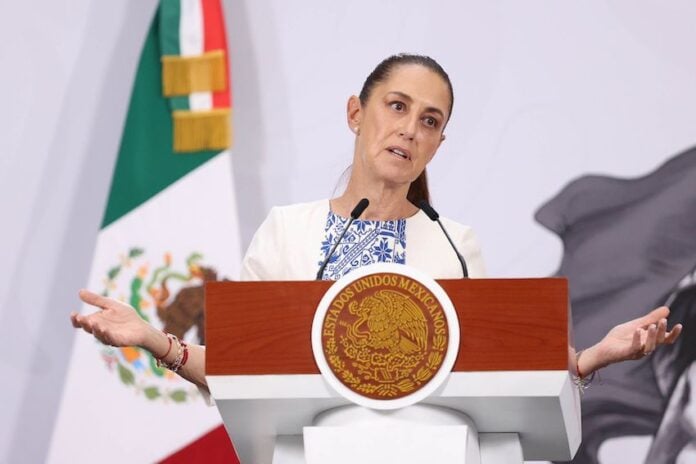
President Sheinbaum also sounded off on rumors that she went to Palenque, Chiapas, over the weekend to seek advice on the situation involving Rocha from former President López Obrador, calling them misogynistic. (Moisés Pablo/Cuartoscuro)
Sheinbaum’s mañanera in 60 seconds
🏛️ Sinaloa leadership transition: Sheinbaum acknowledged that Gov. Rubén Rocha Moya has taken leave amid U.S. drug trafficking accusations, with interim governor Yeraldine Bonilla Valverde appointed by the state Congress. She directed federal security officials, including Security Minister Omar García Harfuch, to meet with Bonilla to coordinate on security.
🛡️ 4T under attack: Sheinbaum pushed back against what she called a media and right-wing “campaign” linking her government to drug trafficking, defending the “fourth transformation” (4T) movement’s anti-corruption record and citing welfare expansion, poverty reduction and cartel extraditions as evidence of clean governance.
👩🏽 Misogyny charge: Sheinbaum denied going to Palenque to seek AMLO’s counsel on the Rocha situation — she was there to inspect a rail project and open an ecological park — but said the insinuation that she needed his guidance carried “many characteristics of misogyny,” as it implies she can’t make major decisions independently.
Why today’s mañanera matters
U.S. prosecutors’ drug trafficking accusations against Sinaloa Governor Rubén Rocha Moya, the mayor of Culiacán, a Morena party senator and seven other Sinaloa-based officials continue to be the dominant topic in Mexico’s national conversation. Rocha has temporarily stepped down as governor as the Federal Attorney General’s Office (FGR) assesses a U.S. request for the provisional arrest of the 10 suspects for extradition purposes, and conducts its own investigation into the U.S. allegations.
President Sheinbaum last week endorsed the determination from the FGR and the Ministry of Foreign Affairs that the U.S. Justice Department hasn’t provided sufficient “proof” to establish the probable guilt of Rocha and the nine other defendants.
On Monday morning, she acknowledged Rocha’s decision to take leave, and — mindful that the “fourth transformation” political movement she leads could be tainted (or is being tainted) by the allegations against him — defended her government against what she characterized as a smear campaign.
Also of note at today’s mañanera was Sheinbaum’s response to claims that she went to the southern state of Chiapas to seek advice on the situation involving Rocha from former President Andrés Manuel López Obrador. AMLO, the president’s erstwhile political mentor, lives on a ranch in Palenque, a town in Chiapas best known for the Palenque archeological site.
Sheinbaum acknowledges that Rocha has taken leave as governor of Sinaloa
Sheinbaum noted that Rocha requested leave as governor of Sinaloa and an interim governor, Yeraldine Bonilla Valverde, was appointed by the state Congress on Saturday.
She said that she instructed federal security officials, including Security Minister Omar García Harfuch, to meet with Bonilla to explain to her “the process of coordination” on security issues between the federal government and the government of Sinaloa. That meeting is set to take place on Monday.
“It’s very important that, in the face of this government change that occurred in Sinaloa, the federal security cabinet is present to strengthen the activities of coordination,” Sheinbaum said.
She also said that Rocha asked for federal protection while on leave as governor and his request was granted.
Sheinbaum defends federal government amid ‘campaign’ against it
Sheinbaum said that since the U.S. Department of Justice requested the provisional arrest for extradition purposes of Rocha and the other nine defendants, there has been a “campaign” in the media and on social media against the federal government and the “fourth transformation” (4T) movement it represents.
The campaign, she said, is “mainly promoted” by “some media outlets who are always going to speak ill of us” and “the Mexican right wing.”
Sheinbaum summarized the attack on her administration as follows: “The government of Mexico has links to drug trafficking.”
After reiterating the assertion that the federal government doesn’t protect anyone who has committed a crime, the president launched into an impassioned defense of the 4T movement that she leads, and which is supported by Morena, the party founded by AMLO.
“Our movement came to power with a very clear order — to put an end to the regime of corruption and privileges,” said Sheinbaum, who noted that the FGR is assessing the United States’ request for Rocha’s arrest.
She went on to say that “if we hadn’t put an end to the corruption of the past, we wouldn’t have the welfare programs” that the government currently offers.
🗣️ “Nosotros no protegemos a nadie”
Claudia Sheinbaum aclaró que llegó al poder con la consigna de acabar con la corrupción y los privilegios, al ser cuestionada sobre el caso de Chihuahua y los funcionarios acusados por EU pic.twitter.com/RcDyEPhMSb
Sheinbaum asserted that it would be impossible for the government to spend 1 trillion pesos (US $57 billion) annually on welfare schemes if the corruption of days gone by — i.e., the period before AMLO took office in 2018 — still existed.
She also attributed the increase in tax collection in Mexico — “without increasing taxes” — to the “honesty” of her government and that led by López Obrador.
“How can it be explained that there are welfare programs that couldn’t be provided before? Because there is honesty in the management of resources,” Sheinbaum said.
“If there was corruption, how can it be explained that in the period of President López Obrador, 13.5 million people exited poverty? If there was corruption, how can it be explained that for the first time ever there are more people in the middle class than in poverty? If there was corruption, how can it be explained that we can travel around the country and the people greet us and hug us?” she asked.
“… If we weren’t putting an end to corruption, how can it be explained that a Morena mayor was arrested in Jalisco, in Tequila?… How can all this, everything that we have done from 2019 until now in the governments of transformation, be explained if there was corruption?” she asked.
Sheinbaum denounces misogyny in claims she went to Palenque to seek advice from AMLO
Toward the end of her press conference, Sheinbaum addressed claims that she went to Palenque, Chiapas, over the weekend to seek advice on the situation involving Rocha from López Obrador.
#Mañanera |”No fui a pedir línea”: Sheinbaum (@Claudiashein) responde a críticas tras su gira en Palenque🇲🇽🗣️
La presidenta calificó los señalamientos como misóginos, defendiendo su capacidad para tomar decisiones sobre el futuro de México. pic.twitter.com/FFMdKUtJHW
The president — who went to Palenque to inspect a rail project and inaugurate an ecological park — said she didn’t meet with AMLO, but stressed that “there wouldn’t be anything wrong” with doing so.
Sheinbaum said that assertions that she had gone to Palenque to consult AMLO have “many characteristics of misogyny.”
The insinuation, she said, is that she can’t take “decisions on the future of the country” on her own.
By Mexico News Daily chief staff writer Peter Davies (peter.davies@mexiconewsdaily.com)
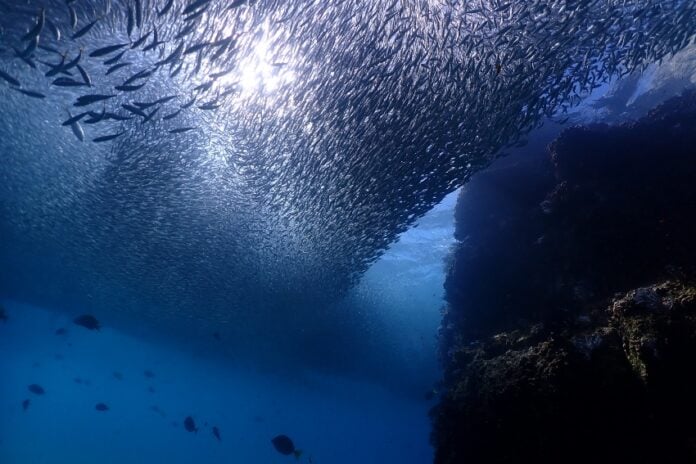
A pristine paradise, Cabo Pulmo is a protected national park that boasts the highest concentration of marine life in the Sea of Cortés. (Adventures in Baja)
Cabo Pulmo is cause for hope. Once a small fishing village on the East Cape of Los Cabos, when the waters around its coral reef became fished out by the early 1990s, residents lobbied the federal government to make it a marine park. It’s now a national park and world-class dive destination, with the most abundant marine life in the Gulf of California, or Sea of Cortés. In fact, during its decade of peak recovery, between 1999 and 2009, marine life grew by an astonishing 463%.
But almost as soon as Cabo Pulmo became an internationally recognized model for marine conservation and sustainability, threats began appearing on the horizon. Not surprisingly, given that the park is located in Los Cabos, an area of rapid tourism growth in recent decades, many of these threats to degrade Cabo Pulmo’s pristine ecology have come from real estate developers.
Semarnat cancels permits for Baja Bay Club
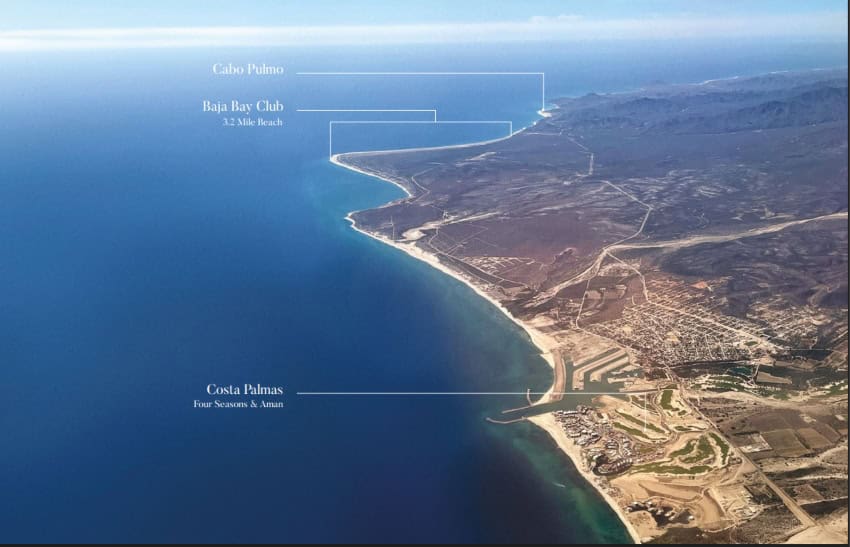
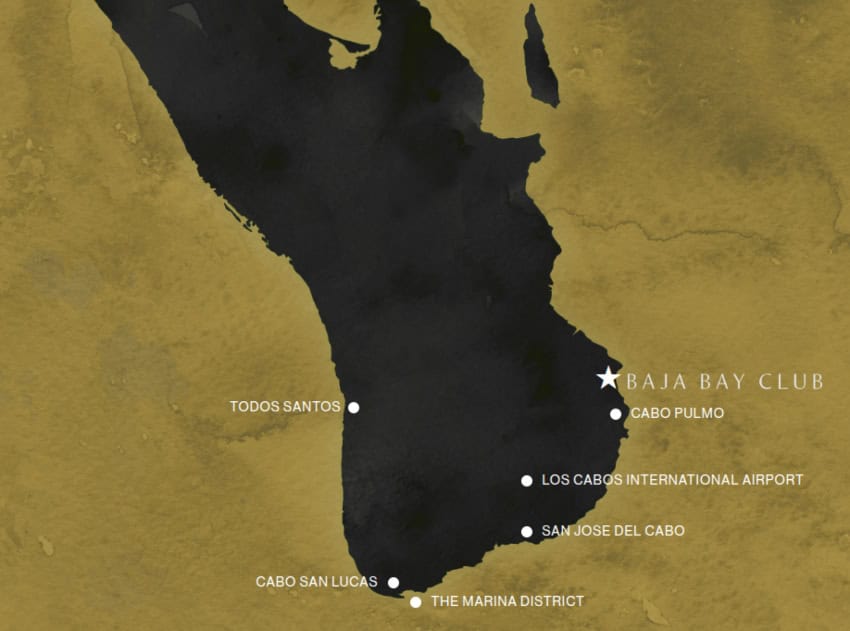
The massive Baja Bay Club project encompasses 3.2 miles of coastal property. The problem is that it’s less than a mile from Cabo Pulmo and a threat to its protected reef system. (Baja Bay Club)
In March, Mexico’s Ministry of Environment and Natural Resources (Semarnat) ruled environmentally “unviable” a large-scale development called Baja Bay Club, only 1.5 kilometers from Cabo Pulmo, that was to include 422 villas, a 275-room beachfront hotel, a marina and an 18-hole golf layout by noted golf course architect David McLay-Kidd.
In its ruling, Semarnat noted some omissions and irregularities in Baja Bay Club’s application for the project, including the concealment of water sources and runoff — a direct threat to Cabo Pulmo’s reef system. The project would also have disrupted wildlife corridors and endangered protected species and Semarnat likewise confirmed that the application had been split into two separate filings — for the project and its hotel — to avoid a regional environmental impact assessment.
But more legal wrangling will almost certainly follow. After all, the battle over this project, and the one that preceded it on the same land, has gone on for 20 years.
Cabo Cortés
The story started back in 2006, when Spanish firm Hansa Urbana submitted its environmental application for Cabo Cortés, an epic-scale project on 3,814 hectares that was to include 15 hotels, 30,000 hotel rooms, plus two golf courses and a marina. Environmental groups and residents of Cabo Pulmo immediately mobilized to fight the project, bringing so much pressure to bear that by 2012, then-President Felipe Calderón promised publicly to cancel Cabo Cortés. Semarnat made it official in 2015 with a 100-plus page ruling, stating that the project was simply incompatible with Cabo Pulmo’s protection.
The real question is, why were the permits ever approved in the first place? Mexico’s Senate seemed to agree when, in 2011, it called on the Secretary of Public Administration to investigate the granting of Cabo Cortés permits to determine whether any laws had been broken. But such an investigation never took place.
Cabo Dorado Trust
The Cabo Dorado Trust subsequently acquired 600 hectares owned by Hansa Urbana to repackage as Baja Bay Club. The trust is administered by Diego Sánchez Navarro of Grupo Desarrolla, son of Eduardo Sánchez Navarro, the largest developer in Los Cabos.
This map is not drawn to scale, and Baja Bay Club appears further away from Cabo Pulmo than it actually is. (Baja Bay Club)
Along with other Baja Bay Club principals, DMB Development, Hart Howerton and Swaback Architects and Planners, the project was one of two to receive approval during the final weeks of Andrés Manuel López Obrador’s presidency. The other was La Abundancia, a smaller 68.6-hectare development that’s also, by dint of its proximity to Cabo Pulmo, a threat to the park’s ecology.
So the battle continues, and as more developments target the East Cape, the last coastal area of Los Cabos that hasn’t been heavily developed, more loom on the horizon. Especially given that more than 3,000 hectares of the old Cabo Cortés project remain undeveloped.
Cabo San Lucas set a record for cruise ships in 2025 and 2026 looks even better
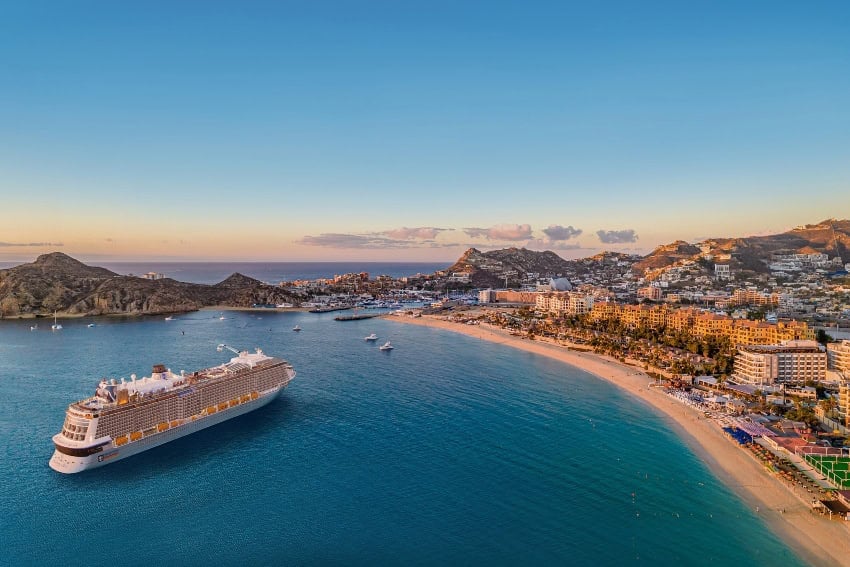
Air travel to Los Cabos is slightly down in 2026, but one area of the tourism economy is still thriving: cruise ships. Cabo San Lucas topped the one million mark for cruise ship arrivals in 2025 — 1,057,758 passengers from 285 cruise ships — the first time the Land’s End city has ever reached this milestone.
Last year was a record year for cruise ship travel to Mexico, and several Pacific Coast ports benefited, with Ensenada (1.3 million) and Puerto Vallarta (1 million) also posting all-time highs for cruise visitors. For Cabo San Lucas, 2025 arrivals were up by 46% over 2024, a sharp uptick, but one in line with the massive increases seen in recent years.
In 2022, for example, Cabo San Lucas welcomed 540,773 passengers, a tally that it has nearly doubled only three years later; and if the first two months of 2026 are any indication, more records will be smashed this year. In January and February, the destination saw 264,140 arrivals, an astonishing 75% increase relative to the same months in 2025.
Cruise ship visitor numbers have been growing by leaps and bounds in Cabo San Lucas in recent years. (Royal Caribbean)
The cruise ship boom
What’s behind this cruise ship boom? Much bigger ships. In 2022, the average cruise ship in Cabo San Lucas brought 2,382 passengers. In 2025, that average had grown to 3,711. Considering Carnival is expecting ships that can carry 8,000 passengers by 2029, this super-sized trend should continue.
Chris Sands is a writer and editor for Mexico News Daily, and the former Cabo San Lucas local expert for the USA Today travel website 10 Best and writer of Fodor’s Los Cabos travel guidebook. He has also contributed to numerous other websites and publications, including The San Diego Union-Tribune, Marriott Bonvoy Traveler, Forbes Travel Guide, Porthole Cruise and Travel, and Cabo Living.
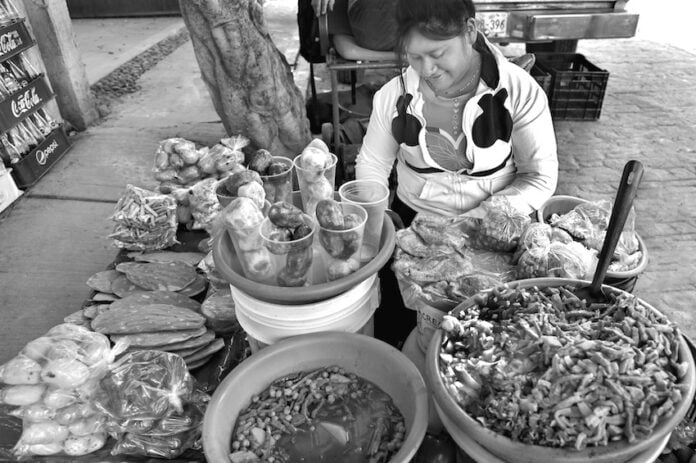
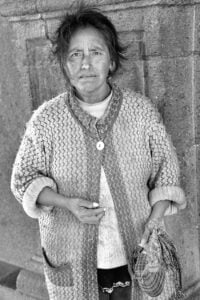
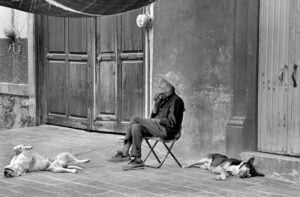
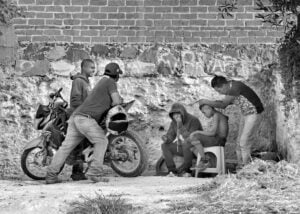
Photographer Sherry Rubel celebrates the ordinary in San Miguel de Allende, with this collection of photos. (All photos by Sherry Rubel)
I grew up in my father’s darkroom, which is where I learned the process of black and white photography. Since then, the camera has become my eyes. Taking photos is my way of connecting, communicating; I’m attempting to document life in front of me through my lens. Rather than using words to describe life, I photograph it.
For me, it’s always been about the human face — not just as a subject, but as a way to tap into our shared humanness. I use my lens to document a genuine reality rather than a polished version of it, looking for the quiet truths found in everyday, unscripted moments.
I’m drawn to these moments because they are things most people wouldn’t stop to look at or pay much attention to. I find “truth” in quiet, unscripted moments in time. People living and going about their days feels spontaneous and genuine. They are unstaged and real. These photos are a few of many from my time living and traveling in and around San Miguel, where I’m just trying to connect and capture people, life, as it truly is.
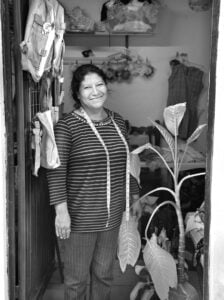
A seamstress stands in her workshop in San Miguel de Allende, where small tailoring businesses remain essential for clothing repair and custom work in the local economy.
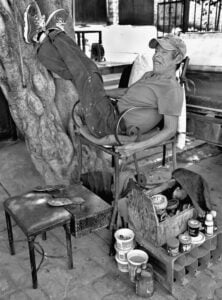
A shoeshine worker rests between customers, a common sight in Mexican plazas where the trade continues as a steady source of informal employment.
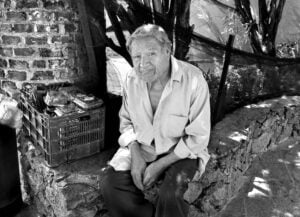
A street vendor sits beside his goods, part of the widespread informal marketplace that provides income for many families in Mexican towns.
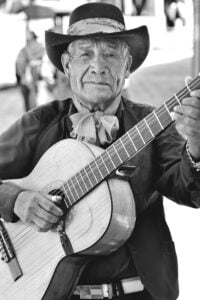
A mariachi musician holds his guitar in San Miguel de Allende, where live traditional music remains a visible part of public and cultural life.
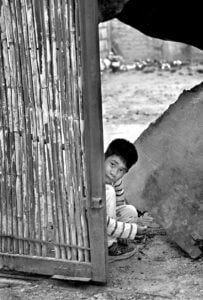
A boy peers from a doorway, offering a glimpse into everyday residential life in a small Mexican neighborhood.
A woman stands with her belongings, highlighting the economic challenges faced by vulnerable populations in urban areas.
An older man relaxes in the shade with his dogs, a quiet street scene typical of slower-paced moments in town centers.
A young child sits near packaged bread at a family-run stall, underscoring the role of small-scale food sales in local livelihoods.
Young men gather for a haircut on a neighborhood street, reflecting the social, open-air nature of daily life in many Mexican communities.
Sherry Rubel is an international photographer who cares about documentary storytelling and the ways people connect. After several trips to San Miguel, she’s found a deep rhythm in the local culture, capturing life exactly as it happens. She is drawn to the way Mexico feels so raw and real.
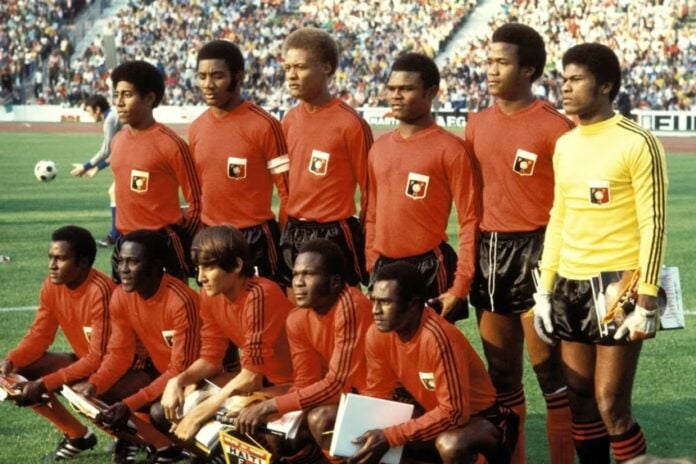
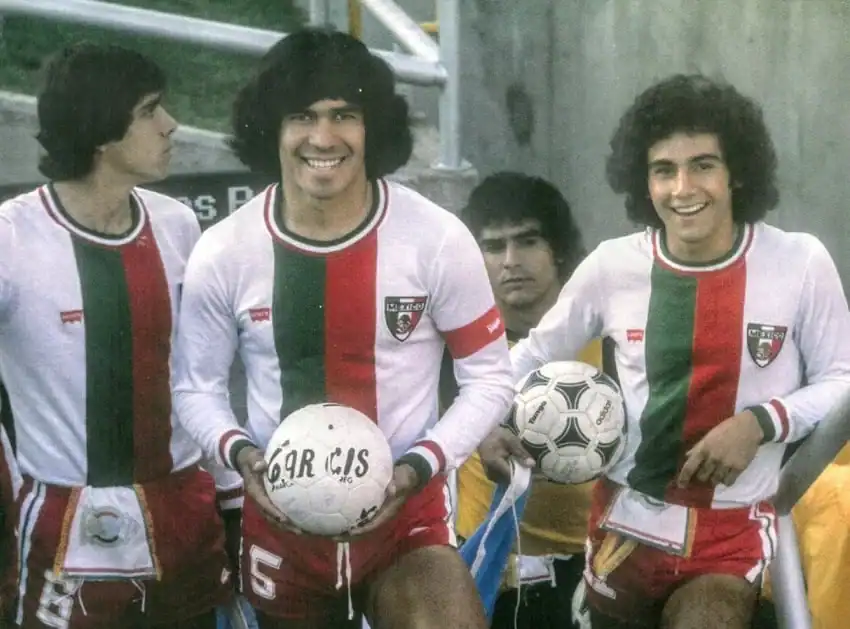
Haiti qualified for the 1974 World Cup, despite losing to Mexico in the 1973 CONCACAF qualifier. Mexico, despite beating the home side, did not. (FIFA)
The Mexican football team entered the 1970s on a wave of optimism, having just staged a successful World Cup tournament. The team had done well in front of the home fans, reaching the quarter-finals for the first time. There was further reason to celebrate the following year when Mexico won the regional CONCACAF Nations Cup in Trinidad. Mexico’s victory was not unexpected; they were the regional soccer superpower, and the real surprise had been the solid performance of Haiti. Like Mexico, the Haitians went unbeaten through their five games, but draws against Mexico, Costa Rica and Cuba cost them the title.
Jean-Claude “Baby Doc” Duvalier had recently taken over the country on the death of his father, and his anti-Communist stance saw the island’s economy being subsidized by the U.S. There was optimism that better days lay ahead, and even the tourist industry had started to pick up. Thus, there was little hesitation in awarding the 1973 CONCACAF tournament to Haiti. This would be a particularly important competition because, for the first time, the regional championship would double as a World Cup qualifying group.
World Cup qualifications for Mexico
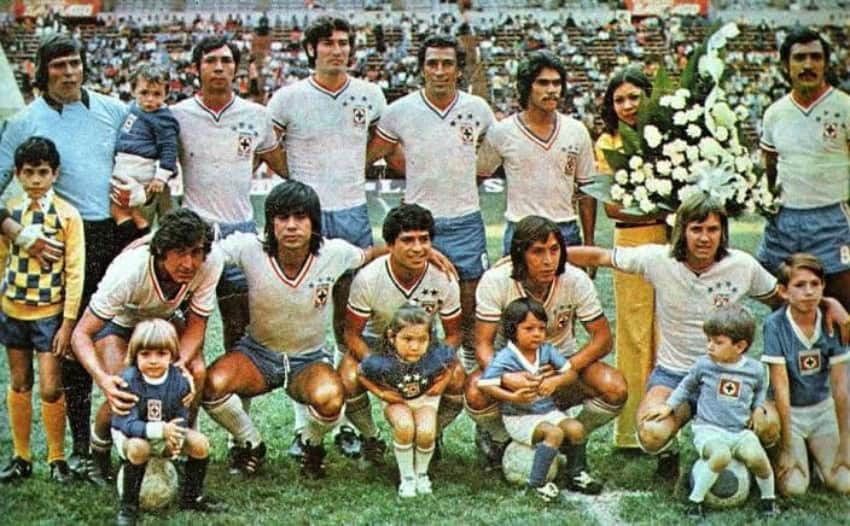
At the time, Mexican football was being dominated by Cruz Azul, champions in 1972, 1973 and 1974. The man behind this success was Raúl Cárdenas, who had guided Mexico to the 1970 World Cup quarterfinals. The other great manager of this generation, Ignacio Trelles, was plying his trade at Club Puebla, and the man in charge of the national team was Javier de la Torre. He was a Guadalajara man in his heart and soul, both as a player and three times manager. Indeed, he was still managing Guadalajara while looking after the national team as a secondary job. This Mexican team had some talented players, including Enrique Borja, who was already a veteran of two World Cup tournaments, Horacio López Salgado, who would win 50 caps, and Octavio Muciño, who had been at the heart of Cruz Azul’s recent success.
Mexico’s World Cup campaign started well, and they saw off Canada and the U.S. in the preliminary round to qualify for Haiti and the finals of the CONCACAF tournament. The team was then inactive for nearly six months as the Mexican championship wound through its bloated program of regular-season games and playoffs. From September, the national team started to prepare for their trip to Haiti with a hectic schedule of matches. Many fixtures were against local sides, including a 0-2 defeat to a team consisting of the best foreign players in the Mexican league. It had not been a particularly impressive warmup, but World Cup qualification was considered a foregone conclusion, and no alarm bells were ringing.
The 1973 CONCACAF Championship in Haiti
Six teams had qualified for the regional championships in Haiti, only one of which would win a ticket to Germany for the World Cup finals. There was only one stadium grand enough for the occasion, the Stade Sylvio Cator. The need to play games before darkness, but after the worst of the heat, meant there would only be one game a day. The pattern would be a round of three games, a day of rest, and then start again.
Honduras, considered the team most likely to challenge Mexico, started by beating Trinidad, while Mexico had a disappointing draw with Guatemala. Haiti, as expected, won its opening game against minnows Netherlands Antilles. In the second round, Mexico struggled against Honduras, trailing 0-1 for much of the game before a goal from Horacio López Salgado salvaged a point. It had not been an impressive start, and they trailed both Haiti and Honduras. The team was not gelling, and the first doubts were starting to fester in the squad. Could Mexico actually miss out on a World Cup place?
One of the most corrupt games ever played
It was Dec. 4, the day after Mexico’s draw with Honduras, that would go into history as one of the most corrupt games ever played. It did not involve Mexico directly, but would have a major impact on its chances of qualifying. Trinidad and Tobago would be playing the home side, a game they entered with some optimism. They had a group of players who had learned football the old “street way,” with endless pick-up games on the Queen’s Park Savannah, and for the first time, the squad would be strengthened by a handful of professionals who were plying their trade in the newly formed North American Soccer League (NASL).
It was a good team, and they tore Haiti apart, getting the ball into the net five times. However, on four occasions, celebrations were halted by a late whistle as the referee indicated an infringement nobody else had seen. In the end, Trinidad and Tobago lost 1-2. Had the referee been bribed, or just intimidated by the passionate 30,000-strong crowd? Or, as rumours suggested, had the Haitian team been taken into the hills to go through a voodoo ceremony?
Mexican club team Cruz Azul dominated in the 1970s. The national team, however, was not so formidable, despite boasting several Cruz Azul players on the 1973 CONCACAF tournament squad. (Instagram)
Mexico’s loss to Trinidad and Tobago scuttles World Cup chances
Before then, however, Mexico faced Trinidad and Tobago. Kevin Verity, the latter’s coach, brought his team to watch the Mexicans train, which overawed some of his younger players. Verity, however, felt he had seen a weakness in the Mexicans and adjusted his tactics. Trinidad would strengthen their midfield, let the Mexicans push forward, and launch quick counterattacks.
These tactics worked, with quick attacks down the wing and long throws into the penalty area from left back Winston Phillips causing trouble for the Mexicans. When New York Cosmos star Everald “Gally” Cummings scored after 35 minutes, Mexico had no choice but to push forward, and this left them even more exposed to counterattacks. Trinidad went on to win 4-0, which made the result of the final round of games immaterial. Although Mexico recovered to beat Haiti, the team would miss out on the World Cup for the first time in 25 years.
What went wrong?
What had gone wrong? Coach Javier de la Torre was a Guadalajara man in his heart and soul, both as a player and a three-time manager. Indeed, he was still managing Guadalajara while looking after the national team as a secondary job. He had never played for Mexico and did not have the feel for international football that Ignacio Trelles had built up, or which seemed to come naturally to Raúl Cárdenas. There might also have been some deeper problems within Mexican football.
The season was long and exhausting, and the players had looked off the boil in Haiti. They would win the ball only to give it away; there was little sign of the ticker-tac passing of Mexican football at its best. This was perhaps most notable with striker Enrique Borja, on whom so much was dependent. Like many natural goal scorers who prowl the opponents’ penalty area looking for a ball that bounces loose or a defender who hesitates, spells of prolific scoring could be followed by drought, and Borja went through a lean spell in Haiti.
More reasons for failure in Haiti
Mexican clubs had also fallen into the habit of buying players from South America, which was proving cheaper than investing in training programs that might develop the next generation of talented Mexican players. In addition, while the first African teams to enjoy some success at the World Cup, Cameroon and Algeria, were strengthened by a core of players with European experience, Mexican players tended to stay at home. Previously, such factors had not mattered, but regional standards were rising with Honduras, Costa Rica and, at this point, Haiti closing the gap. There was also, above all, the decision to play all the games in one venue. In previous tournaments, and in those in the future, Mexico would benefit from playing home games at altitude and in front of passionate home crowds. In the end, it was surrendering the staging of the qualifying tournament to Haiti that proved a fatal decision.
Despite the fuss over the qualifying tournament, Haiti had a reasonable side that year. Their players tended to be big, physical and fit. They also had that “uncoached” quality that allowed them to be unpredictable, with dramatic clearances from their own penalty area, and long, ambitious shots at goal. Francois Duvalier had made sure there was plenty of government support, with improved training facilities and good food for the squad. He took a personal interest in their preparation, sometimes turning up at practice sessions and even phoning the senior players to see how they were. This flattered some and scared others.
The 1978 FIFA World Cup did not go well for Mexico, although at least they qualified. (Facebook)
The road back to relevance
The failure to qualify in Haiti was to be the start of a dismal period for the Mexican team, which would also fail to qualify for both the 1974 and the 1982 World Cup tournaments. In between, their 1978 appearance in Argentina is best forgotten, with Mexico losing to Tunisia and being thrashed 6-0 by West Germany.
Despite this poor international record, many players from the 1973 team had distinguished careers in the sport, none more so than Manuel Lapuente Díaz, who became one of the most successful managers in Mexican football. In a managerial career that lasted 35 years, he would win five Primera División championships with three different clubs. Others would not be so lucky. Muciño, the four-goal hero against Netherlands Antilles, was killed the following year after being shot in a restaurant car park following an altercation with a local football fan, while Fernando Bustos died in a car accident on the road to Qurétaro in 1979.
The return of the World Cup to Mexico
As for the national team, it would be 1986, when the world’s greatest sporting event returned to Mexico, before the decline started to be reversed. Staging the World Cup that year led to renovated stadiums, sponsorship and improved television coverage. Clubs, led by Necaxa, became better run and invested in facilities and youth teams. Hugo Sánchez left Mexico to become a superstar in Madrid and, in doing so, paved the way for other Mexican players to follow the path to Europe. They returned with experience of the wider soccer world and helped bring in a successful era of Mexican football during which the team became ever more competitive on the world stage.
Bob Patemanlived in Mexico for six years. He is a librarian and teacher with a Master’s Degree in History.
Talavera tiles are a uniquely Mexican form of ceramics. But the word for tile in Spanish, azulejos, has an Arabic origin. (Talavera San Pedro)
In our everyday Mexican lives, many of the words we use stem from the Indigenous languages that were once spoken here, before the arrival of the Spanish. From aguacate (the delicious avocado fruit from which guacamole is made) to tlapalería (the place to find screws, lightbulbs and even paint), Spanish is filled with words that come directly from Náhuatl. This is no surprise, as the Mexica Empire was one of the strongest powers at the time of the conquest — perhaps the greatest on the continent.
But before the interaction between Spanish and Náhuatl, other languages influenced daily conversation and added new words to our dictionaries. The most significant of these was Arabic.
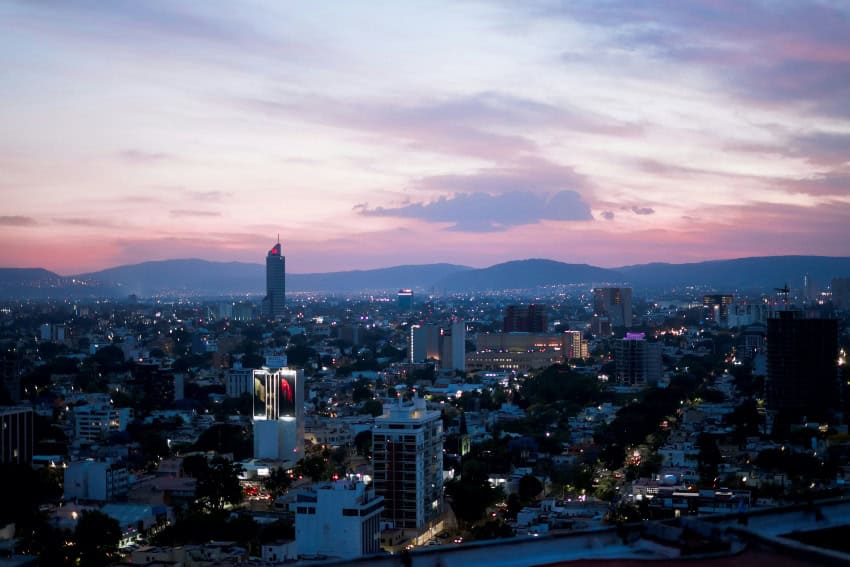
Guadalajara is one of many Mexican place names with Arabic origins, as the Spanish guada came from the Arabic word wadi, meaning river. (Roman Lopez/Unsplash)
A history lesson
The cultures of Spain and the Arab world have been in a fascinating dialogue for centuries. This dates back to 711, when Muslims began to populate the territory that is now known as Spain (Al-Ándalus). Despite the initial invasion, the resulting coexistence of cultures enriched art, gastronomy, architecture and, of course, language. Today, there are approximately 4,000 Spanish words of Arabic origin, or nearly 8% of our vocabulary.
Ojalá
Few words depict the presence of Arabic culture as clearly as ojalá. This expression is used when wishing for something to happen, either for yourself or for someone else. Although it translates to “hopefully,” that translation strips away its deep cultural background.
According to the Real Academia Española, ojalá comes from the Hispanic-Arabic šá lláh, which evolved from the Classical Arabic in šāʾ Allāh — meaning “if God wills.” When analyzing the origin of the word, we cannot ignore that, in Arabic culture, naming God (Allah) brings his presence into our lives. Even today, when non-Muslim Mexicans say ojalá, we are inadvertently invoking a deity from a heritage that feels distant, yet remains on the tip of our tongues.
Guadalupe
It is fascinating to find that the name of Mexico’s most beloved religious figure, La Virgen de Guadalupe, has neither a Spanish nor an Indigenous origin, but an Arabic one. The devotion to our Lady of Guadalupe was brought by Hernán Cortés himself. Although the Arab occupation of Spain had ended by the time he left for the Americas, it left deep remnants in his home region of Extremadura.
While there are many hypotheses about the word’s second half, the first is a clear Arabism: wadi (river), which became the Spanish guada. One of the strongest proposals for the suffix is the Latin lupus (wolf). In that case, Guadalupe would mean “the river of the wolves.” A similar example is Guadalajara, from wadi al-hijarah, meaning “stony river” or “river of stones.”
The everyday stuff: almohadas, azúcar, and alcohol
Aside from religious words, Arab culture is present in our everyday moments too. The classic request, “¿Me regalas una tacita de azúcar?” reflects the immense commercial and cultural influence of Arabic-speaking civilizations (with the word for sugar, azúcar, coming from the Arabic sukkar). While the later Ottoman Empire (which was Turkic, not Arab) inherited these territories, it was the earlier Caliphates that established Arabic as a lingua franca — a language used to communicate across different cultures and ethnicities from the borders of China to the Iberian Peninsula.
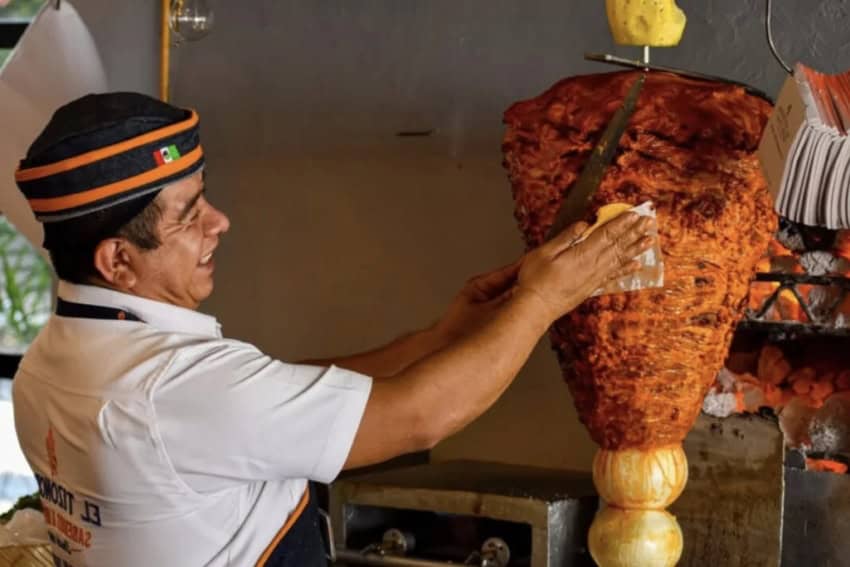
Mexico owes its beloved tacos al pastor to Arabic influence, as Syrian and Lebanese immigrants brought shawarma-style spit cooking to Puebla and Mexico City and local variations evolved. (El Tizoncito)
Arabic did more than facilitate communication; it named the very innovations that transformed daily life. From the almohada we sleep on to the alcohol we use for medicine or celebration, these terms reflect a legacy of comfort and science.
Last but not least, the food! Maybe the clearest example of this cultural continuity is the taco al pastor. While many associate it solely with Mexican identity, its origins are undeniably Middle Eastern. In the early 20th century, a significant wave of Lebanese and Syrian immigrants arrived in states like Puebla and Mexico City. They brought with them the shawarma, a method of roasting seasoned lamb on a vertical spit.
Over time, Mexican cooks adapted this technique: lamb was replaced with pork, pita bread with corn tortillas, and Middle Eastern spices with achiote and chilies.
Natural resources and architecture
Even the way we describe our natural resources is flavored by this heritage. The word aceite (oil) comes from az-zayt, the juice of the olive. Azafrán (saffron) and arroz (rice) changed our palates forever. Furthermore, the visual landscape of Mexico — from the colorful azulejos (tiles) in Puebla to the intricate cúpulas of our colonial churches — stems from the Mudéjar architectural style, a synthesis of Muslim and Christian techniques.
Follow the clue
As in most stories of emigration, contact between Spanish and Arab cultures resulted in a mix in which the lines between the two became increasingly blurred. During the centuries of coexistence in the Iberian Peninsula, the people didn’t just speak “pure” Arabic or “pure” Latin. They spoke a cluster of Romance dialects infused with Arabic structures. This was the true laboratory of the Spanish language.
If you want to spot Arabic words, use the “article rule.” Alacena (pantry), alberca (pool), algodón (cotton), almohada (pillow) and albahaca (basil) all have the same article at the beginning: al. This Arabic prefix means “the” and helps us spot words that may have a Middle Eastern origin. It has also become redundant, since in Spanish we add el or la next to it, making phrases like el algodón literally mean “the the cotton.”
Lydia Leija is a linguist, journalist and visual storyteller. She has directed three feature films, and her audiovisual work has been featured in national and international media. She’s been part of National Geographic, Muy Interesante and Cosmopolitan.
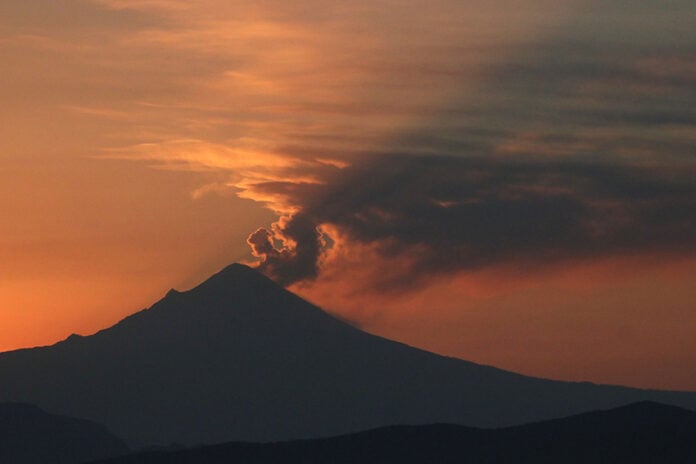
Small clouds of ash from Popocatépetl volcano catch the light of the rising sun, as seen from Cuernavaca on Tuesday. (Margarito Pérez Retana / Cuartoscuro.com)
The week began where last week left off — with the fallout from the discovery of an unauthorized CIA surveillance operation in Chihuahua. On Monday, Mexico’s Foreign Ministry delivered a formal protest note to U.S. Ambassador Ronald Johnson over the operation, demanding an explanation and asserting that any intelligence activity on Mexican soil requires prior government authorization. By Tuesday, Sheinbaum told reporters that Washington had verbally agreed to respect Mexican law going forward — though she acknowledged no written commitment had been received and that an investigation into the extent of the operation remains open.
That fragile equilibrium was immediately complicated by a new bilateral flashpoint. On Wednesday, the U.S. Department of Justice unsealed an indictment charging Sinaloa Governor Rubén Rocha Moya and nine other state officials with drug trafficking and alleged ties to the Sinaloa Cartel. It was the most direct U.S. action against a sitting Mexican governor in recent memory, and it landed with force on both sides of the border. Sheinbaum responded that Mexico would not extradite Rocha — or any official — without what she called “irrefutable evidence,” reaffirming national sovereignty as the governing principle of her response. In Washington, members of Congress went further: A bipartisan group of U.S. legislators called on Mexico to impeach Rocha and warned of legislative consequences if Mexico failed to act. Mexico’s own opposition parties echoed that demand domestically.
All of this unfolded against a backdrop of economic data that told its own complicated story. Mexico’s economy contracted 0.8% in the first quarter of 2026, the first quarterly contraction in three years — even as export revenue surged 27.7% in March, driven by a 43.7% increase in non-automotive manufactured goods including electronics. The contrast underscores the difficult position Mexico finds itself in heading into the summer: strong trade numbers masking underlying economic weakness.
Didn’t have time to catch this week’s top stories? Here’s what you missed.
CIA fallout: A verbal assurance, an open investigation
Mexico’s formal protest over the CIA’s unauthorized operation in Chihuahua marked the first time the government has put its objections in writing to the U.S. ambassador since the operation was disclosed last week. The protest note expressed Mexico’s opposition to U.S. personnel participating in domestic security operations without federal knowledge, and stated that the government expects the incident to be a one-time exception. The following day, Sheinbaum said U.S. officials had privately acknowledged the violation and pledged to comply with Mexican law going forward — but stopped short of saying the matter was resolved. An internal investigation into who in Mexico may have facilitated the operation, and whether the Chihuahua state government had any role, is ongoing.
Sinaloa governor indicted: Mexico pushes back on U.S. pressure
The U.S. indictment of Governor Rocha (a member of the ruling Morena party) and nine Sinaloa state officials on drug trafficking charges set off a rapid chain of political reactions. The timing drew immediate comment: Days after Morena senators accused Chihuahua’s PAN Governor Maru Campos of facilitating the unauthorized CIA operation on Mexican soil, Washington’s legal pressure landed squarely on a Morena-affiliated governor — a sequence that both sides of Mexico’s political divide exploited.
Sinaloa Governor Rubén Rocha Moya, seen here in Culiacán shortly before President Sheinbaum entered office, is a Morena party member and close ally of former President López Obrador. (Rubén Rocha Moya/Facebook)
Rocha denied the charges, while Sheinbaum refused to commit to extradition, saying the evidence presented was insufficient under Mexican law and that any next steps would be determined by the FGR’s independent review — not by U.S. pressure. In Washington, the U.S. House Foreign Affairs Committee warned that the indictments are ‘only the beginning’ and vowed accountability for anyone ‘complicit in trafficking drugs into the United States. Mexico’s Citizens’ Movement party and other opposition groups sided with the U.S. position domestically, calling for impeachment proceedings — a demand the ruling Morena bloc has not endorsed.
Navy captures top CJNG commander in Nayarit
In a significant security operation largely overshadowed by the week’s diplomatic turbulence, the Mexican Navy arrested CJNG commander Édgar “El Jardinero” Tabares Murillo in Nayarit state. El Jardinero is allegedly a top operational commanders of the Jalisco New Generation Cartel in the Pacific region, responsible for overseeing drug trafficking routes and cartel territorial control across several states. The arrest was carried out by naval infantry forces and resulted in no military casualties.
Economy: Contraction, export surge and an auto sector warning
Mexico’s GDP shrank 0.8% in the first quarter of 2026 compared to the previous quarter with all three economic sectors — primary, secondary and tertiary — contracting quarter-over-quarter. The headline figure contrasts sharply with trade data: Export revenue rose 27.7% year-on-year in March, with manufacturers of electronics, auto parts and agricultural products all posting double-digit gains.
Mexico News Daily this week debuted the MND Sheinbaum Index™, a new monthly tracker that measures presidential performance across five weighted categories: economic management, security, sovereignty and foreign relations, social policy, and governance and transparency. Sheinbaum’s inaugural score for March 2026 came in at 60.1 out of 100 — a passing grade, the index notes, but with notable drags from economic indicators and security metrics. The index is designed to offer a data-grounded alternative to purely narrative assessments of the administration’s progress, and will be updated monthly.
World Cup: The squad takes shape, and the city prepares
Mexico’s national football federation released its first batch of World Cup player selections, naming a mix of younger, national players with an eye on ending the country’s long-running round-of-16 elimination streak. The full squad will be finalized in coming weeks. In Mexico City, authorities announced that free fan festivals will be held across all 16 boroughs during the tournament, with outdoor screens, cultural programming and food markets planned for each venue — an effort to ensure the World Cup experience reaches beyond the stadiums.
The indictment of the Sinaloa governor, a member of the ruling Morena party, will likely continue to dominate the bilateral agenda with the U.S. in coming weeks. Sheinbaum has framed Mexico’s position clearly — no extradition without formal process and evidence — but U.S. pressure and the threat of legislative retaliation mean the standoff is unlikely to be resolved quickly. Domestically, opposition calls for Rocha’s impeachment will test the unity of the Morena party and its allies. On the CIA front, the investigation into the Chihuahua operation remains open, and any new disclosures about the scope of foreign intelligence activity on Mexican soil could reignite that crisis. With the World Cup now weeks away, the government is also managing the enormous logistical and security demands of hosting a global tournament — including matches in Mexico City, Guadalajara and Monterrey — while navigating one of the most turbulent bilateral moments in recent years.
This story contains summaries of original Mexico News Daily articles. The summaries were generated by Claude, then revised and fact-checked by a Mexico News Daily staff editor.