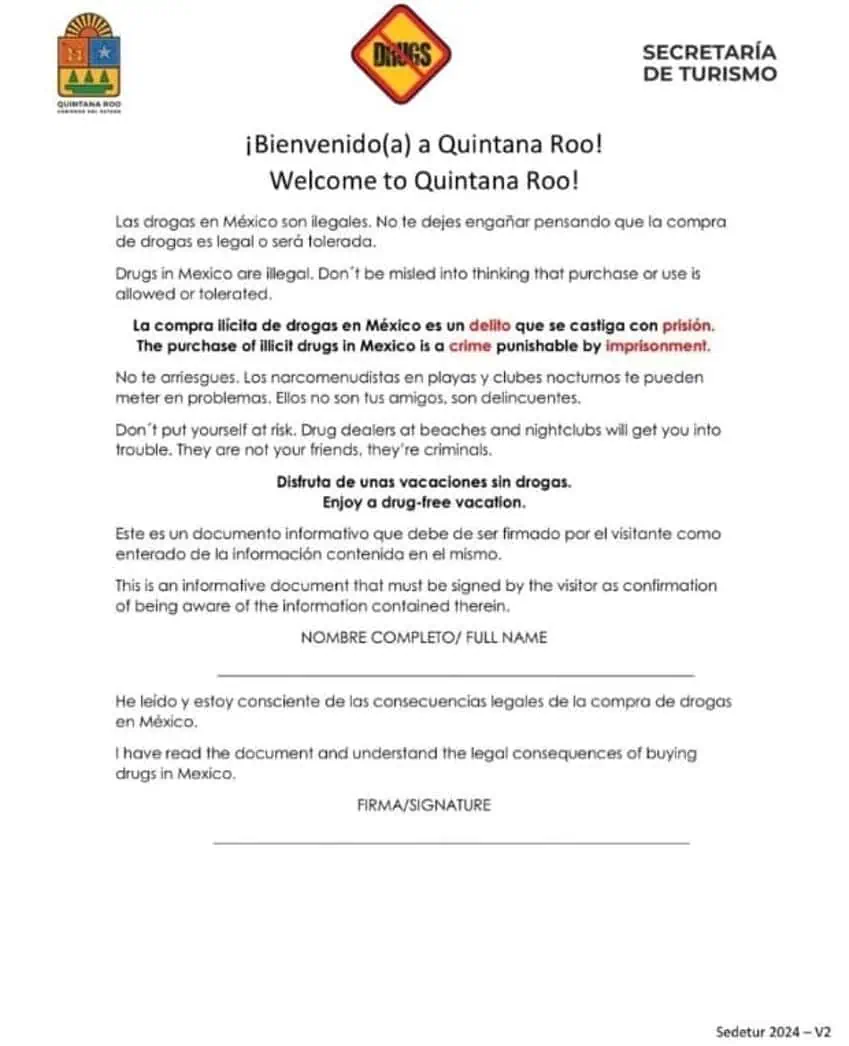
A draft of the proposed advisory for visitors to Tulum, presented by the Tulum Hotel Association and the Quintana Roo Tourism Ministry. (Sedetur)
In efforts to inform and protect visitors to the Caribbean resort, Tulum hotels and the Quintana Roo Tourism Ministry are spearheading a proactive approach.
In the near future, tourists could be asked to sign a document — written in both Spanish and English and issued by the state tourism ministry — in which the signatory acknowledges that purchasing illegal drugs in Mexico is a crime.
Riviera Maya News reported that the one-page document is being circulated by the Tulum Hotel Association in hopes of winning consensus among member hotels.
“It is a format we suggest be integrated into the hotel check-in process,” Carla Patricia Andrade, director of the association, told Riviera Maya News. “It is a formal notification that in Mexico the consumption of these substances is illegal.”
If approved, all guests would be required to sign the document, confirming that they recognize the consequences of illegal drug consumption, Andrade said.
The idea behind the notice is to ensure that guests not only have a safe vacation but that they are aware that everybody in Tulum — foreigners included — are subject to the local laws.
Andrade told La Jornada Maya that Tulum is just as safe as any destination for those who come to enjoy the culture, the natural beauty, the adventure tourism, bird-watching, or just lazing on the beaches. “We have so much to offer here,” she said, “that it is not necessary to involve the consumption of illicit drugs.”
Drug use among tourists is a legitimate concern as evidenced by a tragedy in December —the bodies of two young U.S. citizens were found inside a rented suite in the Holistika neighborhood of Tulum. Local media outlets reported the cause of death was accidental overdose.
The proposed document is unequivocal, warning:
“Don’t put yourself at risk. Drug dealers on beaches and nightclubs will get you into trouble. They are not your friends, they’re criminals. Enjoy a drug-free vacation.”
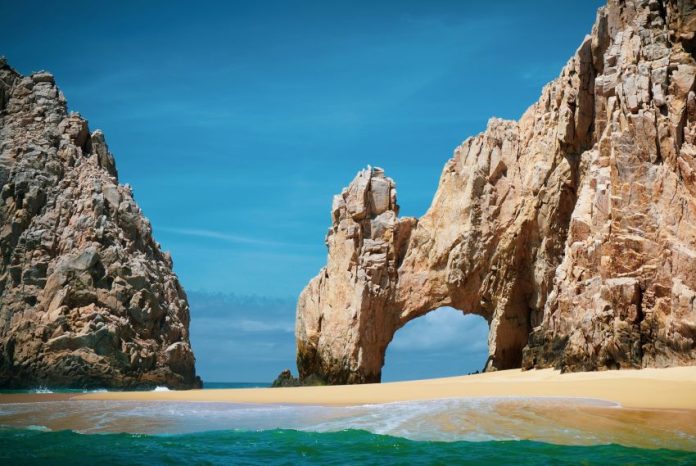
Air travel to Los Cabos has exploded since 2021, with flights from the U.S., Europe and Mexico offering sun seekers the chance to enjoy one of Mexico's best beach destinations more conveniently than ever. (Vania Medina/Unsplash)
Los Cabos has been a popular tourist destination for over 50 years, but in recent years the destination has witnessed a period of unprecedented growth. In 2019 and 2021, the years before and after the pandemic-challenged 2020, Los Cabos welcomed 2.8 million visitors. In the two years since, however, the numbers have increased dramatically, from 3.3 million in 2022, to 3.86 million in 2023. Initial projections for 2024 forecast 4.2 million people this year. If that bears out, the number of annual visitors will have increased by a whopping 50% since 2021.
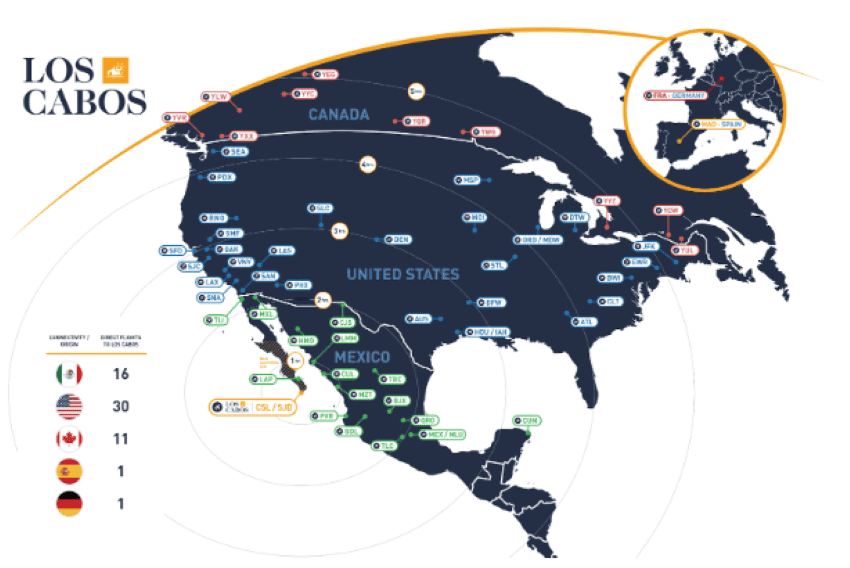
This remarkable growth has been made possible by enhanced airline connectivity, with more flights bringing more tourists from destinations throughout North America, and increasingly from Europe too. Last year alone, 14 new air routes were established in North America, so that by March of this year, over 600 flights a week were arriving, bringing passengers directly from 30 cities in the U.S., 11 in Canada and 16 in Mexico.
Flights to Los Cabos have exploded in recent years. (Los Cabos Tourism Board)
More flights are coming from Europe
The big news recently is that Los Cabos will soon see expanded service from Europe, too, courtesy of flights from leisure airline Condor, which will deliver passengers from Frankfurt, Germany. Service on Airbus A330neo jets begins in November 2024 and is expected to run seasonally from November to April. Condor will offer twice weekly non-stop flights, bringing an estimated 16,000 yearly visitors with a benefit of US $1 billion annually for the local economy.
This added connectivity brings the number of countries delivering tourists to Los Cabos from outside México to four: the U.S., Canada, Spain, and Germany. Before the recent announcement of service from Frankfurt, Los Cabos received flights from only one European city: Madrid, Spain.
Spanish airliner Iberojet will continue that service, which has been running during the summer season since 2022. Visitors have increased every year from Madrid, from 8,000 the first year to 10,000 in 2023, with an estimated 15,000 expected in 2024.
More direct flights are being added in the U.S.
The biggest market for Los Cabos continues to be the U.S. Over 55% of airline passengers to Los Cabos in 2023 originated from México’s neighbor to the north, compared to a little more than 34% from México itself, and only 6% from Canada. Los Cabos’ increased connectivity to the U.S. somewhat masks the fact, however, that almost half of all American tourists in 2023 flew from only two states: California (representing 29% of total U.S. visitors) and Texas (17%).
Germany’s Condor will soon start direct flights from Frankfurt to Los Cabos. (Condor Flugdiens)
But flights have recently been added in other new and established markets. Seasonal service from Las Vegas to Los Cabos, for example, began in December 2023, with Alaska Airlines offering flights four days a week through April of this year.
Frontier Airlines, which canceled regularly scheduled Denver to Los Cabos flights in February even though it was among the airport’s most popular routes, quickly made amends. Frontier will begin twice-weekly service from Phoenix to Los Cabos beginning on May 16.
Beginning this month, Southwest Airlines also launched weekly Saturday flights from St. Louis to Los Cabos. Southwest is a major carrier to the destination, bringing passengers from Austin, Baltimore, Chicago, Denver, Houston, Kansas City, Oakland, Orange County, Phoenix, Sacramento, and San Diego in addition to St. Louis.
These airlines are joined by American, Delta, United, JetBlue, and Sun Country Airlines in providing service to Los Cabos from a total of 30 cities or metro areas across the U.S. The Eastern portion of the country is less connected than the West Coast, it should be noted, but flights are regularly scheduled from New York City, Newark, Charlotte, and Atlanta.
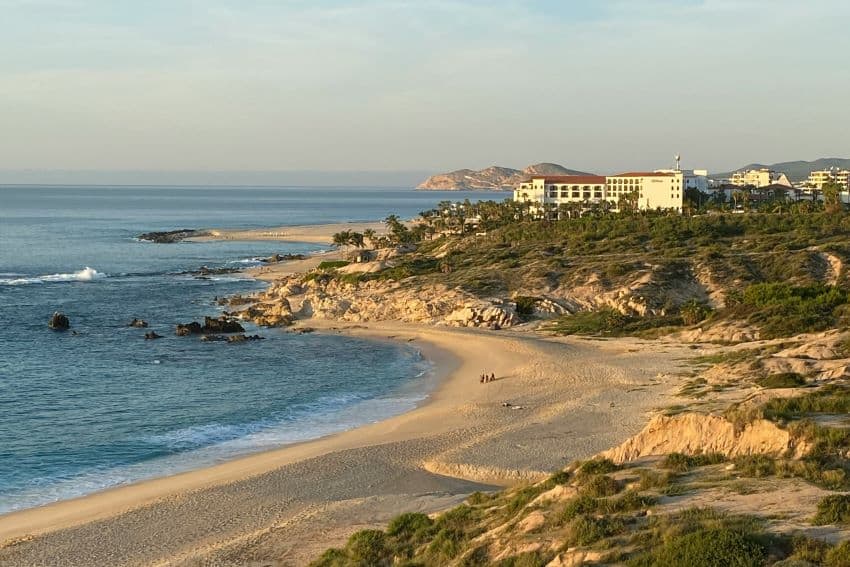
Baja California’s beaches are now more accessible than ever, with flights from 30 U.S. cities to the state. (Charlie De León/Unsplash)
New flights from Canada
Canada brings far fewer passengers to Los Cabos than the U.S., but the nation’s airlines have likewise increased connectivity during the past year. Air Canada, for example, added a weekly flight from Montreal to Los Cabos during the recent winter season (that service ends this month, by the way). The carrier also offers seasonal flights to the destination from Toronto and Vancouver, which will continue through April
Vancouver is the Canadian destination most connected to Los Cabos, with weekly flights from airlines Air Canada, Flair, Sunwing, and WestJet. However, flights can also be booked from Abbotsford, Calgary, Edmonton, Kelowna, and Victoria.
Semi-private jets are now an option
There are plenty of budget-friendly ways to get to Los Cabos but for those seeking more luxurious transportation options – meaning no waiting and no lines – semi-private jet service Aero now offers service from Van Nuys Airport in Los Angeles to airports in Cabo San Lucas and San José del Cabo. These flights offer a host of upscale amenities, along with the exclusivity provided by limited seating (the company’s ERJ135 jets, for example, accommodate only 16 passengers).
Aero has partnered with the acclaimed Waldorf Astoria Los Cabos Pedregal resort, for instance, to deliver guests for special events, and has been providing service to Los Cabos since 2022, with tickets originally priced at $1,600 each way. Prices now vary, often with significantly better rates, depending on when you book and what time of year you choose to travel.
For the discerning traveler, there is always the option of booking a private jet! (Aero)
Domestic flights available from Los Cabos For Vacation Jaunts
Not only is it easier than ever to get to Los Cabos, but it’s also easier than ever to use it as a jumping-off point to other popular destinations on Mexico’s Pacific Coast. That’s because of a new domestic airline, Señor Air, which recently began operating out of Los Cabos International Airport in San José del Cabo. Twice-weekly flights to Hermosillo and Puerto Vallarta are scheduled through April. Flights to Los Mochis and Mazatlán, meanwhile, were offered during the winter months.
Domestic service, of course, is also offered throughout México by airlines such as AeroMéxico, VivaAerobus and Volaris.
Chris Sands is the Cabo San Lucas local expert for the USA Today travel website 10 Best, writer of Fodor’s Los Cabos travel guidebook, and a contributor to numerous websites and publications, including Tasting Table, Marriott Bonvoy Traveler, Forbes Travel Guide, Porthole Cruise, Cabo Living and Mexico News Daily. His specialty is travel-related content and lifestyle features focused on food, wine and golf.
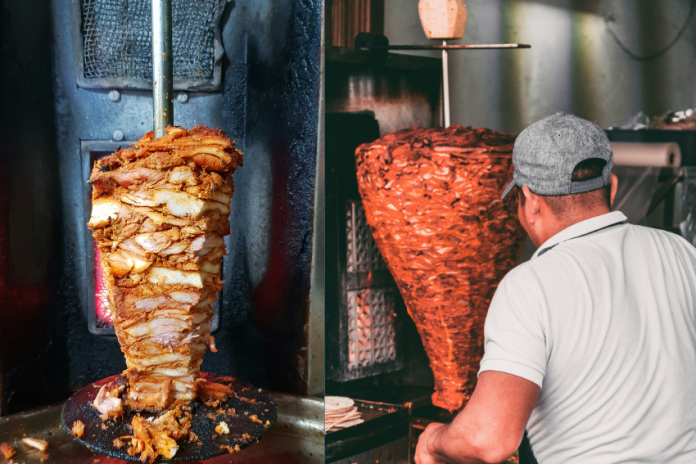
Döner kebab and tacos al pastor are two sides of the same cultural coin, but there's more in common than just that. (Canva)
I was staying in Berlin last month in a neighborhood with a strong Middle Eastern influence, the proud working-class neighborhood of Wedding. Every time I was out and about, I was confronted with a constant reminder of Mexico. A familiar, haunting smell beckoned me around every corner. As I walked down the neat and orderly streets of the Germany capital, these 20 kilo, spinning, vertically roasting, layered pieces of meat were a reminder of the legendary trompos of taquerías across Mexico. After spending a few years in Veracruz, this was both a welcoming and comforting sight to behold.
In the vibrant tapestry of Mexican cuisine, a surprising thread of German culinary tradition is woven throughout, introducing flavors and techniques that have subtly melded with Mexico’s rich culinary heritage. This blending of cultures is akin to a carefully woven quilt, where the distinct notes of German influence tangle with the bold, complex flavors of Mexican dishes.
Middle eastern immigrants brought variations of the kebab to both nations – in Mexico, it has become the iconic taco al pastor. (Taquería Don Rey/Facebook)
Meat, cheese and beer bring Mexico and Germany together
First up, let’s talk tacos al pastor, a dish that’s practically synonymous with Mexican street food. Here’s the twist: the method of cooking meat on a vertical spit is not originally Mexican. It’s a culinary import, adapted from Lebanese immigrants, which was then given a German makeover. German immigrants, bringing with them a penchant for pork, saw an opportunity to blend their own meat preparation techniques with this method, resulting in the birth of tacos al pastor. It’s a beautiful example of culinary evolution, where technique and tradition merge to create something uniquely delicious. German immigrants didn’t just bring their knack for brewing to Mexico; they practically laid the foundation for Mexico’s burgeoning beer industry. They introduced European lagering techniques, which when combined with Mexico’s indigenous ingredients produced beers that were both refreshing and uniquely Mexican. This melding of brewing traditions has made Mexico one of the world’s leading beer exporters, a testament to the enduring legacy of German craftsmanship and Mexican ingenuity.
Queso is another area where German influence is unmistakable. The Mennonite communities in Mexico, particularly in Chihuahua, introduced queso menonita. Also called queso Chihuahua, this cheese, with its mild flavor and excellent melting qualities, quickly became a staple in Mexican kitchens, demonstrating how German dairy farming practices have enriched Mexican cuisine.
How to make “Rouladen a la Mexicana”
In the spirit of creating a shared table, I’d like to humbly offer my riff on the classic German Rouladen and infuse it with some Mexican deliciousness. Rouladen traditionally consists of thin slices of beef rolled around a filling of bacon, onions, mustard, and pickles cooked to perfection. Here’s how to give this dish a Mexican twist, creating “Rouladen a la Mexicana”.
Rouladen a la Mexicana, a Latin twist on a German classic. (Live Like You’re Rich)
Ingredients:
4 thin beef slices (about ¼ inch thick), preferably flank steak for its robust flavor
4 tablespoons of adobo sauce (from canned chipotle peppers) as a substitute for mustard, adding a smoky depth
8 slices bacon
1 large onion, finely sliced
1 jalapeño, deseeded and finely chopped (for those who favor heat)
4 pickled jalapeños, sliced (echoing the traditional pickle component but with a Mexican kick)
1 cup queso Chihuahua, shredded
Salt and pepper to taste
1 cup beef broth
1 cup tomato sauce (to introduce a tangy, rich base)
1 tsp. of cumin
1 tsp. of Mexican oregano
Olive oil for searing
Fresh cilantro, chopped (for garnish)
Lime wedges (for serving)
Instructions:
Prep the Beef: Lay out the beef slices. Season both sides with salt and pepper. Spread a tablespoon of adobo sauce on top of each slice. On each beef slice, place two slices of bacon, a sprinkle of sliced onion, a few pieces of jalapeño, pickled jalapeños, and a generous amount of queso Chihuahua. : Roll up each beef slice tightly around the filling. Secure with toothpicks or kitchen twine to keep them from unraveling.
Heat olive oil in a large skillet over medium-high heat. Sear the rouladen on all sides until they are nicely browned. This not only adds flavor but also helps to seal in the juices. Remove the rouladen from the skillet. In the same skillet, add the remaining onions and jalapeños, sautéing until soft. Pour in the beef broth and tomato sauce, then add cumin and Mexican oregano, stirring to combine. Return the rouladen to the skillet, spooning the sauce over them. Cover and simmer on low heat for 1 hour or until the beef is tender. The slow cooking process melds the flavors and tenderizes the beef, a hallmark of both German and Mexican cooking traditions.
Remove the toothpicks or twine. Serve the rouladen with a sprinkle of fresh cilantro and lime wedges on the side. The acidity of the lime brightens the dish, adding a layer of freshness.
“Rouladen a la Mexicana” marries the hearty, comforting essence of German cuisine with the vibrant, bold flavors of Mexico, creating a dish that’s both familiar and excitingly new. Enjoy this fusion feast that celebrates the culinary traditions of two cultures, brought together on a single plate.
Stephen Randall has lived in Mexico since 2018 by way of Kentucky, and before that, Germany. He’s an enthusiastic amateur chef who takes inspiration from many different cuisines, with favorites including Mexican and Mediterranean.
Mexico's appearance on the Kearney FDI Confidence Index for the first time in four years is a sign of growing interest by companies around the world in nearshoring. (Clayton Cardinalli/Unsplash)
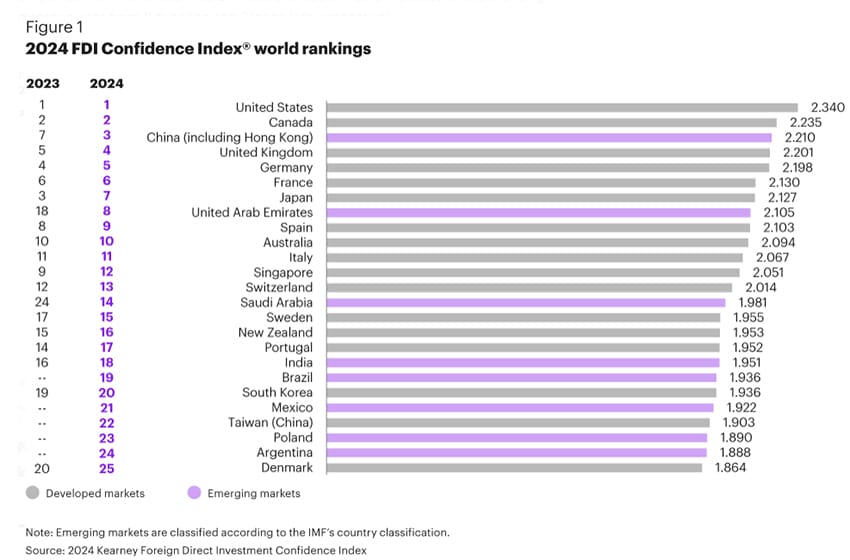
After a four-year hiatus, Mexico has reemerged as a top contender for foreign direct investment (FDI), appearing on Kearney’s 2024 FDI Confidence Index — placing 21st among 25 countries.
Mexico’s return to the list for the first time since 2019 comes amidst a global shift toward nearshoring, where companies are relocating operations closer to major markets such as the United States.
On Kearney’s world rankings list, Mexico was No. 21, ranking just above Taiwan, which has been a focus of concern by US tech companies worried about potential supply-chain issues. The majority of chips and other components for AI tech is made by companies in Asia. (Kearney)
Mexico’s resurgence can be attributed to several factors: its geographical proximity to the U.S., a massive and growing consumer base, and a skilled labor pool that makes the nation of 131 million an attractive option for companies seeking to optimize their supply chains.
The Kearney report highlights Mexico as the leading beneficiary of manufacturing companies migrating from Asia, a trend known as “reshoring” — driven by a desire to reduce transportation costs, improve responsiveness to customer needs and minimize potential disruptions caused by geopolitical tensions.
According to Mexico’s Economy Ministry (SE), more than US $31.5 billion of FDI was pledged to Mexico during January, February and the first half of March — with $5.67 billion in the first 15 days of March alone. Those investment announcements, which came from 73 private companies, promised to generate 39,192 jobs.
While the United States remains the undisputed leader in FDI attraction for the 12th consecutive year, Mexico’s return to the top 25 signifies a renewed investor confidence in the nation’s economic potential. The report surveys investor sentiment regarding the next three years of FDI flows.
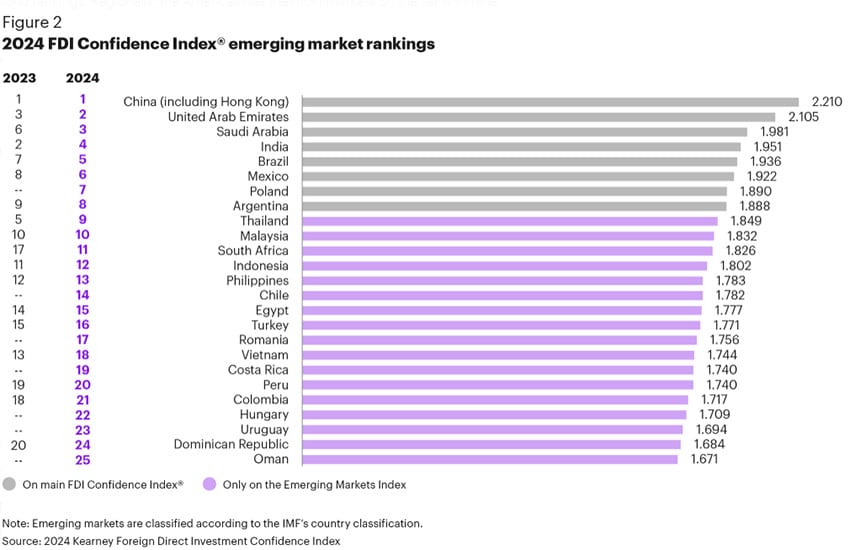
Notably, Mexico was sixth in the emerging market rankings, improving two spots from 2023, due to the growing appeal of Mexico’s burgeoning manufacturing sector and its ability to compete globally.
Mexico is behind established powerhouses such as China, Brazil and the United Arab Emirates on this list but ahead of Argentina, Thailand, Malaysia and Indonesia.
Mexico made a return appearance on Kearney’s emerging markets top 25, rising from No. 8 in 2023 to No. 6 this year. (Kearney)
The Kearney Index also sheds light on broader trends shaping the global investment landscape. Technology, particularly artificial intelligence (AI), is rapidly becoming a key differentiator for investors.
Many Kearney respondents anticipate leveraging AI for various purposes, including investment decision-making, supply-chain management optimization and enhanced customer service experiences. Companies that effectively integrate AI into their operations are likely to gain a competitive edge in attracting foreign capital.
The Wall Street Journal reported Sunday that major U.S. tech companies have asked their Taiwanese manufacturing partners to increase production of AI-related hardware in Mexico in order to have access closer to home.
Kearney’s FDI Confidence Index paints a picture of a global investment environment brimming with both optimism and caution. While investors express confidence in the overall health of the global economy, they remain wary of risks such as geopolitical instability and a more restrictive regulatory environment.
And according to data presented by Omar Troncoso, a partner at Kearney México, Mexico was the 12th largest economy in the world in 2023, based on preliminary information from the International Monetary Fund (IMF).
Seojin Mobility representatives at the groundbreaking ceremony last week for the Korean company's first plant in Mexico. (Seojin Mobility Mexico)
Korean electric motor manufacturer Seojin Mobility will invest US $300 million in its first Mexico plant, which is now under construction in the northern state of Nuevo León.
Reforma newspaper reported that the first stage of construction is expected to be completed by February 2025 at a cost of $200 million, while the second $100 million phase will involve the construction of hybrid motors. The Korean electric vehicle (EV) supplier anticipates the plant, once operational, will create 300 jobs.
Byung Hyuk Kang, general director of Seojin Mobility México, and José Antonio Quiroga, the local municipal president, presided over the groundbreaking ceremony on March 28 in the city of Escobedo, just north of Monterrey.
Byung Hyuk told reporters that Seojin Mobility will build motors for electric vehicles for the Hyundai plant in Savannah, Georgia, and has plans to collaborate with Kia Motors’ operations in the city of Pesquería, 36 kilometers west of Escobedo.
When asked if Seojin would build motors for the Tesla plant in Santa Catarina (27 kilometers southwest of Escobedo), Byung Hyuk said that is unlikely, though not impossible.
“We will be focusing on four Hyundai models in the United States,” he said, explaining that the company also hopes to work with Kia. “[Kia] has a plan for a small model electric vehicle in 2025.”
Seojin Mobility will make motors at its Mexico plant for Hyundai electric vehicles that are made in the United States. (Hyundai)
Seojin Mobility, headquartered in Siheung, South Korea, is the primary supplier for Hyundai and Kia and also has contracts with GM, Renault, Ferrari and Volvo. Still, the proximity of the Tesla plant presents several advantages.
“With Tesla being nearby, we might find an opportunity to develop [new] products,” Byung Hyuk admitted, while emphasizing the new plant will serve to strengthen Seojin’s association with Hyundai and Kia México and develop the local electric vehicle market.
During the groundbreaking ceremony, the Seojin director said the company chose Escobedo for its location (near the industrial center of Monterrey and just 150 miles from Laredo, Texas) and the presence of a qualified workforce.
“Escobedo has been preparing to take advantage of nearshoring, creating an industrial district,” Quiroga said of the municipality’s development plan, which includes the construction of two hotels at a cost of $1 billion. “We are pleased that companies such as [Seojin Mobility] are coming to settle in our municipality.”
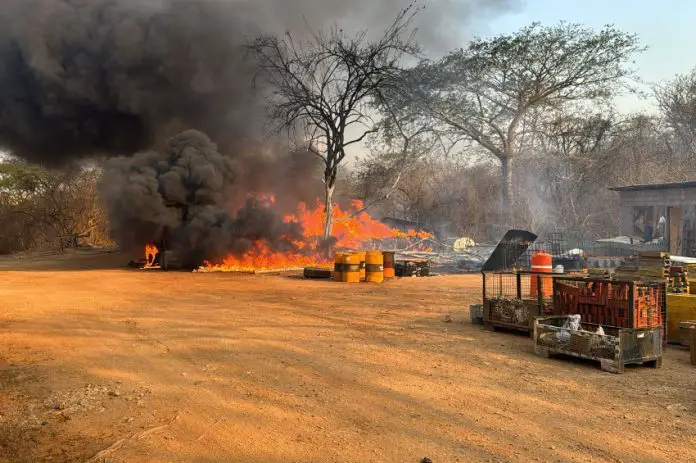
In the aftermath of the gun battle, photos uploaded to social media showed fires blazing in the area near the La Angostura reservoir bridge. (Isaín Mandujano/X)
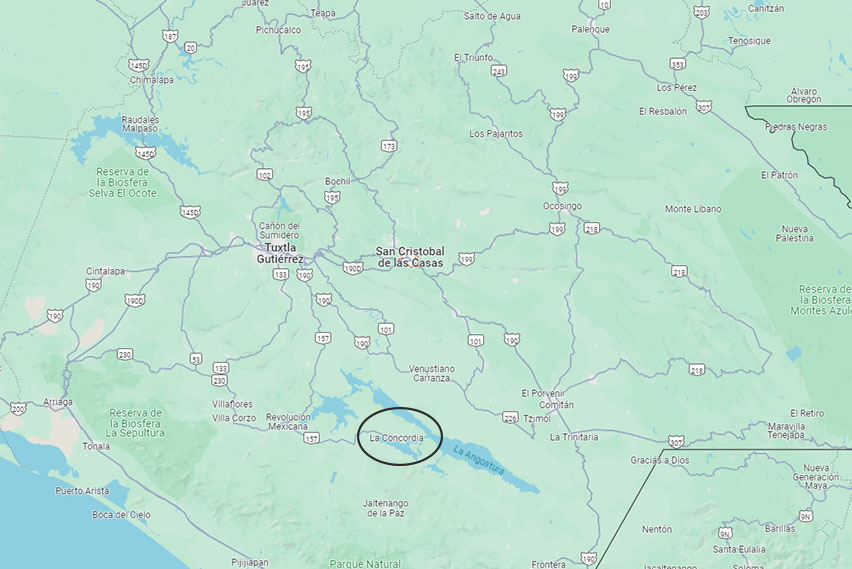
Dozens of civilians were caught in the crossfire of a gun battle between National Guard (GN) troops and presumed cartel gunmen on Sunday in the municipality of La Concordia, Chiapas, located off federal route 157 about 185 kilometers south of San Cristóbal de las Casas.
Initial unattributed reports indicated that one civilian had been killed and another severely wounded, but the Fray Bartolomé de las Casas Human Rights Center (Frayba) has since reported at least 25 people dead and a dozen or more wounded.
The municipality of La Concordia is located 185 kilometers south of San Cristobal de las Casas. (Google Maps)
According to a statement published Wednesday afternoon by the federal Public Security and Civil Protection Ministry (SSPC), only five people were killed in the shootout on Sunday afternoon. An additional five men were found dead by federal and state security forces at the Nuevo Paraíso ejido, where there had been reports of a gunfight between armed civilians earlier that morning.
This confirmed statements made by President Andrés Manuel López Obrador at his Wednesday morning press conference, in which he denied the human rights organization’s account.
“There were two separate incidents,” the president said. “[Frayba] talks about 25 victims, but that is not so. Instead, there were maybe 10 — five in one incident and five in the other.”
The shootout, according to the Frayba statement, occurred before noon on Sunday as roughly 40 people were waiting in vehicles to be ferried across the La Angostura reservoir, when the GN arrived in pursuit of armed civilians.
Migrants in 2021 crossing the La Angostura reservoir in La Concordia. The crossing has become a route for migrants heading north, which has brought more organized crime to La Concordia as criminals target migrants. Local activists estimate a total of 2,300 residents of La Concordia and two nearby towns have been forced to leave their homes due to cartel violence. (Pedro Anza/Cuartoscuro)
A firefight ensued between the GN and the gunmen, with the civilians caught in the middle. Frayba reported the existence of videos — which they said had been taken by the GN — that appear to show that some victims had been shot in the head and may have been victims of extrajudicial killings by security forces.
The SSPC statement said 13 Guatemalan nationals had been arrested after the confrontation.
Frayba is demanding a full investigation, insisting that a massacre occurred, and accusing the GN of using excessive force. Frayba is also asking that the government’s security policy be overhauled and that soldiers not be used for policing duties.
Chiapas has seen an uptick in violence and forced displacements since criminal organizations began infiltrating the region, where they are vying for control of drug trafficking and human smuggling routes.
Another violent incident took place on Monday in the Chiapas city of Ocozocoautla, about 36 kilometers west of the state capital Tuxtla Gutiérrez.
According to the newspaper El Universal, shots were fired when heavily armed civilians kidnapped two unidentified men. Local officials said no bystander injuries occurred and state authorities have begun an investigation.
Just a week earlier, two people were killed and a third injured when a predawn shootout left early-morning commuters stranded while security forces shut down the main highways in Ocozocoautla for eight hours.
On March 19, gunmen ambushed a GN detail in Ocozocoautla, killing one and injuring two. The soldiers had responded to an apparent bogus emergency call reporting a vehicle accident when they were attacked on federal highway 145D.
A few days earlier, hitmen attacked the local offices of the Federal Attorney General’s Office (FGR), killing an official. In February, a presumed cartel gang murdered three policemen and the police chief of Berriozabal, a city a few miles east of Ocozocoautla.
A Maya Train car derailed on March 25, but was traveling at low speed so there was minimal damage, and no injuries were reported. (Cuartoscuro)
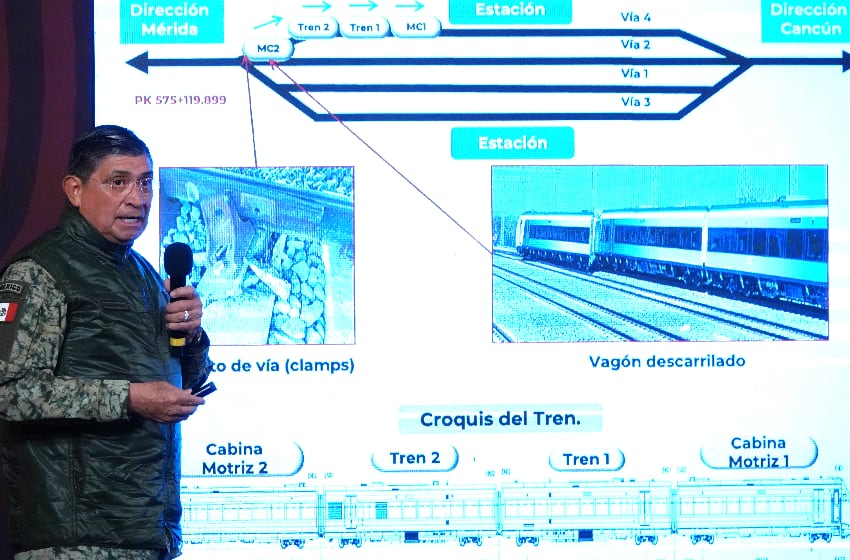
The derailment of a single Maya Train car near Tixkokob station in Yucatán state on March 25 was caused by a failure in the track fastening system, according to Mexico’s Defense Ministry (Sedena), which operates the Maya Train.
Defense Minister General Luis Cresencio Sandoval revealed Tuesday that although the system is designed to be automated, it is still being operated manually due to its incomplete state. This manual operation — in this case, the improper clamping of tracks — is believed to be the culprit behind the car derailment.
General Sandoval said at President López Obrador’s Tuesday morning press conference that the incident was caused by human error. (Cuartoscuro)
“The incident was caused by a lack of mechanical screw fixings that ensure the change of track with the rail,” read a document displayed by Sandoval during President Andrés Manuel López Obrador’s Tuesday morning press conference at the National Palace.
Because the train was traveling at a slow speed, approximately 10 kilometers per hour, it sustained minimal damage and there were no injuries. An investigation is currently underway by federal authorities. The train’s manufacturer, Alstom, and track constructor, Azvindi, are also involved in damage assessment.
This incident raises concerns about the Maya Train project, which has faced criticism for its premature inauguration and environmental impact. The railroad, a signature infrastructure initiative of the current government, stretches 1,554 kilometers through the Yucatán Peninsula states of Quintana Roo, Yucatán and Campeche and neighboring states of Tabasco and Chiapas. Originally projected to cost US $7.5 billion, the government now anticipates the final price tag to exceed US $28 billion.
Initially, President López Obrador had described the derailment as “strange,” hinting at the possibility of sabotage meant to make his government look bad in the lead-up to the June elections. However, there reportedly is no evidence to support this theory.
The Maya Train began operations on three of its seven sections in December. The derailment incident occurred on Section 3, near the Tixkokob station located east of Mérida, Yucatán’s capital.
Footage on social media showed the last car of the train, which had been bound for Cancún, off the tracks near a railway junction. The Maya Train agency released a statement acknowledging the derailment, which occurred as the train passed over a track switch at the Tixkokob station entrance.
Officials assured the public that a committee is investigating the incident and that the Maya Train will implement preventative measures to avoid similar incidents in the future.
Adrián Guerrero Caracheo is a candidate for the Celaya, Guanajuato, city council. His whereabouts were unknown for over a day after a shooting that killed a Celaya, Guanajuato, mayoral candidate. (Adrián Guerrero/Facebook)
When Gisela Gaytán, a Morena candidate for mayor of Celaya, Guanajuato, was murdered on Monday afternoon in a flurry of gunshots, a member of her party running for city council was initially believed to have lost his life as well. But Celaya city council candidate Adrián Guerrero Caracheo is safe and sound, Guanajuato authorities reported Tuesday.
Guerrero was hiding out with his family and cooperating with authorities investigating Gaytán’s murder, authorities said.
Gisela Gaytán was shot and killed Monday on her first day of campaigning for mayor. She had asked the National Electoral Institute for protection after receiving threats. (Gisela Gaytán/Facebook)
Gaytán was shot and killed Monday while campaigning in San Miguel Octopan, a community of the Celaya municipality located about 10 kilometers northeast of downtown Celaya.
The 38-year-old lawyer had asked state electoral officials for protection but had not yet received any when the shooting occurred, on her first day of campaigning.
Guerrero, a Morena councilor candidate, was initially believed to be dead as well after Ricardo Sheffield, the party’s senatorial candidate in Guanajuato, said in a press conference that Guerrero was taken with two other injured people to the hospital, where he supposedly died.
Guerrero’s reported death was additionally confirmed Tuesday morning by Rosa Icela Rodríguez, head of the Ministry of Security and Citizen Protection (SSPC), as well as by President Andrés Manuel López Obrador, also of Morena.
Hours later, however, the SSPC corrected the error and changed the aspiring councilman’s status to “missing.” He still had not been located, officials said, but he was “not deceased, as reported this morning,” the agency said.
It wasn’t until hours later that Guerrero contacted Morena party officials. The candidate was also reportedly seen at the federal Attorney General’s Office in San Miguel de Allende, according to the newspaper Infobae, asking for protection for himself and his family in the wake of the attack.
As for protection before the shooting, Sheffield said that the National Electoral Institute had granted it to him and Alma Alcaraz Hernández, who is running for governor of Guanajuato — but not to the nine Morena candidates for municipal positions, including Gaytán.
Their requests were turned over to the Electoral Institute of the State of Guanajuato (IEEG), whose officials were informed that their campaigns had not yet begun, he said.
Gaytán had already reported having received threats, said Mario Delgado, national leader of Morena, who attacked the IEEG for “not responding” to a situation that “ended in tragedy.”
Celaya is currently governed by Javier Mendoza, who is seeking reelection with the National Action Party (PAN), a party with significant clout in Guanajuato.
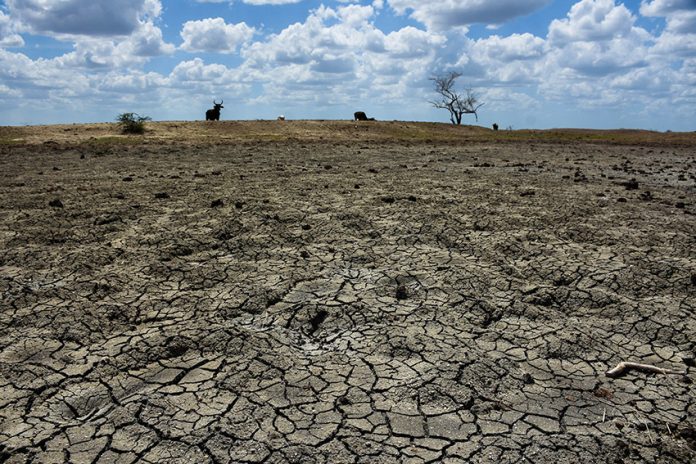
Changing climate conditions, like the increased heat and drought that have affected many areas of Mexico, are just one of the factors driving the recent surge in extinctions. (Michael Balam/Cuartoscuro.com)
The last time the world underwent a mass extinction 66 million years ago, the place now known as Mexico had front-row seats. A 200-kilometer-long meteorite slammed into Earth near the Yucatán Peninsula, setting off a chain of events that extinguished about 75% of all species living at the time, an event known as Earth’s fifth mass extinction.
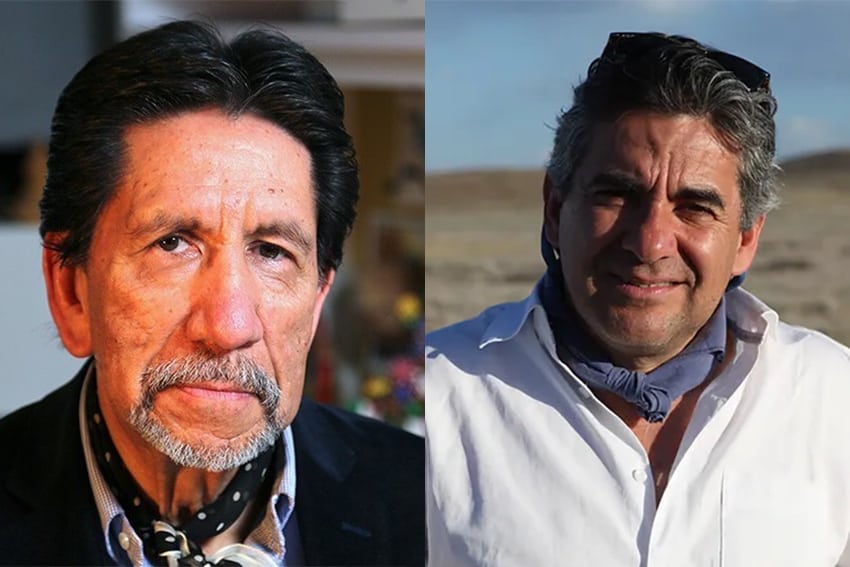
Now, scientists say the Earth is in a sixth mass extinction — but this time, it’s because of humanity. The very term “sixth mass extinction” used to be controversial among experts. It isn’t anymore, thanks in part to the work of two internationally renowned Mexican scientists. Dr. Gerardo Ceballos, a researcher at the National Autonomous University of Mexico (UNAM), and Stanford University professor Dr. Rodolfo Dirzo have worked together for decades to understand why the Earth is losing so many species and spread the word about the threats that nature and humanity face.
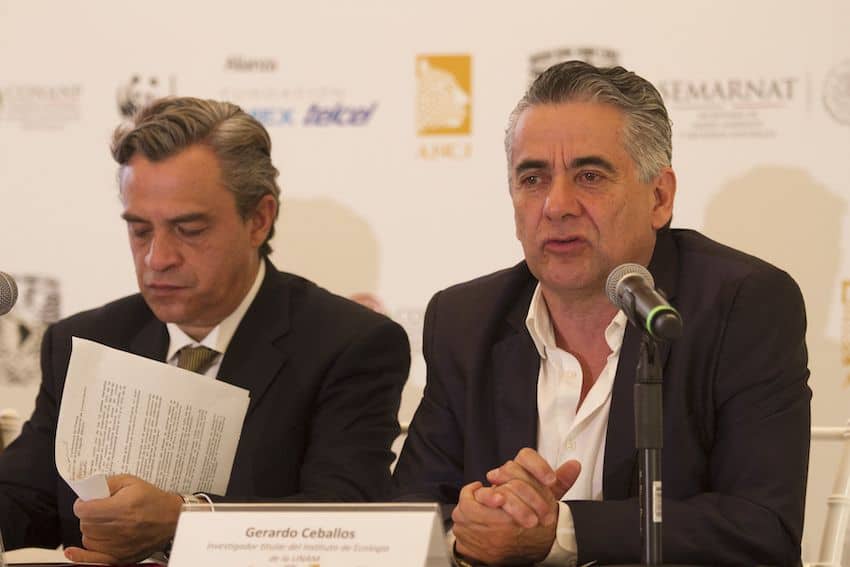
Dr. Rodolfo Dirzo (L) and Dr. Gerardo Ceballos (R). (BBVA/Indianapolis Zoo)
That’s why Ceballos and Dirzo won the BBVA Foundation’s 2024 Frontiers of Knowledge award, a recognition of pioneering work addressing the most pressing issues of our century. Since the award was established in 2008, more than 10% of recipients have gone on to win Nobel Prizes. This year marks the first time that anyone from Mexico or Latin America has received the Frontiers of Knowledge award.
Just as Mexico had a front-row seat to the biotic crisis 66 million years ago, it is once again center-stage on matters of extinction and biodiversity loss. In addition to the ground-breaking science coming from Mexican scientists like Dirzo and Ceballos, Mexico is one of the most biologically diverse countries in the world. It is also an example of how human activity can lead to the loss of those irreplaceable natural resources.
I sat down to talk to Dr. Ceballos and Dr. Dirzo about the award, their work and what the world can learn from Mexico.
How has Mexico changed over the years with respect to its scientific institutions? You’re the first Mexican winners of this award. Is it surprising that it’s taken until now?
Ceballos: No, not really. There is a lot of high-quality science being done in Mexico, Latin America and Iberoamerica. But we’re at a disadvantage compared to other countries because they have many, many more people and resources dedicated to working on these topics. That’s why this award is so important.
What is the sixth mass extinction?
Dirzo: In 550 million years, there have been five documented episodes of catastrophic extinction where a large proportion of species disappear from the face of the planet. These are called mass extinctions. It’s a very rare phenomenon in the history of life. The last one was only 66 million years ago: the extinction of the dinosaurs. Now, much earlier than would normally happen, we’re seeing another extinction, the sixth, generated by the human species.
Jaguars used to exist from the south of the United States to the south of Argentina. The species still exists, but it’s gone now in many places. When you add populations disappearing in one place, then another, then another, eventually you get to total extinction. Populations are going extinct in massive numbers right now.
The other research that Gerardo and others have done is on the extinction of species. Say 370 species in the last 500 years. If you see it in the context of the normal speed of species extinctions, depending on the group of animals, it can be 100 to 1000 times faster than normal. From the perspective of geological history, it’s very fast.
Dr. Gerardo Ceballos presenting the national plan for the conservation of jaguars in 2016, in collaboration with the National Commission of Natural Protected Areas (CONANP). (Moisés Pablo/Cuartoscuro)
With time, what kind of effects can these extinctions have on the planet?
Dirzo: For the local ecosystem in, say, the forest of Veracruz, where there are no more jaguars, tapirs, wild boar or deer, the ecological processes that happened with the interactions of those animals and their environment — the dispersal of seeds, the hunting of prey and the rest — no longer exist.
So ecological interactions are going extinct as well, and many of those losses mean problems for humanity. The simplest is that if animals that pollinate flowers go extinct at the local level, those flowers can’t reproduce. If you have a crop — alfalfa or apples for example — the loss is enormous for you. Your whole business and all that food production — it’s an economic problem and a truly serious food supply problem.
This almost always leads to problems for human well-being. A world without pollinators? A world without seed dispersal? A world without pest regulation? It would be impossible to survive.
It would be impossible to survive in a world without pollinators, says Dr. Dirzo, as the process of food production — for all species — would halt. (Carolina Jiménez/Cuartoscuro)
Your work has also focused on how the loss of biodiversity affects human diseases. That’s another way it directly affects us, right?
Dirzo: Yes. We just endured a pandemic — the strongest hypothesis at present is that it came from a wild animal, probably kept in a market. That pathogen was able to jump from an animal species to the human species. In changing the structure of animal populations with illegal animal trafficking, we put ourselves in contact with those animals and that’s a serious risk for us.
Ceballos: All of these environmental interactions that are lost when populations are lost are what we as scientists call “environmental services.” Environmental services are all the benefits that we get for free when nature is functioning well, like the fertilization of all the soils and pollination. 70% of all the active compounds in the medicines we use today come from wild plants and animals. There are enormous benefits.
The wall behind me is made of bricks. If you take away one brick, the wall keeps working but it won’t work as well. There’s more noise, dust, etcetera. If you take away more bricks, it will weaken and eventually collapse. That’s an analogy for what’s happening with populations in nature. The collapse we’re talking about is a collapse of the biological systems that make life on Earth possible — life in general and human life in particular.
Mexico began a serious jaguar conservation effort in 2010 which has seen the population recover by 20%. “Everything we are able to save — natural ecosystems, species — will probably be what survives into the future,” emphasizes Dr. Ceballos. (Joaquín Sanluis/Cuartoscuro)
So we’re facing losing everything that sustains us, food, air. I don’t want readers to think I’m exaggerating, making up an apocalypse…
Ceballos: But it is a question of apocalypse. We should stop being afraid to call it what it is. The collapse has already started. If you look at all the predictions that there have been about climate change and the extinction of species, they have been surpassed by a lot. What was expected to happen in 2100 is happening this year. There’s still hope but if we don’t frame the questions in terms of their real magnitude, it’s not ethical.
And what signs of hope are left? Not hope that everything will be fine and exactly the same as in the past, but hope in the sense of finding conservation strategies that work?
Dirzo: There is much that can still be done. We need to inform the public about the challenges that we must face so that we can attack the problem collectively. To the degree that we have a more informed society, it’s possible to elect leaders and decision-makers, demanding that they have a clear agenda for addressing environmental problems.
Ceballos: This year, 50% of the global population will change their president or leader. If Trump wins, or in Mexico if the successor of the current president wins, they are people who don’t have the slightest idea of the seriousness of the current problem. It would be a huge setback to this effort.
The work required to save the planet and save humanity doesn’t require changing the existing economic systems. Conservation can become a huge business for companies that invest in undoing all the harm we have done. There’s no time to change them. The window of opportunity is closing quickly but it’s still open, which should give us hope.
There are many successes, cases of rural or Indigenous communities, of private enterprise, of government, and all of those success stories should be told, to understand that there is a solution. In Mexico, for example, we began to work on jaguar conservation in 2010. In the first census there were 4,000 jaguars. In 2018, we had increased to 4,800 jaguars, despite the enormous problems the country has.
We have to double down on our efforts. Everything we are able to save — natural ecosystems, species — will probably be what survives into the future. It’s a great responsibility.
It seems like many people know that nature is at risk, but it can be difficult to accept what is happening. You both deal with this reality every day without turning a blind eye. What gives you the strength to do so?
Ceballos: Achievements like this kind of award give me a lot of hope. We should keep working as much as we can, as long as we can still save species and areas. In Mexico, we’re going to make 3 million hectares of new reserves despite having a government less interested in the environment than any in the past 40 years. We have to work hard today, take good care of each other today, enjoy ourselves today. The better we make the present, the better the future will be.
Is there anything else that MND readers need to know?
Dirzo: They need to know that the system that keeps life on Earth going, as we know it today, is at serious risk due to unprecedented human activity. There’s tradition, culture and an important foundation of knowledge in Mexico. We have Indigenous communities that continue to contribute new genetic materials, strains and varieties that are a real global treasure. We hope readers’ curiosity will be piqued to know more and even reach out to us. Whatever Gerardo and I can do, we are always available to contribute.
Ceballos: I’d add that we’re very proud of the Mexicans outside of Mexico and they should be incredibly proud of Mexico. Despite all the bad news that comes out of the country, it’s much bigger than that in terms of biological diversity. They should be enormously proud of the biological and cultural heritage we have in this country. I hope many readers can take an interest and participate, however they can, in the conservation of nature, wherever they are in the world.
Rose Egelhoff is an associate editor at Mexico News Daily and a freelance writer. She’s on Twitter and the internet.
The "Galapagos of Mexico" are the perfect destination for eco-tourists, though the islands harbour a dark past. (Photos by Visita Islas Marías)
Everything deserves a second chance — even destinations. And what better opportunity for a makeover than turning a former federal penitentiary into a haven for eco-tourism, wildlife and regrowth? Mexico’s Islas Marías in the state of Nayarit, once a hardened penal colony for more than a century, has been transformed into what is being called the Galápagos Islands of Mexico.
Islas Marías is a small archipelago of islands in the Pacific Ocean, approximately 94 kilometers from the coast of Nayarit. From 1905 until 2019, the islands were used as a penal colony — Islas Marías Federal Prison. In 2019, President Andrés Manuel López Obrador announced that the prison would close and an ecological and cultural center would open in its wake, bringing an opportunity for education and eco-tourism to this remote part of Mexico. In 2022, Islas Marias opened as a tourist center and ecological preserve, aimed at protecting the native wildlife of the islands, among the most diverse in Mexico.
Once a prison, the Islas Marías has reinvented itself as a natural paradise. (Mario Jasso/Cuartoscuro)
Today, visitors can tour Islas Marías in Nayarit through government-regulated tour packages, making for one of the most unique eco-tourism experiences in the country. Read on to learn everything you need to know about Las Islas Marías in Nayarit, Mexico.
Where are Islas Marías, Nayarit?
Islas Marias is an archipelago of nine islands, though there are three that are known as the principal islands. They are located about 94 kilometers from San Blas, Nayarit, and 322 kilometers from the tip of the Baja peninsula.
History of Islas Marías
In 1905, Porfirio Díaz bought the Islas Marías archipelago and converted it into a penal colony. By 1908, nearly 200 people were already imprisoned on the islands. In 1910, President Álvaro Obregón began banishing petty criminals and opposition politicians to the archipelago. Life in the prison was exceptionally difficult, with prisoners permitted only 15 minutes of sunlight per day.
But the islands, while stained with a cruel history, are also so isolated from the mainland that they are practically teeming with spectacular and rare wildlife. The islands are home to a diverse array of plants and animals, including the Tres Marías raccoon, the endemic Tres Marías cottontail rabbit, sharks, sea turtles, tuna, red snapper, large colonies of sea birds and much more. The wildlife on the islands is so rich that in 2010 they were designated a UNESCO biosphere reserve.
There is only one way to visit Islas Marías, and that is part of a regulated tour package. This is because the ecosystem is so delicate and unexposed to tourism, so the government has put packages in place to help protect the natural environment.
Two packages are available: one with a ferry departure from San Blas, Nayarit, and another with a departure from Mazatlán. Ferries depart once a week on Fridays at 8 a.m., alternating between San Blas and Mazatlán. Return ferries leave from Puerto Balleto on the island every Sunday at 11 a.m. The ferry trip is roughly four hours and vessels are outfitted with bathrooms and a snack bar.
Keep in mind that you cannot bring any food onto the island. What you can (and must) bring, however, is cash because you won’t find any ATMs in Islas Marías. Establishments are also unable to process credit cards.
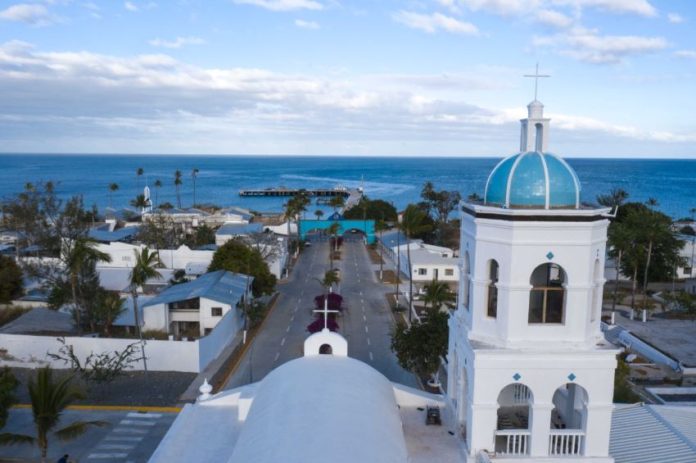
Visitors from Nayarit will arrive at Puerto Balleto, on Isla María Madre.
Both ferries dock in Puerto Balleto on Isla María Madre, the largest of the islands. The packages include round-trip ferry tickets, guided tours by Biosphere Protectors, hiker insurance and entrance to the natural protected area.
A tourist-class seat costs 3,500 (US $210) pesos. Executive class seats are 3,800 pesos (US $230). A private cabin seat is 4,000 pesos (US $240) and private cabins can seat up to eight passengers. Guests can then choose what type of approved accommodation to book, which ranges from single rooms to entire houses for larger groups. Food costs are 1,900 pesos (US $114) per person, which includes buffet meals for the entire visit.
Once you reach the island, the visit is somewhat limited — again, to protect the natural environment. Tourism on the island is regulated by the Mexican Navy, and free exploration is restricted. Still, there is freedom and flexibility in choosing the guided tours that align with your interests.
Given the delicate nature of the biosphere, there is little chance to freely explore the islands – but there are a variety of activities available for visitors to enjoy.
One of the activities is a visit to the former prison — think of it like the Mexican version of an Alcatraz tour. Visitors can get a feel for what life was like being imprisoned on the island. The guides are deeply knowledgeable about the dark history of the prison and share some of the most interesting stories.
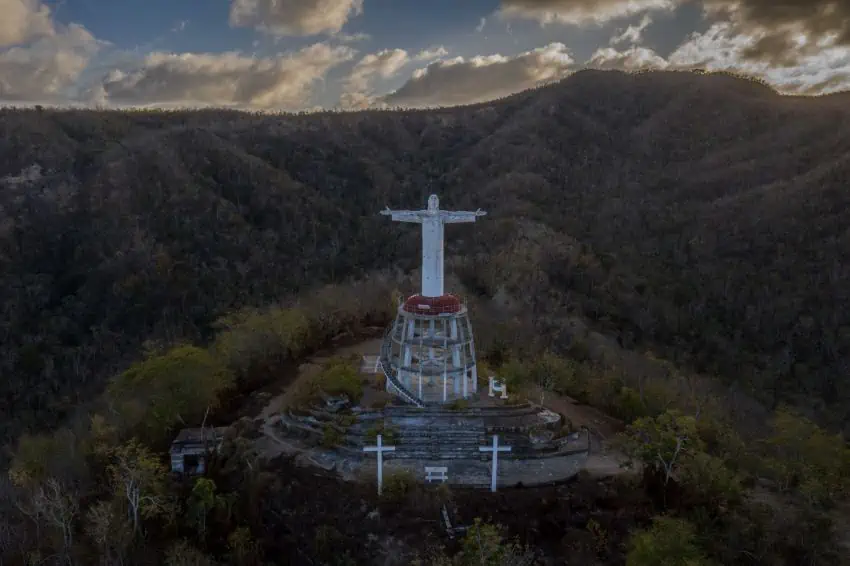
But for travelers who aren’t as excited about dark tourism, there are plenty of ecological and historical things to do that veer more towards the new identity of Islas Marías. A sunrise hike to the towering Christ the Redeemer statue or a hike to El Faro Lighthouse, nightly stargazing, crafts markets in Puerto Balleto, an afternoon at Playa Chapingo, cliff tours at Mirador Punta Halcones, and museum and historical sites tours are just some of the activities that visitors to Islas Marías can do with their weekend visit.
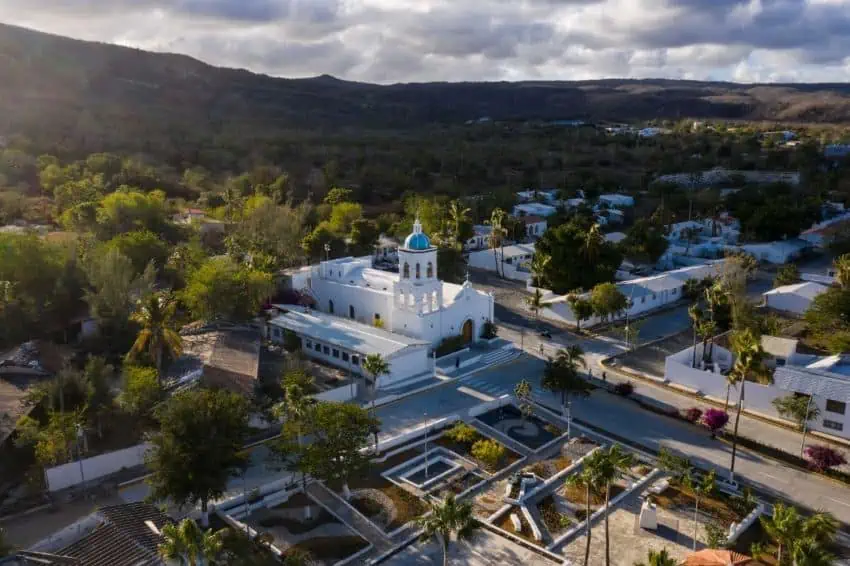
What all visitors can expect is a glimpse into a side of Mexico rarely seen by the majority of tourists or locals. These isolated islands offer pristine, undeveloped beaches and are completely devoid of modern-day developments. Forget all-inclusive resorts, restaurants, bars or even grocery stores. The islands’ natural beauty tells the real story here, both in the relics of a painful past, and the growth and rebirth of a new and exciting future.
Meagan Drillinger is a New York native who has spent the past 15 years traveling around and writing about Mexico. While she’s on the road for assignments most of the time, Puerto Vallarta is her home base. Follow her travels on Instagram at @drillinjourneys or through her blog at drillinjourneys.com.