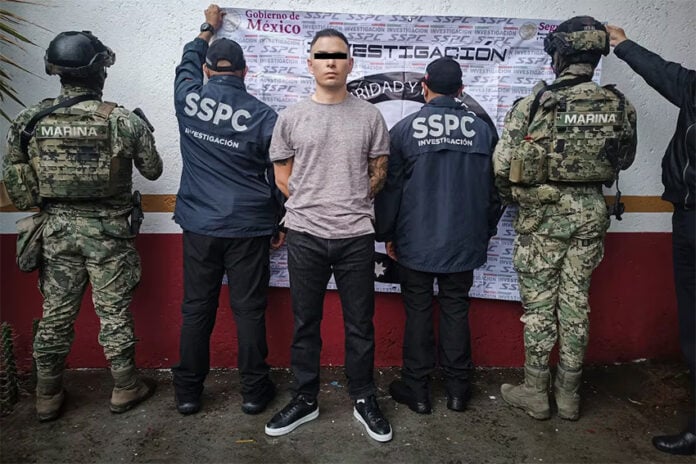
The arrest of "Lobo Menor" in Mexico City rid Ecuador of one of its most powerful alleged criminal gang members. (SSPC)
The alleged mastermind behind the assassination of Ecuadorian presidential candidate Fernando Villavicencio in Quito has been arrested in Mexico City’s affluent neighborhood of Polanco following a coordinated operation involving Mexico, Ecuador and Colombia.
The suspect, who went by the name of Juan Carlos Montero Mestre but whose real name is Ángel Esteban Aguilar Morales, aka “Lobo Menor,” had an arrest warrant for the murder of Villavicencio three years ago. He is also considered one of the leading members of the Ecuadorian gang Los Lobos.
According to Mexico’s Security Minister Omar García Harfuch, Aguilar was on Interpol’s red notice list and linked to drug trafficking, extortion and homicide.
Ecuadorian Interior Minister John Reimberg said the suspect would be held in the Encuentro Prison, a maximum security center that Ecuador President Daniel Noboa’s government designed based on the prison model of El Salvador’s Nayib Bukele.
“Hide wherever you hide, we will find you and capture you. Lobo Menor: The Encounter awaits you,” Reimberg wrote on his official X account, in a message directed to wanted criminals.
Aguilar’s capture occurred on Wednesday in the Polanco area of Mexico City, following a coordinated operation by the Navy’s Special Operations Unit, the Security and Citizen Protection Minister and the National Institute of Migration.
ALIAS “LOBO MENOR” CABECILLA DE LOS LOBOS, DETENIDO EN MÉXICO.
Ángel Esteban Aguilar Morales, alias “Lobo Menor”, cabecilla del grupo criminal “Los Lobos”, tiene orden de captura por estar procesado en el caso del asesinato de Fernando Villavicencio, consiguió papeles falsos con…
The Mexican Security Cabinet indicated that they received a tip about Aguilar’s arrival in the country and, in collaboration with Colombia’s intelligence, tracked him down to the Polanco neighborhood.
In a post on his official X account, Colombian President Gustavo Petro described him as “one of the world’s greatest killers,” as well as one of Ecuador’s most wanted criminals, linking him with Mexican cartels and Iván Mordisco, Colombia’s top public enemy.
Petro alleged that Aguilar was the mastermind behind the assassination of Ecuadorian presidential candidate Fernando Villavicencio and that his capture “constitutes a significant blow against transnational organized crime.”
Furthermore, he reaffirmed “the effectiveness of trilateral cooperation between Colombia, Ecuador, and Mexico in the fight against multi-crime networks.”
Los Lobos is an Ecuadorian criminal organization considered to be one of the largest and most violent gangs in the country. They have created alliances with other Ecuadorian groups and have forged relationships with international criminal organizations, including Mexican cartels, to move cocaine and exploit illegal gold mining.
Volunteers help load a ship bound for Cuba from the Yucatán coast, carrying aid as part of Mexico's participation in “Nuestra América: Convoy to Cuba.”
(Linea Independiente/on X)
Mexican vessels participating in an international humanitarian effort to deliver food, medical supplies, and solar equipment to Cuba prepared to set off Thursday afternoon.
Four boats were scheduled to depart from Mexico starting Thursday, carrying material aid for the beleaguered island nation as part of an international solidarity initiative in response to the intensified U.S. blockade of Cuba.
🇨🇺🔴 Enviarán 30 toneladas de ayuda a Cuba desde Yucatán
A bordo se incluyen paneles solares, alimentos enlatados, agua embotellada y productos de limpieza, entre otros artículos de primera necesidad.
The first ship was preparing to depart from the port of Progreso, Yucatán, on Thursday and three more will set sail from Isla Mujeres, Quintana Roo, on Friday. The plan is to arrive in Havana on March 21.
David Adler, coordinator of Progressive International, described Mexico “as the most symbolic, powerful, strong and proactive country in its solidarity with the Cuban people.”
Brazilian climate activist Thiago Ávila, helping coordinate the Mexican convoy, said the organization has been preparing about 40 people to make the trip, applying for visas and carrying out organizational work.
“There is no time to lose, as the Trump administration intensifies its offensive against the island and its campaign to isolate its people,” Adler said in a statement. “Together we can break the siege, save lives and defend the cause of Cuba’s self-determination.”
Due to the U.S. blockade, Cuba has been mired in an economic crisis that was exacerbated by the sudden suspension of oil supplies from Venezuela in January after the U.S. ousted President Nicolas Maduro, a Havana ally.
After U.S. President Donald Trump threatened retaliation against any country sending oil to the Caribbean island, Mexico also halted shipments.
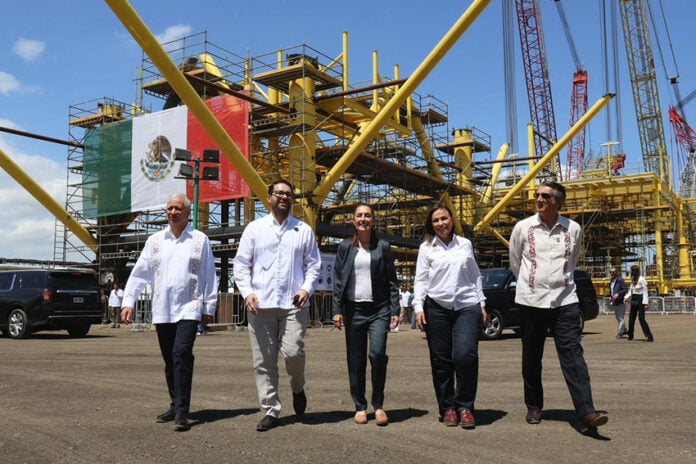
President Sheinbaum led an event celebrating the anniversary of Mexico's 1938 oil nationalization in Pueblo Viejo, the site of a historic oil refinery near Tampico on the Veracruz-Tamaulipas border. (Presidencia)
Speaking at a Pemex industrial complex on the banks of the Pánuco River in Veracruz on Wednesday, President Claudia Sheinbaum used the 88th anniversary of Mexico’s oil expropriation to set her government’s next energy goal: sharply reducing the country’s dependence on imported natural gas.
While Mexico has made significant progress reducing gasoline imports — thanks to the Olmeca refinery in Dos Bocas, the acquisition of the Deer Park refinery in Texas and the rehabilitation of six other refineries — Sheinbaum acknowledged a stubborn vulnerability remains. Mexico still imports 75% of the natural gas it consumes, a fuel that powers the country’s electricity plants and factories.
“The call to advance in energy sovereignty acquires enormous relevance every day,” she told Pemex workers at the event. “It means advancing in energy sovereignty, increasing domestic natural gas production — that is the next objective.”
Alongside natural gas, Sheinbaum said her government would continue expanding renewable energy capacity, including solar, wind and geothermal, while maintaining oil and fertilizer production.
The natural gas challenge is significant. As previously reported by Mexico News Daily, virtually all of Mexico’s gas imports arrive via pipeline from the United States, creating a dependence that some energy analysts describe as a national security risk.
Sheinbaum’s government is currently studying whether what it describes as sustainable fracking could help unlock domestic reserves, though no final decision has been made.
Sheinbaum drew a direct line between the 1938 expropriation — in which former President Lázaro Cárdenas seized the assets of 17 foreign oil companies in 1938 and founded the state oil company Pemex — and her government’s push to reduce gas imports. She presented both as responses to the same underlying challenge: ensuring that Mexico’s energy resources remain under national control rather than dependent on foreign suppliers. Pemex’s debt has fallen 13% in the past year to its lowest level in over a decade, she noted, as evidence the state oil company’s recovery is on track.
“Mexico will not be sold. Mexico will not be surrendered. Mexico will be defended,” she told the crowd.
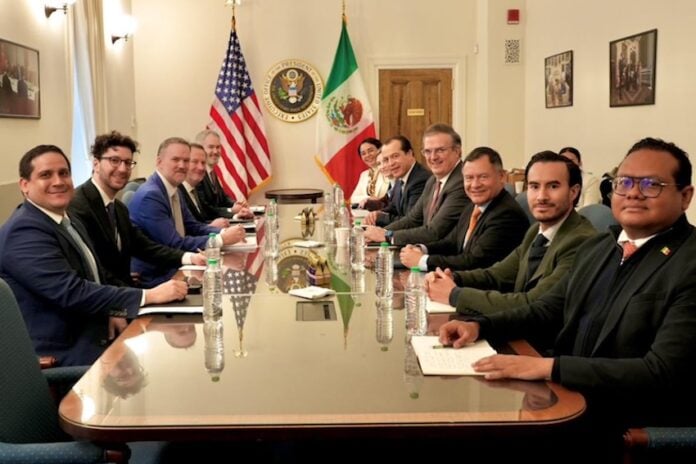
When Economy Minister Marcelo Ebrard and USTR Jamieson Greer sat down with their respective teams in Washington on Wednesday, the USMCA formal review had officialy begun. (Marcelo Ebrard/on X)
The formal review of the U.S.-Mexico-Canada (USMCA) free trade agreement that has been looming over almost all recent trade issues in the region has officially begun.
Mexico’s Economy Minister Marcelo Ebrard and U.S. Trade Representative Jamieson Greer sat down with their respective teams in Washington Wednesday to start in-person negotiations.
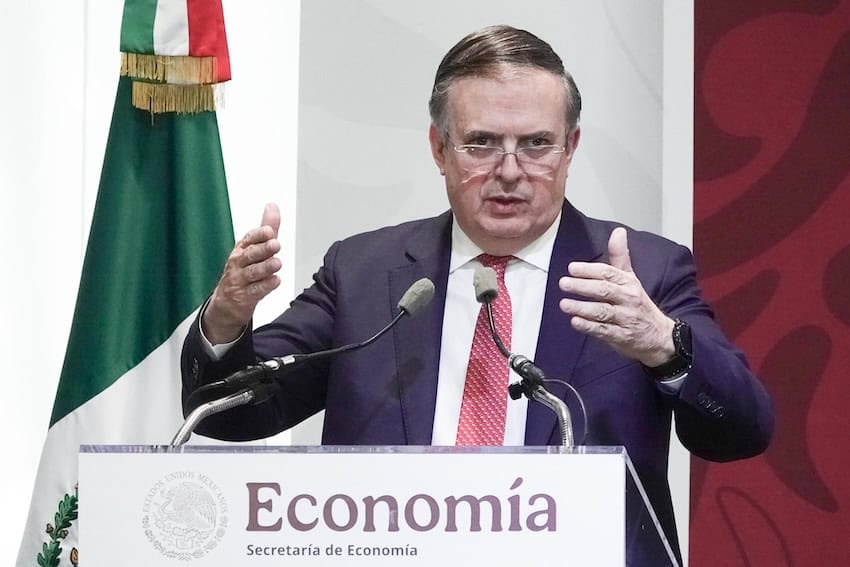
Economy Minister Marcelo Ebrard is leading the Mexican negotiating team during the USMCA review, and has mentioned trade asymmetries and the Trump tariffs as his top priorities. (Camila Ayala Benabib/Cuartoscuro.com)
As had been the case with recent preliminary and informal USMCA review meetings, only two of the three nations participated. Canada is expected to join the talks in May.
Ebrard posted a photo of the two teams at the office of the U.S. Trade Representative (USTR) and explained that the purpose of this first meeting was to discuss the countries’ expectations for the future of the USMCA.
“We held talks with Ambassador Jamieson Greer, head of the USTR, and his team to begin discussions regarding the review of the USMCA,” he wrote. “The technical teams will be working today and tomorrow throughout the day.”
Wednesday’s meeting followed a virtual meeting on Tuesday between representatives of the Mexican Economy Ministry and the USTR to finalize the details and outline each country’s expectations for the review.
Ebrard has indicated that Mexico’s interests lie in resolving issues such as trade asymmetries and the tariffs that the Trump Administration has imposed on trading partners in the last year on products such as steel and aluminum, and on the automotive sector.
Upon arriving at Wednesday’s meeting, Ebrard told a Mexican TV network that Mexico’s vision is “to reduce our dependence on other regions, to work as a team and to see what we each want to do regarding rules of origin and how we can secure the supply chain.”
As the Los Angeles Times noted, more than US $4 billion worth of goods cross the U.S. borders with Canada and Mexico every day.
After this week’s talks, working groups will begin addressing specific aspects of the treaty’s 34 chapters.
We’re going to present a lot of data; we’re well-prepared,” said Ebrard, who has long held that Mexico’s objective is to guarantee the permanence of the USMCA, based on a strategy of “cool heads and firmness.”
The USMCA under review is the successor to the original 1994 North American Free Trade Agreement. Its future is uncertain, however, given U.S. President Donald Trump’s many lukewarm statements about it, and his demonstrated willingness to impose tariffs on his two neighbors, whom he accuses of facilitating fentanyl trafficking to the United States.
Trump has even suggested the possibility of letting the USMCA expire and seeking separate bilateral agreements with Mexico and Canada.
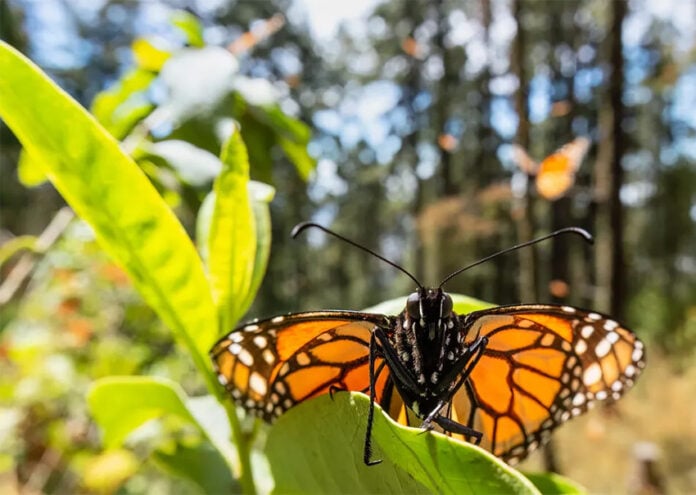
The last two seasons have seen a modest rebound of monarch butterflies in Mexico, though experts caution that the species still remains at risk of extinction. (McDonald Mirabile / WWF-US)
The monarch butterflies that winter in Mexico’s high‑elevation forests are getting a reprieve — but not yet a rescue — as Mexico, the United States and Canada step up joint efforts to keep its famed migration from collapsing.
New figures released this week by Mexico’s Ministry of Environment and Natural Resources (Semarnat) and the World Wildlife Fund (WWF) show monarch colonies covered 2.93 hectares of oyamel fir forest in central Mexico this winter, up from 1.79 hectares in 2024-25 — a 64% increase.
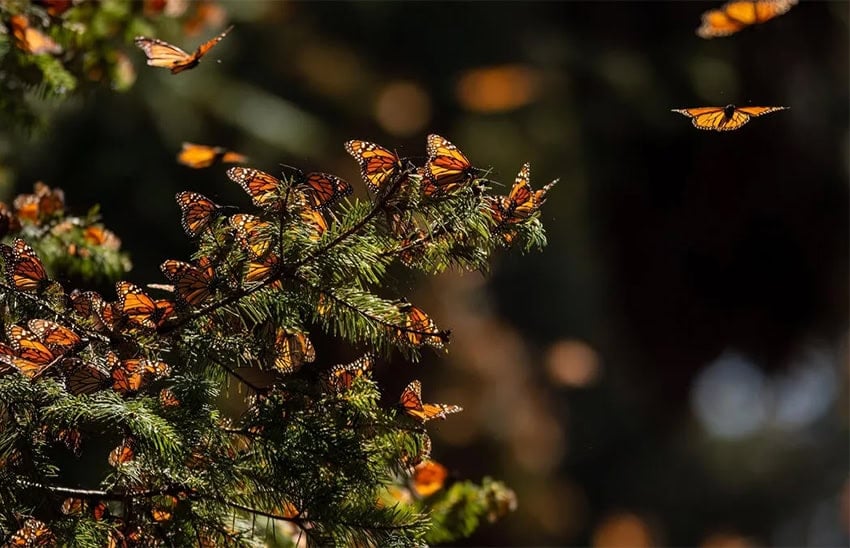
Monarch butterfly colonies in central Mexico have grown since 2022, but still remain far from stable. (McDonald Mirabile / WWF-US)
This winter’s 2.93 hectares of trees blanketed in butterflies compares with 1.79 hectares a year earlier and just 0.9 hectares the winter before.
However, while encouraging, the gains leave the eastern monarch population still down by more than 80%–90% since the 1990s.
Several conservation groups warn the population still remains at risk of extinction, with a model from the U.S. Fish and Wildlife Service pointing to a 56-74% possibility of extinction by 2080.
Research cited by the Center for Biological Diversity and U.S. government scientists indicates the population needs to occupy at least 6 hectares (roughly 15 acres) of winter habitat to remain above the risks of migratory collapse.
Long-term trends underscore the gap. In the record 1996-97 season, monarchs in Mexico covered about 18.19 hectares, more than 44 acres. They cluster from roughly early November to March, when they depart and begin laying eggs as they move into the southern U.S.
Today’s 2.93 hectares represents a fraction of those historic numbers, even as citizen groups, schools and farmers across the U.S. and Canada seed milkweed and nectar plants along the flyway.
Monitoring data attribute this winter’s larger colonies to more eggs and larvae surviving during a less-dry U.S. spring and summer, along with fewer drought impacts along the southbound route into Mexico.
Meanwhile, in Mexico, communities have been reforesting hillsides, patrolling the reserves to reduce illegal logging and building monarch‑based ecotourism, with help from the National Commission of Natural Protected Areas (Conanp) and the WWF.
Mexican officials say those measures, and the weather in the United States, helped drive this year’s rebound.
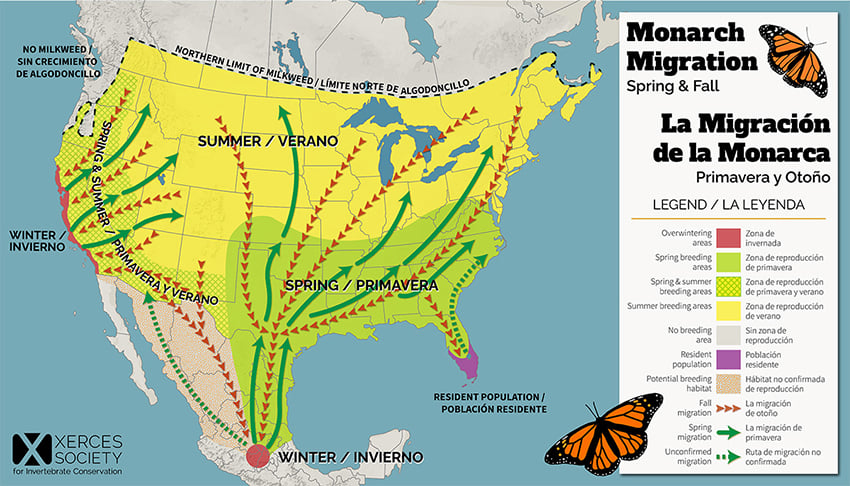
Monarch butterflies every year embark on a multi-generational migration spanning up to 3,000 miles from central Mexico to southern Canada. (Xerces Society for Invertebrate Conservation)
Also, there is new data showing some pressure easing on the wintering grounds themselves.
A joint WWF–Mexico report found 2.55 hectares of forest degraded in the core of the Monarch Butterfly Biosphere Reserve between February 2024 and February 2025, down from 3.73 hectares the previous year, with most loss driven by illegal logging and smaller amounts by fire and drought.
Other threats to monarch populations include widely used insecticides and herbicides in North America, climate change and extreme weather.
The Monarch Butterfly Biosphere Reserve — in the mountains of central Mexico in the states of Michoacán and México — included nine major butterfly colonies this winter. The five sanctuaries generally open to the public are Sierra Chincua, El Rosario, La Mesa, Piedra Herrada and El Capulín.
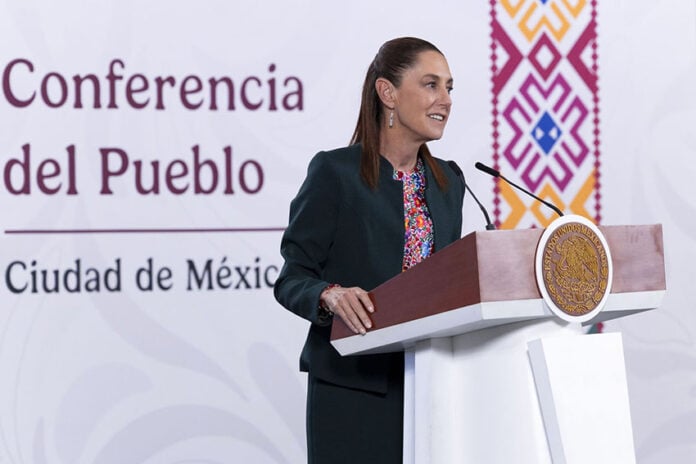
President Claudia Sheinbaum said this week her government is using this window of opportunity to push trilateral action.
“Yes, there are talks between Semarnat, both with Canada and the United States, and [Conanp] is also strengthening its support,” Sheinbaum said.
Sheinbaum said the greatest challenge now lies along the U.S. leg of the route, where monarchs need pesticide‑safe milkweed and nectar-rich habitat as they move north out of Mexico and back toward Canada.
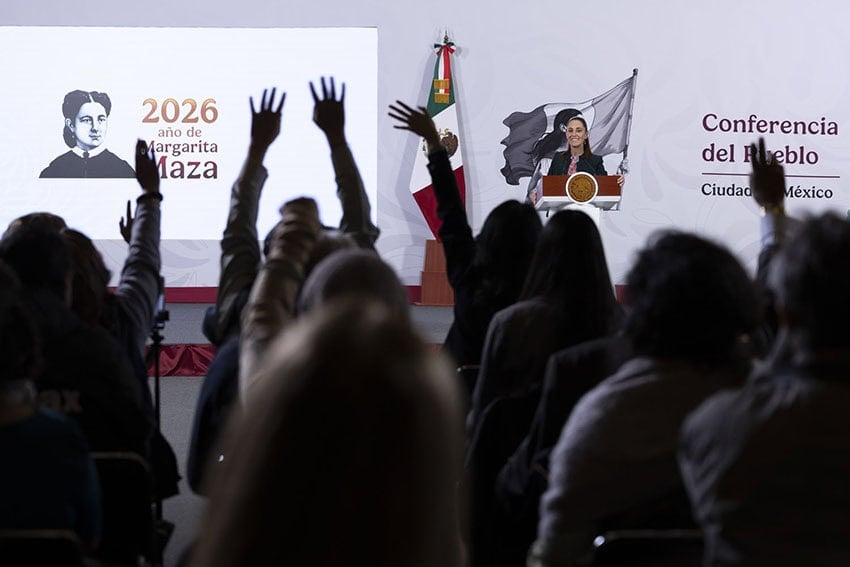
A program to welcome home repatriated Mexicans, striking teachers and the King of Spain all received mentions at Thursday's presidential presser. (Juan Carlos Buenrostro/Presidencia)
Sheinbaum’s mañanera in 60 seconds
🍎 CNTE teachers’ strike continues: Sheinbaum said her government lacks the budget to meet the dissident teachers union’s demands, but insists dialogue remains open. She pushed back on street protests while talks are ongoing, noting the union failed to show up to a previously requested meeting with her.
🏆 King Felipe VI invited to World Cup: Mexico formally extended an invitation to Spain’s monarch for the tournament opener, as diplomatic relations between the two countries continue to warm following the king’s recent remarks acknowledging abuses during the Spanish conquest.
✈️ “Mexico Embraces You” nears 190,000 returnees: Interior Minister Rodríguez reported that nearly 190,000 Mexicans — mainly deportees and voluntary returnees from the U.S. — have been registered under the repatriation program since it launched on January 20, 2025, with over 154,000 arriving by land.
🚗 USMCA talks update: Sheinbaum said Mexico has responded point-by-point to a U.S. list of 54 alleged non-tariff barriers, declaring the concerns largely settled. Mexico’s top priority in the ongoing talks is eliminating tariffs on the automotive, steel and aluminum sectors.
Why today’s mañanera matters
Thursday’s mañanera touched on both domestic pressure points and several delicate international issues ranging from U.S. deportations to relations with the King of Spain.
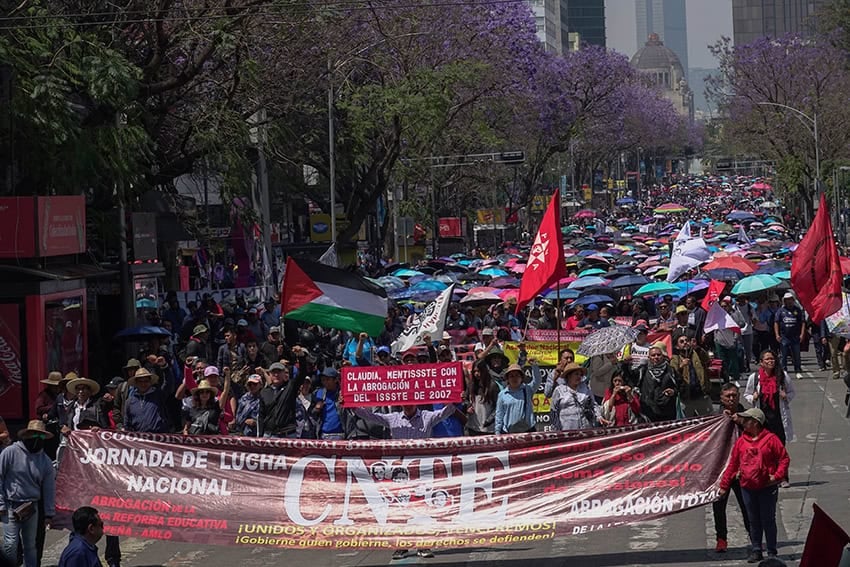
A day after members of a dissident teachers union started a 72-hour strike demanding higher wages, President Claudia Sheinbaum insisted her administration does not have the budget to address CNTE’s demands.
Striking teachers belonging to the CNTE union marched toward Mexico City’s Angel of Independence on Tuesday before setting up camp in the Zócalo. Their demands include wage increases and the repeal of a 2007 pension reform law. (Rogelio Morales / Cuartoscuro.com)
The thaw in Mexico’s diplomatic relations with Spain continued as Mexico formally invited King Felipe VI to this summer’s World Cup. But while relations with Spain warmed, Mexico took note of a more somber milestone regarding relations with the United States: The government’s “Mexico Embraces You” repatriation program — designed to welcome and support Mexicans deported from the U.S. — has registered nearly 190,000 returnees since early 2025.
The president also mentioned that the Economy Ministry’s priority during ongoing talks with the U.S. Trade Representative in the context of the review of the U.S.-Mexico-Canada agreement is to achieve the elimination of tariffs for the automotive, steel and aluminum industries.
Dialogue with striking teachers continues
As members of the CNTE teachers union prepared a second day of marches and blockades in the capital, Sheinbaum said her administration is willing to maintain talks with the teachers, but criticized their decision to take to the streets.
“If negotiating channels are open, why shut down the streets?” she asked, referring to ongoing talks in the states where the CNTE operates.
The president insisted that the door to dialogue remains open, saying it is the preferred way to approach conflict resolution, but questioned the CNTE’s commitment to compromise.
“The last time they asked to meet with me, they didn’t show up,” she said.
The Education Ministry and Segob have hosted talks with the CNTE, but Sheinbaum maintains that there are insufficient public funds to meet their demands for higher wages.
She recalled that a 10% salary increase was approved last year and said her government is actively looking for other ways to provide support, “because we believe in Mexico’s teachers.”
Last year, the CNTE staged 20 days of protests in Mexico City and they have threatened to take action during the World Cup if their demands are not met.
Among their top demands is the repeal of the 2007 revision of the ISSSTE Law, which governs social security and pensions for state employees. That reform transformed the solidarity-based pension scheme into one reliant on individual accounts.
President Sheinbaum questioned the union’s decision to take to the streets, saying that negotiating channels a remain open. (Juan Carlos Buenrostro/Presidencia)
Mexico invites Spanish monarch to inaugural World Cup match
Although reluctant to characterize diplomatic relations with Spain as on the mend, Sheinbaum confirmed that King Felipe VI had been invited to the World Cup.
Sheinbaum demurred by saying that Gabriela Cuevas, Mexico’s representative to FIFA, sent invitations to all countries of the world with whom Mexico maintains diplomatic relations.
The news follows Felipe’s remarks on Monday that there were “significant abuses” during Spain’s conquest and colonization of Mexico in the 16th century.
On Tuesday, Sheinbaum said the comments might not have been everything Mexico had hoped for, but admitted that it was “undeniably a gesture of rapprochement by the king.”
Repatriation program approaches 200,000 registered arrivals
Interior Minister Rosa Icela Rodríguez reported that between Jan. 20, 2025, and March 18 of this year, the government’s “Mexico Embraces You” strategy program registered 189,830 repatriations.
Rodríguez said the Command Center, the Segob entity that records incident reports during the return process, reported “a clean record” thus far.
Se han realizado 189,830 repatriaciones de connacionales como parte de la Estrategia Nacional de Repatriación “México Te Abraza”, del 20 de enero de 2025 al 18 de marzo de 2026, informó la secretaria de Gobernación, Rosa Icela Rodríguez. pic.twitter.com/EnuHRZgjgI
The U.S. government had submitted a list of 54 measures that it categorized as “non-tariff barriers.” Among the primary U.S. concerns are limits to private foreign investment in Mexico’s energy sector — an issue directly affecting U.S. companies — the ban on planting genetically modified corn and the restrictions on open-pit mining and fracking.
Responding to a question, Sheinbaum said the vast majority have already been addressed and defended point-by-point.
“Mexico clearly presented its position within the existing legal framework,” she said, “answering each concern one-by-one. I believe the concerns have been settled.”
Sheinbaum added that Mexico’s priority is to achieve the elimination of tariffs for the automotive, steel and aluminum industries.
BTS, the South Korean boy band that brought K-pop into the global mainstream, could perform a free concert at Mexico City's Zócalo following sold-out stadium shows in May. (Netflix)
BTS, the South Korean boy band that transformed K-pop into a global cultural force, may be the next band to give a free show at Mexico City’s Zócalo.
To that end, Sheinbaum said that she sent a letter to South Korean President Lee Jae Myung to ask for his support to schedule more concert dates and explore the possibility of a free concert. She noted, however, that the decision to make it free depends on producers.
“We wrote to the President of Korea asking for his help,” Sheinbaum said at her Tuesday morning press conference. “They will perform at the GNP, and tickets sold out immediately because they are a group that young people like. We asked him to put us in touch with producers so they could return to Mexico.”
Sheinbaum said that the South Korean president responded positively to the request.
After a brief hiatus due to mandatory military service, BTS announced their return to the music scene with the release of their new album, “Arirang,” which is scheduled for Thursday. As part of this global comeback, the group will perform a live show from Gwanghwamun Square in Seoul, set to be streamed on Netflix this Saturday.
BTS: THE RETURN | Documentary | Official Trailer | Netflix
The group’s comeback includes a global tour, with performances in Mexico City planned for May 7, 9 and 10. This marks the group’s first performance in Mexico since 2017.
BTS, which is short for Bangtan Sonyeondan and translates as Bulletproof Boy Scouts, was formed as a group around 2010 in Seoul, South Korea, within the company BigHit (now HYBE). The band’s breakthrough, however, came between 2015 and 2017 with the single “I Need U,” which earned the group its first No. 1 ranking in Korea.
Since then, BTS has appeared several times in the Billboard Hot 100 (singles), Billboard 200 (albums), and has at least six singles that reached number 1, including the popular song “My Universe” featuring Coldplay.
Mexico. A land of opportunity, peace and pyramids. (Juliana Barquero/Unsplash)
I’ve spent a fair amount of my life leaving.
Not running, just moving. Following love, duty, curiosity, adventure or simply the call of the unknown.
Leaving is something I’ve spent a fair amount of my life doing. (Law Tigers)
I learned early that home could be packed into boxes and rebuilt somewhere else. When I was 3, my mum married my stepdad, an American Air Force pilot, and we left England for Japan. I don’t remember the logistics, only the feeling of newness. I remember the different air, the different sounds and a childhood shaped by impermanence.
From Japan, we moved to Florida, and then, when he retired, to Louisiana, his home state. It made sense that we’d root ourselves where his story had begun.
And then they divorced.
We stayed.
From Louisiana to England and back
Louisiana is where I grew up properly. It’s where adolescence unfolded in thick humidity and Friday-night lights. It’s where I learned to properly shuck a crawfish tail and where I received my undergraduate degree from Louisiana State University while spelling “Geaux Tigers” correctly. It was the first place that felt less like a posting and more like a choice.
And then, after graduation, I left again.
LSU in Baton Rouge, Louisiana, where I went to college. (LSU)
I moved back to England and stayed for 14 years. Fourteen years of building a career and relearning the rhythms of the country I’d left as a toddler. But with each year, something tugged quietly across the Atlantic.
My mum was still in Louisiana.
She never once asked me to come back. That’s the kind of mother she is: steady, selfless and determined that her children live fully wherever they land. But on visits home, I began noticing small shifts. A slower step. A deeper sigh at the end of the day. A longer nap. Time was doing what it does without asking permission.
In 2008, I stopped pretending the pull wasn’t there, and I moved back to Louisiana.
Moving to Mexico
For more than a decade, we had proximity again. Ordinary, precious proximity. Quick calls that turned into coffee. Lunches and errands that required no planning. The comfort of knowing I was close if she needed me.
And then, in 2021, I left once more. This time for Mexico.
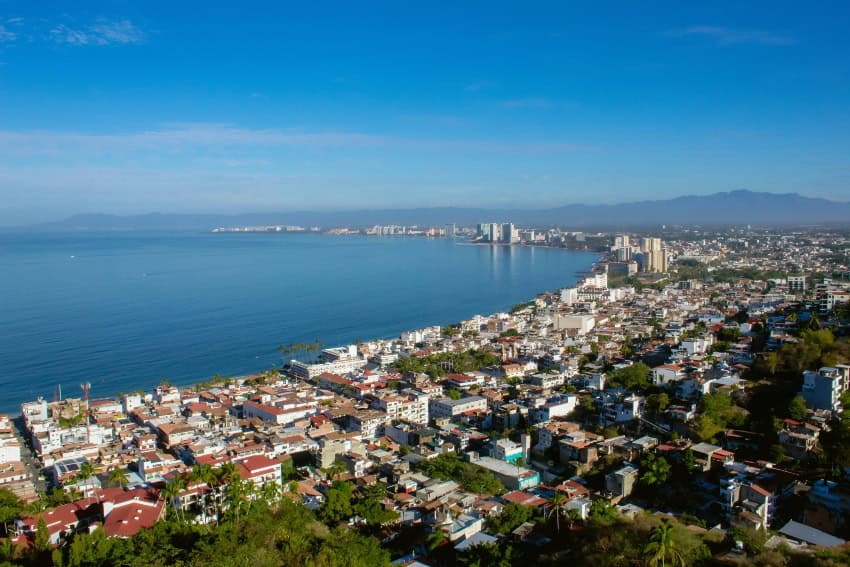
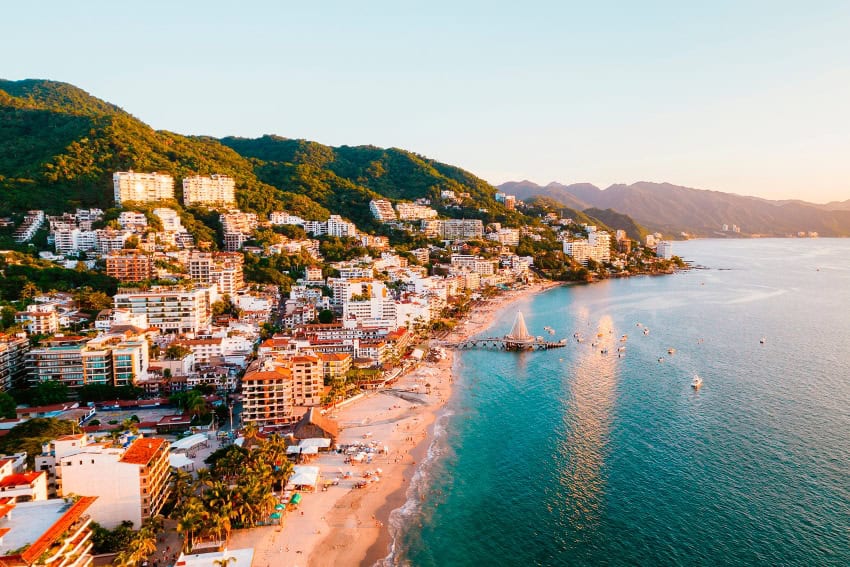
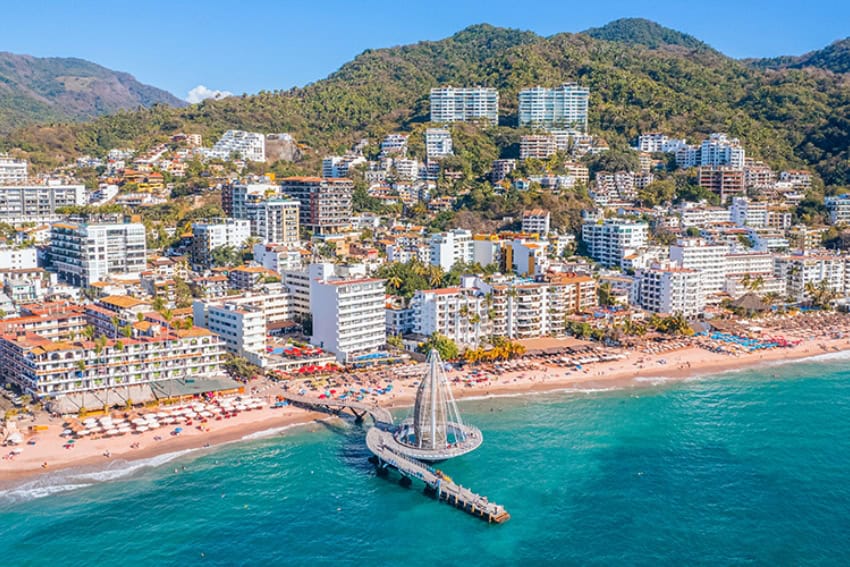
I moved to Puerto Vallarta, Mexico, in 2021. (Roman Lopez/Unsplash)
It was the boldest move yet as it wasn’t a return to familiarity but a leap toward something entirely new. I chose Puerto Vallarta for its color and its possibilities. I chose a life that felt expansive and sunlit. I met someone. And soon I was building that life deliberately with him.
When my car was all packed up in Baton Rouge to make the trip here, I told myself I knew how to do distance. I’d done it before. But this time, she was in her 80s.
A year after I moved, my mum made a decision that still humbles me. She sold her Louisiana home, the one that had held decades of memory, and moved to Portland. My brother had already built a life there, drawn by Oregon’s green expanses, softer pace and the love of a wonderful, caring woman who’d become his wife. My mum had a tiny house built in their driveway, replacing the garage.
Watching her dismantle a lifetime was quietly devastating. Sorting photographs. Letting go of furniture that had witnessed birthdays and heartbreak. Choosing which objects would accompany her into this smaller intentional space.
She didn’t call it downsizing because what she was really doing was choosing connection over square footage and proximity over permanence.
And then she began coming to us. To Mexico.
Family time in Puerto Vallarta
Every winter, mom comes to visit for a soft, golden season. (The Villas Group)
Every winter, she trades Oregon’s rain for Mexico’s sun. For three months, our spare room becomes hers. The wardrobe fills with her neatly folded summer clothes. The kettle whistles more often.
Those months are soft and golden.
We sit on the porch in the mornings before the heat presses in. She cradles her tea, and I hold my coffee. We talk about politics or neighbors or the price of avocados. Sometimes we sit in companionable silence, watching the sun spill over the wall.
I find myself studying her face without meaning to. Her lines are deeper now. Her movements are more measured. There’s the careful way she lowers herself into a chair.
Aging is subtle until it isn’t.
In February 2025, while she was here in Puerto Vallarta, she became ill. What began as discomfort escalated quickly. At 82, five days in the hospital isn’t a minor interruption; it’s a reckoning.
Going to the hospital in your 80s isn’t an interruption, but a reckoning. (Visit Puerto Vallarta)
There’s a particular amount of fear and guilt that grips you when your parent lies in a hospital bed in a country you chose. I remember standing by the window, palm trees swaying against an impossibly blue sky, thinking, “This was meant to be the joyful chapter.”
But Mexico held us.
The big question
The care she received was exceptional: The doctors were attentive, the nurses were compassionate and communication was clear. In those five days, this country shifted from being my adventure to being the place that cared for my mother.
And that matters.
When she was discharged, thinner, tired, but resolute, we sat at the dining table and had “The Conversation.”
It wasn’t dramatic or morbid, just intentionally honest.
Eventually, it’s time to have the conversation. Where do you want to rest? (Visit Puerto Vallarta)
What happens if the inevitable happens here? What are your wishes? Where are the documents? Who do we call? Do you want to be repatriated, and to which country does “home” belong now?
There were tears. There was awkward laughter. There was relief.
Living across borders means love has to be organized. It means researching medical professionals before you need them. It means keeping in touch with those doctors even when she flies back to Oregon. It means having plans in place so that if the worst happens, you’re not scrambling through grief and paperwork at the same time.
Preparation doesn’t diminish joy. It protects it.
The Pyramid of the Moon
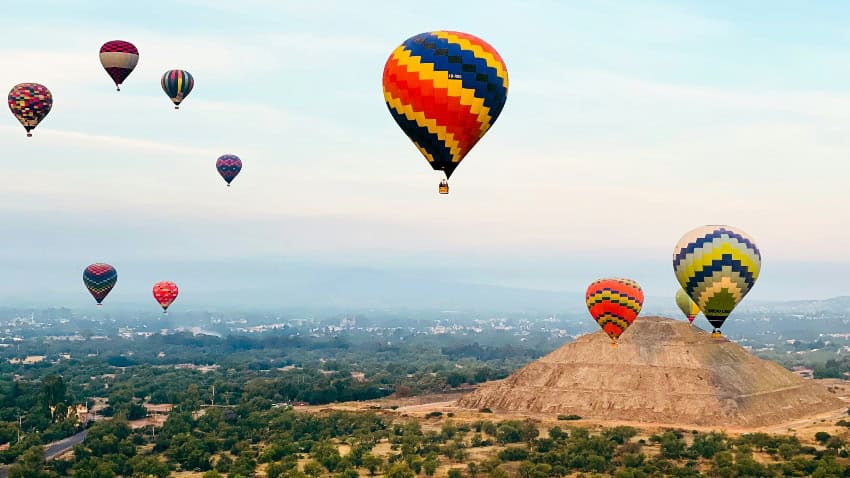
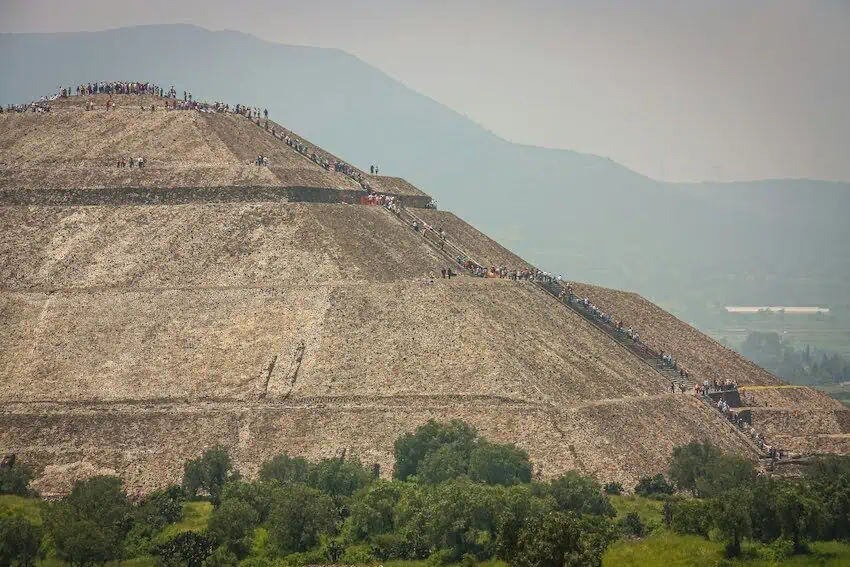
A year later, just a few weeks ago, at 83, she stood with us at Teotihuacán, just outside Mexico City, staring up at the Pyramid of the Moon.
“I think I’ll try,” she said.
My mom climbed the Temple of the Sun in Teotihuacán. (Samantha Velazquez/Unsplash)
And she did.
Slowly. Carefully. Resting often.
My boyfriend climbed with her as I videoed, and he hovered without wanting to hover. My heart was lodged somewhere in my throat.
Younger tourists passed them easily, but she climbed with quiet determination.
Halfway up, she stopped and looked out across the Avenue of the Dead stretching into the distance.
When I joined them, I asked what she was thinking when she stopped.
It’s not how fast you climb, it’s whether you get to the top. (Francisco Kemeny/Unsplash)
“I’m glad I came,” she said.
Three words that seem to hold our entire family’s history. And I knew what she meant.
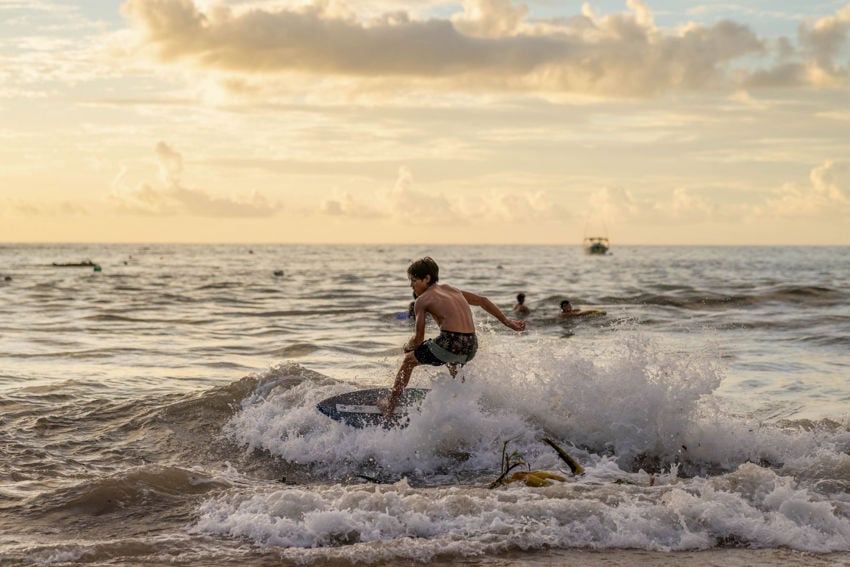
Young boy surfing in Puerto Vallarta. (Agencia Perspectiva/Cuartoscuro)
I’m glad I came to every single moment that shaped you.
Missing your mom
Our parents will age wherever we are. Staying in England wouldn’t have frozen her. Staying in Louisiana wouldn’t have slowed time. Leaving didn’t cause her to grow older; it simply meant I had to learn how to love her across more miles.
She flew back to Portland a few weeks ago, and I’ve been a bit weepy. The spare room seems so incredibly empty. The mornings are quieter, and I still glance at the empty porch chair beside mine before remembering she’s thousands of miles away.
The missing doesn’t soften just because the initial leaving was my choice. But neither does the gratitude.
Gratitude from Mexico
I’m grateful she crossed oceans when I was 3. I’m grateful she let me leave again and again. I’m grateful she chose family in Oregon. I’m grateful she chooses us for three months each year. I’m grateful she climbed a pyramid at 83.
I’m grateful we spoke honestly about endings before they arrive.
Climbing to the top of the Pyramid of the Sun when it was still allowed. (Maciej Cisowski/Pexels)
Living in Mexico while your parents age elsewhere is an exercise in holding opposites. Joy and worry. Freedom and responsibility. Sunshine and hospital corridors.
So we do what we can.
We invite them into our new worlds. We encourage their visits. We do the research. We keep the doctors’ numbers close. We have the hard conversations early. We plan, not because we expect the worst but because love deserves steadiness.
And then we embrace the ordinary.
Tea on the porch.
A slow walk around a market.
Times on the porch swing are always nostalgic. (The Porch Swing Company)
A careful climb up ancient steps.
There’s always room on the porch
One day in the not-so-distant future, there won’t be another winter flight. I know that. One day, there won’t be another climb.
But for now, there’s still a suitcase in Oregon waiting for her next visit. For now, there are still mornings warmed by Mexican light and the comfort of her presence beside me.
I’ve spent my life leaving. What I’m learning now is how to stay. In the moment, in the gratitude, in the fragile beauty of having her here at all.
No matter how far we travel, no matter how many countries shape us, there’s a simple rule I intend to keep.
I will always make room on my porch.
Charlotte Smith is a writer and journalist based in Mexico. Her work focuses on travel, politics, and community. You can follow along with her travel stories at www.salsaandserendipity.com.
What does Chef Lupita cook when she wants to show off the cuisine of her native state of Tabasco? Pejelagarto, of course. (Instagram)
It was a cold day in Doha, Qatar’s capital — an extraordinary weather pattern for this small country. And just as extraordinary was my encounter with Mexican Chef Lupita Vidal, who was also in Doha as a guest chef for the Qatar International Food Festival (QIFF) on behalf of the 2026 Qatar Mexico and Canada Years of Culture (YoC) program.
I met up with her and her husband, photographer Jesús David, in Saasna for lunch, a Qatari restaurant in the chic Msheireb district in Downtown Doha. They both arrived carrying shopping bags of purchases they had made that morning at Souq Waqif, the city’s traditional market.
Over a date salad and a chicken, prawn and lamb majboos, she told me this was her first time in Doha.
“My work has taken me to many parts in Mexico and the United States, but this is the farthest we’ve ever been,” she said, smiling while exchanging glances with her husband.
Vidal’s journey as a chef started in Tabasco, a state in southern Mexico typically not associated with Mexican cuisine, which makes Vidal’s success even more remarkable.
“I’m here representing Mexico. But most of all, I’m here representing Tabasco,” she said, highlighting the arduous journey she undertook to bring visibility to the state’s cuisine. “I think Mexico is a mega-ultra-diverse country, and within that diversity — as someone from Tabasco — you don’t feel Mexican because nobody pays attention to your cuisine.”
An unexpected success story in Villahermosa
Vidal’s success with her first restaurant was completely unexpected. After graduating from culinary school and working two years in the kitchens of Yucatán, Vidal went back to Tabasco and opened La Cevichería Tabasco with David in the city of Villahermosa.
“We opened this little cevichería as a way to capitalize ourselves and leave Tabasco, because we both thought that we wouldn’t be successful there,” Vidal said.
Chef Lupita Vidal never dreamed her journey would take her all the way to Qatar. (Instagram)
Their “tiny” restaurant, as Vidal described it, was a family-run enterprise: Vidal’s mother was the cashier, David was a waiter and she was the chef. The menu was inspired by the cuisine of Mexico’s south, and featured six dishes.
But over time, the restaurant began to attract more clients and to expand its offerings.
“Suddenly, we had to get more chairs and tables, and, without planning it, we realized we couldn’t leave anymore because the restaurant was doing really well,” Vidal said.
Amidst this growth, Vidal began to feel the responsibility of having a team and “feeling the need to teach them something more,” she said.
Into the heart of Tabasco
Unlike other renowned chefs who have traveled the world, learning about foreign cuisines, Vidal didn’t have that opportunity. But instead of feeling limited by this, her lack of international exposure motivated her to explore the culinary world near her. So she and David took to the road and traveled throughout Tabasco.
During this time, the pair traveled to all corners of the state, exploring different cooking techniques, flavors and ingredients, realizing just how rich the state’s culinary heritage was. People welcomed them into their homes, introduced them to local ingredients and taught Vidal firsthand how they cooked their meals. The couple also began working with local producers, fishermen and artisans, featuring their products in their restaurant.
The chef has become a tireless promoter of the glories of Tabascan cuisine. (Instagram)
“Traveling through Tabasco made me realize just how little we knew about our own state, how little pride we Tabascans have in our state and how badly we speak about ourselves,” Vidal shared with raw honesty.
A Tabasco cookbook
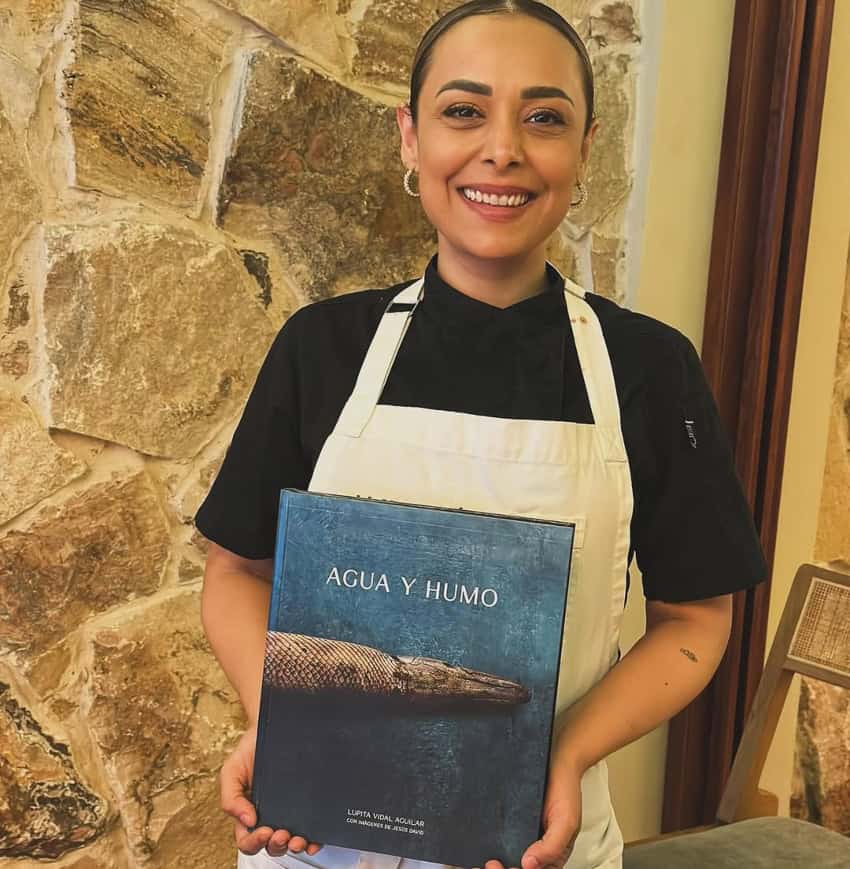
Recognizing the value of their discoveries, the couple felt compelled to document them all in a book. A decade after their journey through Tabasco began, they published Agua y Humo: Cocinas de Tabasco (Water and Smoke: Kitchens of Tabasco) in 2024, a book that covers the cuisine of all seven of Tabasco’s regions.
Offering a deep exploration of Tabasco’s culinary heritage, the book wasnominated in the Women category and the Independent Publishing category at the Gourmand World Cookbook Awards.
“We weren’t expecting it,” David told me.
“I thought it was a joke! And we never imagined it would take us all this way,” Vidal said and opened her arms, acknowledging the fact that she was in Qatar for a live cooking demonstration at QIFF’s closure ceremony.
When I asked her what she would cook at the event the following evening, on a stage before hundreds of guests, she smiled.
Chef Lupita has won awards for her book on Tabascan cuisine, “Agua y Humo.” (Instagram)
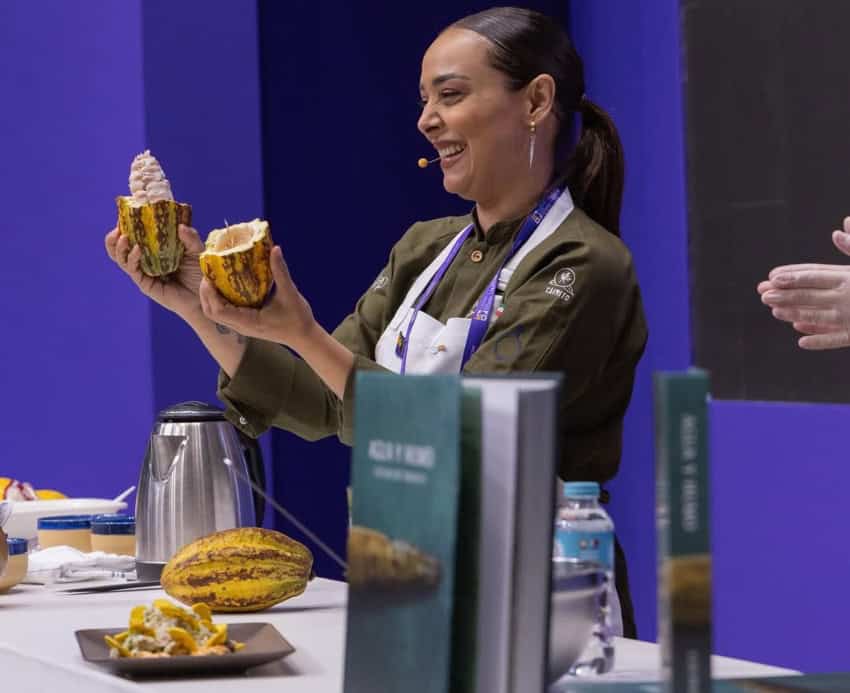
“The pejelagarto, of course!” she said, referring to the prehistoric fish found in the rivers of Tabasco. “I will season it with spices I brought from home, including momo (hoja santa), chipilín and criollo parsley.”
At the actual event, Vidal also prepared pozol, an ancestral drink made of nixtamalized corn and cacao.
A Tabasco culinary ambassador
Vidal’s success in the culinary world has shone an unlikely spotlight on Tabasco.
“I’ve felt so much responsibility for being a pioneer,” she said. “Of doing what no one had ever done. Just as I wanted to leave at some point, many Tabasqueños want to leave their state. They don’t stay because it’s hard to work there. But we have stayed, and we will continue to work there,” Vidal said.
Vidal’s career has been on a rising trajectory for the last several years. In 2020, she was an invited judge on the TV show “Master Chef México,” and the recognition has not stopped since. Most recently, she won Culinaria Mexicana magazine’s 2025 award for Best Mexican Chef and was acknowledged by the National Chamber of the Restaurant and Seasoned Food Industry (CANIRAC) as an Ambassador for Tabasco’s Cuisine.
A sense of pride in place
But she is not one to rest on her laurels: She and David opened a second restaurant in Tabasco in 2022 — Salón Caimito — and, most recently, a third in Valladolid, Yucatán — Caimito Refresquería at the end of 2025.
Chef Lupita has now opened three restaurants in Mexico: two of them in Tabasco and a third in Yucatán. (Instagram)
Vidal’s hope is that her work makes Tabasqueños feel proud of their home state and their food.
“Tabasco has so much to offer, and we need to feel proud of who we are and the food we eat. And if we eat pejelagarto, well — let’s eat it proudly,” she said.
Before we said goodbye, I asked Vidal what it meant to be Mexican in today’s world. Two ideas stood out — pride and potential.
“I think we are a great country and a culture loved by everyone. And I think that if we really worked together, as a team, we could achieve anything,” she said. She noted that her teamwork with David is precisely what has propelled their success.
“I believe that one of our greatest achievements is that we have done something that no one had expected, within our own state and our own country,” she said.
Gabriela Solis is a Mexican lawyer turned full-time writer. She was born and raised in Guadalajara and covers business, culture, lifestyle and travel for Mexico News Daily. You can follow her lifestyle blog Dunas y Palmeras.
Legal exportation of reptiles from the United States into Mexico by land requires expressed approval from several U.S. agencies, of which the tractor driver apparently had none. (CBP)
U.S. Customs and Border Protection (CBP) officers intercepted a tractor with 39 live pythons hiding inside on March 5 while conducting outbound operations. The driver was starting to cross the World Trade Bridge from Laredo in Texas to Nuevo Laredo in Tamaulipas.
CBP officers flagged for inspection a 2021 Peterbilt tractor traveling to Mexico and then found the snakes after the driver had provided a declaration that no prohibited goods were being transported.
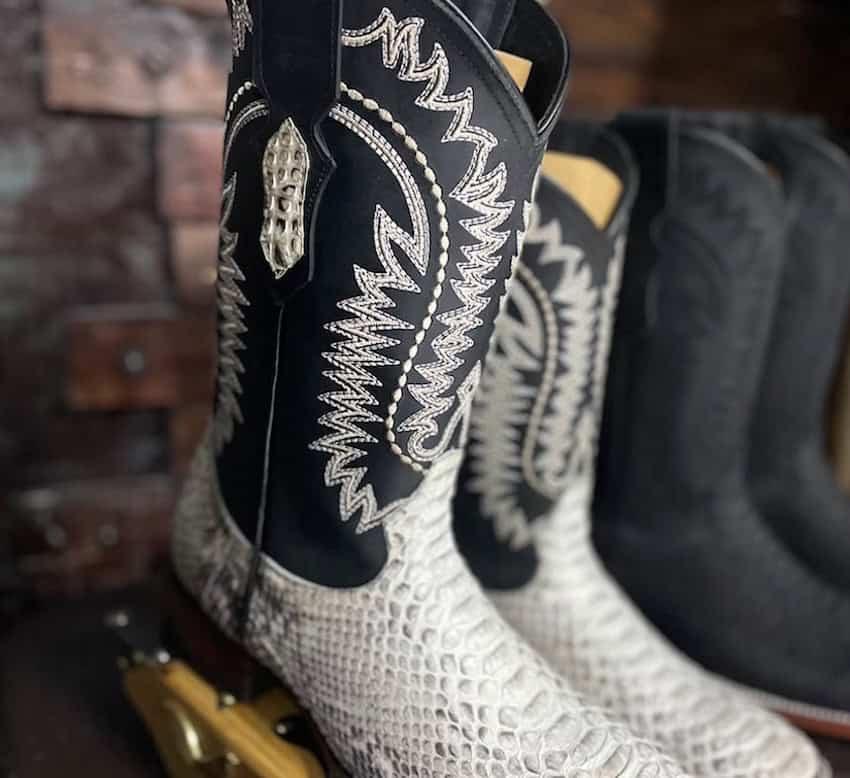
Animal smugglers know there’s a market for pythons in Mexico, either live as pets or dead as snakeskin boots. (Facebook)
Officials contacted U.S. Fish and Wildlife Service agents who took custody of the animals. The pythons were transported to a controlled environment where their condition could be monitored, according to CBP reports.
The driver was given penalties of $34,824 for export violations, while CBP seized the tractor and trailer.
Exporting live reptiles across the U.S.-Mexico border requires compliance with several U.S. and international regulations, and approval must be given from agencies such as the U.S. Fish and Wildlife Service, the U.S. Department of Agriculture and the U.S. Census Bureau.
This is not the first time this year that someone has been caught trying to smuggle wildlife across the border. In February, a U.S. citizen allegedly attempted to transport 11 parrots in a private vehicle from Mexico into the U.S., via the Córdova–Las Américas International Bridge near Ciudad Juárez, Chihuahua.
This followed an incident in November when a man was caught attempting to smuggle two Mexican orange-fronted parakeets in his pants across the border between Tijuana and San Diego.
“The interception of live pythons at the World Trade Bridge highlights the vigilance and dedication of our CBP officers in enforcing laws that protect both our borders and our environment,” said Port Director Alberto Flores, Laredo Port of Entry. “CBP remains committed to preventing the illegal importation and exportation of wildlife and ensuring compliance with all federal regulations.”