President Claudia Sheinbaum had a bruising week on the domestic front.
On Wednesday, her electoral reform — a campaign promise — failed in the Chamber of Deputies after members of the National Action Party (PAN), the Institutional Revolutionary Party (PRI), Citizens’ Movement (MC) and the ruling Morena party’s allies, the Labor Party (PT) and the Green Party (PVEM), all voted against it.
It was the first time since PT and PVEM joined forces with Morena in 2018 that they didn’t offer their broad support to an initiative backed by the president.
On Thursday morning, Sheinbaum announced a “Plan B,” though the bill’s opponents still see it as a pathway to a single-party system favoring Morena. Mid-week, Sheinbaum also announced a visit to Brazil and reaffirmed Mexico’s support for Cuba, keeping Latin American diplomacy on the agenda even during a difficult week.
Further afield, Italy knocked Mexico out of the World Baseball Classic — a tough pill for fans craving a win — but World Cup fever is building, with Mexico City’s Zócalo carpeted in artificial turf in preparation for the world’s largest simultaneous soccer practice, to be held this Sunday.
Didn’t have time to follow the news this week? Here’s what you missed.
Sheinbaum’s electoral reform fails — and pivots to ‘plan B’
Mexico’s lower house of Congress on Wednesday rejected Claudia Sheinbaum’s electoral reform proposal, dealing a significant blow to the president. While a majority of deputies voted in favor of the bill, the reform proposal required two-thirds support as it sought to amend Mexico’s Constitution. All told, 259 deputies supported the bill while 234 opposed it.

The setback marks a rare rift in the coalition between the ruling Morena party and its partners, as the Green Party (PVEM) and the Labor Party (PT) withheld their support. Some of the proposed changes, which Sheinbaum’s party framed as budget austerity measures, were viewed by smaller parties as reducing their own power.
Time for plan B: Sheinbaum’s electoral reform fails in the lower house
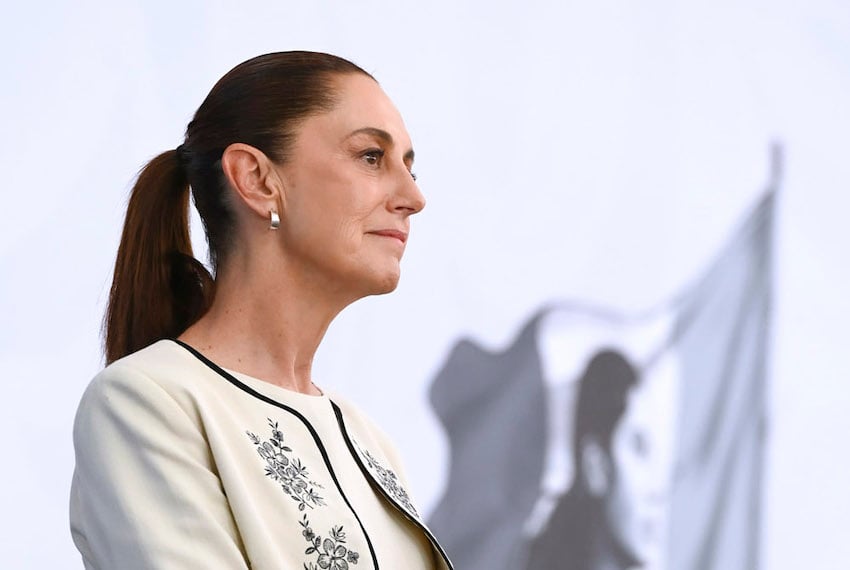
At her Thursday mañanera, Sheinbaum unveiled a “Plan B”: rather than amending the Constitution — which requires a supermajority — she will seek to change secondary laws, which require only a simple majority to pass.
She said her plan has three main objectives: to reduce the privileges that persist in local Congresses, reduce privileges in municipalities, and strengthen public consultation, giving citizens a greater say on important issues, including via referendums. She said she would submit the new bill to Congress on Monday.
What’s happening with Uber at the Mexico City International Airport?
Taxi drivers blocked access to both terminals of Mexico City International Airport (AICM) on Wednesday, demanding that rideshare apps be blocked from the airport. The protest was organized by the taxi group New Image Land Transportation, and the drivers vowed to remain indefinitely until authorities gave a written commitment not to modify the law protecting their exclusive operating rights.
The blockade came after proposed legislation would allow ride-hailing apps like Uber and DiDi to operate on all federal properties, including airports. The action was prompted by that bill, which the protesting taxi operators say would threaten their livelihoods.
Starting Thursday, the National Guard resumed enforcement of an on-again, off-again policy banning rideshare services from picking up passengers at AICM’s two terminals. But Uber wasn’t about to stand down: company officials noted that its lawsuit against the policy has yet to be adjudicated, and that last October, a federal judge ordered an end to “arbitrary fines and detentions” until it is resolved.
Rideshare drivers caught in the act this week received only verbal warnings.
At her Thursday presser, Sheinbaum offered some sympathy to taxi drivers, noting that they pay airport operating fees while ride-hailing apps do not — calling that “a valid argument.” She floated a proposal to designate a pick-up zone farther from the terminals for app drivers.
However, AICM tried to implement a similar solution in the past to little lasting effect. With World Cup season kicking off in June, millions of international visitors touching down at Mexico City International Airport will be looking for familiar rideshare options — making this a dispute with a ticking clock.
As of today, passengers who order an Uber to or from one of AICM’s two terminals will most likely get a ride, but may experience delays or harassment in the process.
Steel tariffs and surging oil prices
Economy Minister Marcelo Ebrard announced the permanent renewal of tariffs on steel imports from Asian countries that don’t have trade agreements with Mexico, speaking at the 78th Assembly of the National Iron and Steel Industry Chamber.
The tariffs, ranging from 10% to 35%, will protect Mexico’s domestic industry from imports from South Korea, Vietnam, China and other nations covering 220 steel products. Ebrard also called U.S. steel tariffs on Mexico “illogical,” noting that a surplus trade partner being hit with a 50% tariff is “unprecedented.”
The economy minister said he will address this issue next week when Mexico begins the first round of negotiations ahead of the formal review of the US-Mexico-Canada trade pact (USMCA).
Meanwhile, with the Middle East war pushing global oil prices higher, the government renewed its voluntary gas price cap agreement with 96% of the country’s gas stations, pledging to keep regular gasoline below 24 pesos per liter. A key factor in the surge in oil prices is the closure of the Strait of Hormuz, through which roughly 20% of global oil supply normally passes.
Veracruz oil spill blamed on private tanker
What began in early March as an unidentified oil contamination off the southern Veracruz coast has turned into a widening environmental emergency affecting over 200 kilometers of Gulf of Mexico coastline.
On Wednesday, Veracruz Governor Rocío Nahle initially suggested the oil might have come from a natural seafloor seep. Later, Nahle said the spill originated from a private oil tanker off the coast of Tabasco carrying out exploration tasks.
Clean-up efforts have taken on some urgency as coastal communities prepare for an influx of tourists during the Holy Week holiday period beginning later this month. Environmentalists warn that the oil spill is likely to affect the beaches for up to two months.
New economic forecasts, parks and billionaires
Mexico received a string of upbeat economic signals this week. BBVA and Barclays both raised their growth forecasts for Mexico’s GDP this year — BBVA from 1.5% to 1.7%, and Barclays from 1.2% to 1.8% — joining the OECD and Banco de México in revising their outlooks upward. BBVA’s chief economist cited President Sheinbaum’s mixed-ownership investment model in energy and infrastructure, while Barclays pointed to the early start of USMCA negotiations as a positive development.
On the industrial side, the first 20 industrial parks under Plan México officially opened for business. Together, the parks represent more than US $711 million in direct investment and 3.5 million square meters of capacity for manufacturing and logistics facilities. Roughly 245 companies are expected to operate within them, creating an estimated 62,000 direct jobs across 10 states, including Nuevo León, Baja California, Chihuahua, Jalisco and Mexico City. The government has pledged a total of 100 such parks by 2030.
In other business news, 24 Mexicans made the Forbes 2026 Billionaires List, with a combined net worth of $267.3 billion — up more than 60% from last year.
Anti-cartel efforts: Arms seizures, money trails and the ‘Shield of Americas’
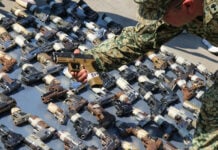
Government data released this week showed that authorities seized 24,122 firearms between October 1, 2024, and February 28, 2026 — at roughly twice the rate of the previous administration. Security Minister Omar García Harfuch noted that approximately 80% of the seized guns came from the United States.
On the U.S. side, the Treasury Department’s Financial Crimes Enforcement Network (FinCEN) identified 14 U.S. counties near the southwest border where it believes cartels are laundering cash, requiring money service businesses in those counties to file Currency Transaction Reports. Five of the counties — including Maricopa and Pima in Arizona and three New Mexico counties — were newly added to the list.
The week also brought an awkward geopolitical moment. The United States established a new “Americas Counter Cartel Coalition,” also branded the “Shield of the Americas,” at a summit in Florida — but Mexico was not invited, even though U.S. President Trump called it the “epicenter of cartel violence.”
Trump said that the “heart” of the initiative between the ACCC partners — which includes the United States, Argentina, Ecuador, El Salvador, Panama, Paraguay and Peru — is “a commitment to using lethal military force to destroy the sinister cartels and terrorist networks.”
On Monday, the president reiterated that Mexico “proudly continues to say no” to Trump’s offers to send the U.S. army into Mexico for the purpose of combatting organized crime.
Sheinbaum holds the line on sovereignty following Trump’s latest remarks: Monday’s mañanera recapped
Environmental headlines
🐋 A rare albino blue whale was spotted off the coast of Loreto, an extraordinary sighting that capped what officials called an unprecedented whale-watching season on the Baja California Peninsula.
🐆 Two African leopard cubs were born at the Irapuato Zoo in Guanajuato, a rare and celebrated arrival for the species.
🏗️ A luxury condo expansion in Acapulco is facing backlash after an investigation found the project has caused significant damage to the coastal seabed — prompting calls for a halt to construction and greater protections for the bay.
Development indicators
🛡 Homicide rates dropped 35% in February, with Sheinbaum celebrating the continued downward trend in murders during her presidency.
🚂 Train ridership in Mexico topped 55 million as the Maya Train and other passenger rail links posted year-over-year increases.
✈️ Tourism to Mexico doubled since 2000, with international visitor numbers to double again by 2050.
💻 Google, Meta and TikTok agreed to crack down on digital violence against women in Mexico, committing to strengthening community standards and increasing cooperation with authorities on abuse cases.
Looking ahead
Three storylines from this week carry momentum into the coming days. On the electoral reform front, Sheinbaum said she will submit her “Plan B” — secondary law changes requiring only a simple majority — to Congress on Monday. Whether Morena’s allies, whose defection sank the constitutional version, will line up behind the softer bill remains the key question.
On trade, the formal bilateral USMCA review could begin as early as next week, with Minister Ebrard leading the Mexican delegation. The outcome will determine whether the treaty is extended to 2042 or enters a cycle of annual renegotiations.
And on Cuba, President Díaz-Canel confirmed on Friday that his government had recently held talks with U.S. officials. When asked whether Mexico had played a role in facilitating the dialogue, Sheinbaum was characteristically measured: “Let’s say we’ve promoted dialogue with both U.S. and Cuban authorities.”
Progress in those talks could also clear the way for Mexico to resume fuel shipments to the island — a long-standing aid relationship that has been complicated by U.S. sanctions.
Looking for last week’s roundup? Check it out here.
Mexico News Daily
This story contains summaries of original Mexico News Daily articles. The summaries were generated by Claude, then revised and fact-checked by a Mexico News Daily staff editor.