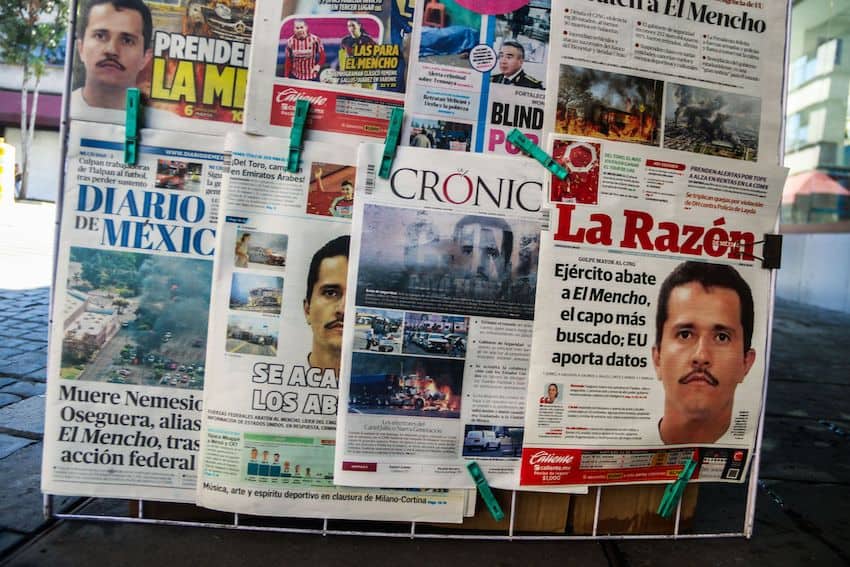
On Sunday, Feb. 22, the Mexican Army killed Nemesio “El Mencho” Oseguera Cervantes — founder and supreme leader of the Jalisco New Generation Cartel (CJNG), one of the world’s most powerful and violent criminal organizations, and a man who had evaded capture for more than a decade.
What followed was one of the most intense weeks in recent Mexican memory: narco-blockades, arson attacks on stores, buses and at least one Costco, a flood of misinformation that state authorities scrambled to debunk and a high death toll among security forces. By Friday, the question had shifted from whether El Mencho was really dead to who would replace him.
The events of the week put Mexico’s cartel crisis back at the top of international news feeds — often inaccurately. Foreign headlines ranged from alarmist to outright wrong, with AI-generated images of burning airports and firefights on runways circulating as fact. The reality on the ground told a different story: the worst of the unrest was concentrated in western Mexico and was quickly contained. For many observers, the speed and decisiveness of the federal response suggested that this chapter of Mexico’s war against the cartels may be playing out differently than those that came before.
Didn’t have time to catch every story of the week? Here’s what you need to know about the week of Feb. 23-27 in Mexico.
The killing of El Mencho
How the Mexican Army found him
On Friday, Feb. 20, military intelligence agents tracked down a trusted associate of one of Oseguera’s romantic partners. That man transported the woman to a property in Tapalpa, a quiet cobblestoned mountain town roughly 130 kilometers southwest of Guadalajara — a place better known for its pine forests, artisan markets and weekend tourists than for its connection to one of the world’s most wanted criminals.
The property turned out to be an upscale home inside the gated Tapalpa Country Club residential development — a large, two-story structure with high ceilings, pendant lighting, fine wood finishes and wide windows overlooking wooded grounds. “From the air, the property appears secluded, integrated into the wooded landscape, far from urban noise,” the newspaper Milenio reported after its journalists were given access to the home. Inside, they found luxury furniture, neatly folded clothes, fruit and meat in the kitchen, a handwritten copy of Psalm 91 dated Jan. 25 — “He will cover you with his feathers, and under his wings you will find refuge” — a religious altar bearing statues of the Virgin of Guadalupe and Saint Jude, patron saint of desperate causes and medication for kidney disease, an ailment El Mencho was known to suffer. The unmade beds suggested the departure had been abrupt.
The woman — apparently not Oseguera’s wife — met with him at the property and left the following Saturday. That same day, military intelligence confirmed El Mencho had remained behind with a close security circle.

The operation
In the early hours of Sunday, Feb. 22, the operation launched. The stated goal was a live arrest under the Federal Firearms Law. El Mencho’s security team made that impossible. “The attack the organized criminal personnel carried out was really very violent,” Defense Minister Ricardo Trevilla Trejo said afterward. Military personnel returned fire. Oseguera and his inner circle fled into the dense wooded area bordering the property. Special Forces pursued them through the trees, and when CJNG members opened fire a second time, El Mencho and two of his bodyguards were shot and critically wounded. Two other cartel members were detained.
Military medics reached the three wounded men and determined that immediate evacuation was essential. Because landing in Guadalajara was judged too dangerous — the cartel could mount an armed attack at any Jalisco hospital — the helicopter carrying Oseguera flew first to Morelia’s international airport in Michoacán. The bodies were transferred to an Air Force plane and taken to Mexico City, where the Federal Attorney General’s Office formally confirmed their identities. El Mencho died en route. He was 59 years old.
The U.S. Department of Justice had maintained federal charges against him for years and offered a multimillion-dollar reward for information leading to his capture. His death marked one of the most consequential moments in Mexico’s battle against organized crime in a generation.
The violence and fear that followed
The CJNG’s retaliation was immediate and overwhelming. More than 250 narco-blockades were reported across 20 Mexican states within hours of the news breaking, and arson attacks erupted across Jalisco almost simultaneously.
Jalisco Governor Pablo Lemus Navarro declared a statewide “Code Red” and convened a security committee at all three levels of government. The governor of neighboring Nayarit, Miguel Ángel Navarro, issued a similar warning, calling on residents to shelter in their homes.
In Puerto Vallarta, thick columns of black smoke rose from multiple points across the city and more than 10 vehicles were torched. Hotels advised guests to remain indoors. Public transport stopped and hundreds of flights to Puerto Vallarta and Guadalajara, as well as nearby Manzanillo and Tepic, were canceled or diverted.
The U.S. Embassy in Mexico City — which issued a shelter-in-place order covering the states of Jalisco (including Guadalajara, Puerto Vallarta and Chapala), Tamaulipas, Michoacán, Guerrero and Nuevo León — urged citizens to “be aware of your surroundings; avoid areas around law enforcement activity; and seek shelter and minimize unnecessary movements.” Canada, the UK, Australia and India also issued security alerts to their nationals in Mexico.
In Guadalajara, the metro system shut down and roadblocks paralyzed major arteries. Schools in Jalisco and Nayarit canceled classes on Monday. Residents across the city shared informal shelter-in-place warnings through neighborhood WhatsApp groups.
In Mexico City, all bus routes to Guadalajara, Guanajuato, Michoacán, Mazatlán and other points northwest were suspended on Sunday. Some neighborhoods of the capital were noticeably quieter on Sunday night. However, no incidents were reported and activities proceeded as normal on Monday.
Mayor Clara Brugada convened a “permanent” Security Cabinet session the moment the operation became public, coordinating with federal forces and issuing a clear public statement: “Serenity and trust are built with verified information and coordinated efforts.” She later confirmed that “the nation’s capital remains at peace.” Approximately 5,000 security agents were deployed at the international airport.
Fake fires, real fear: Debunking the lies that went viral after ‘El Mencho’ fell
Life returns to Jalisco — cautiously
The Code Red was lifted on Tuesday evening after more than 48 hours. Supermarkets, banks, markets, restaurants and public transport resumed across the state. Schools reopened on Wednesday.
Mexico News Daily spoke with residents of Guadalajara and Zapopan to gauge the mood. María Fernanda, 36, a Guadalajara mother, said her family had “somewhat resumed normal life” on Tuesday but remained wary. “I’m skeptical and I’m taking lots of precautions. I’m not sure I’ll send my kid to school yet,” she said.
Fernanda, 32, went further: she and her friends had planned a girls’ night out for Wednesday but canceled. “We have no intention of going out at night. At least not yet.” Rubén, 50, who runs a private airport transport service, reported smooth operations by Tuesday — but drew his own line: “I don’t recommend going out at night or in the early morning,” he said, adding that he refused to take clients to the airport before 7 a.m.
Travelers driving back into Guadalajara from Tapalpa, Puerto Vallarta and Tepic by Wednesday reported smooth roads, though burned truck carcasses still smoldered on several federal highways.
The human toll
According to Security Minister Omar García Harfuch, 25 National Guard officers, one state police officer, one security guard and a civilian woman who was reportedly pregnant were killed in 27 retaliatory attacks on Sunday. Three soldiers who participated in the initial Tapalpa operation later died from their wounds. An additional 34 cartel members were killed in those incidents.
Among the cartel’s organizers, a man known as “El Tuli” — El Mencho’s chief logistics and financial confidant — was identified by the Defense Ministry as the person coordinating the CJNG’s violent response from El Grullo, near Tapalpa, and offering 20,000-peso (roughly US $1,160) bounties per soldier or National Guard member killed.
A parachute regiment deployed to El Grullo killed “El Tuli” when he opened fire on military personnel. He was found carrying 7.2 million pesos and nearly US $1 million in U.S. dollars in cash.
Sheinbaum’s response
On Sunday afternoon, Sheinbaum took to social media with a measured appeal for calm: “There is absolute coordination with the governments of all states; we must remain informed and calm. In the vast majority of the national territory, activities are proceeding with complete normality.” She extended recognition to “the Mexican Army, National Guard, Armed Forces and Security Cabinet.”
At her Monday mañanera, flanked by Defense Minister Trevilla and Security Minister García Harfuch, she was confident and convincing of her administration’s control of the situation.
They reported that all the narco-blockades set up by the CJNG on Sunday had been removed and that a total of 2,500 additional federal troops were being deployed to Jalisco to bolster security in the state.
Aside from a residual flare-up on Monday night that impacted roadways leading to and from Guadalajara, the panorama in Mexico has been calm since Tuesday, Feb. 24.
Did the US participate in the El Mencho operation?
The short answer, according to both the Mexican government and U.S. officials, is: no. However, it was made possible by a bilateral information exchange.
The Defense Ministry confirmed that U.S. intelligence contributed to locating Oseguera, and Trump and several senior U.S. officials publicly praised the outcome — a notable show of cross-border cooperation at a moment of otherwise tense bilateral relations. The operation, however, was Mexico’s — planned and executed entirely by Mexican forces.
Sheinbaum’s approval rating climbs
A new survey found that nearly half of Mexicans now view President Sheinbaum more favorably following the CJNG takedown, with broad public support for the military operation even amid deep concern about the collateral violence it unleashed.
Mexicans largely credited her administration for the result — a remarkable political windfall for a president who had faced persistent pressure on security since taking office.
Mexico sends more food aid to Cuba
Away from the security headlines, Mexico this week dispatched a second major shipment of humanitarian aid to Cuba, sending 1,200 tonnes of food to the island as it continues to grapple with severe shortages.

The shipment follows an earlier batch and reaffirms the Sheinbaum government’s commitment to the bilateral relationship, even as Mexico navigates its own domestic crises.
World Cup updates
By Thursday, the main question at the president’s mañanera had pivoted to whether the week’s violence would jeopardize Mexico’s FIFA World Cup co-hosting role — a concern Sheinbaum dispatched with characteristic composure.
In Miami on Wednesday, FIFA president Gianni Infantino told reporters, “We have full trust in the authorities in Mexico, [in] President Sheinbaum and her team, and we actually fully support them as well.”
Sheinbaum subsequently noted on Thursday that Infantino said that no changes would be made to the schedule of the World Cup, which will be held in the United States (78 matches), Canada (13 matches) and Mexico (13 matches).
“… We are monitoring of course the situation, but we have full confidence that everything will be great. Mexico is a football country, and the Mexicans, the authorities but also the people, will do everything they can to ensure that the World Cup and the playoffs … will be a celebration of football,” Infantino said.
View this post on Instagram
Morena’s new electoral reform proposal
On Wednesday, the Sheinbaum government unveiled a sweeping proposed electoral reform to be submitted to Congress the following Monday.
Interior Minister Rosa Icela Rodríguez presented the proposal’s 10 key points, which include reducing the Senate from 128 to 96 seats by eliminating proportional-representation positions; cutting overall election spending by 25% by slashing budgets for the National Electoral Institute, political parties and electoral tribunals; and simplifying voting from abroad.
For context, Mexico’s 2024 federal election cost 61 billion pesos (US $3.55 billion) — the government contends Mexico’s per-voter spending exceeds that of any other country in the world. The 500-seat Chamber of Deputies would remain intact, but all deputies — including proportional-representation candidates — would have their names on ballots, and eight new deputies representing Mexicans living abroad would be added. Because the reform amends the constitution, it requires two-thirds majorities in both chambers, meaning Morena must keep its congressional allies — the Green and Labor parties — firmly in line, with no margin for defections.
Economic results, forecasts and investment
Despite the week’s upheaval, Mexico’s economic headlines were largely positive.
Mexico took in a record US $40.8 billion in foreign direct investment in 2025 — the highest figure ever recorded. While 2025’s GDP growth came in at a modest 0.8%, reflecting a year of real headwinds, the outlook for 2026 is improving considerably. Both Banxico and the OECD raised their forecasts this week: the Bank of Mexico lifted its 2026 GDP growth projection to 1.6% from a previous estimate of 1.1%, with a revised projected range of 1% to 2.2%. The OECD published its Economic Survey of Mexico 2026 on the same day, projecting growth of 1.4% this year and 1.7% in 2027 — an upward revision from the 1.2% the Paris-based body forecast for 2026 back in December.
Banxico Governor Victoria Rodríguez Ceja acknowledged that 2025 had been “particularly complex” with “elevated uncertainty,” but pointed to improving trade conditions and nearshoring investment as drivers of the sunnier outlook.
Congress also gave final approval to a 40-hour workweek law — a long-sought labor reform set to take effect in the coming months — and Coca-Cola’s US $6 billion investment commitment provided a high-profile commercial vote of confidence in Mexico’s medium-term prospects.
Looking ahead: The succession question
With El Mencho gone, the question that preoccupied security experts by week’s end was the same one governments, analysts and rival criminal organizations were all quietly running: who takes over the CJNG?
At Friday’s mañanera, held in Mazatlán, Security Minister García Harfuch laid out the intelligence picture. The cartel has regional leaders spread across the vast majority of Mexico’s 32 states, he said, and authorities have identified the four “strongest” figures within the organization. Two of those four are considered most likely to claim the top position. García Harfuch declined to name any of them publicly, saying only that all four are “under investigation.”
Media reports have nonetheless filled in some of the blanks. Oseguera’s stepson, Juan Carlos Valencia González — a 41-year-old California native known as “R3” — is widely considered a leading contender. Others named in press reports include Hugo Gonzalo Mendoza Gaytán (“El Sapo,” The Toad); Audias Flores Silva (“El Jardinero,” The Gardener); Ricardo Ruiz Velasco (“El Doble R”); and Heraclio Guerrero Martínez (“Tío Lako”), who reportedly lost a son during the Tapalpa operation itself. The cartel he is vying to lead has an active presence in 28 of Mexico’s 32 states, making the stakes of the succession fight exceptionally high.
Security analysts warn that the leadership vacuum carries serious risks. Unlike the Sinaloa Cartel, which has a more diffuse leadership structure, the CJNG was built around El Mencho’s singular authority. A power struggle among regional bosses could trigger fragmentation, intensified territorial battles with rival groups and a new spike in violence in core CJNG territories. Whether the cartel holds together or splinters — and how fast — will be one of the defining security stories of the months ahead.
Mexico News Daily
This story contains summaries of original Mexico News Daily articles. The summaries were generated by Claude, then revised and fact-checked by a Mexico News Daily staff editor.