From childhood in Mexico to college in the U.S., Ann Dolan shares her experience raising kids in San Miguel de Allende with podcast hosts Travis Bembenek and George Reavis. (Shutterstock)
Oftentimes, when one talks to parents who are considering moving to Mexico with kids, the focus of the conversation is on potential negatives. What if they don’t like it? What if they don’t learn Spanish? What if they don’t fit in? What if they fall behind their U.S. counterparts? What if they don’t have the same sports? What if they can’t get into a good college? Rarely is the conversation framed around the potential positives or benefits of growing up in another country and culture. I think this largely contributes to the persistence of “confidently wrong” perceptions about raising kids in Mexico.
In today’s episode, we interview someone who quickly puts to rest many of those questions. Ann Dolan and her family provide an exceptional case study that we can all learn from. Ann and her husband Jim moved to Mexico at a young age, and years before having kids. When they ultimately decided to have kids, they chose to have them in Mexico and to continue living in San Miguel de Allende.
When it came time to decide on elementary school, they stayed in Mexico. The same for middle school. All three of their kids grew up bicultural and bilingual and are now all at college in the U.S. Their oldest, who is graduating this spring, already has a job on Wall Street in New York City.
How could all of this have happened for a family living in little San Miguel de Allende? Listen to Ann share the experiences of having, raising and educating kids in Mexico. This episode is guaranteed to leave you informed and inspired!
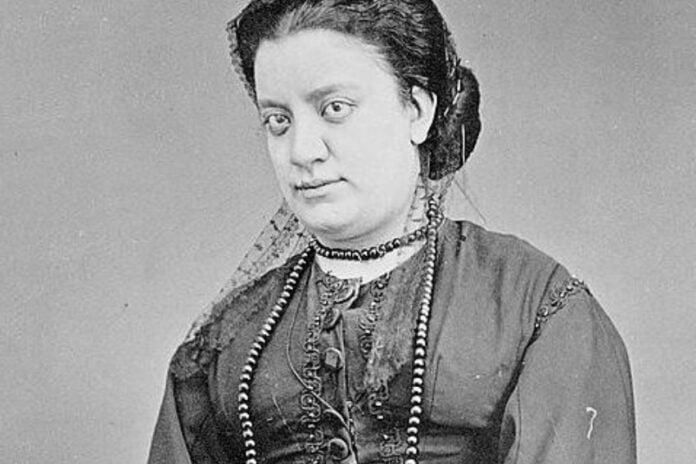
Ángela Peralta was the greatest opera singer ever born in Mexico, a prodigy who by the age of 17 had already performed to acclaim in Milan’s La Scala opera house. (Public Domain)
In August 1883, fresh off a stunning performance in the title role of the opera “Maria di Rohan” in La Paz, Ángela Peralta, the opera singer known as the “Mexican Nightingale,” arrived in Mazatlán to a reception fit for a queen. Crowds of admirers holding flowers and handkerchiefs overhead thronged the pier where her ship had docked, as the celebrated soprano was greeted by the city council and serenaded by a band playing the national anthem.
Peralta, according to popular legend, was wearing a dark coat and a small hat and sang a brief rendition of “La Paloma.” When she made her way down to the carriage assigned to her, her most passionate admirers unyoked the horses so that they might convey her in the carriage aloft, followed by the rest of the crowd, to her arranged lodgings at the Hotel Iturbide, next door to the Teatro Rubio, where she was scheduled to perform in the coming days.
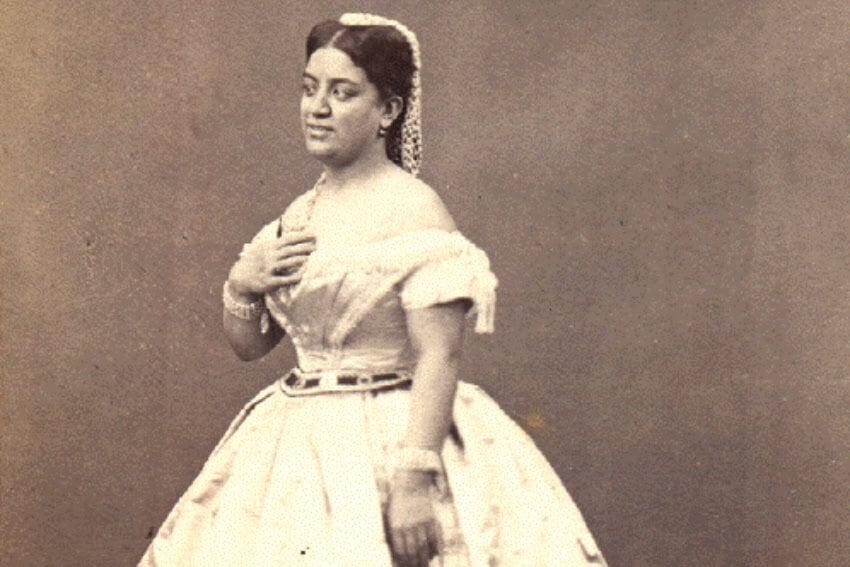
Peralta, at the peak of her powers as an artist in the role of Lucía de Lammermoor, was renowned for the rare emotional expressiveness of her voice and its exceptional clarity. (Public Domain)
Little did the Nightingale know, as her carriage was carried on broad shoulders through the streets of Mazatlán, that eight days later she would be married for the second time, and that eight days later she would be dead at the age of 38.
The yellow plague
Before virologist Max Theiler discovered a vaccine for yellow fever while working at the Rockefeller Foundation laboratories in New York City during the 1930s — an achievement for which he would later receive a Nobel Prize — the infectious viral disease had likely killed millions. It still kills tens of thousands of the unvaccinated each year, mainly in Africa and South America.
No, it’s not contagious. Like malaria or dengue, yellow fever is transmitted into the bloodstream via a mosquito bite. But unlike the other two, it can be particularly devastating due to its ability to cause rapid organ failure and death. In the 19th century, yellow fever was rightly feared, not only for its potentially fatal consequences but also for the extremely painful symptoms that accompanied the disease.
There are three phases: incubation, acute and toxic. During the initial “silent” phase of yellow fever, lasting three to six days, there is often no obvious sign of infection, as the virus spreads in the bloodstream, causing headaches and body aches that can be mistaken for the flu. However, once the acute phase sets in, so too does a high fever, along with symptoms such as dizziness and confusion. Worse yet is the so-called “coup de barre,” an excruciating pain in the back and legs that feels as if the afflicted is being beaten with a stick.
Only 15% of those infected are destined for the severe version. But they are first deceived by a brief period of remission before the tragic reality sinks in. Then, a week to 10 days after being bitten, yellow fever’s most famous symptoms arrive. These are jaundice, a yellowing of the skin and eyes, and “black vomit” as acids from the eroding stomach lining turn blood from red to black.
The outbreak that would ensue in 1883, killing not only Peralta but 2,500 people — an astonishing 16% of Mazatlán’s residents at the time — was already present when she and her company arrived aboard the steamship Newbern from Baja California Sur. According to local reports, yellow fever was brought from Panama aboard two ships, the San Juan and the San Blas, which were allowed to dock without being quarantined. These ships already had dozens of infected passengers aboard, who were then bitten by Aedes aegypti mosquitoes in Mazatlán, which passed the virus on to the local population.
Early days in Mazatlán
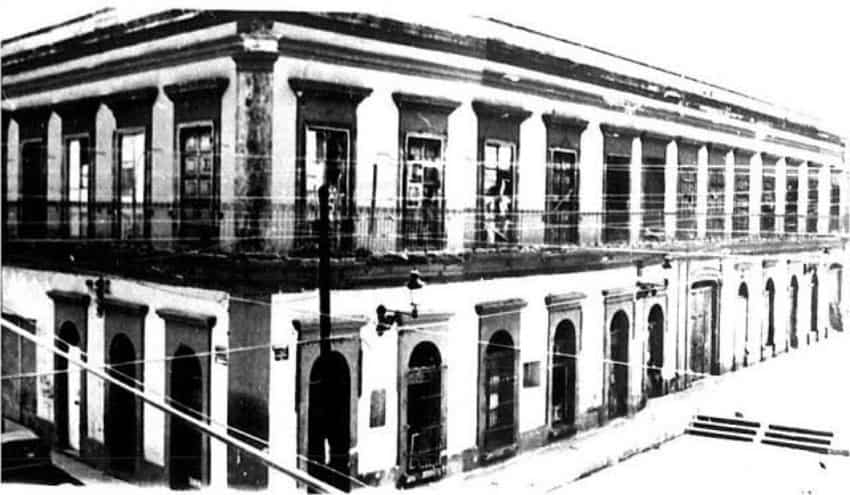
The Hotel Iturbide in Mazatlán, where Peralta and her opera company were lodged. (Public Domain)
Peralta and her company had arrived at the worst possible time. Although there had been several outbreaks of yellow fever in Mexico during the 19th century in the cities of at Altamira, Tampico, Tuxpan and Veracruz, none had occurred on the Pacific coast. This was the first, and the conditions then present in Mazatlán were ripe for it. The rainy season, which had just ended, had left pools of stagnant water, and this, combined with the heat and humidity of August, fueled the mosquito population that would spread the disease.
By the time Peralta and her company arrived on Aug. 22, dozens of deaths had already been reported in Mazatlán. It’s quite possible many of the company were bitten by infected mosquitoes before they even arrived at the Hotel Iturbide — perhaps even before they disembarked from the ship. When the first rehearsal was held two days later, Friday, Aug. 24, at the Teatro Rubio, the company’s musical director, Pedro Chávez Aparicio, was already feeling ill. So Peralta stepped in to direct the rehearsal, singing several arias to get a feel for the acoustics of the venue.
Over the weekend, she would begin to feel the first symptoms. By the following Monday, Chávez had died, and Peralta was confined to her hotel room at the hotel, in the throes of the disease that would eventually kill her.
The flight of ‘La Ruiseñora Mexicana’
Despite Peralta’s rather florid name, María de los Ángeles Manuela Tranquilina Cirila Efrena Peralta, she had been born into a Mexico City family of modest means. Her talents, however, were soon apparent. By the age of eight, she had already been enrolled in the National Conservatory of Music. That same year, she met internationally renowned opera singer Henrietta Sontag, who was then visiting Mexico. Peralta was able to imitate her so perfectly that Sontag predicted that with European training, she would become one of the world’s best opera singers.
Her voice, heard for the first time publicly when she performed at the Gran Teatro Nacional at age 15 in the role of Leonora in Verdi’s “Il Trovatore,” was a rare soprano absoluta. With this versatile instrument, she was able to perform coloratura roles that required vocal acrobatics like trills and arpeggios while sustaining very high notes with flawless technical skill. But Peralta could also sing with immense power. Comparisons to songbirds, from goldfinches to nightingales, soon followed.
At 17, she performed the lead in Donizetti’s “Lucia di Lammermoor” at La Scala opera house in Milan, bringing down the house and receiving 23 curtain calls. One of Donizetti’s sons, in attendance, lamented that his father had not lived to see her perform. Francesco Lamperti, with whom she studied in Milan, declared her “angelic by voice and by name.” She went on to appear in all the other great opera houses in Europe, from Naples and Rome in Italy and Barcelona and Madrid in Spain, to Paris and St. Petersburg. She conquered the U.S., too, performing in New York City.
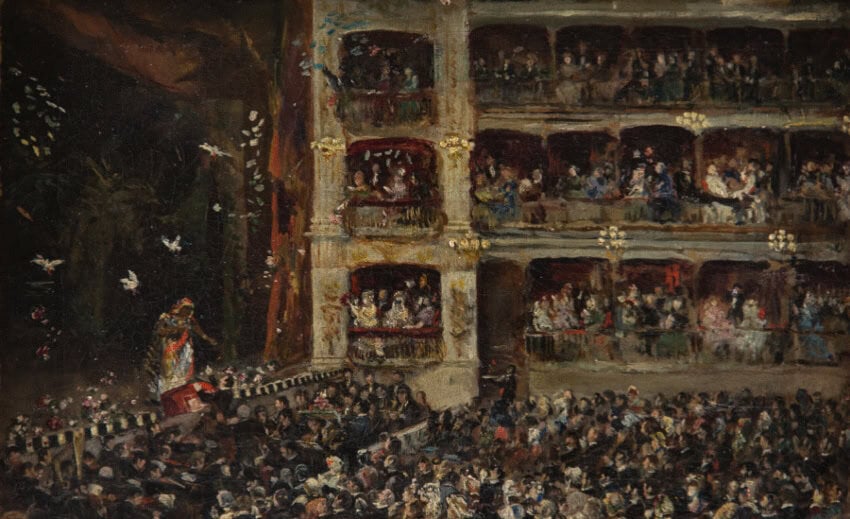
Painting of Peralta in performance as Aida, circa 1877. (Colección Museo Nacional de Historia)
But already, the “black star” that Peralta felt was following her had begun to show itself. Her first husband — first cousin Eugenio Castera, whom she married in Madrid — had already begun to show signs of mental illness during the first year of their marriage. By 1876, he had been committed to an institution in Paris, where he died the same year.
Peralta returned to Mexico, where a decade earlier she had performed for Emperor Maximilian and Carlota. This visit promised to be every bit the same success when she opened to acclaim, performing “Aida” at the Gran Teatro Nacional in 1877. But when it became common knowledge that she was now in an unmarried relationship with her lawyer and manager, Julián Montiel y Duarte, the capital’s public, electrified by the gossip, turned against her. Her opera performances were increasingly met with hecklers, and by the end of the 1870s, she had vowed never again to perform in Mexico City.
This was the reason for her tours of the “provinces” of Mexico, like the fateful one that brought her to Mazatlán in 1883.
Final days in Mazatlán
On the morning of Aug. 30, eight days after she’d arrived in Mazatlán, by which point she was on her deathbed, Peralta legalized her relationship to Julián Montiel y Duarte by marrying him in room 10 of the Hotel Iturbide. Her signature does not appear on the marriage certificate, though, and it is speculated that she was dead before her vows had been uttered, and that her head had to be manipulated so that she could nod her “I do.”
The Nightingale would sing no more. So devastated was Mazatlán by the yellow fever outbreak that claimed Peralta’s life that only a few members from the company went to the cemetery to see her buried, and not a single note was sung at her gravesite. Of the 38 people who had accompanied her to Mazatlán, 34 fell ill, and at least 14 died. Montiel y Duarte survived, but spent the last 19 years of his life disputing claims that he had married Peralta for whatever was left of her estate.
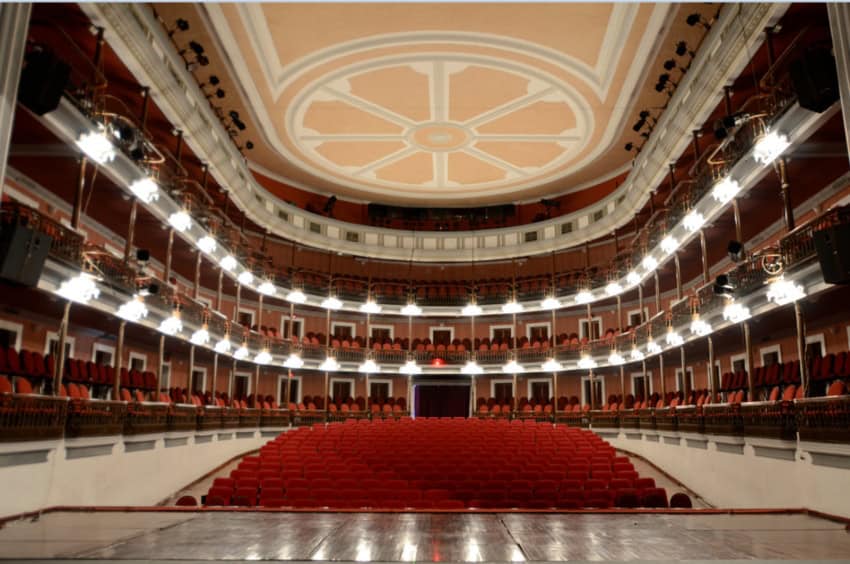
Her legacy would prove more enduring. In 1937 — the same year Theiler discovered the cure for yellow fever — Peralta’s remains were disinterred from Mazatlán and removed to the Rotonda de las Personas Ilustres in the Panteón de Dolores in Mexico City. She was the first woman ever to receive this honor. The Teatro Rubio in Mazatlán, meanwhile, built in 1874 and where Peralta had rehearsed before her death, was renamed for her and received a significant restoration in 1992. Today, it remains a magnificent showplace for the next generation of talented Mexican singers and performers.
The Teatro Ángela Peralta in Mazatlán is the restored theater where she was once meant to perform. (Gobierno de Mexico)
Of course, there will never be another “Mexican Nightingale.”
Chris Sands is the former Cabo San Lucas local expert for the USA Today travel website 10 Best and writer of Fodor’s Los Cabos travel guidebook. He’s also a contributor to numerous websites and publications, including Tasting Table, Marriott Bonvoy Traveler, Forbes Travel Guide, Porthole Cruise, Cabo Living and Mexico News Daily.
Mexico City's Paseo de las Heroinas honors important women in Mexican history with statues. (Instagram)
From the towering Angel of Independence, where the remains of Mexico’s founding heroes rest, to the anti-monuments erected by social movements, the statues and markers along Mexico City’s Paseo de la Reforma both commemorate the nation’s long history and show how different parts of society dispute the meaning of that history or fight to make their voices heard in its telling.
When we watch Women’s Day marchers paint the metal barriers around the Caballito statue or relatives of victims of forced disappearance turn the Glorieta del Ahuehuete roundabout into the Glorieta de las y los Desaparecidos, we’re seeing disputes over the nation’s collective story. In that sense, President Claudia Sheinbaum’s unveiling of six new statues of historical figures on Reforma, all Indigenous women, is a highly symbolic intervention by the state — especially since one of the figures commemorated has for generations been a synonym for treason to the country.
The president said as much at the unveiling ceremony on Wednesday morning, calling the new monuments “a firm symbol against racism, classism and misogyny.” The new statues form part of the existing Paseo de las Heroinas (Promenade of the Heroines), a sculpture walk established during Sheinbaum’s tenure as Mexico City’s head of government, which introduced statues of female heroes of the country’s history onto Reforma for the first time. So who are the six Indigenous women joining the Paseo de las Heroinas?
Malintzin: The interpreter, revisited
Long represented as a traitor, Malintzin is now looked at differently by historians. (Public Domain)
The strange group of foreigners to whom she was given as a slave in 1519 called her Marina, to which the Mexica (Aztecs) added the honorific “-tzin,” making her Malintzin, which the Castillians turned back into Spanish as Malinche. In Mexico, that name means everything from a preference for European trends to outright treason.
In another time, Malintzin’s inclusion in the Paseo de las Heroinas might have been highly controversial. But artists and scholars of Mexican colonial history have done much in recent years to rehabilitate her image from that of a traitor to that of a gifted polyglot and enslaved woman who did what she could to survive in a world turned upside down. President Sheinbaum’s own government staged Mujeres del Maíz at the end of 2025 to “revalorize, recognize and vindicate Malintzin in a different way,” in the president’s words.
Tz’akbu Ajaw: The Red Queen of Palenque
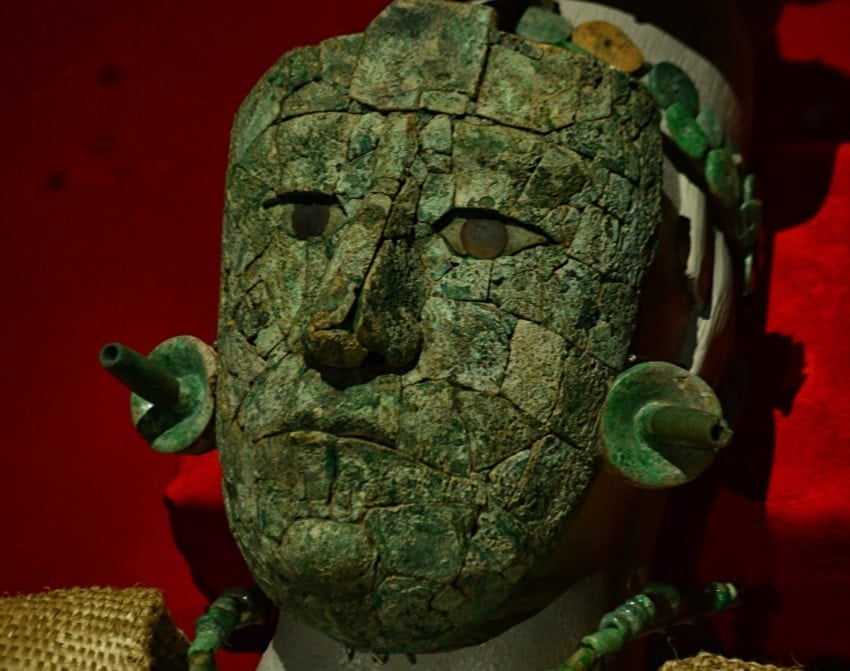
The Red Queen of Palenque is best known for her extraordinary funeral mask. (ProtoplasmaKid/Wikimedia Commons)
In 1994, 24-year-old archaeologist Fanny López was helping to stabilize Temple XIII of Palenque, one of the most important city-states of the Classic Maya period, located in modern-day Chiapas. Palenque had been famous for decades as the site where the fabulous tomb of Pakal the Great, lord of Palenque and the fifth-longest-reigning monarch in world history, had been found in 1952.
López discovered that Temple XIII held a tomb too, and as the Chiapas native and her team slid back the lid of its sarcophagus, their eyes met something incredible: the remains of a woman wearing an enormous malachite mask, surrounded by treasures and covered entirely in crimson cinnabar dust. Clearly, this woman had been important and had some relationship to Pakal, but there were no glyphs to tell for certain who she was. Was she the king’s mother? His grandmother? The answer has not yet been definitively proven, but most specialists now believe that the noblewoman, who has come to be called the Red Queen for how she was buried, was Ix Tz’akbu Ajaw, Pakal the Great’s wife.
Much is still unknown about the Red Queen’s life. Born around A.D. 610 into the royal family of Uhx Te’ K’uh, a Maya city in present-day Tabasco state, Lady Tz’akbu Ajaw married Kʼinich Janaabʼ Pakal as a teenager. Their two sons would both succeed their father and rule Palenque, showing the truth of Tz’akbu’s name, which means “Queen of Countless Generations.”
Pakal earned the sobriquet of “the Great” by leading Palenque out of a period of political turmoil and into its period of greatest wealth and splendor through an ambitious program of public works. Tz’akbu Ajaw’s name and titles feature prominently on the monuments of her husband’s time, suggesting an important role in Palenque’s public life.
Tecuichpo: Last empress of the Mexica
Tecuichpo Ixcaxochitzin was her original first name, which translates from ancient Náhuatl to “Divine Lady” and “Cotton Flower,” respectively. (ProtoplasmaKid/Wikimedia Commons)
When she died in 1551, Isabel Moctezuma was the richest woman in the colony of New Spain, holding extensive tracts of land and Indigenous slaves. This is not only remarkable because she was an Indigenous woman, but because she certainly died poorer than she was born: Isabel, also called Tecuichpo, was born Tecuichpoch-Ixcaxochitzin. Her parents were Moctezuma II, the Mexica king who ruled over most of Mexico and was overthrown by the Spanish, and Teotlalco, a princess of the city of Ecatepec.
Despite being a woman living in a world rocked by colonial invasion, Tecuichpo exercised what agency she had as an important noblewoman. First wed as a child to her father’s general, Atlixcatzin, Tecuichpo married Cuitlahuac and then Cuahtemoc, Moctezuma’s successors as leaders of the Triple Alliance, before being wed to a series of Spanish conquistadors.
In the Americas, Spanish colonialism was most effective wherever it came up against a settled, stratified society whose ruling class it could decapitate and replace, which meant that cooperative Indigenous nobles were key in setting up the new colonial order. After accepting Christian baptism and a new name, Doña Isabel was recognized as her father’s legitimate heir, a status she used to recover some of Moctezuma’s possessions through the Spanish courts. As royally certified nobility, Isabel’s descendants among Europe’s aristocracy, including the current dukes of Alba and Segorbe in Spain, continue her father’s line today.
Ñuñuu Dzico Yecu: Shield of Jaltepec
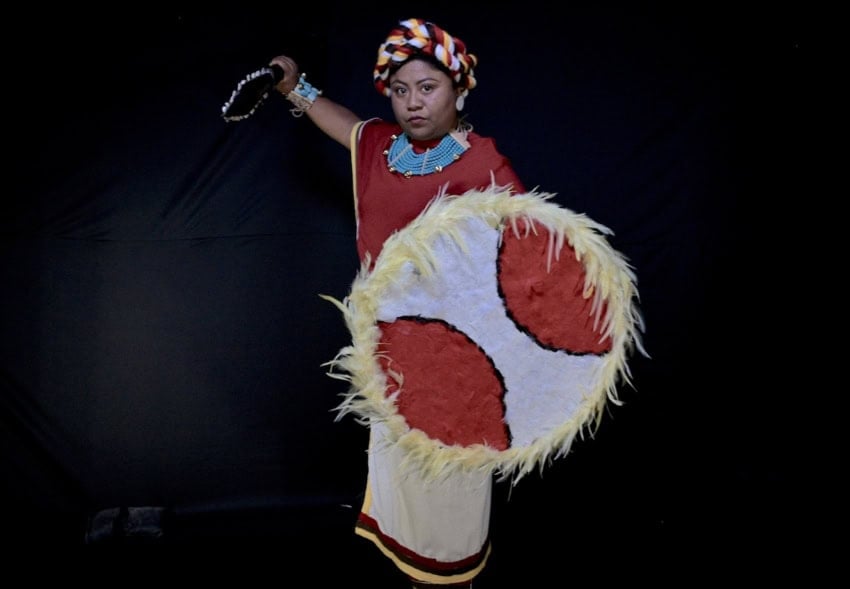
Known by many names, from Ñuñuu Dzico Yecu to Six Monkey and War Quechquemitl, she’s remembered as a Mexican heroine. (INAH)
The Ñuu Savi, better known as the Mixtecs, are one of Mexico’s largest Indigenous groups today. The Mixtec peoples never unified as a single empire; they were traditionally divided into competing kingdoms called ñuu. That competition was to mark the life of Lady Six Monkey, named for the day of her birth and born into the ruling family of the city of Jaltepec in the late 11th century. Her early years took place in the context of bloody struggle with Jaltepec’s rival kingdom of Tilantongo, and as a teenager, she became engaged to the ruler of the city of Huachino. When noble vassals of Huachino opposed the match and publicly insulted her, Six Monkey went on the offensive, leading troops against the rebels, capturing their cities and taking them back to Huachino for ritual execution. Her campaign — a striking example of the gender equality that could be found among Mixtec elites — was a total success, and Six Monkey took the name War Quechquemitl, for the garment she wore from then on, decorated with symbols of war.
The second part of Lady Six Monkey-War Quechquemitl’s life was shaped by her conflict with the man who would become one of the most powerful rulers in Mixtec history: Lord Eight Deer Jaguar Claw, king of Tututepec. A member of the ruling family of Tilantongo, Eight Deer had forged a huge sphere of influence in Oaxaca by the turn of the 12th century and had long nursed a grudge against Jaltepec and Huachino.
Seeking to stop Eight Deer’s rise, Six Monkey had his brother assassinated in 1100 and moved to crush her rival in open warfare. She lost, and Huachino was destroyed, while Six Monkey and her husband were captured and executed by Eight Deer. But the queen got some measure of revenge in the end: Six Monkey’s son Four Wind was taken by Eight Deer as a hostage, raised in his court and eventually installed as the puppet ruler of Jaltepec. Four Wind never forgot what Eight Deer had done to his mother: As a grown man, he led a rebellion against Eight Deer, executing the great lord and marrying his daughter so that the three cities were finally united as Six Monkey had dreamed of.
Xiuhtzaltzin: First queen of the Toltecs
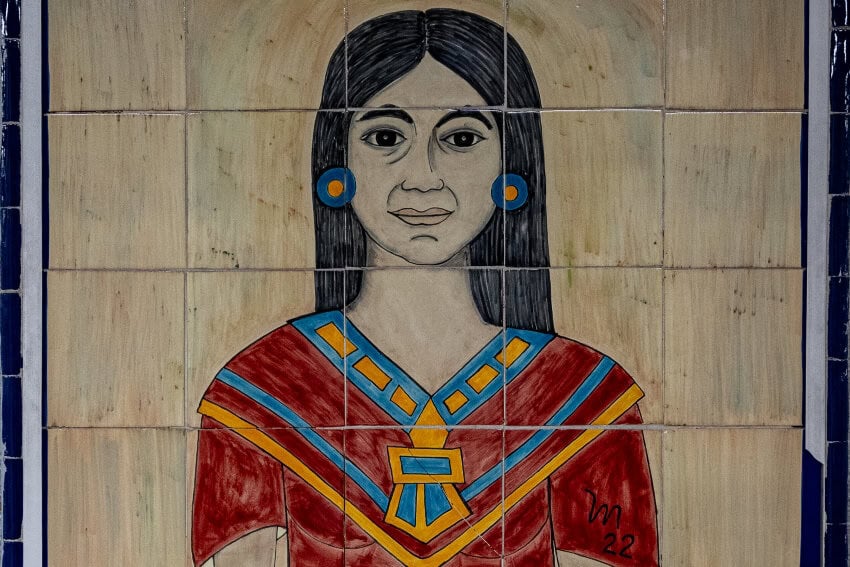
Xiuhtzaltzin, queen of the Toltecs, ruled alongside Mitl, her husband, the king. (Facebook)
The fall of the great city of Teotihuacán marked the beginning of Mesoamerica’s Postclassic period, and one of the cities that came to fill the space left behind was Tollan, in what is now Tula, Hidalgo. Tollan’s inhabitants, the Toltecs, left no written records, so much of the information we have on them comes through the oral histories of the Mexica — whose civilization rose centuries after Tollan’s fall and who may have called all great builder cultures Toltecs — as viewed through the lens of Spanish chroniclers. That means that taking narratives about the Toltecs at face value can be tricky, but the exceptional circumstances of the reign of Xiuhtzaltzin might point to her actually having existed.
Only men could succeed to the throne of Tollan, and Xiuhtzaltzin’s husband was Mitl, the 11th king of the city. When Mitl died, the throne should have passed to their son. But Xiuhtzaltzin was so beloved by the Toltecs, tradition says, that her son declared that he would rather be his mother’s vassal than her successor, and so Xiuhtzaltzin became the only woman ever to rule Tollan. If Xiuhtzaltzin’s face looks familiar to you, that’s not by coincidence: 2025 was declared the Year of the Indigenous Woman by the federal government, and the steely-eyed woman in a huipil and earrings who appeared on the government’s official letterhead for all of last year is a representation of Xiuhtzaltzin herself.
Eréndira: Warrior princess of the Purépechas
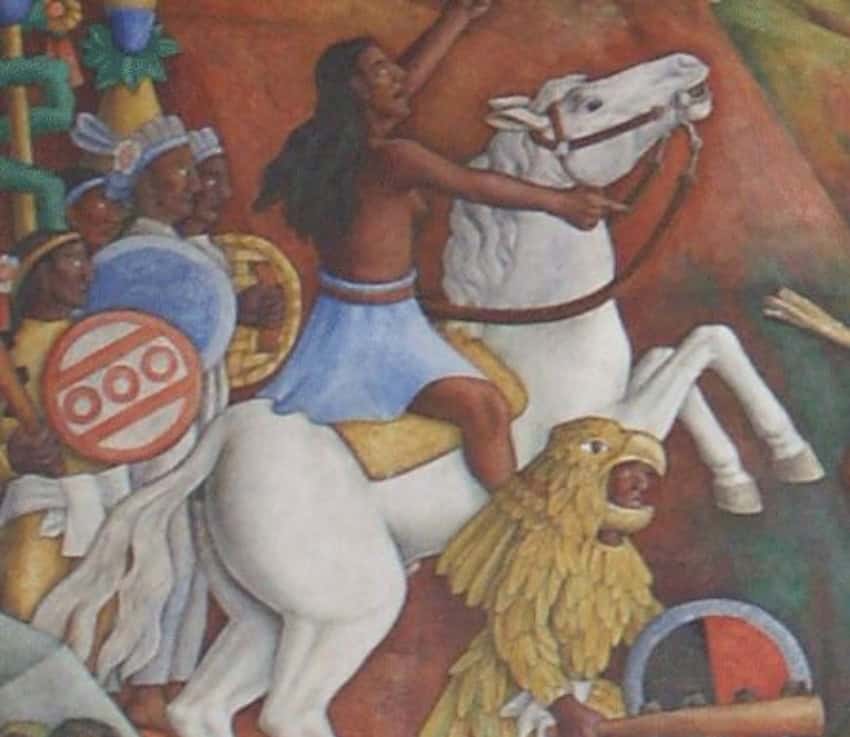
Eréndira, as represented in the famous mural by Juan O’Gorman. (Radhee/Wikimedia Commons)
When the Spanish arrived in Mexico in 1519, the Mexica were the great power in the country’s Central Highlands; second after them were the neighboring Purépecha, who ruled much of Western Mexico. The Purépecha polity had its seat in Tzintzuntzán, Michoacán, and its last king was Tangaxuan II. Not believing that he could resist the Spanish, Tangaxuan accepted baptism and chose to become a vassal of the invaders when they reached his domains in 1522. Though they looted his city anyway, the Spanish allowed him to continue ruling until 1530, when the infamous conquistador Nuño Beltrán de Guzmán tortured and burned him at the stake.
Legend tells that Tangaxuan’s daughter Eréndira, infuriated by her father’s weakness in the face of the Spanish, took it upon herself to lead the Purépecha resistance. Part of her story revolves around Eréndira becoming the first Indigenous person to learn to ride a horse, and the figure of the princess on a white horse leading Indigenous combatants against the Spanish invaders is a powerful symbol of the Purépechas and the state of Michoacán, depicted in artwork like Juan O’Gorman’s famous mural at the Gertrudis Bocanegra library in Pátzcuaro.
Was Eréndira real? It’s hard to say. Colonial-era records don’t mention her, although the “Relación de Michoacán,” set down around 1540 by Franciscan friars in the region, does mention women as part of the anti-Spanish resistance. She first appears in collections of Michoacán’s oral stories collected in the early 20th century, but what’s clear is that her story, a tale of the thirst for dignity triumphing over acquiescence, is a much older one.
A missing wallet became a lesson in Mexican values for Sarah DeVries. (Emil Kalibradov/Unsplash)
About 17 years ago, when I still lived in Querétaro, my sister came for a visit. I took some money out of my Mexican account and put it, along with my bank card, in a little card-sized wallet.
Before I realized it was truly missing a couple of days later — I was absolutely sure it was in the house somewhere — I got a call. A taxi driver had turned the card and wallet in at a Bancomer branch, and they were holding it for me.
The wallet and bank card were turned in at the nearest branch, but the cash was not. (Srkgoqpxtbtl/Blogspot)
“And the cash?” I said hopefully. I’d taken out a hefty sum of about 4,000 pesos to spend while my sister was visiting (this was back when the dollar was closer to 10 pesos than to 20).
The guy laughed.
“Oh no, of course there was no money in there,” he said. “I’m amazed even the card was returned — you should count yourself lucky!”
I went to get my card and tried not to be too sad about the lost money, which at the time represented almost a full quincena (two weeks of pay) for me. Since then, I’ve been much more attentive to my personal belongings.
Lost in a car wash
I recalled this incident last week when I went to get my driver’s license renewed where I live now in Xalapa — a very cold 3.5 hours of standing in line.
As I got closer to the bank clerk-style windows, I noticed that people were swiping their cards to pay the license fees. “Oh good!” I thought. For once, I wouldn’t have to take a sheet of paper, go to the X24 — a convenience store chain similar to OXXO — pay in cash and then return. Score!
A trip to the X24 store to pay for the license renewal wasn’t necessary, but money to pay was. (Facebook)
I felt in my purse for my wallet; I then looked down and did some digging. It was not there. Oh no.
I glanced at the friendly-seeming older guy I’d been chatting with in line behind me. Could he have taken it? A quick study of his non-bulging pockets reassured me he hadn’t — my wallet is pretty big, so at least it would have been noticeable.
The next step was to call my partner, who’d dropped me off and then taken the car for a car wash before taking it for verification — Mexico’s equivalent of getting your car’s annual emissions inspection.
This was followed by a fruitless search of car verification centers that actually had the requisite sticker for the car to verify said verification — he was all over the place.
“I don’t see it,” was his first response, and my heart plummeted.
“No, wait!” He looked in the back seat and found it sitting there, having gone through a solo car wash with various workers cleaning the car’s interior.
The car had been washed but the wallet was thankfully left untouched. (Facebook)
“Oh no. Check to see if the money’s still there,” I said.
Miraculously, it was — 2,000 pesos — as were all my bank and credit cards. I kept a close eye on my bank account for any unfamiliar transactions, of which there were none.
Thank you, thank you, honest car wash workers! Heads, I win. It could have been so much worse.
A one-in-a-million miracle
Little did I know that a couple weeks before, a friend had had an even more miraculous wallet rescue.
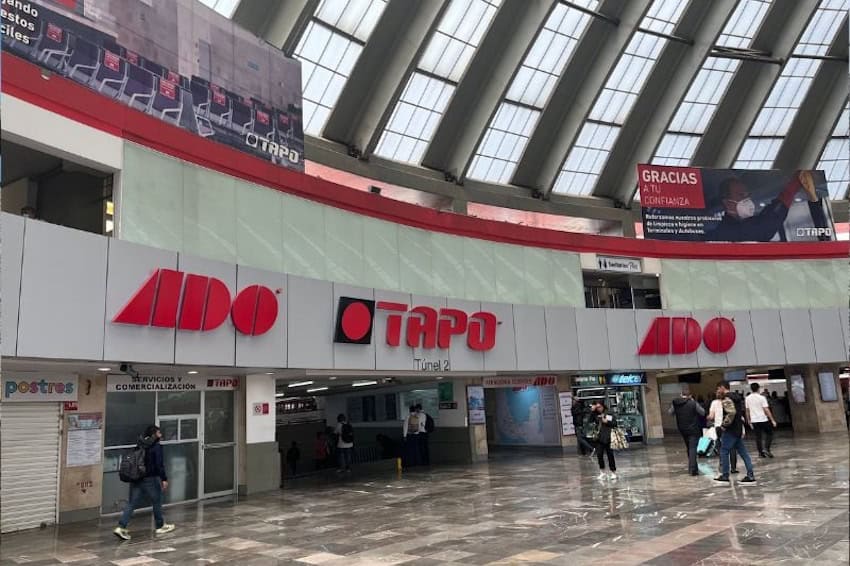
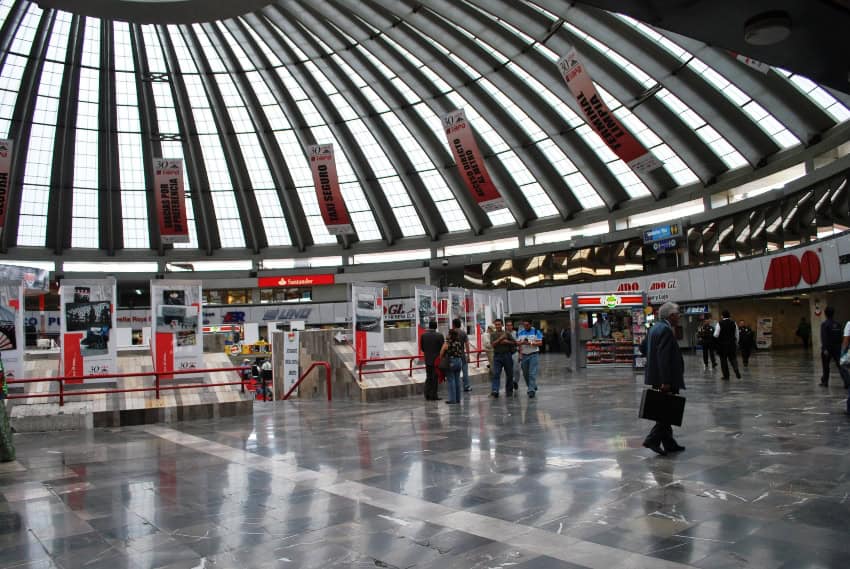
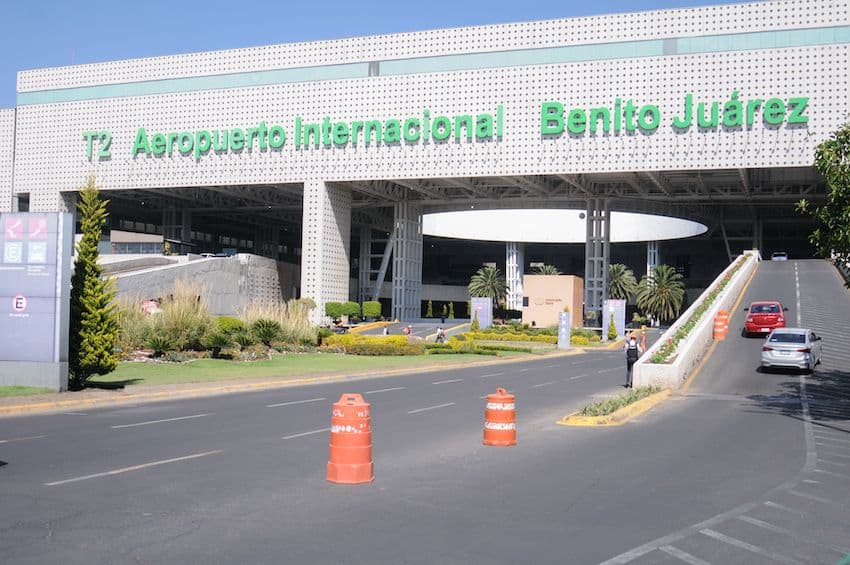
Hers was 100% higher stakes. She took a bus from Xalapa to TAPO, one of Mexico City’s main bus terminals, and a taxi from TAPO to the Mexico City airport — the one that has more than seven passengers a year.
Once at the airport, she had a terrible realization: Her wallet, where she carried her passport as well, was no longer with her. At first, she thought she’d dropped it somewhere in the airport. With her limited Spanish, she proceeded to find every security worker along the way to ask them if they’d seen it. This took a while.
Mexico City’s TAPO bus station was the site of another unlikely miracle. (Travel Mexico Solo)
Needless to say, she missed her flight.
Later, she figured she must have left it in the taxi. But how would she get back to TAPO with no money? Luckily, she remembered that she’d stashed about US $40 in her backpack, so she exchanged it for pesos and took the Metrobus back to TAPO. Most of those hearing about her plan were not optimistic.
“Your wallet is long gone,” someone told her. “You’ll never get it back.”
“It would be a miracle,” another said. “Literally a one-in-a-million miracle if you got it back.”
“I have to try,” she kept answering.
Back at TAPO, she approached the window where she’d bought her taxi ticket. She hadn’t looked at the driver’s name, but she remembered the car color: a kind of odd creamy beige.
Back to the TAPO terminal to try to track down a taxi driver, who miracle of miracles, was found and still had the wallet. (Thelmadatter/Wikimedia Commons)
The dispatcher wasn’t sure which driver it was, but she called around to all the different cabs, one by one, until someone was able to tell her which driver it probably was. Success!
And guess what — one-in-a-million. The driver had the wallet! Another car — my friend never really figured out why — returned her wallet to her. And inside was everything: cash, cards, passport, IDs.
Wow, wow, wow!
During all this, she’d gotten on the phone with the airline to explain the situation.
“You’ll have to pay the difference for a flight tomorrow,” they’d told her. She was looking at a painful US $700 credit card charge.
But guess what: She got to the ticket counter in Mexico City, explained what had happened, and the agent simply printed her another ticket, no charge.
She made her flight after all, thanks to an honest taxi driver in Mexico City. (Daniel Augusto/Cuartoscuro)
A more honest Mexico?
I tell these two anecdotes here because they’re just so freaking heartwarming. Mexico is famous for many positive things, but let’s be honest: Honesty — see what I did there? — is not one of them. For my friend and me, the honesty and integrity of two ordinary working people saved our butts.
Whether people in general are becoming more honest or the stars simply happened to align for us, I do not know.
But boy am I glad we both got to have one less gigantic problem to deal with.
After an update on security in Baja California, President Sheinbaum went into detail about Mexico's response to a new threat from U.S. President Trump against countries — like Mexico— that supply oil to Cuba. (Gabriel Monroy / Presidencia)
President Claudia Sheinbaum held her Friday morning press conference in Tijuana, the largest city in the state of Baja California.
“Today we’re going to finally inaugurate the first stage of the viaduct,” she said at the start of the mañanera.
Homicides declined significantly in Baja California in 2025
Early in the press conference, National Public Security System chief Marcela Figueroa reported that the average daily homicide rate in Baja California declined from 6.5 in 2024 to 4.7 last year, a reduction of 28%.
The daily homicide rate in Baja California in 2025 was the lowest of the past eight years, she said.
The National Public Security System director, Marcela Figueroa, said homicides in Baja California declined 28% last year. (Gabriel Monroy / Presidencia)
San Felipe, located on the Gulf of California, ranked as Mexico’s fourth most violent municipality in 2025 based on its per capita homicide rate, according to crime data website elcri.men.
Tecate ranked as the 43rd most violent municipality in the country, while Tijuana ranked 45th, according to elcri.men.
Tijuana recorded more than 1,000 homicides last year, making it Mexico’s most violent city in terms of total murders.
More than 5,000 people arrested in Baja California since Sheinbaum took office
Between Oct. 1, 2024 — the day Sheinbaum was sworn in — and Jan. 15, a total of 5,509 people were arrested in Baja California for allegedly committing “high-impact” crimes, such as murders and kidnappings, Security Minister Omar García Harfuch reported.
He said that in the same period, authorities seized 1,253 firearms in the state, and confiscated more than 30 tonnes of narcotics, including 242 kilograms of fentanyl.
García Harfuch also said that authorities have dismantled three methamphetamine labs in Baja California during the past 15 months. Since the national strategy against extortion was launched last July, 70 people have been arrested in the state for allegedly committing that crime, he said.
Later in the press conference, García Harfuch said that “a cell of Los Chapitos” — a faction of the Sinaloa Cartel controlled by sons of imprisoned drug lord Joaquín “El Chapo” Guzmán — was to blame for an attack on two Sinaloa state deputies in Culiacán on Wednesday.
Sheinbaum responds to US plan to impose tariffs on countries that supply oil to Cuba
The question came a day after Trump issued an executive order declaring a “national emergency” because, the U.S. president claimed, “the policies, practices, and actions of the Government of Cuba constitute an unusual and extraordinary threat … to the national security and foreign policy of the United States.”
The executive order asserted that “Cuba welcomes transnational terrorist groups, such as Hezbollah and Hamas, creating a safe environment for these malign groups so that these transnational terrorist groups can build economic, cultural, and security ties throughout the region and attempt to destabilize the Western Hemisphere, including the United States.”
In his executive order, Trump also said that he had determined that it was “necessary and appropriate to establish a tariff system,” under which “an additional ad valorem duty may be imposed on imports of goods that are products of a foreign country that directly or indirectly sells or otherwise provides any oil to Cuba.”
The executive order, the Associated Press reported, “would primarily put pressure on Mexico, a government that has acted as an oil lifeline for Cuba and has constantly voiced solidarity for the U.S. adversary even as Mexican President Claudia Sheinbaum has sought to build a strong relationship with Trump.”
Mexico is the top oil supplier to Cuba, but state oil company Pemex canceled plans to send a shipment of crude to the Communist-run island this month. That move, Sheinbaum said earlier this week, was a “sovereign decision” rather than an act of succumbing to pressure from the United States, which is pressing for regime change in Cuba.
On Friday morning, Sheinbaum thanked the reporter for his question about Trump’s executive order before proceeding to read out a prepared statement.
“Number 1: Mexico unequivocally reaffirms [its commitment to] the principle of sovereignty and free self-determination of peoples, a fundamental pillar of our foreign policy and of international law,” she stated.
“[Number] 2: The application of tariffs on countries that supply oil to Cuba could trigger a humanitarian crisis of great reach, directly affecting hospitals, food supply and other basic services for the Cuban people. [That is a] situation that must be avoided through respect for international law and dialogue between the parties,” said Sheinbaum, who has said that Mexico could mediate talks between the U.S. and Cuban governments.
“[Number] 3: I have instructed the minister of foreign affairs to immediately establish contact with the U.S. Department of State in order to precisely know the reach of the order that was published [by Trump] yesterday, and also to let them know that we have to prevent a humanitarian crisis for the Cuban people,” the president continued.
“And [number] 4: Mexico will seek different options … to help, in a humanitarian way, the people of Cuba, who are going through a difficult time.”
Mexico’s President Claudia Sheinbaum is warning that Trump’s threat to impose additional tariffs on countries sending oil to Cuba could trigger a humanitarian crisis. She also said Mexico will continue to offer Cuba humanitarian support. pic.twitter.com/gbzxc6QKGq
Sheinbaum stressed that her government needs to find out “the reach” of Trump’s executive order because, “we don’t want to put our country at risk in terms of tariffs.”
She also emphasized that “there are other ways to support” the people of Cuba apart from with oil.
“Mexico will always show solidarity [with Cuba],” she added.
Sheinbaum suggests US could send oil to Cuba
Later in her press conference, Sheinbaum was asked whether Mexico would stop sending oil to Cuba if it meant that the U.S. would impose additional tariffs on Mexican goods.
“We’re going to wait,” the president responded, stressing once again that her government needs greater clarity about the Trump administration’s plans.
She subsequently told reporters that Mexico has only sent a minimal amount of oil to Cuba, although the exact quantities shipped to the Communist-run island in recent times are disputed.
Mexico, via its state oil company Pemex, became the lead supplier of oil to Cuba after oil exports from Venezuela — the island’s previous top supplier — dropped in 2025. (Presidencia/Cuartoscuro)
“Yesterday, the director of Pemex … [said that] what has been sent … is less than 1% of what Mexico produces,” Sheinbaum said, referring to shipments corresponding to contracts between the state oil company and Cuba as well as oil given to the Caribbean island as humanitarian aid.
She went on to say that in Mexico, in Cuba, and in “other places around the world,” refined oil is used to fuel cars, public transport and power plants.
“Let’s imagine there is no electricity. Without electricity, hospitals don’t work, refrigerators don’t work, and a humanitarian situation is created, … a situation that impacts people’s lives,” Sheinbaum said.
“Our interest is that this doesn’t happen with the Cuban people. And I believe it’s not just our interest, the interest of the government, but the interest of all the people of Mexico,” she said.
“And that’s what we want to express to the U.S. government — that it’s very important that there isn’t a situation of humanitarian crisis on the island,” Sheinbaum said.
“So I gave instructions to the Minister of Foreign Affairs [Juan Ramón de la Fuente] to speak about this with the U.S. government, or [to propose] that they send oil [to Cuba]. It’s a matter of support for the Cuban people,” she said.
“Of course, we don’t want to risk there being more tariffs on Mexico, do we? Rather, via diplomatic channels, we simply seek a scheme of dialogue, of communication, that ensures there is not a serious situation for the Cuban people, who are already going through a very difficult situation,” Sheinbaum said.
Trump issued his executive order, titled “Addressing Threats to the United States by the Government of Cuba,” the same day as he spoke to Sheinbaum by telephone.
Sheinbaum reiterated on Friday that she and Trump didn’t discuss Cuba during their 40-minute call.
“We spoke about the Mexico-United States relationship. The issue of Cuba wasn’t discussed,” she said.
By Mexico News Daily chief staff writer Peter Davies (peter.davies@mexiconewsdaily.com)
The four new access points, in addition to the seven recently added, will be in Jaguar Park. (Elizabeth Ruiz/Cuartoscuro.com)
The Tourism Ministry has confirmed that there will soon be four new public beach access points in Tulum as part of its plan to reactivate tourism in the popular resort destination in the state of Quintana Roo.
Tourism Minister Josefina Rodríguez has been on record declaring that the opening of beaches is a priority of the government’s comprehensive strategy for the Mexican Caribbean.
Tourism Minister Josefina Rodríguez has long supported increased beach access for the public living in or visiting Tulum, Quintana Roo. (Alain Hernández/Cuartoscuro.com)
“Beaches are not a privilege, they are a right,” Rodríguez said, emphasizing the goal of diversifying what’s on offer to tourists and reducing the effects of seasonality.
Rodríguez told reporters that a key element of the Tulum Reborn tourism development plan is to guarantee the right to freely enjoy the beaches. The plan was launched in November in response to a decline in tourism which, some critics said, was partly due to restricted access to beaches.
“Tulum currently has seven new public access points, and four more will be added next week,” she said, adding that the new access points are located within Jaguar Park, “a space with top-tier infrastructure that combines conservation, recreation and tourism.”
All the access points feature appropriate signage as well as spaces such as the sports corridor, which allows tourists and residents to enjoy recreational activities in proximity to the sea free of charge.
Rodríguez also said “a permanent dialogue is being maintained with hotel owners” to ensure public access in Tulum’s Hotel Zone. “This is in accordance with federal decrees that establish the right of way when there is not enough public access,” she said.
Additionally, an inter-institutional assessment in conjunction with the Agrarian, Territorial and Urban Development Ministry and the Environment Ministry has been ongoing for more than three months and includes adjustments to federal regulations, as well as land-use planning in coordination with the municipal and Quintana Roo governments.
Similar forums are taking place in Baja California and in destinations such as Acapulco.
Sectur is also conducting a nationwide assessment to identify and establish new public access points to the country’s beaches and is developing a National Registry of these access points.
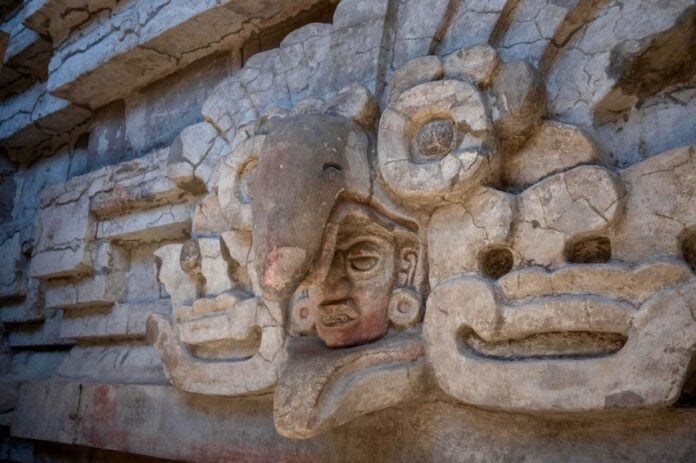
The remarkably preserved tomb lies in in the municipality of San Pablo Huitzo in Oaxaca state’s Central Valleys region, former territory of the Zapotec nation. (Secretaría de Cultura/Cuartoscuro)
A 1,400-year-old Zapotec tomb carved into a hillside in the state of Oaxaca is being hailed as Mexico’s “most significant archaeological discovery of the last decade.”
President Claudia Sheinbaum said as much last week when she announced the find at a press conference. A delegation led by Mexico’s Minister of Culture Claudia Curiel de Icaza made a subsequent on-site visit this week.
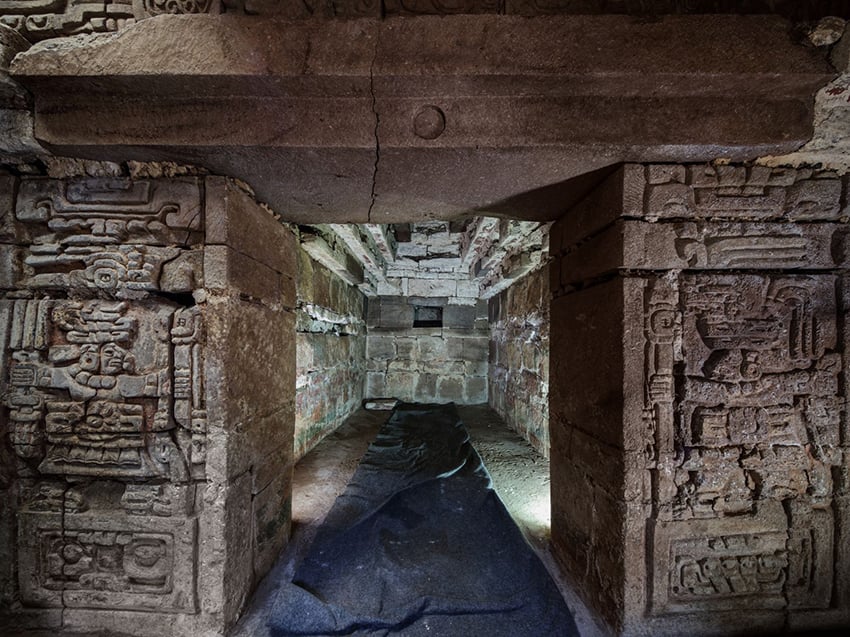
The unusually well-preserved tomb is expected to give new insight into the worldview of Zapotec people who lived over a millennium ago. (Gerardo Peña/INAH)
“Stabilization work is underway to open it to the public at the end of the year,” Curiel said. “It is one of the most important findings of Zapotec culture … due to its state of preservation and the information it will provide us about the cosmogony of these peoples.”
“This site is something wonderful,” added Oaxaca Governor Salomón Jara Cruz, who was part of the contingent that was able to go into the tomb. “Finding such beautiful [and ancient] remains is something unique.”
The tomb — dated to about 600 AD and known as Tomb 10 of Huitzo — lies in the newly registered Cerro de la Cantera archaeological site, in the municipality of San Pablo Huitzo.
It is in the state’s Central Valleys region, former territory of the Zapotec nation, about 35 kilometers northwest of Oaxaca city.
Tomb 10 was discovered last year (no exact date was given) after an anonymous report of looting, which led the National Institute of Anthropology and History (INAH) to start rescue excavations that uncovered the chamber.
According to INAH, the funerary complex belongs to the Late Classic period (600 AD to 900 AD), a time in Mesoamerican history when major city-states flourished and then began to decline.
INAH specialists say the crypt, reached by a shaft, is a stepped-vault chamber made with limestone slabs and gray quarry stone, covered with stucco and measuring about 5.55 meters in length.
One of its most striking features is an owl sculpture over the entrance. In Zapotec cosmology, owls symbolize night and death; its beak covers the stuccoed and painted face of a Zapotec lord, likely an ancestor for whom the tomb was dedicated and who served as an intercessor with the gods.
A lintel above holds a frieze of stone slabs engraved with calendrical names, while the jambs show a man and a woman — who “may have served as guardians of the site” — with headdresses and artifacts in both hands.
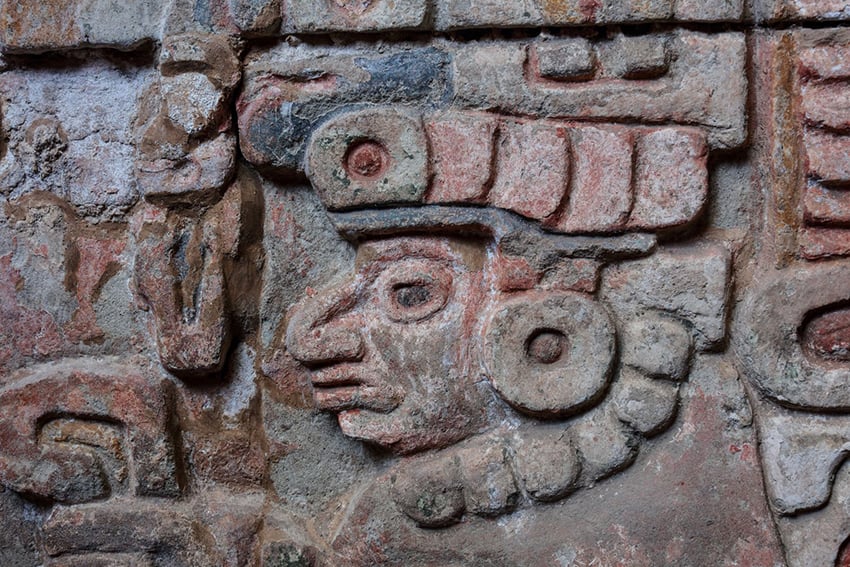
Hints of color are still visible on the murals and carvings inside the tomb, one of which shows figures carrying bags of copal incense. (Gerardo Peña/INAH)
Inside, sections of mural painting in ocher, white, green, red and blue depict “a procession of figures carrying bags of copal incense and walking toward the entrance.”
Tomb 10 appears linked to the ancient kingdom of Huijazoo, whose capital stood on a nearby hill, Cerro de la Campana. Tomb 5, which was discovered in 1985, is well-documented in scholarly works and the media.
Given the proximity between Tomb 5 and Tomb 10, INAH considers the area to have been an acropolis contemporary to Monte Albán, the great Zapotec capital of its time.
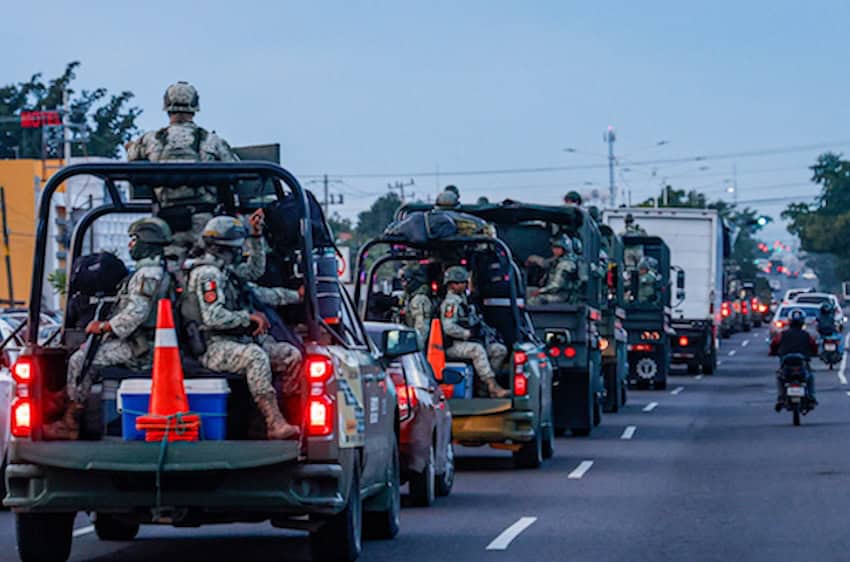
Security forces have arrived en masse in Culiacán and Mazatlán in Sinaloa state in response to an armed attack on two state legislators that left both gravely injured.
(José Betanzos Zárate/Cuartoscuro.com)
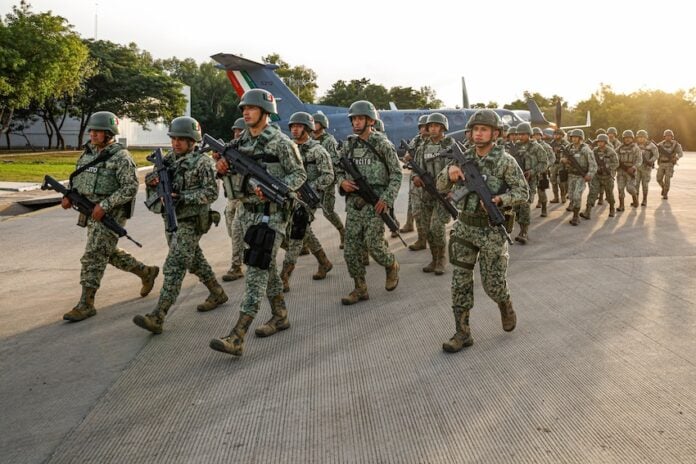
After an armed attack on two state legislators, the Defense Ministry (Sedena) has deployed 1,600 soldiers to the troubled state of Sinaloa which has been struggling to cope with a civil war between rival factions of one of Mexico’s most powerful drug cartels.
A car in which Representatives Sergio Torres Félix and Elizabeth Montoya were riding was attacked by gunmen around noon Wednesday by unknown assailants who fled the scene before authorities arrived.
The newly deployed troops have established their presence in the state capital, while Representatives Sergio Torres Félix and Elizabeth Montoya remain hospitalized from the attack. (José Betanzos Zárate/Cuartoscuro)
During her Thursday morning press conference, President Claudia Sheinbaum said arrests had been made in connection with the attack. Then on Friday, Security Minister Omar García Harfuch said early investigations indicate that a sub-faction of Los Chapitos — part of the Sinaloa Cartel — are likely responsible for the attack.
Sheinbaum also said she intends to go ahead with a working visit to Sinaloa in early February as planned.
The internecine fighting involving the Sinaloa Cartel began in September 2024, the month before Sheinbaum took office. Ending the persistent violence there has been one of the top priorities of her security strategy, but the results have been far from encouraging.
Among the Sedena personnel on the ground in Sinaloa are 90 members of the Army’s Special Forces Corps. The security forces arrived on Thursday via four heavy Air Force transport aircraft and were deployed to the state capital Culiacán and the coastal city of Mazatlán.
The deployment of additional soldiers comes less than a week after hundreds demonstrated in Culiacán to protest the killing of a civilian during a botched military operation. A 24-year-old man was shot while driving in the state capital, apparently in a case of mistaken identity.
The status of the two Citizens Movement lawmakers remains critical but stable.
Due to the severity of his condition, Torres has been in intensive care, where he is sedated and intubated. Following lengthy surgical procedures, Torres is said to be doing well although the next 72 hours will be crucial.
Montoya lost an eye in the attack after being injured by shrapnel and projectiles. She underwent facial reconstruction surgery and is said to be recovering well.
After visiting the two lawmakers, Sinaloa Governor Rubén Rocha said Torres’ vital signs are responding well to the trauma after being shot in the head and in the torso. As for Montoya, Rocha said she was conscious and is able to hold a conversation.
Members of the Army, the National Guard and state police officers are deployed around the private clinic where Montoya is hospitalized, and another contingent is on patrol at a focused-care hospital where Torres was transferred to recover from the head injury.
The security forces are also expected to participate in an ongoing search-and-rescue operation looking for 10 mining engineers kidnapped at a site near Concordia, about 83 kilometers (51 miles) northeast of Mazatlán.
Thanks to a partnership with the Germany company Flix, Maya Train tickets will soon be on sale in Europe. (Maya Train)
Tickets for the Maya Train will go on sale in Europe starting Feb. 1, thanks to a collaboration with the German transport company Flix
Flix, a German mobility and technology company that operates mainly under the FlixBus and FlixTrain brands, will distribute Maya Train tickets on its website, app and physical stores across Europe.
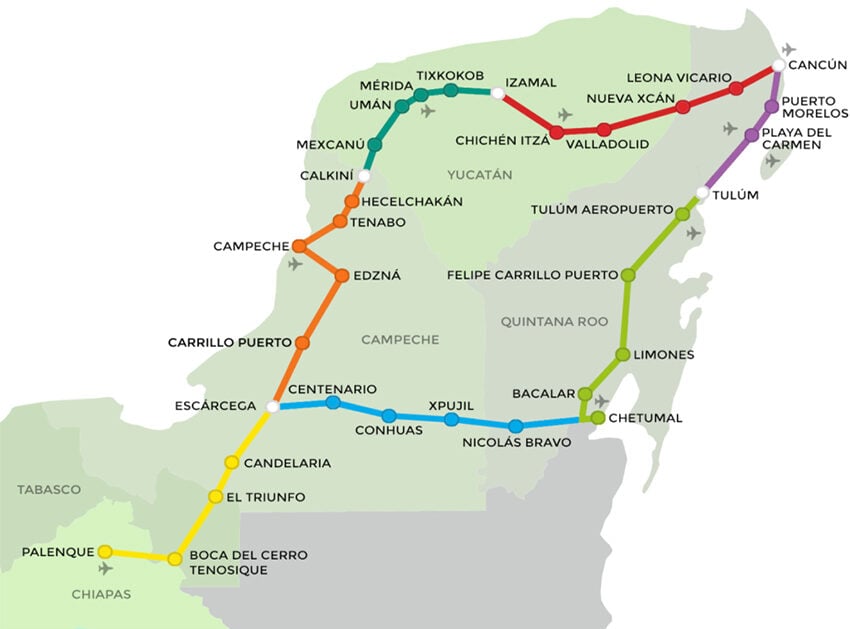
The Maya Train, which was completed in 2024, runs a 1,554-kilometer loop around the Yucatán Peninsula, connecting the region’s archaeological sites, beaches and cities like Mérida and Cancún. (Ruta Tren Maya)
Until now, the Maya Train only sold tickets in Mexico. With this alliance, it will open its international sales in the European market for the first time.
The Mexican passenger train will now be integrated into Flix’s catalog, which operates in more than 40 countries and connects hundreds of destinations, making it easy to include the Maya Train in international itineraries.
Tourism Minister Josefina Rodríguez Zamora said that the tickets’ availability in Europe will allow foreign travelers to plan their trips further in advance, while helping advertise the train across the pond. She remarked that the addition of the Maya Train to Flix’s network “strengthens the country’s tourism competitiveness by integrating digital tools that simplify the travel experience and bring the destinations of the Maya World closer to a greater number of international visitors.”
With this collaboration, Mexico seeks to reduce logistical barriers by allowing European travelers to plan, book and pay for their rail journeys before arriving in Mexico, just as they would with a bus or train within Europe.
Meanwhile, head of the Maya Train Óscar David Lozano pointed out that the alliance also seeks to redistribute the tourist flow towards local communities to strengthen community tourism.
According to official data by the Tourism Ministry (Sectur), the Maya Train offers 20 daily commercial runs and has transported 2.15 million passengers since it began operations in December 2023. During the recent winter holiday period, it recorded a peak of 9,844 passengers in a single day.
The Maya Train, one of the signature projects of former President Andrés Manuel López Obrador (2018-2024), runs for 1,554 kilometers (966 miles) across five states in southern Mexico: Chiapas, Tabasco, Campeche, Yucatán and Quintana Roo.
Mexico's exports exceeded US $664.8 billion, a 7.6% increase compared to 2024. Despite the Trump tariffs, more than 83% of the exports went to the U.S. market.
(Adolfo Vladimir /Cuartoscuro)
Mexico’s economy avoided a recession in 2025 as gross domestic product (GDP) rebounded in the final quarter thanks to growth in trade and stronger performances in the industrial and manufacturing sector.
During the year, shipments of goods abroad exceeded US $664.8 billion, a 7.6% increase compared to 2024. Despite the multitude of tariffs imposed by Trump, more than 83% of these exports went to the U.S. market.
Analysts cited by the newspaper El País agree that the performance of exports and the private sector’s residential construction were the driving forces behind Mexico’s economic growth in 2025, despite a collapse in public investment “due to the significant spending cuts implemented by the Sheinbaum administration to reduce the fiscal deficit.”
Bloomberg News reported that the growth can also be attributed to the strong performance of the agricultural sector, which rose 0.6% in the fourth quarter compared to the same period of the previous year. Industry and manufacturing grew just 0.3%, while the services sector accelerated to 2% year-on-year.
Defying the Trump tariffs
In a year marked by U.S. trade aggression, the record-breaking performance of exports prevented Mexico’s GDP from dipping into recession. Even so, the preliminary data represents the slowest growth since 2020 when COVID-19 seriously disrupted economies across the globe.
Last year’s GDP growth was lower than in 2024, when the Mexican economy registered a 1.2% increase. It also marked a fourth consecutive decline since a 5% rebound in 2021 as the economy recovered from the pandemic.
Paradoxically, even though U.S. tariffs further clouded the outlook for Mexico as soon as U.S. President Donald Trump took office in January 2025, Latin America’s No. 2 economy enjoyed strong exports.
Mexico’s economic growth accelerated in the fourth quarter of 2025. From October to December, the Mexican economy grew by 0.8% compared to the previous quarter. And compared to the same quarter of 2024, the Mexican economy grew by 1.4%.
What went right and what went wrong
Alfredo Coutiño, director for Latin America at Moody’s Analytics, said that in addition to the strong exports, cash transfers from the Sheinbaum administration and the increase in the minimum wage helped keep the Mexican economy afloat.
“Furthermore, the easing of U.S. tariffs and [Mexico’s] efforts to comply with [US-Mexico-Canada trade agreement] rules reduced the impact of tariffs and protected the trade balance, preventing the economy from falling into negative territory,” he said, adding, however, that Mexico’s overall economic performance was “mediocre” in 2025.
Gabriela Siller, director of analysis at Banco Base, told El País that the rise in informality has also pushed Mexico into an economic stagnation trap exacerbated by a decline in fixed investment, the drop in productivity and the weakening of its institutions.
Coutiño also described a “chronic anemia” in productive investment in Mexico, as well as a climate of uncertainty surrounding constitutional reforms, which discouraged private investment.
Marco Oviedo, Latin America strategist for XP Investments, concurred, saying the controversial judicial reform remains an issue of concern.
“Investment stalled after the reform was announced, and this is evident both in the number of employers, which has been declining, and in the informal sector, which continues to grow,” he said.
The outlook for 2026 seems more promising, however.
Oviedo says the first six months of 2026 could see manufacturing and construction as driving forces, reflected in both investment and private consumption in anticipation of the FIFA World Cup for which Mexico will serve as co-host.