Home Blog Page 163

MND Local: Puerto Vallarta September news roundup

0
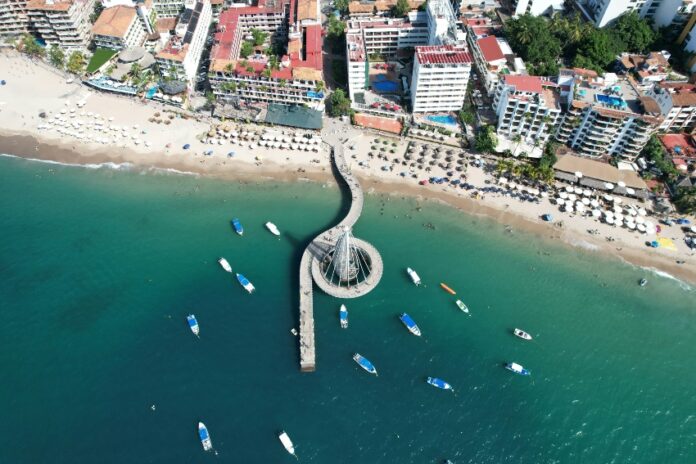
Puerto Vallarta beachfront
Several major projects are currently underway in Puerto Vallarta, as the city continues to refine tourist infrastructure offerings. (Unsplash/Emmanuel Appiah)

Puerto Vallarta and Nayarit are currently advancing several major projects, including airport and highway construction, water system improvements and tourism-related initiatives. Officials say the developments are intended to expand infrastructure, address service demands and respond to changes in the region’s economy and visitor profile.

Puerto Vallarta airport expansion reaches 54% completion

Construction of the new terminal at Puerto Vallarta International Airport has reached 54% completion, according to operator Grupo Aeroportuario del Pacifico (GAP). The 9.2 billion peso project is scheduled to begin phased operations in late 2026, with full use expected in 2027.
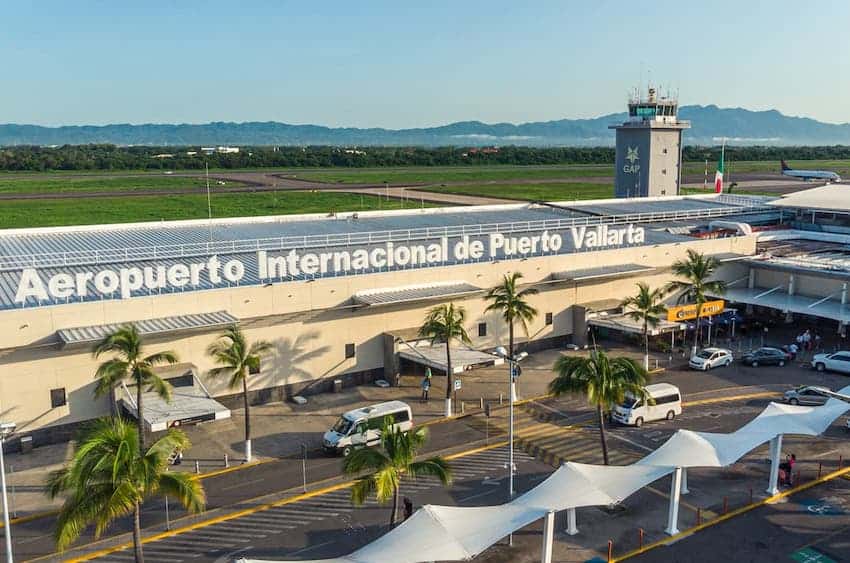
Puerto Vallarta International Airport
The expansion project at the Puerto Vallarta International Airport is now 54% complete (X, formerly Twitter)

The terminal will add 74,000 square meters of space, expanding the airport’s total surface area to 119,114 square meters. Once complete, it is expected to double passenger capacity, accommodating 6 million additional travelers per year. The design includes eight new jet-bridge gates and up to seven remote positions, bringing the total to 19 contact and 13 remote gates for domestic and international flights.

The project incorporates sustainability features aimed at LEED Gold certification, including rainwater harvesting, solar panels and solar-control glass facades. GAP describes it as part of a wider program to expand capacity across several airports, with major investments also underway in Morelia and Aguascalientes.

Puerto Vallarta handled 6.8 million passengers in 2024, a record high, and 4.3 million between January and July 2025. The airport serves 18 airlines and 52 routes in peak season, with new services scheduled from Porter Airlines in late 2025 and Southwest in early 2026.

Puerto Vallarta marks 3,355 free pet sterilizations

Puerto Vallarta has surpassed 3,300 free sterilizations of dogs and cats, reaching 3,355 procedures during the first week of September, according to Bienestar Animal Puerto Vallarta. 

The program, led by department head Roberto Ornelas, provides free sterilization services across the municipality to help control overpopulation, prevent disease and reduce pet abandonment. Officials highlight that each procedure supports animal health, as well as eases the financial burden on families who may otherwise struggle to afford veterinary care.

The city hosted its first Animal Welfare Fair, where volunteers carried out 229 sterilizations over three days. The event took place at multiple sites, including Linear Park, the Ixtapa Dome, La Lija Sports Center and the Agustin Flores Contreras Stadium. Alongside the surgeries, residents participated in education activities on pet care and responsible ownership.

Cat and dog laying side by side
So far this September, volunteers have sterilized over 3,000 animals for free in Puerto Vallarta. (Unsplash/Andrew S)

They hold the free campaigns every Thursday at rotating locations. Residents can find details about upcoming venues, fasting requirements and hygiene guidelines on the Animal Welfare Department’s social media channels.

Puerto Vallarta business groups present joint tourism initiatives

Puerto Vallarta’s main business groups have presented a series of proposals aimed at strengthening the city’s tourism sector, citing concerns over declining hotel occupancy, lower visitor spending and a shifting tourist profile. The initiatives were outlined at a press conference on September 17 by Carlos López Aranda, president of Canaco; Francisco Gabriel Vizcaíno, president of Coparmex; and Jorge Luis Carbajal, vice president of Canirac.

The leaders emphasized that the project reflects collaboration between business groups, academia, civil society and government, to revitalize Puerto Vallarta’s Malecón, the Cuale River and the Cerro neighborhood. They noted that the area has faced challenges from limited infrastructure, insufficient promotion and reliance on peak tourist seasons.

The organizers have structured the proposals around four main pillars: upgrading infrastructure and mobility, implementing training and marketing programs for local businesses, coordinating among key visitor entry points such as the port, bus station, and airport, and promoting sustainable tourism practices. Additional efforts will focus on showcasing Puerto Vallarta’s culinary scene through tours, festivals and training in sustainable restaurant practices.

Final phase of Tepic-Compostela highway underway

The Ministry of Infrastructure, Communications and Transportation (SICT) reports that construction is advancing on the Tepic-Compostela highway, with completion targeted for October 31, 2025. The current work focuses on the final tunnel in the municipality of Tepic, marking one of the last major steps before delivery.

The 26-kilometer section will feature a 2.4-kilometer branch to Tepic Airport, a toll plaza, 10 bridges, two railroad crossings, 19 intersections and a loop junction. It will also link to the Las Varas-Puerto Vallarta highway, reducing travel time between Tepic and Puerto Vallarta International Airport from three and a half hours to approximately one hour and 15 minutes. 
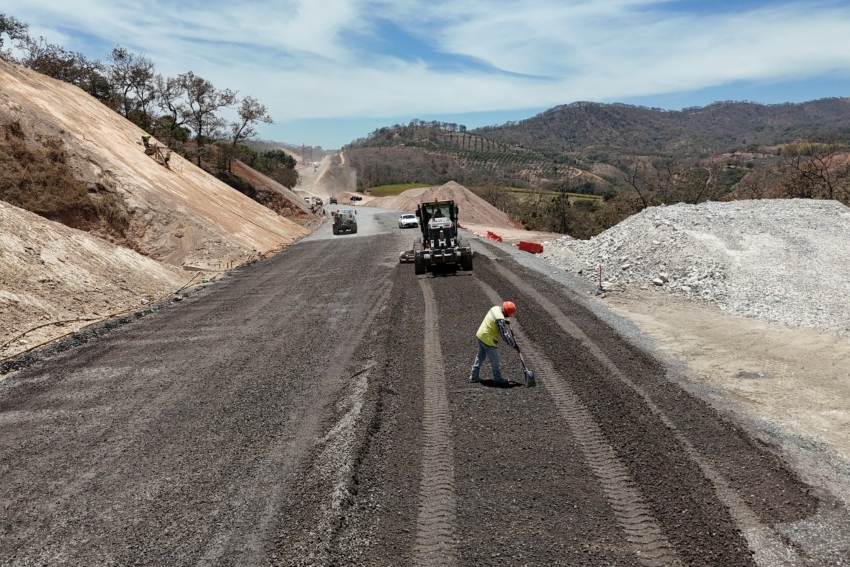
Tepic-Compostela Highway project
Work on the Tepic-Compostela Highway (pictured here) will include a link to the Las Varas-Puerto Vallarta Highway. (Gobierno de Mexico)

They plan to open the road to the public on November 1. 

A new branch of the highway, from Las Varas to San Blas, is in the study phase as well. Construction teams expect to begin work in 2026.

Meagan Drillinger is a New York native who has spent the past 15 years traveling around and writing about Mexico. While she’s on the road for assignments most of the time, Puerto Vallarta is her home base. Follow her travels on Instagram at @drillinjourneys or through her blog at drillinjourneys.com.
Murder of Colombian artists won’t affect bilateral relationship, Sheinbaum says: Tuesday’s mañanera recapped

5
Sheinbaum mañanera 23 September 2025
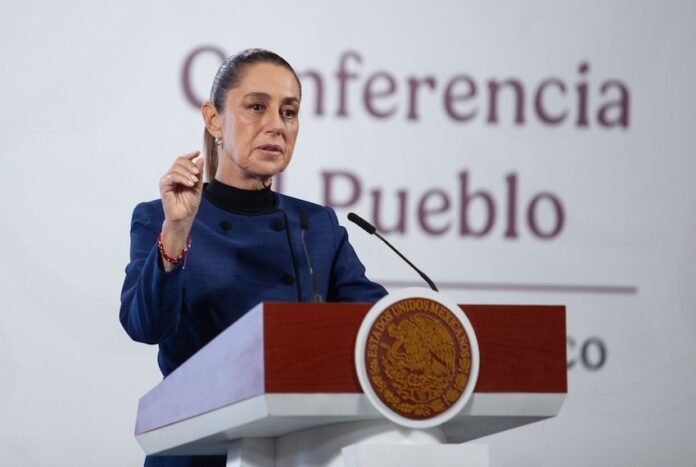
The president spoke about two separate murder cases on Tuesday, one in which two Colombian nationals were killed and another in which a young student was stabbed to death. (Andrea Murcia/Cuartoscuro)

Violence in the Mexico City metropolitan area reared its head at President Claudia Sheinbaum’s Tuesday mañanera.

The president spoke about two separate murder cases, one in which two Colombian nationals were killed and another in which a young student was stabbed to death.

Sheinbaum: Murder of Colombians ‘an unfortunate episode,’ but it won’t affect Mexico-Colombia relationship

Sheinbaum noted that the bodies of two Colombian artists — a singer known as B King and a DJ who performed under the name Regio Clown — were found “some time after” the Mexico City Attorney General’s Office began a search for the two men and issued “all the alerts” to assist in their location.

The bodies of Bayron Sánchez (B King) and Jorge Luis Herrera (Regio Clown) were found in a México state municipality southeast of central Mexico City last Wednesday, a day after they went missing in Mexico City, but they weren’t officially identified until Monday.

Reports from Mexican news outlets have linked the performers’ deaths with La Familia Michoacana, one of six Mexican cartels that are designated as foreign terrorist organizations by the United States government.

Sánchez is the nephew of the Colombian cartel leader Camilo Torres, alias “Fritanga,” according to media reports cited by the Reuters news agency.

Sheinbaum said that she would leave it to the Mexico City Attorney General’s Office and her security cabinet to provide more information about the case, but she noted that the Ministry of Foreign Affairs is in contact with the government of Colombia.

She described the murder of the two Colombians as “an unfortunate episode,” but said there was no reason it would affect the relationship between Mexico and Colombia.

Before the discovery of the bodies was made public on Monday, Colombian President Gustavo Petro requested assistance from Sheinbaum in the search for the two men.

“I ask the President of the United Mexican States, Claudia Sheinbaum, my friend and comrade in struggle since M19 [sic], and the entire diplomatic corps of Colombia in Mexico, to ensure that the singer Bayron Sánchez and his fellow band member Jorge Herrera appear alive,” Petro posted on X on Sunday, four days after the bodies of the men were found.

M-19 was an urban guerrilla group active in Colombia in the 1970s and 1980s, before it transitioned into a political party. Petro has asserted that Sheinbaum was a member of M-19, a claim she rejected including with a hearty laugh — on Tuesday.

“I’m not going to get into a debate with President Petro,” she added.

Sheinbaum laments murder at her alma mater 

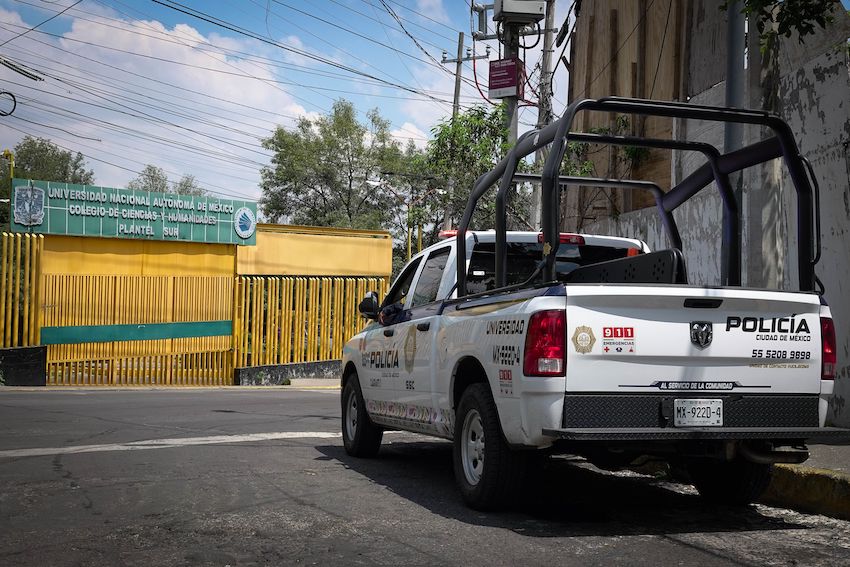
Sheinbaum also commented on an attack on Monday at the southern campus of the College of Science and Humanities (CCH Sur), a high school-level educational institute run by the National Autonomous University of Mexico (UNAM) in Mexico City.

A 19-year-old student killed a 16-year-old student and injured a 65-year-old college worker in the stabbing attack. The attacker, while attempting to escape, jumped off a building at the school, fracturing both his legs. He was taken to hospital, where he was placed in the custody of police.

On Monday, a student was murdered at the College of Science and Humanities (CCH Sur), a high school-level educational institute run by the National Autonomous University of Mexico (UNAM) in Mexico City. (Rogelio Morales/Cuartoscuro)

Sheinbaum described the attack as a “very painful” incident, before noting that she is a graduate of CCH Sur, a school she entered as a 15-year-old in 1977.

She said that her government was waiting for the investigation into the deadly attack to conclude.

“I asked the interior minister to approach the family [of the student who was killed],” Sheinbaum said.

A reporter told the president that CCH Sur students had previously reported other students taking bladed weapons into the school, but the director of the educational institute allegedly didn’t take any action in response.

Sheinbaum said that her government is willing to assist the CCH Sur students and the school itself in any way it can.

By Mexico News Daily chief staff writer Peter Davies (peter.davies@mexiconewsdaily.com)

Inside Conagua’s quest to eliminate water theft in Mexico

0
A water truck in Mexico
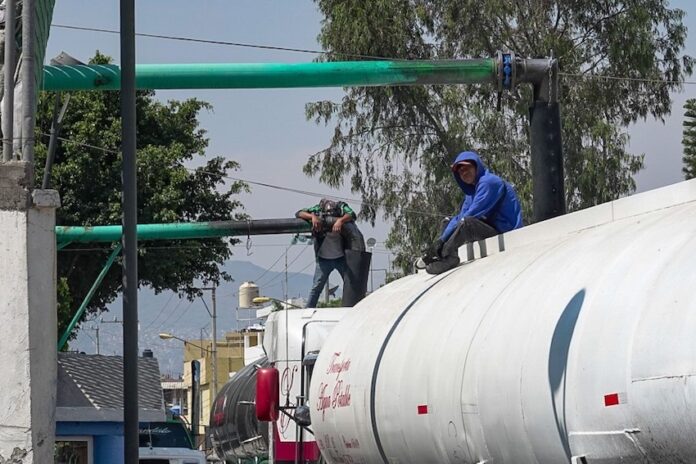
Know a case of water theft? Citizens can report illegal water use via Conagua's National Water Complaints Portal linked below. (Rogelio Morales/Cuartoscuro)

Water has effectively been stolen on a large scale in Mexico by concession-holders, according to a senior official with the National Water Commission (Conagua).

In an interview with the newspaper El Universal, Conagua’s deputy director for water management, Mauricio Rodríguez Alonso, said that the federal agency has detected more than 52,000 irregularities related to water concessions, including cases in which water was being exploited by people whose concessions were no longer valid.

Pozo Barranca del Muerto
The review of water use permits is a key focus of the National Water Plan that was presented by the federal government last November. (Gob. de CDMX/Cuartoscuro)

In other cases, Conagua has found that water was being used for purposes unrelated to the applicable concession, Rodríguez explained.

The review of water use permits is a key focus of the National Water Plan that was presented by the federal government last November.

Rodríguez told El Universal that Conagua has so far reviewed 90% of 536,000 water concessions.

Although various parts of Mexico have had a very productive rainy season that has replenished previously parched reservoirs, the long-term availability of water remains an ongoing national concern.

Efforts to save water and stop the illegal exploitation of the essential resource are much-needed.

Who holds water concessions in Mexico? 

Rodríguez said that water use permits have been issued to farmers, factories, hydroelectric power plants and municipal governments.

Around two-thirds of concessions were issued for agricultural purposes, he said.

Rodríguez said that each concession stipulates the amount of water the holder is permitted to use and is valid for varying periods of time ranging from 10 to 30 years.

The expiration and misuse of concessions

Rodríguez said that during the current federal administration, Conagua “realized” that many water concessions “lack validity.”

He didn’t specify how many expired concessions were being used to access water, but described the number as “large.”

Mauricio Rodríguez Alonso
According to Rodríguez, some of the water concessions in question are being used for “huachicoleo de agua” (water theft). (@CDHCMX/X)

Farmers and municipal governments are among those who have failed to renew their concessions on time, the official said.

Rodríguez said that Conagua has also detected that the geographic coordinates associated with some water concessions “are wrong,” while some permits that were issued for agricultural purposes are being used to divert water to real estate developments, golf courses and water parks and other swimming areas (balnearios).

“We detected more than 52,000 inconsistencies, of which not all were specifically related to the issue of change of [water] use, but also to validity, wrong coordinates and other details,” he said.

Rodríguez said that people found to be using an agricultural water permit for other purposes are asked to apply to change the concession and pay the applicable fees.

If a person doesn’t follow Conagua’s directive, “we begin an administrative process against [him or her],” he said.

President Claudia Sheinbaum said Monday that people who have misused water concessions also have to pay a fine.

Where is illegal water use most common?

Rodríguez told El Universal that Conagua commences operations “every week” to detect where water is being illegally exploited.

He said that the problem is “more pronounced” in certain states, including Chihuahua, Guanajuato, México state and Michoacán.

What has Conagua done to combat the illegal use of water?

Rodríguez said that Conagua has shut down 256 wells from which water was being illegally extracted. He said that water was being extracted from some of the wells to fill up water tankers known as pipas.

“Last week we detected … [a water source] in Puebla, where one well supplied 300 pipas,” he said.

“That’s why we closed it. We notified the Attorney General’s Office and began a [criminal] procedure. This is a business we call huachicoleo de agua [water theft],” Rodríguez said, using a colloquial word (huachicoleo) that usually refers to fuel theft.

He said that security forces, including the National Guard, accompany Conagua personnel during operations to “block illegally established wells.”

Rodríguez also said that Conagua “recently signed an agreement to make use of satellite images” to help the agency detect where water is being illegally exploited.

He explained that citizens have reported cases of illegal water use via Conagua’s National Water Complaints Portal.

“We get a complaint practically every week,” Rodríguez said.

Conagua calls on water concession-holders to get their papers in order 

Rodríguez said that Conagua will carry out an “information campaign” to inform water concession-holders, including the owners of small and medium-sized farms, how they can “regularize” their permits.

Water commission demolishes illegal dams built by Chihuahua ex-governor

“They’ll have a period of three months,” he said, adding that concession-holders will be able to carry out the necessary bureaucratic procedures online via Conagua’s website or in person at Conagua offices.

“Our objective is to put the concessions in order,” Rodríguez said.

“We make a respectful call to everyone to put … [their] concessions in order,” he said.

Conagua ‘recovers’ 4 billion cubic meters of water 

El Universal asked Rodríguez how much water Conagua has “recovered” since Sheinbaum took office in October 2024.

“Four billion cubic meters,” the official told the newspaper, explaining that “a large part” of that amount was recovered from “irrigation districts” where Conagua is assisting farmers to use new irrigation technology.

Rodríguez said that Conagua has also recovered water via “administrative procedures” that enabled the “return” of water from hydroelectric plants, and as a result of the National Human Right to Water Agreement, in which the private sector joined federal and state authorities as a voluntary participant.

“[There are] business owners who return the water they don’t use,” he said.

At her morning press conference on Monday, Sheinbaum said “there has been a lot of cooperation from a lot of business owners.”

She said that many factories and large-scale farmers, including milk producers, have “returned” to Conagua part of their authorized water allotment so that the federal agency can allocate the water to “other uses,” including human consumption.

With reports from El Universal 

OECD follows the IMF in lifting Mexico’s economic growth outlook for 2025

0
building
Both the IMF and the OECD have attributed Mexico's upward trend to its strong external market, with exports so far holding their own despite U.S. trade policy uncertainty. (Shutterstock)

Noting that the global economy has demonstrated surprising resilience, the Organization for Economic Cooperation and Development (OECD) raised its forecast for Mexico’s Gross Domestic Product (GDP) from 0.4% to 0.8% for 2025.

The OECD also projected a 1.3% increase in the Mexican economy in 2026, an improvement compared to that body’s previous forecast of 1.1%.The positive news comes just days after the International Monetary Fund (IMF) revised its Mexico GDP forecast to 1.0% this year — up from -0.3% in April — while projecting 1.5% growth in 2026.

Latest growth forecast reduction comes from the OECD.
In upgrading Mexico’s GDP outlook for the rest of the year, the OECD noted that U.S. tariffs haven’t yet had their full effect. (File Photo)

Issued on Tuesday, the “OECD Economic Outlook, Interim Report September 2025” cited a stronger-than-expected performance in Mexico’s exports despite a volatile global trade environment. 

However, the organization did note that “the full effects of tariff increases have not yet been felt, although they are becoming increasingly evident in spending decisions, labor markets and consumer prices” around the world.

As for inflation in Mexico, the OECD bumped up its forecast for this year to 4.2% (its previous estimate was 3.4%), but foresees improved containment in 2026, projecting inflation of 3.6%. This reflects persistent cost pressures that should gradually moderate in the coming years, it said.

While inflation remains a challenge, the OECD called for a “vigilant” monetary policy, urging Mexico’s central bank (Banxico) to “react promptly to shifting risks to price stability.” 

The organization foresees Banxico continuing its monetary easing policy with additional rate cuts in its effort to moderate inflationary pressures. Along with Mexico’s resilient export sector, it said, lower interest rates could provide additional support to domestic demand in 2026, complementing the ongoing momentum from trade, paving the way for more stable growth.

Given the global outlook, the OECD urged policymakers to observe fiscal discipline to safeguard long-term debt sustainability and maintain room for maneuver to respond to future crises.

It also warned of downside risks in the short-term, citing additional tariff hikes and increased concerns about fiscal liabilities, including volatile crypto-assets, all of which could pose additional financial stability concerns.

The upward trend is based on the strength of Mexico’s external sector which the OECD regards as a stabilizing force, despite the increasing trade frictions.

With reports from El Economista, Mexico Business and El País

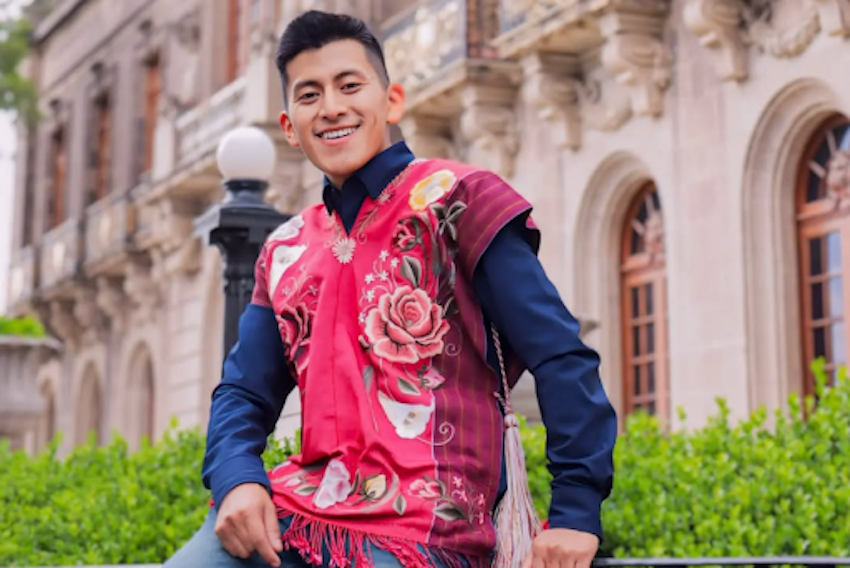
This Chiapas teacher of his Tzotzil language has a star pupil: ChatGPT

4
Andrés ta Chikinib
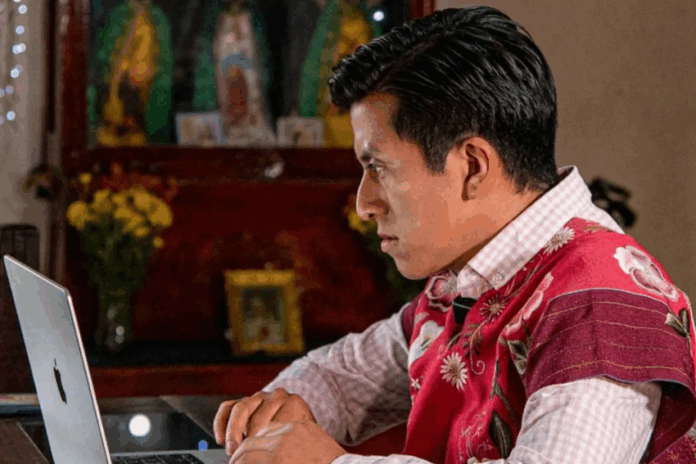
The 29-year-old educator described his AI-powered student as "inquisitive and persistent, demanding clarity and coherence.” (Andres Ta Chikinib/Instagram)

An educator in the southern Mexican state of Chiapas is bridging the gap between Indigenous language and artificial intelligence by teaching Tzotzil to ChatGPT.

Andrés ta Chikinib, a 29-year-old teacher and poet, had an amused grin on his face as he described his unusual pupil.

Chiapas teacher
Chikinib says he wants to ensure that the language of more than 400,000 people in Chiapas has a presence in the digital world and is accessible to future generations. (Instagram)

“ChatGPT has become another student, inquisitive and persistent, demanding clarity and coherence,” said the resident of Zinacantán, a municipality of 45,000 in the Chiapas highlands predominantly inhabited by Tzotzil Maya.

Chikinib has spent nearly a decade promoting Tzotzil literacy — despite only learning to read and write in his own tongue at age 19.

A lack of classroom materials led him to a novel solution: “As a Tzotzil language teacher, I couldn’t find any material to share, so I started creating it myself. But this work takes a lot of time.”

Chikinib began by feeding ChatGPT — an online, AI-powered chatbot — his dialect’s vocabulary, grammatical structures and core rules. He deliberately avoided any translations into Spanish.

He said he’s been using the Tzotzil dialect spoken in his own village or region. Tzotzil is made up of several distinct regional dialects that can differ in pronunciation, vocabulary and some grammar; intelligibility between them varies.

He said ChatGPT responded not only by repeating what was taught, but by asking questions, recognizing linguistic patterns and even catching roots unique to Tzotzil.

His goal extends far beyond novelty, nor is it to translate Tzotzil into Spanish or create a structured learning model.

Rather, he wants to ensure that the language — spoken by more than 400,000 people in Chiapas — has a presence in the digital world, is accessible to young people and future generations, and gets the same respect as it does in the community.

However, it is unclear exactly how his work will benefit others in the short term. Interactions with ChatGPT generally improve the AI’s performance only within that user’s session or context — unless the data is specifically used to retrain underlying models or converted into face-to-face teaching materials.

“If we don’t share, how can we demand institutional respect or visibility?” Chikinib said, responding to critics who question digitizing languages — such as José Daniel Ochoa Nájera, a linguist in Chiapas at the State Center for Indigenous Languages, Art, and Literature (CELAL).

Ochoa warned of a “linguistic colonialism,” in which “some languages” get expanded through digital technology, while others “remain marginalized.”

“AI can tell our stories, yes,” he added. “But who decides which stories and how they are told? Technology can be a tool or a dispossession.”

According to the latest figures from Mexico’s National Institute of Statistics and Geography (INEGI), Mexico boasts 68 Indigenous languages (encompassing 364 variants) spoken by some 7 million people. Mexico is among the top 10 nations globally with the most Indigenous languages, ranking second in Latin America behind Brazil.

About 6% of Mexico’s population of 132 million can speak Nahuatl, Tzeltal, Maya, Zapotec, Tzotzil, Mixtec or another Indigenous language. Still, language loss remains a serious concern, as nearly 300 Indigenous languages have disappeared historically in Mexico. The global rate is about 25 languages disappearing annually.

With reports from MVS Noticias, López-Dóriga Digital, Radio Formula and Diario de Yucatán

Tourism Minister: ‘There is no insecurity for tourists in Mexico’

14
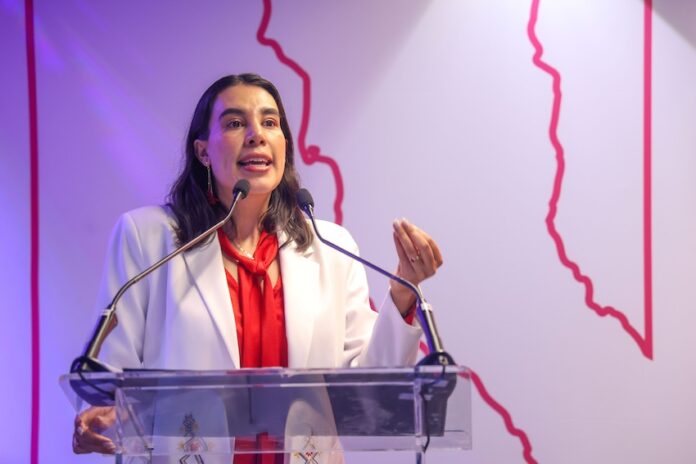
Tourism Minister Josefina Rodríguez at podium
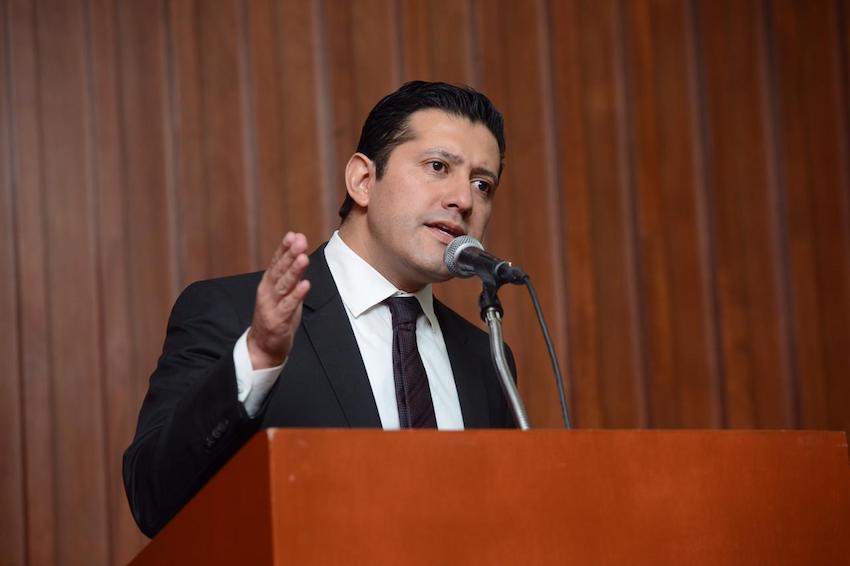
Tourism Minister Josefina pointed out that the number of foreign tourists in Mexico is growing, with 47 million visiting in the first six months of 2025. (Moisés Pablo/Cuartoscuro)

Tourism Minister Josefina Rodríguez said Tuesday that “there is no insecurity for tourists in Mexico.”

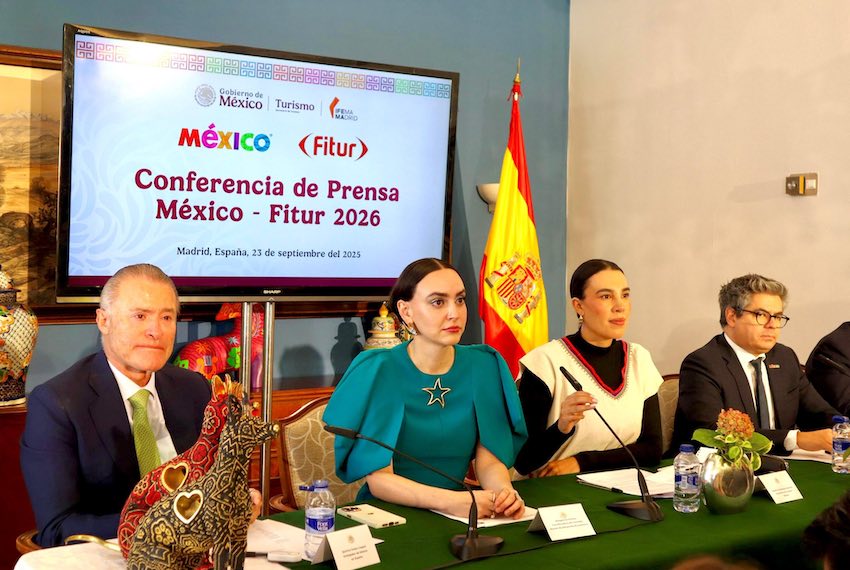
Rodríguez made the comment in anticipation of Madrid’s 2026 International Tourism Fair (FITUR) scheduled for January 2026, at which Mexico will be the guest country of honor. 

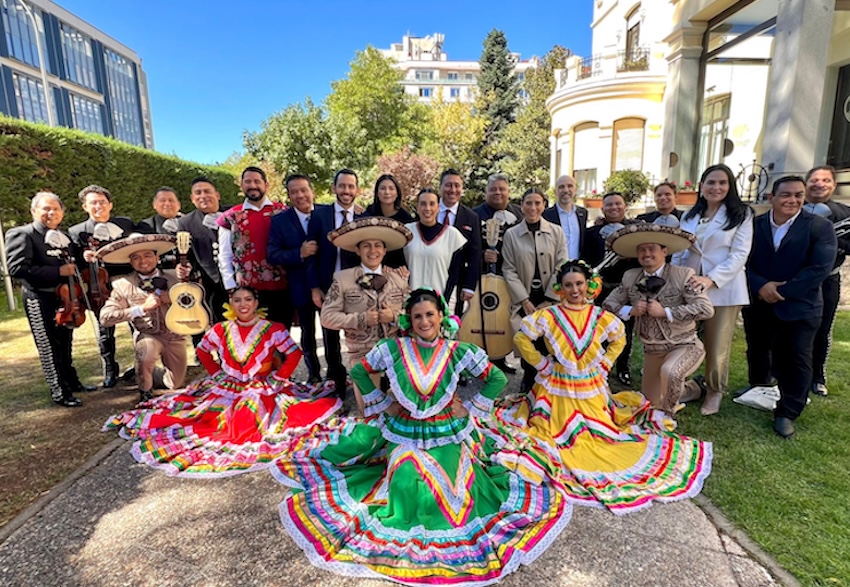
Mexican embassy in Spain
The Mexican Embassy in Spain celebrates Mexico being named the guest country of honor at Madrid’s 2026 International Tourism Fair (FITUR), scheduled for January 21-25, 2026. (Sectur)

“A tourist who goes to Mexico is protected, is loved,” she said in a speech from Madrid. “That’s why there has been an increase in foreign tourists to our country.” 

The minister’s reassuring words faced headwinds from recent events. The day before her press conference, two visiting musicians from Colombia were found brutally murdered in México state. And in August, the United States issued an alert that warned U.S. citizens not to travel to all but two of Mexico’s states due to the risk of homicide, kidnapping and terrorist violence.

The tourism minister addressed the latter concern by noting that such alerts have been commonplace for many years.

“We are not alarmed; this is not a new alert,” she said. “These alerts have been in place for a long time. There is no insecurity for tourists.” 

More tourists continue to choose Mexico 

While violent incidents cannot be dismissed, no matter how isolated, the big-picture statistics support Rodríguez’s optimism. 

Between January and June this year, Mexico welcomed 47.4 million international visitors, marking a 13.8% increase over the same period in 2024, according to Mexican government figures. 

In addition, 7.36 million tourists arrived by air from the U.S., marking a 2.4% rise from the same period last year. 

“Coming to Spain as a guest country opens a window of opportunity for us to continue positioning ourselves in established markets like Europe,” said Rodríguez, flanked by Altagracia Gómez, Sheinbaum’s business sector advisor. (Josefina Rodríguez Zamora/Facebook)

Mexico’s role as co-host in the 2026 FIFA World Cup is expected to contribute to a higher volume of tourism next year, with several matches to be played in Mexico City, Guadalajara and Monterrey.

In August, President Claudia Sheinbaum said that the Tourism Ministry aims to establish Mexico as the fifth most-visited country in the world by 2030, from sixth position at present. 

“Coming to Spain as a guest country opens a window of opportunity for us to continue positioning ourselves in established markets like Europe,” said Rodríguez. “We want more. We’ve had the same numbers for many years.” 

She also said that her ministry wants to encourage a wider knowledge of what Mexico has to offer tourists. “We don’t want them [only] to return to Cancún,” she said. “We’d rather they take [for example] the new Maya Train. We’re going to show the world that Mexico is in fashion.”

Rodríguez had announced in a press statement the day before that the latest version of Mexico’s Tourism Investment Portfolio includes 473 tourism-oriented projects from 26 states, with a total value of US $22 billion.

The minister said the number of projects is 67% higher than those recorded in April, and the largest investments are destined for the states of Nayarit, Guerrero, Hidalgo, Jalisco and Quintana Roo.

With reports from El Financiero and Milenio

Hurricane Narda brings heavy rains and high waves to Guerrero, Michoacán and Colima

0
Hurricane Narda's path
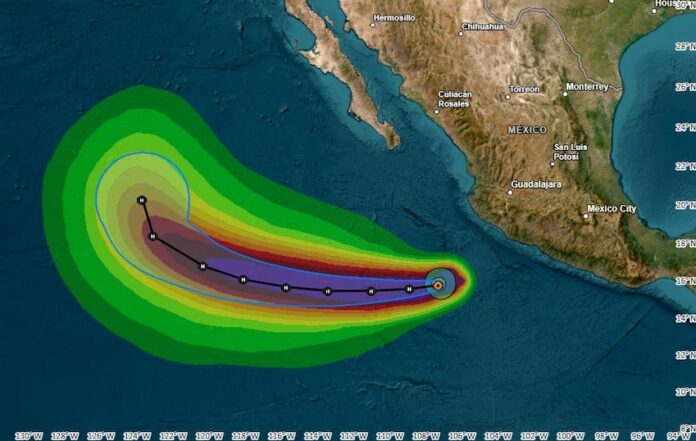
Hurricane Narda was located 475 kilometers southwest of Manzanillo, Colima, and 480 km south-southwest of Playa Pérula, Jalisco, on Tuesday morning. (NOAA)

Hurricane Narda will bring heavy rains primarily to the western states of Guerrero, Michoacán and Colima, where authorities have issued alerts due to the storm’s potential severity.

While the hurricane is expected to move parallel to the coast without making landfall, it will bring intense rainfall and strong winds to Mexico’s central Pacific region. Narda is currently a Category 1 hurricane and is expected to continue on a westward path away from mainland Mexico.

According to the National Meteorological Service (SMN), at 9 a.m. on Tuesday, Hurricane Narda was located 475 kilometers southwest of Manzanillo, Colima, and 480 km south-southwest of Playa Pérula, Jalisco, with maximum sustained winds of 140 kilometers per hour, gusts of 170 kilometers per hour, and moving west at 20 kilometers per hour.

The states of Guerrero, Michoacán and Colima, which sit along the Pacific coast, will likely experience very heavy to intense rainfall with expected accumulations ranging between 75 and 150 millimeters within 24 hours. 

Strong winds and high waves in coastal areas are also anticipated, which will heighten the risk of landslides, flooding in low-lying areas and rising levels in rivers and streams. 

In addition to these states, forecasters have warned that Jalisco will also experience intense rainfall as well as wind gusts of 40 to 60 kilometers per hour. Waves in coastal areas could reach between 2.5 and 3.5 meters in height. 

Although with less intensity, Narda will also bring rainfall to the states of Nayarit, México state and Mexico City. 

Authorities have urged residents in the affected areas to heed safety recommendations due to the potential for damage caused by the heavy rains. 

Narda is the 14th cyclone of the season to form in the Pacific Ocean. The season typically ends by Nov. 30.  

With reports from El Financiero and TV Azteca

2 suspects identified in grenade attack on Morelia migration office

3
police officer neutralizes a grenade outside Morelia's INM
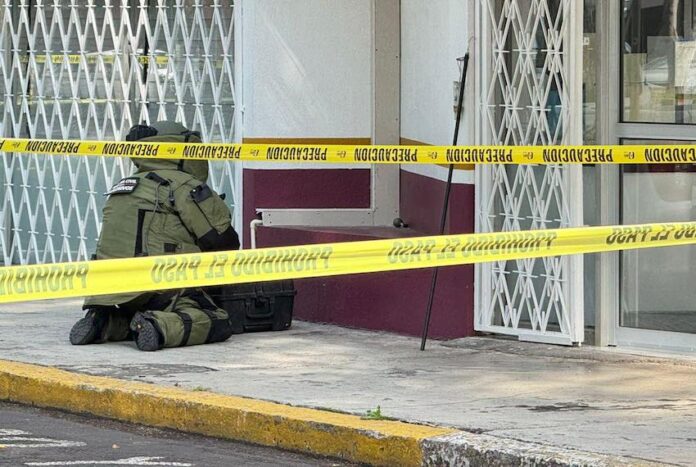
The explosive experts arrived shortly after 9 a.m. on Monday. (SSP Michoacán)

A South American person was the target of a failed explosive attack outside the offices of the National Migration Institute (INM) in Morelia on Monday, according to the Michoacán attorney general.

The explosive device didn’t detonate and was removed by explosives experts from the Michoacán Civil Guard police force at 9.24 a.m. Monday, the INM said in a statement.

The grenade was thrown toward the INM offices in the Camelinas neighborhood of Morelia, the capital of Michoacán, by a person in a vehicle, according to a preliminary report.

Michoacán Attorney General Carlos Torres Piña said that “everything indicates” that the failed attack using a “handmade” explosive device was aimed at “a South American person” who was waiting for the INM offices to open. He didn’t offer any additional information about the person who was allegedly targeted or cite any possible motive for the attack.

Morelia police chief Pablo Alarcón Olmedo said that authorities had reviewed security camera footage and obtained “important information” about the incident.

“We believe that two people are involved,” he said without offering further details.

No arrests in connection with the incident had been reported by 10 a.m. Tuesday.

The INM said that “the possible presence of an explosive device” outside the INM offices in Morelia was first reported at approximately 8:33 a.m. Monday.

It said that INM security personnel “proceeded to verify the information, cordon off the area and activate civil protection protocols,” which included reporting the presence of the explosive device via the 911 emergency telephone number.

Employees were evacuated from the INM offices and nearby streets were closed. Police and soldiers attended the scene before the explosive experts arrived shortly after 9 a.m.

Alarcón said that the leader of the Civil Guard’s explosives unit “manipulated the object and confirmed that it was an improvised, hand grenade-style explosive, which didn’t detonate.”

The INM said that an investigation is underway and expressed its willingness to fully collaborate with the relevant authorities on the matter. Torres said that the Federal Attorney General’s Office would lead the investigation.

In its statement, the INM said that “the safety of its staff and the users” of its services is a “priority.”

The National Migration Institute, part of the federal Interior Ministry, is the agency that handles immigration matters in Mexico. Among its duties is processing foreigners’ applications for residency in Mexico.

With reports from Reforma, Aristegui Noticias and El Universal

Greenpeace activists scale 100-meter monument to protest destruction of Maya Rainforest

5
Greenpeace banner hanging from Estela de Luz that says "La Selva Maya Grita!"
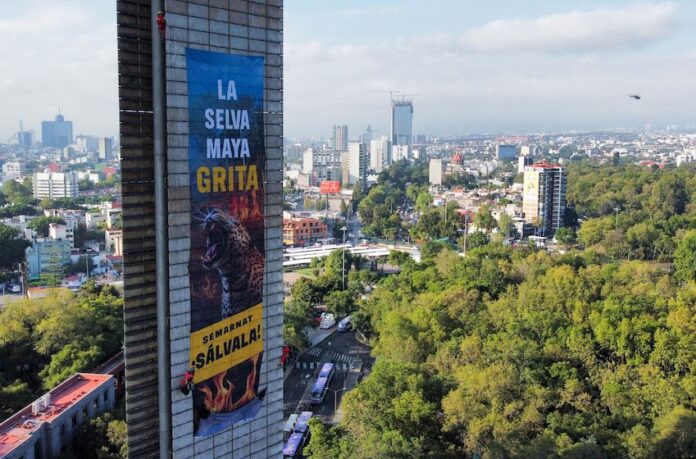
Greenpeace México is demanding the government forge a comprehensive national agreement to protect the 15-million-hectare Maya Rainforest and its waters for present and future generations. (Galo Cañas/Cuartoscuro)

Greenpeace activists climbed Mexico City’s Estela de Luz monument on Tuesday morning to bring attention to the destruction of the Maya Rainforest.

A group of protesters unfurled a 27-meter-long, 6-meter-wide banner calling on Mexico’s Environment Ministry (Semarnat) to do more to protect the jungle, a critical ecosystem in southeastern Mexico. The Selva Maya, which expands into northern Guatemala and Belize, is the largest tropical forest in Mesoamerica.

Greenpeace activists scaling the Estela de Luz monument in downtown Mexico City
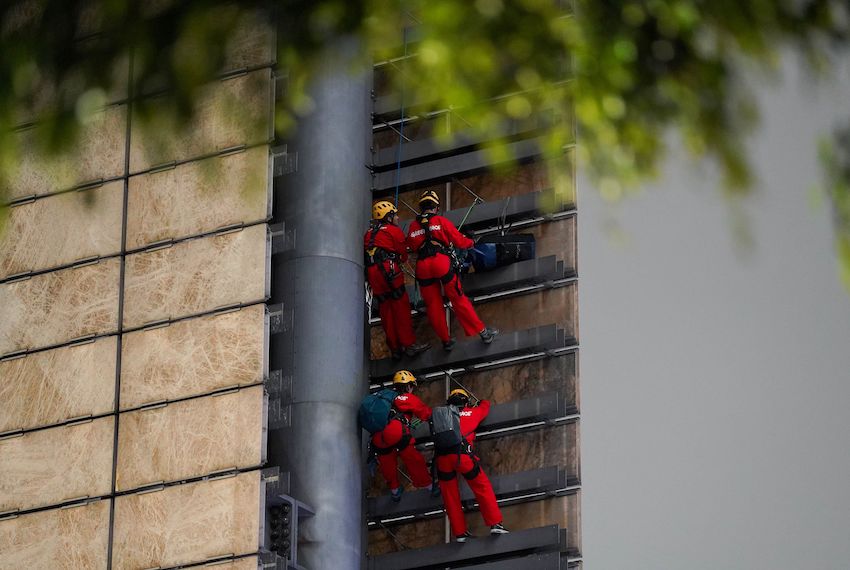
The protesters are seeking to call attention to the fact that “[the destruction] that happens in the jungle doesn’t stay in the jungle.” (Galo Cañas/Cuartoscuro)
The 104-meter-tall Estela de Luz monument, built in 2010 to commemorate the 200th anniversary of the beginning of Mexico’s independence movement, is located on the western end of the iconic Paseo de la Reforma avenue at the entrance to Chapultepec Park.

Nine protesters arrived before dawn to scale the monument, reaching a height of approximately 70 meters, whereupon they spread open the banner, which read: The Selva Maya cries out! Semarnat, save it!

Another 20 or so protesters locked arms and formed a barrier around the base of the monument to prevent security from getting to those climbing the monument before the banner could be displayed.

One of the protesters told reporters that their objective was to send a direct message to Semarnat to enhance and enforce policies to protect the ecosystem, insisting that “what happens in the jungle doesn’t stay in the jungle.”

Greenpeace México demanded the government forge “a comprehensive national agreement to protect … the rainforest and its waters for present and future generations.”

The protesters also directed attention to the Greenpeace México website and its “México al grito de ¡Selva!” (“Mexico to the Cry of the Jungle”) campaign, which calls on the public to take action before it is too late. 

“From its cenotes and underground rivers — the largest freshwater reserve in Mexico — to its ancient trees and endangered species like the jaguar, tapir and scarlet macaw, the Maya Rainforest is a treasure trove of life that regulates the climate, captures carbon, and sustains entire communities. But it is in grave danger.”

In a press release, Greenpeace México outlined its demands and explained that it timed this protest to roughly coincide with the nation’s Independence Day celebrations. 

In demanding that the Mexican government and the states of the Yucatán Peninsula halt deforestation and commit to protecting the Selva Maya, Greenpeace México urged the public to “raise our voices during this patriotic month.”

“May our green, white and red flags blend with the deep green of the jungle, reminding us that freedom is also defended with roots and branches that sustain life,” it said.

Insisting that “deforestation not only destroys trees, it also fragments communities, poisons water and uproots cultures” that have thrived in the region for millennia, Greenpeace also asserted that “thousands of hectares disappear under the advance of megaprojects for tourism, livestock, real estate, agroindustrial and railway development … Places that were once sacred are now commodified, privatized and reduced to the logic of money.”

With reports from El Universal, La Silla Rota and Milenio

40 years later: Memories of Mexico City’s 1985 earthquake

0
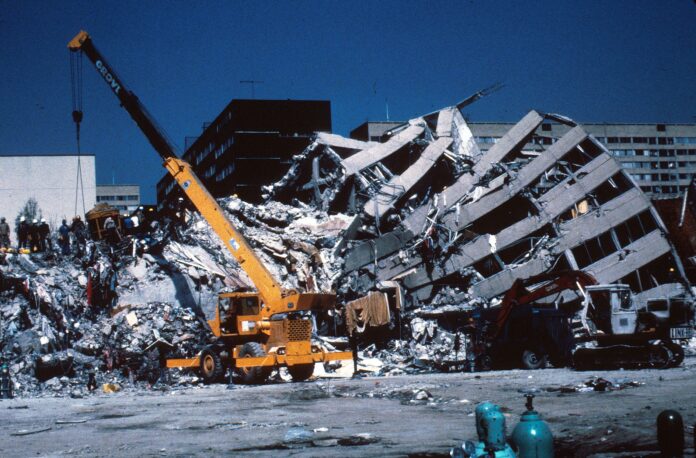
40 years on, the catastrophic Mexico City earthquake looms large in the memories of those who survived it. (United States Geological Survey)

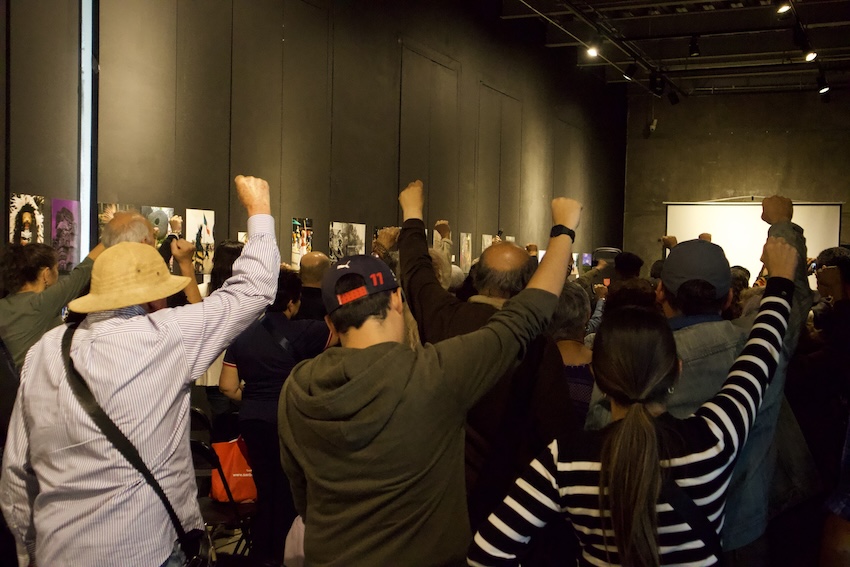
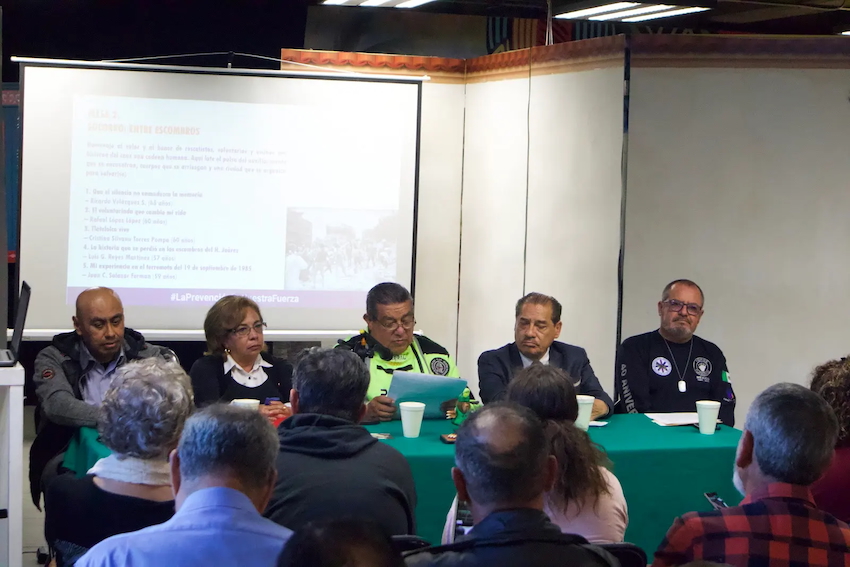
Forty years after Mexico City’s devastating 1985 earthquake, survivors gathered at the El Rule Cultural Center to read their personal narratives of a disaster that continues to mark the city and its people

“Stunned, we watched as the building directly across from our house crumbled,” recalls Cristina Silvana Torres Pompa, a resident of the Tlatelolco neighborhood. “All we could do was cry, hug each other, and pray while everything creaked and we heard glass breaking. The earth shook so violently that it shook us to our core.” 

Survivors share memories of the 1985 earthquake in Mexico City

Survivors of the quake express solidarity and gratitude for rescuers. (Vera Sistermans)

At 7:19 a.m. on September 19, 1985, an earthquake with a magnitude of 8.1 collapsed hundreds of buildings and killed an estimated 10,000 people (although some death toll estimates are as high as 45,000). 

Cristina Silvana, along with 29 other survivors, shared her story at an event titled “Living Books — After the earthquake: Voices that rebuild,” which the Ministry for Comprehensive Risk Management and Civil Protection organized on September 17 and 20 to commemorate the 40th anniversary of the disaster. 

Living Books was designed to be “an exercise of memory,” Johan Antonio Toro Marín, the Ministry’s Resilience Policy Coordinator and organizer of the event, explained, highlighting the importance of such a platform. “We realized that memory, and memory of risk and disaster, is very short,” he said, “and all the people who lived through 1985 are now over 50.”

As Toro Marín noted, younger generations and those who have migrated to Mexico’s capital might be oblivious to what was lost in the rubble. Nevertheless, the stories shared at the “Living Books” event demonstrated that the 1985 earthquake continues to affect countless lives, prompting many to reassess their perspectives and priorities. 

A chance to say ‘thank you’

16-year-old Carolina Rojas Ávila was still asleep in her family’s apartment in La Roma’s Benito Juárez housing complex when the earthquake hit. Woken by a strong movement, she watched in horror as the building collapsed around her.

“My mother and I looked at each other, and I knew she was saying goodbye to me. The roof collapsed on top of my mother and brother; they disappeared right before my eyes,” Carolina tells the audience, reading from her story. “The floor began to rise, causing me to slide until my legs were covered in debris. I just closed my eyes because I knew it was the end.” 

Over 400 buildings collapsed during the 1985 earthquake in Mexico City, and thousands more had structural damage. (Cristina Silvana Torres Pompa)

Hours later, three strangers pulled her and her family members from the rubble of their home with their bare hands,  but many of her friends from the building did not survive.

She never found out who her rescuers were. “I could not thank them, and that feeling stayed with me forever. Now people look at me a little strangely because I am grateful for everything. I never miss the chance to say thank you.”

A calling to become a rescuer

While people like Carolina had to adapt to a life without their home and loved ones, others became rescue workers almost overnight. 

“I wanted to be a veterinarian; that was my dream. However, the earthquake of September 19, 1985, changed the course of my life,” said Rafael López López, who shared his story titled “The Volunteer Experience That Changed My Life.”

The day after the earthquake, Rafael was walking through the disaster-stricken city center when a dump truck drove by, looking for volunteers for rescue efforts: in the Tlatelolco neighborhood, the enormous Nuevo León residential building had collapsed entirely. In response, the 20-year-old grabbed a metal helmet from his collection of military memorabilia and joined the improvised brigade. Over the following weeks, Rafael and other mostly inexperienced volunteers working in Tlatelolco pulled hundreds of bodies from the rubble. Against all odds, they managed to save a few survivors. 

“We did everything empirically. Thank God it worked,” Rafael’s fellow volunteer Benjamín Izunza González points out.

Rafael López López remembers his experiences as a volunteer rescuer in the days following the disaster. (Vera Sistermans)

“The press dubbed us Los Topos (The Moles) because we resembled the little animals, entering through holes, digging tunnels,” Rafael says. 

40 years later, the Topos de Tlatelolco continue to volunteer as a rescue team, responding to national and international disasters, including the 2023 earthquake in Turkey and the 2015 earthquake in Nepal.

How the 1985 earthquake changed Mexico City 

Rafael currently serves as the president of Los Topos. He also reconsidered his career aspirations as a veterinarian and is now applying the lessons he learned as a rescue worker in his position as Outreach and Training Policy Coordinator at Mexico City’s Department of Comprehensive Risk Management and Civil Protection.

The 1985 earthquake, which remains the strongest Mexico has registered to this date, not only changed the course of the lives of numerous individuals but also transformed the country’s perspective on disaster response and preparedness. 

“In 1985, we had nothing. There were no protocols, mechanisms or government policies,” says Rafael. “Over the past 40 years, we have seen tremendous development in various areas.” 

In May 1986, authorities established the National Civil Protection System, and since 1991, Mexico City has operated a seismic alert system featuring over 4,000 sirens strategically placed throughout the city, as noted by Toro Marín.

Additionally, city officials have adapted building codes to reduce vulnerability. “The 1985 earthquake exceeded expectations of what the seismic demand on a structure would be,” Toro Marín explains. “The lessons learned from the 1985 earthquake became the 1987 regulations.” 

This year, on the 40th anniversary of the disaster that shaped Mexico City, its policies and the lives of many residents, events like Living Books and the annual September 19 disaster drill ensure that the stories and lessons from the 1985 tragedy continue to strengthen the city’s resilience 

Vera Sistermans is a freelance journalist and security analyst based in Mexico City. Her work mostly focuses on Indigenous culture, violence, and resilience.