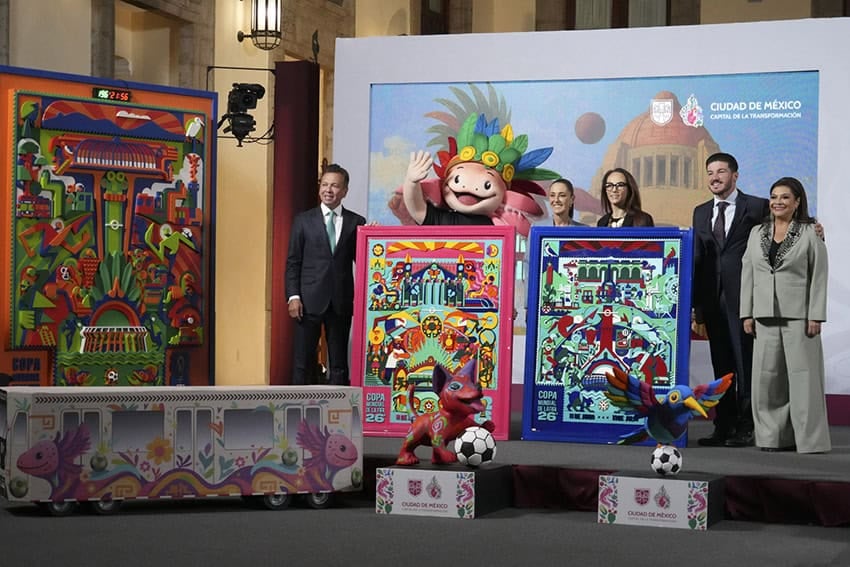
The festival features 15 feature films and five short films specially selected from this year's Sundance Festival in Park City and Salt Lake City, Utah. (Sundance)
The Sundance Film Festival, back in Mexico City for a second consecutive year, announced its official program last week.
The line-up includes 15 feature films and five short films, as well as a series of panels with filmmakers, and will run from Thursday, May 29, through Sunday, June 1.
The festival will be hosted by Cinépolis Diana on Mexico City’s iconic Paseo de la Reforma boulevard, as well as Cinépolis Carso, Cinépolis Mítikah and Cinépolis Oasis Coyoacán. (Libre Acceso A.C.)
The festival’s opening film is the documentary “Prime Minister,” a portrait of Jacinda Ardern, former Prime Minister of New Zealand, directed by Michelle Walshe and Lindsay Utz. The film, which chronicles how Ardern led her nation through unprecedented challenges, implemented bold policies and became the second leader in history to give birth in office, won the 2025 Sundance Film Festival Audience Award: World Cinema Documentary.
On April 29, the Sundance Institute, the nonprofit organization dedicated to the discovery and development of independent artists, announced that it was partnering with the Mexican cinema chain Cinépolis for the second edition of Sundance Film Festival: CDMX 2025.
Amanda Kelso, acting CEO of Sundance Institute, said the partnership will also host film festivals in 2026 and 2027.
“Following the launch of Sundance Film Festival: CDMX last year, we are delighted to be returning to audiences in Mexico City and further engaging with the local film community,” she said.
Alejandro Ramírez, CEO of Cinépolis, said the festival highlights his company’s “dedication to fostering environments where independent films can reach broader audiences.”
“We are motivated by the chance for these exceptional movies to inspire future filmmakers and to broaden the dialogue around cinema as a powerful medium for expression and change,” he said. “We are proud that our partnership … is extending through 2027.”
The festival’s main venue is Cinépolis Diana on Mexico City’s iconic Paseo de la Reforma boulevard. Other venues that will host festival activities include Cinépolis Carso, Cinépolis Mítikah and Cinépolis Oasis Coyoacán.
In addition to “Prime Minister,” the festival will screen seven other documentaries and seven narrative feature films.
Among the documentaries is “2000 Meters to Andriivka,” about a Ukrainian platoon on a mission to liberate the village of Andriivka. Director Mstyslav Chernov received the 2025 Sundance Film Festival Directing Award: World Cinema Documentary.
The documentary “Mr. Nobody Against Putin” follows a teacher going undercover to film what’s really happening in his school. It won the 2025 Sundance Film Festival World Cinema Documentary Special Jury Award.
Other documentaries include “One to One: John & Yoko,” “SALLY,” which was presented with the 2025 Alfred P. Sloan Feature Film Prize for its portrayal of science and technology, and the 2025 Sundance Film Festival U.S. Documentary Special Jury Award for Archival Storytelling “Selena y Los Dinos” about the Mexican-American singer Selena Quintanilla.
Among the feature films are “DJ Ahmet,” the winner of the 2025 Sundance Film Festival Audience Award: World Cinema Dramatic and World Cinema Dramatic Special Jury Award for Creative Vision, “Plainclothes,” which was recognized with the 2025 Sundance Film Festival U.S. Dramatic Special Jury Award for Ensemble Cast and “Twinless,” the recipient of the 2025 Sundance Film Festival Audience Award: U.S. Dramatic and U.S. Dramatic Special Jury Award for Acting presented to Dylan O’Brien.
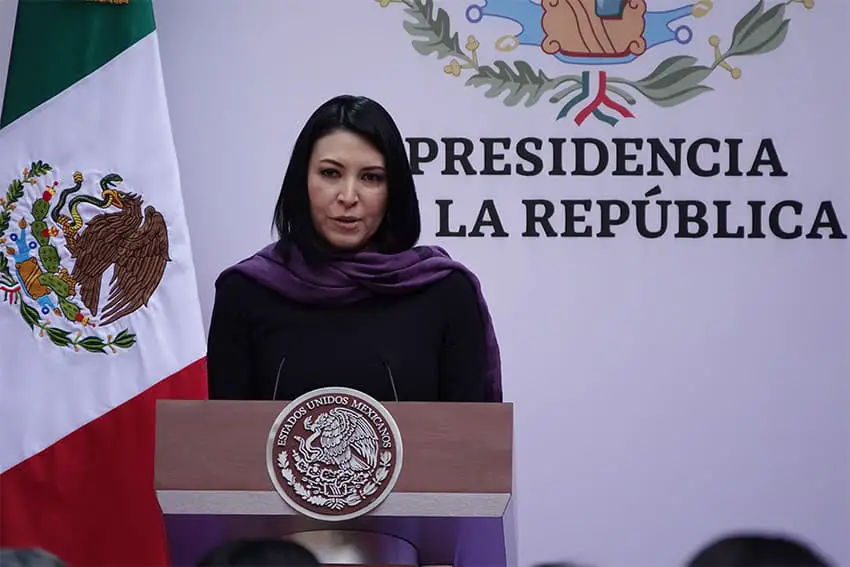
President Sheinbaum and members of her cabinet learned of a fatal attack on two close government aides shortly after the president took the podium on Tuesday morning. (Presidencia/Cuartoscuro)
During the mañanera, Security Minister Omar García Harfuch approached the president and showed her something evidently important on his phone. Sheinbaum also received a document that apparently informed her of the armed attack that occurred just six kilometers or so south of the National Palace.
Expressions of concern and consternation were visible on the faces of various officials as they learnt of the terrible news.
Toward the end of the press conference, Sheinbaum announced she had some “very, very important information” to convey, before proceeding to read out a Mexico City government statement confirming that Brugada’s personal secretary Ximena Guzmán as well as José Muñoz, an advisor, had been shot dead at the intersection of Calzada de Tlalpan and Napoleón Street in the Mexico City neighborhood of Moderna, located in the Benito Juárez borough.
‘We’re going to get to the bottom of this situation’
After reading out the statement, Sheinbaum conveyed condolences to the families of the victims on behalf of the federal government and declared that “all the support” Brugada needs will be given to her.
“We’re going to get to the bottom of this situation and ensure there is justice,” she said.
“And our unconditional support to the jefa de gobierno,” Sheinbaum said, using Mayor Brugada’s official title.
She said that the two victims had been “working in our movement” — the ruling Morena party — for a long time.
“We know them,” Sheinbaum added.
Later in the press conference, a reporter asked the president whether the government had any knowledge of the two aides having received threats.
“We don’t,” Sheinbaum said.
“I believe we shouldn’t speculate and we have no knowledge [of that]. … They don’t even use security, nothing,” she said.
“… We have to see the investigation in order to be able to know the cause [of the attack],” Sheinbaum said.
Mexico City Mayor Clara Brugada held a brief press conference on Tuesday morning following the murder of her aides, where she expressed her cabinet’s “profound consternation and grief” and commitment to guaranteeing public safety in the capital. (Victoria Valtierra/Cuartoscuro)
A ‘very cordial meeting’ with the new US ambassador
Sheinbaum noted that the new United States Ambassador to Mexico, Ron Johnson, came to the National Palace with his wife on Monday to present his letter of credence.
“It was a very cordial meeting. We spoke about the importance of the Mexico-United States relationship … and about the importance of having permanent communication,” she said.
Sheinbaum specified that she and Johnson spoke about trade, migration and security, with an emphasis on the “very good coordination” between Mexico and the United States.
“We want to maintain this coordination, this collaboration,” she said.
“He was very respectful,” Sheinbaum said, adding that he recognized the work her government has done.
“I think it’s going to be a good relationship between the ambassador and the government,” she said.
¡Saludos al pueblo de 🇲🇽 de mi parte y de mi esposa Alina! Esperamos conocer aún más de su país, su cultura y a muchos de ustedes. pic.twitter.com/mQ7mO8Ddi0
— Embajador Ronald Johnson (@USAmbMex) May 20, 2025
Ron Johnson said it was an “honor” to be in Mexico to represent U.S. President Donald Trump and the people of the United States.
“Our relationship with you, with Mexico, is of great importance,” he said.
“… We’re more than partners. We’re neighbors and friends. … I’m here to work with President Sheinbaum and her team on issues of interest such as security, the border and migration,” Johnson said.
27 seconds with the pope
A reporter asked Interior Minister Rosa Icela Rodríguez about her “brief encounter” with Pope Leo XIV following his inaugural Mass in Vatican City on Sunday.
“I just greeted him, gave him the letter. I said to him, ‘we brought a letter on behalf of the president with an invitation to come to Mexico,'” Rodríguez said.
“And he lifted up his arms and said, ‘when?’ And I just smiled and straight away showed him the gift that I took and I told him it was a Mexican handicraft and he smiled,” she said.
The interior minister noted that she gifted the pope “an engraving in silver of the Virgin of Guadalupe” on behalf of the Mexican government.
“He smiled … and I offered my hand to say goodbye. We had already said goodbye but … [then] he told me: ‘Please give greetings and blessings to the presidenta and also to the people of Mexico,'” Rodríguez said.
“… That was it,” she said.
By Mexico News Daily chief staff writer Peter Davies (peter.davies@mexiconewsdaily.com)
Viridiana Álvarez began her decade-long quest in January 2015. (Viridiana Álvarez/Instagram)
Viridiana Álvarez, a 39-year-old mountaineer from the city of Aguascalientes, was honored with a Guinness World Record on Monday for becoming the first woman to summit all of the world’s 14 peaks above 8,000 meters and the Seven Summits, the highest mountains on each continent.
Álvarez, who began her decade-long quest in January 2015, completed her final climb on Oct. 12, 2024, scaling the Indonesian mountain known as Carstensz Pyramid and Puncak Jaya.
“I’m very excited to receive this record because it’s proof once again that dreams do come true,” she said at the Mexico City ceremony, noting she started mountaineering at 30 despite her landlocked home state having no mountains.
She is also the first Latin American to climb K2, the second-highest mountain in the world and regarded as the deadliest, with approximately one person dying on the mountain for every four who reach the summit.
In 2022, she became the first Mexican woman inducted into mountaineering’s Hall of Fame.
At Monday’s ceremony in Mexico City, Guinness representative Alfredo Arista praised the trailblazer for her “effort, sacrifice and passion,” calling the achievement “no easy feat.”
Álvarez, whose education includes the Women’s Leadership Program at Yale University’s graduate business school, described the peaks of Everest, K2 and Annapurna as “special” due to their physical and emotional challenges. She nearly died while climbing K2.
Álvarez quit her office job — she had worked 10 years in the automotive and manufacturing industries — to pursue mountaineering. She now serves as a public speaker who promotes messages about breaking paradigms, especially to youth, and presides over Líderes de Altura (Height Leaders), a nonprofit that focuses on social causes and community improvement.
Álvarez began her journey by reaching the summit of 8,848-meter Mount Everest (Asia) on May 16, 2017 — her first of the Seven Summits. The others: Aconcagua (South America), Denali (North America), Elbrus (Europe), Kilimanjaro (Africa), Carstensz (Oceania) and Mount Vinson (Antarctica).
“She’s proven that human limits are made to be surpassed,” said Arista.
Advanced composite materials from the joint venture will support next-generation vehicles and industrial applications. (Shutterstock)
Monterrey-based Katcon Global and Indian automotive components manufacturer Tata AutoComp Systems have announced a joint venture to manufacture advanced composites for the automotive industry in Mexico.
Katcon Global — founded in Monterrey in 1993 — is a leader in exhaust systems, thermal insulation and advanced materials components with 11 manufacturing plants and five technology centers in eight countries.
Katcon supplies leading OEMs (original equipment manufacturers) across North America, Europe and Asia through its manufacturing and R&D facilities.
Tata AutoComp — established in 1995 in Pune, India, under the aegis of the Tata Group, which owns the Jaguar Land Rover brand — specializes in the design, development, manufacturing and supply of auto-component products and services, including components for next-generation electric vehicles (EVs). The company has 61 factories worldwide, including in India, North America, Latin America, Europe and China.
According to a press release, the joint venture “will specialize in lightweight applications for passenger and commercial vehicles, agricultural tractors, off-road vehicles, and specialized non-automotive segments.”
In addition to its two plants in Monterrey, Katcon also runs The Katcon Institute of Innovation and Technology (KIIT), which is focused on CAD & CAE engineering. (Katcon)
The new venture builds on a 13-year partnership in India between Tata and Katcon focused on exhaust systems and emission after-treatment solutions.
Katcon CEO Carlos Turner said the new partnership “reflects our shared commitment to innovation and excellence,” which reinforces his company’s strategy of “enabling the future of mobility through advanced materials.”
With Katcon’s advanced composite technologies and Tata’s industry expertise, Turner said the venture will deliver “innovative, lightweight solutions that address the evolving needs of the North American automotive market.”
Tata AutoComp Vice Chairman Arvind Goel called the arrangement “a significant milestone,” describing it as “a reverse model compared to our previous alliances” since this represents Tata’s first international partnership that contributes proprietary technology. In the past, Tata licensed or adopted partner technologies.
Goel pointed out that Tata’s Composite Division — recently recognized with the Deming Award for excellence in Total Quality Management — will lead on the technology front with its patented formulations and in-house capabilities for composite compounds and sheet manufacturing.
The new Mexico-based venture will rely on Katcom’s regulatory knowledge and its local operations. It is expected to strengthen both companies’ manufacturing presence in North America and support OEMs in meeting weight-reduction and regulatory targets.
Only the first section of the Pyramid of the Moon will be open to climbers in order to protect the structure. (Daniel Augusto/Cuartoscuro)
Visitors are once again allowed to climb the Pyramid of the Moon at the Teotihuacán archaeological complex near Mexico City after five years. The National Institute of Anthropology and History (INAH) announced the decision as part of efforts to boost tourism in the Teotihuacán Valley.
“Climbing the pyramid will be allowed starting Monday, May 19, 2025, following conservation and improvement work to ensure visitor safety,” INAH announced before removing security cordons around the pyramid.
Access is only permitted to the top of the first section, which consists of five platforms and 47 steps. The upper levels remain closed to preserve the physical integrity of the monument.
During the closure, INAH said it worked to improve the pyramid for visitor safety. The structural improvements include repairs to the crumbling stairs, professional cleaning and handrail adjustments to ensure visitor safety.
INAH also said surrounding municipalities have committed to preserving and protecting the cultural heritage in Teotihuacán.
Not even Alicia Keys was permitted to climb the pyramids at Teotihuacán when she visited Mexico City in 2023. (Alicia Keys/Twitter)
About Teotihuacán
Located about 50 kilometers northeast of Mexico City, Teotihuacán was one of the most important pre-Hispanic cities in Mexico and Mesoamerica. Its name in Nahuatl means “place where the gods were created,” a name given by the Mexica centuries after the site was abandoned.
The entrance fee to the archaeological complex is 100 Mexican pesos, with exemptions for seniors, children under 13, retirees, pensioners, people with disabilities, teachers and students with a valid ID.
Built between 200 and 450 A.D., the Pyramid of the Moon is located at the northern end of the Avenue of the Dead (Calzada de los Muertos). It is the second largest pyramid in Teotihuacán — after the Pyramid of the Sun — and served as an important ceremonial and ritual center.
Art professor Antonio Castro, who was an artist in residence at Camino al Arte in Atotonilco, said he found the site to be "a space that encourages meaningful conversations — especially about the issues affecting society.” (Photos by Anne Richards)
A new residency for international artists has opened on a scenic property in Atotonilco, just outside San Miguel de Allende.
“Throughout the centuries, Atotonilco’s extraordinary energy has made it possible for hot waters to flow and spiritual fervor to buzz,” says Camino Al Arte’s founder Monica Contreras, referring to Atotonilco’s well-known natural hot springs. “In 2020, I decided this would be a site where artists, writers and creative minds could gather to produce works of ingenuity and beauty.”
Camino al Arte’s idyllic retreat is located in the rural town of Atotonilco, near the city of San Miguel de Allende.
In October 2023, Contreras’ vision of a dedicated space for imagination and invention became a reality when the Mexican and U.S. nonprofit residency welcomed its first artist. Since then, the architecturally modern grounds surrounded by mesquite trees have fostered the work of 23 creatives from Canada, the U.S., Mexico and South America.
One of these artists is Antonio Castro, a professor of art at the University of Texas-El Paso.
“I believe that Camino al Arte’s mission is about creating opportunities for both emerging and established artists from around the world to connect with the artistic community in San Miguel de Allende and the surrounding areas,” Castro says. “But more than that, it’s also a space that encourages meaningful conversations — especially about the issues affecting society — and, in turn, influences how we create.”
With a unique philosophy that welcomes women artists with their children, senior artists over 70 and emerging artists fresh out of school, Camino al Arte aims to be an inspirational presence in the community.
Visiting artists hold onsite educational events on topics of local importance. Contreras works closely with the surrounding schools, teachers and families.
“Thanks to the artists, we are able to sponsor a community arts education program called Somos El Arte,” she said. “We [give] about 20 workshops, classes and demonstrations per year to primarily youth, women and teachers.”
Monica Contreras envisioned Camino al Arte as a space where artists, writers and other creative minds could gather to not only be productive but to also be an inspirational presence in the surrounding community. (Camino al Arte/Instagram)
Internationally recognized artists
It seems Contreras is achieving her original dream, which she says is “to improve people’s lives through their immersion in and exposure to the arts.”
“We are just getting started,” she says, “but in five years, Camino al Arte will offer an even more robust residency program, scholarships and stipends for emerging artists, and expanded infrastructure for programs for our community’s art education activities.”
Though Contreras has a special place in her heart for both emerging and senior artists, Camino al Arte has also been an escape for those with well-established careers, such as Professor Castro.
This April, the artist-in-residence was Danielle Trussoni, a New York Times, USA Today and Sunday Times Top 10 bestselling novelist. Her most recent novel, The Puzzle Box, recently won the Los Angeles Times Book Prize in the Mystery/Thriller category.
Danielle says she came to Camino al Arte seeking peace and quiet.
“I had a book come out last October and spent that entire month touring. During that winter, I wrote the proposal for a new book that just sold. It was an intense four months. And now I need a finished manuscript by July. I have a tight deadline.”
Danielle, who has a seven-year-old daughter, laughed.
“There is a lot of noise in my house. This is the first time that I have been able to calm down. I meditate in the morning. I’ve been able to get into the natural rhythm of my work. I take walks, and, if I want to, I write in the middle of the night.”
Castro found his time at Camino al Arte to be a life-changing experience. Already a successful graphic designer with many significant awards, he came to the residency to do something distinct and personal — to commemorate the memory of his mother.
Author Danielle Trussoni came to Camino al Arte seeking peace and quiet, which the writers’ retreat certainly provides.
“My mother had passed away the previous year after battling Lewy Body Dementia, a vicious and degenerative disease,” he says. “Watching her forget her children and her husband was devastating, not just for her, but for our entire family.
“As heartbreaking as it was, I found the strength to document her final years through photography, intending to use those images as the foundation for a new body of work. Over three intense weeks of creation at Camino al Arte, I found myself not only confronting her illness but also reflecting deeply on what it meant to be her son. The process brought back memories of joy, love and resilience. It reminded me that her legacy was not defined by her disease but by the life she lived and the joy we experienced together.”
“Being in such a secluded place gave me the space and focus to process everything I’d been through,” Castro added. “In a way, it became a personal kind of mourning, but through the eyes of an artist.”
A positive community impact
One of Contreras’ hopes for the future is to focus even more on beneficial interactions with families in the Atotonilco community.
“Last summer,” she said, “Uruguayan resident artist Serrana del Castillo decided to expand her cultural exchange experience by spending time at the home of Carmen Muñoz, a community leader. Serrana’s goal was to learn how to cook like the locals do, and Carmen taught her the basics: from gathering vegetables and grinding corn to cooking mole and making fresh tortillas. I love this memory because it really exemplifies the magic that happens at Camino Al Arte: Local and visiting talent meet, joining hands to produce something extraordinary.”
The Community Impact Residency is one way that artists-in-residence at Camino al Arte can have not only a creative retreat but a chance to connect with a very different community than they’ve previously encountered.
Contreras has recently launched a new program called the Community Impact Residency. Made possible by the organization Fomento Educacional A.C., this scholarship offers a unique opportunity for emerging artists and graduate students from the United States to interact with Mexican communities through art.
Residents are selected to create impactful projects that address important social issues, such as forced migration, water scarcity, teen pregnancy and gentrification.
“Camino Al Arte has a special focus on mitigating the effects of living without access to arts and culture in some of our most vulnerable communities,” Contreras says. “Our goal is to stimulate people, especially our youth, to develop skills that help raise their optimism, creativity and productivity levels and overall quality of life.”
The social impact of the nonprofit is made possible thanks to donations and contributions from patrons and artists alike.
Fostering multicultural understanding
This sanctuary, where artists from around the globe come to live, create and volunteer together, is a rare opportunity to learn about other cultures.
“I was born in Ciudad Juárez, Chihuahua,” says Castro. “And like many border dwellers, I split my young years between Juárez [Mexico] and El Paso, Texas. Spanish was my first language, and the duality of life on the border became a defining part of who I am.”
Living at the intersection of two nations is a unique experience, says Castro
Local children at one of Camino al Arte’s workshops.
“Yet, rather than being a source of confusion or conflict, this duality enriches us. Border people are not splintered by these influences; we are made more whole, more resilient,” he says. “I’ve found that those who grow up along the border are remarkably adaptable, often thriving in situations that might challenge individuals from the interior of either country.”
Camino al Arte is in many ways a revolutionary new addition to the ever-evolving cultural offerings in Mexico. And, as Castro points out, being immersed in other cultures and languages is a source of enrichment and understanding.
“There is a palpable confidence that comes from navigating multiple worlds daily. It becomes a strength, a way of seeing, a way of being — and in my case, a way of creating.”
Camino al Arte offers two-, four-, six- and eight-week residencies, with flexibility for those who wish to stay longer.
With Biovitalio, company The Green Team believes it's found a truly biodegradable material to replace plastics. (John Pint)
It seems the world is being smothered by microplastic. Our oceans are full of it. Here in Mexico the ubiquitous leaf blower raises huge clouds of it for us to breathe. And a little bit of it gets inside us every time we eat or drink anything from a plastic container.
Didn’t they invent biodegradable bags — and paper cups and paper plates — to get rid of this problem?
Plastic waste a pressing issue in Mexico, where little plastics residue can be recycled. (Andrea Murcia/Cuartoscuro)
Well, the truth is now out: the paper in those cups is actually impregnated or coated with plastic. In fact neither the cups nor the plates are recyclable and when they finally break down what you get is microplastic.
Likewise for those supposedly biodegradable bags, which it turns out can only be biodegraded in special facilities. A 2017 study shows that, over a year, there was no degradation seen in so-called biodegradable bags submerged in seawater at 25 C. When they’re deposited in a landfill, a 2021 US National Library of Medicine report says, only one percent will be degraded after 100 years.
And what do those bags eventually turn into? You guessed it: microplastic. Hard to believe? Sad to say, it’s true. Those bags are made out of polylactic, which comes principally from corn. It should be harmless, but in the end, it too can fragment into microplastic.
Enter the new paper cup made by Ecovasos of León, Guanajuato. Like all “paper” cups, it’s impregnated with something to allow it to hold water. In this case, the “something” is called Biovitalio, and Ecovasos says it will decompose in landfill in 12 weeks. and they claim it will never, never turn into microplastic or nanoplastic, which is capable of going through your nose and directly into your brain.
A range of products made using Biovitalio. (John Pint)
Biovitalio, the magic ingredient in the Ecovaso, is made by a company called The Green Team, which has a commercial office in Mexico City. They put me in contact with company representative Margarita Villanova.
“The Green Team,” Villanova told me, “is the first corporation created to offer eco-compatible products and solutions to reduce the environmental impact of plastics. We have a presence in Asia, America and Europe and our headquarters are in Panama. Our expansion plan in Mexico includes manufacturing and certifying locally in order to enter markets in the United States, Canada, Central America and the Caribbean.”
As for Biovitalio, Vilanova told me it was developed in response to the false belief that cardboard cups and plates don’t pollute. “Just in America,” she said, “more than 25 million cups are used every day and nobody is going to recycle them and they will not biodegrade even though you’ve deposited them in a container for recyclables. So we created Biovitalio and you can actually use our cup to plant a seedling in your garden. The cup will naturally decompose in 12 weeks, in the meantime providing nutrients for your plant because all the ingredients of the cup comply with food grade standards.”
Conversing with Villanova, I learned that the Green Team has a great many other truly biodegradable products that substitute for plastic: heat-shrink film, straws, trays, bio cellophane, bags of all kinds and sizes, bottles, material for 3D printing and a water-soluble laundry detergent called Natural Load, which comes in the form of lightweight biodegradable sheets.
They even have flushable dog-waste bags. Says Villanova, “Our bags never leave microplastics, unlike those made from avocado seed or cornstarch, which need at least 500 years to biodegrade. And we have certifications and laboratory tests to confirm what we say.”
So what is Biovitalio made of?
Biovitalio is made from the parts of Asian pineapples that restaurants discard. (Tropical Table)
“We buy Asian pineapples from restaurants,” Villanova told me. “They sell us the parts of the pineapple that they don’t use. We wash and process this material and extract the alcohol. This forms the base to which we add components developed by Green Team to create polyvinyl alcohol.”
I was surprised to learn that this formula — and the Green Team’s roots — go back to the work of Emo Chiellini, award-winning professor of chemistry at Pisa University in Italy.
According to bioplastics expert Michael Stephen,Chiellini and his British colleague, professor Gerald Scott, were among the scientists who had developed plastic in the post-war period. But they came to understand that the durability they had given it would eventually produce serious problems for the whole world.
Eventually they developed what they called “oxo-biodegradable” plastic, but, wrote Stephen in 2020, “their invention ran into fierce opposition from the commercial interests of the bio-based plastic companies and is in consequence being actively obstructed by the EU Commission. However, it is clear to me that more people every day — even in the EU —are realizing the value of their invention.”
John Pint has lived near Guadalajara, Jalisco, for more than 30 years and is the author of “A Guide to West Mexico’s Guachimontones and Surrounding Area” and co-author of “Outdoors in Western Mexico.” More of his writing can be found on his website.
Even though Trump has imposed tariffs on some imports from Mexico, the peso has appreciated almost 8% since the U.S. president began his second term on Jan. 20. (Sandra Gabriel/Unsplash)
The Mexican peso continued to appreciate against the US dollar on Tuesday morning, reaching its strongest position since last October.
Shortly after 11 a.m. Mexico City time, the USD:MXN rate was 19.25, according to Yahoo Finance!, representing an appreciation of almost 0.4% for the peso compared to its closing position of 19.32 to the dollar on Monday.
The peso also appreciated on Monday after closing at 19.47 to the dollar last Friday, according to the Bank of Mexico.
The strengthening of the peso this week came as the dollar weakened against various currencies after Moody’s Ratings downgraded the United States’ sovereign credit rating by one notch on Friday to Aa1 from the highest Aaa level.
The downgrade, Reuters reported, was “due to concerns about the nation’s growing, $36 trillion debt pile, in a move that could complicate President Donald Trump’s efforts to cut taxes and send ripples through global markets.”
The newspaper Milenio reported that there was a broad selloff of the greenback on Monday in light of Moody’s downgrade of the United States’ credit rating.
At 19.26 to the dollar, the peso hasn’t been stronger since the middle of October, shortly after President Claudia Sheinbaum took office.
The peso has had a good 2025 so far, after ending 2024 at 20.63 to the dollar. It did, however, weaken to above 20.8 to the greenback in April after China escalated a trade war ignited by Trump’s sweeping “reciprocal tariffs.”
Even though Trump has also imposed tariffs on some imports from Mexico, the peso has appreciated almost 8% since the U.S. president began his second term on Jan. 20.
The newspaper El Economista has attributed the strengthening of the peso in recent months to Mexico getting an exemption from some U.S. tariffs (such as the “reciprocal tariffs” announced in April), Mexico’s “high international reserves,” the expectation of lower interest rates in Mexico and “the weakness of the greenback.”
The attack occurred near the Xola metro station before 8 a.m. in the borough of Benito Juárez. (Galo Cañas/Cuartoscuro)
The personal secretary of Mexico City Mayor Clara Brugada and a government advisor were shot dead on a busy avenue in the capital on Tuesday morning, authorities said.
The Mexico City government said in a statement that Ximena Guzmán, Brugada’s personal secretary, and José Muñoz, an advisor, were killed at the intersection of Calzada de Tlalpan and Napoleón Street in the neighborhood of Moderna, located in the Benito Juárez borough.
The statement said that the aggressors were on a motorbike when they opened fire on the vehicle in which Guzmán and Muñoz were traveling.
The Mexico City government said that the local Security Ministry and Attorney General’s Office, “with support from the government of Mexico,” are carrying out investigations “to determine the motive of the attack.”
“In addition, an analysis of [footage from] video surveillance cameras in the area is being carried out to identify the probable culprits, who it is known were traveling on a motorcycle,” the government said.
“There won’t be impunity. The culprits will be arrested and they must face justice. From the Mexico City government we send our condolences to the relatives and loved ones [of the victims], and all necessary support will be provided,” the statement concluded.
President Claudia Sheinbaum read out the Mexico City government statement at her morning press conference and pledged that justice will be served.
“We’re going to get to the bottom of this situation,” she said, adding that the federal government will provide “unconditional support” for Brugada.
Sheinbaum also said that the two victims had collaborated with the ruling Morena party for an extended period.
“Our solidarity and support to the families of these two people, who had been working in our movement for a long time. We know them. Our solidarity with their families and with Clara,” she said.
While Sheinbaum was mayor of Mexico City, her then security minister Omar García Harfuch — now the federal security minister — was targeted in an armed attack in the capital that was attributed to the Jalisco New Generation Cartel.
García Harfuch was wounded in the 2020 attack, while three other people were killed.
Following her morning press conference on Monday, the president accepted letters of credence from the ambassadors to Mexico of Algeria, the Dominican Republic, Colombia, the United States and Slovakia. (Moisés Pablo/Cuartoscuro)
The acceptance of letters of credence from new ambassadors to Mexico and the upcoming judicial elections were among the topics President Claudia Sheinbaum spoke about at her Monday morning press conference.
Here is a recap of the president’s May 19 mañanera.
Sheinbaum accepts letter of credence from new US ambassador
Sheinbaum told reporters that she would welcome new ambassadors to the National Palace, including new U.S. ambassador Ronald Johnson, in the early afternoon.
Shortly before 2:30 p.m., she posted a photo to social media that showed her with Johnson along with a letter of credence from United States President Donald Trump.
The president on Monday also accepted letters of credence from the ambassadors to Mexico of Algeria, the Dominican Republic, Colombia and Slovakia.
Sheinbaum with Ambassador Ronald Johnson on Monday. (Presidencia/Cuartoscuro)
Mexico’s richest person, Carlos Slim, was also reportedly at the dinner hosted by Verástegui, a well-known actor, singer, pro-life advocate and leader of an ultra-conservative political movement. He made an attempt to contest the 2024 presidential election in Mexico, but the National Electoral Institute rejected his candidacy after he failed to accumulate the total number of signatures required to meet the eligibility requirements.
Sheinbaum didn’t comment on Johnson’s dinner with Verástegui, who the new U.S. ambassador described as his “brother.”
Instead, she reiterated that her administration wants a “good relationship with the United States government.”
Sheinbaum said last week that when she saw the new ambassador, she would request “a lot of coordination” and “collaboration” between Mexico and the United States as well as a “relationship of respect.”
Sheinbaum predicts large turnout at June 1 judicial elections
Sheinbaum noted that Mexico’s first-ever judicial elections are just two weeks away.
“We’re very happy, I’m very happy, because there will be broad and free participation,” she said.
“… The people will decide who they want to be part of the judicial branch, [it’s] unprecedented,” Sheinbaum said.
“And I’m also happy because there is a lot of unity between the government and the people,” she added.
Later in the press conference, Sheinbaum conceded she didn’t have an “approximate” number on how many people will vote in the judicial elections.
However, “when polls are done … half of the people say they’re going to vote,” she said.
“… We have to wait and see what the turnout is. It’s better that the people [elect judges] than just a few or the president,” Sheinbaum said.
Sheinbaum argues that elections are necessary to rid the judiciary of ills such as corruption and nepotism. She said earlier this month that holding judicial elections is “a very democratic way to clean up the judicial power, … to put an end to this nepotism, corruption, and these judges that release criminals from organized crime with impunity.”
There are a range of concerns about the popular election of judges, including that the ruling Morena party will attempt to stack the courts with judges sympathetic to their cause and that organized crime groups could effectively install judges by pressuring or coercing citizens to vote for their preferred candidates.
“It’s better that the people [elect judges] than just a few or the president,” Sheinbaum reiterated on Monday. (Moisés Pablo/Cuartoscuro)
‘Our support for Marina del Pilar’
Sheinbaum reiterated her support for Baja California Governor Marina del Pilar Ávila, whose United States tourist visa, along with that of her husband, was revoked this month.
“Our support for Marina del Pilar. She has done very good work at the head of the Baja California government,” she said.
Sheinbaum said that the Federal Attorney General’s Office had no information that indicated that the governor was under investigation in the United States.
There is speculation that Ávila, via her husband Carlos Torres Torres, has links to a money laundering network, but the governor denies she has “done something wrong.”
“She does good work, the people like her a lot,” Sheinbaum said. “I’ve seen it, I’ve noticed it while in Baja California.”
By Mexico News Daily chief staff writer Peter Davies (peter.davies@mexiconewsdaily.com)