Mexico this week announced a plan to expand its natural gas distribution network, part of a push to reduce dependence on natural gas imported from the U.S. (Shutterstock)
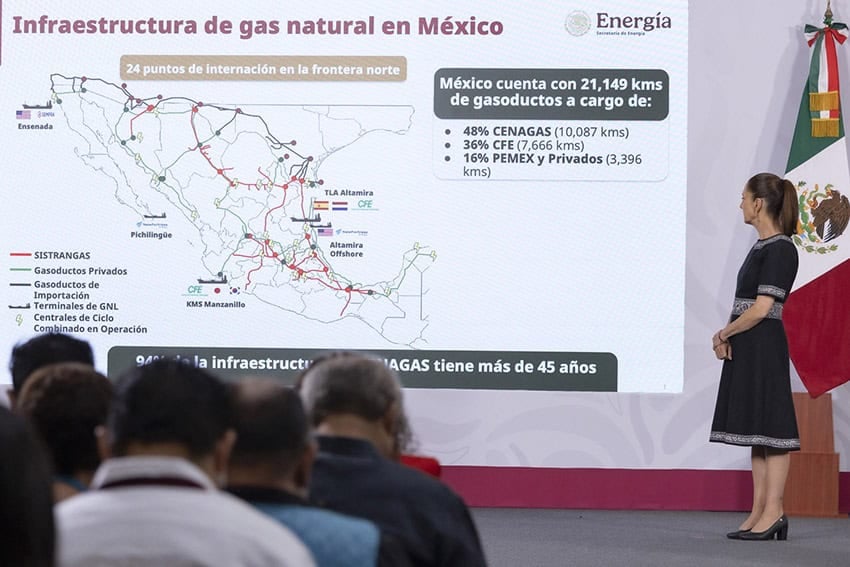
President Claudia Sheinbaum on Thursday announced a 140 billion-peso (US $8.14 billion) investment to expand, modernize and rehabilitate Mexico’s natural gas infrastructure.
“Our goal is energy sovereignty,” Sheinbaum said, adding that the investment will serve “to expand production capacity of fuels and renewable energy sources, so as not to depend on foreign countries.”
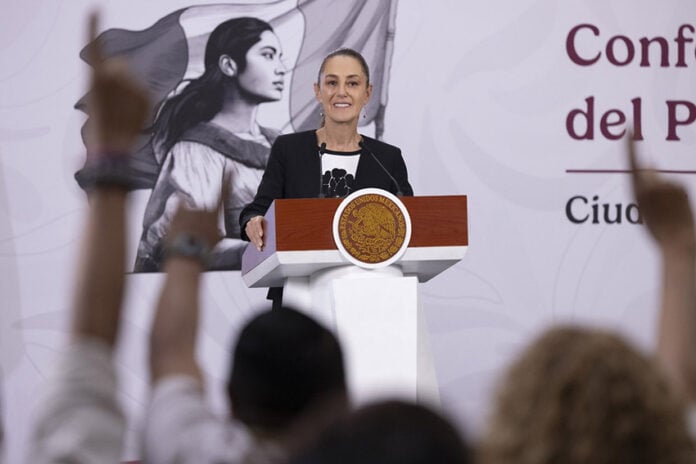
President Claudia Sheinbaum announced the investment at her Thursday morning press conference. (Juan Carlos Buenrostro / Presidencia)
The funds — provided by the Federal Electricity Commission (CFE) and National Center for Natural Gas Contro (Cenagas) — will be used to build and maintain natural gas pipeline and distribution networks.
Energy Minister Luz Elena González saidMexico consumes approximately 9 billion cubic feet of natural gas per day, of which only 2.3 billion are produced by state-owned oil company Pemex. As a result, Mexico relies on imports to meet nearly 75% of its natural gas needs, almost all of it (more than 6.5 billion cubic feet per day) coming from U.S. sources.
González said the project seeks to guarantee a “safe, efficient and timely” supply of natural gas for electricity generation (60% of which depends on natural gas), for the 15 economic development hubs that are key to Sheinbaum’s Plan México economic policy and for other industrial activities.
First presented on March 18, Sheinbaum’s energy sovereignty strategy seeks to increase national production and reduce risks derived from external dependence, which creates vulnerabilities to price fluctuations, international conflicts or climate contingencies.
This is especially important since the government projects a 30% increase in the demand for natural gas by the end of Sheinbaum’s six-year term in 2030.
Pemex CEO Víctor Rodríguez has said that Mexico has vast natural gas resources — both conventional and unconventional reserves — that have not been fully exploited. Rodríguez estimates that production could increase to more than 4 billion cubic feet per day by 2030, and approach 8 billion in a decade, bringing the country closer to energy self-sufficiency.
Another key part of the energy sovereignty strategy is the construction of 13 new CFE power plants that are expected to be completed by 2030.
Expanding Mexico’s 21,149 kilometers of gas pipelines is essential to supply these new power plants, and González said more than 39 billion pesos (US $2.27 billion) will be allocated solely for pipeline maintenance and rehabilitation.
The strategy also seeks to increase electricity generation from clean sources and renewable energies from the current 24% to 38% by 2030.
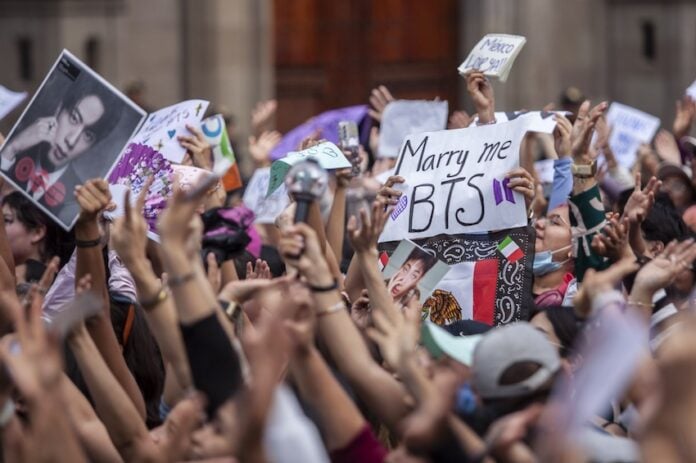
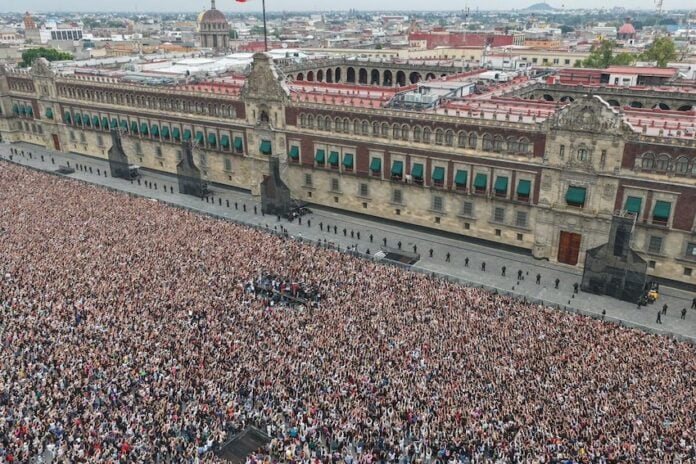
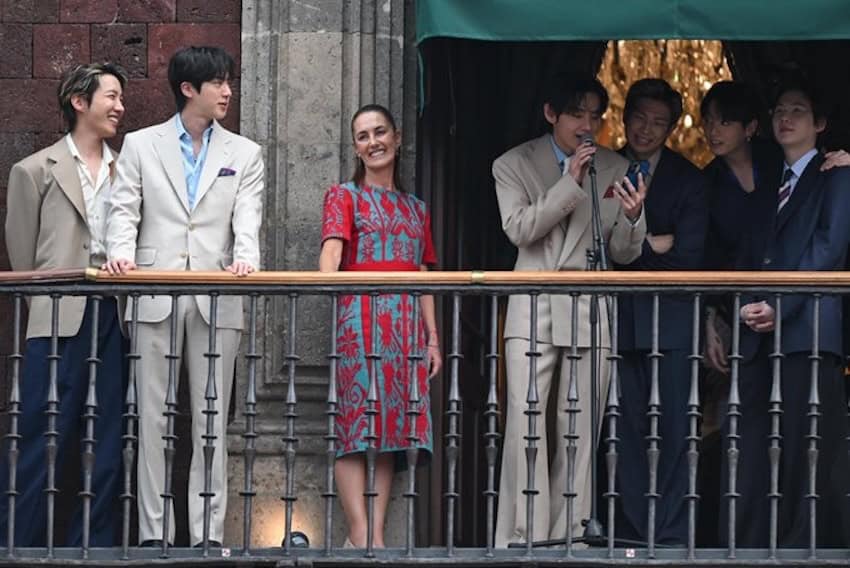
MEXICO CITY — An estimated 50,000 fans of Korean boy band BTS filled the Zócalo on Wednesday afternoon, arriving from early morning to secure positions, waiting in the sun for approximately six hours, and were rewarded at 5 p.m. with a five-minute appearance during which the group stood on the National Palace balcony, waved, said hello in English, and left.
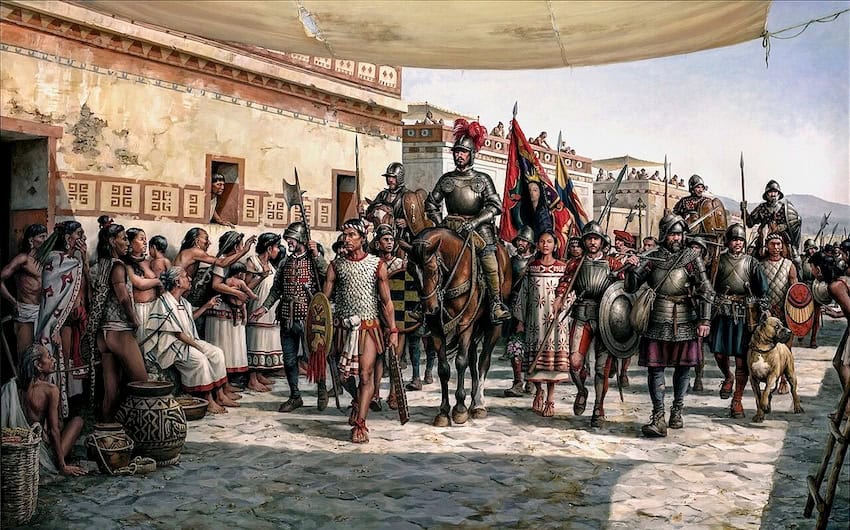
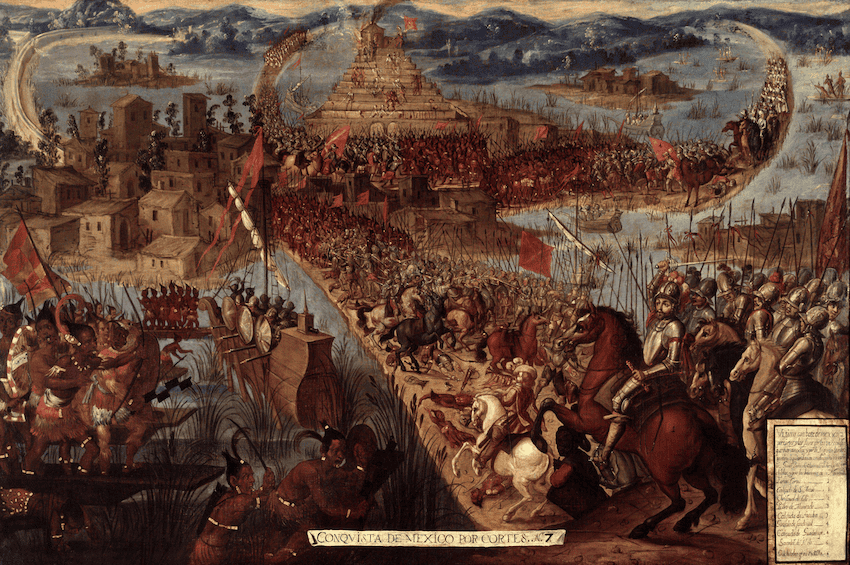
The parallels between the feted arrival of the Spanish in the same square, 5 centuries earlier, is too good not to mention. (Netflix)
There was no music. There was no singing. One member attempted three sentences in Spanish. The crowd was the population of a medium-sized Mexican city. Representatives from the crowd confirmed that it had been worth it, that they would do it again, and that they were already saving for 2027.
BTS member RM told the assembled crowd: “Hello, Mexico. We are BTS. Thank you so much for coming to see us. We can’t wait for tomorrow’s concert. I love you, thank you so much.” This statement, which contains 34 words and took approximately 18 seconds to deliver, was an event for which people had travelled from multiple states and stood in the sun since 10 a.m.
Member V, known for his musical range, vocal ability, and extensive artistic output, followed by saying he did not speak Spanish very well and then speaking a small amount of Spanish.
The appearance had been coordinated by Mexico’s Culture Minister following a direct diplomatic exchange between President Claudia Sheinbaum and the government of South Korea, making it the first time in recent memory that a bilateral diplomatic communication between two sovereign nations was initiated specifically so that a crowd could watch someone wave.
Sheinbaum, appearing alongside BTS on the balcony, told the group they had to come back next year, a statement delivered with the authority of a head of state and received by the band with the expression of people who were not sure if this was a request or an official government position. BTS agreed to review its schedule.
V’s three sentences in Spanish have been transcribed, translated, and posted to seventeen fan accounts. They have collectively received 4.2 million likes. The sentences were about missing Mexico. Mexico confirmed that it also misses BTS. Diplomatic relations are excellent.
At her May 8 press conference, Sheinbaum addressed U.S. accusations of political interference by Mexican consulates, the end date for Mexico's 2025-26 school year and plans to talk with U.S. President Trump.
(Carlos Ramos Mamahua / Presidencia)
Sheinbaum’s mañanera in 60 seconds
🇲🇽 Consulates defended: Sheinbaum flatly rejected claims that Mexico’s 53 consulates in the United States interfere in American politics, calling the accusations “completely false” and saying consulates exist to protect Mexican citizens, not meddle in U.S. affairs. Her defense came as the U.S. State Department plans a review of the consulates.
⚽ School year in flux: The president distanced the federal government from Education Minister Mario Delgado’s announcement that the 2025–26 school year would end June 5 — nearly six weeks early — due to the World Cup and heat, characterizing it as a tentative “proposal from the states” and saying a final calendar is yet to be defined.
📞Trump call coming: Asked whether she would seek a call with Donald Trump to discuss the U.S. drug trafficking charges against Sinaloa Governor Rubén Rocha Moya, Sheinbaum said she and the U.S. president “talk quite often” and could speak again soon.
Why today’s mañanera matters
At her final mañanera of the week, President Sheinbaum responded to two significant news stories that broke on Thursday:
Reporting that the U.S. State Department will conduct a review of Mexico’s consulates in the United States amid claims they are interfering in U.S. politics.
Sheinbaum’s remarks about the plan to end the school year almost six weeks earlier than scheduled were particularly significant as she indicated that the decision is not yet final.
Also of note at today’s mañanera was the president’s suggestion that she could speak to U.S. President Donald Trump soon. They would certainly have a lot to speak about, especially on the topics of trade — bilateral talks on the USMCA will take place this month — and security cooperation.
Trump said this week that the United States would take action against cartels in Mexico if the Mexican government doesn’t do so itself. Sheinbaum indicated on Thursday that she wasn’t overly concerned by the warning because Mexico is “acting” against cartels and drug trafficking.
Sheinbaum: Mexican consulates don’t interfere in US politics
A day after CBS News and other media outlets reported that the U.S. State Department would review the 53 Mexican consulates in the United States, Sheinbaum rejected claims that Mexico’s consulates are involved in political activities in the United States.
“It’s completely false,” she said.
What consulates of any country do is “protect their citizens,” Sheinbaum said, noting that they also issue visas.
She said Mexican consulates in the U.S. carry out “diplomatic work” and “help Mexican citizens,” including by facilitating bureaucratic procedures they need to complete in Mexico.
Sheinbaum also said Mexican consulates provide protection, support and legal assistance to Mexicans detained in immigration raids in the United States.
“This is the work that the consulates carry out. … It’s not the case that consulates conduct any kind of politics against the U.S. government … or that they’re playing politics in the United States. That is totally false,” she said.
Sheinbaum highlighted that respect for people’s right to self-determination is enshrined in the Mexican Constitution.
“We have no reason to [try to] influence the politics of the United States from Mexico,” she said.
🔴 “Es completamente falso”, responde Claudia Sheinbaum sobre el reporte de CBS News acerca de una revisión a los consulados de México en EU.
“No estamos de acuerdo, no es así que los consulados realicen algún tipo de política contra el gobierno estadounidense” pic.twitter.com/sIUflIQ6Aj
Sheinbaum said that her government doesn’t have any information about the State Department review of the Mexican consulates in the U.S., and asserted that there is no reason for one to be carried out.
“[The consulates] are very respectful of U.S. politics,” she said.
The New York Times reported that the State Department “review comes after claims have been circulating in conservative media in recent months that Mexican consulates interfere in American politics and encourage mass migration to the United States.”
“The accusations largely originated from Peter Schweizer, a right-wing author and contributor to Breitbart News who has promoted conspiracy theories about foreign government influence,” the newspaper wrote.
Sheinbaum: Decision to end school year early is not yet definite
Sheinbaum said that Education Minister Mario Delgado’s announcement on Thursday that the 2025-26 school year would end almost six weeks early on June 5 is a “proposal … that comes from the states.”
“It’s not a decision of Mario,” she said, noting that the federal education minister and state education ministers had convened for a meeting.
Sheinbaum said that the main reason for what she characterized as a tentative decision to end the school year on June 5 rather than July 15 is the World Cup, which Mexico will co-host with the United States and Canada.
“So this proposal was taken, there is not yet a defined calendar,” she said, although Delgado himself posted to social media an updated school calendar showing that the school year will conclude on June 5.
“It’s also important that children don’t lose classes, right? … Children’s class days also have to be considered,” Sheinbaum said.
A reporter asked the president whether she would seek a call with President Trump to discuss U.S. prosecutors’ drug trafficking accusations against Sinaloa Governor Rubén Rocha Moya — who is currently on leave — and nine other Sinaloa-based current and former officials.
“We talk to President Trump quite often and we could speak soon,” Sheinbaum said.
“We have a lot of common issues, … the Mexicans who live there [in the U.S.], the trade issues and many other issues,” she said.
Although the Mexico-U.S. relationship is currently strained, Sheinbaum stressed that “we want to maintain it.”
“… We don’t necessarily have to agree on everything … and when we don’t agree we have to say so,” she said.
“But that doesn’t mean we don’t seek a good relationship,” Sheinbaum said.
She subsequently reiterated that Mexican authorities have determined that there is currently insufficient proof against Rocha and the other nine defendants to warrant their “urgent arrest” for the purpose of extradition to the United States.
By Mexico News Daily chief staff writer Peter Davies (peter.davies@mexiconewsdaily.com)
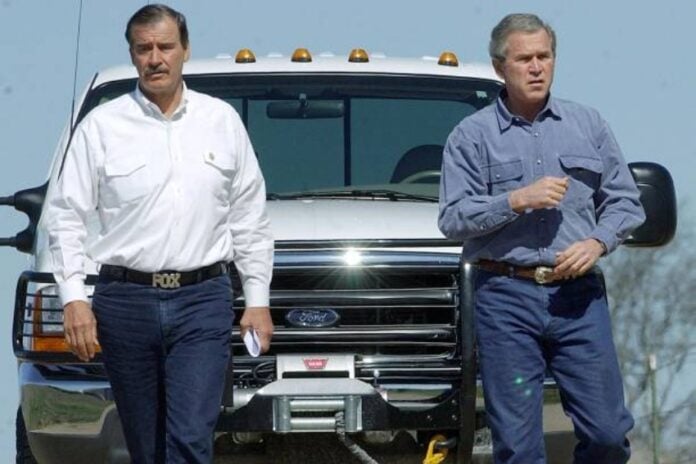
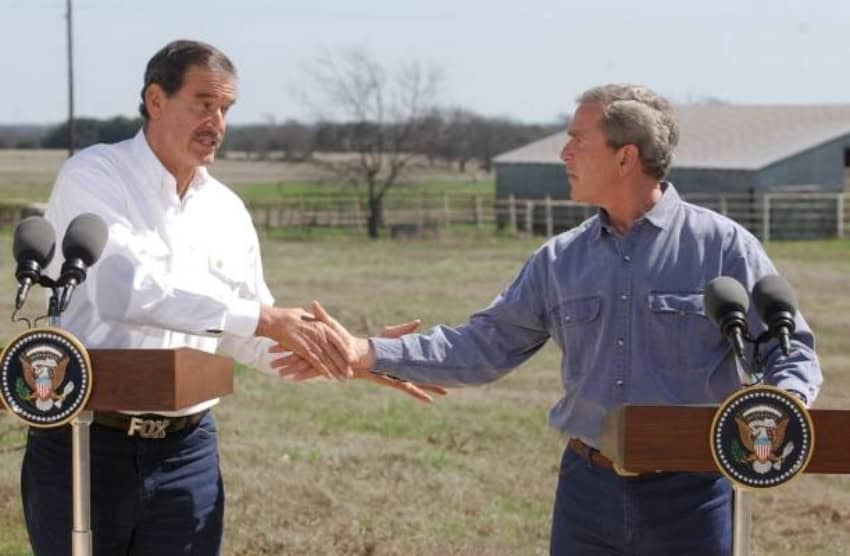
U.S. President George W. Bush and Mexican President Vicente Fox had a lot in common. But their opinions differed significantly when it came to broccoli. (Getty Images)
It’s February 2001, and George W. Bush is in Guanajuato, Mexico, on his first foreign trip as president. He’s there to visit Vicente Fox, the man who just ended 71 years of one-party rule in Mexico. The two leaders share several parallels: both are cowboys, both are conservative and both are new to the job. On vegetables, however, they differ greatly.
The difference nearly caused an international incident.
The two presidents shook hands after this meeting in Texas in 2004, but by then their budding bromance had ended. (Getty Images)
The two men met on Fox’s Rancho San Cristóbal, in the heart of Mexico’s agricultural export country, surrounded by fields of broccoli and cauliflower crops bound for U.S. supermarkets, through which Fox’s family had built a sizable income. Naturally, he offered Bush a plate of broccoli.
Bush gave it an immediate thumbs-down.
“Make it cauliflower,” he said. Reporters scrambled.
Had the U.S. president just insulted the Mexican president on his own land?
The short answer is no. The long answer is also no, but it deserves some attention.
A Bush family tradition
Apparently, an aversion to green crucifers ran in the family.
George H.W. Bush — the 41st president of the U.S. and father of the man now standing in a Mexican broccoli field — had already publicly declared war on the vegetable a decade earlier.
“I do not like broccoli. And I haven’t liked it since I was a little kid, and my mother made me eat it. And I’m President of the United States, and I’m not going to eat any more broccoli.”
Like father, like son.
Birds of a feather
On paper, the duo was well matched. Both projected a certain folksiness that went over well in their respective heartlands.
Fox had just ended seven decades of one-party Institutional Revolutionary Party (PRI) rule with his 2000 election victory, although his rancher credentials were inherited at best. It was his father who had dedicated his life to the land and moved the family to a 1,000-acre ranch in the municipality of San Francisco del Rincón, Guanajuato.
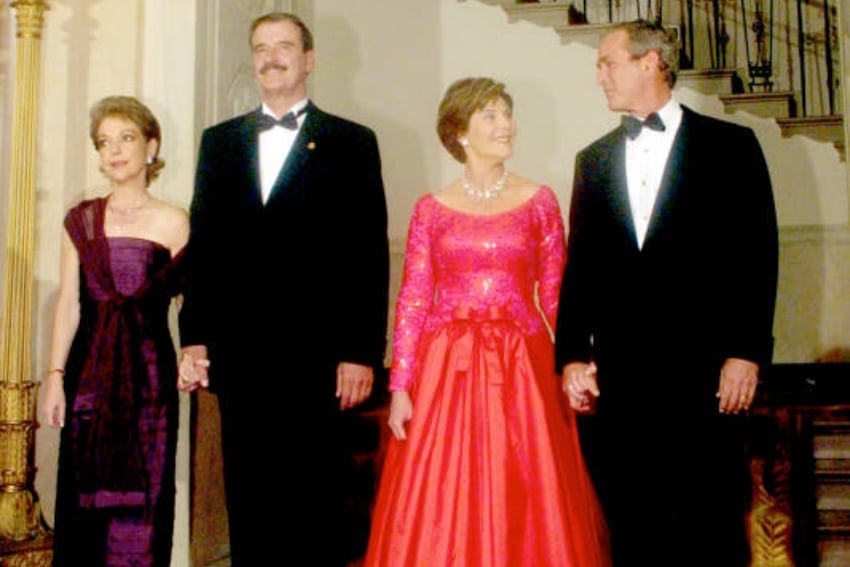
The presidents and their first ladies on a formal occasion. Both Fox and Bush were more comfortable on ranches. (Getty Images)
Vicente grew up to run Coca-Cola in Mexico before pivoting to politics, not that this mattered much to the electorate. Not unlike Bush’s attempts to convey a down-home image during his presidential bid, Fox campaigned in cowboy boots and a belt buckle and won the election, promising to modernize Mexico’s economy and drag its political system out of institutional stagnation.
Fox, who had campaigned not just on modernization but also openness, seemed the perfect U.S. ally. Bush’s Texas upbringing, meanwhile, gave him enough Spanish to exchange pleasantries with Fox, and he slipped comfortably into the role of a willing American suitor.
So why was Bush here, on a broccoli farm in Guanajuato, on his very first trip abroad as president?
With Fox’s election, Mexico had turned a historic page, and Washington was eager to be on the right side of it. The hope was that the two countries could enter a new era, one where a thriving NAFTA trade agreement would deepen cooperation on border infrastructure, commerce and security.
The visit to Rancho San Cristóbal was choreographed accordingly: two leaders comfortable on a ranch, figuring out the future of North America.
Fox, for his part, had an ambitious agenda ready. He pushed for what he called the “whole enchilada” — a broad deal that might include regularization for undocumented Mexicans already in the U.S., plus new legal channels for future workers. It was an audacious ask, and Bush, at least publicly, wasn’t dismissing it.
But before anything could move forward, September 11, 2001, happened.
An unraveling enchilada
The bilateral agenda Fox had staked so much political capital on shifted almost overnight. Immigration reform, the new era of North American cooperation — everything was on hold as Washington pivoted to security and war.
In 2003, as the U.S. pushed for United Nations backing to invade Iraq, Mexico held a rotating seat on the Security Council. Fox’s vote was unusually important to the U.S. president: While his vote wasn’t vital, it was symbolic.
Pressure from the White House was intense, but Fox chose to align with Mexican public opinion, which was overwhelmingly antiwar. Surveys showed 80% of Mexicans were against the invasion, shaped in part by fears of economic shock, possible border tightening and a long history of distrust for Mexico’s northern neighbor.
Outside the U.S. Embassy in Mexico City, protesters hung a banner reading “Today Iraq, Tomorrow Mexico,” a slogan that captured how many Mexicans saw the war as part of a broader pattern of U.S. interventionism.
Recovering from back surgery in a Mexico City hospital, Fox told reporters that Bush had “insistently” tried to convince him but that Mexico’s decision would be a state one, not a personal one.
These days, what most people remember is “the broccoli incident”: that moment at Fox’s ranch in San Francisco del Rincón when Fox offered “Dubya” some broccoli and Bush famously gave it an immediate thumbs-down, saying, “Make it cauliflower.”
The clip lives on in social media, resurrected by history accounts and meme pages as evidence that George W. Bush was, indeed, a quirky character. Mexican commentators file it alongside Fox’s other ridículos internacionales, of which there were plenty, the most notable being a leaked phone call in which Fox asked Fidel Castro to eat lunch and leave a Monterrey summit early so as not to cross paths with Bush. Castro was offended, and that blooper ended up on front pages worldwide.
Years later, in Fox’s memoir, he would describe Bush as “the cockiest guy I have ever met in my life,” and a “windshield cowboy,” afraid to ride a powerful horse.
For the record, photos of an adult George W. Bush on horseback are nowhere to be found.
Bethany Platanella is a travel planner and lifestyle writer based in Mexico City. She lives for the dopamine hit that comes directly after booking a plane ticket, exploring local markets, practicing yoga and munching on fresh tortillas. Sign up to receive her Sunday Love Letters to your inbox, peruse her blog or follow her on Instagram.
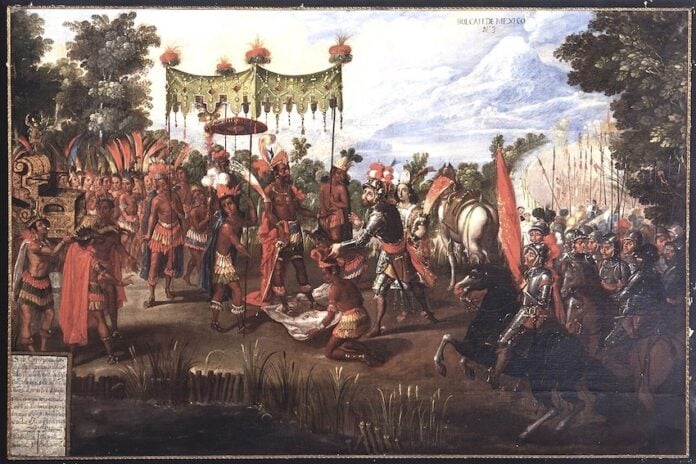
No one believed that Hernán Cortés was Quetzalcóatl, nor that the Spaniards were gods when they arrived in Tenochtitlán. (Jay I. Kislak Collection/Rare Book and Special Collections Division/Library of Congress/Wikimedia Commons)
Francisco López de Gómara never set foot in America, nor had he ever encountered Mexica culture. However, as a Spanish humanist historian endorsed by the Catholic Church, he enjoyed writing chronicles and official records about the discoveries his country’s conquerors had made in the New World.
At the height of his career as chronicler of the new territory, around 1552, he proposed an idea that would change the way Indigenous Americans were viewed.
“The story of the ‘white gods’ is a dehumanizing narrative,” historian Camilla Townsend has argued. (Augusto Ferrer Dalmau/Wikimedia Commons)
As Hernán Cortés’ secretary, he thought it appropriate to suggest that the Indigenous people in Mexico had allowed European colonization because they considered the Spaniards to be gods, and specifically that Cortés was the return of the god Quetzalcóatl. A historical review of pre-Hispanic records, however, does not corroborate this assumption.
No mention of ‘gods’ in firsthand accounts
During his years as a conquistador, Cortés wrote many letters to the Spanish monarchs. In them, he reported the most significant events in the process of territorial colonization that the Spanish sought to carry out abroad. In none of them, notes historian Camilla Townsend, does he address the idea that the native inhabitants saw the Spaniards as gods.
Yet, López de Gómara’s “white gods” narrative was so convincing and powerful that many colonizers from Europe adopted it as a banner that delegitimized theexisting ways of life in the Americas. Despite the millennia of scientific, cultural and religious development already possessed by the native inhabitants, the force of arms, foreign diseases and hate speech against the pre-Hispanic world were powerful Spanish tools thatdiminished their power. The idea that the Mexica believed the Spaniards were “white gods” was so effective that it was eventually used to justify the military campaigns waged throughout the Americas to conquer Indigenous peoples, since the myth characterized them as naive and naturally submissive to European conquerors of supposedly superior intellect.
Not only that, it was valid in the eyes of the Spanish invaders to question whether the beings they encountered in the New World were truly human, and therefore, whether theydeserved God’s mercy.
Cortés was never Quetzalcóatl
Eight ominous omens are said to have preceded Cortés’ arrival. All of these manifestations appeared to Moctezuma in the months leading up to the arrival of the Spanish in Tenochtitlán. None of them were related to the ancient Mexica myth that the feathered serpent god Quetzalcóatl would one day walk among humankind again.
In a 2002 article in the INAH journal, Arqueología Mexicana, historian Miguel de León Portillaargued that the belief in “the return of events and people seems to have been a recurring element in Mesoamerican thought.”
Europeans adopted the flawed “white god” narrative as a banner to delegitimize the existing ways of life in the Americas. (Thomas Kole/Wikimedia Commons)
Although the religious ministers of Tenochtitlán indeed preached the myth of Quetzalcóatl’s return, there is no evidence linking this mythological and cultural framework in the minds of the Indigenous peoples of Mexico to the Spaniards’ arrival.
Why were the Spanish able to successfully conquer the Mexica?
While it is true that the Spanish possessed superior weaponry to the Mexica, there is no primary evidence demonstrating that this made the Spanish appear as gods in their eyes. On the contrary, it is well known that Cortés managed to subdue Tenochtitlán with the help of the Tlaxcalans, who had a much larger army than the Spaniards. What’s more, the Tlaxcalans had an in-depth knowledge of the local terrain. Otherwise, the European expansionist campaigns in America would likely have been unsuccessful. Sheer numbers and technology were the decisive factors, not misguided Indigenous beliefs.
Although historical records from the period support this more practical version of events, even in Mexico, the belief that the Mexica thought the Spaniards were gods still lingers.
Centuries after the conquest, this persistent assumption seems rather absurd and is similar to the belief that America was actually discovered when people had been there for millennia.
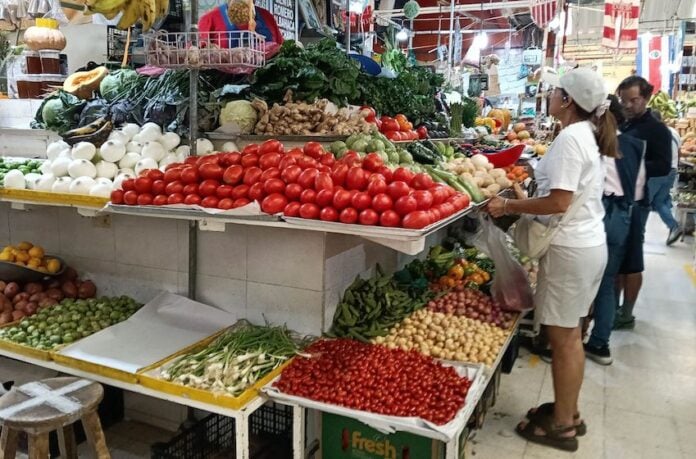
Though inflation eased in April, food prices moved upward, mainly due to a 21.43% increase in fruit and vegetable prices. (Daniel Augusto/Cuartoscuro)
Official data showing a decline in inflation in April was published on Thursday morning and just hours later the Bank of Mexico (Banxico) board voted in favor of cutting the central bank’s key interest rate by 25 basis points.
The national statistics agency INEGI reported that Mexico’s annual headline inflation rate was 4.45% in April, down from 4.59% across March. The decline in April came after the headline rate increased in each of the first three months of 2026.
Among those applauding Banxico’s latest interest rate cut was President Claudia Sheinbaum, who said the move “activates investment.” (Mario Jasso/Cuartoscuro)
INEGI also reported that month-over-month inflation was 0.20% in April, while the annual core rate — which excludes volatile food and energy prices — was 4.26%, down from 4.45% across March.
Later on Thursday, a divided Bank of Mexico governing board voted in favor (3-2) of lowering the central bank’s benchmark interest rate from 6.75% to 6.50%. The 25-basis-point reduction is the bank’s second interest rate cut this year after the key rate was lowered from 7% to 6.75% in March. The Banxico board has demonstrated on various occasions that it is willing to cut the bank’s key interest rate even when inflation is well above the 3% target.
Fruit and vegetable prices increase more than 20%
INEGI’s data shows that fresh food prices increased 7.98% in April compared to the same month last year. The annual spike was the product of a 21.43% increase in fruit and vegetable prices and a 1.05% reduction in the cost of meat.
The annual inflation rates in April for the other categories monitored by INEGI were as follows:
Packaged food, beverages and tobacco: 5.35%
Services: 4.52%
Non-food goods: 2.82%
Energy (including electricity and gasoline): 2.8%
On a month-over-month basis, the price of poblano chiles increased 41.42% in April while tomatoes and high-octane gasoline were 19.25% and 6.16% more expensive, respectively.
In contrast, green tomatoes were 34.8% cheaper in April than in March, while electricity prices fell 14% as lower summer rates commenced in various cities including Mérida, Monterrey and Acapulco.
Banxico interest rate looks set to stay at 6.50% through 2026
In a statement on Thursday, the Bank of Mexico acknowledged that inflation decreased in April “due to a decline in its core component.”
The central bank said that “the balance of risks for the trajectory of inflation within the forecast horizon remains biased to the upside,” but noted that its governing board nevertheless deemed it “appropriate to make an additional reference rate cut and thereby conclude the [monetary policy easing] cycle that began in March 2024.”
“… Looking ahead, the Governing Board estimates that it will be appropriate to maintain the reference rate at its current level. It judges that the monetary policy stance is well-suited to face the challenges posed by the macroeconomic environment, including those associated with an extension and escalation of the Middle Eastern conflict and its repercussions,” Banxico said.
The bank forecasts that the average annual inflation rate in the second quarter of 2026 will be 4.1%. It anticipates that inflation will decline to 3.8% in the third quarter, 3.5% in the fourth quarter, and 3.2% in the first quarter of 2027. Banxico sees inflation converging to its 3% target in the second quarter of 2027 and remaining at that level through next year and the first quarter of 2028.
The central bank said that its forecasts are subject to “various risks.”
On the upside those risks are:
Disruptions due to foreign trade policies or to an inflationary impact from geopolitical conflicts.
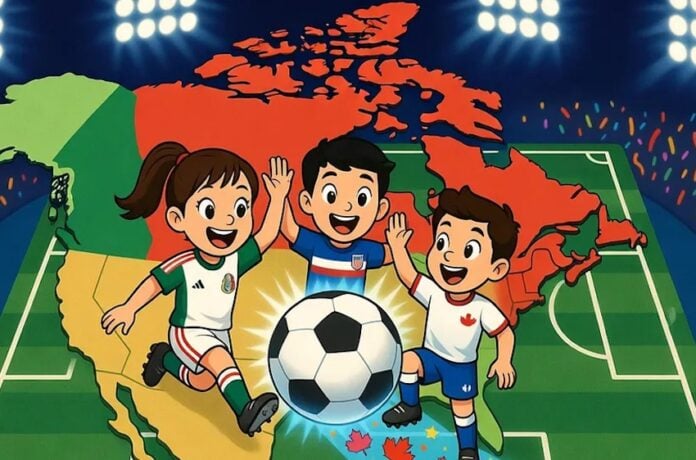
Will we as a region keep kicking the ball back and forth across the border… or finally build the shared pitch we all deserve? (Image courtesy of the author)
I was raised watching, playing and experiencing football — soccer for my American friends, though I’ll use the words interchangeably here.
My dad started taking me to Ciudad Universitaria Stadium in Mexico City to watch Pumas when I was barely old enough to walk. I’ve been going ever since. It was the only time all week I was allowed to swear. I saw people from every corner of the city chanting the same songs, I hugged countless strangers after every goal, and yes, I’ve cried tears of pure joy alongside tough, strong men when the Pumas last lifted a trophy (sadly, it was a long time ago). Believe me: soccer is the ultimate social blender.
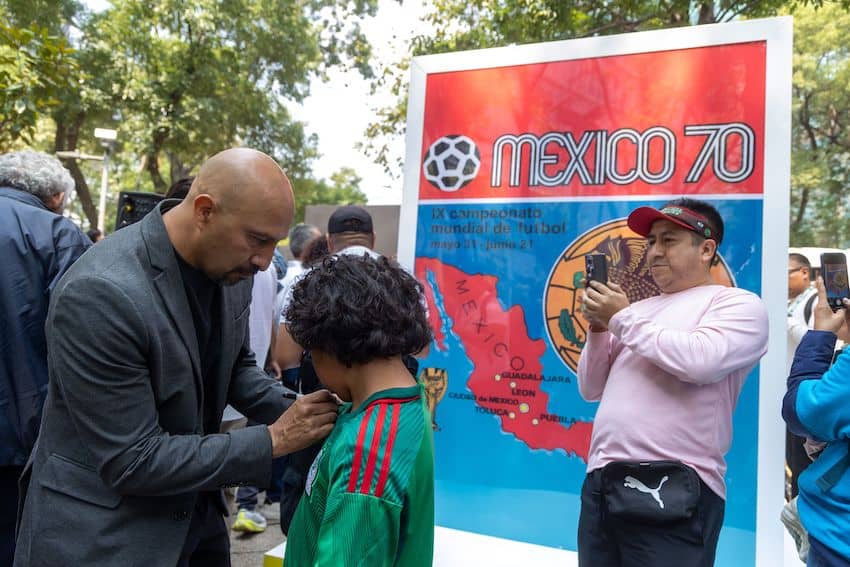
Oscar “El Conejo” Pérez signs a jersey during the unveiling of monumental Panini cards along Mexico City’s Reforma Avenue, featuring soccer players who have played key roles in World Cups throughout history. (Moisés Pablo/Cuartoscuro)
I’m a true fan. A couple of times I’ve traveled to Europe, I’ve made sure to catch a Champions League match (the tournament where the top club teams from every national league face off). I saw Benfica (Portugal) take on Manchester United (England), mainly to watch Javier “Chicharito” Hernández, a Mexican forward, do his thing.
Another time, it was Real Madrid versus Paris Saint-Germain at the Santiago Bernabéu. The magic starts the moment you step onto the subway: fans from every corner of the world, wearing different colors, sharing the same buzz. Soccer has taken me closer to cities, countries, and cultures than anything else ever could. When Rafa Márquez played for Barcelona, I fell in love with Cataluña — just like my parents did with Madrid decades earlier when Hugo Sánchez lit it up for Real Madrid. Players become walking ambassadors. Once, backpacking in Thailand, someone asked where I was from. When I said Mexico, the guy shouted: “I love Chicharito!” Never underestimate the soft power of a football shirt.
So let’s get serious about something fun: soccer — and sports in general — can be a powerful platform for social integration, economic development, talent mobility, cultural mixing and serious revenue. It’s the perfect soft but extremely effective tool to pilot deeper North American integration.
A systematic review of 69 studies on sport for social integration among disadvantaged populations (migrants, refugees, at-risk youth) shows football consistently scores four big wins: interaction through shared play, identification with something bigger than yourself, acculturation (learning the new culture while keeping your own roots) and placement (real pathways to jobs, school and networks).
Grassroots programs like Midnight Basketball in the U.S. or Community Cup in Ottawa prove the pattern — crime drops, social capital rises and “them” quietly turns into “us.” In North America’s super-diverse cities, ethnocentric soccer teams let Mexican-American kids stay rooted while building proud hyphenated identities. Barriers exist (cost, discrimination, old-school gender rules), but when programs are co-designed with the players themselves, soccer turns tension into trust faster than any trade agreement ever could. We need to tackle this systematically. Time to look at Europe…
Economic development & solidarity
The Union of European Football Associations (UEFA) doesn’t just reward the superclubs (like Real Madrid, Paris Saint-Germain or Manchester United), it forces them to subsidize the rest of the pyramid. Ten percent of Champions League revenue is allocated to solidarity payments, with €308 million earmarked this cycle for clubs outside the elite.
That money builds academies, women’s programs and community pitches in places that would otherwise be forgotten. North America can copy the model and improve it: tie a permanent Liga MX-MLS-Canadian hybrid tournament — the Leagues Club, for example — to a legacy fund that channels prize money into border-city leagues, public fields in underserved neighborhoods and youth development where the next stars are born. The result? Broader economic growth, inclusion and a stronger regional talent base that feeds everyone.
Talent mobility
Before 1995, European clubs lived under strict “foreigner quotas”; a capped amount of foreigners per team.
Then the Bosman ruling happened: the European Court of Justice ruled that those limits violated free movement of workers. Overnight, talent flowed freely — Spanish kids in German academies, Polish strikers lighting up the Premier League and Mexican prospects finally getting real shots abroad. We can do the same here without erasing national flags. A “North American youth sports passport” would let kids from Tijuana, El Paso or Windsor cross borders for tournaments the same way players already move in Europe. Liga MX already dominates U.S. Hispanic viewership and packs American stadiums. Imagine formal talent pipelines that turn raw border passion into pro contracts while still feeding strong national teams and a thriving continental league.
Cultural mixing without losing national identity
Europe proved you don’t have to surrender your flag to gain a continent. Fans still scream for Spain, Germany or Poland, but they trade scarves, share memes and build hybrid identities during EURO summers (the national-team continental tournament that feels like a mini-World Cup).
In North America, Mexican national team games in the U.S. routinely outdraw the U.S. team. The more than 40 million Mexicans and Mexican-Americans in the U.S. fill stadiums every time El Tri plays. I saw it firsthand a few weeks ago in Chicago — freezing cold, yet thousands packed Soldier Field for Mexico versus Belgium. Soccer is living proof that regional identity doesn’t replace national identity; it makes both richer, louder and more fun.
Revenue streams
EURO 2024, hosted by Germany, didn’t just fill stadiums — it turned out to be a huge source of revenue: €7.44 billion in economic impact for Germany, with 44% of ticket holders coming from abroad and nearly two-thirds using public transit.
The Champions League is a redistribution machine pulling in €4.4 billion in gross revenue in 2024/25, with €3.4 billion going to clubs. North America has already experimented with this — Leagues Cup finals drew 69,000 fans, and the 2026 World Cup will co-host 104 matches across three countries. Early projections point to hundreds of millions (if not billions) in tourism, media value, sponsorships, hotels and short-term rentals, especially in border cities. Every peso or dollar spent on tacos, scarves and match-day beers stays inside the region, turning soccer from a cost center into a continental cash engine.
That said, a friendly but firm critique: soccer cannot become an elitist sport. It was born in the streets and trenches and must stay accessible. Tickets for the 2026 World Cup cannot price out the very families and working-class fans who make this beautiful game what it is. The whole point is social cohesion, family values, and bringing people of all classes together on the same stands. We missed the mark on pricing this time, but we can — and must — do better going forward.
The 2026 World Cup as catalyst
While 48 teams battle across 16 stadiums in three countries, a parallel score (maybe more important) will be measured in tourism, international fandom, infrastructure upgrades and lasting connections. This is North America’s chance to spearhead a true turning point in our region. It’s the perfect excuse to lock in permanent structures: a continental club tournament, solidarity funds, youth passports and border-city circuits that turn the pitch into the place where Mexico, the U.S. and Canada finally play as one team.
Europe turned 22 guys chasing a ball into a continental identity project. We’ve got the fans, the passion, the infrastructure, the tacos and the 2026 stadiums already installed. The only question left is whether we keep kicking the ball back and forth across the border… or finally build the shared pitch we all deserve.
Let’s use this World Cup as the catalyst for something bigger, more ambitious and more forward-looking. Soccer has always been the best pilot program — and the best excuse — for deeper social, cultural, political and economic integration. We must not miss the chance.
Pedro Casas Alatriste is the Executive Vice President and CEO of the American Chamber of Commerce of Mexico (AmCham). Previously, he has been the Director of Research and Public Policy at the US-Mexico Foundation in Washington, D.C. and the Coordinator of International Affairs at the Business Coordinating Council (CCE). He has also served as a consultant to the Inter-American Development Bank. Follow his Substack here.
Since the vast majority of the 50,000 BTS fans crowding Mexico City's Zócalo were probably shut out from tickets for this week's concerts, the Korean boys' brief appearance on the balcony of the National Palace was as close as they'll get to their K-pop idols, at least for this year. (Presidencia)
An estimated 50,000 fans of the Korean boy band BTS turned Mexico City’s Zócalo into a sea of purple on Wednesday as the K-pop superstars stepped onto a National Palace balcony alongside President Claudia Sheinbaum.
The appearance — which did not include any singing or music — came one day before the group was to open its “Arirang” world tour at Estadio GNP Seguros. The first of three sold-out shows in Mexico City was set for Thursday night, with others to follow on Saturday and Sunday.
A balcony appearance along with the president was what fans had waited for all day — no music, no singing, no dancing, but a lot of valiant effort at speaking Spanish. (Presidencia)
Fans carrying homemade banners and cardboard cutouts of the band’s seven members began arriving at the Zócalo in the late morning to secure spots for the appearance around 5 p.m.
From the balcony, band member RM, whose real name is Kim Nam-joon, said, “Hello, Mexico. We are BTS. Thank you so much for coming to see us. We can’t wait for tomorrow’s concert. I love you, thank you so much.”
Kim Tae-hyung, known professionally as V, followed by saying, “I don’t speak Spanish very well, but I’ll try.” He then delivered a short message in Spanish thanking fans, saying BTS misses Mexico and praising the crowd’s energy.
Then Sheinbaum spoke, revisiting a statement she had made in March about getting BTS to return to Mexico for more shows. Turning to the band, she proclaimed, “I already told you that you have to come back next year,” prompting a loud roar and exuberant chants from the crowd below.
On Thursday, Sheinbaum took it a step further, saying at her morning news conference that “BTS will return to Mexico in 2027. We will announce the dates soon,” adding that the group agreed to review its schedule.
Virtual queues swelled to more than 1.1 million users worldwide, and fans reported crashes, stalled orders and error messages during presales and general sales.
Sheinbaum said she wrote to South Korean President Lee Jae-myung asking for help securing more dates — and even exploring a free Zócalo concert — to respond to young Mexicans shut out by the stampede for tickets.
City officials said Wednesday’s balcony appearance was coordinated by Culture Minister Claudia Curiel after those exchanges with officials in Seoul.
Recibo con gusto a uno de los grupos más queridos por las y los jóvenes de México: BTS. La música y los valores unen a México y Corea del Sur. pic.twitter.com/OS39Sp0H6g
— Claudia Sheinbaum Pardo (@Claudiashein) May 6, 2026
BTS has performed in Mexico City twice before as part of large, multi-artist K-pop concerts.
In 2014, BTS appeared in the KBS Music Bank World Tour at Mexico City Arena, along with groups including EXO-K, Beast and Infinite. They returned to the same venue in 2017 for KCON Mexico, which also featured Monsta X, Red Velvet and NCT 127.
For this week’s sold-out shows, individual tickets originally priced around 5,000–5,500 pesos (US $290-$318) for mid- to high-tier sections were listed on resale sites Thursday for roughly 24,000 pesos (US $1,390). Better seats were listed at more than 100,000 pesos ($5,788) each.
Indeed, for many fans, Wednesday’s five-minute glimpse from the Zócalo may be as close as they get to BTS this time around.
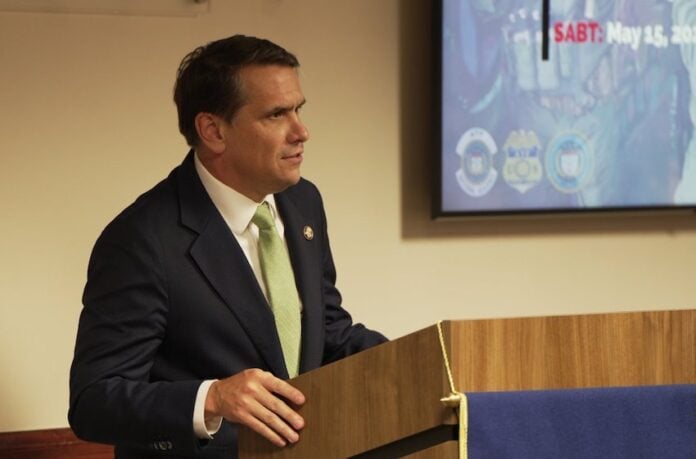
"We've already indicted multiple government officials out of Mexico ... And so that's something that will continue," acting U.S. Attorney General Todd Blanche said in a NewsNation interview on Wednesday. (@ATFHQ/X)
A week after a U.S. indictment accusing Sinaloa Governor Rubén Rocha Moya of drug trafficking and weapons offenses was unsealed, acting U.S. Attorney General Todd Blanche indicated that U.S. prosecutors will file more charges against Mexican politicians.
NewsNation immigration correspondent Ali Bradley highlighted that the Trump administration has “promised to bring consequences to Mexico when it comes to corrupt politicians that might have ties to the criminal cartels” and asked Blanche what consequences there could be for Mexican officials beyond revocations of their U.S. visas.
“… I think that that’s something we’ve done in the past, but we’re certainly going to continue to do that,” he said.
Asked specifically whether “we could see more indictments” against Mexican officials, Blanche responded:
“Sure, yes, and we’ve already indicted multiple government officials out of Mexico, a judge recently as well. And so that’s something that will continue. One consequence of having a lot of the leaders of some of these cartels brought here over the past year … is some of them will likely want to cooperate and that cooperation could lead to additional charges.”
Since February 2025, Mexico has sent more than 90 cartel figures to the United States in three separate transfers. Beyond the people sent to the U.S. in those transfers, many other Mexicans accused of drug trafficking, including two sons of convicted drug lord Joaquín “El Chapo” Guzmán Loera and Sinaloa Cartel leader Ismael “El Mayo” Zambada, are in U.S. custody.
Rocha — who is currently on leave as the Federal Attorney General’s Office assesses the U.S. allegations against him and conducts its own investigation — is accused of colluding with the “Los Chapitos” faction of the Sinaloa Cartel, which is led by sons of Guzmán Loera. Nine other current and former Sinaloa-based officials, including a Morena party senator and the mayor of Culiacán, are accused of drug trafficking in the same indictment. Rocha, who also represents Morena, denies the U.S. allegations against him.
Blanche: ‘We have a very good relationship with the Mexican government’
After noting that an indictment had been filed against Rocha in the southern district of New York and indicating that more allegations against Mexican officials were likely forthcoming, Blanche added:
“By the way, we have a very good relationship with the Mexican government right now. I mean I think they recognize the importance of their relationship with us, and also that that relationship depends on cooperation and support in the immigration space, combating drug trafficking and things like that.”
Indeed, President Claudia Sheinbaum has repeatedly said that her government is willing to cooperate with the United States on security as long as Mexican sovereignty is respected. However, she has made it clear that said cooperation doesn’t extend to handing over Rocha to the U.S. without hard proof demonstrating his probable guilt.
On repeated occasions, Sheinbaum has said that the superseding indictment published online by the U.S. Department of Justice is almost entirely devoid of “proof” against Rocha and the nine other defendants. Last week, she said that a handwritten list in the indictment that allegedly shows how much officials received in regular bribes from “Los Chapitos” is just “a sheet of paper.”
‘Send proof’: Sheinbaum reiterates her message to US authorities
At her Thursday morning press conference, Sheinbaum was asked to respond to Blanche’s statements indicating that more indictments will be filed against Mexican politicians.
“Proof,” she responded.
“… What have we said? Send proof because the extradition treaty or [the bilateral agreement] on mutual trust and collaboration has to do with sending proof,” Sheinbaum said.
🚨 “Envíen pruebas”, responde Claudia Sheinbaum luego de que el fiscal Todd Blanche advirtiera que habrá más acusaciones contra políticos mexicanos.
La presidenta insistió en que las detenciones deben apegarse a la ley mexicana; “también queremos que ellos cooperen y no han… pic.twitter.com/0ilLTAVybV
A strong first quarter of 2026 was followed by an even stronger April, pushing car sales in Mexico for the four months over the 500,000 mark, a new record. (AMDA)
Car sales in Mexico topped the 500,000 mark in light vehicle sales during the January-April period for the first time ever, according to the national statistics agency INEGI.
The sales figure represented a 4.8% increase over the same period in 2025 and topped the previous record for January-April set in 2017 when 493,823 light vehicles were sold.
Guillermo Rosales, president of the Mexican Association of Automotive Distributors, cites as a key factor in Mexico’s healthy domestic sales a “hyper-competition” among quality manufacturers vying for customers. (AMDA)
Key to breaking the half-million mark was an especially strong April when light vehicle sales reached 118,859, which INEGI said was an 8.6% improvement over April 2025 sales. The 381,632 vehicles in the previous three months had represented an increase of 3.7% over the first quarter of 2025.
Guillermo Rosales, president of the Mexican Association of Automotive Distributors (AMDA), said a primary factor driving car sales is “hyper-competition” among automotive brands. Adding to that healthy competition was the arrival of Chinese electric vehicles that stand out for their level of technology and connectivity.
Also helping, Rosales said, was that the 50% tariff on vehicle imports from countries outside North America has not yet raised vehicle prices.
Among domestic automakers, Stellantis (up 15.8%), Hyundai (up 13.7%), General Motors (up 6%) and Volkswagen (up 5%) enjoyed the biggest sales increases.
Nissan, No. 1 in sales in Mexico with a 17.3% market share, remained stable with just a 0.1% increase in April, while Toyota and Lexus boosted their cumulative market share to 8.1% by selling a combined 10,713 light vehicles in April.
Last month’s sales performance exceeded AMDA’s forecast of 113,124 units by 4.8% and was the best April for light vehicle sales since 2013.
Furthermore, AMDA speculated that since some brands (including Chinese carmakers BYD, GAC and Chirey) do not report their figures to INEGI, the overall April 2026 performance (including imported vehicles) might have actually been closer to 127,000 units. If accurate, this would represent an increase of 8.5% compared to April 2025 and would set a new record for sales in the month of April.
The newspaper El Economista reported that some Chinese brands enjoyed triple-digit growth last month, including Geely (283%), Changan (101%) and Jetour SOUEAST (610%). However, El Economista said Great Wall Motors and MG sales declined.
Rosales said the market share of Chinese brands has increased by up to 1 percentage point, with total volume rising by a similar amount. Total imports from China have increased by a similar amount.
Expansión magazine attributed this to a more competitive offering in terms of price and equipment, as well as a faster expansion of their product portfolio. This combination has allowed some Chinese brands to overcome the original perception of low reliability that marked their entry into the Mexican market.