Home Blog Page 41

US and Mexico set May 25 date for first official USMCA negotiating round

2
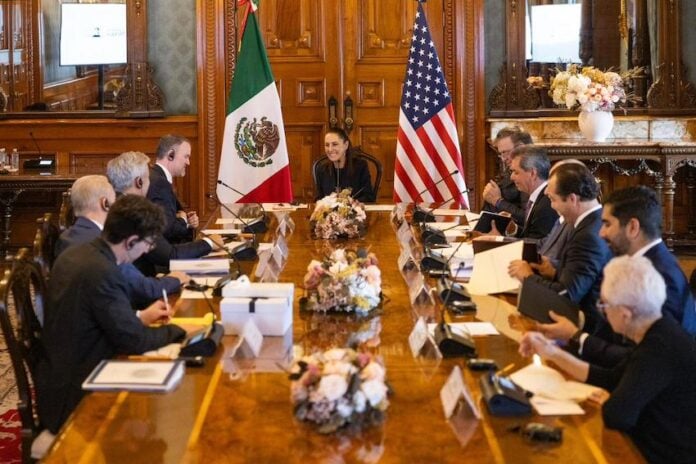
Sheinbaum chaired a meeting at the National Palace attended by Greer, U.S. Ambassador to Mexico Ron Johnson, Mexican Economy Minister Marcelo Ebrard, Finance Minister Édgar Amador Zamora and other officials.
Sheinbaum chaired a meeting at the National Palace attended by Greer, U.S. Ambassador to Mexico Ron Johnson, Mexican Economy Minister Marcelo Ebrard, Finance Minister Édgar Amador Zamora and other officials. (Presidencia)

After meeting with U.S. Trade Representative Jamieson Greer in Mexico City on Monday, President Claudia Sheinbaum declared that talks with the United States related to the review of the U.S.-Mexico-Canada Agreement (USMCA) are advancing “positively.”

Sheinbaum chaired a meeting at the National Palace attended by Greer, U.S. Ambassador to Mexico Ron Johnson, Mexican Economy Minister Marcelo Ebrard, Finance Minister Édgar Amador Zamora and other officials.

“I received at the National Palace the delegation from the United States, headed by Ambassador Jamieson Greer, Trade Representative, for the conversations with Mexico regarding the review of the USMCA. We continue to advance positively,” the president wrote on social media.

Later on Monday, Ebrard and Greer — the top USMCA negotiators for Mexico and the U.S. — issued a joint statement that outlined the objectives for bilateral trade talks this week.

“Ambassador Greer and Secretary Ebrard directed their teams to advance important technical discussions this week on economic security and complementary trade actions, strengthened rules of origin for key industrial goods, collaboration on critical minerals, and to resolve outstanding bilateral trade irritants,” the statement said.

The English-language statement issued by the Office of the United States Trade Representative said that Greer, who has returned to the United States, and Ebrard “also agreed to hold a first official bilateral negotiating round for the USMCA Review the week of May 25, 2026, in Mexico City.”

Mexican and U.S. officials met in Washington, D.C., last month, to commence USMCA review trade talks. No Canadian representatives participated in those discussions.

In their statement, Ebrard and Greer said that “the USMCA Joint Review” — involving all three countries — will take place on July 1. The three North American trade partners have to decide whether they want to renew their free trade pact for an additional 16 years — i.e., to 2042. Mexico is confident that the USMCA will be extended, even though U.S. President Donald Trump has made disparaging remarks about the pact. Even if Mexico, the U.S. and Canada don’t agree to extend the agreement during the upcoming review process, it would not be terminated until 2036.

There is a range of “trade irritants” between Mexico and the United States. Mexico’s primary complaint is that Trump has imposed tariffs on a range of Mexican goods, including steel, aluminum and vehicles. Among the United States’ concerns is Mexico’s energy sector framework, which favors state-owned firms over private and foreign companies.

Citing industry sources, Reuters reported on Tuesday that Greer “told Mexico’s auto and steel industries they should not ​expect the renegotiation of the U.S.-Mexico-Canada Agreement to remove President Donald Trump’s tariffs on their sectors”.

US more concerned about deficit with China than deficit with Mexico 

Another trade irritant for the United States is that it has a large deficit with Mexico — US $196.9 billion in 2025, a 14.8% annual increase. Trump has cited the deficit as one reason for his decision to impose tariffs on Mexican goods, and last year, he and Sheinbaum agreed to work to narrow the trade imbalance.

Nevertheless, Greer said on Monday that the U.S. is more concerned about its trade deficit with China than its trade deficit with Mexico, according to a report by the newspaper El Economista.

The U.S. trade representative made the remark during talks with Mexican officials at the headquarters of the Mexican Banking Association (ABM), El Economista reported, citing sources who were at the meeting.

China’s trade surplus with the United States was $202.1 billion in 2025, exceeding Mexico’s surplus with its northern neighbor by $5.2 billion. China thus had the largest trade surplus with the U.S. of any country in 2025, even though its surplus declined 31.6% last year.

The United States has good reason to be more concerned about the deficit with China than the deficit with Mexico. The U.S. and China are, of course, geopolitical rivals, but beyond that, there are other reasons why the Trump administration wants to reduce the reliance on imports from China. One key issue is that Chinese exports to the U.S. contain very little U.S. content. According to an analysis by the SAI consultancy firm that was cited by El Economista, at the end of the last decade, exports from China to the U.S. had just $4 of U.S.-made content for every $100 of goods sold, whereas Mexican exports to the U.S. had $40 of U.S.-made content for every $100 — ten times more.

At the ABM headquarters, Greer highlighted that Trump wants to “re-industrialize” the United States, according to El Economista, but recognized that Mexico is a key supply chain partner. Indeed, the two countries are said to be part of a “co-production system.”

Greer meets with business groups 

During his visit to Mexico City, Greer also participated in meetings with the Business Coordinating Council — a leading Mexican private sector group — and the American Chamber of Commerce of Mexico (AmCham), which represents U.S. companies in Mexico and seeks to facilitate economic integration between Mexico and the United States. Ebrard attended both meetings as well.

AmCham president Oscar del Cueto said that there is a “genuine interest” from both the Mexican and U.S. governments to “know the private sector’s positions” on issues related to the USMCA.

American Chamber of Commerce names CPKC’s Oscar Del Cueto as new president

“From AmCham, we see the review of the USMCA as an opportunity to continue advancing in this [bilateral] integration while looking after the competitiveness of each of our economies,” he said.

“We don’t have to divide the cake, we can make a bigger cake together,” del Cueto said.

AmCham said in a statement that during the meeting with Greer and Ebrard, it “highlighted four common objectives” for both Mexico and the United States:

  • Re-industrialize the United States and Mexico in order to better compete with Asia.
  • “North Americanize” supply chains.
  • Build energy and critical minerals security.
  • Strengthen Mexico’s economy as part of a stronger North America.

“To achieve this, we proposed that Mexico receive preferential tariff treatment, that the duration of the USMCA be extended as soon as possible to provide certainty for investment, and that we work toward the vertical integration of our region to balance the trade deficit and strengthen our economic resilience,” AmCham said.

With reports from El Economista
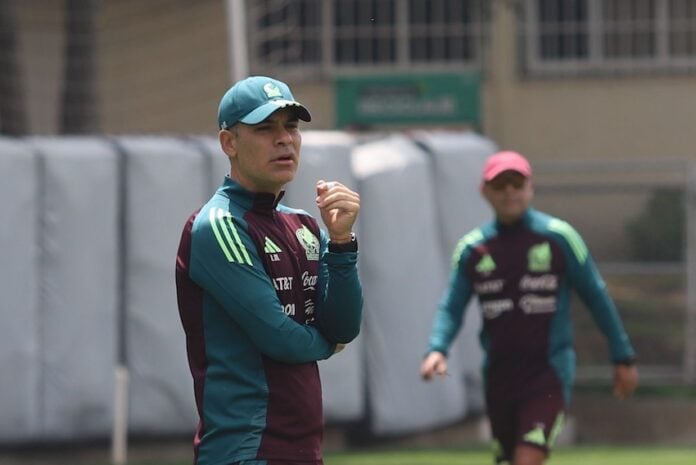
Confirmed: Rafael Márquez will take the reins as El Tri’s head coach after the 2026 World Cup

0
Rafa Márquez
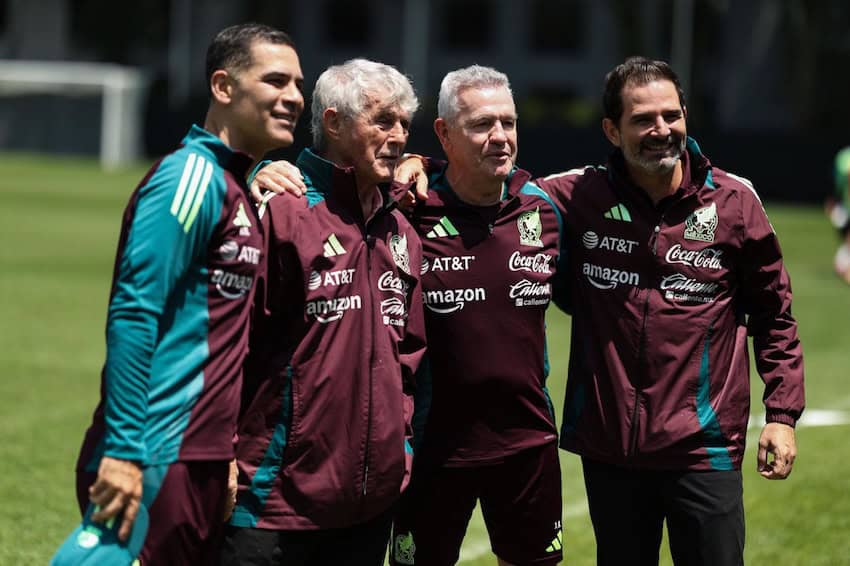
Mexican soccer legend Rafa Márquez has been widely assumed to be the next head coach of Mexico's men's national soccer team and now it's official; he will take over the team leadership after Mexico's participation in this year's World Cup. (Daniel Augusto/Cuartoscuro)

In a widely expected move, the Mexican Soccer Federation (FMF) has confirmed that legendary former national team captain Rafael Márquez will become the next head coach following Mexico’s participation in the upcoming World Cup.

Duilio Davino, the national team’s general manager, told Fox Sports on Monday that Márquez has signed a contract and is already assembling a coaching staff with the mission of qualifying for the 2030 World Cup.

Rafa, Bora, Aguirre
Getting together last August was the future head coach of the Mexican National Team (Rafa), a former head coach of the team (Bora Milutinovic) and the current head coach and general manager, Javier Aguirre and Duilio Davino. (FMF/Cuartoscuro)

“Today, as an assistant and as a coach, he’s just like he was as a player,” Davino said. “He transforms the locker room and inspires the team.”

Márquez, known during his playing days as “The Kaiser of Michoacán,” is currently the top assistant on the national team coaching staff and has been sitting beside Javier Aguirre since the latter took the reins of El Tri in July 2024.

Aguirre and Márquez guided Mexico to two titles last year — the Concacaf Nations League and the Concacaf Gold Cup. 

Aguirre has described Márquez’s presence on the coaching staff as “significant,” calling his preparation both on and off the field “remarkable.” 

“His leadership is based on conviction and his contributions have strengthened the team’s defensive performance,” Aguirre said.

Since retiring in 2018, Rafa has served as general manager for Liga MX club Atlas (his boyhood team with whom he debuted in 1996 at 17 years of age), before spending four years coaching in Spain’s second division.

Davino said Rafa has already recruited about 80% of his staff, and is set on hiring Andrés Guardado, the player who succeeded him as El Tri skipper, as his top assistant. 

Márquez has selected long-time Toluca netminder Alfredo Talavera to be in charge of Mexico’s goalies. “Tala” appeared in 503 Liga MX games during his 19-year career and earned 43 caps with El Tri. He currently serves as the goalkeepers coach for Mexico’s Under-23 team.

Vidal Paloma, a member of Rafa’s staff at Barça Atletic, has also been hired.

Rafa brings plenty of international experience to the task. Not only did he win four La Liga titles and two UEFA Champions League trophies with Barcelona, but he also starred for Mexico at five World Cups (sharing the all-time record with Lionel Messi, Cristiano Ronaldo, Germany’s Lotthar Matthaus and Guardado). 

Márquez also has the fourth-most caps in national team history with 147 appearances, a list topped by Guardado with 180.

Looking ahead to the next World Cup, Mexico will have to survive the regional qualifying tournament to earn its way to Spain-Portugal-Morocco 2030, something it was spared doing for this year’s event by virtue of being host.

With reports from Eje Central, Uno-TV, Juan Futbol and Soy Fut

Opinion: Seat 34B is not a foreign policy

37
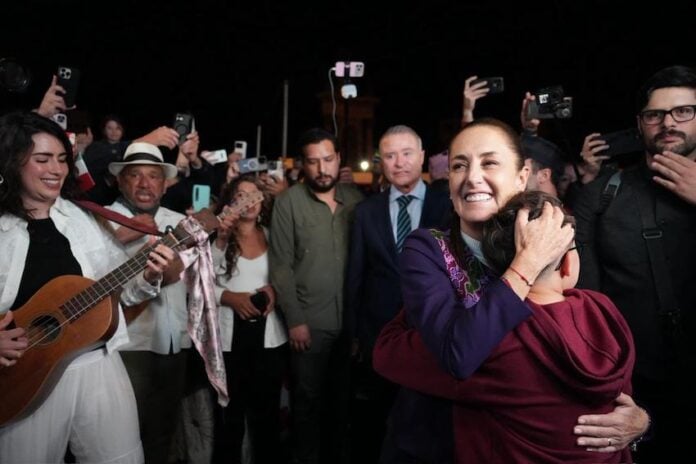
President Claudia Sheinbaum of Mexico receiving a warm welcome in Barcelona on April 17. (Házel Cardenas/Presidencia)

There is a genre of political video you have probably seen before, even if you didn’t have a name for it. A leader boards a commercial flight. They greet the crew warmly. They open a laptop. The camera catches it all at just the right angle. It goes viral. We call it transparency.

It isn’t.

What we are watching — when President Claudia Sheinbaum flies economy to Barcelona, or to Rio, or to Ottawa — is not a candid moment. It is a produced one. Her team filmed it, edited it and released it. That single fact should change everything about how we read it. Your own communications office does not film a spontaneous gesture. What they film is a choreography.

I want to be precise here, because this argument is often misread: I am not saying Sheinbaum is a bad president. I am not saying the video is a lie. I am saying it is a genre — one with a long history and a very specific purpose — and that we should know the difference between the genre and the thing it is designed to represent.

The oldest trick in the modern playbook

Edward Bernays, Sigmund Freud’s nephew and the man who invented public relations as a discipline, understood something about human psychology that politicians have exploited ever since: people do not respond to arguments as much as they respond to images. A well-chosen image doesn’t just inform. It feels like proof.

Bernays called it the “conscious and intelligent manipulation of organized habits and opinions.” He was not being cynical. He genuinely believed that democracy and businesses required this kind of management, that the masses needed to be guided by the right emotional signals. Whether or not you agree, his mechanics were correct: a striking image can rearrange a person’s fears and desires faster than any speech or statistic.

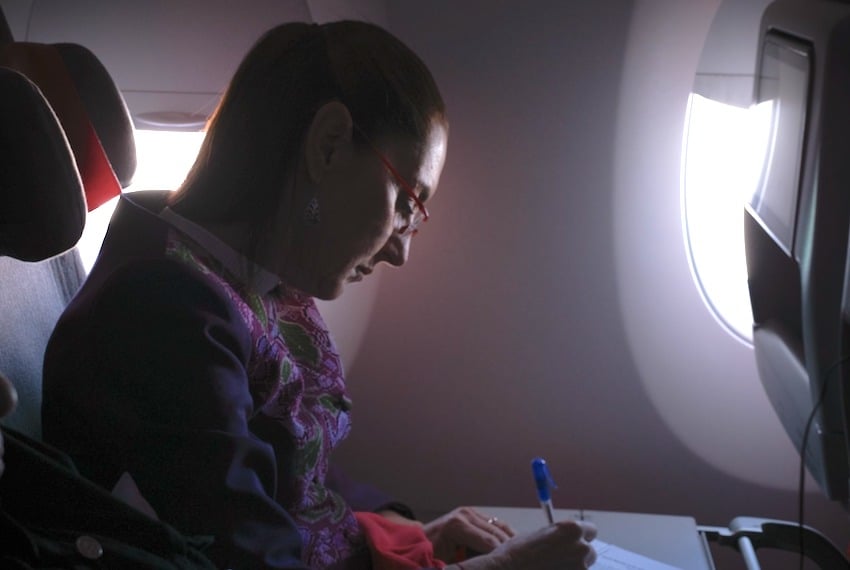
On Friday, President Sheinbaum once again traveled internationally in an economy seat, this time to Barcelona, Spain.
On Friday, President Sheinbaum once again traveled internationally in an economy seat, this time to Barcelona, Spain. (Claudia Sheinbaum/Facebook)

The boarding a commercial plane video is a Bernays masterclass. Its message is not spoken — it doesn’t need to be. The image says everything: here is a president who is one of you, who lines up and works mid-flight as you do, who does not believe she is better than you.

It is good storytelling. The problem is that good storytelling and good governance are not the same thing, and confusing the two has costs.

Barcelona as a case study

Let’s use the Barcelona trip itself as the test. Strip away the images and ask what the trip was actually for, and what it accomplished.

The official purpose was the In Defense of Democracy summit — a gathering that, by its very name, carried serious weight. In practice, it operated as two parallel events: a broader forum for progressive political movements from around the world, and a separate meeting of the heads of state of Brazil, Colombia, Uruguay, Spain and the president of the European Union. When a reporter at Sheinbaum’s April 16 press conference called it an “anti-Trump meeting,” Sheinbaum immediately corrected the label. “It’s not an anti-Trump meeting at all,” she said. “I consider it a meeting for peace.”

That rebranding happened before the president even boarded the plane — and it is worth pausing on. The same trip was simultaneously framed as a bold gesture of diplomatic normalization with Spain. Each audience received the version most useful to them. That is not communication. That is product placement.

What remained were the images: Sheinbaum in economy class, Sheinbaum greeted by Mexicans waving flags, Sheinbaum hugging a musician from San Miguel de Allende. A gathering ostensibly convened to defend democracy and discuss global peace had been converted, in the public conversation, into a display of presidential warmth and accessibility. The policy content evaporated. The optics survived.

If we ask what the trip accomplished diplomatically, the picture becomes even thinner. This was not a state visit to Spain. There was no meeting with the Spanish royal family — the direct target of AMLO’s original letter demanding a formal apology for the crimes of the Conquest, and therefore the symbolic party with whom any genuine institutional rupture existed. Embracing Pedro Sánchez is ideologically coherent, but it is not the same as repairing Mexico’s relationship with Spain as a country. Isabel Díaz Ayuso, president of the Community of Madrid, dismissed the entire event as a “narco-state summit” — a signal that whatever symbolic repair occurred was felt by some Spaniards and not others.

Now zoom out further and the foreign policy picture becomes harder to read. Sheinbaum declined an invitation to Davos, sending representatives in her place — forfeiting a stage where leaders shape their countries’ economic narratives directly.

She has not made a high-visibility visit to Washington, D.C., nor to the Mexican communities in Los Angeles, Chicago or Houston, where millions of her compatriots — many undocumented, many living under the threat of deportation — would have the most to gain from that symbolic and political embrace. Barcelona’s Mexicans got the hug, the flags, the musicians. The Mexicans in the United States, who are navigating one of the most hostile political climates in recent memory, are still waiting.

This set of choices reveals her priorities. Barcelona offered a friendly crowd, ideological alignment and a controlled environment. Washington would offer tension, risk and the kind of visibility that cannot be fully managed. One of these trips is better PR. The other would be harder, more meaningful diplomacy.

What the coach seat doesn’t tell you

A boarding pass tells you nothing about the judicial reform that many legal experts warn will weaken Mexico’s justice system. It tells you nothing about energy policy, about PEMEX, about what happens in classrooms across the country. It tells you nothing about whether the person in that seat will make decisions that improve your daily life or complicate it.

This is not a trivial distinction. Every minute we spend discussing the president’s seat assignment is a minute we are not spending on any of those questions. And that displacement — of the substantive by the symbolic — is not accidental. It is the point. The boarding pass video does not just generate goodwill; it consumes oxygen. It fills the conversation so efficiently that there is less room left for everything else.

Travis Bembenek asked in his column this week what it would take for Sheinbaum’s critics to approve of her leadership. It’s a fair question, but it may be the wrong one — not because Sheinbaum doesn’t deserve evaluation, but because a president’s “approval” is not actually the job of a citizen.

We were never supposed to be fans

Somewhere in the last two decades of political branding, we confused two very different relationships: the relationship between a consumer and a product, and the relationship between a citizen and a government.

Consumers approve or disapprove. They rate, they recommend, they return. Politicians — and the communications teams that serve them — have learned to exploit this instinct brilliantly. They run permanent campaigns not because elections never end, but because approval ratings are easier to manage than policy outcomes. An image of a president in economy class is measurable, shareable and emotionally immediate. A structural reform of the energy sector is none of those things.

The result is that we have learned to evaluate governments the way we evaluate restaurants: based on how the experience felt, not on whether the food was actually nutritious. And a president who understands this — who is skilled at managing the emotional register of her image — has a significant advantage over citizens who haven’t noticed the mechanism.

Approval, in a democracy, was never supposed to be the goal. Accountability was. Those are not the same thing, and one of them requires us to look past the boarding pass.

What I’m actually asking for

I am asking that we, as citizens and as readers, learn to notice when we are being shown a symbol in place of a substance, and resist the substitution. Symbols, after all, are most powerful when they point toward something real. This one points toward a seat.

The president of Mexico does not need our approval to govern. She needs our attention — the sustained, critical, unglamorous kind that does not fit in a 40-second vertical video. The kind that asks what the judicial reform will mean for ordinary people five years from now. The kind that notices which questions get answered at the morning press conference and which ones don’t. The kind that looks at a trip to Barcelona and asks not how it felt, but what it changed. 

That is not cynicism. It is citizenship. And it is the one thing no communications team, however talented, can produce for us.

I will add one last thing: A president is not a private citizen — the office itself transforms whoever holds it.

The political, economic and social consequences of anything happening to her mid-flight are immense, and no amount of good optics is worth that risk. Austerity is admirable until it becomes reckless, and a head of state boarding a commercial aircraft with strangers is, by any security standard, closer to the latter than the former.

Maria Meléndez writes for Mexico News Daily in Mexico City.

Oil spill due to pipeline leak near Progreso has been contained, governor says

0
oil slick near Puerto Progreso, Yucatán
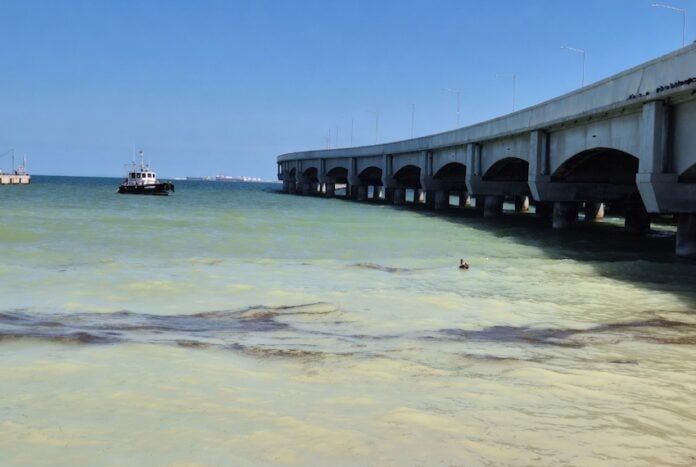
Local media documented at least two main slicks, one roughly 300 meters from shore under the pier and another about 100 meters away. (@PlayaRiviera/X)

A new hydrocarbon leak off the coast of Progreso, Yucatán, was quickly contained and is unrelated to the massive Pemex oil spill in the Gulf of Mexico that fouled over 600 kilometers of shoreline in recent weeks, state and federal officials said Monday.

During a live broadcast, Yucatán Governor Joaquín Díaz Mena said authorities traced the latest slicks near the iconic arch pier in Puerto Progreso to “a leak … in a disused underwater pipeline.”

He said the problem was handled by the Mexican navy (Semar), Petróleos Mexicanos (Pemex) and local authorities. 

“Specialized divers worked to contain the situation and permanently seal this leak,” he said. “The pipeline has been completely sealed, the area is now under control, and there is no risk to the population or port activities.”

Fishermen had reported diesel-like stains near the 6.5-kilometer pier, one of the world’s longest, over the past week — warning about environmental damage, threats to fishing and risks for swimmers.

Local media documented at least two main slicks, one roughly 300 meters from shore under the pier and another about 100 meters away. Preliminary checks indicate the damaged line once transferred hydrocarbons — a category of compounds that includes crude oil and refined fuels like diesel and gasoline — to the deep-water port and is ruptured in at least two sections.

Díaz Mena stressed that the Progreso leak “is not related” to the earlier Gulf spill that hit Veracruz, Tabasco, Campeche, Tamaulipas and Yucatán, and even sent tar and oil residue as far as Texas.

After weeks of denials, Pemex admits responsibility for Gulf Coast oil spill

That disaster began with a major leak in a subsea pipeline that was detected in early February but denied internally by Pemex, according to President Claudia Sheinbaum and Pemex director Víctor Rodríguez.

After weeks of public complaints and satellite-based investigations by environmental groups, Pemex acknowledged responsibility for the spill, and three high-ranking officials were removed from their posts as prosecutors review possible crimes.

In the wake of that spill, Sheinbaum has moved to tighten oversight in the region.

During her morning press conference Monday, she announced a decree to create a Gulf of Mexico Observatory “to monitor the situation permanently using satellite imagery,” strengthen emergency response and ensure that proper investigations are carried out.

The observatory will bring together the science ministry, the navy, Pemex and environmental regulators to track spills in real time and publish reports — part of a broader push to restore trust after the concealed Gulf leak.

With reports from La Jornada Maya, La Silla Rota, López-Dóriga Digital and Milenio

Mexico doubles down on security, inspections at cultural and archaeological sites

0
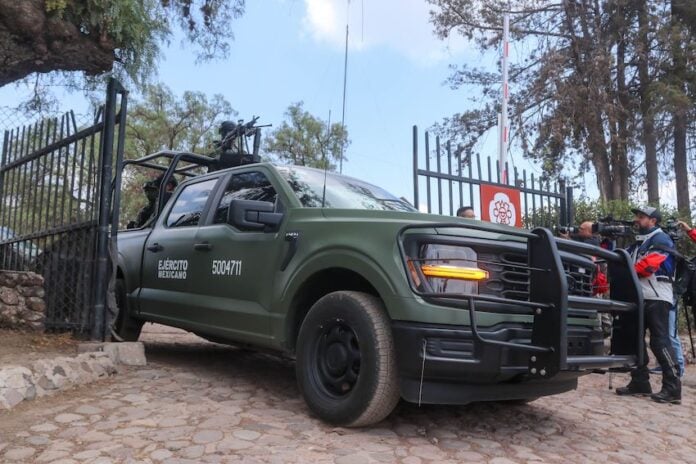
Among the improvements to security at Mexico’s archaeological sites will be expanded physical and cyber patrolling by the National Guard and the National Intelligence Center to identify and prevent any threats.
Among the improvements to security at Mexico’s archaeological sites will be expanded physical and cyber patrolling by the National Guard and the National Intelligence Center to identify and prevent any threats. (Axel Sánchez/Cuartoscuro)

Monday’s shooting at the iconic Teotihuacán archaeological zone 30 miles northeast of Mexico City has prompted the government to implement enhanced security protocols at the country’s cultural heritage sites.

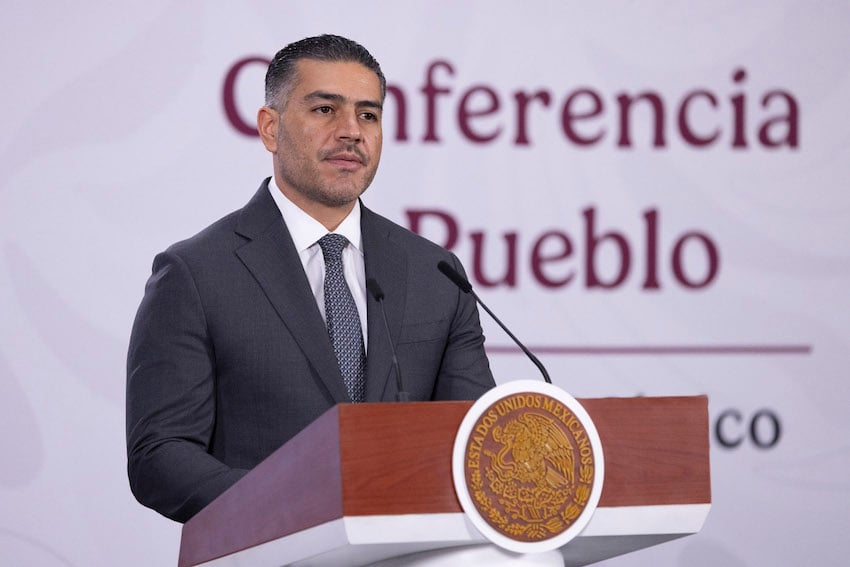
By order of President Claudia Sheinbaum, Security Minister Omar García Harfuch said on Tuesday that his ministry has already begun coordinating with the Culture Ministry to improve protocols that will ensure the safety of visitors and prevent similar occurrences in the future.

Cuauhtémoc, Ciudad de México, México, 21 de abril de 2026. La doctora Claudia Sheinbaum Pardo, presidenta Constitucional de los Estados Unidos Mexicanos en Conferencia de prensa matutina “Conferencia del Pueblo” en el Salón Tesorería de Palacio Nacional. La acompañan Rosa Icela Rodríguez Velázquez, secretaria de Gobernación; Omar García Harfuch, secretario de Seguridad y Protección Ciudadana (SSPC); Claudia Curiel de Icaza, secretaria de Cultura; Guillermo Briseño Lobera, comandante de la Guardia Nacional (GN); Cristobal Castañeda Camarillo, , secretario de Seguridad del Estado de México y José Luis Cervantes Martínez, fiscal general de Justicia del Estado de México. Foto:
Security Minister Omar García Harfuch said on Tuesday that there will be an increased presence of the National Guard at Mexico’s cultural heritage sites following a shooting at Teotihuacán on Monday. (Juan Carlos Ramos/Presidencia)

“The presence of the National Guard will be increased in full coordination with local authorities, preventive inspections and access controls will be reinforced and surveillance systems in these spaces will be strengthened,” Harfuch said during Sheinbaum’s daily press conference on April 21.

Among the improvements to security at Mexico’s archaeological sites will be expanded physical and cyber patrolling by the National Guard and the National Intelligence Center to identify and prevent any threats.

“We will continue to act intelligently … to protect citizens and those who visit our country,” he said, adding that Monday’s attack was “unprecedented and regrettable.”

Mexico currently does not have metal detectors installed at any of its archaeological sites. President Sheinbaum on Tuesday called for more rigorous inspections so that guns do not enter archaeological sites or other public places, though she declined to say whether weapon-detecting technology will be established at their entry points.  

Images of the shootout atop the Pyramid of the Moon have dealt a severe blow to Mexico’s international image as a safe destination just weeks ahead of the anticipated arrival of 5 million visitors for the FIFA World Cup. 

The terrifying incident has increased scrutiny of Mexico’s security capabilities ahead of the tournament, even as violence at the country’s tourism and cultural sites is exceedingly rare.

Mexico City has hosted several massive events recently without incident, including free concerts in the capital’s main square (Shakira drew 400,000 people on March 1 and Andrea Bocelli headlined another show that attracted 300,000 fans on April 18) and four separate World Cup qualifying matches in late March.

The authorities have been preparing for months with multimillion-dollar investments in infrastructure and the projected deployment of 100,000 officers in stadiums, hotels and airports.

Still, a fatal shooting at a popular tourist location — Teotihuacán, a UNESCO World Heritage Site, received 1.6 million visitors last year — represents a significant blow to the government’s hopes that it could use the World Cup to consolidate the country’s appeal as a tourism powerhouse.

With reports from Razón, LopezDoriga.com, Bloomberg, Euro News and El País

Teotihuacán shooter inspired by Columbine massacre in US, AG says: Tuesday’s mañanera recapped

3
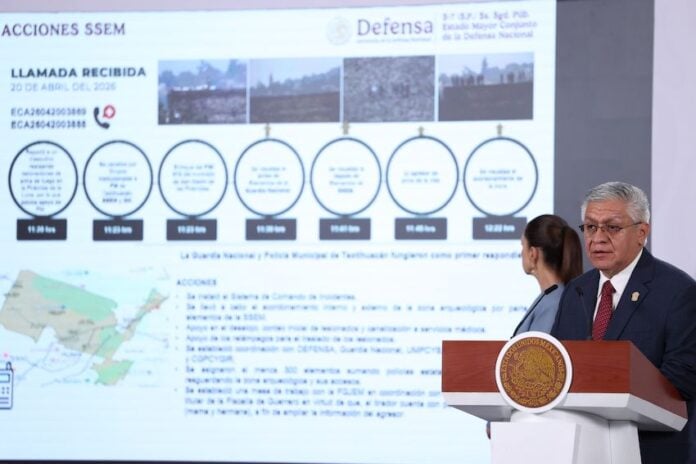
México state Security Minister Cristóbal Castañeda said the gunman took his own life after he was shot in the leg by members of the National Guard, which prevented a larger death toll. 
México state Security Minister Cristóbal Castañeda said the gunman took his own life after he was shot in the leg by members of the National Guard, which prevented a larger death toll. (Galo Cañas/Cuartoscuro)

Sheinbaum’s mañanera in 60 seconds

  • 🔺 Teotihuacán shooting: Sheinbaum opened her press conference by expressing solidarity with the family of a 32-year-old Canadian woman killed by a gunman at the archaeological site on Monday. Thirteen others were hospitalized, including nationals from Colombia, Russia, Brazil, the Netherlands and the United States.
  • 🔍 Lone-wolf, copycat profile: The attacker, identified as Julio César Jasso Ramírez, 27, killed himself after being shot by the National Guard. Authorities found material allegedly linked to the Columbine massacre and believe he planned the attack over multiple prior visits to the site.
  • 🏛️ Security overhaul pledged: Sheinbaum noted archaeological sites have never had metal detectors “because situations like this had never occurred.” She announced stricter entry inspections going forward. Teotihuacán will reopen on Wednesday.

Why today’s mañanera matters

The primary focus of President Sheinbaum’s Tuesday morning press conference was the shooting that occurred on Monday at the Teotihuacán archaeological site, a pre-Columbian city located around 50 kilometers northeast of Mexico City. A gunman killed a Canadian woman and wounded 7 other people — all foreigners — before turning the gun on himself. The shooting at one of Mexico’s best-known tourism attractions made headlines around the world.

Shooting at Teotihuacán leaves 2 dead, at least 6 wounded

Sheinbaum stressed that such an attack was unprecedented at an archaeological site in Mexico. Nevertheless, a random shooting that claimed the life of one foreigner and left various others with injuries will no doubt inflict some damage on Mexico’s international reputation.

With the first match of the FIFA men’s World Cup in Mexico City less than two months away, the federal government will be working overtime to convince foreigners that Mexico is a safe place to visit. That work already ramped up after the violent response to the killing of cartel boss “El Mencho” in a military operation in February.

The government response to this attack, including the planned beefing up of security at Teotihuacán and other archaeological sites, will be crucial to giving everyone — Mexicans and foreigners — the confidence to keep visiting Mexico’s numerous pre-Columbian architectural masterpieces.

Sheinbaum laments shooting at Teotihuacán

At the very start of her press conference, Sheinbaum expressed the government’s “solidarity” with the relatives of the Canadian woman killed by a gunman at the Teotihuacán archaeological site on Monday, and with those injured.

The government of México state — where Teotihuacán is located — reported on Monday night that 13 people were hospitalized due to injuries they sustained at the archaeological site. Seven of those people were shot, while the others sustained injuries due to falls. Those injured are from Colombia, Canada, Russia, Brazil, the Netherlands and the United States. The youngest victim is a six-year-old Colombian boy, who was shot, while the oldest is a 61-year-old American woman, who also sustained a gunshot wound.

The Canadian woman who was killed was 32. Her identity had not been disclosed as of 9 a.m. Tuesday.

The gunman, who killed himself at the scene of the crime, was identified as 27-year-old Julio César Jasso Ramírez. México state Security Minister Cristóbal Castañeda said that Jasso was from Tlapa, Guerrero.

In video footage, the attacker can be heard telling people who were with him on a platform of the Pyramid of the Moon that tourists who came to Mexico from “fucking Europe” won’t return.

Castañeda: Gunman killed himself after he was shot in the leg by the GN 

Castañeda told Sheinbaum’s press conference that the gunman took his own life after he was shot in the leg by members of the National Guard, which responded to the attack perpetrated from the Pyramid of the Moon at Teotihuacán. State and municipal police also responded to the shooting.

The México state security minister said that authorities determined that the aggressor acted alone. He said that Jasso arrived at the site in an Uber vehicle. Castañeda also said that authorities had located a hotel where the gunman stayed the night prior to committing the attack.

He said that six of the seven people who were shot have been discharged from hospital.

Gunman was allegedly inspired by 1999 Columbine massacre in US

México state Attorney General José Luis Cervantes Martínez said that at the scene of the crime, authorities collected a pistol, a knife and 52 cartridges that the gunman hadn’t used. He said that authorities also seized the aggressor’s “tactical-style backpack” as well as a voter’s ID card, a cell phone, bus tickets, and “literature, images [and] manuscripts allegedly related to violent events … in the United States in April 1999.”

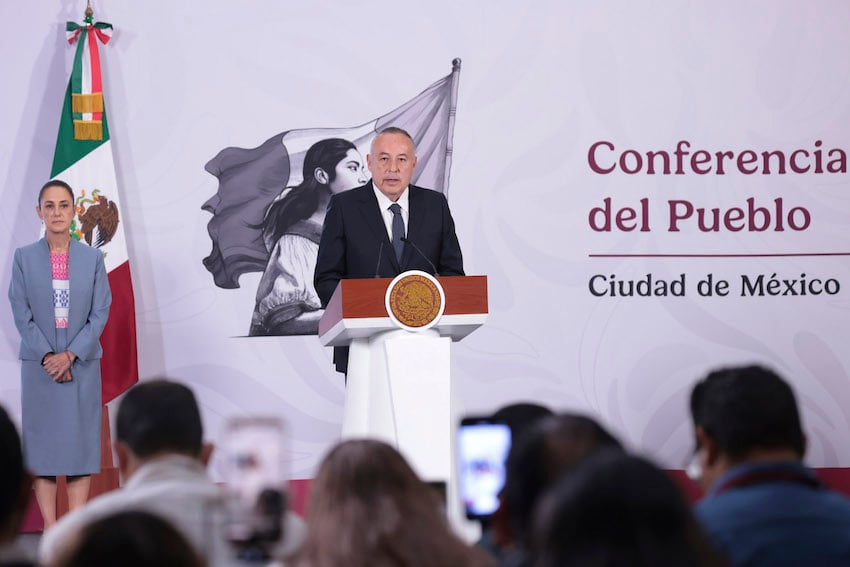
The México state Attorney General José Luis Cervantes
The México state Attorney General José Luis Cervantes said that the attack was not “spontaneous,” explaining that authorities determined that the gunman visited Teotihuacán on “various” prior occasions — allegedly to plan his attack. (Juan Carlos Ramos/Presidencia)

That was a reference to the Columbine High School massacre, which occurred on April 20, 1999, exactly 27 years before the shooting at Teotihuacán.

Jasso reportedly appears in photographs performing the Nazi Salute. Adolf Hitler was born on April 20, 1889, exactly 137 years before Monday’s attack.

Cervantes said that evidence indicates that Jasso has a “psychopathic profile … characterized by a tendency to copy situations that occurred in other places, at other times and by other people.”

The “hypothesis” that Jasso was a “copycat” killer is under investigation, he said.

AG: ‘Quick’ GN intervention prevented more serious consequences

Cervantes said that the “quick intervention” of the National Guard (GN) prevented “more serious consequences” — i.e., deaths and injuries. Security Minister Omar García Harfuch made similar remarks, saying that the GN intervention stopped the gunman from attacking and thus “prevented the loss of more lives.”

García Harfuch also said that the gun used by the attacker was almost 60 years old, as it was made in “approximately” 1968. Cervantes said that authorities didn’t know where Jasso obtained the gun, but added that they had determined that he paid 40,000 pesos (US $2,300) for it.

The México state attorney general also said that the attack was not “spontaneous,” explaining that authorities determined that the gunman visited Teotihuacán on “various” prior occasions — allegedly to plan his attack.

Asked whether racism could have motivated the attack, given the message the gunman conveyed to European tourists, Cervantes responded:

“As you know, the attacker lost his life. That makes it impossible for us to conduct subsequent interviews. … I wouldn’t speak about a motive, I would speak about psychopathy, I would speak about an ailment, I would speak about an illness and within the framework of that illness one can commit all kinds of barbarities. … We have a preliminary conclusion that makes us assume … that [the attack] was the product of a mental ailment.”

Sheinbaum: Attack at archaeological site is the first of its kind 

Referring to armed attacks at archaeological sites, Sheinbaum said, “we all know that we hadn’t witnessed something like that in Mexico.”

“It’s the first time it occurs,” she said.

Sheinbaum acknowledged that it appears that the gunman had “psychological problems” and “was influenced by episodes that occurred abroad.”

“So it’s not something that is related to [organized] crime,” she said.

Sheinbaum acknowledged that the question everyone is asking is: How did the man get into Teotihuacán with a gun?

“There aren’t security arches in archaeological sites,” she said, referring to walk-through metal detectors.

“There never has been. Why? Because these situations had never occurred,” Sheinbaum said.

She said that from now on, there must be more stringent inspections to ensure that guns aren’t taken into archaeological sites or other public places.

“We have to strengthen security in these sites, but we also have to recognize that this is the first time that a situation like this has occurred,” Sheinbaum said.

Sheinbaum: ‘It’s safe to be in Mexico’

A reporter noted that the U.S. Embassy issued a security alert in light of the shooting at Teotihuacán and asked the president whether it was an “exaggeration” to do so.

“They have their protocols,” Sheinbaum responded.

“… It’s safe to be in Mexico,” she added.

To support her assertion, Sheinbaum cited the arrival of more than 16 million international visitors to Mexico in the first two months of the year.

García Harfuch said that security in Mexico for the FIFA men’s World Cup — which will commence in just over seven weeks — is “guaranteed.”

Teotihuacán to reopen on Wednesday  

Sheinbaum said that Teotihuacán — one of Mexico’s most-visited archaeological sites — will reopen to the public on Wednesday.

“It opens tomorrow with the reinforcement of security,” she said.

Sheinbaum reiterated that “this situation is a situation that we all lament.”

However, she stressed that “there is confidence in our country,” including from the tens of millions of foreign tourists who come to Mexico every year.

By Mexico News Daily chief staff writer Peter Davies (peter.davies@mexiconewsdaily.com)

MND Local: Celebrations in La Paz and chaos and extraordinary generosity in Los Cabos

2
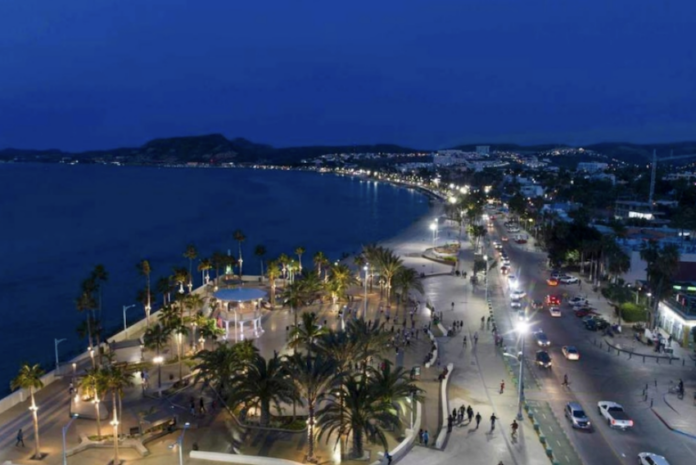
May is traditionally a month of celebration in La Paz, the capital city of Baja California Sur. (Visit Baja Sur)

Sixteen years after Hernán Cortés landed in Cozumel with a few hundred Spaniards to begin the conquest of Mexico, he sailed into the bay of La Paz with three ships on May 3, 1535. 

He wasn’t the first European to reach the shores of the Baja California peninsula. Cortés, entranced by stories of gold and pearls in Garci Rodríguez de Montalvo’s 1510 story of romance and adventure, “Las Sergas de Esplandían” — the origin of the name California — had sent two prior expeditions. The first failed and the second was hijacked by mutineer Fortún Jiménez, who landed near La Paz in 1533, before he and his men enraged local Indigenous inhabitants, with predictably dire results. 

Cortés, however, was the first to establish a settlement on the peninsula, and although it proved short-lived — the colonization effort lasted less than a year —  his arrival is celebrated as the birth of the city of La Paz, the capital of Baja California Sur. 

The origin of the Fiestas de Fundación in La Paz and the celebrations in 2026

La Paz is celebrating its 491st anniversary this year with free rock concerts for the public in Parque Revoción. 

The annual Fiestas de Fundación, with which La Paz memorably celebrates its long history, wasn’t established until the mid-1940s, and one of its traditional highlights, the reenactment of Hernán Cortés arrival, didn’t take place for the first time until 1958. The reenactment and the annual crowning of a Reina Calafia almost certainly owe an inspirational debt to Fernando Jordán’s iconic poem “Calafia,” which was submitted for the Juegos Florales competition in 1955, and memorably invoked Queen Calafia while recalling the initial meeting between Cortés and the Indigenous Guaycura. 

Fiestas de Fundación celebrations since then have ranged from a single day to an entire month’s worth of festivities and planning and scheduling can often be a bit quirky. This year, for the 491st anniversary, for example, the city has gone non-traditional, focusing on Rock Fundación, which will showcase performances by Mexican rock bands Jumbo, DLD, Resorte, and Allison at Parque Revolución on May 16-17. The concerts will be free and open to the public.

Beach vendor chaos in Los Cabos

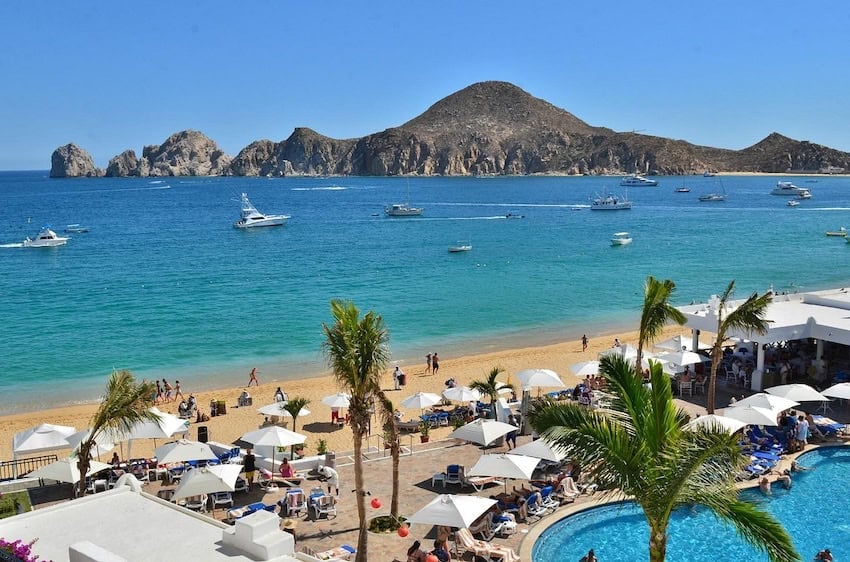
Cabos San Lucas’ Playa El Médano has become a hot spot for vendors, sparking a battle between authorities and traders. (TripAdvisor)

While La Paz celebrates, Los Cabos will be attempting to solve the ongoing and extremely messy unauthorized vendor situation centered around Playa El Médano in Cabo San Lucas.

Mexico News Daily first reported on this battle over “informal commerce” last August, when municipal authorities announced that they had conducted a sweep to rid the popular beach of over 300 illegal vendors. In the future, it was noted, only the 698 authorized vendors wearing uniforms and official ID tags would be allowed.

By November 2025, the 300 unauthorized vendors had all returned and the Los Cabos Coordinating Council (CCC) had called a press conference to address what the head of the Revolutionary Workers’ Confederation (COR) was describing as a lack of institutional control. The Los Cabos Hotel Association wasn’t happy either, citing complaints from tourists over the sheer number of people trying to sell them things as they tried to enjoy their margaritas in peace. To absolutely no one’s surprise, the “chaos and anarchy” has continued into 2026, with CCC President Julio Castillo Gómez accusing the municipal government of being “permissive” with the 300 illegal vendors, who by now seem as entrenched on the beach as their legal counterparts.

But since the illegal vendors are being linked with drug sales and fostering a climate of insecurity, private sector interests are pushing for the municipality to hire a dozen more enforcement officials, to go along with the 15 officials already so employed, and finally put a stop to the acrimonious situation. 

Celebrity couple donates US $2 million to local charity

Russell and Ciarra Wilson on stage
Ciarra and husband Russell Wilson announced that their foundation would be making a US $2 million donation to the Los Cabos Children’s Foundation at a recent benefit gala. (LCFF)

Celebrities have been a staple of Los Cabos life since the earliest days of tourism in the destination, with many proving not only to be active promoters of the area, but also benefactors for local causes. But no celebrity in recent memory has come close to the staggering generosity shown by the Why Not You Foundation of Super Bowl-winning NFL quarterback Russell Wilson and his pop star wife, Ciara, who pledged US $2 million during a recent benefit gala for the Los Cabos Children’s Foundation (LCCF) at the Four Seasons Resort and Residences Cabo San Lucas at Cabo del Sol

When it was founded in 2002, the mission of LCCF was to help local children receive needed cancer treatment in the U.S. However, in the years since, that mission has grown as the organization has expanded to collaborate on numerous health-related projects, to the benefit of over 121,000 children and adolescents.

“Giving back is the greatest gift,” said the couple about their life-changing donation, which will go to providing essential healthcare, nutrition, preventive care and rehabilitation services to children and families throughout Baja California Sur.

“Over the past decade of work with our Why Not You Foundation, our goal has always been about helping the youth globally! This partnership with Los Cabos Children’s Foundation and our Why Not You Foundation helps expand critical access to pediatric health and rehabilitation services in Mexico, in a city that has brought many memories to us over the years! We are blessed and extremely grateful in advance, knowing this partnership will hopefully bring great joy and memories to children and families in Cabo.”

Los Cabos hotel group Solmar invests $6 million in upgrades and sustainability

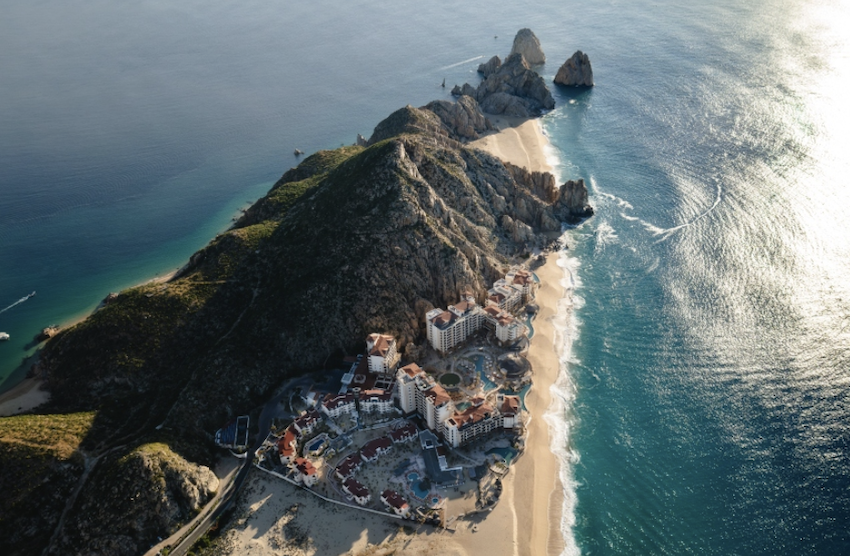
Grand Solmar Land’s End Resort and Spa will be among the Solmar Group properties receiving upgrades. (Solmar Hotels and Resorts)

Solmar is the only hotel group that was born in Los Cabos. Former cannery manager Don Luis Bulnes Molleda’s Hotel Solmar was the first property to open in 1974, near Land’s End in Cabo San Lucas, but in the half-century since, several more high-profile projects, from resorts to restaurants, have followed.

The company behind the portfolio, Solmar Hotels and Resorts, recently announced a US $6 million investment to provide guest room upgrades and sustainability improvements to some of its signature properties, including the Grand Solmar Land’s End Resort and Spa, where a new water heating system will be installed, and Playa Grande Resort, which is getting a design makeover, plus new in-room mattresses.

Chris Sands is a writer and editor for Mexico News Daily, and the former Cabo San Lucas local expert for the USA Today travel website 10 Best and writer of Fodor’s Los Cabos travel guidebook. He has also contributed to numerous other websites and publications, including The San Diego Union-Tribune, Marriott Bonvoy Traveler, Forbes Travel Guide, Porthole Cruise and Travel, and Cabo Living.

Suro Ceramics: From a humble Jalisco workshop to the world stage

1

Tucked in the shadow of Guadalajara, the neighboring towns of Tonalá and Tlaquepaque have long been celebrated as the cradle of Mexican clay, their roots tracing back to pre-Columbian Tonalteca ceramics. From this tradition of kilns and workshops, one name has risen to international prominence: Suro Ceramics.

What began in the early 1960s as a modest clay workshop has evolved, across three generations of the Suro family, into a world-renowned contemporary art studio whose pieces have graced the tables of Michelin-starred restaurants, the walls of major airports and the hands of more than 700 artists from around the globe.


View this post on Instagram


A post shared by 180° (@180grados__)

The founder, Noé Suro, was a craftsman with a designer’s eye. In the 1970s he created the now-classic ceramic beehive lamp, and through that decade and the next he built the business into a supplier for emerging hotel chains, including Hyatt, across Mexico.

The workshop’s transformation into something far more ambitious began in the early 1990s, when José Noé Suro — the founder’s son — brought his passions for contemporary art, design and gastronomy into the family enterprise. Tradition and centuries-old techniques became a foundation for experimentation rather than a constraint, as he invited local and international artists to work alongside the studio’s craftsmen.

A New Era

José Noé Suro became a gravitational figure in Guadalajara’s cultural scene. As a partner of Bar Américas, one of Mexico’s most influential electronic music venues since the 1990s, he moved fluidly between artistic circles. Collaborations with artists Jorge Pardo and José Dávila signaled a shift in the studio’s identity — from craft workshop to creative laboratory.

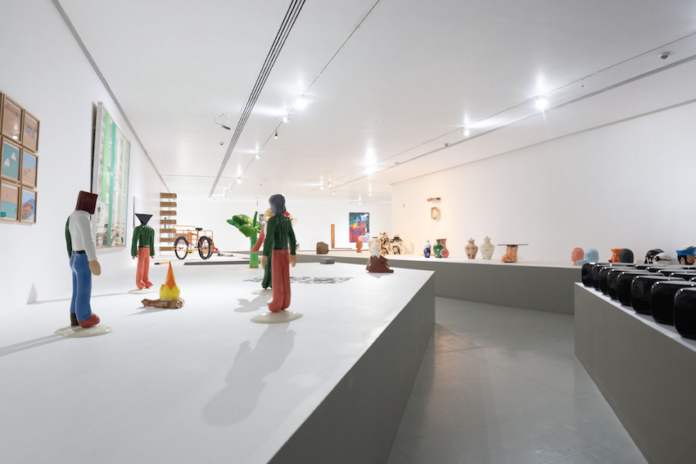
To date, more than 700 artists have worked at Suro, and José Noé has assembled a collection of more than 500 pieces. The scope of that legacy was on full display in “Suro Ceramics: A History of Collaboration, Production, and Collecting in Contemporary Art,” an exhibition organized by curator Viviana Kuri at the Zapopan Art Museum from 2021 to 2022.

The roster of collaborating artists reads like a survey of contemporary art’s most significant voices: Gabriel Orozco, Tatiana Margolles, Erwin Wurm, Marcel Dzama, Rirkrit Tiravanija, Nairy Baghramian, John Baldessari, Sarah Crowner, Nicole Eisenman, Michelle Grabner, Adam Pendleton and Jeff Gibbons, among others.  Suro’s reach extends into public space as well. In Dallas, the studio’s work appears at the Marketplace Commissary in downtown — designed by Jorge Pardo — and along the walkways of Oak Cliff’s Bishop Arts District. Installations have also been mounted at John F. Kennedy International Airport in New York and at Guadalajara’s international airport.

(Suro)

In a parallel venture, Noé Suro and Sara Pereyra founded Merkki, a design and collaboration platform that pairs Suro’s traditional craftsmanship with the visions of contemporary artists and designers, yielding functional pieces that push the boundaries of both form and technique.

At the Table

José Noé Suro’s appetite for gastronomy has made the studio a natural partner for some of the world’s most acclaimed chefs. Suro has produced tableware for restaurants led by Elena Reygadas of Rosetta, Eduardo García Guzmán, Alfonso Cadena and Francisco Ruano in Mexico, as well as Enrique Olvera of Pujol and Daniel Humm of Eleven Madison Park, the three-Michelin-star destination in New York.

A collaboration with artist José Dávila produced a custom tableware line for Casa Dragones, the celebrated tequila brand based in San Miguel de Allende.

The arc from a Jalisco clay workshop to a studio shaping the tables and walls of the world’s most discerning spaces is, in many ways, the story Tonalá and Tlaquepaque have always told — one fired slowly, shaped by hand and built to last.

Ana Paula de la Torre is a Mexican journalist and collaborator for various outlets, including Milenio, Animal Político, Vice, Newsweek en Español, Televisa and Mexico News Daily.

2 US embassy employees and 2 Chihuahua officials killed in car accident following anti-cartel operation

6
narco-lab in Chihuahua
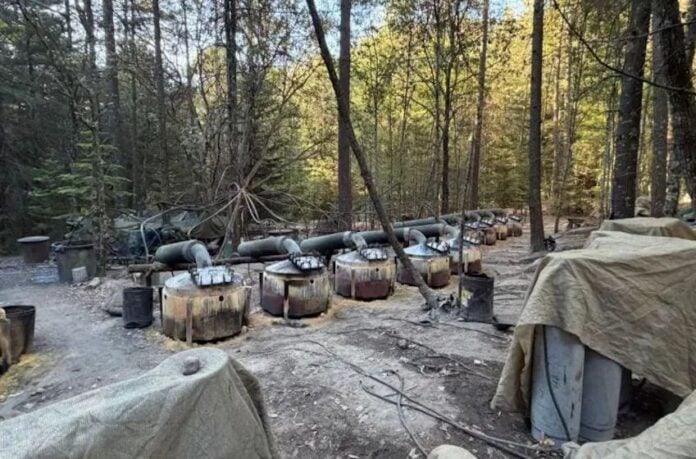
An investigation is ongoing amid speculation that the incident could have been a premeditated attack. (Attorney General's Office of Chihuahua)

Two U.S. Embassy instructors and two Chihuahua state police officials died in an accident  Sunday after an operation to dismantle six narco-labs in the Sierra Tarahumara. 

The deaths occurred when the vehicle fell into a ravine while traveling on a highway connecting the municipalities of Morelos and Cuachochi in southwest Chihuahua.

The U.S. Embassy officials, identified as “instructors … participating in training work as part of a regular exchange of security cooperation,” have not been identified. 

A U.S. Embassy spokesman said the men were “collaborating with the Chihuahua authorities in the fight against cartel activities.” The narco-labs targeted by the operation allegedly belong to the Sinaloa Cartel.

Initial reports indicated the van in which the victims were riding skidded and went off the road. Some reports indicated the vehicle exploded after the driver lost control; others reported it exploded after landing at the bottom of the ravine.

An investigation is ongoing amid speculation that the incident could have been a premeditated attack

Chihuahua Attorney General César Jáuregui identified the state agents as Pedro Román Oseguera Cervantes, director general of the Chihuahua Investigation Agency, and Manuel Genaro Méndez Montes, a ministerial police officer.

The accident, which occurred around 2 a.m., was communicated to the media by Júaregui about 12 hours later.

In a social media post shortly after Júaregui’s announcement, U.S. Ambassador to Mexico Ronald Johnson lamented the deaths of the U.S. Embassy personnel and the state agents while insisting the mission to advance the shared commitment to security and justice will continue with greater determination.

“We honor their dedication and tireless efforts to confront one of the greatest challenges of our time,” he said. “Our thoughts and prayers are with them and their loved ones.”

Johnson described the tragedy as “a solemn reminder of the risks faced by those Mexican and U.S. officials who are dedicated to protecting our communities.”  

Chihuahua Governor Maru Campos paid tribute to Oseguera, who had been on the job just seven months, saying he died while “working for the peace and security of Chihuahua residents.”

President Claudia Sheinbaum on Monday said she was unaware the U.S. Embassy was working with Chihuahua officials to combat drug cartels. 

She told reporters that she has requested information from the Chihuahua government and asked Ambassador Johnson to meet with Foreign Affairs Minister Roberto Velasco to clarify the presence of U.S. personnel on Mexican soil.

With reports from La Jornada, El Financiero, CNN, The Guardian, CBS, Zeta and Reuters

A new 30-km north-south bike route opens in Mexico City

0
new bike path
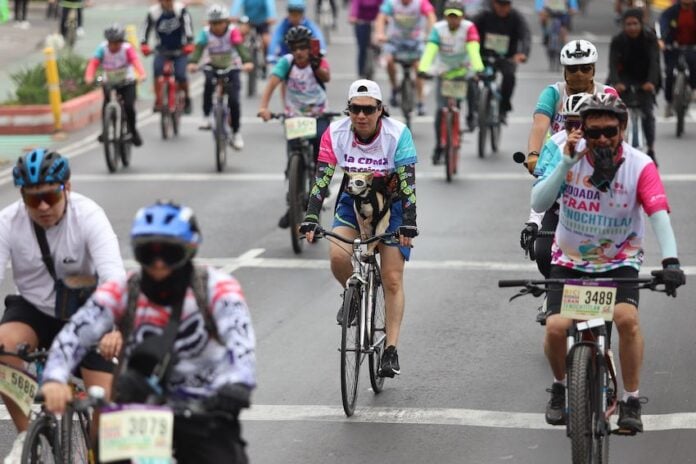
The 30-kilometer "Great Tenochtitlán Bike Path" connecting Mexico City's Historic Center with the Huipulco area near the Banorte Stadium was inaugurated on Sunday. (Daniel Augusto/Cuartoscuro)

Mexico City has inaugurated a new bike route that connects the Historic Center with the Huipulco area in the south, near the Banorte Stadium where World Cup games will be played this summer. 

Dubbed the Great Tenochtitlán Bike Path, the cycling corridor covering 15 kilometers (eventually 17) in each direction runs along Calzada de Tlalpan, the major north-south route since Aztec times. 

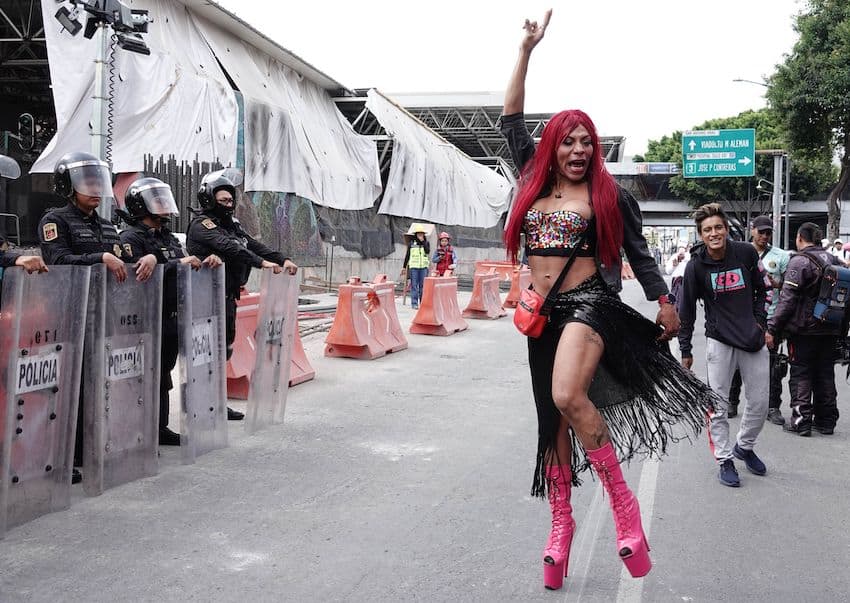
A sex workers’ collective has been protesting the new bike path along the Calzada de Tlalpan, claiming that it has disrupted those doing business in the area, including them. (Camila Ayala Benabib/Cuartoscuro)

The project is part of Mexico City’s sustainable mobility strategy for the 2026 World Cup and beyond, as it seeks to prioritize bicycles and pedestrians over cars, and improve connectivity between the center and the south of the capital.

The new cycling path was inaugurated by Mexico City Mayor Clara Brugada in an event that included more than 10,000 cyclists riding along the new corridor. Prior to the mass ride, hundreds of cyclists formed the image of a monumental bicycle at the Zócalo.

During her speech, Brugada said the new bike path is part of a wider project that seeks to add 300 kilometers of bike lanes across Mexico City.

“Every bike ride is a way to resist inequality in the use of public space and to affirm another way of experiencing the city with a bicycle; closer, more human, more just,” she said. “The bicycle is the most democratic vehicle; anyone can use it, a girl, a boy, young people or older people.”

The cycle path features rehabilitated sidewalks to improve pedestrian comfort and safety along the same route. More than 5,000 new lights will allow for nocturnal rides.

Not everyone in the city is celebrating the initiative. Some groups say the bike lane is part of a “social cleansing” in the lead-up to the World Cup, claiming it is designed for tourism and not for residents.

The event saw protests from sex workers, merchants and residents, who expressed concerns about the impact on their activities, saying they were not consulted on the changes.

Meanwhile, independent sex workers who work on Calzada de Tlalpan — a road that has historically been known by different names for being a prostitution hotspot — claim that the bike path has generated “displacement,” both for them and for merchants in the area.

Protesters also complained about the reduction of vehicle lanes, changes to pick-up and drop-off zones and obstruction of pathways used by pedestrians, including parents and children who attend nearby nurseries and schools.

With reports from El Financiero, La Silla Rota, Proceso and Record