Home Blog Page 53

MND Local: Guadalajara addresses a measles outbreak and other news

4
Guadalajara
Guadalajara has had a busy month for news, headlined by a measles outbreak. (Daryl Parada/Unsplash)

So far in 2026, Jalisco has suffered the worst measles outbreak in Mexico, with infections reported in 39 of the state’s 125 municipalities. This unenviable statistic follows an entire year in which Jalisco had the second-highest level of confirmed cases in Mexico, just behind Chihuahua.

Measles infections spur 15 Jalisco primary schools to switch to remote classes

The deteriorating situation in the state has led 15 elementary schools to partially or completely suspend in-person classes, according to the Jalisco Ministry of Education (SEJ). 

Measles Guadalajara
Fifteen elementary schools in Jalisco have switched to remote classes due to the state’s measles outbreak. (Tec de Monterrey)

The upsurge in measles cases has been especially challenging to contain as it’s broadly distributed. Schools in Zapopan, Guadalajara, Tlajomulco, Tlaquepaque and Tonalá all struggled with an upsurge in cases in January. Most have now switched to remote learning. 

In response, the Jalisco Ministry of Health (SSJ), Mexico’s Social Security Institute (IMSS), and other health providers have intensified the state’s vaccination effort, with a focus on the Guadalajara Metropolitan Area. The effort involves small brigades of healthcare workers going house-to-house, 670 fixed vaccination centers across the state, and 40 mobile units targeting busy public spaces. 

As of mid-January, the campaign was distributing up to 12,000 doses daily.

Guadalajara airport improvements accelerate ahead of the World Cup

Four and a half months before the start of the 2026 FIFA World Cup, the Guadalajara International Airport has numerous works underway that, combined with others already completed, will help to smooth the journey for thousands of international fans headed to la perla Tapatía to enjoy the festivities.

In a recent interview with the newspaper El Mural, Airport Director Cryshtian José Amador Lizardi touted several key improvements that he says will enhance airport access for visitors and residents alike ahead of the first kickoff at Zapopan’s Estadio Akron. These include an increase in the airport parking lot’s capacity from 2,000 to 4,000 spaces and the expansion of the Guadalajara-Chapala Highway to three lanes.

Transit improvements are also pending

The city is also working day and night to add Line 5, a bus rapid-transit link on a dedicated lane of the Carretera Chapala connecting the airport to Guadalajara’s mass transit network. This new line, to be known as “Mi Macro Aeropuerto,” is slated to begin operations on May 15, roughly three weeks before kickoff at Estadio Akron.

Taxis wait at the entrance of the Guadalajara International Airport
The Guadalajara International Airport is expanding its parking availability ahead of the 2026 FIFA World Cup. (Shutterstock)

Due to time constraints, Mi Macro Aeropuerto will use a temporary station in front of the airport’s international lounge during the World Cup, with a permanent station planned for the airport’s future Terminal 2, projected to be completed by 2027.

The airport’s enhancements build on several other improvements completed in 2024 and 2025, including the addition of a second runway and the remodeling of Terminal 1. 

In parallel, the airport has expanded ground transport services, with the addition of a third taxi company as well as a new shuttle service that runs from the airport terminal to the historic center, the new bus terminal, Expo Guadalajara, and the Minerva roundabout, with departures every hour.

United Airlines to add direct service to Guadalajara in June for World Cup

In related news, United Airlines just announced it will add daily nonstop service between Guadalajara International Airport (GDL) and Chicago O’Hare (CHI) in June, to capitalize on increased demand tied to the coming 2026 World Cup. 

The route will be offered June 8–27 on a Boeing 737-700 aircraft, according to the Aeroroutes website.

New program teaches metro children about responsible pet ownership

For anyone who’s seen a puppy callously discarded on the street after Christmas or noticed a neglected animal languishing on private property, you may have wondered: What can be done about such an awful situation? 

Dog and cat Mexico
New programs in Guadalajara aim to reduce animal suffering and cruelty (Andrew S/Unsplash)

It turns out you’re not alone. 

In Guadalajara, a new program aims to reduce animal suffering and change the human mindset that underpins it. Over the past year, 53 “Veterinarian for a Day” and 32 “Mini Farm” workshops have been held around Guadalajara’s metro region, involving nearly 2,000 locals, most of whom were children. 

The Mini Farm workshop participants enjoyed a “hands-on” experience, living with and caring for animals, including sheep, goats, donkeys, rabbits and roosters. According to specialists, these experiences are valuable for children who do not have pets at home, as it strengthens values such as empathy and respect for animals while preventing abuse. 

Ruth Rodríguez, who oversees the programs, put the focus squarely on fostering more responsible pet ownership.

“We try to leave them with a clear message about the responsibility involved in having a pet: feeding them, cleaning their space, vaccinating them and taking them to the vet,” Rodríguez said. “We also promote responsible adoption and not impulsive purchases, especially during the holiday season.”

With greater awareness and sensitivity, the program aims to reduce the rate of pet abandonments and improve the quality of life for local animals.

Charros baseball team claims 2nd consecutive LMP Championship

Charros of Jalisco
The Charros of Jalisco have won another championship, defeating the Tomateros of Culiacán. (LMP)

While half of the United States endured blizzard-like conditions in late January, the Charros of Jalisco were putting on a clinic against the Tomateros of Culiacán at their home stadium in Zapopan. On Sunday, January 26, the team wrapped up its second consecutive Mexican Pacific League (LMP) Championship, sweeping the best-of-seven series 4-0, in front of a capacity crowd. 

The decisive fourth game was filled with drama: The Charros took an early lead on a two-run single from Alejandro Osuna, accompanied by two runs from Julián Ornelas. The Tomateros responded with a six-run rally, capped by Orlando Martínez’s three-run homer, seizing the lead 6-3. 

But the Charros would not be denied. They rallied in the bottom of the sixth, scoring three times, and wrapped up the series with an 8-6 win.

Next up for the Charros is the Caribbean Series, which began earlier this week in Guadalajara and continues through Feb. 7.

After discovering that life in Mexico was a lot more fun than working in corporate America, Dawn Stoner moved to Guadalajara in 2022, where she lives with her husband, two cats and Tapatío rescue dog. Her blog livewellmexico.com helps expats live their best life south of the border.

Backing Bachelet, Sheinbaum says it’s ‘time for a woman’ to lead the UN: Tuesday’s mañanera recapped

3
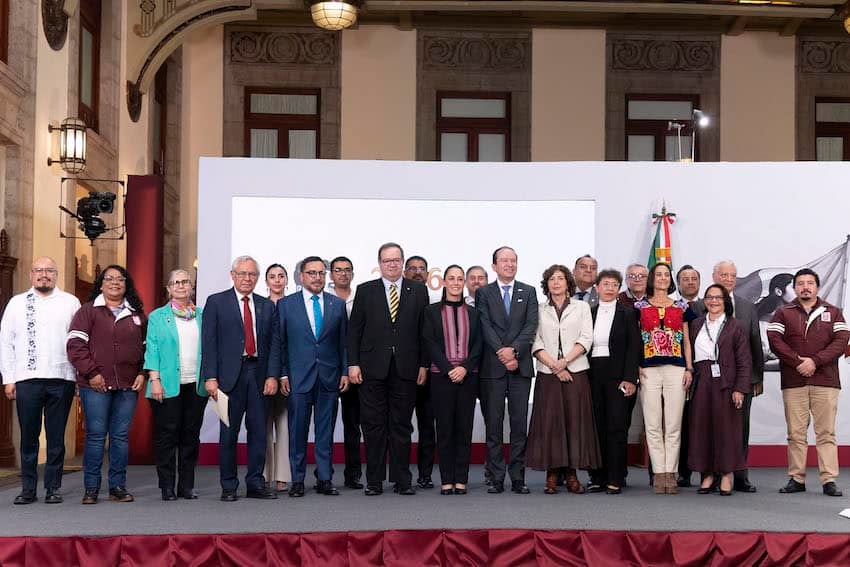
Cuauhtémoc, Ciudad de México. 03 de febrero 2026. La presidenta constitucional de los Estados Unidos Mexicanos, la Doctora Claudia Sheinbaum Pardo en conferencia de prensa matutina en el salón de la Tesorería de Palacio Nacional. La acompañan: Edgar Amador, secretario de Hacienda; Bertha Gómez Castro, subsecretaria de Egresos de la Secretaría de Hacienda; Jorge Mendoza, director del Banco Nacional de Obras y Servicios Públicos (Banobras); Rodrigo Mariscal Paredes, titular de la Unidad de Planeación Económica de la Secretaría de Hacienda y Crédito Público (SHCP); María del Carmen Bonilla, titular de la Unidad de Crédito Público y Asuntos Internacionales de la Secretaría de Hacienda y Crédito Público (SHCP); Diana Aurora Correa, subdirectora de Diseño Digital y Medios Sociales en la Unidad de Memoria Histórica.
Sheinbaum said that Bachelet has a "pacifist vision" for the world and is concerned about the well-being of the planet's poorest people. (Gabriel Monroy/Presidencia)

Early in President Claudia Sheinbaum’s Tuesday morning press conference, Finance Minister Edgar Amador presented a four-year, 5.6-trillion-peso (US $323.4 billion) public-private investment plan. (Read Mexico News Daily’s story on the plan here.)

In the second half of her mañanera, Sheinbaum responded to questions on a range of issues, including Mexico’s support for former Chilean president Michelle Bachelet’s candidacy to become the next secretary-general of the United Nations and her government’s decision to send a shipment of humanitarian aid to Cuba.

Mexico backing Bachelet as next UN secretary-general 

Asked about Mexico’s support for Bachelet’s candidacy, Sheinbaum first noted that the former president of Chile is a woman.

“It’s time for a woman [to lead the UN],” she said.

Since its establishment in 1945, the United Nations has never been led by a woman. A new secretary-general will be selected later this year and replace António Guterres at the helm of the UN on Jan. 1, 2027.

To date, two candidates have been nominated: Bachelet and Rafael Grossi, an Argentine who has been director general of the International Atomic Energy Agency since 2019.

Sheinbaum noted that Bachelet twice served as president of Chile, and that she is a well-regarded woman who “knows” the United Nations.

Indeed, the Santiago native served as United Nations high commissioner for human rights between 2018 and 2022, and executive director of UN Women between 2010 and 2013.

Sheinbaum said that Bachelet has a “pacifist vision” for the world and is concerned about the well-being of the planet’s poorest people.

“[That’s] very important. So, that’s why we decided to support her candidacy,” she said.

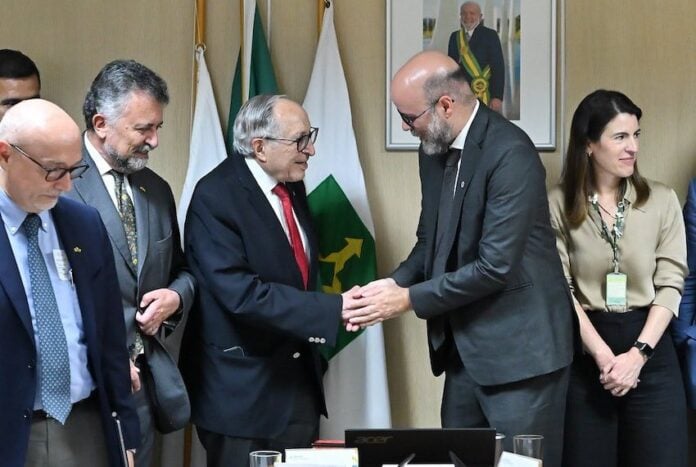
Bachelet was formally nominated as a candidate for UN secretary-general by Mexico, Brazil and Chile at a ceremony in Santiago on Monday.

Michelle Bachelet was formally nominated as a candidate by Mexico, Brazil and Chile at a ceremony in Santiago on Monday.
Michelle Bachelet, Mexico, Brazil and Chile’s nominee for UN Secretary-General, served as president of Chile from 2006 to 2010 and again from 2014 to 2018. (@GabrielBoric/X)

“This candidacy reflects the shared desire of our countries to actively contribute to the strengthening of the multilateral system and to promote leadership capable of responding to current challenges,” the three countries said in a joint statement.

Sheinbaum said that Mexico’s Environment Minister Alicia Bárcena — a former UN official who had been touted as a possible candidate for the secretary-general role — will remain in her government and “help us” with “more things here.”

Sheinbaum: Consignment of humanitarian aid to Cuba won’t create additional tension between Mexico and US

Two days after she announced that her government was preparing a consignment of food and other non-oil supplies for Cuba, Sheinbaum was asked what exactly the shipment would consist of and when it would be sent.

“Our objective is to send it this week. We’re going to see whether it is possible,” the president said.

She said that Mexican authorities have to find out what people’s needs are in Cuba in order to send items that are really required.

“It will be very transparent and we will report on it appropriately,” Sheinbaum said.

A reporter subsequently asked the president whether Mexico’s provision of aid to Cuba would add to tensions between her government and the administration of U.S. President Donald Trump, who last Thursday announced his intention to impose tariffs on imports from countries that supply oil to Cuba.

“No,” Sheinbaum responded.

“Shouldn’t it?” the reporter probed.

“No,” replied Sheinbaum.

Among the current tensions between the Mexican and U.S. governments are those related to trade and security.

Sheinbaum responds to appointment of Morena’s new Senate leader 

A reporter asked the president her opinion on the appointment of Senator Ignacio Mier as the new leader of the Morena party in the Senate.

Senator Ignacio Mier
Ignacio Mier will lead Morena in the Senate after Adán Augusto López stepped down. (Wikimedia Commons)

“Well, it’s a decision of the Morena senators,” Sheinbaum responded.

“We’re very respectful [of their decisions],” she said.

Senator Adán Augusto López Hernández announced on Sunday that he had decided to step down as Morena’s leader in the Senate. He has faced accusations related to the alleged criminal activity of the man who served as his security minister when he was governor of Tabasco between 2019 and 2021.

However, Sheinbaum said on Tuesday that she wasn’t aware of any criminal investigations into the conduct of López Hernández, who served as federal interior minister between 2021 and 2023 before leaving that position to take part in the contest to become Morena’s candidate in the 2024 presidential election.

By Mexico News Daily chief staff writer Peter Davies (peter.davies@mexiconewsdaily.com)

Business confidence in Mexico hits its lowest point in 3 years

1
Mexico City, Mexico – August 15, 2020: Empty streets while the Covid pandemic took on the city and posters warning people to stay inside their houses
Despite advances, business leaders have been souring on the Mexican economic reality for several years now, according to surveys from Mexico's national statistics agency, INEGI. (Shutterstock)

Business confidence in Mexico fell to its lowest level in three years, according to the results of a survey conducted by the national statistics agency INEGI.

The survey results demonstrate that internal and external uncertainty is negatively affecting the perception of Mexico’s business leaders. Economic weakness (Mexico posted just 0.7% growth in 2025), inflationary challenges and anxiety over the scheduled review of the US-Mexico-Canada trade agreement were likely contributing factors.

construction site
Construction executives were the only cohort that showed improved confidence in January compared to December in the INEGI survey. (Gabriela Pérez Montiel/Cuartoscuro)

Using seasonally adjusted figures, INEGI’s Global Business Confidence Opinion Indicator (IGOEC) suggested that those surveyed were pessimistic about the economy.

The January 2026 results showed the IGOEC stood at 48.0 points, 0.2 points less than in December 2025 — the fourth consecutive monthly decline — and a 3.4-point decrease year-on-year, the 21st straight annual decline. The last time it dipped this low was in December 2022 (47.4 points).

The indicator has now remained below 50 points (which, according to INEGI, is the threshold for pessimism) for 11 consecutive months.

The IGOEC is compiled via a Monthly Business Opinion Survey, in which business executives in the manufacturing, construction, trade and private non-financial services sectors evaluate the economic situation of the country and their companies. The responses are weighted by sector.

Each respondent is asked how they feel about: 1. The current investment environment; 2. The current economic situation of the country; 3. The future economic prospects of the country; 4. The current economic situation of their own business; 5. The future economic prospects of their own business.

Three of the four sectors that the IGOEC comprises showed monthly declines (only construction offered an improved assessment, though it remained below the 50-point pessimism level) and all four sectors had negative year-on-year responses.

As for individual sectors, manufacturing registered decreases with regard to the perception of the future economic situation of the country and future prospects of private companies.

Construction sector responses revealed that those surveyed were bullish regarding the investment environment, but were uncertain about the country’s future economic situation and equally concerned about their own business prospects, both current and future.

Trade sector respondents were also pessimistic about the current investment environment, whereas executives in the private non-financial services sector were positive about the current investment environment and the current and future economic situation of the country.

With reports from La Jornada and El Economista

Mexico starts 2026 with lowest drought levels in 6 years

0
a stream of water in Mexico
The figure for Jan. 15 marks the lowest percentage since water authorities recorded a similar reading in January 2020 (7.2%). (Conagua)

Mexico began 2026 with its smallest drought footprint in six years. As of Jan. 15, only 7.4% of the country was experiencing some degree of drought — from moderate to exceptional — according to the Drought Monitor of the National Meteorological Service (SMN) and Conagua.

The figure marks the lowest percentage since water authorities recorded a similar reading in January 2020 (7.2%). Meanwhile, 13 states have overcome their most severe water shortage problems, mainly thanks to improved rainfall during the recent rainy season.

Mexico’s current drought status is striking compared to last year. By mid-January 2025, approximately 40% of the country was experiencing some degree of drought, while 15% faced extreme or exceptional conditions.

The most recent crisis point occurred on May 31, 2024, when nearly 76% of the country experienced moderate to exceptional drought.

States typically hit by drought — including Sonora, Chihuahua and Coahuila in the north, and Tabasco in the south — have seen moderate to severe drought conditions decrease. However, areas of the northeast, such as northern Tamaulipas, still report moderate to extreme drought.

Conagua attributed the improvement to a “very active” 2025 rainy and tropical cyclone season. Eight cyclones, along with 40 tropical waves and the North American Monsoon, helped reduce the drought that affected approximately 49% of the country as of May 15, 2025.

According to official data, rainfall was concentrated mainly in central, west-central, eastern and southern Mexico, as well as the Yucatán Peninsula.

Conagua also noted that by the end of the 2025 rainy season, national water storage reached 72%, up from 64% in 2024. More than 80 dams exceeded 100% of their ordinary maximum water level, including the Cutzamala System, which supplies water to Mexico City. Its storage reached 97%, compared to 67% the previous year.

Experts have warned that although 2025 brought relief, Mexico remains highly vulnerable to future droughts due to climate change, the variability of phenomena such as El Niño and La Niña and the overexploitation of water resources.

With reports from Noticias IMER and López Dóriga

Remittances dropped 4.6% in 2025, the biggest annual decline in 16 years

0
Financial crisis, crumpled one dollar banknote, US dollars on the white table. Bank image and commercial photo background.
The fall to US $61.8 billion in remittances received marked the biggest drop since 2009, but it still accounted for 3.4% of Mexico’s GDP in 2025. (Shutterstock)

Remittances to Mexico from abroad declined by 4.6% in 2025, to a total of US $61.8 billion, marking the biggest fall since 2009, the Bank of Mexico (Banxico) reported on Tuesday

Remittances contributed 3.4% of Mexico’s GDP in 2025, according to an analysis by Banco BASE’s director of economic analysis, Gabriela Siller. 

Indigenous waiting in line
Mexicans living in remote pueblos often have to wait in line to receive their remittances from relatives abroad, which for many, is most of what they have to live on. (Claroscuro)

Electronic transfer was the method of preference for senders, accounting for 99.1%, or $61.2 billion, of remittances sent. 

Of the total remittance income sent to Mexico electronically, 49.6% was collected in cash, totaling $30.3 billion. Remittances sent as bank deposits accounted for 50.4% of the total, or $30.9 billion.

Most remittances sent to Mexico come from Mexicans who live and work in the United States. 

The Trump administration’s aggressive deportation agenda has created fear among the Mexican migrant community, causing many to limit their movements outside their homes. 

In addition, the worsening United States labor market and a stronger peso against the dollar were cited as factors driving the decrease. 

A growth in remittances was observed during just three months last year: January, March and December.

In December, remittances totaled $5.3 billion, which was 1.9% higher than in the same month in 2024. The average remittance sent in December was $408 per transfer, which is slightly higher than the $375 average recorded in December 2024.

The three states that received the highest quantity of money from remittances were Guanajuato, Michoacán and Jalisco, accounting for 8.9%, 8.7% and 8.3% of total transfers, respectively.

With reports from Expansión

Cartel operator detained in connection with shooting of 2 Sinaloa legislators

1
Federal security forces said that "55 doses" of crystal meth, a long gun, two firearm magazines, a vehicle and two telephones were seized from Jesús Emir "N" when he was detained. (@OHarfuch/X)

Federal security forces have detained a man in connection with the armed attack last Wednesday on two Citizens’ Movement party (MC) lawmakers in Culiacán, the capital of the northern state of Sinaloa.

According to a joint statement issued by federal security forces on Tuesday, Jesús Emir “N” was arrested in Culiacán on Monday in an operation carried out by personnel from the Mexican Army, the Navy, the Federal Attorney General’s Office, the Security Ministry and the National Guard.

The statement said the suspect is “related to the attack against two deputies in the state of Sinaloa” on Jan. 28. In a post to X, federal Security Minister Omar García Harfuch wrote that “one of those responsible for the cowardly attack” on the MC lawmakers had been detained. Authorities haven’t disclosed any possible motive for the crime.

The detained suspect was identified in media reports as Jesús Emir Bazoco Peraza, also known as “El Compa Güero” and “Radio 13.”

The joint statement said that Jesús Emir “N” has been identified as the person responsible for controlling “communication radios” for a criminal cell and installing cameras to monitor the movements “of the authorities.”

Assassination attempt leaves 2 Sinaloa state legislators hospitalized in Culiacán

It also said that the suspect purchased drones for a criminal cell.

Last Friday, García Harfuch said that “a cell of Los Chapitos” — a faction of the Sinaloa Cartel controlled by sons of imprisoned drug lord Joaquín “El Chapo” Guzmán — was to blame for the attack on Sergio Torres Félix and Elizabeth Rafaela Montoya Ojeda, both of whom are MC deputies in the Sinaloa state Congress.

The two lawmakers were in a vehicle when they came under fire near the boardwalk in downtown Culiacán. They were both wounded, and six days later remain hospitalized.

In their joint statement, federal security forces said that “55 doses” of crystal meth, a long gun, two firearm magazines, a vehicle and two telephones were seized from Jesús Emir “N” when he was detained.

They said that the suspect and the confiscated items were turned over to the “corresponding” public prosecutor, “who will determine his legal situation.”

In his X post, García Harfuch said that investigations are continuing in order to “detain all those responsible” for the attack on Torres and Montoya “and ensure that this crime doesn’t go unpunished, as President @Claudiashein instructed.”

The federal security forces said that security camera footage has been analyzed and that “lines of investigation” to identify the perpetrators of the attack have been drawn up.

They said it was established that the perpetrators used a white truck to flee the scene of the crime. That vehicle was found on the second floor of a supermarket parking lot, according to the joint statement.

For well over a year, Culiacán has been the epicenter of a bloody conflict between Los Chapitos and Los Mayos, another Sinaloa Cartel faction that was formerly led by Ismael “El Mayo” Zambada, a longtime leader of the cartel who last year pleaded guilty to drug trafficking charges in U.S. federal court.

Who is ‘El Compa Güero’?

The newspaper El Universal reported that Bazoco Peraza is an “operator” for the “Los Chapitos” faction of the Sinaloa Cartel. His nickname means “The Blond Buddy.”

Río Doce, a Culiacán-based newspaper, reported that the suspect is a former employee of the Culiacán municipal government and a member of the Institutional Revolutionary Party, or PRI.

Citing municipal government documents, Río Doce wrote that Bazoco Peraza worked at a park in Culiacán from 2018 until at least 2021, doing a range of tasks including operating children’s rides, selling tickets and preparing food.

Citing information on the National Transparency Platform, Río Doce also reported that the suspect joined the PRI in Sinaloa in 2019 and remained a member of the party at least until July 2025.

16 ‘organized crime members’ arrested in Sinaloa in a single day 

On X, García Harfuch noted that a total of “16 organized crime members related to violence” in Sinaloa, including Bazoco Peraza, were arrested in the northern state on Monday.

Ten of the 16 suspects were detained in Culiacán, while the other six were arrested in Navolato, a city and municipality that borders Culiacán to the west.

In addition to making the arrests, authorities seized drugs, vehicles, firearms and tactical equipment.

In addition, in three different communities in the municipality of Culiacán, authorities “located and disabled four areas where various materials used in the manufacture of methamphetamine were concentrated,” according to a statement issued by federal security forces.

The authorities seized 2,810 liters of “chemical substances” at the four sites, the statement said.

The federal security forces said that the 16 arrests, confiscations and dismantling of the meth manufacturing areas were the result of the “strengthening” of security in Sinaloa, a state to which 1,600 additional soldiers were deployed after the attack on the MC deputies.

With reports from El Universal, MilenioReforma and Río Doce

Avocados From Mexico ditches US $8M Super Bowl ad for AI ‘Guac Guru’

2
Guac Guru AI based on Rob Riggle
Prediction Pit uses real-time data from SportsDataIO to predict plays, results and statistics during the playoffs and Super Bowl. (Avocados from Mexico)

Avocados From Mexico (AFM), the non-profit marketing organization that promotes U.S. imports of the essential guacamole ingredient, will not have a traditional TV spot during this year’s Super Bowl (Feb. 8). Rather, it will premiere an interactive digital tool designed with AI that offers real-time football predictions and custom guacamole recipes. 

Dubbed the “Prediction Pit,” AFM is offering a digital guacamole-inspired experience instead of a traditional 30-second ad, which costs around US $8 million. 


The decision marks the third consecutive year AFM has skipped a Super Bowl ad. The company’s last big game spot in 2023 — capping a decade of annual appearances — humorously reimagined the Garden of Eden, with Eve’s avocado (not apple) creating a naked utopia called “The Big Avocado” in modern-day New York.

“We wanted to use that platform to launch our communication strategy,” CEO Alvaro Luque told Forbes. “The Super Bowl is still our No. 1 consumption date in the U.S. — and it’s still growing. Last year was the largest Super Bowl in terms of consumption in our history.”

Still, AFM believes its new targeted approach will deliver better returns.

The web-based experience features an AI avatar modeled after comedian Rob Riggle, playing “Guac Guru” to offer live football predictions.

The initiative follows last year’s Guacline activation, which connected fans with “Gronk AI” — a digital version of Rob Gronkowski offering tips and recipes ahead of the Super Bowl.

The Prediction Pit uses real-time data from SportsDataIO to predict plays, results and statistics during the playoffs and Super Bowl. Users select their team and receive insights on win probabilities, touchdowns, player performance and other metrics — all in a lighthearted tone, with no actual betting involved.

“By blending real-time football data, technology and the undeniable appeal of our avocados, we’re creating an experience that not only engages fans with the sport they love but also enhances their celebration of game day,” said Luque in a press release.

How many avocados will Mexico export to the US ahead of the Super Bowl?

According to AFM, in the two weeks leading up to the Super Bowl, Mexico sends a truckload of avocados to the U.S. every six minutes. Moreover, retail volume during the week of the game is 32% higher than the average. 

Overall, Michoacán and Jalisco, the leading producers of avocado in Mexico, will send some 127,000 tons of avocados to the U.S. ahead of the Super Bowl, according to the Association of Avocado Producers and Export Packers of Mexico (APEAM).

Out of the total figure, 88% of avocados will be exported from Michoacán while 12% from Jalisco. 

With reports from Digiday, Marketing Dive and Fresh Fruit Portal  

‘A warm scolding’: Why did Sheinbaum snap at members of her audience?

14
In a video that went viral over the weekend, Sheinbaum is seen yelling, "You need to work more with the people, all of you. Work more with the people. Stop being there and ... [spend time] in your territory."
In a video that went viral over the weekend, an angry Sheinbaum is seen yelling, "You need to work more with the people, all of you. Work more with the people. Stop being there and ... [spend time] in your territory." (Social media)

A small group of Morena party politicians apparently believed it was a reasonable request: they asked President Claudia Sheinbaum to pose for a photo with them at an event in the municipality of San Quintín, Baja California, on Saturday.

But instead of a photo, the ruling party politicians got a public dressing-down from a visibly angry president.

“You need to work more with the people, all of you. Work more with the people. Stop being there and … [spend time] in your territory,” exhorted Sheinbaum in a rebuke that was caught on camera and subsequently went viral on social media.

On the receiving end of the presidential reprimand were federal Senator Armando Ayala Robles, Baja California Deputy Evelyn Sánchez and San Quintín Mayor Miriam Cano, among other Morena party politicians.

Prior to scolding the politicians, Sheinbaum had engaged with San Quintín locals and heard complaints about the poor condition of highways, abandoned hospitals and medicine shortages, among other issues.

‘A warm scolding’ 

Asked at her Monday morning press conference about the message she conveyed to the Morena party politicians in San Quintín, Sheinbaum said her words amounted to “un regaño caluroso” (a warm scolding), even though her demeanor at the time was certainly not friendly or affectionate.

Asked about the “context” of her remarks, the president responded that San Quintín is “an area of many shortcomings” where agricultural workers from all over Mexico primarily live in irregular settlements.

Sheinbaum Feb. 3, 2026
When asked about the motive behind her “warm scolding,” the president said it was “a call to everyone [in Morena] to be close to the people, especially the humble people, who need us the most.” (Saúl Lopez/Cuartoscuro)
She pointed out that there are water shortages in San Quintín and that many agricultural workers don’t earn the minimum wage because they are paid “by the box” of produce they fill.

“So, it’s a situation of poverty. The agricultural day workers are residents of our country — internal migrants. Some go to Sonora, others to Sinaloa [and] in this case to Baja California. They have many deficiencies [in their lives],” Sheinbaum said.

“We are developing a comprehensive plan [to remedy the situation], it began with president [Andrés Manuel] López Obrador — the San Quintín Justice Plan,” she said.

“… We’re going to finish a hospital, expand the one that is there. We’re going to improve the health care centers. We’re going to improve the schools. We’re going to build more high schools. We’re going to improve the roads. And we’re going to install an integrated [service] center where the government of Mexico is present,” Sheinbaum said.

Sheinbaum: The photo request was incongruous with the local circumstances 

Sheinbaum told reporters that “some deputies” called out “photo, photo, photo!” to her as she passed them at the event at which she presented the Justice Plan for San Quintín Agricultural Workers.

“It seemed to me that one thing didn’t go with the other, right? A photo of the president [and Morena politicians] with the circumstances we were experiencing,” she said.

“So, that’s why, a little annoyed, I said to them: … ‘Don’t just stay in Congress [or] here in the city. Go out to the land, be close to the people,'” said Sheinbaum, who — following in the footsteps of López Obrador — spends most weekends outside Mexico City on tours that allow her to get up close and personal with Mexicans from all parts of the country and all walks of life.

“That is what all of us from this movement have to always keep in mind, and even more so when you see such significant needs in a town,” she said.

Sheinbaum added that she will “always” be “grateful” to the nation’s deputies and senators “because they have approved a lot of very important reforms for the country and for the advancement of the transformation” — a reference to the so-called “fourth transformation” Morena says it is carrying out in Mexico.

“But this is a call to everyone [in Morena] to be close to the people, especially the humble people, who need us the most,” she said.

Asked how the Morena politicians took her scolding in San Quintín, Sheinbaum responded:

“You’ll have to ask them that, right? But I think it’s a wake-up call for everyone in the face of such circumstances.”

With reports from Reforma and El Financiero

Mexico fines Zinc Nacional for contaminating homes and schools in Monterrey

0
Zinc Nacional
Hazardous waste processor Zinc Nacional was fined US $4.8 million for emitting dangerously high levels of lead, arsenic and cadmium. (Profepa)

In one of Mexico’s most aggressive moves yet against industrial pollution, the government has fined hazardous waste processor Zinc Nacional about 83.2 million pesos (US $4.8 million) and ordered sweeping cleanup measures at its plant near Monterrey, Nuevo León.

The action followed a joint investigation by The Guardian newspaper and the Mexican investigative unit Quinto Elemento Lab that found dangerously high levels of lead, arsenic and cadmium in homes and schools around the plant in the Monterrey metropolitan area.

The reporting showed facilities in the region were emitting more toxic heavy metals than those reported in many U.S. states, and more carbon dioxide than nearly half the world’s nations.

Mexico’s Federal Attorney for Environmental Protection (Profepa) disclosed in late January that the fine was imposed Dec. 17, 2025, after inspections were launched earlier in the year in response to media reports.

In a press release, the agency also said it signed an Environmental Liability Agreement on Dec. 10 obligating Zinc Nacional to carry out remediation, restoration and compensation for environmental damage and to implement 24 corrective measures.

Those measures include relocating key processes to a new plant outside residential areas, building covered warehouses to end open-air storage of raw materials, paving internal roads, constructing new water and containment systems, remediating contaminated land and reforesting more than 5 hectares of company property.

Another outcome is an industrial Atmospheric Monitoring Network described by Profepa as “the first of its kind in Latin America” — designed to track heavy metals and other pollutants around major plants.

Profepa chief Mariana Boy Tamborrell said, “The work we have done over the past year with Zinc Nacional is a watershed moment in how we monitor and inspect regulatory compliance by industries.”

Investigation finds dangerous levels of heavy metals around Monterrey hazardous waste plant

Zinc Nacional, a privately owned Mexican company founded in 1952, has acknowledged some contamination on its land but said its emissions remain below regulatory limits but vowed to “reduce the environmental footprint of our operations.”

Residents and activists say government actions still fall short of addressing health risks in surrounding neighborhoods.

​Zinc Nacional recovers zinc from waste — including material shipped from U.S. steel mills — and supplies zinc oxide, zinc sulfate and other compounds to customers in North America and beyond.

Its plant in the municipality of San Nicolás de los Garza — the part of Monterrey metro area that includes the Universidad Autónoma de Nuevo León (UANL) — sits about 200 km from the U.S. border crossing at Laredo, Texas, and 430 km from San Antonio, Texas.

With reports from The Guardian, La Jornada and Reporte Indigo

Sheinbaum doubles down on Plan México, committing 5.6 trillion pesos to major projects

3
Finance Minister Edgar Amador in 2026
In presenting the four-year public-private investment plan, Finance Minister Edgar Amador indicated that this year's spending alone could boost GDP growth by 2.5%. (Galo Cañas/Cuartoscuro)

The federal government unveiled a mixed public-private investment plan on Tuesday, committing 5.6 trillion pesos (US $323.4 billion) toward spurring major infrastructure and development projects over the next four years.

During the president’s daily press conference at the National Palace, Finance Minister Edgar Amador announced that the funds will be distributed across eight strategic sectors, following the analysis of more than 1,500 potential projects identified by federal agencies.

Transmission lines
The energy sector is slated to claim more than half the multi-trillion-peso investment, with railways in second place at 16%. Other sectors slated for investment are highways, ports, health care, water, education and airports. (Cuartoscuro)

The development plan targets eight critical sectors: energy, railways, highways, ports, health care, water, education and airports.

Amador said more than half the money (54%) would be spent on energy sector projects, with railways (16%) and highways (14%) also getting considerable attention.

President Claudia Sheinbaum described the ambitious program as a “reinvigoration of Plan México,” the scheme she launched in January 2025 with the aim of making Mexico the 10th largest economy in the world.

Plan México outlines a vision for “equitable and sustainable development” that promotes growth while prioritizing the public good. Its goal is to reduce reliance on imports from China and create 1.5 million new jobs.

“Public investment in highways, water and energy will continue to rise, equaling 2% of GDP,” she said.

Infrastructure investment was a point of contention during congressional budget debates. Mexico’s 2026 budget allocates 1 trillion pesos (US $58 billion) to welfare programs and a similar amount to public investment.

Sheinbaum said the Finance Ministry will utilize “a range of mechanisms” to increase public investment by an additional 722 billion pesos (US $41.9 billion) this year. Still, in terms of GDP, the percentage destined for infrastructure is trending downward from the 2014 high of 4.5%.

Jorge Mendoza, director of the National Bank of Public Works and Services (Banobras), said the new model is aimed at “guaranteeing state ownership and oversight of key projects with the help of private capital to lessen risk.”

Sheinbaum restated Mendoza’s claim, declaring that, unlike past schemes, the new investments guarantee that concessions remain in the hands of the state, with controlled financing rates and no predatory contracts. 

Amador reiterated that the central focus of the strategy is public investment as a catalyst for development, emphasizing that economic growth must be complemented by income distribution and social welfare. 

“We don’t just need growth in macroeconomic variables,” he said. “We need to complement growth with justice and income distribution.”

Facing a fiscal deficit of 4.3% and with limited room for maneuver, the Sheinbaum administration is seeking a third way, working with the private sector to bolster public investment with private capital.

The plan envisions the use of new investment vehicles specializing in infrastructure. Amador promised more efficient and transparent financing schemes than the old Public-Private Partnerships (PPPs). 

The government intends to maintain a degree of control over the investments, while also aiming for effective governance to ensure the projects are financeable and bankable.

“We will be looking for highly cost-efficient schemes, with transparency and a specific focus on infrastructure projects,” he said.

With reports from Reuters, El País, El Economista and El Heraldo de México