The golden eagle is emblematic of the Mexican nation. (Gob MX)
Mexico’s National Commission of Natural Protected Areas (Conanp) has confirmed the discovery of a golden eagle nest in the northern state of Coahuila, marking what officials called a major advance for the conservation of the country’s national symbol.
The nest was located in the northern part of the state following reports from local monitor Juan Carrasco Reyna, a member of the community group Alas del Desierto (Wings of the Desert).
Last year, a similar community monitoring group in the southern state of Chiapas helped discover the elusive harpy eagle — a striking, almost mythical-looking species thought to perhaps be extinct in Mexico.
Carrasco originally spotted signs of golden eagle activity in the Ocampo Flora and Fauna Protection Area near the Piedritas ejido, land collectively owned and worked by a rural community.
After a fruitless first visit, Conanp technicians returned April 4 and documented a female perched on a nest, soon joined by the male — confirming an established breeding pair.
“The establishment of this new territory is a positive indicator of the health of the ecosystem and a fundamental step forward in the protection of this emblematic species,” Conanp said in a press release last week.
The Ocampo protected area serves as a critical conservation zone and wildlife corridor for animals such as black bears and mountain lions. It anchors a larger Chihuahuan Desert region that connects with Big Bend National Park across the Rio Grande in Texas.
While the area has been recognized as a golden eagle habitat, Conanp didn’t mention any previously documented nests — let alone an active nest with a confirmed breeding pair — inside Ocampo.
In Mexico, each confirmed nest is a big deal because the golden eagle (Aquila chrysaetos) is listed as threatened under Mexico’s NOM-059 environmental regulation.
Habitat loss, illegal trafficking, hunting and electrocution are among the main dangers to the raptor, which is also considered a bioindicator of ecosystem health, according to UNAM Global.
The birds are monogamous and require vast territories to hunt, making the appearance of the Coahuila breeding pair a sign of improving conditions for the species.
Mexico’s golden eagle population is both small and thinly spread. A recent summary drawing on government and academic data estimated “fewer than 150 active breeding pairs across the country.”
The golden eagle is formally recognized as Mexico’s national bird. The emblem on the flag shows a golden eagle perched on a prickly pear cactus devouring a snake, an image rooted in an Aztec legend that said the gods would reveal the site of their capital when they saw such a bird on an island in Lake Texcoco.
Today the eagle is widely described by Mexican institutions as a symbol of strength, courage and resilience, much as the bald eagle functions in the United States.
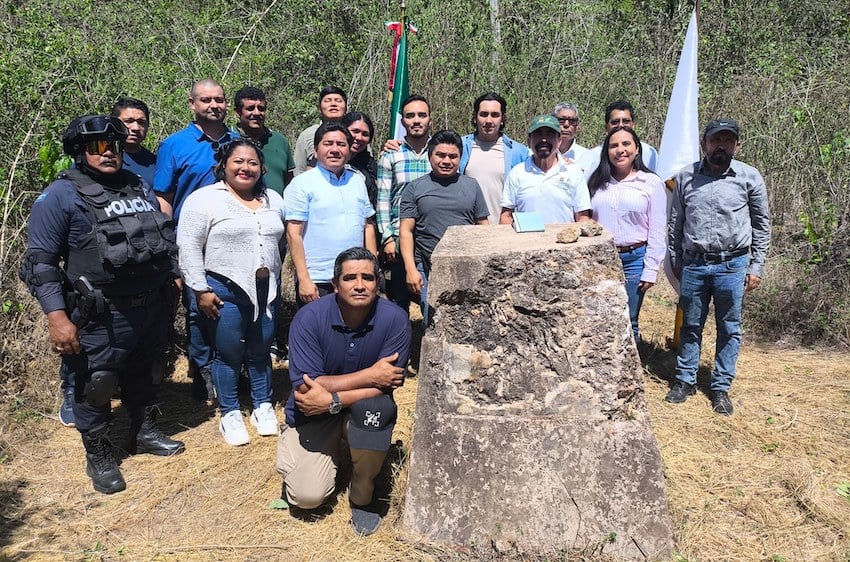
Punto Put — which is an acronym in Spanish for "point of territorial union" — was erected in 1922 over the ruins of an old hacienda called Rancho Put in Campeche. More than 100 years later, Quintana Roo considers it the state's rightful territory. (Consejería Jurídica del Poder Ejecutivo del Estado de Quintana Roo)
“It is the most significant court case in the entire history of the state.”
Those are the words of Arturo Coral, a lawyer representing Quintana Roo in a territorial dispute with the Caribbean coast state’s two neighbors — Campeche and Yucatán.
“There isn’t, there hasn’t been and there won’t be another case like this,” Coral told the newspaper El País.
He was speaking about a legal case related to a long-running dispute over close to 10,000 square kilometers of land on the Yucatán Peninsula.
One 5,000 square kilometer parcel of land that is in dispute is located in a kind of no man’s land between Quintana Roo and Campeche. Which state does it belong to?
Another parcel of land with an area of some 4,800 square kilometers and which is located on the border between Quintana Roo and Yucatán is also disputed. Which state does that belong to?
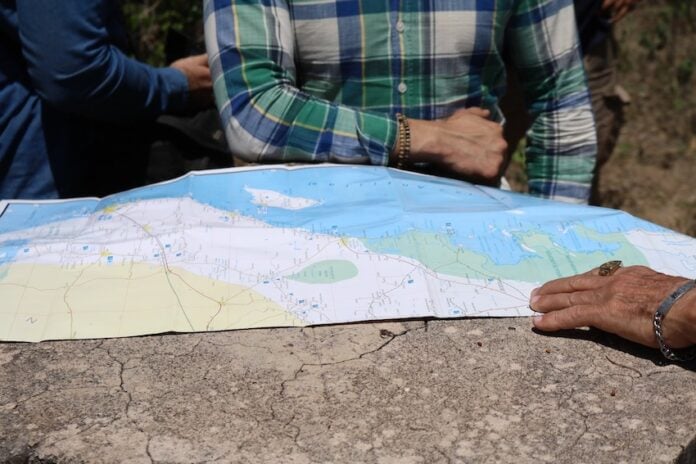
The answer to those two identical questions will come from Mexico’s Supreme Court, which has been tasked with settling the dispute over land extending from Punto Put, a point that is supposed to delineate the borders between Quintana Roo, Campeche and Yucatán.
The news outlet Posta reported that “physically,” Punto Put “is a concrete monolith with a pyramidal form” that was “erected in 1922 over the ruins of an old hacienda called Rancho Put.”
A territorial dispute is born
“In the heart of the jungle of the Mexican southeast there is a point that divides more than unites: Punto Put, an area where the borders of Campeche, Yucatán and Quintana Roo are found, and which for more than 100 years has been the cause of a dispute between the three states. It all began in the 19th century, when the old Province of Yucatán fragmented: Campeche became a state in 1863 and Quintana Roo was born as a federal territory in 1902. In that process, the border lines between the three were never well defined, since the peninsula lacks natural features — such as rivers or mountains — that could have served as reference points. That is how the confusion arose over exactly where the three territories meet.”
The passage above comes from a report published by the news outlet Quadratín last October.
The creation of the municipality of Calakmul in Campeche in 1996 intensified the dispute, according to media reports. El País reported that “the dispute reappeared in 2019” when Quintana Roo — which became a state in 1974 — “ratified its territorial coordinates in a constitutional reform.”
Attempts by the federal Senate and courts to resolve the dispute have been to no avail.
The land in dispute is not inconsequential — it represents around 20% of Quintana Roo’s entire territory and is home to around 23,000 people living in more than 300 communities, according to El País. The land disputed by Quintana Roo and Campeche runs southward to Mexico’s border with Belize and Guatemala.
Water supplied by one state, education by another
In an article published this week under the headline “Put, the coordinate in the middle of the jungle that will decide the map of the Yucatán Peninsula,” El País reported that the Punto Put land disputed by Quintana Roo and Campeche is “rich in precious wood but poor in public services.”
“Both [states] claim it as their own, though neither takes full responsibility for those who live there,” the newspaper reported. “Water from here, school from there.”
El País reported that Quintana Roo authorities drilled a well that supplies water to the community of San Antonio Soda, but the Campeche government provides residents with “everything else” — a health center “without a doctor,” schools, paved roads and streetlights.
The newspaper also reported that most of the people who live in the disputed area between Quintana Roo and Campeche are from other states of Mexico who were lured to the region by the availability of farming land.
In the land disputed by Quintana Roo and Yucatán, “each state has informally divided up each community,” wrote an El País journalist who recently reported from the area. Still, arguments over who is responsible for things such as water supply, health care and road maintenance persist.
A recently elected Supreme Court justice is responsible for the Punto Put case
The Supreme Court previously considered the dispute in 2013, but didn’t hand down a ruling to resolve it, in large part because the Senate failed to submit a file containing expert reports and evidence, El País reported.
Punto Put. (Consejería Jurídica del Poder Ejecutivo del Estado de Quintana Roo)
El País spoke to residents of communities within the disputed land that had differing opinions about which state their community should belong to. They will no doubt be waiting with bated breath for the Supreme Court’s decision.
However, El País indicated that other residents are unconcerned about the state in which their community will end up.
“The government is like our husband,” Ana, a 54-year-old San Antonio Soda resident, told El País. “Wherever it takes you, that’s where you’ll stay.”
In Cerro de las Flores, a community near the border with Belize and Campeche, Alejandro Álvarez told El País that political candidates from both Campeche and Quintana Roo visit during election campaigns to try and win votes. He said they pledge to do different things for the community, but don’t deliver after they are elected.
“Neither of the two [states] makes an effort here,” said Álvarez, who was reportedly fed up with the intermittent failures of services such as electricity, internet and public transport.
Talent on the move is not a threat to be managed. It is the quiet second-stage engine that could turn North America’s demographic imbalance into its greatest asset, Pedro Casas writes. (Courtesy of the author)
A few days ago, NASA’s Artemis II rocket launched from Kennedy Space Center. It is carrying a crew on a trip around the Moon and safely back home. I’m using Artemis II as a metaphor to explain where North America stands right now in demographic terms.
Our shared “rocket” — the United States, Canada and Mexico working together under the USMCA — has already launched toward steady growth and stronger development through 2050 and beyond. The goal is simple: reach high and fast, building a competitive economy while coming back safely without running out of fuel.
The first-stage engine (the one that gets us out of the atmosphere) is our own birth rates. Unfortunately, they are running low: around 1.6 children per woman across the region (way below the replacement rate). It will help us launch and take some nice pictures, but that’s pretty much it. Once we are past the atmosphere — and that will happen very fast — we need a second booster.
The real second-stage boost comes from migration and talent moving across borders.
As you can see in the Congressional Budget Office chart below (to which I added some emojis), the rocket has just launched and the U.S. has only a few years of population growth left on its own. By 2030, native population growth (births minus deaths) hits zero (let that one sink in). Time to activate the second booster: migration. Even with optimistic predictions, the U.S. runs out of gas by 2056, when overall population growth stalls and population decline officially begins. Houston, we have a problem!
Now imagine that while we’re all watching Artemis II fly off live, a very different rocket blasts off from China and its Southeast Asian neighbors. Uh-oh — it seems like we’re in a race. China’s rocket — let’s call it The Overshoot Express — is supposedly fueled by huge population numbers.
But the latest UN World Population Prospects 2024 Revision reveals the punchline. China has already peaked and is losing people faster than any large country in modern times. Its population could drop by more than 200 million by 2054, with fertility down to just 1.01 children per woman.
The whole East and Southeast Asia region has been revised downward as well. In a world where the UN now expects the global population to peak earlier and lower than previously thought — around 10.3 billion in 2084 — the winners will not be those with the largest headcount at launch. They will be the ones whose rocket was built for smart integration, with a powerful second booster.
As you can see, we North Americans are playing a completely different ball game. Our initial fuel tank is almost ten times smaller. So yes, we need to compete smarter with our reserve tank: migration, talent mobility, demographic complementarity — call it what you want.
The current system doesn’t help. Visa backlogs, mismatched credentials and misguided fears of “brain drain” and “job stealing” keep talent locked in silos. We are leaving money, innovation and jobs on the table because we keep politicizing the issue instead of tackling it head-on. In rocket terms, we might be risking not reaching the Moon.
How do we win the race? An efficient talent policy is the best way forward. Why? (This is a good moment to read my previous article on demographics.)
First, it fills real labor gaps. U.S. projections show 190 million job openings by 2033, with 26% in high-retirement fields such as engineering and nursing. Managed mobility could cover 10–15% of those gaps and boost GDP by 1–2% per year (McKinsey).
Second, it accelerates innovation. Knowledge moving back and forth drives 20–30% faster regional progress in integrated economies (OECD).
Third, it spreads prosperity more evenly. Returnees start 20% more businesses, and remittances fuel local investment (IOM).
Fourth, it strengthens security. Better-tracked migration flows reduce irregular migration by 30–50% and shrink opportunities for trafficking (EU experience).
And these are only a few examples.
We don’t need to invent this from scratch. Europe, Australia and ASEAN already run smart programs that move talent without chaos. North America can adapt them with four practical steps that build on what we already have under the USMCA.
Update the TN visa to TN 2.0. Expand it to include fields such as AI, semiconductors and clean energy; streamline paperwork online; and add short 3-5 year circular options so workers can go home with new skills and return later. No open borders — just targeted, temporary boosts.
Create regional skills certificates. Pilot trilateral programs in high-demand fields so that a Mexican technician certified in Monterrey can work in Detroit without starting from scratch, and a U.S. engineer can train teams in Guadalajara and bring fresh ideas home.
Build circular migration pathways with real incentives. Re-entry guarantees, portable pensions and small reinvestment funds for returnees who start businesses or train others. Tie them to safe logistics corridors so everything remains legal and secure.
Fund cross-border talent hubs. Think apprenticeships in Tijuana-San Diego, joint AI boot camps in Austin-Monterrey, or exchanges between the Illinois Universities System and UNAM in Mexico City for quantum computing. Short-term instructor visas could create positive “brain circulation” loops.
These steps are practical, not radical. They rely on existing USMCA chapters on labor (C.23) and digital trade (C.19), remain rights-based and could actually reduce irregular flows by making legal pathways more attractive.
Before concluding, a quick note on the geographical dimension. The vast majority of U.S. territory is aging, while the Sunbelt is booming. The latest Cooper Center (University of Virginia) projections show the South and West adding 6-8 % more people each decade through 2050, with Texas, Florida and the border states leading the trend. That is not random luck; it is geography meeting demographics head-on.
The U.S. southern border is no longer just a line on a map; it is the launchpad for North America’s next rocket (It actually is. Literally and figuratively. Now, do me/you a favor and spend four minutes reading my article about the border).
When youthful Mexican talent flows north through those same Sunbelt corridors and skilled Americans reinforce Mexican capital infrastructure — feeding factories, data centers and energy hubs — the rocket does not just stay aloft. It accelerates.
Demographics and geography are finally working together, turning our shared border into the most powerful second-stage booster the continent has ever had.
Talent on the move is not a threat to be managed. It is the quiet second-stage engine that could turn North America’s demographic imbalance into its greatest asset. We already have the pieces: youthful Mexico, experienced U.S. and Canada and shared trade rules. What we need is the imagination (political will?) to connect them.
When we do, the regional utopia stops being a dream and starts looking like the most dynamic and inclusive rocket on Earth. The round trip to the Moon is only the beginning. Next stop: Mars.
Pedro Casas Alatriste is the Executive Vice President and CEO of the American Chamber of Commerce of Mexico (AmCham). Previously, he has been the Director of Research and Public Policy at the US-Mexico Foundation in Washington, D.C. and the Coordinator of International Affairs at the Business Coordinating Council (CCE). He has also served as a consultant to the Inter-American Development Bank. Follow his Substack here.
President Sheinbaum was previously opposed to fracking, whose impacts on the environment include soil and groundwater contamination and toxic emissions. (Shutterstock)
Sheinbaum’s mañanera in 60 seconds
🏗️ Fracking feasibility panel debuts: Sheinbaum introduced a multidisciplinary group of Mexican scientists tasked with assessing whether “sustainable fracking” is technically and economically feasible across different regions of Mexico.
🧪 Science minister sets the terms: Rosaura Ruiz predicted that the group would recommend biodegradable chemicals and recycled water use in any fracking operations, framing the effort as applying “science for social well-being” without harming ecosystems or water supplies.
🛢️ Geoscientist gives fracking a green-ish light: Luis Fernando Camacho Ortegón said he’s monitored U.S. fracking for 20+ years and that current technology has reached “a very stable level of security,” citing no serious accidents in the Eagle Ford Shale region of Texas.
❓ Is the decision already made? A reporter pressed Sheinbaum on whether the panel’s composition signaled fracking is a done deal. She flatly said “no,” insisting that scientists with opposing views are also part of the group — just not present on Wednesday.
🤝 Communities get a veto: Sheinbaum pledged that Indigenous and local community consultations will happen before any fracking decision, saying “we’re not going to do anything against the communities.”
🇺🇸 Texas dependency is the real driver: The president said Mexico can’t keep sourcing 75% of its gas from Texas fracking operations, framing domestic fracking research as a matter of energy sovereignty, not just economics.
🌐 Foreign tech yes, foreign control no: Sheinbaum floated the idea of Pemex hiring foreign fracking technology rather than ceding resource control, declaring flatly: “We’re not going to hand over our resources to foreign countries.”
Why today’s mañanera matters
President Sheinbaum’s Wednesday morning press conference focused on the possibility of “sustainable” fracking taking place in Mexico.
While Sheinbaum stressed that no decision has yet been made, she appears to be strongly in favor of allowing the controversial gas extraction technique, provided that there are guarantees that it won’t create environmental problems or adversely affect local communities. The main aim is to reduce Mexico’s dependency on natural gas imports from the United States.
Sheinbaum has acknowledged her previous opposition to fracking, but now asserts that it can take place safely via the use of new technologies. A scientific committee has been formed to offer an expert opinion on the topic, and it appears likely that its conclusions will be used to legitimize a government decision to allow “sustainable” fracking.
Fracking has already taken place in Mexico, but the practice was largely paused by former president Andrés Manuel López Obrador. Sheinbaum’s apparent push to launch a “sustainable” fracking initiative in Mexico represents a major break with the policy of her predecessor, political mentor and founder of the political movement she now leads.
Today’s mañanera was extremely significant as the president unveiled the experts who will assess the feasibility of “sustainable” fracking and reiterated her openness to the use of the gas extraction method. If fracking is approved by the Sheinbaum administration, the president’s Wednesday morning press conference will be seen as an important milestone on the journey to such a decision.
Sheinbaum introduces scientific group that will assess fracking feasibility
At the very start of her press conference, Sheinbaum highlighted that a group of Mexican scientists from various universities was in attendance.
“They’re going to help us with a question we posed a week ago — Under what conditions is the non-conventional exploitation of gas in our country feasible or not feasible?” she said.
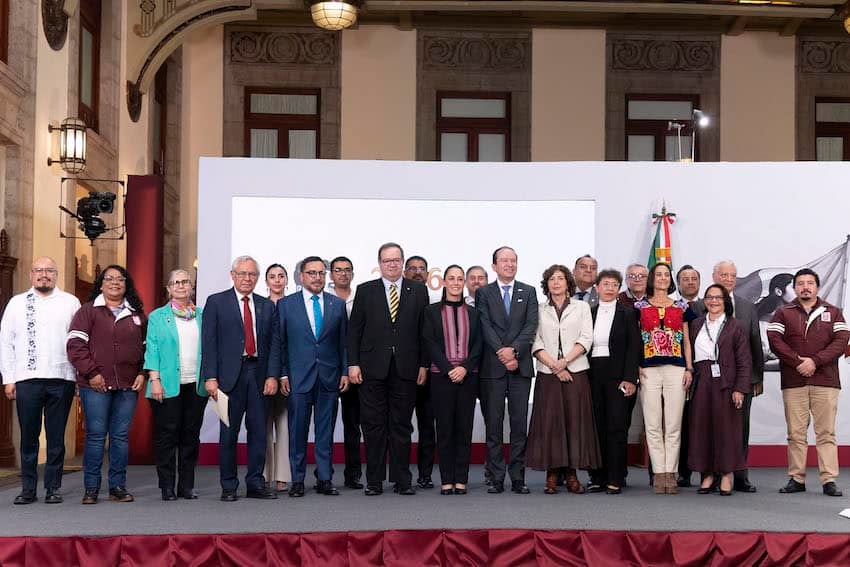
The following experts joined President Sheinbaum at her fracking press conference: Luz Elena González, Energy Minister; Víctor Rodríguez Padilla, Director of Petróleos Mexicanos (PEMEX); Rosaura Ruiz Gutiérrez, Science, Humanities, Technology and Innovation Minister; Leonardo Lomelí Vanegas, Rector of the National Autonomous University of Mexico (UNAM); Arturo Reyes-Sandoval, Director General of the National Polytechnic Institute; Gustavo Pacheco López, Rector of the Autonomous Metropolitan University (UAM); Patricia Guadalupe Herrera, Director of the Mexican Institute of Water Technology; Erick Emanuel Luna Rojero, Head of the Research Division at the Mexican Petroleum Institute; Emilia Esther Calleja, Director General of the Federal Electricity Commission (CFE); and Cuitláhuac García Jiménez, Director General of CENAGAS. (Juan Carlos Buenrostro/Presidencia)
On Wednesday, she said that the scientific group will assess whether such fracking is feasible in different parts of the country.
“This is the task that we gave them,” Sheinbaum said.
The group is slated to offer an initial opinion on the feasibility of sustainable fracking in Mexico in two months.
Science minister: ‘The commitment of this government is to reach energy sovereignty’
Speaking immediately after Sheinbaum’s opening remarks, the federal minister for science, humanities, technology and innovation, Rosaura Ruiz declared that “as the president has said in recent days, the commitment of this government is to reach energy sovereignty, without compromising water security or the health of our ecosystems.”
Ruiz subsequently noted that the ministry she leads put together the “multidisciplinary” scientific group that will assess the viability of sustainable fracking in Mexico.
She said that the group will “recommend the use of chemicals” for fracking “that are biodegradable.”
Ruiz also spoke about the importance of using recycled water in fracking so as to “not affect catchment areas and human consumption, especially in arid areas.”
The science minister asserted that she, other officials and the scientific group “are here to give confidence and scientific rigor to the people of Mexico.”
“We’re not improvising, we’re applying science for social well-being and the protection of our soil,” she said.
Geoscientist: Current fracking technology has a ‘very stable level of security’
Asked whether fracking in Texas affects the environment in Mexico, Sheinbaum referred the question to a member of the scientific group.
Luis Fernando Camacho Ortegón, a geoscientist from the Autonomous University of Coahuila, said that he and other scientists have been monitoring “the non-conventional hydrocarbons industry” — i.e., fracking — in the United States for over 20 years.
He said that fracking techniques were previously inefficient and acknowledged that fracking has caused “some problems.”
However, Camacho asserted that fracking technology has improved a lot, and told reporters — in a contestedclaim — that there have been no accidents or contamination related to fracking in the Eagle Ford Shale region in Texas.
“We haven’t heard of any accident or serious problem,” he said, adding that “the current technology” used in fracking “has reached a very stable level of security.”
Sheinbaum rejects suggestion that a decision about fracking has already been made
A reporter asserted that the “composition” of the scientific group and the remarks of its members indicated that a decision about allowing fracking in Mexico has already been made.
“Fracking will be carried out, [gas] will be extracted and what we’re [really] asking is where and how,” he said.
“… Has the decision already been made?” asked the reporter, who said that the scientific group appears to be “strongly” in favor of fracking.
“No,” Sheinbaum responded.
“That’s why we’re consulting the scientists,” she said.
Sheinbaum asserted that “many” members of the scientific group have “spoken out against this form of gas extraction,” although few if any of them were present at today’s mañanera.
“Today we introduced those who are here,” she said.
Ruiz subsequently said that not all of the members of the scientific group were able to attend the president’s press conference. She also asserted that the scientists who are part of the group have “different positions” on the issue of fracking. The science minister echoed the president’s remarks, declaring that no decision on allowing fracking has been made.
Sheinbaum: ‘We’re not going to do anything against the communities’
Sheinbaum told reporters that consultation processes with Indigenous people and other citizens will take place before any decision about fracking is made.
“We’re not going to do anything against the communities … because we’re not like that,” she said.
“… That must be made clear,” Sheinbaum said.
“The first thing is to see the technical and scientific viability [of sustainable fracking],” added the president.
She said last week that the “sovereignty” of Mexico, “the development of the country” and its “environmental future” will be central considerations in any decision her government makes about fracking.
On Wednesday, Sheinbaum said that the scientific group will offer an opinion on the feasibility of sustainable fracking in around two months, including information on the cost of “new technologies” that could be used to extract gas from non-conventional deposits. She said the group might determine that sustainable fracking in Mexico is “too expensive.”
Sheinbaum: We can’t continue depending on gas from Texas
Sheinbaum declared that “what we can’t do” is continue depending on gas fracked in Texas in order to meet 75% of Mexico’s gas needs.
“While we can continue buying, we have to seek energy sovereignty,” she said.
“It’s very important to continue researching [the feasibility of sustainable fracking],” Sheinbaum said.
“And we’re not hiding anything. If I wanted to hide something, we wouldn’t be publicly presenting what we’re doing,” she said.
‘We’re not going to hand over our resources to foreign countries’
Sheinbaum raised the possibility that state oil and gas company Pemex could “hire” the technology required to carry out sustainable fracking from a foreign company or companies.
In response to a reporter’s assertion that the hiring of technology would create a “technological dependency,” the president highlighted that Mexico already depends on foreign technology “in many areas,” including in the energy and health sectors.
Asked whether she could rule out foreign companies coming in to Mexico to carry out fracking, Sheinbaum declared that “we’re not going to hand over our resources to foreign countries.”
Asked whether the extraction of gas in Mexico via fracking would bring down gas prices, the president responded:
“Beyond the price, [the important thing] for all Mexicans is availability … [of] gas in our territory. That is extremely important for all Mexicans. Sovereignty is a matter for everyone. It’s not just an individual benefit, it’s a collective benefit. It’s about the homeland, the nation, the future of Mexico.”
Sheinbaum said last week that the commencement of sustainable fracking in Mexico — if approved — could take 10 to 15 years. However, it appears that the government is interested in moving as quickly as possible in order to promptly ease, if not eliminate, Mexico’s dependency on U.S. oil.
By Mexico News Daily chief staff writer Peter Davies (peter.davies@mexiconewsdaily.com)
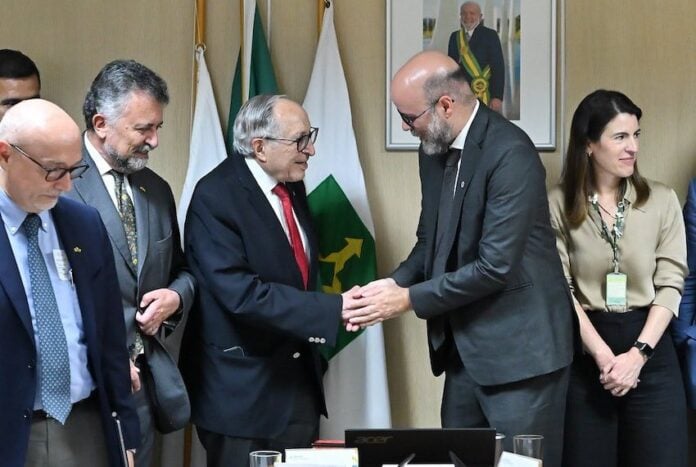
The agreement was signed during Health Minister David Kershenobich’s work trip to Brazil within the framework of the wider healthcare cooperation agenda that both countries began last year at the 78th World Health Assembly in Geneva, Switzerland. (Health Ministry)
Mexico and Brazil have announced the signing of a Memorandum of Understanding to boost technical, scientific and institutional cooperation in the healthcare sector while expanding citizens’ access to services, technologies and medicines.
The agreement was signed during Health Minister David Kershenobich’s work trip to Brazil within the framework of the wider healthcare cooperation agenda that both countries began last year at the 78th World Health Assembly in Geneva, Switzerland.
Este encuentro entre Brasil y México en materia de salud, ofrece oportunidades para fomentar el desarrollo de la industria farmacéutica, la formación de recursos humanos y conocer referencias claras para la implementación del Servicio Universal de Salud de nuestro país. https://t.co/QnNA45VXtR
— Dr. David Kershenobich S (@DKershenobich) April 14, 2026
Key agreements include the creation of a bilateral analysis committee focusing on the healthcare systems of Mexico and Brazil; the exchange of information and best practices between Brazil’s Farmácia Popular (Popular Pharmacy) and Mexico’s Farmacias del Bienestar (Well-being Pharmacy); and the implementation of a joint technical team for telemedicine and telehealth.
The agreement prioritizes technical, scientific and institutional cooperation in health surveillance and disease control (such as dengue and other infections), as well as epidemiological exchange and collaboration to develop new platforms such as messenger RNA. Other actions include cooperation on new platforms such as local production of supplies and the strengthening of clinical research.
To boost education, the agreement also aims to facilitate training exchanges between the two countries and enhance the capacities of healthcare professionals.
During the signing of the memoranda, Kershenobich said Mexico wants to continue developing “joint initiatives with Brazil, especially in the areas of pharmaceuticals, vaccines and innovation.” Previous bilateral agreements between the two countries include those signed in August last year to accelerate regulatory processes and strengthen regional production of vaccines and medicines.
Brazil’s Health Minister Alexandre Padilha celebrated the strategic nature of the bilateral collaboration and highlighted Brazil’s universal healthcare system — known as the Unified Health System (SUS) — whose model, he said, can contribute to Mexico’s goals.
“The SUS is a concrete example of inclusion and can contribute to the transformation process of the Mexican system, as we move forward together in innovation, drug production, and responding to common health challenges,” he stated.
Recently, President Clauda Sheinbaum announced her administration will transform the public system (IMSS-Bienestar and Health System for Well-being) towards a program that offers free health care for citizens and legal residents regardless of their social security status.
During his trip, Kershenobich held meetings with medical management teams to draw on their experience under SUS ahead of Mexico’s transition, which is expected to begin in January 2027.
“Mexico sees the SUS as an important source of inspiration for advancing the construction of a more integrated and accessible system,” Kershenobich said, adding that their collaboration with Brazil seeks to strengthen Mexico’s “capacities and guarantee more access to health for our populations,” he said.
MEXICO CITY — Following the announcement that Italian opera legend Andrea Bocelli will share the Zócalo stage with cumbia institution Los Ángeles Azules and singer Ximena Sariñana on April 18, city officials confirmed this week that they consider the booking “completely normal” and have no intention of slowing down.
The free concert will feature a full symphonic orchestra and is expected to draw hundreds of thousands of fans to the Plaza de la Constitución — continuing a tradition of landmark Zócalo performances that included Shakira’s record-breaking show just weeks prior.
The fateful decision that started it all. (Banco Plata)
Sources close to the city’s cultural programming office, however, confirmed that preliminary discussions are already underway for future events, including a proposed evening with Metallica and Guadalupe Pineda, a tentative double bill pairing Björk with Los Yonics, and what one official described only as “a Radiohead and Pepe Aguilar situation we’re still working through logistically.”
Also reportedly in early conversations: Celine Dion and Banda MS, Roger Waters and Paquita la del Barrio, and a headline slot for Bad Bunny and Plácido Domingo that two separate departments claim the other one proposed first.
When asked what unifying artistic vision connected these lineups, a spokesperson pointed to the April 18 bill and said, simply, “Can you imagine this fusion?”
Rumour has it that the Kid Rock and Peso Pluma crossover has already been cancelled.
This portrait of Natasha Gelman by Diego Rivera is a jewel of the Gelman art collection. (Diego Rivera)
Mexico’s art world is going through one of the most intense media controversies in recent times due to the imminent departure of the Gelman collection, arguably the most important private collection of 20th-century art in the country.
The collection was originally assembled by Natasha and Jacques Gelman, a married couple of European descent who arrived in Mexico as Jewish refugees in the 1940s. Together, they became great patrons and collectors of modern Mexican art after making a fortune in the Mexican film industry following Jacques’ discovery of Cantinflas.
What is the Gelman collection?
Jacques and Natasha Gelman put together an amazing collection of Mexican art. However, since their deaths, controversy has surrounded it. (Gelman Collection)
Boasting 160 works by some of Mexico’s most renowned artists, the collection includes pieces by Frida Kahlo, as well as several artworks by Diego Rivera, José Clemente Orozco, María Izquierdo and David Alfaro Quintero.
“The Gelman collection has the third most important collection of Frida Kahlo’s paintings in Mexico,” curator and cultural analyst Ximena Apisdorf told me. “That’s only one of the reasons why this case is so relevant.”
Currently exhibited at the Modern Art Museum in Mexico City, the collection is set to leave the country as part of an agreement between Marcelo Zambrano, who recently acquired part of the Gelman collection, Banco Santander and the National Institute of Fine Arts and Literature (INBAL).
The controversy surrounding its leaving the country
According to the agreement, the collection will now be called Colección Gelman Santander and will initially be exhibited over the summer at the upcoming Faro Santander Museum in Spain before traveling to museums around the world under the management of the Spanish bank.
Upon learning the news, Apisdorf — along with nearly 380 individuals from the artistic community — sent an open letter to Mexico’s government. In it, they expressed their concern about the departure of the collection, given that 30 pieces have been declared National Artistic Monuments and thus are subject to restrictions on export.
“No one doubts that the change of ownership is a matter that strictly concerns private individuals,” the open letter says. “However, the fate of the work protected by these decrees … concerns us all.”
A selection of the Gelman collection is currently being displayed in an exhibit at the Museo de Arte Moderno in Mexico City. (Gobierno CDMX)
According to Carlos Lara, an expert lawyer in cultural heritage issues, a National Artistic Monument decree sets limits to the property of an artwork, while granting two property dimensions: a symbolic and a legal one.
“The legal dimension means that the piece belongs to the owners,” Lara explained to me. “Meanwhile, the symbolic dimension is granted to Mexicans, meaning that while the legal ownership rests with the owners, the artwork is symbolically considered to belong to the people of Mexico.”
The legal issues involved
One of the limitations of an artistic monument is that the artwork cannot leave the country except under certain conditions that must be approved in advance by the INBAL. In the case of Kahlo’s work, her artwork must always return to the country.
Lara said that INBAL’s permission for the artwork to be displayed abroad is legal. However, the lack of transparency is a concern.
“It’s the usual lack of transparency surrounding the duration of travel permits and the issue of the works traveling to different venues that’s concerning,” he said, adding that INBAL itself acknowledges in the agreement the need to avoid, as far as possible, periodic and recurring travels as the handling and transporting of the pieces poses risks to the artworks’ integrity.
This lack of transparency adds to previous debates surrounding the opaque management of the collection following Natasha’s death.
Painting of Natasha Gelman by Frida Kahlo, whose art must always return to Mexico. (Facebook)
Since Natasha’s passing in 1998, the collection has been in a legal and narrative limbo marked by a rarely-seen will to which everyone refers and which reportedly said that it was Natasha’s will that the collection remain undivided in Mexico.
But after her death, Robert Littman — the Gelman’s art adviser — appeared as the will’s alleged executor and acted as the rightful owner managing the collection for years before selling it to Marcelo Zambrano in an operation lacking transparency and allegedly contravening Natasha’s will.
Will the collection return to Mexico?
Adding to the controversy, Apisdorf said it’s unclear whether Santander actually owns the collection or simply manages it, arguing it is suspicious that its name is now attached to the collection.
“It’s like a child. If you don’t plan to adopt the child, you don’t give him your last name,” Apisdorf said.
“How many times do we have to tell you that the Culture Ministry is complying with the law?” she said.
Sheinbaum said that while artworks designated as cultural heritage of Mexico — as is the case with works in the Gelman Collection — cannot be sold abroad, they can be exhibited in foreign countries. (Moisés Pablo/Cuartoscuro)
Culture Minister Claudia Curiel Icaza later clarified that the collection belongs to Mexican collectors and not to Santander; that the export permit is temporary and for five years; and that after its exhibition in Spain and other venues, the collection must return to Mexico.
Banco Santander and legal loopholes
Banco Santander has also addressed the issue and confirmed Curiel’s statement that the pieces will return to Mexico and that the owners are still Mexicans.
“We reiterate that no signed agreement foresees a change of ownership, nor the definitive transfer of the collection to any point outside of Mexico,” the Fundación Banco Santander said. “The agreement entails five years of collaboration with the current administration.”
However, the agreement — seen by newspaper Excelsior — says that the five-year term could be extended, meaning the collection could stay abroad for an indefinite period of time.
“As far as I know, this is not the first time a long-term authorization with periodic renewals has been signed,” Lara said. “Just look at the Tonalamatl Aubin Codex.”
This Codex of pre-Hispanic origin is currently exhibited at the National Museum of Anthropology and History, but legally — and paradoxically — belongs to France. Thanks to an agreement with periodic renewals between France and Mexico, the Codex has remained in Mexico.
The fear of the Gelman collection leaving Mexico is that classic paintings by Mexicans, like this one from Diego Rivera, may remain indefinitely in Spain. (Gelman Santander Collection)
“One of our fears in the artistic community is that eventually, Santander may decide that for the sake of preserving these works, they will no longer travel and will keep them permanently in Spain,” Apisdorf said.
“Ultimately, Gelman’s case is a very clear example of the problems that arise when a cultural piece is viewed as a financial asset,” she emphasized. “But in any case, we will not stop defending the collection.”
Gabriela Solis is a Mexican lawyer turned full-time writer. She was born and raised in Guadalajara and covers business, culture, lifestyle and travel for Mexico News Daily. You can follow her lifestyle blog Dunas y Palmeras.
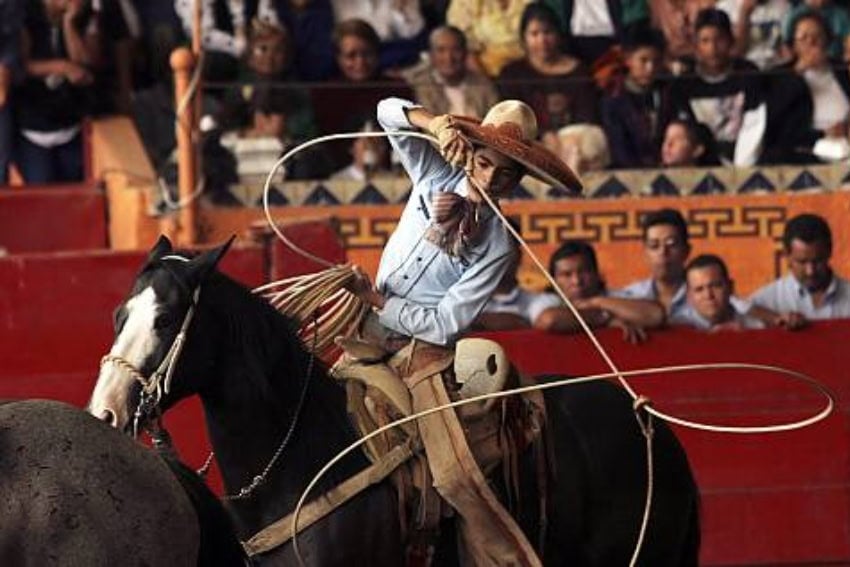
Charrería is the national sport of Mexico and an iconic symbol of the nation. (Gobierno de Mexico)
Amigos, this weekend I went back to the saddle. After decades without riding, taking the reins again felt less like a hobby and more like going home. Within charro circles, there’s a phrase we like to repeat: “A charro isn’t made, but born.”
More than riding, I missed the people and the culture around charrería. Charros tend to have a very particular temperament: forward-moving, blunt and generous, with the kind of steel nerves you need if you’re going to be a good horseman. They also come with a certain bon vivant streak; they know their horses, their tequila and sobremesa.
Charrería reflects the skills charros need for ranching and cattle herding. (UNESCO)
Today, as a historian and former charra, I find it intriguing how charrería has been closely tied to Mexico’s elite and become an emblem of our identity. Since the viceregal period, it has been a pastime of ranch owners, generals, power brokers and businessmen who could afford to spend serious money and time on horses. Even today, you need resources to practice charrería. And even if no one admits it openly, charros still tend to quietly quiz newcomers: What family are you from, who taught you, which lienzo do you ride at? Just to prove you really were born into the charro world.
From cattlemen to charros
Charrería emerged with the introduction of cattle and horses into what is now Mexico in the mid-1500s, and with the daily work of managing the haciendas and ranches that Spanish families carved out of the newly conquered territory. Much of the ranching economy is concentrated in a region known as Nueva Galicia, roughly corresponding to today’s Jalisco, Nayarit, Aguascalientes and Zacatecas.
In the early colonial years, however, Indigenous people, mestizos and even creoles were forbidden to ride. The ban didn’t last. Within a few decades, it became clear that Spanish landowners found it beneath them to do the hard work of tending their own cattle, and the law quietly yielded to economic reality. Yet, those landscapes demanded highly skilled horsemen who could control herds across vast, open stretches of land.
So who handled the herds?
Here, it’s worth pausing to acknowledge the horsemen from Salamanca, in Spain. They had already adopted elements of Mozarabic riding styles, and the few historians who study charrería seriously argue that Mexico inherited from them not only the word “charro,” but also the basic saddle design, the one-handed rein, characteristic clothing and even the broad-brimmed hat.
In other words, Mexican charrería is the local expression of a much longer equestrian tradition that can be traced back — through Spain — to Arab riders. Mexico did not import a fully formed “charro” from Europe; it reworked this Iberian, Hispano-Arab way of riding in the very specific context of New Spain’s haciendas and Indigenous labor.
Over time, the “charros of the new world” changed the repertoire by turning the reata (or rope) into a central tool. Roping cattle had been a practical necessity; gradually, charros began to show off with it, adding personal style and spinning tricks before throwing the loop.
Austrian archduke Maximilian of Habsburg adopted the charro suit during his brief reign as emperor. (Public Domain)
That is why so many of today’s charreada events carry the names of specific ranch tasks. What looks like a stylized performance in the lienzo is essentially a carefully choreographed memory of everyday work: stopping a horse on a dime, roping a steer by the head, flipping it and holding it down.
How did those working horsemen end up as a national symbol?
By the time of Mexican Independence in 1821, the new country needed a face — a figure who could stand in for “the real Mexico.” That figure couldn’t be a peninsular Spaniard, and it couldn’t be purely Indigenous either in a society built on mestizaje. The charro, a popular and admired mestizo or criollo horseman, was perfectly placed to become that emblem.
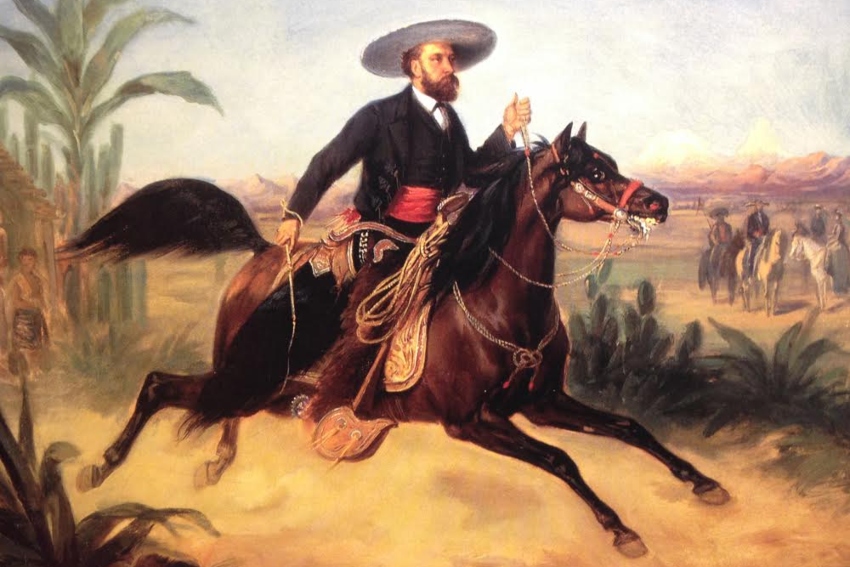
No wonder that some forty years later, when the Austrian archduke Maximilian of Habsburg arrived to rule Mexico with conservative backing, one of his first political gestures was to tour the country dressed as a charro. He believed that wearing the charro suit would signal love and respect for his adopted nation.
Contrary to a persistent myth, Maximilian did not invent or redesign the charro suit. It already existed, in multiple variants, and was worn by different social groups. The emperor adopted it, quite deliberately, as a marketing strategy — a way to wrap himself in an already powerful symbol.
By the Porfiriato at the turn of the twentieth century, Mexico’s economic and social life revolved around haciendas, and the charro was a key figure in keeping those estates working.
When the Revolution broke out, many of those charros — men used to commanding horses, men and territory — became colonels and generals. They turned into part of the new political class, standing shoulder-to-shoulder with both the common soldier and the emerging military elite.
From horseman to national sport
The charro and the charra, too, are symbols of Mexico. (Gobierno de Nuevo León)
After the Revolution, Mexico once again needed a symbol of the nation. As in a century before, that symbol had to be mestizo, with revolutionary overtones but also a fundamentally “kindly” face.
Radio, cinema and the press all helped sculpt that figure. The charro, once merely a cattleman on horseback — and by then firmly embedded in Mexico’s economic and political elite — became a national emblem.
In 1921, that elite coalesced into the Asociación Nacional de Charros, which still exists today. Its role was to preserve charro tradition, but also to regulate it.
Official recognition followed quickly. In 1934, the president established September 14 as National Charro Day, and in 1940, another president formally declared charrería the national sport of Mexico. Even today, though their influence has waned, members of the Asociación Nacional de Charros ride in the official Independence Day parade every September 16, since they are the “reserve” of the Mexican Army.
Riding alongside the charro, there is almost always a woman: dressed as an adelita or a china poblana, she is part of the visual script of “lo mexicano.” But her story is its own chapter.
What happens during a charreada?
Men’s charrería and the suertes
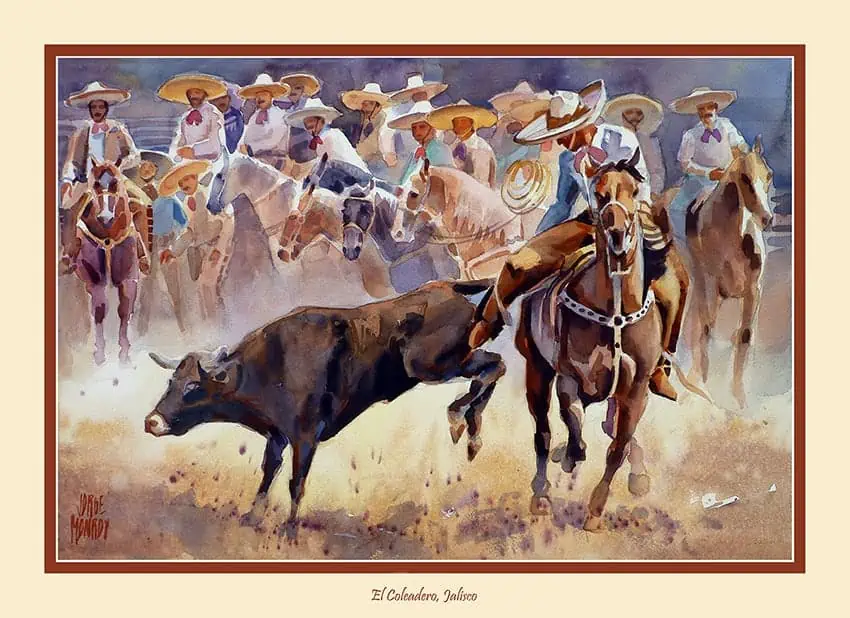
In the men’s competition, charrería is organized around a series of set events, or suertes: coleadero, piales, cala de caballo, bull and mare riding, manganas on foot and on horseback and the paso de la muerte, among others, formally codified as ten core disciplines.
Jorge Monroy’s painting of El Coleadero, a charrería event in which a bull is brought down by pulling its tail. (File Photo)
Each one is designed to showcase specific aspects of ranch skill: roping and throwing cattle, stopping and reversing a horse with precision, staying on a bucking animal, or leaping from a saddled horse onto a running mare. The logic is always the same — demonstrate mastery of livestock, recall the routines of hacienda work and do it all with elegance under pressure.
Escaramuza charra
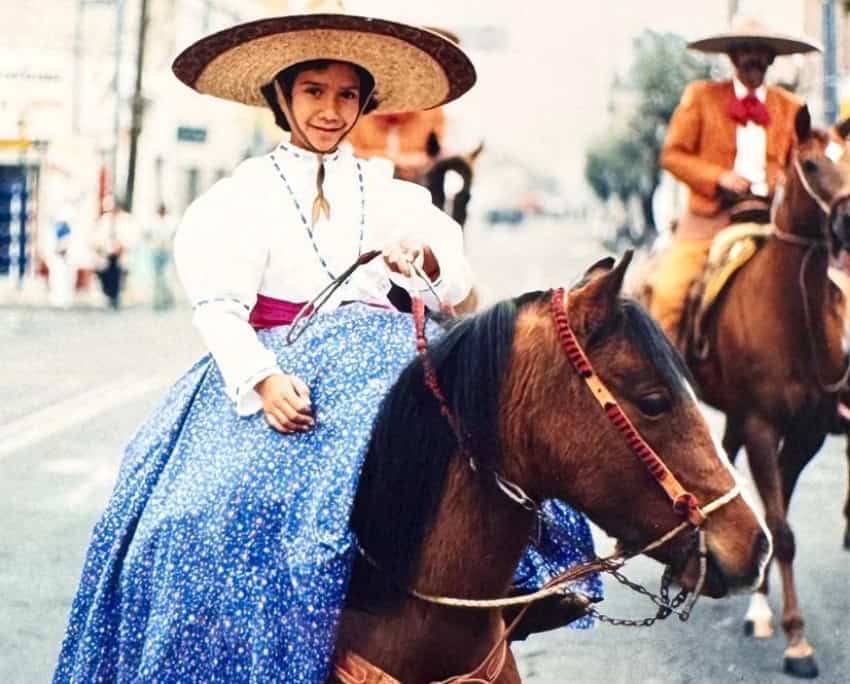
Escaramuza teams are made up of eight women who perform tightly choreographed patterns at a gallop, riding sidesaddle, with both legs draped to one side of the saddle.
Academics see these women as heirs to revolutionary figures like the adelitas and to popular icons like the china poblana, but also as modern athletes negotiating strict dress codes, risk and discipline.
They ride directly into the heart of a sport built by men, and in doing so they subtly redraw the silhouette of who gets to be associated with the word charro.
Children and youth charrería
Charro associations and the federation have created children’s and youth divisions, treating them as crucial to passing down the tradition. In its heritage listing, UNESCO explicitly highlights these intergenerational dynamics: families training together, elders teaching youngsters, skills and stories moving from one generation to the next.
Charros today
Recent scholarship treats charrería as a living cultural phenomenon that still shapes regional and national identities. Even though today charro practices intersect with globalization, mobility and changing land use, charrería exists alongside gated communities, industrial agriculture and streaming platforms. Yet it continues to offer a thick sense of belonging and a language of resistance to cultural erasure.
Yours truly as the most important member of the parade at age 7. (Maria Meléndez)
Today, that world of reins, reatas and carefully rehearsed risk is no longer just a private passion of a few families or a convenient symbol for the state. It is formally recognized as part of Mexico’s intangible cultural heritage, a living archive of memory and muscle that survives only because, generation after generation, someone is still willing to climb into the saddle and ride.
Maria Meléndez writes for Mexico News Daily in Mexico City.
Thanks to what the IMF sees as a gradual recovery from last year's stagflation, the global financial organization boosted Mexico's 2026 GDP forecast by one-tenth of a percentage point. (Moisés Pablo/Cuartoscuro)
Even as it reduced its global growth forecast for the year to 3.1%, the International Monetary Fund (IMF) upgraded Mexico’s forecast by one-tenth of a percentage point, to 1.6% for 2026, recognizing its recovery from a year of stagflation.
The IMF’s lowered expectations for the world as a whole were based on the Iran war. “Before the war, we were preparing to revise our forecasts upward to 3.4%,” the IMF’s chief economist, Pierre-Olivier Gourinchas, was reported as saying.
Kristalina Georgieva heads the IMF, which issued economic forecasts for Mexico, Latin America and the world as its annual meeting began on Monday in Washington, D.C. (IMF)
But the pessimism is expected to be temporary. “Our baseline forecasts are based on a relatively short conflict, with a temporary disruption to the energy market that would disappear next year,” Gourinchas added.
“In Mexico, weak economic growth in 2025 amid fiscal consolidation, restrictive monetary policy and headwinds from trade tensions is expected to lead to a mild recovery,” the IMF report stated.
The IMF also improved its economic outlook for Mexico in 2027, from 2.1% to 2.2%.
Meanwhile, Mexico’s Finance Ministry expects growth to fall somewhere between 1.8% and 2.8% in 2026, followed by 1.9% to 2.9% growth in 2027.
In Latin America and the Caribbean, the IMF revised its forecast upward by 0.1 percentage points, to 2.3% growth.
The global economy, as the IMF sees it
At the IMF annual meeting in Washington, which is running through April 18, International Energy Agency Director Fatih Birol warned that April may be worse than March for global energy supply. The increase in oil prices is expected to drive inflation to a global average of 4.4%, which is 0.6 percentage points higher than stated in the IMF’s January forecast.
Also, if the Iran conflict continues, the economic impact could be much more significant, with a worst-case global growth scenario of just 2%, according to Gourinchas.
“The world is facing this shock after having already endured the impact of COVID-19 and the war in Ukraine… with very little room for political maneuvering,” explained the IMF’s managing director, Kristalina Georgieva.
According to the Treasury, Casino Centenario in Nuevo Laredo and Diamante Casino in Tampico are "involved in a money laundering and cash smuggling enterprise" operated by the Northeast Cartel. (Google Maps)
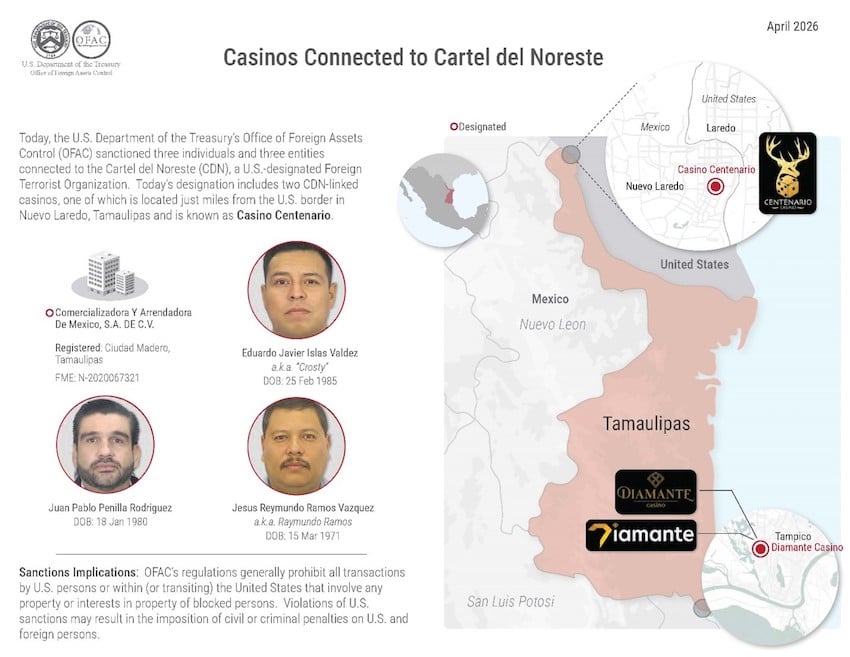
The U.S. Department of the Treasury on Tuesday announced sanctions against three men and two casinos in Tamaulipas for their alleged involvement with the Cartel del Noreste, or Northeast Cartel (CDN), one of six Mexican cartels that the U.S. government has designated as foreign terrorist organizations.
The individuals sanctioned include the president of the Nuevo Laredo Human Rights Committee, Raymundo Ramos, against whom the Ministry of National Defense used Pegasus spyware during Andrés Manuel López Obrador’s presidency (2018-24), according to a 2022 investigation by three civil society organizations.
(U.S. Treasury)
The Treasury Department said in a statement that Ramos is in fact “a CDN associate that leads the CDN disinformation campaign against Mexican authorities while posing as a ‘human rights’ activist.”
“Under the guise of human rights activism, Ramos solely advocates for violent cartel members by filing false complaints against the Mexican military, paying individuals to attend protests, and protecting the reputations of fallen or arrested CDN members,” Treasury said.
“On the CDN payroll, Ramos engages in these activities with the goal of boosting the public opinion of CDN and discrediting Mexican authorities’ law enforcement initiatives against the cartel,” it stated, adding that “Ramos has supported CDN in this capacity for over a decade.”
The Nuevo Laredo Human Rights Committee president has previously denied links to the Northeast Cartel.
The other two individuals designated and sanctioned by the Treasury’s Office of Foreign Assets Control (OFAC) on Tuesday are Eduardo Javier Islas Valdez and Juan Pablo Penilla Rodríguez.
Treasury said that Islas, aka “Crosty,” is “in charge of CDN human smuggling operations in Nuevo Laredo.”
It said that Islas “oversees human smugglers” and “grants permission to move the migrants, acting as a gatekeeper for human smuggling along the Rio Grande into Texas.” Treasury said that the 41-year-old “also ensures the continuity of cross-border activities that sustain the cartel’s criminal enterprise by controlling cash stash houses in Nuevo Laredo.”
Penilla is a defense attorney who “provides illegal services to CDN members,” according to the Treasury. It said that Penilla “assisted” former Zetas leader Miguel Treviño “in Mexican prison — despite OFAC’s sanctions against him — by serving as his intermediary to the current leadership of CDN and other criminal associates.”
Treviño’s faction of the Zetas morphed into the CDN over the last decade. Treviño is now in U.S. custody, having been transferred to the United States along with his brother and 27 other cartel figures in February 2025.
Treasury said that Ramos, Islas and Penilla as well as Casino Centenario in Nuevo Laredo and Diamante Casino in Tampico are “involved in a money laundering and cash smuggling enterprise” operated by CDN.
It also said that “the three individuals designated today play central roles in advancing CDN’s criminal dominance over the Nuevo Laredo plaza in Tamaulipas, Mexico, supporting the cartel’s broader illicit operations, which include fentanyl trafficking, human smuggling, money laundering, and extortion.”
Treasury’s sanctions freeze all U.S.-based assets of the designated individuals and casinos and ban any U.S. person or business from transacting with them, effectively cutting them off from the U.S. financial system.
1 of the designated casinos is just 2 miles from the Mexico-US border
Treasury said that Casino Centenario in Nuevo Laredo is “located just two miles [3.2 km] from the U.S. border.”
The casino is “utilized by CDN as a stash house for fentanyl pills and cocaine, as well as a vehicle to launder illicit proceeds and integrate them into the legitimate financial system through its gaming operations,” Treasury said.
“CDN also uses the backrooms of Casino Centenario to torture and intimidate alleged enemies of the cartel. Many CDN members also frequent Casino Centenario,” the department said.
Treasury said that the same entity that operates Casino Centenario — a company known as CAMSA — “also operates Diamante Casino, which has a location in Tampico, Tamaulipas and a gambling website with the same name.” The company is also subject to the sanctions.
Treasury said that “CDN is primarily based in the Mexican states of Tamaulipas, Coahuila, and Nuevo Leon” and for a period of “decades” has been involved in drug trafficking.
“CDN is involved in violent criminal activity on both sides of the border, including the kidnapping and killing of individuals that threaten their criminal enterprise on the southern border,” it said.