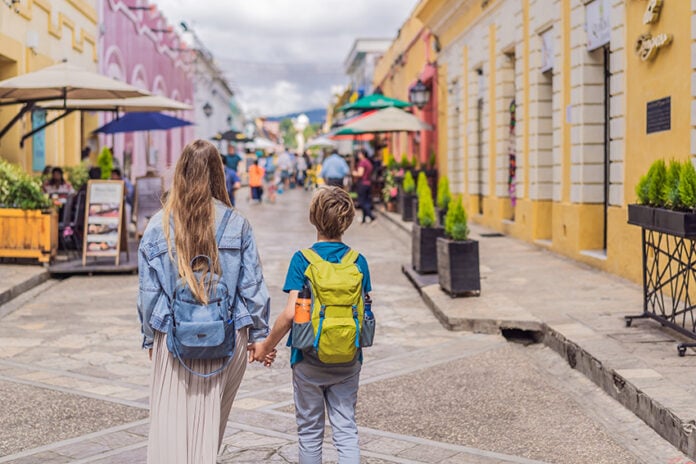
How can expat families make sure their kids thrive in a new country? Three couples share their experiences on this week's podcast episode. (Shutterstock)
As the “Confidently Wrong” podcast Season 2 rolls along, we continue to explore the confidently wrong assumptions around raising kids in Mexico. In today’s episode, we interview three different couples from three countries — the U.S., Canada, and the U.K. — who are raising their children in Mexico.
We wanted to find out how it’s going: What went well or not so well? How are their kids are doing academically? Do they play sports? How is school similar and different from their home country? And perhaps most importantly: Are the kids happy and thriving?
We also probed into whether they would say that they were running from their home country, running to Mexico, or a little bit of both.
What you will hear is unfiltered, real-life experiences from parents on what it’s really like to raise your children in Mexico. Check it out and you might just be inspired to try it yourself!
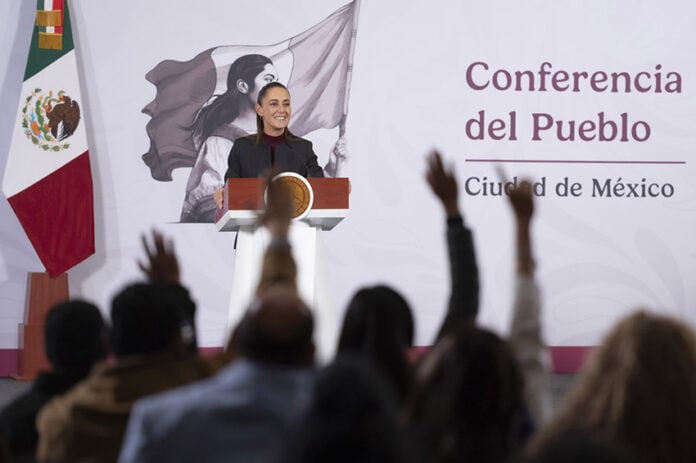
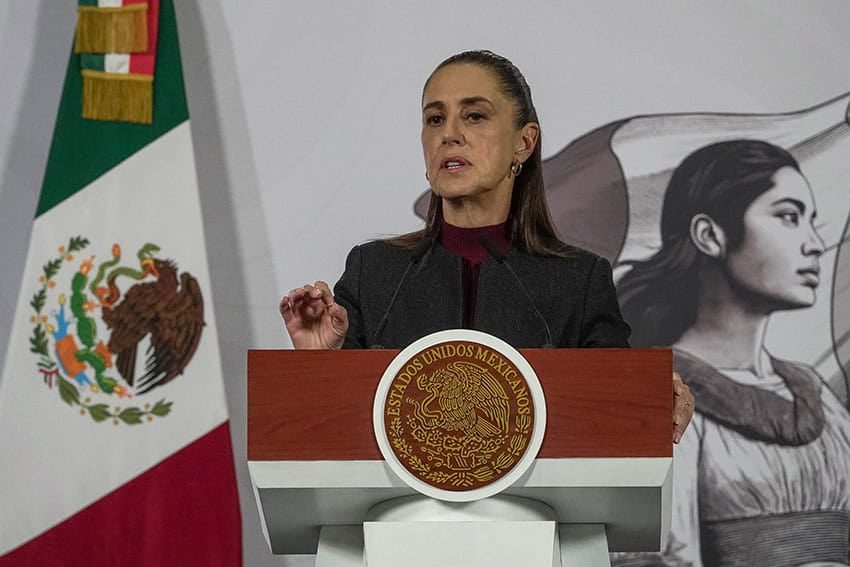
If Cuba requests it, Mexico could be the base for transporting humanitarian aid from around the world to the struggling island, the president said on Friday. (Saúl López / Presidencia)
The possibility of establishing an air bridge to Cuba and the quest to mine lithium in Mexico were among the topics President Claudia Sheinbaum spoke about at her Friday morning press conference.
On Thursday, Cuba President Miguel Díaz-Canel posted a video to social media of the humanitarian aid-carrying Mexican Navy vessels arriving in Havana.
“#ThankYouMexico. Thank you, dear @Claudiashein,” he wrote on X.
#GraciasMéxico. Gracias, querida @Claudiashein. Las ayudas humanitarias de nuestros hermanos mexicanos valen no sólo como carga material. En ellas viajan la solidaridad, la amistad y la ejemplar historia de soberanía y respeto al derecho ajeno que distinguen a #México. pic.twitter.com/MsuiRjdhI4
“The humanitarian aid from our Mexican brothers and sisters is not only valuable as material goods,” Díaz-Canel wrote, adding that the goods also represent “solidarity, friendship and the exemplary history of sovereignty and respect for the rights of others that distinguish #Mexico.”
Sheinbaum: ‘We don’t produce lithium in Mexico, but there are reserves’
“At this time, we don’t produce lithium in Mexico, but there are reserves of lithium,” she said.
Sheinbaum reiterated that Mexico’s reserves of lithium — a metal used in a range of batteries, including those that power electric vehicles — are in clay deposits that are technically difficult and expensive to mine.
“The technology to do it already exists. The issue is that it’s very expensive,” she said.
“So we need to reduce the costs in order to produce lithium … that is in clay soil,” Sheinbaum said.
Sheinbaum noted that the Mexican Petroleum Institute is collaborating with the state-owned lithium company, Litio MX, on efforts aimed at the commencement of lithium mining in Mexico.
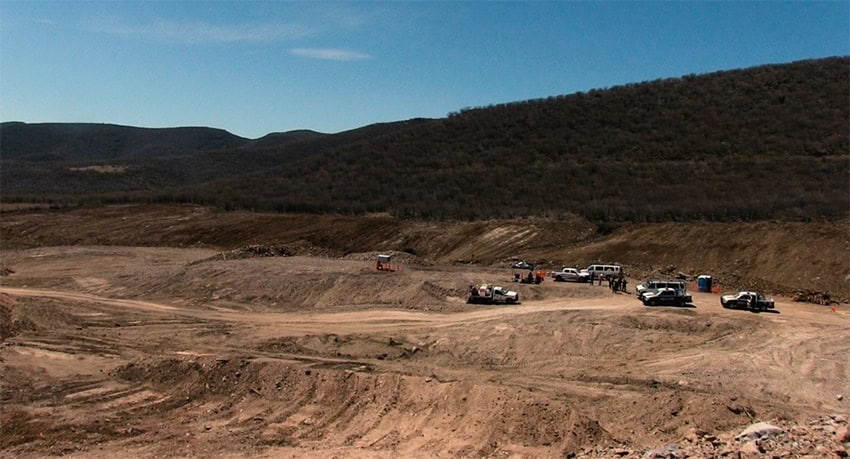
Mexico’s largest lithium deposits are in Sonora, where the federal government established a lithium mining reserve in 2023. There are smaller deposits in other states including Baja California, San Luis Potosí and Zacatecas.
The Mexican government established a lithium mining reserve in Sonora in 2023, but has yet to produce refined lithium due to the cost and difficulty of extracting from the area’s clay deposits. (Global Atlas of Environmental Justice)
‘Who are they?’ asks Sheinbaum about security-focused NGO that suggested Mexico shouldn’t host World Cup
A reporter highlighted that the Citizens Council for Public Security and Criminal Justice (CCSPJP), a Mexican NGO, held at a press conference this week at which its president said that it wasn’t a good time for Mexico to host the FIFA World Cup due to insecurity.
“Who said that?” Sheinbaum asked, prompting a reporter to repeat the name of the NGO.
“And who are they?” Sheinbaum asked, to which the reporter replied that it is a “citizens’ council that provides security statistics.”
Seventeen Mexican cities, including Culiacán, Manzanillo, Colima, Acapulco and Irapuato, were included on the list, which ranked cities according to their per capita homicide rates.
On Friday morning, Sheinbaum noted that preliminary homicide data comes from the states. Those numbers, she said, are subsequently validated or corrected by the national statistics agency INEGI via a review of death certificates.
“It’s data from the Attorney General’s Offices, all the country’s Attorney General’s Offices,” she said.
Sheinbaum didn’t respond to assertions that state Attorney General’s Offices are not accurately reporting homicides because they are incorrectly classifying some murders as less serious crimes. Nor did she respond to claims that the decline in homicides during her presidency is related to an increase in disappearances.
By Mexico News Daily chief staff writer Peter Davies (peter.davies@mexiconewsdaily.com)
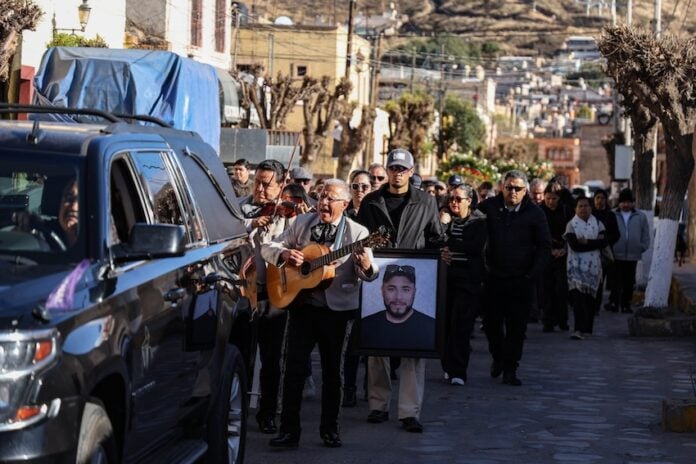
Friends and relatives in the town of Sombrerete, Zacatecas, say goodbye to Zacatecas-born Ignacio Salazar Flores, one of the abducted miners found dead in a mass grave this week.
(Adolfo Vladimir/Cuartoscuro)
President Claudia Sheinbaum on Friday insisted that a “thorough investigation” of the disappearance of 10 Sinaloa miners is being carried out, and that investigators do not necessarily accept the notion that the abduction was a case of mistaken identity as previously suggested.
The remains of five of the missing were discovered earlier this week in a mass grave near the site of the Concordia mine, where investigators are still working to identify the other bodies found there. A total of 14 bodies have been recovered at the site as of Friday.
At her daily press briefing, President Sheinbaum made it clear that her prosecutors are not simply taking the word of suspects in custody who claim that the incident was a case of mistaken identity. (Rogelio Morales / Cuartoscuro.com)
During her daily press briefing, Sheinbaum responded to questions about the motive for the kidnapping, saying prosecutors are not simply taking the word of the suspects in custody who claim that the incident was a case of mistaken identity.
“The investigation involves speaking with family members, other mine workers and the mining industry to understand the circumstances surrounding this tragic and regrettable incident,” she said.
Although Security Minister Omar García Harfuch said four people detained in relation to the case said the miners were mistaken for members of a rival criminal group, Sheinbaum said the possibility that the company they worked for, Vizsla Silver Corp, had been the victim of extortion or threats from criminal groups has not been ruled out.
Sheinbaum said the Federal Attorney General’s Office is conducting “an in-depth investigation,” adding that the mining industry chamber should be consulted to discover if the kidnapping was related to an extortion scheme.
In this regard, Sheinbaum speculated about the possibility that the mining company “bears some responsibility for the events.”
In a statement issued on Thursday, Vizsla insisted that it adheres to “best practices in safety and governance” and “complies with applicable Mexican and Canadian laws,” while acting in the long-term interests of Vizsla Silver and its stakeholders.
“A zero-tolerance approach is maintained toward bribery, corruption, extortion, and any form of unlawful or unethical conduct,” it said, adding that it “has made significant investments in security and risk management.”
Vizsla also said it is maintaining direct contact with affected families and is providing practical and financial assistance, as well as access to appropriate support services.
“This is an incredibly painful time for the families of our colleagues, for our team and for the community of Concordia,” company president Michael Konnert said. “We stand with the families and are doing what we can to support them, while also looking after our colleagues during this difficult period.”
Vizsla said it is cooperating fully with Mexican authorities “as their investigation and search continues,” and is “thoroughly reviewing the circumstances surrounding recent tragic events.”
Mexico and China have a "golden opportunity" to strengthen ties according to Chinese Ambassador Chen Daojiang, seen here meeting with the Mexican Senate last July shortly after his appointment to the role. (Daniel Augusto / Cuartoscuro.com)
China’s ambassador to Mexico on Wednesday expressed confidence that Beijing and Mexico can deepen ties in areas such as manufacturing, innovation and the digital economy, while intensifying collaboration in industrial chains, energy and the green economy.
At a reception celebrating the Chinese New Year, which begins on Feb. 17, Ambassador Chen Daojiang observed that his country’s 2026-2030 five-year plan is “a golden opportunity” to strengthen cooperation and seek shared prosperity in the comprehensive strategic partnership between the two countries.
The trade talks shared the spotlight with a reception in honor of the upcoming Chinese New Year (Feb. 17), providing a pretext for both sides to talk about a “new opportunity” for improved economic ties. (Mario Jasso/Cuartoscuro.com)
This outlook appears mutual as Mexico’s Deputy Economy Minister Vidal Llerenas met with China’s chief trade negotiator Li Chenggang in Beijing on Monday
The Mexico-China dialogue is taking place as the U.S., Mexico and Canada have begun to review their free trade agreement (USMCA), a process that is likely to include U.S. pressure for tighter rules on China-origin goods.
In China for the first face-to-face talks since Mexico imposed tariffs of up to 50% on many Asian imports in December, Llerenas and Li conducted in-depth exchanges on bilateral economic and trade relations, the Chinese Commerce Ministry said in a statement released on Thursday.
Although China warned Mexico about imposing the tariffs, Beijing has yet to announce countermeasures.
Mexico’s duties — widely seen as an attempt to placate U.S. President Donald Trump, who has levied significant tariffs on Chinese goods — apply to items including automobiles, auto parts, textiles, clothing, plastics and steel.
Mexico confirmed the working visit to Beijing in a statement, saying it “discussed further promoting bilateral trade flows in a more balanced manner to strengthen supply chains and contribute to the development of domestic industry.”
China is Mexico’s second-largest trading partner after the U.S.
During Wednesday’s event at the Chinese Embassy in Mexico City, Fernando González Saiffe, director general for Asia-Pacific at Mexico’s Foreign Affairs Ministry (SRE), said the bilateral relationship “is going through an excellent period,” citing “a solid political dialogue, growing trade exchanges and significant investment flows.”
Joining Llerenas in Beijing, Foreign Affairs Ministry undersecretary María Teresa Mercado spoke to China’s Assistant Minister of Foreign Affairs Cai Wei to “enhance the dynamism of bilateral dialogue and contacts and expand cooperation in areas such as technological innovation, public health and smart water management.”
Mexico Business News columnist Roberto Corral Cazares wrote this week that Mexico must carefully balance the USMCA renegotiations and Trump’s demands, especially as Mexico appears eager to craft a hybrid, limited China interaction that can limit the damage to its economy caused by Trump’s tariffs.
Trump’s demands include tough stances on immigration, drug trafficking, new rules for the automotive industry and other stumbling blocks, such as the pause on issuing US visas to cargo truck drivers delivering exports to the United States. Those drivers are now required to prove they are proficient in the English language.
Mexico’s application of tariffs on Chinese goods are viewed as a way to appease Washington ahead of the USMCA review, but the Sheinbaum administration — which insists the tariffs are intended to increase domestic production and address trade imbalances — is treading a fine line here as well.
Corral says this is another negotiation in the making.
“Enforcing the China tariffs that Mexico has imposed will also be a challenge, given the vast amount of imports from China and the fact that China does not buy similar quantities of Mexican goods,” he concluded.
The Yucatán peninsula features thousands of cenotes: crystalline, freshwater sinkholes that not only attract tourism, but also play a key role in the region's water cycle. (Jorge Fernández / Unsplash)
Tulum now has an official roadmap for responsible cenote tourism. On Monday, the Quintana Roo Ministry of Tourism inaugurated the Sustainable Cenote Route (Ruta de los Cenotes Sostenibles), a certified circuit connecting 12 cenotes selected for their natural beauty and conservation potential in the Maya jungle.
The initiative, which has received certification from the Mexican Sustainable Tourism Association, replaces informal and loosely managed access to these sites with a structured framework of marked trails, certified local guides and reusable water filtration systems at each location, according to the state tourism ministry. The filtration systems are designed to reduce potable water consumption while allowing visitors to swim and snorkel without contaminating the surrounding ecosystem.
Tulum is home to dozens of cenotes, 12 of which have been selected for the Sustainable Cenote Route.
“The initiative seeks to protect cenote ecosystems while offering an educational experience,” said María López, the regional tourism director. She added that guides have been specifically trained to explain aquifer conservation and the biodiversity that depends on the fragile freshwater systems.
Beyond swimming, visitors can take part in low-impact snorkeling, underwater wildlife photography and art workshops using recycled materials, the ministry said. A community waste collection component sees collected materials transported to regional recycling centers.
For international travelers, the route offers bilingual packages that bundle transportation, certified guides and a certificate of participation in cenote conservation efforts. The program aligns with the Quintana Roo government’s ecological tourism strategy, which has been in development since 2024.
Officials estimate the route could drive a 15% increase in local lodging occupancy during the low season, with conservation funding channeled through community contributions and partnerships with non-governmental organizations.
For a destination where cenotes underpin both ecology and tourism, the launch signals a deliberate shift away from open-access recreation toward a more managed tourism model. Whether the route delivers on its ambitions will depend on enforcement and sustained visitor participation — but Tulum’s cenotes, for now, have a certified path forward.
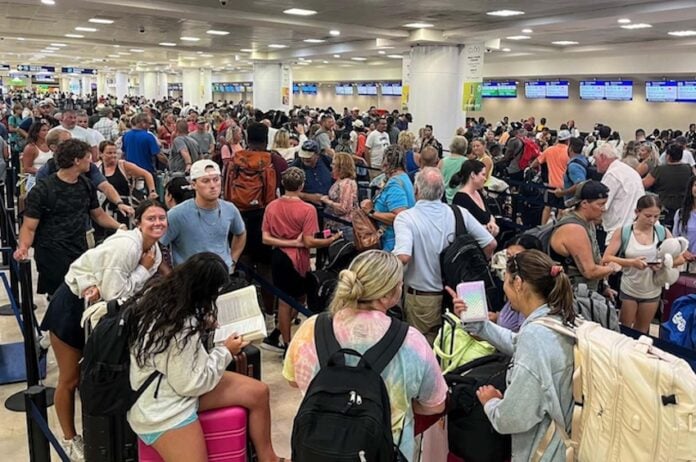
Passengers crowd the Cancún airport. Lately, more and more of them are Canadian, and fewer and fewer American. (Elizabeth Ruiz/Cuartoscuro.com)
Data from a variety of sources now show that Canadians — not Americans — are the top international visitors arriving to Mexico’s main tourist destination, the Caribbean coast. And for the first time ever, the Cancún-Toronto route ranked as the busiest of any international flight to Mexico, according to the Mexican Civil Aviation Agency (AFAC).
Of 10 air routes with the most international traffic to the Mexican Caribbean last year, six connecting with the U.S. showed downturns while two Canadian flights experienced significant passenger surges.
A study conducted by the Center for Advanced Research in Sustainable Tourism (STARC) at Anáhuac University’s Quintana Roo campus revealed that travel from Toronto, the capital of the Canadian province of Ontario, climbed 26.1% compared to 2024, displacing the two flights from Texas (Dallas-Cancún and Houston-Cancún) which had traditionally topped this annual list.
In fact, last year’s Dallas-Cancún flights had 4.5% fewer passengers than in 2024. Two other popular U.S.-Caribbean routes suffered declines last year — Chicago-Cancún (down 11.7%) and Atlanta-Cancún (–2%).
In contrast, the Montreal-Cancún connection surged 24%.
The STARC study concluded that the likely cause of the rise in travel to Mexico by Canadians is a reaction to the punitive policies, threats and insults directed toward Canada by U.S. President Donald Trump, who has even proposed making it the 51st U.S. state.
Francisco Madrid, director of the Center for Advanced Research in Sustainable Tourism that documented the rise in Canadian air passengers to Mexico’s Caribbean coast, predicts that airlines will continue to exploit the “Trump effect” to woo more Canadian passengers, whose numbers rose by 12% to 13% in 2025. (STARC)
On Thursday, Forbes Magazine wrote that Canadians are one year into a boycott of U.S. destinations that has cost the U.S. economy US $4.5 billion. The boycott is likely to continue in 2026, Forbes said, as trips to the U.S. turned lower in January.
Citing data from Mexico’s Tourism Ministry, the Canadian Broadcasting Corporation (CBC) reported in December that the number of Canadians flying to Mexico increased 11.3% between January and September 2025 compared to the year before, an increase of almost 200,000 tourists.
“I do think that there is a Trump effect, but I don’t think it’s only a Trump effect. … Mexico is an attractive possibility for Canadians … and we see that reflected in the numbers,” Sara Ranghi, marketing director for Meliá Hotels International, told the CBC.
Francisco Madrid, director of STARC, forecast that airlines will not miss the opportunity presented by the Trump effect to take advantage of the Canadian market.
“The Canadian market made a big difference in 2025, growing by approximately 12 to 13%,” he said.
Editor’s note: The headline of this article has been updated, as the original headline did not accurately reflect the content of the story. We regret the error.
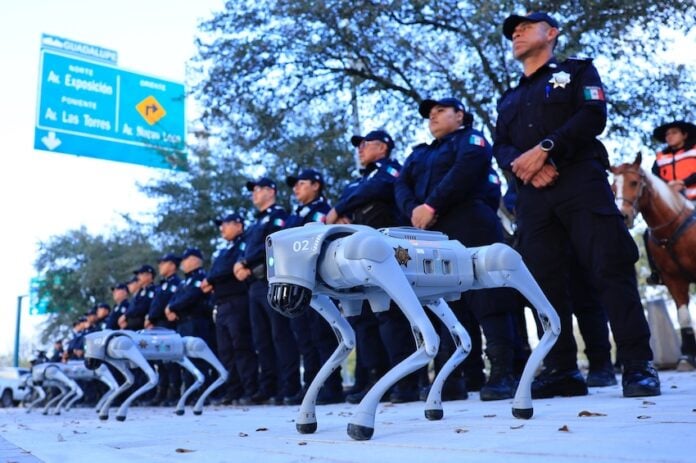
The four robotic quadrupeds will be armed for their surveillance work, not with weapons but with video cameras, night-vision lenses, speakers and two-way communication systems.
(Guadalupe.gob.mx)
Robot dogs will join the police ranks in Guadalupe, Nuevo León, when the 2026 World Cup comes to Monterrey’s BBVA Stadium, giving officers four mechanical first-responders at one of the tournament’s three sites in Mexico.
Authorities in Guadalupe — a municipality in the Monterrey metro area that includes the stadium — have formed a new K9-X unit made up of four quadruped robots that will patrol in and around the venue, renamed Monterrey Stadium for the World Cup.
The site is scheduled for three group-stage matches and one round-of-32 game from June 14-29, plus it will co-host a six-team play-in tournament March 23-31 to determine the final two World Cup berths. Akron Stadium in greater Guadalajara will be the other host.
The robots, operated remotely much like drones or video game characters, are designed as first-responders only.
The automatons then broadcast orders and relay live images to police.
“These K9-X robot dogs will support the police with initial interventions, using video footage and ultimately entering high-risk areas,” Guadalupe Mayor Héctor García said at a news conference, adding that they will step in if there’s a fight or a situation “involving an intoxicated person.”
García said the idea took shape after two officers were killed on patrol last year, prompting the question, “How can we ensure that some kind of technological system enters first [before] the human beings.”
The municipality spent about 2.5 million pesos (US $145,700) on the four units, which each require a human operator from the local Security and Citizen Protection Secretariat.
During a CONCACAF Champions Cup soccer match between the Monterrey Rayados and Xelajú from Guatemala on Wednesday, the robots patrolled entrances, common areas and a pedestrian bridge; checked corridors inside the stadium; and scanned the undersides of vehicles around the complex (although it wasn’t quite the same, since the crowd was only about 10,000 as compared to the more than 53,000 expected for World Cup matches).
The robot dog pack attended their first soccer match on Wednesday, when they patrolled a modestly attended game between the Monterrey Rayados and Guatemala’s Xelajú. (Gabriela Pérez Montiel / Cuartoscuro.com)
Authorities say they will also work alongside new surveillance drones and anti-drone systems as part of Guadalupe’s broader World Cup security plan.
The robot pack joins a growing cast of mechanical canines in northern Mexico: the aforementioned DogBot in Zacatecas and the AI-powered Waldog in Monterrey who roams neighborhoods to promote animal welfare and responsible pet ownership.
In Guadalupe, the robotic dogs will be doing more than just that; however, they won’t go beyond surveillance tactics.
“We have excellent police officers and cutting-edge technology to ensure the safety of Guadalupe residents,” García said.
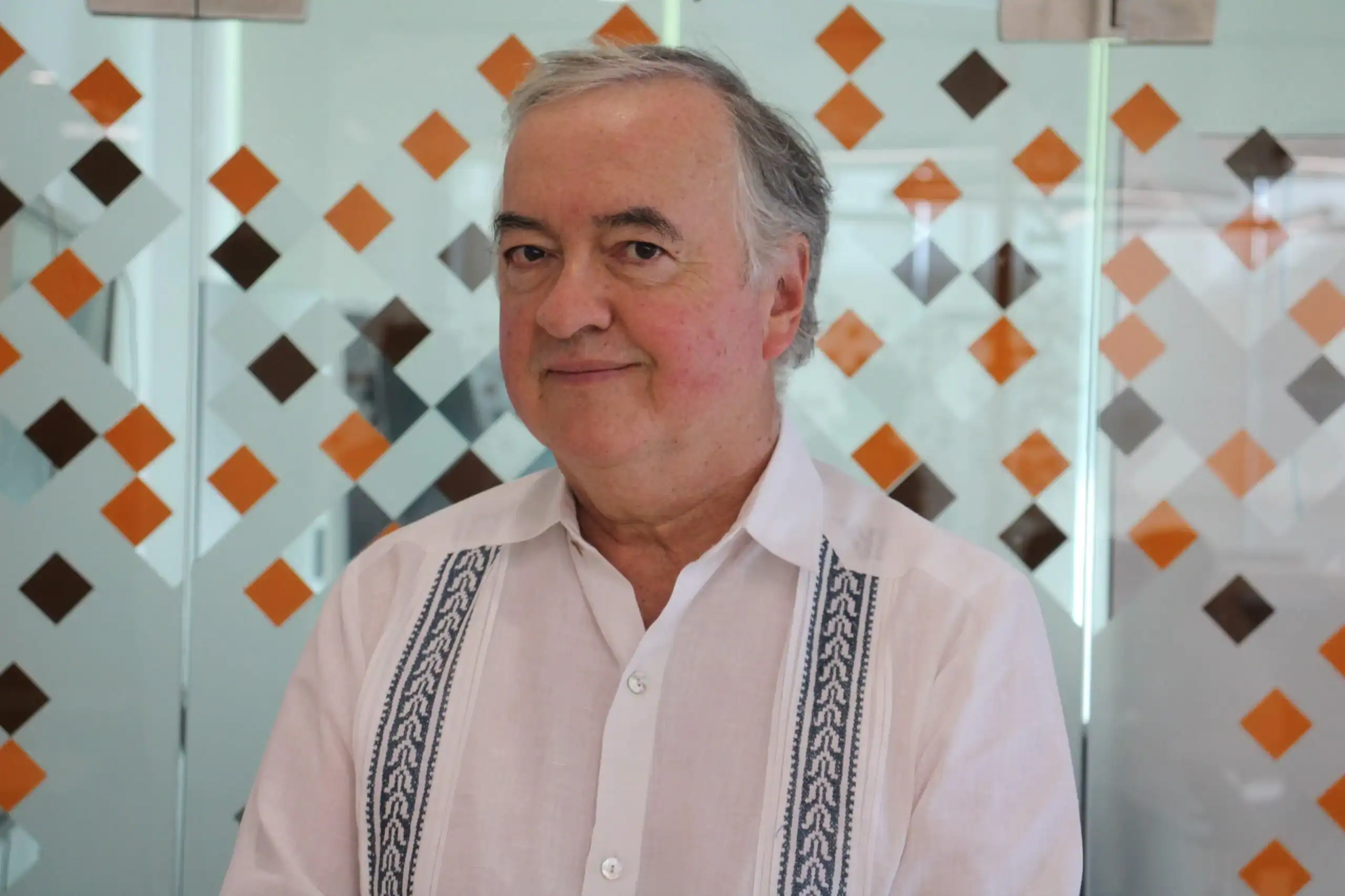
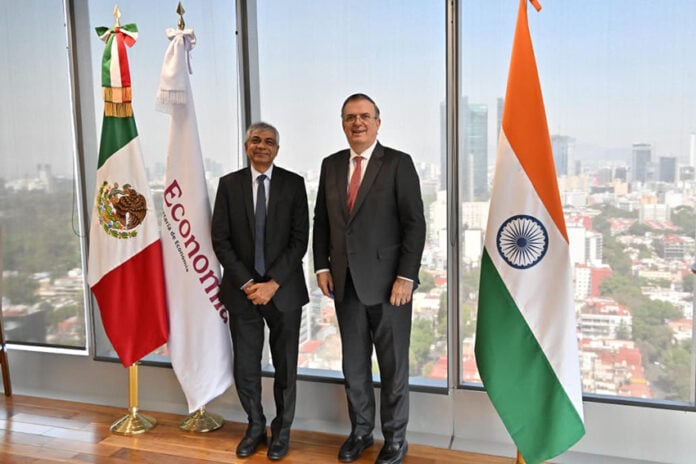
Mexico’s Economy Minister Marcelo Ebrard and India’s Ambassador to Mexico Pankaj Sharma met in Mexico City Wednesday to discuss trade cooperation and announced plans for further trade talks in coming months. (Economy Ministry)
Mexico and India are taking steps to strengthen their economic relationship following a meeting between Mexico’s Economy Minister Marcelo Ebrard and India’s Ambassador to Mexico Pankaj Sharma.
Held at Mexico City, the meeting aimed to review and strengthen the bilateral strategic agenda, with an emphasis on trade, investment and technology. This dialogue took place ahead of Ebrard’s meeting with India’s Trade Minister Piyush Goyal in Cameroon next month.
Siempre un gusto conversar con Panjak Sharma , Embajador de la India en nuestro país . Hoy revisamos el encuentro que sostendré con el Ministro de Comercio de ese país durante la reunion de la OMC en Camerún . Crecerán nuestras relaciones comerciales y de inversión. pic.twitter.com/tjPLJTENPt
“Today we reviewed the content of my upcoming meeting with the Minister of Trade of that country at the upcoming WTO meeting in Cameroon,” Ebrard shared on his official X account. “Our trade and investment relationship will grow.”
During the meeting, both officials agreed on the importance of including greater Indian investment in Mexico to strengthen President Claudia Sheinbaum’s Plan México, as well as supporting Mexican multinational companies with investments in India.
They also highlighted the need to foster greater cooperation in priority sectors such as science, technology, pharmaceuticals and digitalization, recognizing the potential for complementarity between the Mexican and Indian economies.
As a result of the meeting, Ebrard and Goyal are expected to have a call in the upcoming weeks, in addition to their upcoming meet-up at the Cameroon World Trade Organization conference.
The diplomats made no public mention of India’s proposal to Mexico for a preferential trade agreement.
Following the announcement of the new tariffs, India proposed a trade agreement with Mexicoto mitigate the impact of the Mexican tariff increase. No news on the agreement has been announced.
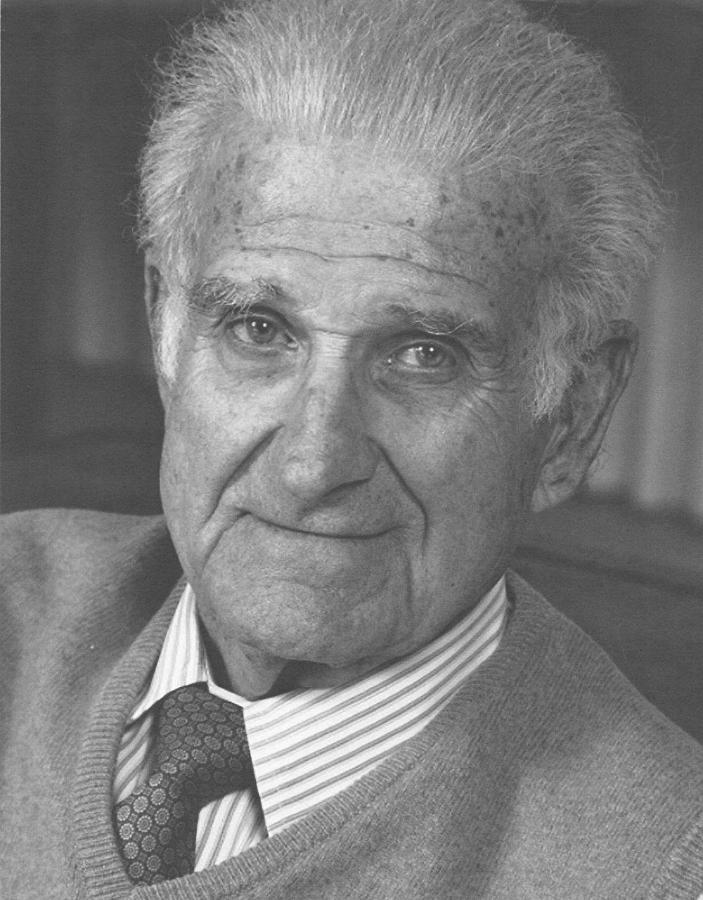
Elena Durán, world-renowned flautist, has returned to her Mexican roots. (Secretaría de Cultura CDMX/Wikimedia Commons)
It’s a Friday night in 1957. Young Elena Durán sits beside her grandmother at the Star Theatre in West Oakland, California, watching a Mexican film. It’s a ritual the two ladies share regularly, but tonight is different. Before the feature, a newsreel shows Pedro Infante’s funeral in Mexico City, held after the beloved singer and movie star died in a plane crash. According to Elena’s memory of the evening, the entire cinema is in tears.
Her grandmother, Soledad, left Aguascalientes for the United States, but her love for Mexico never faded. So she took her granddaughter, born in East Oakland to Mexican-American parents, to the movies. It was here that Mexican Golden Age film stars and music — from ranchera to corridos — would shape Elena’s life path.
When Elena Duran was eight years old, soon after she’d received her first flute for Christmas, her father took her to meet legendary flute maker George Koregelos. They became lifelong friends. (Elena Duran/Facebook)
For the next 60 years, the talented musician would explore prestigious concert halls, famous palaces and high-security prisons, finally stopping for good in the country her grandmother yearned for. Here is the story of Elena Durán, one of the world’s most respected flautists.
The classical years
When Elena was just seven years old, a school music teacher, Frank Ono, passed her in the corridor and said, “You’ve got great lips for the flute!” That was all it took, and she immediately asked her parents for one. At eight, her wish came true — she received a flute for Christmas.
Shortly after, her father took her to meet George Koregelos, who eventually opened House of Woodwinds in Oakland. Elena spent countless hours in the shop, meeting famous woodwind players who all made it a point to see George when they were in the Bay Area.
At eighteen, Elena took her first private lesson. She then enrolled at Mills College, but after just one year, she was offered a lecturer position at Stanford University. Once she had two teaching years under her belt, Elena took the leap and moved to Europe to study with some of the greatest flute players of all time: Jean‑Pierre Rampal, Aurèle Nicolet and James Galway.
She remembers in a rare moment of doubt, Rampal reassured her: “Your path is going to be very different, but you will be able to do it.” As Elena would state during our interview, “You can’t get through life without people who believe in you.”
Rampal’s belief in her led to great things.
Elena would go on to perform multiple times for the British Royal Family, including Queen Elizabeth II. She performed with the Royal Philharmonic Orchestra at the Royal Albert Hall in London. In 1984, Paul McCartney saw her on British television and called personally to collaborate. The result was “We All Stand Together,” a song which reached No. 3 on the U.K. Singles Chart. She recorded Bach with jazz violinist Stéphane Grappelli, Mozart with the Royal Philharmonic, and was the first to record Claude Bolling’s “California Suite” at Abbey Road Studios.
Duran playing on Christmas Eve in 2024 in Mexico City. (Alejandro Medina Guzman/Mexico City Culture Ministry)
Through it all, Elena’s philosophy remained — and continues to remain — simple: “It should be fun. Be really enthusiastic about what you do. Don’t overteach, and don’t overthink. Approach it with trust, knowing something positive will come.” This motto taught her to “change with the changes” and never take no for an answer.
By any measure, Elena Durán had “made it.” So why, in the 1990s, did she leave it all behind for Mexico?
The return
Elena and Michael, her husband and manager, moved to Mexico for what was supposed to be one year. They stayed for several. The 1995 peso crisis forced them to leave, albeit temporarily. The pair returned in the early 2000s, and this time Elena was ready to fully embrace her grandmother’s legacy.
In 2000, she released “Nostalgia for Mexico,” her first Mexican recording — a selection of salon music featuring composers like Manuel M. Ponce. Instead of replacing those magical Mexican voices from her childhood, Elena chose to honor them with her flute. Michael explains: “When another singer sings Esperón or Jiménez songs, it’s never as good as the original. But on the flute, it reawakens the memory without challenging the original.”
Those Friday nights at the Star Cinema were no longer just memories.
“I’m kind of living the part of the Mexican dream that my grandmother had,” Elena says. “She went to America but never forgot Mexico, never became Americanized. I’m lucky that I can live in both worlds.”
Validation
One evening at a reception for Manuel Esperón — composer of “Amorcito corazón” and “¡Ay, Jalisco, no te rajes!” — Elena played several of his songs. The next Saturday morning, her doorbell rang. It was Esperón himself, 97 years old, asking if she would play more of his music.
Elena Duran - Flautas Sin Fronteras
Between 2006 and 2008, Duran performed at several men’s prisons in Mexico and in the U.S. with her initiative, Flautas Sin Fronteras. This is a recording of her performing at a men’s prison in Mexico City.
For the next two years until his passing, they worked together. He wrote “Blues Maldad” specifically for her, a concert piece showcasing the jazz and blues influence he loved but rarely explored. Then Rubén Fuentes — the arranger behind José Alfredo Jiménez’s most famous rancheras, including “Amanecí en tus brazos” — asked if she would do the same for his music.
The validation from Mexico’s greatest composers led to a commission from Naxos International: “The Mexican Songbook,” six recordings preserving the work of Esperón, Jiménez, Fuentes, Armando Manzanero, Manuel M. Ponce and Agustín Lara. She’d played for royalty, but this — the blessing of the composers whose songs her grandmother loved — was all the validation she needed.
From concert halls to prisons
Elena wasn’t content playing only for those who could afford concert tickets. For the last 25 years, she has devoted her energy to Flauta Sin Fronteras, taking music to prisons, border communities and homeless populations in Mexico and the U.S. She has received two humanitarian awards: from Catholic Charities of San Diego for her work with homeless women, and from Casa Familiar in San Ysidro for her work along the border.
“You have to take people as you find them,” says Elena about working in prisons. “You can’t go in there and judge. The goal is to have some sort of emotional contact with them and not to judge the experience they’re living through.”
After every concert, she doesn’t join the warden for coffee; she goes straight into the audience to greet every single attendee.
Coming full circle to Mexico
At a concert in Laredo for “Pedro Mi Amor,” a tribute to Pedro Infante, she arrived to see a man waiting for her with chocolates and flowers. Elena recognized him immediately: Emilio Girón Fernández, the child actor who played El Torito — Pedro Infante’s beloved son — in the films “Nosotros los Pobres” (We, the Poor) and “Ustedes los Ricos” (You, the Rich), the same actor she’d watched as a child with her grandmother. She introduced him to the eager audience, bringing Pedro Infante’s films to life.
As Mexico City’s official tourism and cultural ambassador, Elena plays in the Zócalo on Christmas Eve for those who have nowhere else to go.
“There are a lot of people who have nothing,” she says. “Maybe I can give them something.”
Elena maintains deep ties to her grandmother’s family in Aguascalientes.
“I have a very big Mexican family there. My grandmother was a key pillar in my young world.”
She still loves the Pedro Infante films they watched together — “the epic quality, the black-and-white, the music.”
Michael observes the contrast: “It’s great if she’s playing in Berlin or the Royal Albert Hall in London, but to play in the Zócalo or a park — I see that as the beginning.”
Soledad gave her granddaughter a creative foundation through movies and music at the Star Cinema. Today, Elena brings them home to Mexico.
Watch Elena Durán perform live with Edgar Ibarra on piano at the Residence of the British Ambassador on Feb. 17, 2026, at 6:30 p.m. The performance is hosted by Amistad Británico‑Mexicana, a charitable foundation supporting education and health projects like Elena’s Flauta Sin Fronteras.
Bethany Platanella is a travel planner and lifestyle writer based in Mexico City. She lives for the dopamine hit that comes directly after booking a plane ticket, exploring local markets, practicing yoga and munching on fresh tortillas. Sign up to receive her Sunday Love Letters to your inbox, peruse her blog or follow her on Instagram.
The legend of Cantinflas lives on in Guadalajara, and everywhere else in Mexico. (Omar Rosales)
I’m always up for a challenge, especially when it combines my love of history with my love of learning something new. So when a reader (thanks, Robin Miller) recently noticed a photo in one of my articles and asked whether anyone would be up for a bit of a deep dive into history, my answer was immediate and enthusiastic.
The challenge for me was to create an article about someone I thought I’d never heard of, Cantinflas. As it turns out, that wasn’t entirely true.
Last year, I was celebrating the New Year with my family in Guadalajara. From our balcony, you could see a nearby building with an enormous mural painted across its side, the unmistakable face of a rather handsome, cheeky-looking man with a slightly crooked expression, looking out over the city. My boyfriend, a fan of classic Mexican cinema, immediately recognized him and told us a bit about who he was and why he mattered.
At the time, I filed it away as an interesting detail. But when this opportunity came along, learning more about Cantinflas suddenly felt like a continuation of that moment. A sort of thread picked up again, rather than something entirely new.
The birth of Cantinflas
And what I learned is that Cantinflas isn’t just a character. He’s a lesson disguised as laughter, and a reminder that sometimes the smartest way forward is sideways, preferably with a joke.
Before the baggy trousers, the thin moustache, the crooked tie and the unstoppable stream of words, there was Mario Fortino Alfonso Moreno Reyes, born in 1911 in Mexico City. He grew up in a working-class neighborhood, shaped by noise, movement and the kind of daily improvisation that comes from having to figure things out as you go.
Mario’s early life wasn’t glamorous: He tried boxing and bullfighting. He took on odd jobs. He briefly joined the military. Like many people searching for direction, he didn’t lack ambition; he simply lacked a clear path.
Famed as an actor, comedian and movie star, Cantinflas was also an icon of Mexico City. (Iberia Airlines)
What he did have was exceptional timing, sharp instinct and an uncanny ability to read a room. Most importantly, he understood how power sounded when it spoke down to you.
Mario’s real education didn’t happen in a classroom. It happened in the carpas — traveling tent theaters that brought comedy, music and satire to working-class audiences. These weren’t polite crowds. They were loud, impatient and honest. If you bored them, they let you know immediately.
This environment shaped everything.
When Mario forgot lines or faced a restless audience, he didn’t freeze. He filled the silence. He talked and joked. He argued with imaginary authority figures. He twisted language until it bent into something absurd and hilarious.
And slowly, something unexpected emerged: Cantinflas.
A genius for language
The character wasn’t refined, heroic or even particularly competent. But he was resilient, quick-witted and impossible to dismiss.
CANTINFLAS CRUZANDO LA FRONTERA DE LOS USA "SIN EL MURO"
Cantinflas was born not from planning but from survival, and his defining trait was language. Specifically, his ability to use it as both a shield and a weapon.
He spoke rapidly, confidently and endlessly, often arriving nowhere at all. Yet somehow, by the end of his speeches, the people in power were exposed as empty, rigid and ridiculous.
So powerful was this style that the Spanish language eventually absorbed it. The verb cantinflearentered the dictionary, meaning to talk a lot without saying anything clearly.
But that definition misses the point.
Cantinflas didn’t speak nonsense; he spoke around nonsense. He mirrored bureaucracy, legal jargon and political doublespeak so perfectly that their absurdity became undeniable.
He made confusion visible, and people recognized themselves in that confusion.
The man behind Cantinflas
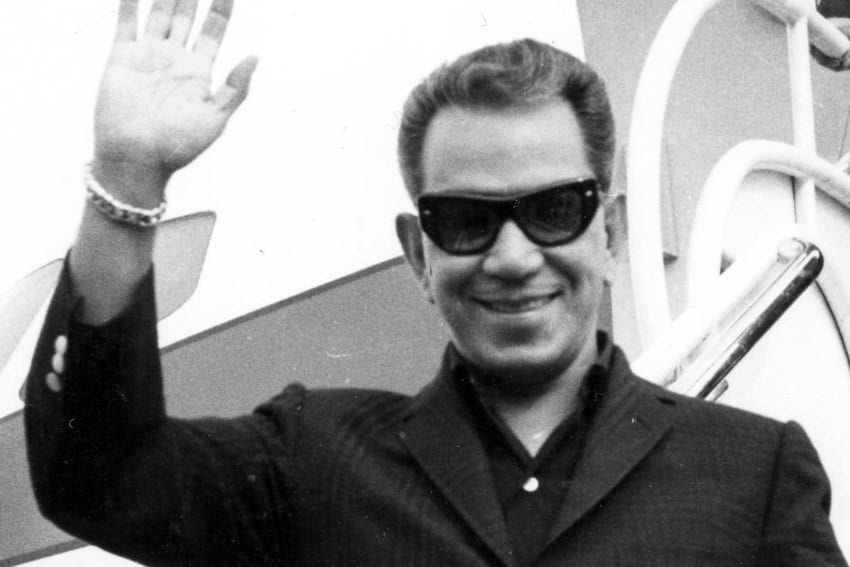
Mario Moreno inhabited the character of Cantinflas, but that was not who he was in real life. (Golden Globes)
What makes Cantinflas truly fascinating is how closely the character and the man were intertwined, and how carefully Mario Moreno kept them balanced.
On screen, Cantinflas was manic, poor and underestimated. He played janitors, shoeshiners, soldiers, train workers and unemployed dreamers, men constantly navigating systems that weren’t designed for them.
Off-screen, Mario Moreno was methodical, intelligent and deeply aware of his influence. He built a production company, controlled his image, negotiated contracts and became one of the most powerful figures in Mexican cinema.
The contradiction wasn’t accidental. Cantinflas pretended not to understand the rules. Mario Moreno understood them completely. That understanding allowed him to critique society from within it, without ever losing the audience that mattered most to him.
Trains appear repeatedly in the world Cantinflas represents, both literally and symbolically. In mid-20th-century Mexico, trains meant movement, migration, labor and possibility. They connected cities, carried workers and offered opportunity, but only if you could afford a ticket.
And those who couldn’t? They rode on top.
Cantinflas and his meaning in Mexico
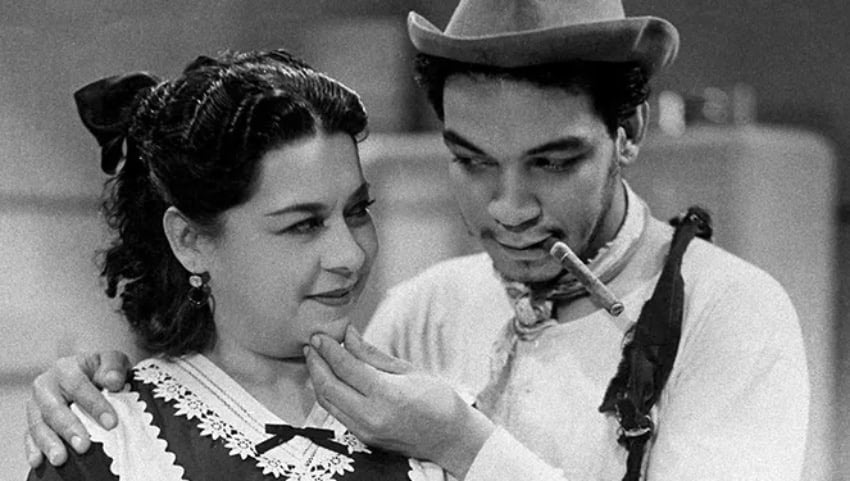
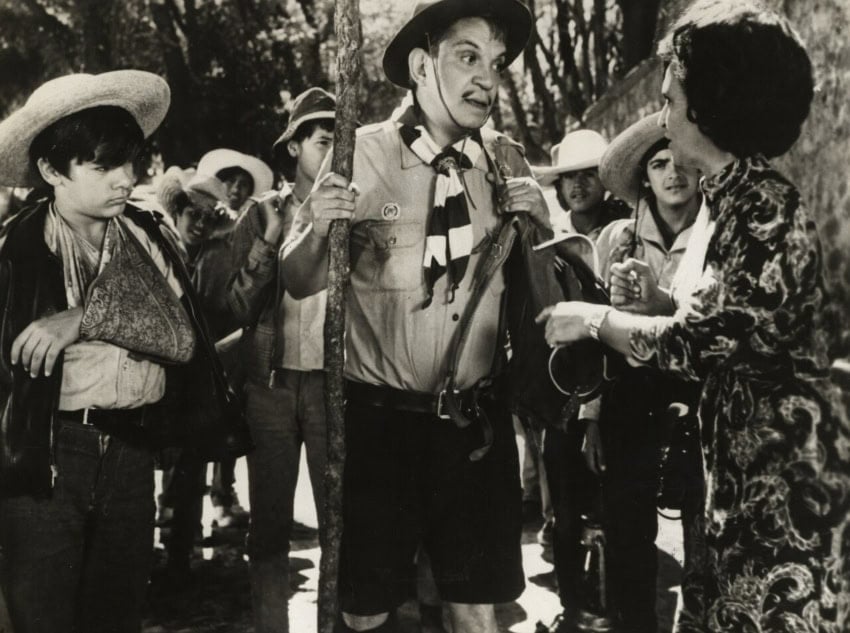
Cantinflas, seen here in the movie “El Profe,” doing what he does best: explain. (Public Domain)
Whether this practice was allowed is, as you might expect, a bit complicated. Officially, passenger cars were for ticket-holders only. In practice, enforcement was inconsistent. Long rural stretches went unsupervised, and authorities often turned a blind eye. Riding on top of trains became an informal, dangerous but widely tolerated solution for people who needed to move and had no other option. Not legal in any technical sense, but it was understood.
This tradition didn’t disappear with Cantinflas’ era. Even today, migrants travelling north through Mexico, particularly on freight trains collectively known as La Bestia, continue this practice. The risks are enormous: injury, death, exploitation. But for many, the train remains a lifeline rather than a choice.
And Cantinflas captured this world perfectly.
I watched a few of his films this week, and in “Ahí está el detalle” (known in the U.S. as “You’re Missing the Point”), there’s a scene where his character rides atop a train, scrambling and arguing with other passengers in a blur of pandemonium and impeccable comedic timing. The scene isn’t just slapstick; it reflects lived reality. People had to improvise, adapt and quite literally hold on for dear life.
In “El barrendero” (The Street Sweeper), Cantinflas weaves through crowds, streets and even freight trains, turning everyday movement into a comedic ballet that exposes the absurdity of rigid systems imposed on flexible lives.
By highlighting the humor, ingenuity and resilience of these travelers, he helped audiences understand why breaking the rules was often simply common sense.
A culture of resilience
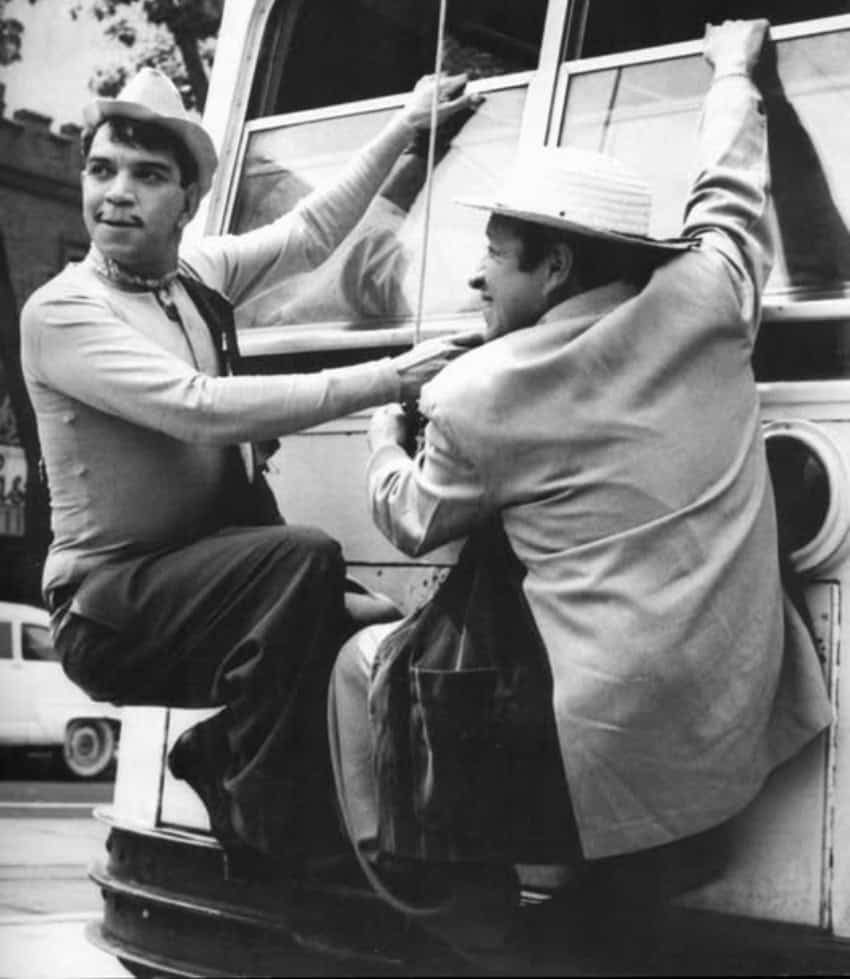
Whether riding atop trains or hanging onto the back of buses, Cantinflas always figured out a way to get where he wanted to go. (Facebook)
Watching Cantinflas navigate chaos is much like watching those rooftop travelers holding on tightly, adapting constantly and never losing dignity, even when the journey is anything but smooth.
In this way, Mario Moreno immortalized an entire culture of resilience — the people who ride on top, who improvise, who survive and who manage to laugh while doing so.
Cantinflas’s comedy wasn’t cruel, nor was it loud for the sake of volume. It was protective. He never punched down; he didn’t need to. His targets were authority figures who hid behind titles, uniforms and complicated language. In his films, police officers, politicians and bureaucrats often spoke clearly but said nothing meaningful.
Cantinflas spoke frantically and revealed the truth anyway.
Mario Moreno once suggested that laughter allowed people to hear things they might otherwise reject. Comedy made truth easier to swallow and harder to punish.
That’s why Cantinflas could exist at all.
‘Around the World in 80 Days’
David Niven and Cantinflas in the movie “Around the World in 80 Days.” (IMDb)
By the time Cantinflas appeared in “Around the World in 80 Days,” earning Moreno a Golden Globe, he had already made history. He was internationally recognized, financially successful and culturally untouchable.
Yet the character never became sleeker or safer. Cantinflas stayed loyal to the people he came from: the overlooked, the underestimated and those still trying to figure it all out.
And I think that part really matters.
Making it, in the Cantinflas sense, doesn’t mean abandoning who you were, or who you are, to become acceptable. It means translating your experiences into something meaningful and bringing others with you.
Mario Moreno didn’t escape his origins; he transformed them.
One of the reasons Cantinflas endures is that his comedy is inseparable from his humanity. He never mocked people for being poor or struggling. He mocked the structures that made survival unnecessarily hard.
Cantinflas, around the world in 80 days
That’s why audiences laughed and cried at the same time. Cantinflas’ world was absurd, but it was recognizably theirs. The struggles were real, and the laughter gave them breathing room.
He remains relevant because the world he critiqued hasn’t disappeared. Bureaucracy still overexplains. Authority still talks in circles. Ordinary people still improvise their way through unfair systems.
Cantinflas reminds us that intelligence doesn’t always sound polished, that dignity can stand in worn shoes and that resistance doesn’t have to shout; it can smile.
And maybe that’s why images of people riding atop trains still resonate. They aren’t symbols of recklessness. They’re symbols of resilience, adaptation and finding a way forward when the rules aren’t fair.
Charlotte Smith is a writer and journalist based in Mexico. Her work focuses on travel, politics and community.