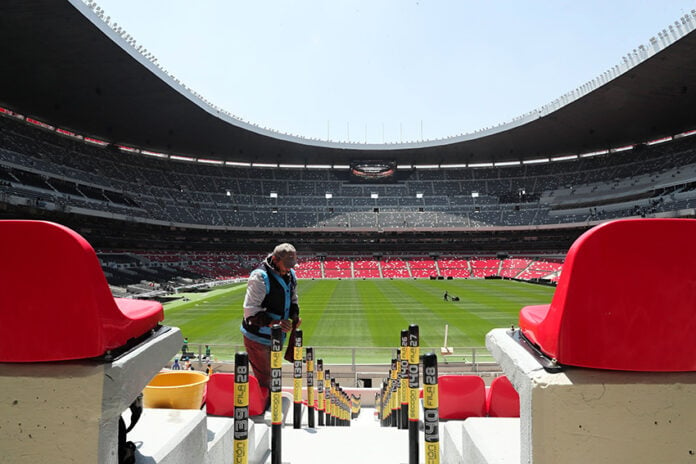
Workers finish the remodel of Banorte Stadium (now temporarily renamed Mexico City Stadium) in late March. (Tomás Pérez de la Cruz / Cuartoscuro.com)
Soccer’s world governing body FIFA on Thursday formally received full control of Mexico City’s Banorte Stadium — better known as Azteca Stadium — only to learn that there remain logistical issues related to the arena’s box seats.
With the handover, the venue has now been officially renamed Mexico City Stadium for the duration of the World Cup as FIFA prohibits corporate-sponsored names, a long-standing policy intended to prevent sponsors not affiliated with the organization from receiving exposure.
“Throughout the 2026 World Cup, the stadium will be known as ‘Estadio Ciudad de México,’ as mandated by FIFA. … [T]he stadium’s operation and communications will be handled through FIFA and its official channels,” it said.
The reassignment occurred two days later than originally planned as the stadium obtained special permission to delay the handover to allow Cruz Azul — one of the two Mexico City soccer clubs that call Banorte Stadium home — to stage a playoff game on Wednesday night.
However, while World Cup organizers moved in to put the finishing touches on the historic venue, FIFA learned that an issue related to box seats has become more complicated.
In order to finance the construction of the stadium in the 1960s, boxes were sold to private investors in an arrangement that granted owners rights to use them at any and all events for 99 years.
As FIFA requires full and complete control of stadiums during the World Cup, box seat owners were informed they would not be permitted to use them during the tournament.
However, FIFA responded last month by saying it would prohibit box seat owners from entering the stadium with food and drinks and said it would not allow resale of seats in the boxes.
Roberto Ruano, a lawyer representing the luxury box owners, said some of his clients received messages that organizers were going to remove refrigerators, blenders and other personal property in the boxes as part of this new rule.
🏟️ ⚽️ El Estadio Banorte ya fue renombrado como “Estadio Ciudad de México” con motivo del Mundial de futbol, el cual arrancará el próximo 11 de junio
On Wednesday, a federal judge granted box owners an injunction against the FIFA action.
Ruano celebrated the ruling and defended the box owners, saying that “no regulation from an international body (FIFA) can trample on the rights we have as Mexicans.”
He added that the contracts clearly stipulate that “seats and stands can be sold, rented or transferred, contrary to the threatening statements indicating that if these spaces were offered through any external channel, they would be suspended by FIFA.”
Meanwhile, FIFA has also taken control of Guadalajara’s Akron Stadium — renamed Guadalajara Stadium — and Monterrey’s BBVA Bancomer Stadium, now named Monterrey Stadium. Those stadiums will each host four World Cup matches, while Mexico City Stadium will host five games.
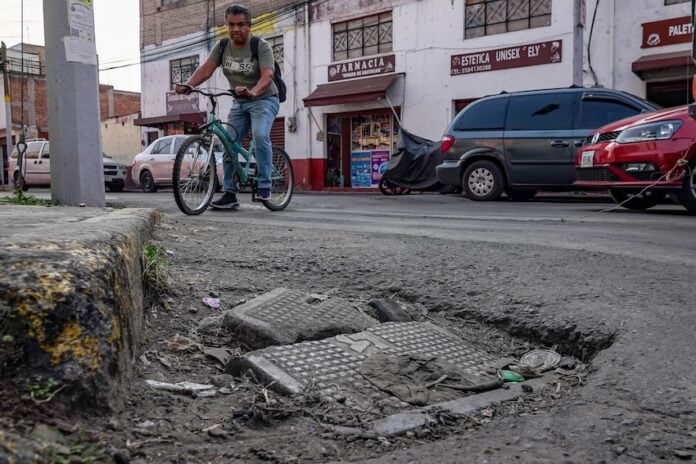
Unlike most crime, potholes can be an everyday annoyance to urban residents, and some grow so large that they present a real danger to vehicles and their drivers. (Rogelio Morales / Cuartoscuro.com)
For residents of Mexico’s cities, potholes remain the primary concern, followed by the supply and delivery of drinking water, insufficient public lighting and traffic congestion.
According to the latest National Survey of Urban Public Safety conducted by the national statistics agency INEGI, 82.7% of those surveyed considered street potholes to be the most important problem in Mexican cities.
The survey was carried out by interviewing adults in more than 27,000 homes across 91 urban areas from Feb. 23 to March 13.
Although Security Minister Omar García Harfuch and others focused on the reduction of the perception of insecurity when the survey was first published in late April, a deeper dive into the data by the newspaper El Economista examined how other details might impact the country’s economy.
The fact that more than eight out of 10 adults expressed such concern about potholes while worries about crime fell from 56.6% to 52.1% should be instructive for authorities, who tend to spotlight insecurity.
Of the 91 urban areas where the survey was taken, El Economista pointed out that potholes were identified as the No. 1 concern in 81 of them. It also found that in the northern city of Ciudad Obregón, Sonora, 99.8% of respondents said potholes were their top concern.
In addition to being a priority for constituents, the issues identified as top concerns by the public ought to be recognized as disincentives to attracting investment, particularly for the largest local economies in the country.
After potholes, 59.2% of respondents identified failures and leaks in the drinking water supply as a top concern. This was followed by worries over insufficient public lighting (56.3%), frequent traffic congestion (53.6%) and then criminal activity. The fifth-ranked concern among urban residents was overcrowded or poorly served hospitals (51.4%).
Other issues identified in the survey results were street drains clogged by accumulated waste (50.6%), neglected parks and gardens (41.2%), deficiencies in the public drainage network (40.9%) and poor public transport service (39.9%).
The Onjuku, a former research vessel donated by Japan to Mexico in the 1970s, was stripped of any toxic materials, taken out 27.8 kilometers off the Tamaulipas shore and set off with explosives, causing it to sink to the ocean floor, where it will serve as base material for an artificial reef that will benefit fish and marine fauna and flora.
(Navy Ministry)
The Mexican Navy sank a donated Japanese ship off the coast of Tamaulipas this week, expanding a growing artificial reef system in the Gulf of Mexico that officials say will boost marine life, fishing and tourism.
The former oceanographic research vessel Onjuku, donated by Japan in the late 1970s and used for more than four decades by Mexico’s navy, was sunk Tuesday in a controlled operation about 15 nautical miles (27.8 kilometers) off the coast.
After holes were cut in the ship’s hull, small explosive charges were applied. The sinking was also shown during President Claudia Sheinbaum’s Tuesday morning press conference.
Admiral Raymundo Pedro Morales Ángeles described the broader initiative as “the vision of a country that transforms steel into life.”
An artificial reef is a human-made structure placed on the seafloor to mimic some functions of a natural reef — giving fish, various types of coral and other organisms hard surfaces to colonize where the bottom was previously flat or barren, according to marine agencies.
Around the world, decommissioned ships have been sunk — such as this one in Florida — to enhance fish habitat, support wreck diving and ease pressure on natural reefs.
In Mexico, the Navy has used obsolete vessels to form artificial reef systems off both the Pacific and Gulf coasts, including projects in the states of Sonora, Michoacán and Colima.
This national artificial reef program has been promoted as a way to restore marine ecosystems, foster biodiversity, support sustainable fishing and draw eco-tourism.
The Onjuku is the second of at least nine navy ships slated for sinking off the Tamaulipas coast, following last year’s sinking of the former coastal patrol vessel ARM Huracán.
Both were sunk east of El Mezquital, a fishing area on the state’s long, narrow strip of coastline that separates the Laguna Madre from the gulf.
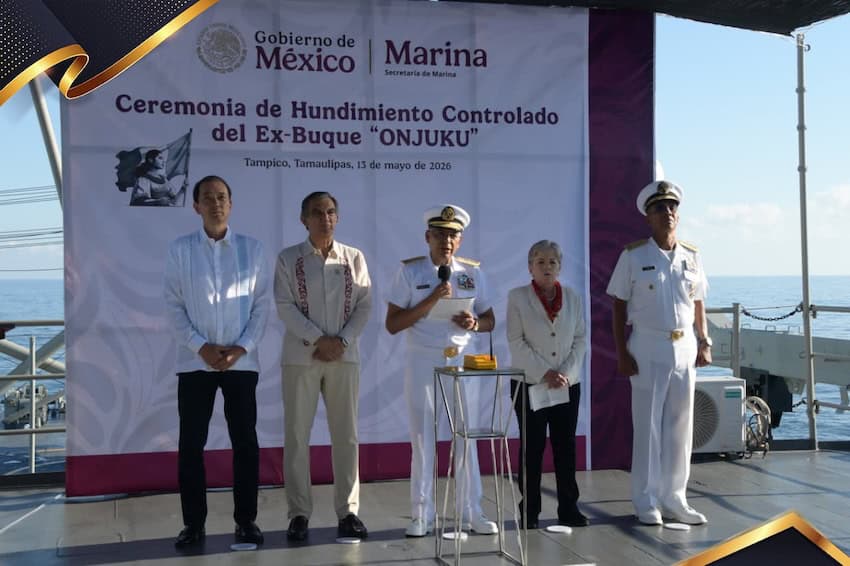
A burial of a ship at sea, even for a good cause, calls for a ceremony, and the Mexxican Navy Ministry obliged this week in Tampico, Tamaulipas, where Navy Minister Admiral Raymundo Pedro Morales Ángeles presided over the “Ceremony of the Controlled Sinking of the ex-ship Onjuku.” (Navy Ministry)
Tamaulipas also hosts the wreck of a former U.S. Navy destroyer that was later commissioned as the Mexican destroyer Usumacinta E-20. Now considered a mature reef structure, it was sunk in 2004 off Altamira, a port city in the Tampico metro area.
Authorities say the new reefs offer refuge for species such as pompano, wahoo, Spanish mackerel and dogfish in a strategic area where the Laguna Madre meets the Gulf of Mexico, while also helping deter illegal and unreported fishing.
The latest sinking is also part of an “underwater museum” concept that aims to create living reefs for divers and researchers.
Some environmental groups have criticized such projects, warning that old hulls can leach toxins or that governments use reefing as a cheap way to dump scrap. They argue that badly prepared vessels risk releasing fuel residues, asbestos or other contaminants into the food chain and that some historic ships would be better recycled or preserved on land.
Artificial reef supporters say that when a ship is thoroughly stripped and cleaned before sinking, what is left is mostly bare steel that quickly attracts corals, sponges and fish. Mexican officials say the Onjuku was stripped of its equipment and decontaminated before it went down, including the removal of fuels, oils, wiring, plastics and other hazardous materials.
Everyone loves their mother, so why is she mentioned in so many Mexican swear words? (Instagram)
There are several words to refer to moms in Mexican Spanish, from the classic mamá to a more formal madre, to say nothing of coloquial words such as amá or jefa (or jefita if you are feeling loving). In Mexico, moms can be the bosses at home and yet the first ones brought up when a stranger wants to start a fight. But why?
A long tradition
Mexicans are not the only ones to use female progenitors to insult their listeners. From Cicero to Shakespeare, history has used allusions to mothers, including their physical and personal traits, to incite violence in confrontational situations. It seems reasonable that the one who brought you into this world can be seen as someone to take care of, but also — for your opponent — a point of weakness.
Clearly, the world’s fascination with mothers goes way, way back. Why should Mexico be any different?
Although often used in jokes, there’s a specific expression whose roots are tied up in Mexican identity from the colony the country once was, and represents a lot of values that may have been erased from our everyday lives, but remain just beneath the surface: hijo de la chingada (a deeply offensive insult, not to be used lightly).
Octavio Paz and ‘La Chingada’
One of the clearest and maybe the most extensive explanations of this phenomenon was written by Octavio Paz in his “The Labyrinth of Solitude.” He dissects the word, linking its offensive popular use to our mestizo origins. A lot of our female ancestors did not procreate in fairy tale-like conditions, but rather in a violent environment in which their very culture was in peril.
“Who is La Chingada? Above all, she is the Mother. Not a mother of flesh and blood, but a mythical figure,” he said. “La Chingada is one of the Mexican representations of Motherhood, like La Llorona or the ‘long-suffering Mexican mother’ we celebrate on May 10th. La Chingada is the mother who has suffered — metaphorically or in reality — the corrosive and defaming action implicit in the verb that gives her her name … La Chingada is the Mother opened, violated or mocked by force. The ‘son of La Chingada’ is the offspring of violation, abduction or mockery.”
From this comes the verb chingar, which can mean something as mild as to bother, or something as intense as to rape. According to Paz, the word could have come from xinaxtli, the Nahuatl word for a specific seed. However, in response to this idea, the Real Academia de la Lengua Española says that the expression has been part of the Spanish language even before the conquest of Iberian Romani: čingarár.
No, I’m not your ‘mamacita’
Although your mamá is sacred, a mamacita is sexualized. (Lady Yuliana/Instagram)
Besides insults and swearing, there’s another adaptation from a maternal word: mamacita is used to catcall. It is annoying, but the link to reproduction lies beneath the surface. As journalistLaura Martinez states about her own uncomfortable encounter with a street harasser: ”A man calls you mamacita because what he really wants is to get in bed with you and turn you into the mother of his children.”
Writer Elena Poniatowska depicts a similar situation when her preadolescent character Lilus Kikus is called mamacita at the beach. Kikus’ reaction is rather detached, reflecting that she is not the catcaller’s mom after all.
Some other expressions about moms
Poca madre, or little mother, is a popular descriptor in Mexican Spanish. Its varied meanings, however, have nothing to do with moms. (Facebook)
Una madre (a mother) can be used to refer to something in a contemptuous way. For example: Pásame esa madre (pass me that mother).
No tener madre (to have no mother) is used alternatively as either a good or bad expression. It all depends on context. It can, for instance, refer to a shameless or cowardly person. Or it can refer to something amazing, cool or fun. For example, No tienes madre (you have no mother), generally means you don’t own up to things, while esta salsa no tiene madre (this salsa has no mother) means you’re tasting something extremely good to go with your tacos.
Much like no tener madre, poca madre (little mother) can be good or bad. Compare how, for example, qué poca madre tienes (what little mother you have) is often negative, whereas tu casa está pocamadre (your house is little mother) means your house is awesome — with the positive pocamadre written as a single word.
Madrear (to mother someone) is a rather offensive way of talking about physical violence. For example: A Juan se lo madrearon (Juan was badly beaten).
Something disgusting can be described as a madres. For example: Aquí huele a madres (it smells like mothers in here) describes an intense stench.
Lydia Leija is a linguist, journalist and visual storyteller. She has directed three feature films, and her audiovisual work has been featured in national and international media. She’s been part of National Geographic, Muy Interesante and Cosmopolitan.
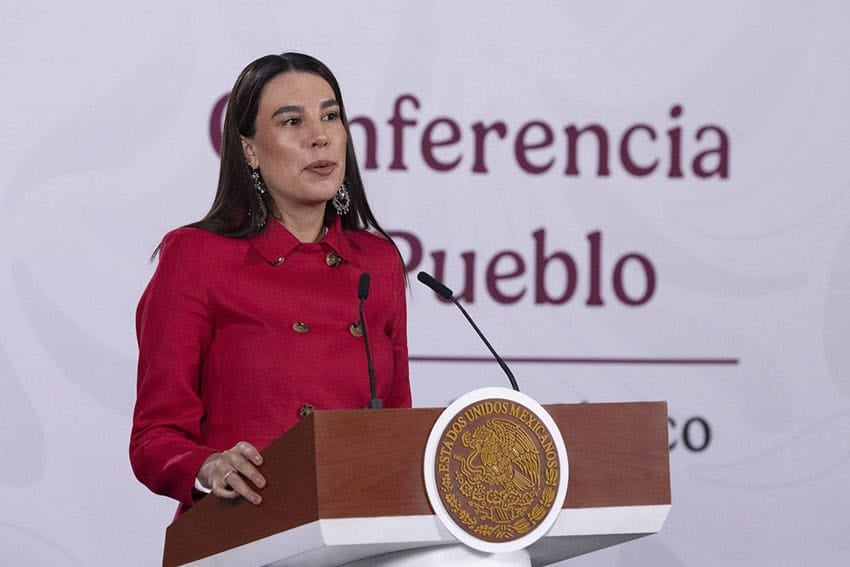
President Sheinbaum spoke in defense of her education minister after a recent controversy and supported a plan to beautify Mexico City ahead of the World Cup next month. (Carlos Ramos Mamahua / Presidencia)
Sheinbaum’s mañanera in 60 seconds
🎓Delgado stays put: Sheinbaum dismissed rumors that Education Minister Mario Delgado will resign or be fired, saying he’s doing a “great job” and pointing to plans to create 330,000 new university places. She downplayed the school calendar fiasco, saying, “There was a proposal, people didn’t agree with it, and we returned to the original proposal.” In addition, Sheinbaum accused The Economist and other outlets of blowing the affair out of proportion.
🇨🇳Plan China: Tourism Minister Josefina Rodríguez unveiled a strategy to grow Chinese tourism to Mexico. The government wants China to become Mexico’s 10th-largest source of tourists by 2029, up from 14th today. Key moves include debut participation at the ITB China fair in Shanghai and a presence on Chinese social media platforms like Weibo.
🏙️“Ajolotización” defended: Sheinbaum backed Mexico City Mayor Clara Brugada’s decision to plaster the capital with axolotl imagery and purple-painted pedestrian bridges ahead of the World Cup, saying the color and murals “give happiness to the city.” Not everyone agrees: One Mexico City motorcyclist told Televisa there’s still “a shitload of potholes” whose repair should take priority.
Why today’s mañanera matters
At her Friday morning press conference, President Sheinbaum responded to “rumors” that Education Minister Mario Delgado would leave his job — either by resigning or being fired.
There have been calls for Delgado to go after his announcement last week of an ill-conceived plan to end the school year 40 days early due to Mexico’s World Cup hosting duties and hot weather. The plan was abandoned, but just hours before that announcement was made, the education minister put his foot in it again by essentially saying that the last month of classes is a waste of time.
Sheinbaum has stuck by Delgado, a Morena party powerbroker, and continued to do so at today’s mañanera.
Also of note at the president’s final press conference of the week was Tourism Minister Josefina Rodríguez’s announcement of a plan aimed at attracting more Chinese tourists to Mexico, and Sheinbaum’s defense of Mexico City Mayor Clara Brugada’s decision to make extensive use of the image of the ajolote (axolotl) and purple paint to beautify the national capital ahead of the FIFA men’s World Cup.
‘Plan China’: Government aims to attract more Chinese tourists
Tourism Minister Rodríguez told reporters that tourism to Mexico from China is “very important” and the government wants to “consolidate the market.”
She said that 107,000 Chinese tourists came to Mexico in 2025, representing an annual increase of 8.2%. Rodríguez highlighted that the top ten states visited by Chinese tourists are Mexico City, México state (where the Teotihuacán archaeological site is located), Nuevo León, Jalisco, Baja California, Chiapas, Querétaro, Guanajuato, Quintana Roo and Chihuahua. She also said that Chinese tourists, in the main, are not seeking “sun and beach” (sol y playa) when they travel to Mexico, but rather “culture, gastronomy and experiences,” including ones related to Day of the Dead.
Tourism Minister Josefina Rodríguez unveiled the new Plan China strategy to draw more Chinese tourists to Mexico. (Carlos Ramos Mamahua / Presidencia)
After noting that Mexico held its first-ever tourism fair in China last year, the tourism minister said her ministry’s “goal” is for China to become the 10th-largest source country of tourists to Mexico by 2029. She said that China is currently the 14th-largest source of tourists to Mexico.
As part of a tourism promotion strategy dubbed “Plan China,” Rodríguez said that Mexico, for the first time, will be represented at ITB China, a leading tourism trade fair that will take place in Shanghai later this month.
Among the other aspects of Mexico’s “Plan China” strategy are attendance at other tourism fairs in China and the presence of the official “Visit Mexico” brand on Chinese social media sites such as Weibo.
Sheinbaum rejects ‘rumors’ that Delgado will leave education minister role
A reporter asked the president about “rumors” that Education Minister Mario Delgado will leave his position.
Sheinbaum said that was not the case, before noting that she would attend a meeting with Delgado later in the day.
She said that Delgado — a former lawmaker and ex-chief of the ruling Morena party — is doing a “great job” as education minister, highlighting that he is working on a number of projects, including one aimed at creating 330,000 new places for students at campuses of the Rosario Castellano University and “other universities.”
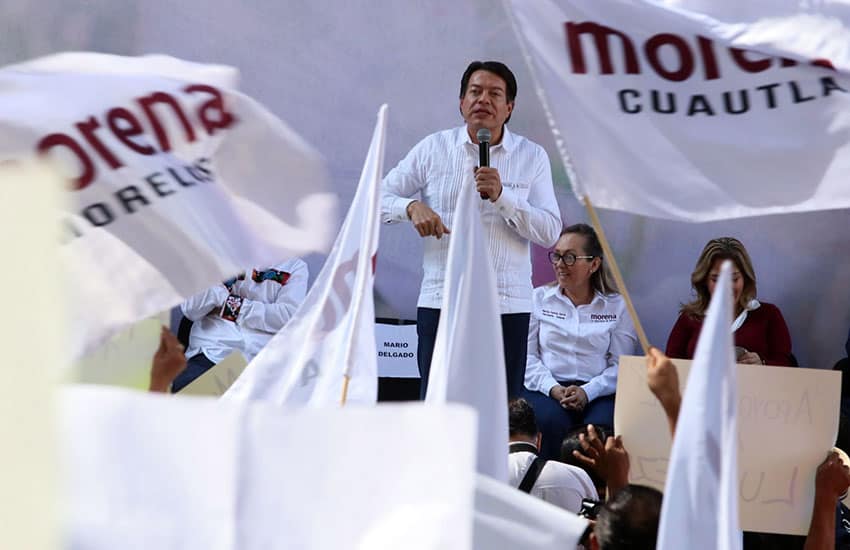
Mario Delgado, current education minister and former president of the Morena party, came under fire after announcing that the current school year would be cut short due to the World Cup — a controversial proposal that was quickly walked back. (Cuartoscuro)
Sheinbaum played down the controversy surrounding the announcement and subsequent cancellation of the plan to end the school year almost six weeks early on June 5.
“There was a proposal, [people] didn’t agree with it, and we returned to the original proposal [to end the school year on July 15],” she said.
“… The eyes of the world are on Mexico,” she said before suggesting the issue was blown out of proportion by The Economist and other media organizations.
Published under the headline “Mexico’s daft plan to cut the school year for the World Cup,” The Economist article said that the retreat on the plan to end the school year early “made it look as though the [Education] ministry was freestyling one of the most basic parts of its job.”
“The affair is a blot on Mexico’s education system, which has several serious problems,” The Economist wrote.
Sheinbaum defends the ‘ajolotización‘ of CDMX
A reporter asked Sheinbaum about the “ajolotización” of Mexico City — the extensive use of the image of ajolotes (axolotls), in murals, on light rail carriages, etc. — as well as the beautification of public infrastructure in the capital, such as pedestrian bridges, by painting it purple.
Sheinbaum told reporters that “all governments paint pedestrian bridges … and Clara decided that in order to beautify the city she was going to use the color lilac” — which matches the flowers of Mexico City’s ubiquitous jacaranda trees, and is not too dissimilar to the political color of Morena.
“Now there is great criticism, I don’t see why,” she said. “In addition, the truth is the bridges look very beautiful.”
Sheinbaum also said that the use of color and the painting of murals on streets and in other public spaces “gives happiness to the city.”
“It makes it beautiful and that greatly changes the mood of those who live in the city,” she said.
Sheinbaum also noted that “Brugada chose the ajolote, an animal endemic to the Valley of Mexico, as a symbol of the city.”
“I don’t know why there is so much criticism,” she said.
One Mexico City resident who spoke to the broadcaster Televisa said that the government should first focus on fixing streets in the capital, rather than painting pedestrian bridges purple.
“There is still a shitload of potholes,” said Gerardo Franco, a motorcyclist.
“They should focus on what society really needs,” he said.
By Mexico News Daily chief staff writer Peter Davies (peter.davies@mexiconewsdaily.com)
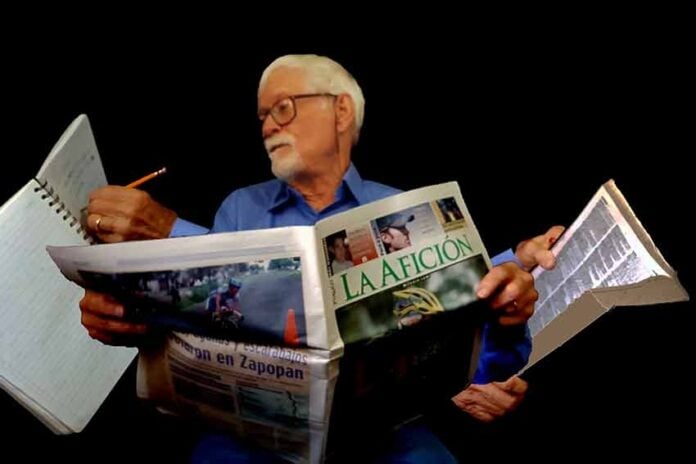
Learning Spanish from a newspaper sometimes seems as if it requires six arms, as the language used is often different from that of conversational Spanish. (John Pint)
Long ago, I reached the point where I could carry on a conversation in Spanish about practically any topic. It gave me the feeling I had reached a certain mastery of the language.
After all, I’ve spent years living in a genuine Mexican community with very few foreigners. On top of that, my wife just happens to be a first-rate Spanish teacher who never fails to let me know cuando metí la pata (when I made a blooper).
Just as in other languages, the Spanish vocabulary used in newspapers is often more elevated, precise and formal. (John Pint)
Nevertheless, every time I picked up a newspaper and glanced at the front page, I would wince. It seemed like every headline contained at least one word I had never heard of. A few examples:
Otorgan premio a Selene Argueta
El Congreso insta a modificar la ley
El Banco Central sale al quite para frenar la caída del peso.
La Comisión avala el nombramiento del subsecretario
El tribunal suspende cautelarmente la aplicación de la norma
El Congreso subsanará omisiones del dictamen
Buying the newspaper and reading a few paragraphs frequently left me even more depressed, as I would inevitably come upon yet more words that I’d swear had never been spoken in my presence. In fact, I questioned whether they had ever been spoken in anybody’s presence!
So, what’s going on here?
Conversational versus cool
First, it’s important to note that journalists around the world — writing in any language — delight in using expressions beyond those commonly used in casual conversation: trendy words, sports jargon, idioms, metaphors and allusions — anything to spice up those headlines.
Here are just a few examples in English. The italicized words would probably perplex most nonnative speakers of our language, no matter their fluency:
Iran war roils markets
Gulf states fend off attacks
Mexican peso tanks
“Don’t turn Kharg Island into America’s next quagmire”
Couple snared in phony kidnapping scheme
North Korea vows to ramp up nuclear weapons production
In the Spanish-speaking world, this tendency to “juice up” headlines and stories leads writers to use metaphors and sport-inspired expressions, just like their colleagues around the world. Just bear in mind that one of those sports could be bullfighting, with jargon all its own.
Spanish-language journalism’s formal vocabulary
In addition, the Spanish-speaking world has something that journalists and linguists call el registro formal, a kind of elevated journalistic register that was shaped over the years by law, bureaucracy and editorial tradition.
In this elevated lexicon, decir is replaced with a more precise word like aseverar. Hacer may become confeccionar. Instead of tener, you may see ostentar, and buscar is elevated to indagar.
Admirers of this lexicon claim that it brings precision, conciseness and clarity to journalism, substituting vague expressions with more exact terminology.
I think the same could be said for the lexicon you find in legal contracts. After all, who but a lawyer enjoys reading “legalese?”
This Spanish journalistic register differs sharply from everyday speech. Headlines favor abstract, authoritative words that sound precise and official — but are rarely used in daily conversation.
In other words, newspaper Spanish is not harder Spanish. It is a different kind of Spanish.
Less-official-sounding Spanish
Enjoying newspapers in Spanish requires a familiarity with the “institutional” form of the language. (Public Domain)
Here are the Spanish headlines presented earlier, followed by a less-elevated version of the same.
Otorgan premio a Selene Argueta → Le dieron un premio a Selene Argueta. (Selene Argueta was given an award.)
El Congreso insta a modificar la ley → El Congreso pide que se cambie la ley. (Congress is calling for the law to be changed.)
El banco central sale al quite para frenar la caída del peso → El banco central actúa para frenar la caída del peso. (Central bank steps in/comes to the rescue to halt the peso’s fall. Note: salir al quite is an expression used in bullfighting for the maneuver by which one torero distracts the bull to save another who is in danger.)
La Comisión avala el nombramiento del subsecretario → La comisión aprueba el nombramiento del subsecretario. (The committee approves the appointment of the undersecretary.)
El tribunal suspende cautelarmente la aplicación de la norma → El tribunal frena temporalmente la aplicación de la norma. (The court temporarily halts the enforcement of the regulation.)
El Congreso subsanará omisiones del dictamen → El Congreso corregirá los errores de la opinión. (Congress will fix the omissions in the ruling.)
Reading the newspaper in Mexico doesn’t just require good Spanish. It requires familiarity with institutional Spanish.
The six-arm solution
In bygone days, the procedure for mastering journalistic vocabulary was simple but overwhelming: You would take in hand a good bilingual dictionary (the thicker the better), the newspaper of your choice and a spiral notebook where you would write the new words and their translation for future review and reference. It was an approach that required the patience of a monk, and to do it, you needed six arms.
Today, you can whiz through a newspaper or an obra of Spanish literature using the tap-and-hold feature of your smartphone or e-book reader, which will give you an instant definition or a translation of “elevated” words like otorgar and cautelarmente.
Try MND Tutor
To help you find your way through the maze of las noticias en español, take a look at our own MND Tutor. It operates at three levels, plunging you into topics like los carteles, the FIFA World Cup, Mexico’s dark colonial past and the deep roots of El Día de San Valentín. After each reading, you will take a quiz to let you know how much you’ve picked up.
For even more help, you can visit websites like EasySpanishNews or Spanish in Levels, designed to help you expand your vocabulary in Spanish.
Just be warned: Teachers of Spanish as a foreign language consider learning to read the newspaper one tiny step along the long road to the mastery of Spanish literature. But take that first step!
John Pint has lived near Guadalajara, Jalisco, for more than 30 years and is the author of “A Guide to West Mexico’s Guachimontones and Surrounding Area” and co-author of “Outdoors in Western Mexico.” More of his writing can be found on his website.
The film and album showcase three sold-out December shows in Mexico City, as Dua Lipa wrapped up her Radical Optimism world tour. (Madison Phipps/Dua Lipa)
British pop superstar Dua Lipa announced the release of “Dua Lipa (Live From Mexico),” a concert film and live album recorded during her three sold-out concerts at the GNP Seguros Stadium in Mexico City last December, as part of the closing of her Radical Optimism Tour world tour.
Through her social media channels, the singer revealed that the feature film will premiere May 21 at 11 a.m. Mexican Central time on her official YouTube channel.
Dua Lipa - Live From Mexico
Lipa shared that now she and her fans “can enjoy these shows forever and ever and ever.”
“This tour has been the most beautiful and rewarding experience of my career so far,” Dua Lipa says in the film’s trailer. “Mexico City, I love you, I love you, I love you,” she says.
Memorable moments during her Mexico City tour included Dua Lipa’s live performance of classic Mexican songs like “Bésame Mucho” and “Oye Mi Amor,” which she performed alongside Fher Olvera, lead vocalist of the Grammy-winning Mexican pop band Maná.
Lipa’s love for Mexico City has been evident throughout her career. In her newsletter Service 95, the singer called Mexico City one of her “favorite places in the world” and recommended some of her favorite destinations in the capital.
In a special tribute to Mexican fans, her production team even opened a pop-up taco shop dubbed Taquería La Dua during her December concert series in Mexico City. Diners enjoyed Dua Lipa-themed tacos before or after the show, turning the concert into a broader cultural moment within the artist’s universe.
In the upcoming film, fans will enjoy the live performance of a variety of songs from her 2024 album, Radical Optimism, as well as some of her older, fan-favorite hits, including “One Kiss” and “New Rules.”
Overall, the film will feature 21 songs from the three concerts.
It was not Diego Luna's first successful appearance at the Cannes Film Festival, but this week's presentation of his new film "Ashes" may have been the most satisfying, as his adaptation of Brenda Navarro's novel explored a theme that means a lot to him, immigration.
(Cannes Film FestivaL)
Diego Luna returned to the Cannes Film Festival this week with his fourth narrative feature, “Ashes,” a Spanish‑language migration drama that drew a prolonged standing ovation.
Sixteen years after his directorial debut “Abel” played at Cannes — and 25 years after he broke through as an actor in the international hit “Y Tu Mamá También” — Luna showed “Ashes” in the festival’s Special Screenings program, out of competition.
The roughly 100-minute movie — whose Spanish title is “Ceniza en la boca” (“A Mouthful of Ash”) — is based on Mexico City–born Brenda Navarro’s novel, a finalist for the 2023 Mario Vargas Llosa Biennial Prize. “Ashes” is the official English title.
It follows two siblings who travel from Mexico to Spain to reunite with their mother, an undocumented worker navigating life on the economic margins.
“It’s about those who have to find another place,” Luna, 46, said of the film, which he also co-wrote.
The world premiere took place Wednesday in the Buñuel Theatre at the Palais des Festivals, where Luna was joined by his close friend and “Y Tu Mamá” costar Gael García Bernal, the movie’s executive producer, and Oscar-winning filmmaker Alfonso Cuarón.
The screening elicited a five- to six-minute standing ovation, according to posts on social media, and has been praised for its emotional depth in tackling issues of migration, family wounds and identity.
Cannes general delegate Thierry Frémaux introduced “Ashes” by saying it’s “a film that stays with you.”
Adriana Paz, who shared Cannes’ best female performance award in 2024 for “Emilia Pérez,” stars as the mother.
“I’m so happy to be in Cannes with this film,” Paz said. “Thank you, Diego, for bringing me back.”
A former child actor in Mexican telenovelas, Luna went on to star in Hollywood blockbusters such as “Rogue One: A Star Wars Story” and in series such as Netflix’s “Narcos: Mexico.”
He also plays the lead in “México 86,” which will debut on Netflix on June 5, just days before the 2026 World Cup kicks off in Mexico City. The comedy-drama is about how Mexico landed the 1986 World Cup after Colombia withdrew as host country due to economic and political problems.
“Ashes” also will be on Netflix, but so far only in Latin America, Spain and Portugal. Beyond that, no U.S. theatrical distributor or streaming partner has been announced, nor is there a release date.
A year ago, Luna made noise when he guest-hosted on “Jimmy Kimmel Live!” and gave a staunch defense of immigrants in the United States and denounced what he called “the authoritarian policies” of President Donald Trump. The next day, his monologue was lauded by Mexican President Claudia Sheinbaum.
This week, Luna cited his desire to explore migration and empathy as reasons for returning to big-screen directing. His last feature was 2016’s “Mr. Pig,” about an aging U.S. pig farmer who heads to Mexico with his beloved prize hog.
“The fear, the ignorance, the hate we are seeing around migration, this is the way to fight that — reflecting on it, telling stories, trying to get you close to understand the story of just one person who can’t live where they belong,” he told The Hollywood Reporter.
The 49ers will be the home team vs. the Minnesota Vikings on Nov. 22 at Estadio Azteca. (Facebook)
The NFL on Thursday confirmed that San Francisco will “host” a game in Mexico City this season, the third time the five-time Super Bowl champions will play at Banorte Stadium, better known as Estadio Azteca.
The Red and Gold will face the Minnesota Vikings in a Week 11 Sunday Night Football clash, with kick-off scheduled for 7:20 p.m. local time on Nov. 22.
The game may be six months away, but the NFL’s announcement that pro football will return to Mexico has generated excitement already, especially since the 49ers, one of the favorite teams among the Mexican fan base, will be playing. (NFL Mexico)
“We are thrilled to welcome the San Francisco 49ers back to Mexico City for the 2026 NFL game in Mexico,” NFL México General Manager Arturo Olive said. “We look forward to [the NFL] returning to a country that plays such an important role in the growth of our sport … and reaffirming our deep and long‑standing connection with fans across [Mexico].”
League officials said Mexico is home to the NFL’s largest fanbase outside the United States and the upcoming game is part of the league’s new three-year commitment to host regular season games in Mexico.
The Niners took part in the first-ever regular-season NFL game played outside of the United States on Oct. 5, 2005 (losing 31-14 to the Arizona Cardinals), then defeated the Cards 38-10 on Nov. 21, 2022. Both games were played in Estadio Azteca.
This will be the sixth regular-season NFL game played at Mexico City’s historic stadium which will play host to the inaugural World Cup match on June 11, but the first NFL contest since the 49ers’ victory four years ago.
Estadio Azteca has recently begun hosting sporting events again after a nearly two-year restoration project ahead of the World Cup during which “The Colossus of Santa Úrsula” will host five matches.
Since the 2022 game in Mexico, the NFL has visited the United Kingdom, Germany, Brazil, Ireland and Spain, as it has aggressively expanded its international footprint. This year, the league will play its first regular season games in Australia and France, while staging nine games across seven countries on four continents during the 2026 season.
The return of the 49ers — one of the most popular teams among Mexico football fans along with the Dallas Cowboys, Pittsburgh Steelers and Kansas City Chiefs — is not unexpected. The NFL had announced in February that The Gold Rush would be playing a home game in Mexico.
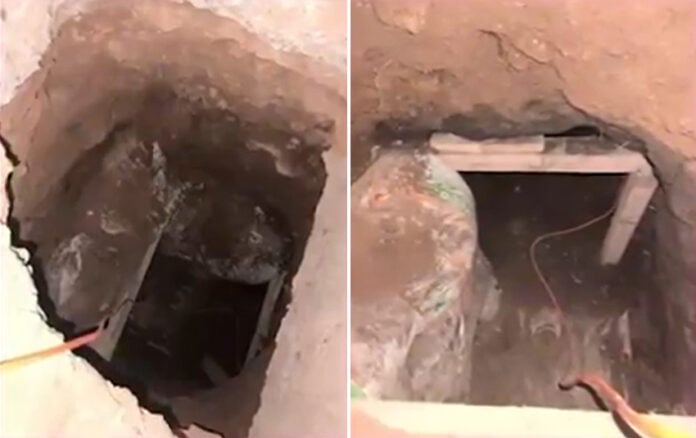
Police found the tunnels thanks to a tip from a local resident who heard construction noises coming from underground. (SSP Hidalgo)
State police in Hidalgo arrested six men this week as they were digging a tunnel in an attempt to reach underground Pemex pipelines to steal fuel, authorities said.
The men were detained in the Loma Bonita neighborhood of state capital Pachuca on Monday.
La rápida atención a un reporte ciudadano permitió a la Policía Estatal frenar el robo de hidrocarburo directamente de ductos de Pemex en #Pachuca.
En la acción fue frustrada la excavación de un pozo, además del aseguramiento en flagrancia de seis personas y una camioneta.
— Seguridad Pública de Hidalgo (@SSP_Hidalgo) May 12, 2026
The Hidalgo Security Ministry said that a quick response to a citizen’s report allowed state police to “stop the theft of fuel directly from Pemex pipelines in Pachuca.”
The citizen who reported the alleged crime and other people in the area reportedly heard sounds emanating from underground, alerting them to the construction of a tunnel.
In addition to arresting six men, police also seized a pickup truck in Loma Bonita, located about eight kilometers northwest of downtown Pachuca. Police reportedly found tools for digging and the perforation of pipelines in the vehicle.
The tunnel the men were digging was located on a private commercial property. The tunnel was reportedly located two meters underground and was eight meters long. It was close to reaching underground pipelines, according to reports.
In a separate operation in the municipality of Epazoyucan, Hidalgo, on Monday, state police seized eight vehicles transporting 4,710 liters of stolen fuel, the state government said. Two men were arrested and an illegal pipeline tap was discovered in the community of El Mercillero.
A second fuel theft tunnel was located in Pachuca
The subterranean passageway in Loma Bonita wasn’t the only fuel theft tunnel discovered in Pachuca this week.
The Federal Attorney General’s Office (FGR) announced on Wednesday that its personnel, Pemex workers, state police and Civil Protection employees had located a nine-meter-long tunnel running next to a Pemex pipeline in the Hidalgo capital.
The tunnel was found on a property located on the Santa Julia Ejido (communal land) in Pachuca, the FGR said in a statement. The FGR had obtained a warrant to search the property. Authorities found a range of tools in the tunnel that could have facilitated the theft of fuel from the underground pipeline. No arrests were reported.
According to municipal data, a total of 79 illegal taps on fuel pipelines were detected last year in Pachuca, a city located about 90 kilometers northeast of central Mexico City. Only 40 municipalities across Mexico recorded a higher number of pipeline perforations in 2025.
Thieves commonly perforate Pemex pipelines to steal fuel such as gasoline and diesel, a practice that can be extremely dangerous. Numerous perforated pipelines have exploded in Mexico. A pipeline explosion in Tlahuelilpan, Hidalgo, in 2019 claimed more than 130 lives.
In 2025, Pemex recorded losses of almost 23.5 billion pesos (US $1.36 billion) due to fuel theft, a 14.4% increase compared to the previous year.