Home Blog Page 65

MND Local: Everything you need to know about Ensenada Bay Village, Ensenada’s coming cruise attraction

1
Ensenada Bay Village
Rendering of Ensenada Bay Village as it is expected to look when work on the two-year project is complete. (Carnival Corporation)

Ensenada is one of Mexico’s oldest cruise ports, dating back to 1965, when Stanley B. McDonald founded Princess Cruises and created the concept of the “Mexican Riviera,” with cruises from Los Angeles to Mexican destinations such as Ensenada, Mazatlán, Puerto Vallarta and Acapulco.

Nor has Ensenada’s popularity as a cruise destination ever waned. It remains the third most popular cruise port in the country — behind Cozumel and Mahahual (Costa Maya) in Quintana Roo and ahead of fellow Pacific Coast ports Cabo San Lucas and Puerto Vallarta — and has welcomed in excess of 1 million cruise ship passengers in two of the past three years.

Ensenada Bay Village
The announcement for Ensenada Bay Village on Dec. 5, 2025, was attended by numerous dignitaries from Ensenada and the companies involved. (Carnival Corporation)

Based on a recent announcement, that number should only continue to rise.

Ensenada Bay Village project unveiled

Plans for Ensenada Bay Village — a new shoreside port destination for cruise ship passengers that’s being developed in partnership between Carnival, Hutchison Ports ECV and the ITM Group — were announced during a public presentation at the Ensenada Cruise Terminal in early December 2025.

The US $26 million project is expected to take two years to complete, but will welcome up to 9,000 visitors per day and have a significant economic impact on Ensenada, creating at least 350 new jobs and bringing in an estimated $120 million to the local economy each year.

“Ensenada Bay Village represents meaningful investment in Baja California,” noted Baja California’s governor, Marina del Pilar Ávila Olmeda. This project supports local jobs, expands tourism and highlights the culture and natural beauty that make our state a unique destination,” she said. 

What will Ensenada Bay Village’s attractions be?

Ensenada Bay Village is going to be a village-style port resort, steps from where ships are docked. Cruise passengers will be able to enjoy not only swimming pools, thermal springs and spa offerings but also wine and cheese pairings, tequila tastings and activities like zip lines, a scenic boat ride and a dune buggy rally.

By design, the village — with architecture that evokes 18th-century mission-era California — is meant to appeal to both kids and adults and be family-friendly. Ensenada Bay Village is also envisioned as a complementary attraction, which perhaps accounts for the fact that, as yet, there have been no controversies or complaints from local businesses that rely heavily on business from the cruise ships.

Will Ensenada Bay Village be free for cruise ship passengers?

Ensenada Bay Village
Relaxing attractions like swimming at Ensenada Bay Village will be steps from where cruise ships dock. As to how much they cost, that remains to be seen. (Carnival Corporation)

Costs to cruisegoers are as yet unknown. Carnival has not revealed whether there will be admission fees or premium charges for the various rides and attractions. Nor is there any rush to announce this information, given that Ensenada Bay Village — based on its two-year construction timeline — is not due to open until late 2027 or early 2028. 

What does Ensenada Bay Village mean for other cruise lines?

Carnival Corporation is the world’s largest cruise company, owning not only Carnival Cruise Lines but also, among other subsidiaries, Princess Cruises and Holland America Line. 

However, despite Carnival Corporation’s dominant market share in Ensenada (it accounted for 71% of all cruise visits in 2023-2024), its cruise lines are not the only ones that visit the destination; Royal Caribbean, Norwegian and Disney-owned ships are all frequent visitors too. Are their passengers also welcome at Ensenada Bay Village?

The answer is yes. The destination will also welcome guests from other cruise lines, reinforcing a shared commitment to inclusive tourism and regional growth,” Carnival confirmed in a statement. 

However, that doesn’t necessarily mean that pricing will be the same for passengers of other cruise lines — again, no pricing information has yet been released — or that non-Carnival-owned cruise lines will recommend Ensenada Bay Village with the same enthusiasm as they do other local attractions.

That said, Carnival’s investment in Ensenada is a reflection of just how strong its presence is in the port, and Ensenada Bay Village will almost certainly benefit other cruise lines. 

Who’s developing Ensenada Bay Village?

Ensenada Bay Village
Ziplines and dune buggy rally races will be among the attractions at Ensenada Bay Village when it opens — likely in late 2027 or early 2028. (Carnival Corporation)

Hutchison Ports ECV and the ITM Group are the companies developing Ensenada Bay Village, in partnership with Carnival, and the US $26 million figure quoted for the project is considered a minimum investment.

Mexican-owned ITM Group is a specialist in hospitality and cruise port development and management. More to the point, ITM has a history of collaborations with cruise lines, having partnered with Royal Caribbean Cruises since 2019 on port projects under the Holistica Destinations banner, a 50-50 venture that includes operation of the Port of Roatán in Honduras. 

ITM was also instrumental in developing Puerto Costa Maya at Mahahual in Quintana Roo, Mexico’s second-largest cruise port, although that concession was subsequently shared as a Holistica Destinations partnership and is now solely administered by Royal Caribbean.

Given this history, ITM Group was a logical partner for Carnival in Ensenada. So, too, was Hutchison Ports ECV, a subsidiary of Hong Kong-based conglomerate CK Hutchison Holdings Limited, since this company has the concession (acquired via the government of Mexico) for the Ensenada Cruise Terminal. The Ensenada Bay Village project would not be possible without Hutchison’s participation.

What is the Baja California Sur connection?

ITM Group, notably, also acquired the concession for developing the Port of Pichilingue in La Paz, Baja California Sur’s capital. Aquamayan Adventures, which shares the same owner as ITM Group — entrepreneur Isaac Hamui Abadi — had plans to build a new US $50 million cruise pier there, but after environmental protests, that project was scuttled in 2022.

Still, Baja-based cruise ports do seem to be on the rise, with both Ensenada and Cabo San Lucas recording robust visitor numbers in 2025, and La Paz also seeing strong traffic. For example, Mexico welcomed 8.7 million cruise ship passengers between January and October 2025, and was projected to finish the year with over 10 million, with the Baja California peninsula’s top three cruise ports accounting for more than 2.5 million of that total.

Chris Sands is the former Cabo San Lucas local expert for the USA Today travel website 10 Best and writer of Fodor’s Los Cabos travel guidebook. He’s also a contributor to numerous websites and publications, including Tasting Table, Marriott Bonvoy Traveler, Forbes Travel Guide, Porthole Cruise, Cabo Living and Mexico News Daily.

Sheinbaum announces plan to standardize medical records and care: Tuesday’s mañanera recapped

9
Sheinbaum Jan. 20, 2026
President Sheinbaum said that the government's goal is for "all Mexicans" to get a card through an in-person registration campaign beginning in March. (Juan Carlos Buenrostro/Presidencia)

The federal government’s plan to issue public health care cards to all Mexicans was the main focus of President Claudia Sheinbaum’s Tuesday morning press conference.

Here is a recap of her Jan. 20 mañanera.

Mexico to issue public health care cards 

“This is the new identification card for the universal health care service,” said Deputy Health Minister Eduardo Clark as an example of the credencial was displayed on a screen behind him.

An example of the new health identification card to be rolled out in Mexico, presented on a screen at Sheinbaum's daily press conference
An example of the new identification card. (Juan Carlos Buenrostro/Presidencia)

The card, he said, is “the guarantee of the right to health care” for Mexican citizens and eligible foreign residents of Mexico.

People will use their ID card when accessing the services of the public health care providers to which they belong. Those providers include the Mexican Social Security Institute (IMSS), the State Workers’ Social Security Institute (ISSSTE), IMSS Bienestar and state governments in the eight states that haven’t signed on to the federal government’s universal IMSS Bienestar scheme.

Clark said that the new ID card will come in physical and digital versions. The latter will become available in April.

“What does the card have? First, your full name, your CURP [national ID code], your sex, your place of birth and date of birth, and your nationality,” Clark said.

“And on the back there are two QR codes that allow us to validate the health care provider to which you belong and allow you to check which is your closest [health care] unit,” he said.

“In addition, it also has information about organ donation, which we’re going to request during the registration [process], as well as your blood type,” Clark said.

The Health Ministry official also said that people’s health care cards will be linked to an “electronic medical record” — i.e., their medical history.

“The credencial is a way of linking all this information,” he said.

Clark highlighted that Mexicans have a constitutional right to free health care.

“This is a way of putting a face to that right,” he said.

Clark also said that the card will allow people to know which health care provider they are affiliated with.

“We often don’t know which entitlement we have. … For example, there are students who perhaps don’t know they have IMSS. There are, perhaps, pensioners who, having been married to a person who was a beneficiary of a [health care] institution, have the right [to health care at the same institution],” he said.

Registration process to start in March 

Welfare Minister Ariadna Montiel Reyes told reporters that the government will issue the health care cards to “the entire population of Mexico,” including children.

She said that 14,000 Welfare Ministry workers will work to register Mexicans so that they can receive their cards. Citizens will complete the registration process at 2,365 “modules” to be set up by the Welfare Ministry in an initial stage, Montiel said.

She said that adults will need to provide an official form of identification with a photo, such as a passport or voter ID card, and a document that includes their address in order to register to receive a health care card. Montiel said that people who register will have their photo and fingerprints taken for their new card.

At a later date, people who have registered will receive a telephone call or a text message advising where and when they can collect their physical card, she said.

Montiel said that the registration process will commence on Mar. 2 in 14 states that have signed onto the federal government’s IMSS Bienestar scheme. The process will begin in other “federalized” states on Mar. 23, and will subsequently take place in the states where IMSS Bienestar doesn’t operate.

How much will the issuance of the health care cards cost?

Sheinbaum said that the government will spend around 3.5 billion pesos (US $198.8 million) on the registration process and the issuance of the new health care cards.

She said that the government’s goal is for “all Mexicans” to get a card.

It remains to be seen how close the Sheinbaum administration will get to achieving that goal.

Many Mexicans who have private health insurance or can afford to pay for private treatment out of their own pocket prefer to seek medical treatment in the private system. Convincing such people to register for a universal health care card could prove to be a challenge.

Toward a more integrated public health care system

Sheinbaum said that the government needs to issue the cards in order to make progress toward a more integrated public health care system.

This year, Sheinbaum said, people will continue to access health care services at the facilities of the health care provider to which they belong. However, she indicated that the public health care system will become more unified at some point in the future, allowing people to access treatment at any public health care facility.

“Let’s suppose that I belong to ISSSTE and I go for treatment at IMSS. Where does IMSS get its money from? From the workers who are affiliated with IMSS, from employers and from the federal government. If an ISSSTE beneficiary [receives treatment from IMSS], … ISSSTE will have to pay IMSS for the treatment of that patient so that [public] health services don’t become unbalanced. For that to occur we have to make what we call a clearing house so that … [payments] are automatic,” Sheinbaum said.

“… When I was mayor [of Mexico City] we did that for the public transport systems,” she said, noting that her administration in the capital created an “integrated mobility” card that people can use on the Metro, in the Metrobús and on various other forms of public transport.

“And then every month we say, ‘Metro, you get this much; Metrobús, you get this much; Trolebús, you get this much,'” Sheinbaum said.

“So the process of digitalization is necessary to enter into a system of this type [for health care], [a system] that ensures that no entity is disadvantaged, but rather that resources are allocated appropriately to each of them,” she said.

“By law, IMSS can only treat its beneficiaries. It could treat others if you pay for the service. Of course, all this has to be developed gradually,” Sheinbaum said, adding that the “first step” is to issue the public health care cards.

By Mexico News Daily chief staff writer Peter Davies (peter.davies@mexiconewsdaily.com)

Mexico falls from PwC’s list of top 10 countries to invest in

3
pwc
The consulting firm PwC ranks countries by perceived investment potential every year. In their latest ranking, the United States again took the top spot, while Mexico dropped out of the top 10 after ranking eighth last year. (PwC)

Mexico has fallen out of the top 10 in the consulting firm PwC’s latest global investment ranking, after climbing to a tie for eighth place last year.

The 29th PwC Global CEO Survey, unveiled at the World Economic Forum taking place in Davos, Switzerland, this week, gathered responses from 4,454 CEOs across 95 countries, including Mexico, between Sept. 30 and Nov. 10, 2025. 

The CEOs’ input revealed a more somber mood than last year. A noteworthy 30% of respondents were less optimistic about business opportunities in 2026. Just over half of CEOs plan to make international investments in 2026, at 51%. 

They were asked which three countries or territories, excluding their own, would receive the greatest proportion of capital expenditure from their company in the next 12 months.

The United States came out on top for investor preference, with 35% of CEOs placing it in the top three countries that will receive the highest proportion of their investment. 

Here are PwC’s top 10 global investment destinations: 

For 2026 

  1. United States: 35%
  2. Germany: 13%
  3. India: 13%
  4. United Kingdom: 13%
  5. China: 11%
  6. United Arab Emirates: 8%
  7. Saudi Arabia: 7%
  8. France: 7%
  9. Spain: 6%
  10. Singapore: 6%

For comparison, here are last year’s rankings:

For 2025

  1. United States: 30%
  2. United Kingdom: 14%
  3. Germany: 12%
  4. China: 9%
  5. India: 7%
  6. France: 7%
  7. United Arab Emirates: 6%
  8. Australia: 5%
  9. Singapore: 5%
  10. Mexico: 5%

While the launch of the Plan México national investment strategy in January 2025 was expected to attract more investors to Mexico, the introduction of U.S. tariffs on Mexico and other countries drove up investor uncertainty in 2025. 

In 2026, CEOs are more concerned about the potential impact of tariffs, as 20% of CEOs thought their companies would be highly exposed to the risk of significant losses due to tariffs over the next year. 

The three primary concerns for participants were economic volatility (31%), technological disruption (24%) and geopolitics (23%). Almost one-third said that geopolitical uncertainty is making them less likely to make large new investments.

Many CEOs viewed reinvention as a growth strategy, with 42% of respondents saying their company had begun competing in new sectors over the past five years. Meanwhile, 44% expect to invest outside their current industry, with technology being the most attractive sector.

With reports from El Economista

In 1 year, Michoacán authorities deactivated more than 1,600 improvised explosive devices

0
IED device laying on the ground
According to a localized task force, IEDs are most common in the Tierra Caliente and Sierra Costa regions of Michoacán. (@foro_militar/X)

The number of improvised explosive devices (IEDs) located, seized and deactivated by state authorities in Michoacán more than doubled last year, indicating that criminal groups’ use of the makeshift bombs is becoming more prevalent.

According to data from the Michoacán Security Ministry, 1,645 IEDS were neutralized by state authorities last year, an increase of 122.5% compared to 2024. The figure doesn’t include IEDs seized and deactivated by federal security forces such as the army and National Guard.

Crime groups that operate in Michoacán, including the Jalisco New Generation Cartel (CJNG) and Los Viagras, attach IEDs to drones to carry out aerial attacks and also use the devices as landmines and car bombs.

In 2023, the Michoacán government created a police task force called the Explosive Devices and Dangerous Materials Specialized Group to combat the use of IEDs, whose detonation has claimed the lives of civilians, police officers and soldiers in the state.

The newspaper El Universal reported that the group’s efforts are mainly concentrated in the Tierra Caliente and Sierra Costa regions of Michoacán, where organized crime activity is particularly prevalent.

According to Carlos Roberto Gómez Ruiz, chief of the specialized group, the use of IEDs by cartels and other criminal groups is now common.

“All the criminal factions are using these kinds of explosive devices,” said Gómez, who was quoted by El Universal in a Jan. 15 report.

“Not just here in the state [of Michoacán], in the whole country. Unfortunately, it is a common practice,” he said.

The New York Times reported last September that “like other armed groups around the world,” cartels in Mexico “combine old and new weapons to deadly effect.”

“Drones circle overhead in Michoacán, while roads and footpaths used by soldiers and civilians alike are seeded with IEDs,” the newspaper wrote.

“Over the past two years, the state has recorded more mine explosions than anywhere else in Mexico, a chilling marker of the drug war’s evolution.”

In November, the federal government launched “Plan Michoacán for Peace and Justice,” a 57-billion-peso (US $3.2 billion) initiative devised in response to the murder of the mayor of Uruapan on Nov. 1 and general insecurity in the state.

Between Nov. 10 and Jan. 12, 198 IEDs were seized by federal and state security forces involved in the implementation of the plan, according to the federal government’s security cabinet.

IED attacks in Michoacán

Improvised explosive devices have been used in numerous attacks in Michoacán in recent years. Among the fatal incidents are:

  • The explosion of a car bomb outside a community police station in the town of Coahuayana last month that killed six people, including three police officers. The Michoacán Attorney General’s Office attributed the attack to members of the CJNG.
  • The explosion of a landmine in the municipality of Los Reyes last May that claimed the lives of eight members of the National Guard. The location where the landmine detonated is part of an area where both the CJNG and the Cárteles Unidos (United Cartels) are vying for control, El Universal reported.
  • The explosion of a land mine on a lime farm in the municipality of Buenavista last February that claimed the lives of two workers, including a 15-year-old boy.
  • The death of four soldiers in the municipality of Aguililla in a May 2024 attack that was perpetrated by landmines, firearms and drones carrying explosives. The attack was attributed to the CJNG.

With reports from El Universal

Mexico leads LatAm in AI patents after IP office reports record year

1
Head of IMPI Santiago Nieto Castillo sitting at a desk
IMPI, headed by Santiago Nieto Castillo, noted that the record number of filings last year responds to public policies that promote innovation, and to the objectives of Plan México. (IMPI/Facebook)

The Mexican Institute of Intellectual Property (IMPI) reported that it granted a record number of patents in 2025, with a clear increase in trademark and other distinctive sign applications and registrations. 

According to IMPI, last year it granted 972 patents to Mexican individuals, the highest figure in 30 years and the highest level since comparable records began in 1995. Furthermore, the agency said that 150 patents remained unpaid at the end of the year, which would bring the annual total to 1,112 Mexican patents. 

This figure far exceeds the approximately 700 patents granted by IMPI in 2024, which means an increase of close to 38% year over year. 

IMPI noted that the record number of filings last year responds to public policies that promote innovation, and to the objectives of Plan México, a federal program that seeks to use national patents as a driving force for economic development and technology transfer.

Interestingly, 2024 also saw a record number of patents, revealing a positive trend over the past two years.

Ahead of the 2026 FIFA World Cup (taking place in Mexico, Canada and the United States), IMPI reported it granted 344 trademark registrations for brands linked to the sporting event. 

On a global scale, IMPI referenced data from the World Intellectual Property Organization (WIPO), which ranks Mexico 11th for the total number of patents granted, 11th for total trademark registrations granted, 14th for trademark applications submitted, and 7th for registered trademarks in force.

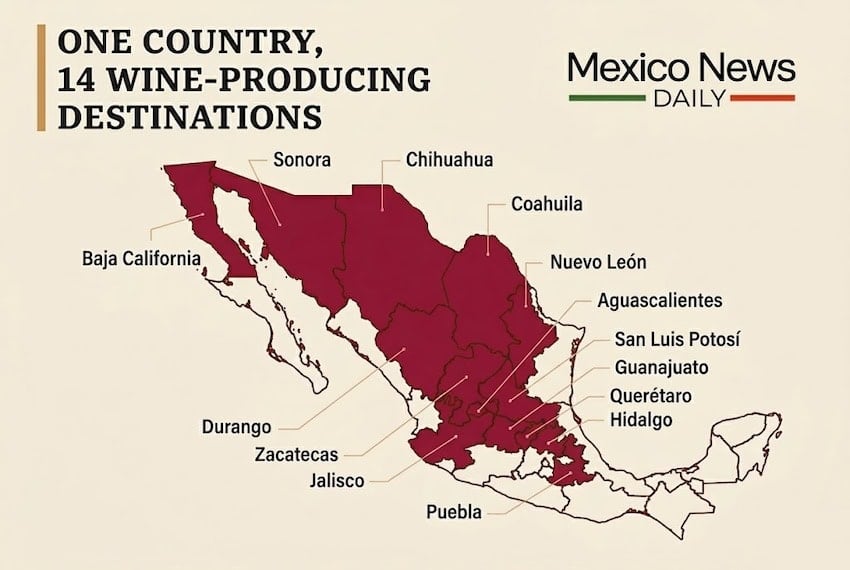
Finally, the agency said it published 14 declarations of protection for geographical indications during 2025, with the aim of promoting and exporting Mexican products. Some of these included Maya chewing gum from Quintana Roo and Campeche, Chignahuapan Christmas ornaments, and wines from the Querétaro wine region, among others.

As regards Artificial Intelligence (AI) filings, Mexico stands out regionally.  

According to the Latin American Artificial Intelligence Index, Mexico is leading in the number of AI patents among Latin American countries. Together with Brazil, these two countries account for approximately 95% of AI patent filings in the region.

Mexico News Daily

Same sport, same Olympics, same country: Mother and son will compete together for Mexico

1
sarah Shlepe
Alpine skier Lasse Gaxiola was a last-minute addition to the Mexican Winter Olympics team, joining his mother Sarah Schleper, who has competed in six previous Winter Olympics. (Sarah Schleper Gaxiola/Facebook)

A 17-year-old skier will join his 46-year-old mother on Mexico’s tiny Winter Olympic team in Italy next month, the first such mother-son combo in Mexican history.

Alpine skier Lasse Gaxiola, 17, has been named Mexico’s fifth athlete for the Milan-Cortina Winter Olympics, where he will compete in the same sport as his mother, veteran Olympian Sarah Schleper. 

Schepler and Graxiola
Sarah Schleper was born in the United States and is married to Mexican coach Federico Gaxiola. Their son Lasse was born in Mexico. (@COM_Mexico/X)

The Winter Games are scheduled for Feb. 6–22 in northern Italy. 

Schleper, 46, is set for her seventh Olympic appearance, extending a career that began in 1998 when she raced for the United States before later switching allegiances and coming out of retirement after marrying Mexican coach Federico Gaxiola.

Their son, Lasse, secured his Olympic berth through the International Ski Federation rankings after a series of junior and FIS-level races around the globe. He has also competed in age-group races in Europe.

His qualification completes a five‑member Mexican delegation that will compete in Italy. Alongside Schleper and Gaxiola (who split time between Mexico City and ski resorts in Europe and elsewhere), the team includes alpine skiers Regina Martínez and Allan Corona and figure skater Donovan Carrillo.

In 2022, Mexico sent a team of four athletes to the Winter Olympics in Beijing, China.

Schleper’s path to this moment stretches back decades.


View this post on Instagram


A post shared by VictoryMe (@victorymedia.oficial)

The native of Vail, Colorado, competed for the U.S. in four Winter Olympics: 1998 in Nagano, Japan; 2002 in Salt Lake City, U.S.; 2006 in Turin, Italy; and 2010 in Vancouver, Canada.

Then, after obtaining Mexican citizenship in 2015, she competed for Mexico in 2018 in PyeongChang, South Korea, and in 2022 in Beijing.

Her seventh appearance will be one short of the record eight held by Japanese ski jumper Noriaki Kasai and German speed skater Claudia Pechstein.

Her best finish was 10th place in the women’s slalom in 2006, which came one year after her lone World Cup victory, at a slalom event in Switzerland.

Eight years ago, she told Vice.com she was “extremely proud of being Mexican — extremely proud of what I’ve done to get here.”

In that interview, she was also asked if her own kids — Lasse wasn’t even 10 years old at that point — would someday ski for Mexico.

“Sometimes Lasse trains with us in the summer,” she replied. “He doesn’t want to be a racer, but he’s a great skier. I’m pretty sure he’d compete for Mexico, though. It’s a long way away, but there’s an opportunity there.”

In Milan-Cortina, Sarah and Lasse will join Venezuelan lugers Werner Hoeger and his son Christopher (Salt Lake City 2002) as the only parent-child combo competing for the same country in the same event at the same Winter Olympics.

A parent-child combo has occurred several times in the Summer Games, but only one time as a mother-son combo: pistol shooters Nino Salukvadze and her son Tsotne Machavariani at the Rio Games in 2016.

With reports from Latinus, TUDN and the Mexican Olympic Committee

Mexico loses 25,000+ formal employers in record decline

1
Empty room of office cubicles
According to the Center for Economic Studies of the Private Sector (CEESP), uncertainty resulting from high levels of insecurity and the judicial reform "will probably continue to limit the creation of formal jobs" this year. (Unsplash)

The number of formal sector employers in Mexico declined for a second consecutive year in 2025, according to data from the Mexican Social Security Institute (IMSS).

At the end of December 2025, there were 1,029,280 IMSS-affiliated employers in Mexico, a reduction of 2.4% compared to a year earlier.

The decline came after the number of IMSS-affiliated employers fell 1.6% in 2024.

In an economic analysis document, the Center for Economic Studies of the Private Sector (CEESP) noted that the number of IMSS-affiliated employers declined by 25,667 last year.

The research center said that the decline was the largest on record.

“The IMSS results reflect the complexity of listing new employers and keeping existing ones active,” CEESP said.

It said that the reduction in IMSS-affiliated employers was mainly due to the closure (or descent into informality) of businesses with a small number of employees. Such businesses, CEESP said, are least able to afford “the constant increase in labor costs” — including due to annual increases in the minimum wage — and to withstand economic uncertainty.

Oscar Ocampo, economic development director at the Mexican Institute for Competitiveness (IMCO), noted that 83% of employers that were removed from IMSS’s list of formal sector employers in 2025 were businesses with five employees or fewer.

“This speaks to how costly it is to be a business owner in Mexico,” he said.

“In this country, it is very difficult for micro and small companies to do business,” said Ocampo, who was quoted in a report by El Sol de México.

What factors make survival difficult for businesses in Mexico?

According to Ocampo, businesses in Mexico, especially small ones, have been negatively affected by the slowdown in economic growth, low levels of investment (although foreign direct investment increased last year), the increase in the minimum wage and the increase in the number of paid vacation days to which formal sector employees are entitled.

The IMCO economic development director also said that extortion negatively impacts businesses. Extortion is a widespread problem in Mexico, and its incidence has increased since President Claudia Sheinbaum took office in October 2024.

Last July, the government launched a new national strategy against extortion as the centerpiece of its efforts to combat the crime, while in November, the Senate passed a new anti-extortion law.

Data from the ANPEC small business association shows that half of all businesses in Mexico have been victims of a crime, El Sol de México reported, and extortion is a particular problem for small businesses. Some such businesses are forced to make large payments on a regular basis to extortionists, a situation that affects their profitability and ongoing viability.

In Cuautla, Morelos, a city that journalist Ioan Grillo recently described in his publication CrashOut as Mexico’s “capital of extortion,” the crime is particularly prevalent.

“The butchers have to pay the maña, the criminals. Every kilo of beef they sell they pay 20 pesos. The tortilla shops pay. The public transport, the buses and taxis pay,” Francisco Cedeño, a local journalist, told Grillo last October.

The outlook for Mexico’s formal employment sector

In its analysis, CEESP wrote that the “signs of weakness” evident in Mexico’s formal employment sector at the end of 2025 could continue this year.

It noted that the number of formal sector employees in Mexico rose by 278,697 last year, representing an increase compared to 2024. However, CEESP pointed out that the figure is “significantly lower” than in previous years, except for “the year of the pandemic” — 2020 — when the Mexican economy contracted more than 8%.

The majority of the formal sector jobs created last year went to digital platform workers, such as Uber drivers and Rappi delivery workers, who were able to move out of the informal sector thanks to the launch of a pilot program that provided employment benefits to them.

CEESP wrote that to a “large extent,” the 2025 job creation numbers reflect “the difficulty of creating quality jobs” in Mexico, which it said increases “the need” for people to seek employment in the informal sector, which employs more than 50% of Mexican workers.

“We have already highlighted on several occasions the need for an environment that facilitates the creation of more jobs by formal companies,” CEESP said.

However, the research center said, “high labor costs” as well as “other factors such as
uncertainty resulting from high levels of insecurity and a judicial reform that could affect the intention to open new workplaces and close some existing ones” will “probably continue to limit the creation of formal jobs” this year.

With reports from El Sol de México

Climate change: Migratory birds are starting to abandon the state of Jalisco

1
a bird
As one Guadalajara biologist explains the problem, "Prolonged droughts and the evaporation of bodies of water force birds to move to other locations or even stop migrating altogether.” (semadet.jalisco.gob.mx)

Academics from the University of Guadalajara are warning that climate change’s impact on migratory birds from the U.S. and Canada is causing “a silent and growing imbalance in the local ecosystem.”

The continued migration of many bird species that arrive in Jalisco each year faces serious threats due to rising temperatures, pollution and the expansion of urban areas with excessive lighting.

Professors Carlos Palomera García and Jesús Alberto Espinosa
The warning issued by the Guadalajara researchers Carlos Palomera García and Jesús Alberto Espinosa was not aimed at bird lovers alone. The diminished presence of migratory birds in Jalisco indicates a dangerous imbalance in the overall ecosystem of the state. (UdeG)

Biologist Jesús Alberto Espinosa said migration has declined among species that depend on increasingly dry regional wetlands. The climate crisis is particularly evident in the reduction of critical ecosystems that are losing their capacity to provide refuge.

“There are species that are not returning,” he said. “We used to see the American grebe in the 1980s and 90s; now it’s extremely rare. Roseate spoonbills, which used to arrive in good numbers in Zapotlán el Grande, are hardly ever seen today. Storks and ducks, which were common, have also seen their populations decline.”

With less water and more severe droughts, the natural cycle is disrupted, affecting both birds and humans.

The survival of these birds depends directly on the health of the wetlands, such as the Zapotlán Lagoon, which not only regulates the local climate but also supports 360 families of fishermen and artisans.

The Sayula Lagoon, which should be full of thousands of birds and is an important site for their conservation, is dry because not enough rain fell this past year.

“Prolonged droughts and the evaporation of bodies of water force birds to move to other locations or even stop migrating altogether,” said Carlos Palomera, a biology professor.
“The lack of water … prevents the reproduction of aquatic organisms that serve as food for the birds, [while] rising temperatures disrupt natural cycles: Insects hatch prematurely, and birds arrive late to areas where they previously found abundant food. This reduces their chances of survival and affects the entire food chain.”

The decline in migratory birds has serious consequences: As natural pest controllers, their absence favors an increase in insects that damage crops or transmit diseases. Additionally, many species perform vital functions such as pollination and seed dispersal, essential for forest regeneration.

Espinosa and Palomera spoke Monday at the inauguration of their photo exhibit — “Glimpses of Nature” (“Miradas a la Naturaleza”) — which they hope will raise public awareness by explaining the importance of ecological preservation in mitigating the effects of climate change on birds and other animal groups.

The exhibit lasts through Feb. 25 at the Juan José Arreola State Public Library of Jalisco, in Zapopan.

With reports from La Crónica, UDG-TV and Aristegui Noticias

US-originating measles outbreak has now reached every state in Mexico

1
Health Minister David Kershenobich joined President Claudia Sheinbaum at her morning press conference Tuesday
Health Minister David Kershenobich joined President Claudia Sheinbaum at her morning press conference Tuesday to discuss the government's strategy to confront the fast-spreading measles outbreak in Mexico. (Mario Jasso/Cuartoscuro.com)

Despite efforts at a nationwide vaccination campaign, measles has now spread to all 31 Mexican states and Mexico City, with 7,131 cases reported over the past year and 24 deaths confirmed.

Over the past 12 months, more than 11.8 million measles vaccines have been administered nationwide, prioritizing girls, boys and susceptible populations.

Unlike their U.S. counterparts, Mexican health authorities are waging a vaccination campaign against measles, but so far it has not been enough to prevent the spread of the highly contagious illness. (Mario Jasso/Cuartoscuro)

While the Health Ministry (SSA) points out that only 5% of the total cases are active, specialists from the National Autonomous University of Mexico warn that measles “is the most contagious disease there is, even surpassing Covid-19.” 

On Tuesday, the government announced it will reinforce vaccination efforts at high-traffic locations, such as airports and bus terminals, with the aim of preventing infections and detecting possible cases early.

In a statement, the SSA said more than 90% of confirmed cases correspond to people without a history of vaccination, and severe cases and deaths are concentrated mainly in populations with incomplete vaccination schedules, young children, as well as people with malnutrition or weakened immune systems.

The most affected age group is children aged 1 to 4 years (1,089 registered cases), followed by the 5 to 9 year age group (830 cases). 

The states where the most cases of measles have been detected are Chihuahua with 4,495 (and 21 of the 24 deaths), followed by Jalisco (1,020 cases and one death), Chiapas (430), Michoacán (261) and Guerrero (248).

At the same time, cases of Febrile Exanthematous Diseases (illnesses causing fever and a widespread skin rash such as measles, rubella, roseola, scarlet fever and chicken pox), 17,267 cases have been registered in the same period.

The SSA said its National Epidemiological Surveillance System is monitoring the epidemiological behavior of measles, allowing for the timely detection of cases, their confirmation by laboratory and the identification of circulating genotypes.

“The increase in measles cases recorded during 2025 occurs in a context of regional resurgence of the disease in the American continent, a phenomenon documented and promptly warned by the Pan American Health Organization (PAHO) and by health authorities of various countries,” the SSA noted.

In November, the PAHO announced that the Region of the Americas lost its verification as free from endemic measles transmission. Canada lost its measles-free status on Nov. 10, 2025, while Mexico and the U.S. have been granted two-month extensions from the PAHO to contain the measles outbreak. Mexico has been summoned to a virtual meeting on April 13 to review whether it will maintain its measles-free status, given the active outbreak.

According to the magazine Scientific American, declining national vaccination rates in the U.S. and Canada have helped entrench measles in those countries, while growing antivaccine messaging by U.S. Health Secretary Robert F. Kennedy, Jr, has also contributed to the outbreaks there.

Mexico’s measles outbreak began in February 2025 and health authorities in the state of Chihuahua originally linked it to a late January 2025 outbreak in an undervaccinated community in Gaines County in West Texas.

With reports from El Universal, Proceso, La Jornada and Sin Embargo

New 10 and 20-peso coins to honor Mexico’s ancestry

1
Bank of Mexico logo on a wall
Starting this year, Mexico will gradually replace its 10 and 20-peso coins with new designs honoring Tonatiuh, the Mexica sun god, and the Maya Temple of Kukulkan at Chichén Itzá. (Cuartoscuro)

Starting this year, Mexico will gradually replace its 10 and 20-peso coins after the Bank of Mexico (Banxico) and the Mexican Coin House announced changes in currency production. 

According to a decree published in the Official Gazette of the Federation, the new coins will be manufactured with a mix of metal alloys in order to optimize minting costs, adapt to metal availability, ensure continuity in the production of national currency and strengthen security systems. 

The new 10-peso coin design will feature the national coat of arms with the inscription “Estados Unidos Mexicanos,” while the reverse will show the image of Tonatiuh, taken from the Sun Stone. The ring will also display the symbol “$10,” the mint mark “Mo,” and the inscription “diez pesos” (10 pesos).

Meanwhile, the 20-peso coin will be dodecagonal. The obverse will feature the same inscription “Estados Unidos Mexicanos,” and the back will depict the Temple of Kukulkán at Chichén Itzá. It will also feature the symbol “$20,” the face value “veinte pesos” (20 pesos), the year of minting and the mint mark of the Mexican Coin House. 

As a security feature, the reverse of the coin, within its center, will have the microtext “Chichén Itzá, Temple of Kukulkán — Cultural Heritage” and an image with the number 20.

The introduction of these new designs does not imply the immediate withdrawal of the coins currently in circulation, which will retain their legal tender status and be accepted throughout the country until the monetary authority determines otherwise.  

Kukulkán
The Temple of Kukulkán at Chichén Itzá in Quintana Roo. (Wikimedia Commons)

In addition to changes to the 10 and 20-peso coins, a new generation of 1, 2 and 5-peso coins made of bronze-coated steel is being prepared as part of the Mexican Coin House’s 2025-2030 program. 

These changes follow the withdrawal of the blue 20-peso banknote bearing the image of President Benito Juárez last year. Its successor is a green-and-reddish horizontally oriented 20-peso bill from the “G family,” which was introduced in 2021 to commemorate the 200th anniversary of Mexican independence.

With reports from La Jornada, Uno TV and Milenio