Home Blog Page 665

What you need to know to host a posada this holiday season

6
Host your own posada. (Freepik)

It’s posada season! If you live in Mexico or in regions where Mexican culture prevails, you might feel a sense of…well…anticipation? Excitement? Anxiety? It seems that where there is one, there are dozens, and what was once a traditional Catholic commemoration of Mary and Joseph’s journey from Nazareth to Bethlehem has transformed, for many, into a boozy holiday party. 

Posada means “inn” or “shelter.” In its purest form, it is a religious event that begins on December 16th, the day Mary and Joseph left Nazareth in search of a place to deliver baby Jesus. For nine nights, the pair journeyed across difficult terrain until reaching Bethlehem, where Mary gave birth on December 24th, known in Mexico as Nochebuena

As a religious event, it begins in church where parishioners recite the Holy Rosary. It then continues into the local neighborhood in the form of a procession. Some processions are simple, with volunteers carrying a manger scene, while others are elaborate, theatrical reproductions of the couple’s journey.

The procession stops at the door of a house (who, in reality, is the predetermined party host for the evening), and in the form of a song will ask for an invitation to enter. This is known as la letanía, in which Joseph asks the innkeeper (in this case, the owner of the dwelling) for shelter. The figurative innkeeper responds in song, claiming there is no room. After a bit of melodic negotiation, the procession will be granted entry. And here is where the “party” portion of our posada begins.

(This is a very brief round-up of an intricate religious tradition, which I have summarized in the interest of the time you have to spend reading.)

With that said, these days the reenactment has seemingly fallen to the wayside, at least in my experience here in Mexico City.

And without such a societal obligation, I feel rather empowered to host a posada myself!

Such an announcement requires adequate research. I enlisted the help of my closest Mexican friends, memories of previously attended posadas, and, of course, the mighty internet to determine exactly what is required to throw a successful posada. 

Here is what I’ve learned:

  • The date: The posada should take place between December 16th – 24th. 
  • The ice-breaker: A sing-along of the aforementioned letanía is to take place upon arrival. Copies of the lyrics are available online and booklets are for sale in your local tianguis. Have them available for guests unfamiliar with the song. If possible, offer a candle to each attendee to light during the song.
  • The drink: Ponche will be expected. It’s a warm punch with brown sugar, sugar cane, cinnamon, and fruits such as apples, guavas, and tejocotes. Feel free to add a kickif the attendees are mostly adults. It’s okay to ask a guest (with whom you’re very close) to bring some, as posadas often have a potluck element. Or, you can make it yourself!

Tejocotes, a seasonal winter fruit. (In the Kitchen with Matt)
  • The food: Offer typical foods like tamales, pambazos, tostadas, tacos de canasta, or even enchiladas. Buñuelos, a sweet fried fritter, are also a dessert staple this time of year.
  • The gift bag: La colación are small, colorful sugar candies with a shape similar to jelly beans and a texture not unlike Sweet Tarts, often found with peanuts, almonds, or orange zest inside. These can be offered in small baskets or bags (known as un aguinaldo) to guests or can (and probably should) be included in the most important guest of all, la piñata. Speaking of…
  • The guest of honor: The piñata, which might be my sole purpose for throwing a posada to begin with, was for years stuffed with typical Mexican sweets like la colación, sugar cane (yes, the actual cane, chopped in small pieces), peanuts, oranges, mandarins, and other small fruits. It’s more common today to stuff them with chocolates or lollipops. Whatever you choose to fill it with, it will likely have six points and look like this:
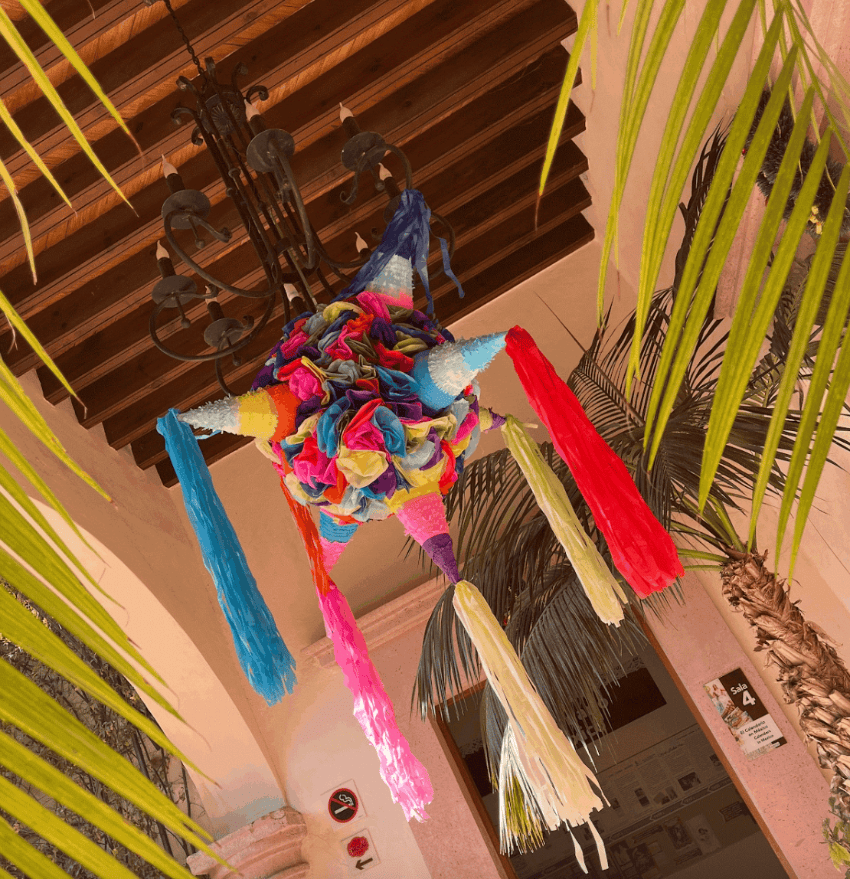
Photo by Bethany Platanella

Every guest gets a shot until it’s broken. Each participant should be blindfolded, spun in a circle three or more times, and given a stick with which to bash the beautiful work of paper mache art. He or she has the length of the following dicho, which is repeated by onlookers, to attempt victory:

Dale, dale no pierdas el tino porque si lo pierdes, pierdes el camino. Ya les diste una, ya le diste dos y tu tiempo se acabó!

When the piñata is broken, there’s a chance your guests will burst out in shrieks as they crawl, quite literally, over one another to fill the aforementioned baskets or bags with as many goods as possible. It’s a sight to behold so I suggest having your camera ready to go on video mode.

And there you have it! A basic, easy-to-follow guide to hosting a successful posada. Have I missed anything? Is there any part of a posada that you really love? Leave them in the comments below.

¡Feliz Navidad!

But what does it meme? The humor you need this holiday season

3

If you’re on a quest to understand Mexican humor — or at least to find the best Mexican memes to share with your friends — we’ve got you covered! Here’s this week’s curated collection with a translation, background, any relevance to current events, and hopefully, a good chuckle.

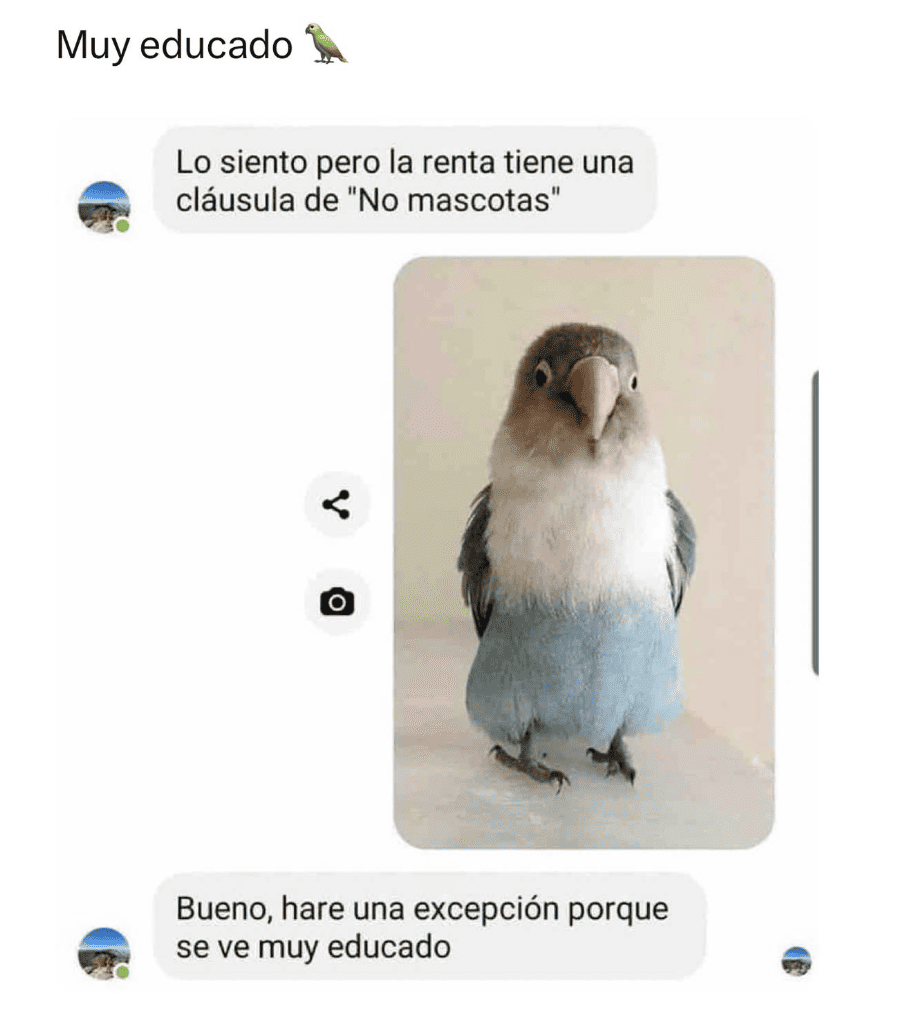
Meme translation: “I’m sorry, but the rental agreement has a ‘no pets’ clause.” (picture sent) “Well, I’ll make an exception because he looks very polite.”

What does it meme? Every animal-loving renter (or would-be renter) has run into the “no pets” problem at least once. Perhaps the trick is just to find an extremely polite-looking pet!

Meme translation: “Take care of my ecosystem just like you take care of your bill.”

What does it meme? This one is more sweet than funny, a reminder to give value to things that need to have a value assigned to them. 

The axolotl, an adorable…amphibian, I think?…is having a moment. It even made it onto the new award-winning bank note in 2021! Many people, myself included, still treasure the first ones they received, mostly crisp and in perfect condition (we’ve got ours between the pages of a book). The little dude above reminds us that many things need to be taken care of, some even more than a 50-peso bank note.

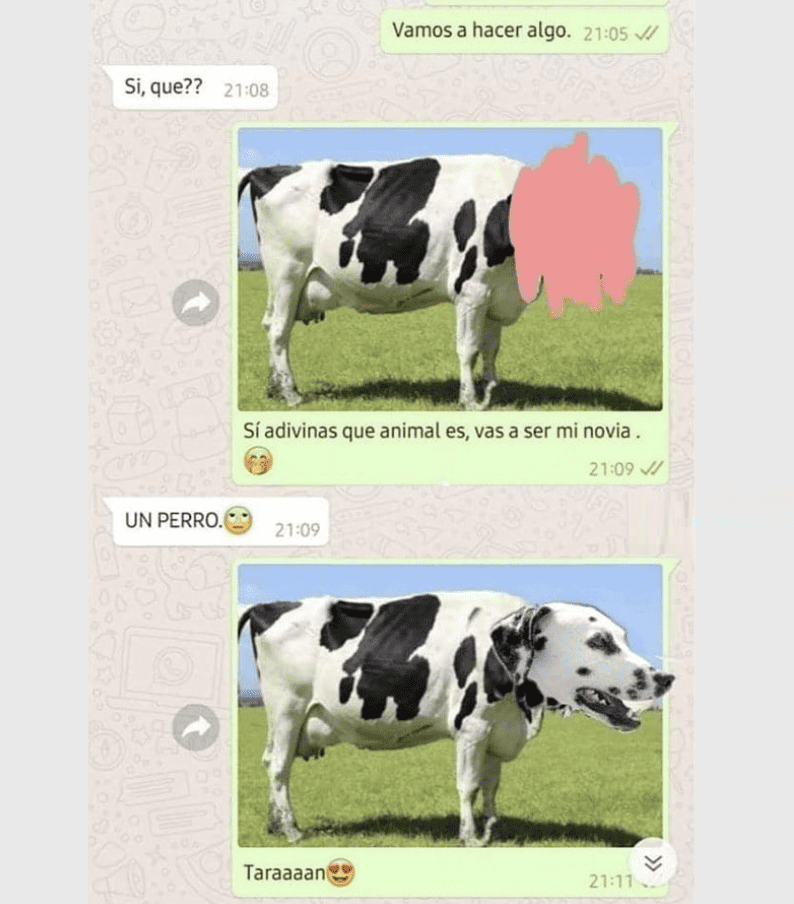
Meme translation: “Let’s do something.” “Okay, what?” “If you can guess what animal this is, you can be my girlfriend.” “A DOG.” “Ta-da!”

What does it meme? Well, no one can say that Mexican men aren’t persistent! Add playful and charming to the list, and it’s easy to see how one might get entangled in romance around here. I’ve seen this meme make the round a few times, and it never fails to crack me up! 

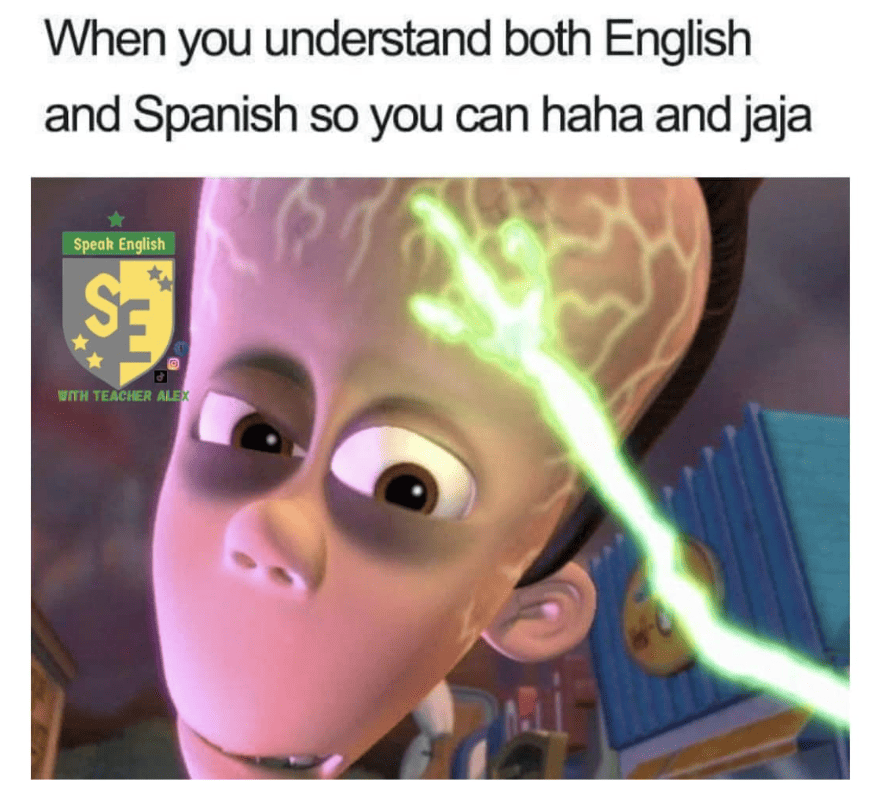
Meme translation: Y’all know what? It did not occur to me until I was proofreading this thing that this one is actually in English. Something to not look forward to about being fully bilingual: not realizing what language something is in. Whoops!

What does it meme? If you’ve got many Spanish-speaking friends on social media, you might have noticed that they write “haha” as “jaja,” which is phonetically the same. I learned Spanish back in the days when one would have to go to an internet café to instant message people on MSN Messenger (as close to “texting” as we got back then), and pretty much immediately got used to laughing “in Spanish.” It didn’t make me feel like I had a giant brain, but it was a minor indicator that I was at least somewhat familiar with the language.

I got a little too used to it, though, and later my mom asked me in desperation, “Why do you keep saying ‘yes’ a bunch in German? What does that even mean?”

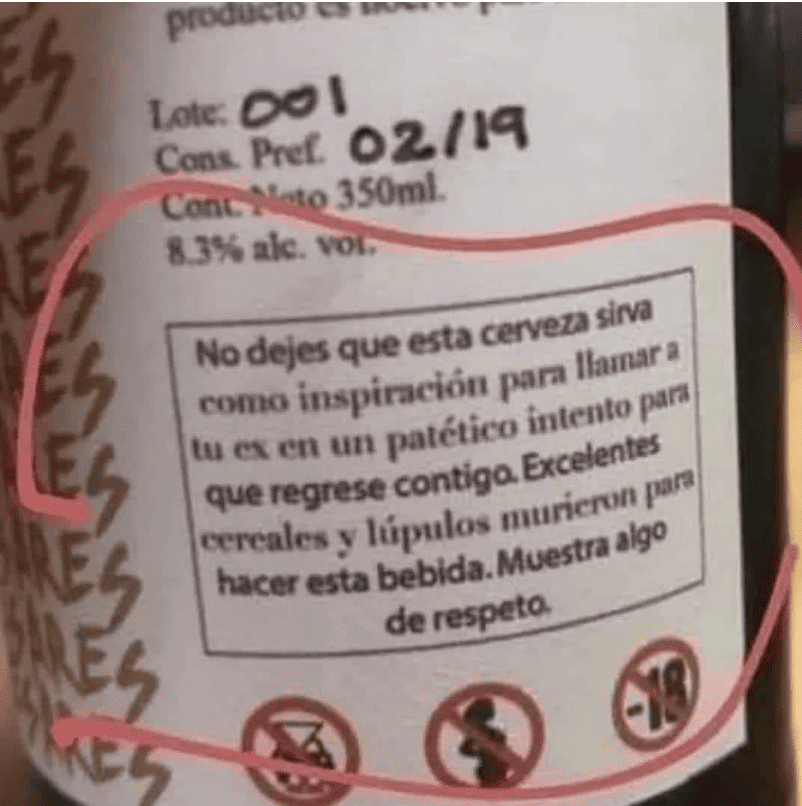
Meme translation: “Don’t let this beer be an inspiration to call your ex in a pathetic attempt to get back with them. Excellent grains and hops died to make this drink. Show some respect.”

What does it meme? Overall, we’re a passionate, romantic bunch down here. Unfortunately, when that passion gets paired with alcohol, exes can get dialed or texed, kisses can get planted on the wrong person and declarations of love can get shouted from the…bar stool tops. You get the idea. Kudos to this beer maker for trying to prevent a regrettable decision before it happens! 

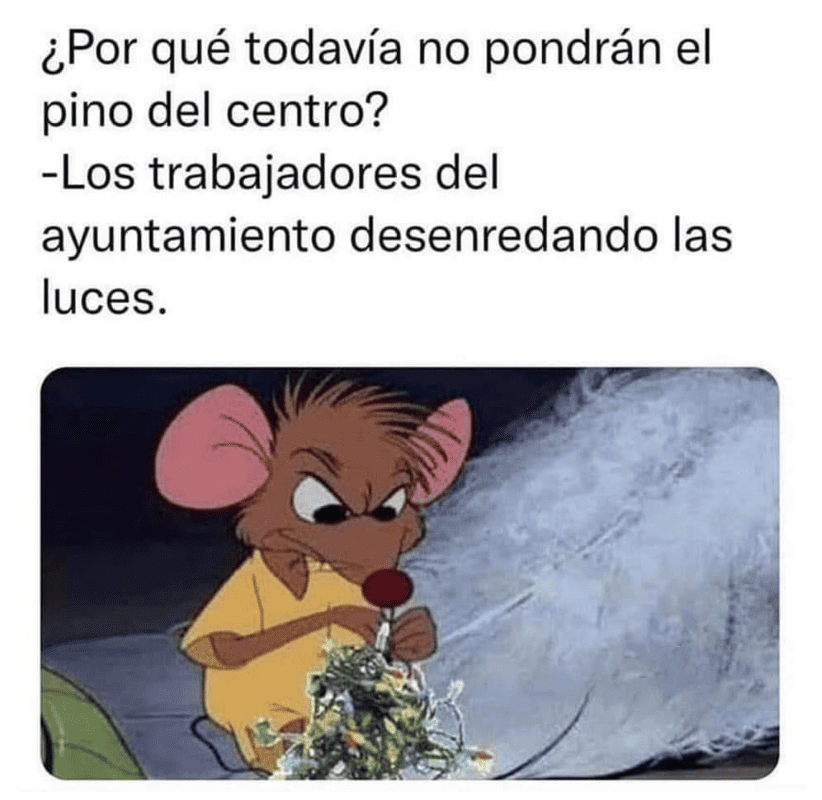
Meme translation: “Why haven’t they put up the Christmas tree downtown yet?” “City workers untangling the lights.”

What does it meme? The tone in most countries lately seems to be a grouchy, “Oh, government! Can’t they do anything right?” This meme reminds us that behind every institution, public or private, there are real people – or mice – trying to untangle the Christmas lights from last year, just like the rest of us.

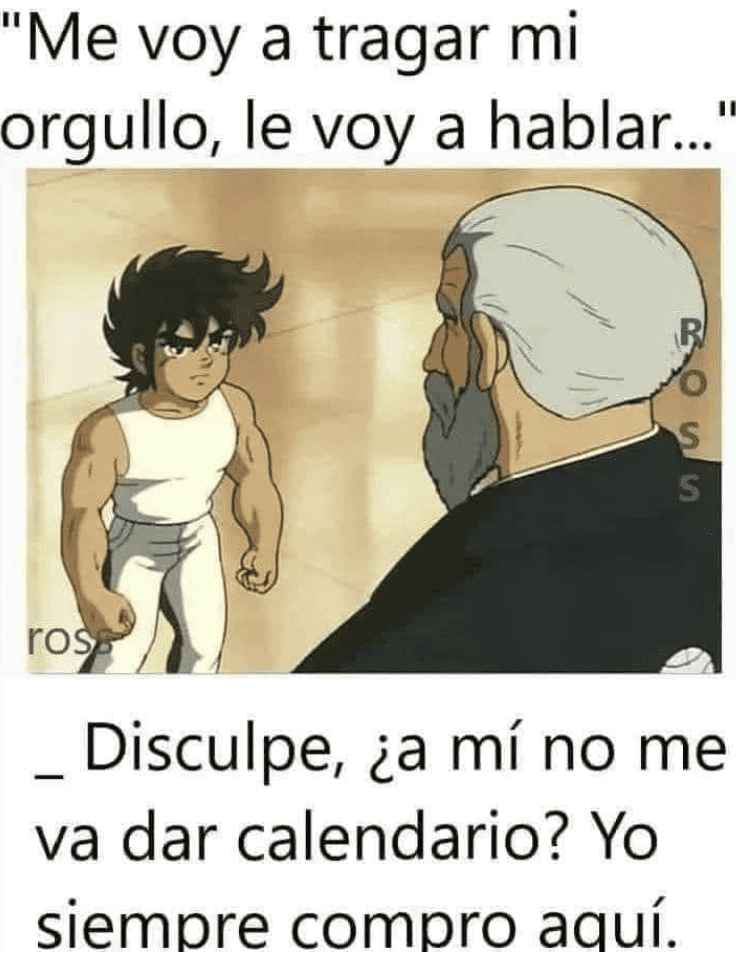
Meme translation: “I’m going to swallow my pride and talk to him…” “Excuse me, aren’t you going to give me a calendar? I buy things here all the time.”

What does it meme? There are always some small businesses – often stores or the gas delivery company – that have simple, through-the-year one-page wall calendars made up with their name on it and some kind of holiday message (“Gas Express wishes you a very happy holiday!” or something) to give to their loyal customers.

I always appreciate the gesture, but it’s never occurred to me to look forward to them or count on their use. My partner, however, has already mentioned several times that he wants a calendar from the gas delivery people…so we’ll be ordering gas in a week or so when (hopefully) they’ll be handing them out!

Sarah DeVries is a writer and translator based in Xalapa, Veracruz. She can be reached through her website, sarahedevries.substack.com.

Mexico as a land of opportunity for foreigners: A perspective from our CEO

4
Travis and Tamanna Bembenek on a recent visit to Mexico City that inspired Travis to think about how the influx of foreigners in Mexico is diversifying. (Courtesy)

Last week my wife and I went to Mexico City for a few days to meet with several embassies and professional organizations on behalf of Mexico News Daily.

We were there to look for additional sources of news and information to bring our readers from unique and experienced perspectives. It was fascinating to meet with and review the plans of embassies like the U.K., U.S., India, and Australia for Mexico in 2024. Witnessing the work of each embassy gives us the chance to peer into the perspectives of its citizens coming to Mexico and to understand their motivations and ambitions.

As someone who has spent significant time over many years in Mexico City, I am used to seeing the incredible diversity of the people of Mexico within Mexico City. It has always been common to hear different Indigenous languages, see completely different clothing styles, and smell and taste different foods reflecting the many unique regions of the country.

But this time was different. Very different. As we walked and took Ubers around the city from meeting to meeting, we were surprised, actually completely blown away, by the amount of foreign diversity that we saw around us. Not just the much-discussed wave of people moving from the United States to areas like Roma Norte and Condesa in Mexico City, but real, full-on global diversity.

One afternoon we had lunch in Lomas de Chapultepec at a Korean BBQ restaurant. The place was packed with Koreans – as well as many other nationalities – and the food was prepared and tasted just as it would be in Seoul. After lunch we strolled to Polanco, where we came across a Chinese grocery store buzzing with Chinese families buying food for the week. We were trying to find an item in the store and as the Mexican employee did not recognize it, a Chinese customer began speaking to us in Spanish to tell us in which aisle to find it. This made-for-TV incident left all of us laughing and smiling.

The next day we had a tasty Indian lunch and the manager amazingly was from a city just 30 minutes away from where my wife grew up in India. Dinner that evening was at a great Lebanese place. While walking the streets, we heard languages from all over the world – from Asia, Europe and South America.

Another sight I was not at all accustomed to seeing in Mexico was that of blue-collar foreign workers. We saw Venezuelans, Central Americans, and Haitians working side by side with Mexicans in construction and other jobs. A lot of thoughts and opinions are likely to arise on this issue in particular, but at the end of the day, Mexico is providing an opportunity for these immigrants to work and try to live a better life than they can in their home countries. Mexico has historically been unable to provide enough opportunities for its own population, so to see people from other countries now working here is an interesting development and one to keep an eye on.

I will end with a final observation of something I am not used to seeing in Mexico – the degree of global experience that an increasing number of Mexicans we meet are now acquiring. During our meetings this week, we met with many young Mexicans who had studied or worked abroad, where they gained global experience, and returned to their home country to work and make an impact.

What does all of this diversity of foreigners coming to Mexico and of Mexicans living abroad and coming back tell us about the country’s future trajectory in the global economy? I will be curious to find out.

Travis Bembenek is the CEO of Mexico News Daily and has been living, working or playing in Mexico for over 27 years.

After Senate indecision, President López Obrador appoints Supreme Court justice

0
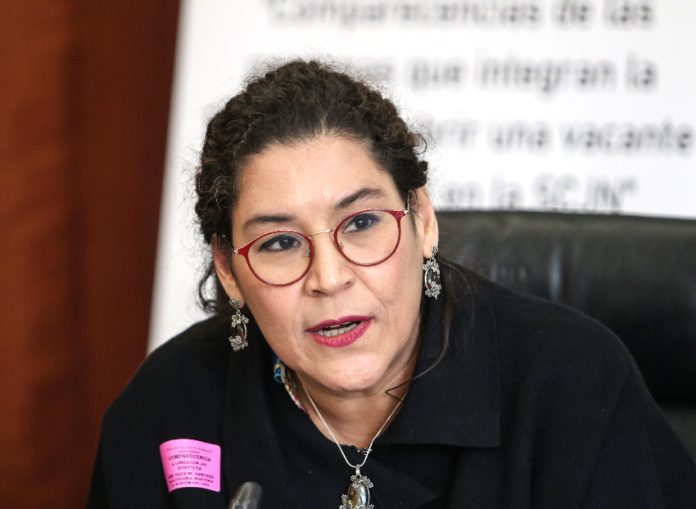
Lenia Batres
Critics are concerned about Batres' close ties to AMLO and Morena. Her brother Martí Batres is currently the mayor of Mexico City. (Cuartoscuro)

President López Obrador on Thursday designated a member of the ruling Morena party as Mexico’s newest Supreme Court (SCJN) justice, hand-picking Lenia Batres Guadarrama for the role.

It was the first time in Mexican history that a president directly appointed a SCJN justice, an occurrence that was permitted because the Senate on two occasions failed to endorse any of the candidates put forward by López Obrador.

The designation and swearing in of Batres — a former federal deputy and chair of López Obrador’s executive legal advisory council until Thursday — came after she and two other women failed to attract two-thirds support among senators in a vote held in the early hours of Thursday morning.

The 54-year-old sister of Mexico City Mayor Martí Batres received the most votes out of three candidates on the president’s short list — 54 out of 121 votes cast — but that number was well short of the qualified majority required for the Senate’s appointment of a Supreme Court justice.

Morena and its allies have a simple majority in the Senate, but not the two-thirds majority required to approve changes to the constitution, or in this case, appoint a Supreme Court justice. Talks the ruling party held with the Citizens Movement party failed to yield an agreement that would have allowed the Senate to make the appointment.

López Obrador said on Friday that he met with Lenia Batres and Bertha María Alcalde Luján, another of his nominees, before he appointed the former as a Supreme Court justice.

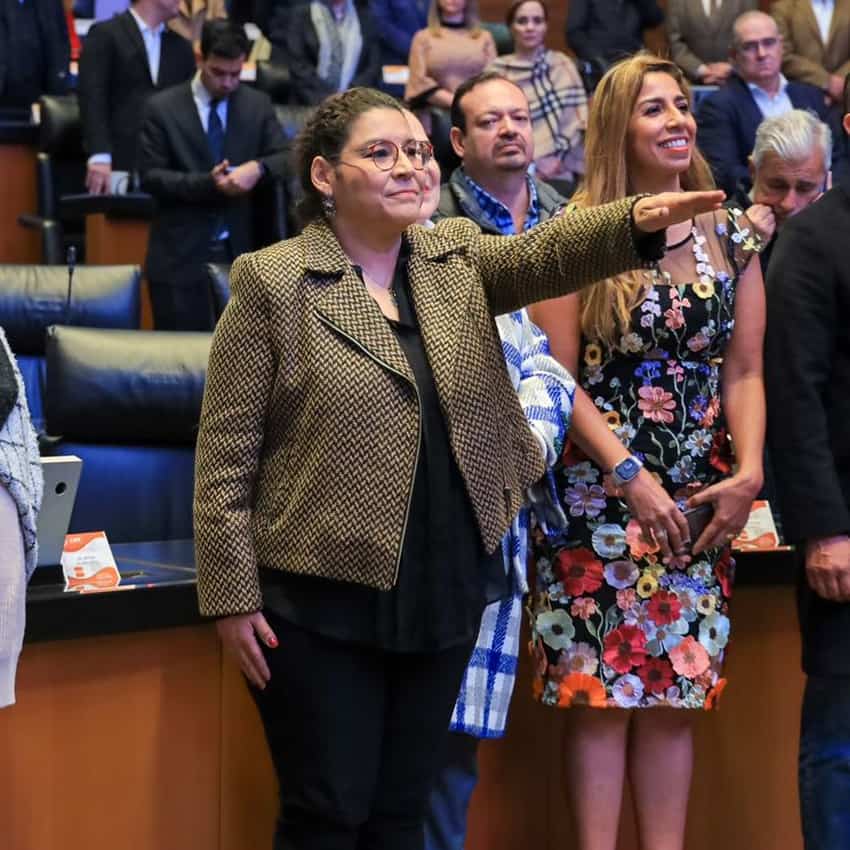
A woman salutes in a congressional hall with a crowd seated behind her
Lenia Batres during her swearing-in as a justice of the Supreme Court, at the Senate chambers on Thursday. (Senator Ana Lilia Rivera/X)

“I said to them, what are we going to do? Help me,” he told reporters at his morning news conference.

“How are we going to do it? We’re talking about 15 years of guaranteed work,” López Obrador said, recounting the meeting.

He said that Alcalde — sister of federal Interior Minister Luisa María Alcalde — noted that she won a first vote in the Senate, but acknowledged that Batres prevailed in subsequent ones.

According to López Obrador, Bertha Alcalde then said that she had “no problem” with Batres being appointed as a SCJN justice and that she could “help” in other areas.

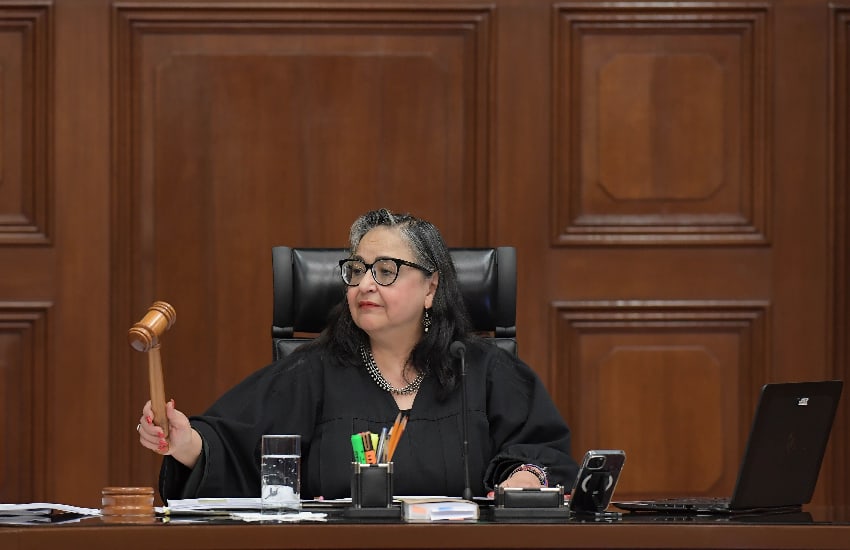
Chief Justice of the Supreme Court Norma Piña
Batres will serve under Norma Piña, the first woman to be chief justice of the Supreme Court. (Suprema Corte de la Nación/Cuartoscuro.com)

“I didn’t do it, but I felt like standing up and hugging her. In other words, [it was] an act of dignity, of exceptional, extraordinary principles,” López Obrador said, adding that there are people who “fight tooth and nail” for lesser positions.

“And that’s why Lenia was the proposal. … That’s the way it was and now she’s a justice,” he said.

Batres has two law degrees, including a master’s in criminal law, but no experience as a judge.

For a newly-appointed SCJN justice, that’s not unprecedented, according to Luis Eliud Tapia, a legal consultant at the Washington D.C.-based global criminal justice watchdog Fair Trials.

In fact, “it’s a good idea for people without a judicial career to be on the Supreme Court, as long as they’re independent and impartial,” he told Courthouse News.

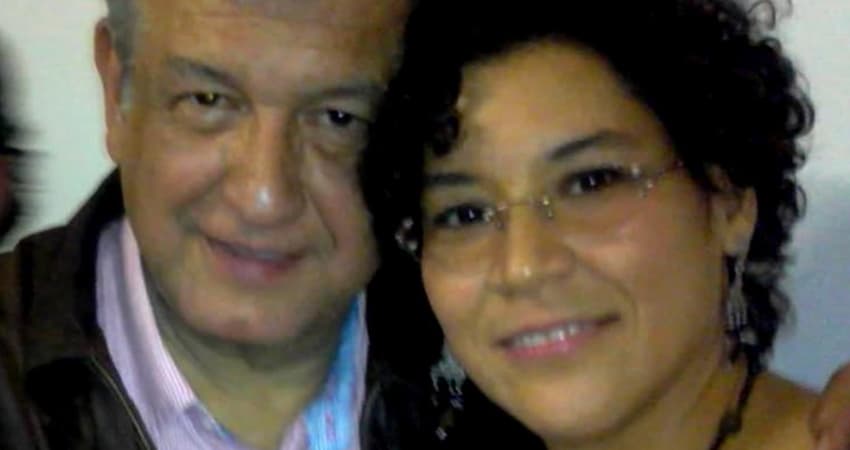
However, Batres’ independence and impartiality have been questioned because she is a member of the party founded by López Obrador, has worked with him (including when he was mayor of Mexico City in the early 2000s), and “openly expressed loyalty to the president and his project to transform Mexico,” according to Courthouse News.

A photo of López Obrador with Lenia Batres
Batres has previously worked with López Obrador and is a member of the Morena political party. (Lenia Batres/Facebook via Latinus)

López Obrador — who asserts that there is no corruption, nepotism or cronyism in his government — is “leaving behind people who will be loyal to him,” said José Antonio Crespo, a prominent Mexican political scientist.

Batres is the fifth Supreme Court justice to be appointed since the current federal government took office in late 2018. The previous four were nominated by López Obrador on three-person shortlists, but not directly appointed by him.

The court’s chief justice is currently Norma Lucía Piña Hernández, the first woman to occupy that position.

During his presidency, López Obrador has been an outspoken critic of the Mexican judiciary, including the SCJN, which this year handed down rulings against the government’s transfer of control over the National Guard from the civilian Security Ministry to the Defense Ministry, its electoral reform package and a 2021 presidential decree that protected government infrastructure projects from legal challenges.

The president has been especially critical of Piña, and has claimed that two of the justices appointed during his term, Margarita Ríos Farjat and Juan Luis González Alcántara, “have betrayed” his political agenda.

The appointment of Batres comes after Arturo Zaldívar, a former chief justice, announced last month that he was resigning to join the presidential campaign of Claudia Sheinbaum, who will represent Morena in the June 2, 2024 election.

Five of the Supreme Court’s justices are now women, while the other six are men.

Before he leaves office next year, López Obrador hopes to get a constitutional change through Congress that would allow citizens to directly elect Supreme Court justices and other judges.

With reports from El Economista, El País and Courthouse News 

Discovering Mexico: This hacienda hunter shares his secrets

1
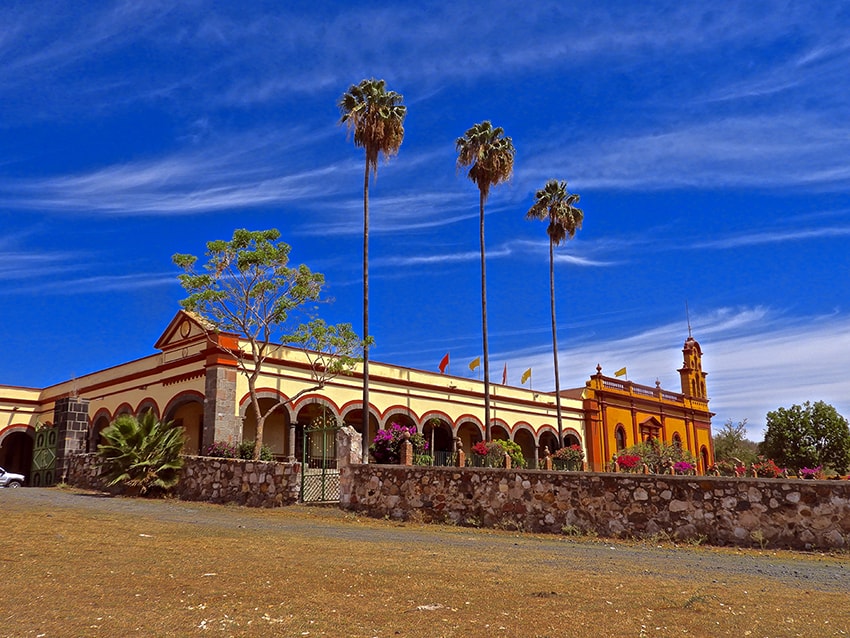
Parts of the award-winning TV series “Pancho Villa the Centaur of the North” were filmed here at the Hacienda of San José de Gracia in Michoacán. (Photo Jim Cook)

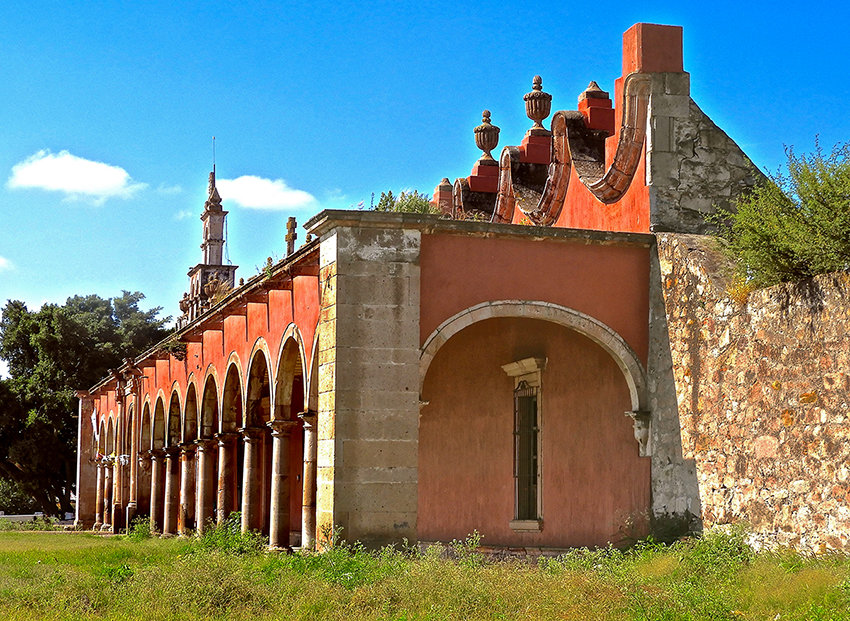
Haciendas, whether in ruins or restored, inevitably have fascinating stories to tell, but many of them are hidden away, sometimes in the most unexpected places.

How do you find them? And once you have located one, how do you get inside?

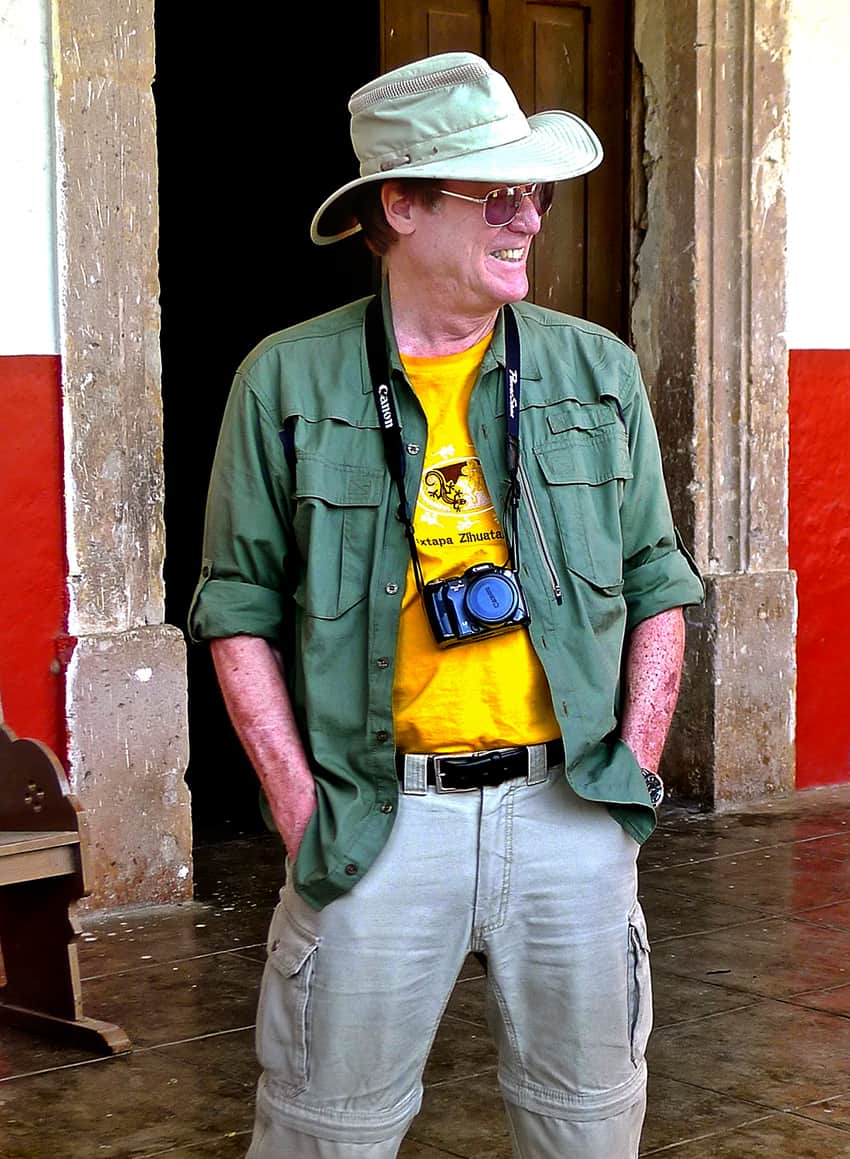
Cook is seen at Hda. La Sauceda in the Ameca Valley of Jalisco.

To answer these questions I sat down with Jim Cook, co-author of the blog “Jim and Carole’s Mexican Adventure” and long-time leader of a group of explorers unofficially known as the Hacienda Hunters, based in the Lake Chapala area but ready to track down haciendas wherever they may be found. 

Like many foreigners living around Lake Chapala, Cook and his wife Carole started exploring the area guided by Tony Burton’s book “Western Mexico: a Traveler’s Treasury.” Here are some of the recommendations. 

Use my bathroom

One of the sites recommended by Burton is the plaza of San Isidro Mazatepec, located 45 kilometers northwest of Chapala, where visitors can see the entrance to the well-preserved casa grande (main house) of what was once a hacienda.

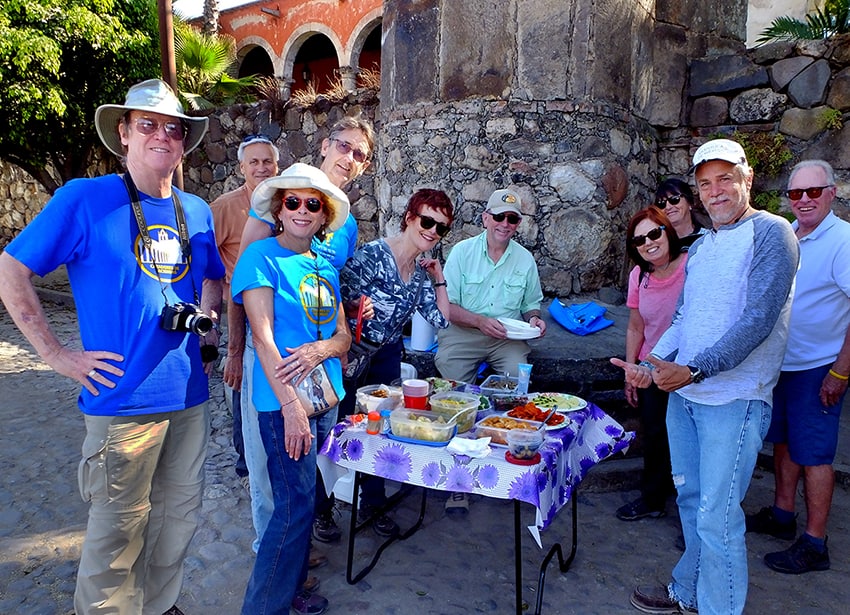
The Hacienda Hunters take a snack break near little-known, seldom-visited Hacienda Providencia, one of the first commercial producers of tequila in the 18th century, located 50 kms west of Guadalajara. (Jim Cook)

“We were in the plaza,” Cook told me, “and one party member needed to find a restroom. So she went to a peanut seller in the plaza and asked if any public restrooms were nearby. Then a young man buying peanuts said, ‘Why don’t you come with me? You can use the bathroom in my house,’ and he pointed to the casa grande. and she said, ‘No, I can’t do that because I’ve got my friends with me here.’ And the young man replied, ‘Bring them all along!’”

Guests of honor

Cook and friends trooped up to the beautifully preserved casa grande and minutes later sat in the courtyard sipping wine, with the young man translating between them and his mother.

“There we were,” said Cook, “when all of a sudden the big door swings open and a whole mob of relatives visiting from Houston come in… and now we’re in the middle of a big family reunion party with us as the guests of honor!”

When Cook and friends tried to leave, the mother said, “You’ve got to come back and stay with us a while. We have all kinds of bedrooms here.”

This, says Cook, “was my first introduction to that famous Mexicanism: mi casa es su casa and things have gone pretty much the same way on all the hacienda hunts we have been on since.” 

According to the Cooks’ blog, Hacienda San Sebastian, in Jalisco, was built in the 17th Century, and at its peak, in the early 20th Century, possessed almost 65,000 acres. Today it is still functioning as a farm. (Photo Jim Cook)

How to spot a hacienda

After this experience, the group began looking for more haciendas.

“There is surprisingly little information out there,” said Cook, “but I eventually understood that almost every little pueblo you find was—in the past— a hacienda. Of course, they were broken up after the Revolution when the land was redistributed. So the casa grande and the subsidiary buildings are now repurposed. The chapel, for example, maybe the community church and the casa grande may now be City Hall or a community center. So when you understand this, you can easily spot them. Another thing you can keep an eye out for is a double row of palm trees in a straight line. They will mark the main drive to the former hacienda.”

Since many of these pueblos are at the end of rough brechas (dirt roads), Cook started looking for people with four-wheel-drive, high-clearance vehicles to recruit as Hacienda Hunters.

“After a while,” he told me, “I had a group of people who were hacienda addicts, just as I was. We usually had three drivers of four-wheel drive vehicles, each with three passengers. I learned after a while that a caravan of more than three vehicles is too complicated. and with more than four people in a car for an all-day adventure, it gets a little tight.”

Once an expedition is lined up, Cook looks for information on the hacienda they want to visit.

The Hacienda de Santa Ana Pacueco in Guanajuato dates back to 1544. Eventually it became the core of a latifundia (collection of haciendas) that eventually became the largest in western Mexico. Read all about it on the Cooks’ blog. (Photo Jim Cook)

“Sometimes there’s a lot and sometimes there’s nothing at all. Once or twice I’ve run into haciendas whose names I never found out. Hacienda hunting requires a lot of research.”

Getting inside

Getting inside the hacienda is usually easy if the owner is there, Cook told me. “Virtually all of them are very proud of their hacienda and they know something of its history. so they immediately invite us in and take us around. If there’s only a caretaker present, it’s a little trickier because the caretaker is there to stop you. But even the caretakers will sometimes say, ‘These people look all right, so I’ll just let them walk around.’” 

Jim and Carole’s Mexican Adventure – which has had more than one million page views from people living in 130 countries – includes well-researched descriptions and gorgeous photos of 35 haciendas, perhaps enough to turn you, too, into a hacienda addict. Even more dangerous may be the comments in italics sprinkled throughout each blog, relating what you see among the ruins to the bigger picture of Mexico in days gone by. 

The Cooks’ description of the Hacienda in Mazatepec, for example, might put you at risk of becoming a historian:

Slavery for all practical purposes

“Under the encomienda system set up by the conquistadors with Crown approval, the indigenous people in an area became, for all practical purposes, the slaves of the  hacendados. In theory, this system involved an exchange: protection from hostile tribes by the Spanish owner in return for required labor. Of course, nobody bothered to ask the indigenous people if they agreed to such an exchange. Those who resisted faced extreme punishment including death. By the end of the 17th Century, 500 such ‘protected workers’ labored to produce the wheat that was then the primary product of Hacienda San Isidro Mazatepec.”

And then, there are Cook’s insights. Here’s an example from the blog posting on the Mazatepec Hacienda:

Life in the slow lane

“Oscar seemed to have a special affection for this horse. He spoke quietly as he stroked this beauty. I was curious about Oscar and his family and asked him why they lived in Houston rather than Mexico. ‘It is for the children,’ he answered. ‘Things up north move much more quickly, and that is good for them.’ I considered this for a few moments, then responded. ‘I moved down here for just the opposite reason. Things move much more slowly here, and I like that.'”

Yes, hacienda hunting may be dangerous. It might turn you not only into a historian but also a philosopher.

The writer has lived near Guadalajara, Jalisco, for more than 30 years and is the author of A Guide to West Mexico’s Guachimontones and Surrounding Area and co-author of Outdoors in Western Mexico. More of his writing can be found on his website.

The Spanish you need to keep your health routine in Mexico

0
Don't lose your healthy routine while vacationing in Mexico. (Freepik)

In a world that’s constantly on the move, maintaining a daily routine can be a challenge, especially when it comes to Mexico during the holiday season. For many of us, routines serve as pillars of stability, providing a sense of normalcy amid the chaos of travel. However, resisting the festive dishes prepared by your grandmother, mother, or someone who cares about you can be challenging. At the same time, we all work throughout the year to maintain our health and appearance, and it’s stressful to feel that we jeopardize everything during the holiday season.

So, I’ll share my approach if you’d like some tips on managing your routine without feeling guilty and completely avoiding the delicious dishes.

I’ve been starting my mornings for a while now with a routine that has contributed to my well-being. I start my days with a glass of celery juice, a habit I’ve incorporated into my life in recent years. It aids digestion, reduces inflammation and detoxifies the body —always handy after having too many tamales. 

An easier alternative is green juice, which you can get at any establishment in Mexico that serves breakfast. Or a glass of water with lemon juice, which t serves as a hydrating and alkalizing elixir, jumpstarting the metabolism and boosting immune function. Follow this mix with a meditation and stretching session, setting a positive tone for the day ahead while calming your nerves after listening to your uncle’s story for the tenth time. Doing this is feasible in Mexico or wherever you may be. 

Each component of this routine contributes to overall happiness and well-being. However, the challenge arises when the familiarity of home is traded for the excitement of holiday travel. During Christmas –  especially in Mexico, between posadas, tamales, buñuelos, piñatas, ponche and all the goodies that define the season – it’s not as easy to stick to your established routine. The holidays become a delicate balance between savoring the joy of festive gatherings and staying true to the rituals that fuel your body. 

The secret lies in adapting. While it may be impractical to replicate the exact routine on the road, incorporating elements of it can be a realistic compromise. Next time you go get breakfast get a green juice (¿me puede traer un jugo verde?, por favor… ¿qué lleva?, disculpe). While grabbing some lunch or dinner with friends or family during your travels, instead of getting a super sweet lemonade, try asking for a glass of water and a lime on the side (¿me puede traer un vaso de agua con un limón aparte, por favor?) and drink it before you put any food in your stomach. On the other hand, if it’s hard to get some alone time, embrace the local surroundings for meditation and stretching, turning it into an outdoor adventure or a quiet moment by taking it all in.

The holidays are a time of celebration and connection; stressing over a disrupted routine can overshadow the joy of the season. Find a balance that works for you, allowing flexibility while still prioritizing your well-being. After all, the essence of the holiday spirit is the gift of presence – being fully engaged in the moment, whether with loved ones or savoring your mom’s homemade dishes.

Paulina Gerez is a translator-interpreter, content creator, and founder of Crack The Code, a series of online courses focused on languages. Through her social media, she helps people see learning a language from another perspective through her fun experiences. Instagram: paulinagerezm / Tiktok: paugerez3 / YT: paulina gerez 

Aguascalientes Congress decriminalizes abortion within first 12 weeks

0
Campaigners in Aguascalientes celebrated the result of the vote, as Aguascalientes passed legislation to legalize abortion up to 12 weeks. (Angie Contreras/X)

The state of Aguascalientes has legalized abortion within the first 12 weeks, in compliance with Mexico’s Supreme Court (SCJN) ruling to decriminalize abortion at the federal level.

The law will come into effect upon its publication in the official state gazette, announced deputy Jaime González de León from the National Action Party (PAN).

The legislation was passed in Aguascalientes state congress, during a secret ballot. (Gonzalo Kinich Fernández/X)

The legislative vote took place in a secret session on Thursday, so the margin in favor of the resolution is unclear.

“Ultimately, what we know is that once the votes were counted, we complied with the Nation’s Supreme Court of Justice to decriminalize abortion,” Gonzáles de León told reporters after the vote.

Unofficial sources reported that the session resulted in 20 votes in favor and seven against. Six of the votes in favor came from deputies from the PAN party and one from the Institutional Revolutionary Party (PRI).

In August, the Mexican Supreme Court approved an injunction against the legislature of Aguascalientes, ordering it to decriminalize abortion in response to lawsuits filed by reproductive rights groups. In September, the court followed up by declaring that abortion could no longer be considered a crime at the federal level, a ruling that built upon a similar case involving the Coahuila state government in 2021.

While the Supreme Court determined first-trimester abortion was legal at a federal level, many states are yet to bring their laws into compliance. Coahuila and Aguascalientes amended their laws in response to direct orders from the Supreme Court, while Mexico City, Baja California Sur, Guerrero, Veracruz, Colima, Hidalgo, Sinaloa and Quintana Roo brought their laws into compliance voluntarily or legalized abortion before the Supreme Court ruling.

“This situation was something we had to address before Dec. 31 because if we didn’t, we would fall into contempt, and [the Supreme Court] could have even sent us to jail,” González de León said.

With this decision, Aguascalientes becomes the 12th state to decriminalize abortion in Mexico and its public health system must provide this service to anyone who requires it.

According to Supreme Court Justice Juan Luis González Alcántara, authorities in Aguascalientes opened 73 criminal abortion investigations between 2015 and June 2023.

With reports by Expansión and La Jornada Maya

Tourist in Ixtapa dies after attack by marine animal

3
A beach with police and a body bag, cordoned off
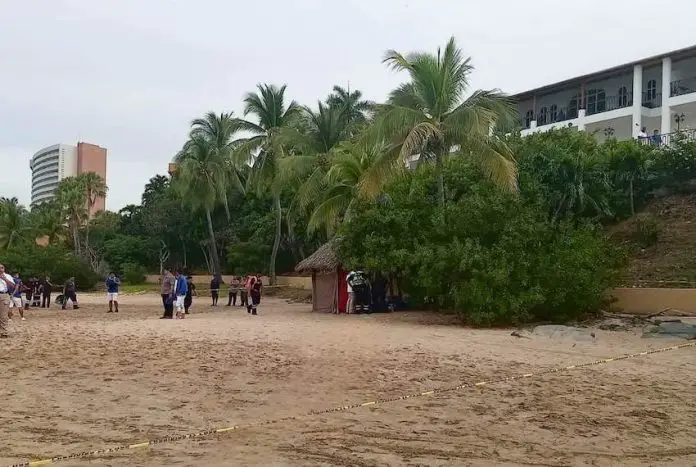
A Belgian tourist died earlier this month after a shark attack severed his femoral artery, according to a surviving victim of the same attack. (@RTG_Noticias/X)

An incident at a beach in Ixtapa, Guerrero, resulted in the death of a 76-year-old Belgian man after he was attacked by either a shark or a crocodile.

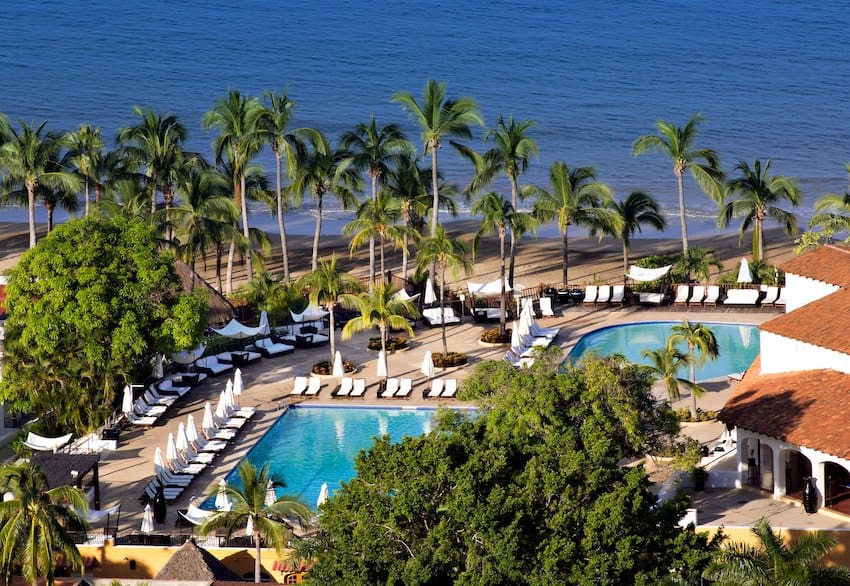
The attack occurred Wednesday morning at Quieta Beach, a public venue that doubles as the swimming area for Club Med’s Ixtapa Pacific resort. The beach is located in Ixtapa’s second hotel zone, about 6½ km from central Ixtapa and 9 km from the neighboring tourist destination of Zihuatanejo.

The tourist who died had been staying at the Club Med Ixtapa Pacific resort. (Club Med)

The victim was named as Joseph Bynens, who reportedly had one of his legs bitten off and succumbed to his wounds after receiving on-site medical aid from the Mexican Red Cross.

Originally it was reported that Bynens was from Canada, but Tourism Minister Miguel Torruco Marqués said he was a Belgian national who was staying at Club Med.

According to several reports, the attack occurred at about 9:15 a.m., just minutes after Valerie Haurowitz, 52, from Los Angeles, California, was similarly attacked. She was reportedly in stable condition on Thursday.

Authorities haven’t been able to confirm whether the attacks were by a shark or crocodile. Using drones and other methods, Civil Protection workers and the Navy tried to locate the culprit.

The vicinity of Quieta Beach includes a crocodile farm, prompting reinforced security measures.

Tourists were previously alerted to a crocodile’s presence at Palmar Beach in central Ixtapa, and visitors to nearby La Ropa Beach recently reported seeing either a crocodile (but maybe a shark) in Zihuatanejo Bay.

Shark attacks are nothing new in the area, having been reported on several beaches in the Costa Grande region along Guerrero’s Pacific Coast. In 2019, an American tourist was the victim of an attack in Troncones, just north of Zihuatanejo, and in 2008, a series of attacks in the region claimed the lives of one tourist and one local.

Marine biologists suspect it’s highly probable that Bynens was attacked by a crocodile, said Zihuatanejo Mayor Jorge Sánchez Alec. Sánchez added that a bacteriological analysis of the bites will allow a more comprehensive conclusion to be reported on Friday.

The attacks come 10 days after a 26-year-old woman died after a shark attack in Melaque, Jalisco. 

Quieta Beach was closed after Wednesday’s tragedy. Purple flags were placed to indicate the presence of dangerous marine fauna.

“The safety of beachgoers is our utmost priority,” Torruco said. The minister added that the beach will remain “closed until we have reports on the area.”

With reports from Milenio, Infobae, Quadratin and EFE

President López Obrador inaugurates first 3 sections of Maya Train

8
A teal train leaves a station
The Maya Train leaves behind a burst of confetti as it leaves Campeche station for its maiden voyage. (LopezObrador.org.mx)

The Campeche-Cancún stretch of the Maya Train railroad officially opened on Friday, 3 1/2 years after construction of the government infrastructure project began.

President López Obrador inaugurated sections 2,3 and 4 of the 1,554-kilometer-long railroad at a press conference in Campeche city on Friday morning.

President Lopez Obrador inaugurates first sections of Maya Train
The president held his morning press conference in Campeche on Friday. (Lopezobrador.org.mx)

“We’re very pleased to be here with you in Campeche on this truly historic day because we’re inaugurating this stretch [of railroad] from Campeche to Cancún,” he said.

The multi-billion-dollar railroad “is a project for the people of Mexico and that’s why we’re all going to take care of it,” said López Obrador, who has traveled frequently to the southeast of the country to inspect construction progress.

“It’s a project for all Mexicans … [and will] greatly help the development of the southeast,” he said.

At the conclusion of the press conference, the president, National Defense Minister Luis Cresencio Sandoval and Campeche Governor Layda Sansores unveiled an inauguration plaque.

A map of the route and stations of the Maya Train
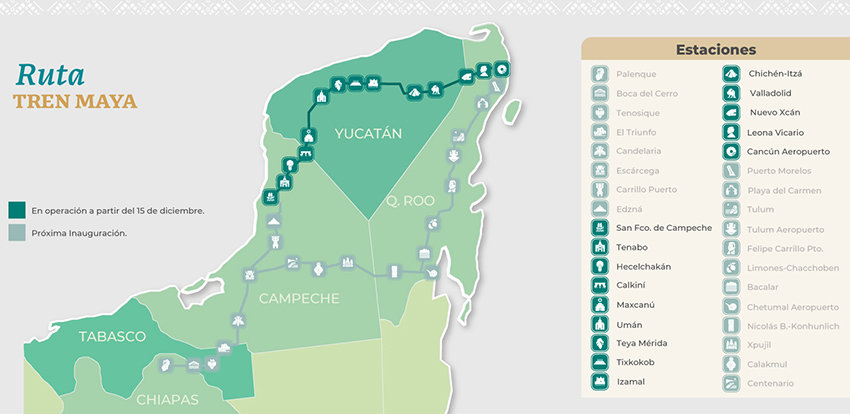
The route and stations of the Maya Train. (Tren Maya)

López Obrador and other officials later boarded the Maya Train for the five-to-six hour, 473-kilometer trip to the Cancún Airport station. The first trip on which ordinary paying passengers will be on board will depart Campeche for Cancún on Saturday morning.

Among the 14 stations located along the three sections inaugurated on Friday is one near Yucatán state capital Mérida (in a locality called Teya) and another close to the Chichén Itzá archaeological site. There are also stations in the colonial cities of Izamal and Valladolid, both in Yucatán.

Built by private companies and the Mexican army, the railroad has a total of seven sections and 34 stations (including modest ones known as paraderos, or stops).

López Obrador said last month that the stretch between Cancún and Palenque, Chiapas, will open on Dec. 31, while the entire railroad and its 34 stations will be operational on Feb. 29, 2024.

An overhead shot of under-construction stop of the Maya Train, surrounded by rainforest.
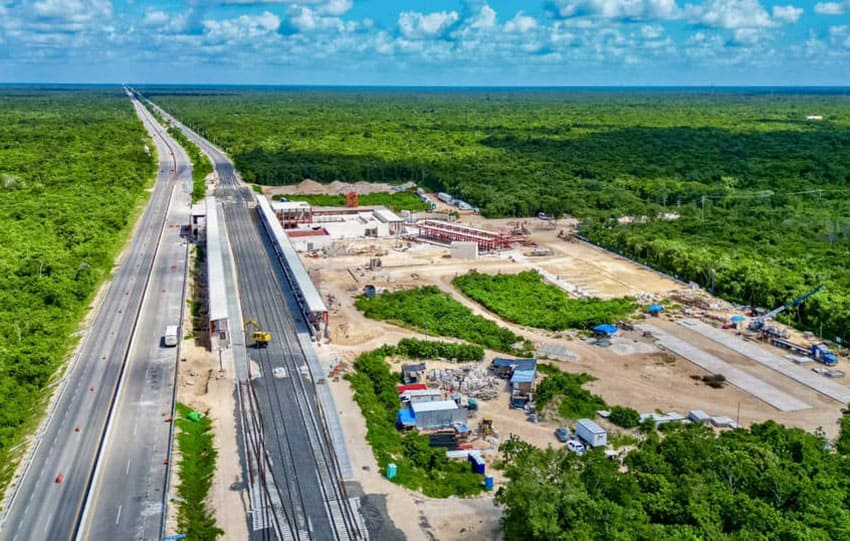
The project has faced opposition from environmentalists over the environmental cost to Yucatán peninsula ecosystems and hydrology.(Facebook @MaraLezamaOficial)

The president inaugurated construction of the railroad in June 2020, and pledged at the time that it would be finished in 28 months, or by October 2022.

However, the project has faced a range of challenges, including court rulings that have temporarily halted work and ardent opposition from environmental groups, which say that the construction and operation of the railroad pose a threat to wildlife, subterranean rivers and the Maya jungle.

A collective of groups representing Maya communities said before construction of the railroad began that there was “nothing Maya about it.

Although the project has taken longer than he initially anticipated, López Obrador declared on Friday that the still-incomplete railroad had been built in “record time,” and reiterated his belief that it is the most important public work currently under development anywhere in the world.

He said that around 100,000 workers from all over Mexico contributed to the construction of the railroad, which, once fully operational, will connect cities and towns in five states: Tabasco, Campeche, Yucatán, Quintana Roo and Chiapas.

With reports from El Financiero and López-Dóriga Digital

Nuevo León approves US $153M towards incentives for Tesla

0
Infrastructure projects and land use permits have already been cleared for Mexico's first Tesla "gigafactory." (@tesla_adri/X)

The government of Nuevo León has agreed to spend US $153 million on incentives to facilitate the set-up of Tesla’s electric vehicle “gigafactory” near Monterrey.

These incentives include electricity, water and transport infrastructure, and a reduction in Tesla’s payroll tax, to encourage job creation.

A rendering of Tesla’s planned “gigafactory” in Nuevo León. (Tesla)

Tesla CEO Elon Musk first announced the gigafactory in March, with an investment of at least US $5 billion. In October, Musk said Tesla hoped to start construction in 2024, but was not ready to go “full tilt” due to global economic conditions. He also asked the Nuevo León government to start infrastructure projects in support of the factory, including a rail link, a water treatment plant and the widening of four highways.

Nuevo León Governor Samuel García confirmed that the state had agreed to provide this infrastructure, but said that it first had to be authorized by an unspecified “committee.” Now, it seems, the Economic Development Council has granted that authorization.

The announcement comes days after the federal Environment Ministry (Semarnat) issued permits approving the change of land use for the factory. Tesla is still awaiting water and energy permits. Although Nuevo León is a severely water-stressed region, Tesla has made several commitments to mitigate the factory’s impact, including the use of recycled water.

Nevertheless, economic and bureaucratic obstacles have slowed the set-up process. Musk has said that initial production of Tesla’s next-generation electric vehicle will start at its Texas factory, as the Mexico one won’t be ready in time. Although no opening date has been announced, the Mexico plant is unlikely to be operational until 2026.

The Nuevo León government is eager to accelerate construction on the factory, which local authorities said in March would employ up to 6,000 people. In September, García said that Tesla and its suppliers would invest US $15 billion in the project – triple the original estimate and far surpassing the $4.5 billion planned for the first phase.

The state’s economy minister, Iván Rivas, has also assured that the plant will be crucial in boosting Nuevo León’s development.

“[Tesla’s] Nevada gigafactory generated an economic spillover 28 times greater than public investment, while in California, 120 jobs were created in the supply chain for every 100 Tesla jobs,” he said. “In this way, in Nuevo León there would be 12,000 new direct jobs related to Tesla, [representing] almost 15% of the jobs created each year in the state.”

Besides the actual Tesla factory, the Nuevo León government said that more than 30 Tesla suppliers are looking to set up in the state. García has claimed that “Tesla’s arrival confirms Nuevo León as the next regional hub for electromobility in Latin America,” taking advantage of its position on the United States border to reap the benefits of the nearshoring trend.

With reports from Forbes and Bloomberg Línea