Home Blog Page 905

Find 5 of Mexico’s best outdoor experiences in 1 of its biggest cities

0
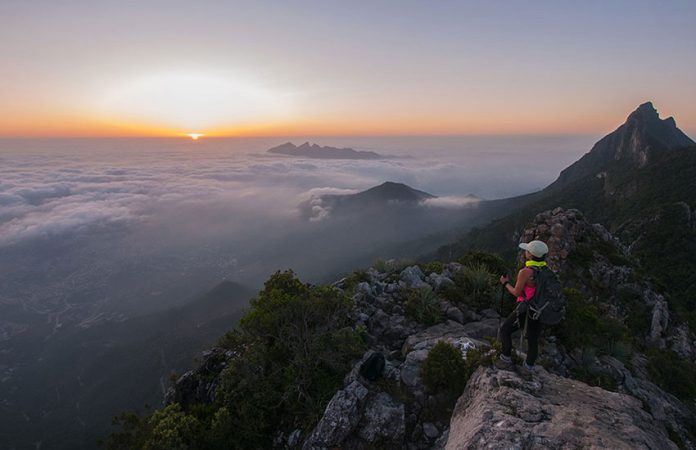
Chipinque Park
View of Monterrey from the top of Chipinque Park. (Photo: Bakpak Revista de Aventura)

The city of Monterrey, one of Mexico’s largest, is nestled in the foothills of the Sierra Madre Oriental mountain range, surrounded by soaring peaks, knife-blade ridges and countless hiking trails. It’s no misnomer that the city’s name means “King of the Mountains” in Spanish. 

As for the “king” of Monterrey’s hiking clubs, I’d say that honor goes to an organization known as the La Comunidad Bakpak, which sprang into existence, along with the first publication of Bakpak Revista de Aventura (Bakpak Magazine), in 2005.

I asked the leader of Bakpak Community, Alejandro González, to describe five great hiking destinations that people could reach from his hometown.
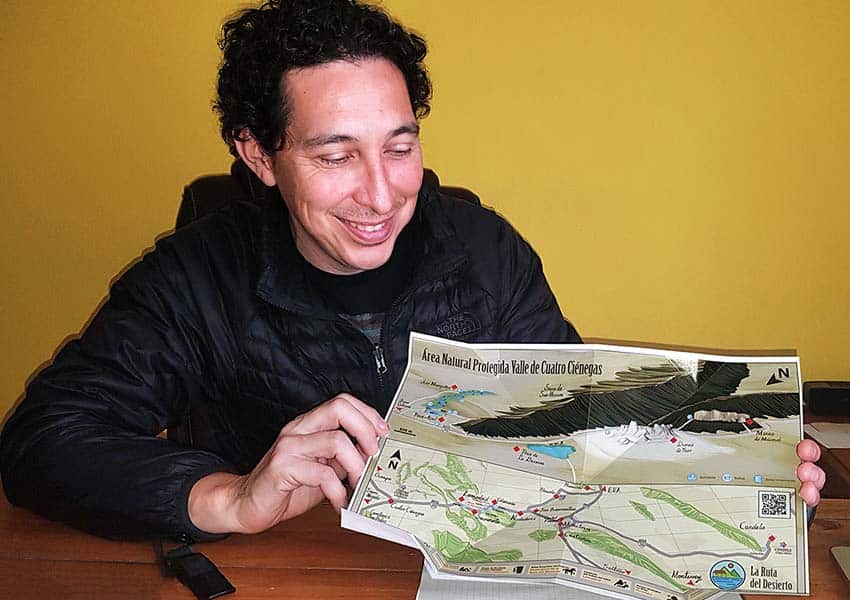
Alejandro González
Cartographer, publisher and outdoor enthusiast Alejandro González with one of his maps, folded origami style.

“I’ll do better than that,” he replied with a smile. “I’ll tell you about five excellent hikes you can do without leaving Monterrey’s city limits.”

Cerro de la Silla (Saddle Mountain)

“This is probably the favorite hike of the people of Monterrey,” said González, “and the Cerro de la Silla is definitely the iconic symbol of the city. People like to hike up to The Saddle in the morning or in the evening along a trail called La Brecha de la Virgen (Trail of the Virgin), and you will in fact find several little shrines [to her] along the way.”

I learned that Saddle Mountain has two famous landmarks. The first is called El Teleférico. It was a 3.3-kilometer cable car system inaugurated in 1961 and closed in 1964 after two tragic accidents.

“A hike from the city streets up to this point would be suitable for beginners and might take one hour,” González said. “From here, you can see just about all of Monterrey. This is also a great place to enjoy a magnificent sunset over the town, should you decide to do the hike in the late afternoon.”

From the Teleférico, the trail goes on to the second landmark of Saddle Mountain: the summit, which is another impressive lookout point from which you have a 360-degree view of the city. 
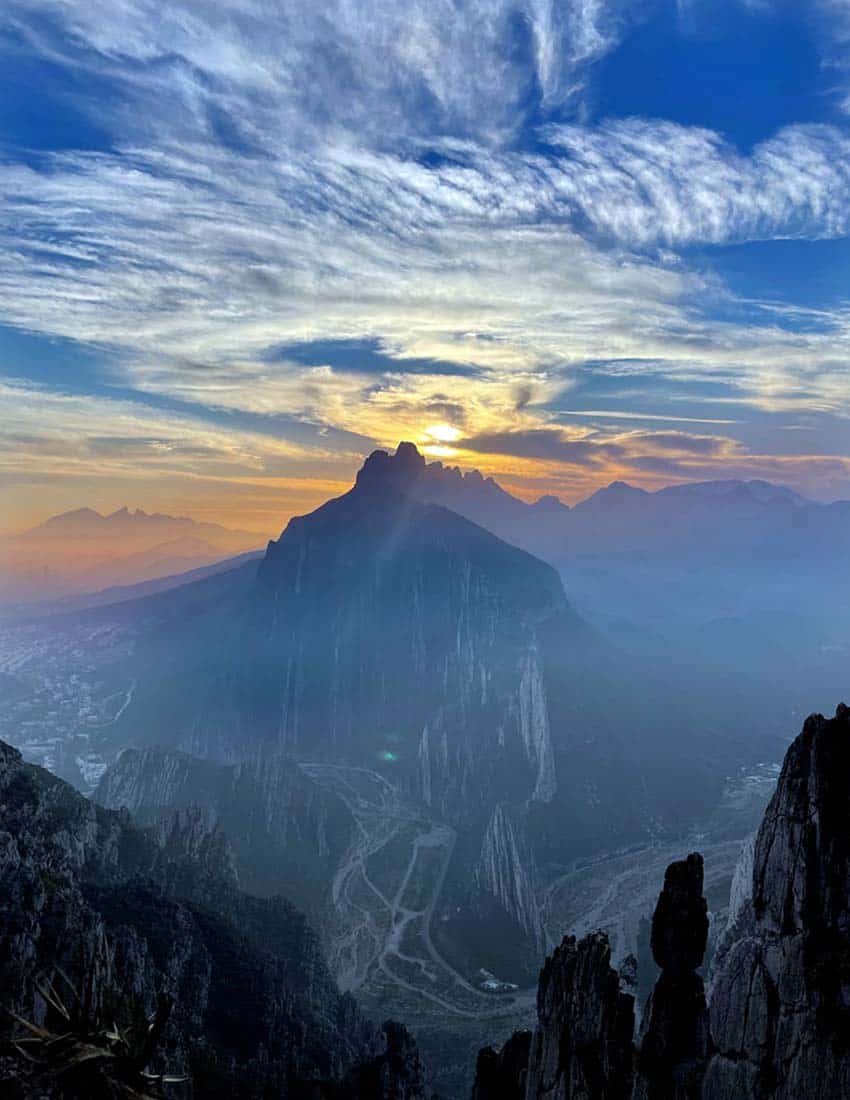
La Huasteca Ecopark in Monterrey, Mexico
The dramatic limestone mountains of La Huasteca Eco Park. (Photo: Zanna Van Dijk)

This part of the hike, says González, is for experienced people, and you may need another 90 minutes to hoof it from the Teleférico to the peak.

Chipinque Ecological Park

This is a luxuriant pine and oak forest that was developed into a recreational area by private companies. The result is one of Mexico’s most beautiful and best-organized parks, with over 60 kilometers of trails. It’s set up very much like the national parks in the United States, complete with rangers.

Chipinque is, first of all, a nature reserve. It is especially famous for its great variety of butterflies, but here you will find everything from white-tailed deer and gray foxes to pumas and even black bears. If you are lucky, you might also glimpse the Mexican coati, an omnivorous member of the raccoon family. 

As for birds, in Chipinque you can see wild turkeys, mountain pygmy owls, red-tailed hawks and blue-capped motmots.

According to González, among Comunidad Bakpak’s most popular activities in Monterrey is their Night Trail Run under the Autumn Moon, which they organize in Chipinque Park. 
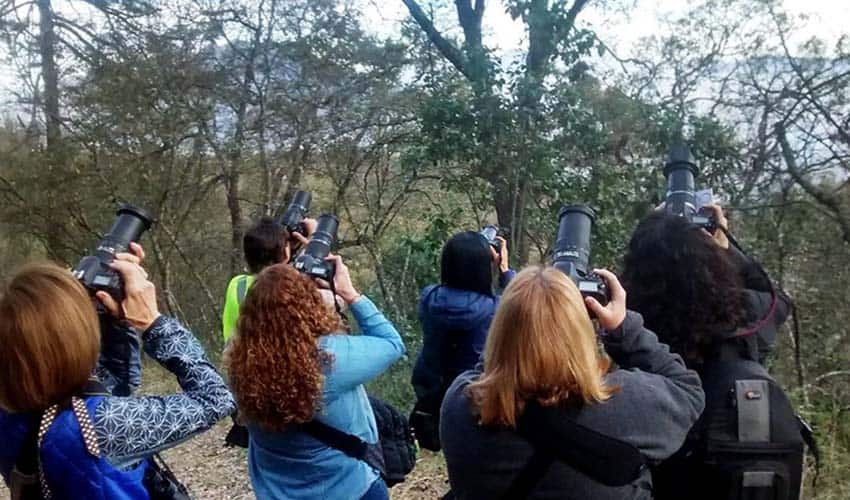
Birdwatching at Monterrey, Mexico's Chipinque Ecological Park
Monterrey’s Chipinque Ecological Park is a favorite haunt of birdwatchers.

“This is directed at helping people experience nature through their five senses, to gain new awareness,” he said.

Because El Chipinque is located 15 kilometers from downtown Monterrey, people can do either day or night hikes, soak up the good vibrations and then go back home to sleep in their beds.

La Huasteca Ecopark

La Huasteca is a municipal park whose entrance is located only 20 minutes from downtown Monterrey. This is a massive canyon with long, thin, high limestone mountains running along both sides like giant knife blades: a sight that boggles the mind.

The park is a paradise for rock and mountain climbers, with nearly 400 bolted routes.

“La Huasteca is a place of silence and solitude,” González said. “In this park, you have lots of choices both for climbing and for hiking — in fact, even for trekking. Here you can go walking for 80 kilometers, if you want to!”
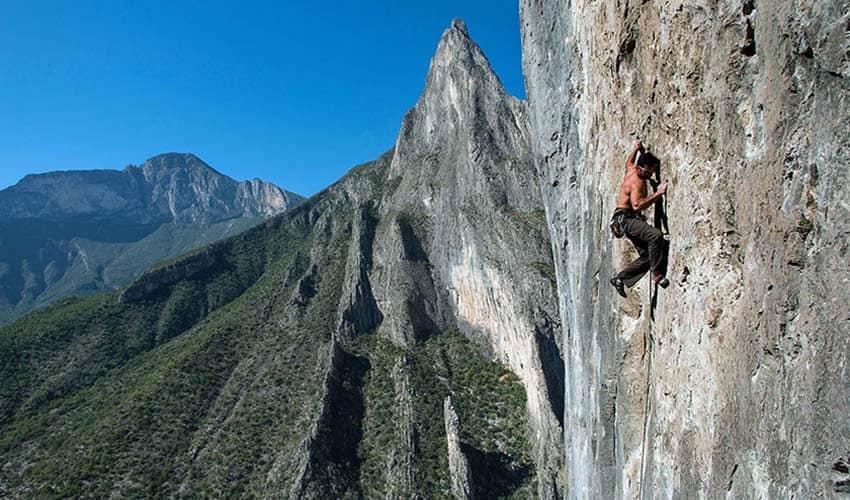
El Potrero Chico rockface, near Monterrey, Mexico
El Potrero Chico, one of the world’s premier big-wall sport climbing destinations, is just a one-hour drive from downtown Monterrey. (Photo: Marriott Bonvoy)

El Santiago

This is a Pueblo Mágico (Magical Town) located inside the city limits of Monterrey, just a 20-minute drive from downtown. From Santiago, you can visit a lovely waterfall called Cola de Caballo. 

It’s a 40-minute walk from town to waterfall, but note that you’ll be walking through a very touristy area.

If you’re more in the market for high adventure, note that Santiago just happens to be the portal to several gorgeous canyons: San Cristóbal, Chipitín, Matacanes and Hidrofobia

These attract canyoneers from all over the world but require great technical skill and lots of experience.

“Whether you hike to the waterfall or rappel down a canyon,” says González, “you are bound to work up an appetite, and Santiago just happens to have lots of great places to eat. Here you can experience the cuisine of northern Mexico. For example, machaca — in Santiago, you will find the original, the real thing.”
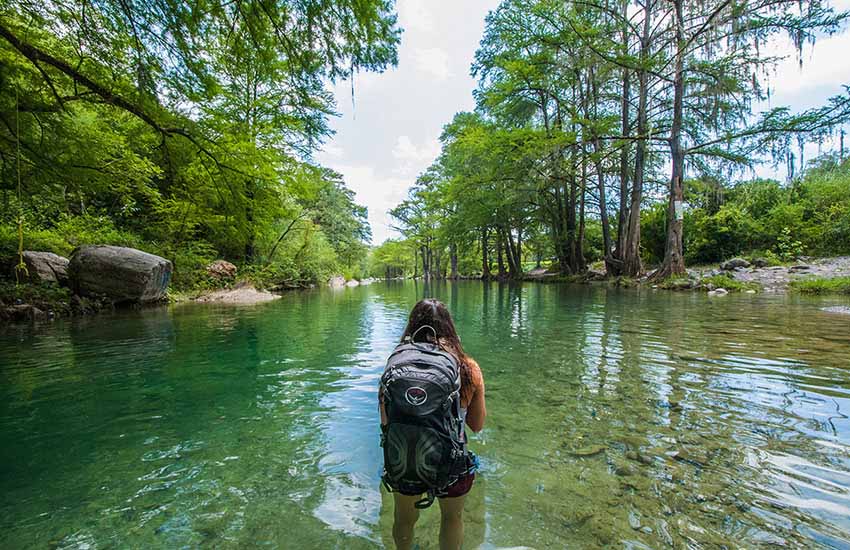
Rio Ramos in Nuevo Leon, Mexico
While hiking along the Río Ramos you can take a dip in its crystalline waters, in the shade of venerable Montezuma cypresses. (Photo: Bakpak Revista de Aventura)

El Río Ramos 

“This is a forest of sabinos, or Montezuma cypresses, along a river,” says González. “The walk takes you to the town of Cozumelito, and along the way we find turquoise blue pools of water. Here you can swim in perfectly clean water and you could hike for as many as 16 kilometers.”

González recommends reaching Río Ramos very early in the morning — especially in the summer — “when you will find the water crystal-clear and you can hear the birds singing.”

If you’re heading for Monterrey and want to experience nature while you’re there, you can contact the Bakpak Community through their website or their Facebook page.

The writer has lived near Guadalajara, Jalisco, since 1985. His most recent book is Outdoors in Western Mexico, Volume Three. More of his writing can be found on his blog.

Land dispute means more delays for the Oaxaca-Puerto Escondido highway

0
An unfinished stretch of the much-anticipated highway from Oaxaca city to Puerto Escondido.
An unfinished stretch of the much-anticipated highway from Oaxaca city to Puerto Escondido. (Twitter @lopezobrador_)

The completion of a new highway in the state of Oaxaca — from the inland city of Oaxaca to the state’s beachside tourist areas on the Pacific Coast — is being held up by residents of two communities who have set up a blockade.

“There are 15 km left to finish this work, however, an old agrarian conflict between Sola de Vega and San Vicente Coatlán is at stake,” President López Obrador tweeted earlier this week. “We made a good proposal to the towns,” he added.

In his morning press conference on Monday, the president said that a dialogue is being held with representatives of the two highlands communities, and that he had met personally with both sides a day earlier.

“If there is no agreement in a month, we will make a new route — a bypass,” he said.

The project has been fraught with problems for some 20 years, especially since the original contract was awarded in 2009. Five years later, that concessionaire ceded the rights to the project to another company; then in 2016, the project was about halfway done when it suspended and passed to the National Infrastructure Fund (Fonadin).

An original completion target of July 2015 now seems like a bad joke — though as recently as last August, officials were expecting the highway to open by the end of 2022.

The project is a two-lane highway measuring 12 meters wide, stretching roughly 102 kilometers (64 miles) and supplanting what for years has been a treacherous mountain road, Highway 131. It is said that the new highway will slash travel time from the capital city of Oaxaca to the coastal destinations of Bahías de Huatulco and Puerto Escondido from 6 to 8 hours down to 2 to 3 hours.

The 26-kilometer segment from Barranca Larga in the mountains to Ventanilla on the coast is what is holding things up. Ventanilla is where the highway will hit the coast — 17 kilometers from Puerto Escondido, 58 kilometers from Mazunte and 100 kilometers to Santa María Huatulco.

The “agrarian conflict between two localities” (San Vicente Coatlán and Villa Sola de Vega) “dates back 47 years and prevents work from continuing on [that] stretch,” according to Infobae.

On its official website in July 2022, the federal government’s National Institute of Indigenous Peoples (INPI) posted a statement about the conflict — a territorial dispute that has displaced some families and has previously left dead bodies in its wake.

The INPI statement noted that the peace process had experienced “advances” after a mandate by AMLO had brought Indigenous leaders to the bargaining table with municipal, state and federal representatives.

“Dialogue and conciliation are the way to achieve lasting peace,” it stated.

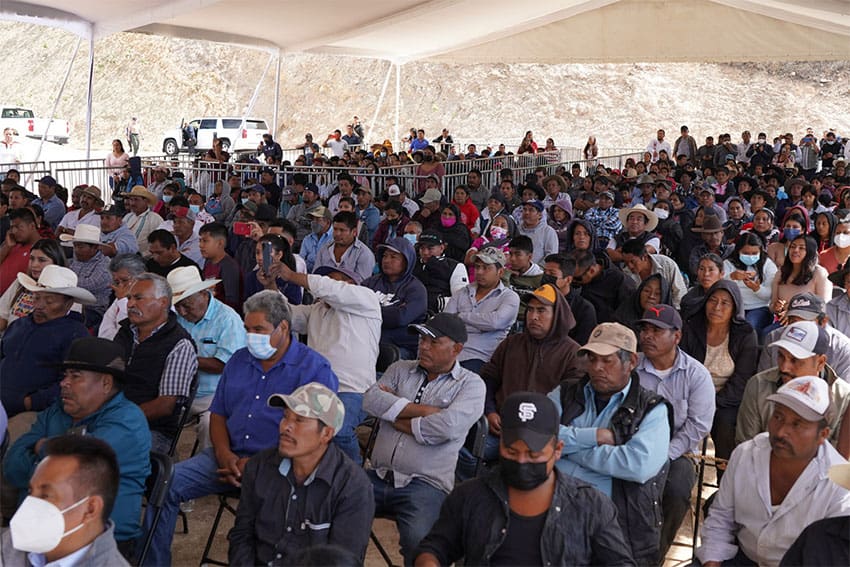
In a white shade tent with rocks visible outside, a crowd of people with serious expressions look toward the camera.
Residents of the communities gathered to listen to the president speak about the government’s proposed solution to the dispute, on Jan. 15. (Twitter @lopezobrador_)

The dispute revolves around land, the INPI statement said, noting that the local leaders had pledged to maintain peace and de-escalate the conflict zone while continuing talks.

The statement also pointed out that Adelfo Regino Montes, the INPI’s general director, spoke of a presidential proposal to provide financial compensation if the communities can halt their dispute.

In speaking about the conflict this week, AMLO recalled two famous phrases: “Nothing by force, everything by reason and law,” by Oaxacan-born Benito Juárez (Mexico’s president from 1858 to 1872) and “a problem that is avoided explodes” by the late Jesús Reyes Heroles (a prominent Mexican politician, jurist and academic in the 1960s through 1980s).

Overall, the highway is 87.5% complete, Oaxaca Governor Salomón Jara Cruz said after he and other government officials completed a tour of the Barranca Larga–Ventanilla section earlier this month. The full highway consists of 10 bridges, three tunnels and two toll booths, and is expected to be used by 4,253 vehicles per day.

The toll plaza at Barranca Larga was only 38% complete at the time of the governor’s tour. The plaza will include a National Guard base, a solar farm, an administration building and a control center.

On a recent airing of his television show “Jueves de Gozona,” Governor Jara said he anticipates the highway being completed within six months and that he will work with the groups that have shown resistance to its construction.

With reports from Infobae and El Universal Oaxaca

Once again, judge halts work on Maya Train section 5 over environmental permits

0
Construction workers use heavy machinery to smooth gravel, with forest in the background.
Maya Train construction workers on the section between Cancún and Tulum kept up the pace on Wednesday morning after a judge's order suspended work. (Elizabeth Ruiz / Cuartoscuro.com)

A judge has issued an order temporarily suspending works on section 5 of the Maya Train, which runs between Cancún and Tulum.

The First District Court of Mérida granted the injunction in response to environmentalists’ claims that the public-private megaproject, which aims to construct a 1,500-kilometer railroad around the Yucatán Peninsula, lacks authorization to change the use of forest lands.

“When changing the line of the train from the road to the jungle, they did it without investigations, without making the change of land-use,” explained José Urbina, a spokesperson for the activist group Sélvame del Tren. “… Article 97 of the Forest Law says that if you cut down a tree without authorization, you cannot touch the area for 20 years.”

He argued that the National Fund for Tourism Promotion (Fonatur) should use those 20 years to rethink the Maya Train project in a way that avoids damage to the jungle and underground aquifers.

The injunction was awarded on Tuesday but as of Wednesday, construction work on section 5 continued. Environmental groups called for their supporters on social media to spread the word about the existence of the injunction, and to pressure authorities to halt construction.

Section 5 of the train was initially planned to run through the center of Playa del Carmen, but its route was modified after local hotel owners complained about the impact on their businesses. Jungle has already been cleared to construct the new trackway, triggering protests by environmentalists and Indigenous groups.

The Maya Train speeds through the jungle, in an illustrative rendering by federal authorities.
The Maya Train speeds through the jungle in an illustrative rendering by federal authorities. (Fonatur)

Despite several previous injunctions, construction on section 5 continued through last year, after the government declared the line a matter of national security. In August, a federal judge rejected several outstanding legal challenges, giving the project a green light to continue.

Last month, President López Obrador attempted to appease critics by announcing plans to construct 72 kilometers (45 miles) of elevated trackway over the jungle. However, activists still object to the damage the supporting columns could do to the region’s cenotes, or sinkhole lakes.

“From today, any act that aims to continue logging or clearance in the aforementioned areas must be suspended or paralyzed so that the removal or destruction of the area’s flora is not permitted,” read a statement by the activist group Sélvame del Tren in response to the latest injunction.

The group called for locals to monitor activities on section 5 to ensure that construction crews comply with the suspension order.

With reports from Proceso and La Jornada Maya

US $200 million investment in lithium-ion battery production in Nuevo León

0
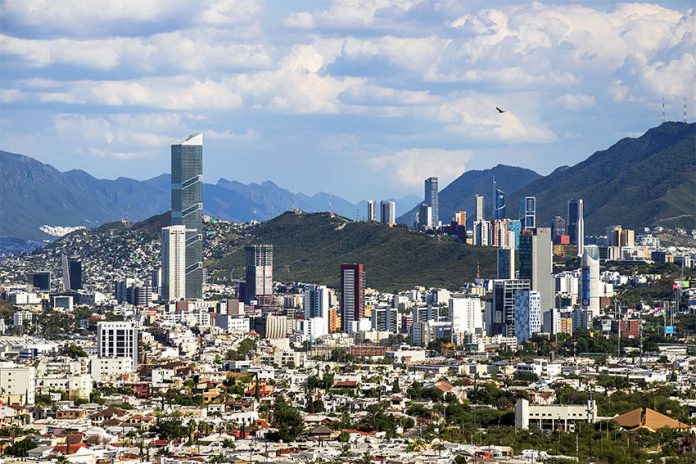
The skyline of Monterrey in Nuevo León.
The skyline of Monterrey in Nuevo León, home to the municipal area where citizens felt the least insecure in the country, according to INEGI data. (Daniel Escobedo CC BY-SA 4.0)

A Mexican affiliate of a U.S. company has announced a US $200 million investment to produce lithium-ion batteries in Nuevo León and distribute electric vehicles across the country.

Cenntro Automotive México, an importer and distributor for the New Jersey-based electric vehicle manufacturer Cenntro Electric Group, will make lithium-ion batteries at a plant in the OMA VYNMSA Aeroindustrial Park at the Monterrey International Airport.

Construction of the 10,436-square-meter state-of-the-art facility began last year, and it is expected to begin operations in the second quarter of 2023.

City Porter vehicle by Cenntro Automotive
Cenntro Electric Group manufacturers commercial electric vehicles targeted at governments and businesses. (Photo: courtesy)

Cenntro Automotive México president Andrés Lankenau said that the US $200 million investment will be spread over three years. The money will be spent on the battery manufacturing facility and to help the company expand its presence in Mexico, he said.

Lankenau also spoke about Cenntro Automotive México’s growing vehicle distribution business.

“Companies in Mexico are aware of the environment and committed to renewing their fleets with electric vehicles. Cenntro is quickly becoming the [leading] provider of the highest quality commercial vehicles … in Mexico,” he said.

Cenntro Electric Group makes and sells a range of small and large EVs that have been distributed to more than 20 countries around the world. Their vehicles are targeted for sale to businesses and governments.

Cenntro Automotive México could be joined in Nuevo León by Tesla, which is reportedly set to announce its first vehicle plant in Mexico this month.

The company’s CEO, Elon Musk, traveled to the northern border state last October and met with Governor Samuel García and other officials.

With reports from El Economista, Mexico Industry and Milenio

Morena supporters favor Ebrard over Sheinbaum for president in new poll

0
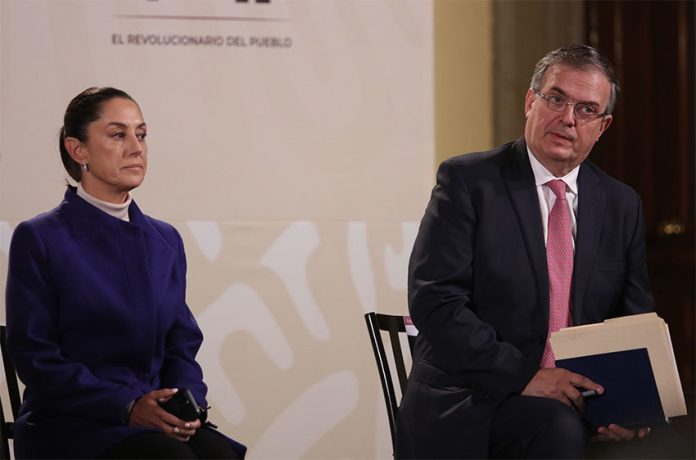
Mexico City Mayor Claudia Sheinbaum and Foreign Minister Marcelo Ebrard onstage at a recent press conference.
Mexico City Mayor Claudia Sheinbaum and Foreign Minister Marcelo Ebrard onstage at a recent press conference. (Andrea Murcia Monsivais / Cuartoscuro.com)

Mexico City Mayor Claudia Sheinbaum is no longer the favored successor to President López Obrador among supporters of the ruling Morena party, a new poll found.

The finding suggests that the recent fatal accident on the capital’s Metro system had a negative impact on the reputation of the mayor, who declared last October that she is ready to become Mexico’s first female president.

One-third (33%) of respondents who identified as Morena supporters in an El Financiero newspaper poll nominated Sheinbaum as their preferred candidate at the 2024 presidential election. That’s a decline of eight percentage points compared to the newspaper’s previous poll, which was conducted in December.

The most recent poll was conducted on Jan. 6, 7 and 11, meaning that the Line 3 Metro crash — in which one woman was killed and scores of people were injured — was likely at the forefront of the minds of at least some respondents.

The accident occurred on the morning of Jan. 7.

In the most recent poll, Foreign Affairs Minister Marcelo Ebrard is now the preferred Morena presidential candidate among Morena supporters, with 35% of such respondents nominating him as their first choice. That’s an uptick of one percentage point compared to El Financiero’s previous poll.

Interior Minister Adán Augusto López and Morena Senate leader Ricardo Monreal were nominated as the preferred candidates by 20% and 9% of respondents, respectively.

A selfie of the three politicians outdoors with trees and a multistory building in the background.
Ebrard takes a selfie with Sheinbaum and Interior Minister Adán Augusto López, at the fourth anniversary of the current administration in November. (Twitter @claudiashein)

The views of Morena supporters are especially important as the party will conduct its own survey to decide who its flag bearer will be at the 2024 presidential election.

Sheinbaum’s popularity among all 800 respondents to the El Financiero poll (including all political parties) also dropped, although she remained the preferred Morena presidential candidate. Exactly one-quarter of those polled nominated the mayor as their candidate of choice, a decline of five percentage points compared to the previous poll.

The preferences among all respondents increased for each of Ebrard, López and Monreal, but none made up enough ground to catch Sheinbaum. The foreign minister was two percentage points behind, with 23% of respondents choosing him as their preferred candidate.

The percentage of respondents who said they had a favorable opinion of the Mexico City mayor also dropped five percentage points to 41%. Despite that, Sheinbaum still garnered more favorable opinions than each of her Morena rivals.

Incidents on the capital’s Metro system have tarnished the administration of the mayor, who took office in late 2018. In addition to this month’s accident, an overpass collapse on Line 12 claimed the lives of 26 passengers in May 2021, while a police officer died in a fire in the subway system’s downtown substation in January of the same year.

A majority of respondents (56%) to a separate El Financiero poll conducted in the capital last week described the Mexico City government’s management of the Metro system as “bad” or “very bad.”

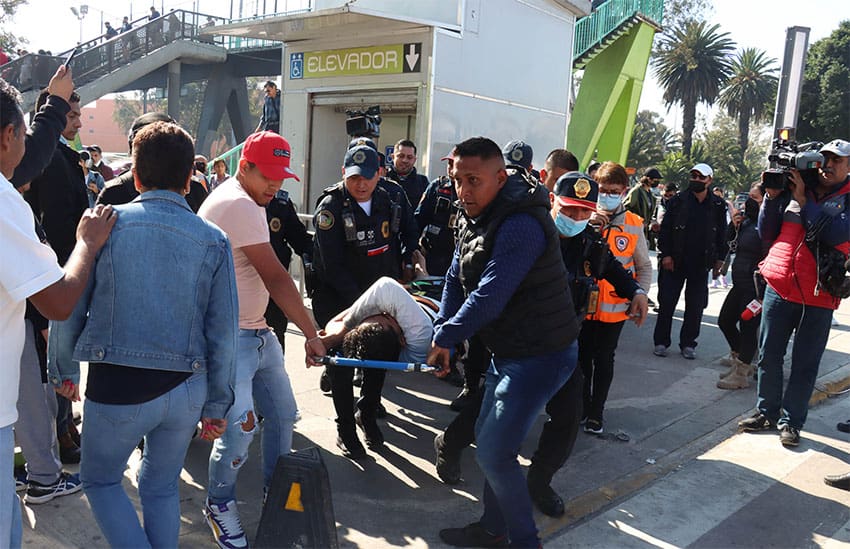
Emergency services push through a crowd to extract injured passengers from the crash on gurneys.
The crash on Metro Line 3 earlier this month injured dozens and killed one young woman. (Rogelio Morales Ponce / Cuartoscuro.com)

The Line 12 disaster is considered a threat to the presidential aspirations of both Sheinbaum and Ebrard — the latter was mayor of Mexico City when the line was built — but they have maintained their status as the leading Morena party contenders, and polls indicate that either would triumph if chosen to run at the 2024 election.

Among the possible opposition candidates, El Financiero’s poll found that former federal tourism minister Enrique de la Madrid is seen as the strongest presidential candidate for the three-party Va por México alliance, which confirmed last week that it would field a common candidate at next year’s election.

Just under one-quarter of respondents — 23% — nominated de la Madrid as the best opposition candidate, while 22% opted for Senator Lilly Téllez.

The other possible opposition candidates who attracted at least 10% support were:

  • Senator Claudia Ruiz Massieu Salinas (PRI): 15%
  • Deputy Santiago Creel (PAN): 12%
  • Senator Beatriz Paredes Rangel (PRI): 11%
  • Querétaro Governor Mauricio Kuri (PAN): 11%

With reports from El Financiero 

Cantona: an impressive but underrated archaeological site

0
Cantona archaeological site
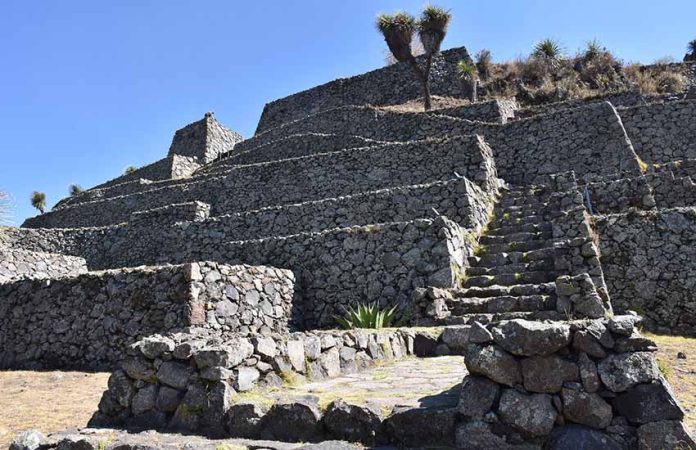
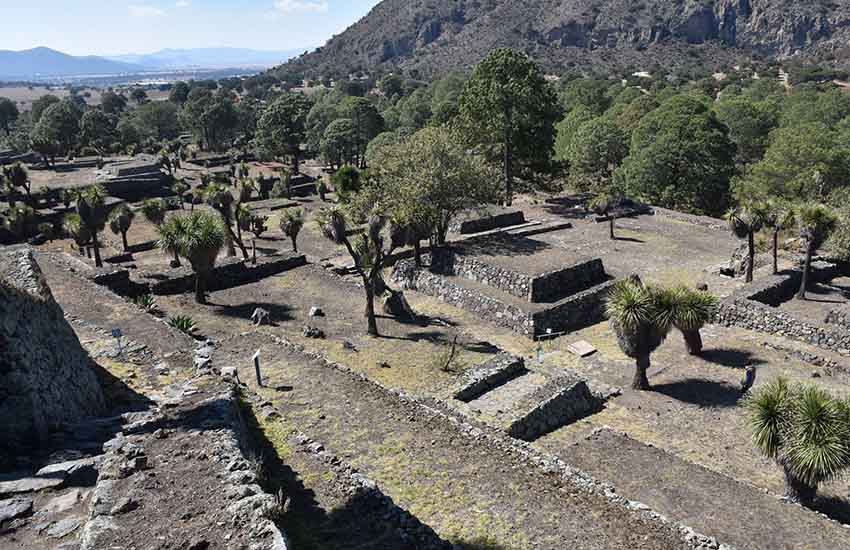
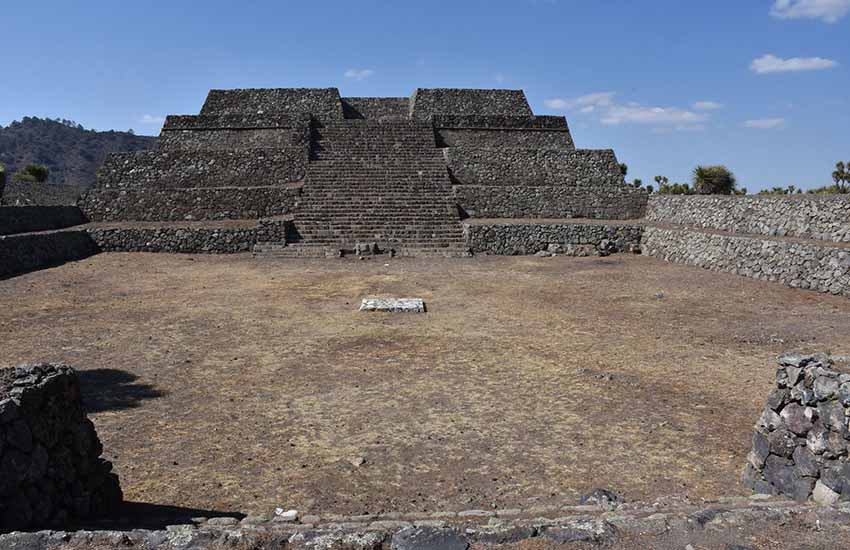
At its peak, the ancient city of Cantona had a population of around 100,000 people. (Photos by Joseph Sorrentino)

Cantona, located in the northeast corner of Puebla state,  is one of the most impressive pre-Hispanic ruins I’ve visited in Mexico, but for some reason, it doesn’t get nearly the attention of sites like Teotihuacán or Monte Alban. 

Which is a shame because it’s only about an hour-and-a-half drive from Puebla city, and the excavated portion boasts pyramids, ball courts and numerous ancient streets and plazas. It’s well worth the trip. 

The first people to populate the area where Cantona was built arrived around 1000 B.C. (its name is derived from Caltonal, a Nahuatl word meaning “House of the Sun.”). It’s not certain who these ancient people were, but they may have been Olmecas or Popolocas. It’s believed that the city eventually hosted just under 100,000 people.  

Cantona archaeological site

Obsidian is abundant in the area, and Cantona’s residents used it in tools, weapons and decorative elements. Researchers know these early settlers traded it for other goods, a practice that eventually turned Cantona into an important regional power. 

The city grew tremendously between 600 B.C. and A.D. 600, increasing from 800 acres to 2,700 acres. During this period, Cantona became a fortified city, with tall defensive walls. At its peak, around A.D. 900, Cantona occupied almost 3,700 acres. 

To date, 14 pyramids, numerous altars and plazas have been excavated here. It’s believed that the city once contained 8,000 housing units. 

Cantona experienced a rapid decline in population between A.D. 900 and 1000, possibly due to political upheaval. It was eventually abandoned completely by around the year 1050, but its existence had stretched over 2,000 years, lasting longer than any other Mexican civilization. 

According to Israel Cristóbal Benétiz, a docent in Cantona’s site museum, the fully excavated site is about 70 acres, just under 2% of estimated area that Cantona once covered. 

“This is the southern part of Cantona,” he said, “and it was the administrative and ceremonial site.”

Several features make Cantona unique. One can be seen immediately upon entering the ruins: First Avenue, a narrow avenue lined with a low wall. It continues for 563 meters (1,850 feet), intersecting with other streets and connecting with patios, pyramids and ball courts. The streets follow the area’s topography, so none are completely straight, but it’s estimated that Cantona had 4,000 of them. 

Also unique is that none of Cantona’s structures were built using mortar, and none were covered with stucco, building styles found in most other pre-Hispanic sites. Builders used volcanic stone for many of the structures, white quarry stone for the pyramid steps and white limestone for ceremonial structures.

A short walk from the entrance of the ruins is Patio 2, one of several excavated locations where people lived. It’s believed that fifteen to twenty people lived on an elevated platform in this patio. There was also a structure where religious and civic ceremonies were held and, nearby, a tomb. 

An area designated as the Western Access or Entrance features a structure standing an impressive 14 meters (46 feet) tall. This entrance leads to the western civic and ceremonial centers of the city. Walking up the building’s 47 steps brings you to an area that overlooks several patios. 

While many pre-Hispanic sites across Mexico have ball courts for a ritual game known as pelota, Cantona, has a remarkable 27 courts, said Benétiz. Only six have been restored, he said. 

The walls lining the courts are sloped, and each court is oriented in a different direction, perhaps designed to follow the sun’s path throughout the year. In addition to the playing field, the courts have a shrine, a plaza and a pyramid. 

Cantona archaeological site
Cantona’s Earth Fertilization Plaza. Phallic symbols and other offerings were found in this section.

Pelota was a ritual game that, according to Diego Landa Calderón, a Spanish missionary, was played very fast and very violently. While he recorded that there were human sacrifices associated with the game, historians debate whether it was the losing or winning captain (or even the losing or winning team) that was sacrificed. 

What is clear is that decapitated remains of sacrificial victims have been found at some of Cantona’s pelota courts. A stele marks midfield at Pelota Field No. 7. Several decapitated human remains have been uncovered behind it. 

There are several excavated plazas — ceremonial centers with pyramids, altars and often a pelota court — the  largest of which is called The Great Plaza. A variety of offerings have been uncovered at the bases of the pyramids, buried inside their walls and under their altars. 

One of the most important plazas was the Earth Fertilization Plaza, a space dedicated to agricultural rites. Its pyramid is the largest one yet uncovered in Cantona, and in it were found nine phallic sculptures, now housed in the site’s museum. A number of human sacrifices and other offerings have also been excavated in this plaza. 

Although there are housing units in this portion of Cantona, only rulers, priests and other elites lived there; the majority of the population lived below this area. 

Looking down from the top of several of Catona’s pyramids, you can make out the outlines of streets and buildings.

Walking at a leisurely pace, stopping to take numerous photos and climbing up eight of the pyramids took me just two hours. Although none of the climbs were dangerous, some were fairly steep. Most of the steps were narrow and built with uneven stones. Caution is urged. 

Be sure to spend some time in the museum, where many examples of Cantona’s pottery, figures and jewelry are found. Information in both Spanish and English is available. There’s also Señor Benétiz, who will offer visitors a wealth of additional information.

Some tips: be sure to wear comfortable shoes; hiking boots may be best. Bring water, snacks or lunch (nothing is available onsite), as well as sunscreen and a hat. In late December, a steady wind blew, so bring a jacket or sweater. Finally, there was no internet connection available at the site, and it was spotty elsewhere, so bear that in mind. 

The closest restaurant, located just before the highway entrance, was closed when we visited, but another called Covadonga, was a short distance away. They only take cash. 

Admission to Cantona is a modest 85 pesos. It’s open Tuesday–Saturday, 10–5. 

Joseph Sorrentino, a writer, photographer and author of the book San Gregorio Atlapulco: Cosmvisiones and of Stinky Island Tales: Some Stories from an Italian-American Childhood, is a regular contributor to Mexico News Daily. More examples of his photographs and links to other articles may be found at www.sorrentinophotography.com He currently lives in Chipilo, Puebla.

Search continues for missing human rights defender and community leader

0
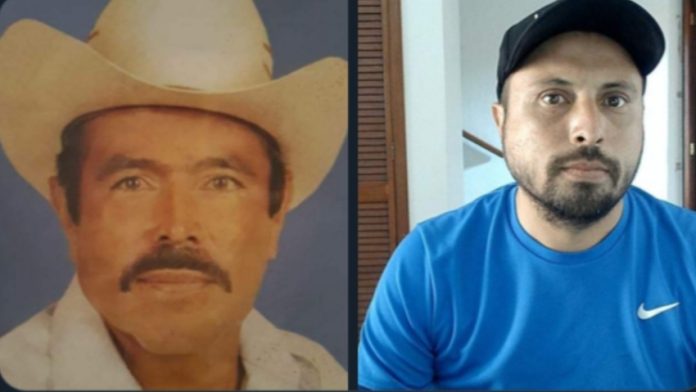
Antonio Díaz Valencia and Ricardo Lagunes Gasca disappeared on Sunday. (Centro Prodh Twitter)

The Michoacán Attorney General’s Office (FGE) has confirmed the disappearance of two men who attended a community meeting in Aquila, Michoacán, last Sunday.

A statement issued by the FGE on Wednesday suggests that Ricardo Arturo Lagunes Gasca, an environmental and land rights lawyer and human rights defender, and Antonio Díaz Valencia, a teacher and Indigenous community leader, were victims of an armed attack as the vehicle in which they were traveling after the meeting was found in the neighboring state of Colima with bullet holes in it.

The FGE said the two men traveled to Aquila from Colima to attend a community meeting at which issues being considered by the Colima Agrarian Tribunal were discussed.

Family members of both missing men held a press conference on Thursday to plead for support from the federal attorney general’s office in locating them. (Juan José Estrada Serafín / Cuartoscuro.com)

On Sunday afternoon, Lagunes, a 71-year-old Colima resident who represents citizens at the tribunal, and Díaz, 41, spoke with their families and told them they were returning to Colima, the Attorney General’s Office said.

On Sunday evening, the FGE said, authorities in Colima received a report of gunfire in Cerro de Ortega, a location in Tecomán, a Colima municipality that borders Michoacán.

Police subsequently located the vehicle in which Lagunes and Díaz were traveling. The vehicle, owned by Lagunes, had bullet holes in it, the FGE added.

“The disappearance of Ricardo Arturo Lagunes was reported Monday at the Colima Attorney General’s Office while the [report of the] disappearance of Antonio Díaz was filed in … [Michoacán] capital [Morelia],” the statement said, adding that a search operation commenced immediately.

According to a report by news website Animal Político, a person identified as Guadalupe “Lupillo” Magaña asked Lagunes and Díaz for a lift to Coahuayana, a Michoacán municipality between Aquila and Tecomán.

Michoacán residents who blocked the coastal highway in that state to denounce the disappearance of the men claimed that Magaña has links to the Jalisco New Generation Cartel (CJNG). They demanded that he be investigated in connection with the disappearance of Lagunes and Díaz, Animal Político said.

A CJNG criminal cell carried out an attack on Aquila last weekend and reportedly killed three residents. The FGE didn’t mention any possible motive for the crime apparently committed against Lagunes and Díaz, but attacks on activists are common in Mexico.

The former is known for his work in favor of migrants and Indigenous communities while the latter is a well-known teacher who sought to be an elected representative at an upcoming indigenous assembly, Animal Político reported.

According to the Associated Press, the two men had been active in fighting a massive iron ore mine in Aquila. The meeting they attended in Aquila was “an anti-mining community meeting,” The Guardian said.

Amnesty International urged authorities in Michoacán and Colima to carry out a “diligent investigation” that considers the men’s work as land defenders.

Michoacán Governor Alfredo Ramírez said Wednesday that authorities hoped “to find these two people alive,” noting that searches were underway in that state as well as Colima.

With reports from Animal Político

AMLO declares Canadian energy companies’ disputes resolved

0
La Lucha solar park in Durango, Mexico
The La Lucha solar park in Durango, owned by Northland Power, one of the Canadian companies in dispute with Mexican nationalistic energy-sector policies. (Photo: Vilfer Electric)

Problems faced by four Canadian companies with interests in Mexico have been resolved, President López Obrador said Thursday.

The president told his regular news conference that he had met on Wednesday with businesspeople from Canada who had grievances related to the electricity sector.

“When he came [to Mexico last week], Prime Minister Trudeau asked me to see them, and, personally, with [the federal government’s] economic cabinet, we attended to four Canadian companies and resolved the problems without any obstacle,” López Obrador said, adding that he had also met with U.S. firms.

President Lopez Obrador of Mexico
President López Obrador told reporters Thursday that he had “resolved the problems without any obstacle,” though at least one government official disagreed with that assessment, according to Reuters. (Photo: Presidencia)

He didn’t name the Canadian firms, but an unnamed government official told the Reuters news agency that those he was referring to are the pension fund CDPQ — which has interests in several Mexican companies; engineering, logistics and energy company ATCO Ltd.; electricity generator Northland Power and Canadian Solar Inc.

The official, Reuters said, described the talks with the companies as initial discussions.

Another unnamed official told the news agency that a framework for solving the companies’ disputes had been agreed on. The official said that the companies would likely have to make changes related to their use of electricity self-supply permits.

Such permits allow companies to operate on electricity they generate themselves, but the federal government is trying to end that practice.

Both Canada and the United States last year filed challenges against Mexico’s nationalistic energy policies, arguing that they discriminate against Canadian and U.S. companies and violate the USMCA trade pact. Talks to resolve the dispute are ongoing.

According to Reuters, officials and industry sources are “very doubtful” that López Obrador’s efforts to resolve U.S. and Canadian companies’ problems on a case-by-case basis will be sufficient to bring the dispute proceedings to an end.

Canada and the U.S. could request the establishment of a dispute panel to make a ruling if an agreement isn’t reached via talks. That was how a dispute was resolved on Jan. 11 between the United States  and Mexico and Canada on regional content percentage rules on automobiles produced in the USMCA zone.

López Obrador declared Thursday that his government “always seeks conciliation” with disgruntled parties.

He also said that the government is dealing with extortion problems faced by two Canadian mining companies in Guerrero.

“I told the Canadians that there are 125 Canadian mining companies [in Mexico], and we only have problems at two,” López Obrador said.

“… They’re being extorted in Guerrero by crime groups; we’re already attending [to the situation],” he said.

With reports from Reforma and Reuters 

Fugitive ex-police supervisor from Iguala detained

0
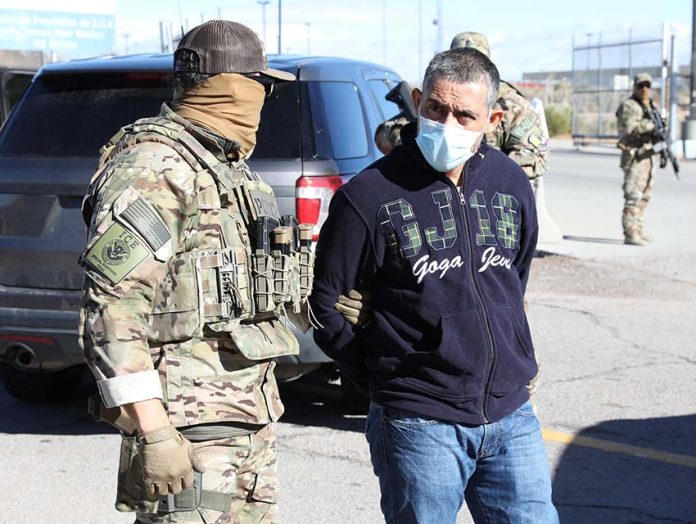
Alejandro Tenescalcos arrested by ICE authorities
Investigators believe Alejandro Tenescalco, 41, played an active role in the 2014 kidnappings of 43 students from the Ayotzinapa Rural Teachers' College in Guerrero. ICE authorities said they arrested Tenescalco in Santa Teresa, New Mexico after he scaled a border wall there. (Photo: ICE)

On Wednesday, United States authorities handed over to Mexico custody of Alejandro Tenescalco, a former Iguala municipal police officer wanted in connection to the disappearance of 43 students from Ayotzinapa in 2014.

According to a statement by Mexico’s National Migration Institute (INM), Tenescalco was detained by U.S. Customs and Border Protection (CBP) on Dec. 20 while trying to cross the border irregularly. He was detained until Wednesday, when he was turned over to Mexican authorities once it was established that he did not meet the conditions to be granted asylum in the U.S.

On arrival in Mexico, Tenescalco was handed to Mexican authorities and turned over to the federal Attorney General’s Office due to a warrant for his arrest issued in 2015. He had been wanted for almost nine years on kidnapping and organized crime charges related to the Ayotzinapa case. Mexico had offered a 10-million-peso (US $500,000) reward offered for information on his whereabouts.

Alejandro Tenescalco being transferred from US custody to Mexican custody at the Santa Teresa port of entry.
Alejandro Tenescalco being transferred from U.S. custody to Mexican custody at the Santa Teresa port of entry. (Photo: Twitter)

The Interdisciplinary Group of Independent Experts (GIEI), which is participating in investigating the case along with the federal government’s Commission for Truth and Access to Justice, has long singled out Tenescalco as a key actor in the events of Sep. 26, 2014, when 43 students from the Ayotzinapa Rural Teachers’ College were abducted while traveling through Iguala, Guerrero.

“We had insisted on his search and arrest since our first report,” GIEI member Carlos Beristáin said. “He’s a key person that night.”

The GIEI’s reports place Tenescalco in three key locations on the night of the disappearances. One Iguala police officer described him firing a gun on the students’ bus during the initial attack. Another officer testified that Tenescalco later drove one of the cars that patrolled the town perimeter following the attack, while agents of the Iguala police and members of the criminal group Guerreros Unidos took the students away.

Finally, telephone signals from that night suggest that Tenescalco was near Barandilla, a police facility in Iguala where the FGR believes the students were taken.

Tenescalco had once been suspected to be “El Caminante,” the alias given to a mysterious figure who communicated with several Iguala police officers on the night of the attack. He was identified as El Caminante by the federal Attorney General’s Office of President Enrique Peña Nieto’s government.

But in 2020, at which point President Lopez Obrador was in office, both the government’s Commission for Truth and Access to Justice in the Ayotzinapa case and the GIEI concluded that El Caminante was likely an ex-general by the name of Marcos Esteban Juárez Escalera, who was Guerrero’s head of public safety until about a month before the kidnappings.

The late retired General Marcos Esteban Juárez Escalera
The late retired General Marcos Esteban Juárez Escalera in 2013, when he was general director of Guerrero’s Ministerial Police. (Photo: Saúl López/Cuartoscuro)

Although the National Commission for Human Rights suggested that Juárez be investigated, the federal Attorney General’s Office did not pursue it, and Juárez died in late 2020.

According to a report published by the Truth and Access to Justice Commission in August, and later leaked to the press in unredacted form, almost all of the 43 students were murdered, dismembered and buried on the night of the attack. The report asserts that the military played a key role in the students’ disappearance, and also implicates government officials in facilitating and covering up the killings.

With reports from El País

Baja tour operators demand answers after surprise cuts to whale watching permits

0
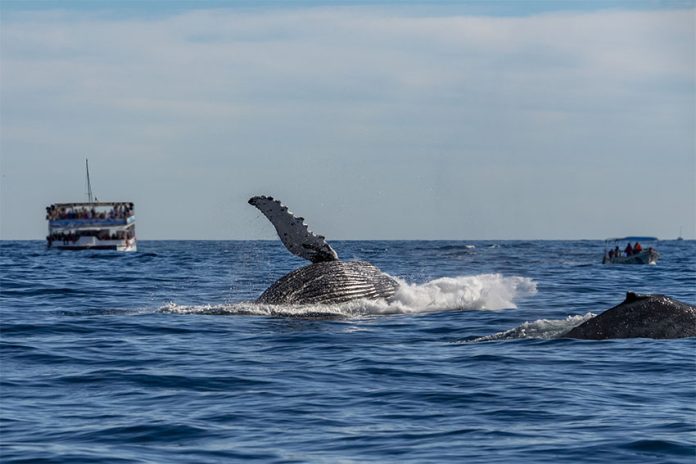
A humpback surfaces off the coast of Cabo San Lucas, BCS as tourists look on.
A humpback surfaces off the coast of Cabo San Lucas, BCS as tourists look on. (Depositphotos)

With the heart of whale watching season in Baja California Sur just around the corner, operators of tour boats in various parts of the state have gone public with their claim that the federal ministry that oversees them has reduced the number of permits issued for the 2022-23 season.

“An injustice is being committed,” said Mario Ruiz Quiroz, a tour operator based in Puerto San Carlos, a popular area on the Pacific Coast for spotting whales, sharks, rays and other marine life. “Many families depend on this income.”

Ruiz explained that the situation is serious, since the whale watching boats cannot operate without the permits issued by the Ministry of Environment and Natural Resources (Semarnat) — mainly because inspectors from the environmental protection agency Profepa are tightly watching over them. The new season began last month.

A group of operators from various tourist-oriented coastal areas — including Puerto San Carlos, Adolfo López Mateos, Puerto Chale and Bahía Magdalena — joined together this week in the state capital of La Paz to demand that the missing  permits be granted and to inform the media of the situation.

“We are urging that the permits be delivered to us now, because the season is upon us and [many of us] don’t have a way to provide our services legally and without any fear,” said Crispín Mendoza Ramos of the Puerto San Carlos Unión de Lancheros (boatmen’s union). “It’s going to be a shame when someone gets some tourists in their boat, and [the public officials] show up and say, ‘You’re going to the slammer.’”

Although no exact figure is available, one media report, based on figures from the boatmen, said that in Puerto San Carlos, 24 businesses were expecting permits, but only 11 received them.

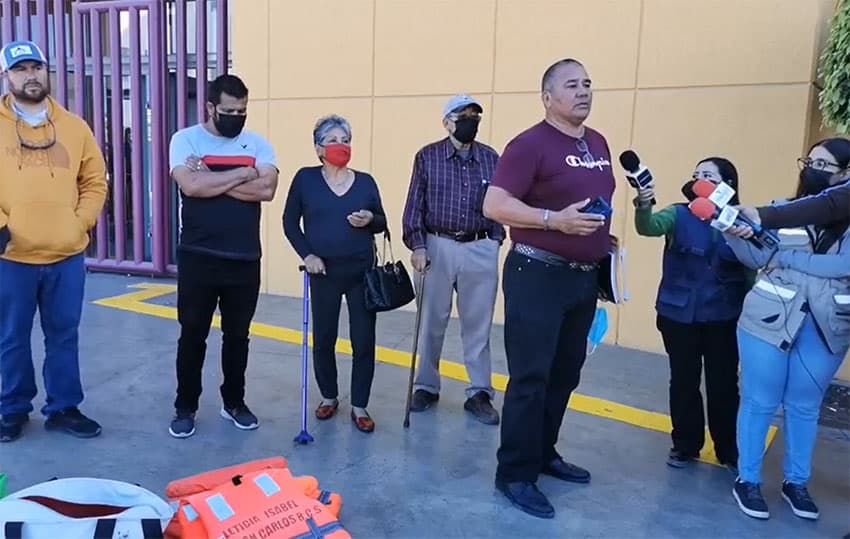
A small group of men an women stand in front of a pile of life vests and whale photos in front of a building, while a man in a red shirt speaks into the microphones of several news reporters.
Tour operators, including members of the Puerto San Carlos boatmen’s union, gathered in La Paz to protest the new limits and reallocation of permits, which they say was a violation of their agreement with the government. (Screenshot via Suena La Noticia)

The Tijuana-based newspaper Zeta, citing counts made by the boatmen, reported that only 78 permits had been issued in the municipality of La Paz, compared to 98 last season.

Making the issue even tougher to stomach, operators say, is that many had already paid for insurance, verification permits for their vessels and improvements to get their boats up to speed for the current season.

Blue and gray whale watching season in Mexico runs from December to April in the Pacific Ocean and the Gulf of California, with mid-January to March being prime time. More than 60,000 tourists arrive each year to get an up-close-and-personal look at the giants of the sea.

Another issue, the boatmen say, is that with the reduced number of permits, there will be fewer boats in operation, thereby putting a squeeze on tourists who want to see whales.

“Most of us already have reservations” on the books, Ruiz said. In Cabo San Lucas and other big tourist areas, he added, “There will be no boats [available] and that will greatly affect the economy of the town.”

On their journey to La Paz this week, the tour operators asked for Governor Víctor Castro Cosío to advocate on their behalf — noting that hoteliers, restaurateurs and the population in general depend on whale watching.

A whale shark statue with the sea in the background at sunset.
Marine-themed street art on the La Paz boardwalk pays tribute to the fact that many in the town earn their living through ecotourism. (Luis Aleman / Unsplash)

As of Wednesday at noon, Semarnat officials had yet to say anything publicly about the issue.

“We are being violated,” Ruiz said. “They’re not telling us anything.”

The confusion also stems from this being the first time in 30 years that something like this has happened, the boatmen said.

They also said they had an agreement with environmental authorities that no new permits would be issued in Baja California Sur for this season.

This was agreed upon in the name of sustainable and responsible tourism — so as to not increase activity around the whales even more — and also to help guarantee work for local operators already in business.

However, the tour operators said they have found instances of new permits being issued. “We do not know why they were granted,” said one.

Maribel Collins, the head of Baja California Sur’s Tourism and Economy Ministry (SETUE), said in a press release that, on behalf of the governor, she had started a dialogue with federal officials to seek a solution.

According to a Dec. 15 blog post by Profepa titled “The gray whale is back in Mexican waters,” the whales carry out a migration of up to 18,000 kilometers (11,200 miles) annually, starting in the waters off Alaska. The warm and shallow waters off Mexico’s Pacific Coast are a “refuge,” providing an ideal place to reproduce and nurse their newborns before heading back north toward Alaska.

To guarantee the protection of the whales, Mexico has many regulations about the areas and times of year in which whale-watching excursions can take place. The states where such activity is legal are Baja California, Baja California Sur, Nayarit, Jalisco, Sinaloa, Sonora, Oaxaca and Guerrero.

With reports from Zeta and El Sudcaliforniano