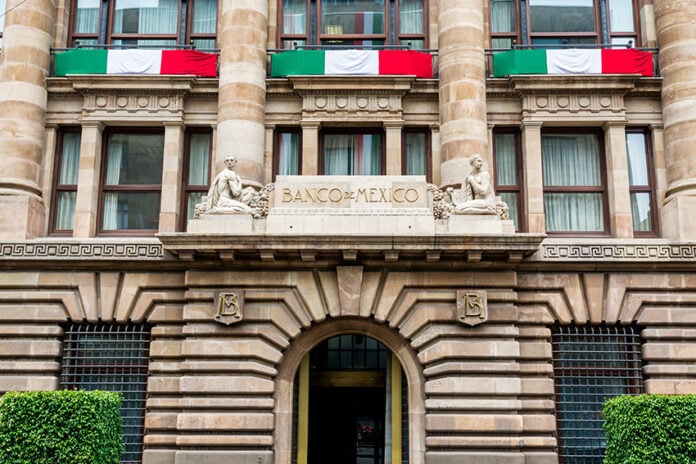
New data from the central bank shows that foreign investors have pulled back from Mexican government bonds amid global trade and tariff uncertainty. (Shutterstock)
During the first ten months of 2025, foreign investors withdrew more than 130 billion pesos (US $7 billion) in bonds backed by the Mexican government, marking one of the largest outflows of foreign capital from government instruments in recent years.
According to data from the Bank of Mexico (Banxico), at the end of 2024, some 1.8 trillion pesos (US $99.5 billion) in Mexican government bonds were held by foreign investors.
In contrast, by the end of October of this year, the amount declined to 1.7 trillion pesos (US $92.4 billion) after investors sold off government bonds worth 43.6 billion pesos (US $2.3 billion) in October alone, marking seven consecutive months of capital outflows.
The Trump effect?
According to the central bank, in January, the month Donald Trump returned to the U.S. presidency, foreign investors sold off 29 billion pesos (US $1.5 billion) worth of Mexican government bonds.
February saw a rebound, with purchases amounting to 49 billion pesos (US $2.6 billion), followed by 17.2 billion pesos (US $925 million) in March.
However, since then, there have only been outflows. In April, foreign investors sold off 27.8 billion pesos (US $1.52 billion) of bonds. May sales reached 46 billion pesos (2.53 billion), followed by losses of 4.9 billion pesos (US $272 million) in June, 9 billion pesos (US $489 million) in July, 10 billion pesos (US $544 million) in August and 32 billion pesos (US $1.7 billion) in September.
Analysts at Banamex noted that foreign holdings of bonds now account for 12% of the total, the lowest level since 2010.
The outflow coincides with a period of global financial volatility, marked by geopolitical tensions stemming in part from tariffs and trade policies imposed by the United States administration, as well as uncertainty over the upcoming review of the United States-Mexico-Canada Agreement (USMCA).
Another key factor is the decline in interest rates for financial instruments like Federal Treasury Certificates. In 2025, these rates stood at around 11%, but due to ongoing cuts have lowered interest rates to approximately 7%.
If the trend continues, analysts predict an adjustment in interest rates and greater volatility in the Mexican peso, especially as elections and the renegotiation of the USMCA approach.
While government bonds have fallen out of favor with foreign investors, capital is still flowing into the country through other routes. Foreign direct investment (FDI) in Mexico increased 14.5% in the first nine months of 2025 to reach just over US $40.9 billion — a new record for the time period, President Claudia Sheinbaum said Thursday.
“The willingness to invest in our country is reaffirmed,”she wrote in a social media post. “We’re going to end 2025 very well.”
L'Étape Mazatlán by Tour de France took place earlier this month in the "Pearl of the Pacific." (Gobierno del Estado de Sinaloa)
On November 9, L’Étape Mazatlán by Tour de France 2025 turned the Pacific coast into the heart of international cycling. The event welcomed cyclists of all levels, offering three routes: the Sprint (37.7 km), the Short (65 km), and the Long (112.4 km).
The event was a festival of sport and families, as national and international cyclists rode coastal routes in a spirit of community. Warm, clear weather graced the entire day, while security measures, technical support and logistical efforts ensured a safe experience for competitors, visitors and local residents.
We went to Mazatlán's 'Tour de France': Here's what we saw
Families lined the streets to cheer, visitors enjoyed Mazatlán’s cuisine and scenery, and cyclists experienced the thrill of a Tour de France-style race in an energetic and welcoming atmosphere.
Mexico News Daily’s Eduardo Esparza went to take in the sights and sounds of the malecón. Here’s what he found.
Eduardo Esparza is a professor, filmmaker and professional photographer from Mazatlán, Sinaloa. His first feature film, “Con un pie en la gloria,” will premiere this summer.
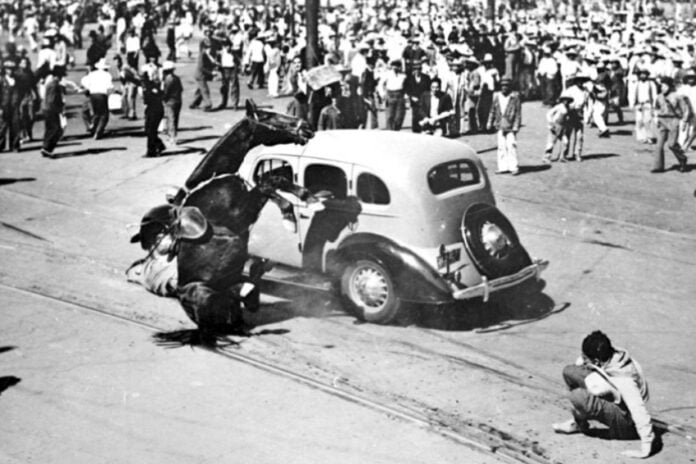
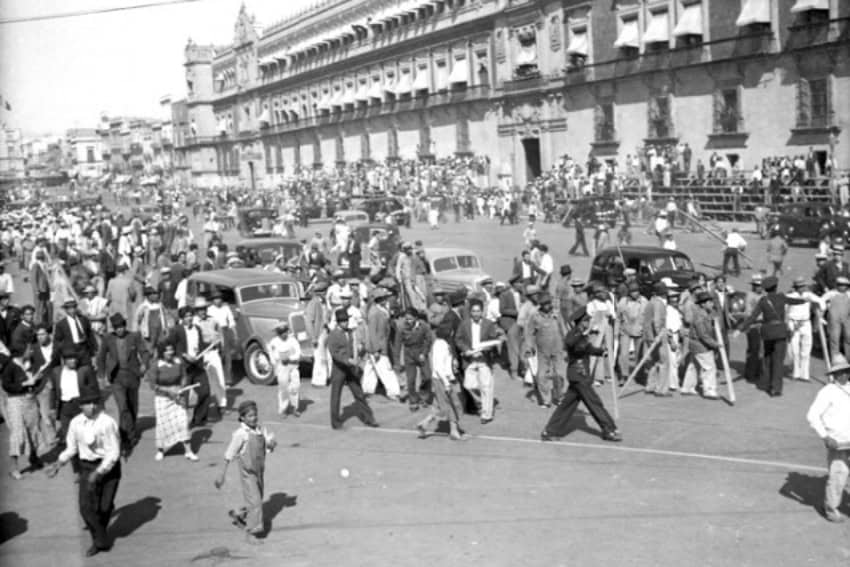
Mexico City's Battle of the Zócalo in 1935 saw violence erupt between fascists and communists. (Casasola/Wikimedia Commons)
November 20, 1935: Nazi-aligned paramilitaries charge on horseback. Communists under the red flag zoom towards the enemy in dozens of cars. A 16th-century plaza witnesses it all. Where is this? The actors and year suggest Poland, Germany or France. But this is four years before World War II breaks out in Europe, and far from the battlefields of Old World Europe. This scene is happening in the Zócalo, the heart of Mexico City — on Revolution Day, no less. At the end of it all, three people will be dead and dozens injured.
How did this dress rehearsal for the Second World War come to happen in Mexico, of all places? What did it mean? Read on to find out.
The Cárdenas years
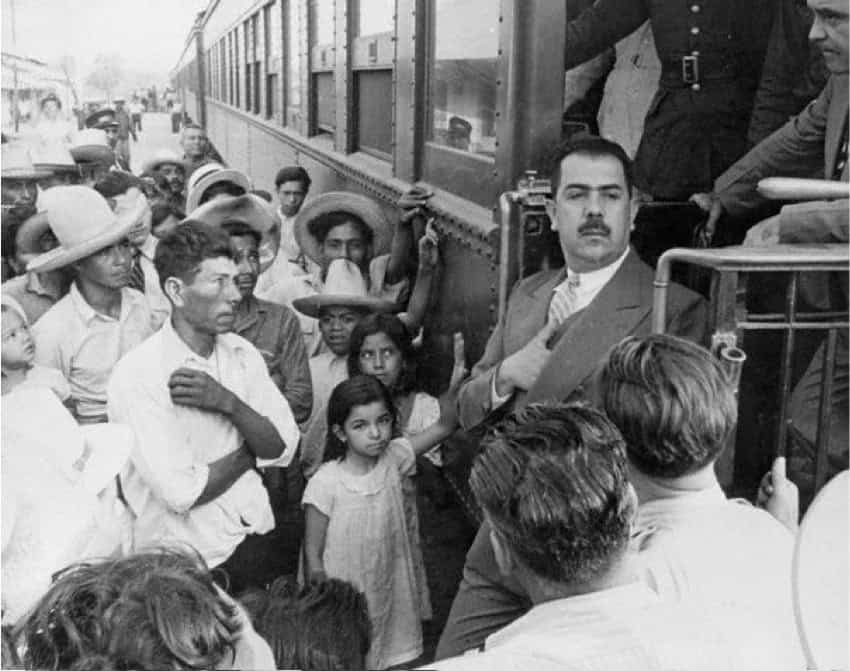
Lázaro Cárdenas, seen here arriving by train, was president of Mexico from 1934 to 1940. (Doralicia Carmona Dávila/Wikimedia Commons)
There’s no making sense of the Battle of the Zócalo without understanding the national politics of 1930s Mexico. Though the progressive Constitution of 1917 had been in place for over a decade, many historians will tell you it wasn’t until the presidency of Lázaro Cárdenas that the promises of the Mexican Revolution finally began to be fulfilled.
An economic nationalist and former officer in the Constitutionalist faction during the Revolution, Cárdenas ran under the slogan of “Mexico for the Mexicans.” The first year of his government centered on a power struggle with former president Plutarco Elías Calles, who had all but controlled the previous three presidents in the period known as the Maximato. To cement his own position, Cárdenas looked to build alliances with broad sectors of society and turned to the country’s peasants and workers.
Land reform, the central demand of the Revolution, took off under Cárdenas’ government, with the state redistributing more land to peasants than all previous post-revolutionary governments put together. The first years of Michoacán native’s rule also saw the president ally with industrial labor, pushing for the fragmented workers’ movement to reorganize under a new umbrella organization, an effort that led to the formation of the Confederation of Mexican Workers (CTM), to this day Mexico’s largest labor union confederation. In the following years, labor militancy would help Cárdenas to expropriate and nationalize Mexico’s oil and railways.
Communists and fascists in Mexico
Enter the Mexican Communist Party (PCM). Founded in 1919, the PCM had been forced underground by the government in 1930, with many leaders deported or jailed in the infamous Islas Marías penal colony. It continued working underground into the 1930s, and despite its reduced membership, was an important player in peasant organizing in many states across the country. When Cárdenas took office, restrictions on the PCM were relaxed, and the party returned to public activity.
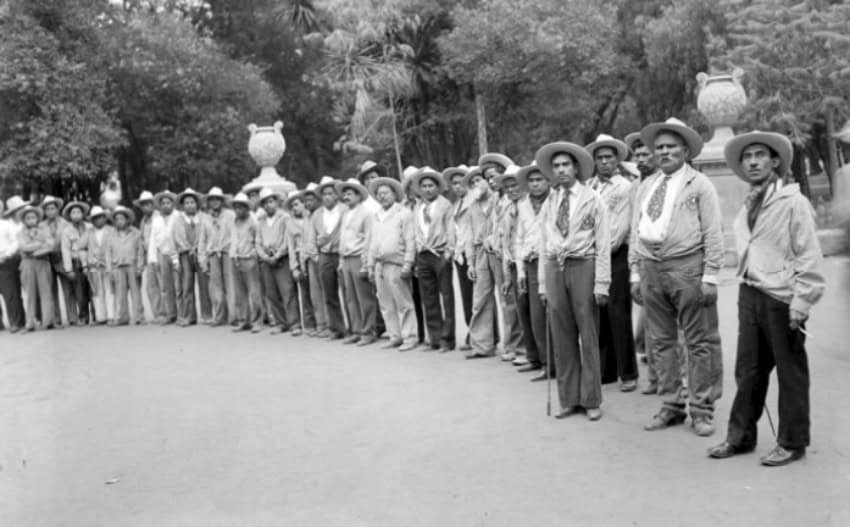
None of this peasant and labor organizing was welcomed by Mexico’s middle and business classes, who were, moreover, horrified by the government’s easing up on the PCM. They organized too, and where the Mexican communists looked to Moscow for inspiration, the middle classes looked to Berlin and Rome. Where the Nazis had the brownshirts and the Italian fascists had the blackshirts, those who followed their example in Mexico founded the Gold Shirts, also known as Revolutionary Mexicanist Action, in the year that Cárdenas took office.
Supported by the German embassy and led by a former Villista soldier named Nicolás Rodríguez Carrasco, the Gold Shirts opposed Cárdenas’ government, violently broke up labor strikes and preached the expulsion of Chinese and Jews from the country. They were joined in their organizing by organizations like the Pro-Race Committee, the Employers’ Confederation of the Mexican Republic and the Anti-Chinese League and received the financial backing of industrialists of the stature of Eugenio Garza Sada, owner of Cuauhtémoc Brewery and one of Mexico’s richest men.
The Camisas Doradas, or “Gold Shirts,” were Mexico’s answer to the fascist movement then gaining power in Europe. (Casasola/Wikimedia Commons)
The communists denounced the anti-foreigner rhetoric of these groups as a trick to take pressure off of Mexican capitalists, while the fascists, attacking small Jewish and Chinese merchants, pointed to the PCM as a manifestation of the Jewish-Bolshevik plot to destroy Mexico. When the PCM tried organizing workers, the Gold Shirts would attack their picket lines and break up their strikes.
Almost every month of 1935 saw violent incidents between fascists and the labor movement. In March, the Gold Shirts took over the PCM’s Mexico City offices, wounding several members and burning party literature, provoking demonstrations in solidarity with the communists around the country. In August, workers and Gold Shirts traded gunshots in Tizapán, Mexico City, and the communists held increasingly massive anti-Nazi rallies around the capital as autumn rolled around. The stage was set for a bloodier confrontation. It came on Revolution Day.
The Battle of the Zócalo
Mexican Revolution Day celebrates Francisco I. Madero’s Nov. 20, 1910, call to the Mexican people to overthrow the dictator Porfirio Díaz. Today, it is celebrated with a military parade in the nation’s capital, a tradition which in 1935 was only a few years old— it would not be until a year later that Revolution Day was officially declared a national holiday. That day, in fact, was the first time that the holiday would ever be celebrated by a sitting president, and the plan was for Cárdenas to watch the civic-military parade from the central balcony of the National Palace.
The best description of what happened in the Zócalo on that day comes from the pen of journalist Mario Gill. Gold Shirt leader Nicolás rode at the front of a “militarily organized column, with uniformed infantry and a cavalry detachment, marching in correct formation.” Leading the communists was no less than the painter David Álfaro Siqueiros, already famous then and today remembered as one of the “Big Three” of Mexico’s world-famous muralist movement. It was PCM member and railroad worker Valentín Campa, however, who was in charge of the strike against the Gold Shirts. The fascists were determined to march before the eyes of President Cárdenas, and the communists were determined to stop them.
As the Gold Shirt column approached the National Palace, a group of young communists emerged from the crowd and threw firecrackers down at their horses’ feet, causing the animals to panic. At the same time, other militants took the Gold Shirts by surprise with sticks and stones. The shocked fascists defended themselves with whips and riding crops, but the bulk of the PCM’s attack was still to come. As the two sides fought, writes Mario Gill, “a small, secretly organized fleet of cars manned by drivers of the Taxi Drivers Union, PCM members, launched themselves without warning against the cavalry in a rapid flanking move.” Dozens of Gold Shirts and their horses, rammed directly by the cars, rolled in the dust. In an instant, the Gold Shirt column was dispersed, with the riders who had managed to stay mounted taking off down the streets of the Historic Center.
Nicolás Rodríguez, knocked off his horse in the car strike, was spotted fleeing the Zócalo by a young communist named Rafael Galván, who pursued and stabbed him on the corner of Calle República de Argentina and República de Guatemala. When the dust settled, around three dozen people were wounded and three were dead, including the young communists Carlos Salinas Vela and J. Trinidad García.
Fighting broke out in front of the Palacio Nacional on Revolution Day in 1935. (Casasola/Wikimedia Commons)
The battle after the battle
The next months were pivotal for both sides. The Communist Party’s prestige may never have been higher, evinced by the fact that 15,000 workers and students attended the funeral of Salinas and Trinidad. The government came under increased pressure from the labor movement and civil society to ban Revolutionary Mexicanist Action, which it did in February 1936. Nicolás Rodríguez, left for dead, survived his injuries and headed north to Monterrey, where he was apparently soon involved in more violence.
The struggle between Mexico’s communists and fascists didn’t end there, however. Not to be deterred, the former Gold Shirts reorganized within groups like the Nationalist Union, Mexican Nationalist Vanguard and, most famously, the National Sinarquist Union. Despite Mexico entering World War II on the Allied side under President Manuel Ávila Camacho, its anti-Jewish agitation in the ‘30s had already borne fruit in the shape of Mexico’s secret 1934 ban on Jewish immigration. The powerful business interests that had backed the Gold Shirts carried on their struggle in politics, with backer Eugenio Garza Sada supporting right-wing presidential candidate Juan Andreu Almazán in the 1940 elections. Those elections, overseen by Lázaro Cárdenas, are widely believed to set the precedent for the electoral frauds that would characterize Mexico for much of the rest of the century.
The PCM’s alliance with the ruling party was short-lived. Cárdenas’ party, the PNR, was abandoning its radicalism. It wanted to be the only game in town, and there was no way it could tolerate a movement working for another revolution in Mexico. Relations between the PNR and PCM declined in the last year of Cárdenas’ government, and the day before the president’s term ended, the government raided the communists’ headquarters and arrested dozens of party members. The government of Manuel Ávila Camacho continued to sideline the PCM, and by the 1950s, anticommunist repression was back on.
What did the Battle of the Zócalo mean?
Seen from nearly a century’s distance, the Battle of the Zócalo stands less as a dress rehearsal for Europe’s coming catastrophe than as a vivid expression of Mexico’s own unresolved social battles. Although both the PCM and Gold Shirts understood themselves as part of worldwide movements, their clash that November afternoon was born not of foreign scripts but of the home-grown tensions — between workers and industrialists, peasants and landowners, revolutionaries and counterrevolutionaries — still shaping the young post-revolutionary state.
In that sense, the Battle of the Zócalo didn’t prefigure Mexico’s future so much as it illuminated the fault lines of its present. And though the Gold Shirts were scattered and the PCM was soon pushed back underground, the forces they represented remained embedded in Mexican political life. Long after the dust of November 20, 1935, had settled, the struggle over what the Revolution meant, and who it was for, continued to shape the country’s path through the 20th century and beyond.
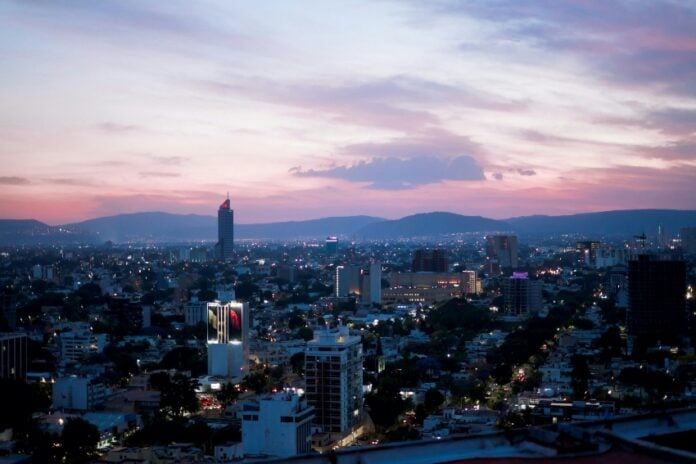
Are there secret tunnels beneath Mexico's third biggest city? You bet. (Unsplash/Roman Lopez)
For at least 300 years, the rumors have persisted. Beneath the streets of Guadalajara lies a vast network of tunnels that connect important buildings in the city, from churches and convents to mansions and monuments, chapels and cemeteries. The tunnels are wide and high enough to accommodate horses and even carriages, it’s said.
Supposedly, the Father of the Revolution, Miguel Hidalgo, even used these tunnels to escape his enemies and Benito Juárez found them handy for getting around the city unnoticed. People still talk about the story of a group of priests who were in the cathedral one minute and then suddenly appeared at the governor’s palace for a meeting. When the meeting was over, it was said, they reappeared at the cathedral, having never been seen upon the city streets.
Friar Buzeta to the rescue
Guadalajara’s underground aqueducts were built hundreds of years ago by a Franciscan friar. (John Pint)
An investigation into these mysteries, carried out in 2013 by Dr. Alicia Torres Rodríguez of the University of Guadalajara, revealed the truth behind the rumors. The legendary “tunnels of Guadalajara” are actually galerías filtrantes, underground aqueducts constructed during the colonial period to direct potable water into the city.
Most of them, says Torres, “owe their origin to a Franciscan Friar named Pedro Buzeta.”
In the 1700s, she says, the city was desperately short of water. Word reached the city fathers that a Spanish friar had recently succeeded admirably in bringing water to the city of Veracruz, and they sent for him.
Buzeta soon determined that water could be found on the north and southwestern skirts of Guadalajara and that the best way to carry it into the city was not via aqueducts but through a gravity-based filtration gallery, which employs 3,000-year-old technology originating in Persia.
This underground aqueduct is widely known by its Arabic name: qanat.
How to dig a qanat
To dig a qanat, technical experts called muqannistrace a straight line above ground between a well and a distant site where water is needed. At regular intervals along this line, workers dig holes less than a meter wide, down to an exact depth — different for each hole.
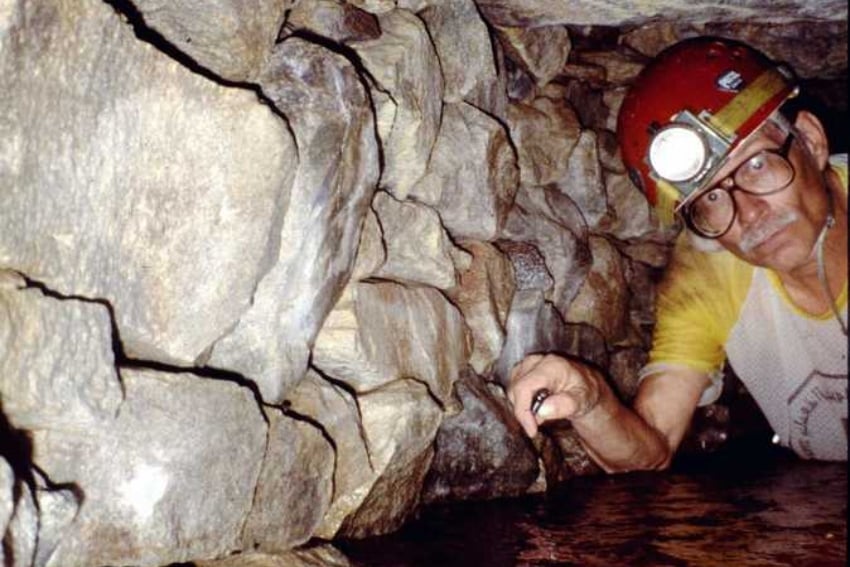
Qanats are holes dug underground and joined together, resulting in tunnels. (John Pint)
Next, all the holes are joined together underground, resulting in a tunnel perhaps 2 meters high and 1 meter wide, with a downward slope of less than 2 degrees.
The final step is to connect the tunnel to the water well. This is tricky indeed, and if it’s not done exactly right, the person making the connection may not survive. Once water is slowly moving through the filtration gallery, all the access holes are covered with flat rocks to keep the qanat clean and to reduce evaporation.
This technology proved very popular and was adapted by the Arabs, the Romans, the Chinese and the Spaniards, who brought it to Mexico. Most qanats are less than five kilometers long, but some are over 70 kilometers in length.
‘This is not a cave!’: Guadalajara’s hidden qanats
For many years, I was a cave explorer in western Mexico, which led to my first encounter with a qanat in the hills above the little town of La Venta del Astillero, located just west of Guadalajara.
It seemed at first that our group of speleologists had discovered a very long, very curious cave with 70 small roof entrances in a straight line, spaced 11 meters apart. Those holes produced beams of light that we found both picturesque and useful.
But when we invited archaeologist Phil Weigand to take a look at it, he immediately said: “John, this is not a cave; it’s a qanat!”
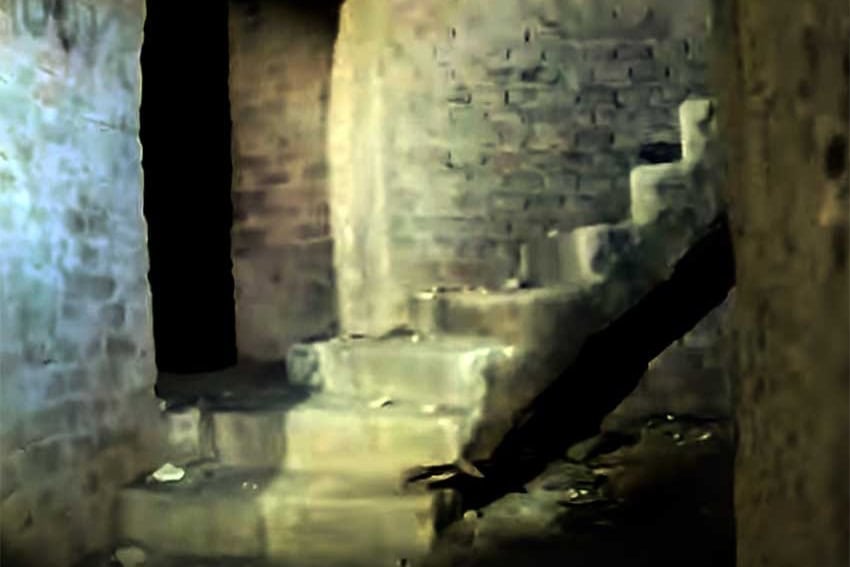
A spooky staircase spirals down to one of 20 kilometers of qanats under the city of Guadalajara. (Jalisco Desconocido)
Once we recognized the pattern, we found several more qanats in the area. One of these finds occurred after a request from the director of a tree farm at the northwest end of Guadalajara.
‘A request like this is what cavers live for’
“There’s a kind of well on our property with iron rungs that go down to a locked gate. Behind the gate, there’s a long tunnel. Would you please come and tell us what this is?”
A request like this is what cavers live for. We arrived with lights, helmets and survey gear.
“Inside that tunnel, did you see any small holes in the roof?” I asked the director.
“No, I didn’t,” he said — which surprised me.
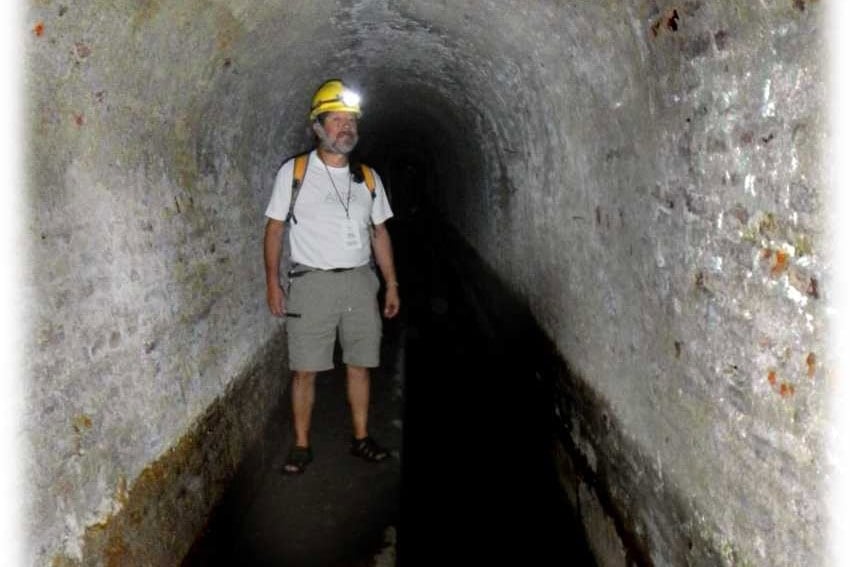
We clambered down the rungs, the tree farm director unlocked the gate and we found ourselves at the start of a long, straight tunnel just over 1 meter wide and almost 2 meters high— not quite spacious enough for a carriage but perhaps enough for a small horse.
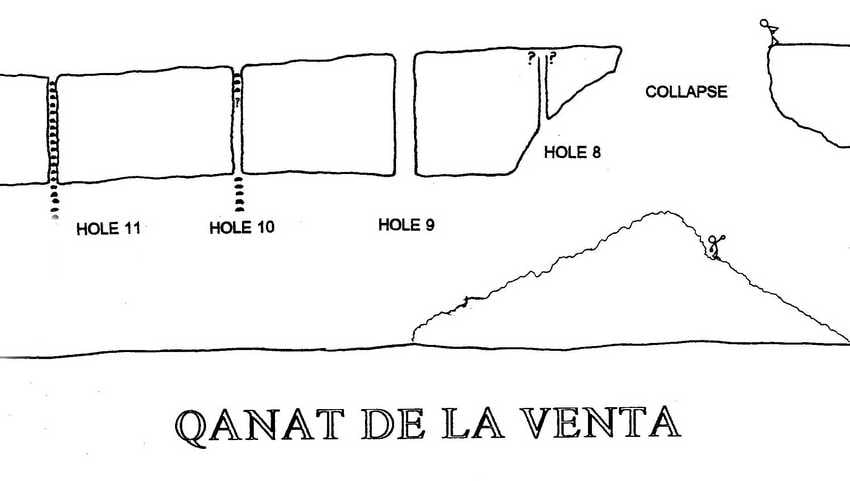
Profile view of Qanat de La Venta showing access shafts and a section that collapsed. (Sketch by John Pint)
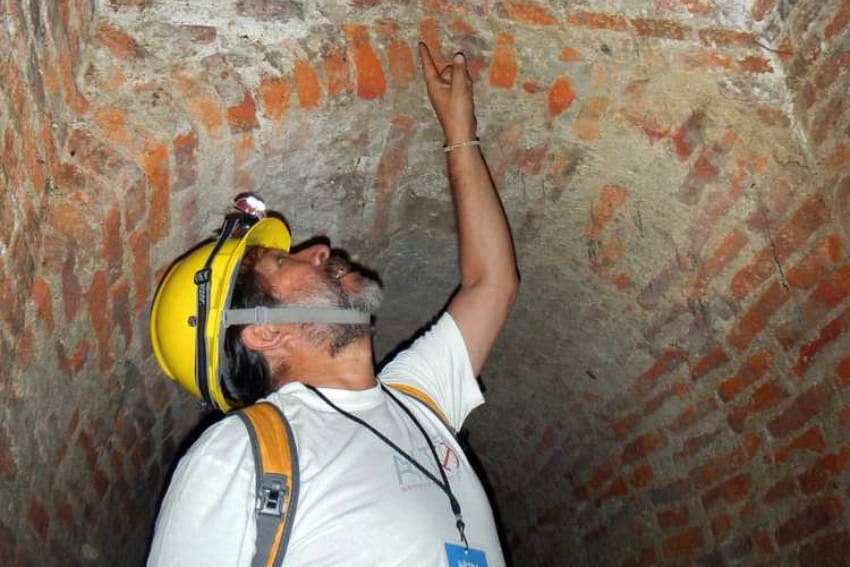
The walls and the curved roof were made of brick and looked in good condition. Water was running along a channel on the right.
“This looks suspiciously like a qanat, and a very elegant one at that,” I told him.
We began our survey, and exactly 100 meters from our starting point, we found an opening above our heads: a shaft with footholds, leading up to a kind of manhole cover with sunlight streaming through a small hole.
Every 100 meters, there was a shaft, indicating that this was, indeed, a qanat.
After 300 meters, our passage emptied into a big, round pool. On the other side, we could see tunnels similar to the one we were in. They led off to other places.
By now, it was clear: We were inside the network of qanats built under the supervision, or at least inspiration, of Friar Buzeta.
20 kilometers of crumbling qanats
Qanats still bring a substantial portion of water to Guadalajara, but they’re beginning to crumble. (John Pint)
By the beginning of the 20th century, Dr. Torres estimates, Guadalajara was supplied by nine lines of filtration galleries with a total length of up to 20 kilometers.
Amazingly, these qanats, built between 1731 and 1895, still supply a substantial amount of water to the city.
Unfortunately, no one knows exactly where they are located. “They have been abandoned,” says Torres, “and they are beginning to crumble.”
Bear that in mind in case someone invites you on an underground tour of Guadalajara.
John Pint has lived near Guadalajara, Jalisco, for more than 30 years and is the author of “A Guide to West Mexico’s Guachimontones and Surrounding Area” and co-author of “Outdoors in Western Mexico.” More of his writing can be found on his website.
Sheinbaum — who accused opposition parties, including the PAN, of infiltrating the "Gen Z" protests that took place last Saturday — described the news of the contract as "very interesting." (Mario Jasso/Cuartoscuro)
A commercial arrangement between an opposition political party and a Generation Z influencer, and the upcoming seventh anniversary of the “fourth transformation” political movement’s hold on power, were among the issues President Claudia Sheinbaum spoke about at her Wednesday morning press conference.
Here is a recap of the president’s Nov. 19 mañanera.
Sheinbaum: Revelation that promoter of ‘Gen Z’ protest is on the PAN’s payroll is ‘very interesting’
A reporter asked the president her opinion about a social media post in which the Morena party’s national president, Luisa María Alcalde, wrote:
“Breaking news. The ‘nonpartisan’ young man @EdsonAndradeL, the main promoter of the ‘Generation Z’ march, was hired by the National Action Party [PAN] in February 2025 for $2,106,810.00 MXN [US $114,800], divided into 12 payments of $175,577.50 [pesos], which he continues to receive.”
💥Noticia de última hora.
El joven “apartidista” @EdsonAndradeL principal impulsor de la marcha de la “Generación Z” fue contratado por el Partido @AccionNacional, en febrero de 2025 por $2,106,810.00 (Dos millones ciento seis mil ochocientos diez pesos 00/100 M.N.), dividido… pic.twitter.com/7XnoEHHpKs
Alcalde, who served as labor minister and interior minister during the 2018-24 presidency of Andrés Manuel López Obrador, included a copy of Andrade’s contract with the PAN in her post.
There is “a lot of information” for everyone to analyze, she added.
In a video posted to social media on Wednesday, Andrade — who also identified by the government as a promoter of the “Gen Z” protests at last Thursday’s mañanera — accused Sheinbaum of persecuting him.
“Claudia Sheinbaum’s persecution against me has gone so far that to look after my safety, today I have to abandon my home and country,” he said.
“… I am no longer just a target of the government, but also of [organized] crime. They’re seeking to criminalize me for working, exposing a contract that has nothing to do with my personal political opinions, but rather with the production of institutional content in which I clearly don’t appear and don’t make on my own,” said Andrade, who asserted that his address and personal details have also been exposed.
“…Nobody pays me to raise my voice, I’ve done it since I was 16 years old,” he said.
After nearly 7 years of ‘transformation,’ there is ‘a lot to celebrate,’ says Sheinbaum
After a reporter noted that a Dec. 6 pro-Sheinbaum rally is being promoted on social media, the president said that she and her government colleagues have been thinking for some time about holding a public celebration to mark “seven years of transformation in the country.”
López Obrador, who initiated the “fourth transformation” (4T) political project now led by Sheinbaum, took office on Dec. 1, 2018.
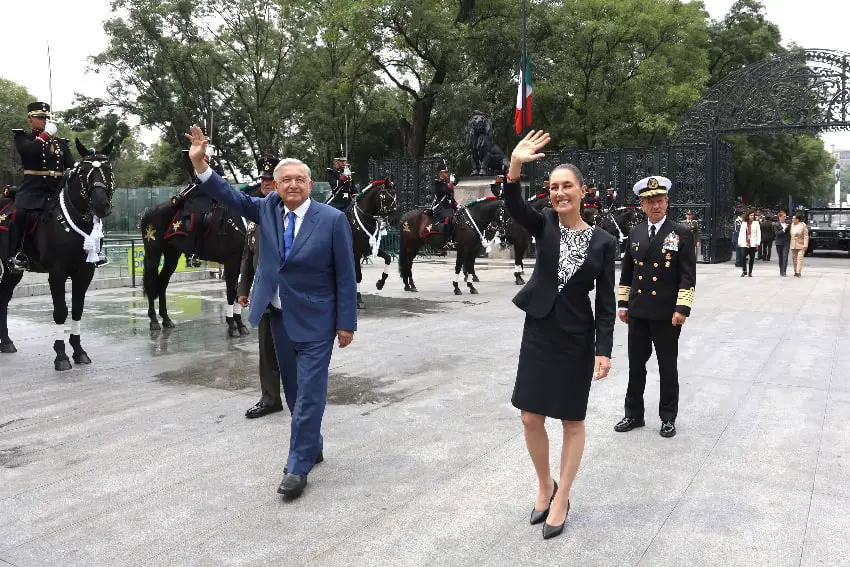
Claudia Sheinbaum has continued the political movement of former president Andrés Manuel López Obrador (L). (Cuartoscuro)
“There is a lot of support for the transformation movement, the majority are with the transformation movement,” the president said five days after the largest anti-government protests since she took office on Oct. 1, 2024.
“Record in Foreign Direct Investment. Celebration! Largest supercomputer in Latin America. Celebration! All seniors have a universal pension. Celebration! All young people in secondary school now have scholarships. Celebration! All high school students have scholarships. Celebration! A 125 percent increase in the minimum wage. That’s something to celebrate!” she said.
Sheinbaum cited a number of other reasons to celebrate seven years of the 4T, including.
While Sheinbaum certainly believes that Mexico has changed for the better over the past seven years, she acknowledged that “there are problems as well.”
“Of course, there are problems in Mexico, but that’s why we’re here, to work every day for the well-being of the people and for peace and tranquility,” she said.
By Mexico News Daily chief staff writer Peter Davies (peter.davies@mexiconewsdaily.com)
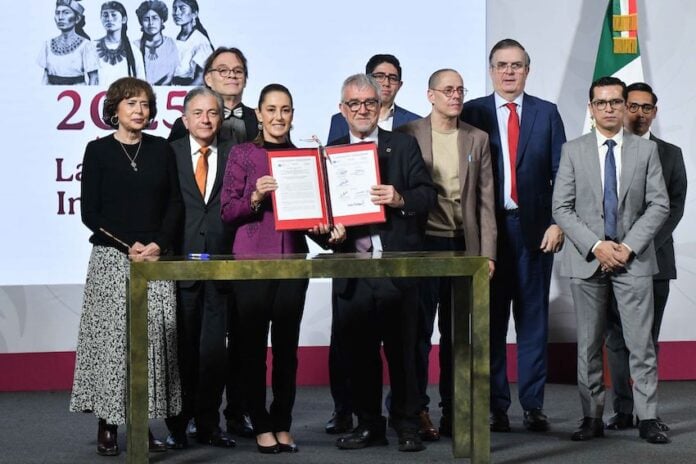
President Claudia Sheinbaum stands with Mateo Valero Cortés, director of the Barcelona Supercomputing Center (BSC), and some of his colleagues at Wednesday's mañanera
where they signed an agreement regarding the construction of a Mexican supercomputer. (Mario Jasso/Cuartoscuro.com)
Mexico will soon be home to Latin America’s largest supercomputer, National Coordinator of Digital Infrastructure Jorge Luis Pérez Hernández announced on Wednesday.
The supercomputer will be the result of a collaborative agreement between Mexico’s Infotec and Spain’s Barcelona Supercomputing Center (BSC), but it will be built in Mexico.
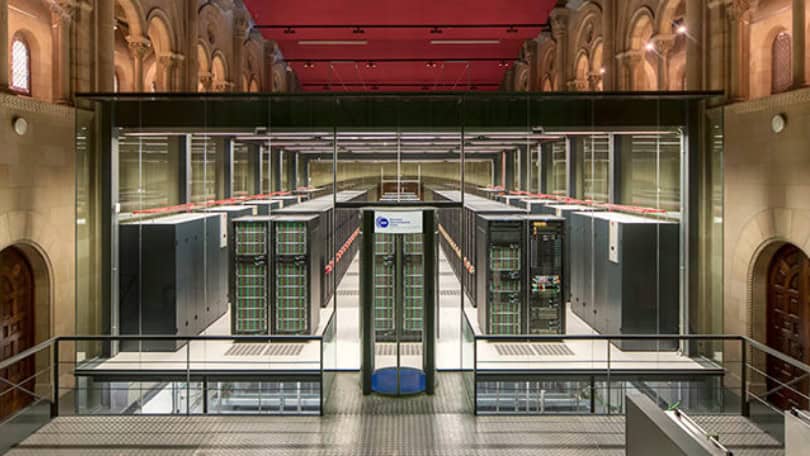
BSC, a European leader in the superconductor sector, has its plant in a former church in Barcelona. (@rechgab/X)
“It will be 100% Mexican and will be vastly different from the current largest one, which is located in South America and belongs to a private company,” Pérez said, speaking during the daily presidential press conference.
The project aligns with the Plan México national economic strategy, according to the head of Mexico’s Digital Transformation and Telecommunications Agency, José Antonio Peña Merino.
Pérez said that while the facility is being constructed, which will take between 24 and 36 months, Mexico will have access to the BCS MareNostrum equipment to begin priority projects in January 2026.
While a conventional computer takes up to 30 days to process large volumes of information, a supercomputer can carry out 314 trillion operations per second, said Pérez.
In Mexico, some of the priority projects include:
Climate models for Mexico, to improve forecasts for extreme weather events.
Data processing from the Tax Administration Service (SAT) and Customs, to optimize the customs inspection system.
Precision agriculture through the analysis of more than 2 million satellite images, to detect water and crop needs.
Artificial intelligence, with massive multitasking models for virtual assistance.
“A country that doesn’t compute, doesn’t compete,” Pérez said.
He also emphasized that all data will be protected by the Mexican government and national researchers.
A collaboration with BSC supercomputing
BSC has attracted around US $692 million in business investment over the last two decades, and currently employs around 1,400 people, with 1,200 researchers.
The company has previously collaborated with Mexico on other projects, such as earthquake simulations, which earned it an award at the World Supercomputing Congress.
Supercomputers are key to conducting scientific research, according to BSC’s director, Mateo Valero Cortés.
The BSC facility, located in a former chapel in Barcelona, has developed five generations of its MareNostrum supercomputer to date. The latest, the MareNostrum 5, is 10,000 times faster than the first version from 2004, said Valero.
In 2024 alone, BSC participated in 440 research projects, and it is currently working on digital twin projects and virtual representations of complex systems, such as the human body, cities and the climate. Valero said BSC already has a digital twin of the circulatory system.
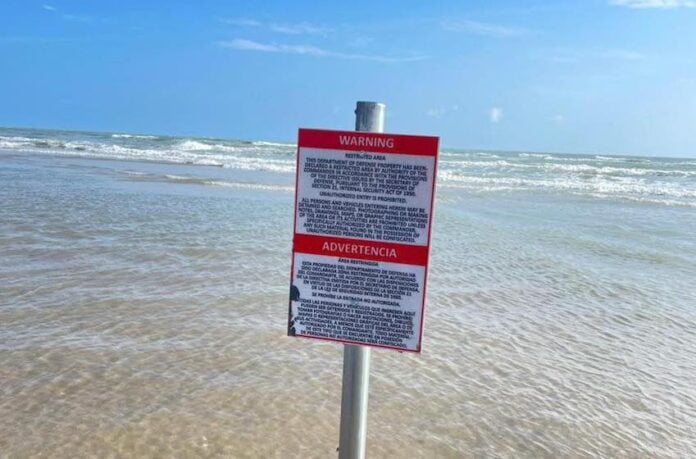
The Mexican Navy removed six signs on Playa Bagdad in the state of Tamaulipas that had been placed there by the U.S. government, warning people away. (Facebook)
The Mexican Navy reported that it has removed six warning signs planted on Mexican territory in the border state of Tamaulipas warning that anyone found on what the signs called “National Defense Area III” would be “detained and searched.”
The United States government later acknowledged that it had arranged to have the signs put up, according to President Sheinbaum.
In her daily press conference on Tuesday morning, Sheinbaum confirmed the location of the signs. “Boundary signs were put up on a section of Playa Bagdad (Baghdad Beach),” Sheinbaum said.
Playa Bagdad is located where the Rio Grande meets the Gulf of Mexico. The river, which originates in south-central Colorado in the United States and is called the Río Bravo on the Mexican side, forms the border between the two countries for a long stretch.
Reports of unidentified men arriving at the beach by boat to install signs prompted the response from Mexico’s Naval Ministry (Semar).
The signs reportedly stated in Spanish and English that the area was Department of Defense property and a “Restricted Area” by order of “the commander.” They also said that “unauthorized entry is prohibited,” as are photography or drawings, and stated, “If you are found here, you may be detained and searched.”
Sheinbaum said her government was communicating with U.S. authorities in order to get an explanation.
“First, the consulate was consulted, then the embassy,” she said. “They hadn’t issued an official report, so the signs were removed. Later, a U.S. government agency stated that a company had indeed been hired to put them up.”
The Pentagon said in a statement that contractors would work with “appropriate agencies to avoid confusion in the future.”
National Defense Areas (NDAs) are U.S. military zones along the U.S. side of the country’s southern border, managed by the U.S. Defense Department. On May 1, the U.S. established a new 418-km NDA along the southern border of Texas with Mexico.
In the past, said the statement, changes in water depth and topography have altered the perception of the international boundary’s location, suggesting the possibility of a location mistake.
Mistake or not, the warning signs appeared as threats of a unilateral U.S. incursion into Mexico roil the bilateral relationship. U.S. Secretary of State Marco Rubio has declared that no such plans exist while President Donald Trump continues to make provocative remarks, suggesting he would be “proud” to launch strikes in Mexico to stop the flow of illegal drugs.
As part of the "Pez Vela 2025" security strategy, navy personnel arrested 54 "alleged lawbreakers" in recent days in the municipalities of Manzanillo, Tecomán, Villa de Álvarez and Colima. (Semar)
The Mexican Navy announced Tuesday that it had detained 54 people in recent days in Colima, Mexico’s most violent state in terms of homicides per capita.
The suspects are believed to be members of the Jalisco New Generation Cartel (CJNG), or a crime group previously affiliated with that organization, according to media reports.
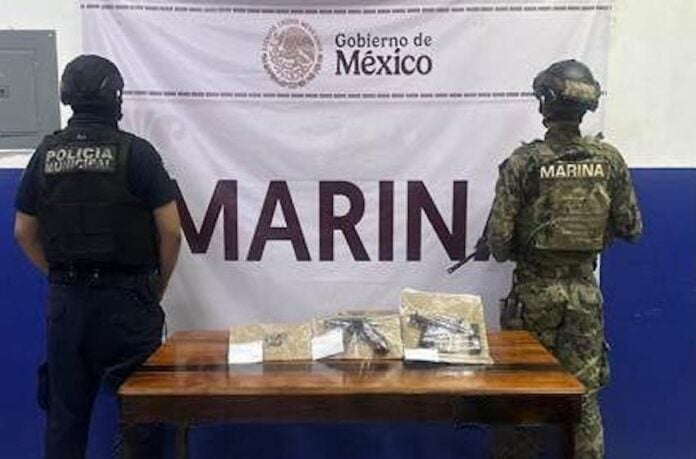
The Navy Ministry (Semar) said in a statement that as part of the “Pez Vela 2025” security strategy, navy personnel arrested 54 “alleged lawbreakers” in recent days in the municipalities of Manzanillo, Tecomán, Villa de Álvarez and Colima.
The navy personnel, who were acting “in coordination” with the Federal Attorney General’s Office and state and municipal authorities in Colima, also seized four firearms, ammunition, 18 bladed weapons, a pickup truck that had been reported as stolen, eight motorcycles, “presumed” drugs, two computers and nine mobile phones, among other items, according to the Semar statement.
Five properties were also secured.
The Navy Ministry said that the suspects and the seized items were turned over to “the relevant authorities.”
The newspaper Reforma reported that the suspects are “linked” to the CJNG, while the news site Sin Embargo wrote that they are “alleged members” of that cartel.
The news site Infobae México reported that “security sources” confirmed that the suspects belong to Los Mezcales, “a crime group that originally formed part of the Jalisco New Generation Cartel.”
Como parte de la estrategia de seguridad “Pez Vela 2025”, durante recorridos de vigilancia en las colonias Tecomán, Villa de Álvarez y Colima en Manzanillo, personal naval logró la detención de 54 presuntos infractores de la ley, aseguramiento de armas, sustancias ilícitas y… pic.twitter.com/GOBL472ZSF
The two crime groups are no longer affiliated, Infobae reported, citing a deadly 2022 prison riot in Colima city as the event that precipitated their “definitive breakup.”
In its statement, Semar reaffirmed its commitment to “the society of Colima” to “strengthen peace, security and well-being” of families.
Morelos ranked second, followed by Sinaloa, Chihuahua and Baja California.
Colima, made up of just 10 municipalities, is Mexico’s least populous state, with just over 730,000 residents, according to the 2020 census results. Bordering the states of Jalisco and Michoacán, as well as the Pacific Ocean, Colima is Mexico’s fifth smallest federal entity by area.
Criminal control of the port of Manzanillo — a major entry point for fentanyl precursor chemicals from China — is highly coveted by crime groups, as are trafficking routes that run north and northeast from the Pacific coast state.
It remains to be seen whether the arrest of the 54 criminal suspects will lead to a reduction in homicides in Colima.
Federal officials have attributed a reduction in homicides in Guanajuato to the arrest in March of members of a crime cell linked to a range of crimes in that state, including homicides. Despite the decline, Guanajuato continues to lead the country for total homicides, with 2,229 between January and October.
Arrests are up, homicides are down, but government still faces pressure over its anti-crime efforts
The announcement of the 54 arrests in Colima comes the week after two alleged CJNG operators and “generators of violence” were arrested in the Pacific coast state. Both Jaime Tonatiuh Mendoza Fregoso and Yajaira Berenice “N”, a woman known as “La China,” were detained in Manzanillo.
Meanwhile, Security Minister Omar García Harfuch reported on Nov. 11 that 37,000 people had been arrested for allegedly committing high-impact crimes such as murder and kidnapping since the current federal government took office on Oct. 1, 2024.
Anti-government and anti-Morena sentiment were on prominent display in the protests, which were organized by a Generation Z movement, but attracted older Mexicans in large numbers.
A major catalyst for the protests was the Nov. 1 assassination of Uruapan mayor Carlos Manzo, an outspoken anti-crime crusader who had urged the federal government to take a more active and aggressive approach to combating Mexico’s notorious criminal organizations.
The federal government responded to his murder and general insecurity in Michoacán with Plan Michoacán, touted by Sheinbaum as a “comprehensive strategy” with “more than 100 actions,” including the deployment of additional troops to the state.
Por instrucciones de la Presidenta @Claudiashein hoy informamos avances en la investigación del asesinato de Carlos Manzo, donde gracias a un trabajo coordinado con la @FiscaliaMich y el @GabSeguridadMX se realizaron labores de inteligencia, análisis de cámaras y seguimiento… pic.twitter.com/AfScKExb5H
García Harfuch announced Wednesday that an alleged mastermind of Manzo’s murder had been detained. That person, identified as Jorge Armando “N,” is allegedly a leader of a CJNG cell.
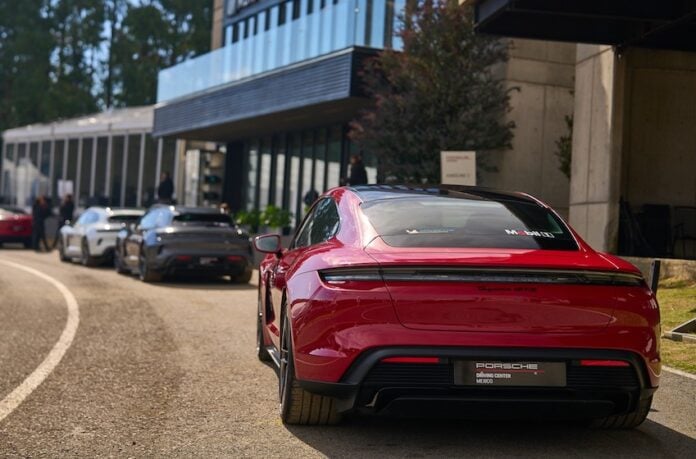
Official Porsche driver Felipe Nasr, a member of Porsche Penske Motorsport, lauds the new Porsche Driving Center in Mexico as a facility that "brings the Porsche DNA closer to people throughout Latin America." (Porsche)
Mexico has just become home to the first Porsche Driving Center in Latin America, marking a new milestone for the brand in the region and an opportunity for drivers to feel what it’s like to get behind the wheel of one of the most revered automotive brands in the world.
Located in the Mexico Drive Resort, a world-class automotive complex near Mexico City, halfway between its western limits and the México state capital of Toluca, the center features a high-performance 4-kilometer track that combines technical curves, challenging straightaways and elevation changes that allow drivers to explore every nuance of Porsche performance.
The Porsche Driving Center’s 4-kilometer track features technical curves, challenging straightaways and elevation changes. (Porsche Driving Center Mexico)
“The Porsche Driving Center Mexico is an incredible platform that brings the Porsche DNA closer to people throughout Latin America,” said Brazilian Felipe Nasr, official Porsche driver since 2022 and member of the Porsche Penske Motorsport team, at the recent inauguration ceremony of Porsche’s new center. “It’s not just about driving fast, but about understanding what makes these cars so special.”
The track was designed by the Formula 1 go-to architect Hermann Tilke, who has also created F1 circuits such as the Circuit of the Americas in Austin, Texas, and the Yas Marina Circuit in Abu Dhabi, United Arab Emirates, among others.
Besides allowing visitors to test Porsche’s sport and electric vehicles, the center offers hospitality areas, meeting rooms, a dedicated fleet of cars and courses for all levels. It hosts Porsche club meetings as well as open days for the general public.
As part of the inauguration event, the center hosted the Porsche World Road Show 2025, bringing together customers, enthusiasts and specialized media from Mexico and other Latin American and Caribbean countries to drive the entire range of cars on the Mexico Drive Resort track.
Porsche officially arrived in Mexico in 2001, when the first models were sold in the country. But the brand’s connection with Mexico dates to the early 1950s, when the now legendary Carrera Panamericana was run along the recently inaugurated Panamerican Highway, 3,507 high-speed kilometers (2,178 miles) from the U.S. border to the Guatemalan border. In fact, the Porsche 911 Carrera model owes its name to that race.
41) In 2024, households spent an average of 15,891 pesos (US $865) per month. Mexico City had the highest average, at 22,128 pesos (US $1,205), while Chiapas had the lowest, at 9,039 pesos (US $492) per month.
(Source: INEGI, National Survey on Household Income and Expenditures – ENIGH, 2024)
Household spending varies widely by region, reflecting differences in income, prices and cost of living.
42) In 2024, Santiago was the most registered name in Mexico, with 7,570 people; among females, the most common name was Sofía, with 5,192 people.
43) Between April and June 2025, 14.3 million people worked more than 48 hours per week.
(Source: INEGI, National Survey on Occupation and Employment – ENOE, second quarter 2025)
Long work hours affect nearly a quarter of Mexico’s workforce. A 6-day workweek is common in both formal and informal jobs, though the current administration is pushing to standardize a 40-hour or 5-day workweek.
44) In 2023, of the 8.9 million people with a disability in Mexico, 53.4 percent (4.7 million) were women.
(Source: INEGI, National Survey on Demographic Dynamics – ENADID, 2023)
Women represent a slight majority among people living with disabilities, a trend that grows with age. The intersection of gender and disability poses unique challenges in access to education, employment, healthcare and protection from discrimination.
45) Mexico has 12,557 kilometers of coastline — equivalent to traveling from Tapachula, Chiapas, to Tijuana, Baja California, three times.
(Source: INEGI, Coastline Data – LIC, 2023)
Mexico’s extensive coastline touches the Pacific Ocean, the Gulf of California, the Gulf of Mexico and the Caribbean Sea.
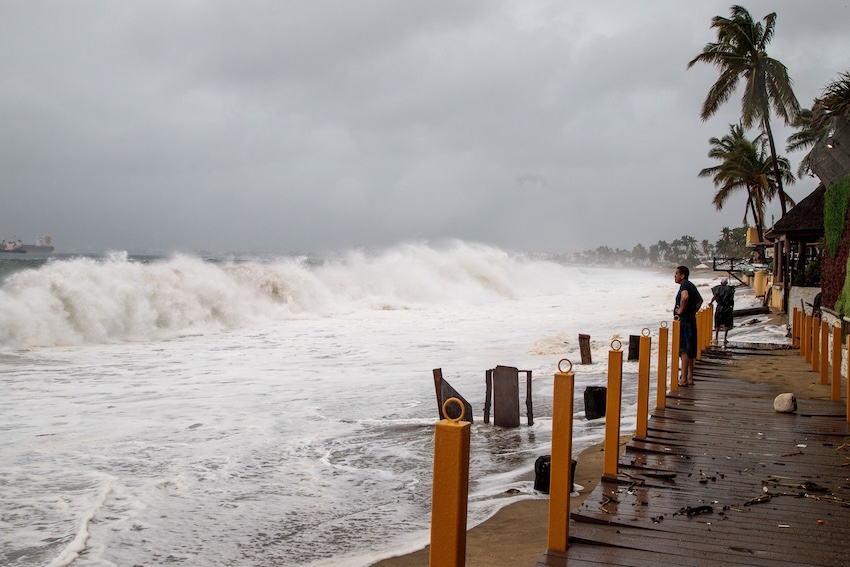
Hurricanes and their remnants impact nearly every corner of Mexico’s territory due to the fact that it is bordered by water on three sides. (Flor Larios/Cuartoscuro)
46) There are different types of households in Mexico; one of these is the single-person household, formed by just one individual. In 2023, 5.4 million such households were recorded.
(Source: INEGI, National Survey on Demographic Dynamics – ENADID, 2023)
Single-person households make up an increasing share of Mexican homes. This trend accompanies social changes such as later marriage, urbanization and a drop in fertility rates.
47) In 2023, the economic value of unpaid work performed by women in Mexico was nearly three times greater than that of men: 86,971 versus 36,471 pesos per year.
(Source: INEGI, Satellite Account of Unpaid Household Work – CSTNRHM, 2023)
Women carry out the large majority of unpaid domestic and caregiving tasks. This reflects persistent gender roles; unpaid labor remains central to household functioning, yet contributes to inequality in economic and social opportunities.
48) Between April and June 2025, 6.3 million people were employed in Mexico’s primary sector.
(Source: INEGI, National Survey on Occupation and Employment – ENOE, second quarter 2025)
The primary sector includes agriculture, livestock, forestry, fishing and hunting, and accounts for roughly one in ten jobs in the country.
49) In 2021, the main types of violence experienced by women in Mexico throughout their lives were psychological (51.6%), sexual (49.7%) and physical (34.7%).
(Source: INEGI, National Survey on the Dynamics of Relationships in Households – ENDIREH, 2021)
More than half of women in Mexico have faced psychological or sexual violence at some point.
50) There is a gender gap in caregiving for people with disabilities. In 2022, among those who provided this care, women dedicated an average of 35.9 hours per week, while men averaged 32.7 hours.
(Source: INEGI, National Survey for the Care System – ENASIC, 2022)
Most caregiving hours are still provided by women, who often balance these duties with employment and other family responsibilities.
51) What is Mexico’s literacy rate? In 1895 (the first year a modern census was carried out in Mexico), only 17.6% of the population aged 15 and over could read and write. By 2020 (the year of the most recent census), this had risen to 95.0%.
(Sources: DGE. General Census of the Mexican Republic, 1895; INEGI. Population and Housing Census – CPV, 2020)
Literacy rates in Mexico have risen dramatically in the last century, reaching near-universal levels today. Progress reflects expanded access to education and improved opportunities, though there are still regional and gender gaps in the country’s literacy.
52) Between 2000 and 2020, the average years of schooling for women in Mexico rose from 7.2 to 9.6 years; for men, it went from 7.7 to 9.8 years.
(Source: INEGI, Population and Housing Census – CPV, 2000 and 2020)
The gender gap in education has narrowed significantly, reaching near parity in years of schooling. Women are now equally likely — or even more likely in younger cohorts — to finish secondary or higher education, though differences persist in certain fields and access in rural areas.
53) In 2024, people with a disability in Mexico had an average monthly income of 6,927 pesos (US $377), compared to 10,366 pesos (US $565) for those reporting no disability.
(Source: INEGI, National Survey on Household Income and Expenditures – ENIGH, 2024)
This sizable income gap reflects continued barriers to education, employment and inclusion for people with disabilities. Inequality in pay and job access is even greater for women and those living in rural or marginalized areas.
54) Small grocery stores (tiendas de abarrotes) are the most common retail establishments in Mexico. In 2024, 672,075 of these businesses were registered.
(Source: INEGI, National Directory of Economic Units, 2024)
Small grocery stores form the backbone of the local retail economy throughout cities and rural areas. These stores play a crucial role in daily access to food, basic goods and community life, despite competition from large supermarkets.
55) In 2023, 214 billion cubic meters of water were sourced from groundwater, surface water, and rainfall for human use and economic activities in Mexico. This is equivalent to the volume of 85.7 million Olympic-sized pools.
(Source: INEGI, Economic and Ecological Accounts of Mexico – CEEM, 2023)
Agriculture is the largest consumer, accounting for almost a third of withdrawn water, followed by industry, services and households.
56) Between April and June 2025, microbusinesses employed 23.6 million people — 39.7% of the total working population.
(Source: INEGI, National Survey on Occupation and Employment – ENOE, second quarter 2025)
Small-scale enterprises are the most important source of jobs in Mexico, especially for self-employed workers and informal labor.
57) The Veracruz Reef System is a protected natural area where human activities and marine ecosystems coexist. In 2020, more than 809,000 people lived in 90 localities near this zone.
(Sources: INEGI. Línea de Costa – LIC, 2015; INEGI. Geo-statistical Framework – MG, 2020; INEGI. Population and Housing Census – CPV, 2020)
The region surrounding the Port of Veracruz is vital for biodiversity, tourism and fishing, while also facing pressures from development and environmental change.
58) The Total Fertility Rate (TFR) is the average number of children a woman would have over her reproductive years. In Mexico, this TFR dropped from 2.21 in 2014 to 1.60 in 2023.
(Source: INEGI, National Survey on Demographic Dynamics – ENADID, 2014 & 2023)
Fertility rates in Mexico have declined sharply, now among the lowest in Latin America. The change reflects later childbearing, greater access to education and contraception and shifts in family aspirations.
59) In Mexico, a dry climate covers 50.3% of the national territory.
(Source: INEGI, Climate – CLIM, 2020)
Most of northern and central Mexico is dominated by arid or semi-arid zones, with low annual rainfall and high evaporation rates.
60) In 2023, 52.4% of people who personally carried out a government trámite went to a government office; 16.2% used the internet.
(Source: INEGI, National Survey on Government Quality and Impact – ENCIG, 2023)
Most people still prefer in-person government services, though digital options are on the rise.