Home Blog Page 16

Mexico and the 1966 FIFA World Cup: The breakout year that wasn’t

0
Two national selection team members for Uruguay and Mexico battle on the soccer pitch for control of the ball during a game at Wembley Stadium. Fans, mainly men and boys, in trenchcoats, watch the game in the bleachers.
Mexico arrived at Wembley Stadium with a legendary coach and a strong team of Cup veterans and promising young players. So why couldn't El Tri make it past the group stage that year? (UAF)

Sixty years ago, the 1966 FIFA World Cup was staged in England, the spiritual home of the sport, where the rough street game had been given both rules and passion, and Mexico’s national selection team that year arrived at Wembley with an experienced Mexican coach and a team full of strong players.

Mexico’s play during the Cup was solid and steady, even against bigger names like England and France. The team had enthusiastic fans cheering them on at Wembley. Mexico was also on a high, having been chosen to host the next World Cup in 1970, as well as the Olympics in 1968. It all should have added up to a Cup performance to remember here in Mexico. But once the tournament started, the national team never made it out of the group round. What went wrong? 

A strong start 

Embed from Getty Images

Mexico’s 1966 World Cup team members pose for a photographer with London’s Evening Standard newspaper two days into the tournament.

The 1966 tournament, like many from the era, employed a format that remained largely unchanged: 16 teams in four groups, with the top two in each group advancing to the knockout stages. It was a very exclusive affair, with Europe and South America reserving 14 of the 16 places.

One spot went to North America — with Mexico always the favorite to qualify — and one had to be shared between Asia and Africa. In 1966, it was North Korea, of all countries, that came through a heavily boycotted qualifying tournament.    

Mexico had a far less controversial path to the finals. The first round of matches took place in March 1965, with Mexico’s national team dispatching Honduras and the U.S.

The second round started a month later, when Mexico joined the other group winners, Jamaica and Costa Rica. Two away games, a draw with Costa Rica and a 3-2 win in Jamaica put the Mexicans in control, and they went through undefeated. Over the two rounds, they had won six of their eight games, scoring 20 goals and conceding just four.

Isidoro Diaz, one of Mexico’s most underrated players of this period, was a standout with five goals.

A balance of veterans and bright young players
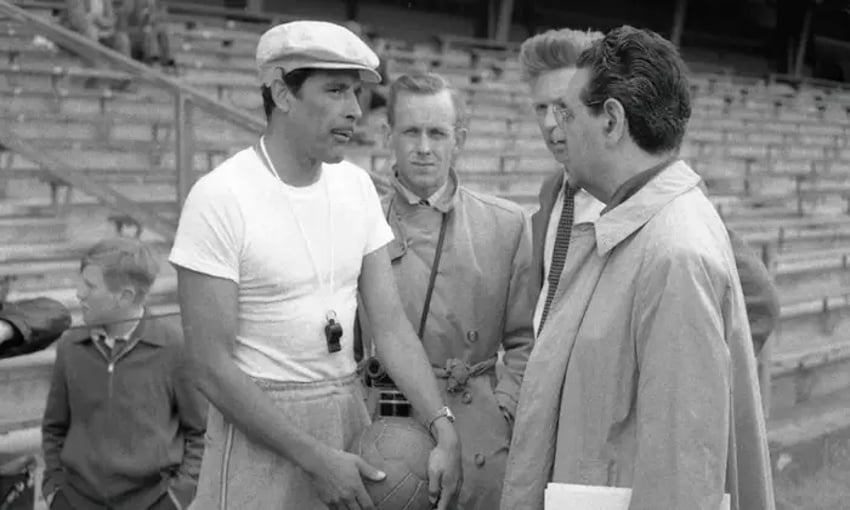
Legendary Mexican soccer coach Ignacio Trelles in a white men's tee and sweatpants, holding a soccer ball by his hips as he converses with three unidentified men in trenchcoats near the nearly empty bleachers of a sports stadium.
Mexico’s team in the 1966 World Cup was coached by legendary Mexican player and coach Ignacio Trelles, who was on his third Cup stint. (Mexsport)

The draw for the finals took place in the Royal Garden Hotel in London. For the first time, the ceremony was televised live. There were four pots, representing South America, Europe, Latin Europe and the rest of the world. The last group consisted of Mexico and North Korea, with Bulgaria and Switzerland considered the weakest of the European teams. By the time this fourth pot was brought forward, the groups were already taking shape, and Mexico was the first name out, placing them in Group 1 alongside England, Uruguay and France. 

Mexico started the World Cup year with a series of friendly games against local clubs. Preparations picked up momentum in June with the opening of Estadio Azteca. This was celebrated by a club tournament, after which Tottenham stayed on to play the Mexico national team, the visitors winning 1-0. The great Ignacio Trelles was the coach for his third World Cup tournament and was notably loyal to his regular players.

Even so, four years is a long time in football, and the squad for England was a balance of veterans (eight players from 1962) and new faces. Raúl Cárdenas was missing from the defense after three World Cups, but Gustavo Peña was an excellent replacement. Two young strikers, Aaron Padilla and Enrique Borja, had been added, and 22-year-old goalkeeper Ignacio Calderón was in the squad. Five of the players came from Club Deportivo Guadalajara, which was expected, as Chivas were the team of the decade, having won the Mexican championship in 1964 and 1965. However, 10 clubs would contribute players.

Antonio Carbajal’s milestone Cup

Upon reaching London, Mexico based itself in the Alexandra National Hotel. Little was known of Mexican football in those pre-Internet days, and the press, in search of a story, focused on Antonio Carbajal, the 37-year-old goalkeeper who would be appearing in his fifth World Cup. This is still a record — although barring injury, both Cristiano Ronaldo and Lionel Messi look set to play in a sixth tournament later this year.

There was a bit of drama before a single ball was kicked, with the World Cup trophy being stolen from a display. There was a ransom demand, an arrest and a hero dog who found the trophy while being taken for a walk.

Embed from Getty Images

The Jules Rimet Trophy is placed into a safe at Cannon Row Police Station in London, March 1966. Stolen at a public exhibition, the trophy was found a week later in a garden hedge by a dog named Pickles.

The tournament kicked off on a Monday evening with a dull 0-0 draw between England and Uruguay. Two days later, Mexico came out onto the Wembley pitch to play France. Despite 75,000 tickets having been sold, the stadium was half empty. Many fans had bought blocks of tickets to secure their seats for the semifinals and final, and it seems that some of these did not consider this a particularly attractive match.

However, there was no lack of support from the Mexican community in London, with the press photographers drawn to the small gathering of sombrero-wearing supporters that gathered in one section. It was all good-natured. When the fans got a bit excited, jumping up and down and waving their coats in the air, the police walked over more because they were bored than because they feared a riot.

Mexico vs. France

Embed from Getty Images

Mexican fans rush the field during the Mexico vs. France match. They placed a sombrero on the head of Mexican player Guillermo Hernández.

This match was a typical Mexican performance under Trelles, packing the defense and counting on quick counterattacks. Ignacio Calderón was preferred to the veteran Antonio Carbajal in goal, and while he seemed hesitant to come out of the six-yard box, he was a big man who would not be bullied on his line. There was plenty of action and a fair bit of muscle, the Mexican defense giving out as good as they received. The halftime band marched on with the score still 0-0, but then, in the 48th minute, Mexico produced the breakthrough. A young Enrique Borja muscled the ball away from Gabriel De Michèle, and although he was facing the wrong way, his natural striker’s instinct kicked in; he twisted and turned to put the ball into the net as if by sheer determination. Both sides now began searching for a decisive goal: France to get back in the game, Mexico to secure a second point.

The goal, when it came, was soft. France’s Gérard Hausser was outside the penalty area with four defenders between him and the goal. However, the defenders had not closed him down, and he saw the opportunity to shoot. His shot hit the post and had the luck to bounce in. It was one of only two goals Hausser would score in his short international career.

It was probably a matter of bad luck that Mexico didn’t come away with more. The team had an early goal discarded, and both sides might have claimed penalties. 

Mexico vs. England

Otra vez CAÍMOS con el ANFITRIÓN | Inglaterra vs México | Mundial 1966

During the 1966 match between Mexico and England, fans on both sides were on the edge of their seats for a full 37 minutes before either side scored.

Their second game was against England, which was probably the toughest of the two remaining matches. Mexico continued the same tactics, but more so, at times packing eight or more men between the ball and the goal, so England resorted to a series of long crosses.

The front men for England were Roger Hunt and Jimmy Greaves, small, nimble players who wanted the ball on the ground, and the home crowd grew restless as the minutes ticked by. Then, in the 37th minute, England finally scored. Bobby Charlton collected the ball in his own half, ran forward unchallenged, edged to his right to create more space and let off a blast from well outside the penalty area. It was probably the most iconic goal of a long and distinguished career.

Mexico came out for the second half a little more adventurous, but they also seemed limited to sending long balls into the area. Only Borja and Padilla showed any flair, reported The Times newspaper. The issue was decided in the 75th minute when Roger Hunt pounced on a mistake from Calderón to tap in a goal that was as scrappy and simple as the first had been brilliant.

Antonio Carbajal’s last World Cup appearance

England would not play their final game until the following day, so there were numerous permutations. However, presuming England did not totally collapse against France, then Mexico would have to beat Uruguay by at least two goals, while Uruguay would secure its place in the next round with a draw. The major change on the Mexican side was giving the goalkeeper’s jersey to Antonio Carbajal. Whether this was in order to secure his record of playing in five World Cups, or due to concerns over the way Calderón had fumbled the ball — leading to the second English goal — is uncertain. 

A respectable crowd of 61,000 gathered on a rainy and gray Tuesday afternoon. The first half was surprisingly one-sided, with Mexico running their more favored South American opponents into the ground. There was a stream of near misses, including hitting both post and bar, and one great save and lots of safe hands from goalkeeper Ladislao Mazurkiewicz. The English fans, always likely to cheer for the underdogs, became more pro-Mexican as the Uruguay defenders resorted to some nasty fouls.

An underestimated team

Whatever coach Ondino Viera said at halftime worked, and the second half saw Uruguay far more competitive in midfield. Both sides created chances, but the game ended goalless. The English press praised the performance of the “brave and now-underestimated Mexicans as they fought for a win.” Their play, the report continued, “was sharp and intelligent.” Isidoro Diaz was described as “a bulky left wing half with a silky touch and a fearsome tackle.” Enrique Borja and Aaron Padilla also got mentions. 

And so Mexico departed from the World Cup. They had taken two points, and the narrow defeat to England looked better and better as the home side made their way through the tournament. Much of the attention was once again on Antonio Carbajal and his fifth World Cup appearance.

“We shall never see the likes of Carbajal again,” suggested the Times.

Mexico, the reporter also noted, had played well and had only been let down by their inability to score. They might well, he predicted, be a force next time, when the tournament would be coming to Mexico.

Bob Pateman lived in Mexico for six years. He is a librarian and teacher with a Master’s Degree in History.
Mexico’s week in review: A CIA bombshell, a credit warning and the World Cup countdown

0
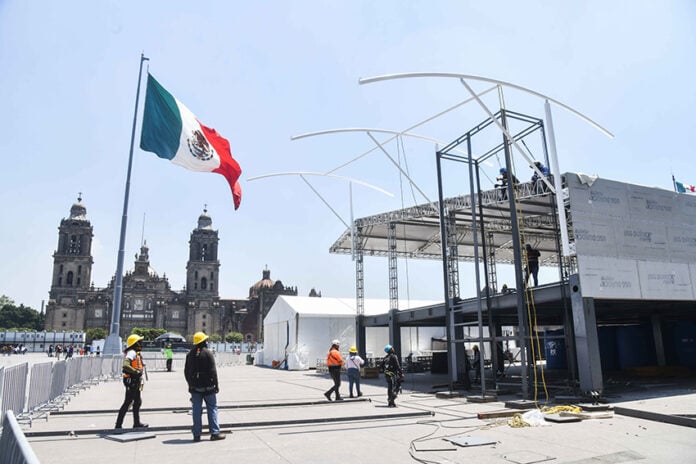
Workers install a FIFA Fan Fest stage in Mexico City's Zócalo plaza
Workers install a stage in Mexico City's Zócalo, one of 18 FIFA Fan Fest locations in the city, in preparation for the World Cup. (Mario Jasso / Cuartoscuro.com)

The CIA story that has shadowed Mexican-U.S. relations since late April took a new turn this week. On Wednesday, CNN published a report alleging that the CIA had orchestrated the assassination of a cartel figure on Mexican soil — a claim Mexico’s government rejected in unequivocal terms, calling it false, unverified and based on anonymous sources. At her mañanera, Sheinbaum went further, suggesting the report was part of a coordinated media campaign targeting her government — at the same time that a separate report identified Mexico as a target in an alleged U.S.-backed influence operation aimed at destabilizing left-leaning Latin American governments.

The week’s economic signals were mixed but consequential. S&P downgraded Mexico’s credit outlook from stable to negative and cut its 2026 growth forecast to just 1% — a blow that Finance Minister Edgar Amador quickly pushed back on, insisting Mexico is ready to grow and that the downgrade misreads the country’s fundamentals. Against that backdrop, tech exports reached a record high, cementing Mexico’s position as the United States’ top trading partner, while the European Union formally green-lit a new trade deal with Mexico ahead of a signing summit set for May 22.

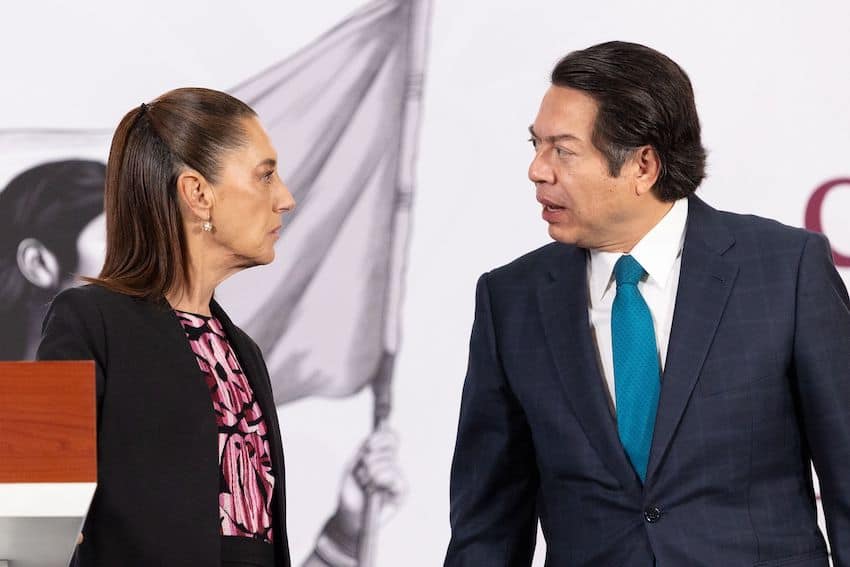
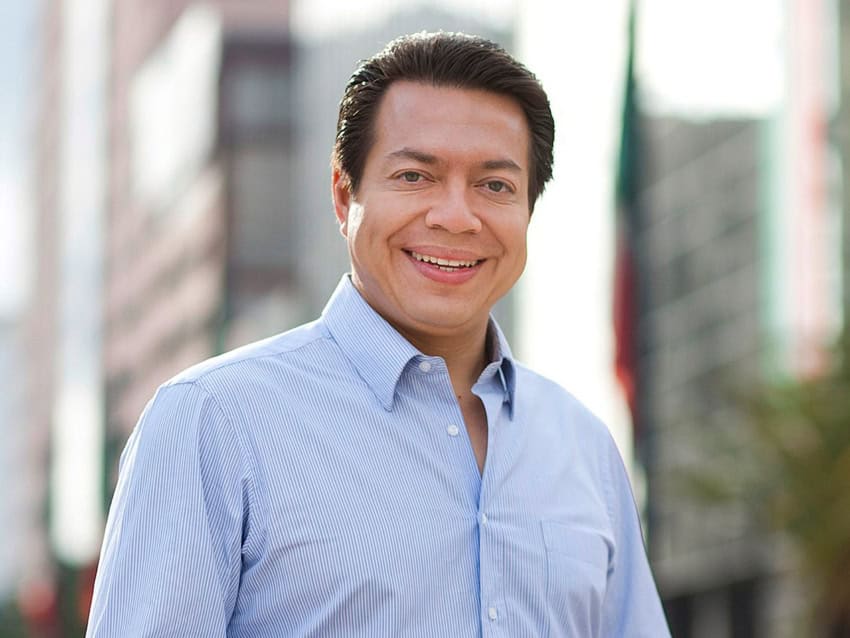
President Sheinbaum and Education Minister Mario Delgado
The week started with a reversal: The Education Ministry reaffirmed July 15 as the current school year’s end date, after Education Minister Mario Delgado, right, had previously announced that the school year would end more than a month early. (Moisés Pablo/Cuartoscuro)

Closer to home, a school calendar dispute that began last week escalated into a full-blown political controversy. After the Education Ministry announced that the current school year would end more than a month early, the pushback was immediate. The Ministry ultimately reversed its decision, confirming July 15 as the official end of the school year — a move Sheinbaum defended throughout the week despite sustained criticism. And with the World Cup now three weeks away, the tempo of preparations visibly accelerated: FIFA officially took possession of the Azteca and Mexico City Stadium became its new official name, while Mexico’s homegrown electric mini-car cleared a milestone of its own.

Didn’t have time to catch this week’s top stories? Here’s what you missed.


Mexico rejects CIA assassination report, calls it a media campaign

Mexico’s Foreign Ministry and Sheinbaum both flatly denied the CNN report alleging a CIA-orchestrated cartel killing on Mexican territory, with the Foreign Ministry stating that the claim has no factual basis. At Wednesday’s mañanera, Sheinbaum rejected both reports as false and, when asked whether the simultaneous CNN and New York Times stories and U.S. Senate testimony by the DEA chief amounted to a coordinated campaign, answered “yes” — attributing it to an “international right-wing movement” she said is “betting on the defeat and failure of the Mexican government.” The CIA story dovetailed with a separate report identifying Mexico alongside Honduras, Bolivia and other left-leaning governments as targets of an alleged U.S.-backed influence and destabilization operation — allegations the U.S. government has not confirmed.

S&P downgrade lands as trade data tells a different story

S&P’s decision to move Mexico’s credit outlook to negative and forecast just 1% GDP growth in 2026 cited fiscal pressures, weak investment and uncertainty around the USMCA review. Finance Minister Amador rejected that characterization, arguing that Mexico’s fundamentals are sound and pointing to strong export performance and planned public investment as evidence the economy is better positioned than the rating implies. The counterargument has some data behind it: Mexico’s tech exports hit a record, with the country now accounting for 16.3% of total U.S. goods imports in the first quarter — the highest share ever recorded — driven by electronics, medical devices and auto parts. Meanwhile, the EU’s approval of a revamped trade agreement with Mexico, set to be signed May 22, offers the prospect of diversified export markets at a moment when over-reliance on the U.S. is a source of economic risk.

Tech exports boom as Mexico cements top spot in US trade

USMCA: Mexico signals ‘no rush’ as July 1 review deadline nears

With the USMCA’s mandatory review deadline approaching, Sheinbaum told reporters Thursday that there is no rush and Mexico will not accept terms that compromise its interests simply to meet an arbitrary deadline. Sheinbaum said negotiations are proceeding at the pace dictated by their complexity — and that a good deal is more important than a fast one.

Pemex director out after a month of crises

Víctor Rodríguez, who served as Pemex director for approximately 18 months before resigning this week, was replaced by the company’s chief financial officer, Juan Carlos Carpio. Sheinbaum said Rodríguez had accepted the position on the condition that he would remain for only a year and a half — a request she said her administration was now honoring. His final months in the role were marked by a major Gulf Coast oil spill and cover-up, along with declining production and other operational setbacks.

School year dispute: Backlash forces reversal of early-end plan

The week’s school calendar controversy had its roots in the prior week, when Education Minister Mario Delgado announced on May 7 that the school year would end June 5 — nearly six weeks early — citing extreme heat and World Cup logistics. The announcement drew immediate backlash from parents and local officials, and Sheinbaum said on May 8 that the change was “a proposal” and not yet finalized. The resolution came Monday, after a five-hour meeting between Delgado and all 32 state education secretaries: the July 15 closing date was restored. Sheinbaum said all 32 state ministers had agreed to maintain the original calendar, while allowing for state-level adjustments in cases of extreme heat or World Cup-related logistics.

World Cup: Azteca becomes ‘Mexico City Stadium,’ and Olinia gets a launch date

FIFA this week formally assumed operational control of the Azteca, which will be known as Mexico City Stadium for the duration of the tournament — a standard FIFA commercial requirement that bars non-affiliated sponsors from receiving exposure. The handover was not without friction: luxury box holders, who carry 99-year usage contracts, won a federal injunction against FIFA’s plan to restrict their access and remove personal property from their suites.

On a more celebratory note, officials confirmed that Mexico’s prototype electric mini-car, the Olinia, is complete and will make its public debut on June 7 as part of the World Cup buildup — a symbolic showcase for domestic manufacturing ahead of the tournament. A new survey, meanwhile, found that potholes rank as the top urban concern among city-dwelling Mexicans — above water supply failures, insufficient public lighting, traffic and crime — a finding with obvious implications for a country about to host millions of international visitors.

Tourism up, and Mexico courts Chinese visitors

International tourism grew 11.9% in March compared to the same month last year, despite concerns that the high-profile “El Mencho” military operation earlier this year would deter visitors to western Mexico — a sign that the impact on overall arrivals was limited.

On Friday, Tourism Minister Josefina Rodríguez unveiled Plan China at Sheinbaum’s mañanera, a government initiative aimed at moving China from 14th to 10th among Mexico’s largest tourist source markets by 2029. The plan includes debut participation at the ITB China fair in Shanghai and a targeted presence on Chinese social media platforms, including Weibo.

Looking ahead

The EU trade deal signing on May 22 will be the week’s most concrete diplomatic event, and a meaningful data point in Mexico’s effort to strengthen ties beyond North America. The USMCA talks are expected to begin in earnest the week of May 25, with a July 1 review deadline providing the clearest pressure point on the calendar. On the domestic front, the school year controversy is unlikely to fully subside — the policy reversal leaves questions about coordination between Delgado’s ministry and state governments that critics will continue to press. And as June 11 approaches, the World Cup’s organizational machinery shifts from preparation into execution: Mexico City Stadium hosts the tournament opener, and the country’s readiness — potholes and all — will be on display to the world.


Also in the news this week

Mexico News Daily

This story contains summaries of original Mexico News Daily articles. The summaries were generated by Claude, then revised and fact-checked by a Mexico News Daily staff editor.

Looking for last week’s round-up? Find it here.

How I’m outgrowing US exceptionalism: A work in progress

25
US flag and Constitution, U.S. exceptionalism
U.S. exceptionalism is the belief that the nation's founding principles and way of life make the United States inherently superior to all other countries. (Getty Images)

Like most kids growing up in the 1950s, I recited the United States’ Pledge of Allegiance every morning in school, along with singing “God Bless America” and “America the Beautiful” in school assemblies. I was conditioned to believe the United States was the best country, superior to any other in our democracy, equality and freedom. That fabled motto, “the land of opportunity,” is one example of what we call exceptionalism.

It’s more than that, though. Extreme versions of exceptionalism include the belief, especially among the world’s major powers, that not only are we better, but that our nation’s values confer a special status. The core message is, “My country, tribe or group is so special that we don’t have to play by the same rules that everyone else does. Unlike you, we’re uniquely good, advanced and enlightened, and we don’t answer to anyone but ourselves.”

Overcoming US exceptionalism

Flag of Mexico
An exposure to other countries, as well as to their flags and national anthems, is a good antidote to U.S. exceptionalism. (Alexander Schimmeck/Unsplash)

Fortunately, my dad was a diplomat, and my exposure to other countries while growing up was my first influence in outgrowing my sense of U.S. exceptionalism. At school assemblies in Argentina and Ecuador, for example, I sang their national anthems too, and in Pakistan, I studied the history of the Indian subcontinent, including the tragic story of the Partition.

An international childhood, though, didn’t completely immunize me from exceptionalism, as I discovered when I moved to Vancouver in the early 1970s. After graduating from college, I was surprised — and embarrassed — to discover that Canadians knew a lot more about American history and politics than I knew about Canada. My understanding of Canadian culture consisted of images of the Royal Canadian Mounted Police and “Anne of Green Gables.” Indeed, ignorance of other countries is an example of exceptionalism. 

I would be reminded of my ignorance again, 40 years later, when one of my Spanish teachers in Guanajuato — where my husband and I live part of the year — gently corrected my misconceptions about the Mexican-American War. I believed that Mexico had invaded the U.S., whereas the war actually began in a disputed area. My teacher was so gracious and polite about it; he didn’t make me feel stupid, but I was still embarrassed.

Why ‘Americans’ know so little about other countries

While I don’t defend it, there’s a reason why folks from the U.S. know less about Mexicans and Canadians — and many other countries, for that matter — than vice versa. Throughout history, lesser powers have had to know more about dominant empires in order to survive. Because the odds are against them, they study their potential adversary carefully and strategically. We who belong to a more powerful nation, on the other hand, often suffer from complacency and arrogance.

The U.S. is not unique in its exceptionalism. When I married a Brit, he pointed out that the United Kingdom is the only country in the world that doesn’t include its name on its postage stamps.

Recently, the issue came up again. An article I wrote for Business Insider was titled, “We’re Americans who own a home in Mexico.” 

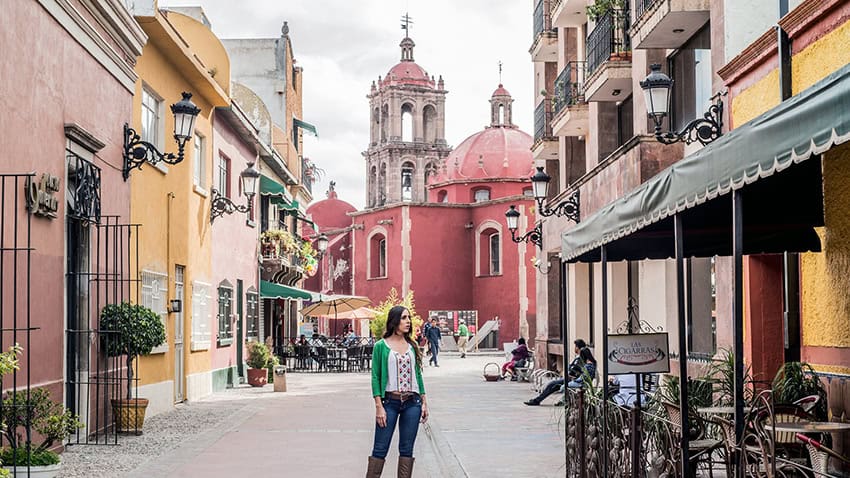
A cathedral in downtown Irapuato, Guanajuato
Describing oneself as American is problematic, since the same descriptor can be applied to virtually everyone in the hemisphere. In Guanajuato, the writer describes herself as estadounidense. (Visit Mexico)

“You shouldn’t have allowed the editors to describe us as ‘Americans,’” my husband objected.

He was right, but the truth is, I hadn’t noticed — again, my internalized exceptionalism.

U.S. citizens often use the term “American” to describe ourselves, while people all the way from Canada to Chile are residents of “the Americas.” In Mexico, I don’t refer to myself as norteamericana, because “North America” includes Canada and Mexico. Instead, I say, estadounidense. 

Living in Mexico for the last 21 years has been an ongoing wake-up call about how U.S. exceptionalism teaches you that everything is better in the U.S. Here are just three areas where Mexico excels:

Health care

Medical costs in Mexico are at least 50% lower than in the U.S., making services highly accessible without massive insurance premiums or deductibles. Plus, Mexican doctors spend more time with patients, offering a more personal experience.

Homelessness

Unlike the U.S, it’s rare to see Mexicans living in tent camps or on the street. Homelessness is less common in Mexico due to strong extended families that make it a priority to support relatives.

Indigenous rights

Also unlike the U.S., which historically operated with racial segregation, Mexico recognizes a vast number of Indigenous rights in its constitution, reflecting its unique, complex history.

A doctor cares for an elderly patient. Healthcare in Mexico podcast
Healthcare in Mexico, on average, is about 50% lower than similar care in the U.S., and with more personalized service. (Shutterstock)

As a U.S. citizen who has chosen to live abroad, I don’t denigrate the U.S., and I haven’t given up on it. It’s the country of my birth, my family and my culture. And I am indeed proud of some aspects of it — its Constitution and its national parks, to name two. 

But my long-term vision is for the U.S. to cultivate a more respectful, egalitarian and mature approach to globalism. To put it in kindergarten terms: “Our country is great, and so is yours. We each excel in different ways, so let’s learn from each other.”

I know, this sounds almost stupidly naive, as though I were five years old. But as the poet Robert Browning, himself an internationalist, said, “A man’s reach should exceed his grasp / Or what’s a heaven for?”

Meanwhile, my personal goal is to notice my exceptionalism, get past my initial defensiveness and keep on waking up, however long it takes. 

Louisa Rogers and her husband Barry Evans divide their lives between Guanajuato and Eureka, on California’s North Coast. Louisa writes articles and essays about expat life, Mexico, travel, physical and psychological health, retirement and spirituality. Her recent articles are available on her website, authory.com/LouisaRogers.

MND Tutor | Sargazo

0

Welcome to MND Tutor! This interactive learning tool is designed to help you improve your Spanish by exploring real news articles from Mexico News Daily. Instead of just memorizing vocabulary lists or grammar rules, you’ll dive into authentic stories about Mexican culture, current events and daily news.

Sargassum — the foul-smelling brown seaweed — is washing up on Mexico’s Caribbean beaches in record volumes, with the Great Atlantic Sargassum Belt surpassing 38 million tons in July 2025, a 40% increase over the previous record set just two years earlier.

Now, companies are trying to turn the crisis into an opportunity, collecting around 20,000 metric tons of sargassum per year along the Riviera Maya and processing it into agricultural biostimulants, a cosmetic emulsifier, and an experimental seaweed-based leather alternative.

Despite this ingenuity, sargassum blooms are expanding in both size and season, arriving as early as January now, and scientists warn that Atlantic current shifts linked to climate change could continue accelerating the crisis through 2050.

Find out how companies are fighting this threat and creating a more sustainable world by reading the full article here.


Let us know how you did!

Check out our complete MND Tutor archive here!

The MND News Quiz of the Week: May 16th

0
News quiz
(Mexico News Daily)

What's been going on in the news this week? Our weekly quiz is here to keep you on top of what’s happening in Mexico.

Get informed, stay smart.

Are you ready?  Let’s see where you rank vs. our expert community!

Which classic European band performed a concert on top of a bus in Mexico City's historic center this week?

According to a new federal government survey, what did 82.7% of respondents nationwide say is Mexican cities' worst problem?

Government official Víctor Rodríguez resigned after a troubled month. What position did he resign from?

What is Mexico's new "Plan China," announced this week?

Which international musical artist turned their Mexico City concerts from 2025 into a new live album coming out this month?

Which major economic power just greenlit an official date to begin negotiations to modernize its trade pact with Mexico?

The World Wildlife Fund has joined forces with which Mexican state to protect its jungles, mangroves and underground water systems?

"Olinia" made the news this week. What is Olinia?

Mexico issued a public health alert this week for what contagious pathogen, although no infections have been documented in the country?

The birth of three offspring in a Coahuila wildlife preserve in recent weeks has marked a milestone in what species’ return to northern Mexico?

Immerse yourself in authentic Japanese culture at this Tlaxcala boutique destination hotel

1
Japanese-inspired boutique hotel Japoneza in Tlaxcala
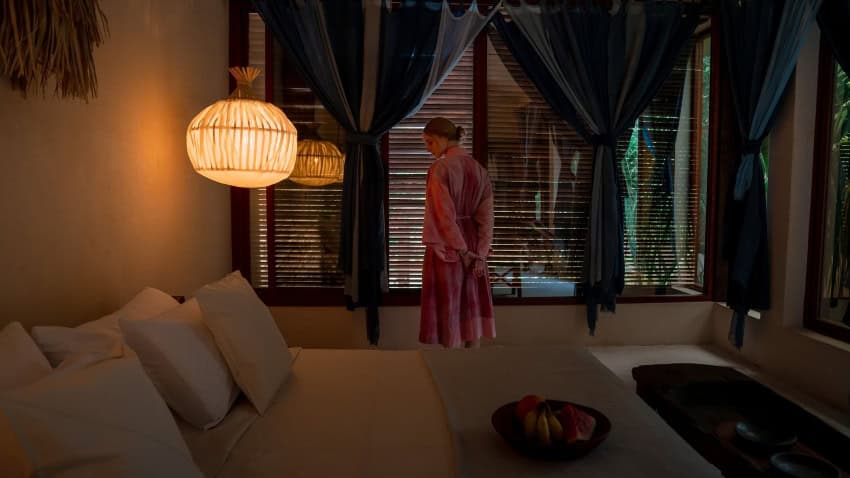
Japanese-inspired boutique hotel Japoneza is a beautiful retreat set in the middle of nature in Mexico's smallest state. (JapoNeza)

For decades, Mexico has maintained an ongoing love affair with Japanese culture — most commonly expressed through an addiction to ramen, anime and more. Indeed, Japan has been a fixture in Mexico’s imagination since 1897, when a small Japanese community known as the “Enomoto Colonization Party” arrived in Acacoyagua, Chiapas, to grow coffee as some of the earliest Japanese immigrants to reach Latin America.

Today, for those seeking to experience Mexico’s appreciation for Japanese culture in a truly unique form, there’s a hotel hidden in a corner of Mexico’s smallest state, Tlaxcala, that has been cultivating a Japanese-inspired retreat space for some years now: JapoNeza.

A Japanese retreat in the middle of nature

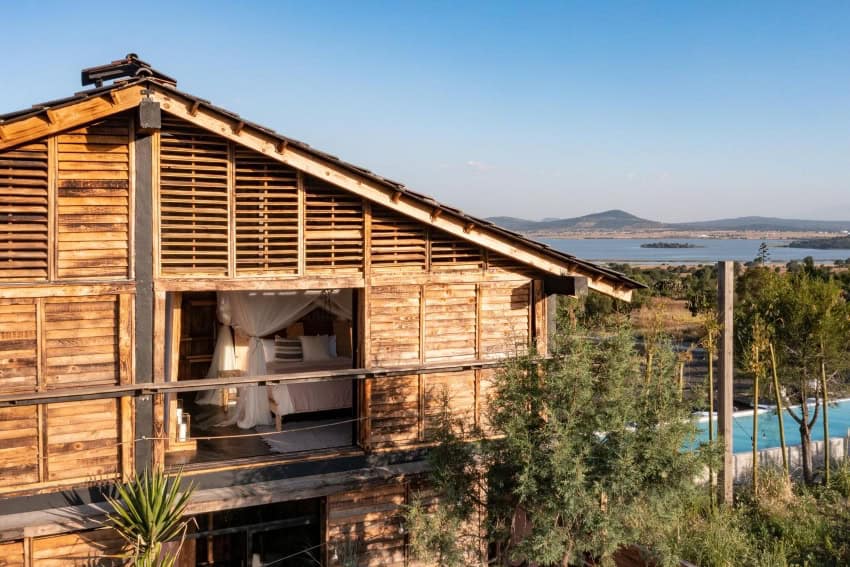
Backdrop of JapoNeza in Tlaxcala
JapoNeza enjoys a superb natural setting, with unobstructed views of Lake Atlangatepec and La Malinche National Park. (JapoNeza)

Picture this: an unobstructed view of the nearby Lake Atlangatepec. Horses running in the open, semidesert fields. In the far distance, La Malinche National Park awaits, looming boldly on the horizon. Tlaxcala is an overlooked destination, most certainly, offering the riches of pulque, haciendas and Indigenous heritage. 

And then you enter your room. A private onsen —  a Japanese thermal tub similar to a small jacuzzi that’s made from local cedar wood and covered in concrete — is at your disposal. You are immersed in Shinrin Yoku, a Japanese practice of therapeutic relaxation centered on immersing yourself in nature (in Spanish, translated as baño de bosque, or, in English, “forest bath”). There’s a cold-plunge pool too, all set inside the Japanese minimalist design of a boutique hotel.

“Here, you can watch the mountains while bathing. It’s a retreat,” says Claudia Terán, JapoNeza’s administrator. “You come here to be in silence, because all around us there isn’t anything. It’s just the lake and a mountain. No cars. Just our four horses. It’s completely silent.”

“We have a philosophy of being in contact with nature,” Terán elaborates on the concept of Shrinrin Yoku. “That’s our ambiance. You come here to enjoy an artisanal space completely made of wood. It was made in part by the local people, using local trees. Everything was salvaged from trees that fell naturally, so it’s rescued wood and 100% repurposed.”

“Everything is self-sustainable and recycled here,” she says. “The rooms and pools use solar panels. Whatever we can consume comes from us. We have chickens that produce organic eggs. We have a biodegradable system, and our water gets recycled to water the gardens. That’s part of the Japanese concept for us.”

Globally recognized

JapoNeza — which includes eight rooms spread across two buildings — has received multiple nominations for the best boutique hotel in Mexico, and has been recognized globally by international architecture associations. It’s also been featured in media outlets like Vogue.  

It’s certainly not the first nor only such hotel in Mexico. In 1959, the Sumiya (today known as Grand Fiesta Americana Sumiya) was opened in Cuernavaca, Morelos. A large-scale effort, the Sumiya was a notable Japanese-style estate in its time, with a garden that showcased Mexico’s botanical wealth. Much later, in 2018, a modern approach to Japanese lodging was introduced with Ryo Kan in Mexico City’s Little Tokyo neighborhood. The space is an authentic ryokan (a traditional Japanese inn that includes kimonos, tatami mats and more). Outside of that, however, JapoNeza has become the only such venue that can offer a true Japanese retreat outside of the nation’s capital.

Hotel bedroom at the Japanese-inspired JapoNeza
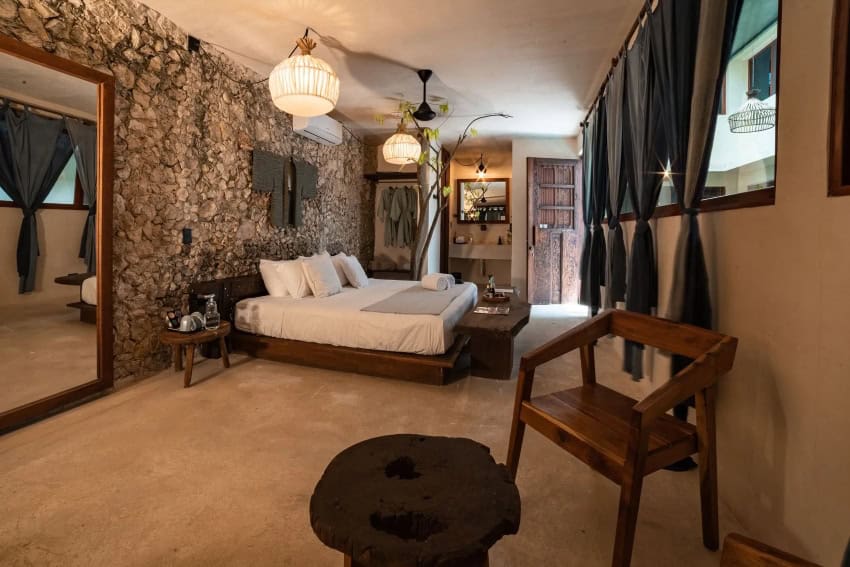
Japanese aesthetics are a distinctive feature of JapoNeza, which opened in 2020 in Tlaxcala. (JapoNeza)

JapoNeza first opened in 2020, atop a plot of land that was once a ranch. The vision originated with Fausto Terán, a Mexico City resident who purchased the land and designed the hotel himself after feeling inspired and connected to Japanese aesthetics, which derived from his years of martial arts training and trips to Japan.

A Japanese aesthetic

“The techniques on how to burn the wood, to protect it against termites, is a Japanese technique that Fausto learned in Japan,” says Laura Terán, his sister, who helps to manage the hotel’s daily operations.

For a state like Tlaxcala, which generally feels undervisited by tourists — often passed over by domestic and international travelers alike — JapoNeza stands out as a destination experience, ideal for those looking to escape the frenetic pace and overcrowded saturation of larger, more popular areas in favor of quiet contemplation.

The hotel’s kitchen features a combination of Mexican and Asian dishes, often made from scratch and using locally-grown ingredients — sometimes mixed in one bowl to create a singular fusion. 

“We make mixed food,” Terán says. “Pollo al Tocatlán [a regionally popular steamed chicken dish], but we include mushrooms and nopales. We have Japanese noodles, prepared with Asian sauces, but we will add spinach and whatever we have in season from our farm. We also make ramen in a Mexican way, using a pozole verde that is made with pepitas de calabaza, and then we add seaweed.”

After an energizing bowl of Mexican ramen, you can ride one of the horses across Mexico’s landscape or bathe in an open-air onsen. Or both.

Now also in Mérida

JapoNeza interior hotel layout in Tlaxcala
For those who appreciate JapoNeza’s unique charms, a second location has recently opened in Mérida. (JapoNeza)

It’s no surprise that the niche hotel has gained popularity with travelers looking for something different in central Mexico. In 2023, the Tlaxcala hotel expanded eastward, reaching the historic center of Mérida, near the shores of the Yucatán peninsula. 

Though it is ensconced in a busier urban location than its original counterpart in rural Tlaxcala, it’s still dedicated to the same Japanese principles of sustainable ecoconservatism and minimalistic design. 

“[Merida] is different, of course, but shares the same concept regarding natural appreciation,” Terán says. “No trees were cut down to construct the hotel. Instead, the hotel was built around the trees that existed, and they are now part of the rooms. The roots are respected.”

Some differences — besides being in an immediately more populous area — include more outdoor opportunities to cool off. (Note that the Mérida location is for adults only; Tlaxcala, in contrast, welcomes families and larger groups).

“The heat of Merida, it’s intense,” Terán points out. “The showers are outside, for example, to keep cool and refreshed.” 

Cultural connections

In terms of finding and maintaining the cultural bridge between Japan and Mexico — two nations that, on the surface, can seem at odds — Terán has ideas. And perhaps the two cultures are not as distant as one might initially assume, she says.

“Japanese culture represents order, the appreciation of natural life,” she says. “With the Mexican field worker, we have that in common. I work with many Mexicans who take care of the land, and I can see their love for their animals. It’s about contemplation and being in touch with what’s around us. That’s a commonality.”

Alan Chazaro is the author of “These Spaceships Weren’t Built For Us” (Tia Chucha Press, 2026), “Notes from the Eastern Span of the Bay Bridge” (Ghost City Press, 2021), “Piñata Theory” (Black Lawrence Press, 2020), and “This Is Not a Frank Ocean Cover Album” (Black Lawrence Press, 2019). He is a graduate of June Jordan’s Poetry for the People program at UC Berkeley and was selected as a Lawrence Ferlinghetti Poetry Fellow at the University of San Francisco. His work can be found in NPR, The Guardian, SLAM, GQ, L.A. Times, and more. He is currently based in Veracruz.

The boom up north: A perspective from our CEO

7
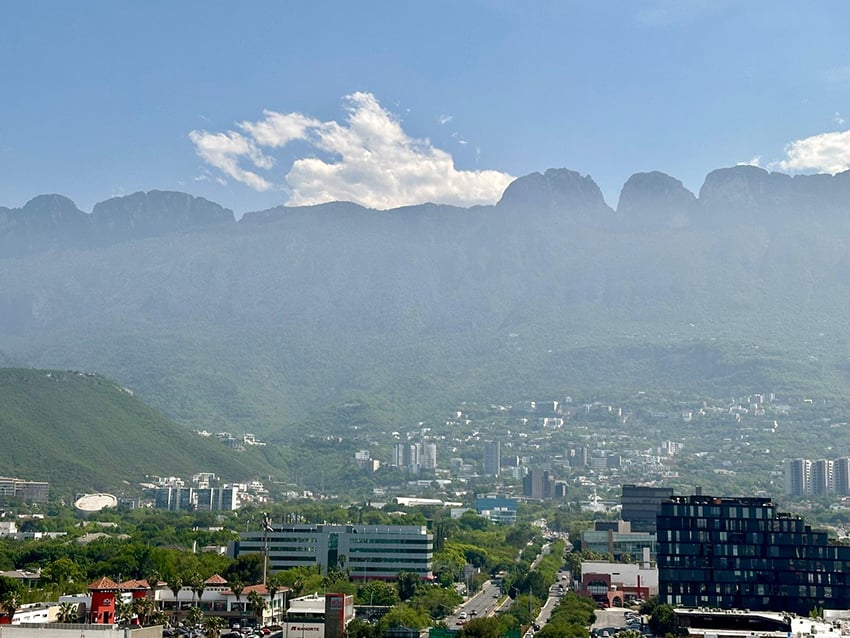
A cityscape of Monterrey, Nuevo León
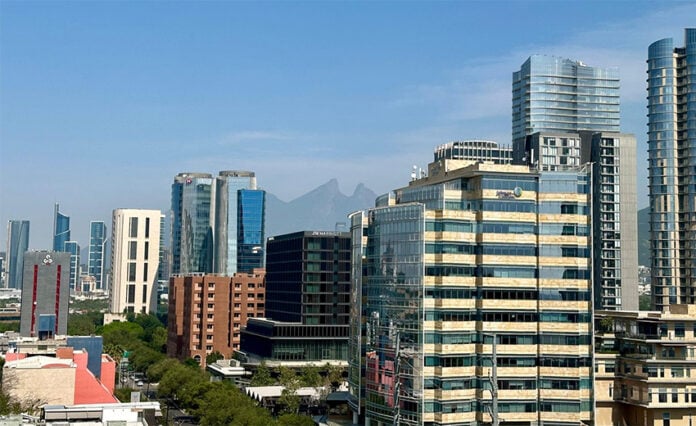
Mexico News Daily CEO Travis Bembenek recently visited Monterrey for the annual members meeting of the American Chamber of Commerce of Mexico's Northeast chapter. (Travis Bembenek)

At the risk of offending some Mexican friends, the northern city of Monterrey, Mexico, was not love at first sight for me. I vividly remember my first trip there, almost 30 years ago. I had recently been hired, fresh out of college, and the company I was working for had a quality problem with some product that had been sold to a customer in Monterrey. It was the middle of summer, the heat was unbearable, and nobody wanted to go — so they sent me to go check things out.

I assumed that the meeting would be held in our customer’s offices, and so I dressed accordingly (which was a full suit and tie back in those days). The meeting started off in their air-conditioned offices, but the customer then encouraged me to go see the extent of the problem firsthand in their warehouse. I accepted and was driven about thirty minutes away to an industrial park outside of town. As I was escorted into a massive warehouse, I quickly realized that it was NOT air-conditioned. Imagine the scene — temperatures in the upper 90s, me wearing a full suit, and spending hours opening pallets of dusty boxes to inspect the product inside. By the time the day had ended, I think I had lost 5 pounds from sweating so much, my new suit was a sweaty, dirty pulp, and I swore I never wanted to return to Monterrey. I didn’t see any reason to go back to the hot, dry, dusty industrial city again.

Skyline of Monterrey, Nuevo León
Monterrey, the northern state of Nuevo León’s capital, is now the second-largest metropolitan area in Mexico. (Travis Bembenek)

But come back I did, and frequently. Over the following 25 years, I estimate that I returned to Monterrey well over 50 times, each time learning to like it a little more. But when the pandemic came and I left the corporate world, I stopped going. I did not visit again until this past week — the first time in six years. The American Chamber of Commerce of Mexico graciously invited me to their annual members meeting for the Northeast chapter and I jumped at the chance to go check out the city after a long absence.

Of course, I have read a lot about Monterrey’s boom over these past years in Mexico News Daily. Foreign direct investment (FDI) has poured into the area. The population has increased dramatically — nearly doubling in the past 30 years to 5 million-plus people — and it is now the second-largest metropolitan area in the country. For perspective, the Mexico City metro area has grown over 30% while the Guadalajara metro area grew roughly 70% in that same time period. Equally impressive is the infrastructure boom of highways, trains, bridges, subways and more.

The governor of Nuevo León, the state in which Monterrey is located, is Samuel García. Samuel is a 38-year-old, supremely confident, ambitious politician who is not a member of the Morena political party. I first heard him speak two years ago at a meeting of businesspeople in Mexico City. He essentially told the audience that the rest of Mexico was getting left behind as Monterrey was racing ahead, while imploring them to come invest in Monterrey.

And in many ways, he is right. The state has taken in a significant share of the country’s FDI since the pandemic. An infrastructure boom is transforming the city. The airport, already much larger, is still expanding and rapidly adding flights to destinations across Mexico, North America, and even Europe and Asia. The city already has three subway lines and is currently building three monorail lines. Highways and train lines are being built to better integrate trade between the region and the United States. Dams have been built to address the water scarcity problem. New office and condo towers are going up everywhere, including what will be the second-tallest building in the Americas. It’s all pretty damn impressive.

A under-construction skyscraper and a partially built light rail in Monterrey, Nuevo León
New monorail lines, skyscrapers and other infrastructure projects are underway in Monterrey, including the soon-to-be second-tallest building in the Americas (at right). (Travis Bembenek)

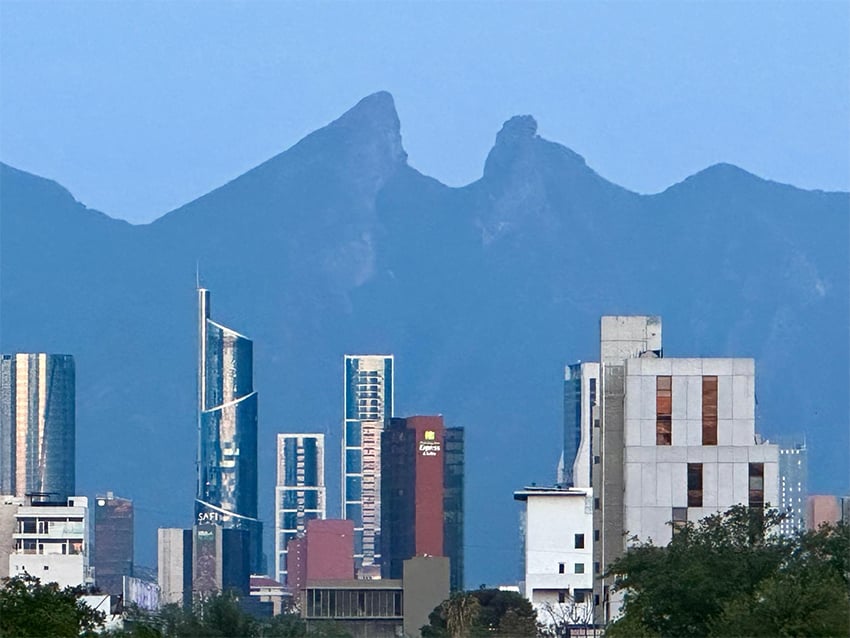
Many of our readers might be thinking, “Ok fine, but why would I ever want to go there?” My simple answer: To get inspired by the energy of what the people are accomplishing there, as well as be awed by the beauty of the mountains surrounding the city. People from Monterrey are very proud of their heritage and their mountains — and rightly so. They do not allow themselves to be so encumbered by the bureaucracy of the federal government. They are excited about the business opportunities ahead of them. They view themselves as the Texas of Mexico: part of Mexico, yet fundamentally different.

As the state economy minister, a bright young woman named Betsabé Rocha, reminded the AmCham meeting crowd: “The giant beer brewer Cervecería Cuauhtémoc had extremely humble beginnings, starting by making ice.” Her message was clear: that the people and companies of Monterrey have massive ambition and abilities to evolve and grow. Her message was also inspiring, as were many others at the meeting. It was fascinating to see so many women leaders presenting and attending, especially given Monterrey’s reputation for having a machista culture.

After the AmCham meeting, I met with Tatiana Cloutier. My timing was perfect. Tatiana started the week as the head of the Institute for Mexicans Abroad, working directly for President Claudia Sheinbaum. But that changed by the end of the week as Sheinbaum announced that Tatiana was stepping down to run for the governor of Nuevo León in next year’s election as a candidate for the Morena party. Over a lunch of tostadas and soft drinks at a humble local restaurant, we talked about why she wanted to run for governor.

Tatiana didn’t deny that Monterrey and the state were booming economically. She was clearly proud that it was attracting new residents from across Mexico, companies from around the world, and building impressive infrastructure. But she talked at length about her concerns that the boom was leaving too many in the middle and lower classes behind. In her words, too many Regios (as people from Monterrey are called) are seeing a rapidly increasing cost of living with a lack of focus on issues that matter most to them. Issues like improved security, water availability, education, bus routes, etc. In my very unscientific study talking to a dozen or so working-class locals, I heard similar concerns.

The city of Monterrey, Nuevo León
The mountains surrounding Monterrey are a point of local pride, providing a dramatic natural backdrop to one of Mexico’s most industrial cities. (Travis Bembenek)

Monterrey is a city on the move. A few days in the San Pedro area of the city will most certainly leave you inspired by the transformation and ambition of the city and its people. The views of the surrounding mountains will leave you awestruck — such beautiful nature so close to such a major city. The political future of the region will be fascinating to watch: if Tatiana is successful in bringing Morena leadership to a state that has yet to embrace a governor from the party, or if the state will continue to chart its own independent path.

As I returned to the airport in an Uber, I chatted with the driver, a recent immigrant to Mexico from Belarus. He told me he was on vacation a few years ago in Playa del Carmen and fell in love with his now wife, who is from Monterrey. They married, moved to the city two years ago, and just recently had a baby girl named María Elena. He proudly showed me photos of her on his phone. I asked him how life was. His answer: “Monterrey has been good to both me and my family.”

A proud immigrant to a booming city.

I encourage you to go check out what is now Mexico’s “second city.” You won’t regret it.

Travis Bembenek is the CEO of Mexico News Daily and has been living, working or playing in Mexico for nearly 30 years.

The short and unnecessary drama of Mexico’s aborted school year reduction

7
Two children playing outside in Mexico
The 2025-2026 school year in Mexico almost ended early, until parents nationwide complained. (Josue Michel/Unsplash)

When I heard the news last week that the Public Education Ministry (SEP) had decided that Mexico’s school calendar would be shortened by a month and a half — seemingly out of nowhere — I was already grouchy.

“A month and a half early? That’s got to be a prank,” I typed in a group chat I have with a few parents I get along especially well with. “Anyway, about this Mother’s Day event …”

Secretary of Education Mario Delgado
Education Minister Mario Delgado is the man ultimately responsible for Mexico’s brief attempt at shortening the school year. (ITAM)

The real source of my grouchiness at the time was the kids’ proposal — apparently accepted without question by the teacher — that we be invited to school to play a soccer game with our children. Competitive physical exercise as a Mother’s Day gift? I kid you not.

I was incredulous and ready to cause a stink about it.

A puzzling and preposterous idea

Alas, that soon faded into the background as I realized that we had more pressing issues to discuss — mainly, what we would do with our children for an extra month and a half this summer? And what would become of the lessons they hadn’t yet completed, or the exams? This particular generation of sixth graders had missed their kindergarten graduation because of COVID-19. Now, thanks to officials deciding to shorten the Mexico school calendar, it looked like they’d miss their elementary school graduation as well.

The first thing I watched was Education Minister Mario Delgado’s announcement on a Facebook post in which he explained that the school year was going to end on June 5 instead of July 15, as previously planned.

“Because of various circumstances and petitions, we’ve made the decision to move up the end of the school year,” he said in a recorded video.

Hmm. Circumstances and petitions? Like, from his kids?

The man behind the announcement

So who was this guy who’d decided “with other state education ministers” (and who are they, for that matter?) that the World Cup and hot weather in some parts of Mexico were good reasons to cut the school year short for the entire country with less than a month’s notice?

From what I could glean from a cursory internet search, Delgado is essentially a “party man” with Morena. He’s an economist who’s held various positions, including as a senator and as a deputy in the Mexican Congress. He also served as head of the Morena party and was the Mexico City education minister before that. He resigned as the Morena party boss in 2024 to join President Sheinbaum’s cabinet as her education minister.

Most glaring to me was the fact that he has not, as far as I can tell, ever worked in any capacity at a school. He hasn’t been a teacher or a principal. His degrees have nothing to do with education. Also, revealingly, Delgado was at the center of a controversy regarding some lavish spending habits by Morena officials — members of a political party whose central identity is built around austerity.

Now, my belief that all politicians should take a vow of poverty, priest-style, is another article entirely. They have not, but it’s still not a great look.

Does having kids qualify you to be education minister?

All this begs the question of why he was chosen as education minister. Surely, having once been a student and having kids who are students isn’t enough alone to qualify you to lead an educational institution. But it did seem to explain why he’d proudly announce such a preposterous idea.

Even more preposterous was his apparent surprise that anyone might have a problem with the new plan. I mean, how out of touch do you have to be with regular people to not realize that they might be upset about this? Did he assume that most Mexicans would be taking their children to World Cup games?

Some dumb reasons given for the calendar change

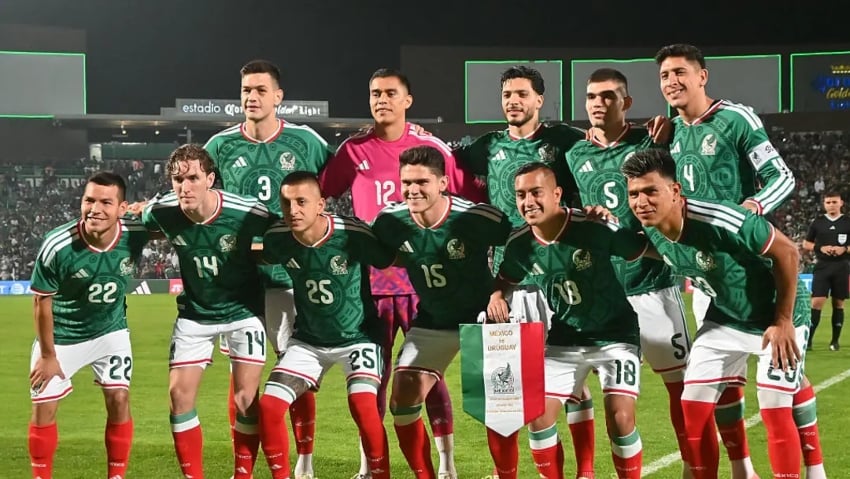
Mexico's national team for 2026 World Cup
What’s more important: World Cup games or the education of Mexico’s children? (Getty Images)

As both a parent with a child currently in the Mexican schools and someone who was a teacher here for years, I feel particularly qualified to comment on this, so let’s look at some of the points that he — or they, if I’m being fair, as the state secretaries apparently agreed unanimously on this calendar change — considered:

  • Some kids and their parents might want to watch or attend the World Cup 2026 games instead of going to school.
  • Some students might be affected logistically by the games.
  • In some parts of Mexico, it’s going to be hot during June, especially if you live in the desert. Maybe it will be too hot to go to school.
  • According to Delgado, kids don’t really do anything in their classrooms after June 15 anyway.
  • Parents unfairly treat the school as daycare (how dare they have jobs!), and teachers should get to rest instead of being required to babysit.

Some things they failed to consider

  • Shortening the school year in this way is illegal. Save for extraordinary circumstances — say, a worldwide pandemic — national law says there must be at least 180 days of classes. The exact number can vary between 180 and 200; this year’s original calendar was set for — and is once again — 185 days long.
  • Delgado hadn’t apparently run the idea by the president. On the day after his announcement, at her daily press conference, President Claudia Sheinbaum seemed to be put on the defensive. She responded by saying that the decision was not yet “set in stone.”
  • Childcare. In this economy, as in many economies, it is common for both parents to work. It is common for both parents to need to work, in fact. School is, indeed — at least in part — a very necessary daycare.

Gender assumptions are still alive and well

In a country that seems to be trying hard, at least at an institutional level, to find gender parity, it saddens me that basic gendered assumptions are so alive and well in Mexico. Aunts, grandmas, moms — there’s always assumed to be some woman in the family just sitting around, waiting to swoop in to care for children at a moment’s notice. When there’s not, that’s taken to be a private family problem, not an institutional one.

This is probably the point that made me the most upset. How telling that the decision-makers who wanted to shorten the Mexico school calendar apparently thought releasing kids a month early wasn’t a big deal at all! Morena may be a party of the poor, but its politicians are quite privileged. They would not have any trouble securing childcare for their own kids: They could afford camps, tutors and nannies.

The little people? Meh, they’d figure it out — just flatter them with how great they are: “Something something, strength of the Mexican family, something something.”

Really? Nothing happens during the last month of school?

As someone who was a high school teacher here in Mexico for five years, I can personally tell you that this idea is not true. Teachers have a curriculum. We plan our curricula and space them out in the time we have. The only time I didn’t “do much” academically with a class was the last couple of weeks when I had seniors about to graduate. But we still didn’t just sit around.

No self-respecting teacher is just going to sit around with their students doing nothing for a month, and the assumption that this is what happens speaks to the very little faith institutional leaders have in those charged with the job of educating the nation’s children.

Also, most families and many businesses make long-term plans based on the SEP calendar: When can summer camp programs be offered? When can families plan vacations? When should you set your ice cream cart outside of schools, and when should you make other plans? When do we need to talk to a boss or two to see if we can get reduced hours or an adjusted schedule in advance? All these “little people” logistics without the resources required for sudden change were apparently forgotten.

The plan is off again

Happily, the plan for the new calendar was quickly scrapped. What unnecessary drama! In his remarks regarding the backtrack, Delgado stated, “We know how to correct course because we know how to listen. The proposal of May 7 served its purpose of sparking a necessary debate about the flexibility of the school calendar.”

Uh-huh. Sure, man.

Once it was over, our busy parent chat for my kid’s classroom received a message: On June 5, the kids would be giving presentations on historical mathematical figures, and did we want to dress them up in Greek togas?

Mathematical formulas
A student presentation on historical mathematical figures — complete with toga costumes that parents would be asked to supply — had at least one parent reconsidering her opposition to the shortening of the Mexico school calendar. (Arthur Jalli/Unsplash)

“Sheesh,” joked one of the moms, as exhausted as the rest of us by endless school-related requests. “Maybe the school year should have ended on June 5.”

Mother’s and Teacher’s Day gifts

As for Mother’s Day? In the end, I didn’t go. My kid was sick with a bad fever, which is in line with most Mother’s Days for me — there’s always something, and those somethings are not usually cards or flowers.

I had actually been planning to go to our “soccer-game gift,” but the gods had other plans for me that did not involve me giving the teacher the stink eye for not having told her students, “Now, children, how about we think about something your moms might actually enjoy?”

But later, when the group leader asked for suggestions for a Teacher’s Day gift, I was ready.

“I’ve got it! We let her play soccer with our kids!”

Sarah DeVries is a writer and translator based in Xalapa, Veracruz. She can be reached through her website, sarahedevries.substack.com.

Víctor Rodríguez resigns as Pemex director after a month of troubles

5
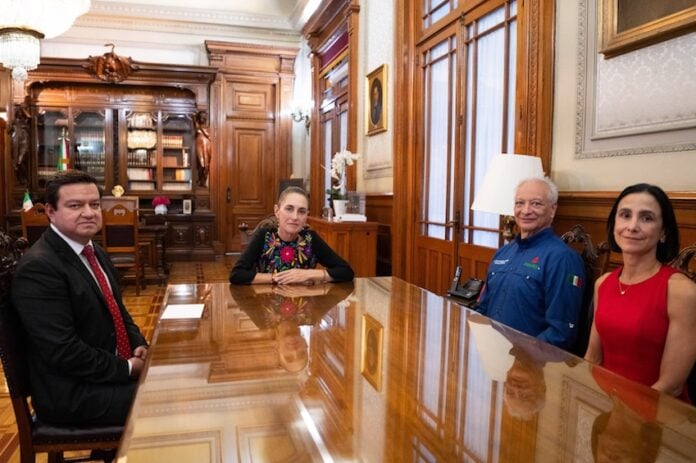
Sheinbaum, Rodriguez Carpio and Luz Gonzalez
Outgoing Pemex Director Víctor Rodríguez (right) and his announced replacement Juan Carlos Carpio met Thursday with President Sheinbaum and Energy Minister Luz Elena González Escobar. (Presidencia / Cuartoscuro)

President Claudia Sheinbaum appointed Juan Carlos Carpio to be the new director of Mexico’s state-owned oil company after the embattled former CEO stepped aside on Thursday. 

Víctor Rodríguez resigned to return to his academic pursuits and will continue to support the government from the Institute of Electricity and Clean Energy, Sheinbaum said.

Characterized as a resignation, Rodríguez’s departure was considered a foregone conclusion even before credit ratings agency S&P on Tuesday revised Mexico’s outlook to “negative,” citing the government’s continued fiscal support of the debt-ridden oil company. 

S&P reaffirmed Pemex’s credit rating (“BBB” with a negative outlook), but acknowledged that its “capital structure is unsustainable, given its low liquidity and high leverage.”

Rodríguez faced considerable criticism in April over a massive oil spill that affected almost the entire southern half of the Gulf of Mexico. 

After initial denials that Pemex was responsible, Rodríguez confirmed on April 16 that a pipeline belonging to the state-owned oil company was the primary source of the disaster, but insisted he was unaware of the problem and was misled by his subordinates.

Despite this, Sheinbaum said the oil spill had nothing to do with the change of leadership at Mexico’s flagship company.

In a video released Thursday night on social media entitled “Relevant news,”  (shown here in Spanish), Sheinbaum explained that Rodríguez’s departure was premeditated.

“When I won the election I asked Víctor to come help me at Pemex and he said, ‘I’m busy at the [national university], it’s going to be very difficult,’ but … after thinking about it, he told me, ‘Yes, I’ll help you, but on one condition, only a year and a half’,” she said.

Sheinbaum and Rodríguez have known each other for decades, studying physics at the National Autonomous University (UNAM), collaborating on academic projects and publishing papers together on energy matters while working at the Faculty of Sciences.

Sheinbaum tapped Rodríguez to head Pemex “to boost Pemex’s profitability and rescue the company from ballooning debt and recurring accidents,” calling him “an expert in energy economics and policy.”

For his part, Rodríguez said it was an honor to have served in Sheinbaum’s administration, saying “I retire with the satisfaction of having served with honesty and commitment.”

The newspaper El País reported that Rodríguez had twice submitted his resignation last year only to have Sheinbaum refuse to accept it.

In addition to the environmental disaster in the Gulf, Rodríguez’s tenure at Pemex was marred by a fatal accident at the Olmeca refinery in Tabasco, the failure to manage the company’s persistent debt while unable to attract foreign capital, significant financial issues including losses of US $2.6 billion in 1Q 2026 and declining oil production.

In January, Pemex reported a debt of approximately US $84.5 billion, a 13.4% decrease compared to 2024. The reduction was achieved due to the support of nearly US $22.65 billion granted last year by the Finance Ministry for debt repurchases and the issuance of pre-capitalized notes.

The appointment of Carpio, formerly Pemex’s finance director, must be approved by the Pemex Board of Directors.

An economist ​trained at UNAM, Carpio is close to Energy Minister Luz Elena Gonzalez, for whom he worked ​when she was head of Mexico City’s finances during Sheinbaum’s tenure as mayor of the capital.

With reports from Reuters, The Associated Press, La Jornada, Infobae and N+

Opinion: Sheinbaum, Meloni and Takaichi — a comparison worth exploring

17
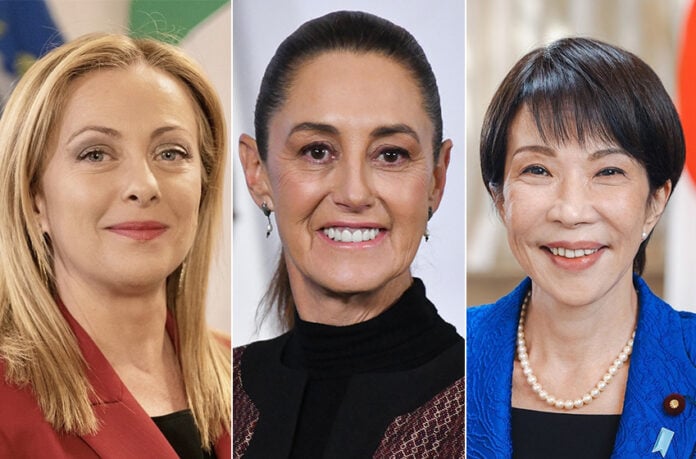
Italian PM Giorgia Meloni, Mexican President Claudia Sheinbaum and Japan PM Sanae Takaichi
Italian Prime Minister Giorgia Meloni, Mexican President Claudia Sheinbaum and Japanese Prime Minister Sanae Takaichi are each the first woman to lead their country. Is that where the similarities end? (Government of Italy/Cuartoscuro/Government of Japan)

Let me start with a confession. When I was first asked to compare Claudia Sheinbaum, Giorgia Meloni and Sanae Takaichi, my instinct was to push back. The piece felt like the kind of thing you write about women that you would never even think to write about men. Nobody, as far as I know, has published a piece comparing Macron, Xi Jinping and Trump on the grounds of them being males in positions of power. Beyond the fact that they are all women leading their countries, what is the basis for putting them in the same sentence? They disagree on almost everything: migration, climate, gender, China, the role of the state. Treating them as a category because they share a chromosome felt reductive.

Female heads of government are not news in themselves, either. Thatcher, Merkel, Bachelet, Indira Gandhi, Jacinda Ardern. The list is long, the ideological span runs from hard-right to socialist, and that already tells us something useful: Being a woman predicts almost nothing about how someone will govern.

So why bother?

Because the more I sat with the assignment, the more the discomfort was the point. In a world where machismo is not the exception but the operating system — in Mexico, in Italy, in Japan — the fact that three of the world’s largest economies are simultaneously led by women, each the first ever in her country’s top job, is genuinely remarkable. Thatcher, Merkel and Bachelet broke their ceilings one at a time, decades apart.

What is new in 2026 is that all three breakings happened almost at once. That is rare. And when history clusters its exceptions like this, I think it is usually trying to say something about the rules they’re breaking.

Three women, three doorways

Giorgia Meloni grew up in working-class Garbatella, raised by a single mother after her father walked out when she was a baby. She joined the youth wing of Italy’s post-fascist movement at fifteen, never went to university, and in 2022 became the first far-right head of government in Western Europe since 1945. Hers is now the third-longest-serving government in Italian republican history.

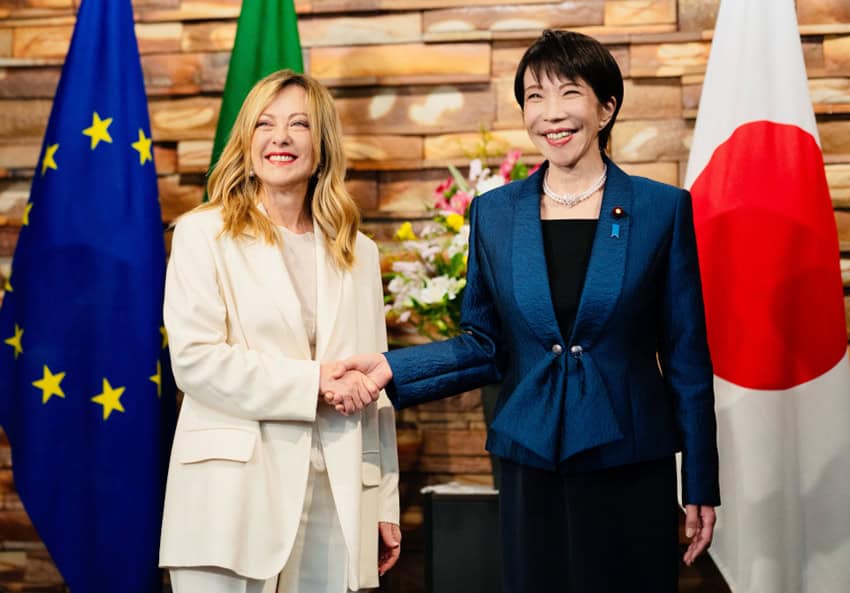
Italian Prime Minister Giorgia Meloni and Japanese Prime Minister Sanae Takaichi shake hands
Italian Prime Minister Giorgia Meloni and Japanese Prime Minister Sanae Takaichi meet during Meloni’s January visit to Japan. (Government of Italy)

Sanae Takaichi was a heavy-metal drummer in college and remains a vocal Iron Maiden fan. Her three declared political heroes are Margaret Thatcher, Shinzo Abe and Ronald Reagan. Protégée of the assassinated Abe, she won the leadership of Japan’s ruling LDP in October 2025; in February 2026 she gambled on a snap election and won a two-thirds supermajority, the largest ever for a single party in the lower house. The Economist promptly called her “the most powerful woman in the world.”

Claudia Sheinbaum is the daughter of two scientists who were also activists in Mexico’s 1968 student movement. She was a student activist in the 1980s and spent time at Berkeley while working on a Ph.D. on energy use in Mexico’s transportation and building sectors. In June 2024 she won 35.9 million votes — close to 60%, the largest absolute count in Mexican history — and used her constitutional supermajority to pass six amendments in her first three months in office.

What they share — and it isn’t what you’d think

Despite ideological distance, three patterns repeat. None came from a political dynasty. All three built their careers outside the inner circles of their establishments — and may govern with that outsider impatience because they did not inherit the system, so they owe it less. Each succeeded a charismatic male predecessor whose shadow still defines the landscape: AMLO for Sheinbaum, Abe for Takaichi, Berlusconi for Meloni. Managing a male predecessor’s ghost — invoking him when useful, distancing oneself when necessary — is one of the most consistent challenges of female leadership in major economies. And none campaigned on gender, yet all three are judged through it: Meloni’s voice is “shrill,” Takaichi’s marriage history is dissected, Sheinbaum is “cold” and “robotic.” Descriptors that almost never travel to male leaders.

How each is actually governing

Eighteen months into Sheinbaum’s term, three-and-a-half years into Meloni’s, and six months into Takaichi’s, we have enough material to evaluate not just their arrivals but their actual records. The scorecard below tracks six dimensions; four are worth pulling out in prose.

On the economy, all three have so far avoided crises. Italy under Meloni has grown slowly — projected GDP growth of 0.6%-0.8% — but kept its deficit near 3% and absorbed €194 billion (US $226 billion) in EU recovery funds. Mexico under Sheinbaum has held macroeconomic stability through a turbulent year: Foreign direct investment hit a record $36 billion in the first half of 2025, the major credit rating agencies have all kept Mexico’s rating intact, and growth has been sluggish at around 0.7%. Japan under Takaichi has rolled out a roughly $134 billion stimulus, heavy on semiconductors, AI and strategic technology — too early to judge results, but large enough that markets are paying attention.

On security and sovereignty, the three look most different. In Mexico, perceived insecurity remains the country’s top concern: 48% of Mexicans named it the country’s main problem in March, even as government data has reported falling homicides since October 2024. In Italy, Meloni’s government issued more than 450,000 migrant work permits between 2023 and 2025 — a quietly pragmatic policy that contradicts her hardline rhetoric. In Japan, Takaichi has redefined the country’s posture more dramatically than her domestic predecessors: She accelerated the timeline to reach 2% of GDP in defense spending, lifted decades-old restrictions on lethal weapons exports, and broke long-standing strategic ambiguity by stating that a Chinese attack on Taiwan could trigger a Japanese military response. Beijing retaliated with flight cancellations, seafood import bans and increased military patrols.

And then there is the Trump factor.

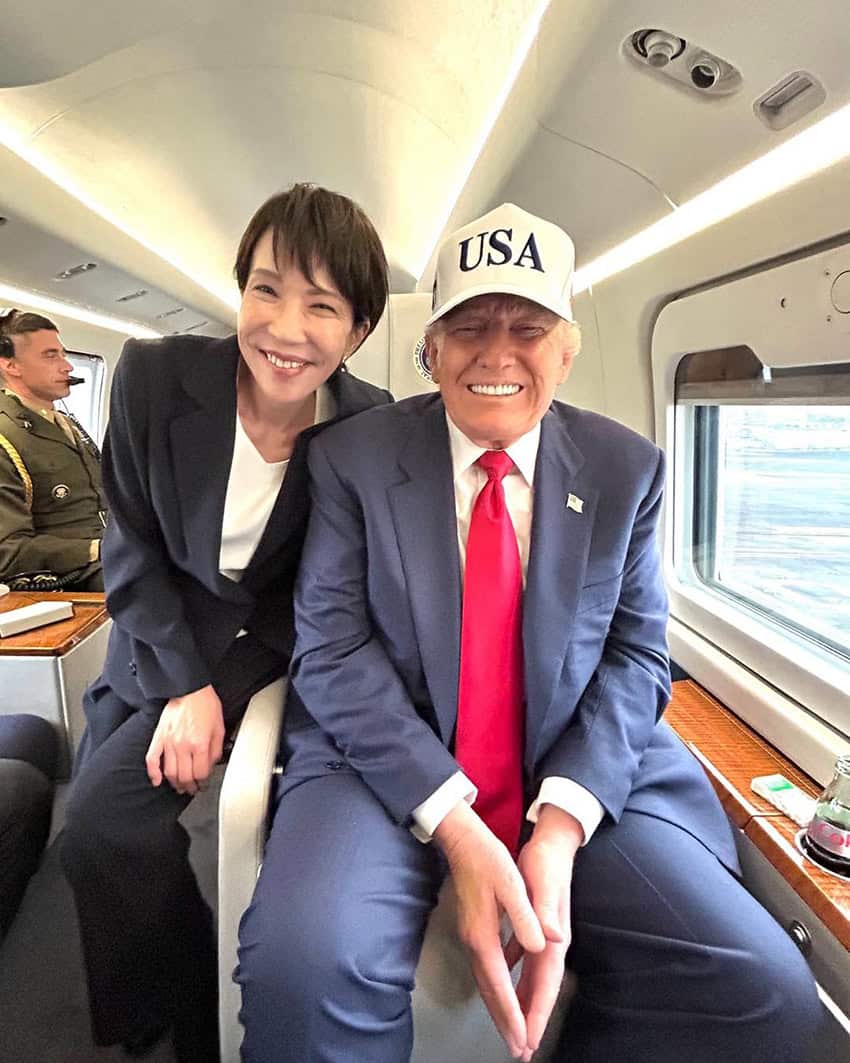
Trump’s relationship with Meloni was, until early this year, the warmest of any European leader’s; she was the only one to attend his second inauguration. That changed in April, when Trump publicly attacked her over her support for Pope Leo XIV and her position on the Iran war, calling her “much different than I thought.” The relationship has cooled. Takaichi has been more careful. She has kept the relationship warm but said little, and six months in, I think Washington still cannot quite tell what kind of partner she is going to be. That ambiguity is probably her foreign policy at the moment.

Japanese PM Takaichi poses for a photo with Trump on Air Force One
Takaichi maintained a friendly but neutral relationship with the U.S. and President Trump. (Sanae Takaichi)

Sheinbaum, by contrast, has executed what most analysts now consider a textbook performance under impossible pressure. She has avoided retaliatory tariffs; secured at least three separate extensions on Trump’s tariff deadlines; kept USMCA largely intact through repeated 25%, 30% and 35% threats; and, according to multiple reports, earned the personal respect of Trump and his inner circle, including Stephen Miller. Her formula has been to keep a cool head and maintain mutual respect. She publicly emphasizes that “dialogue and respect have prevailed” while quietly tightening cooperation on fentanyl interdiction, migration and — controversially — imposing tariffs of up to 50% on roughly 1,400 goods from China and other Asian countries without trade agreements with Mexico, a move that aligns Mexico with U.S. concerns about Chinese transshipment. So far, only Sheinbaum has so far managed to turn the experience of being cornered into something that looks like a strategy.

Finally, on the question this article is really asking — what each has actually delivered for the women coming after — the contrast is sharp. Meloni and Takaichi run conservative governments that have actively rolled back, or refused to advance, gender-related rights: Meloni has tightened reproductive politics and restricted LGBTQ+ family rights; Takaichi opposes same-sex marriage, separate marital surnames, and female imperial succession. Sheinbaum is the only one who openly identifies as a feminist; she elevated the women’s affairs body to a full Ministry and has pushed substantive-equality reforms — though Mexican feminist movements remain critical of how much of that agenda has been substantive versus rhetorical.

The harder question

So we have three women, three exceptions, three different politics. The interesting question is no longer whether their gender matters — it clearly does, in the obstacles they have faced and the scrutiny they receive — but whether their gender is producing different outcomes. And the honest answer, eighteen months in, is: I cannot really see it. Not yet, anyway. Not in the ways we were promised.

There are two competing theories. The optimistic one says women in power govern differently: more cautious, more consensus-driven, less prone to the testosterone-fueled brinkmanship that produces wars, market crashes and constitutional crises. The skeptical one says the opposite: women who reach the top in male-dominated systems do so precisely by out-hawking the men. They have to be tougher, more disciplined, more willing to break things, because the margin for error is smaller. Thatcher, the original Iron Lady, is the patron saint of this theory.

So look at our three. Each one shows us, in her own way, what governing actually costs. And what they show is not as neat as we might like.

Meloni has been smarter than her rhetoric. She governs to Berlusconi’s right on migration but to his left on Europe — this is calculated moderation, not a softening. The 450,000 migrant work permits she quietly issued between 2023 and 2025 are the gap between the speech and the governing. Isn’t this the most interesting thing about her premiership? Then in April 2026, when Trump pressured her over Pope Leo XIV, she stood with the Pope. You can disagree with everything else she has done and still recognize that for what it was: a leader choosing conviction over advantage, which is rarer than it should be.

Takaichi has done in six months what three decades of Japanese prime ministers would not attempt. She has accelerated rearmament, broken strategic ambiguity on Taiwan, and visited the Yasukuni shrine in a way her male predecessors only dared in private. Whether that is courage or recklessness, we will only know later. What is harder to argue is that she did not know what she was doing. She knew and did it anyway. In a moment that confuses noise with strength, a leader who acts quietly but forcefully is worth watching.

Sheinbaum’s record under pressure is the most instructive of the three, because the pressure on her has been the most relentless. She has never raised her voice or lowered her standards — a rare trait in Mexican politics. She held the line against Trump’s tariff threats by acting as if the line did not need to be defended — which, as it turned out, was the right way to defend it. Judicial reform is where admiration gets complicated, but in the first days of April we learned that Morena congressmen are proposing an update, which could address some key concerns of judicial reform critics. Anyhow, history grades on what gets left standing, and we will not really know that for years.

This is going to sound like a joke except it isn’t. Three women walked into the hardest rooms in the world. One chose conviction over favor. Another chose action over approval, even when the action was the kind that closes doors permanently. The third chose “cabeza fría” over confrontation, and turned it into the most underrated form of leverage of the year. None of them looks particularly cautious. None looks consensus-driven. All three look, in their own ways, like leaders who reached the top by being harder than the men around them — and who are governing accordingly. That is not a failure of female leadership. It may be the most honest demonstration we have ever had of what the top of politics actually requires of anyone, regardless of gender. None of them chose easy, because  none were offered easy.

I think this is the real finding. The table doesn’t change because of who sits at it. The people who sit at it may not share an ideology, or a background, or even an ambition the rest of us would recognize. What they share is the loneliness of those who got to the top and found out power is nothing like they had been told. In a few decades, we will discuss their legacies and get to a fair scorecard. Hopefully by then we will be talking about the office itself — what it selects for, what it rewards, what it slowly asks you to give up in exchange for keeping it. They didn’t invent those terms. They, like us, inherited them.

Let us know what you think in the comments.

Maria Meléndez writes for Mexico News Daily in Mexico City.