Home Blog Page 269

State by Plate: Three cheers for Puebla!

3
A chile en nogada served on a plate
The little state of Puebla packs a culinary punch that few other states could only dream of. (Julia Estrada)

The legends of Mexican food run deep in the highlands, and in Puebla especially. I don’t think it’s that important whether Dominican nun Andrea de la Asunción prepared the first mole poblano circa 1681 at the Convento Santa Rosa, or that it was served to viceroy Tomás Antonio de la Cerda y Aragón. Nor do I think it matters whether she invented it after acquiring her complicated recipe via divine inspiration. Likely, she didn’t invent it at all. Nor did Fray Pascual, who legend has it stumbled at just the right time while preparing a dish for viceroy and bishop Juan de Palafox y Mendoza, and thus accidentally spilled chile peppers and chocolate into a pot filled with turkey.

What’s important is that there are so many of these legends because they highlight just how central mole poblano is to Mexican cuisine and cultural history. It’s a crown jewel of a dish; one that has stood the test of time and deserves mention among the great achievements in worldwide gastronomy.

A decorative plate filled with mole poblano and rice.
Mole poblano remains the pride of Puebla’s gastronomy, as it has for hundreds of years. (Visit Puebla)

Puebla, the ancestral home of mole poblano, is not short on iconic dishes either. Like Oaxaca, it’s one of Mexico’s gastronomic capitals and boasts a lengthy list of mouthwatering achievements. However, in the interests of space, let’s focus on just three.

The birth of mole poblano, Mexico’s culinary masterpiece

Mole as a dish originated during Mexico’s pre-Hispanic past. It was a complex sauce even then, 500-plus years ago, prepared as it was ceremonially by the Mexica with ingredients such as chile peppers and pumpkin seeds. Those ingredients are still used in today’s moles. Chocolate was a later addition, as were ingredients brought by the Spanish colonizers, such as cinnamon, cloves and anise. Thus, rather than being invented in a burst of creativity, most modern culinary historians think that mole experienced a long and gradual evolution.

However, since the first mole poblano recipes weren’t written down until the 19th century, the steps of its particular evolution can only be guessed at. Over time, its ingredient list has shortened, decreasing from over 100 to around 20. These typically include multiple varieties of chile (ancho, chipotle, mulato and pasilla, notably), nuts and seeds (peanuts and almonds for the former, sesame and pumpkin seeds for the latter), plus fruits and culinary staples such as tomatoes, tomatillos, onions and garlic. Turkey or chicken is typically the protein of choice.

Individual ingredients are prepared multiple ways, from grinding and toasting to frying and straining. Given this complexity, mole poblano historically was known for being incredibly labor-intensive and taking days to prepare. As a result, it was often saved for special occasions. That tradition continues today, even as modern mole pastes and powders have generally made cooking the iconic sauce considerably easier and less time-consuming.

Mole poblano remains the most famous of Mexico’s more than 300 regional mole sauces. It’s a living testament to hundreds of years of culinary inventiveness in Puebla and fascinating even without its imaginative origin stories.

The patriotic origins of chiles en nogada

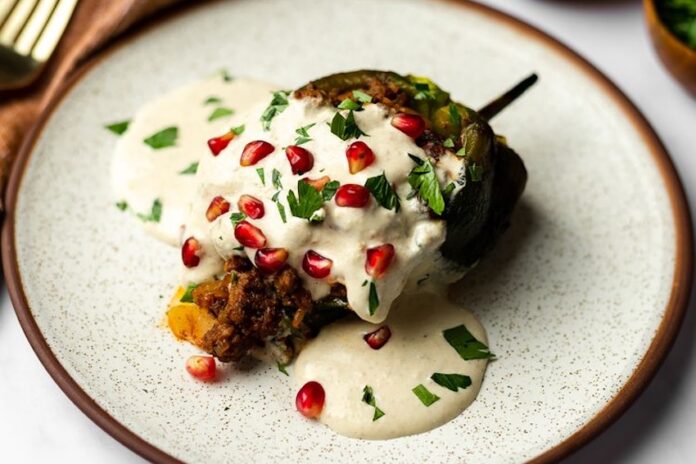
A plate of Chile en nogada, an example of Puebla food
It’s no coincidence that the colors of chiles en nogada mimic those found in the Mexican flag. (Ahleli/Wikimedia Commons)

Nearly as delicious and more aesthetically pleasing — thanks to ingredients that mimic the Mexican flag’s colors — chiles en nogada dates back to the period of Mexican independence. As the story goes, and just as with mole poblano, there are several to choose from — the dish was created to honor Agustín de Iturbide, the ill-fated future emperor of Mexico (he would eventually face a firing squad), after he had signed the Treaty of Córdoba formalizing the end of the war with Spain and establishing Mexican independence in 1821.

Iturbide visited Puebla four days after signing the momentous treaty and was feted on his saint’s day — August 28th in the Catholic calendar celebrates Saint Augustine of Hippo —with a dish incorporating seasonal ingredients: chile poblano stuffed with pork, fruits and pine nuts and slathered in nogada — or walnut — sauce made from the selfsame nuts along with almonds, milk, cheese and sugar added. Topping the dish is a colorful mix of pomegranate seeds with a parsley garnish to ensure the proper red, white and green color scheme.

According to local lore, the feast for Iturbide was organized by the Bishop of Puebla, with the featured dish created by Augustinian nuns from the Convento de Santa Mónica. However, as the mole poblano legends indicate, nuns were in abundant supply in Puebla. Hence, an alternative theory exists crediting the dish to the Clarisas — Franciscan Poor Clares nuns — who had invented it well before Iturbide’s visit.

If this version is correct, the dish was created in the 18th century, with the recipe revived by a local society of ladies for the august (literally) occasion in 1821.

Interestingly, the dish is believed to have originally been conceived as a dessert. Today, of course, it’s an entrée.

The proto-pastor: tacos árabes 

Three tacos arabes served on a plate, an example of puebla food
Tacos árabes evolved from Middle Eastern shawarma and later led to tacos al pastor. (Jicara y Molinillo/Wikimedia Commons)

Speaking of all these nuns, I have a confession to make. Despite loving mole poblano and chiles en nogada, I don’t eat those dishes with anywhere near the frequency of tacos árabes. Here’s another: If I had to list my favorite tacos, tacos árabes would be above tacos al pastor.

That’s perhaps not so controversial, given that tacos árabes were the progenitor of tacos al pastor: Meat cooked on vertical spits, shawarma style, was a cooking method brought to Mexico by Middle Eastern immigrants who settled in Puebla in the 1930s.

Two establishments, La Oriental and Tacos Bagdad, are credited with pioneering tacos árabes beginning as early as 1933. However, changes began to be made almost immediately. Due to being more readily available, the traditional lamb was replaced with pork loin on trompos, as the vertical spits are known in Mexico, and the pita bread that originally accompanied the tacos was soon improved with the flour tortilla.

Salsa, too, was soon added as the tacos were transformed from a Middle Eastern specialty to a Mexican one. That process would continue in Mexico City, where tacos árabes ultimately gave birth to tacos al pastor in the 1950s, thanks to achiote marinades and smaller corn tortillas. But the original tacos, born in Puebla, are still going strong and are delicious in their own right.

Chris Sands is the Cabo San Lucas local expert for the USA Today travel website 10 Best, writer of Fodor’s Los Cabos travel guidebook and a contributor to numerous websites and publications, including Tasting Table, Marriott Bonvoy Traveler, Forbes Travel Guide, Porthole Cruise, Cabo Living and Mexico News Daily. His specialty is travel-related content and lifestyle features focused on food, wine and golf.

Why more Americans are crossing the border for healthcare

15
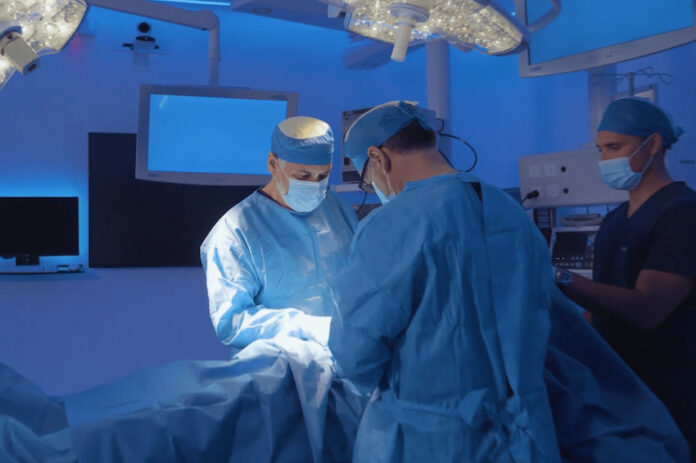
Two doctors perform a medical operation
Baja California is fast becoming an international medical hotspot. What's drawing Americans to the border in search of healthcare? (Obesity Control Centre)

I’ve spent a lot of time in hospitals over the years — usually as a visitor, sometimes as a patient and increasingly as a journalist. But I wasn’t expecting to be floored by the level of luxury, innovation and hospitality I saw on a recent tour through some of Tijuana’s leading medical tourism and healthcare facilities.

As I walked through a private recovery suite, sampled gourmet snacks from an on-site kitchen and took a peek at a hyper-efficient technology system that incorporates 21st-century tools like the Cloud and AI, one thing became crystal clear: Tijuana is raising the bar for global medical care. And patients from around the world, especially the United States, are taking notice.

Tijuana's New Medical Plaza
With new developments across the city, Tijuana is embracing demand for medical facilities. (Bellphoria)

A growing industry

Medical tourism isn’t new to Mexico, but it’s never looked quite like this.

According to the Global Wellness Institute, the global wellness economy hit US $4.4 trillion in 2020, and wellness tourism accounted for $436 billion of that. On the U.S. side of the border, the healthcare industry alone was valued at $808 billion in 2021, based on data from the International Institute of Market Metrics (IIMM). So it’s no surprise that Americans are increasingly seeking more affordable alternatives — and often, better service — just a short flight or drive away.

Mexico is the second most popular destination for medical tourism globally, drawing in an estimated 1.4 to 3 million international patients in 2020, according to Patients Beyond Borders. Their analysis found that Americans can save between 40% and 60% on major procedures here, from dental implants and bariatric surgery to fertility treatments and stem cell therapy.

And for many patients, that journey starts in Tijuana.

Located just across the U.S. border from San Diego, Tijuana has emerged as one of the most visited cities in the world for medical tourism. Its proximity to California, coupled with modern facilities and significantly lower costs, has made it a viable option for everything from dental implants and bariatric surgery to fertility treatments and cosmetic procedures.

Cyntar: Integrating technology with recovery

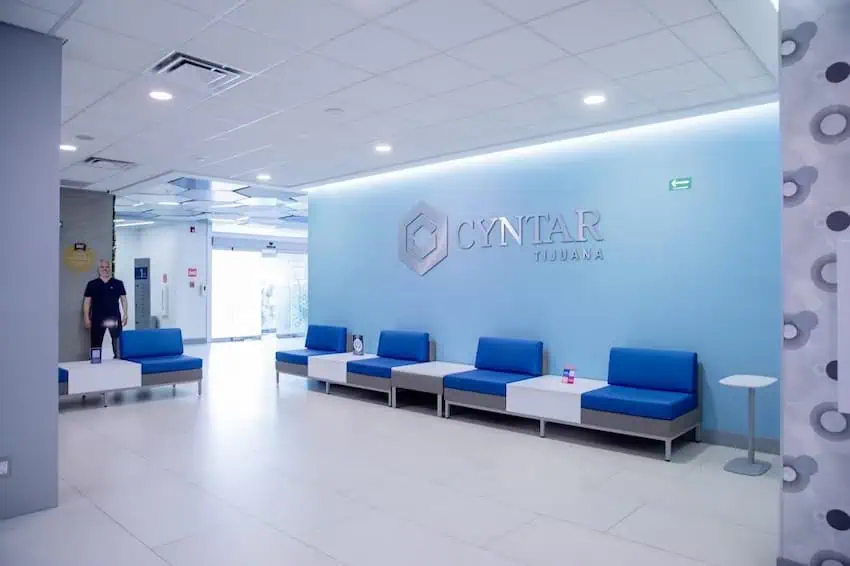
A hospital waiting room
(Cyntar Tijuana)

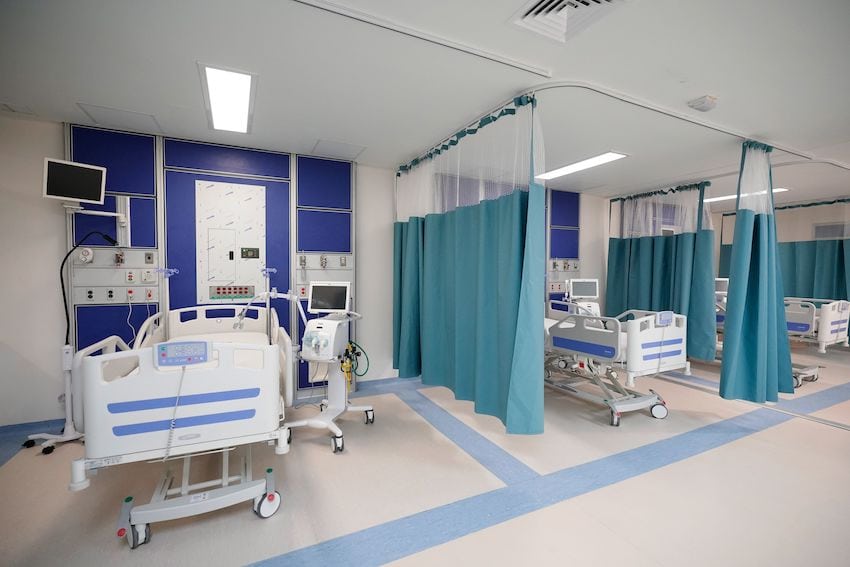
Among the more specialized facilities in Tijuana is Cyntar Hospital. This facility emphasizes technological integration with patient care and recovery, providing a series of 360° Recovery Rooms.

These rooms are equipped with customizable environmental controls and in-room monitoring technology that allows for continuous tracking of vital signs. According to Dr. Ariel Ortíz, CEO and Founder of the Hospital Center Tijuana, most patients go home within a day of their procedure and are monitored from the comfort of their own home via a digital, remote monitoring device. This allows doctors to keep a check on their patients in real-time, while their patients are recovering in their own beds.

The hospital also features designated areas designed to allow for more private interaction between patients and medical professionals — a shift away from more traditional open-ward systems. Cyntar offers a range of specialties, including minimally invasive general surgery, interventional cardiology, gynecology, orthopedics, urology, ENT and gastrointestinal diagnostics.

The hospital is also accredited by Joint Commission International, similar to U.S. medical centers like Princeton University Healthcare, New York University, University of California, San Diego, UCLA, Washington University, Mount Sinai Hospital and George Washington University. 

NewCity Medical Plaza

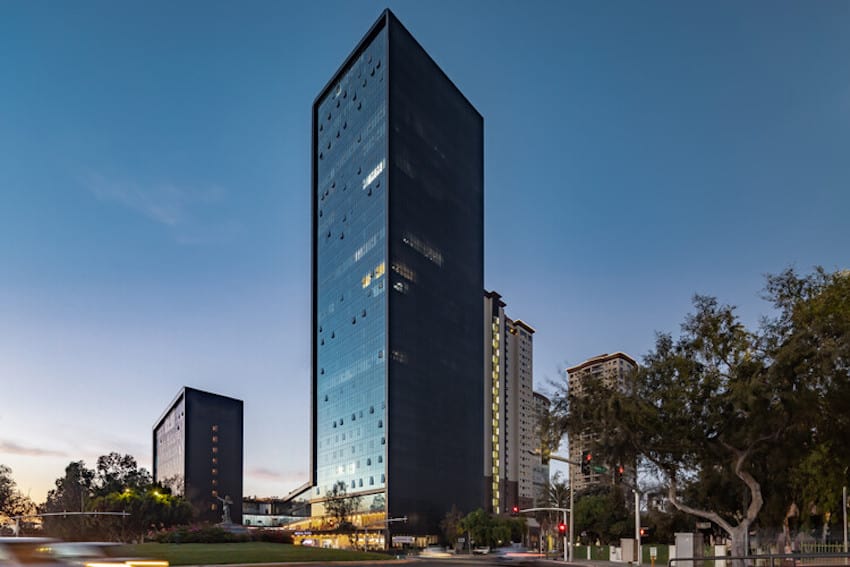
New City Medical Plaza, Tijuana
(archdaily.mx)

Another prominent complex is NewCity Medical Plaza, a multi-use development that combines healthcare services with hospitality, dining and retail. The concept is designed around providing all-in-one access for patients and their companions, from surgery to post-op recovery and leisure.

Located about three minutes from the San Diego border, NewCity includes a full-service hospital, radiology and lab services, more than 30 medical specialties and what it markets as Tijuana’s only five-star wellness hotel. Patients undergoing outpatient or elective procedures can recover in the hotel while remaining close to medical support.

Among its four flagship clinics are: 

  • Hairfax, specializing in hair restoration;
  • ProgenCell, offering stem cell therapies;
  • The Fertility Center by IMI, which focuses on reproductive health and IVF;
  • The Dental District offers general and cosmetic dental care.

The complex also includes a dining plaza featuring local cuisine and wines from Baja California’s Valle de Guadalupe, a beauty salon, clothing retailers and family-friendly events. While these amenities are not part of the medical services themselves, they aim to make the experience more appealing for both patients and their families.

Considerations for medical travelers

IMSS hospital ward in Juchitan, Oaxaca, with three empty stalls with hospital beds and medical equipment.
(Cuartoscuro)

Tijuana’s expanding medical tourism offerings are not without scrutiny. While many clinics cater specifically to international patients and many doctors are certified or trained abroad, standards can vary. Most reputable facilities will provide information about physician licensing, success rates and international affiliations. 

For travelers coming from the U.S., logistics are relatively simple. Tijuana is accessible by car, with medical facilities often providing medical transportation services to and from San Diego. The Cross Border Xpress (CBX) terminal allows foot traffic directly from the Tijuana airport into Southern California.

As healthcare costs remain a barrier for many Americans, Tijuana continues to position itself as a competitive alternative for a wide range of medical and wellness needs. Its hospitals and clinics have responded by investing in infrastructure, expanding specialties and combining healthcare with hospitality.

The cost savings are significant, and for those who do their homework, Tijuana offers a practical, nearby and sophisticated option for medical care.

Meagan Drillinger is a New York native who has spent the past 15 years traveling around and writing about Mexico. While she’s on the road for assignments most of the time, Puerto Vallarta is her home base. Follow her travels on Instagram at @drillinjourneys or through her blog at drillinjourneys.com.

Taste of Mexico: Nopales

4
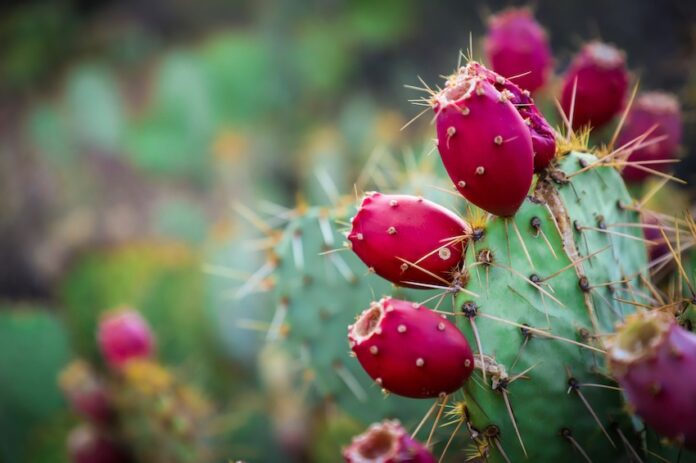
Nopal cactus with red tuna fruit
It's on the flag, in the history and part of the cuisine. Why is this little cactus so special to Mexicans? (Frankie Lopez/Unsplash)

Amigos, you ask and Taste of Mexico delivers. On Instagram, Aparigraha asked us to do a series about vegetarian food in Mexico, so today we’ll talk about the edible plant that helped shape this nation: the nopal.

Did nopales really shape a nation though?

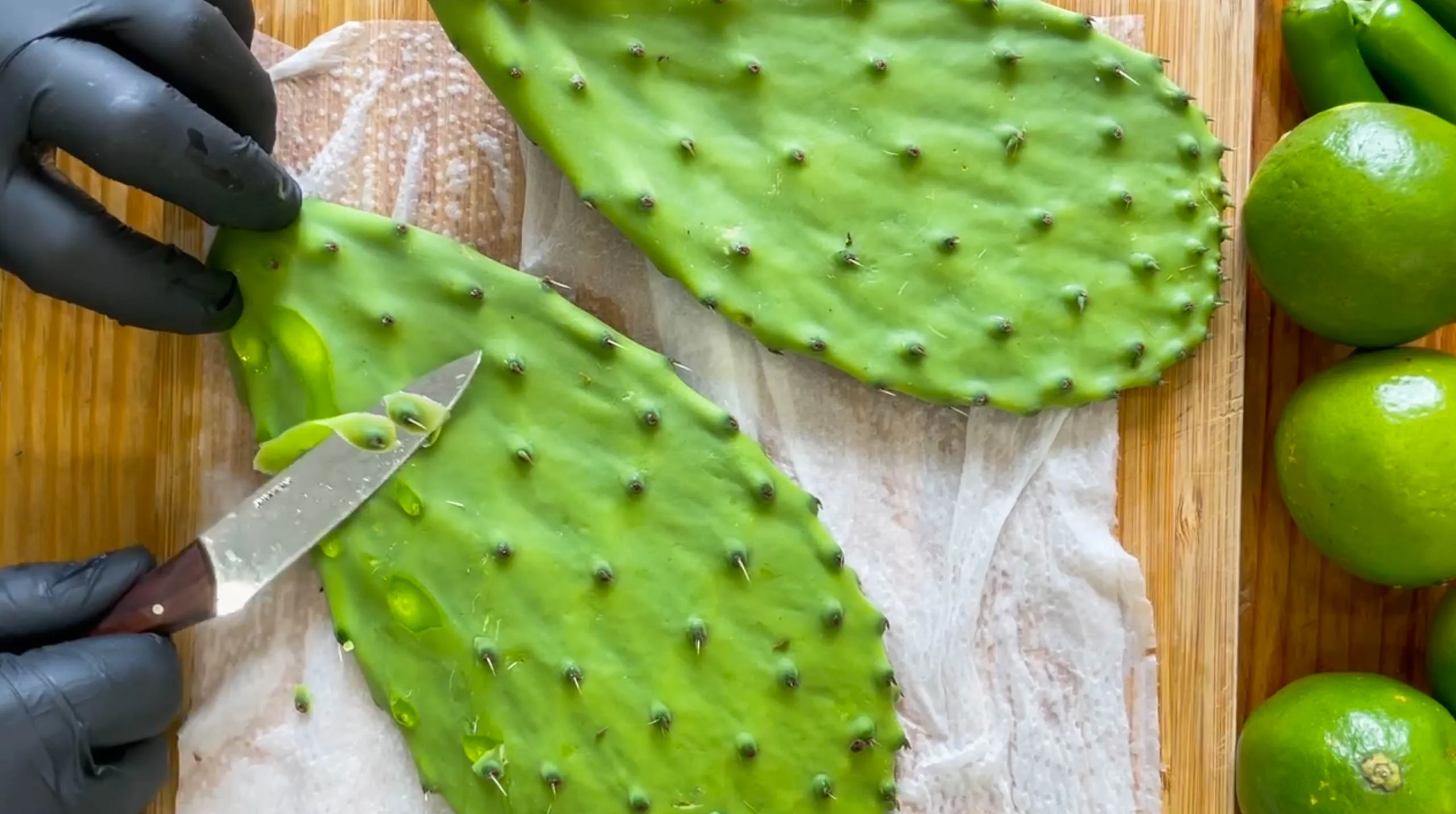
nopales being prepared with a small knife
It’s not unfair to suggest that the humble nopal has played a major role in shaping modern Mexico. (Chosen Foods)

Have you ever looked closely at our national emblem? It’s a reminder of the founding of Aztec civilization. According to legend (albeit one that is now much distorted and oversimplified) the Mexica were searching for a place to settle. Guided by Huitzilopochtli, the god of the Sun and war, they were to found their kingdom where they saw an eagle devouring a serpent atop a nopal cactus. They “found” this sign in the middle of Lake Texcoco.

For the Mexica, the nopal cactus was considered a sacred tree that linked the three realms: its roots connected to the underworld, the cactus pads represented earthly existence, and the tunas (the prickly red fruits that grow on the nopal), seen as sacred hearts, connected to the thirteen heavens and nourished the sun god Hutzilopochtil.

A staple in times of crisis

The symbolic importance of the nopal is no coincidence. This plant grows throughout the country and thrives in harsh conditions, making it a symbol of resilience. It has been consumed for over 20,000 years and domesticated for nearly 9,000 years, serving as food, drink, and medicine.

Rich in fiber, vitamins A and C, minerals, and antioxidants, the nopal has played a vital role in maintaining a balanced diet when combined with other ingredients. Furthermore, it can be consumed in various forms.

There are over 200 types of nopal, with 93 found in Mexico and 62 being endemic. The most popular variety is Milpa Alta.


View this post on Instagram


A post shared by Mexico News Daily (@mexiconewsdaily)

Nopal as medicine

Mexica warriors ate nopal with blood to gain strength before important battles. Every 52 years, during the New Fire ceremony, dried nopal was burned to prevent the end of the universe.

The mucilage from nopal, known as “slime,” is used for pain relief in burns and wounds. The tunas act as electrolytes and provide a natural alternative to Pepto Bismol. Brewing nopal flowers as tea can help regulate blood pressure. If you have diabetes, nopales are your best ally because they help to regulate sugar levels in the bloodstream.

Nopal in daily life

The mucilage from the nopal cactus was crucial in the construction of houses, as it helped adobe bricks adhere to one another. Additionally, it played a role in purifying water in canals and in fixing pigments in textiles and on walls.

Furthermore, the nopal served as a habitat for the cochineal insect, which produced a distinctive red dye. This dye was so valued that it was used in the artworks of renowned painters such as Rembrandt and Van Gogh.

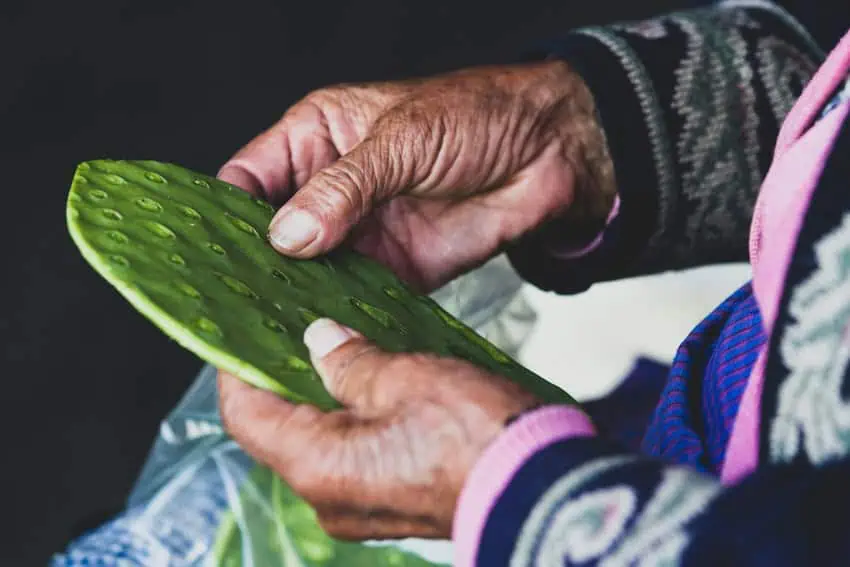
The hands of an elderly woman prepare a nopal cactus
It’s food, it’s cement, it’s paint — is there anything nopales can’t do? (Daniel Lloyd Blunk-Fernandez/Unsplash)

Nopal, the superfood

Amigos, this truly represents the Taste of Mexico. On average, each Mexican consumes about 6.4 kg of nopal per year. We enjoy it in various dishes, including salads, tacos, soups, pickled with chiles, grilled, in juices, and alongside stews. Recently, there have been some exciting innovations: you can now find dehydrated nopal spicy snacks, ice creams, tortillas, and even nopal supplements.

Every 100 grams of nopal contains just 16 calories, making it an appealing option for those looking to lose weight. Remarkably, 60% of its weight is pure fiber. Its mucilage acts as a prebiotic, which helps improve gut health. If you experience trouble sleeping, you’ll be glad to know that nopal provides magnesium, calcium, potassium, vitamin C, vitamin A, and a wealth of antioxidants.

How do I add it to my diet?

There are many ways to enjoy it! The most common is as a side to a stew. However, another easy way to use it is as a substitute for tortillas or dishes made with corn masa, such as tlacoyos, sopes, or gorditas.

Nopal Huarache Recipe

Ingredients:

6 medium nopales, cleaned and de-spined
2 cups refried beans
300 g mushrooms or any topping you like
Fresh cheese or tofu
Shredded lettuce
2 avocados, sliced
Salsa to taste
Salt and pepper

Optional:

Chopped epazote
Red onion
Dried oregano

Instructions:

1. Clean the nopales:
Remove the spines and rinse the nopales thoroughly.
2. Grill the nopales:
Heat a skillet, griddle, or grill over medium-high heat. Season the nopales with salt and grill on both sides until they change color. You can add a bit of oil if you like.
3. Prepare the topping:
Sauté the mushrooms or tofu with garlic and onion.
4. Assemble the huarache:
  • Place each grilled nopal on a plate.
  • Spread a layer of refried beans on the nopal.
  • Add your chosen topping.
  • Add fresh cheese or tofu as desired.
  • Garnish with shredded lettuce, avocado slices, and salsa.
Make or buy a regular corn huarache and use nopal as a topping. The flavor combination is unique.

If you’re vegan or vegetarian (but especially if you’re not) I sincerely hope that you incorporate nopales in your everyday meals. Remember, whenever you make a recommendation or request, we are always attentive to your messages.

María Meléndez is a Mexico City food blogger and influencer.

Why are Mexican cars so expensive?

13
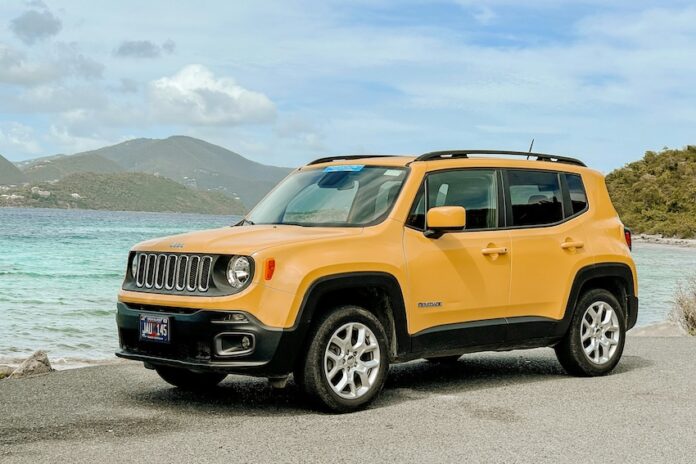
A yellow Jeep on a beach
Given that Mexico's automotive sector is so enormous, why aren't cars cheaper here? Sarah DeVries has some ideas. (Hans Isaacson)

When I was shopping around for a car a few years ago, I was surprised at the prices I was seeing. New cars in dealerships, I knew, were out of my range. But even used cars, some of them over 10 years old, seemed extremely pricey.

“320,000 pesos for a 2012 SUV? If someone has that kind of cash on them, why wouldn’t they just use it for a down payment on a new car?” I’d think.

The cost of SUVs in Mexico seems to have become astronomical in recent years. (@sh_fred/Twitter)

Granted, this was the pandemic. Supply chains worldwide were seeing major disruption, and Mexico was no exception. Many places seemed simply “out of” cars. I’d walk into dealerships and be ignored, a shock coming from a place where salespeople fall over themselves to court you as a customer.

In the end, I finally found a good used car. It was three years old at the time, and still under warranty. I paid 240,000 pesos for it, a sum borrowed from a gracious uncle that I’m still paying back.

A recently arrived friend of mine asked about my car purchase, hoping to buy his own. “I don’t know what it’s going to be like now, though,” I told him. Prices, as we all know, have gone up.

Over the past three years, in fact, the average price of a new car in Mexico has gone from 348,000 to 516,000 pesos in 2024. Yikes.

Why, especially when Mexico manufactures so many cars? Wouldn’t saving them an overseas trip reduce the cost?

Well, like most things in life, the answer is more complex than we’d like it to be. Part of the reason, of course, are repercussions from the supply chain issues still being dealt with postpandemic. Even if they’re assembled here, not all the materials needed are sourced here. Cars are also coming equipped with increasingly complex and expensive computer systems. Taxes on vehicles in Mexico are high, and don’t end when you buy them. States differ, but in my own state of Veracruz, I must pay for a verificación, i.e., safety testing, twice a year.

Once you get the car, too, maintaining it is expensive. Gasoline in Mexico, for example, has more than tripled in price over the past 15 years. So far it shows no signs of abating. It currently takes me around 1,000 pesos to fill up my 40-liter tank. As I watched my sister fill up her own car of the same capacity and pay a little over US $20 for it on a recent trip, my jaw dropped. If Mexico is the source of all this petroleum, why on earth are we paying so much?

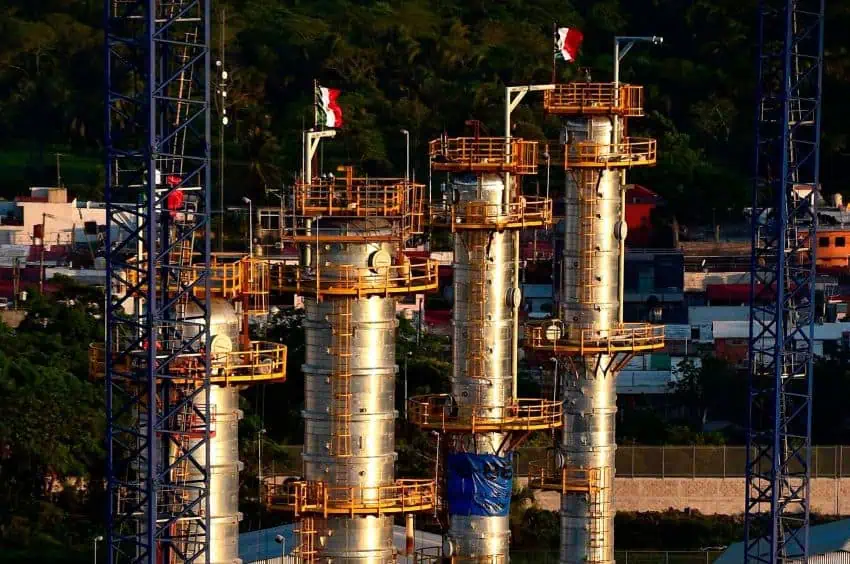
A Pemex refinery
Mexico is a major oil producer, but that doesn’t translate into low prices at the pumps. (Presidencia/Cuartoscuro)

Well, for quite a while, all we had was the crude stuff, not the finished product. This meant that we’d send the crude mostly to the U.S., then they would sell it back to us as gasoline. Sheesh.

According to PEMEX, gasoline self-sufficiency for Mexico is possible within a few years. I both hope they are right and also will believe it when I see it. I’m not very business-minded, but my own logic tells me that a company that’s extremely in debt is not going to be lowering its consumer prices anytime soon.

Luckily, our environmental scientist president seems ready to help us transition to electric vehicles. Not that she necessarily needs help.

Since 2020, electric vehicles have already been pouring into Mexico from China. The percentage of hybrid or electric new car sales is already fast approaching 10%. Not wanting to miss the boat, Mexico is working on its own EVs (electric vehicles). The first made-in-Mexico electronic bus debuted not long ago, and there is a lot of excitement — and, yes, doubt — about a Mexican-made consumer EV, the Olinia, set to retail at much lower prices than other new cars. It’s similarly no-frills, but, hey, it will be safer than motorcycles!

There’s also, of course, the question of demand. Why should anyone lower their prices if people are still buying vehicles?

And boy, are they buying, even as car prices increase.

At least in my city they are: We are packed to the brim. My favorite joke lately is that half the people in the city should have to get rid of their cars to decongest the roads. Not the half I’m in, obviously.

A traffic jam
Why is it that Mexican roads usually feel like this in any major city?! (Nabeel Syed/Unsplash)

A favorite pastime that is not a joke, however, is tracing mental fantasy routes around my city for a fantasy bus fleet that we don’t have. “About 50 buses that just go back and forth between these two points, another 50 between these two points — that outta do it!” My fantasies are vivid.

I mean, we have buses. We just don’t have enough, and with all the traffic, they can hardly move anyway. But I would be extremely happy to leave my car at home and hop on public transport so that I don’t have to drive myself. I bet I’m not the only one.

Luckily, what we do have are models for what’s possible, and we’ve got them right here in Mexico. My favorite public transportation system so far in Mexico — Mexico City’s MetroBus, with its own dedicated lanes — is already fully electric. This is a system that I dream of for my city. Some day!

While things in Mexico look uncertain lately, especially given all the tariff craziness, they also look, well, new. We are in a time of major transition.

Mexico, I believe, is on the right track. I just hope it remembers this famous adage as it considers how Mexicans are going to get around:

“A developed country is not one in which the poor have cars, but where the rich use public transportation.”

I’ll take one great EV-powered public transportation system per community to go, please!

Sarah DeVries is a writer and translator based in Xalapa, Veracruz. She can be reached through her website, sarahedevries.substack.com.

How the map of Los Cabos has changed over the past 40 years

0
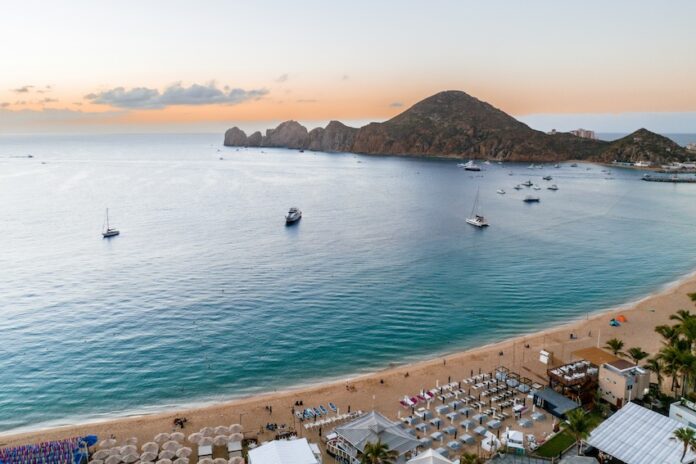
A sunrise over Cabo San Lucas
The Los Cabos region didn't always look like it does today. How has it changed over the years? (Josh Withers/Unsplash)

For those who’ve visited Los Cabos or lived in the area for any appreciable amount of time, the changes that have occurred here in recent decades are remarkable, not only in terms of population increases or the rapid rise in the number of tourists visiting but also in terms of general development. 

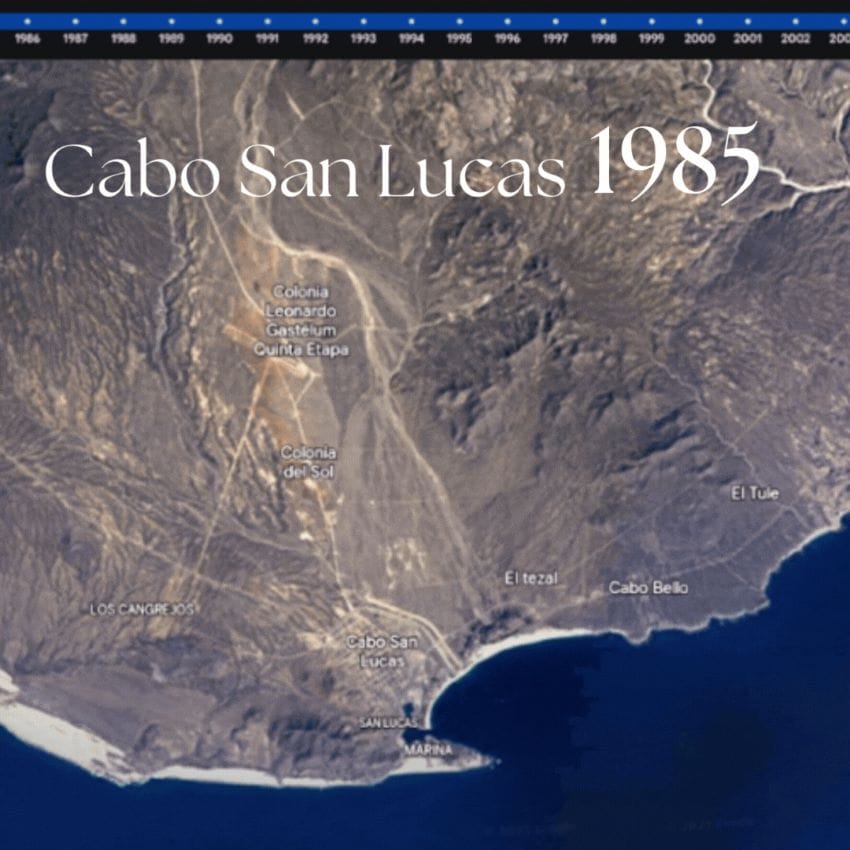

For this article, I used Google Earth imagery to show how the maps of cape cities Cabo San Lucas and San José del Cabo have changed since 1985 (the limits of Google Earth’s historical capacity). I’ve paid particular attention to the timeframe 2005 – 2025, not only because Google Earth’s satellite imagery quality improves from this point onwards, but also because this is when the pace of development quickens. 

Cabo San Lucas and San José del Cabo in 1985

(Courtesy of Google Earth)

One of the first things you’ll notice in these maps is that they show no golf courses. That’s because there were none before 1987. Nor were there many hotels since tourism was not very developed. The Hotel Twin Dolphin, a Tourist Corridor favorite of the time, had 55 rooms, according to my Baja Traveler guidebook published in 1988. The Hotel Finisterra in Cabo San Lucas had the same number. Meanwhile, in San José del Cabo, the Hotel El Presidente boasted 250 rooms, a massive number for the time. 

By 1990, the closest year I could find accurate data, there were 22 hotels with 2,531 rooms in Los Cabos serving the 228,000 foreign tourists who visited that year. The population, likewise, remained very modest by today’s standards. The Los Cabos municipality had 43,920 residents as of the 1990 census, with Cabo San Lucas and San José del Cabo each boasting around 15,000 residents. 

Nightlife started in earnest in 1989 and 1990 in Cabo San Lucas, with El Squid Roe, Cabo Wabo, and Giggling Marlin appearing around this time.

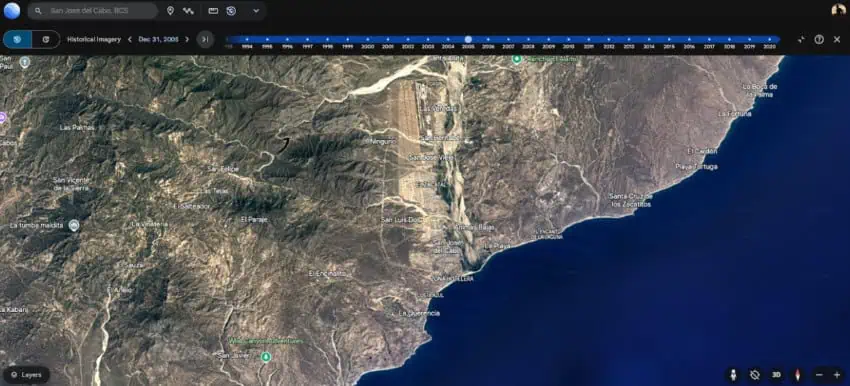
Cabo San Lucas and San José del Cabo in 2005

San José del Cabo in 2005. (Courtesy of Google Earth)

By the dawn of the new century, growth is rapid in both Cabo San Lucas and San José del Cabo. The combined population in the Los Cabos municipality rose from 105,469 in 2000 to 164,162 in 2005 to 238,487 in 2010. 

The Los Cangrejos and Colonia del Sol neighborhoods rapidly grew in Cabo San Lucas. Indeed, according to the book Los Cabos, Prospective for a Natural and Tourism Paradise, 99% of the growth in Los Cabos between 2000 and 2005 occurred in just a few places: Cabo San Lucas and its Colonia del Sol and Los Cangrejos neighborhoods; and in San José del Cabo colonias like San José Viejo, San Bernabé, Las Veredas, and La Playa.

There were still no golf courses evident on the Pacific Coast. Davis Love III’s acclaimed Diamante Dunes Course would be the first in 2009. However, several can be seen in the Tourist Corridor, including the Cabo San Lucas Country Club and the Ocean and Desert courses at Cabo del Sol.

San José del Cabo experienced 124% growth during this decade, as the population of residents grew from 31,102 in 2000 to 69,788 in 2010. Golf courses, the backbone of local real estate developments, have been built at Querencia (2000), but not yet at Club Campestre or Puerto Los Cabos (both 2007).

Even bigger gains were being made in terms of tourism. Foreign tourists rose from 464,200 in 2000 to 842,606 in 2010. As tourism numbers climbed, the hotel room inventory in Los Cabos more than doubled, increasing from 6,167 in 2000 to 13,390 in 2010.

Cabo San Lucas and San José del Cabo in 2015

(Courtesy of Google Earth)

The Category 4 Hurricane Odile, which hit Los Cabos on September 14th, 2014, did over one billion dollars worth of damage, but didn’t slow down growth, as these 2015 satellite photos indicate. El Tezal, Cabo Bello, and Cangrejos are all growing in Cabo San Lucas, with several golf courses now evident on the Pacific Coast of the Land’s End city, including Love’s Dunes Course, Tiger Woods’ El Cardonal (2014) at Diamante, and Jack Nicklaus’ Quivira (2014).

There were 118 hotels in Los Cabos in 2013, although the number of rooms had declined slightly to only 13,003 in 2014. The total population of Los Cabos in 2014 was 294,452, with both Cabo San Lucas (99,072) and San José del Cabo (95,310) poised to break 100,000 and transform from towns to cities. 

The RIU Santa Fe, with 1,200 rooms in Cabo San Lucas, became the largest hotel in the area during this era. Hotels and resorts like The Cape, A Thompson Hotel in the Tourist Corridor, and the Hyatt Ziva and JW Marriott in San José del Cabo welcomed guests for the first time in 2015. The Hyatt Ziva, featuring 591 rooms, joined RIU Santa Fe and the RIU Palaces among Los Cabos’ biggest properties.

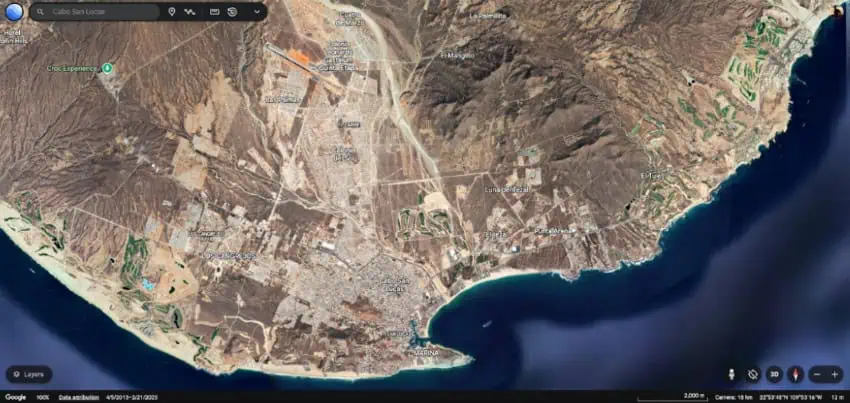
Cabo San Lucas and San José del Cabo in 2025

Cabo San Lucas in 2025 (Courtesy of Google Earth)

By 2025, Baja California Sur had 500 hotels and 29,000 hotel rooms available, with the largest part of the inventory (over 180 hotels and 18,000 rooms) in Los Cabos. Close to four million tourists visited in 2023 and 2024, with the population at 351,111 as of the 2020 census. Los Cabos had surpassed La Paz in terms of population, with Cabo San Lucas boasting 202,694 residents, and San José del Cabo at 136,285.

Using the Google Earth distance tool, I measured the developed area in Cabo San Lucas in 1985 at its outermost points as about 2.5 kilometers in length by 1.25 kilometers in width. By 2025, it had expanded to about 11 x 7. Thus, the physical dimensions of the city were growing. The same is true for San José del Cabo, although less dramatically so visually.

However, despite what seems to be fluid borders of the cape cities, the area of the Los Cabos municipality has remained stable, leading to a population density that has continued to rise. It was 93.6 residents per square kilometer in 2020, up from 11.7 in 1990, 28.1 in 2000, 63.6 in 2010, and 76.7 in 2015. The current number is the highest in Baja California Sur, although it bears noting that the state overall has the lowest population density in Mexico.

Chris Sands is the Cabo San Lucas local expert for the USA Today travel website 10 Best, writer of Fodor’s Los Cabos travel guidebook and a contributor to numerous websites and publications, including Tasting Table, Marriott Bonvoy Traveler, Forbes Travel Guide, Porthole Cruise, Cabo Living and Mexico News Daily. His specialty is travel-related content and lifestyle features focused on food, wine and golf.
Mexico is a top 10 happiest country. Is it the food? A perspective from our CEO

8
A Mexican family eats food together and enjoys a meal
People who share meals with others report higher life satisfaction and a more positive outlook, according to the U.N.'s World Happiness Report. (Shutterstock)

We recently published an article about how Mexico is, for the first time, ranked in the top 10 happiest countries in the world. Having spent so much time in Mexico over the past 30 years, that doesn’t surprise me. What did surprise me was that the article cited one of the most significant factors in the happiness correlations was “frequently eating with other people.”

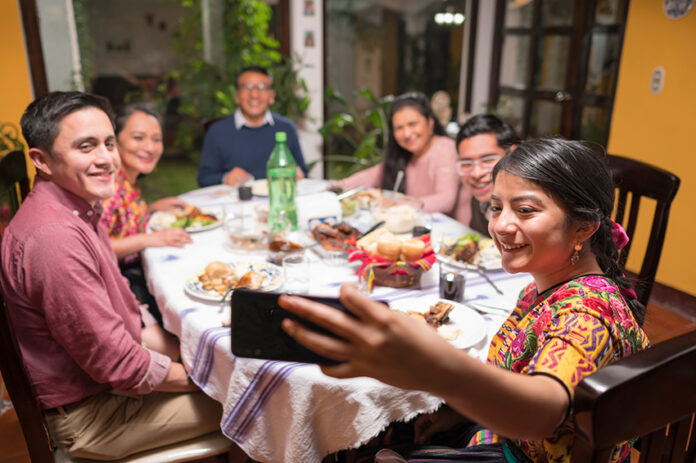
I would contend that Mexico and Mexicans have eating figured out. They know what to eat, they know how to eat, and they know that eating with other people is a big part of the happiness of it all. One thing you notice in Mexico is that restaurants often times have seating for big groups — like really big groups of 8 or 10 or 12. That, of course is because it is very common to see very large groups of Mexicans eating (and of course loudly laughing) together.

A family hosts a celebration in Oaxacan in which neighbors and community eat together and enjoy a meal
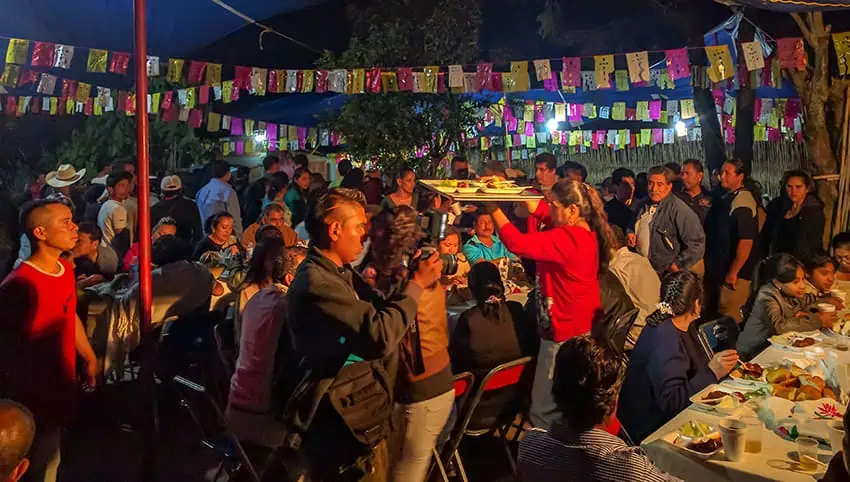
Mexico might be onto something: Large family and community meals, which are more common in Mexico than in the U.S., have been cited as a factor that boosts happiness in Mexico — and it doesn’t hurt that the food is delicious. (Andrew McMullen/Shutterstock)

I once read a saying in the United States that said: “No one has ever left a Mexican restaurant in a bad mood.” That stuck with me because I really do think it is true. Mexican restaurants tend to be busy, loud and fast paced, with music playing. It’s hard not to feel better in an environment like that — especially if the chips and salsa are good and the margaritas are strong.

Besides the atmosphere of the restaurants and recognizing the joy of sharing a meal with others, Mexicans get food right in another big way. They have literally centuries of traditions and family customs behind many of the things they eat. There is a fascinating history and logic to what they eat, when they eat it and how they eat it.

Mexico News Daily has tried to capture this for you in our Taste of Mexico video and article series. In it, we give you the history, culture, traditions and nutritional facts behind many of the most important foods in the country. We also have several other food articles each week that help inform, educate and tempt you to get more adventurous and confident to try some of the country’s amazing food.

For example, did you know that many varieties of tomato have been eaten in Mexico for thousands of years? It was in fact the Spanish who was brought tomatoes from Mexico to Europe. That’s right, the Italian food that we all enjoy today can be traced back to the Spanish bringing back tomatoes from Mexico. We share the full fascinating story here.

Taste of Mexico: Tomatl

Did you know that the superfood chia is actually from Mexico? That’s right, a chia diet goes back thousands of years in Mexico. We explain the history and talk about the many health benefits.

For the more adventurous, we explain how (and why) to eat “Mexican caviar” (ant larvae), called escamoles locally. We share the history of this strange food and tips on how to eat them.

Taste of Mexico: Escamoles

For the much less adventurous, we explain how to order churros in Mexico. You might be surprised to learn that there are a lot of options for how to “dress up” your churro. You need to be prepared when your turn comes up in the long line to buy one!

Afraid to try spicy salsa? We explain the history of spicy salsa in Mexico and the logic behind getting a rush from spicy food.

Why eating spicy salsa matters

Finally, if you love cooking and want to try some of the many healthy and tasty Mexican fruits and vegetables, we bring you a monthly look at what is in season and what you can cook with it.

The above is just a small sampling of some of our food articles from just the past few weeks, so check out MND’s Food & Drink section and get inspired.  It might even improve your overall level of happiness!

Travis Bembenek is the CEO of Mexico News Daily and has been living, working or playing in Mexico for nearly 30 years.

Another US anti-immigration ad appears in Mexico: Friday’s mañanera recapped

29
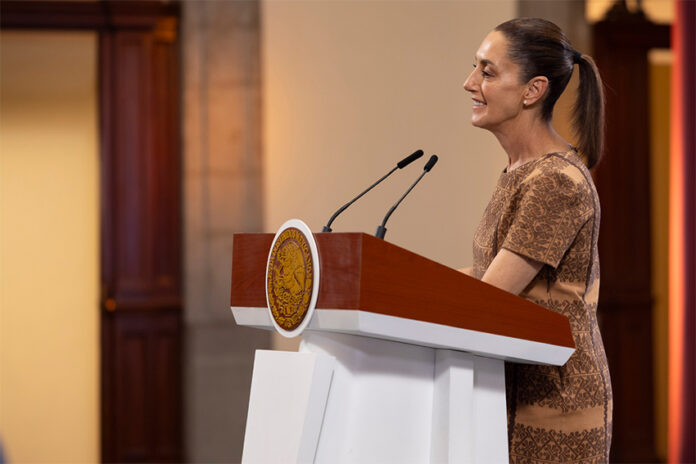
President Claudia Sheinbaum
Foreign relations took center stage on Friday after another U.S. anti-immigration ad began appearing to Mexican user of online platforms like YouTube. (Presidencia)

At her final press conference of the week, President Claudia Sheinbaum spoke about a new United States government anti-immigration advertisement and her administration’s plan to ban the paid broadcast of such messages in Mexico.

Interior Minister Rosa Icela Rodríguez was also on hand at the National Palace, where she provided an update on the number of deportees Mexico has received from the United States in recent months.

Here is a recap of Sheinbaum’s May 9 mañanera.

New US anti-immigration ad appears online in Mexico  

A reporter noted that a new U.S. anti-immigration ad has been airing in Mexico in which United States Secretary of Homeland Security Kristi Noem warns would-be migrants to not undertake the “dangerous” journey to the United States and declares that people will be caught and deported if they enter the U.S. illegally.

In the ad, which is dubbed into Spanish, Noem also encourages undocumented people in the United States to self-deport using the CBP Home app.

The airing of the ad on YouTube in Mexico this week — seen on several occasions by Mexico News Daily — comes after a similar anti-immigration ad featuring Noem was broadcast on Mexican television last month.

Kristi Noem in an anti-immigration ad from the U.S. government
Sheinbaum has introduced legislation that would ban foreign propaganda like the recent ads featuring U.S. Homeland Secretary Kristi Noem from being shown in Mexico. (Screen capture)

Sheinbaum subsequently submitted a telecommunications reform bill to Congress that seeks, among other objectives, to ban advertising or propaganda financed by a foreign government, except for cultural or touristic purposes. The Senate paused the legislative process related to the bill late last month so that an “open parliament” process can take place amid claims that the proposed legislation promotes censorship.

On Friday, Sheinbaum said that she understood that the new ad featuring Noem is only airing on online “platforms,” and not on television as was the case last month.

“The law is not approved yet,” she noted before reminding reporters that the “proposal” is that foreign governments be prohibited from paying to have ads disseminated in Mexico.

“They have the right to record a message and if someone wants to see it on their social media they can access it,” Sheinbaum said.

However, paying so that an ad is “disseminated more” in Mexico — as the U.S. government has evidently done to reach a wider audience this week — will be prohibited (if and when the new law is approved), she said.

The ban will apply to foreign government ads focused on “politics” and “ideological matters,” but not “cultural, touristic and sporting issues,” Sheinbaum said.

More than 38,000 Mexicans deported from US since Trump took office 

Interior Minister Rosa Icela Rodríguez reported that 38,065 Mexicans have been deported from the United States since United States President Donald Trump commenced his second term on Jan. 20.

She also reported that 14,305 people — almost 40% of the total number of Mexican deportees — have been received at 10 “attention centers” set up in northern border cities as part of the government program México te abraza (Mexico embraces you) for people expelled from the United States.

Deportees in Ciudad Juárez, Mexico in January 2025
Almost 40% of Mexican deportees have used the services offered through the Mexico Te Abraza program. (Carlos Sánchez Colunga/Cuartoscuro)

Rodríguez said that those people have been received “with warmth and humanism,” highlighting that they were given meals, medical care, legal advice, financial support and help to enroll in government programs, among other assistance. The interior minister said that no problems had been reported at the 10 reception centers for deportees.

She pointed out that the National Immigration Institute has provided transport that allowed more than 2,000 deportees to travel to their states of origin. Rodríguez said that the “main destinations” for returnees have been Coahuila, Durango, Zacatecas, Querétaro, Aguascalientes, Mexico City, Michoacán, Jalisco, Guerrero, Oaxaca, Chiapas and Puebla.

She said that Sheinbaum has ordered the continued operation of the reception centers “to attend to repatriated Mexicans — honest people who have worked far from their nation to help their families get ahead.”

“They have contributed to the economy not just of the United States but also to that of the country of their birth,” Rodríguez said, referring to the remittances immigrants in the U.S. send to their families in Mexico.

While the federal government has expressed opposition to the Trump administration’s plan to expel large numbers of undocumented people, the interior minister put a positive spin on the deportation of Mexicans, saying that it gives them the “opportunity to return home” and reunite with their families.

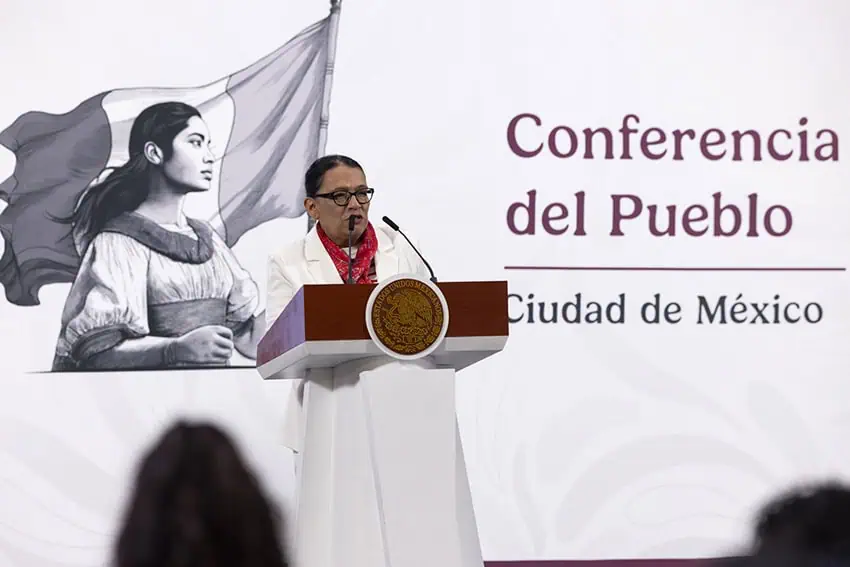
Interior Minister Rosa Icela Rodríguez
Interior Minister Rosa Icela Rodríguez Mexican deportees for their hard work and economic contributions. (Presidencia)

“It is also the opportunity to rediscover a Mexico that is different to that they left when they set off in pursuit of the American dream,” Rodríguez said.

“The Mexico of today is in full transformation and has a humanist government led by the President Claudia Sheinbaum, who favors above all the well-being of those who most need it,” she said.

The Mexican Files 

Filmmakers Sergio Arau and Yareli Arizmendi, who made the 2004 satirical film “A Day Without a Mexican,” appeared at the mañanera in a pre-recorded video to present their new “emergency documentary” called “The Mexican Files.”

Like “A Day Without a Mexican,” the film shows “what would happen” if Mexicans weren’t in the United States, Arizmendi said.

The trailer, which was played at the morning press conference, appears below.

The Mexican Files- TEASER

By Mexico News Daily chief staff writer Peter Davies (peter.davies@mexiconewsdaily.com)

Mexico sues Google over ‘Gulf of America’ renaming

11
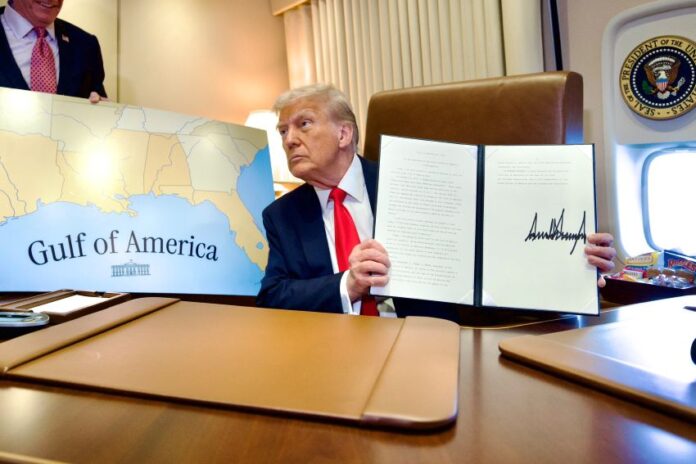
President Trump displays a recently signed bill renaming the Gulf of Mexico
President Donald Trump signed an order to rename the Gulf of Mexico as the Gulf of America in the first days of his second presidential term. (POTUS/X)

Mexican President Claudia Sheinbaum confirmed Friday that her administration has filed a lawsuit against Google for displaying the name “Gulf of America” on its maps for U.S. users, escalating a dispute that involves tech giants and lawmakers on both sides of the border.

“The lawsuit has already been filed,” Sheinbaum said without specifying where or when it was submitted. She first warned of such a lawsuit in February.

The legal action follows Google’s decision to update its U.S. maps in line with an executive order signed by President Donald Trump on the first day of his second term, which renamed the Gulf of Mexico to the Gulf of America for federal purposes.

Sheinbaum, speaking at the National Palace during her Friday morning news conference, or mañanera, emphasized that Mexico’s demand is straightforward: Google and other platforms should apply the “Gulf of America” name only to the portion of the gulf that falls within U.S. territorial waters, as specified by Trump’s decree, and not to the entire body of water shared by the United States, Mexico and Cuba.

“That’s what we’re demanding be included in the platform. We’ll see how this resolution from the United States Congress comes out, but they can only name the part of the United States territory,” Sheinbaum said.

She added: “What we’re saying is that Google should put ‘Gulf of America’ where it belongs, that is, in the part that belongs to the United States, and that it should put ‘Gulf of Mexico’ in the territorial part that belongs to Mexico and Cuba. That’s what we’re demanding: that it appear on the platform.”

The controversy intensified Thursday when the Republican-controlled House of Representatives narrowly passed a bill to codify Trump’s executive order, titled “Restoring Names That Honor American Greatness,” which required all federal agencies to update documents and maps to reflect the new name.

The measure, introduced by Rep. Marjorie Taylor Greene (R-Ga.), now heads to the Senate, where its future remains uncertain.

In the House, the bill passed 211-206, with all Democrats and one Republican (Rep. Don Bacon of Nebraska) voting against it.

Greene defended the legislation, saying, “The American people deserve pride in their country and they deserve pride in the waters that we own, that we protect with our military and our Coast Guard.”

She also accused Democrats of “fighting to keep the Gulf of America named the Gulf of Mexico because the cartels are their business partners.”

“They fight for the cartels so much,” she added.

Meanwhile, Democrats said the bill was a waste of time and resources, and they accused Republicans of ignoring important matters while wasting what House Minority Leader Hakeem Jeffries (D-N.Y.) called an “entire legislative day” to debate the bill.

The initiative is “silly, small-minded and sycophantic,” Jeffries added.

In addition to Google, Apple has also updated its maps for U.S. users to reflect the new name, further fueling Mexico’s objections.

Sheinbaum said she has sent two letters to Google and warned of legal action if the company did not limit the name change to U.S. waters.

Google has defended its decision, citing its policy of following official government sources and consulting multiple authorities to ensure accurate representation. The company’s change means U.S. users see “Gulf of America” on Google Maps, while Mexican users see “Gulf of Mexico” and users elsewhere see both names.

The name “Gulf of Mexico” has been recognized internationally since the 1550s and remains the official designation by the United Nations and most global authorities.

Sheinbaum, in a pointed retort to Trump’s move, has suggested renaming the United States “Mexican America,” referencing historical maps from before 1848.

With reports from El Financiero, El Economista, NBC News, AFP and Infobae

Completion of Cancún’s Nichupté bridge delayed to December

0
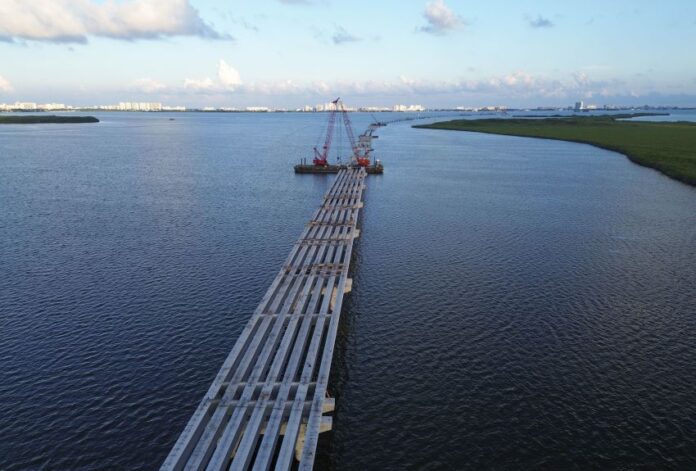
Aerial view of unfinished Nichupté bridge.
The new bridge promises faster commutes for Cancún residents and tourists. (Elizabeth Ruiz/Cuartoscuro)

The 11.2-kilometer-long Nichupté Vehicular Bridge — a critical infrastructure project connecting downtown Cancún and its bustling hotel zone — will open in December, four months later than expected.

The long-delayed project is expected to benefit 1.3 million residents of the resort city, save commuters up to 45 minutes in travel time and serve as an important evacuation route during hurricane season.

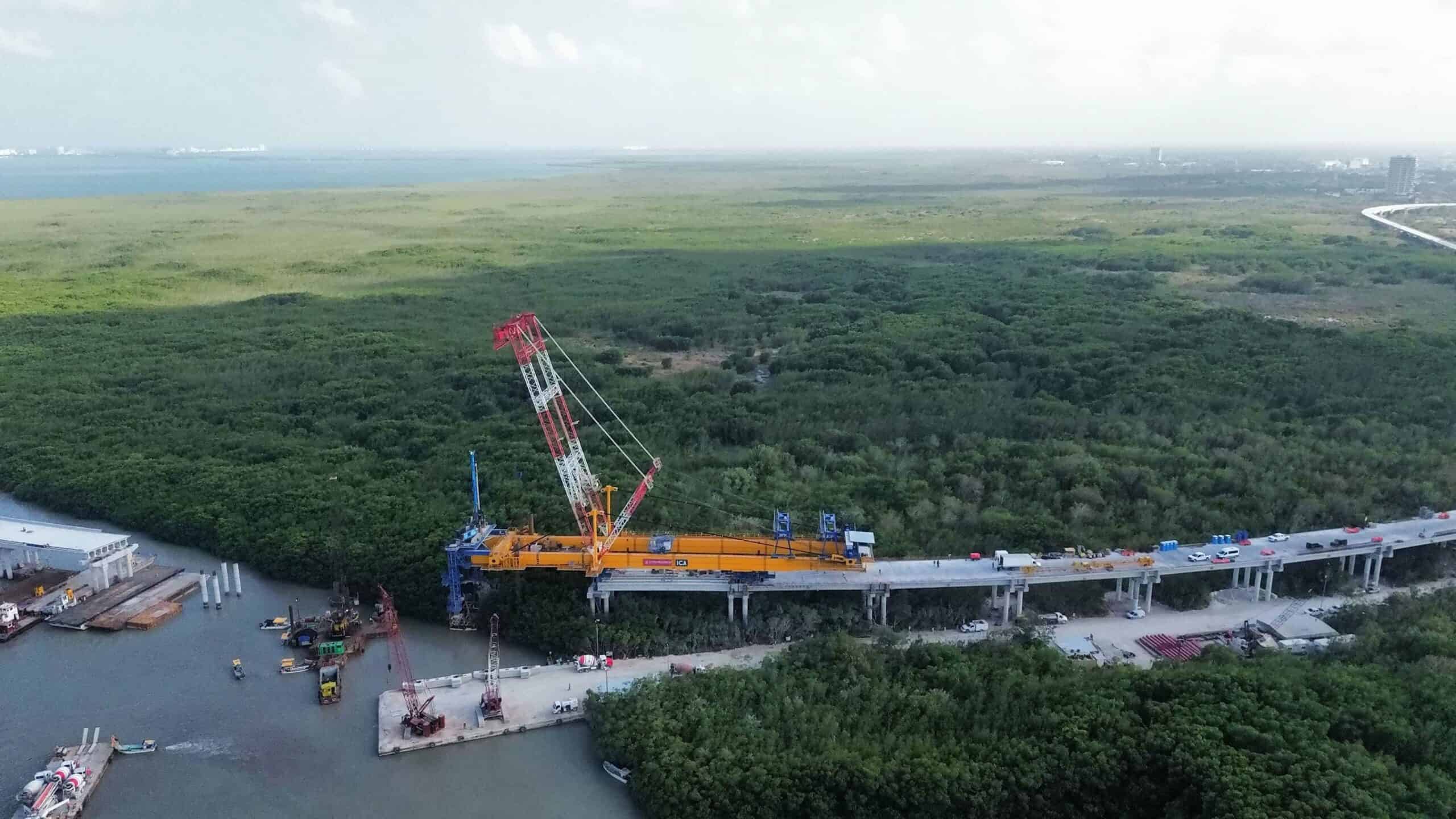
Aerial view of unfinished Nichupté bridge.
The bridge’s elevated design protects the Nichupté Lagoon ecosystem. (Elizabeth Ruíz/Cuartoscuro)

José Antonio Esteva, minister of Infrastructure, Communications and Transportation (SICT), provided an update on the project during President Claudia Sheinbaum’s Wednesday morning press conference.

Esteva said there are currently 714 workers and 123 machines operating at five active work sites. He also confirmed a budget overrun of nearly 2.9 billion pesos (US $145 million).

“We expect to spend 2.1 billion pesos (US $108 million) this year to complete the bridge,” Esteva said. 

This will bring the total cost of the bridge to 8.6 billion pesos (US $440.5 million). Construction company ICA originally budgeted 5.6 billion pesos (US $286 million) for the project.

The 14.9-km-long project features an 8.8 km, three-lane span over the Nichupté Lagoon and will benefit 1.3 million residents as well as the millions of tourists who visit the Caribbean resort.

Most of the bridge will be elevated above the lagoon on stilts. It will also feature a 103-meter metal suspension bridge section.

Sheinbaum visited the site with Quintana Roo Gov. Mara Lezama and ICA CEO Guadalupe Phillips in April. At the time, with the bridge 78% completed, Sheinbaum said it would be operational by November.

Originally expected to be completed late last year, the SICT had targeted an August inauguration after design modifications were required in January. The alterations became necessary when several maritime zone permits were denied on environmental grounds.

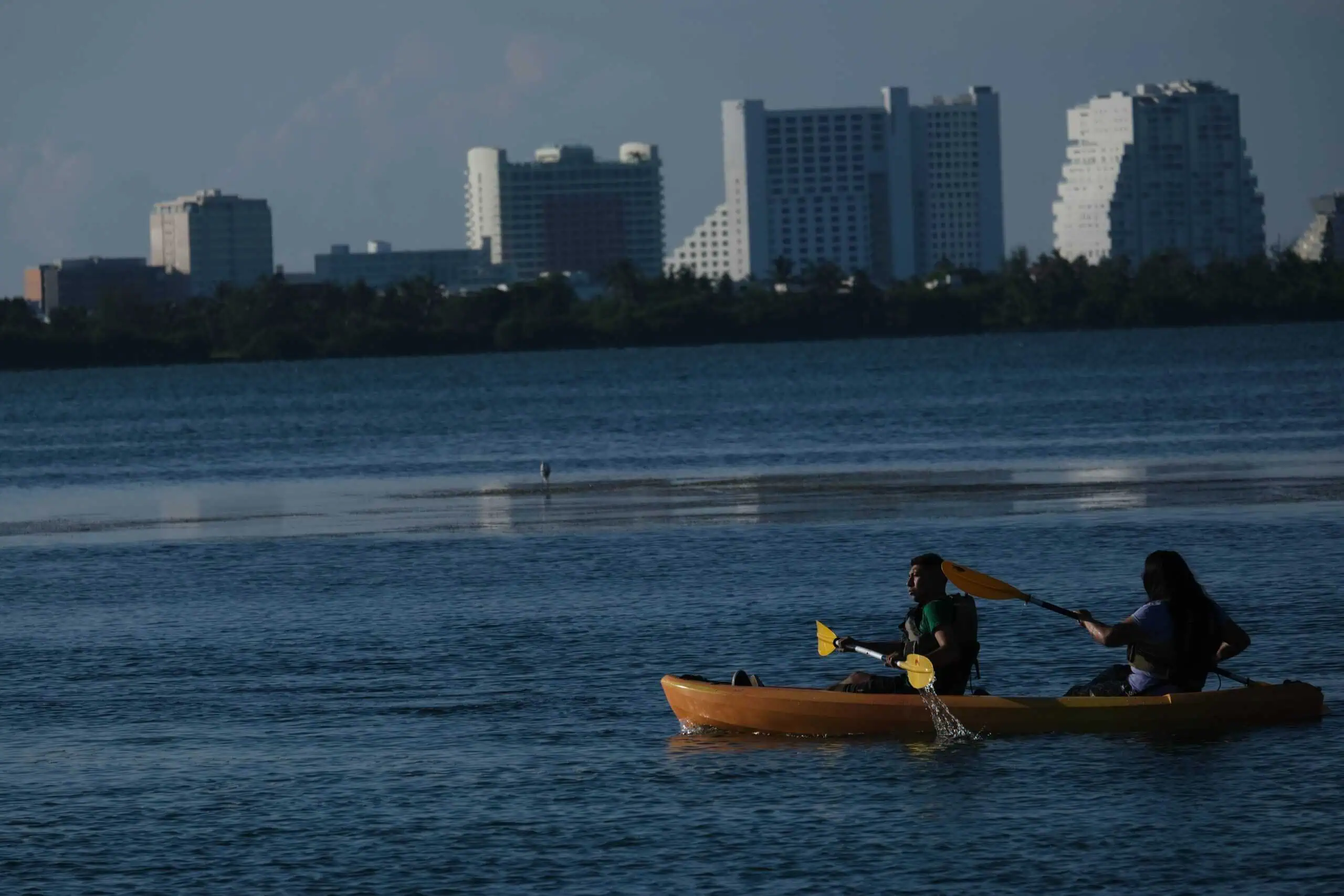
Kayakers in the Nichupté lagoon.
Nichupté Lagoon’s natural beauty draws kayakers and nature lovers — even as major infrastructure like the new bridge takes shape nearby. (Greenpeace/Cuartoscuro)

Additional delays were caused by the addition of a metal arch section to provide extra support, upgrades to storm drainage systems to prevent lagoon contamination, and the installation of an Intelligent Transportation System to manage traffic flow more efficiently. 

Once operational, the bridge’s direct, elevated route over the Nichupté Lagoon will ease the burden on current roads and sharply reduce travel times for residents heading to work and tourists heading to resorts or nearby attractions. 

With reports from The Cancún Sun, Reportur and Por Esto!

Who is Luz Elena González and why is she one of Mexico’s most important politicians?

2
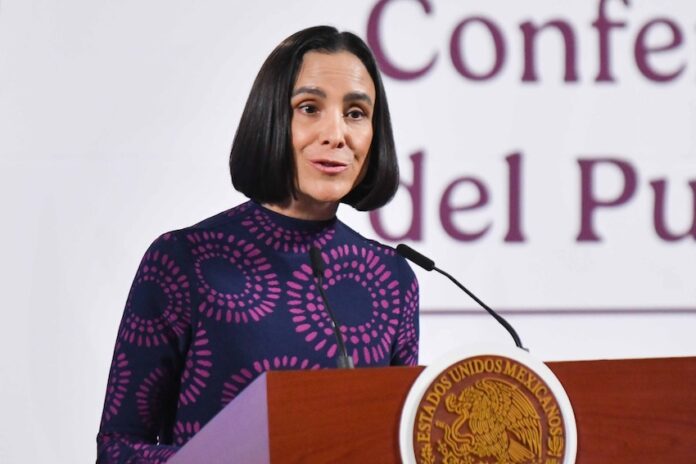
Luz Elena González speaking at podium
While the role of Energy Minister might not seem alluring, Luz Elena González has control of much of Mexico's financial future. (Mario Jasso/Cuartoscuro)

Luz Elena González Escobar, Mexico’s energy minister, has quickly emerged as a key figure in the nation’s economic and energy policy, leveraging decades of experience in finance and urban planning.

Before being appointed to the federal government, González served as Mexico City’s finance minister under then-Mayor Claudia Sheinbaum. She now holds significant sway as chair of the boards of both Pemex and the Federal Electricity Commission (CFE), making her one of the most powerful voices in the cabinet.


View this post on Instagram


A post shared by Mexico News Daily (@mexiconewsdaily)

In February, González unveiled the National Electric System Strengthening and Expansion Plan 2025-2030, which allocates US $32.7 billion to modernize and expand the country’s power grid. The goal, she said, is to “ensure that no productive process or investment will be delayed due to a lack of energy.”

Internationally, González has prioritized energy diplomacy, particularly with the United States. In March, she met with U.S. Energy Secretary Christopher Wright at CERAWeek in Houston. The meeting led to agreements on continued cooperation, increased investment in petroleum and natural gas, and streamlined engagement for U.S. companies seeking to invest in Mexico.

Framing energy as “an enabler of development,” González has pledged to cut red tape and facilitate investment. As Mexico faces mounting pressure to modernize infrastructure while transitioning to cleaner energy, her leadership will be central to balancing sovereignty, private capital, and global collaboration.

Whether Mexico can deliver on these promises remains to be seen — but the stakes for its economy are high. Mexico News Daily’s María Meléndez explains what you need to know about another low-profile but high-power government figure.

Mexico News Daily