Home Blog Page 4

Ambassador Johnson and Sheinbaum spar over where US help ends and interference begins

27
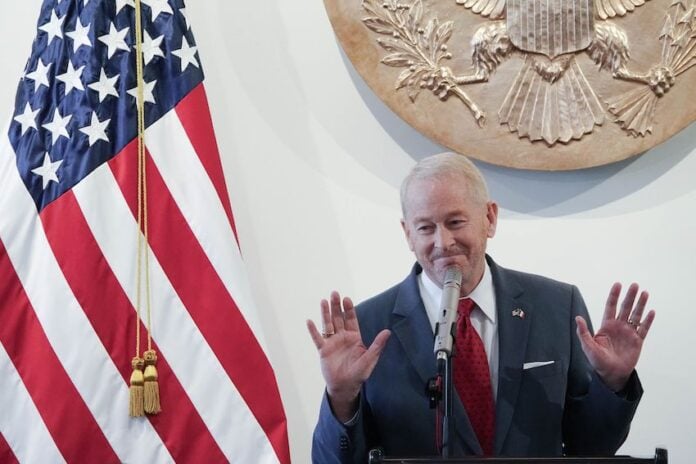
U.S. Ambassador to Mexico
On Monday, the U.S. Ambassador to Mexico Ronald Johnson posted a message on his X account that was clearly directed at President Claudia Sheinbaum, even though the ambassador didn't mention her by name. (Camila Ayala Benabib/Cuartoscuro)

On numerous occasions, U.S. Ambassador to Mexico Ronald Johnson has taken to social media to praise the Mexican government’s actions against organized crime and highlight its close collaboration with the Trump administration on security issues.

On Monday, Johnson sent a different message via his X account, one clearly directed to President Claudia Sheinbaum, even though the ambassador didn’t mention her by name, as he often does in his social media posts.

“The fight against cartels should unite us, not divide us,” he wrote.

“People on both sides of our border want to live safely and in peace. They deserve freedom from the intimidation, corruption, and fear that the cartels inflict. Every moment spent turning this shared security challenge into a political dispute is a missed opportunity to strengthen our partnership and protect the people we serve.”

The timing of the post was telling. It came the day after Sheinbaum declared that Mexico “is not anyone’s piñata” and railed against U.S. interference in Mexican affairs during a forceful speech at a large rally in Mexico City to mark the second anniversary of her election.

Sheinbaum is not happy that U.S. Central Intelligence Agency officers allegedly participated in a drug lab raid in the northern state of Chihuahua in April without the knowledge or authorization of her government. She has expressed her dissatisfaction with U.S. authorities for requesting the arrest and extradition of Sinaloa Governor Rubén Rocha Moya and various other Sinaloa-based current and former officials without providing hard proof supporting the drug trafficking accusations against them. She has asserted that U.S. media reports claiming that the CIA was involved in a targeted assassination in Mexico are not only false, but part of an orchestrated international campaign against her government.

All this, Sheinbaum believes, amounts to U.S. meddling in Mexican affairs. All the while, she is forced to deal with U.S. President Donald Trump’s semi-regular threats to take unilateral action against Mexican cartels on Mexican soil.

At her rally speech on Sunday, Sheinbaum made her strongest statements yet against alleged U.S. interference in Mexico. Among them:

  • “The Political Constitution of the United Mexican States and the National Security Law establish with precision that no foreign agent may carry out tasks that correspond exclusively to Mexican authorities. Whoever comes to our country must do so respecting our sovereignty, accrediting themselves in accordance with the law and subject to our regulations.”
  • “An office of the United States Department of Justice issued an urgent request for the arrest for extradition purposes of 10 Mexican citizens — including a sitting governor, a sitting mayor, and a sitting senator — without publicly presenting evidence to support the request. An action of that magnitude has no precedent in the history of our bilateral relationship.”
  • “We must ask — and it is a legitimate question: … [Does the U.S. have] a genuine, legitimate interest in helping Mexico? Is it a genuine commitment to combating organized crime? Or are we witnessing sectors of the American far right using our country to position themselves ahead of their 2026 elections? Or perhaps they intend to influence the 2027 elections in our country? These are not rhetorical questions.”
  • “Let it be heard loud and clear, Mexico doesn’t accept interference. We are a free, independent and sovereign country.”
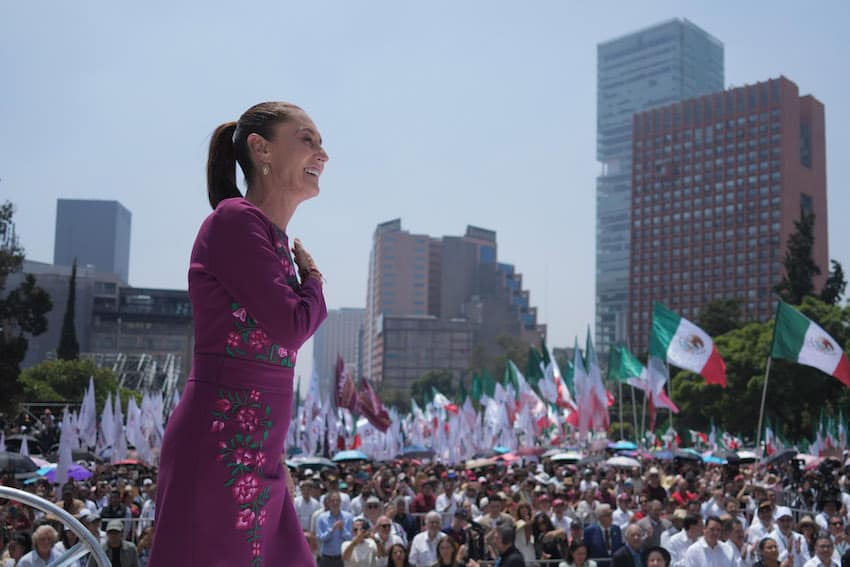
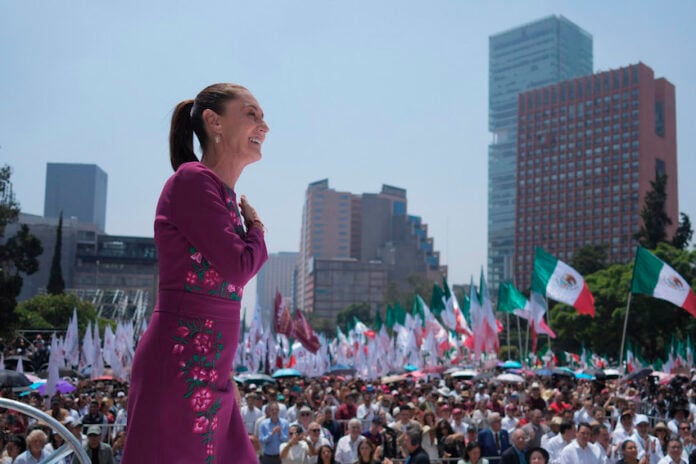
Sheinbaum stands on a stage before a rally on May 31, 2026
Mexico “is not anyone’s piñata,” President Claudia Sheinbaum declared during a rally on Sunday. (Hazel Cárdenas/Presidencia)

Johnson’s social media post on Monday indicates that he believes that Sheinbaum is creating a “political dispute” between Mexico and the United States by denouncing alleged U.S. interference in Mexican affairs. The ambassador evidently thinks — or at least publicly indicates — that the issues the Mexican president spoke about on Sunday, and has been speaking about for weeks, should not be an impediment to the additional strengthening of a bilateral security cooperation that he himself has described as “historic.”

For Sheinbaum, things are not that simple. While she said on Sunday that security cooperation with the United States would continue, the president evidently feels she cannot ignore, or even downplay, U.S. actions that she sees as violations of Mexican law, the Mexican Constitution and Mexican sovereignty, and/or blatant examples of U.S. interference. She frequently vows to stand up for Mexico and the Mexican people — no matter what — and with her words on Sunday, she did that emphatically.

“Strongest rhetoric I can remember hearing from Sheinbaum,” Brian Winter, a political analyst and editor-in-chief of Americas Quarterly, wrote on X.

Sheinbaum responds to Johnson 

At her Tuesday morning press conference, Sheinbaum took the opportunity to respond to Johnson, a former Green Beret and CIA officer to whom the Mexican government sent a protest note after the CIA’s alleged participation in the security operation in Chihuahua in April came to light.

She said that her government agrees with part of the ambassador’s social media message “because we have to work together when we have shared problems.”

“One of those is obviously violence caused by organized crime, and on that, as we have always said, we seek collaboration and coordination in order to be able to make progress together — they act in their territory and we act in … [our] territory,” she said.

Sheinbaum subsequently stressed that “it’s important for ambassadors to stick to the issue of coordination and collaboration.”

“Ambassadors have to be respectful of a country’s internal matters,” she said, making it clear that she believes that Johnson had overstepped the mark.

“Our ambassador in the United States, our ambassador in France, our ambassadors in any place in the world — Australia, India — don’t offer opinions on a country’s political issues because our constitution clearly establishes [the right to] self-determination … and respect and non-intervention, ” Sheinbaum said.

“We have to also remember that it’s important for the [U.S.] ambassador to stick to bilateral issues and to respect the internal affairs of our country because Mexico’s affairs correspond to Mexicans,” she added.

Sheinbaum’s remarks on Tuesday came a day after she said that she didn’t believe Trump was leading the meddling and media “offensive” against Mexico.

She also stressed that her administration wants “a good relationship with the United States government.”

As things stand, however, the bilateral relationship between the North American neighbors and trade partners is certainly strained.

By Mexico News Daily chief staff writer Peter Davies (peter.davies@mexiconewsdaily.com)
Mexico’s Mennonites: A troubling pattern of deforestation

3
Mennonites in Quintana Roo
Mennonite deforestation in Mexico has led to government fines in communities where illegal logging operations have been found, such as in Quintana Roo. (Ale Escárcega/Wikimedia Commons)

Coakee William Wildcat of the Oklahoma Seminole Nation, founder and executive director of the nonprofit Mother Tree Food and Forest, works in agroecology restoration around the U.S.–Mexico borderlands, combining progressive ecosystem restoration methodology and ancestral traditions. Among the issues that concern him the most are those of the Mennonites in Mexico.

“We have Mennonites buying up all the Indigenous land on the Mexican side (of the Mexico-U.S. border) and displacing all the Indigenous peoples,” he said. “And they are doing the most destructive agriculture imaginable.” 

Mennonite family in Campeche
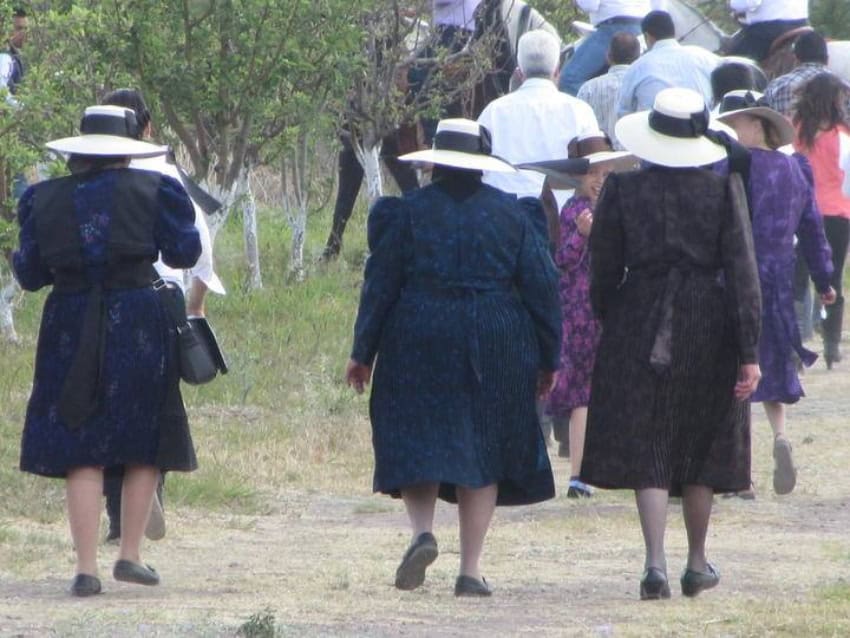
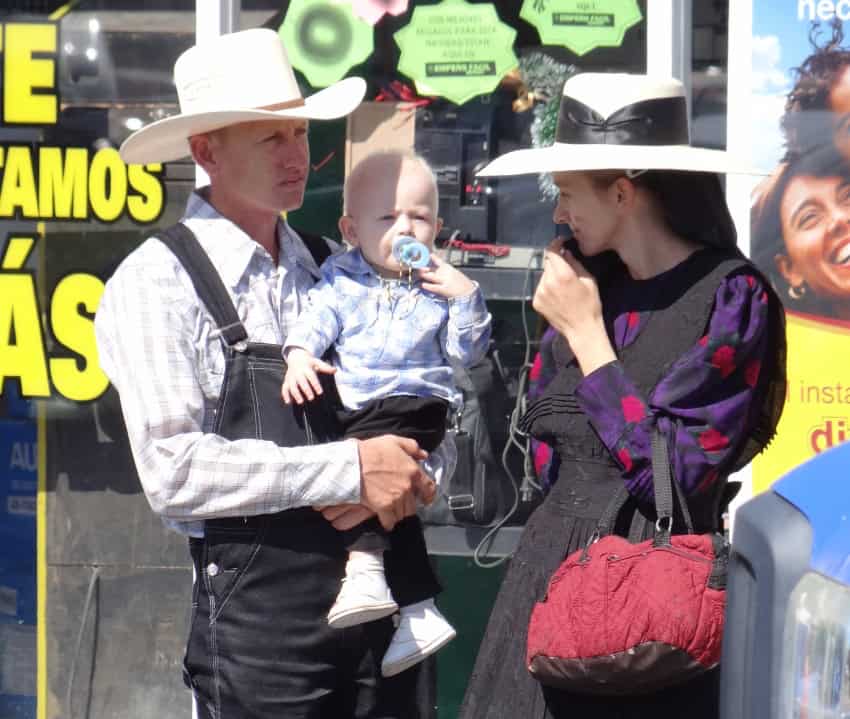
A Mennonite family in Campeche. Mennonite communities have existed in Mexico since 1922. (Adam Jones, Ph.D/Wikimedia Common)

The Mennonites’ origins 

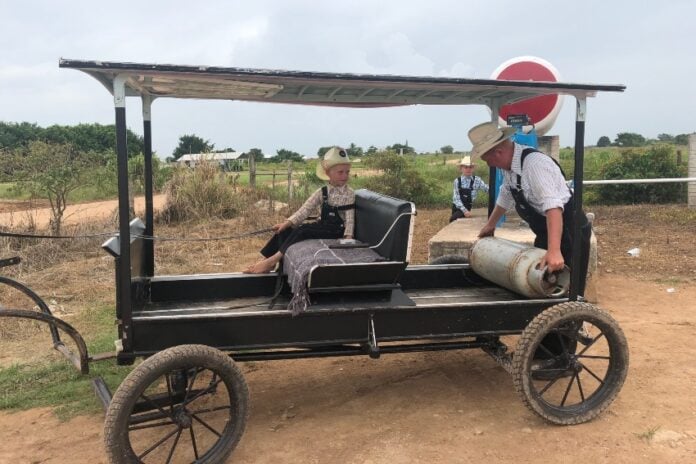
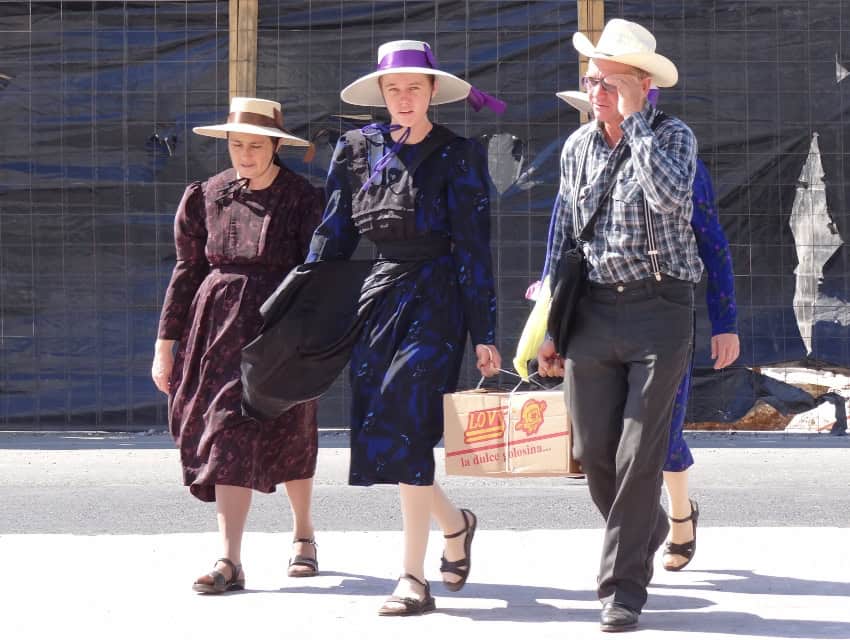
Following the teachings of the 16th-century Dutch priest Menno Simons, the most conservative Mennonites live in the countryside based on an ancestral understanding that living far away from the center of society means evil can be better controlled.

While cars and mobile phones are used by some Mennonite communities, most conservative communes’ way of life is far from the typical understanding of modernity: horse‑drawn transport, wooden houses and no electricity.

This doesn’t exactly suggest environmental destruction. But the reality of Mennonite agriculture in Mexico is more complicated and includes bulldozers, rule‑breaking, burning and extreme deforestation, all bound up in the realities of Indigenous ethnic persecution.

The Mennonites are an Anabaptist religious group that formed in the 16th century during the Protestant Reformation in Central Europe. Yet today, two‑thirds of Anabaptists live in Africa, Asia and Latin America.

Persecution toward Anabaptists came in multiple forms, often a result of tensions between Catholic and Protestant officials and Anabaptist practices, including a refusal to baptize until adulthood or to involve themselves physically or financially in violence and wars. This caused the Mennonites to flee to North America in the 1700s.

Mennonite cultural center in Chihuahua
A Mennonite cultural center in Cuauhtémoc, Chihuahua. Cuauhtémoc is home to both traditional and progressive Mennonite factions. (L8stbefore/Wikimedia Commons)

Mennonite roots in Latin America

The Mennonites reached Mexico in 1922, a popular destination as President Álvaro Obregón allowed the Mennonites to buy land and promised no obligation to military service, as well as total autonomy to practice religion and religious education without interference.

Obregón stated that “it is the most ardent desire of this government to provide favorable conditions to colonists such as Mennonites who love order, lead moral lives and are industrious.”

The settling of the Mennonites in the 1920s and 1930s clashed with the formalization of the ejido system during this period — part of the post-Revolutionary agrarian reforms that promised property to landless people, namely Indigenous groups and those with historical ties to the land.

Mennonites and Mexico’s ejido system

Much of the land claimed by the Mennonites was taken away from agraristas — local agrarian activists — thus undermining the spatial and political rights of that were fought over during the Mexican Revolution.

The Mennonites’ purchase of what is now the Nuevo Ideal Colony resulted in the closing and reopening of Mennonite schools as the government navigated rightful land claims, often favoring what it saw as the economic benefits of the Mennonites over its ideological stance in support of ejidos.

Mennonites in Nuevo Ideal
Mennonites in Nuevo Ideal, Durango, once the site of numerous rival land claims by campesinos. (Facebook)

Rapid industrialization and urbanization during the 1940s and the growth of their colonies saw increasing land given to Mennonite communities, with many locals forced off their property. Rural Mexicans organized protests, as well as a government‑aligned national union and the independent Central Campesina Independiente (CCI). 

While Indigenous claims sometimes resulted in Mennonite land being redistributed into ejidos, the overarching pattern was capitalist expansion of Mennonite colonies, a form of colonization that pushed rural communities off their land. Later, legislation in 1992 helped facilitate the development and sale of previously protected forest land.

Mennonite assimilation and cultural preservation

Census data has recorded 74,122 Mennonites living in Mexico

Younger generations within more liberal factions are increasingly integrated within their sociocultural surroundings: They learn Spanish and marry interculturally. But through religious worship, language, labor, gastronomic practices, clothing, family and gendered organization and the sharing of oral lore, the Mennonites continue to preserve their identity.

Mennonites in Campeche
A Mennonite family in Campeche in the Yucatán Peninsula. (Adam Jones, Ph.D./Wikimedia Commons)

In a bid to preserve a traditional lifestyle, some Cuauhtémoc Mennonites banned women and children from learning Spanish and integrating with local Indigenous and Mexican communities. 

God’s will is that humans control nature

The Mennonites are part of a wider systemic issue in Mexico of cultural erosion through trade liberalization, land reforms and the capitalization and mechanization of agriculture. Their arrival coincided with the rise of Latin American developmentalism, where the transformation of “virgin” lands for productive means was favored by governments across the region. This suited the Mennonites’ understanding that it is God’s will for humans to control and utilize nature.

Last year, the Federal Attorney for Environmental Protection (Profepa) began filing criminal complaints against Mennonite communities and shut down seven properties in response to the illegal razing of more than 2,600 hectares of forest in the Mexican states of Campeche, Yucatán and Quintana Roo. The agency seized timber, three tractors and a variety of agricultural equipment.

In the Piedras Negras ejido in José María Morelos, native rainforest was reported to be illegally removed, with the natural vegetation in San Diego Buenavista in Tekax being felled, burned and replaced by leveled ground.

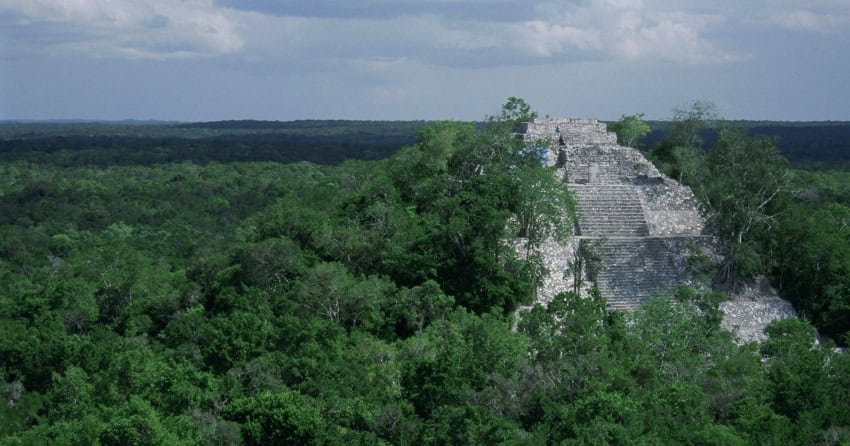
The Maya Forest is a critical carbon sink and home to up to 400 bird species, 100 mammal species and endangered jaguars. Global Forest Watch has warned that each year a Dallas‑sized chunk of the forest is disappearing, threatening biodiversity, groundwater stores and ecosystem health. While a handful of Mennonite communities agreed to halt deforestation in response to government requests, not all agreed.

Maya Forest
The Maya Forest is losing 80,000 hectares of tree cover every year to agricultural incursions. (Nature Conservancy)

Upwards of 1.5 million hectares of tree cover were lost in the states of the Maya Forest (Quintana Roo, Campeche and Yucatán) between 2001 and 2018, causing a shortening of the rainy season and affecting planting schedules.

The forest is losing 80,000 hectares of tree cover every year due to agricultural expansion, and modern development projects are also a secondary culprit.

Illegal logging in Bacalar

In Bacalar, Mennonite deforestation has resulted in the El Bajío ejido changing from primarily rainforest to expanses of agricultural lands, due to the influx of Mennonites and their mechanized agricultural practices since 2000. Illegal logging, monoculture practices and deforestation threaten local ejidatarios’ livelihoods and block access to their travel by horseback.

In March 2017, the Federal Attorney’s Office for Environmental Protection and the Mexican Navy reported unauthorized logging on 1,445 hectares of forested land. Despite Mennonites and the ejido authorities of Paraíso and El Bajío being penalized with a fine of 10,266,640 Mexican pesos (around US $500,000), harmful deforestation continues to take place.

Global Forest Watch’s satellite data has exhibited the increasing expansion of large‑scale agriculture and forest clearing in Bacalar in 2022 and 2023, such as in the Blanca Flor, San Fernando, Paraíso, El Bajío and Salamanca ejidos. A Mennonite representative claimed the new colony was a necessary response due to a shortage of space for Bolivian settlers and that they were granted permission by the Program for the Certification of Ejido Rights and Land Titling to establish their own ejido.

Since its establishment in 2005 by the Mennonites, the Salamanca ejido experienced a loss of 4,600 of its 5,000 hectares of rainforest by 2012, and three additional Mennonite settlements have since been established nearby.

Cultural erosion of Indigenous peoples

Melipona honey bee hive
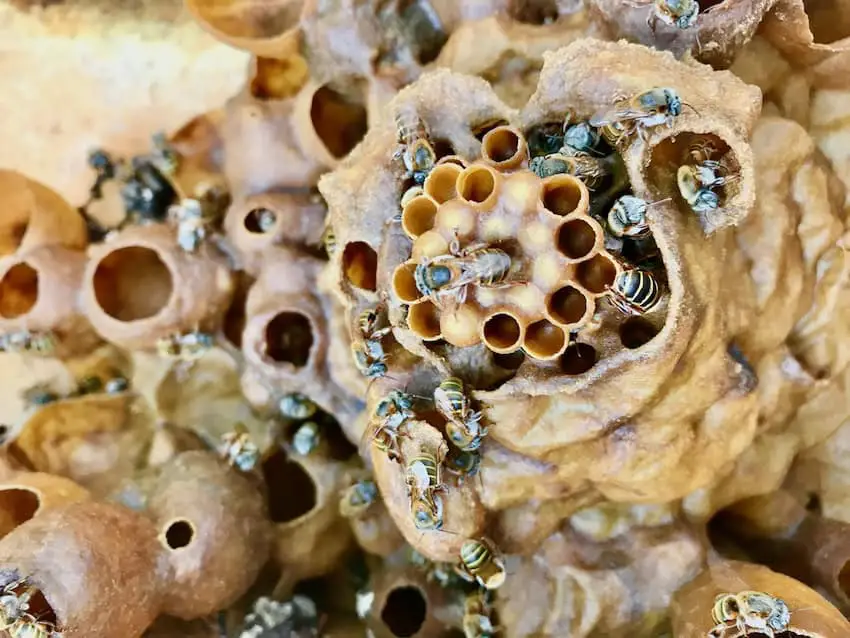
Mennonite settlers in Bacalar and their agricultural methods are threatening traditional Maya practices of beekeeping. (Bel Woodhouse)

By settling in Bacalar, Mennonites threaten the Blanca Flor Maya community’s beekeeping practices. Campeche Mennonites’ use of genetically modified soy crops and the weed killer glyphosate also threatens Maya bee colonies and milpas more widely.

Medicinal plants and Indigenous farming practices involving crop rotation are widely jeopardized, as are their non-hybrid native crops when contaminated by Mennonite agrochemicals used for hybrid crops, such as those provided by the pharmaceutical company Bayer.

Critically, the Mennonites have reportedly used Indigenous labor to bolster their commercial means and agricultural expansion. Additionally, many Mennonites have been imposing their value systems onto Indigenous peoples in Mexico through agriculture, education, language and labor, reflecting claims to cultural and ethnic superiority through missions to “civilize” Indigenous peoples.

What’s next?

There are, of course, conflicting points of view, and while seeking to comprehend the marginalization of Indigenous peoples, it is also important not to overlook either their agency and self‑determination or ongoing and future opportunities for peaceful collaboration with Mennonite colonies.

The situation in Mexico’s borderlands and southern states reflects a broader, unresolved tension between land rights, cultural survival and agricultural expansion that has defined the region for centuries. For Indigenous communities — Maya beekeepers, milpa farmers and ejidatarios alike — the stakes are not abstract: they are measured in disappearing forests, contaminated crops and eroded traditions. At the same time, the Mennonites themselves remain a people shaped by their own history of persecution and displacement, a complexity that resists simple vilification.

What is clear, however, is that meaningful resolution will require enforceable environmental protections, genuine recognition of Indigenous land rights and a willingness from all parties — including the Mexican government, which has long favored economic development over ecological and cultural preservation — to reckon honestly with who bears the cost of agricultural progress and who has always been asked to bear it most.

Millie Deere is a freelance journalist.

MND Local: Tourism highs and lows in Los Cabos, and new Michelin Guide restaurants around the Baja California peninsula

2
A drone shot of Baja California Sura and Los Cabos
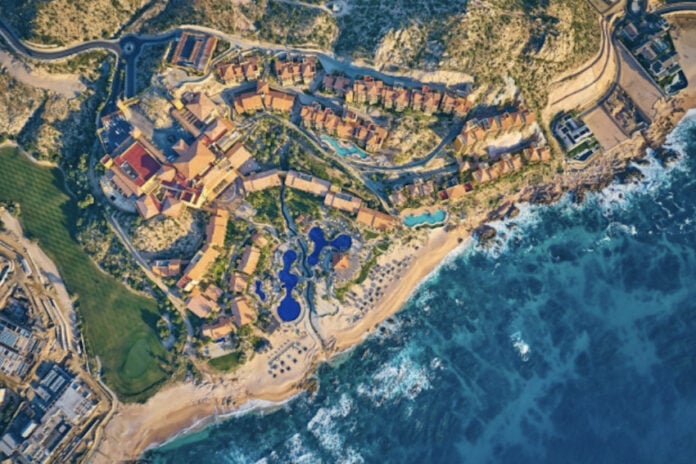
A big picture overview of tourism in Los Cabos in 2026 shows some interesting trends. (Grand Fiesta Americana)

It has been a strange year for tourism in Los Cabos. After starting the year well, the number of international visitors arriving by air dipped significantly below expectations in both March and April: down 7.1% and 9.7% relative to 2025 numbers for those months, respectively. To make matters worse, as noted last month, domestic arrivals have been slipping with disheartening regularity since last summer.

What’s strange is that the number of tourists coming to Los Cabos this year hasn’t dropped overall. That’s because Mexico’s Pacific Coast ports are in the middle of an unprecedented cruise ship boom. In 2025, Ensenada, Cabo San Lucas and Puerto Vallarta — the top Pacific Coast ports — all posted record numbers, and all finished the year with over one million passenger arrivals.

Los Arcos, Los Cabos
Cabo San Lucas has never been more popular as a cruise ship destination than it has been during the last two years. (Norwegian Cruise Line)

A balancing of numbers

Last year may have been a record year for cruise ship passengers in Cabo San Lucas, but that record won’t last long. That’s because the 2026 numbers logged have been staggering. Through April, Cabo San Lucas has welcomed 158 cruise ships so far this year, carrying 597,981 passengers. For the same period last year — again, 2025 was a record year — the destination received 102 ships with 355,707 passengers. So the number of ships is up 54.9%, and the number of passengers is up over 68%.

These astonishing figures help balance the disappointing air arrivals so far this year, which, through April, are down 2.9% for international visitors and 3.9% for international and domestic visitors combined. In sheer numbers, Los Cabos is down about 107,000 tourists this year. That’s by air. Meanwhile, via cruise ship, it’s up over 242,000 this year. That’s a net positive, right?

Not at all. That type of math doesn’t work in reality because the value of tourists who fly to Los Cabos is worth so many times more than those who arrive via cruise ships.

An imbalance of value

On a recent Sunday, when two cruise ships were at anchor in Cabo San Lucas Bay, I walked through the downtown area and saw very few tourists. Puzzled by this, I called a source knowledgeable about local cruise ship matters. “That’s because so few of them are actually getting off the ship,” he told me. Are they scared? I asked. “No, just cheap.”

In 2026, the average cruise ship arriving in Cabo San Lucas carries 3,785 passengers. There’s no data available on how many stay on the ship in port versus those who debark to enjoy shopping, dining and activities. But we do know that traditionally, the average cruise ship tourist is worth US $80 to $100 dollars to the local economy. Multiply that by 3,785 and the sum is certainly not negligible. Cruise ships do bring value that local business owners very much appreciate.

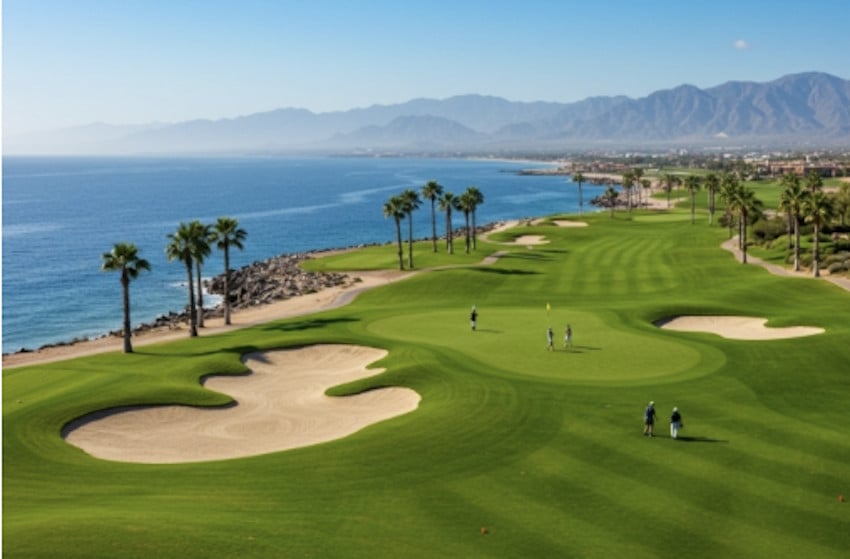
Los Cabos attracted 84% of all tourists who flew into Baja California Sur in 2025, with each tourist contributing thousands of dollars to the local economy through hotel rates and high-priced activities like golf, seen here at Puerto Los Cabos (Coldwell Banker Riveras).

But compare those tourists, who stay for a few hours, with those who arrive by air, and, according to the most recent data, stay for 4.7 days, and spend about US $2,000 on hotel rooms alone (As of January 2026, during the height of “high season,” the average hotel rate was US $499 per night). So, at a minimum, the average fly-in tourist is worth at least 20 times more in economic value than the average cruise ship tourist, and that’s not even counting what these airline brought visitors are spending on food, drinks, transportation and activities. 

That’s why a surfeit of cruise ship tourists can never replace a dearth of fly-in tourists, no matter how many of the former there are, or how many records they break. And it’s why the Los Cabos Tourism Board (Fiturca) puts so much emphasis on the establishment of new air routes.

Courting the European tourism market

Just last week, Francisco Villaseñor, director of Los Cabos International Airport, told the Gringo Gazette that “tourism and airport officials are seeking a direct air connection between Los Cabos and Cancún as part of a broader strategy to attract more international travelers, particularly from Europe.”

Two weeks ago, a delegation of Los Cabos tourism officials and local hotel representatives led by Fiturca’s managing director, Rodrigo Esponda, was in Frankfurt, Germany, to attend IMEX Frankfurt, one of the world’s largest trade shows for the meetings, conferences and events industry. Frankfurt, not coincidentally, is where the only direct European flight to Los Cabos, from Condor Airlines, originates. 

So while airline passenger numbers from the U.S. and within Mexico may have dipped in recent months, Los Cabos tourism officials are working to boost arrivals from other parts of the world, and also to position the destination as a stop on longer vacations for Europeans that may have begun elsewhere in Mexico, like Cancún. This kind of strategic thinking is why tourism to the destination in the long term, over the past decade, has been up an impressive 130%. It’s also why Los Cabos continues to dominate tourism within Baja California Sur, accounting for 3.8 million, or 84%, of the over 4.52 million tourists who flew into the state in 2025.

Famed for its tasting menus, Nemi Restaurante in La Paz has now been recognized by the Michelin Guide as a regional culinary standout. (Nemi/Instagram)

Michelin Guide joy in La Paz

The Michelin Guide’s latest selections for Mexico were announced on May 20, 2026. Los Cabos, home to one Michelin star at Cocina de Autor and 14 recommended restaurants, saw no new additions or subtractions. La Paz, however, the state capital, became the first destination in BCS outside Los Cabos and Todos Santos to host a restaurant worthy of the guide’s coveted recognition. 

That’s Nemi Restaurante, helmed by chef Alejandro Villagómez, who worked for 10 years under acclaimed chef Enrique Olvera at Pujol in Mexico City — itself honored with two Michelin Guide stars — before opening his own restaurant in the historic heart of La Paz in October 2019. At Nemi, “the tasting menu focuses almost exclusively on the bounty of Baja California — though it also welcomes guests like French truffles —all perfectly paired with Mexican wines,” Michelin Guide, which awarded “recommended” status to the restaurant, notes.

Elsewhere around the Baja California peninsula, several new eateries were added to the Michelin Guide, including Comal Restaurante in Ensenada, and Amapola and Fireside in Valle de Guadalupe. Additionally, Damiana in Valle de Guadalupe, already the possessor of a coveted Michelin star — one of five such “starred” restaurants in Baja California — was also awarded a new “green star,” indicative of its commitment to sustainability and responsible restaurant practices.

Chris Sands is a writer and editor for Mexico News Daily, and the former Cabo San Lucas local expert for the USA Today travel website 10 Best and writer of Fodor’s Los Cabos travel guidebook. He has also contributed to numerous other websites and publications, including The San Diego Union-Tribune, Marriott Bonvoy Traveler, Forbes Travel Guide, Porthole Cruise and Travel, and Cabo Living.


Mexico bars travelers from 3 African nations over Ebola fears ahead of World Cup

0
Mexico City International Airport with a World Cup statue at center
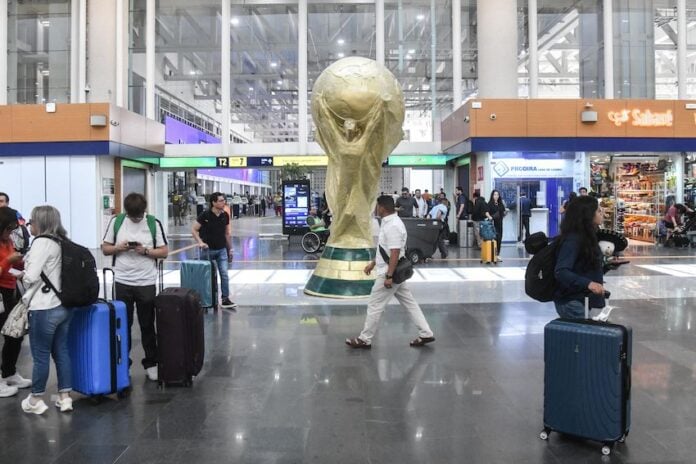
According to Mexico's Health Ministry, no individuals with the disease have been identified in the country to date. (Mario Jasso/Cuartoscuro)

Mexico has imposed travel restrictions on three countries as a precaution against a possible Ebola outbreak less than two weeks before the FIFA 2026 World Cup.

International travelers who have been in Uganda, the Democratic Republic of the Congo or South Sudan in the last 21 days are currently barred from entering Mexico. The restriction does not apply to those with a Mexican passport or valid Mexican residency, and is active for an initial 60 calendar days.

Ebola, which is transmitted through direct or indirect contact with blood, bodily fluids or secretions from infected individuals, has officially killed at least 40 people in central Africa in recent weeks — though hundreds more deaths are suspected.

The World Health Organization (WHO) declared the most recent outbreak as an international public health emergency on May 15 and has since raised the risk to “very high” after registering 750 suspected cases.

Health Minister David Kershenobich, speaking at President Sheinbaum’s daily press conference on Tuesday, said that Mexico would not impose a total entry ban but recommended that those who have been in or transited through these countries in the last three weeks reschedule their trips until the emergency is over. 

Earlier in May, Mexico issued an Ebola-related travel advisory for those planning to travel to the affected African region. 

WHO warnings on Ebola outbreaks in Africa prompt Mexico to issue a travel advisory

Mexican nationals or legal residents arriving from the three countries will be subject to epidemiological surveillance. Authorities will collect data on their itinerary, documents and place of stay and will contact them every 24 hours to monitor for symptoms.

The United States and Canada have announced stricter restrictions on travelers arriving from the three affected African countries.  

The Democratic Republic of Congo’s national team will be permitted to participate in the World Cup, as their players reside in Europe and held their pre-tournament training camp in Belgium. 

In the event of a suspected case of Ebola in Mexico, the individual will be admitted to the National Center for Research and Care of Burn Victims at the National Institute of Rehabilitation for evaluation and treatment. 

Mexico’s Health Ministry (SSA) said that no individuals with the disease have been identified in the country to date; however, its most recent travel advisory raised the risk of contagion abroad to high. 

The SSA also issued a new epidemiological alert outlining the actions to be taken for any individual who has been in areas with Ebola transmission or has had contact with a confirmed case and has a sudden fever of 38.6 degrees Celsius or presents any of the principal symptoms.

With reports from Infobae, BBC and La Jornada 

A massive soccer-themed interactive mural in La Paz earns a Guinness World Record

0
soccer-themed mural in La Paz, Baja California Sur
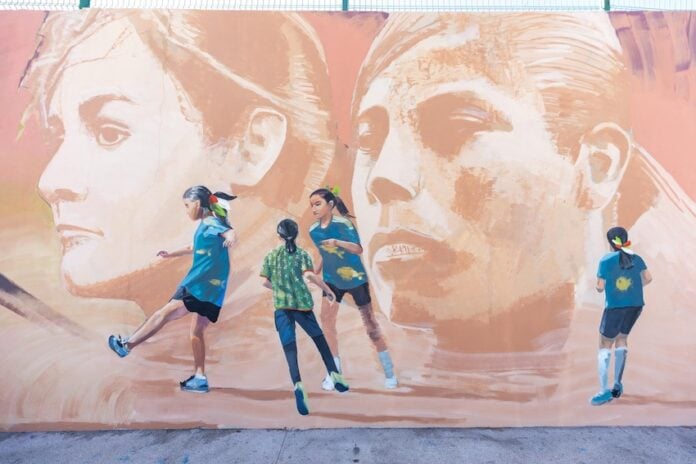
Compelling as it is for its static image alone, the mural boasts the added attraction of interactivity via QR codes. (Josefina Rodríguez Zamora/Facebook)

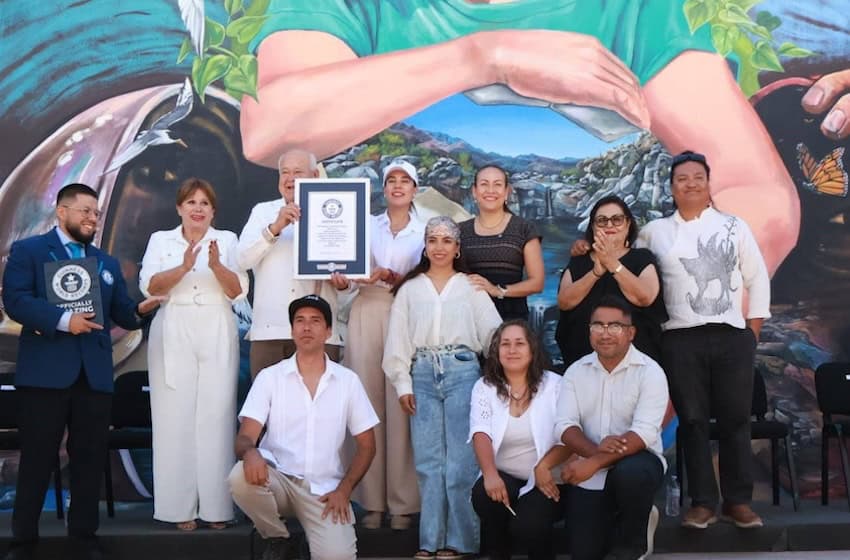
Mexico achieved yet another Guinness World Record associated with the upcoming 2026 FIFA World Cup, this time for creating the world’s largest interactive soccer mural in La Paz, Baja California Sur.

Covering an area of 625.68 square meters, the La Paz mural is twice the size of the previous record holder, a mural of 324 square meters also located in Mexico, in the city of León, Guanajuato.

BCS gov and team
Baja California Sur Gov. Víctor Manuel Castro Cosío displays the certificate confirming the Guinness World Record for the massive soccer-themed interactive mural created by local artists. (BCS State Government)

The colossal artwork, which blends a passion for soccer with Baja California Sur motifs, stretches along the perimeter wall of the Arturo C. Nahl Stadium. 

“The Guinness World Records recognition reflects the essence of Baja California Sur,” Governor Victor Manuel Castro Cosío said at the award ceremony. “Through art and sports, we create spaces for encounters that strengthen our communities and show the world who we are as a state.”

Created by local artists Elti Alejandro, Edel Rodríguez, Lenin Ruiz, Uli Martínez, and Amira Morales, the mural features images of Baja’s deserts, its seas and communities, with soccer as the common thread in the artwork’s narrative. 

Beyond the paintings on the wall, visitors can interact with the artwork by scanning QR codes scattered throughout the mural to activate an augmented reality experience where some images come to life on screen. 

No city on the Baja California Peninsula is a World Cup host, but the interactive mural is part of President Claudia Sheinbaum’s strategy to bring the World Cup to all regions of Mexico.  

“From Baja California Sur, we tell the world that we are ready to play on the field of culture, art, and community,” Mayor Milena Quiroga Romero said. “This mural is our voice, our pride, and our way of welcoming the 2026 World Cup.” 

Earlier in March, Mexico received its first Guinness World Record in the lead-up to the World Cup, when 4,757 people gathered in the southern state of Chiapas to create the world’s biggest soccer jersey formed by human figures. 

A couple of weeks later, it received its second Guinness World Record for the largest soccer class ever, which included 9,500 people playing soccer at Mexico City’s Zócalo, the country’s largest public square.  

With reports from Posta and Milenio

Trump not behind the US meddling in Mexico, Sheinbaum says: Monday’s mañanera recapped

3
Sheinbaum on June 1, 2026
On Monday morning, Sheinbaum also raised the possibility that U.S. government agencies, rather than the U.S. president (Bush or Obama), had the idea of launching a "war" on Mexican drug cartels. (Juan Carlos Ramos Mamahua/Presidencia)

Sheinbaum’s mañanera in 60 seconds

  • 🇲🇽🇺🇸 Not Trump’s doing: Sheinbaum said she doesn’t believe Trump has personally “led” U.S. interference in Mexican affairs, pointing instead to far-right sectors who want a bad bilateral relationship while reiterating that dialogue between the two governments remains strong.
  • Obama or Bush? The president raised the possibility that Calderón’s drug war was conceived by U.S. agencies rather than the former president himself — though her suggestion that Barack Obama may have been behind it appears wrong, as George W. Bush was in office when the war on drugs launched in late 2006.
  • ✏️ Teacher talks: Sheinbaum expressed confidence that talks with protesting CNTE teachers will produce progress before the World Cup kicks off June 11, even as she acknowledged some of their demands — including a 100% pay rise — cannot be met on budgetary grounds.

Why today’s mañanera matters

President Claudia Sheinbaum held her Monday morning press conference the day after she delivered a lengthy speech at a rally in Mexico to mark the second anniversary of her election as Mexico’s first woman leader.

In that address, Sheinbaum declared that Mexico “is not anyone’s piñata” as she railed against U.S. interference in Mexican affairs in light of the CIA’s alleged participation in a drug lab raid in Chihuahua in April and U.S. prosecutors’ request for the arrest of Sinaloa Governor Rubén Rocha Moya and various other current and former officials accused of drug trafficking in league with the Sinaloa Cartel.

One significant development at today’s mañanera was Sheinbaum’s statement that she doesn’t believe U.S. President Donald Trump has “led” the United States’ meddling (or alleged meddling) in Mexican affairs.

Also of note was the president’s apparently erroneous suggestion that former U.S. President Barack Obama may have come up with the idea of launching a “war” on Mexican drug cartels almost two decades ago.

Sheinbaum: ‘I don’t think it’s President Trump who has led this offensive’   

A reporter told the president that she was “more direct” in the remarks she made about the United States on Sunday, and asked her what “diplomatic actions” she would consider taking to avoid U.S. interference in Mexico’s affairs.

“There is a lot of dialogue with the United States,” responded Sheinbaum, who, in light of the CIA’s alleged participation in the drug lab raid in Chihuahua, recently offered a lesson on Mexico’s legal framework to U.S. Homeland Security Secretary Markwayne Mullin.

“I confess, she added, “I don’t think it’s President Trump who has led this offensive on different issues.”

Sheinbaum was referring to U.S. interference in Mexican affairs as well as an alleged media offensive against her government that she says is funded and promoted by “national and international conservative sectors,” including sectors of the U.S. media and far-right U.S. politicians.

She said that her administration wants “a good relationship with the United States government” and “all its areas” — i.e., all its departments and agencies.

Sheinbaum reiterated that there is “a lot of communication” between the Mexican and U.S. governments before adding:

“As I said yesterday, I think there are sectors of the United States far right who don’t want there to be a good relationship, who want there to be a bad relationship with Mexico, who don’t agree with the government we lead for ideological reasons.”

Sheinbaum has maintained an amiable relationship with Trump even as the U.S. president threatens to take unilateral action against Mexican cartels in Mexico and accuses his counterpart and her government of being “very afraid” of cartels. The two presidents have spoken by phone on numerous occasions and met face-to-face at the FIFA men’s World Cup draw in Washington, D.C., last December. However, Sheinbaum and Trump have not yet held formal one-on-one talks to discuss the many and varied challenges in the bilateral relationship, including ones related to security and trade.

Was Calderón’s war on drugs Obama’s idea? Sheinbaum suggests it may have been — even though the 44th US president wasn’t yet in office

A reporter asked the president whether there were any parallels between Chihuahua Governor Maru Campos and former President Felipe Calderón (2006-12) given the “possibility” that the former violated the constitution by allowing CIA officers to participate in a drug lab raid alongside state forces and the latter “opened the doors” to the “fast and furious” gunwalking sheme, a highly-controversial initiative of the U.S. Bureau of Alcohol, Tobacco, Firearms and Explosives.

“We’ll always be left with the question of whether the war against the narco was an idea of Felipe Calderón or an idea of Obama because Obama was in government,” said Sheinbaum, somewhat changing the focus of the interaction.

Shortly after he took office in late 2006, Calderón launched a militarized “war” against Mexico’s notorious drug cartels. The U.S. president at the time — and until January 2009 — was George W. Bush, not Obama. Therefore, Sheinbaum’s suggestion that Calderón’s war on drugs could have been Obama’s idea appears to be refuted by the simple fact that Obama was not sworn in as president until more than two years after it started.

Sheinbaum frequently rails against Calderón’s security strategy, pointing out that it caused homicide rates to surge and highlighting that the security minister under the ex-president was Genaro García Luna, who in 2024 was sentenced to 38 years in prison in the U.S. after he was convicted of colluding with the Sinaloa Cartel.

On Monday morning, Sheinbaum also raised the possibility that U.S. government agencies, rather than the U.S. president (Bush or Obama), had the idea of launching a “war” on Mexican drug cartels.

“It was the time when the DEA had the greatest opening [to operate] in Mexico, with Felipe Calderón,” she said.

“Complete openness. … Particularly in the period of Calderón, the doors were opened to U.S. agencies in Mexico,” Sheinbaum said.

“… With [former President Enrique] Peña [Nieto] as well … although [Mexico] was less open. And then when President [Andrés Manuel] López Obrador arrives, he says ‘foreign agents can be here, they can do their work but in coordination with the government of Mexico and they have to have their permits and … it was put into law [and] we took it to the constitution,” she said.

Sheinbaum confident that progress will be made in talks with protesting teachers 

Sheinbaum told reporters she is confident that progress will be made in talks between the federal government and members of the CNTE teachers union before the commencement of the World Cup on June 11.

World Cup prep collides with teacher protests at Mexico City’s Zócalo

Teachers affiliated with the CNTE have been protesting in Mexico City, Oaxaca and elsewhere as they seek to pressure the government to meet their demands. Those demands include a 100% pay increase and the repeal of the 2019 education reform as well as the 2007 ISSSTE (State Workers’ Social Security Institute) Law, which changed their pension system and will leave them — they say — considerably worse off in retirement.

Sheinbaum expressed confidence that progress will be made in talks with the CNTE even as she highlighted that “some” of the protesting teachers’ demands can’t be met for budgetary reasons.

“I’m confident that the talks will go well,” she said, referring to dialogue between the CNTE, the Interior Ministry and the Ministry of Public Education.

“We’re going to place trust in that [process],” Sheinbaum added.

By Mexico News Daily chief staff writer Peter Davies (peter.davies@mexiconewsdaily.com)
Mexicans over 60 will soon outnumber the young

0
old friends
A steady increase in life expectancy combined with a plunging birth rate is expected to lift senior citizens' share of the Mexican population to just under 25% by 2050, almost double the current 13.2%. (Camila Ayala Benabib/Cuartoscuro)

Mexico’s elderly population is increasing at such an accelerated rate that the National Population Council (Conapo) estimates that there will be more senior citizens than children by 2034.

The aging population and the low average schooling rate suggest that the population’s make-up will pose challenges for Mexican society. 

grandpa and baby
In eight years, there will be more Mexicans over 60 than under 12, a demographic phenomenon that is considered a turning point with major implications for society. (Unsplash)

The National Population Program 2026-2030 report submitted by Conapo reveals that Mexico will reach a turning point in eight years, when there will be more people over 60 years of age than children under 12.

The picture painted by Conapo warns that in a relatively short time, Mexico will be a long-lived society, with low fertility rates and increasingly smaller and more diverse families.

The study indicates that fertility rates have fallen to 1.6 children per woman while life expectancy has increased by 15 years since 1970.

To illustrate the demographic changes, Conapo pointed out that the population growth rate in the 1970s was 3.21 children while currently it is well below the generational replacement level of 2.1 children per woman.

Falling below the generational replacement threshold is not negative in itself, but it poses a concrete challenge. A population with fewer young people and more older adults requires adapting pension and healthcare systems to support those who reach old age.

Additionally, the reduction in mortality provides other challenges for Mexico’s health system: addressing chronic and cardiovascular diseases, infectious diseases, malnutrition and various marked inequalities between regions and social groups.

Other findings of the population report

  • Mexico is the 11th most populous country in the world, with approximately 133 million inhabitants. 
  • Life expectancy at birth is 75.85 years: 79.24 for women and 72.74 for men. In 1970, that figure barely exceeded 60 years for the entire population. 
  • By 2050, it is estimated that nearly one-quarter of Mexico’s population will be over 60, almost double the current proportion (13.2%).
  • A growing number of women — especially young women — are childless and have no desire to have children. Between 2018 and 2023, the percentage nearly doubled among women aged 20 to 24, rising from 23.7 to 43.2%, while the national average increased from 31.3 to 50.1%.
  • Women who speak Indigenous languages ​​have an average of 2.51 children, compared to 1.67 among those who do not speak them. 
  • Women who did not reach secondary school have 2.42 children, while the fertility rate of women with upper secondary or higher education is 1.44

Finally, despite the increasing number of Mexicans returning and more foreigners arriving, Mexico continues to experience population loss. Even so, Conapo concludes that Mexico will increasingly become a destination country and a country of permanent return migration.

With reports from El País, La Jornada and Excelsior

Chichén Itzá, Mexico’s top cultural attraction, reopens after 13-day closure

0
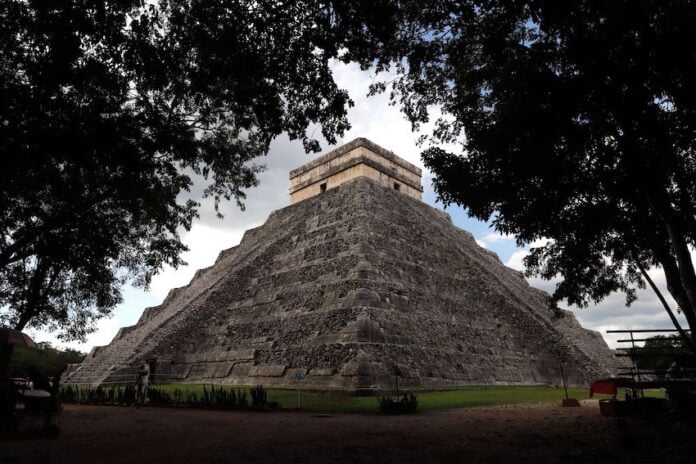
Chichén Itzá
Chichén Itzá was the most-visited Mexican cultural site in 2025. This year, however, the archaeological wonder was closed from mid-May through June 1 over a labor dispute. (Martin Zetina/Cuartoscuro)

Chichén Itzá reopened to tourists Monday after a two‑week closure that left thousands of visitors unable to enter and caused millions of pesos in losses for the tourism industry in Yucatán and Quintana Roo.

Mexico’s most-visited cultural attraction in 2025 closed May 18 amid a bitter dispute over the relocation of hundreds of vendors — who for years have sold their handicrafts and trinkets within the site, steps away from the ruins — and new regulations for the local tour guides who offer guided visits for a fee.

The shutdown of the archaeological site in Tinum, Yucatán, roughly a two-and-a-half-hour drive from Cancún, Quintana Roo, led to mass tour cancellations and what the Mexican Association of Inbound Tourism Agencies (AMATUR) called a “terrible image of Mexico.”

“Chaos at Chichen Itza with thousands of tourists unable to enter,” beamed a headline in Reportur. The tourism-industry news outlet reported that each day around 9,000 visitors were unable to enter. 

Then again, the closure didn’t completely keep people out.

On one day when protesters blocked staff but waved roughly 1,000 visitors through for free, two foreigners were detained after jumping barriers and climbing the Temple of Kukulcán. With basically no security within the site, it was local artisans who reportedly called authorities.

The rogue climb echoed a 2025 incident in which a German visitor was detained for scaling the same pyramid.

Chichén Itzá’s gates reopened at 8 a.m. on Monday under a deal struck after 13 days of negotiations between the Yucatán government, the National Institute of Anthropology and History (INAH), artisans, tour guides and Tinum authorities.

Access is now exclusively through the new Visitor Assistance Center, known as CATVI.

Authorities pledged there will be no evictions and no increase beyond the 666 authorized vendors operating inside the complex.

Some 264 artisans agreed to move into stalls in a new handicrafts market that all visitors must pass through before entering via CATVI. Meanwhile, vendors on the causeway between Cenote Sagrado (Sacred Cenote) and the Temple of Kukulcán, also known as El Castillo, will remain in their current spaces.

Pablo Euán of the Indigenous Governing Council of Pisté said the council will oversee the reorganization of artisans and guide work areas.

In a statement, the council said reopening “represents a relief for hundreds of families” but stressed “the fight continues” for a community economic corridor and respect for collective rights.

Officials insist the closure of the old access, known as Old Parador, is irreversible, even as injunctions and community demands keep the conflict from being fully resolved.

With reports from Quadratin, Excélsior and Reportur

At Sunday rally, Sheinbaum denounces US interference in Mexican affairs

17
Sheinbaum stands on a stage before a rally on May 31, 2026
Mexico "is not anyone's piñata," President Claudia Sheinbaum declared on Sunday. (Hazel Cárdenas/Presidencia)

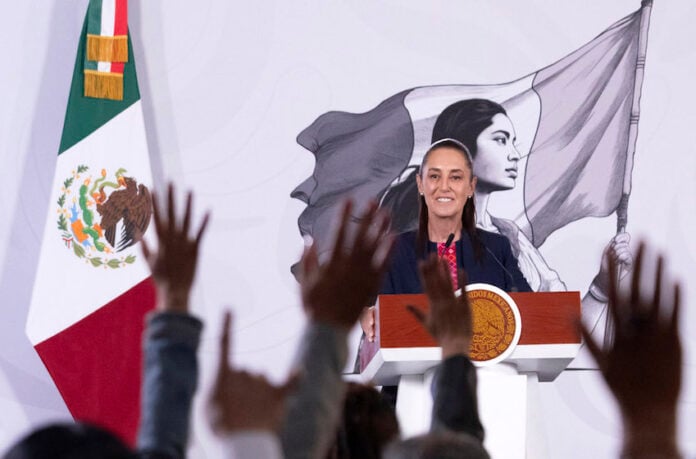
Mexico “is not anyone’s piñata,” President Claudia Sheinbaum declared on Sunday as she railed against U.S. interference in Mexican affairs during a large rally in Mexico City to mark the second anniversary of her election.

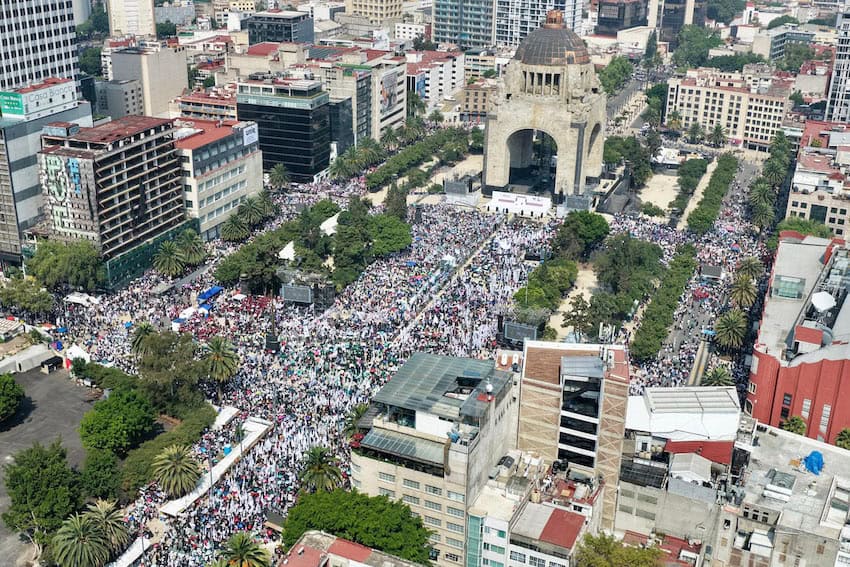
Speaking to a crowd of 130,000 people gathered in front of the Monument to the Revolution, Sheinbaum presented an impassioned defense of Mexican sovereignty in light of the CIA’s alleged participation in a drug lab raid in Chihuahua in April and U.S. prosecutors’ request for the arrest of Sinaloa Governor Rubén Rocha Moya and various other current and former officials accused of drug trafficking in league with the Sinaloa Cartel.

“Let it be heard loud and clear, Mexico doesn’t accept interference. We are a free, independent and sovereign country,” she proclaimed, prompting an enthusiastic response from rally attendees, including chants of “you are not alone.”

More than 40 minutes into her address, after speaking at length about government achievements and positive developments across a range of areas including the economy, education and healthcare, Sheinbaum turned her attention to what she called “important issues that we think are essential to share with you.”

“Friends: For some months now, we have been the target of a media offensive and million-dollar campaigns on social media. This is no coincidence,” she said.

“… Behind these campaigns are national and international conservative sectors that have never accepted that Mexico recovered its dignity and chose to fully exercise its independence,” Sheinbaum said.

The president asserted that campaigns against her government — and representing the interests of “foreign and national conservative sectors seeking to recover lost privileges or stop the transformation supported by the popular majority” of Mexico — intensified after the death of two CIA officers and two security officials from Chihuahua in a car accident following a drug lab operation on the weekend of April 18 and 19.

“In light of these events, the Federal Attorney General’s Office opened an investigation into possible violations of Mexican law,” said Sheinbaum, who has reiterated that the federal government didn’t authorize or have knowledge of the CIA’s alleged participation in the security operation alongside Chihuahua forces.

“And here we want to be very clear: the Political Constitution of the United Mexican States and the National Security Law establish with precision that no foreign agent may carry out tasks that correspond exclusively to Mexican authorities. Whoever comes to our country must do so respecting our sovereignty, accrediting themselves in accordance with the law and subject to our regulations,” she said.

Referring to the April 29 unsealing of an indictment against Rocha and nine other Sinaloa-based current and former officials, Sheinbaum said that “a few days later, something even more serious occurred.”

“An office of the United States Department of Justice issued an urgent request for the arrest for extradition purposes of 10 Mexican citizens — including a sitting governor, a sitting mayor, and a sitting senator — without publicly presenting evidence to support the request,” she said.

“An action of that magnitude has no precedent in the history of our bilateral relationship,” Sheinbaum said.

“And so we must ask — and it is a legitimate question: Is this a genuine, legitimate interest in helping Mexico? Is it a genuine commitment to combating organized crime? Or are we witnessing sectors of the American far right using our country to position themselves ahead of their 2026 elections? Or perhaps they intend to influence the 2027 elections in our country? These are not rhetorical questions,” the president said just two days after Mexico’s Congress approved a reform that allows the nullification of elections tainted by foreign interference.

“Mexico is not anyone’s piñata,” Sheinbaum added.

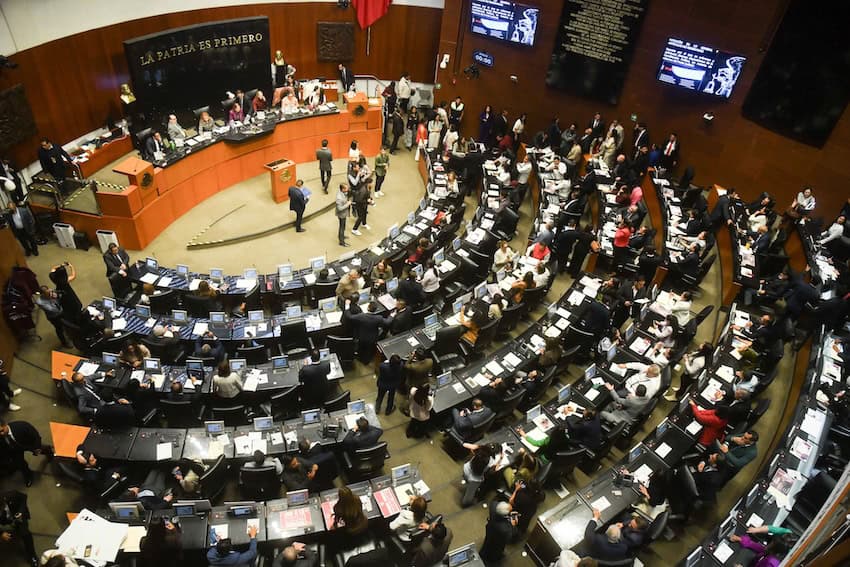
Congress
The foreign interference reform, approved on Friday, will nullify any election result deemed to have been influenced by “illicit financing, propaganda, the ⁠systematic dissemination of disinformation, digital manipulation and the intervention of foreign governments or agencies.” (Mario Jasso/Cuartoscuro)

The president went on to say that when verdicts of guilt or innocence are “dictated from abroad,” when attempts at “pressuring our institutions from the outside” are made, and when the idea that a foreign country can intervene in Mexican affairs is normalized, “we are no longer talking about cooperation, we are talking about interference.”

“… It is legitimate to question the true motives behind extradition proceedings targeting elected officials. Because — let’s be clear — first they come for some, then for others, until offices of the [U.S.] Justice Department become the primary elector in Mexico. We cannot allow that,” she said.

“Mexico’s history knows where that path leads. Interventions have never delivered justice or well-being,” Sheinbaum said.

“Therefore, we must not fall for the trick. Let this be clear: we will never defend corruption or collusion with crime. Never. That is what Mexico’s state institutions are for: the Federal Attorney General’s Office and the judiciary, she said.

“So firm has our fight against corruption and criminal collusion been that the Attorney General’s Office has proceeded against officials from all political parties when their ties to criminal activity have been proven,” Sheinbaum added.

The president’s remarks on Sunday denouncing foreign interference in Mexico were her strongest statements yet against the United States’ meddling (or alleged meddling) in Mexican affairs. Although she has reiterated that her government won’t protect anyone who has committed a crime, Sheinbaum has been accused by opposition politicians and others of providing cover for Rocha and other Morena party officials accused of drug trafficking by U.S. prosecutors. She has endorsed the Federal Attorney General’s Office’s declaration that U.S. authorities have not provided sufficient evidence to arrest Rocha and his co-defendants.

As she spoke at her rally on Sunday — held two days before the actual second anniversary of her election — a large banner was unfurled from a nearby building. “Claudia Sheinbaum protects narco-leaders,” read the banner, which featured images of the president and Rocha, who is currently on leave as governor of Sinaloa, one of Mexico’s most violent states.

In addition to strong rhetoric, a commitment to keep collaborating with the US 

While Sheinbaum denounced the United States’ meddling in Mexican affairs, she also vowed to continue security collaboration with the Trump administration.

“We believe in cooperation between nations, in the exchange of information, and in joint efforts to tackle shared problems. But cooperation does not mean subordination. Collaboration does not mean submission,” she said.

“The fight against organized crime is a shared responsibility of all states. But that fight cannot be used as an excuse to undermine fundamental principles of international law, such as non-intervention and respect for the self-determination of peoples. We will continue to collaborate to prevent drugs from crossing the border — out of humanist conviction and because we understand the pain that problem causes in U.S. families,” Sheinbaum said.

“… It is better to work together as trading partners, respecting one another and strengthening our shared interests with mutual respect for our sovereignty. But let this be absolutely clear: Mexico does not allow interference in our internal affairs, because we do not meddle in the internal affairs of other nations. That is the constitutional principle of non-intervention,” she said.

Sheinbaum also reiterated that, “to help us reduce violence in Mexico,” it is “essential” that the United States “stop the illegal trafficking of weapons into our country” and “address the serious problem of drug use in their territory.”

Sheinbaum outlines her government’s ‘main achievements’ 

On a stage erected in front of the Monument to the Revolution in Plaza de la República, the same square where presidential candidate Luis Donald Colosio made a famous speech in March 1994 just 17 days before he was assassinated, Sheinbaum began her address on Sunday by noting that on June 2, 2024, nearly 36 million Mexicans voted in favor of continuing on “the path of transformation begun by President Andrés Manuel López Obrador,” who was in office from 2018 to 2024.

Aerial shot of 100,000 people gathered in support of President Sheinbaum on Sunday at Mexico City's Monument to the Revolution
Over 100,000 people gathered in support of President Sheinbaum on Sunday at Mexico City’s Monument to the Revolution. (Hazel Cárdenas/Presidencia)

“With that support, I assumed the honor and enormous responsibility of leading the continuation of the fourth transformation of public life — a mandate born of the popular will, of the conviction of millions of Mexicans who stated clearly that “the past of privileges, corruption, decadence, and abandonment of the homeland and the people must not return,'” she said.

“And on that day, something else occurred that will be forever etched in the memory of our nation: for the first time, a woman reached the presidency of the republic. It was a victory for the women of Mexico, but above all, the victory of a people who decided to keep making history,” said Sheinbaum, who now leads the so-called “fourth transformation,” or 4T, political movement founded by López Obrador and supported by the ruling Morena party and its allies.

“Two years after that magnificent and historic triumph of the people, I appear before you again to be accountable, as we have always done — face to face with the people, in the public square,” she said.

On a warm day in Mexico City, Sheinbaum ran through a long list of the government’s “main achievements” since its six-year term began 20 months ago.

Among those achievements — and other positive developments in Mexico — she highlighted an increase in tax collection; record foreign investment in the first quarter of 2026; low unemployment; declining inflation; and a “strong” Mexican peso.”

Sheinbaum also touted a decline in public debt; the boom in export revenue; and the increase in international visitors.

“Mexico is in vogue,” she said, using a phrase she has used before when speaking about the country’s popularity.

In an address broadcast in public squares across Mexico — with the exception of Coahuila, where elections will take place this Sunday — Sheinbaum also spoke about “the labor spring” workers have experienced “since 2019” due to increases in the minimum wage and other pro-worker initiatives, such as the approval of a gradual transition to a 40-hour workweek and the doubling of paid vacation time.

In addition, the president touted her government’s welfare programs, its commitment to austerity, its support for farmers, its healthcare and housing initiatives, its support for Indigenous communities, its “rescuing” of Pemex and the Federal Electricity Commission, its construction of new highways, railroads and water infrastructure, its commitment to making access to water a “fundamental right” and its success in reducing violence in Mexico.

“In 20 months, we’ve reduced homicides by 49% and high-impact crimes by 20%,” Sheinbaum said, referring to data that compares May with September 2024, the final month of López Obrador’s presidency.

“And we will keep delivering results on security — attending to young people and ending impunity — so that all Mexicans can move safely throughout our territory,” she said.

Toward the end of her 65-minute address, Sheinbaum declared that “nothing and no one will stop the transformation of our homeland.”

“That is the new reality,” she said.

“Mexico is a democratic country. It is false that ‘we want to be a dictatorship’ or that ‘we support censorship.’ Quite the opposite. We may well be the country that enjoys the greatest freedoms in the world, because this movement was born of the people, walks with the people, and governs for the people,” Sheinbaum said.

“These are no longer the times of privilege and corruption,” Sheinbaum said before she reaffirmed her commitment to defending the sovereignty and independence of Mexico, pledged to govern in accordance with the will of the people, and wished “long life” to the “fourth transformation of public life in Mexico,” and to “the dignity of the people of Mexico” — and Mexico itself.

By Mexico News Daily chief staff writer Peter Davies (peter.davies@mexiconewsdaily.com)

Get in the World Cup mood with these streaming Mexican soccer series

0
Rafa Márquez
Sit back and enjoy a slice of Mexican history with these on-demand soccer series. (Netflix)

Mexican soccer fever is a real thing. Even if you’re not a passionate aficionado most of the year, everyone in Mexico pauses whatever is going on in their lives to watch “El Tri” take the field. Businesses shut down. Traffic thins out. In many ways, to be Mexican means cheering on the national team when things are good, criticising them when things are bad and following their progress like a religion. 

Being half-Mexican, my upbringing was no exception. I still maintain the penalty given to the Netherlands versus Mexico in the 2010 round of 16 was unjustified. I remember exactly where I was and who I was with when Mexico beat Germany 1-0 in the 2018 World Cup. Soccer is a deep part of Mexican culture to the point where I can’t imagine Mexico without it. But it turns out, I’m not the only person who feels that way. There’s evidence to back up this claim. 

So, for those who crave World Cup action before the latest edition of the tournament kicks off in June, there’s plenty of great content to watch before Mexico plays in their first group stage game. 

Good Rivals

Good Rivals Docuseries - Official Trailer | Prime Video

This docuseries is centered on the intense sporting rivalry between Mexico and the United States. It has gone on for decades, and the show does a great job explaining the cultural impact soccer has had on both nations.

From the pride Mexico feels when beating the United States in their national pastime, to the rise of American soccer in the 1990s, the docuseries makes you feel like you’re right in the action. The interviews with former players, coaches, and journalists provide as sense of perspective and authenticity that often feels missing in sports series of the same nature. What I appreciate most about this docuseries is the fact it makes the case that both nations benefited from playing against each other. 

Rafa Márquez: El Capitán

Rafa Márquez: El Capitán | Official Trailer | Netflix

If there’s any one Mexican soccer player who you should familiarize yourself with, Rafa Márquez is it. Not only was he a beloved captain of the Mexican national team, but he also represented Mexico at some of the world’s top clubs, including Monaco and Barcelona. He became the first Mexican to win the Champions League in 2006, cementing his position as an all-time great of the sport. 

The docuseries also examines the realities of Mexican corruption, the national tragedy of being knocked out of the 2002 World Cup by the United States, and the controversial “no era penal” game against the Netherlands in 2010. 

México 86

Mexico 86 | Official Trailer | Netflix

The 1986 World Cup was by far Mexico’s most successful, based on their performance. It featured some of the most legendary soccer players Mexico has ever had, like Hugo Sanchez, Fernando Quirarte, and Manuel Negrete, who helped lead their nation to the quarter-finals, where they lost on penalties against Germany. 

But Netflix’s México 86 will be centered on the untold story of how a Mexican bureaucrat managed to win the rights for Mexico to host the World Cup over the United States. 

Releasing June 5, this film is part of Netflix’s long-term investment in Mexican cinema

Brazil ‘70: The Third Star

Brazil ‘70: The Third Star | Official Trailer | Netflix

Chronicling Brazil’s third World Cup win in a 5-part scripted mini-series, Brazil ‘70 depicts the emotional journey of how Pelé, Jarzinho, and Carlos Alberto made their country proud on a massive global stage. But 1970 was also significant for Mexico. Before 1970, Mexico’s World Cup past was rather more chequered and they were rarely considered serious contenders at major tournaments

1970 wasn’t just the first World Cup Mexico hosted (and the first outside South America or Europe), but it was the first played on color television. The Azteca was beamed around the world in a way no other stadium had been before, and the legendary footage of Pelé being carried out of Azteca after winning his last World Cup is an image that will live on forever in the minds of soccer fans worldwide. 

Though Brazil ‘70: The Third Star isn’t about Mexico per se, 1970 was the start of Mexico showing the world how amazing their country was on and off the field. 

Are you excited for this June?

After losing in the group stage in the 2022 World Cup and the 2024 Copa America, the nation is hoping that El Tri will turn things around with a solid performance this June. If history shows anything, it’s that Mexico tends to play better when they’re on home soil — advancing to the quarter-finals the two times it hosted the World Cup. 

So, am I optimistic about Mexico’s chances this year since they’re co-hosting with Canada and the United States? All I’ll say is in Guillermo Ochoa I trust. 

Ian Ostroff is an indie author, journalist, and copywriter from Montreal, Canada. You can find his work in various outlets, including Map Happy and The Suburban. When he’s not writing, you can find Ian at the gym, a café, or anywhere within Mexico visiting family and friends.