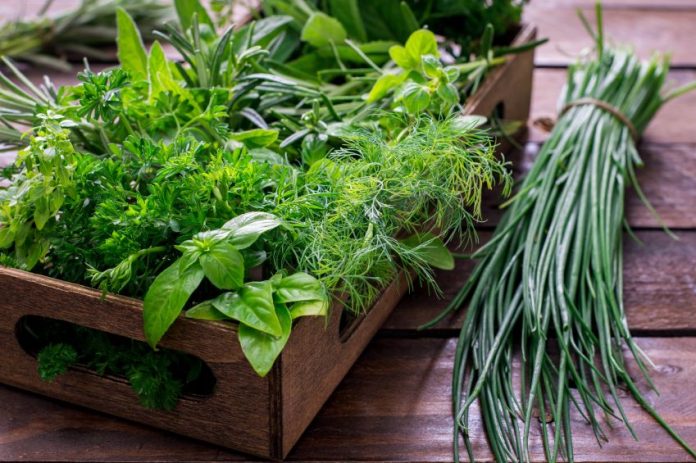
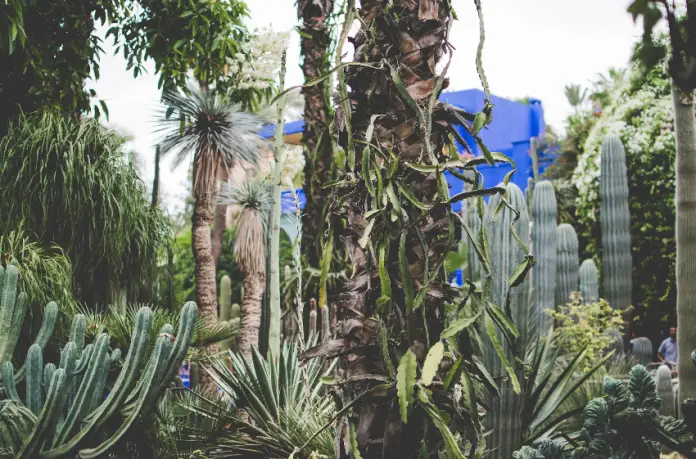
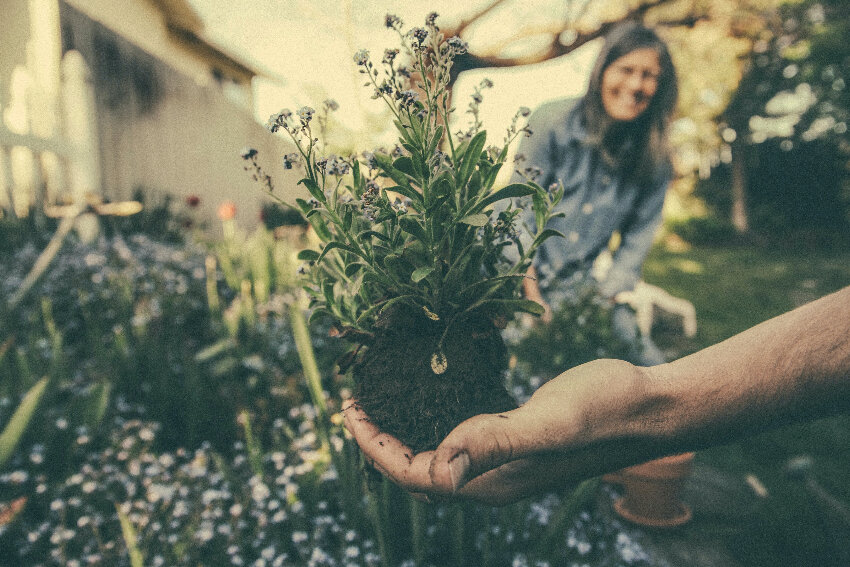
Creating your own little Mexican herb garden can spice up your food, bring color to your house and relax busy minds. (Shutterstock)
Fresh herbs provide a depth of flavor and nutritional value for cooking, teas, cocktails, and herbal remedies. Unfortunately, despite carefully picking the freshest at the store, they often wilt in the fridge before we get to use them. Growing your herb garden at home is not only an eco-friendly and affordable way to have fresh organic herbs available whenever you need and provides a beautiful scent for your home but also offers bees a safe place to rest and replenish on their pollinating journey.
So, are you ready to get your Mexican herb garden going? Here’s a basic guide:
The so called “Vicks plant” not only smells like its (unrelated) medicinal counterpart but is also a great remedy for colds. (Nickolay Kurzenko/Shutterstock)
Step 1: Select the right location
The first step in creating a herb garden is choosing the right location. Most herbs thrive in a spot that receives 4-8 hours of sunlight each day. Find a sunny area in your garden, on your balcony, or even on a windowsill that provides the necessary sunlight. If you have limited space, consider vertical gardening or hanging containers to make the most of your available area.
Step 2: Choose the right containers or beds
The choice of containers or beds for your herb garden depends on your space and preferences. You can use traditional garden beds, hanging baskets, or repurposed containers but your best choice would be, of course, Mexican terracotta pots. Ensure that your containers have adequate drainage. A good trick is to pile pebbles atop the pot’s drainage hole before adding the soil to prevent it from clogging.
Step 3: Prepare the soil
Herbs thrive in well-draining soil. Use a high-quality potting mix or prepare your garden soil by adding compost to improve its texture and fertility. Herbs generally don’t require heavy fertilization, so go easy on the nutrients.
Step 4: Selecting your herbs
You can buy ready-grown plants from your local “vivero” (plant nursery) and plant them into a dedicated herb garden or pot, or buy packets of seeds.
Herb selection is where the fun begins. Here are some traditional herbs well-suited to Mexico’s climate and cuisine, but you can try growing any herb you like.
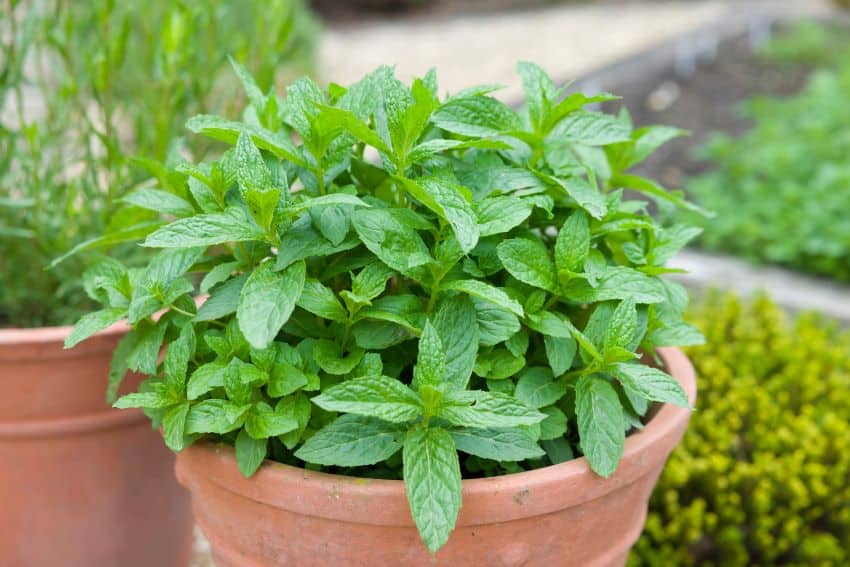
Mentha spicata is the essential taste of a mojito, and easy to grow indoors. (Paul Maguire/Shutterstock)
Cilantro (Coriandrum sativum)
Cilantro is a staple in Mexican cooking, is easy to grow and thrives in containers or garden beds. All you have to do is buy a packet of seeds, sprinkle on soil in a flower pot, and cover with half an inch of soil. Water the seeds just enough to make the soil moist but not flooded and continue lightly watering every day. The seeds will start sprouting about ten days later and continue growing. If you see the plants slanting diagonally, it means they are seeking sun, so move the flower pot to where it can receive more direct sunlight. You can start harvesting 40 days after planting by trimming the branches.
Vaporub (Plectranthus hadiensis)
This plant smells delightfully similar to Vicks Vaporub, hence the name, but is unrelated to the ingredients in the medicinal balm.It is widely used as an ornamental plant because it is easy to cultivate, propagate, and maintain, and its thick leaves on long branches provide a bright pop of color and fragrance. It can be grown in pots or outdoor gardens, grows quickly, and takes very simple care. It is popularly used for decongesting the respiratory tract in case of sinusitis or cough, just drop 12 leaves in a cooking pot with a quart of water, boil for 10 minutes, and then inhale the vapors.
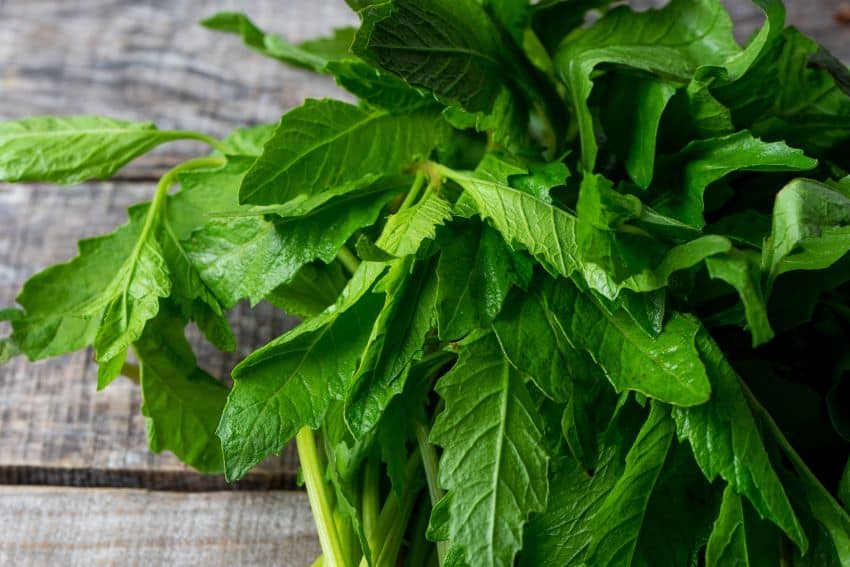
Epazote is one of the most quintessentially Mexican herbs – and plays an important role in traditional cuisine. (Guajillo Studio/Shutterstock)
Epazote (Dysphania ambrosioides)
Epazote is a herb widely loved in Mexican cuisine. Traditionally added to black beans (for its anti-flatulence properties), it also contributes wonderful flavor to salsas, quesadillas and mushroom soup. This plant can be easily grown from a simple sprig. First, place the fresh epazote sprig in a glass of non-chlorinated water. Leave it there for about five days. If it stays green, it’s doing well; if it wilts, try another sprig. When it shows roots, transplant the epazote into the soil. Place it wherever it receives 4 hours of direct sunlight daily and water every three days.
Hoja Santa (Piper auritum)
Hoja Santa has a distinct anise flavor and adds a spectacular twist to many dishes. Designate its spot in an ample and shady spot, as it loves to spread out in warm and humid areas and does not like to share space with others. Sprinkle seeds in the soil and be patient. You will begin to notice growth in three months. Water it once daily, as it thrives in humidity and does not tolerate dryness.
Hoja Santa has an anise-like flavor. (Natalia Ec/Shutterstock)
Mint (Mentha spicata)
Mint is widely loved for its scent and is a very useful herb for making drinks, from tummy-soothing teas to mojitos. It is best to grow indoors year-round in a very bright location to prevent it from stretching for the light and becoming pale. Aim for a well-balanced soil by watering only when the soil feels dry to the touch and the pot feels light. A good trick is to move the pot to the sink, and let running water flush through and out the bottom drainage hole three times. Then let it drain fully and return it to its place. Regular trimmings are necessary to keep your mint plant bushy and encourage new growth. Cutting just above a set of leaves will prompt two new stems to sprout from the leaf nodes. Word of caution: mint is slightly toxic to dogs if eaten in large quantities, so keep this plant out of their reach.
Basil (Ocimum basilicum)
This plant is a real beauty to behold and is well loved in many dishes. Basil seeds are sown shallowly and covered with a thin layer of mulch. Keep the seedbed in the shade and constantly humid until the seeds germinate 10-15 days later. Then, water regularly and place the seedbed in the sun. Transplanting outdoors is usually done two months after sowing, leaving a space of 15 inches in all directions between plants. You can start harvesting 40 days after transplanting, cutting the ends of its stems before they grow any flowers.
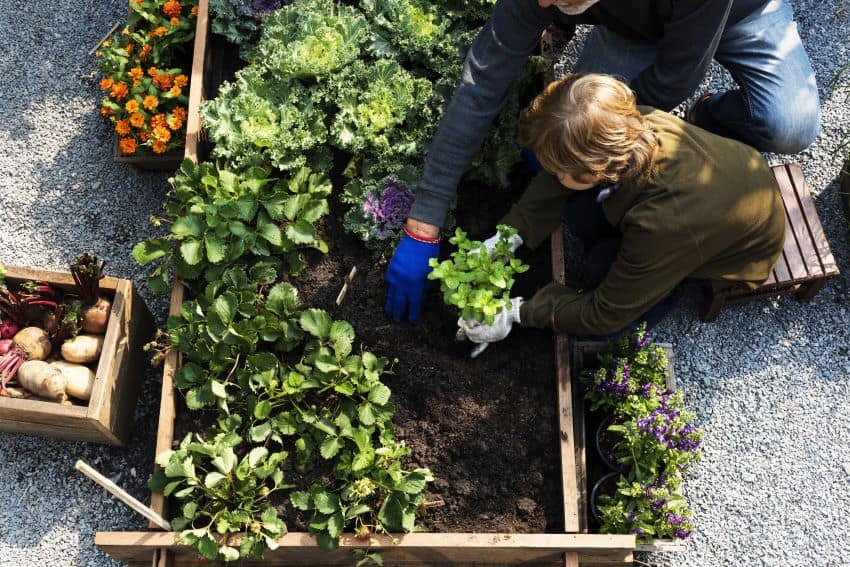
Growing herbs is easier than it sounds, and helps pollinators, such as bees, to thrive. (Rawpixel/Shutterstock)
Step 5: Watering and maintenance
How can you tell when most plants need watering? When the leaves are looking “sad” and pointing to the ground. Consistent watering is essential for herb health. Herbs generally prefer slightly moist soil but be careful not to overwater, as this can lead to root rot. It’s a good idea to water your herbs in the morning to allow excess moisture to evaporate during the day.
Regular pruning and harvesting of your herbs promotes bushy growth and ensures you have a steady supply of fresh leaves. Remove yellowing or dead leaves to keep the plants healthy.
Creating an herb garden at home is a rewarding hobby that provides a relaxing green view, and a rich array of flavors and aromas. No matter your space or resources, there’s always room for a herb garden. So, roll up your sleeves, get your hands dirty, and watch as your herb garden flourishes. Happy gardening!
Sandra is a Mexican writer and translator based in San Miguel de Allende who specializes in mental health and humanitarian aid. She believes in the power of language to foster compassion and understanding across cultures. She can be reached at: sandragancz@gmail.com
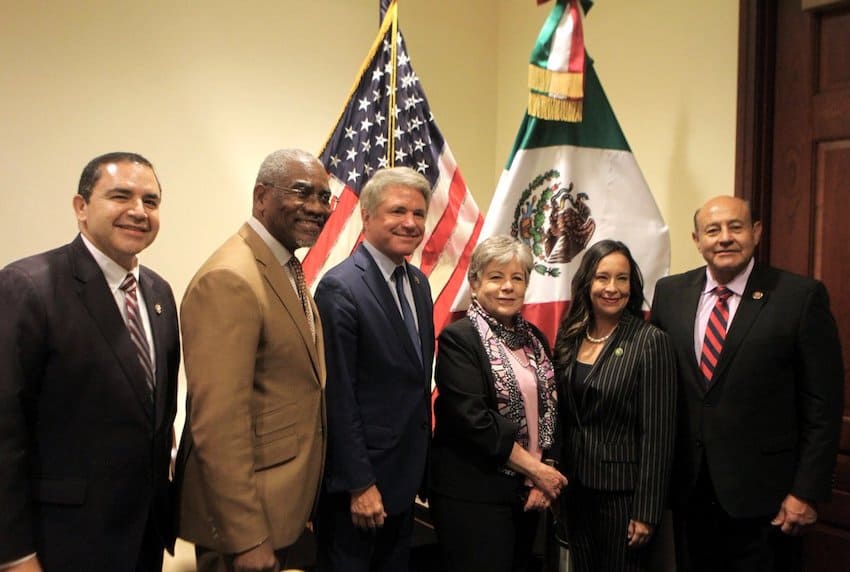
Representatives from the U.S. and Mexico discussed regional integration in the semiconductor industry, as well as exports and the U.S. opioid crisis. From left to right: Economy Minister Raquel Buenrostro, Foreign Affairs Minister Alicia Bárcena, Secretary of State Antony Blinken and U.S. Trade Representative Katherine Tai. (Anthony Blinken/X)
Mexico and the United States have launched a joint “semiconductor action plan” that aims to make North America the world’s “most powerful” chip-producing region.
The announcement of the plan came after high-ranking Mexican and United States officials participated in the third meeting of the relaunched Mexico-U.S. High Level Economic Dialogue (HLED) in Washington D.C. on Friday.
The summit was attended by top-level delegates from both the United States and Mexico. Seen here is Mexican Foreign Affairs Minister Alicia Bárcena (center). (Alicia Bárcena/X)
“Today… we’re launching a joint semiconductor action plan to accelerate our integration, to scale our efforts to attract new investment,” U.S. Secretary of State Antony Blinken told a press conference.
“Under President Biden’s leadership, we’re building regional clean energy technologies and semiconductor supply chains through the Inflation Reduction Act and the bipartisan CHIPS and Science Act that will drive our economies through this century,” he said.
Blinken said that “Mexico’s overhauled one-stop shop website” – the federal government’s “ventanilla única” – “is providing prospective investors the tax and regulatory information that they need to take advantage of this landmark legislation.”
At the same press conference, Foreign Affairs Minister Alicia Bárcena and Economy Minister Raquel Buenrostro offered additional details on Mexico and the United States’ shared ambitions for the semiconductor industry.
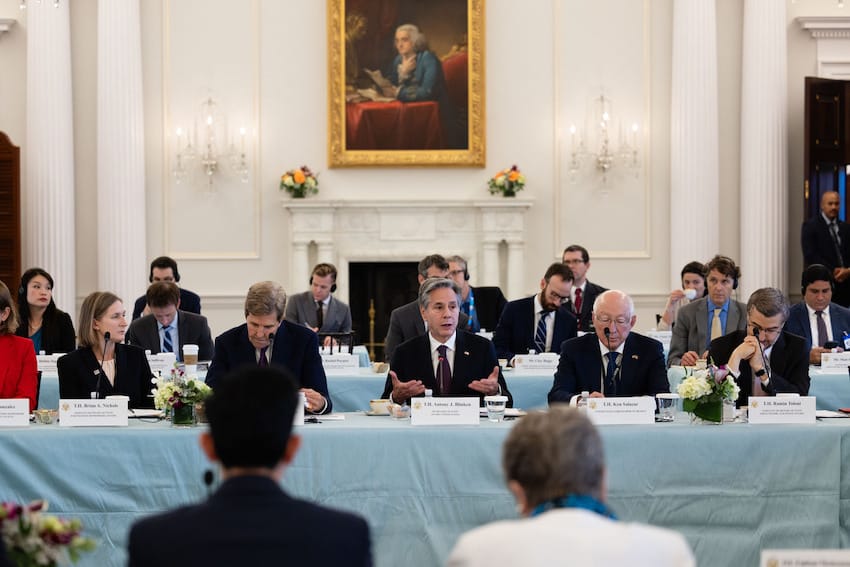
The United States is seeking to establish localized supply chains in Mexico for a number of key industries. (Antony Blinken/X)
Bárcena, who succeeded Marcelo Ebrard as foreign minister earlier this year, said that “supply chains in our region and especially semiconductors and conductors” was “one of the most interesting topics” discussed at Friday’s bilateral meeting.
She said that Mexico and the United States have “a very clear strategy: for this region to become the most powerful region in production of semiconductors and conductors in the world.”
According to the international freight platform ShipHub, Taiwan is the world’s largest semiconductor manufacturer, accounting for 50% of total production. South Korea ranks second followed by Japan, China and the United States.
Buenrostro said Friday that Mexico and the U.S. are “working together to turn North America into the most important place for the integration of supply chains pertaining to several strategic sectors,” including semiconductors, electric vehicles and medical supplies.
With the advent of nearshoring, Mexico now harbors serious ambitions to manufacture semiconductors. (Vishnu Mohanan/Unsplash)
“Regarding semiconductors, Mexico, and the U.S. … are working to see how we can complement each other on this technology to have the strongest supply chain on semiconductors, taking advantage of different ICT markets,” she said.
“For Mexico, this is a significant opportunity. It allows us to have better paying jobs,” Buenrostro said.
At last year’s HLED, held shortly after the United States government released its implementation strategy for the US $50 billion “Chips for America” program, the U.S. invited Mexico to take advantage of massive investment in the sector.
“… What we have is an invitation that is received perhaps once in a lifetime, so we’re going to accept it, and thank you very much for thinking of Mexico,” Ebrard told U.S. officials at a press conference in September 2022.
Semiconductor manufacturing was also a major theme during last year’s talks. (Presidencia)
In a joint statement released on Friday, the Mexican and United States governments said that their officials had “discussed how to seize emerging opportunities through the HLED to promote manufacturing investment and generate employment and prosperity as the United States implements the U.S. CHIPS and Science Act and the Inflation Reduction Act.”
Those two acts, the statement said, “together devote more than $400 billion to strengthening regional semiconductor supply chains, reducing greenhouse gas emissions, and boosting demand for electric vehicles and clean energy technologies.”
“We discussed how to continue medical device and pharmaceutical regulatory collaboration, and advance other work. We also considered ways to address the climate crisis and strengthen regional energy security,” the statement added.
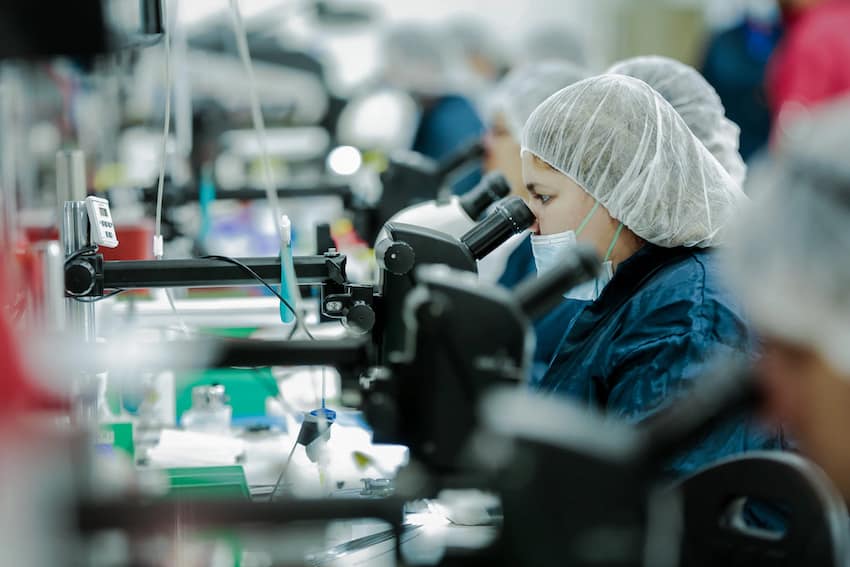
Mexico’s medical device manufacturing industry was also a subject of discussion at the talks. (Tetakawi)
Among other issues discussed at the HLED was cooperation at the Mexico-U.S. border, over which huge volumes of licit – and illicit – goods pass.
“We’re taking steps to improve and strengthen even more our border coordination, like piloting a model port to streamline inspections and finding ways to reduce wait times, making it easier for people and goods to cross legally while strengthening our capacity to deal with fentanyl and other illegal narcotics,” Blinken said.
Bárcena also noted that ways in which border infrastructure can be strengthened were discussed.
“When it comes to land trade between the U.S. and Mexico, we have lines of communications that are extremely important for the transportation of merchandise and people. … We have 60 ports of entry on our shared border. … We have shown progress and talked about the infrastructure on both sides [of the border], discussing how we can bring our infrastructure up to speed so that we have better outcomes,” she said.
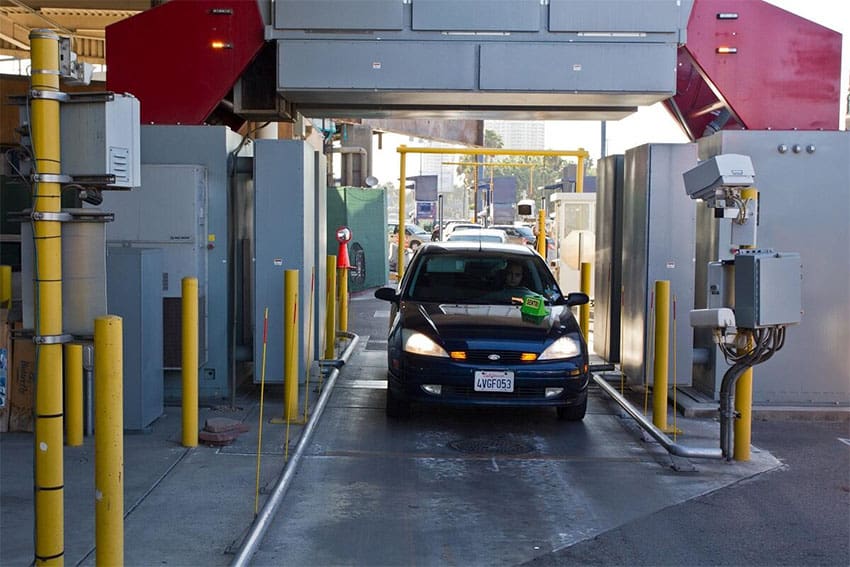
Representatives from the two countries also discussed ways to modernize the U.S-Mexico border to improve crossing times and deter crime. (Josh Denmark/U.S. CBP)
The foreign minister noted that Mexico set aside 15 billion pesos (about US $860 million) to spend on the modernization of border infrastructure this year.
“Among other things, [the investment will] increase our capacity to detect weapons and synthetic drugs,” she said.
Bárcena also highlighted that Mexico is currently the United States’ largest trade partner, with close to $400 billion in two-way trade in the first half of the year.
“That means many things. It means that there are responsibilities, commitments, and I would also say that there is a shared vision to create one of the most powerful areas economically and socially speaking,” she said.
Fentanyl was also a key topic in the talks, as the U.S. and Mexico look to stem the flow of illegal drugs into the United States, which is experiencing a surge in deaths, attributed to the trafficking of fentanyl. (CBP South Texas/Twitter)
The HLED was held ahead of this week’s Mexico-U.S. High-Level Security Dialogue, at which the fight against fentanyl is set to be a central issue. Blinken, Secretary of Homeland Security Alejandro Mayorkas and Attorney General Merrick Garland are among the U.S. officials who will attend the meeting in Mexico City on Thursday.
Buenrostro said Friday that Mexico “is committed to supporting the fight against synthetic drugs,” a view that contrasts with that held by some Republican Party lawmakers in the U.S.
“This is something I want to convey. We want to cooperate. We want to help and do everything at our disposal to control the productive chain, the illicit productive chain of … fentanyl,” she said.
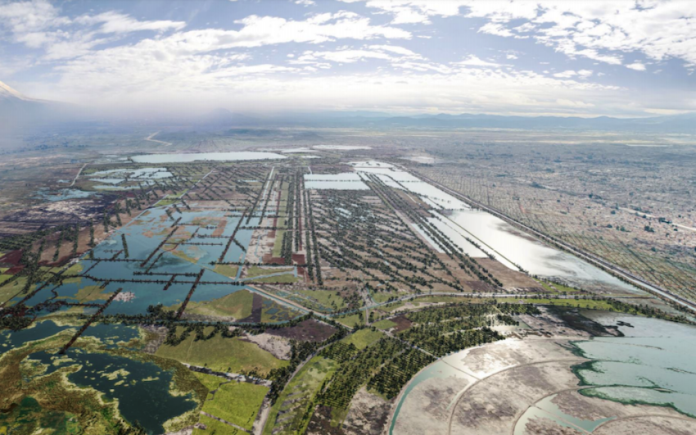
Part of the site of former Lake Texcoco has been designated a natural protected area. (Gobierno de México)
President Andrés Manuel López Obrador spent Friday and Saturday visiting four municipalities in México State where work is underway to create a 14,000-hectare natural reserve on the site of the former Lake Texcoco.
México state Governor Delfina Gómez accompanied AMLO on his tour of Tecámac, Ecatepec, Chimalhuacán and Texcoco, where he made a speech celebrating progress on the massive ecological project.
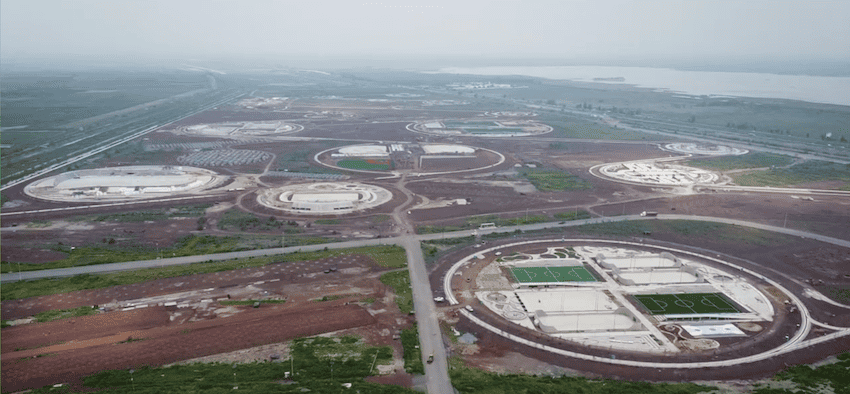
The new site will also host an array of sporting facilities and a new medical university for disadvantaged students in the region. (Screen Capture)
“Today we evaluated progress in the recovery of Lake Texcoco,” AMLO said in a statement on social media. “Wetlands, rivers, bird lagoons and lands comprising more than 14,000 hectares have already become natural protected areas.”
Information from the National Water Commission indicates that the park is now 77% complete, has cost 4.9 billion pesos (US $280 million) and generated 6,100 jobs. It is expected to open in 2024.
During the tour, AMLO announced another addition to the Lake Texcoco project – a new university for medical students –known as the Benito Juárez García Universities for Well-Being (UBBJ) – that will form part of his administration’s educational initiative.
The UBBJ are publichigher education institutes, generally located in marginalized areas where there are few tertiary education options. The new medical school will be the second university campus in Texcoco, alongside an existing civil engineering school
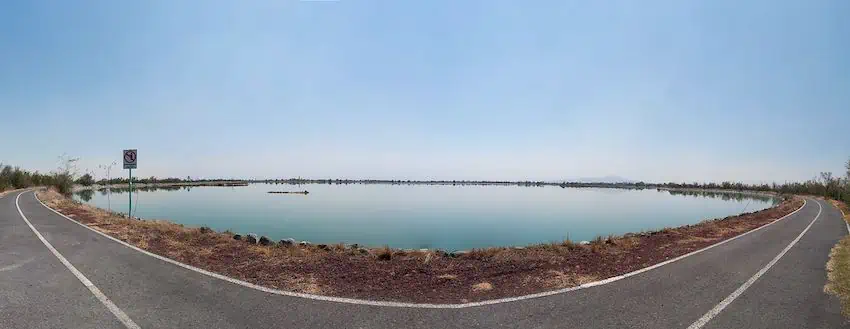
Lake Texcoco, which once dominated the valley, was largely drained off by the Spanish and is now a shadow of its former self. (Diego Simón Sanchez/Cuartoscuro)
Besides the new university, AMLO said that the park would include sports fields for soccer, American football, baseball, basketball and the pre-Columbian ball game “pelota”; a skatepark; recreation areas; walking circuits; sustainable gardens and agricultural spaces; a restaurant; offices and scientific research areas.
The main component of the project, however, is the restoration of four water bodies that once formed part of the enormous lake that filled the Valley of Mexico, but were drained or dried out over the centuries following the Spanish conquest: Lake Nabor Carrillo; the Xalapango and North Texcoco Lagoons; the San Juan Ciénaga and Lake Texcoco. Historic wetlands and forests will also be restored.
The government predicts that this will generate a range ofenvironmental benefits, including better regulation of water resources in the severely water-stressed Valley of Mexico, as well as health benefits for the local population.
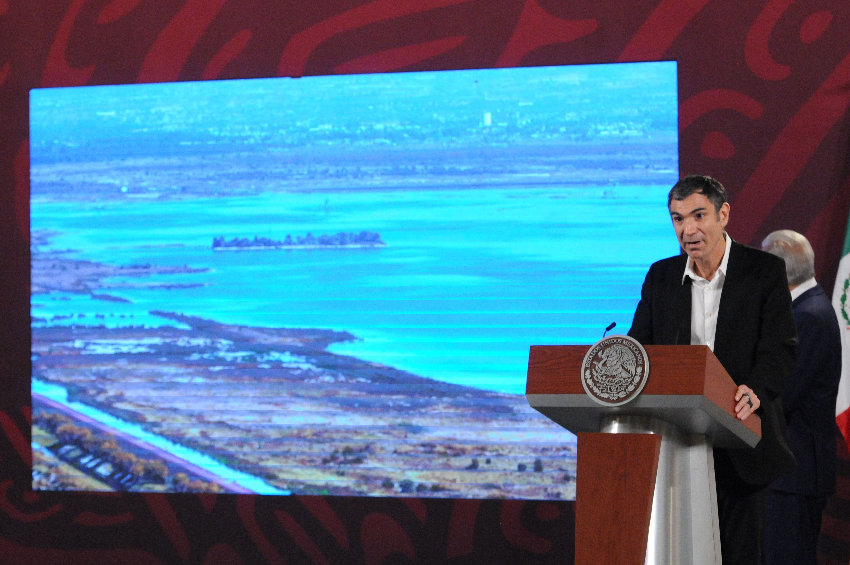
The Lake Texcoco Ecological Park was originally designed by architect Iñaki Echeverría in 2010, but was sidelined four years later by former president Enrique Peña Nieto, who planned to build a new airport on the site at a projected cost of 169 billion pesos (US $9.6 billion) instead.
Iñaki Echeverría discusses the Texcoco project at a morning press conference in July. (Daniel Augusto/Cuartoscuro.com)
While running for office in 2018, AMLO claimed that the full cost of the airport could reach 285 billion pesos (US $16.2 billion) and campaigned to scrap the project and expand the existing Santa Lucía Military Air Base in nearby Zumpango.
In October of that year, a controversial referendum – in which less than 1% of eligible voters participated – backed AMLO plan. The Santa Lucía air base became the new Felipe Ángeles International Airport (AIFA), while the site of President Peña Nieto’s planned airport was given over to the “hydrological and social recovery of Lake Texcoco.”
The win allowed Álvarez to retain his WBC, WBO, WBA and IBF super-middleweight titles. (@shosports/instagram)
Mexican boxer Saúl “Canelo” Álvarez retained his undisputed super-middleweight championship with a unanimous decision over Jermell Charlo in Las Vegas on Saturday night, although some critics felt the fight was boring.
The 168-pounder from Guadalajara, Jalisco, became the first boxer in history to defend his titles at least three times during the era when four organizations have bestowed championship belts.
“Canelo” Álvarez from Guadalajara defends world titles in four weight classes, making him the undisputed super middleweight champion. (@shosports/instagram)
His dominant performance at T-Mobile Arena — two judges scored the fight 118-109, the other 119-108 — allowed him to retain his WBC, WBO, WBA and IBF super-middleweight titles.
His record of 60 wins, 2 losses and 2 draws includes 39 knockouts. Charlo, who fell to 35-2-1, was trying to move up two weight classes from junior middleweight (154 pounds), where he is the undisputed champ.
Álvarez became the king of the super-middleweight class in November 2021 when he knocked out Caleb Plant to grab the IBF title, adding it to his other three world titles.
Canelo then lost a non-title bout to light heavyweight Dmitry Bivol of Russia before defending all four belts in September 2022 and May 2023 bouts. All three were lukewarm efforts that left some people wondering if the 33-year-old’s best days were behind him.
Following the match, Canelo insists he is still at the top of his game, even though some critics call his performance “boring.” (@ShowtimeBoxing/X)
“I understand what people are saying, and I agree,” Álvarez said before the fight. “I didn’t look my best in my last few fights, but I also know why. You’re going to see something different this fight. It’s going to be good.”
Rather, the fight plodded along, and instead of notching a 40th knockout victory, Álvarez appeared frustrated as he looked for Charlo, also 33, to open up and give him some counterpunching opportunities. He did floor Charlo with an overhand right in Round 7, but that was it.
“I’m not disappointed for not knocking him out,” the right-hander said afterward. “I feel spectacular … That’s why there are 12 rounds, to show who is the best. No one is capable of beating this Canelo.”
In the broadcast on Mexican television networks, commentator and Boxing Hall of Famer Julio César Chávez lashed out at both boxers for turning in such a boring fight.
“Oh, sorry, sorry,” he said, after dropping an insult, “[it’s just that fans like us] are very angry. They aren’t throwing any punches.”
Still, Álvarez became the fourth Mexican boxer to reach 20 victories in world championship fights, joining Ricardo López, Marco Antonio Barrera and César Chávez himself, whose career record of 107-6-2 included 86 knockouts.
As for his next fight, Álvarez did not cite an opponent, just a date.
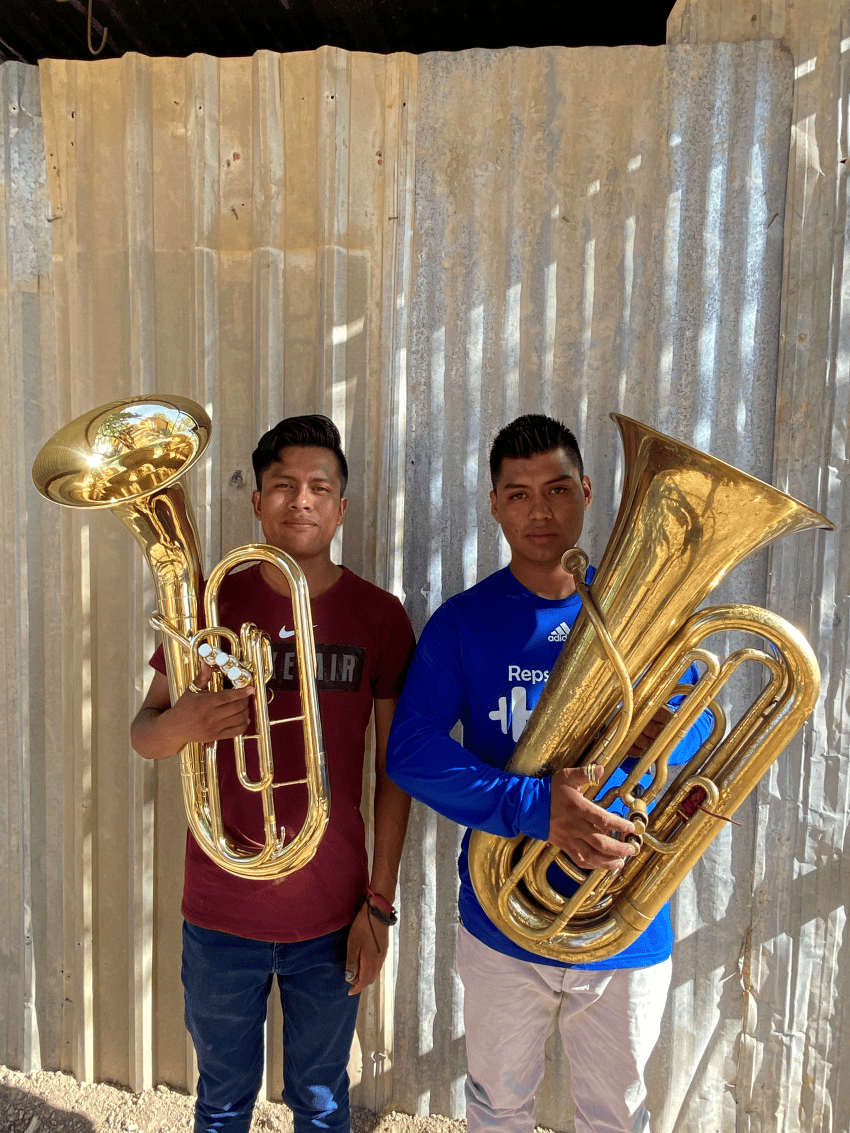
The stranger-than-fiction story of how a French pilot’s passion for music and Mexico brought a life-changing music school to a troubled town in Oaxaca. (Photos: Mirja Vogel)
Fifty children from Oaxaca have just landed at Mexico City International Airport on a flight from Paris. They each carry a musical instrument tightly in their hands as they wait to board a bus back home to the town of Vicente Guerrero.
Their three-week-long tour of France saw the group perform over 50 concerts to packed crowds at a European classical music festival. For nearly all of the children who study at the Santa Cecilia Music School in Vicente Guerrero, a small village 12 kilometers south of Oaxaca city, this was the first time they had left Mexico.
Air France pilot Isabelle de Boves.
Last year, the school’s orchestra and brass band gave a performance for President Andrés Manuel López Obrador during the opening ceremony for the country’s second-largest airport, the new Felipe Ángeles International Airport (AIFA). Seven recent graduates are now studying music at the Autonomous University of Mexico (UNAM) and two recently began degrees at the National Music Conservatory in Mexico City.
This was far from the reality that the pupils and their families had imagined for themselves twelve years ago, when violence, gangs and drug abuse threatened to take control of the lives of many families in Vicente Guerrero. One resident tells me: “Before the Santa Cecilia Music School, the children had nothing to do. They would often be walking on the streets in gangs. There was a lot of trouble and a lot of pain.”
Before classical music came to town, the everyday beatwas dangerous and unpredictable. The town of 14,000 was known for being Oaxaca city’s municipal landfill site since the 1980s. To many, it was an abandoned outpost of the state.
Isabelle de Boves: A pilot with a passion for Mexico and music
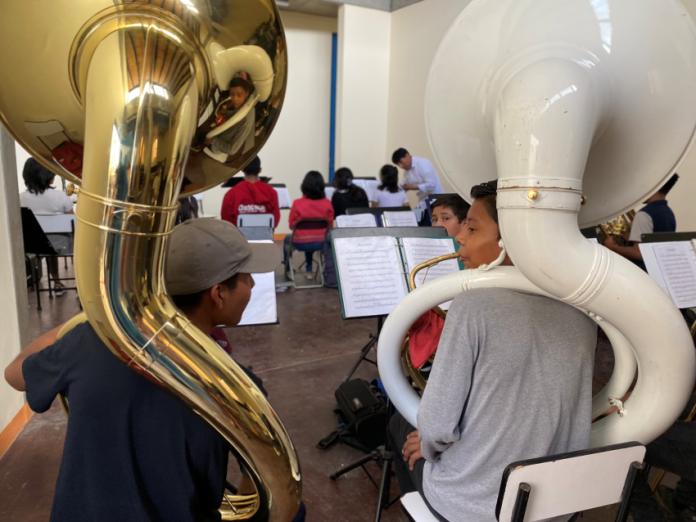
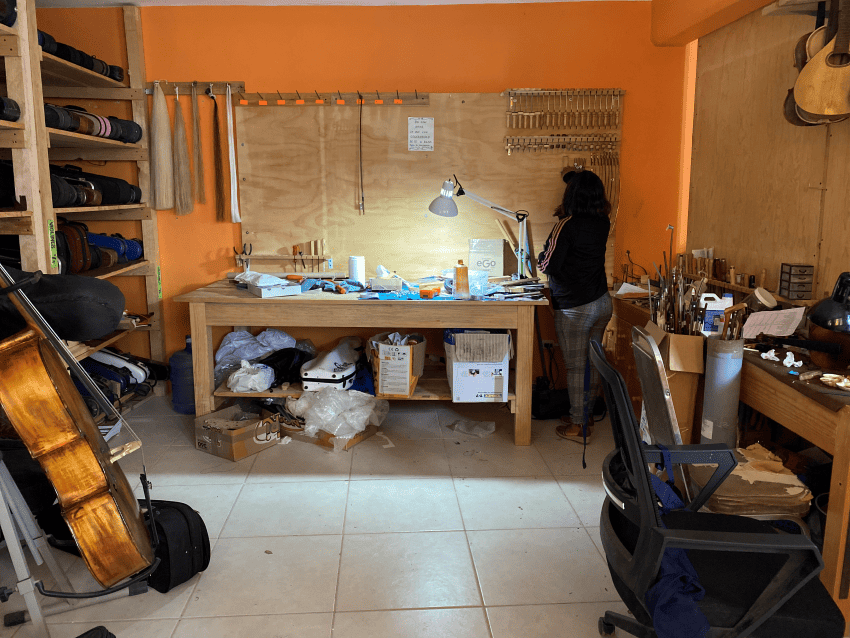
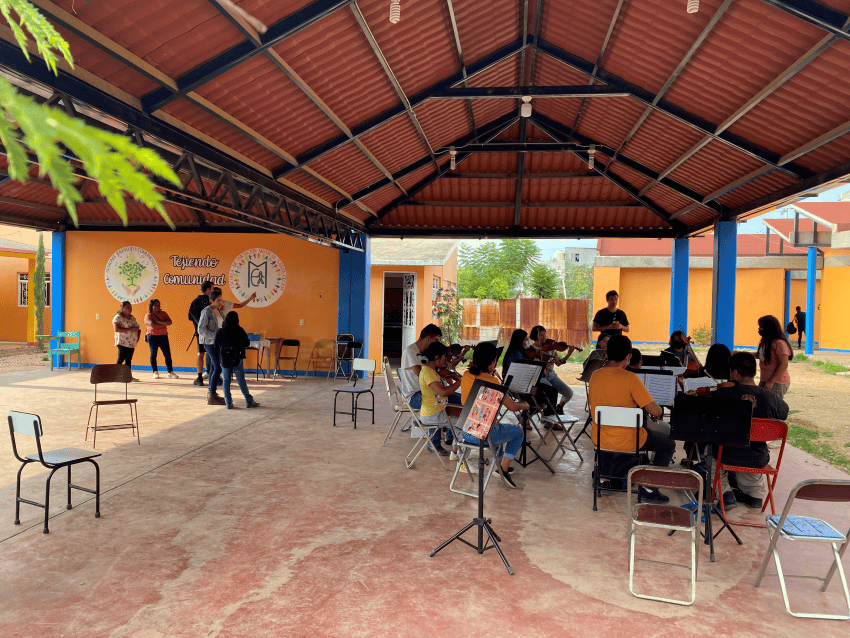
Today, the Santa Cecilia Music School has five large rehearsal rooms, an open-air performance stage, several classrooms and a luthier workshop, alive with jovial chatter and the sound of musicians warming up their instruments.
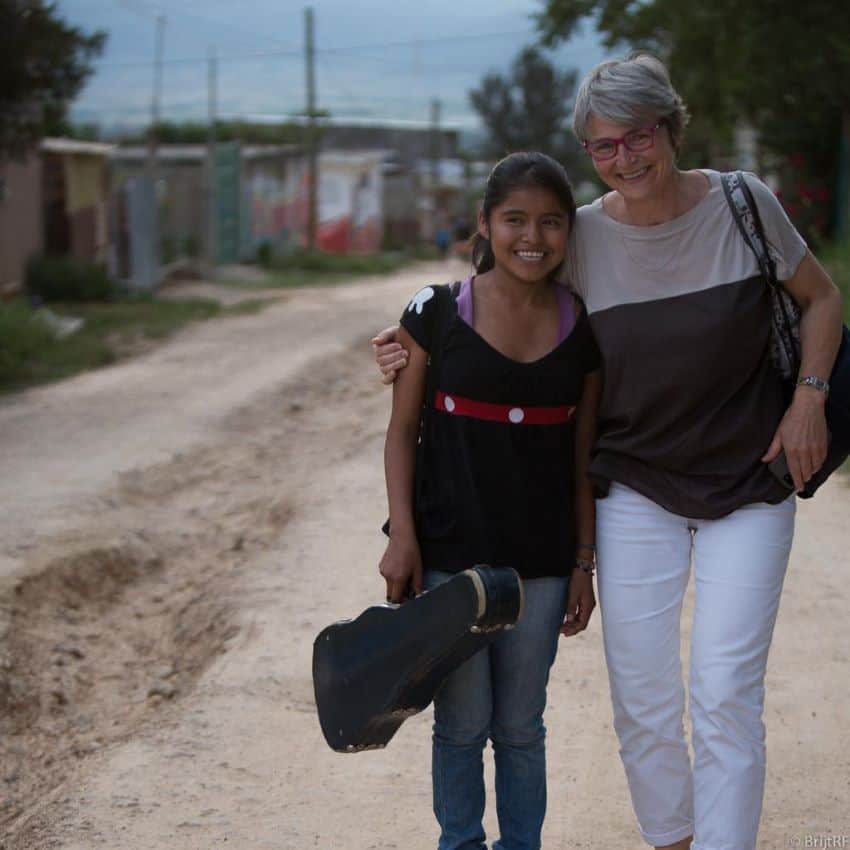
Twelve years ago, a chance trip to the town by Air France pilot Isabelle de Boves, who was visiting her aunt, would alter the town’s future forever. “My aunt has always been a fearless heroine in my life. She has lived and helped communities in some of the most disadvantaged places in the world, and as a child growing up in France, I would always look forward to hearing her stories,” de Boves says of her aunt.
“When I arrived in Vicente Guerrero, [my aunt] took my arm, and we left her home and walked confidently through the town along several dirt tracks. The locals knew her face …she assured me we had nothing to worry about.”
“From a distance, I remember hearing major scales being sung in perfect harmony and a metronome-like rhythm being played in unison. We turned a corner and I saw a group of 21 singing children aged between 8-16 years old, using broken chairs and wooden sticks from the rubbish to keep the tempo. I’ll never forget their shining, lively faces as they played.”
The children told Isabelle and her aunt why they liked playing music and what their favorite instruments were. She was struck by their innocent, unwavering motivation to learn and equally saddened by their lack of musical instruments and resources.
Armando is charming and lively and always seems to be making his fellow students laugh.
On her return to Paris, Isabelle would begin her search for instruments. “In Europe, there are many families who have different instruments lying unused in dusty cases in attics or basements. It’s common that when children stop learning or playing music, many lovely instruments are left unused and unloved.”
Isabelle reached out to old friends and contacts, even adding the details of her hunt for instruments into her Christmas cards until enough had been secured to help build a small band.
Her next scheduled flight to Mexico City was planned for January 2012. Packing her maximum allowance for luggage with brass instruments and securing the support of her flight crew to do the same, 21 instruments donated by people across France were loaded into an Air France Boeing-737 destined for Mexico City.
“The cargo of instruments were stored safely in Mexico City for a couple of months until a bus could be organized to drive them for seven hours to Vicente Guerrero. When they arrived, I was sent photos of the children and hearing them play them made me so emotional.”
Isabelle de Boves would visit more and more in the coming years, bringing instruments and supplies and expanding the capabilities of the orchestra and band. She created a charity, La Banda de Música, to raise money for the school directly, and collaborated with European music teachers to organize for them to visit Vicente Guerrero for extended periods and teach masterclasses. Fundraising concerts took place across France to fund the construction of several new school buildings and the salaries of new music teachers.
Isabelle continues, “We are all so grateful for the continued generosity of people from around the world who helped us grow the school and take on more and more teachers and students, but none of this would have been possible without the backing and tireless work of the people in Vicente Guerrero.”
The close-knit community is deeply rooted in Zapotec culture, the largest Indigenous community in southern Mexico. Though the men and women in the town could not contribute large sums of money to support the school, they instead provided skills, hours of manual labor and often offered parts of their homes for rehearsal spaces. They gave a uniquely communal effort to help kids keep practicing while the building of the school progressed.
Outdoor Stage Rehearsal at the Santa Cecilia Music School in Vicente Guerrero.
How music repaired the reputation of an almost forgotten outpost of Oaxaca
Today, the Santa Cecilia Music School has five large rehearsal rooms, an open-air performance stage, several classrooms and a luthier workshop, alive with jovial chatter and the sound of musicians warming up their instruments. One student, Armando (20) who was part of the 50-strong ensemble that performed in France, tells me about his memories of the violence before the project began.
“There was always violence on the street. I remember kidnappings, robberies and seeing more and more people taking drugs. If you went out on the streets at night here, you’d expect to get into trouble.”
Armando is charming and lively and always seems to be making his fellow students laugh during my visit to the Santa Cecilia Music School. Music has irrevocably changed his life, and he’s better off for it.
Signs of unrest still haunt the streets of the town after dark, and residents still recommend caution when visiting. Music has by no means solved all of the issues in Vicente Guerrero, but it has become a symbol of pride and unity for the disadvantaged town, which was once lost to its reputation as a dangerous municipal landfill site.
Gordon Cole-Schmidt is a public relations specialist and freelance journalist, advising and writing on companies and issues across multi-national communication programs.
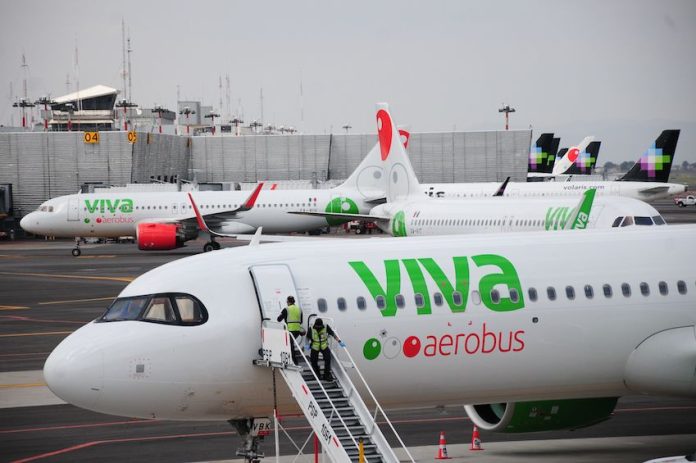
The airline will quintuple its capacity at AIFA by the summer of 2024. (Daniel Augusto/ Cuartoscuro)
Viva Aerobus has become the latest Mexican airline expanding its operations from Mexico City’s Felipe Ángeles International Airport (AIFA), with plans to open 17 new routes from the airport by next summer.
Besides the new routes, Viva Aerobus also plans to add more flights to the ten destinations it already offers from the airport.
Once the routes are operational, Viva Aerobus will be the airline with the most flights from AIFA. (Shutterstock)
“Viva will convert this new airport into a strategic hub in the center of the country by offering 4.5 million seats by 2024; this means that the airline will quintuple its capacity in AIFA in the summer of 2024 compared to 2023,” the company saidin a statement.
New routes to Tulum, Guadalajara, Ciudad Juárez and Mérida will open in December; to Huatulco, Chihuahua, Reynosa, Nuevo Laredo, Veracruz, Tampico and Villahermosa in January; to Tuxtla Gutiérrez, Puerto Vallarta, Chetumal and Los Cabos in April; and to Ciudad Obregón and Durango in July.
Once the new routes are open, Viva will operate a total of 27 routes, 72 daily flights and have 12 aircraft based at AIFA.
“AIFA thanks Viva Aerobus for the confidence it has placed in this new airport,” said General Isidoro Pastor, director general of the airport. “This historic growth of Viva marks a before and after in the connectivity of Mexico City.”
New routes to Tulum, Guadalajara, Ciudad Juárez and Mérida will open in December ahead of the holidays. (aifa.aero)
Viva stressed that its expansion in AIFA was “backed by a solid preference and trust of passengers,” with airline passenger numbers surpassing 600,000 people from January and August 2023.
The low-cost carrier is the latest to significantly increase its services from AIFA, after Aeroméxico announcedplans last week to grow its total operations at the airport by 40%, mostly by moving flights from the older Mexico City International Airport (AICM).
The military-built AIFAopened in March 2022 and was intended to relieve pressure on the AICM. However, the transfer of flights to AIFA has been slower than hoped, partly due to problems with the new airport’s infrastructure.
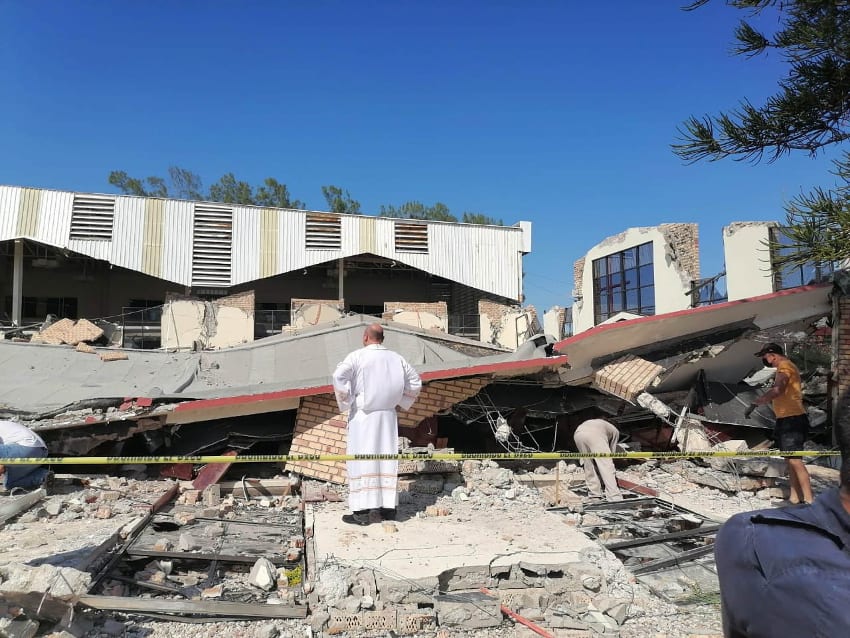
Approximately 100 people were in the church on Sunday when the roof caved in. (CORTESÍA PROTECCIÓN CIVIL DE TAMAULIPASCUARTOSCURO.COM)
The roof of a church in Ciudad Madero, Tamaulipas, collapsed on Sunday, killing 10 people and injuring 60 others, authorities said. One of the hospitalized victims, an 18 year-old woman, died on Monday morning.
The tragedy occurred in the mid-afternoon during Mass at the Santa Cruz church in the Unidad Nacional neighborhood of Ciudad Madero, a city on the Gulf of Mexico in southern Tamaulipas.
The roof collapsed during Sunday mass, when approximately 100 people were inside. (CORTESÍA PROTECCIÓN CIVIL DE TAMAULIPASCUARTOSCURO.COM)
Three children were among those killed when the roof caved in, trapping some 30 parishioners beneath rubble. Tamaulipas police said that approximately 100 people were in the church, where baptisms were taking place.
A structural failure is believed to have caused the collapse of the roof, according to the office of the state security spokesperson. Footage from a nearby security camera showed the gabled roof and at least one wall of the brick church collapsing. The church was reportedly built about 50 years ago.
The injured were transferred to several local hospitals for treatment. Twenty-three people remained in hospital early Monday morning, two of whom had serious injuries, authorities said.
A four-month-old baby, three children aged five and two 9-year-olds were among the injured, according to a list posted online by the Ciudad Madero municipal government.
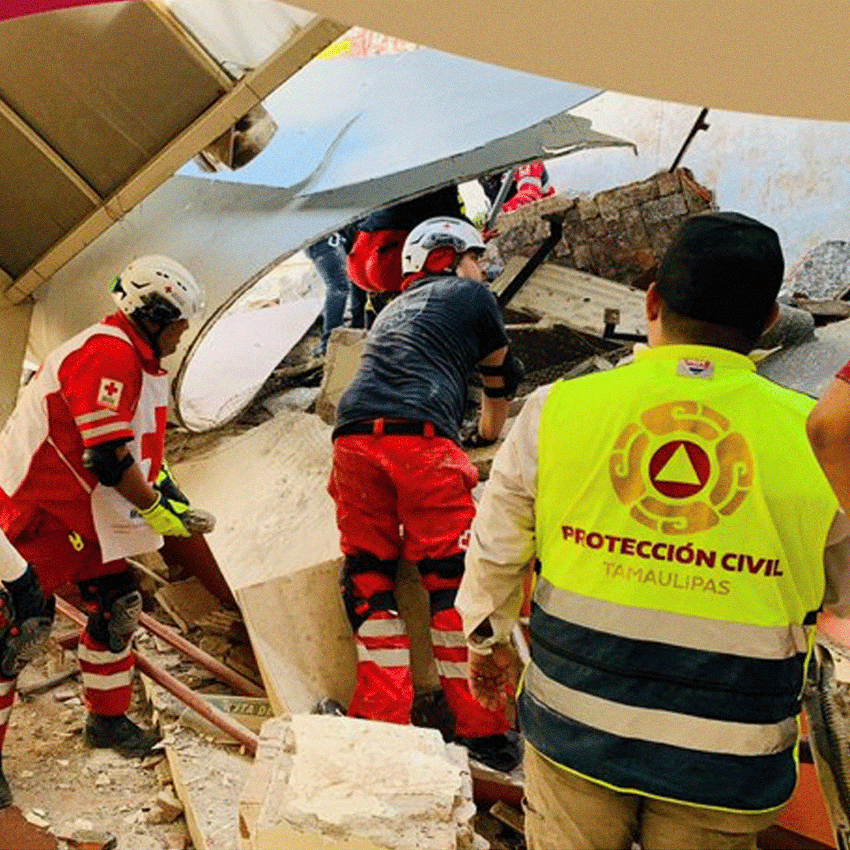
Rescue workers trying to help victims trapped in the rubble. (Protección Civil Tamaulipas/X)
Citizens, some armed with shovels and pickaxes, rushed to the aid of those trapped beneath rubble and emergency services personnel arrived at the church shortly after the roof collapsed. The newspaper Milenio reported an initial scene of “chaos” due to the large number of people trying to help.
Parts of the concrete roof slab came to a rest on top of pews, a situation that may have allowed spaces of air where some people were trapped.
Assisted by police dogs and infrared cameras, the search for victims and survivors continued into the night until all the missing were accounted for. The army, the navy, the National Guard, state police, the Red Cross and Civil Protection personnel all contributed to the efforts.
Tampico Bishop José Armando Álvarez Cano mourned “the painful loss” of parishioners celebrating the baptism of their children.
The governor of Tamaulipas has said experts will determine the cause of the roof collapse. (Protección Civil Tamaulipas/X)
“We pray to the Lord for their eternal rest and the comfort of their families. We remain in prayer for the quick recovery of the people who have been rescued,” the bishop said in a statement.
Tamaulipas Governor Américo Villareal arrived at the church on Sunday night and told reporters that he was shocked and saddened by the tragedy. He said the cause of the roof collapse would be determined by experts.
Villareal said he had spoken to the church’s priest and was informed that the roof was waterproofed some years ago, but no other work had been done.
The governor said that the families of the deceased could count on the “unconditional” support of the state government.
Ángel Vargas, the priest officiating the Mass, said that the tragedy was “unfathomable.”
“They came to seek heaven for the little ones and found eternity. What I want is for the families to be at peace,” he said.
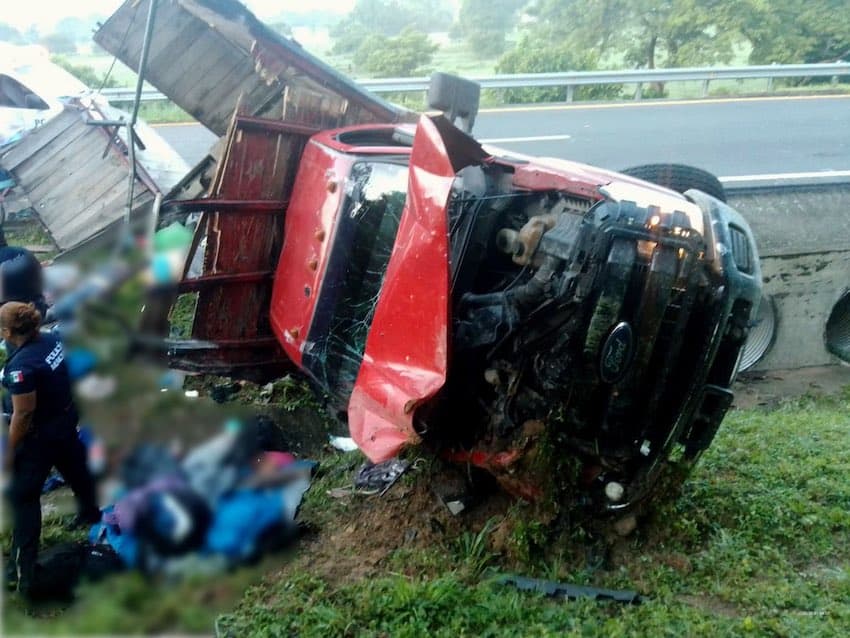
The truck was carrying 27 people, of which 10 - nine women and one minor - were killed on impact. (@isain/X)
Ten Cuban migrants died and 17 more were injured when an overloaded truck overturned in Chiapas early Sunday morning.
The accident happened on the Pijijiapan-Tonalá highway, which is frequently used by migrants traveling north from the Guatemalan border towards the United States. The dead were all women, one of them a minor.
The driver of the overloaded vehicle was reportedly speeding before he lost control of the unit. He immediately fled the accident. (@INAMI_mx/X)
According toa statement by Mexico’s National Migration Institute (INM), “the driver was speeding, lost control of the unit and overturned.” The driver then fled.
Photos of the accident scene show that the truck was a wooden-backed Ford model not designed to carry people, and was also missing license plates. The vehicle was almost entirely destroyed on impact.
Of the 27 Cuban migrants traveling in the truck, 17 survived but were seriously injured. They were transferred to hospitals in Pijijiapan and Huixtla for treatment, and Cuban authorities are being kept informed of their condition.
The newspaper El Universal reported that the migrants had spent several days in Tapachula trying to obtain Mexican humanitarian visas before boarding the truck north. The human smugglers who facilitated the journey have not been identified by authorities.
It was the second fatal accident in three days involving migrants being transported through Chiapas in overloaded trucks. On Thursday,two people died when a dump truck carrying 52 migrants of various nationalities also lost control and overturned in the municipality of Mezcalapa.
In December 2021,55 migrants were killed and more than 100 injured in similar circumstances when a tractor-trailer overturned in Chiapas. Investigations into the accident uncovered anetwork of human smugglers who allegedly charged migrants 60,000 pesos (US $2,860) each to transport them to the U.S. border.
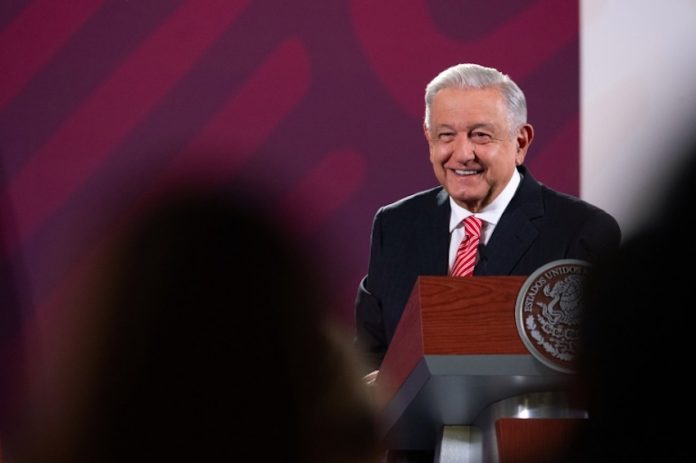
President López Obrador covered an array of controversies and current events this week, from cartel violence in Chiapas, to lithium mining rights, as well as international relations and the outcome of a new report on the 2014 Ayotzinapa case. (lopezobrador.org.mx)
The discovery of a pre-Columbian tomb in Chiapas, the kidnapping of a Michoacán mayor, Marcelo Ebrard’s dissatisfaction with the ruling Morena party’s presidential candidate selection process, the presence of large numbers of gringos in Mexico City, lithium mining concessions, violence in Nuevo León and “vile propaganda” from United States politicians were among the topics discussed at this week’s morning press conferences, or “mañaneras”.
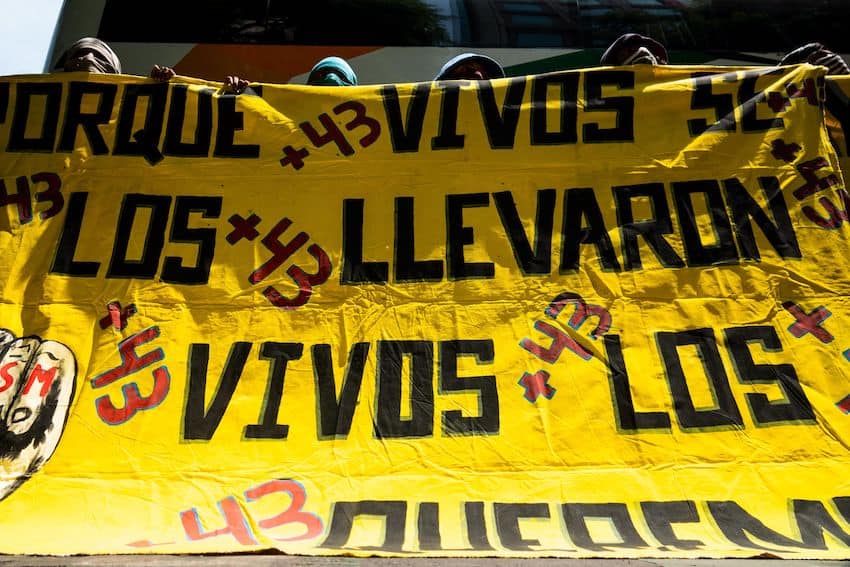
President López Obrador also spoke at length about the government’s investigation into the abduction and presumed murder of 43 students in Guerrero, who disappeared nine years ago this week.
The Ayotzinapa case, where 43 students were kidnapped in Iguala, Guerrero, again reared it’s head this week.(Galo Cañas/Cuartoscuro)
The government released a new report on the Ayotzinapa case on Tuesday, but there are still many unanswered questions, including a particularly crucial one: “Where are the young men?”
AMLO acknowledged that the parents of the students have misgivings about his government’s investigation, but declared that “whether they believe us or not, we’re going to continue because it’s a matter that has to do with our convictions and conscience.”
Monday
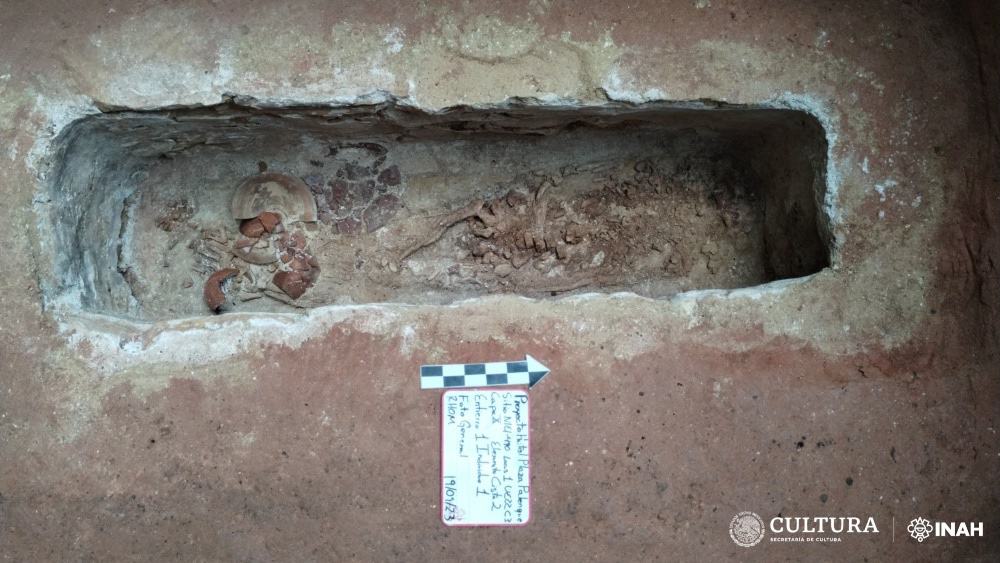
During an update on archaeological work along the route of the Maya Train railroad, the director general of the National Institute of Anthropology and History (INAH) announced that a pre-Columbian tomb of an “important person” was discovered on Sept. 11, next to the site where a Maya Train hotel is being built in Palenque, Chiapas.
The burial in the Maya city of Palenque is estimated to be around 1,000 years old. (INAH/X)
An “offering” of three ceramic vessels was found alongside human remains, Diego Prieto Hernández told reporters.
He said that a structure was “built on purpose to contain the tomb” and that the “dedication” that had evidently gone into it indicated that the deceased was “an important person for the community that settled on the site,” located approximately two kilometers from the ancient Maya city of Palenque.
“… As soon as the excavation is finished and physical anthropology studies have been carried out more information about the person who was buried in this structure will be provided,” the INAH chief said.
The expansion of cartel presence in Mexico’s southern border region was a major talking point. (Screen Capture)
“In Chiapas, on the border with Guatemala, … there are organized crime groups that are allegedly fighting for territory in order to have space to … [move] drugs that come in from Central America, to have control over that territory,” he said.
“And unfortunately they clash [but] there haven’t been a lot of murders in Chiapas in general,” López Obrador said.
“…There has been a lot of propaganda,” he said, making an apparent reference to material posted online by cartels to demonstrate their strength.
“So they brought out a video in which 20 pickup trucks are going into Frontera Comalapa and people on both sides of the highway are apparently welcoming them,” López Obrador said before asserting that opponents of his government – “the conservatives” – are responsible for disseminating the footage and making it go “viral.”
He said the government was attending to the situation in Chiapas and noted that he had ordered an additional deployment of National Guard troops to the border region.
Responding to a question about migration – a hot topic due to the large numbers of people currently passing through the country en route to the United States – AMLO said there are two main reasons why people decide to leave their homes.
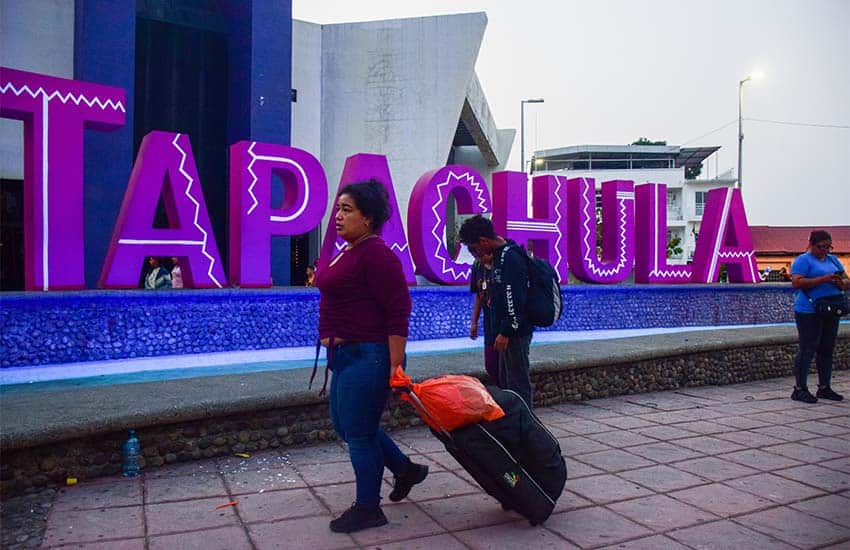
Tapachula, on the border with Guatemala, is known as ground zero of the migrant crisis in southern Mexico. Local activists estimate that there are around 40,000 migrants stuck in the city. (Damian Sánchez Jesús/Cuartoscuro)
“It’s the lack of opportunities for employment, … for wellbeing and a lot of people also flee their countries due to violence – they’re the two things. So we have to attend to this,” he said.
“I’m going to talk about that in my next meeting with President Biden,” López Obrador said. “… The UN should put together a global plan to combat poverty,” he added.
The president later highlighted that public investment is benefiting Mexico’s south and southeast, a part of the country large numbers of people have left over the years due to a lack of work opportunities.
“Why do we have more growth in the southeast than in the north and the center? Due to public investment, because in 2018 public investment was 500 billion pesos and this year it’s one trillion [US $57 billion] – double,” AMLO said.
Among other remarks, López Obrador rejected a study that found that cartels are collectively the fifth largest employer in Mexico and announced that the Defense Ministry has offered to provide security to 2024 presidential election candidates Xóchitl Gálvez and Claudia Sheinbaum.
“We have to guarantee their protection … and avoid tragedies,” he said, explaining that the government must act “cautiously” as election season approaches.
Tuesday
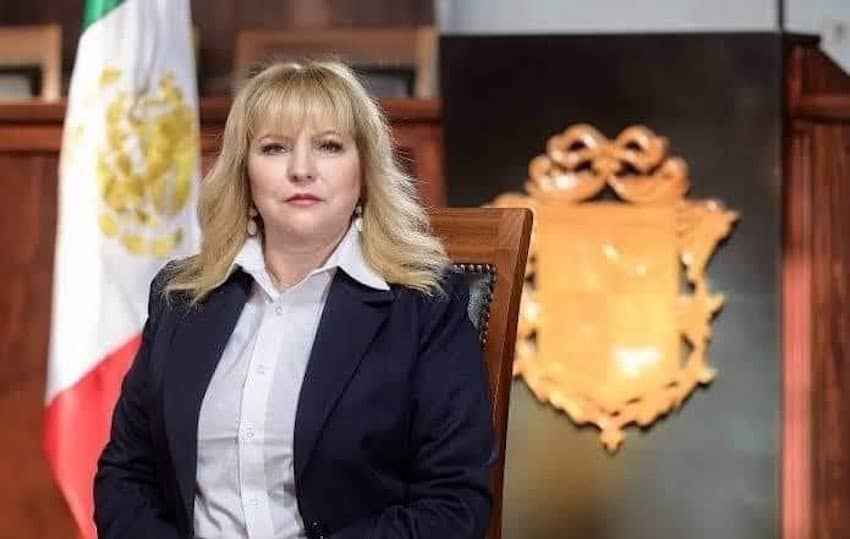
Before responding to reporters’ questions, AMLO noted that he was informed at his early morning security meeting that the mayor of a Michoacán municipality who was kidnapped in Guadalajara last Saturday had been released.
He said that the mayor, Yolanda Sánchez Figueroa, was on her way back to Cotija, Michoacán, in the company of National Guard personnel.
The kidnapped mayor was later released unharmed. (José Diaz/X)
On the ninth anniversary of the disappearance in Guerrero of the 43 Ayotzinapa Rural Teachers College students, López Obrador was asked why it has been so difficult to find out what happened to the young men.
“We’re doing a thorough, serious investigation and we’re making progress,” AMLO responded.
“The mistake of hiding the truth and disposing of evidence was made, the mistake of imposing what was called a ‘pact of silence,'” he said.
The kidnapping of 43 students in 2014 has been one of the most defining moments of Mexico’s gruelling drug war. Emotions around the disappearance remain high. (Graciela López/Cuartoscuro)
“So we’re confronting all of that and we’ve made a lot of progress,” López Obrador said.
He acknowledged that the parents of the students “insist that the army isn’t cooperating” with the investigation, claiming “that it doesn’t want the facts to be known.”
AMLO said he didn’t agree with that view because the army, which is accused of involvement in the crime, “has handed over all the information it has and has helped a lot to clear up … the terrible Ayotzinapa case.”
López Obrador noted that a lawyer for the parents of the young men, with whom he met on Monday, described information presented by his administration about the case as similar to the widely criticized “historical truth” that the previous government put forward as the definitive version of events.
“I don’t share that point of view,” said AMLO, who subsequently announced that text messages related to the case that the Mexican government obtained from its United States counterpart would be made public later in the day.
He said later in the presser that the government’s priority is to “find the young men.”
The remains of only three of the missing students have been identified. (Graciela López/Cuartoscuro)
“The information we already have and that which we could soon obtain might lead us to that,” López Obrador said.
“It’s not about blaming [someone] for the sake of blaming. It’s not just, ‘It was the state and it was the army’ and that’s it. No, we’re going to find out the truth about what happened. I’m not going to lie nor are we going to fabricate something that isn’t true. We’re going to act with rectitude, we’re not the same [as previous governments],” he said.
After a lengthy discussion on the Ayotzinapa case, López Obrador declared shortly before the end of the press conference that the situation in the border region of Chiapas had normalized.
“The National Guard is already there,” he said, adding that steps were being taken so that Federal Electricity Commission workers could go into communities to restore power service that was allegedly cut by cartel members.
“Everything is normal,” AMLO said after a reporter inquired whether food was available in the region and students had returned to school.
“All the blockades have now been removed,” he added.
López Obrador accepted that organized crime groups may have “social bases” among residents of the southern border region, but claimed that support was limited given that the government is attending to “social problems” and “young people, which wasn’t done before.”
“What did … [governments] do for young people before? Nothing. Call them ‘ninis’,” he said, using a pejorative colloquial term for people who don’t have a job and aren’t studying.
“That mustn’t be forgotten,” López Obrador said.
Wednesday
At the beginning of his engagement with reporters, AMLO fielded a question about former foreign affairs minister Marcelo Ebrard’s decision to ask the Federal Electoral Tribunal to intervene in his case against the presidential candidate selection process conducted by the ruling Morena party.
“Nothing, nothing, nothing,” López Obrador responded when asked whether he had any opinion on the matter.
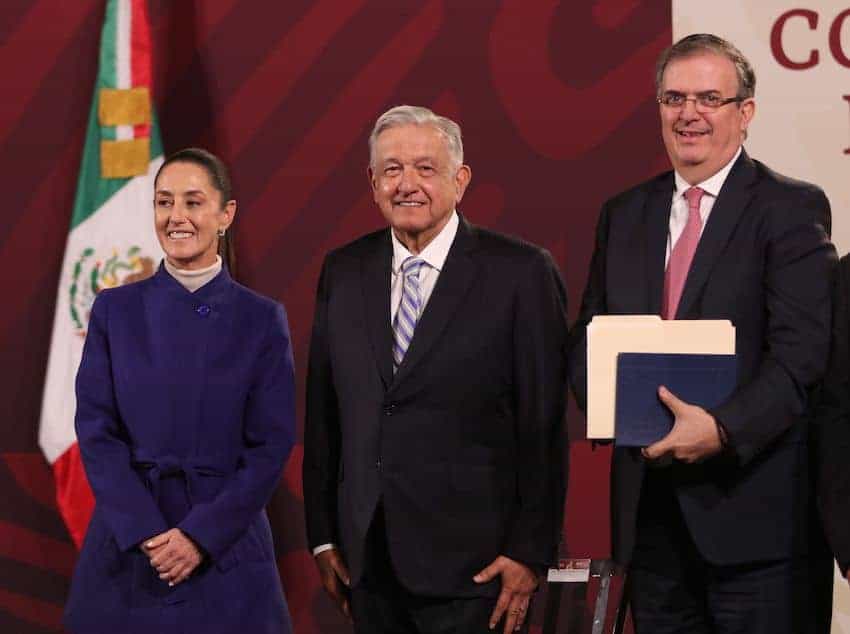
Ebrard (right) has protested the outcome of the Morena leadership contest, in which rival Claudia Sheinbaum (left) was selected as the presidential candidate for the 2024 election. (Gob MX)
“There are legal procedures and there are freedoms, that’s all I can say,” he said.
“I already finished [my tenure] as leader of the movement of transformation,” AMLO added, referring to Morena. “I already handed over … the baton of command.”
López Obrador switched on his internal autopilot and reiterated his commitment to fighting corruption when a reporter raised a case involving an embezzlement scheme allegedly linked to former Veracruz governor Miguel Ángel Yunes.
The president also weighed in on the Miguel Ángel Yunes Márquez embezzlement case. (Victoria Raza/Cuartoscuro)
“We have to moralize the public life of the country, purify the public life of the country,” he said.
“We also have to continue combating corruption, not just for moral reasons but also because a lot of money can be recovered and saved for the development of Mexico,” AMLO said.
“Mexico’s main problem was corruption, that’s why we didn’t make progress … so we can’t make a truce with corruption. … It’s the plague, I’ve said it many times, it’s what damaged Mexico the most during a long period of time. Corruption is the main cause of economic and social inequality in the country,” he said.
López Obrador sought to clarify his remarks, saying that “there was no corruption in pre-Hispanic Mexico,” but the scourge “arrived with the invaders.”
Later in the presser, AMLO said that a “kind of competition” is taking place in the United States in which people aspiring to elected office, including those seeking to represent the Republican Party at next year’s presidential election, compete with each other to see who can make the “most daring” threat toward Mexico.
“What should we do? Well, don’t take those declarations seriously – they’re nonsense,” he said. “… It’s politicking, not politics.”
López Obrador segued into an attack on the media, describing it as a “power of control and manipulation.”
He advised Mexicans to use social media to inform U.S. citizens and people around the world “what Mexico is,” explaining that “if our country was how the media in the United States depicts it … nobody would come to live in Mexico City.”
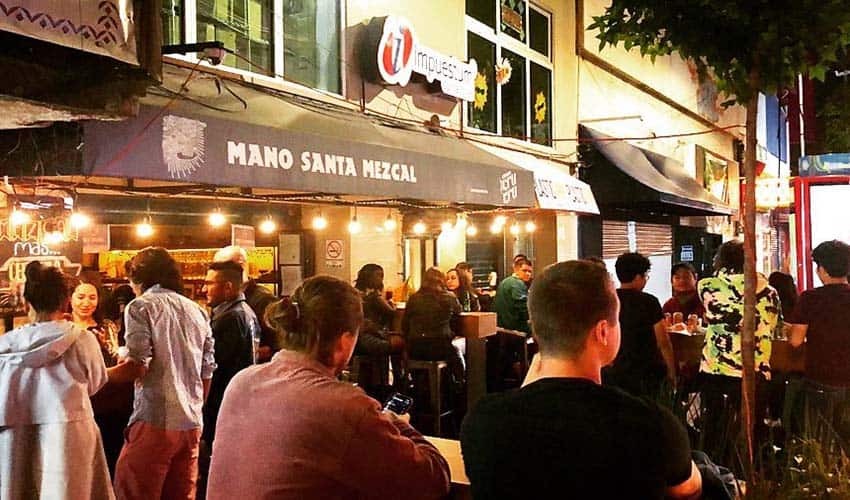
“[But the city] is full of Americans, that didn’t happen before. Now you go to a restaurant in La Roma, Colonia Del Valle, Polanco [or] Condesa – those who go to restaurants tell me – and half the tables are taken by Americans, and people even complain that prices have gone up,” AMLO said.
The oft-reported influx of foreigners living in Mexico City neighborhoods like Roma Norte was another topic addressed by the president. (Mano Santa/Facebook)
“… There were a lot of them in the Zócalo for the Cry of Independence. And we’re pleased that they participate, that they integrate themselves into the life of Mexico, they’re welcome, but we have to inform United States citizens about what is really happening [in Mexico] so that those political campaigns based on lies and slander…don’t make progress,” he said.
Near the end of his midweek mañanera, López Obrador acknowledged that Tuesday was a bad day for violence, “especially in Nuevo León,” where 12 human heads and other body parts were dumped at different locations across the Monterrey metropolitan area.
Before concluding the presser, he reaffirmed his commitment to continuing the Ayotzinapa case investigation “until we know the truth and the most important thing – where the young men are.”
AMLO said that the parents of the students “have every right” to disagree with the government’s findings, “but regardless of whether they believe us or not, we’re going to continue [the investigation] because it’s a matter that has to do with our convictions and conscience.”
Thursday
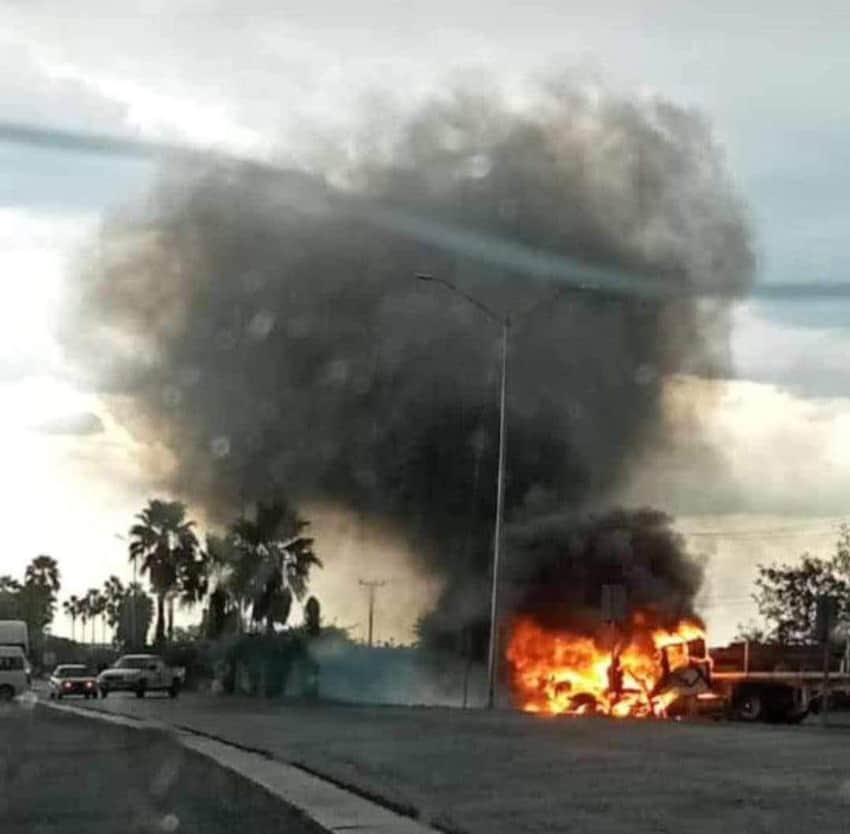
“We are taking action on both cases,” López Obrador said after a reporter mentioned fiery narco-blockades in Nuevo León on Wednesday and the murder a day earlier of a Federal Attorney General’s Office official in Chiapas.
A burnt out vehicle between Montemorelos and Hualahuises in Nuevo León on Wednesday. (Screen capture)
“In Chiapas, we’ve made a lot of progress with the support of the people. The National Guard is there and we hope that normality is reestablished soon,” he said without specifically referring to the murder.
“And in the case of Nuevo León, the same thing, action is already being taken. There’s a confrontation between [crime] groups … and we’re there helping the Nuevo León government in everything we can,” AMLO said, noting that the National Guard and the army are deployed to the state.
López Obrador also said that an investigation is underway into the abduction of seven teenagers in Zacatecas, six of whom were found dead on Wednesday.
“There is one who fortunately is alive, injured,” he said before directing a message to the people of Zacatecas and Nuevo León.
“We’re working in a coordinated way with the local authorities and we’re going to continue combating crime and guaranteeing peace and tranquility, which is our responsibility,” AMLO said.
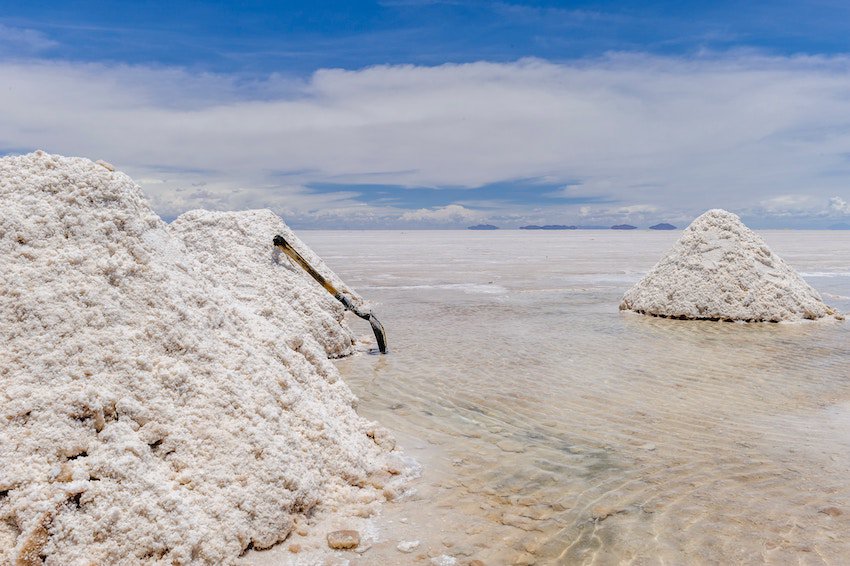
The government’s decision to cancel mineral rights for lithium mining firm Ganfeng Lithium was a major story this week. (Alexander Schimmeck/Unsplash)
Asked about the reported cancellation of lithium mining concessions held by Chinese company Ganfeng Lithium, López Obrador indicated that a final decision hasn’t yet been made.
“But we’ve taken the decision that lithium belongs to the nation because it’s a strategic mineral,” López Obrador said.
Later in the presser, the president turned his mind once again to his proposal to have Supreme Court justices and other judges elected by citizens.
“The judicial power will be renewed, I have confidence in that, we just have to do it legally and democratically. We have to wait for the elections,” AMLO said, tacitly acknowledging that the constitutional reform he plans to put forward during his last month as president will require the support of two-thirds of Congress to pass.
The presidential and congressional elections to be held on June 2, 2024, are “extremely important,” Lopez Obrador said.
“It’s not just about electing new authorities, it’s also deciding whether to continue with the process of transformation or not,” he said.
“And who will decide? The people, the citizens, because that’s democracy.”
Near the end of the presser, López Obrador was asked about Grupo Carso’s purchase of 49.9% of the Mexican subsidiary of Talos Energy, which holds a 17.4% stake in the Zama oil field, located in the Gulf of Mexico off the coast of Tabasco.
The purchase gives Grupo Carso a stake in the Zama offshore oil field in the Gulf of Mexico. It’s considered the largest oil reserves discovery in the last 20 years. (Zachary Theodore/Unsplash)
“I believe it’s a good operation,” he said of the purchase by the Carlos Slim-controlled conglomerate.
AMLO proceeded to rail against the previous government’s energy reform that opened up the sector to foreign and private companies. Contracts were granted for 110 onshore and offshore oil fields, but only three are currently producing oil, he said.
“We arrived [in government] and we offered to respect the contracts, and we are. … To deliver those 110 contracts they did the energy reform, they paid off deputies so that they would vote in favor of the energy reform and they deceitfully claimed that foreign investment would pour in and oil production would increase and the price of gasoline would go down. In a nutshell, they lied,” López Obrador said.
“… I didn’t agree with the energy reform, that is known, but once they delivered the contracts I had to take a decision. If we revoked those contracts, it would have generated a lot of instability,” he said.
“… Politics has a lot to do with practical judgment,” López Obrador added.
Friday
At the very beginning of his press conference, AMLO was asked about the United States House of Representatives’ approval of a proposal put forward by a Republican Party lawmaker to cut off some US $60 million in government funding to Mexico due to its alleged lack of willingness to combat fentanyl production and trafficking.
López Obrador dismissed Rep. Alex Mooney’s proposal as electorally-motivated propaganda.
As elections will be held in the United States in 2024, parties and individuals aspiring to elected office use “delicate matters” such as “harm caused by fentanyl” and “the migration issue” for “political purposes,” he said.
West Virginia Congressman Alex Mooney was also the target of presidential ire after he proposed cutting US $60 million of aid to Mexico. (Alex Mooney/X)
“It’s vile and ordinary propaganda, we shouldn’t take it seriously, it’s just publicity to try to fool United States citizens,” López Obrador said.
As he has done before, AMLO offered some free advice to United States lawmakers about how to combat the fentanyl crisis.
“Attend to your young people guaranteeing them three things: education – education should be free in the United States; work; and thirdly, love, so they don’t use fentanyl. That’s what you should be doing, not blaming us,” he said.
López Obrador also urged the U.S. Congress to approve a support plan for countries in the region with economic, social and political problems that are forcing large numbers of people to leave.
“A comprehensive support plan … so that Venezuelans, Cubans, Nicaraguans, Ecuadorians, Guatemalans, Hondurans don’t have the need to emigrate,” he said.
“They don’t do anything,” AMLO said of U.S. lawmakers before criticizing them for rapidly approving “US $30 or $40 billion for weapons in Ukraine” but ignoring the Western Hemisphere.
“… This is a respectful recommendation: approve a well-being support plan for the people of Latin America and the Caribbean,” he said.
López Obrador later said that he agreed with Elon Musk’s call for “expedited legal approval” of entry to the United States for “hard-working and honest” migrants.
There were also complaints that the U.S. is wilfully ignoring the migration crisis faced by Central America. (Adolfo Vladimir/Cuartoscuro)
In a change of topic, a reporter – after remarking that at least 50 Asian companies are thinking about investing in factories in Mexico – asked the president “what certainty” he could give to firms considering relocation.
“There is investment in Mexico from the entire world, investment is coming in from all over the world, mainly from the United States and Canada, but there are conditions to invest in Mexico,” López Obrador said.
“All the facilities for investment were provided and progress is being made. … In Mexico there are very favorable conditions for investment,” AMLO said.
Later in the mañanera, a reporter asked the president what his government could do to protect journalists, dozens of whom have been murdered in recent years.
“Well, we have to continue combating crime, continue working to avoid violence, everything we’re doing,” López Obrador said.
“… If you ask me, ‘What can we do to guarantee the protection of journalists, social activists and all people?’ [I say] continue attending to the causes of violence,” he said.
AMLO asserted that his government “punishes culprits when there are murders of journalists.”
“In the majority of cases … during our government,” suspects have been arrested and imprisoned, he said, adding: “there is no impunity, impunity is not permitted.”
Shortly before the end of his presser, López Obrador said that he would soon begin announcing replacements for officials who have decided to resign to seek elected office, among whom are Deputy Health Minister and COVID czar Hugo López-Gatell, who is hoping to stand as the ruling Morena party candidate at the 2024 Mexico City mayoral election, and the head of the consumer protection agency Profeco, Ricardo Sheffield, who has his eyes on the governorship of Guanajuato.
“I’ll announce [the replacements] here, starting Monday,” he said.
“… Let’s have breakfast now,” AMLO declared before noting that he was about to embark on a tour of México state.
“Where are we going? Let’s see, to Tecámac first and then to Ecatepec. Tomorrow we’re going to Texcoco and Chimalhuacán and then to Chalco, Valle de Chalco first, then to Chalco and Ixtapuluca,” he said, mentioning no fewer than seven municipalities in Mexico’s most populous state.
By Mexico News Daily chief staff writer Peter Davies (peter.davies@mexiconewsdaily.com)
So, what should we be putting in our gardens? The short answer: as many native plants as possible. (Unsplash)
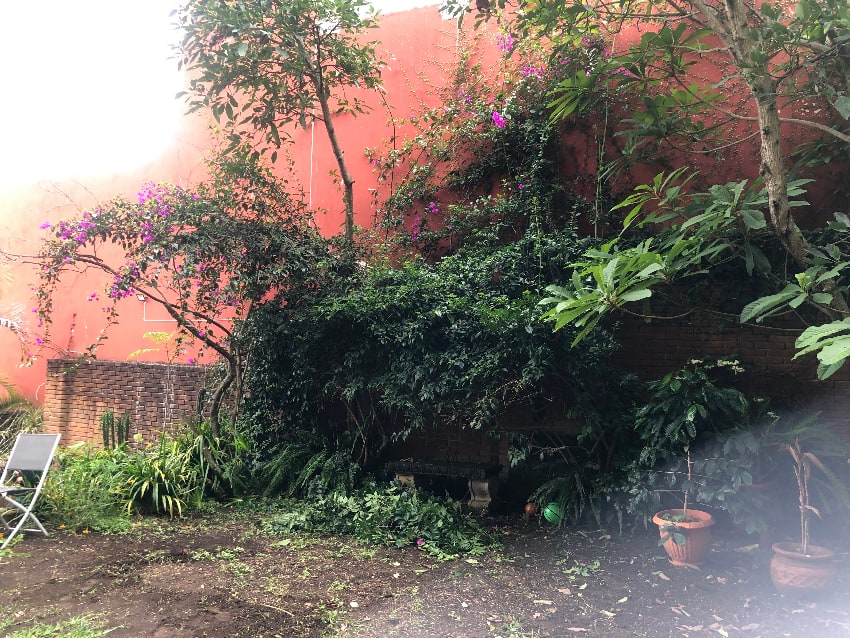
I’ve just fought and won – for now – a battle against some very aggressive bougainvillea.
Before this past year, I’d loved and admired the plant: those look-at-me fuchsia flowers, the way it makes even the sketchiest of neighborhoods look like they’re spilling over in extravagant lushness. A tea made from its flowers is also supposed to help if you have a cough!
But as I discovered since moving into a house with the biggest yard I’ve had in Mexico, bougainvilleas are all-terrain, and it’s easy for them to get out of hand.
They grow easily and rapidly, stretch out, and take over wherever they can if planted in the ground. Their thorns are as sharp as switchblades and about as sturdy.
Before I knew it, four of them had turned into actual trees—big ones.
Sarah’s bougainvillea tree.
After trying in vain to prune them down myself, I was mercifully put back into contact with the gardener who’d helped me at the previous place I lived, who helped cut them down and find someone with a giant truck to haul off the “green trash.”
I’m a little poorer now, but my garden is free of spikey things that could poke holes in my kid and her small guests.
And now I’ve got space to add new plants!
Before this year, I’d never given much thought to the plants with which I share my living space beyond their ornamental or useful values. (Typical human, amiright?)
But now that I’m the steward of a kind of gigantic (for Mexico) piece of land, I want to do things right. I feel guilty for the purposeful demise of my yard’s spikey plants and want to do right by nature.
A conversation with my friend, biologist and PhD candidate Estrella Chévez Martín del Campo (the “del Campo” is purely coincidental, I promise) has helped clear up a lot of doubts and given me some purposeful direction in my quest to “reforest” my backyard. Chévez is a reforestation consultant with Pronatura Veracruz and INECOL and fits the profile of exactly the kind of person I wanted to hear from. Plus, she’s just lovely.
So, what should we be putting in our gardens? The short answer: as many native plants as possible.
But before getting into the “why,” it’s important to look into a few different classifications of plants, which are:
Native plants: plants that evolved in a particular geographical area. Corn, for example, is a good example of a native plant in Mexico. Native plants are naturally suited to the conditions and ecology of the areas where they evolved and are the easiest to care for. Here are some others.
Endemic plants: these are, essentially, extremely local native plants – that is, plants that are native to a more reduced geography. Veracruz, the state where I live, for example, is the “native land” of two very well-known plants, the orchid vanilla and jalapeños (among many others).
Exotic (or introduced) plants: plants that are not native to a specific area but that have survived and thrived in their new homes nonetheless. Many of the plants that Mexico is famous for, like coffee, mango, citrus plants, bananas, and even those lush jacaranda trees, were brought from elsewhere.
Invasive plants: these are plants that have adapted a little too well to their new environments… so much so that they’re taking over the spaces where they’ve landed at the cost of native plants that were already here, a kind of plant gentrification. There are a lot of them out there.
Native plants are the ones that evolved in a particular geographical area. (Unsplash)
So why plant native plants?
They’re easier to care for, even in reduced urban spaces.
They support the local ecology of the area, including its animals.
They’re perfect for local pollinators. (And without pollinators, we’re all toast.)
So, how do you tell the difference between native, exotic, and invasive plants in your area?
Well, that takes a little bit of research. Luckily, resources abound, both modern and old-fashioned! Here’s what you can do to populate your garden with the best plants possible:
Look online! Revive is a handy site (in Spanish) that lets you look up plants based on several different factors, including ecological reforestation and climate. NaturaLista is also a great site where you can find native pollinizers! (If you’re in the U.S. or Canada, here’s a great list in English as well).
If you’re unsure about a plant, use Google Lens, a visual search engine that will lead you to a plant’s name. Look up translations from there, and you’re on your way to research!
Talk to local gardeners: only some people will be more knowledgeable than those who work with plants every day and know exactly what grows, both well and a little too wellin your local area.
Talk to your local botanical garden! It will be filled with ecologists and biologists who know exactly what they’re talking about.
Ask about native plants in your local viveros (plant nurseries) and what they would recommend.
Get a friend like Estrella and pepper her with constant questions. Take her out to lunch for her trouble.
So, let’s pay attention to the other living things we share this earth with. All our futures depend on it.
Sarah DeVries is a writer and translator based in Xalapa, Veracruz. She can be reached through her website, sarahedevries.substack.com.