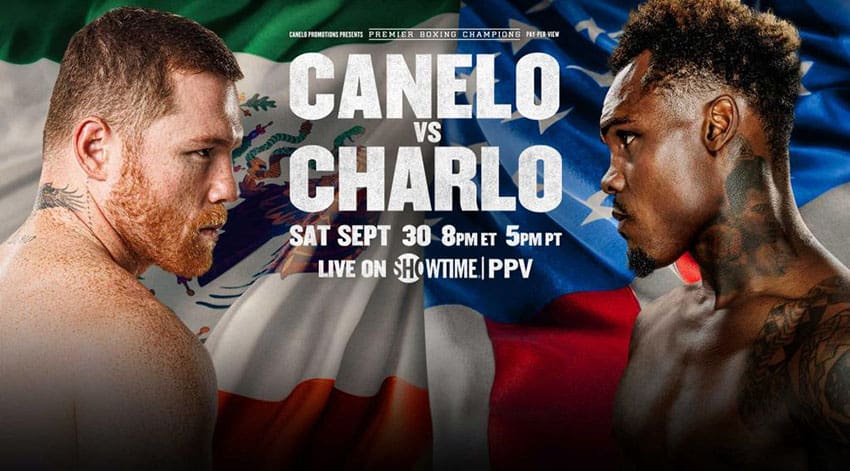
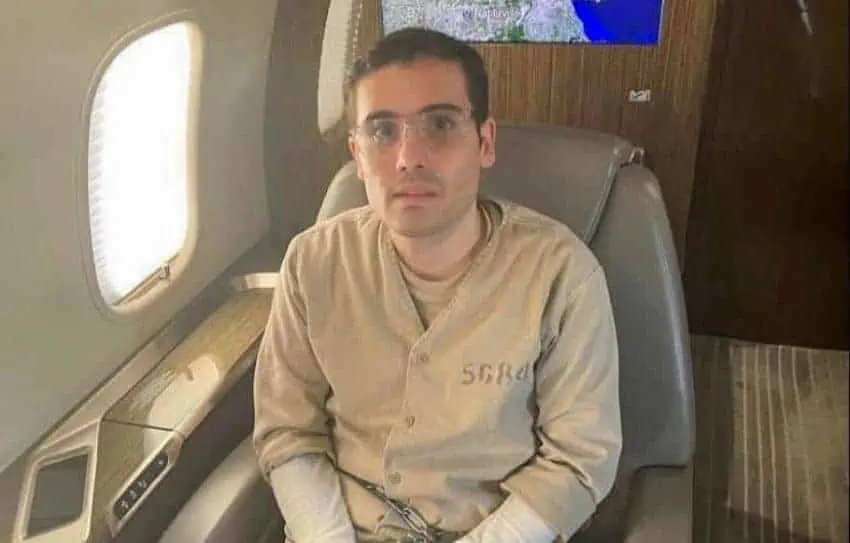
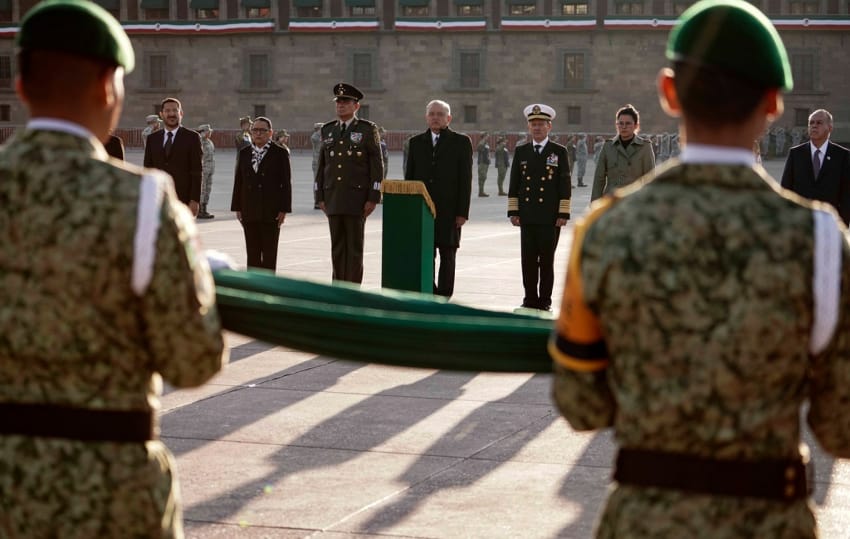
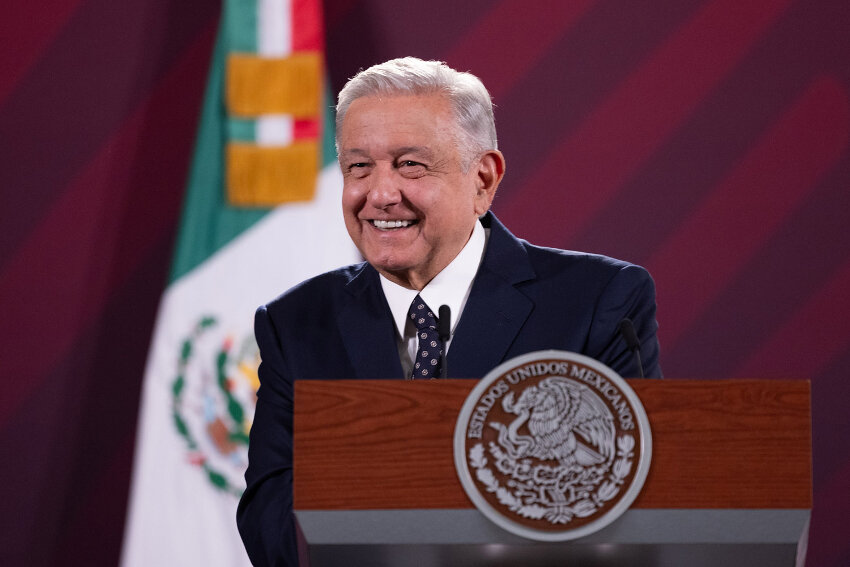
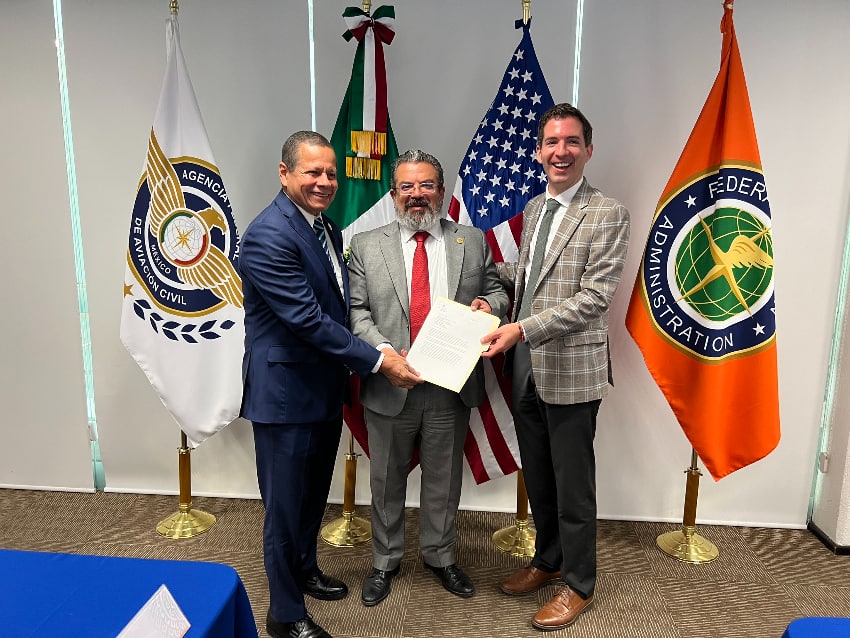
Canelo and Charlo will face off on Saturday. (Canelo Álvarez/Instagram)
World champion boxer Saúl “Canelo” Álvarez of Guadalajara will return to the site of his only loss in his last 19 fights for an intriguing matchup against American Jermell Charlo.
The Saturday, Sept. 30 title bout at T-Mobile Arena in Las Vegas is being billed as “Undisputed vs. Undisputed.” Of boxing’s four major sanctioning bodies that bestow world title belts, all of them have Álvarez as their super middleweight (168 pounds) champion, and the same holds true for Charlo in the junior middleweight (154 pounds) division.
The two boxers, both undisputed champions in their weight division, will face off in Las Vegas. (Showtime)
Álvarez claimed the WBC, WBO, WBA and IBF title belts in late 2021, and this will be his third defense of his undisputed title.
The 33-year-old owns a record of 59 wins (39 by knockout), two losses and two draws. His last loss was three fights ago, on May 7, 2022 in T-Mobile Arena, when he dropped a unanimous decision to light heavyweight Dmitry Bivol of Russia. It was his only loss since 2013.
He has rebounded with two victories since then, including a lukewarm triumph over Brit John Ryder in May at Akron Stadium in Zapopan, Jalisco, adjacent to his hometown of Guadalajara. Billed as “The King is Coming Home,” the fight was Álvarez’s first in his native Mexico in more than 10 years, and a crowd of 50,000 packed the home of Liga MX’s popular C.D. Guadalajara soccer team, commonly known as Chivas.
Though Álvarez dominated, the win didn’t excite his fans, and coupled with the loss to Bivol, the right-hander has some wondering if his best efforts are behind him.
It’s been more than a year since Álvarez last lost a fight. (Showtime)
“I understand what people are saying, and I agree,” Álvarez said recently. “I didn’t look my best in my last few fights, but I also know why. You’re going to see something different this fight. It’s going to be good.”
On the surface, Álvarez would seem to have the advantage, since Charlo, also 33, is moving up two weight classes and fighting at 168 pounds for the first time. But at 5-foot-11, Charlo is actually 3 inches taller than Álvarez, and has a 73-inch reach compared to Álvarez’s 70½ inches. Then again, Canelo is stronger, thicker and more comfortable fighting in the heavier class.
“My whole career has been about chasing Canelo, basically,” said Charlo, whose 35-1-1 record includes 19 wins by knockout. “This is what I’ve been working toward. … The whole goal in this game is to get in the ring with the best, and he’s the best.”
“He’s a fighter that hits hard,” Álvarez said. “He’s a good boxer that knows how to use distance. That’s what makes him dangerous.”
Though Jermell Charlo is moving up two weight classes for the fight, the junior middleweight champion shouldn’t be underestimated. (Showtime)
Jermell Charlo, whose nickname is “Iron Man,” is the twin brother of Jermall Charlo, who is also a professional boxer and is the WBC middleweight champion.
Álvarez will earn approximately US $50 million for Saturday’s fight as part of a three-fight deal with Premier Boxing Champions. Money aside, Álvarez, who will be fighting for the eighth time in less than three years, will be looking to rejuvenate his career after an unimpressive three-fight stretch.
“I think I have at least four more years left, maybe five,” he said. “I’ve been a professional boxer since I was 15 years old. That’s almost 18 years of fighting professionally. I always said I would retire when I was 36. Or 37, around that age. That should be more than enough. That’s so many years of boxing. By then, I’ll have achieved a lot of things, and then I’ll have time to enjoy life with the family and everything.”
The fight on Saturday will mark the first time in the four-belt era that two undisputed male champions are going head-to-head.
Volaris has applied for the most new routes to the United States since the restoration of Mexico's Category 1 safety rating. (LIfes Sundays/Shutterstock)
With the reinstatement of Mexico’s FAA Category 1 safety rating, airlines in the country are expected to add new routes to the United States as soon as November, Infrastructure, Communications and Transportation Minister Jorge Nuño Lara announced on Wednesday.
1. At least 55 new flight routes will launch this year
The government expects ticket prices to fall as competition increases. (Viva Aerobus)
At least 55 new routes to the U.S. will launch before year’s end, adding some 500 new flights per week, and increasing capacity by 3.6 million passengers, Nuño Lara said.
2. Volaris has applied for the largest number of new routes
According to Nuño Lara, Mexico’s largest airline, Volaris has requested 33 new routes, as it seeks to serve Los Angeles, Chicago and San Antonio in the U.S., in addition to Tulum and Mérida.
Viva Aerobus has applied for 17 routes, while Aeroméxico has applied for five.
Airlines are looking to cash in on lucrative new direct routes to cities such as Los Angeles. (Alek Leckszas/Wikimedia)
“These figures will grow over time as airlines adjust their own business plans,” Nuño Lara said.
He added that these new routes are expected to begin operations between November and January 2024, subject to the Mexican Federal Civil Aviation Agency (AFAC) authorization process.
“There’s an ongoing authorization process so that they [the airlines] can market the flights and [tickets] can be put on sale for the winter season,” Nuño Lara said.
3. Prices are expected to decrease as a result
Though flights offered at Mexico City’s central AICM airport will continue to change over time, the airport is saturated with little room for further growth, the transportation minister has said. (AICM/Instagram)
Increased supply would decrease ticketing prices, Nuño Lara said.
“The three airlines (Volaris, Aeroméxico and Viva Aerobus) will be able to open their new routes and with more supply, we should see a price reduction,” he explained.
Finally, Nuño Lara added that the upgrade of Mexico’s safety rating is a “win-win” scenario since passengers will be able to buy direct flights to cities in the U.S. without the need for connections.
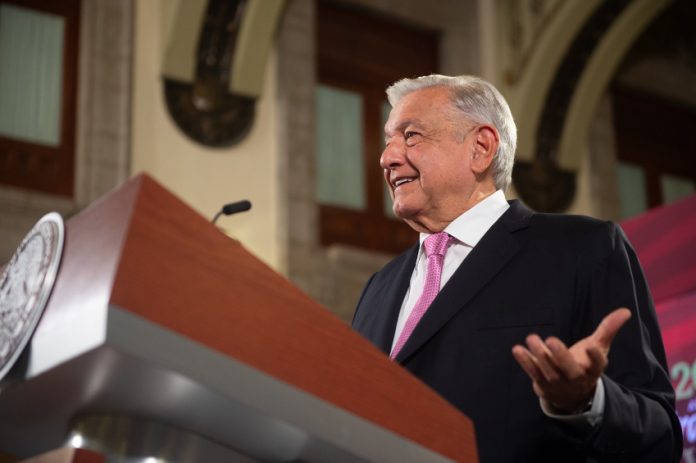
The president covered everything from Ovidio Guzmán's extradition to the Ayotzinapa case to his popularity as a streamer this week. (Gob MX)
“I will never forget that power is humility, but let me show off,” President López Obrador said in a social media post on Wednesday.
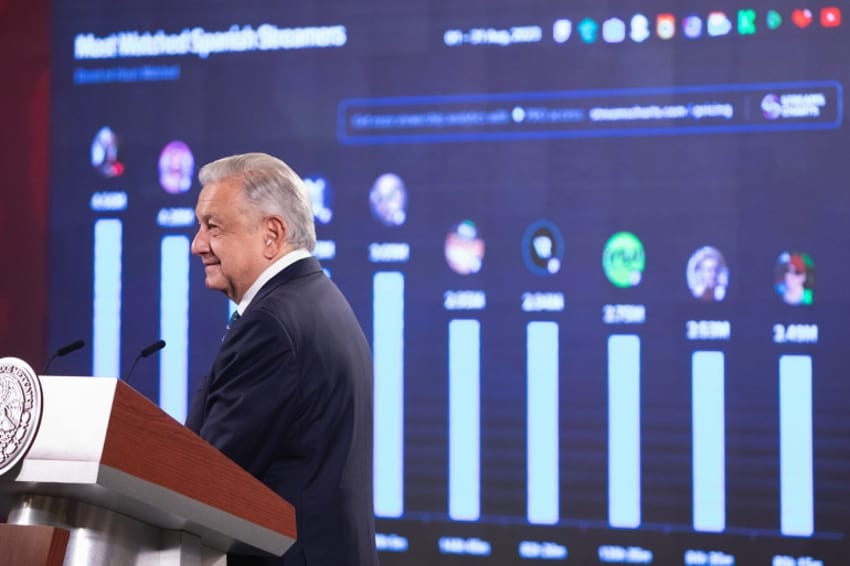
He went on to note that data (from the website Streams Charts) showed that he was the most-watched Spanish-language live streamer in the month of August.
AMLO couldn’t help but share the news about his streaming prowess. (Lopezobrador.org.mx)
A graph AMLO posted to Facebook and X showed that his total “airtime” in August was 61 hours and 15 minutes, most of which was time spent at his morning press conferences, known colloquially in Mexico as mañaneras.
Viewers of the president’s pressers and his other live streams watched a combined 4.56 million hours of “AMLO TV” last month, according to the graph.
That length of time is equivalent to about 520 years, meaning that the period of collective viewership in a single month was longer than the amount of time that has elapsed since Hernán Cortés and his fellow conquistadores conquered Tenochtitlán.
Monday
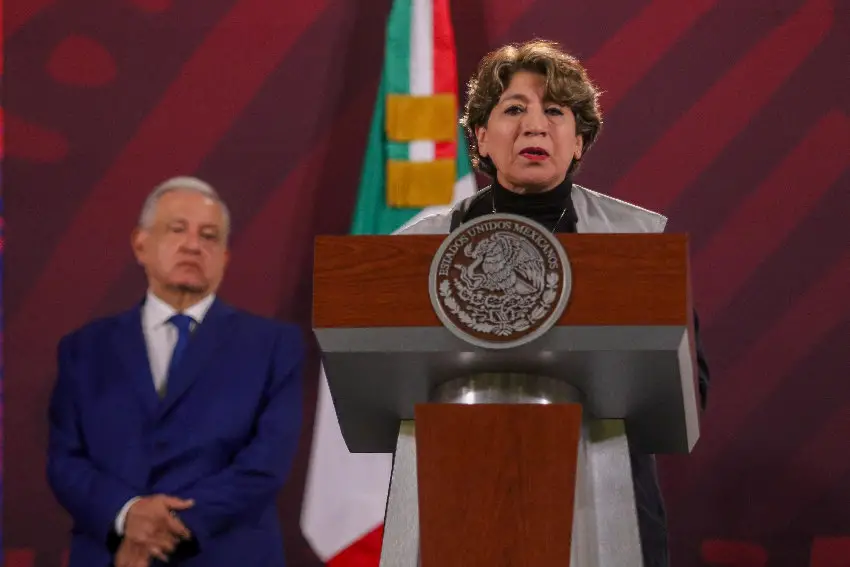
After updates on three rail projects – the Maya Train, the Pacific to Atlantic link across the Isthmus of Tehuantepec and the Toluca-Mexico City line – México state Governor Delfina Gómez took center stage.
“First of all, I come only to put myself at your service,” Gómez told reporters four days after she was sworn in as the first female governor of Mexico’s most populous state.
She said that mexiquenses, as residents of México state are called, are “very grateful” to have a new public transport option now that (a short) part of the Toluca-Mexico City railroad is open.
“I believe that ‘El Insurgente'” – as the new train service is called – “is proof that we can achieve great things if we work as a team, work with a vision and above all think about supporting the neediest class,” said Gómez, who left her position as federal education minister to seek election as México state governor.
Governor Delfina Gómez of México state at the Monday morning press conference. (Cuartoscuro)
Mexico City Mayor Martí Batres noted that the still incomplete project – which was started during the term of the previous federal government but encountered numerous problems – is a “collaboration” between the Mexico City, México state and federal governments.
“El Insurgente,” once completed in 2024, will “form part of the integrated transport system in Mexico City,” he said.
Asked about his “supervision” trip on Sunday on the rehabilitated Isthmus of Tehuantepec railroad, AMLO noted that the journey between the stations in Salina Cruz, Oaxaca, and Coatzacoalcos, Veracruz, is 303 kilometers.
He quickly veered into an attack on the 1994-2000 government led by ex-president Ernesto Zedillo, which privatized Mexico’s railroad system.
“We had the idea to rehabilitate this stretch of railroad [on the isthmus]. It was completely abandoned … because these neoliberal, corrupt, irresponsible people finished off the rail system, especially passenger trains, and they handed concessions for all the country’s freight railroads to two companies,” López Obrador said.
“… There were passenger trains from Mexico City to Monterrey, Mexico City to Guadalajara, Mexico City to Yucatán, and even to Nogales, to the [northern] border,” he said.
“The country was completely connected with passenger trains and these irresponsible people, I repeat, put an end to 150 years of national railroad history overnight, in the blink of an eye,” AMLO said, referring to officials in the Zedillo administration.
When a person is notified of an extradition decision, he or she has the opportunity to challenge it legally, “to go to a judge,” AMLO said.
Ovidio Guzmán was transferred to the U.S. to face charges of drug trafficking, money laundering and others. (CORTESÍA/CUARTOSCURO.COM)
“I understand that in this case, there was no request for [legal] protection,” he said.
López Obrador said it was important for Mexico not to give ammunition to “those who use the issue of drug trafficking with political purposes in the United States.”
“There are two issues that are used a lot when there are elections in the United States – drug trafficking and migration,” he said.
Later in the presser, AMLO said that the government could release recordings obtained from the United States that contain information about the disappearance of the 43 students who were abducted and presumably killed in Guerrero in 2014.
“We’ll see, because there is always the due process thing and we also have to ask for permission from the parents,” he said.
López Obrador said that the government itself didn’t have “any problem” in releasing the recordings of conversations between members of the Guerreros Unidos crime gang, which was allegedly involved in the crime.
“I’m in favor of transparency. I don’t like due process being used as an excuse not to provide information, to hide information,” he said.
Among other remarks, AMLO defended the participation of Russian soldiers in last Saturday’s Independence Day military parade in Mexico City after Ukraine’s ambassador to Mexico and others criticized their involvement in the annual event.
“We have relations with all the countries of the world, and everyone is invited [to the parade]. … It’s always been done,” he said.
Tuesday
During his fortnightly “Zero Impunity” report, Deputy Security Minister Luis Rodríguez Bucio told reporters that a total of 34 people have been arrested in connection with the 2019 murder in Sonora of three women and six children who were part of a Mormon community that was established in northern Mexico some 100 years ago.
Rodríguez noted that one presumed member of the criminal group that allegedly attacked members of the LeBaron, Langford and Miller families was arrested on Aug. 30 and subsequently ordered to stand trial on charges of murder and attempted murder.
José Adrián ‘N,’ an alleged member of La Linea gang, was detained in Nuevas Casas Grandes, by Federal Attorney General’s Office agents supported by the army, he said.
Security Minister Rosa Icela Rodríguez reported later in the presser that last month was the least violent August in six years in terms of homicides.
Data she presented showed that homicide numbers so far this year are down 17% compared to the same period of 2019, the current government’s first full year in office. The same set of data showed that López Obrador’s term in government has been more violent than the sexenios (six-year terms) of his five most recent predecessors.
President López Obrador at an event on Tuesday dedicated to the memory of earthquake victims. (Lopezobrador.org.mx)
After the regular security report, federal Civil Protection chief Laura Velázquez noted that it was the anniversary of two devastating earthquakes.
“Today is Sept. 19, 2023, the earthquakes of 1985 and 2017 are commemorated in memory of the victims and in homage to the important intervention of volunteers, national and foreign rescue workers, public servants, workers, citizens and young Mexicans, who, with courage and a great sense of solidarity, saved a lot of lives,” she said.
Velázquez said there have been 31 earthquakes of magnitude 6.8 or higher in Mexico since 1985, a year in which thousands of people were killed by a powerful temblor that caused extensive damage in the Mexico City area.
She also reminded reporters and viewers that a national earthquake and hurricane drill would be held at 11 a.m. Velázquez said that the objectives of the drill were to raise greater awareness of the risk of natural disasters, educate citizens on what they should do in such situations and “measure our capacity for response in the face of a possible emergency.”
AMLO took his customary position before the press corps to respond to questions and was immediately told that “the main representatives of the traditions of the Indigenous people of Mexico have pointed out that” his handing over of a “baton of command” to presumptive Morena party presidential nominee Claudia Sheinbaum lacked “legitimacy” because the “symbolic act” wasn’t carried out in accordance with “traditional protocol.”
“… That baton that I handed over symbolizes our commitment to attending to Indigenous communities as a priority,” López Obrador said.
“… So that you know, [the baton] was given to my by a community – I don’t want to mention the region, the ethnicity or the culture – … and I requested authorization to give that same baton to she who now leads our movement and they approved,” he said.
The president later highlighted that some sort of government assistance reaches “almost” all Indigenous households in Mexico. The government’s “preference” is to support “the poorest people and unfortunately the poorest are the Indigenous people,” AMLO said.
López Obrador won’t hand over the presidential sash until Oct. 1, 2024, but a reporter nevertheless asked him whether he had already thought about going on a “farewell tour” tour of the nation.
President López Obrador ruled out a farewell tour of the country before the end of his term. (Gob MX)
“I’m constantly touring the country, every weekend,” AMLO shot back.
He said he would continue traveling through Mexico to evaluate the progress being made on public works such as the Maya Train railroad and water infrastructure projects, but ruled out going on a gira de adiós.
“No, no, no,” López Obrador said, asserting that he would only travel for work-related reasons because “we need to finish all the projects.”
“This weekend, for example, I’m going to [inspect] the Maya Train and next weekend I’ll supervise three projects in México state,” he said.
Shortly before the end of the mañanera, AMLO said that the government doesn’t have a “projection” on how Mexico will benefit from the reinstatement of its Category 1 aviation safety rating with U.S. authorities, even though Infrastructure, Communications and Transport Minister Jorge Nuño Lara said last week that “it’s expected that more than 50 new routes from Mexico to the United States will open in the short term.”
“They’re saying that it will help a lot to continue growing the number of operations, especially flights to the United States, but we don’t have a projection,” he said.
The transportation minister Jorge Nuño Lara (center) receiving the document restoring Mexico’s Category 1 rating from Andrew Crecelius Villalobos of the U.S. State Department. (AFAC/X)
“The truth is that even without the Category 1 rating, aviation took off after the [COVID] crisis. The number of operations grew and tourism has grown a lot. Mexico is a very important global tourism destination,” López Obrador said.
“… There is a lot of interest in Mexico, there has always been interest in our country, but now there’s more, a lot more, to the extent that people are coming to live in Mexico from the United States. The number of estadounidenses [U.S. citizens] who live in our country is growing.”
Wednesday
Asked early in his engagement with reporters whether he would still be able to go to the inauguration of a highway in Badiraguato – the Sinaloa municipality where Joaquín “El Chapo” Guzmán Loera was born – in light of the extradition of Ovidio Guzmán, López Obrador gave an unequivocal response.
“Of course! … I’m going to go to the inauguration of that road from Badiraguato to Guadalupe y Calvo, Chihuahua,” he said, referring to two municipalities that are part of the notorious drug producing region known as the Golden Triangle.
“It crosses the mountain range, it helps the marginalized communities,” AMLO said of the new highway.
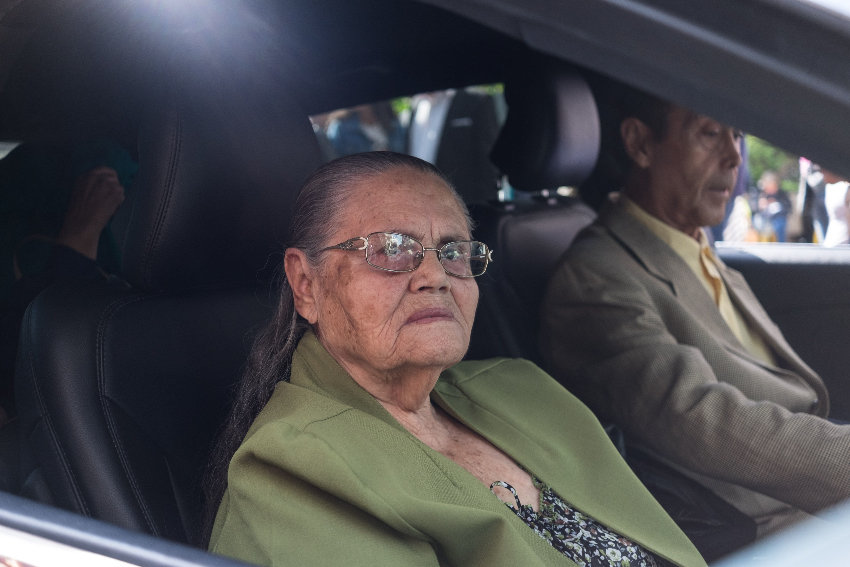
María Consuelo Loera Pérez, mother of notorious drug lord Joaquín “El Chapo” Guzmán. (Cuartoscuro)
“So that we give it context and color, so that the adversaries have a story [to write], it’s the road I was inspecting when Guzmán Loera’s mom showed up to give me a letter asking me to intervene so that her daughters could go to the United States to visit their brother – her son – who is detained in the United States,” he said.
“As I got out [of my vehicle] and said hello and received her letter and listened to her, there was a big scandal. That same road, which at that time was under construction, is now finished and we’re going to inaugurate it,” López Obrador said.
The president subsequently noted that he would meet later in the day with the parents of the 43 young men who were presumably killed in Guerrero nine years ago. He acknowledged that the investigation into the crime is ongoing, but pledged that the Ayotzinapa case would be resolved before he leaves office.
Later in the presser, AMLO aimed to demonstrate that he has maintained consistent views during a long political career that has included almost five years as mayor of Mexico City and three presidential campaigns – 2006, 2012 and the ultimately successful one in 2018.
After acknowledging that he has written 18 books – the most recent of which is the 2021 publication “A la mitad del camino” – López Obrador directed reporters to examine the books for any contradictions in opinions he might have expressed.
“Where are the inconsistencies? Where did I say that taxes had to be raised? Where, in all this time? Where did I suggest that the poor weren’t going to be the first to be attended to? In which book didn’t I say that the main problem [in Mexico] was corruption?” he asked.
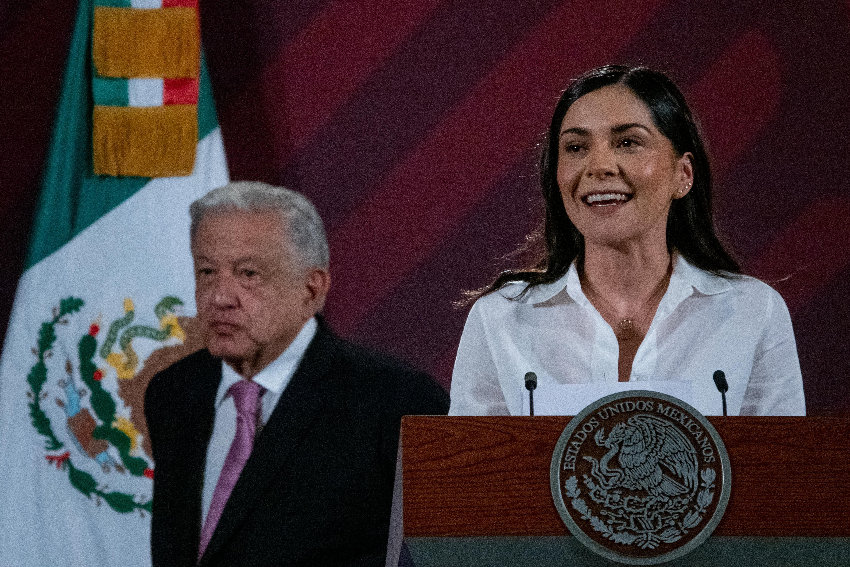
Ana Elizabeth García Vilchis presents the Wednesday segment called “Who’s who in lies of the week” at the morning press conference. (Cuartoscuro)
Toward the end of his midweek mañanera, AMLO was asked about the accusation that Broad Front for Mexico presidential candidate Xóchitl Gálvez plagiarized part of a report she submitted to obtain her computer engineering degree from the National Autonomous University.
“I can’t speak about that,” López Obrador responded, abiding by a National Electoral Institute ruling that he mustn’t speak about electoral issues or candidates in the lead-up to the 2024 elections.
“What we care about aren’t the trains, we care about the migrants,” he said.
López Obrador said he had been informed that freight services to the north of Mexico had resumed, although Ferromex hadn’t at the time indicated that was the case.
Thursday
AMLO’s Thursday presser began with the presentation of the “Global Leader Approval Rating Tracker,” an initiative of the United States business intelligence company Morning Star.
Updated every Thursday, the latest tracker showed – as it has done many times before – that López Obrador is the second most popular world leader among 22 whose support is measured via polls monitored by Morning Star. The only leader with a higher approval rating than AMLO’s 66% was Indian Prime Minister Narendra Modi on 77%.
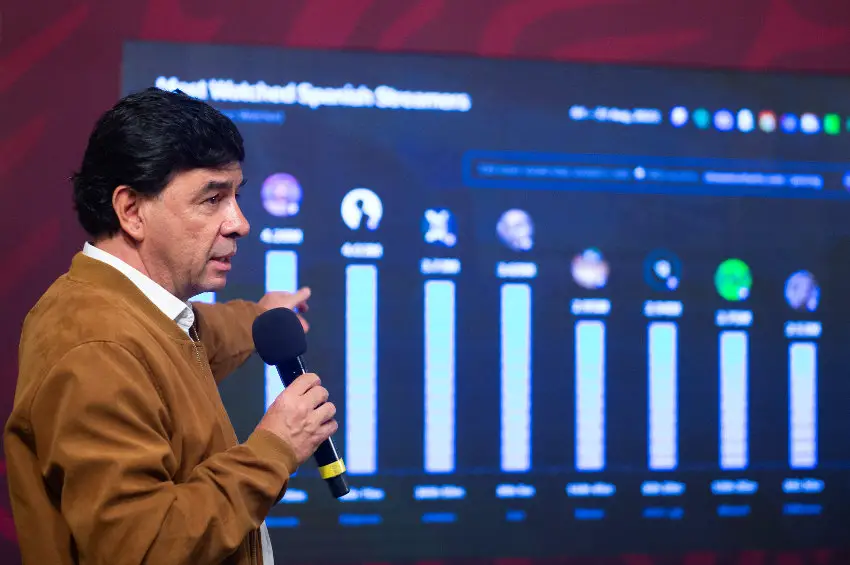
Communications coordinator Jesús Ramírez also presented data that showed that López Obrador was the “most watched Spanish [language] streamer” in August.
Communications coordinator Jesús Ramírez discusses AMLO’s popularity as the most watched Spanish-language streamer. (Gob MX)
“It’s the first time that a politician appears in this list,” Ramírez said.”… The truth is it’s a phenomenon because the rest are gamers,” he said.
AMLO told reporters that they also deserved credit for his ascension to the top of the Spanish-language live streaming rankings because they too take part in his weekday mañaneras.
“It’s collective because you participate, because of the questions, the circular dialogue,” he said.
During a lengthy engagement with reporters on a much more serious issue – the Ayotzinapa case – López Obrador said that “many things” had hindered the investigation into the disappearance of the students.
“Especially vested interests – those who in one way or another participated [in the crime] and don’t want the truth to be known,” he said.
“… All the authorities that participated to create the so-called ‘historical truth,'” AMLO added, referring to the previous government’s official version of events vis-à-vis what happened to the students.
Asked whether it was possible that some of the 43 students were still alive nine years after their disappearance, López Obrador responded:
“We don’t know, we can’t guarantee anything. In other words, we’re still making progress [with the investigation]. The searches are continuing, we haven’t stopped looking for a single day. The investigation continues and I’m confident that in the time we have left [in office] we’re going to find out what happened and above all where the young men are.”
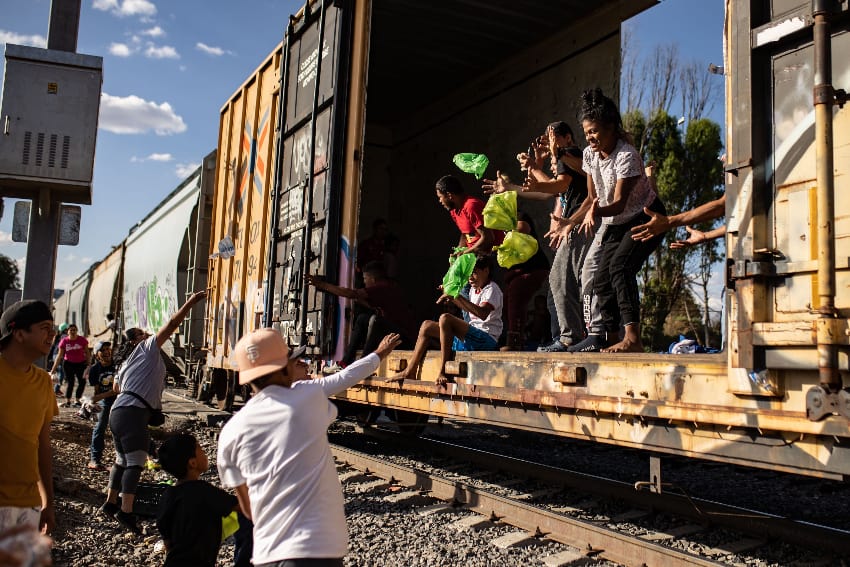
People come out to give food and clothing to migrants traveling on “La Bestia” in Zacatecas. (ADOLFO VLADIMIR /CUARTOSCURO.COM)
AMLO turned his focus to the migration phenomenon after a reporter mentioned the presence of large numbers of migrants in Mexico.
“It’s a structural problem. … There is a worldwide crisis. … People don’t leave their countries for pleasure, they do it out of need,” he said.
López Obrador charged that the United Nations has done “nothing” to address the issue.
“That’s why I don’t go to the UN for the annual appearance [of world leaders]. I went once when Mexico was part of the Security Council and I suggested that the UN had to play a greater role … in attending to the problems of the people of the world, because it became an obsolete bureaucratic apparatus. It’s like an adornment, like a vase,” he said.
“I made a proposal [to the UN]” López Obrador said, noting that he advocated attending to “the problem of corruption in the world” and “the problem of inequality.”
“… What is the UN doing? Nothing. Why [do we have] this influx of migrants. Because there is not a single plan from international financial organizations, the World Bank, or from the main powers [of the world] to help the poorest countries. All they do is take sides in wars and send arms,” he said.
“If all the money used for arms – which only benefits the war industry and causes death and destruction – was used for human development, to guarantee work opportunities, opportunities to study, we’d be living in a more fraternal, fairer, more humane world and we wouldn’t have these problems [such as] the migratory phenomenon,” López Obrador said.
Friday
Responding to his first question of the day, AMLO acknowledged that the Santiago River, which runs through Jalisco and Nayarit, has a “serious contamination problem.”
“… The Environment Ministry is working on it. … We’re going to ask the minister to present a report, [tell us] how we’re doing,” he said.
“… We have to look at the entire course of the river because there are discharges and where [the situation] is most complicated is in [the municipality of] El Salto because that’s where the second largest industrial park in the country is and there are discharges [of industrial waste]. So special work is required to clean the entire catchment area,” López Obrador said.
AMLO subsequently conceded that the contamination of the Santiago River is an issue the government has been unable to resolve.
“But in the time we have left we can do a lot, leave in place a plan for the new government to clean up contaminated rivers, which are everywhere,” he said.
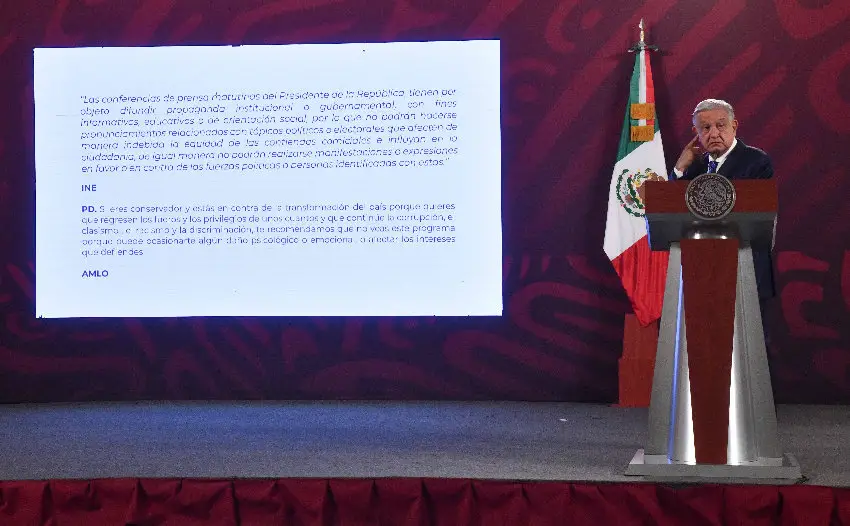
Later in the presser, López Obrador revealed that the National Electoral Institute (INE) had asked the government to display a message to viewers before the commencement of each mañanera.
He read out the message, which said that the objective of the morning press conferences is to “disseminate institutional or governmental propaganda” for informational, educational or “social orientation” purposes.
AMLO shows the message he proposed to show to “conservative” viewers of his morning press conferences. (Cuartoscuro)
It also said that officials can’t make statements “related to political or electoral topics that unjustly affect the equity of elections” or make statements for or against “political forces or people identified with those forces.”
“In other words, I can no longer speak about any politician. I won’t be able to speak about [ex-presidents] Salinas or Fox, according to this,” López Obrador said
Speaking seriously or at least with a straight face, AMLO declared he would add his own message below the INE one.
“More or less it will say: if you’re a conservative and in favor of corruption, classism, racism and discrimination, don’t watch this program, it might affect you,” he said.
“… We recommend that you don’t watch this program because it might cause you psychological or emotional harm or affect the interests you defend,” López Obrador subsequently said after making some modifications to his first message.
Jesús Ramírez, AMLO’s communications chief, noted that the government would challenge INE’s directive to display its message, but López Obrador didn’t appear to like its chances.
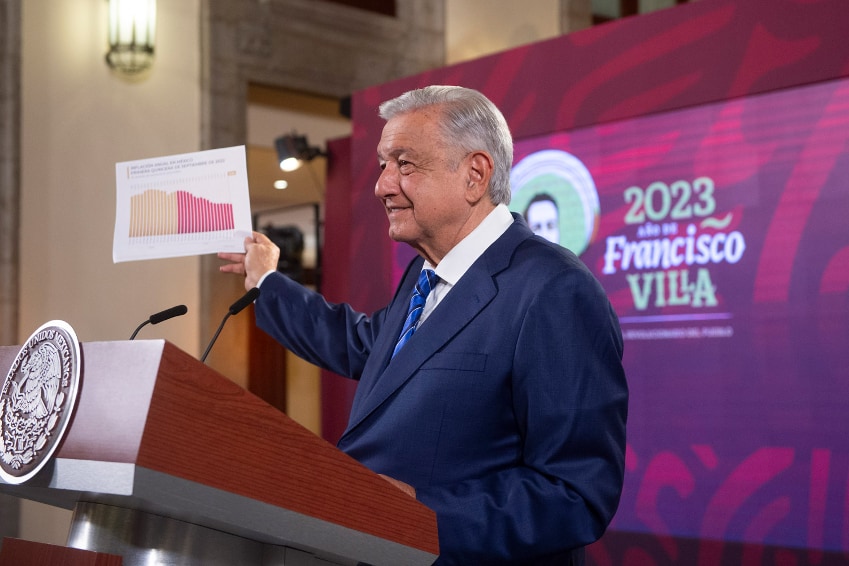
The president showed a graph indicating the steady decline in inflation since June. (Gob MX)
Among other remarks, the president told reporters that about 10 officials including ministers would soon leave his government to seek to stand as candidates at next year’s elections. He noted that Deputy Health Minister Hugo López-Gatell, Mexico’s COVID czar, was among them.
López-Gatell, who is hoping to stand as the ruling Morena party candidate at the 2024 Mexico City mayoral election, is a “first-rate professional, a good public servant,” AMLO said.
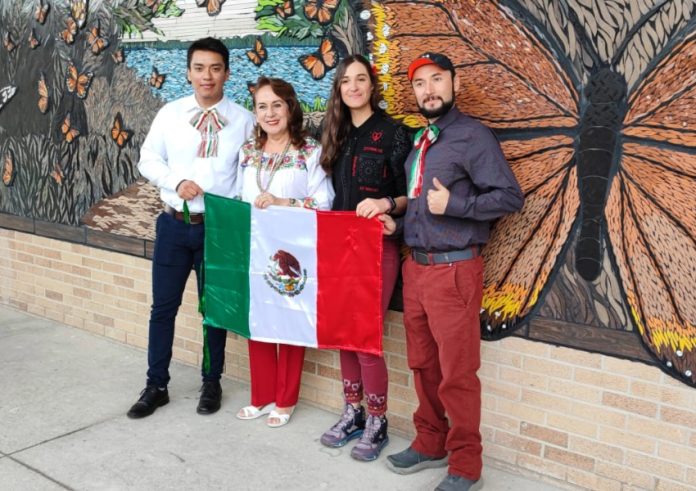
Maricarmen Olvera and team in front of a monarch butterfly-themed mural located in Storm Lake, Iowa.(courtesy Dick Davis)
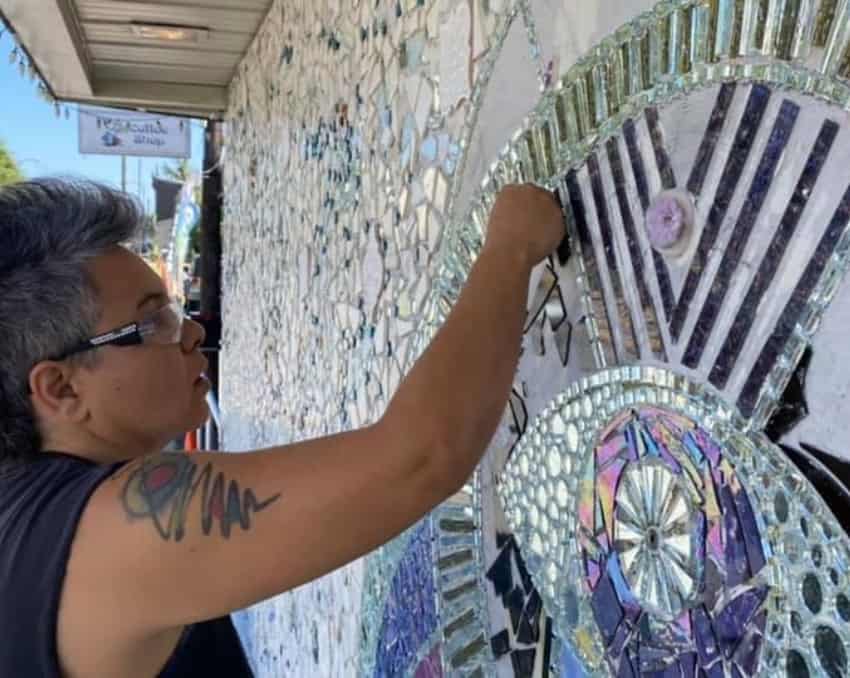
When U.S. tile artist Isaiah Zagar began his first projects in Mexico, little did he know how far his students would take what he taught them – both literally and figuratively.
From Puebla to Iowa
View of the lake at Storm Lake, Iowa. The town is on one of the migration routes for the monarch butterfly. (courtesy Dick Davis)
A mural in the tiny mountain town of Zacatlán, Puebla sparked the establishment of Vitromurales, a non-profit dedicated to transforming derelict walls into works of art that bring locals together and tourists to see what they create.
They refined Zagar’s techniques to create their own unique style, which captivated art lovers in another small town far to the north – Storm Lake, Iowa. Witter Gallery board member Patricia Hampton was so blown away by what project coordinator Maricarmen Olvera Trejo and her team accomplished that she knew she wanted to create something similar there.
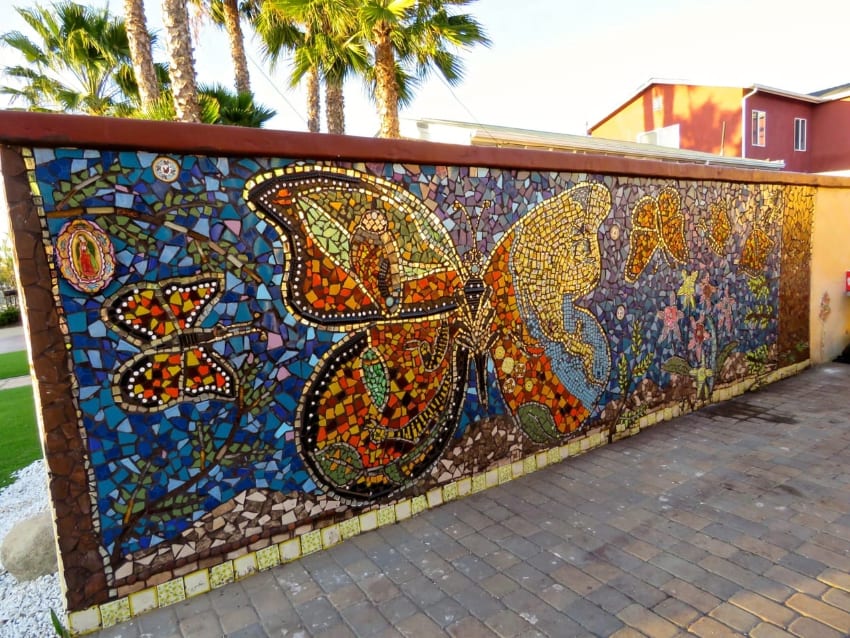
This month, a mural dedicated to monarch butterflies and Storm Lake’s immigrant communities was unveiled at the town’s Buena Vista University. It was a natural combination as the town is on one of the insect’s migration routes between Canada and Mexico, and half the town speaks a language other than English.
The Buena Vista mural is the largest project completed so far by Olvera Trejo and her crew, but it’s by no means the only one. Previously, the Zacatlán artists coordinated various projects based on local culture and scenery. This includes a portrait of Pulitzer-prize-winning journalist and resident Art Cullen, who was left “speechless” by his likeness in cut tile but did write in an op-ed that the work opened possibilities to “…transform [Storm Lake] by public art.”
The role of philanthropist Dick Davis
Butterfly murals by Marisa Martinez in Carlsbad, CA, co-sponsored by the non-profit Butterfly Farms. (courtesy Marisa Martínez)
Serendipity played a role in bringing these two towns together, but it wasn’t magic. The catalyst for these projects is retired stockbroker and philanthropist Dick Davis. He met Maricarmen Olvera Trejo during his travels in Mexico and later artist Isaiah Zagar in Philadelphia.
It was his idea to do the first mural in Zacatlan, but Olvera Trejo’s tireless advocacy got residents to help embrace tile art.
Davis’ meeting with Storm Lake’s Patricia Hampton was also by chance, and he wasted no time presenting the Zacatlán community’s accomplishments.
While Storm Lake has truly embraced the concept of community transformation through tile work, the murals here are not the first that Davis has sponsored in the U.S.
Tile murals in California and Arizona
After Zacatlán put Vitromurales on the map, Davis arranged for the artists to create a bear-themed mural for the Vallejo Charter School in his home state of California. The purpose was to promote the art and cultural exchange that happens naturally as Mexican artists work with U.S. counterparts and the general public.
In addition, he tapped San Luis Potosí artist Marisa Martínez to create murals in Carlsbad and Alleghany. Her work with Davis began with a project to cover a fountain in her city’s iconic Tangamanga Park, impressing Davis with her advocacy for tile work in the state.
The Carlsbad mural, called The Monarch Migration Wall Mural, was co-sponsored by Butterfly Farms in Vista, California. Its theme is the conservation of the Western Monarch butterfly, which migrates to the coast of California instead of Mexico. The project’s novelty initially caused some confusion, with participant Monica Mier noting that “A neighbor thought we were creating graffiti and protested.” But with the mural now well-established, “People drive by and stop.”
Natasha Moraga working on the CoExist mural in Pennsylvania. (courtesy Natasha Moraga)
The Alleghany mural is located in a near-ghost town in Sierra County and is dedicated to the area’s mining history.
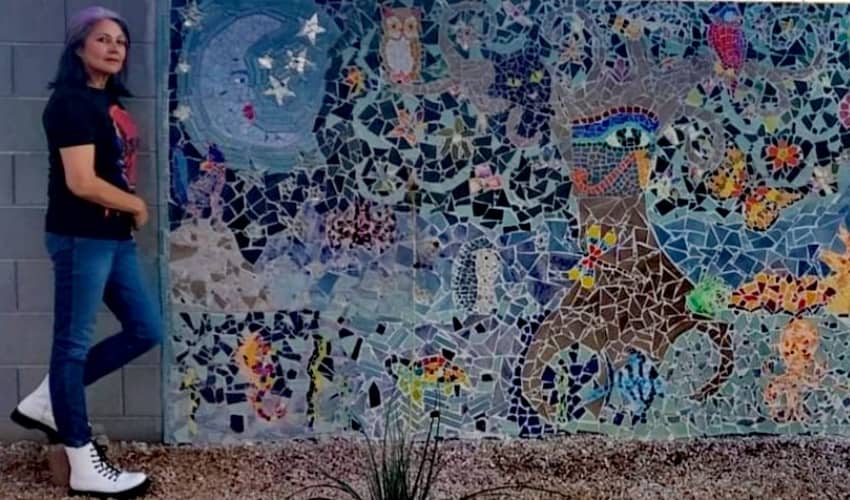
Martinez has not limited herself to work sponsored by Davis. Through personal connections, she was invited to create a surrealist-inspired mural on the cinder block wall surrounding a private home in Laveen, just outside Phoenix, Arizona. This mural is called Árbol de la vida or Tree of Life, based on the planet’s animal life. In the center of this mural is “…the Eye of God, which sees all,” says Martínez. The home’s owners were so impressed with the work that she will be completing a second piece in December in a similar style.
CoExist Gallery owner Shawn Gold came across Moraga’s work in Puerto Vallarta and knew he had to do something similar on his building in the former steel town of Steelton, Pennsylvania. He contacted the artist and the two began setting up a project that would not only cover three sides of Gold’s building but adapt the history and culture of the community.
The design of the finished project was a collaboration among Moraga, glass artist Carrie Strope of Calyx Glass in Nebraska, and members of the Steelton community who submitted ideas. In addition, a local company donated a piece of steel forged in the town that once formed part of the Golden Gate Bridge.
Completed in 2021, the community aspect was just as important to Gold as the art. “We want[ed] to bring the community together and provide a sense of ownership… something that a lot of people could contribute to.”
Why murals in the US?
Artist Marisa Martinez with Surrealist Tree of Life mural livening a plain cinder block border wall at a home in Laveen, Arizona, just outside of Phoenix. (courtesy Marisa Martínez)
For the communities receiving the murals, the attractions include the durable beauty of the tile as well as the impressive ways that Mexican artists have found to refine the techniques taught by Zagar.
The human connections created through these projects are just as important. Artists in the U.S. are introduced to what the Mexicans have developed, with some receiving benefits that have nothing to do with art. Buena Vista University Spanish students took advantage of the Zacatlán artists’ presence to practice their language skills, and another group of students will head to Puebla in the spring to do the same.
Participating physically in the projects is not practical for the long-retired Davis, but “… the artists create and work, that gives me a vicarious feeling as if I’m engaged, rocking and rolling!” He adds, “I support public art, cultural preservation, and cultural exchanges that transform communities and neighborhoods.”
Leigh Thelmadatter arrived in Mexico over 20 years ago and fell in love with the land and the culture in particular its handcrafts and art. She is the author of Mexican Cartonería: Paper, Paste and Fiesta (Schiffer 2019). Her culture column appears regularly on Mexico News Daily.
Cabello planchado, pestañas rizadas, uñas pintadas. One of my favorite treats? The kind of beauty treatments I wouldn’t have even considered getting back home.
If you’ve spent any amount of time in Mexico, you’ve surely noticed something: so many Mexican women are Glamorous, with a capital G!
And if you’ve noticed that, then chances are you’ve also spotted a plethora of beauty salons, nail salons, and spas of all shapes, sizes, and types, making that glamour no mystery at all.
The good news is that for most people, prices are typically quite accessible in ways I find that they’re not north of the Rio Grande (I was shocked when I went for a simple pedicure with my sister in Texas and paid over $60 for it!).
So, how do you make these beauty treatments happen, especially if your Spanish is only so-so?
First of all, let’s look at some tips for any appointment you make:
1) Look online. Most reputable places will have both Facebook and Instagram accounts, and you can look for them by typing in a keyword like “salon” or “uñas” plus the city name in the search bar. I love this option because it lets you look at their work before deciding to contact them!
2) Write out your questions and requests in a message with the help of a friend or an AI translator if needed. That way, they’ll know what services you’re interested in, and you can get help if needed in understanding their questions and responses.
3) Use pictures to show what it is that you want (a good idea even in your native language); a picture really is worth a thousand words, luckily in any language! Pinterest can be an especially good place to get ideas if you don’t find anything on their local pages similar to what you’re looking for!
4) Ask about prices beforehand. Almost every place will have their price per service fairly set in stone, so ask about the services you want in advance so you and your budget are prepared.
Now it’s time to get specific! Below, I will list some of the most popular beauty service categories in Mexico, along with key vocabulary and average price ranges.
One thing to keep in mind: prices will vary by region, as well as some other factors: tourist area vs. non-tourist area, urban vs. rural, fancy super-decorated boutiques vs. holes-in-the-wall. As long as you ask before you buy, there shouldn’t be any surprises!
Cabello (Hair)
From 100-1200 pesos for haircuts; 600-4000 for color and special treatments. Even if we don’t do much else fancy lady-wise, most of us do get our hair cut at least once in a while, right?
Places to get your hair cut can range from someone’s living room to dedicated, fully-equipped hair salons (if your Spanish isn’t great and you’re not adventurous with your hair, I recommend the fully-equipped kind). Most hair salons also offer make-up services for special events!
Here are some key vocabulary words you might want to know:
Cortar (las puntas): cut, trim (the ends)
Lavar y secar: wash and dry
Teñir: dye
Fleco: bangs
Capas: layers
Keratina: keratine treatment (all the rage lately!)
Maquillaje: makeup
Uñas (Nails)
From 200 to 800 pesos, depending on the service. Getting my nails done is something I never did back home: too expensive, too time-consuming, too chemical-y smelling. But here, I go for pedicures at least once a month (my local place is about 400 pesos) and nail care and painting (typically around 300 pesos) about every three weeks.
Nail art is a major thing here, so if you want to go wild, this is your chance! Most places have a price for mono-colored and then go up from there depending on how many designs you want. Here’s some helpful vocabulary:
“Polish”: This is what they say for non-gel (regular) nail polish, the kind that comes off with nail polish remover from the grocery store.
“Gel”: pronounced as “hell” in Spanish.
Acrílica: it is what it sounds like – acrylic!
Extensión: acrylic extensions
Acrimano: when they put acrylic material over your natural nail length, with no extensions
Diseño: design – if you want any special cute shapes on your nails, this is what to ask for!
Efecto: special effects, which might include things like glitter, a matte finish, or anything they need to use several different polishes or magnets to make happen
Forma (ovalo, cuadrado): nail shape (oval, angled)
Pestañas (Lashes)
Want to wake up every morning with long, thick lashes? Mink lash extensions have been popular in Mexico for a while now, and if you’ve got 800-1000 pesos for the first treatment and 500-800 pesos for touch-ups every three weeks or so, they can be great fun!
Essentially, fake “mink” lashes are glued one by one to your natural lashes, a process that takes a couple of hours but that isn’t all that uncomfortable, especially if you’ve wanted to force yourself to just lay there and relax! Results are pretty, dramatic, and immediate.
Key vocabulary:
Rizado(a): curled
Largo: length (also “long”)
Color: is what it sounds like!
Natural: used to describe a natural (as in, not overdone) look.
Retoque: touch-up, which for mink lashes, is approximately every three weeks
Cejas (Eyebrows)
This is the one thing on the list I haven’t tried…I’m from the generation of teens who overplucked their eyebrows in the ’90s, after all!
That said, “microblading” has been all the rage for a few years now, and I have to admit, I have seen some beautiful eyebrows out there lately, not something I’d have ever thought to pay attention to. The cost is around 2000-4000 pesos, and the effects can last up to two years.
Here are some key vocabulary words:
Grueso: thick
Tatuaje: tattoo (from what I understand, microblading basically is “tattooing” one’s eyebrows on!)
This is only a very short list (follow-ups to come!), but they’re all fun, non-permanent ways to dip your toe into the water of what the beauty services industry in Mexico has to offer.
If you’re feeling adventurous, the time is always right to experiment. But even if, like me, you’re quite conservative and cautious when it comes to trying out new beauty treatments, you’re sure to be pleased with what you find!
Sarah DeVries is a writer and translator based in Xalapa, Veracruz. She can be reached through her website, sarahedevries.substack.com.
Beans in general, and black beans in particular, are very healthy foods, high in plant-based protein, fiber and antioxidants. (Freepik)
When it comes to pantry favorites, frijoles negros—black beans—have a permanent place in mine. They’re good tasting and good for you; inexpensive and easy, especially if you use the canned ones; and so versatile it’s kind of ridiculous.
Beans in general, and black beans in particular, are extremely healthy foods, high in plant-based protein, fiber and antioxidants that help manage cholesterol, sugar and blood pressure levels.
While 70% of the calories in black beans come from carbs, they’re unique in that their starch content is what’s called “resistant starch,” meaning that much of it passes through our upper digestive tract without breaking down. Because the starch doesn’t convert into sugars, blood sugar levels don’t rise.
So, are black beans good for you? Absolutely!
Will eating black beans help you lose weight? In a roundabout way, yes. Foods rich in fiber make us feel full quickly; one would ostensibly eat less if they were part of your regular diet.
Long a dietary staple in Central and South America, black beans are everywhere in Mexican cuisine. In the U.S. they weren’t mainstream until fairly recently, although vegetarians were using them as a source of protein long before that. When Chipotle’s Mexican Grill opened in the early 1990s, black beans were an integral part of the menu, quickly beloved by the public.
Black beans have a rich hearty flavor and meaty, dense texture that makes fabulous burgers and chili and is a perfect touch sprinkled on chilaquiles or nachos or used in tacos, quesadillas, vampiros, and other classic Mexican foods. Refried beans (frijoles refritos), found everywhere in everything, are just cooked beans blended or mashed and then sautéed in oil or manteca (lard), with or without added spices, until they form a spreadable paste. A traditional recipe in Mexico is for a robust soup with a black bean base topped with all your favorite things: chopped avocado and onion, a drizzle of crema, a sprinkling of cilantro, maybe a dash of hot sauce.
You may also have heard that black beans are good for dogs. In small portions, unsalted and with no added oil or spices, they can be. PetMD suggests that “occasionally” offering your dog a “small bite” of black beans mixed into their regular food isn’t harmful, but some dogs may have difficulty digesting them.
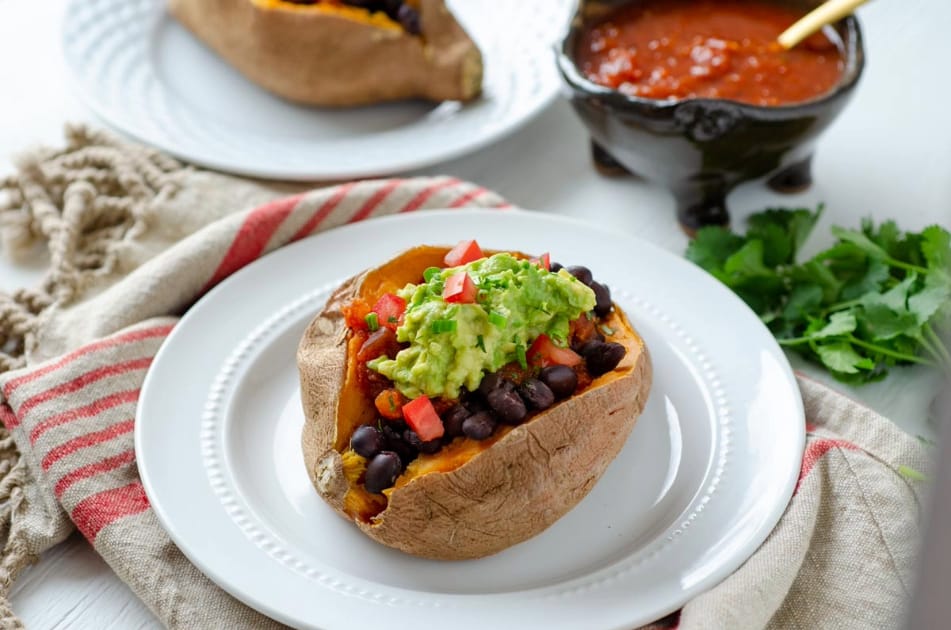
Loaded Sweet Potatoes (Camotes Locos)
Loaded Sweet Potato (PCRM).
2 medium sweet potatoes, scrubbed and halved lengthwise (or purchased already roasted)
1 Tbsp. olive oil
Salt & pepper
1 cup cooked black beans (if using canned, rinse and drain)
If baking the sweet potatoes, heat oven to 425F/220C. Brush sweet potatoes with oil. Sprinkle with salt. Place cut side down on baking sheet and roast 30-40 minutes until cooked through. Remove from oven and let cool slightly. (If using purchased baked sweet potatoes begin here.) Using a fork, rough up the flesh and slightly flatten the potatoes. Season with salt and pepper.
Divide half the cheese among potatoes. Spoon black beans over them, then cover with remaining cheese. Return the pan to the oven; bake another 5 minutes, until cheese melts and beans are warm. Serve with assorted toppings.
Black Bean Mac & Cheese
Mac and cheese with black beans (Stylishcuisine).
2 tsp. cornstarch
1 (12-oz.) can evaporated milk
2 eggs
½ lb. elbow macaroni
1 (15-oz.) can black beans, drained and rinsed
2 whole chipotle chiles packed in adobo, minced, plus 2 Tbsp. adobo sauce from can
1 serrano or jalapeño chile, minced
1¼ cups grated or shredded Chihuahua, Manchego or Asadero cheese
1½ cups grated sharp cheddar cheese
¼ cup chopped fresh cilantro
4 finely sliced scallions
Combine cornstarch, evaporated milk and eggs in a bowl and whisk. Set aside.
Cook pasta according to package directions. Drain, reserving 1 cup pasta cooking water. Return pasta to pot and add reserved cooking water, beans, chipotle chilies, serrano or jalapeño, evaporated milk mixture and cheeses. Cook over very low heat, stirring constantly to prevent burning, until cheese melts and sauce is creamy and smooth. Stir in cilantro and scallions, reserving some for garnish. Transfer to serving bowl, top with remaining cilantro and scallions, and serve immediately.
Black Bean Veggie Summer Salad
Black been salad (Freepik).
1 (14.5-oz.) can black beans, drained and rinsed
2 Tbsp. minced onion
1 ear sweet corn, kernels sliced off
1 jalapeño, minced
Salt & pepper
1 Tbsp. fresh lime juice
1 Tbsp. olive oil
½ Tbsp. white wine vinegar
¼ tsp. ancho chile powder
Pinch ground cumin
¼ cup crumbled corn chips
1½ Tbsp. minced fresh cilantro
Combine beans, onion, corn and jalapeño in a bowl. Season with salt and pepper.
In another small bowl, whisk lime juice, oil, vinegar, chili powder and cumin. Whisk in salt and pepper. Toss vinaigrette with black bean mixture. Refrigerate at least 1 hour or overnight.
When ready to serve, add corn chips and cilantro and stir to combine. Serve cold or at room temperature.
The research article estimates the size of cartels based on mathematical modeling. (Cuartoscuro)
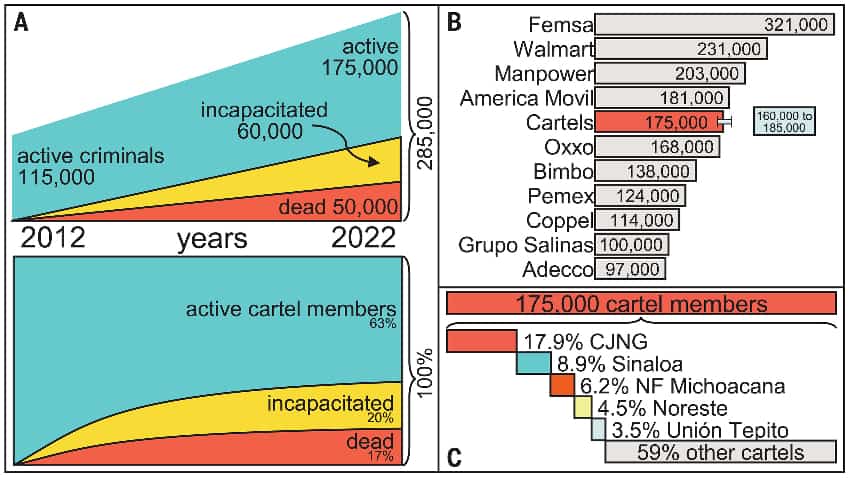
Drug cartels are collectively one of the largest employers in Mexico, employing more people than the ubiquitous Oxxo convenience store chain and the state oil company Pemex, according to a research article published in the journal Science on Thursday.
Using a mathematical model that takes things such as cartel recruitment, homicides and incapacitation of members due to imprisonment into account, the authors of the article calculated that cartels employed between 160,000 and 185,000 people in Mexico in 2022.
The researchers used mathematical modeling to estimate cartel employment. (Prieto, Campedelli, and Hope/Science)
“To construct our model, we gauge data on 150 cartels active in Mexico in 2020, including information on their alliances and rivalries and data corresponding to homicides, missing persons, and incarcerations,” the authors said.
With an estimated 175,000 people on their payroll, organized crime groups including the Jalisco New Generation Cartel (CJNG) and the Sinaloa Cartel are Mexico’s fifth largest employer, the researchers concluded.
Only Femsa, a beverage and retail company and Coca-Cola bottler, Walmart, staffing firm Manpower and telecommunications corporation América Móvil have more employees in Mexico, according to the study.
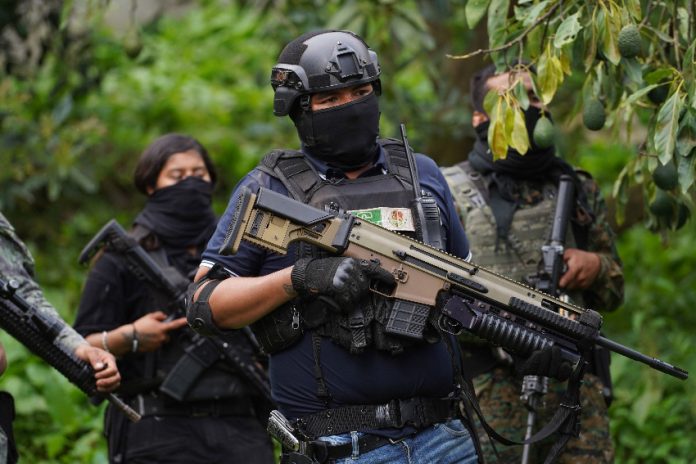
Cartels’ employees include producers of drugs such as methamphetamine and fentanyl, smugglers, sicarios or hitmen, hawks or lookouts, recruiters, accountants and money launderers. Police or politicians who receive payments from cartels could also be considered employees.
Incarceration is one of the ways cartels’ numbers are depleted, but they have successfully recruited enough members to have net gains each year according to the research. (Gob MX)
Published under the headline “Reducing cartel recruitment is the only way to lower violence in Mexico,” the article – after citing data and mathematical calculations – said that “despite efforts from the state to hinder their power, cartels have increased their size by 60,000 members in a decade” between 2012 and 2022.
“Incarcerating nearly 6000 cartel members each year has not prevented them from growing into larger organizations,” the three authors said.
“Between January and December of 2021, cartels recruited 19,300 individuals, losing 6500 members as a result of conflict with other cartels and 5700 members as a result of incapacitation, which resulted in a net gain of roughly 7000 members during that year…A similar estimate is observed for each year between 2012 and 2022,” the authors said.
The articles authors estimated that “over half of the country’s casualties result from the fight between the smallest 140 and largest 10 cartels.” (MARGARITO PÉREZ RETANA /CUARTOSCURO.COM)
“Unless all cartels combined recruit between 350 and 370 people per week, they would have collapsed as a result of conflict, incapacitation, and saturation combined,” they added.
The article explains that “saturation” is indicative of “internal instability and dropouts, which lead to organizational fragmentation.”
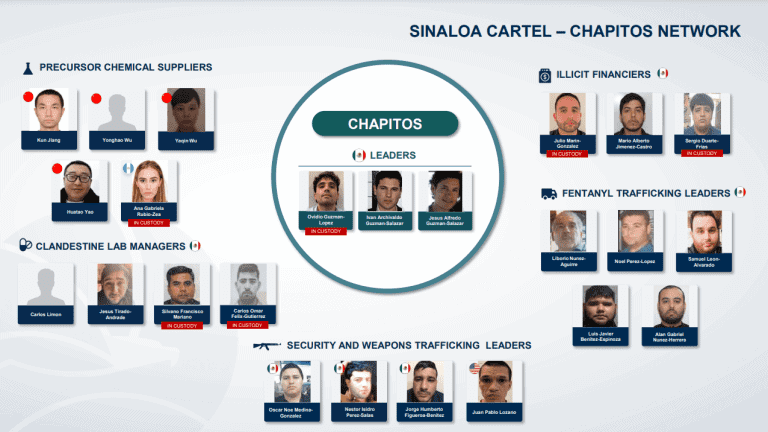
The authors – Rafael Prieto Curiel, Gian Maria Campedelli and the recently deceased security analyst Alejandro Hope – calculated that the “10 largest cartels in Mexico have more than 50% of the active affiliates in the country.”
Of the estimated 175,000 cartel affiliates (or employees), 17.9% work for the CJNG and 8.9% are on the Sinaloa Cartel payroll, the researchers calculated. The Nueva Familia Michoacana, the Northeast Cartel and the Unión Tepito were identified as the next biggest criminal employers.
While over 50% of “active affiliates” work for the 10 biggest cartels, “the conflict between them only produces 15% of the fatalities [in Mexico], ” the article said before noting that the country’s most powerful criminal organizations often target small local ones in order to incorporate them into their own structures.
“… We estimate that more than half of the country’s casualties result from the fight between the smallest 140 and the largest 10 cartels,” Prieto, Campedelli and Hope said.
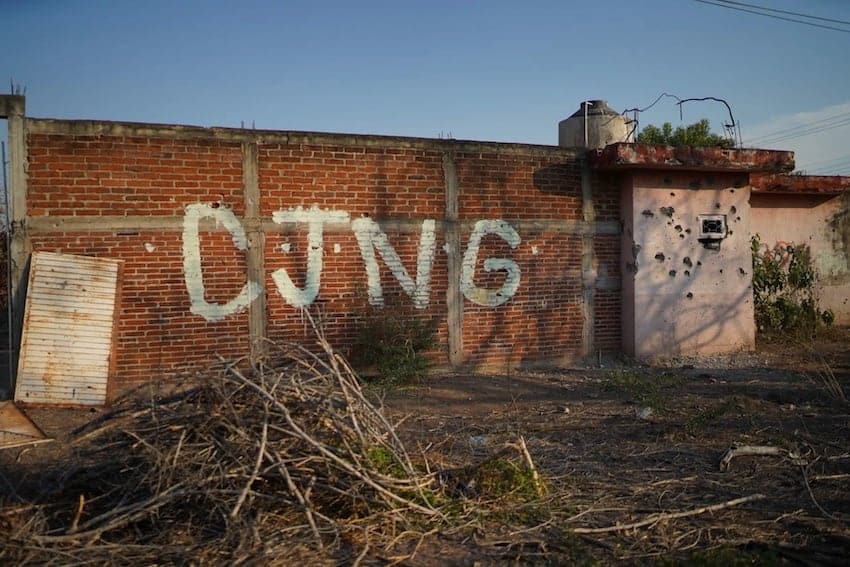
The Jalisco New Generation Cartel (CJNG) is estimated by the study authors to have the largest number of “affiliates” or employees. (Cuartoscuro)
The authors outlined a concerning possible scenario for coming years based on the growth of cartels and the increase in homicide numbers seen over the past decade.
“On the basis of the size of cartels in 2022 and the trends observed in the past decade, we predict that the weekly number of casualties related to organized crime will keep increasing in the coming years,” they said.
“We estimate that if current trends continue, cartels will keep increasing their power, and we could observe 40% more casualties and 26% more cartel members by 2027.”
The key to avoiding that scenario, the authors argued, is reducing cartel recruitment rather than increasing arrests.
“Decreasing the cartel’s ability to recruit by half will reduce the weekly casualties by 2027 by 25% and cartel size by 11%,” they said.
The researchers also calculated that “even in the hypothetical scenario where recruitment drops to zero, it would take three years to return to the – already high – levels of violence observed in 2012.”
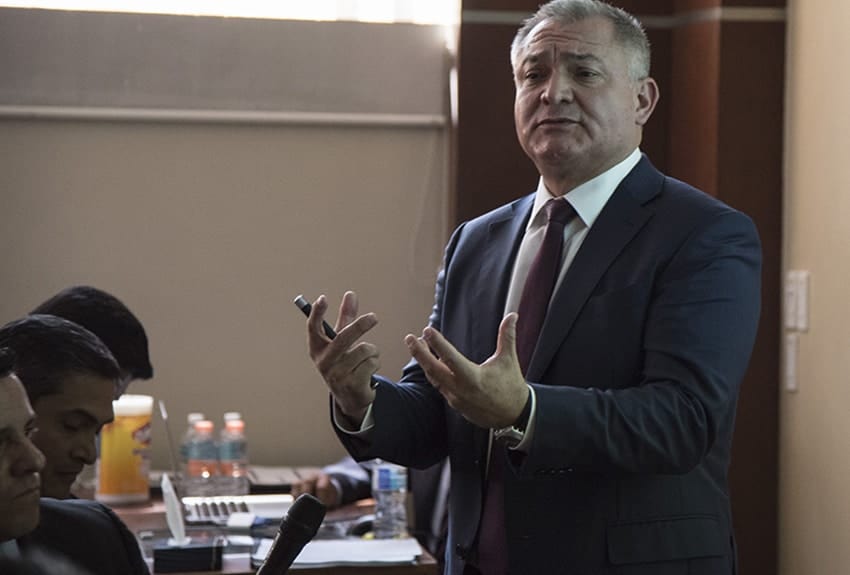
One of the limitations of the research pointed out by some analysts is whether government officials are tallied as cartel employees. Mexico’s ex-security minister Genaro García Luna was convicted of taking bribes from the Sinaloa Cartel in the U.S. earlier this year. (Cuartoscuro)
“This further calls for rapid and timely large-scale initiatives to reduce recruitment in the country,” they said.
Tackling recruitment, the authors said, “will have a triple effect in the future.”
“First, it will lower the number of cartel members, reducing the violence that it can create by having fewer killers. Second, it will lower the number of targets, so fewer people are vulnerable to suffering more violence. And third, it will reduce the cartel’s capacity for future recruitment,” they said.
Prieto, Campedelli and Hope said that “offering policy recommendations is beyond the scope of this work,” but argued that “reducing recruitment requires structural efforts at the state and local levels.”
“This especially applies to areas with high cartel support, where offering educational and professional opportunities that outweigh the short-term benefits offered by cartels represents a critical goal for the future of the country,” they wrote.
President López Obrador agrees. His government has implemented a so-called “hugs, not bullets” security strategy that seeks to address the root causes of crime by offering work and education opportunities to Mexicans, especially the nation’s youth.
DEA Administrator Anne Milgram has launched a “laser-focused” campaign against the CJNG and Sinaloa drug cartels, blaming the groups for “the most devastating drug crisis in our nation’s history.” (Shutterstock)
The “hugs” part of the strategy includes the provision of educational scholarships and employment programs such as the Sowing Life reforestation scheme and the Youths Building the Future apprenticeship initiative.
Despite the government’s efforts to tackle crime and violence in those ways, homicide numbers have hit record high levels during López Obrador’s administration, although there was a decline of almost 10% in 2022 compared to the previous year. The president has repeatedly said that his security strategy will take time to “bear fruit.”
The publication of the cartel-focused research article in Science comes eight weeks after United States Drug Enforcement Administration chief Anne Milgram asserted that the Sinaloa Cartel and the CJNG have more than 40,000 operatives in over 100 countries around the world.
Prieto, Campedelli and Hope said that their work, to the best of their knowledge, “represents the first scholarly attempt to mathematically quantify the size of the cartel population in Mexico.”
They acknowledged “some limitations,” saying that while “the lack of data on the size of cartels represents the inherent motivation of this work, it also represents a structural limitation because our estimates cannot be meaningfully validated with real-world information.”
The DEA has claimed that the Sinaloa Cartel and CJNG have over 40,000 operatives working in more than 100 countries. (DEA)
Victoria Dittmar, a project manager at Insight Crime, a think tank and media organization that researches crime in the Americas, noted that she hadn’t seen any other estimates of cartel member numbers in Mexico.
Quoted in a report by The Guardian, Dittmar expressed some reservations about the study, commenting that “it can be very difficult to say who is a member of a criminal organization, and who isn’t.”
“What about a politician that receives money? Or someone who cooperates with the group just once?” she asked.
Ioan Grillo, a British journalist with vast experience reporting on cartels in Mexico and further afield, said in an article on his Substack site that he was “skeptical of seeing formulas and precise numbers” on cartel activities.
However, he also wrote that he “instinctively” agreed with its conclusions.
“Cartels do employ a hell of a lot of people, perhaps even more than the study finds, and it’s important to point out this colossal problem,” Grillo wrote.
“Preventing youths from joining them has to be key to finding a way out of this mess.”
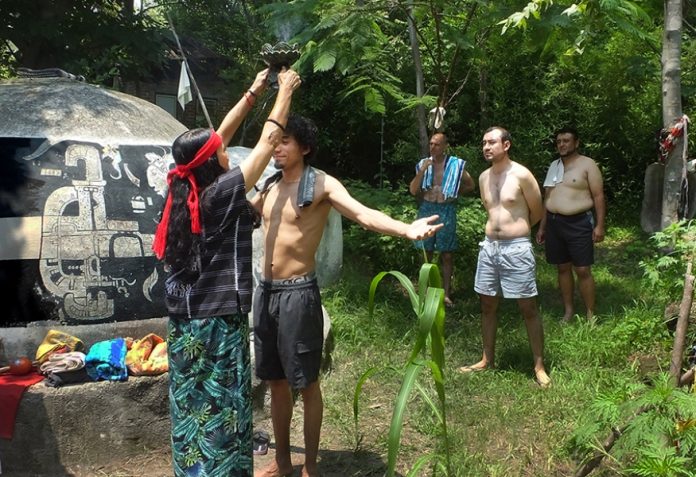
Each participant is purified with incense from head to toe. (Photo John Pint.)
A poster came my way announcing an all-day excursion called “La Ruta del Colibrí” — the Hummingbird Route. It promised a three-part adventure quite unlike any other, so I signed up and I must say the organizers kept their promise.
This activity was conceived by people in the little town of Ahualulco de Mercado, Jalisco, located 60 kilometers west of Guadalajara. Ahualulco natives have always known that curious and wonderful attractions surround their town and, at last, have decided to share some of them with the rest of the world.
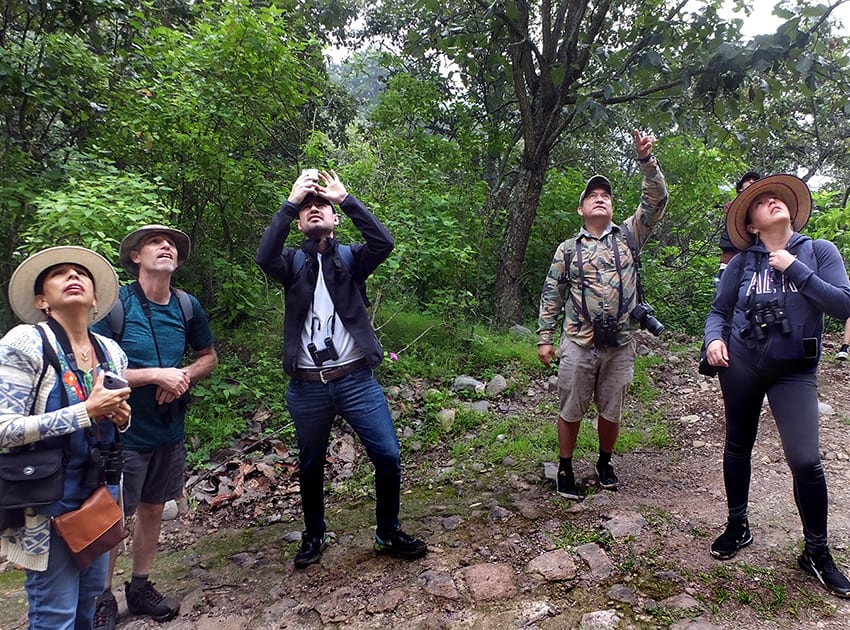
Birdwatching with experts. (Photo John Pint)
We met in the town square at 7:00 a.m. I found that 16 people had signed up for La Ruta del Colibrí and had obviously gotten out of bed very early that morning.
Birdwatching at 7 a.m.
The early start was de rigueur because the first item on the schedule is bird watching and the best time to see birds is right after sunrise.
Off we went in a van along a picturesque dirt road that winds its way through a magnificent forest up to one of the most extraordinary geological sites in the world: the Cerro de Piedras Bola. This mountaintop in the Sierra del Águila is covered in gigantic, remarkably spherical stone balls.
We parked a kilometer and a half from the top and proceeded on foot. Leading the group was biologist and self-made ornithologist Julio Álvarez, who passed out binoculars to all.
As we made our way up the road, we were introduced to all kinds of birds, ranging from the astonishingly beautiful red-faced warbler, as well as the plainest bird imaginable: the brown-backed solitaire. Known as the clarín jilgueroin Spanish, this dull-looking bird, surprises with its glorious song, which sounds like three flutes being played simultaneously. Yes, we saw plenty of beautiful hummingbirds as well.
70 giant stone balls
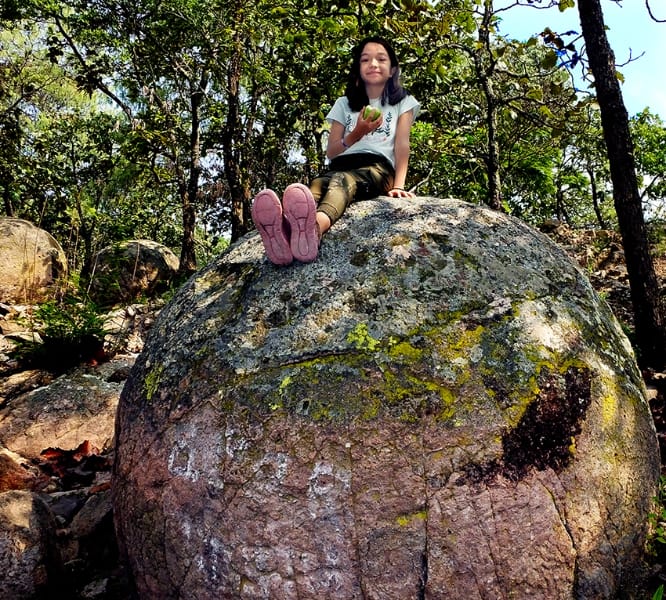
At the top, we snacked among the huge balls of volcanic rock – which measure measuring close to nine meters in circumference – as we listened to the latest theories of how the Piedras Bola were formed were formed, from Canadian geologist Chris Lloyd, who accompanied us on the walk.
Happy apple eater on a giant stone ball. (Photo John Pint.)
Researchers have counted more than 70 giant balls on this hilltop and as far back as 1967 a writer for National Geographic Magazine spent time here trying to figure out just where they all came from.
Hot and sweaty after our hike, we jumped back in the van and proceeded down the mountain to the Hummingbird Temazcal, hidden away in a jungly spot nearby.
Inside a traditional Mexican temazcal (sweat lodge)
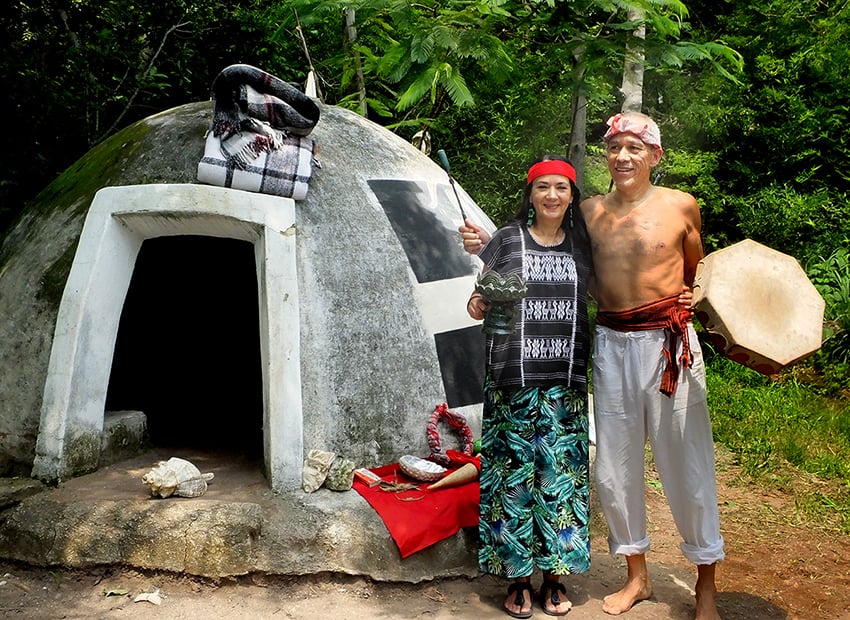
Our hosts, Maru Magaña and Marco Martínez, explained that the word temazcal means “house of the hot rocks” and is part of one of the oldest traditions in the world.
Maru Magaña and Marco Martínez with their temazcal in the jungle. (Photo John Pint.)
Temazcals and sweat lodges were used, perhaps monthly by just about every community up and down the continent of America and in many other parts of the world. Fortunately, some places all over Mexico still follow the temazcal rituals, allowing you to participate in one of the most important and ancient traditions of the human race.
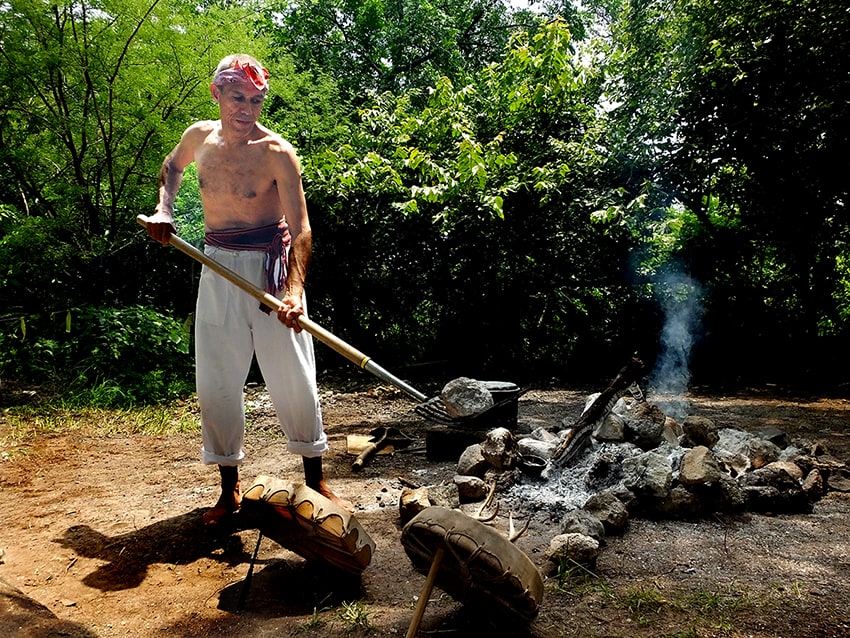
So, wearing shorts or long white dresses, we were called to the sweat lodge by the blowing of a conch shell. Next, we were purified by incense, and then, after making an offering of tobacco, we found ourselves sitting together in darkness as hot volcanic rocks –traditionally called abuelitas (grandmas) were brought in one by one and placed in a hole in the center of the temazcal.
A good number of “abuelitas” or red-hot volcanic rocks must be kept at the ready outside the temazcal. (Photo John Pint.)
“¡Bienvenida, Abuelita!” we would greet each of them.
As none of us was a tough guerrero(warrior), our group remained inside the temazcal for only four puertas (doors), each of which is a period of time spent in darkness, the entrance having been covered with a blanket after seven new abuelitas are brought in.
Once the door is closed, the hot rocks and all the participants are sprinkled with aromatic plants dipped in water. Clouds of steam fill the temazcal.
Inside the little hut, there are also a drum and castanets.
Someone begins to sing an ancient song with easy lyrics, which we soon repeat. The hypnotic drum beat echoes In the misty darkness, doing its magic. In no time at all, we are transformed into a community of friends.
Twenty-eight hot rocks later, we and the bandanas on our heads are completely soaked by sweat and much sprinkling.
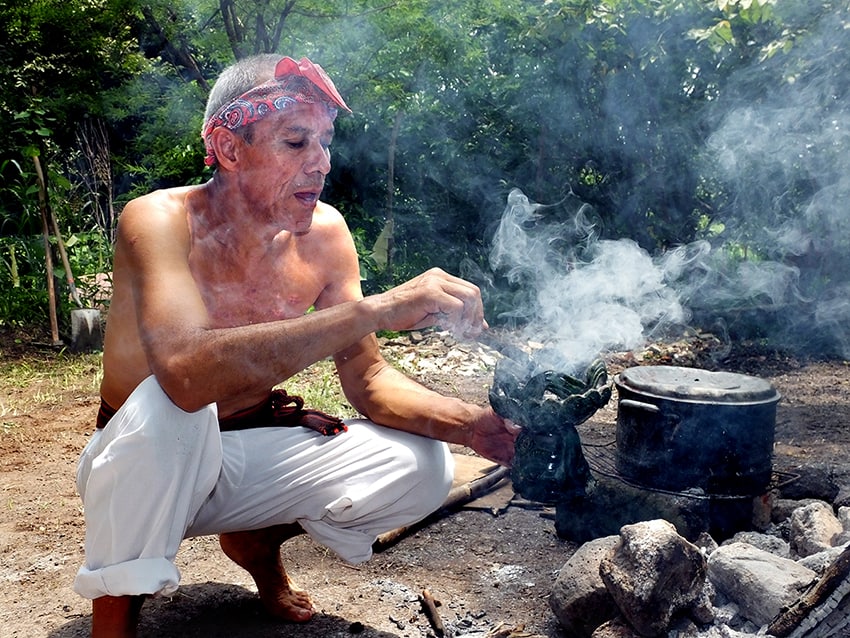
Preparing incense for the temazcal ritual. (Photo John Pint.)
The temazcal is like a womb. Slowly, we crawl out of it, one by one, each of us touching his or her head to the floor in reverence. We are reborn.
Washing off the sweat is a delightful experience and the fresh watermelon and orange slices awaiting us outside taste extraordinarily delicious. But this is just a snack. We are ravenously hungry and lose no time getting back into the van. We are heading for El Restaurante de la Tía Lancho, located in the puebloof Teuchiteco, a two-kilometer drive from the temazcal.
The pre-Columbian restaurant of Tía Lancho
Tía Lancho is a member of Las Mujeres de Maíz, founded in 2011 by Mexican cookbook guru Maru Toledo. Members of the group are graduates of Toledo’s “Smoky School of Gastronomy.” They are skilled not just in cooking without the benefit of gas or electricity but also in finding or growing all the herbs and plants needed for making a meal.
Tía Lancho prepares delicious tortillas for her guests. Las Mujeres del Maíz specialize in rescuing pre-Hispanic traditions and recipes. (Photo Julio Álvarez.)
Whether Tía Lancho serves you mole, pipián, espinazo,or hand-made tortillas, it will taste far more delicious than what you might find in a regular restaurant, and apart from enjoying your meal, you may also be fascinated by a visit to the old-style smoky kitchen where it was made.
Here, you might even try using a molcajeteor a metateand discover just how strong pre-Hispanic cooks had to be.
If you want to visit any of these sites or join in on the next Ruta del Colibrí, just contact the Kan Baálam Travel Agency in Ahualulco. “We can pick people up at the Guadalajara airport,” says owner Alejandro López, “and, yes, we speak English.”
Participants in the Hummingbird Route say they were amazed at how much they learned about temazcals and traditional Mexican food…not to mention those amazing Giant Stone Balls!
The writer has lived near Guadalajara, Jalisco, since 1985. His most recent book is Outdoors in Western Mexico, Volume Three. More of his writing can be found on his blog.
Chinese brands have exploded onto the Mexican market, and are on track to capture a 20% market share by the end of the year. (Jenson/Shutterstock)
More than 80,500 Chinese cars were sold in Mexico in the first eight months of this year, with Chinese brands on track to account for 20% of the domestic car market.
The Mexican Association of Automotive Distributors (AMDA) said on Wednesday that Chinese car imports have increased by 62.6% during 2023 so far, growing their market share from 5.7% to 19.4%.
MG was the top-selling Chinese-owned brand, with more than 35,000 cars sold so far in 2023. (MG Motors/Instagram)
“The arrival of Chinese brands increases the [number of available] offerings and has contributed to the updating of the inventory available in our market,” AMDA president Guillermo Rosales said at a press conference.
Four brands currently dominate the market for Chinese-owned brands in Mexico. MG Motors sold 35,322 units in the first eight months of 2023, followed by Chirey Motor with 26,174, JAC with 12,840, then the Motornation collection of 3 brands, with 6,208.
According to consultancy J.D. Power Mexico, more Chinese firms are now entering the market, including BYD, Omoda, Jetour, GWN Motors and Geely Autos.
“We know that there are seven more confirmed brands that are going to start operations in Mexico and this will give us, not an exponential growth, but a substitution, a fight for the market,” said J.D. Power’s director, Gerardo Gómez.
BYD manufactures vehicles for Bimbo, Lala, Cemex and FEMSA, as well as for ride-sharing app DiDi. (User3204/Wikimedia)
BYD, which first started to explore the Mexican car market a year ago, exemplifies this growing competition. The Chinese company already supplies trucks to brands including Bimbo, Lala, Cemex and FEMSA, as well as manufacturing vehicles for ride-hailing app DiDi. On Thursday, it launched the ‘Dolphin,’ its first electric vehicle for the Mexican domestic market, of which it expects to sell up to 30,000 units next year, according to BYD Americas’ president, Stella Li.
“We will import the vehicles at first, but we have plans to produce vehicles in Mexico,” Li told El Financiero newspaper. “We are doing the research, but we haven’t decided the location yet.”
The arrival of new Chinese brands is just one factor driving dynamism in Mexico’s car market. According to Rosales, traditionally popular brands in Mexico – such as Nissan, Volkswagen and General Motors – are also bringing new models onto the market as they recover from the drop in demand caused by the COVID-19 pandemic.
“We can observe it on the sales floors of the distributors, with increasing coverage and approaching normal conditions,” Rosales said. “We expect this to continue in the coming months, and foresee a 2024 with greater competition among all participants.”
According to the national statistical agency (INEGI), sales of new cars in Mexicogrew by 23.8% last month, reaching 113,873 units, the strongest year-on-year growth Mexico’s automotive industry has seen in the month of August for 23 years.
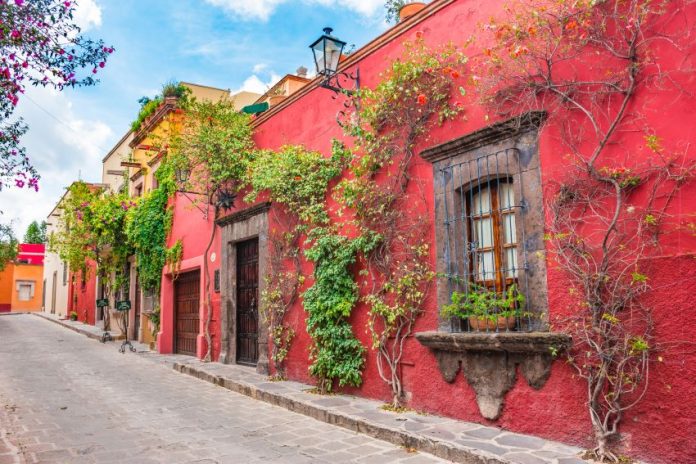
San Miguel de Allende, Guanajuato is one of the most-searched Mexican destinations for vacation home buyers, according to Point2. (Shutterstock)
Large numbers of people in the United States aspire to own a home in Mexico, a recent analysis suggests.
Mexico is the “most wanted destination for U.S. homebuyers looking for a home in the Americas,” according to the real estate company Point2 Homes.
Beach destinations like Tulum are some of the most desirable locations for second home buyers. (Jared Rice/Unsplash)
That conclusion is based on the number of people in the U.S. doing web searches using Mexico-relevant real-estate related keywords such as “homes for sale in Mexico” or “Puerto Vallarta homes.”
The news division of Point2 Homes – which conducted the web search analysis – reported that the average number of Mexico-related real estate searches in the U.S. was 136,530 per month during the 12 months to the end of June, up 3.3% from a year earlier.
Such searches surged almost 60% in a 12-month period prior to the publication of Point2 Homes’ 2022 study, which noted that Mexico had retained its title as “the king of vacation destinations and locations for second homes” for United States citizens.
Point2 said in its latest report that “Mexico remains undefeated” as the most desirable country in the Americas for U.S. homebuyers, despite only a modest annual increase in related web searches.
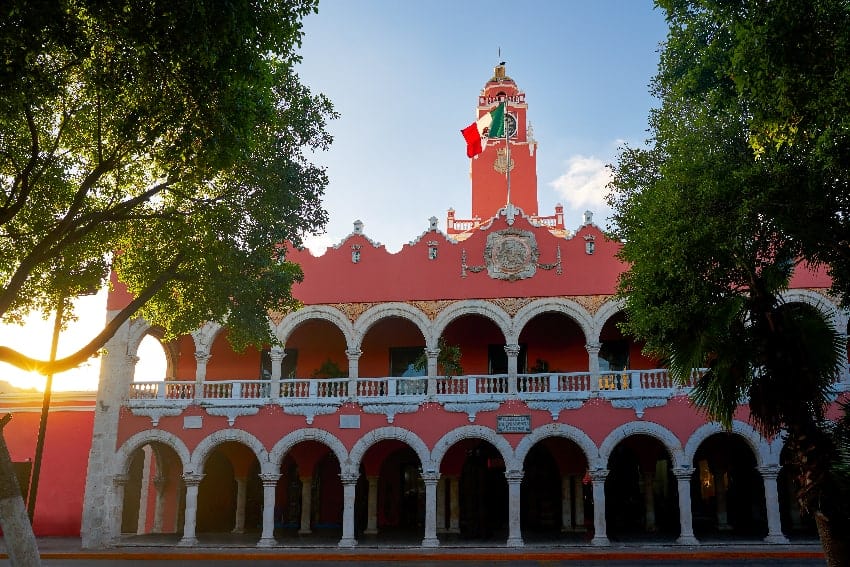
Mérida, Yucatán has become an increasingly popular destination for foreigners. (Shutterstock)
“With more than 130k monthly visits, this land of endless, dazzling beaches and rich culture continues to attract buyers,” the company said.
Point2 said that the only modest increase in online interest in homes in Mexico compared to a year earlier “could prove that the pioneers leading the work-from-everywhere movement are all done searching and buying, leaving the laggards behind.”
“Or, it could be that this year, American buyers have zoomed in on other destinations,” the company said, noting that interest in purchasing a home in Canada – ranked as the “second most wanted destination” in the Americas – had surged 54% in annual terms.
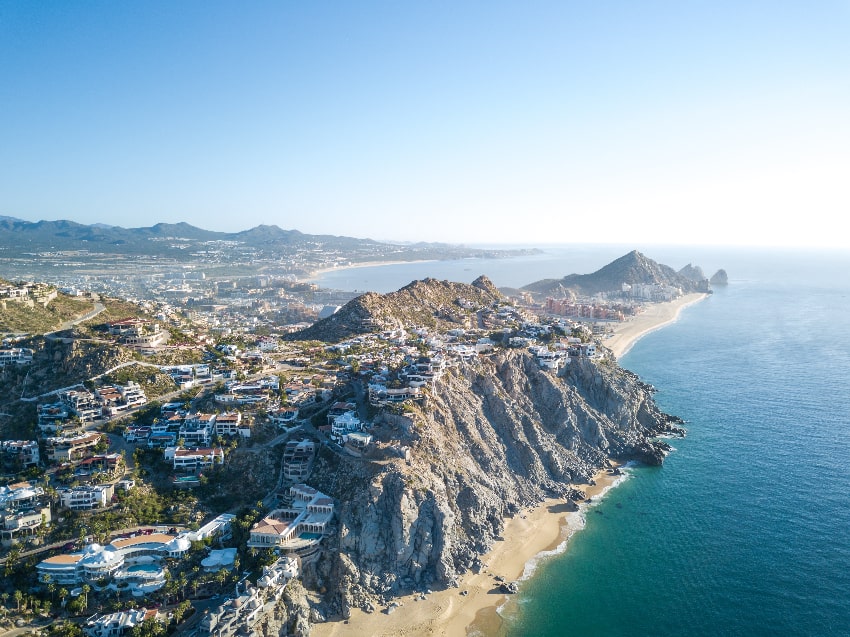
The “most sought-after locations” for home ownership in Mexico, Point2 said, were the Jalisco resort city of Puerto Vallarta, Guanajuato’s colonial gem San Miguel de Allende, Baja Sur hotspot Cabo San Lucas, trendy Tulum in Quintana Roo and Yucatán capital Mérida.
Who is interested in buying property in Mexico?
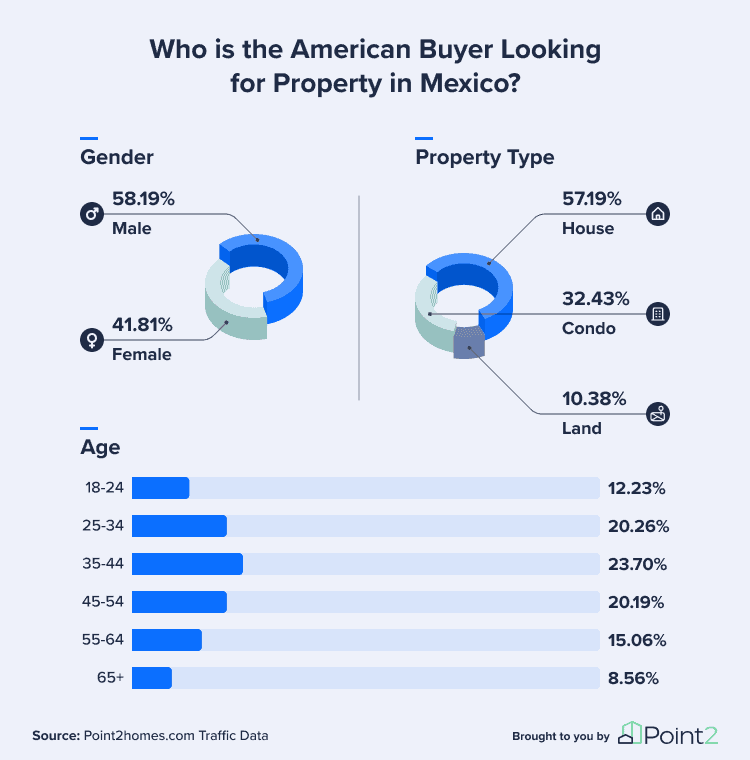
Point2 Homes’ internet traffic data showed that men were responsible for just over 58% of Mexico-relevant real-estate related searches in the United States in the 12 months to the end of June, while almost 42% of searches were made by women.
U.S. residents aged 35 to 44 made 23.7% of the Mexico real estate-related searches during the period, more than any other age cohort.
According to the Point2 survey, the 35-44 age demographic was responsible for the largest percentage of searches compared to other cohorts. (Point2homes.com)
Those aged 25-34 and 45-54 were each responsible for just over 20% of total searches, while Americans in the 55-64 bracket accounted for 15% of searches. The percentages for those aged 18-24 and 65+ were 12% and 8.5%, respectively.
“The surprising part is that people in the youngest age bracket (18 to 24 years old) are driving traffic to Mexico’s real estate pages more than retirees,” Point2 said.
“People aged 65 and over, who might be interested in warmer climate areas to buy a home and retire to are outnumbered by their much younger peers.”
Just over 57% of Mexico-related real estate searches in the U.S. over the past year were for houses, Point 2 said. About one-third of the searches were for apartments while just over 10% were for land.
According to Point2, potential buyers are looking mostly for houses, and primarily in coastal destinations like Cabo San Lucas. (John Cafazza/Unsplash)
In a statement to The Epoch Times, Andra Hopulele of Point2 offered some insight into what buyers are looking for.
“First off, it should be a better version of the home they already live in and boast all the amenities they love or would love to have; and second, the location should be exceptional. That’s why beach and waterfront properties in countries like Mexico, Puerto Rico and Costa Rica immediately come to mind,” she said.
Around the web
Bloomberg reported earlier this year that low crime rates in the state of Yucatán had led to an influx of real estate investors, “some from the U.S. and Canada, who have renovated old houses in downtown Mérida and put them up for rent on Airbnb Inc.”
The news organization said that a three-bedroom luxury home in the historic center of Mérida “might cost about [US] $700,000, while an apartment by the beach overlooking the Gulf of Mexico could go for $340,000.”
The Times cited data from statistics website Statista that showed that the average home price in Mexico City was about 2.9 million pesos in the first quarter of 2022, “making it Mexico’s most expensive market,” but still “more affordable than many markets in the United States.”
Statista’s data for the first quarter of 2023 shows that the average price of a home in Mexico City was 3.66 million pesos (about US $213,000), a 26% increase in the space of a year.
Nayarit had the second most expensive real estate among Mexico’s 32 federal entities, according to Statista, followed by Morelos, Baja California Sur and Querétaro.
Durango had the cheapest average housing price followed by Tamaulipas, Zacatecas, Tlaxcala and Hidalgo.