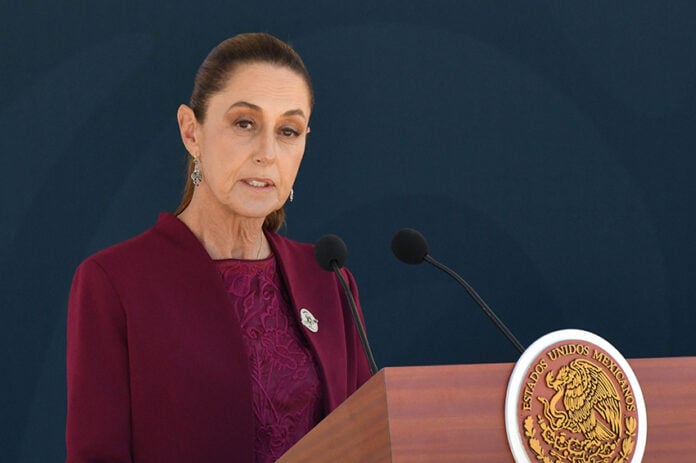
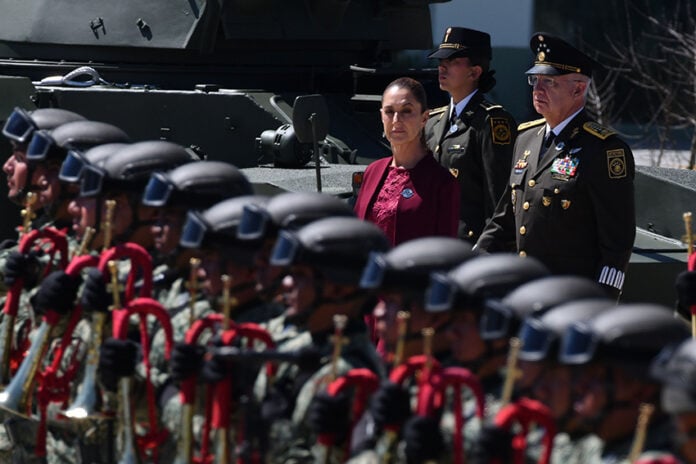
President Sheinbaum — seen here speaking at Army Day in Puebla on Thursday — urged calm and said the Security Cabinet would provide consistent updates as the situation evolved. (Mario Jasso / Cuartoscuro.com)
President Claudia Sheinbaum urged Mexicans to remain calm and stay well-informed after a federal operation targeting Jalisco New Generation Cartel (CJNG) leader Nemesio “El Mencho” Oseguera Cervantes triggered a violent response from cartel henchmen.
The federal Defense Ministry said that Oseguera died while being transported by air to Mexico City after he was wounded by federal forces during an operation on Sunday morning in the municipality of Tapalpa, Jalisco.
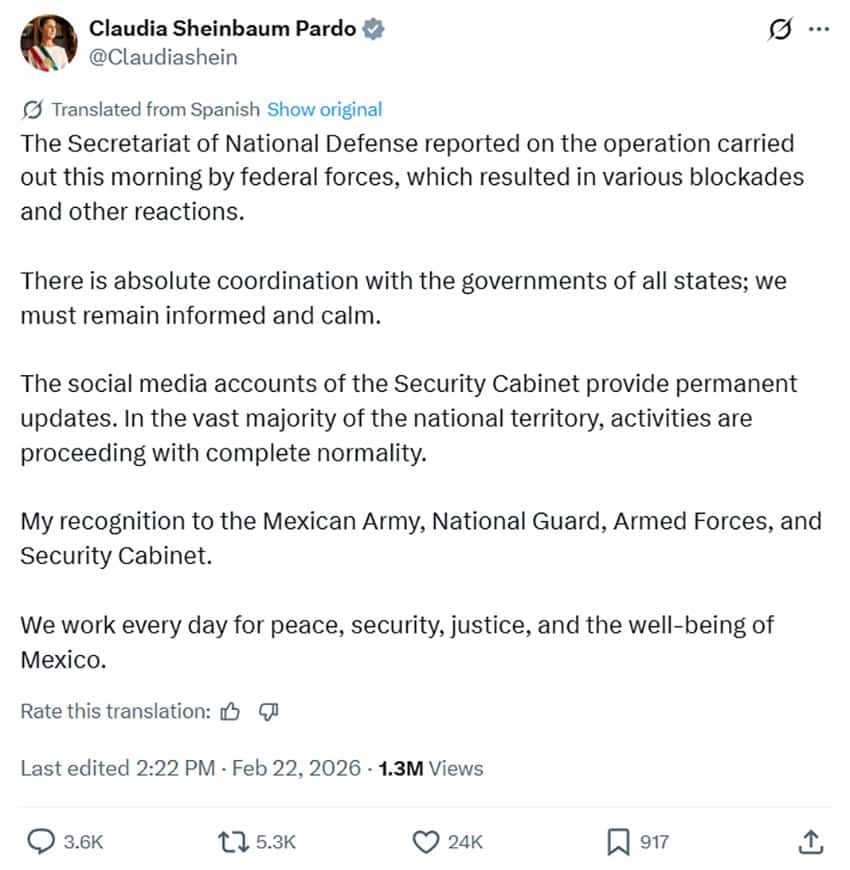
President Sheinbaum urged calm after a military raid killed one of Mexico’s most-wanted crime lords on Sunday morning, triggering blockades by cartel operatives in multiple states. (X)
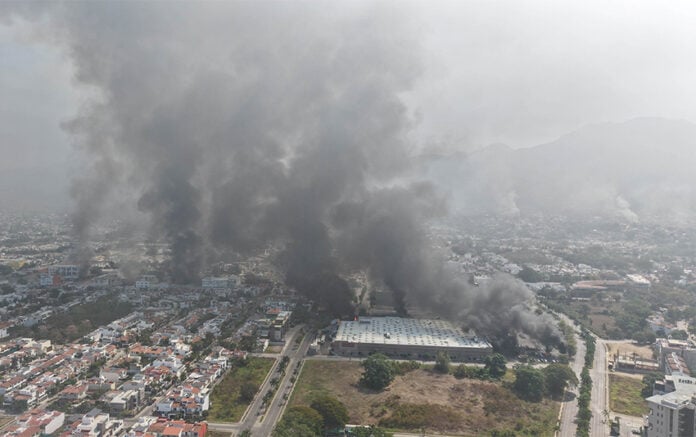
Fiery narco-blockades were erected on roads and highways in Jalisco and neighboring states in response to the federal operation. Many businesses were also set on fire, including a Costco store in Puerto Vallarta, as the CJNG retaliated against the death of Oseguera, who had eluded authorities for years. It wasn’t immediately clear whether any lives of innocent people had been lost due to the hostile cartel response.
On Sunday afternoon, Sheinbaum noted on social media that the Defense Ministry had reported on the operation carried out by federal forces on Sunday morning.
“There is complete coordination with governments of all states,” she wrote.
“We must remain informed and stay calm,” Sheinbaum added.
The president said that the social media accounts of the federal government’s security cabinet are providing regular updates.
Sheinbaum also wrote that “activities” are proceeding normally in most of the country.
“My recognition to the Mexican Army, the National Guard, the armed forces and the Security Cabinet,” she said.
“We work every day for peace, security, justice and the well-being of Mexico,” her post concluded.
It said that the presence of authorities has been strengthened in different parts of the country in order to “clear roads and reestablish order.”
El Gabinete de Seguridad trabaja en coordinación con los gobiernos de las entidades federativas para atender cualquier incidente; se ha reforzado la presencia de las autoridades en distintos puntos para liberar vialidades y restablecer el orden, con el apoyo de los tres órdenes…
— Gabinete de Seguridad de México (@GabSeguridadMX) February 22, 2026
The security cabinet called on people to not disseminate unverified information and “only consult official channels” of communication.
“The priority of the government of Mexico is to protect the population,” the cabinet said, adding that it will continue to provide information.
The Defense Ministry said earlier on Sunday that military personnel came under attack during the operation in Tapalpa, located about 130 kilometers southwest of Guadalajara.
It said that the military personnel returned fire and four CJNG members were killed at the scene and three others, including Oseguera, were seriously wounded and died while being transferred by air to Mexico City.
The Defense Ministry said that three military personnel were wounded, all of whom were transferred to Mexico City for medical treatment.
In Jalisco, Governor Pablo Lemus issued a Code Red, advising state residents to stay inside due to ongoing security incidents. Blockades and acts of arson have reported around the state, with the most significant incidents reported in Guadalajara and Puerto Vallarta.
Governors of Michoacán, Colima and Tamaulipas reported blockades and acts of arson. They did not issue shelter-in-place warnings, but called on residents to check official sources for updates and avoid spreading misinformation. The government of Guanajuato reported in the early afternoon, local time, that blockades in that state had been contained and no longer presented a risk to residents.
Alerts from various foreign embassies remained active as of 3 p.m. Sunday. U.S. Embassy in Mexico said on X that “due to ongoing security operations in multiple states and related road blockages and criminal activity, U.S. citizens should shelter in place in the named locations until further notice.”
Those locations, the Embassy said, are “Jalisco State (including Puerto Vallarta, Chapala, and Guadalajara), Tamaulipas State (including Reynosa and other municipalities), areas of Michoacán State, Guerrero State, and Nuevo León State.”
Locations: Jalisco State (including Puerto Vallarta, Chapala, and Guadalajara), Tamaulipas State (including Reynosa and other municipalities), areas of Michoacan State, Guerrero State, and Nuevo Leon State
The U.S. Embassy also listed various “actions to take,” including “be aware of your surroundings; avoid areas around law enforcement activity; [and] seek shelter and minimize unnecessary movements.”
In a message to Canadian citizens, the Canadian government said that “a shelter-in-place order is in effect in Puerto Vallarta.”
“If you’re in Jalisco State, keep a low profile and follow advice of local authorities,” said a post to the Canadian government’s travel advice account on X.
The United Kingdom’s Embassy in Mexico noted on X that the U.K.’s travel advice for Mexico had been updated with “new information on security incidents across the state of Jalisco.”
That advice warns against “all but essential travel to the areas south and south-west of Lake Chapala to the border with the state of Colima.”
It also warns against travel to 11 municipalities in northern Jalisco.
Among the other countries that issued security alerts to their citizens in Mexico were Australia and India.
“Australians in Mexico be aware of security incidents and roadblocks occurring across multiple states including Michoacán, Jalisco, Guanajuato and Tamaulipas,” Australia’s ambassador to Mexico, Rachel Moseley, wrote on X.
“Take precautions, monitor media and follow the advice of local authorities,” she added.
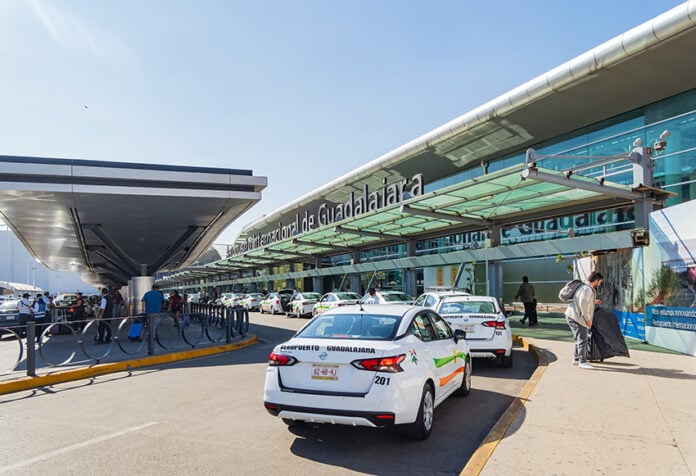
While the Guadalajara airport operator assured the public that the security situation was under control, airlines have suspended some flights in Jalisco, including to Puerto Vallarta. Due to highway blockades across the country, bus service has been suspended in many areas. (Shutterstock)
The operator of the Guadalajara International Airport (GDL) said Sunday that no incidents had occurred inside the facility, despite reports of the presence of armed men.
In a statement posted to X early Sunday afternoon, the Pacific Airport Group (GAP) said that the Guadalajara Airport was operating normally, just hours after the leader of the Jalisco New Generation Cartel (CJNG), Nemesio “El Mencho” Oseguera Cervantes, was killed in a federal security operation in Jalisco.
“The situations recorded in various areas of the state are not impacting the internal operation of the airport terminal nor safety within the facilities,” it said.
“The air terminal is under the protection of the National Guard and the Ministry of National Defense,” GAP added.
The airport operator said that no incidents had occurred inside the airport and declared there was no risk to passengers, airport workers or visitors.
Apparently referring to video footage showing people panicking and running inside Guadalajara Airport, GAP said that “information and material” circulating on social media “doesn’t correspond to situations of risk inside the terminals, but rather hysteria among passengers.”
GAP released its statement after some media outlets, including the newspaper La Jornada, reported the presence of armed men in the Guadalajara airport.
An MND source who was at the airport said that everyone suddenly started running, despite there being no apparent threat.
Earlier in the day, the Guadalajara Airport advised passengers to allow extra time to arrive due to “unforeseen situations” on the highway to Chapala that may change traffic conditions.
Due to developing security situations in Guadalajara and Puerto Vallarta airlines are canceling flights at those airports. Some flights remain inbound to Guadalajara at this time. https://t.co/cur1slMRldpic.twitter.com/fBFNjCI247
Meanwhile, Air Canada said on X that “due to an ongoing security situation in Puerto Vallarta impacting the @VallartaAirport, Air Canada has temporarily suspended operations there today.”
“We are monitoring the situation and are in contact with local authorities who are working to resolve the issue,” the airline said.
“Customers are advised not to attempt to go to the airport unless their flight is shown as operating on http://aircanada.com, and will be directly notified of changes to their itineraries. We will share more information as soon as it becomes available,” Air Canada said.
In a separate statement, GAP said that some flights from Manzanillo airport had been canceled. That airport is located in the state of Colima, which borders Jalisco.
GAP advised passengers to contact their airlines to obtain up-to-date information about the status of their flight. That advice appears sound for anyone traveling to or from Guadalajara, and airports in neighboring states, on Sunday.
Some bus services have also been canceled or delayed, presumably due to the risk of violence on Mexican highways this Sunday as CJNG members react to the death of Oseguera Cervantes, who was wanted both in Mexico and the United States. One affected service was that between Mexico City’s northern bus terminal and the city of San Miguel de Allende in the state of Guanajuato.
Mexico News Daily
Reader: Have you or your travel plans been affected by the unrest in Mexico today? We are monitoring our inbox for on-the-ground updates. Please email us and include any first-hand footage with location information at editorial@mexiconewsdaily.com.
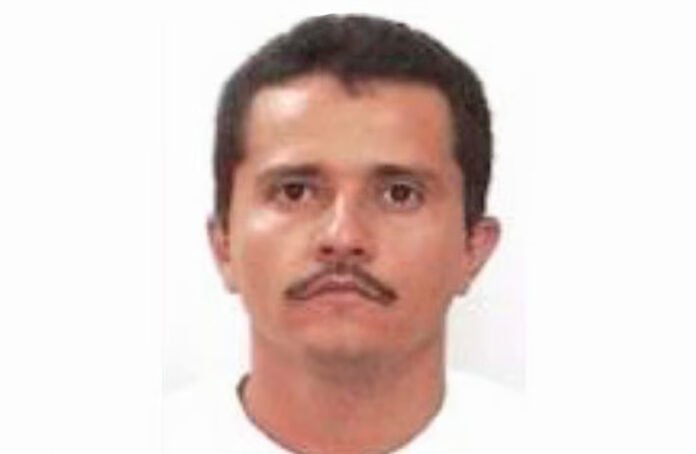
CJNG cartel founder and chief 'El Mencho' was killed in Tapalpa, Jalisco, Sunday morning, Milenio newspaper reported. (US Department of Justice)
This story is developing and will be updated as we learn more.
Nemesio “El Mencho” Rubén Oseguera Cervantes, founder and top leader of the Jalisco New Generation Cartel (CJNG), was killed by federal forces Sunday morning, according to the Ministry of Defense.
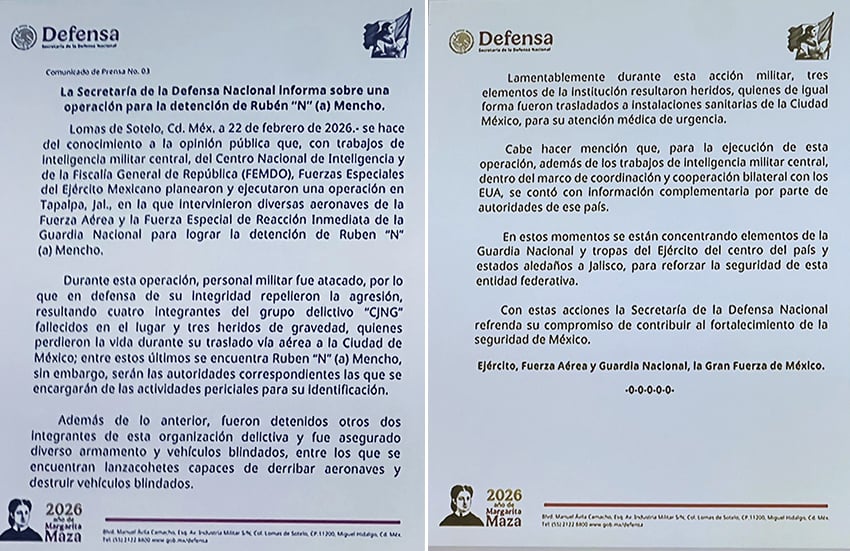
A Ministry of Defense press release confirmed that El Mencho died Sunday morning in a military operation in Tapalpa, Jalisco. (Defensa)
The operation was led by the Army and federal forces in Jalisco in an area known to be controlled by El Mencho.
In a press release, the Ministry of Defense said that during an operation to arrest El Mencho, Mexican military forces came under fire and were forced to defend themselves. Four CJNG operatives were killed in the firefight. Three more, including El Mencho, were gravely injured. They were air lifted to Mexico City but died en route, the Defense Ministry said.
In addition to Mexican military intelligence, United States authorities contributed information used to carry out the operation, the ministry said.
Later, road blockades were reported in at least six states: Jalisco, Michoacán, Colima, Tamaulipas, Guanajuato and Aguascalientes.
Videos that circulated on social media showed the burning of vehicles and public buses in Puerto Vallarta, Guadalajara and Tapalpa. Residents also reported burnings of pharmacies and convenience stores in different parts of Guanajuato.
In Puerto Vallarta, residents reported that the city was under siege by men on motorcycles and the sound of gunshots.
Authorities are maintaining active operations in several states to contain possible reactions and reinforce security following one of the most significant events in the fight against drug trafficking in recent years.
Who was ‘El Mencho’?
“El Mencho” was considered the top leader of the CJNG, one of the most powerful and violent cartels in Mexico, with a strong presence in Jalisco, Colima, Michoacán and other states. He also played a key role in the trafficking of methamphetamine and fentanyl to the United States.
The U.S. Department of Justice had issued federal charges against him and offered multimillion-dollar rewards for information leading to his capture.
El Mencho’s death opens the door to possible internal reshuffling, succession disputes and risks of increased violence in territories where the CJNG operates, something that security specialists see as a likely scenario after the fall of such a concentrated leadership.
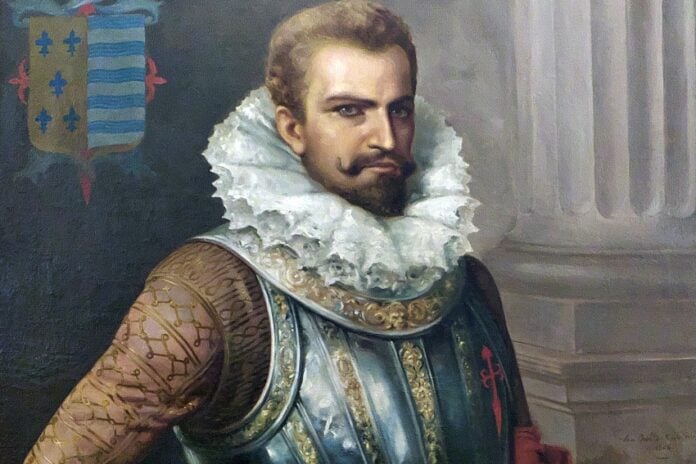
Pedro de Alvarado was one of many Spanish men of his era to seek their fortune in the Americas. (Public Domain)
Pedro de Alvarado was everything Spain wanted in a conquistador. He came from a minor noble family that had a distinguished history but few prospects. He was one of five sons and a twin to the only daughter. His home province of Extremadura, Spain, had a tradition for producing soldiers, and by the time Pedro reached adulthood, the long struggle against the Muslims was over. Thus, there was limited work for a young man with little interest in books or writing but comfortable on a horse and useful with a sword.
The conquest of Cuba
With few prospects in Spain, he set out across the Atlantic in the hope of improving his fortunes. This was 1510, early in Spain’s American venture, when the prospects were greater. Soon after arriving in the Americas, he took part in the conquest of Cuba. Details of the role he played are unrecorded, but Alvarado became the owner of a hacienda. As far as we are aware, the next seven years passed with him managing his lands and establishing a position for himself in island society.
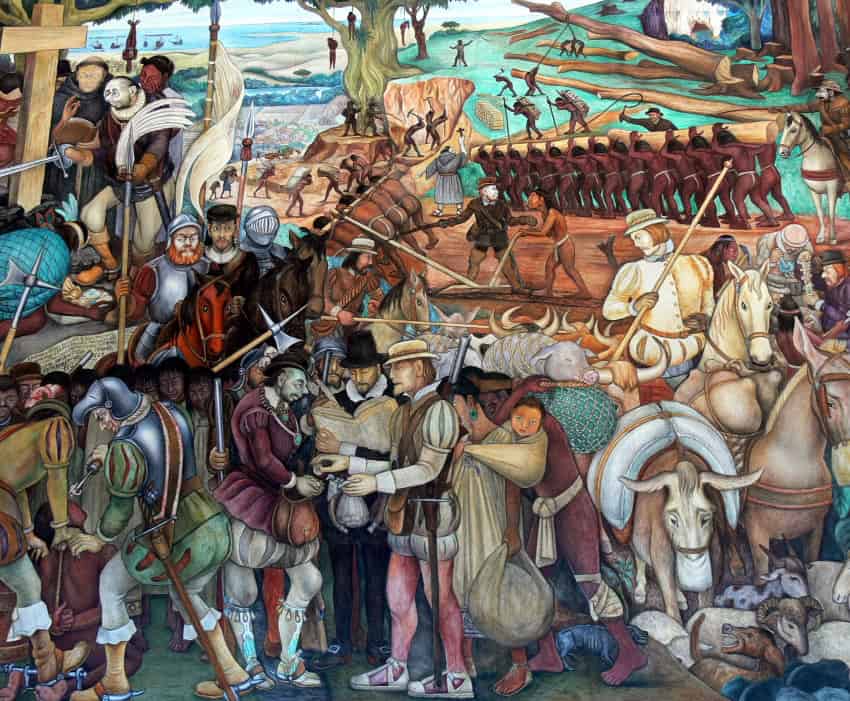
From a mural by Diego Rivera, showing the exploitation of Indigenous people by Spanish conquistadors. (Wolfgang Sauber/Wikimedia Commons
Then, in 1518, he enlisted with Juan de Grijalva to join the expedition that would explore the Yucatán. Alvarado was now 33 and in his prime, moving toward financial independence and with a reputation for generosity, at least toward his Spanish colleagues.
It helped that Alvarado looked the part. Judging by the written descriptions, he was a handsome, well-built man who was something of a dandy, dressing in imported silks and velvets. Historian Bernal Díaz del Castillo, who would have known him well, wrote of his “very cheerful countenance and a winning smile.”
An early return from Yucatán
While Alvarado was a capable leader with a dash of bravado, he was not always easy to work with. For his younger officers, he was generally pleasant enough, but a fierce temper lay behind the soft commands, and he could be reckless. As de Grijalva’s fleet made its way along Mexico’s Atlantic coast, Alvarado, having pulled ahead of the rest of the convoy, took his ship into the Papaloapan River. His commander was not happy with de Alvarado taking such a risk, and shortly afterward, he used the excuse of a ship needing repairs to send Alvarado back to Cuba.
It was a poor decision, for Alvarado used his early arrival in Cuba to claim much of the glory of the expedition for himself.
An expedition to Tenochtitlán
Grijalva brought back a few gold trinkets and stories of a rich inland kingdom. This was enough to attract Spanish interest, and Hernán Cortés was authorized to prepare the next expedition. Alvarado was one of the first to sign up for the campaign. He would have been useful in many ways; Díaz also notes his skill at training young soldiers.
Having reached Cempoala, just north of modern Veracruz, Cortés left part of his force on the coast while he marched the main party inland towards the Aztec heartlands. This route took them through the lands of the Tlaxcalans, who were allies of the Aztecs.
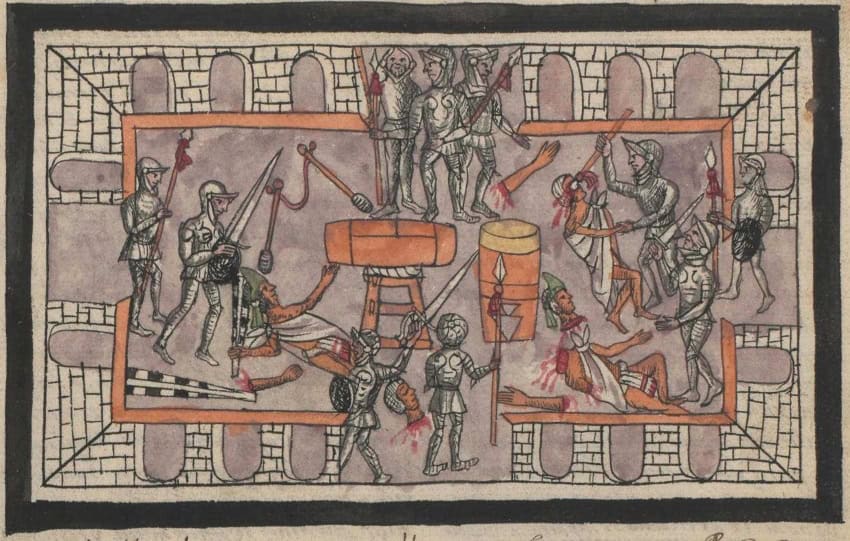
Painting depicting the massacre of the Mexica in the Great Temple, for which Alvarado was responsible. (Public Domain)
Initially, the Tlaxcalans were aggressive but also impressed with Spanish steel, and they started to see the possibility of allying themselves with the foreigners and escaping their Mexica overlords. Alvarado particularly impressed them: Noting his powerful physique and flaming red hair, they named him Tonatiuh, as he appeared to resemble their vision of the sun god.
A diplomatic marriage and the road to Tenochtitlán
As part of the alliance, he was married to one of Chief Xicotencatl’s daughters, a woman who took the Spanish name Doña María Luisa.
As Cortés made his way inland, he sent Alvarado ahead with a small party to make contact with the Mexica ruler Moctezuma II at Tenochtitlán. At this stage, this was as much a diplomatic mission as it was a conquering army.
The story of the destruction of the Mexica Empire is well documented, and we can jump forward six months to April 1520. As negotiations continued in the capital, Cortés faced a new challenge: Diego Velázquez, the governor of Cuba — believing Cortés had disobeyed his orders — sent Pánfilo de Narváez to the mainland to arrest the wayward captain. Cortés departed for the coast to confront the danger, leaving Alvarado in charge of the small Spanish detachment that remained in Tenochtitlán.
The Tenochtitlán massacre
As the day of a big festival approached, the Tlaxcalteca allies of the Spanish became increasingly nervous, fearing the Mexica would use the festival to attack them. It did not help that the best translators had gone with Cortés, leaving Alvarado with a man called Francisco, who had only rudimentary Spanish. Alvarado could have had very little intelligence of the Mexica’s real intentions.
On the night of the festival, hundreds of dancers performed in the Great Temple, making a wall of noise with their shouts and drums. Alvarado, perhaps anticipating that this was the prelude to an attack, perhaps panicking, led a brutal attack on the dancers. Hundreds of people, including the cream of the Mexica nobility, were massacred.
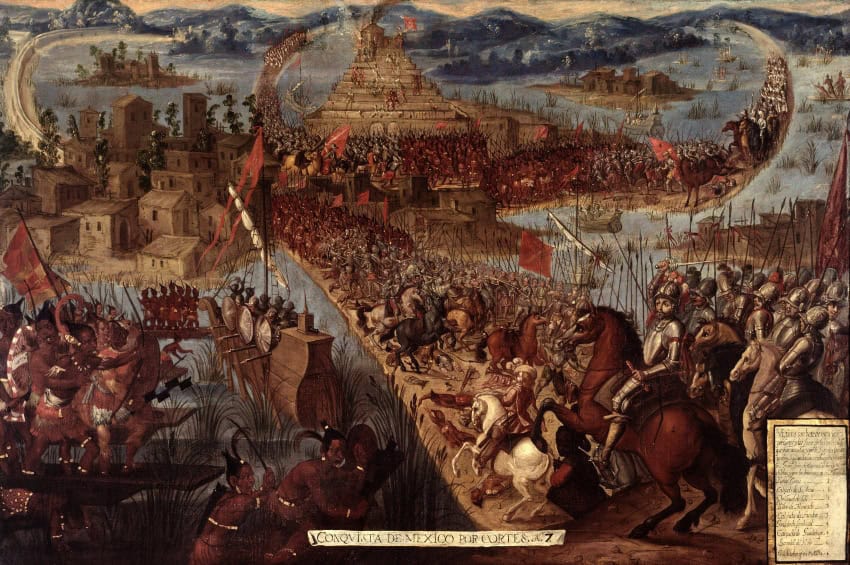
Painting of the Spanish conquest of Tenochtitlán by Hernán Cortés and his conquistadors. (Public Domain)
The city was packed for the festival, and as word of the attack spread, a mob descended on the Spaniards. Alvarado, his head bleeding after having been struck by a stone, led the survivors back to the relative safety of their base in the Palace of Axayacarl. The night had been a disaster not only for the Spanish but also for their vassal, Moctezuma, who lost the last support of his own people.
The retreat from Tenochtitlán, ‘Victorious Night’ for the Mexica
Cortés, having got the better of Narváez, returned with an army strengthened by new recruits. The situation in the capital was untenable, and the Spanish retreated to nearby Tlaxcala. Alvarado, commanding the rear guard, fought with distinction during that dangerous march out of the city. According to a disputed legend, at one point, he escaped capture by using his spear to pole-vault across a gap in the damaged causeway.
For a few weeks, the future of Spain’s influence on the mainland hung in the balance, but Cortés regrouped and once again marched on the Mexica capital. Alvarado was given command of one of the four Spanish divisions, and whatever role he had played in creating the disaster, he now made amends: On the day the city was stormed, his troops were the first to reach the city center.
A promotion and then an inquest
As the Spaniards extended their influence across the country, Cortés summoned his old friend Alvarado for a new task. There were stories that the villages of Chiapas, on the edge of Spanish influence, were being harassed by an Indigenous warrior race from the south, and Cortés wanted to explore that region.
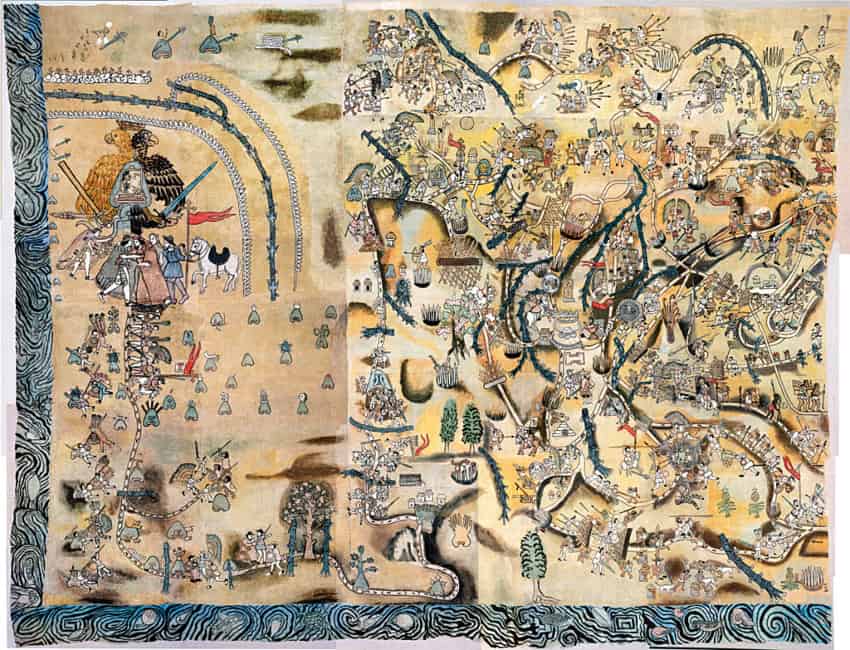
Alvarado argued for a larger force, one that could not only identify the problem but deal with it. And so in 1524, he marched into what is now Guatemala with 300 Spanish foot soldiers, 120 horsemen and several hundred native allies.
He used the same tactics that had proved successful against the Mexica, combining alliances with brutality. Initially, this meant joining the Kaqchikel against their traditional rivals, the K’iche.
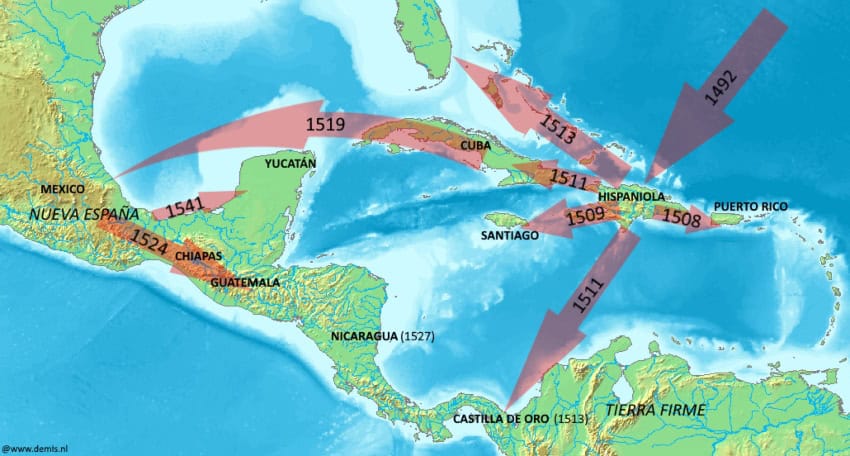
Spanish conquest routes in the Americas following the first voyage of Columbus in 1492. (Simon Burchell/Wikimedia Commons)
The first campaign was brought to a halt by April rains, and Alvarado, leaving his brother Jorge in charge of a far-from-pacified country, returned to Mexico City and then Spain.
To Spain and back
The Spanish trip proved a success. Having defended his actions in Guatemala, Alvarado was confirmed as governor of the new province and awarded the military title of adelantado. Ignoring his marriage to the Tlaxcalteca princess, he took Francisca de la Cueva as his wife. This was an excellent political marriage, for she had close connections to the Spanish king thanks to her influential uncle, the Duke of Albuquerque.
Alvarado’s return to New Spain proved more troublesome. His new wife died very soon after arriving, and there had been a shift in the political balance. Power in New Spain was a struggle between the old landowners and the officials newly sent from Spain, the influence of either side rising or falling on the whims of the king.
Alvarado arrived to find Cortés was out of favor, and he himself faced a formal review, a residencia for his past actions. He might even have spent a spell in prison, but Cortés, that great survivor, returned to influence, and Alvarado was free to seek new projects.
Seeking a route to the Spice Islands
South America seemed to offer unlimited promise, and in 1532, Alvarado landed off the coast of modern Ecuador. He marched inland, a disastrous trek that took a heavy toll on his force.
He returned to the coast, only to be confronted by Sebastián de Belalcázar, who had already started the colonization of Peru and wanted no Spanish rivals in the region. Too weak to offer resistance, Alvarado sold his ships and supplies to Belalcázar — both men claiming to have been robbed in the deal — and returned to New Spain.
The Lienzo de Quauhquechollan codex shows the campaign to conquer Guatemala from an Indigenous perspective. (Public Domain)
The year 1536 saw Alvarado intervene in Honduras, where the small Spanish settlements were at odds with each other. He might well have been facing a second residencia, for in 1537, he once again sailed to Spain, most likely to bring his case before the Spanish king.
The visit went well, and Alvarado’s position as governor of Guatemala was reconfirmed for another seven years and extended to cover the governorship of Honduras. It probably helped that he had married Beatriz de la Cueva, sister of his first wife, thereby retaining the protection of the Duke of Albuquerque.
By 1541, de Alvarado was constructing a fleet to seek a route to China and the Spice Islands. Although Magellan had struggled across the Pacific in 1520, half a century after Columbus, the Spanish had still not been able to chart the tides and winds that would allow a safe journey from New Spain to the Spice Islands and back again.
An unexpected death in battle
Alvarado was sailing north along the coast and had reached Jalisco when news came of an Indigenous rebellion in the area, after a decade of brutal Spanish rule and enslavement via the encomienda system. Coming inland to Guadalajara, he was riding up a steep hill to confront the rebels when his horse slipped in heavy rain and fell on him.
The exact date of the accident is uncertain, so we do not know how long he suffered. However, Alvarado died on July 4, 1541, at the age of 55 or 56.
His will — or rather a letter outlining his wishes — was entrusted to Francisco Marroquín, the first bishop of Guatemala, who had been connected with Alvarado since meeting him in the Spanish Court in 1528 and traveling back with him to New Spain in 1529. The original document still survives.
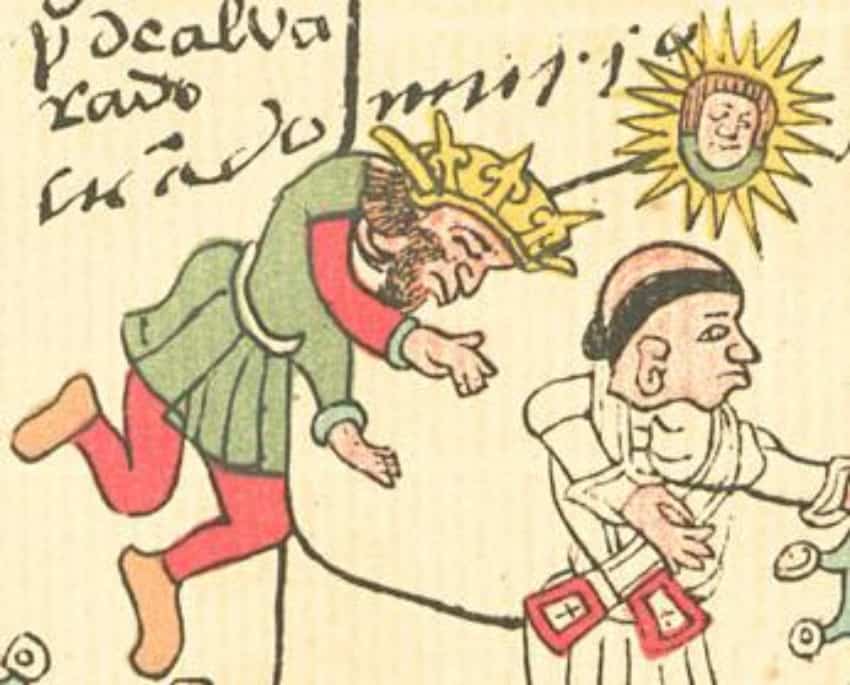
Death of Pedro de Alvarado, depicted in the Codex Telleriano-Remensis. (Public Domain)
According to the provisions of Alvarado’s will, his numerous mestizo children were to be provided for, his slaves on farms and mines were to be released and the church was to be given a new chapel. A ship builder he owed money to was to be paid.
These were honorable gestures, but Alvarado is remembered in Mexico and Latin America for his greed and cruelty to Indigenous people.
Bob Patemanlived in Mexico for six years. He is a librarian and teacher with a Master’s Degree in History.
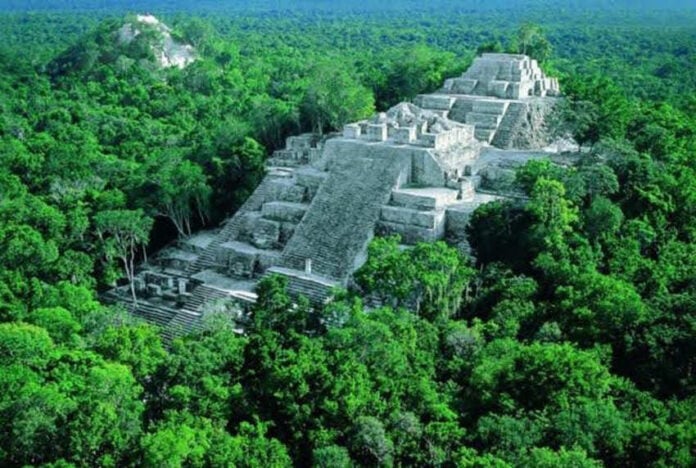
Calakmul's Structures I and II in Campeche display the power and resources the Kanu'l dynasty accumulated as it worked to become the major Mayan power center in Mesoamerica during the Late Classic period. (Sentimientos de mi nación)
As part of an exploration into Mexico’s long and rich history, Mexico News Daily has teamed up with one of the country’s top Maya experts to examine the ancient world that flourished across Mesoamerica.This is Part 4 in a series of articles on the ancient Maya. Follow the links to read Part 1,Part 2 and Part 3.
In our previous entry, we talked about how the Late Classic period for the pre-Columbian Maya was characterized by a high degree of political maneuvering and military aggression, leading to increased political and social complexity.
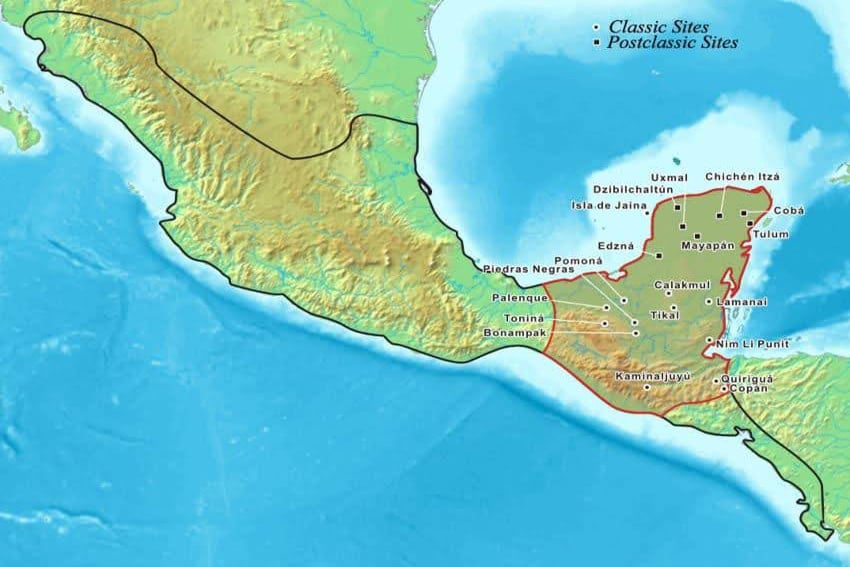
As this map shows, some of Mexico’s most famous Maya cities — such as Chichen Itzá and Tulum — were sites from the Post Classic period (denoted by squares). In the Classic period, the most powerful cities were Tikal and then Calakmul. (Courtesy Pablo Mumary)
Hence the need for this second article on the Maya Late Classic period — continuing our previous installment. Re-read the first part here.
There’s a lot we’re not certain of, but as we mentioned in the previous article, evidence suggests that the Maya societies during this period were involved in an escalating struggle to control natural resources, the procurement of luxury materials and the dominance of trade routes to guarantee the procurement of said luxury materials, and to generally accumulate wealth and power.
Who were the Kanu’l dynasty?
As we mentioned in Part 2 of our series, during much of the Early Classic period, the dominant power in the Maya Lowlands appears to have been the political entity of Tikal, in Guatemala, and its ruling dynasty, the Mutu’l. This dominance followed the defeat of nearby rivals like the city of Uaxactún, as well as the linking of the Mutu’l with foreigners arriving from Teotihuacan — an event we also discussed in Part 2. These Teotihuacan outsiders imposed a new geopolitical reality in Mesoamerica during the Early Classic period and possibly took Tikal as their primary center.
However, we know from an artifact from the Mesoamerican city of Caracol in Belize — referred to as Altar 21 — that Tikal’s forces were defeated in A.D. 562 when Caracol allied with a new force hailing from the distant northern lands: the Kanu’l dynasty, who were from the city of Dzibanché in Quintana Roo and used a distinctive emblem glyph featuring a snake’s head.
During the sixth century, Dzinbanché had begun an aggressive territorial expansion strategy that took them to both northwestern Mexico and southward into Belize and Guatemala’s Petén region. A clash with Tikal, the greatest power in the Petén, was inevitable.
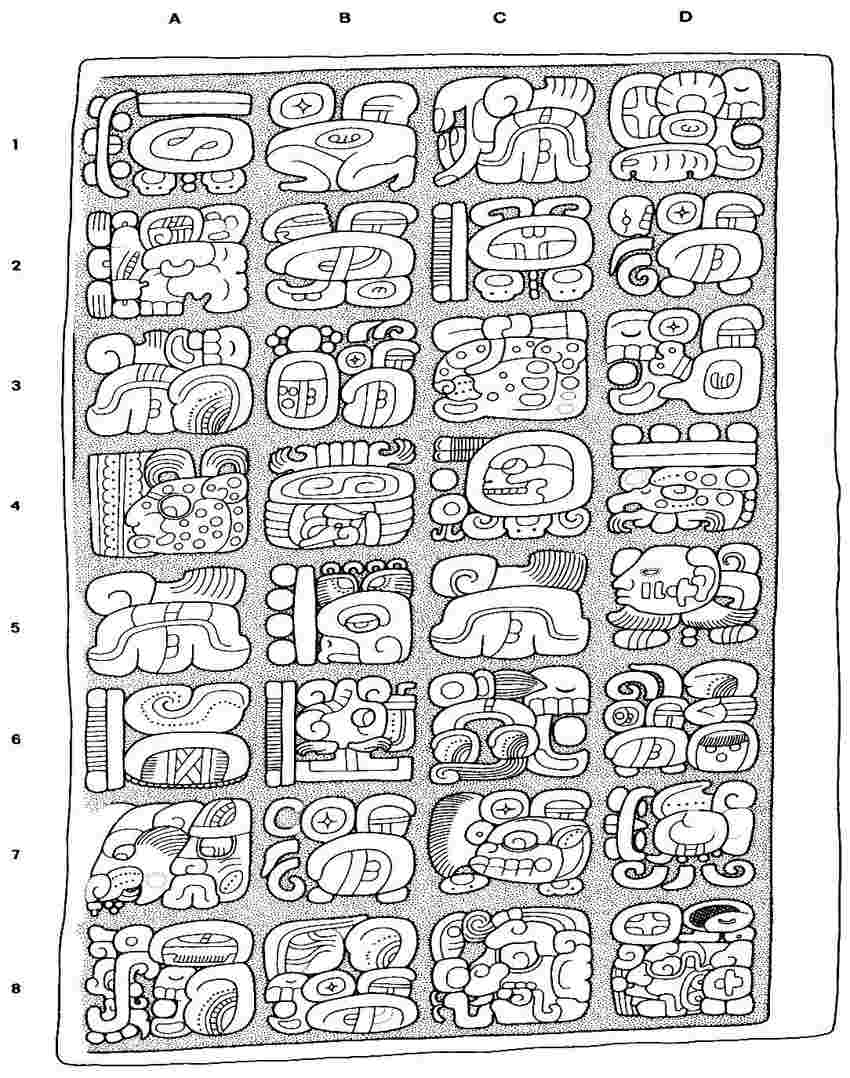
A drawing of Lintel 35 at Yaxchilán, which recounts the sacrifice of a war captain of Dzinbanché who was captured by Yaxchilán. (Harvard University Peabody Museum)
One piece of evidence Dzinbanché’s aggressive expansion can be found in an archeological artifact known as Lintel 35, from the Mesoamerican city of Yaxchilán, in modern-day Chiapas.
Carvings on the lintel recount how, during an armed conflict in A.D. 537, Yaxchilán’s rulers — the Pa’chan dynasty — captured an important war captain of the Kanu’l dynasty and sacrificed him to the city’s patron deities, evidence that Dzibanché’s rulers were rapidly expanding their power and influence.
Likewise, several stelae found in Naranjo — a city located in the Guatemalan Petén near Tikal and Caracol — explain that by A.D. 546, Naranjo’s rulers had already been allies of the Kanu’l dynasty for several generations.
This territorial expansion allowed Dzinbanché to gain control of two key routes: the Usumacinta River in the northwest and the Belize River and its tributaries — whose northern outlet reached as far as Chetumal and whose southern outlet facilitated communication with cities like Naranjo and Caracol. This control also provided a gateway to conquering the west and Tikal.
And so the conflict of A.D. 562 thus signified the collapse of the Mutu’l dynasty as a major power in the region — at least for the moment — and the rise of the Kanu’l dynasty, with its growing network of allies.
Dzinbanché becomes Calakmul
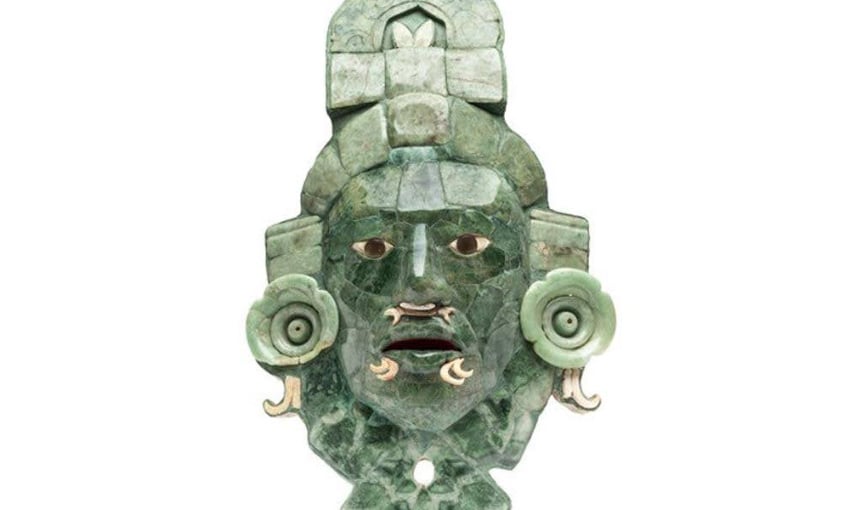
A jade mask found in Structure VII of Calakmul, likely belonging to one of the late Kanu’l rulers. (INAH)
Multiple stone monuments from the beginning of the seventh century record the presence of Kanu’l rulers in different cities across the Maya Lowlands and their military imposition on sites as important as Palenque in Chiapas.
Around A.D. 635, following an interdynastic conflict, the Kanu’l dynasty decided to move its capital from Dzibanché to Calakmul, in present-day Campeche.
The great city of Calakmul — whose ancient name was Uxte’tuun (“the city of the three stones”) — enjoyed a privileged, central strategic location. Its position allowed it to control communications in all directions and establish trade routes to the west, east and south. With the appointment of Yuhkno’m Ch’e’n II as Calakmul’s new ruler around A.D. 636, the Kanu’l dynasty experienced its golden age, establishing a vast network of favorable alliances.
This ruler established what is known as the Camino Real (Royal Road), a communication route reaching the city of Cancuén in Guatemala, which allowed Calakmul to control the important Pasión River, through which various objects and products reached the capital.
Yuhkno’m Ch’e’n II began remodeling Calakmul, erecting several monuments and building its most important pyramidal structures. He also expanded the Kanu’l dynasty’s dominance: Many of the new k’uhul ajaw (holy lords) of other cities owed him fealty, as they had been installed into office in the presence of the ruler himself, who authorized and legitimized them.
Tikal’s loss is Calakmul’s gain
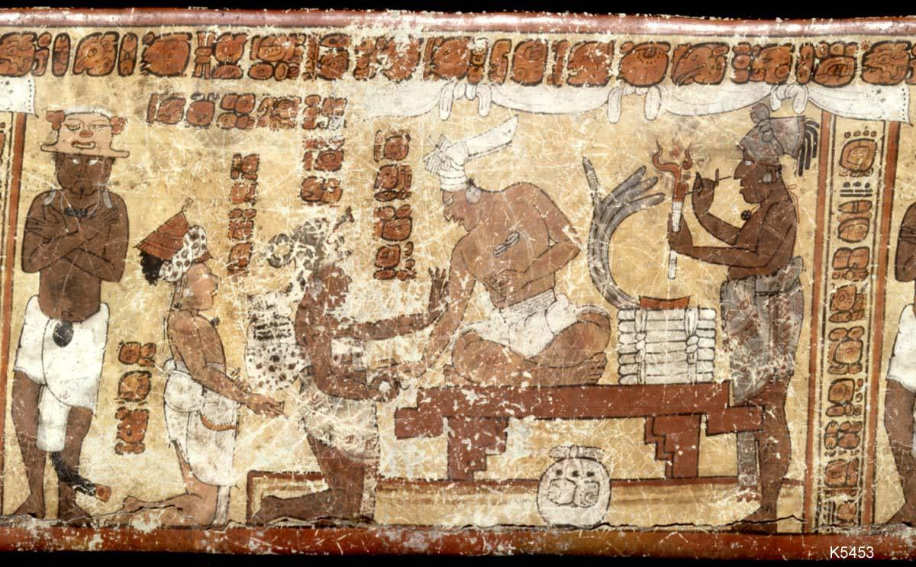
A vase recovered from the Tikal archeological site shows Calakmul ambassadors in the court of a later Tikal ruler, Jasaw Chan K’awiil. (Mayavase Database)
During Yuhkno’m Ch’e’n II’s reign — and until his death in A.D. 686 — the defeated city of Tikal and its leaders suffered submission to the Kanu’l, who closely monitored Tikal’s actions. In this regard, the Kanu’l leaders’ involvement in the internal conflict between two factions of the Tikal dynasty — as noted in the hieroglyphic record in the ancient city of Dos Pilas — is noteworthy.
Located in the Petexbatún region, near the Pasión River, the city became a key enclave to which a section of the Mutu’l dynasty in Tikal was exiled, possibly for advocating a closer relationship with the Kanu’l — possibly under the influence of Calakmul’s leaders. What we do know is that Dos Pilas integrated into Calakmul’s network of allies after the internal dynastic conflict in Tikal.
How Calakmul controlled its vassal cities
Although Calakmul’s network of vassal dynasties maintained a degree of political autonomy in their lordships, the Kanu’l rulers imposed a subtle yet firm control over their subordinates through marriage connections and by raising political hostages.
Yuhkno’m Ch’e’n II and his successors, Yuhkno’m Yihch’aak K’ahk’ and Yuhkno’m Took’ K’awiil, maintained a strategic marriage policy, sending elite daughters to various cities to marry future rulers and thus establish favorable alliances. In addition, hieroglyphic inscriptions also reveal cases where firstborn sons and future young rulers were sent to Calakmul to learn the ways of courtly life while being groomed as loyal future allies. Both of these strategies have been recorded at the site of La Corona in Guatemala.
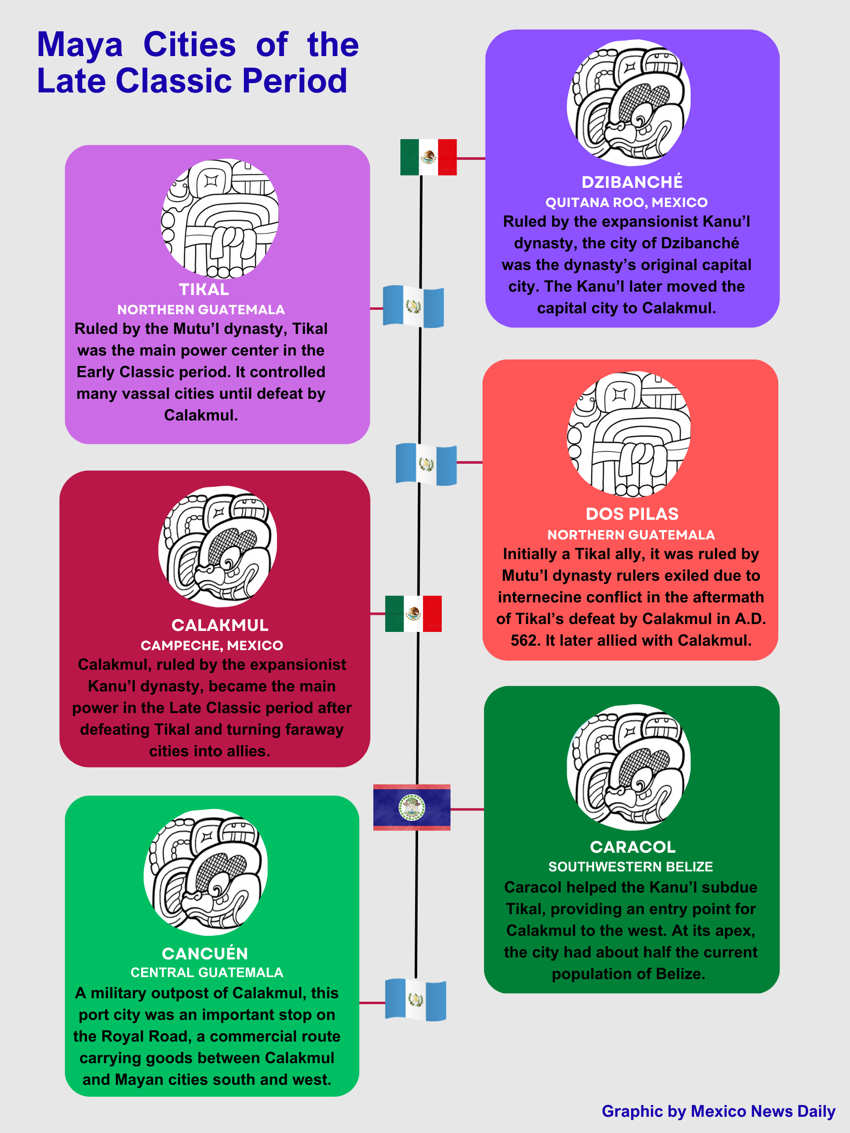
Need a scorecard to keep track of this Mesoamerican “game of thrones”? Here’s a quick guide to all the major Mayan cities discussed in this article. (Mexico News Daily)
A Tikal resurgence and the end of the Kanu’l dynasty
Although Yuhkno’m Ch’e’n II’s successors worked to maintain the Kanu’l dynasty’s power — representing themselves as the great rulers of both the earthly and supernatural planes who had the favor of a large number of deity patron entities that certified their authority — around A.D. 695, Calakmul’s network of allies and its control system began to crumble.
With Yuhkno’m Ch’e’n II’s death in A.D. 686, Tikal’s leaders began to reorganize: Ruler Jasaw Chan K’awiil strengthened his city’s position in the region to the point where he received emissaries from Calakmul at his court to negotiate. No agreement was reached, however, and in A.D. 695, the armies of the two most powerful dynasties in the Maya Lowlands clashed.
The confrontation was decisive, as was the defeat of the Kanu’l dynasty. Calakmul lost one of its most important patron deities, Yajaw Man, on the battlefield, taken back to Tikal as war booty. Gradually, the Kanu’l’s old network of allies became scattered as Tikal — under Jasaw Chan K’awiil and then his son, Yihk’in Chan K’awiil — continued to reconquer nearby territories.
The Kanu’l leadership — with Calakmul now a vassal state to Tikal — understandably made constant attempts to project a sense of normalcy: Yuhkno’m Took’ K’awiil ordered the remodeling of buildings and the erection of new stone monuments exalting the dynasty and its ruler — who bore the most important political titles, was accompanied by preeminent supernatural entities and was adorned as a prominent military chief.
However, the reality was different: A few years later, around A.D. 736, Tikal attacked again at the outskirts of the capital city. Ruler Yuhkno’m Took’ K’awiil was defeated and captured.
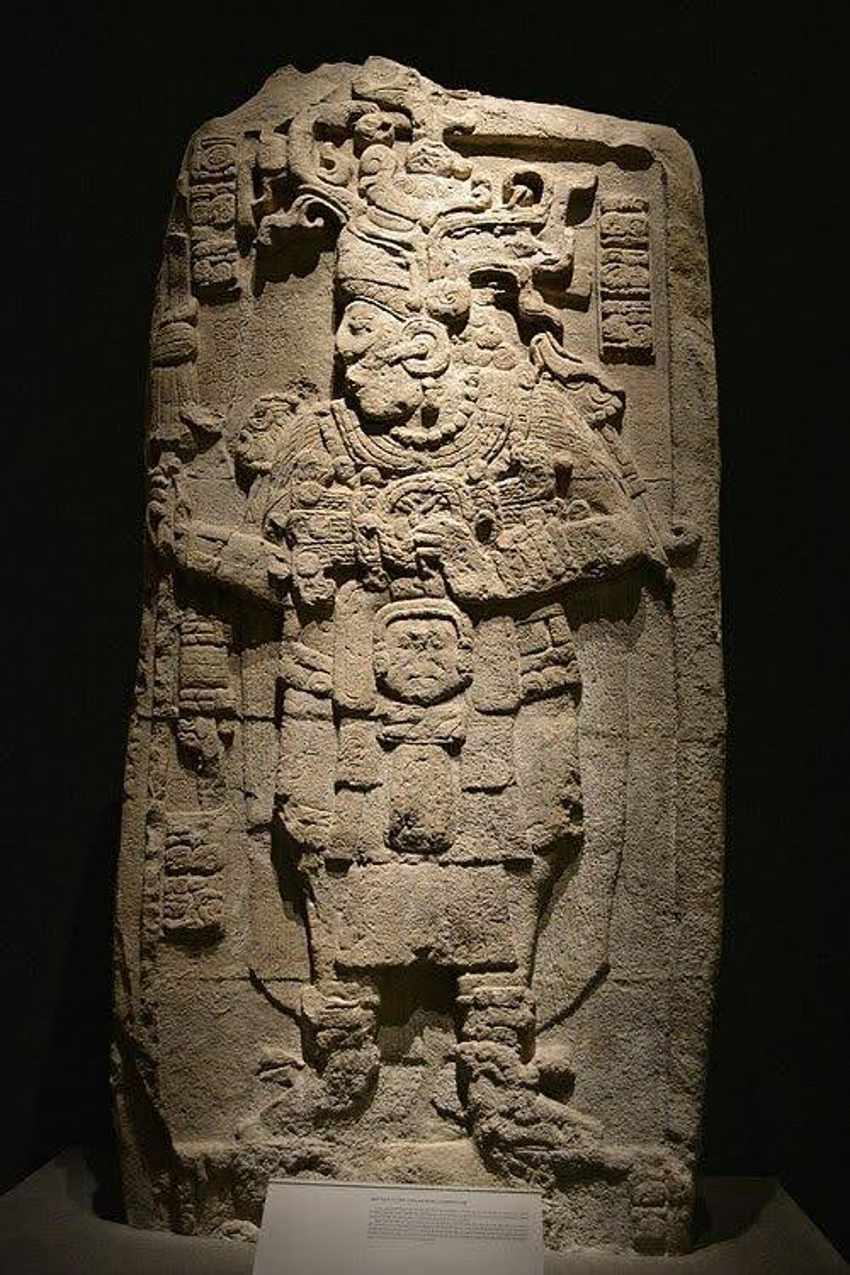
Monuments at Calakmul from the beginning of the eighth century, such as Stela 51 shown here, illustrate how the Kanu’l dynasty responded to the unraveling of its empire with propaganda that denied the empire’s deterioration. (National Museum of Anthropology)
We do not truly know his fate, but he was likely taken to Tikal to be exposed to public derision alongside one of his captured patron entities. Perhaps he was fortunate enough to return to Calakmul. But a potential portrait of him carved on Altar 9 at Tikal — showing a man captured and bound — suggests a tragic end for the last of the Yuhkno’m rulers of Calakmul.
With Calakmul defeated, Tikal’s victorious ruler was not benevolent: He launched a series of attacks against former Kanu’l allies, such as the cities of Naranjo and El Perú-Waka’, subjugating Tikal’s longtime adversaries.
Despite the situation, Calakmul’s leadership made valiant efforts to maintain the political and social order in their city. But by the end of the eighth century, the dynasty’s sunset was an undeniable reality, and the Kanu’l rulers eventually disappeared from the archaeological record.
During this period, we know that the occupation of Calakmul dropped significantly, as did the construction of monuments and buildings. The great Kanu’l city slowly and irrevocably lost its splendor.
Pablo Mumary holds a doctorate in Mesoamerican studies from UNAM and currently works at the Center for Maya Studies at IIFL-UNAM as a full-time associate researcher. He specializes in the study of the lordships of the Maya Lowlands of the Classic period.
"We now live in a complex world, where external pressures, geopolitical interests and global challenges put nations' sovereignty to the test. Our armed forces are the guarantee that Mexico will independently choose its destiny," President Sheinbaum declared Thursday at a speech in honor of Army Day in Puebla. (Mario Jasso / Cuartoscuro)
As Mexico recovered from Carnival weekend — and Valentine’s Day — President Sheinbaum kicked off the third week of February with the announcement of new incentives for Mexico’s film industry. Soon after, Mexico and Canada shared plans to deepen their economic ties while Mexico rejected U.S. President Trump’s invitation to join his Board of Peace. Tariffs and trade pressure continued to be dominant themes throughout the week, which ended with a U.S. Supreme Court decision that struck down many Trump tariffs, including duties levied on Mexican exports. Through it all, Mexico continued to make progress on its many security challenges, with high-profile arrests as well as drug and fuel smuggling busts.
Didn’t have time to read this week’s top stories? Here’s what you missed.
Diplomacy and trade: Navigating Washington while courting Ottawa
Sheinbaum launched the week with a major announcement: a new film tax incentive offering productions a 30% income tax credit on Mexico-based expenditures, up to 40 million pesos per project. Salma Hayek appeared at the National Palace to celebrate the initiative, calling it a long-overdue moment of support for Mexican cinema.
Perhaps the most significant diplomatic and economic story of the week was Mexico and Canada’s move to formalize their partnership in the face of continued U.S. pressure. Economy Minister Marcelo Ebrard announced Monday that the two countries are preparing a joint economic action plan to be unveiled later in 2026, focusing on minerals, infrastructure, supply chains and security cooperation. The announcement came as more than 370 Canadian business leaders descended on Mexico City, Guadalajara and Monterrey for what Ebrard called the most significant bilateral private-sector dialogue in recent years.
At her Tuesday mañanera, Sheinbaum framed the initiative not as a pivot away from the United States but as a deepening of existing ties. “More than a plan B, we’re strengthening our relationship with Canada,” she said, while insisting the USMCA would remain in place regardless of the outcome of this year’s trilateral review.
That same Tuesday, Sheinbaum also confirmed that Mexico had declined President Trump’s invitation to join his newly created Board of Peace, citing the exclusion of Palestine from its inaugural Washington meeting. Mexico’s U.N. ambassador will attend as an observer only.
The Government of Mexico, led by President Claudia Sheinbaum, has formally rejected joining the Board of Peace, stating that Palestine is not included at the table as a recognized state entity.
On Wednesday, Sheinbaum expressed cautious hope that U.S. Trade Representative Jamieson Greer’s public remarks about possible “adjustments” to the U.S.’s 50% steel and aluminum tariffs might presage relief for Mexico. “It would be very good,” she said, while acknowledging her government had nothing concrete yet.
Meanwhile, in a counterpoint to trade tensions, the U.S. government announced a $40 million investment in CIMMYT, the International Maize and Wheat Improvement Center headquartered in Texcoco. U.S. Ambassador Ron Johnson described the two countries as “agricultural powers with deeply integrated markets,” and CIMMYT said the funding will support development of drought- and heat-tolerant crop varieties, genetic resources and early warning systems for emerging agricultural pests.
A busy week for security enforcement
Law enforcement racked up significant seizures across the country this week. Federal authorities dealt a major blow to fuel theft networks with a huachicol bust in Minatitlán, Veracruz, seizing more than 149 vehicles, 25 containers, 17 storage tanks and 82,200 liters of stolen hydrocarbons across four raided properties. No arrests were reported.
Fuel smuggling — which is a lucrative business for organized crime — has been the subject of increasing attention and enforcement over the past year. On Thursday, Sheinbaum confirmed that Mexico has sought the extradition from the United States of businesspeople allegedly involved in importing fuel into Mexico without paying taxes, including “the Jensens” — a Utah family facing charges in the U.S. for allegedly smuggling $300 million worth of crude oil in collaboration with Mexican criminal organizations.
Meanwhile in Oaxaca, military aircraft intercepted a clandestine plane transporting 534 packages of cocaine — more than half a tonne — near the village of Huamúchil in the Isthmus of Tehuantepec. Suspects fled on stolen motorcycles as locals watched what one reporter described as a “movie-set” scene. No arrests were made in that operation either, though the drugs were secured by the Defense Ministry. Together with other busts, Mexico’s seized a total of nearly 10 tonnes of cocaine over the course of the week.
Como parte de la vigilancia permanente que lleva a cabo la Secretaría de Marina en mares mexicanos, en Manzanillo, Colima, personal de la Armada de México @SEMAR_mx interceptaron un semisumergible que transportaba 179 bultos con aproximadamente 4 toneladas de cocaína y… pic.twitter.com/SqFRAGZykD
In Michoacán, the investigation into the assassination of Uruapan mayor Carlos Manzo, shot dead at a Day of the Dead celebration last November, inched forward with three more arrests in connection with the case. The suspects were detained in Tarímbaro and are believed to be connected to alleged CJNG member Alejandro Castellanos Villana, himself arrested in December. In a dramatic move, Manzo’s widow — and current Uruapan mayor — Grecia Quiroz filed criminal complaints against three Morena party politicians, including a sitting senator and a former governor of the state, alleging political motives behind the killing.
Finally on Friday, Sheinbaum held her press conference in Irapuato, Guanajuato, where officials presented data showing a 62% drop in homicides in the state in January compared to the same month last year — the lowest daily murder rate since Sheinbaum took office. Security Minister Omar García Harfuch attributed part of the trend to 4,400 arrests in the state over the past 16 months. Guanajuato remains Mexico’s most violent state by total homicides, but officials called the trend “very significant.”
Business and the courts: Investment anxiety persists
A Bloomberg report painted a troubling picture of Mexico’s post-reform judiciary. According to the investigation, companies operating in Mexico are increasingly avoiding the courts in favor of arbitration, and some have delayed investment plans amid concerns about inexperienced judges, erratic rulings and what many see as a politicized system aligned with the ruling Morena party. Coparmex said investment has fallen to pandemic-era lows. The Supreme Court defended the new judiciary and pointed to ongoing training, while Morena senators noted the reform would “take time to mature.” A second round of judicial elections is set for 2027.
But despite some businesses’ hesitation, investment and new projects continue to roll in:
Houston-based Transition Industries announced it had signed “a long-term firm natural gas supply contract” with CFEnergía to fuel a US $3.3 billion methanol production facility in Topolobampo, Sinaloa.
A group of Sonora businessmen are developing a homegrown electric vehicle, with the first functional prototype scheduled to be released this summer.
Mexico’s airports had a mixed 2025. The AICM in Mexico City saw passenger traffic fall 1.7% to 44.6 million — its second consecutive annual decline — while AIFA grew 11.5% to 7.1 million passengers. U.S. flight restrictions, aircraft engine overhauls and ongoing AICM renovations were cited as contributing factors. The government is counting on the 2026 World Cup and a prospective lifting of U.S. flight restrictions to reverse the trend. Meanwhile, the Guanajuato International Airport is set for a 2.88 billion-peso overhaul over the next four years, including a 23% expansion of the terminal building, three new boarding gates and a 58% larger aircraft apron.
On Thursday, Sheinbaum confirmed that the new rail link between central Mexico City and AIFA will open before Easter — welcome news for commuters and travelers, and a step toward the government’s goal of boosting the airport’s passenger numbers.
In the Yucatán Peninsula, a federal appeals court granted a definitive suspension of construction on Section 5 of the Maya Train — the 65-kilometer Cancún-to-Tulum stretch — until authorities verify compliance with environmental regulations. The civil group Sélvame del Tren, which brought the case, cited the loss of 3.6 million trees and damage to more than 120 caves in the region’s aquifer system. The Maya Train’s freight circuit, however, continues to advance, with four multimodal cargo terminals reported at 25% completion.
Mexico City is facing its own environmental problems: The metropolis recorded only three days of acceptable air quality in the first 48 days of 2026, with four Phase 1 ozone alerts already declared — typically the fourth doesn’t arrive until April. Unseasonably high temperatures and a grassland fire east of the capital worsened conditions, with authorities urging vulnerable groups to stay indoors during peak hours.
On the Caribbean coast, the Navy warned that sargassum arrivals could exceed historical averages by 75% during March and April. Some 280,000 tonnes of the brown macroalgae are drifting westward through the Atlantic, with Playa del Carmen already installing the longest anti-sargassum barrier in its history — five kilometers — ahead of the Easter peak season. The timing is particularly sensitive with the FIFA World Cup drawing international attention to the region this summer.
On a positive note, Mexico welcomed 47.8 million international tourists in 2025, up 6.1% from 2024, generating $31.7 billion in revenue. Mexico currently sits sixth on the global most-visited list, with projections suggesting a top-five ranking is achievable by 2040.
Here are some other culture and lifestyle highlights from last week:
The week ahead promises more of the same complexity. Keep an eye out for news on Mexico’s plans for electoral reform, set to be announced in coming weeks, and the possible approval of a 40-hour workweek. Meanwhile the USMCA review timeline, the ongoing crackdown on fuel smuggling and the question of whether steel and aluminum tariff relief actually materializes will all continue to shape the economic climate. For those planning a Caribbean beach vacation, perhaps start checking the sargassum forecasts now.
Mexico News Daily
This story contains summaries of original Mexico News Daily articles. The summaries were generated by Claude, then revised and fact-checked by a Mexico News Daily staff editor.
Is San Miguel de Allende set to get passenger rail service? President Sheinbaum seems to think so. (Tomás Acosta/Cuartoscuro)
President Claudia Sheinbaum has announced that the passenger train line planned for Querétaro to San Luis Potosí will come through San Miguel in between stops in Comonfort and San Luis de la Paz. The remarks came at her Friday press conference in nearby Irapuato.
San Miguel Mayor Mauricio Trejo noted the development on his Facebook page on Friday but didn’t include any additional details. More than 100 commenters on his post expressed enthusiasm about the development but also wondered whether the train would simply pass through San Miguel or if it will actually stop in the city.
Sheinbaum was accompanied by Andrés Lajous Loaeza, general director of the federal Railway Transport Regulatory Agency, who said that progress was continuing on the Querétaro-to-Irapuato section of the line, which is a distance of about 111 km.
Ground was broken on that US $5.3 billion (90.8 billion pesos) project in September 2025.
The non-electrified passenger line is expected to encourage development in Guanajuato state and also increase connections between the Bajío region and Mexico City through the line from the capital to Querétaro. It is projected to be finished by next year.
Completion of the passenger line from Mexico City to Querétaro is ongoing, but the cost is projected at almost double the original estimate of US $3.7 billion. That route will stop in Tula, Hidalgo and San Juan del Rio.
The federal government plans to build a total of 3,000 km of passenger rail lines during Sheinbaum’s six-year term, a plan she announced even before her inauguration in October 2024.
Cathy Siegner is an independent journalist based in San Miguel and Montana. She has journalism degrees from the University of Oregon and Northwestern University.