Home Blog Page 323

Giant sloth and horse fossils found under cenote in Yucatán

1
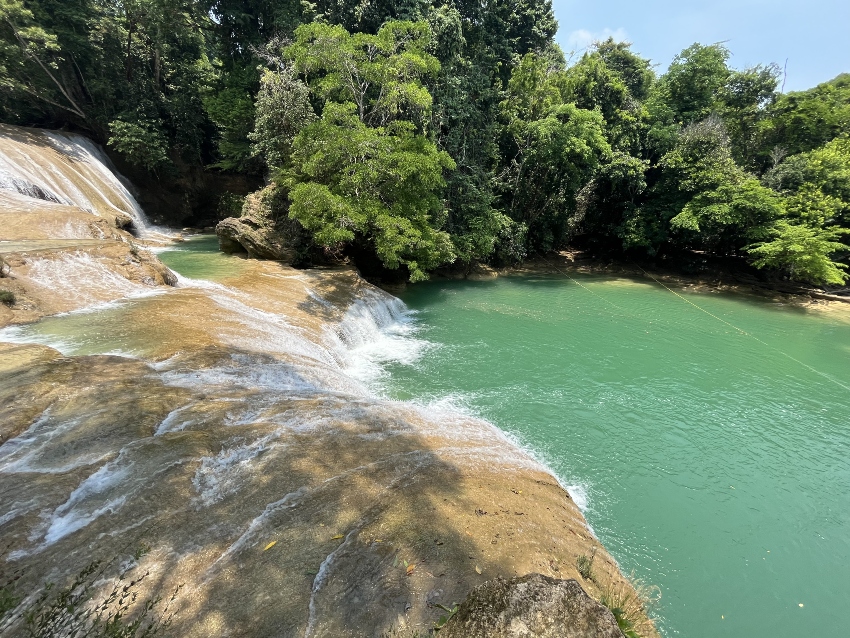
The clear blue waters of the Dzombakal cenote in Yucatán
The fossils were discovered in the Dzombakal cenote in the community of San Antonio Mulix, south of Mérida. (TripAdvisor)

Archeologists in Mexico have found fossils of extinct animals in a cenote in Umán, Yucatán, including those of a giant sloth and prehistoric horses.

Speleologist (cave researcher) Cristián Selun said the fossils date back to the ice age, between 7,000 and 10,000 years ago. This discovery sheds light on the prehistoric fauna that inhabited the region.

A white fossilized bone, one of many fossils found in the Yucatán cenote.
Scientists found more than 20 pieces of fossilized bone in the area. (Yucatán Informa/X)

“The first bones that we saw were those of the sloth,” scuba diver Arnaldo Marruco told news outlet NMás. “It was in other nearby areas that we found more bones, including a jaw, which was of a different size.”

According to scientists, the horses are of the Equus conversidens species while the giant sloth belongs to the species Nothrotheriops shastensis. The sloth weighed 300 kilograms and measured three meters long.

The remains were discovered in 2023 in the Dzombakal cenote in the San Antonio Mulix community of Yucatán. However, the results of their identification and analysis were only recently released by a team of scientists led by paleontologist Jerónimo Avilés Olguín in collaboration with the National Institute of Anthropology and History (INAH).

According to Selun, the bones must be identified and compared with others found in Quintana Roo. The on-site verification process takes time, “especially because human bones have also been found here,” he said.

A yellow fossil, which appears to be a jaw bone, next to a ruler.
The findings included vertebrae, jaws, and arm and leg bones. (Yucatán Informa/X)

To date, scientists have found more than 20 pieces of fossilized bone in the area, including vertebrae, jaws, arm and leg bones and other fossil remains. However, this is the first time a giant sloth has been discovered in Yucatán.

“It was a very large animal. We found the long parts of the legs, very large ribs and shoulder blades,” Marruco said. 

These fossil fragments are protected by INAH since extracting them is forbidden. They’re also monitored and cared for by the community’s inhabitants, who have pledged to preserve the prehistoric findings.

With reports from NMás, Debate and López Dóriga

No deal on tariff negotiations and time is up, Trump says

27
Trump stands at podium shaking his finger
U.S. President Trump has been clear that he considers unilateral military action in Mexico an option. (Gage Skidmore/Flickr)

United States President Donald Trump on Monday dashed President Claudia Sheinbaum’s hopes of reaching a new agreement to stave off tariffs, announcing that 25% duties on all Mexican exports to the U.S. will take effect as scheduled on Tuesday.

“Very importantly, tomorrow tariffs, 25% on Canada and 25% on Mexico. … So they’re going to have a tariff,” Trump told reporters at the White House.

Trump confirms Canada will be hit with 25 per cent tariffs on March 4

“So what they’ll have to do is build their car plants, frankly, and other things in the United States, in which case they have no tariffs,” he said.

Asked whether there was “any room left for Canada and Mexico to make a deal before midnight,” Trump said time had run out.

“No room left for Mexico or for Canada. No. The tariffs you know, they’re all set. They go into effect tomorrow,” he said.

“Just so you understand, vast amounts of fentanyl have poured into our country from Mexico, and as you know also from China, where it goes to Mexico and it goes to Canada. … And it comes in from Canada and it comes in from Mexico, and that’s a very important thing to say,” said Trump, who is also imposing an additional 10% tariff on Chinese imports.

The U.S. president said in late January that he would impose tariffs on Mexican and Canadian imports for three reasons — because migrants have “poured into” the United States via its southern and northern borders, because large quantities of drugs have flowed into the U.S, and because of “the massive subsidies that we’re giving to Canada and to Mexico in the form of [trade] deficits.”

Just before the tariffs were due to take effect in early February, Sheinbaum and Trump reached a deal that postponed the tariffs for one month. The Mexican president won significant praise for negotiating the postponement agreement, under which she agreed to deploy 10,000 National Guard troops to Mexico’s northern border.

After Trump’s announcement on Monday, the Mexican peso weakened, and closed at 20.71 to the US dollar, according to the Bank of Mexico. Trump’s announcement also caused stock markets in the United States to tumble.

Some analysts, including Banco Base’s director of economic analysis Gabriela Siller, have warned that U.S. tariffs on Mexican exports will cause the Mexican economy to go into recession.

A publication from the social platform X
Banco Base economic analysis chief expressed skepticism that tariffs would go into effect this week. (Gabriela Siller Pagaza/X)

On Monday afternoon, Siller wrote on X that she didn’t believe that “general tariffs” would take effect on Tuesday.

“At the last minute” — i.e. sometime on Monday night — “Trump will decide to postpone them,” she wrote. “In the remote case they enter into force, they won’t last very long.”

On Monday morning, Sheinbaum said her government would wait “to see what happens” with regard to tariffs.

“In this, we have to have mettle, calmness and patience,” she said.

“And we have plan A, plan B, plan C, plan D,” the president said, indicating that her government was prepared for any eventuality.

Asked whether she could speak to Trump about tariffs before they are scheduled to take effect at midnight Tuesday, Sheinbaum said that “everything is possible.”

Shipping containers a the Manzanillo port
As of Monday afternoon, across-the-board tariffs on Mexican exports to the U.S. are scheduled to go into effect Tuesday. (Cuartoscuro)

Last November, the president said Mexico would retaliate with its own reciprocal tariffs on U.S. goods if duties were imposed on Mexican exports. However, in more recent times she has been less forthcoming about how Mexico would respond to tariffs imposed by its largest trade partner. Instead Sheinbaum has favored a wait-and-see approach.

As of 4:30 p.m. Mexico City time, the Mexican government hadn’t announced any intention to impose tariffs on United States imports in retaliation for the duties on its exports. For its part, Canada already has a plan to implement tariffs on imports from the U.S. Canadian Foreign Affairs Minister Melanie Joly said Monday that plan remains in place.

On Sunday, United States Commerce Secretary Howard Lutnick questioned the wisdom of Mexico and Canada retaliating against the U.S. with their own tariffs.

“If they think they’re going to retaliate, remember they have so much more that they sell to us than we sell to them. It’s not even close. … This is not a battle we’re ever going to lose,” he said.

For months, the Mexican government has focused on pointing out that United States tariffs on Mexican exports would have a detrimental effect on the U.S. economy. Economy Minister Marcelo Ebrard has said that 25% tariffs would cause the loss of 400,000 jobs in the United States and increase prices for U.S. consumers.

The United States’ imposition of tariffs on its southern and northern neighbors will also violate the terms of the USMCA free trade pact, which superseded NAFTA in 2020.

Following Trump’s announcement on Monday, Jason Crow, a Democratic Party congressman from Colorado, sent a message to U.S. workers via his X account.

“The President just put 25% tariffs on Canada & Mexico. Prices on your fruits, vegetables, clothing, electronics, and more will go up. Your 401(k) savings are going down. Donald Trump is hurting working people,” he wrote.

Mexico News Daily 

Mexican health authorities issue alert following rise in whooping cough cases

2
A child wearing a face mask at school
The states with the highest number of confirmed cases of whooping cough in 2025 are: Nuevo León, Mexico City and Aguascalientes. (Graciela López/Cuartoscuro)

Cases of whooping cough have risen in Mexico in recent months, according to an epidemiological alert issued by the National Committee for Epidemiological Surveillance (Conave) on Feb. 26. 

The number of cases rose from 153 in 2023 to approximately 443 in 2025, marking a 190% increase. During the first seven weeks of 2025, there were 120 confirmed cases and 460 suspected cases of the disease across 21 states. 

Brazil, the United States and Peru have also recorded cases of whooping cough above the typical yearly average.  

What is whooping cough? 

Whooping cough is a highly contagious acute respiratory infection caused by the Bordetella pertussis bacteria. It can take between seven and 10 days for the patient to show symptoms, which can then last up to six to eight weeks.  

During the first phase, patients typically experience cold-like symptoms such as a runny nose, nasal congestion, red eyes, fever and a cough.  

Patients may later experience more severe symptoms such as vomiting, extreme fatigue, violent and rapid coughing and blueing of the lips and tongue.

In Mexico, the acellular pentavalent vaccine protects children against whooping cough, diphtheria, tetanus, polio and influenza type B. (Graciela López/Cuartoscuro)

While adolescents and adults generally recover from whooping cough without any complication, the infection can affect babies more severely, particularly those under six months, restricting their breathing.  

How to prevent whooping cough?

Vaccines remain the main preventive measure against whooping cough. In Mexico, the acellular pentavalent vaccine is administered in four doses at two, four, six and 18 months of age. It also protects children against diphtheria, tetanus, polio and influenza type B. 

Conave recommends several measures to avoid the spreading of the disease, including frequent hand washing; avoiding touching your face with unwashed hands; avoiding close contact with people showing signs of sickness; not sharing personal items and covering your mouth and nose when coughing or sneezing.  

The organization recommends self-isolating in the case of infection.  

Cases of whooping cough in Mexico by state 

According to Mexico’s Health Ministry, the states with the highest number of confirmed cases in 2025 are:

  • Nuevo León: 24 cases
  • Mexico City: 13 cases
  • Aguascalientes: 11 cases
  • Oaxaca: 10 cases
  • México state: 8 cases

Other states with reported cases include:

  • Chihuahua: 7 cases
  • Campeche, Hidalgo and Coahuila: 6 cases each
  • Querétaro: 5 cases
  • Morelos, Tamaulipas, Guanajuato and Jalisco: 3 cases each
  • Durango, Yucatán, San Luis Potosí, Baja California and Veracruz: 2 cases each
  • Guerrero and Sonora: 1 case each

To date, 11 states have zero confirmed cases of whooping cough, including Colima, Chiapas, Michoacán, Nayarit, Puebla, Quintana Roo, Sinaloa, Tabasco, Tlaxcala and Zacatecas.  

With reports from Milenio and W Radio México

Bird flu in US pushes poultry prices in Mexico to 4-year high

1
The average price per kilo of a whole chicken in a public market rose from 52.60 pesos (US $2.57) in February 2024, to 75.20 (US $3.57) in February 2025. 
The average price per kilo of a whole chicken in a public market rose from 52.60 pesos (US $2.57) in February 2024, to 75.20 (US $3.57) in February 2025. (Victoria Valtierra/Cuartoscuro)

Poultry prices are on the rise in Mexico as a pathogenic avian influenza outbreak continues in the United States. 

Commonly dubbed bird flu, the virus has forced poultry producers to euthanize some 160 million chickens in the U.S. since the outbreak began in 2022, creating stress on supply and increasing prices for consumers both at home and abroad. 

Approximately one-fifth (21-22%) of Mexico’s chicken supply is imported from the U.S. and Brazil (with Brazil accounting for only 16% of annual chicken imports). In the past year, chicken prices have risen as much as 43% in some areas while egg prices have increased up to 27%, according to data from the National Union of Poultry Farmers.

For Mexican households, this means that the average price per kilo of a whole chicken in a public market rose from 52.60 pesos (US $2.57) in February 2024, to 75.20 (US $3.57) in February 2025.  

Meanwhile, white eggs — the most popular variety of eggs in Mexico — went from 51.20 pesos per kilo (US $2.50) in supermarkets in February 2024, to 59.50 (US $2.90) in February 2025.

In the northern city of Monterrey, Nuevo León, the price of poultry increased by an average of 18.84% in the first half of February. Data from the National Institute of Geography and Statistics (INEGI), published by the newspaper Reforma, revealed that this rise follows five consecutive months of rising poultry prices.

Chicken and eggs are staple ingredients in Mexico. (Cuartoscuro)

Reforma also said this is the highest price rise recorded by INEGI for any two-week period since June 2021.

“It’s a luxury to eat chicken,” Doña Micaela, a housewife in Mexico City who has also reduced her intake of eggs, told the news outlet Crónica, “I’m now cooking one egg on two tortillas, and sometimes even three [tortillas] so that they are filling.” 

The rise in prices is hitting Mexican families hard, as Mexico is the largest consumer of eggs in the world. According to the Agricultural Markets Consulting Group (GCMA), Mexicans eat an average of 23 kilos of eggs per capita each year. That means that overall, more than 130 million eggs are eaten per day in Mexico. 

As for chicken, Mexico is the fifth largest consumer of pollo in the world, averaging 33.5 kilos per person per year. That means Mexicans eat 5 million tonnes of chicken every year. 

Poultry prices have also weighed on the inflation rate in Mexico

Analysts consulted by Citi Mexico expect inflation to close February at 3.81%, and to reach 3.83% by the end of the year. So far, analysts blame higher inflation levels on the rise in prices of livestock products, including egg (15.17%), poultry (13.03%) and pork (12.42%).

Chicken and eggs are part of Mexico’s so-called Package Against Inflation and Expenditure (PACIC), an initiative established in 2022 between the federal government, producers, distributors and marketers to reduce costs and control prices of 24 essential commodities.

With reports from Reforma and El Imparcial

Mexico has received nearly 20,000 deportees since Trump took office in US

6
The number of deportations from the United States to Mexico has not increased significantly since President Trump took office on Jan. 20.
The pace of deportations from the United States to Mexico has not increased significantly since President Trump took office on Jan. 20. (Damián Sánchez/Cuartoscuro)

President Claudia Sheinbaum said Monday that Mexico has received almost 20,000 deportees from the United States since President Donald Trump took office.

Speaking at her morning press conference, Sheinbaum said that 19,663 people were deported to Mexico between Jan. 20 and March 2.

She said that 15,611 of the deportees — almost 80% of the total — are Mexican, while the remaining 4,052 are foreigners.

On Sunday, just 313 people were deported to Mexico from the United States, Sheinbaum said.

Based on the statistics the president provided, an average of 468 people per day were deported to Mexico from the United States between Jan. 20 and March 2.

Before he took office, Trump pledged to carry out “the largest deportation operation in American history.”

However, during the first six weeks of his second term, “the pace of deportations has held steady compared to last year,” CNN reported on Monday citing an analysis of deportation flight data.

Sheinbaum has expressed her opposition to Trump’s mass deportation plan on repeated occasions. She and other Mexican officials have frequently highlighted the importance of Mexican workers to the United States economy.

President Claudia Sheinbaum at her daily press conference, standing behind the presidential podium, talking to reporters
President Sheinbaum and other Mexican officials have frequently highlighted the importance of Mexican workers to the United States economy.

On Monday, Sheinbaum reiterated that 80% of Mexicans’ earnings in the United States remain in the U.S. via “the payment of taxes, savings and consumption.”

She said the other 20% are sent to Mexico as remittances, which totaled more than US $64 billion last year.

“Our compatriots help us, they help their families … but without them, the United States economy wouldn’t be what it is,” Sheinbaum said.

Government will assess the need for deportee reception centers at the end of the month

Sheinbaum noted that 10 reception centers, or temporary shelters, were set up in northern border cities as part of the government’s “México te abraza” (Mexico embraces you) program for people deported to Mexico during the second Trump administration.

“The truth is they’ve received few people,” she told reporters.

Sheinbaum highlighted that the government also provides access to temporary accommodation and the broader “México te abraza” program to deportees who arrive by air at different airports including the Felipe Ángeles International Airport north of Mexico city, the Tapachula airport and the Villahermosa airport.

Reception centers will remain in place “while repatriations continue,” she said, adding that at the end of March the government will evaluate whether it’s necessary to maintain the 10 on the northern border or whether “fewer” than that number are required.

Mexico News Daily 

Tiny Tlaxcala offers Mexico living like no other

1
Valquirico, Tlaxcala
Tiny Tlaxcala has an unfair reputation as a backwater. Here's why that's wrong. (Shutterstok)

A few years ago, a meme claiming that Tlaxcala didn’t exist went viral in Mexico. Paradoxically, though, Tlaxcala is actually one of Mexico’s most beautiful states and offers an exceptional quality of life.

Located in the central highlands, Tlaxcala is bordered by Hidalgo, México state and Puebla. In 2017 when then-governor Marco Mena announced the inauguration of the state’s first-ever electric escalator, many on social media began to joke that they didn’t know Tlaxcala even existed in the first place.

Tlaxcala historic center
The historic center of Tlaxcala boasts thousands of years of history. (Wikimedia Commons)

Now, for a variety of reasons, the spotlight is firmly on the tiny state, in no small part as the rest of the country has come to celebrate its historical richness. Tlaxacala first came to prominence during the Spanish conquest, when the native Tlaxcalans allied with the Spanish to fight against the Mexica, their historical enemies, which significantly aided the conquerors.

Today, Tlaxcala boasts 1,143 historical monuments, 55 architectural sites and 87 culturally significant properties on the National Institute of Anthropology and History’s (INAH) Catalogue of Historic Monuments. It is also home to two Unesco World Heritage sites, as well as major archaeological digs at Cacaxtla-Xochitécatl, Ocotlan, Tizatlán, and Zultépec-Tecoaque.

A significant portion of these historic buildings and archeological sites are located in the municipalities of Huamantla, Tlaxcala city, Ixtacuixtla, Calpulalpan, Apetatitlán and Tlaxco, all of which are beautiful towns. The beauty and wealth of this state are also linked to its natural heritage: Tlaxcala features stunning forested areas, particularly in La Malinche Matlalcuéyatl National Park, which houses the La Malinche Volcano, standing at a towering 4,462 meters.

Tlaxcala is on the rise

Hiking the La Malinche volcano. (Erick Carrillo/Unsplash)

In the last three years, Tlaxcala has become the safest state in Mexico, fuelling major economic growth in sectors such as construction, mining and trade.

The presence and investment of prestigious companies like Mercedes-Benz and Enel Green Power are indicators of the security and stability of this small state. According to Governor Cuéllar, in the last three years, 29 new companies have been established, and another 23 have expanded, with a total investment of 15 billion pesos (US $731 million).

Other factors have also contributed to the growth of tourism in Tlaxcala. The state has invested in tourism promotion that has apparently borne fruit: tourism — almost entirely domestic — jumped 42% from 2022 to 2023, and won the Tourism Innovation award at the Fitur 2024 Excellence Awards in Madrid, Spain.

Tlaxcala has also hosted various high-profile sporting events, including the World Archery Championships and the World Beach Volleyball Championships. The boom in tourism has led to the opening of at least 22 major hotels in the last three years. The industry’s importance is such that tourism is now Tlaxcala’s second most important source of income.

Today, there is also a public strategy to transform the city of Tlaxcala into a cultural hub for students in Mexico. Institutions such as the National Institute of Fine Arts and Literature (Inbal), the Tlaxcala School of Art (Edart) and School of Music (EMET) and the state’s Ministry of Culture offer bachelor’s degrees in visual arts, plastic arts, music and textiles.

Hacienda San Francisco Soltepec in Huamantla, one of Tlaxcala’s most historic towns. (Roberto Carlos Roman/Unsplash)

Tlaxcala locations you need to experience

Huamantla: This beautiful town is renowned for its gastronomy, tradition, and natural beauty. Its annual festival, the Huamantlada, is famous for the floral carpets crafted overnight during “the night when no one sleeps,” when families of artisans create colorful sawdust and flower carpets that cover more than six kilometers of streets in honor of the Virgin of Guadalupe.

Santuario de las Luciérnagas: Located in the highest region of the state, known as the spur of the Sierra Nevada, this incredible pine, oak and oyamel forest is world-famous for its firefly sightings from June through August. 

La Malinche: The La Malinche volcano is situated in one of the country’s most stunning natural parks and is considered the fifth-highest mountain in Mexico. It offers opportunities for hiking and mountain biking and is regarded as one of the most beautiful natural formations in the country.

Tlaxcala is undeniably on the rise. Its rich history, cultural heritage, natural beauty, gastronomy and safety make this state one of the most promising destinations for tourism, living and investment.

Ana Paula de la Torre is a Mexican journalist and collaborator for various outlets including Milenio, Animal Político, Vice, Newsweek en Español, Televisa and Mexico News Daily.

What’s on in the Riviera Maya & Yucatan this March?

0
Chichen Itza and the temple of Kukulkan
See a godly snake descend from the heavens, or taken in a world-famous DJ set. It's all happening in the Rivieria Maya this month. (Inika Art)

Carnaval is king in March throughout the Riviera Maya and Yucatan! Beads and bling, feathers and festivities will be dancing through the streets in all major towns.

From Isla Mujeres to Merida, Playa del Carmen or across the strait to Cozumel, join the fun and catch some candies or beaded necklaces. Later in the month watch the Mayan phenomenon of the feathered serpent descending the great pyramid and toe-tapping concerts. 

Carnaval crowns it’s King and Queen

A carnival float at the Cozumel carnival
(Bel Woodhouse)

The biggest event of the year takes place throughout the first week of March, as Cozumel Carnaval 2025 crowns its Queen. Huge colorful floats covered in sequined dancers will be parading down Cozumel’s Malecon. The costume competition means the very finest feathered headdresses and gorgeous gowns will be on display during the parades that get things started. 

Date: March 1-5
Location: Cozumel for the biggest, best, and oldest Carnaval tradition in the region. Isla Mujeres, Cancun, Playa del Carmen, Merida for great carnaval parties as well. 
Cost: Free

Bend your brain in a trivia challenge. 

Lol-Ha restaurant in Akumal
(Hotel Akumal Caribe)

Fun for all ages, the whole family is invited to test their knowledge at a trivia challenge. Groups of 4 compete. Swim with the sea turtles in the morning then enjoy free pizza lunch and a trivia challenge to relax your body while engaging your brain. Proceeds help a local library so it’s for a good cause. Tickets are limited so be sure to grab them quick. 

Date: March 4, 2-4 p.m.
Location: Lol-Ha Restaurant, Hotel Akumal Caribe, Akumal
Cost: 500 pesos 

Poker run

A graphic advertising the Riviera Maya poker run
(Poker Run/Facebook)

A fun way to see the area around Puerto Morelos. Play poker at each stop during this all-day motorcycle ride to three different locations. There’s food and drink at all the stops and beautiful scenery along the way. Plus, enjoy great BBQ in Playa del Carmen before riding back to Puerto Morelos to enjoy live music and a happy hour. 

Date: Saturday 8 March, 9:30 a.m. 
Location: meet at Xolox Puerto Morelos Kitchen, Puerto Morelos. 
Cost: poker 250 pesos a hand. 

Experience Mayan ayahuasca

(Shutterstock)

Said to be a sacred voyage of self-discovery and spiritual awakening, the ancient medicine of Tepezcohuite is also known as the “Mayan Ayahuasca.” Those looking for an enlightening experience can expect: emotional healing, physical rejuvenation, creative inspiration and a connection to nature. Held in a safe, natural seaside environment it’ll open your mind and your chakras. 

Date: 12 March, 11 a.m. – 10 p.m. (runs regularly so you have other date options).
Location: Ek Lum Tulum, Tulum.
Cost: 1,400 pesos, $ 68 US.

Ironman Campeche

Ironman triathletes running across the Caribbean coast
(Ironman)

Nestled right next door and bordering both Quintana Roo and Yucatan is the often overlooked state of Campeche. Its capital of the same name is a gorgeous Spanish colonial walled city hosting an Ironman that sells out fast. With a flat run and ride, and a beautiful Gulf of Mexico swim, it’s a perfect course for first-time competitors or those looking to beat a personal best. Ride the rails and catch the new Maya Train over for added fun, while relaxing and watching the scenery.

Date: 16 March
Location: Campeche
Cost: Free for spectators, $271 for competitors

Watch the feathered serpent descend at Chichen Itza

Chichen Itza and the temple of Kukulkan
(Bel Woodhouse)

March is a special time at Chichen Itza. The Spring Equinox puts on a dazzling display as the equinox’s unique light shows the serpent descending the stairs of El Castillo Pyramid. The great pyramid of Kulkulcán. The shadow effect created by the Mayans shows a 120-foot snake creeping down the stairs to meet the head of the snake at the base. The effect only lasts about 45 minutes so be sure to book in advance and not miss it. 

Date: 20 March, 9 p.m.
Location: Chichen Itza.
Cost: Night Show 755 pesos

See Steve Lawler 

Steve Lawler | Space Closing | Ibiza

Tickets are selling out fast for this Pendulum beach party. DJ Steve Lawler is an internationally beloved musician and producer, known as one of the most respected and world’s premier talents. Playing major venues like London and Ibiza, he’s coming to Tulum for one night so be sure to grab tickets before they sell out. 

Date: 22 March, 7 p.m.
Location: Vagalume, Tulum 
Cost: Tickets start at 605 pesos

Bel Woodhouse, Mexico Correspondent for International Living, is an experienced writer, author, photographer and videographer with more than 500 articles published both in print and across digital platforms. Having lived in the Mexican Caribbean for over seven years now, she’s in love with Mexico and has no plans to go anywhere anytime soon.

Tariff concerns prompt Honda to move Civic production from Mexico to US

10
Honda
During a call with analysts in early February, COO of Honda Shinji Aoyama said a 25% tariff on imports to the U.S. could cause an impact of over US $132.7 million. (Shutterstock)

Honda will not be building its next-generation Civic hybrid in Mexico as originally planned, according to the news agency Reuters.

Sources cited by Reuters say the Japanese automaker was influenced by the threat of tariffs from United States President Trump on goods from Mexico and has decided to manufacture the Civic — one of its top-selling models — in the U.S. state of Indiana.

Future models of the Honda Civic will be produced in Indiana, not Mexico, according to company sources.
Future models of the Honda Civic will be produced in Indiana, not Mexico, according to company sources. (Honda)

Honda had initially planned to manufacture the new Civic model in the Mexican state of Guanajuato, Reuters reported, adding that “production was slated to start from November 2027.”

One source told Reuters that Mexico had been chosen “because rising costs were making it tough to produce the [Civic] in Indiana and Canada.”

U.S. sales of the popular Civic, which is appreciated for its affordability, rose 21% year-on-year last year, according to Honda. Reuters reported that the company “sold more than 240,000 Civics, both gasoline and gasoline-electric hybrid models” in the U.S. in 2024.

Is Honda the first domino to topple on the tariff game board?

Several companies in the automotive sector — including Nissan and Nemak, a leading auto parts manufacturer — have said they are considering relocating production if faced with new duties, but Honda’s move to the U.S. would be the first large operational readjustment in the industry.

A Nissan factory in Aguascalientes, Mexico
Nissan currently operates two factories in Aguascalientes and one in Morelos, Mexico. (Nissan de México)

Honda has not officially commented on the reports about the next-generation Civic, saying it will continue to consider “optimal production and allocation globally,” in addition to demand and the business environment.

The company has been weighing its options in the face of new tariffs since November 2024. 

Shinji Aoyama, Honda’s Chief Operating Officer, said then that Honda would have to think about shifting production if the U.S. were to place a levy on imported vehicles. During a call with analysts in early February, Aoyama said a 25% tariff on imports to the U.S. could cause an impact of over US $132.7 million on the company, according to the industry publication Automotive Dive.

The tariff blade could cut both ways. If Mexico or Canada introduce retaliatory tariffs, Honda could face additional cost increases since it exports around 60,000 cars made in the U.S. to Mexico and Canada.

Roughly 80% of the 200,000 vehicles Honda produces in Mexico are shipped to the U.S. and nearly 40% of all Hondas sold in the U.S. are produced in Mexico and Canada.

Reuters reported that Honda’s case highlights the potential for disruption “in industries that cannot drastically alter production plans in the short term given the investment and different production lines in use for different markets.”

With reports from Reuters, Expansión, Automotive Dive and Reforma

Is a last-minute deal on US tariffs still possible?

5
At her morning press conference on Monday, Sheinbaum said that Mexican officials had "very good" meetings with U.S. officials last week.
At her morning press conference on Monday, Sheinbaum said that Mexican officials had "very good" meetings with U.S. officials last week. (Gustavo Alberto/Cuartoscuro)

United States Commerce Secretary Howard Lutnick said Sunday that the U.S. will impose tariffs on Mexican and Canadian imports starting Tuesday, but President Claudia Sheinbaum indicated on Monday morning that there was still a possibility Mexico could avoid the duties.

Lutnick told the Fox News program “Sunday Morning Futures” that both Mexico and Canada “have done a reasonable job on the border,” highlighting that “we’ve had the lowest crossings ever [of migrants] under Donald Trump because of his ability to negotiate with Canada and Mexico.”

“But the fentanyl continues to come into this country and continues to murder our people. The ingredients are made in China, they’re sent to Mexico and Canada and then they come and attack our country and that’s got to end,” he added.

“… There are going to be tariffs on Tuesday on Mexico and Canada. Exactly what they are, we’re going to leave that for the president and his team to negotiate,” Lutnick said, suggesting that the duties could be imposed at a different level than the proposed 25%.

“… He’s going to think about it, he’s going to put them into place on Tuesday,” said the commerce secretary, who described the situation as “fluid.”

Trump himself said last Thursday that “drugs are still pouring into our Country from Mexico and Canada at very high and unacceptable levels” and consequently “the proposed TARIFFS scheduled to go into effect on MARCH FOURTH will, indeed, go into effect, as scheduled.”

Sheinbaum said last November that Mexico would retaliate with its own reciprocal tariffs on U.S. goods if duties were imposed on Mexican exports, while Canada has made it clear it would hit back at its southern neighbor.

On Sunday, Lutnick questioned the wisdom of Mexico and Canada retaliating against the United States with their own tariffs.

Trump and Commerce Secretary Howard Lutnick
“This is not a battle we’re ever going to lose,” Trump’s Commerce Secretary Howard Lutnick said on Sunday. (X)

“If they think they’re going to retaliate, remember they have so much more that they sell to us than we sell to them. It’s not even close. … This is not a battle we’re ever going to lose,” he said.

“The president knows it. He does have the cards and he is going to protect Americans,” Lutnick said.

Mexican officials including Economy Minister Marcelo Ebrard have engaged in negotiations with U.S. officials as they seek to extend a one-month suspension of the proposed tariffs.

Sheinbaum reached a deal with Trump in early February that postponed the tariffs until March 4. As part of the agreement, Mexico deployed 10,000 National Guard troops to its northern border.

Ebrard has said that the United States would be shooting itself in the foot if it imposes a 25% tariff on Mexican exports, asserting that 400,000 U.S. jobs would be lost and prices would rise for U.S. consumers.

The imposition of U.S. tariffs on Mexican and Canadian imports would violate the terms of the USMCA, the North American free trade pact that superseded NAFTA in 2020.

‘Everything is possible’ 

At her morning press conference on Monday, Sheinbaum said that Mexican officials had “very good” meetings with U.S. officials last week.

“We’re going to see what happens [with regard to tariffs],” she told reporters before laughing and smiling broadly.

“In this, we have to have mettle, calmness and patience,” Sheinbaum said.

“And we have plan A, plan B, plan C, plan D,” she said, indicating that her government is prepared for any eventuality.

Asked whether she could speak to Trump about tariffs before they are scheduled to take effect at midnight Tuesday, Sheinbaum said that “everything is possible.”

“Calmness and patience,” she reiterated.

“… It’s a decision that depends on the United States government. This is very important. On our side, we’ve been in communication [with the Trump administration], we’ve reached agreements and carried out the necessary coordination,” Sheinbaum said four days after her government sent 29 drug cartel figures to the United States.

“But it’s a decision that depends on the United States government, the United States president,” she said.

Mexico News Daily 

Punta Pérula: A dream Mexico beach destination

2
Punta Perula coastline in Jalisco
Quiet Punta Pérula, on the remote and beautiful Costalegre, could be where you dreams are made if you journey to find it. (Mexico.Travel)

There are beach towns, and then there’s Punta Pérula — a quiet, unassuming stretch of Pacific coastline that feels like it exists in a parallel universe where time slows, margaritas flow, and everyone knows everyone. No major resorts, no thumping nightclubs, no hordes of tourists. Just golden sand, a shimmering bay, and a tight-knit community that welcomes visitors like long-lost friends. If you ask me, Punta Pérula is the dream.

But this dream was nearly wiped off the map in 2015 when Hurricane Patricia, one of the strongest storms ever recorded, roared ashore and left the town in ruins. Instead of giving up, the residents — both Mexican locals and foreign expats — banded together, rebuilding homes, businesses, and the community itself. Today, Punta Pérula is stronger than ever, a testament to resilience, grit, and an unwavering love for this hidden slice of paradise.

Punta Perula beach
Tucked away from mainstream development, Punta Pérula offers a slice of heaven for those who search for it. (Playas de Mexico)

A dusty little beach town with a big heart

Punta Pérula isn’t the kind of place that announces itself. If you weren’t looking for it, you might miss it entirely. The town’s main drag is a dusty, sunbaked road running about 10 or 12 blocks, with a handful of smaller side streets branching off like veins. Paved roads? You won’t find many. Flashy boutiques? Not a chance. Instead, you get charming beachfront restaurants, a couple of Oxxos, and mom-and-pop markets where you can stock up on fresh produce and cold cervezas. For anything more substantial, you’ll need to make a trip to a bigger town.

But what Punta Pérula lacks in urban conveniences, it more than makes up for in character. Here, community isn’t just a buzzword — it’s a way of life. Whether it’s roast pork night at Monica’s, where locals and visitors gather for a meal with a front-row seat to the sunset, or the weekly Tuesday music night at the community center, there’s always something bringing people together. It’s the kind of place where neighbors look out for one another, where a quick grocery run turns into a 30-minute chat, and where friendships are forged over tacos and tequila.

The love and support within this community are most evident in the town’s Facebook group, where residents share everything from lost pets to local events to offers of help for those in need. It’s the kind of place where everyone truly knows everyone by name, reinforcing the deep bonds that make Punta Pérula feel like home, whether you’re here for a week or a lifetime.

The beach that goes on forever

Punta Perula beach, Jalisco
The simple, unspoiled beach is a huge part of Punta Pérula’s charm. (Viajeros Ocultos)

Then, of course, there’s the beach — the reason people first stumble upon Punta Pérula and the reason they never want to leave. The shoreline curves in a sweeping arch, stretching for miles, with soft golden sand that’s perfect for long, contemplative walks or early morning jogs. Unlike other Pacific beaches, the surf here is usually gentle enough for swimming, making it an ideal spot for families.

On weekdays, the beach is wonderfully serene, often feeling like your own private paradise. But come weekends and holidays, it transforms into a lively scene, with families setting up umbrellas, music drifting from portable speakers, and kids darting in and out of the waves. It’s the perfect balance — enough activity to remind you that life is happening, but never so much that you feel overwhelmed.

Where to eat (and why It’s delicious)

For such a small town, Punta Pérula has a surprising number of excellent places to eat. El Pirata is my go-to for fresh seafood and cold drinks. Right on the beach, it’s the kind of place where you can dig your toes into the sand while savoring some of the best garlic shrimp you’ve ever had.

El Pirata, Punto Perúla
El Pirata is an ideal stop for fresh seafood and cold drinks. (TripAdvisor)

Jazz Café is a charming spot with a laid-back vibe, good burgers, and one of the only places in town where you’ll find a wine list. It’s the perfect place to meet a friend, bring a book, or sit and listen to the music.

And then there’s the food truck on the square — owned by Eddie — who opens Thursday-Sunday to dish out overstuffed burritos, enchiladas, quesadillas, and tacos. 

A commitment to conservation

Beyond its stunning beaches and warm community, Punta Pérula is also home to the Red Carey Jalisco-Nayarit turtle center, where volunteers work tirelessly to protect endangered sea turtles. Depending on the season, visitors can take part in releasing baby turtles into the ocean — a humbling experience that underscores the town’s deep respect for nature. It’s yet another reason to love this remarkable little place.

Red Carey Jalisco-Nayarit turtle center
The Red Carey Jalisco-Nayarit center works to protect Mexico’s endangered turtles.  (Red Carey Jalisco-Nayarit)

No rush, No fuss, No problem

Punta Pérula’s charm lies in its simplicity. It’s a place where the biggest decision of the day is whether to have another beer or switch to a margarita, where plans are loose suggestions rather than strict itineraries, and where people still stop to chat instead of rushing from one place to another.

There are no five-star resorts or luxury spas, no massive grocery stores or designer shops. But that’s the magic of it. Punta Pérula isn’t trying to be anything other than what it is — a humble, beautiful, fiercely loved beach town where the sunsets are spectacular, the people are kind, and life is best enjoyed at a slow, steady pace.

So if you’re looking for all-inclusive buffets and infinity pools, you might want to look elsewhere. But if you crave a place where life feels simple, where community matters, and where the biggest thrill of the day might just be spotting a dolphin in the bay, then welcome to Punta Pérula. You might never want to leave.

Meagan Drillinger is a New York native who has spent the past 15 years traveling around and writing about Mexico. While she’s on the road for assignments most of the time, Puerto Vallarta is her home base. Follow her travels on Instagram at @drillinjourneys or through her blog at drillinjourneys.com